




Abstract
Operational rules and “hacking” detection is implemented across online professional competitive gaming contexts in effort to thwart manipulation and encourage fair play. Violation of “unwritten” rules and implicit local norms, however, are harder to track. Using boundary-work theory, this article demonstrates how different perspectives of unsportsmanlike behavior are defended and disputed by spectators within the esports mode of Counter Strike: Global Offensive (CS:GO). Triangulating data drawn from 50 hr of online observation followed by spectator interviews, this article examines how boundaries of (un)acceptability are drawn and/or redrawn around specific and ostensibly unsportsmanlike behaviors associated with “bad mannering,” “throwing,” and “bug exploiting” in CS:GO. These broad spectra of behavior imply a degree of complexity in local esport gaming contexts, engendering a protean boundary that sets it apart from more traditional views of sportsmanship and would benefit from further critical scholarship.
In the 1990s, the introduction of local area networks (LANs) marked the beginning of “esports.” A form of competitive video gaming culture, the definition for esports has since evolved with the developing literature; Hamari and Sjöblom’s (2017) most recent suggestion places it as a “form of sports where the primary aspects of the sport are facilitated by electronic systems” but where the “input of players and teams, as well as the output of the esports system, are mediated by human-computer interfaces” (p. 213). 1 To date, the professionalism of esports has increased such that sporting organizations, governing bodies, and computer gaming companies now routinely establish teams and events across different esporting genres. Much like conventional sports, esports is also adored and respected by millions worldwide and fans have developed a strong culture of congregating to spectate on their teams at live tournaments or via online streaming services (e.g., YouTube, Twitch; Hamilton, Garretson, & Kerne, 2014; Kaytoue, Silva, Cerf, Wagner, & Rassi, 2012).
Suffice it to say, the popularity of esports has become a focus of ever-growing research, primarily to understand the consumptive needs of both professional players and spectators (e.g., Carter & Gibbs, 2013; Hamilton et al., 2014; Lee & Schoenstedt, 2011). This literature has also questioned (and defended) the legitimacy of esports as a “sport” in its own right (e.g., Cheung & Huang, 2011; Taylor, 2012; Witkowski, 2012). 2 For esport tournaments, this places a spotlight on esporting rules and regulations, and what kinds of behavior are—and are not—acceptable for players (Jenny, Manning, Keiper, & Olrich, 2017). As Hamari and Sjöblom’s (2017) definition alludes, technology and cyber systems are in the esports genetic code, which in turn means that in-game esporting activities are vulnerable to “hacking” and exploitation (Moeller, Esplin, & Conway, 2009). In casual video gaming, where individuals play for leisure or escapism (Warmelink, Harteveld, & Mayer, 2009), hackers can deploy cheats to bend the physics of the in-game world, creating an unfair advantage over other players. To regulate this in professional video gaming, esports organizers have adopted a standardized set of rules that prohibit the use of exploitative tactics and require compulsory installation of cheating detection software (Thiborg & Carlsson, 2010). The Counter-Strike series, for example, uses the Valve Anti-Cheat system, automatically banning a user from entering its servers if it detects any manipulation of the software (Moeller et al., 2009).
Taylor (2012) notes that written rules implemented in esports are operational, but this represents only one dimension. Based on Salen and Zimmerman’s (2004) approach, she argues esporting rules can also be constitutive, which are the formal structures “below the surface” of written rules (i.e., the programs that control the world of the virtual game), and implicit, which are “unwritten” and symbolized more as guidelines to acquire dispositions to formulate fair behavior both in and out of the game (p. 51). All of these forms of rules play into the notion of sportsmanship.
While prevalent among sporting cultures, a single all-encompassing definition for sportsmanship has been somewhat elusive and varied across the literature. Thiborg and Carlsson (2010) define sportsmanship as an understanding of the rules, morality, and ethics of the sport to form a balance between the laws and the spirit of the game. Moeller, Esplin, and Conway (2009) define sportsmanship as a rule-based system with adherence to a “body of written conventions and unwritten local norms shared by athletes, officials and spectators in and around the sport” (n.p.).
The literature further defines sportsmanship through fundamental questions of what makes a good sportsperson. For instance, Keating (1964) defines a sportsperson as someone “who can take loss or defeat without complaint or victory without gloating and who treats his opponents with fairness, generosity and courtesy” (p. 29). Arnold (1983) further discusses three forms of sportsmanship where he views (1) sportsmanship as a social union, which is when the understanding and agreement to play by the rules are preserved and continued among players; (2) sportsmanship as pleasure, which is when the individual is magnanimous and generous, promoting fun and pleasure toward the game; and (3) sportsmanship as altruism, which is when players become concerned and aid in the welfare of another, even if they are on an opposing team. However, Abad (2010) notes that a problem with these approaches is that they contrast different ideologies of what sportsmanship is and instead argues that sportsmanship is the balance and correlation among four virtues: fairness, equity, good form, and the will to win.
Fixating on the goal of victory to the point of neglecting local norms can, however, engender behavior that may be viewed to be unsportsmanlike (Abad, 2010; Nlandu, 2008). 3 Considered an illustration of strategic deception, this is where the player does not so much violate the rules of the sport as they do the spirit of the game (Nlandu, 2008). Huizinga (1995) defines a player who ignores or acts against the rules of the game as a “spoil-sport,” and where the withdrawal from these rules “reveals the relativity and fragility of the play-world in which [the player] had temporarily shut himself with others” (p. 11). Consequently, this may have the effect of diminishing the spectator experience and impact negatively on the esports scene.
Perspectives of sportsmanship and unsportsmanlike behavior are further discussed in video gaming literature. Smith (2004) and Moeller et al. (2009) describe types of conflict within gaming culture called extra mechanic—reflecting tensions that do not emanate directly from the game but arise from player actions. 4 Smith (2004) decomposed extra-mechanic conflicts into categories that include grief play, when a player deliberately aims to cause discomfort among other players, and local norm violation, when a player performs in a way that unwritten conventions unacceptable (e.g., “kill stealing” and “camping”; Smith, 2004). While such actions do not technically bend the physics of the games, nor its rules, they attract intense debates among groups in terms of their acceptability (Moeller et al., 2009; Smith, 2004). In video gaming terms, then, local norm violations may squarely capture “unsportsmanlike” activity.
Esports research is still in its infancy but growing rapidly and understanding more about the link with sportsmanship as it presents and holds across different genres, is important, even as the line with conventional sports grows increasingly opaque. Esports also has tremendous value as a teaching and learning environment where viewers seek to gather knowledge of both the game and gameplay, so understanding more about the rule-breaking and unsportsmanlike behavior may be one way of teaching competitors of the sport to perform to an ideal (Abad, 2010; Rutten et al., 2007).
This study, then, builds on previous research on sportsmanship in gaming studies, by focusing on spectator perspectives of unsportsmanlike conduct and articulating it within a specific body of literature that has large presence within social constructivism and other sciences, as well as precedence within esporting literature—boundary-work theory. Boundary-work theory, with its emphasis on how demarcations between fields of knowledge are created, advocated, reinforced, or attached, can enable researchers to better understand how the local norms that determine unsportsmanlike conduct develop. This may allow scholars to acknowledge different perspectives of unsportsmanlike behavior and determine the degree to which different boundaries are flexible and socially constructed. In order to explore this, this study will focus on the First-Person Shooter (FPS) genre, and currently, the most watched FPS esport and third most popular esport game across all genres 5 —Counter-Strike: Global Offensive (CS:GO).
Boundary-Work Theory
Developed by Gieryn (1983, 1999) in the context of demarcation between sciences and “nonsciences,” boundary-work theory examines the style and content of different ideologies and how the characteristics underpinning the efforts construct a social boundary. Gieryn categorizes these characteristics through contrast cases, which separate attributes of science from “nonscience,” and through expulsions, which dispute new disciplines “within” science. In this way, boundary-work analyzes demarcation, and, in the context of the sociology of sciences, counterpoints essentialist views, by arguing that boundaries can be drawn, redrawn, flexed, and changed in ambiguous ways. Thus, the core tenet of the theory is that while the unique qualities of something may set it apart from other cultural practices, the separations that underlie them are socially asymmetrical conventions and warrant critical examination. As a general theory, boundary work provides insight into the construction of boundaries, and the extent to which they are drawn and defended, thus the broad nature of its scholarship has enabled its successful application to other contested areas such as the use of imaging apparatuses in radiology (Burri, 2008), media and paparazzi separation in Princess Diana’s death (Bishop, 1999), social and entrepreneurial strands of journalism (Singer, 2015), and risk management in the banking workforce (Mikes, 2011).
Boundary work also has precedence in study of games and culture. Copier (2003) draws upon boundary work to identify how boundaries are being constructed in gaming studies as distinct from other disciplines, but also within gaming studies, between game researchers, designers, gamers, and so on. In the former, she lends insight into the different kinds of knowledge brought on by the differing perspectives, and in the latter, highlights “hybrid” researchers, where the hybridization implicates researchers participating in their own cultural production.
In one of the few studies on sportsmanship within esports, Carter, Gibbs, and Arnold (2015) draw on boundary work to explore styles of unacceptable gameplay in Eve Online, a massively multiplayer online game that has engendered its own brand of “eveSports.” In Eve Online, players are not restricted by terms of fair play, for example, stealing and bribery are an integral part of its gaming culture. Carter et al. (2015) apply boundary work theory to discover how social norms are developed and disputed within the community and formed their own meta-arguments demarcating legitimacy in forms of play. While Gieryn (1983) identified arguments that reflect resources of science such as experimentation, skepticism, and objectivity, Carter et al. (2015) extend this to the acceptability of behavior, reflecting moral resources such as cheating and fair play, and in doing so, demonstrate its application as a constructivist theory for understanding the processes through which players develop and dispute informal social rules mediating gameplay.
Spectator Perspectives of Sportsmanship in CS:GO
Research on esporting practices say that spectators must comprehend the layout, skills, and rules of the video game in order to be able to spectate it as an esport (e.g., Witkowski, 2012). Seo and Jung (2016) use this view to explain why most esport spectators tend to play the same video game themselves. Hamari and Sjöblom (2017) have also shown that knowledge acquisition correlates positively with esport spectating frequency—not only do spectators observe tactics and actions performed by professional players—they do so in hope that they may use it to improve their own gaming styles and practices. Created by Valve in 2012, CS:GO is the fourth instalment of the Counter-Strike series (Hidden Path Entertainment, 2012) and corresponds with these principles.
CS:GO contains multiple modes of gameplay with the esporting scene focused on Classic Competitive, consisting of two teams of five members divided into terrorists and counterterrorists (Olshefski, 2015; Rambusch, Jakobsson, & Pargman, 2007; Wagner, 2006). The goal for terrorists is to plant a bomb (in one of two areas), protect it until it explodes, and/or eliminate all of the counter-terrorists. The goal of the counter-terrorists is to eliminate all opposing players and/or diffuse the bomb if planted. CS:GO provides different “maps” 6 for teams to play in and each game consists of 30 rounds with roles exchanged at the halfway point (terrorists become counter-terrorists and vice versa). The first team to win 16 rounds wins the game and a tie-breaker results in extra time. Players also start the game with $800 of “virtual money,” allowing them to purchase equipment including armor, grenades, and enhanced weaponry to improve their gameplay and foster more innovative and intricate strategy. Note that the amount of money increases depending on type of actions completed by individual players in each round (e.g., bombs plants/diffusion, number of “kills”).
Cheung and Huang (2011) say that esport spectators “judge” players against local norms, though little is known on what criteria they are judged upon, or what forms of violations are depicted. Sportsmanship in CS:GO esports is invariably entangled in the specific features of the gaming environment, including terrorism narratives, teaming factors, incentivization schemes, and armory building. This likely presents an array of unpredictable local norms and corresponding violations, and a demarcation problem for perspectives (and potential impacts) of unsportsmanlike behavior for spectators. Added to this is the means through which perspectives of unsportsmanlike behavior manifest. Esport spectators do more than just watch a game in that dynamic and “interspectatory” conversation happens through online social media websites and media platforms (Taylor, 2012). Kow and Young (2013) note that esport consumers use these as a gateway for information media in order to exchange and analyze esport discourse. Discussion of local norm violations, and sportsmanship more broadly, is therefore facilitated by these forms of media. Spectators are key stakeholder in esports, with topics of interest including critical analysis of professional players’ in-game strategies, and observed occurrences in competitive matches (Kow & Young, 2013; Taylor, 2012; Whiting & Williams, 2013). This article uses boundary work, then, as a lens through which to examine and criticize when, how, and to what end the boundaries of unsportsmanlike conduct are drawn and defended in CS:GO esports.
Approach
In an attempt to gain a good grasp of spectator perspectives of sportsmanship in CS:GO, this study draws primarily on observations of professional players in tournaments, followed up by semistructured interviews with CS:GO spectators. A qualitative approach utilizing multiple methods was deemed necessary in order to appropriately describe unsportsmanlike conduct.
As Myers (2017) notes, communication practices within online multiplayer gaming environments complicate the use of traditional observational methods, promoting the use of traditional surveys to capture psychosocial dimensions (e.g., Bowditch, Chapman, & Naweed, 2018). However, given the broad (and hitherto unknown) range of potentially unsportsmanlike behavior in CS:GO, observational methods may be invaluable for recording in situ spectator reactions and responses to such phenomena. A total of 50 hr of observations were therefore undertaken across numerous CS:GO esport channels on Twitch. 7 Broadcasts of CS:GO tournaments were chosen at random, varying across different leagues such as LAN events (live in front of audience in massive tournament arenas), online tournaments (online-only leagues), open qualifiers (for LAN events), and one major event (a flagship LAN event with multimillion-dollar cash prizes). Verbal reactions from commentators and emote-based reactions from spectators (present in chat streams) were used as markers to gauge spectator feelings and observed in conjunction with the game in order to effectively detect, elucidate, and record unsportsmanlike behavior. Similar to emojis, Twitch emotes enable consumers to express and emphasize their messages in a suited tone (Tauch & Kanjo, 2016), and the “netiquette” 8 around them predisposes their use—providing a useful means with which to understand online communication, and to some degree, gauge what spectators are feeling. Other, typical reactions included surprise (e.g., “wtf” and “I can’t believe they just did that”) and aggression (e.g., use of cap locks in text, swearing/vulgar language toward specific players or teams). Table 1 displays six emotes, derived from Twitch channels, which were included as emotion markers to derive spectator feelings and emotions.
Twitch Emotes Used as Markers for Forms of Bbad Sportsmanship.
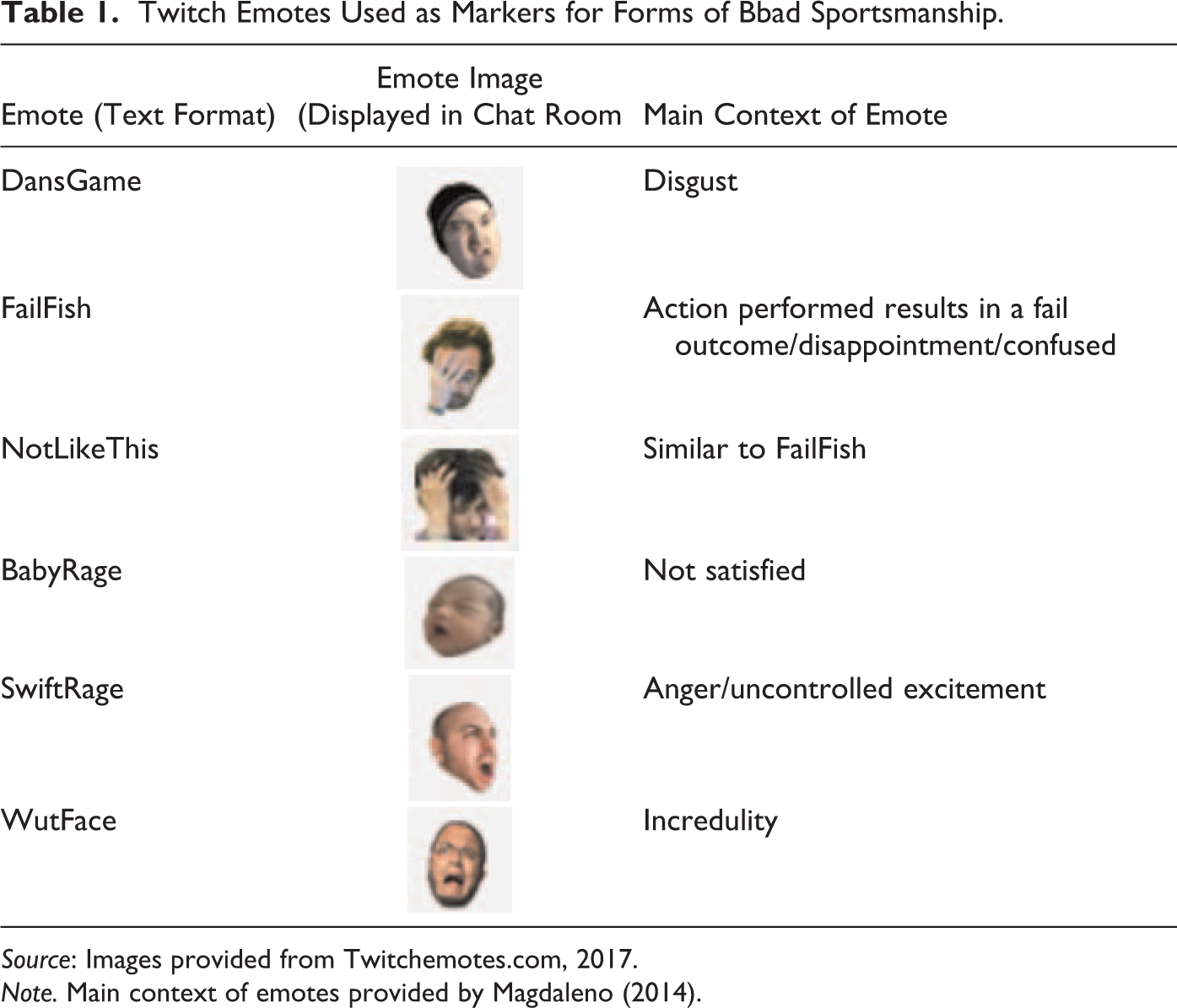
Source: Images provided from Twitchemotes.com, 2017.
Note. Main context of emotes provided by Magdaleno (2014).
Following observations, 15 semistructured interviews with CS:GO esport spectators were undertaken. As a follow-up to observations, interviewing provided an avenue through which to build on data, provide rich insights into what had been observed, and gather perspectives of sportsmanship firsthand. Observations were used to inform the interview protocol, designed with questions that gathered: personal opinions of the importance of sportsmanship in esports; a general understanding of unsportsmanlike behavior, including examples of things experienced as spectators; and thoughts about any potentially unsportsmanlike activity recorded during observations. All 15 participants were male, between the ages of 18 and 35, and of diverse nationality, including German, Canadian, Icelandic, British, French, American, Indian, Dutch, and Filipino-American. The study was promoted within CS:GO subforums on Reddit and Twitch with participants contacting researchers to consent to interview via online chat. All participants regularly spectated CS:GO esports, the majority watching LAN events. They were also frequent players of CS:GO with most playing on a daily basis.
All data were analyzed using NVivo (ver. 11), a software for qualitative data analysis using open, axial, and selective coding according to emergent themes (Cheung & Huang, 2011; Corbin & Strauss, 1990) and interpreted with a focus on unsportsmanlike conduct in the context of boundary work. 9
Perspectives of Sportsmanship, Unsportsmanlike Behavior and Its Impact on the Esports Community
Participant perspectives of displays of “great” sportsmanship concurred with Abad (2010) and included fairness, and a constant will to win. They also correlated with Nlandu’s (2008) position on honestly, trustworthiness, honor, generosity, and magnanimity. However, the most valued perspective of sportsmanship was about the player showing respect toward teammates, fans, opponents, and tournament admins. Doty (2006) argues that respect to others (along with integrity) is of utmost importance for ones “character” and is reflected in all forms of sportsmanship.
Displays of unsportsmanlike conduct were perceived to negatively impact and raise concern for the esports scene in two ways, both of which implicate construction of boundaries between esports and non-esports, and within esports communities. The first was about how esports differentiated from other “mainstream” sports and cultures. Taylor (2012) states that, While mainstream culture has come to terms with passionate football or basketball fans who avidly follow their teams […] and watch multiple games, given the status of computer games in the culture, e-sports fandom is often regarded either quizzically or suspiciously. (p. 193)
“Bad Manners”
Sportsmanship requires the ability to make reasonable decisions on the field of play (Abad, 2010; Nlandu, 2008; Rutten et al., 2007). Participants believe some of these to be “unnecessary” because the corresponding behavior does not reflect the skill nor the strategy elements of the team. However, while no operational or constitutive rules are broken, the acts may violate local norms, and therefore, the implicit rules within the community. In CS:GO, these behaviors are colloquially referred to as “bad manners,” or “BM,” and have even become instantiated into the verb tenses of everyday discourse (e.g., “BM’ing,” being “BM’ed”).
Two forms of BM were observed in the study. The first was associated with behavior after a player is eliminated. When a player is killed, their avatar’s body remains present in deceased state until the next round, with the victorious player typically retrieving the fallen opponent’s weapon and/or progressing further into the game. Occasionally, however, victorious players use the opportunity to strike the fallen body. Knifing (i.e., slash/stab) or shooting an eliminated avatar’s body was considered BM. The second form of BM was associated with how a player is eliminated. FPS games are renowned for incorporating an extensive armory, and in CS:GO, available weaponry falls into the grenade, pistol, rifle, submachine gun and shotgun categories. While the range of weaponry must be purchased before each round, every player carries a knife, which, when wielded, also enables the avatar to run at faster speeds (Witkowski, 2012). Using a knife to eliminate an opponent was considered BM.
As far as skill and strategy are concerned, both forms of BM exude impracticality; why waste valuable in-game time to attack an eliminated opponent, and why risk approaching an opponent with a knife over shooting from a distance? During observations, a player from one team (Team A) eliminated their opponent with a knife in the 15th round. In this scenario, Team A had eliminated four members of Team B and incurred only one causality. The remaining survivor (Team B) spotted a member of Team A and began firing their gun. Instead of using the gun being carried, this member from Team A approached the survivor, switched their gun to a knife and eliminated them, winning the round. In response, the commentators of the match said, Caster one: It was a guaranteed round for [Team A], so I guess they was just trying to cheer everyone up Caster two: It’s like scoring a goal in football just before half time, right. You get a knife here in counterstrike and you could possibly upset [Team B]. Caster one: I like to think of it as scoring an empty netter goal in hockey, and then rubbing it in everyone’s faces.
Following Carter’s et al.’s (2015) discussion of informal rules within the Eve Online community, the construction of a boundary (and threat of norm violation) around these forms of BM may be explained by differing perspectives. One perspective evidently emphasizes the spectator’s own lived experience of emotions associated with the acts, which enable them to see the motives behind the behavior, but also connect with players. As one participant said, It’s always rather funny seeing someone [knife a fallen opponent], as usually…these actions come from feelings of frustration or triumph. It also shows the more humane side of the players, sort of like saying, even though we’re on a professional level, we still feel the same way you do.
Not all forms of BM are made equal. “Teabagging,” for instance, is an in-game action performed when a player eliminates their opponent. In practice, it involves standing over a fallen body and alternating use of the crouch-stand mechanic; on-screen the computer generated image (CGI) environment pans up and down (first-person perspective) and the avatar is seen doing squats (third-person perspective), but the intention and implication is simulation of a sex act, namely dragging testicles across the head of the person beneath them (or across the buttocks if the body is facedown). Whether the act is seen as derogatory or not, varies. During observations, teabagging incidents were recorded and triggered spamming of “BM” in the chat room with dominant reactions of shock and disgust, but also, amusement. This supports Myers’s (2017) own research on the topic, which finds a wide range of player emotions toward teabagging in video games, ranging from disgust to amusement; while Myers constructs a compelling discussion arguing it is a sign of intimacy among players, he also says that such acts can threaten the “seriousness” of professional players (p. 10). In the present study, teabagging was derided by every participant and perceived an unprofessional and “disappointing” form of behavior to spectate among professional players, lending support to Myers’s view. Drawing and redrawing the boundary of acceptability around teabagging appears to rely on whether a person is spectating a professional or a casual game.
Throwing and Match-Fixing
Based on Abad’s (2010) view, playing to one’s fullest potentiation, in any circumstance, is a cornerstone of sportsmanship. If a player, or a team, then decides to “throw” a match, it eclipses this virtue. In their study, Carter et al. (2015) examine this notion, and, in the context of boundary-work, see it as the “spectators attempt to establish what play should be about. Through placing the play within the domain of tournament play…critiques also begin to pull ideologies from other forms of spectator sports” (n.p.). They acknowledge that in Eve Online—a game where stealing is a routinely accepted—throwing a game negatively affects the esports scene. If the former is adherence to a constitutive rule in the fabric of the world, the latter, then, must be an implicit rule violation.
Spectators may, however, find it difficult to identify when a match is being thrown. During the study, professional players were observed performing unusual in-game behaviors, including a terrorist team dropping the bomb and not attempting to retrieve it (allowing victory for counter-terrorists), and a player rushing toward an opponent without firing their gun (i.e., committing in-game suicide). In these moments, the reactions from casters would change, interrupting their normal, fast-paced commentary to one that was stagnated and confused. Within the chat room, a number of spectators accused the team of throwing the match, displaying anger and disgust, with commentators’ responses including: “what is that nonsense?”; “that’s shocking, that’s real amateur stuff”; and “that’s despicable.” It is difficult to claim, with certainty, that these teams were “throwing” the game, but the spectator reactions made it so, and somewhat difficult to conclude anything else. Spectator consensus also suggested that throwing was resulting from “choking” (when a player/team who are currently winning or expected to win a match performs unexpectedly poorly) and/or “tilting” (when a player frustration and confusion cloud their judgment, resulting is use of less strategic actions). In her paper, Witkowski (2012) notes the skill and precision professional players input to navigate through virtual terrain, yet: If a player/team is poor at moving from A to B, or at quickly and precisely targeting the opposition in their sights, or even at manoeuvring about the field space in coordination with teammates […] the likelihood for failure increases with each inadequately executed action. (p. 357)
During interviews, numerous participants discussed a now infamous case of a CS:GO professional team, iBuyPower, who bet on themselves to lose against team NetcodeGuides.com during the fifth season of the CEVO Professional league in August 2014 (Chalk, 2015; Lewis, 2015). The event resulted in an indefinite ban against seven people, including four iBuyPower team players (Chalk, 2015). In 2017, the Electronic Sports League (ESL), an esport tournament organizer, collaborated with the Esports Integrity Coalition 11 on a survey seeking to gather opinions of sanctions regarding cheating, match-fixing, and “doping” (using performance enhancing drugs in esports; Oelschlägel, 2017). The results of the survey provoked changes in the rules for tournaments not partnered, or sponsored, by Valve where players found guilty would only incur a 5-year all-tournament ban. It was also announced that all indefinite bans sanctioned before February 2015 would be lifted—including bans placed on iBuyPower players (Oelschlägel, 2017). 12
As a case study of unprecedented change within the community (prior to this, match-fixing in CS:GO was unknown), the iBuyPower ban introduced a new dimension on how spectators may understand and relate with the consequences of unsportsmanlike behavior. Participants offered opinions on whether the lift was acceptable, and if it should be applied across all CS:GO tournament settings. Brock’s (2017) analysis of the work environment of esports players is useful to expand on this. Woodcock and Johnson (2016, as cited in Brock, 2017) say that esport professional players live in a world where competitive gaming needs must be understood as precarious work in a similarly precarious working environment, where the player’s youth is an important commodity. Brock (2017) extends this by commenting on “short lived” careers of players, where their abilities become “lost” or otherwise debilitated, or they become focused on other goals. In line with this, some participants adopted empathetic views, questioning a need for indefinite bans. As one participant stated, [iBuyPower] have already served an extensive ban during the biggest growth period the game has had. They have been punished suitably, there is very, very low risk of re-offending [sic], and it has most certainly set an example that [match-fixing is] not worth doing. I can’t think of an advantage to keep them banned. Like, in other sports, teams who match fix get a permanent ban, even can go to jail [sic]. That’s it. So why should they be allowed back [in esports]? They knew what they were doing and they still got caught. …cheats are players who don’t have the level of playing with pros and shouldn’t be able to play on the pro scene anymore however match-fixer are just seeking for money [sic], if IBuyPower could have gained more by winning the tournament and not betting on themselves I’m sure they would not have [fixed the match].
Bug Exploiting
Video game bugs and glitches are inevitable “failures” reflecting the inherent difficulty in designing and testing them (Lewis, Whitehead, & Wardrip-Fruin, 2010). On occasion, nonhuman actants can also engage with the game, provoking difficulty for the player (see Conway & Trevillian, 2015). However, depending on the bug or glitch, players can exploit them to gain an unfair advantage over others (Aarseth, 2003). In CS:GO esports, such an example was seen at the PGL Major: Krakow in August 2017, performed by team BIG against their opponents. In most maps, players are able to peek above walls and crates by jumping; this allows them to glimpse the rest of their surroundings but if spotted, gives their position away, or exposes their avatar’s head, rendering it vulnerable to attack. At the PGL Major in Krakow, a bug made it so that if a player jumped and crouched midair before peeking over the wall, they could observe their surroundings without their avatar’s head displayed on the other side (Villanueva, 2017). Members of BIG exploited this bug (now referred to as the “BIG jump bug”) and won the game.
Participants commented on the BIG jump bug with divided perspectives on whether bug exploiting was unsportsmanlike. Most perceived it as method for gaining an unfair advantage on the grounds that such bugs diminished the physics and reality of the game. For example, Every part, object or utility should only be used with or for what it was intended. So…a jump is in the game to either jump on something or to take a look what is on the other side of a high object [sic]. It was not intended to create an advantage for the jumping person who cannot be seen.
Nearly every participant in the study discussed the “Fnatic boost”—another bug exploitation case, occurring at DreamHack Winter 2014. During the second half of the match, members of team “Fnatic” repeatedly gravitated toward, and congregated at, the same spot of the map to eliminate opponents. Fnatic won the game, qualifying for the tournament semifinals (Ouyang, 2014). However, this particular location featured a number of bugs that facilitated “pixel walking” (also known as a “pixel boost”—when an avatar is able to stand on an invisible ledge; see Figure 1), “transparent texture” (being able to see through solid objects such as walls), and “immortality” (rendering a player impervious to damage from certain angles; Švejda, 2014). Unlike the BIG jump bug, exploitation of transparent texture and immortality bugs were against the rules at this tournament and therefore an illegal action (Ouyang, 2014; Švejda, 2014). 13
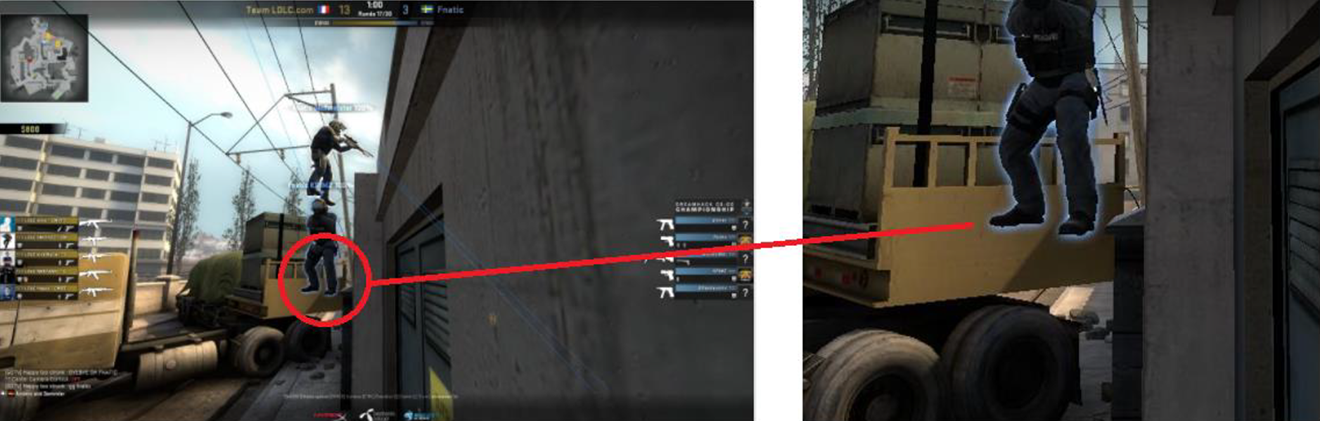
The “Boostmeister” bug exploit used by team Fnatic during the DreamHack Winter 2014. As the position allowed three forms of bugs to be exploited, it was declared illegal in the tournament. Source: Original image from Ouyang (2014).
While the Fnatic boost was illegal, the DreamHack administrators permitted the final match to be replayed but Fnatic decided to forfeit (Ouyang, 2014). The reasons for this are open to speculation but may be attributable to a number of factors. One participant made a point to say that “[Fnatic’s opponents] used [a bug in the game] that was against the rules, too,” which has also been substantiated by others (Shields, 2014, 2017a, 2017b). Fnatic also received a lot of community vitriol in the 6 hr it took administrators to review the game and come to a decision (Rosen, 2017). Another participant noted that: “[Fnatic was] very naive because of course this is going to bring some heat and anger but maybe their competitiveness got the better of them and can I blame them for that? I honestly don’t know.” In nonrelated tournaments, Fnatic had also been accused of (and developed a subsequent reputation for) cheating by the CS:GO community, which may have contributed to fan backlash (Rosen, 2017).
Thus, bug exploiting ostensibly crosses boundaries as far as acceptable behavior and sportsmanship are concerned, and contextual factors are used to dispute or defend them. The intensity of negative/intolerant reactions toward unsportsmanlike behavior may increase in the order of magnitude of the violation (while both were illegal, Fnatic’s boost granted more abilities than the boost used by their opponents), and preheld beliefs about team/player proclivity for sportsmanship affects the extent to which boundaries are drawn. In the case of the BIG jump bug, the other teams at the PGL Major met and agreed to a “gentleman’s agreement” not to use the bug exploit in future matches (Kent, 2017). For players, then, sportsmanship manifested in different ways after an unsportsmanlike behavior-inducing event but shows of sportsmanship were not necessarily congruent with spectator perspectives. For example, as one participant said, I would like admins to put their foot down more when it comes to bug exploits. How is [a gentleman’s agreement] supposed to be enforced? If a team breaks [the gentleman’s agreement] then the admins can’t do anything because breaking a gentleman’s agreement isn’t illegal.
Conclusion
Much like conventional sports, esports is susceptible to in-game rule-breaking and unsportsmanlike behavior. However, esports also exist in an environment where the very systems predispose tampering and/or facilitate unfair advantage. In CS:GO, then, we contend that some boundaries of unsportsmanlike behavior are protean in that they are drawn and redrawn freely, disputed, and defended variably, and in different contexts. For players, some in-game “bad manners” (BMs) enable one to boast their victory against an eliminated opponent, and while unnecessary, spectators may enjoy seeing it, be entertained by it, and find that it makes the professional player more relatable to them. Other forms of BM however, such as “teabagging,” have a less dynamic boundary of acceptability. A key virtue in any sport is to play to the best of one’s ability, the value of which diminishes if the game is thrown. From the spectator perspective, this may be difficult to discern, with online chat room discussion used to mediate interpretation and, to some extent, guide how one should react. Throwing can also be a sign of match-fixing, and in this study, found to attract both sympathetic and unsympathetic spectators’ perspectives, disputing and defending it in different ways. Thus, while a unique esports identity is invariably important to the community, aligning it with principles from conventional sports satisfies a need for external validation. Some unsportsmanlike behaviors are a peculiarity of esports; arguably as complex and emergent as the video games from which they result, “bug exploiting” promotes energetic debate about whether such methods are tactical or create an unfair advantage. Here, spectator perspectives of sportsmanship appear to underwrite the contextual circumstances over the rules of the game. The results of this study may be useful to critical gaming scholars interested in the protean nature of sportsmanship in esports, and for creating a taxonomy of spectator perspectives endorsing further examination of the issue across different games and esports genres.
Footnotes
Declaration of Conflicting Interests
The author(s) declared no potential conflicts of interest with respect to the research, authorship, and/or publication of this article.
Funding
The author(s) received no financial support for the research, authorship, and/or publication of this article.
