



Abstract
Agar.io is a web and app game with simplistic rules and a minimalistic design. Despite this, the game grew to great global prominence in 2015, and the narratives players constructed within the game had great sociopolitical implications from its affects on web culture and even to national political campaigns. This article points to the leaderboard and the ability to broadcast messages to other users through player usernames as the primary reason for the game’s success as a platform for users to broadcast messages. Agar.io, through usernames and omnipresent leaderboards broadcasting these names, affords players the chance to put their ideologies and allegiances in competition through a simulation of a “survival of the fittest” cell culture. Through a formal analysis of the game this article shows that, for Agar.io, the game is in the name(s).
Agar.io is a simple game. Taking part of its name, “agar,” from the substance used to grow cell cultures, players begin a game as a colored circle or “cell” on a grid map littered with other smaller, static dots that the player’s cell can consume to grow larger. Many competing players are on the same map, and the game mimics a real-life cell culture as larger cells split up, consume smaller cells, and rupture when coming into contact with “viruses” on the map. The graphics of the game are minimal, there is no music, and there are only three controls to learn. Despite its simplicity, or perhaps because of it, Agar.io has proven wildly successful. The app has hundreds of millions of downloads, it is one of the 3,000 most visited websites in the world at the time of this article’s writing, and it appears in national political campaign ads. So what is it about such a simple game that makes it so popular? The leaderboard. At the top right corner of every game screen is a list of the names of the top 10 largest cells on the board. A leaderboard is not a particularly innovative concept though, and its presentation does not suggest this great importance. However, after some discussion of the game’s development and reception, this article will demonstrate, through formal analysis of the game, how the ubiquity of this leaderboard gives players the ability to put their ideologies and allegiances in competition through a simulation of a “survival of the fittest” cell culture where the winner is broadcast to all other players—at least until the next largest cell comes along—and it will address the question of why so many people have flocked to this game space as a new zone to simulate this battle. Furthermore, this article expands our notion of casual games to suggest that, while gameplay may be simplistic or minimalistic, casual games like these can also have major social and political implications, in part, because of this simplicity.
Description of Gameplay
Before investigating these larger ramifications, though, it is important to understand the game itself. Agar.io’s breakout success is surprising on its own, but when considering the simplicity of the game, this success seems even more baffling. As mentioned before, when a player starts a game of Agar.io, they appear on a grid map as a colored circle or “cell.” The player can move their cell with their mouse—the cell follows wherever the mouse is with a slight delay—and they collect small, regenerating dots covering this map. As the player collects these dots, their cell grows, and they gain other abilities as a larger cell. Most notably, the player can absorb the cells of other players that are smaller than the player’s own cell. Other players control cells all over the map, and since there is no real “start” or “finish” to a game of Agar.io, other players will control cells of a variety of sizes depending on how long they have been playing this particular game. The players can only view a limited area around their cell within the larger, rectangular grid map, so the player seeks to grow their cell by collecting the regenerating dots and by absorbing the smaller cells of competitors while also avoiding being absorbed themselves. When the player’s cell and all its components are absorbed by other cells, the player has lost, but an option to rejoin the game, back again at the miniscule starting cell size, is immediately available.
Assuming the player’s cell survives, the cell grows and it becomes slower. Once the player achieves a certain size, they can “eject mass” by pressing “w” to shoot out a small bit of itself in front of it. This function can potentially lure an unsuspecting, smaller player willing to risk nearing a larger cell for the chance to grow in size from the ejected mass. It can also serve as a peace offering, of sorts, to indicate a player’s intention to aid a larger cell or a player’s disinterest in antagonizing a smaller cell. Also at this size, by pressing the space bar, the player can split their cell in half. In doing this, the singular large cell divides into two cells about half the size, and the newly split half fires in the direction of the mouse and can potentially absorb other player’s smaller cells. This aspect is particularly useful in absorbing competing cells because, as was mentioned before, cells lose speed as they grow in size. Splitting one’s cell allows the player a chance to catch and absorb a smaller, faster cell, but it does come with risks. A spit cell remains split for a short period of time. This means that a player’s formerly large cell, after splitting, now operates as two smaller cells which are at greater risk of absorption themselves. Additionally, because of the limited view of the map, splitting a cell blindly risks firing directly into a competitor’s larger cell or into a “virus.” Scattered around the map are static, regenerating green jagged cells called viruses. When a larger cell hits one of these viruses, the cell is “ruptured” and splits into many very small cells. Cells can also use the ejecting mass function to increase the size of viruses, and after the virus has reached a peak size, it will also split into two viruses. Smaller player cells will often use this technique to send a virus hurtling to a much larger player cell causing them to rupture and risk being absorbed until their many small cells recombine. Cells smaller than the viruses are not affected by the rupturing effect and will use the viruses as a safe haven from larger cells attempting to absorb them.
These are the primary features of the game. There is no way to “win” a game of Agar.io as even being the largest cell on the map is a dynamic position that could change at any moment. And there is only marginally a way to “lose the game” because players can immediately join the same game with no delay after being absorbed. A single game of Agar.io might never end barring server interruptions or an insufficient number of global players logging in.
Additional Features
There are many other small features worth noting as well. Players now have the option to connect their Facebook account while playing the game. Doing so gives players the chance to gain in-game currency that can purchase preset skins (small artistic designs that appear on the cell in place of the monochrome style), starting mass boosts, and perks that accelerate mass accumulation. Connecting a Facebook account also lets players send in-game currency to other players, acquire currency through liking and sharing the game on Facebook and YouTube, and gain experience toward levels needed to access certain special skins. Players are now also presented with daily “quests” or objectives that, once reached, give the player in game currency or other accessories. These features operate similarly to many other well-known “social games” with the implementation of microtransactions and benefits for sharing and promoting the game through social media. There are also a few different game modes including “teams” (players are sorted to red, blue, or green team), “experimental” (the developer tests new and different mechanics), and “party” (players can host and join private games). Players can also choose a regional server to play on (North America, South America, Europe, Russia, Turkey, East Asia, China, and Oceania) and some graphic options.
Lastly, players can name their cell before they begin a game. This name appears over their cell at all times, and it will appear in the omnipresent leaderboard, visible to all players in that particular game, in the top right of the game screen if the player’s cell ever becomes within the top 10 largest cells in that game. These names cannot exceed 15 characters, can be in most any language or font, and can include emojis. If a player does not choose a name, no text will appear on top of the cell and “an unnamed cell” will appear in the leaderboard if the player makes the top 10. Choosing from a preset list of names can result in the cell having a certain skin too. For example, if a player names their cell “Cameron,” the player’s cell will sport a skin with a crude drawing of former British Prime Minister David Cameron in front of the Union Jack. Many of these skins include famous contemporary political figures, national flags, popular websites, and Internet memes, as well as other options. Because of the simplicity of the other elements of the game, however, the name feature and the leaderboard by extension become a more prominent feature. While the name and leaderboard features have appeared in previous games, in Agar.io, these are integral to the experience of gameplay.
Casual Game With Different Origins
Agar.io’s mechanics and gameplay closely align it with other casual games. Juul (2007) points to many elements frequently appearing in casual games that Agar.io also features. Some of these included short play sessions (a round of Agar.io can last seconds or hours depending on how much time and effort a player invests), simple rules and controls (Agar.io uses a mouse or touchpad with only two other controls), and low barrier of entry (Agar.io’s rules are easy to learn and rewards multiple plays; Juul, p. 207). Additionally, Agar.io does not require any hardware; players can play on phones, tablets, computers, or laptops; the game comes as a simple app or a website; and while the game is free, social elements and additional features come with small purchases (Juul, pp. 206, 207). Agar.io does differ from the stereotypical assumptions of casual games, though, in its development and original market. While many have pointed to the tendency of casual games being designed for, marketed to, and played by women and older audiences (Chess 119; Baron, 2009, pp. 118–120; Juul, p. 206), Agar.io developed out of the website 4chan and followed a trajectory significantly different.
Agar.io released to the public through the website Agar.io on April 28, 2015 (pecopecoros, Reddit, 2016). A young Brazilian game developer named Matheus Valadares developed the game in Java and C++. Before its release on the site, the game was available for people to help Valadares test and develop by connecting to his Internet protocol address which he would share on 4chan’s video game board, /v/, and other forums and boards devoted to games and game development (Anonymous, “No. 292440446,” /v/ 4chan; “Agar.io,” Hackernews). The YouTube channel Vinesauce, popular for streaming video games with commentary, released a video of the game on May 3 which served as a major advertisement for the budding browser game (“[Vinesauce] Vinny—Agar.io (part 1),” 2015). In fact, as a way of crediting the channel for this support, players can use a special Vinesauce “skin” in the game when typing “vinesauce” as their nickname. On the same day, Valadares submitted the game to the Greenlight program on Steam and it quickly received approval (Bens_Dream, Reddit, 2015), though the game was never actually released through Steam likely because of its success on the original site. On May 30, just over a month of its release, PewDiePie (2015) released a video about Agar.io to his tens of millions of subscribers and later received a cell skin as well (“REDDIT WANTS TO EAT ME! (Agario Part 1) | PewDiePie”). On July 8 of that year, Agar.io appeared as an app in both Apple and Google Play Stores through Miniclip. So while Agar.io’s mechanics and gameplay overlap significantly with those of other casual games, the context of the game’s development and rise in popularity differ significantly. This fact could point to the prominence of hate speech and misuse of the leaderboard, a topic addressed later, but it could also explain the game’s enormous success and wide acceptance in other cultural spheres that might otherwise ignore casual games and gaming.
Casual Game, Serious Implications
The release of the game as an app was the beginning of the site and game’s enormous success. In August 2015, Agar.io (2016) was in the 1,000 most visited websites in the United States and globally (Alexa). Also in 2015, in the United States, it was searched for more than any other game on Google in 2015—more than Fallout 4, more than Star Wars Battlefront, and more than Call of Duty: Black Ops 3. In fact, after Lamar Odom and Charlie Hebdo, Agar.io was the third most frequent google search in the world during the year (Google Trends, 2015). Although the site and game have dropped in popularity, Agar.io boasts somewhere in the range of 50–100 million installs on the Google Play Store alone. It even features in an episode of Netflix’s House of Cards where, with roughly 20 s where only gameplay appears on screen, Frank Underwood is introduced to the game and comments, “I rather enjoy the anonymity” (“Chapter 48,” 2016). All in all, Agar.io claims somewhere in the range of 60 million unique users monthly (Business Insider, 2016).
And it’s not just fun to play, though it is. Agar.io has entered into the conversation of real-world issues, so to speak, too. The Kurdish minority party in Turkey, the People's Democratic Party or the HDP, used images from Agar.io to support its cause (Figure 1; “A Political Battleground”). Because of the popularity of Agar.io in Turkey, the HDP used the game to help their campaign to knock the ruling party, the Justice and Development Party or the AKP, out of the super majority. In the campaign ad, a large cell labeled “Biz’ler” absorbs another cell labeled “10%”—the amount of representation they required to take the AKP out of a supermajority representation. There are also two other cells labeled “Aksaray” and “Baski,” “palace” and “oppression,” and they represent the presidential palace constructed by Turkish President Erdoğan earlier in that year. The leading opposition party picked up on this too and made a similar ad meant to show their support for the HDP in overturning the AKP (Political Battleground; Kotaku, 2015). Furthermore, by inputting certain names into the game, players could get special skins for their cells that demonstrated their allegiance to certain candidates in the U.S. presidential election, to show solidarity with France after the Charlie Hebdo attacks and the attack in November 2015 on Paris, and to represent the late Fidel Castro, as well as many others. By intersecting with real-life events and people, Agar.io participates in sociopolitical conversations and allows players to perform these debates on their screens and through their own control.
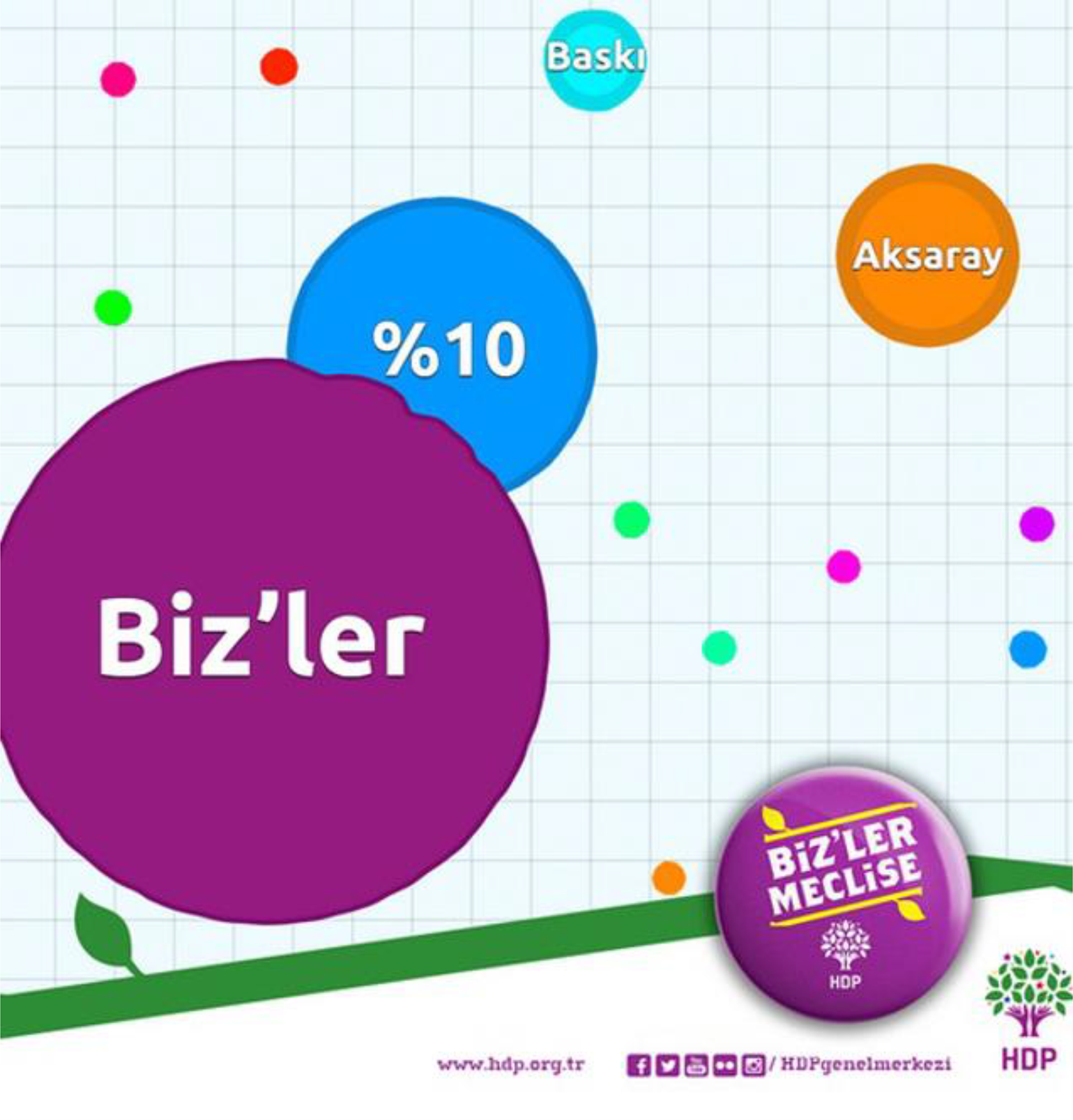
An example of the HDP’s political campaign featuring Agar.io. Adopted from Grayson (2015).
Broadcasting Ideologies: The Leaderboard
With this level of sociopolitical involvement, then, one might expect Agar.io to have a carefully crafted narrative, novel or impressive mechanics or graphics, or some other qualities that set it apart from other games; however, as detailed earlier, Agar.io is a simple game. In fact, when it was at the height of its popularity in August 2015, many of the aforementioned features were not yet available. Most of the skin options were not available. The option to connect to Facebook was not a feature. Players could not choose servers, image quality, or different modes, and there was no currency or experience system. Furthermore, the ability to eject mass and to expand and split viruses was also not available. So if the game was so simple and basic, what made Agar.io so popular, so influential at the time? This is not to suggest that simple games cannot become major successes. As noted before, Agar.io is a casual game, and many casual games succeed in part because of their simplicity. In some ways, though, Agar.io was unique in its simplicity as it lacked even aesthetic or social components characteristic of other casual games. At this time, Agar.io was influencing national political campaigns, was being searched more than any other video game, and gameplay was appearing in major shows, and yet it was little more than single-colored cells circling a grid map eating and being eaten by other similar cells while occasionally splitting and reforming. So what is it about Agar.io?
As suggested before, the names and the leaderboard are what distinguish Agar.io and what makes it unique from other games like it. Leaderboards, however, are not unique features. Arcade games, for example, have long featured leaderboards where players who achieve high scores are able to post a name with a limited number of characters on a list that appears on the idle screen and at the end of games. These high score boards serve as a demonstration of skill at a game and memorialize the players success and skill for all other players to see. However, those scores are, for the most part, only seen by people who play that particular game on that particular machine. In Agar.io, the player’s competency is broadcast. Their name, and therefore their message in 15 characters or less, is displayed to anyone on the server as long as they are in the top 10. This larger broadcasting is not new either. Many mobile games have leaderboards that show the best players and their scores to thousands and maybe millions of people. More competitive triple-A online games have similar leaderboards that appear at the end of matches or when the player calls on them that announce each player’s win–loss record, their kill to death ratio, or other notable statistics alongside their “gamer tag” or username.
The leaderboards in Agar.io, though, are different. They are a fundamental part of the game. They are ubiquitous. It is impossible to play the game without seeing the leaderboard because it sits over the game screen in the top right corner at all times during gameplay. Typically, games, tags, and leaderboards function as somewhat of an afterthought to regular gameplay or as a secondary feature. For Agar.io, without the names and leaderboard, Agar.io would not be the same game. Players would have no clear way to know whether they were successfully progressing in the game or what objective they were striving for or when they had reached it. Insofar as there is a win state to Agar.io, it is the player reaching number one on the leaderboard. In this way, player identity, or the identity presented by the user through their username and skin, is intrinsic to the game. It becomes part of the way, arguably the only way, players make meaning from the game as feuding names embodied by these cells competing for the same “Number One Cell” objective.
As a way to exemplify what I mean when I say that players make meaning through the names and the leaderboard, let me use my own gameplay as an example. When I play Agar.io, one of the names I use most often is “Your Own Mother.” As I play, I commentate on the gameplay either in my mind or aloud if I am playing with other people around. When a larger cell absorbs my cell or acts antagonistically toward my cell, I criticize them by saying something akin to, “how could you do this to Your Own Mother?” or, if I reach a spot on the leaderboard, I say, “wow, Your Own Mother is winning!” While a humorous example, what is worth noting is that I create this narrative and meaning from the names and the leaderboard with myself and others that might be near me. I am not sharing this narrative with other players in game. There is no chat function or any way to communicate with other players beyond the cell’s name, the skin, and the actions of the player in the game. Other players create their own emergent narratives too, but in different ways. In the last game of Agar.io that I played alone, player names ranged from strings of characters reminiscent of user or screen names on other sites and platforms to names of nations. Other players included a specific string of characters at the front end of their name, usually in brackets, as a means of indicating a team or allegiance with other players using the same naming conventions (in this game in particular, at least four cells included “VILLA” before the rest of their name and never appeared antagonistic to similar named cells). Others still would name their cell “Press W” or “W = team” to try and lure unsuspecting players into ejecting mass by pressing the “w” key or to attribute benevolent meaning to the mass ejection mechanic. Several cells had names indicating great hope and expectation (“top 10” and “top cell” both appeared in this game) and even more had no name at all. These examples, as well as many other seemingly unintelligible strings of characters, appeared in a single game of Agar.io lasting just under 12 min. However, unless the players choose to enter into some other platform discussing these emergent narratives (such as Reddit forums dedicated to the game), the meaning behind these names is not evidently and clearly translated to others through gameplay alone. Players are left to their own devices to interpret the meaning behind names and naming conventions and to construct their own narratives regarding the game.
Making Meaning Through Names
And this form of interpretation by players seems to occur quite regularly by many players demonstrated by the players’ actions. Consider the aforementioned political examples. After playing on the Turkish servers during that election, some players commented on how unofficial teams and alliances developed around these political parties. In a Kotaku article on the matter, the writer mentions how cells representing the HDP in various ways would team up to control the leaderboard and that naming your cell any other Turkish political party or other country would result in your cell being quickly absorbed (Political Battleground). The same was true during the 2016 U.S. presidential primaries. While playing during this time, I found that cells with the Donald Trump skin, or any cell name related to Trump in the form of quotes or proposed plans, seemed to never absorb each other. Instead, they would go after other cells collectively and would particularly chase those cells displaying the President Obama or Hillary Clinton skin (Figure 2; “Best Agario Skins”). Again, my understanding of the intentions and motivations behind the actions of players comes solely from my own interpretation of their gameplay since there is no chat function; however, the game’s development team even seemed to support this political narrative. During the months leading up to the 2016 election a window would occasionally pop-up suggesting players use either the Clinton or Trump skin to decide “Who is the most popular U.S. presidential candidate?” as part of the “Election Frenzy” campaign (maciej4411, Reddit, 2016). One Reddit thread from the Agar.io subreddit suggested that Agar.io serves as a political battleground of sorts with the title “Agar.io is a great way to support your 2016 U.S. presidential candidate” (hackis, Reddit, 2015). Commenters on the thread, however, explained that such an experiment would only show that an unnamed cell was the predominant political ideology in the United States or that seemingly trolling usernames supporting Adolf Hitler would win out.

Examples of political figures as cell skins. Adopted from Shafiuddin (2015).
The culture surrounding Agar.io reflects Consalvo’s consideration of gaming cultures of casual games and the paratexts players create and the social capital players accrue by participating and engaging with this culture (“Hardcore Casual”). As Consalvo (2009) notes, “at first blush, it would seem that casual games have no culture,” at least when considering game mechanics and gameplay that do not promote long-term engagement or social/chat-based play (p. 50). Of course, as she concludes, casual games do often develop communities, inspire paratexts, and encourage players, who may not play the “casual game” so casually, to engage at various levels with the game and other players (p. 53). Such is the case with Agar.io, as seen above. However, unlike other casual games developed out of or targeting stereotypical demographics of women and players over 35, Agar.io’s origins contributed to its culture including regressive and offensive behavior.
Connections to Hate and Toxic Technocultures
Having developed directly out of toxic technocultures and trolling spaces like 4chan, it is not entirely surprising to find that leaderboards are often manipulated, through modding, bots, and other means, to say hateful and offensive things. One image circulated in these spaces shows a leaderboard where the names of the largest cells on the board spell out “why do Jews suddenly appear every time money is near” when lined up on the leaderboard (Figure 3; Know Your Meme; 10se1ucgo, 2005). This image was likely created in a photo editing software, but it could have been made by a user, or users, operating modified bots in the game with the goal of achieving and broadcasting this hateful message to other players in the game. Furthermore, the developer of the game has responded to the game’s community, again primarily from 4chan and Reddit, and added requested skins including the American confederate flag, Hitler, and skins for sites like 4chan, 2chan, and 8chan. What’s more, it seems the developer himself shares these views. In a post by the developer in the Agar.io subreddit, the developer seems to bemoan the loss of the Nazi and Islamic State skins (Zeach, Reddit, 2015).

An example of the leaderboard being utilized to promote hateful messages. Adopted from Agar.io. Know Your Meme (2015).
Fortunately, Agar.io does not suffer from these as much today. As it has grown in commercial success, mods and bots have been removed and restricted, thus preventing rogue users from making leaderboards like those mentioned earlier. Also, the Nazi and ISIS skins no longer appear as an option for players. But there is still no filter for names in the game, and players continue to find ways to express themselves and their, sometimes unsavory, ideals in the game. The point in all of this, though, is to demonstrate the way that a simple game element, the ability to name cells, and have those names prominently featured and ubiquitously broadcast when winning, elevates the game from a simple browser game like so many before it, to a global gaming sensation with great implications that a so-called casual game does not typically elicit. I am not the first to note this. A Kotaku article described players of the game as, “ingesting everything in their path like a procession of Pac-Men—Pac-Men with opinions.” In the same article, the author says that, “Agar.io is tremendously popular and (or perhaps because) it gives people tools to represent themselves, their identities” (Political Battleground). Agar.io, through usernames and omnipresent leaderboards broadcasting these names, affords players the chance to put their ideologies and allegiances in competition through a simulation of a survival of the fittest cell culture. For Agar.io, the game is in the name(s).
Why Agar.io as Battleground of Choice?
So far, this analysis has addressed the question of what it is about Agar.io that makes the game so appealing. It has not, however, answered the question of why. Why do so many people choose Agar.io as their space to play out these political and ideological battles? Especially when the game’s development is so steeped in alternative spaces that offer similar ranking systems and welcome alternative views, why do players choose a space where messages cannot extend beyond graphics in the form of skins and 15 character messages that only appear to everyone if the player has the skill to make it in the top 10 largest cells? Unsurprisingly, there are a variety of possible reasons.
One reason why Agar.io seems to be the chosen space for these battles rests in one of the fundamental appeals of games in general: winning. When playing a video game, a player might come to strongly identify with the character they are playing. In these instances, it is not uncommon to feel as if you have succeeded at some objective when it is the character that has actually performed these actions; the player has only submitted certain inputs on a controller. In this way, though, the player feels the character’s success vicariously. Similarly, Agar.io affords players the chance to do this in reverse. When a player’s cell reaches the top 10 leaderboard for all other players to see, that player has associated their cell with a certain identity displayed through name and skin. The success of the player, then, translates into a vicarious success for that identity—whether it be political, ideological, personal, or otherwise nonsensical. No, the success of the player operating the cell does not actually represent the strength of whatever identifying markers the player attributes in choosing a name and skin, but the metaphoric power involved in that identity “winning” in a game offers a different kind of message than what other online spaces afford.
Relatedly, the success of this cell, and therefore, metaphorically, the identity attached to it, does not require the approval or support of any other users or players in a game of Agar.io. In a space like Reddit, for example, a user might believe their message is stronger than any other. Without the help of other users upvoting it and commenting on it, though, the message will become buried among all other posts or even deleted by filters. Although less so than on Reddit, the survival of a thread on 4chan also relies on users to continually post in the thread, and any thread that has not received posts after a period of time vanishes. Agar.io is different. As a simulation of a survival of the fittest cell culture, where fitness is determined by a player’s skill at the game, the aforementioned metaphoric win for the identity of the cell does not require the approval or support of anyone other than the player. In effect, then, Agar.io allows cells that make it into the top 10 leaderboard to play out the fantasy of, “if you could say anything you wanted to everyone, and they had to listen, what would you say?” Albeit the messages in Agar.io cannot exceed 15 characters and a skin, and the audience of the game, while large, is not as comprehensive as that fantasy scenario. Still the audience that a top 10 player broadcasts to is substantial in size and that audience is a captive one because of the ubiquity of the leaderboard on the screen. Players cannot turn off the leaderboard, they do not have the option to play an off-line mode, and because of the general anonymity of players, there is no real process for reporting or removing players that would use this platform to broadcast inappropriate messages.
This effectively welcomes hate speech and unsavory opinions into the game space. Users wishing to express these opinions can do so without fear of moderation, of their message being removed as a result of communal outrage or response, and they can even see their message broadcast further if they make it onto the leaderboard. And yet the success of the message derives not from the strength or value of the idea but from the player’s skill at the game. If a player wishes to announce to the world any form of hate speech, in Agar.io, all a player needs to do is make that message the name of their cell and make it to number one. In some cases, as with the, now removed, ISIS and Nazi skins, that message is even support with comical graphics and skins.
In some ways, too, the limited manner in which messages appear in Agar.io opens the game up to a larger audience than what other spaces might afford. Agar.io’s success extends beyond just one regional context. Peak hours in respective regions show large numbers of players across all of the regional servers and not just the North American or European servers. Furthermore, when a player starts a random game of Agar.io on any server, it is likely that they would see cells with names written in various characters, different languages, emojis, and nontraditional fonts. The game space, then, is not only legible to a particular nation or region but to many. Because of the language constraints, particularly the limit to 15 characters, players must find other ways to convey the message they wish to broadcast should they reach the leaderboard. That message can manifest through skins, simple names, gameplay and interaction with other cells, or some combination of these. Importantly, though, many of these are easily translatable across social, lingual, and national contexts. The game is a casual game because of its ability to reach large, different audiences and simplified gameplay; however, the game’s casual nature does not limit its potential impact. If “the game is in the name(s),” as is the case with Agar.io, then the game only grows in its power to convey messages through gameplay when those ever so important names are legible on a global scale.
This legibility plays into another of the game’s appeals, and perhaps its popularity in spaces like 4chan and Reddit—its similarities to meme culture. By deemphasizing other game elements and emphasizing the naming features, Agar.io allows for repurposing of these mechanics, for humor, for community building, and so forth. Additionally, the ability to display your message of choice under the veil of anonymity means that players have the choice to name their cell anything whether it be conventionally offensive, seemingly irreverent, or absurd. And any of these names are possible, and can possibly be broadcast to all of the other players on the leaderboard, because of the anodyne, tabula rasa that is the game of Agar.io. The background is nothing but a grid, the cells are merely circles, and the namespace is empty. It is up to the player to decide how they want to utilize, repurpose, and play with their name. The cell, after all, becomes entirely secondary to whatever name the player chooses to lay over top of it. While the game originally draws inspiration from cells and cell cultures, Agar.io is less a battle between cells, and more a conflict between the players identified by their names. In this way, Agar.io defies conventional logics about casual games which players, ostensibly, play casually, without significant investment or identification on the part of the player, or otherwise passively consumed. To the contrary, Agar.io players, through the performance of playing the game, are in a competition with their moniker, trying to keep their ideology, their identifier, or their name alive, while also trying to reach the top so that same ideology, identifier, or name can be broadcast for all other players to see as dominant.
Agar.io’s success is undebatable. Its success in terms of sheer number of players notwithstanding, the game’s appearance in, and relevance to, political debates, its troubling development history, and popularity on a global scale all make Agar.io a fascinating study for game scholars interested in the influence video games can achieve on a social and cultural level especially for scholars interested in (not so) casual gaming. Through a formal analysis of Agar.io’s gameplay, this article has pinpointed the aspects of cell names and the omnipresent leaderboard as game elements that distinguish Agar.io from other games like it. Furthermore, because of this unique simplicity, Agar.io offers players the chance to put their ideologies and allegiances in competition through a simulation of a survival of the fittest cell culture in ways that other online spaces today do not afford to their users.
Footnotes
Declaration of Conflicting Interests
The author(s) declared no potential conflicts of interest with respect to the research, authorship, and/or publication of this article.
Funding
The author(s) received no financial support for the research, authorship, and/or publication of this article.