




Abstract
Video games are works of written code that portray worlds and characters in action and facilitate an aesthetic and interpretive experience. Beyond this similarity to literary works, some video games deploy various design strategies that blend gameplay and literary elements to explicitly foreground a hybrid literary/ludic experience. We identify three such strategies: engaging with literary structures, forms, and techniques; deploying text in an aesthetic rather than a functional way; and intertextuality. This article aims to analyze how these design strategies are deployed in What Remains of Edith Finch to support a hybrid readerly/playerly experience. We argue that this type of design is particularly suited for walking simulators (or walking sims) because they support interpretive play through slowness, ambiguity, narrative, and aesthetic aspirations. Understanding walking sims as literary games can shift the emphasis from their lack of “traditional” gameplay complexity and focus instead on the opportunities that they afford for hybrid storytelling and for weaving literature and gameplay in innovative and playful ways.
Even before the age of digital gaming, games and play permeated the literary field. For example, in 1976, Detweiler identified three types of literary phenomena where (analogue) game elements impact and shape post–1965 American fiction. The first refers to a “playful or whimsical” (Detweiler, 1976, p. 48) style of writing, what might be called gamelike literature. These are forms “based on exuberance and exaggeration,” which seem “spontaneous and casually composed” and are usually humorous but do not “portray a particular game, or play a game with the reader” (Detweiler, 1976, p. 48). The second category consists of works of fiction, which embed games within the work as “the foundation of plot, characterization, or imagery” (Detweiler, 1976, p. 48). And, finally, he identifies fiction that takes the form of a game “in which or through which the author plays a game with the reader, either by presenting the story in some cryptic form as a puzzle to be solved or as an inside joke […] or a revision of an older narrative” (Detweiler, 1976, pp. 48–49).
If Detweiler focuses on manifestations of games within literary works, we take a complementary approach and consider how elements of (print) literature can become manifest in video games. We understand literature as “written artistic works” (Literature, n.d.). The overlaps are visible in video games that adopt a literary genre (mainly crime, fantasy, science fiction, horror), video game adaptations of literary works (The Path, Tale of Tales, 2009; The Witcher, CD Projekt, 2007; Agatha Christie the ABC Murders, Artefact Studios, 2016; Game of Thrones, Telltale Games, 2014), video games inspired by literary works (2K Boston and 2K Australia, 2007; S.T.A.L.K.E.R., GSC Game World, 2007; Far Cry 2, Ubisoft Montreal, 2008), video games in which books have a central function (Myst, Cyan, Inc., 1993; Sherlock Holmes, Crimes and Punishments, Frogwares, 2014), in which the characters are writers (Alan Wake, Remedy Entertainment, 2010; Gone Home, Fullbright, 2013), or video games in which reading or writing become a game mechanic/in-game action (Device 6, Simogo, 2013; Stride and Prejudice, No Crusts Interactive, 2013; Elegy for a Dead World, Dejobaan Games, 2014).
In turn, the written text appears in different forms: the written lines of code which underpin video games, the use of characters in ASCII games to create characters and environments, lines of dialogue in speech boxes, words in menus, flavor text describing in-game objects and events, and collectables and artifacts such as scrolls, letters, pages of books, or text which is embedded in the environment to convey additional information about the world (posters, graffiti, comics, newspapers, documents, etc.).
What Remains of Edith Finch (here after WRoEF; Giant Sparrow, 2017) is a video game that uniquely blends different literary elements, an aesthetic use of text and intertextuality with gameplay. In this article, we will offer a close reading of the game emphasizing the interplay between its literary and ludic elements. A close reading can expose hidden layers of meaning within the game (Tosca, 2003; Consalvo & Dutton, 2006; Bizzocchi & Tanenbaum, 2011; Fernández-Vara, 2014), and in the present article, it allows us to focus on the literary elements present in the game and to emphasize their mutually beneficial relationship to gameplay.
We propose that a literary dimension is manifest in the game’s theme and influences; its adaptation of literary genres, forms, and techniques; its overall structure; and in its aesthetic use of written text and metaphoric use of textual artifacts (books, diaries, comic books, letters). We argue that the game belongs to the genre of literary games in which “language is foregrounded as verbal art rather than used as a purely functional tool” (Ensslin, 2014, p. 141), thus affording two types of aesthetic experiences: ludic and literary, the former emphasizing gameplay and the latter the story and the literary devices deployed in its telling. This type of engagement has been identified by Ensslin (2014) as literary gaming, “a specific form of digital gameplay that happens when we interact with digital artefacts that combine so-called ludic (from Latin ludus: game or play) and literary (from Latin littera: alphabetic letter or plural litterae: piece of writing) elements” (p. 1). Literary games invite players to deploy different sets of skills as they simultaneously engage in playing and reading the game.
We start by arguing that walking sims can be understood as literary games and then we analyze WRoEF to illustrate how the ludic and literary elements play out in its design. We conclude by expressing our hope that more games will explore the playerly/readerly hybridity motivated by the game’s innovative design as well as its popular and critical success.
Walking Simulators (Walking Sims) and Literary Gaming
During the past decade, developers have been pushing at the boundaries of the video game form, redefining and expanding their scope, and their player communities. Their potential for creating aesthetic, narrative, emotional, and critical engagement has been widely studied (Anthropy, 2012; Flanagan, 2009; Flanagan & Nissenbaum, 2014; Isbister, 2016; Ryan, 2006, 2015; Sharp, 2015; Upton, 2015; Shaw, 2014 to name but a few). The Chinese Room, Tale of Tales, Fullbright, that gamecompany, Giant Sparrow, Campo Santo are the flag bearers of a new wave of video game developers who explore the medium’s potential for artistic expression, critique, and social change. One of the most important genres that resulted from their combined efforts is the walking sim.
Walking sims are a subgenre of first-person, exploration video games. Although there have been some precursors to walking sims (most notable example is Myst, Cyan, Inc., 1993), the first walking sim is considered to be Dear Esther (The Chinese Room, 2012). Dear Esther started life as a creative response to Half-Life 2 (Valve Corporation, 2004a), a mod 1 in the Source Engine (Valve Corporation, 2004b), but also as an Arts and Humanities Research Council–funded, development-led research project at the University of Portsmouth. According to the Valve Developer page, the stated purpose of the project was to create “experimental game mods […] something radically different from normal: an interactive story that dispensed with traditional gameplay and focused instead on an open-ended, semi-random narrative” (https://developer.valvesoftware.com/wiki/Dear_Esther; n.d.). Dear Esther was the result of Pinchbeck’s (2012) experimentation with the first-person genre (FPS) attempting to investigate what happens when all gameplay is stripped out of an FPS, leaving only the environment, atmosphere, and story.
Since the launch of Dear Esther, multiple titles have emerged that adopt and reclaim the term “walking simulator,” which was coined in derision of their perceived lack of “traditional” gameplay by a frustrated player community. This frustration was directed toward the alternative style of gameplay: no traditional objectives, challenges or rewards, few interaction schemes, and in-game actions. In walking sims, the player mostly walks through the gameworld, interacting with its objects and environments. Because the main in-game action is walking (with the occasional opening of doors and drawers, switching lights on and off, or focusing attention on objects of interest for example by zooming in), they are accessible to a diverse player community regardless of their previous gaming knowledge. Additionally, this limited “palette” in terms of mechanics acts as a creative constraint stimulating the developers to deploy all the other tools in the game design toolbox for generating atmosphere and conveying the narrative: music, sound, animation, environmental and character art, voice-over narration, and text. If the player mostly walks, which requires a minimum of attention, she is free to focus on the aesthetic experience provided by the game (see, e.g., Calleja, 2011, or Upton, 2015).
As the genre matured, developers started introducing new mechanics and interaction schemes to complement walking and diversify gameplay. These new interaction schemes can be observed in The Witness (Thekla Incorporated, 2016)—where puzzle solving is a main mechanic alongside walking, in Tacoma (Fullbright, 2017)—where the player can manipulate the augmented reality recordings of the space station’s crew to rewind and replay them, or in Firewatch (Campo Santo, 2016)—where gameplay equally focuses on “talking” over a two-way radio system as it does on walking, climbing, and exploring. As later discussed, WRoEF introduces a different interaction scheme for each of its characters and is illustrative of this new wave of walking sims.
In walking sims, interaction takes the form of exploration and manipulation of objects (sometimes characters), as well as using player movement that can trigger location responsive events (location triggered audio, for example). Their emphasis on meaning-making, interpretation, and exploration is supported by the slow pace of progression and by not launching the player in a race against time and adversity. Running is discouraged in walking sims, and there are no ticking clocks or win/lose conditions. The games pose very little challenge to the player’s gaming skills, which means that progression is not conditioned by mastery of complicated control schemes, twitch reflexes, or complex hand–eye coordination.
Walking sims do not encourage competition or collaboration: They usually consist of a single player exploring an environment (a notable exception is Journey, thatgamecompany, 2012). They creatively engage with the narrative potential of this environment through extensive use of environmental storytelling and rely heavily on text (written or verbal), sound, and music alongside visuals for creating atmosphere. They are “open works” (Eco, 1989), which foreground the player’s interpretive and meaning-making skills. Walking sims take place in gameworlds that are sensory-rich, experientially complex, logically comprehensible, and self-contained (smaller gameworlds and shorter gameplay experiences). They foreground meaningful and emotional rather than durational experiences. As Dan Pinchbeck states, the walking sim came along at a time of a maturing of the video game medium. I think the time was just right for them, in many ways. We stood on the shoulders of giants, people like Tale of Tales had broken this ground for us, started that momentum going. And there was a move in AAA games as well, towards reflection, pure emotion, not just mechanics and stimulus for their own sake. (Pinchbeck, 2013)
We described the characteristic features of walking sims to illustrate how they are compatible with a ludostylistic analysis (Ensslin, 2014, see also Ryan’s, 2006, ludo-narrative approach) and to argue that literary gaming can offer a useful critical lens to analyze their complex nature as simultaneously readerly and playerly artifacts. We posit that walking sims are literary games and as such are an important addition to Ensslin’s genre. Understanding walking sims as literary games can be a first step toward shifting the discussion from a focus on their lack of traditional gameplay to discussing how this intentional design strategy impacts on the readerly experience as well as on the overall aesthetic and hybrid ludic/literary experience. Their lack of gameplay complexity is compensated by the interpretive complexity enabled by their hybridity. Pinchbeck calls this design strategy creating vacuum space in games. He argues that “Lack of stimulation is not lack of experience”; on the contrary, “Lack of stimulation allows different kinds of reflective, emotional experiences. We have to provide space and time for different types of experiences and different types of resonances to flourish” (Pinchbeck, 2012). As we will later illustrate in our analysis of WRoEF, for some walking sims, these different types of experiences are literary, by which we mean that they foreground reading by engaging with various literary structures, themes, forms and genres, deploying text in an aesthetic rather than a functional way, and referencing other literary works. Upton (2015) argues that these complex interpretive processes required from the players offer an alternative motivation to challenge-based gameplay: “The challenges these games offer is so minimal that successful progression is almost automatic. However, the vacuity of their moment-to-moment play is overshadowed by a compensatory complexity in the interpretive play spaces that they construct” (p. 71). Simply put, reading and interpretation skills replace shooting or puzzle solving or strategizing. Although their number of in-game actions is considerably smaller as compared to other mainstream video games, walking sims are video games and therefore require the deployment of gaming-specific skills and abilities: orientation and navigation of 3-D virtual space via hardware devices (keyboard, mouse, controllers), pathfinding, decision-making in terms of route selection, and interacting with the in-game environments and objects. Which means that players engage in a hybrid reading/playing experience and in order to successfully “complete” the game they need to be able to juggle both types of skills. Ensslin maps these modes of engagement onto Hayles’s (2007) cognitive modes of hyper and deep attention (p. 187), arguing that players who interact with literary games constantly shift from deep attention required by reading to hyper attention deployed in playing (Ensslin, 2014, p. 43). This creates a complex mode of engagement combining the immersive experience of gaming with the interpretive challenges of literature.
Although walking sims fall out with the two categories of literary video games that Ensslin explicitly identifies—auteur games and quasi-literary games—we argue that they fulfill all the criteria laid out by Ensslin and therefore have their individual place on the literary–ludic spectrum. Ensslin (2014) defines auteur games as games that are the result of the artistic vision of an individual author, and feature “sophisticated linguistic elements such as quotes from the Western literary canon” (p. 49), verbal and audio feedback rather than a visual representation of a cursor, dialogue and/or interior monologues, epistolary, and poetic elements, inviting the players to engage in complex processes of interpretation and meaning-making. Walking sims are the result of a collaborative development process, sometimes in large development studios, which is why they cannot easily fit the auteur games category. However, we can easily see how they manifest all the other characteristics of the genre. One need to look no further than Dear Esther (The Chinese Room, 2012), Everybody’s Gone to the Rapture (The Chinese Room, 2015), Gone Home (Fullbright, 2013), Firewatch (Campo Santo, 2016), Journey (thatgamecompany, 2012), or WRoEF to see how these “sophisticated linguistic elements” are central to the gameplay experience. But walking sims are not quasi-literary games either because their engagement with literature is more complex than a simple representation of “in-game literary technologies such as books” or remediation of “canonical literary texts” (Ensslin, 2014, p. 49). As we will go on to discuss in WRoEF, literary influences and manifestations permeate all levels of the game.
Reading WRoEF
“Nothing in the house looked abnormal, there was just too much of it, like a smile with too many teeth” (WRoEF, 2017).
The text What Remains of Edith Finch floats onto a black screen. The horn shatters the silence and the text lingers on the horizon for a couple of seconds before it dissolves in the fog. I am on a ferry, the waves biting angrily but uselessly at the sides of the boat. A diary and calla lilies rest knowingly on my knees. I fiddle with my controller until I manage to open the diary.
A lot of this isn’t going to make sense to you and I’m sorry about that (WRoEF, 2017) it reads. And she reads, as Edith’s voice materializes the text.
I flip the page.
I’m just going to start at the beginning with the house (WRoEF, 2017).
The house is hand-drawn in the middle of the page. As I finish reading, the screen turns black, only the text lingers, floating white. The black screen dissolves and I am now in the woods, the house in front of me in the distance (Figure 1). The text is still here, guiding me through this unknown landscape. I have journeyed inside the diary. I have become Edith Finch.
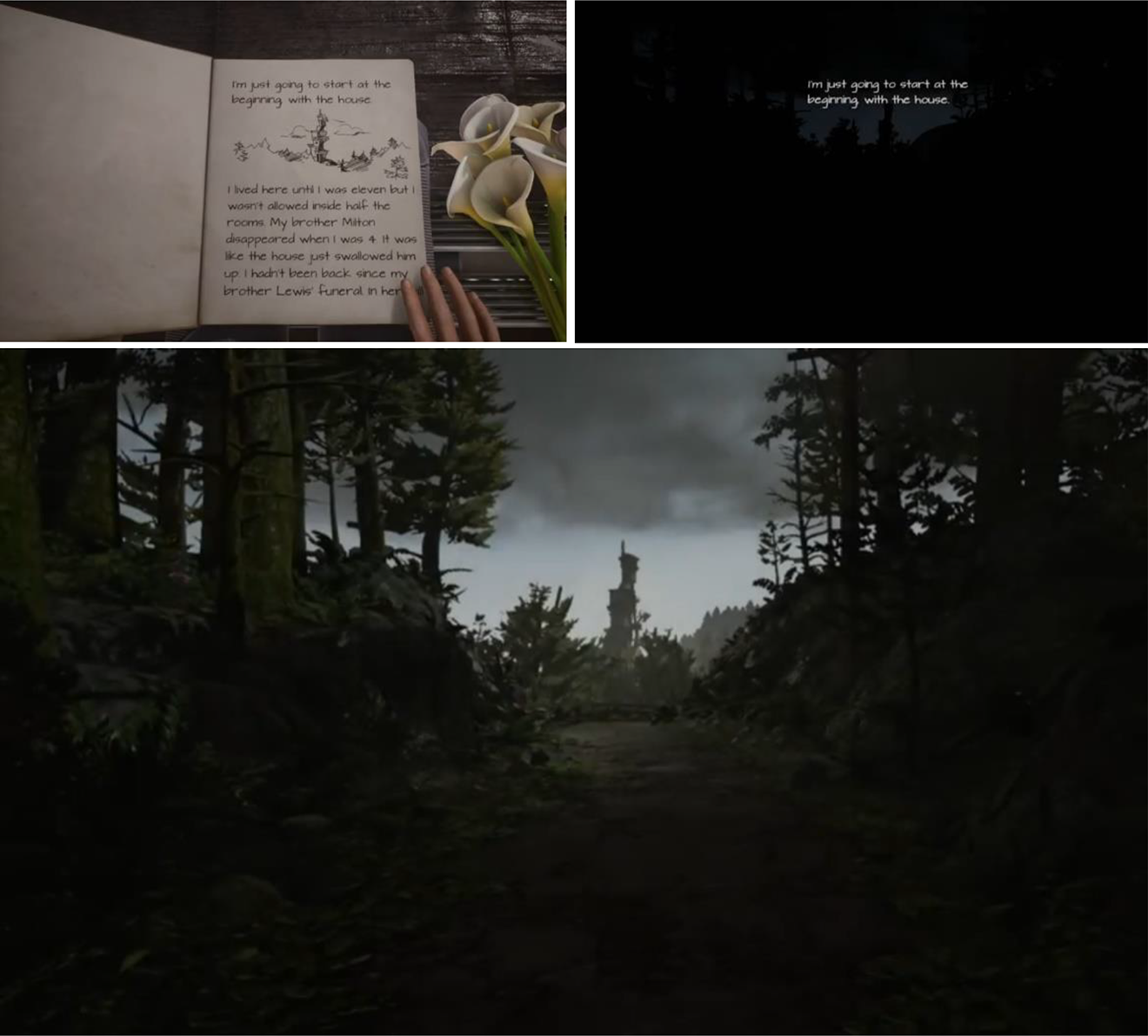
Transitioning from the written page to the digital environment in What Remains of Edith Finch, Giant Sparrow, 2017.
The house is the most awkward construction that I have ever seen. It looks like a child has precariously stacked various cubes atop each other with complete disregard for architectural rigor, structural logic, or gravitational constraints. It is unlikely that it stands and yet it does.
The house looks like everyone left in a hurry. I soon find out that they did.
The writing is everywhere, around me, in the woods, around the house, in keyholes and fireplaces, in the letters, books, and diaries that I find, always guiding me forward, always letting me in. It always appears in the most unusual places and then disappears, or dissolves, or crawls, or flies, or jumps as I follow it higher and deeper inside the house. Forever out of reach, it teases and it plays. The text is not just alive but also endowed with personality. It is cheeky, playful, and joyous.
In the next hours, I discover the Finches as I walk, fly, swim and crawl, swing, flip the pages of a comic book, open cans, decapitate fish, take photos, create a bath-time ballet with frogs and duckies, fly a kite into a storm, hold my mum’s hand as she fades away, and push myself out of my mother’s womb. I die, and die, and die again, until all the Finches are gone. I say goodbye a lot and brace myself to keep going. I walk, read, fly, swim, crawl, swing, flip, and dance them to their death. And as I relive their demise, I feel that it is my hand that gives the final push. I have read/played their story to conclusion.
WRoEF is a first-person game developed by the American studio Giant Sparrow and published in 2017 by Annapurna Interactive for Microsoft Windows, PlayStation 4, and Xbox. The game won the award for Best Narrative at the 2017 Game Awards and Best Game at the BAFTA Game Awards, 2018 (https://www.imdb.com/title/tt4485128/awards).
The game is structured as a collage of playable stories, each depicting the premature demise of one of the members of the Finch family. The player starts the game as the last living member of the Finch family, as they return to the family home on Orca Island in Washington State. As we explore the Finch family house, we uncover the Finch “curse”: the tragic deaths and disappearances that have plagued the family for generations. Each story demands that the player performs different in-game actions that lead to the unescapable and untimely deaths of Molly, Barbara, Calvin, Edie, Odin, Sam, Walter, Gus, Gregory, Lewis, Milton, Dawn, and Edith (Figure 2).

The Finch family tree, What Remains of Edith Finch, Giant Sparrow, 2017.
In what follows, we analyze moments of the game in which literary elements combine with ludic elements to shape the overall gameplay experience. We engage with the game as played to meet Keogh’s (2014) observation that video games are “a bastardisation of forms” (p. 10), which are better understood in the interplay between: “the player, the hardware, and audiovisual representation” (p. 12).
Frame Narrative
WRoEF is structured as a collection of short stories, each distinct, each belonging to a different genre, and using different storytelling techniques. This overall structure of the game borrows the literary technique of a “frame narrative” by developing a collection of stories within a story within a story. The first frame is established on the ferry as Edith’s son follows in his mother’s footsteps returning to Orca Island with Edith’s diary and a bouquet of calla lilies. As the player opens the diary, she is transported inside it, in the story time and space (Figure 1). The player now becomes Edith who after her mother’s death, having inherited a mysterious key, returns to the Finch family house to find out more about her family and the family curse. This is the second narrative layer, simultaneously narration and narrated time, the story within a story that hosts other distinctive stories within it. As the player explores the house, she gradually unlocks various rooms, each belonging to a different Finch. The rooms function as narrative frames, windows to various stories each with its own individual narrative style, mechanics, and setting. These stories are linked spatially and thematically by the house and the Finch curse, while remaining temporally distinct and achronological. The personality of each of the Finches is communicated through a combination of a distinctive literary style (the literary dimension), interaction scheme (the ludic dimension), and environmental storytelling (hybrid literary/ludic dimension). Each character’s room evokes its owner’s personality, age, and passions.
In the rooms, the player finds various written artifacts (letters, books, diaries) either written by or about the room’s owner, which transport her to yet another story time: the moment in which the room’s owner died. These artifacts fulfill the same frame function as Edith’s diary; they are portals that grant the player instant access into another time and into another’s story. This is the gameplay equivalent of Marcel Proust’s “madeleine,” an artifact that summons the past into existence. In this second level of narrative (Edith’s story), the stories of the other Finches (level three narratives) interrupt the narrating time, and story time becoming narration time once more (see Figure 3). What connects the narration time to story time is the written text physically present in both settings (time and place of narration and story). The text thus functions as a visual and aural link to the past.

Levels of narration in What Remains of Edith Finch, Giant Sparrow, 2017.
First-person gameplay combines with first-person voice-over narration to cast the player as Molly, Calvin, Barbara, Walter, Sam, Gregory, Gus, Lewis, young Edith, Edie, and Edith’s son. The voice is how we interpret the emotion and the person behind speech, as Chion (1999) observes: “The ear attempts to analyze the sound in order to extract meaning from it-as one peels and squeezes a fruit-and always tries to localize and if possible identify the voice” (p. 5). Furthermore, we would argue that, following Chion’s terminology, the narrators are acousmatic presences, disembodied voices always out of sight, of the space but not in it, “outside the image but always in the image” (p. 23). The house and its surroundings are their world; they gain demiurgic powers because they voice things still to come into existence including their own deaths. Death and its inescapability are not unusual themes in literary works or cinema. Video games, however, have traditionally focused on its avoidance implying that with mastery of skills, it can be altogether removed. It is perhaps not surprising that Giant Sparrow have opted to engage with narrative voice-overs because, as Chion argues, the narrative voice-over is particularly suited to the dead or those who await death: “the voice enjoys a certain proximity to the soul, the shadow, the double—these immaterial, detachable representations of the body which survive its death and sometimes even leave it during its life” (p. 47). The acousmatic voices of the dead Finches accompany the player, guiding her through their aural and textual remains, both text and voice haunting the house.
Various genres are explored in the game, and although we discuss how elements of magical realism, horror fiction, and poetry are deployed in the stories of Molly, Barbara, and Gus, we want to emphasize that this demarcation is not clear-cut and that elements of magical realism, horror, and poetic language run through the entire game.
Magical Realism: Molly
We find Molly’s room by using the key to open a lock on the book Twenty Thousand Leagues Under the Sea by Jules Verne. The book has a triple significance, alluding to the literary influences of Molly’s story and the initial concept of the game as a scuba diving simulator (see Schilling, 2018), as well as foreshadowing the story that the player is about to experience. The frame to Molly’s story is her diary: As the player opens the diary, Molly’s voice reads the entry dating from December 13, 1947: “Dear diary, I will be gone soon but I wanted to tell somebody about what’s gonna happen. It started when mum sent me to bed without dinner” (WRoEF, 2017). The text lingers as the screen fades to black and then back to Molly’s room in story time (Figure 4).
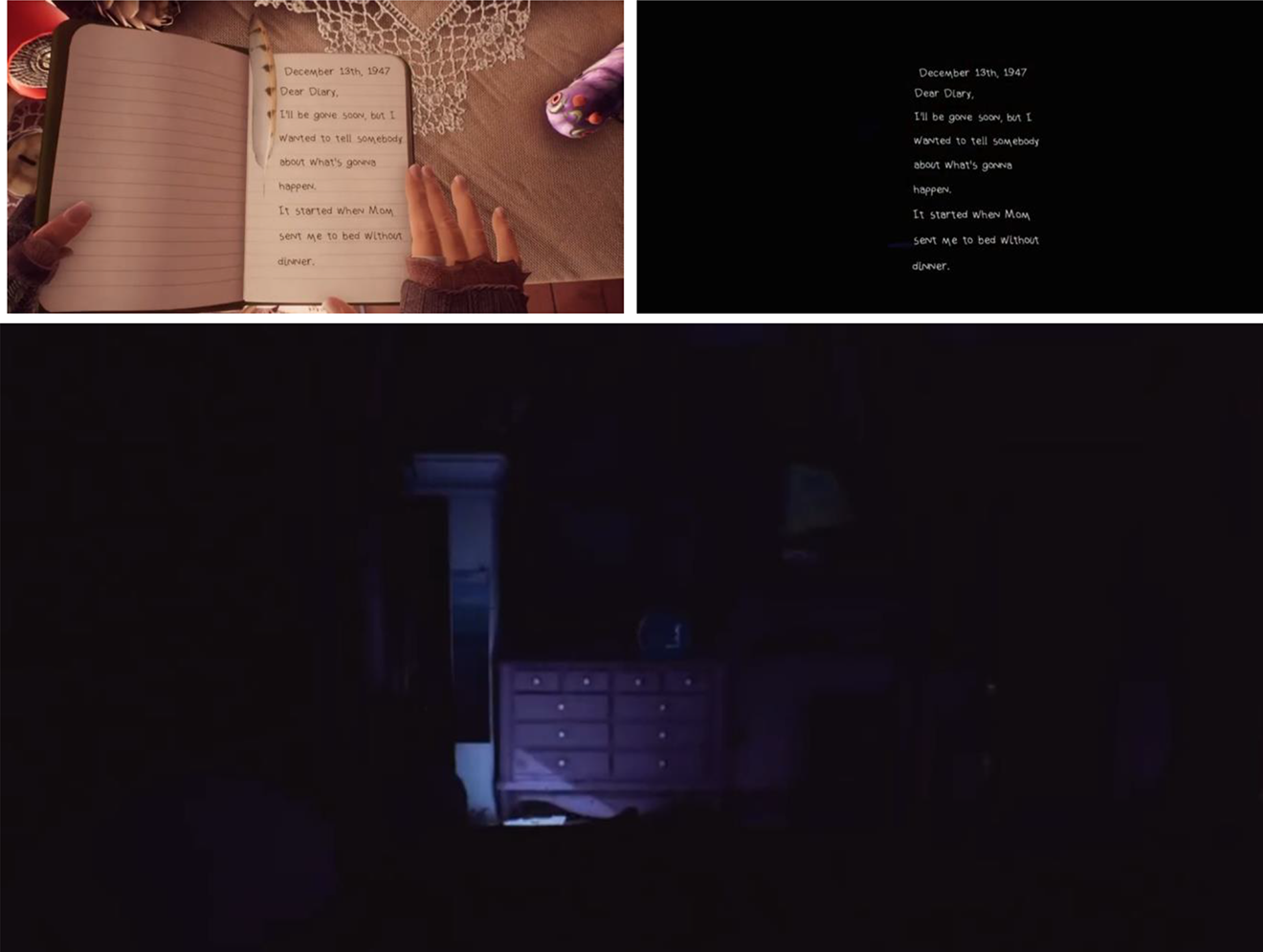
Transition from discourse time to story time, Molly’s story, What Remains of Edith Finch, Giant Sparrow, 2017.
Molly’s voice and her words as nondiegetic text accompany the player as she shape-shifts from Molly, to cat, to owl, to shark, to tentacled monster and explores the island in search of food. Molly’s presence lingers on in her diary and is summoned back by the player reading it to narrate her own death. Molly died when she was 10 years old, her imagination combines with the poisonous berries that the player makes her eat, to send the player on a fantastical journey of playful mechanics where she climbs, flies, swims, and crawls to hunt for food. But the mechanics are not the only element to communicate Molly’s character, her style of writing and the written text are equally playful and unruly. The text also climbs, flies, swims, and crawls, constantly teasing and tempting the player to follow until she eventually arrives back in Molly’s room as a hungry crawling tentacle that hides under Molly’s bed. We become Molly again as she wakes up in her bed, knowing that the monster is waiting for her to fall asleep. We stay with Molly until she writes her final words: “It needs to feed, and we both know: I will be delicious” (WRoEF, 2017) (Figure 5).
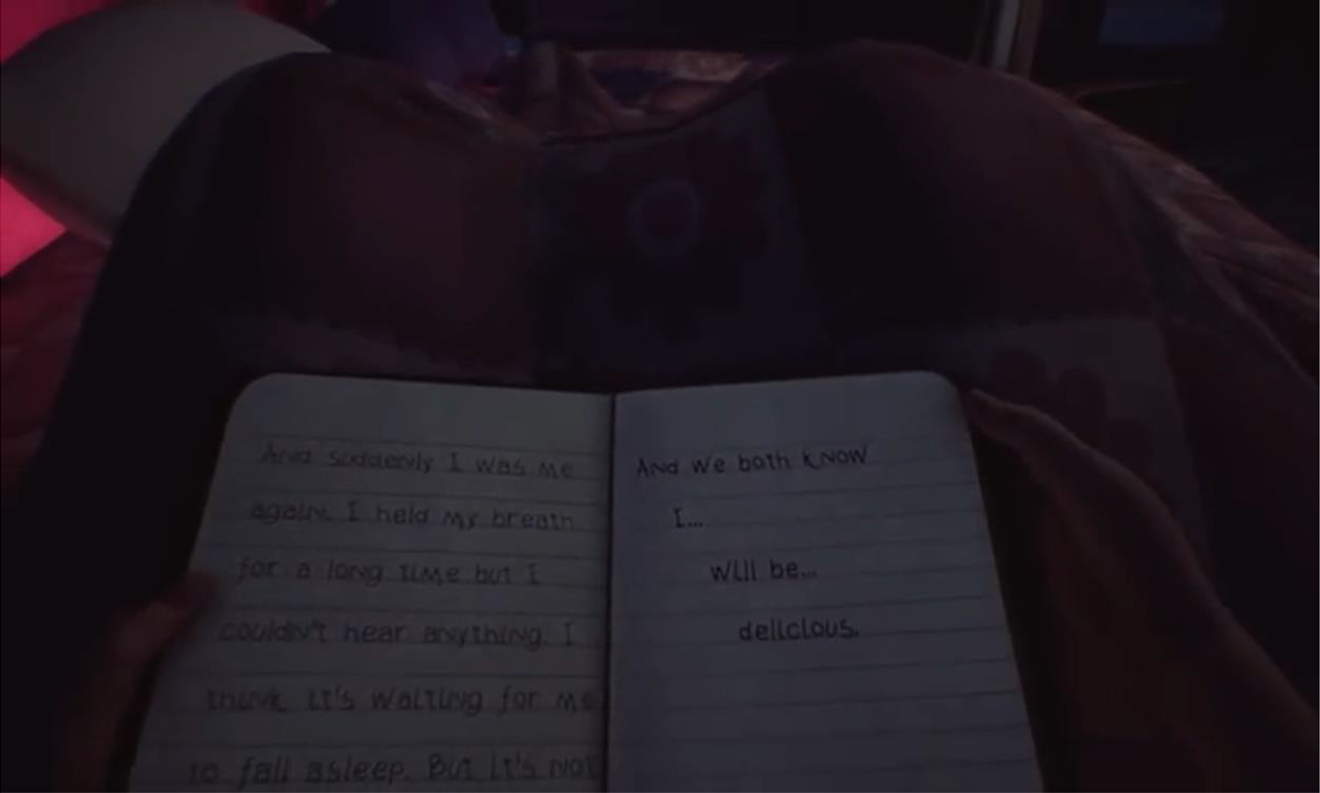
Molly’s story, What Remains of Edith Finch, Giant Sparrow, 2017.
Molly’s story illustrates and encapsulates Giant Sparrow’s fascination with magic realism. The extravagance and excess, which characterize magic realism (Zamora & Farris, 1995), are used generously in Molly’s story. We argue that because this is the first story that the player experiences, it introduces and prepares her to accept a world in which reality and magic coexist. The Finch house is introduced as an accursed and liminal space where the likely and the unlikely merge with the supernatural, a space where “transformation, metamorphosis, dissolution are common” (Zamora & Faris 1995, p. 6). In Molly’s story, these metamorphoses are literal, as the player changes bodies and modes of engagement. Magical realism’s potential for presenting transformative experiences is brought to life by gameplay, which allows the player to perform these herself. Molly’s story illustrates how ludic and literary elements complement each other to create a meaningful cross-disciplinary experience where the player navigates the possibilities and conventions of both literature and gaming. It is perhaps not surprising that Giant Sparrow have adopted this genre if we embrace Zamora and Faris’s (1995) observation that “magical realism is a mode suited to exploring…and transgressing…boundaries” (p. 5).
Horror Fiction: Barbara
Barbara was a child actress who found fame in horror films. In Barbara’s room, we find a comic book called Dreadful Stories, its visual style a clear reference to Tales from the Crypt (EC Comics, 1950–1955). As we open the book, the narrator introduces himself in a voice and manner reminiscent of the Steven Dodd's eponymous television series (Tales from the Crypt, HBO, 1989) “Old Jack here with another ghastly tale” (WRoEF, 2017). The story is underscored by the iconic musical theme of Carpenter and Hill’s (1978) Halloween, another genre-positioning nod. Barbara’s story draws on conventions from horror literature, comic books, and film, creating an innovative hybrid storytelling technique.
The story invites the player to reflect on the conventions of the horror genre as the point of view changes from third person (the player is reading the comic book, image by image, line by line, page by page) to first person, the player becomes the Barbara character in the comic book. The aesthetic conventions, however, are kept, the player now navigates the drawn images of the comic book, her screen space overlaid with speech bubbles, and the borders of the neighboring image strips (Figure 6).

Barbara’s story, What Remains of Edith Finch, Giant Sparrow, 2017.
In keeping with the horror genre, the plot is simple, somewhat formulaic, offering a minimum of information and explanations, as Richard Rouse III (2009) has observed “minimalist game storytelling fits perfectly in the horror genre” (p. 17). Furthermore, we would argue that the design choices, the small screen size for example, only allow space for essential and concise narrative information. This is balanced with a compelling and unique visual style and gameplay. Barbara’s story engages with some established horror tropes while at the same time creatively challenging them. It explores the creative potential of hybridity within established genres and in the process creates a new and unique form.
Ludic and Aesthetic Use of Written Text: Gregory and Gus
The stories of Dawn’s brothers, Gregory and Gus, perfectly illustrate how the written text is used throughout the game to fulfill both a ludic and literary function. The text is alive, it plays and teases, pulling the player deeper and deeper into the fiction, and closer and closer to death. Aside from its purely functional ludic role (guiding navigation), the text also conditions progression. Both Gus and Gregory play with the text that pulls them closer to their ends. In Gus’s story, the text floats in the sky as the player guides a kite through it. The letters are backward, jumbled, or otherwise ineligible until the kite runs through them. The next verse also will not appear until the current verse is read. So, the desire to read the text and find out what happens next is what motivates the player to interact with them.
In Gregory’s story, the writing appears in the bath as baby Gregory is left unsupervised. The player “directs” the toys in the bath to reach/touch it, so that it can be read. Once the text has been read, it disappears, and a new line of text appears. Until the player manages to do so, the story does not move forward. The text itself becomes a toy to be played with. Playing with it, however, moves the story forward and one step closer to Gregory’s end. It is one of the most difficult stories to play through because you know that your curiosity is pushing Gregory to his death.
Gus, Gregory, and the player cannot stop playing just as the story cannot stop unfolding; the story, the game, and the player all have to reach the end.
Intertextuality: Lewis
Lewis’s story is an adaptation of The Coronation of Mr. Thomas Shap by Lord Dunsany (1915). The short story recounts how Mr. Thomas Shap, a businessman, escapes the routine of his mundane life in his imagination. His flights of fancy become more and more elaborate and enticing, so much so that he chooses to never return to reality and lives the rest of his life at the Hanwell Asylum. Similarly, Lewis, after receiving treatment for recreational drug abuse, notices “the monotony of his daily life” (WRoEF, 2017) and escapes his job at a cannery through an imagined world. We “open” Lewis’s story by reading a letter addressed to Dawn from her son’s psychiatrist. The player works at the cannery, moving fish which spawn on the left side of the screen to the right to decapitate them. Gradually, the left side of the screen is taken over by a 2-D world that the player has to navigate and explore at the same time as performing the fish decapitation. This demands that player attention is now divided between the two worlds, Lewis’s reality and his imaginary world materialized on the left side of the screen (Figure 7).

Lewis’s story, the two screen spaces, What Remains of Edith Finch, Giant Sparrow, 2017.
Gradually, this side becomes larger and more demanding but also more interesting and “fun” to engage with. The character’s internal conflict, as his attention is split between the monotonous activities of reality and the glorious and heroic deeds in his imagined world, is expressed and experienced firsthand through gameplay. As players, we become Lewis and experience the challenge of being in and managing the two worlds at once. We help Lewis to build and conquer new worlds: Lewistopia, New Lewisville, St. Lewis, Minneapolewis. Lewis on the left side of the screen is powerful, and his world slowly takes over the screen. The only aspect of reality that is still left is the rhythmic chopping of fish on the backdrop of Lewis’s imagined world (Figure 8).
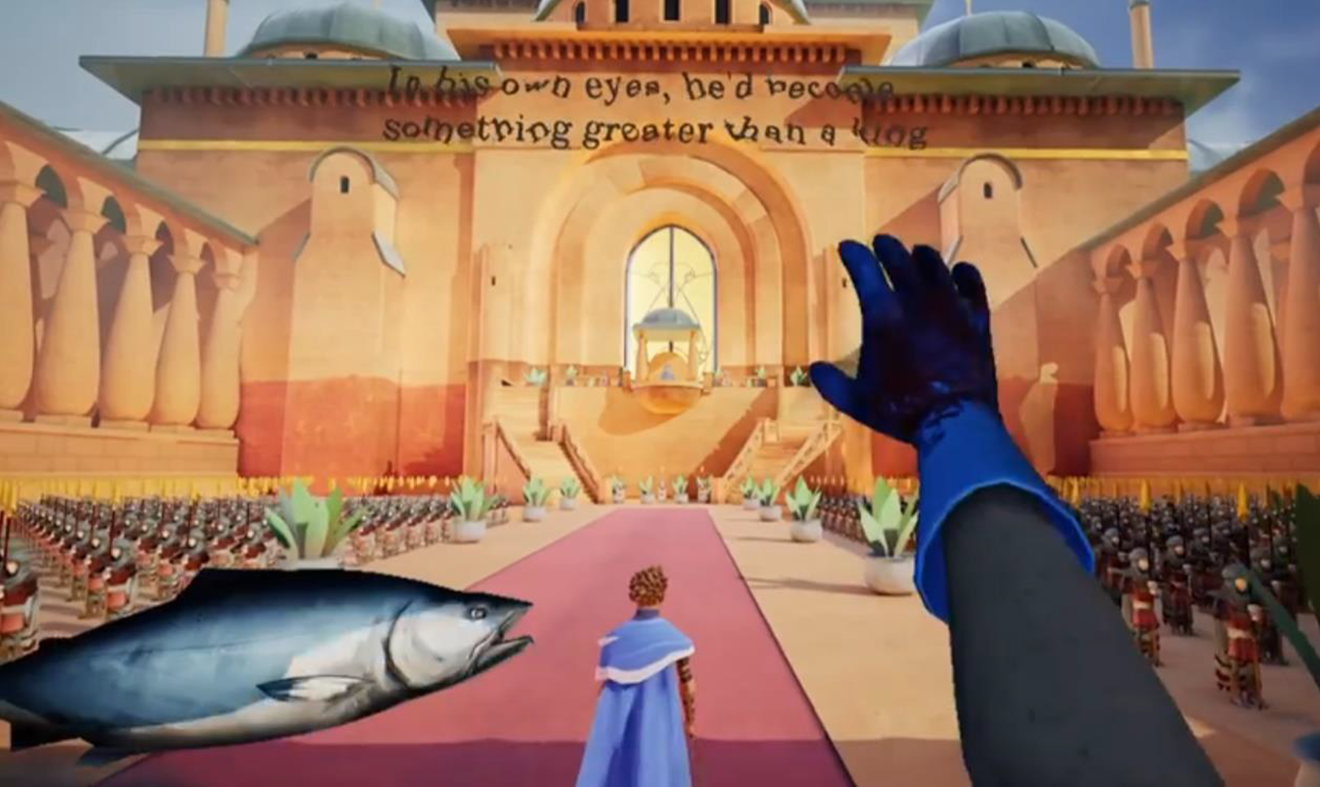
Lewis’s story, fantasy world takes over, What Remains of Edith Finch, Giant Sparrow, 2017.
As Lewis confides in his psychiatrist: “My imagination is as real as my body” (WRoEF, 2017), the door of the golden palace opens and we are in the cannery’s storage cupboard. We walk past the doors and see Lewis meticulously chopping fish. We have become the second Lewis as he readies himself to become king over all the lands of Wonder. The cannery door now opens to the palace as we make our way between the cheering crowds, up the stairs where our queen awaits. We kneel and bend our head to receive the crown. We hear the swoosh of the guillotine and the screen fades to black.
Lewis’s story is a masterpiece in game storytelling, a perfect illustration of what gameplay and storytelling can achieve when designed to complement each other and take advantage of the strengths of both mediums. The alienation between body and mind as well as between fantasy and reality is captured through the game mechanics. The player has to perform actions with both hands on two screens, to be two Lewises at once as they both strive to survive. But Lewis’s story is also a metagame, a reflection on the dual nature of games as both reality and fiction, a duality that does not necessarily need be a separation.
Edith remembers that “Lewis and I spent a lot of time playing games together but he was surprisingly bad at them. He died a lot” (WRoEF, 2017). This becomes an ironic, self-referential comment as “dying a lot” is what the player has to do to be “good” at WRoEF.
Conclusion
WRoEF combines literary elements with environmental storytelling and expressive interaction schemes to deliver a hybrid readerly/playerly experience. In this, it achieves a new level of interpretive play for walking sims and showcases the potential for innovation and artistic expression, which is found in hybridity and cross-disciplinary experimentation with literature and video games. The players are invited to deploy literary and ludic skills; deep and hyper attention; and cognitive, critical, and interpretive skills as they read, play, and navigate through the Finch house. The game developers borrow and blend literary, ludic, and cinematographic techniques to design a compelling narrative and aesthetic experience: The visual storytelling complements the aesthetic use of written and spoken text and expressive mechanics, while the metaphoric and symbolic language takes the form of voice-over narration, monologue, epistolary, and poetic address. The game muddies the demarcations between genres and disciplines exploring themes and forms of expression that have traditionally been outside video game vocabulary and showcasing the creative potential of literary gaming. Understanding walking sims as literary games (Ensslin, 2014) can shift the emphasis from their lack of “traditional” gameplay complexity and focus instead on the opportunities that they afford for hybrid storytelling, for weaving literature and gameplay in innovative and playful ways.
Footnotes
Declaration of Conflicting Interests
The author(s) declared no potential conflicts of interest with respect to the research, authorship, and/or publication of this article.
Funding
The author(s) received no financial support for the research, authorship, and/or publication of this article.
