




Abstract
In this article, we describe three layers of ruins related to computer game technology: in a surface layer, we examine the imagery of ruins in digital games, highlighting game design tools for developing in-game ruination. Secondly, we approach the industrial design model of technological obsolescence as an infrastructural layer that intrinsically demands the production of new provisional spaces for material decay. Lastly, through a waste layer, we unfold the geopolitical dimension of technological obsolescence, calling attention to the transcontinental flows of electronic waste, which also underscores a geological stage of ruination. While exploring these different layers of ruins, we wish to perceive how game design models might relate to different forms of contemporary ruination, inquiring what such material traces have to say as strata of the complex deterioration processes of present-day media.
Your very own gaming PC may be beautiful, but the true beauty of a gaming PC is its upgradability. –Business Insider Magazine
Introduction 1
In the 19th and 20th centuries, the narratives of steady progress that marked the historical development of the communication technologies were nurtured mostly by comparing the properties of new media to older media. The “impacts and effects” of the telephone, for example, were stated above all in comparison to the technical possibilities of the telegraph (Sterne 2007).
The history of computers, and of digital games as their by-products, tends to repeat this narrative yet with an important difference: computers and video game consoles enunciate novelty primarily with respect to previous versions of themselves. Audio bit depth and graphic rendering techniques, processing of particles, grains, and fabric details, object collision physics, and complexity of musical textures, all point to an increase in storage and processing power of the computational medium. Yet, paradoxically, instead of looking and sounding just brighter and cleaner, the visual and aural dimensions of contemporary games seem to present a massive profusion of audiovisual ruins more and more often. This drive towards ruination in computer game visuals could be properly defined as a “longing for ruins” (Ruinensehnsucht), as described elsewhere (Fuchs, 2019). Robert Ginsberg (2004) makes a distinction between the approaches of Late Renaissance and Romanticism in regard to ruination. According to Ginsberg, while in the Renaissance the observation of ruins aimed to recompose unity through the acknowledgment and assertion of what was missing in the fragmented vestiges, early Romantic tradition’s longing for decay aspired to a different form of unity: through ruins, the Romantic gaze was expected to restore the bond between the man-made and the natural.
Under any of these conceptions, it is clear that ruins are deeply evocative spatiotemporal processes. The Russian poet Boris Pasternak posed that a whole post–World War generation of artists was “raised by the beauty of ruins” (Pasternak in Grünbein, 2010), by walking from the ruins of history. Because they are the debris of long-term cultural processes, ruins are not just random accumulations of material structures, buildings, and machines. Ruins are things that “may remind us, may trigger our memory, because they carry memories which we have invested into them” (Assmann 2008), conveying images, symbols, and stories as “lieux de mémoire” (Nora 1993).
What can we learn by walking through the unrelenting accumulation of ruins in games? What could these audiovisual ruins say about their material decay as cultural debris of digital media? Ruins were objects of admiration for Romantic artists, a figuration of trauma for postwar subjectivities, a war-praising tool for belligerent leaders, and memories to conserve for cultural heritage initiatives. In computer games, though the production of high processing power-consuming ruins can also testify about the dynamics of quick disposability and replacement of parts, processors, storage units, and operating systems of digital devices which seem to be properly defined by the gradual reduction of their so-called “shelf life,” their quick deterioration, and prompt need for hardware replacement. To put it simply, audiovisual ruins may be the topographic images of the material ruination processes of technological obsolescence.
To summarize it, with this article, we observe ruins from three different standpoints in order to entangle them: in a surface layer, we examine the construction of the highly detailed imagery of ruins in digital games, highlighting game design tools for developing in-game ruination. Secondly, we approach the industrial design model of technological obsolescence as an accelerator of ruins, an infrastructural layer that intrinsically demands the production of specific spaces for material decay. Lastly, through a waste layer, we call attention to the transcontinental flows of technotrash, unfolding the geopolitical dimension of technological obsolescence, which underscores a final geological stage of ruination.
Electronic waste and planned obsolescence are indexes to assess 21st century capitalist technological culture (Parikka 2017). Digital games should be related to this context as cultural artifacts that have become increasingly influential in contemporary media ecologies. We can trace the connection between the imagery of ruins in games, technological obsolescence, and e-waste via Massumi’s concept of “attunement” (Massumi 2014). Based on this, we propose that there is a primary, nonconscious, presubjective, nonsignifying, and intensive link between physical waste, metaphoric ruination, and technological obsolescence. Thus, with this conceptual article, we wish to subscribe the study of game design into a broader perspective of material culture, entangling game imagery with contemporary cycles of production and disposal of technocultural artifacts.
Images and sounds of ruination: moving through an excess of ruins
In May 2020, Epic Games announced the newer version of its Unreal Engine, releasing on YouTube a demonstrative video with a gameplay section of Horizon Zero Dawn’s sequel (Figures 1 and 2). It was a showcase of the game development tool’s main new features: Nanite, a micro-polygon rendering system to support real-time scaling of highly detailed geometric objects; and Lumen, a dynamic system that simulates the bouncing-of-light effects in global scenery illumination. Indeed, the sand particles pop off from the soil and are smoothly carried by the wind, the multilayered debris and multishaped rubbles of stone hop around as the diffuse glimmers of light from the open sky brighten a predominantly shaded area. While the game’s protagonist wriggles through narrow pathways, the depth of field shifts from shallow to deep, rendering a very cinematic experience of sneaking through ancient ruins in gameplay. Screenshot of Unreal Engine 5 promotional video. Source: Unreal Engine.
13
Screenshot of Unreal Engine 5 promotional video (2). Source: Unreal Engine.
14

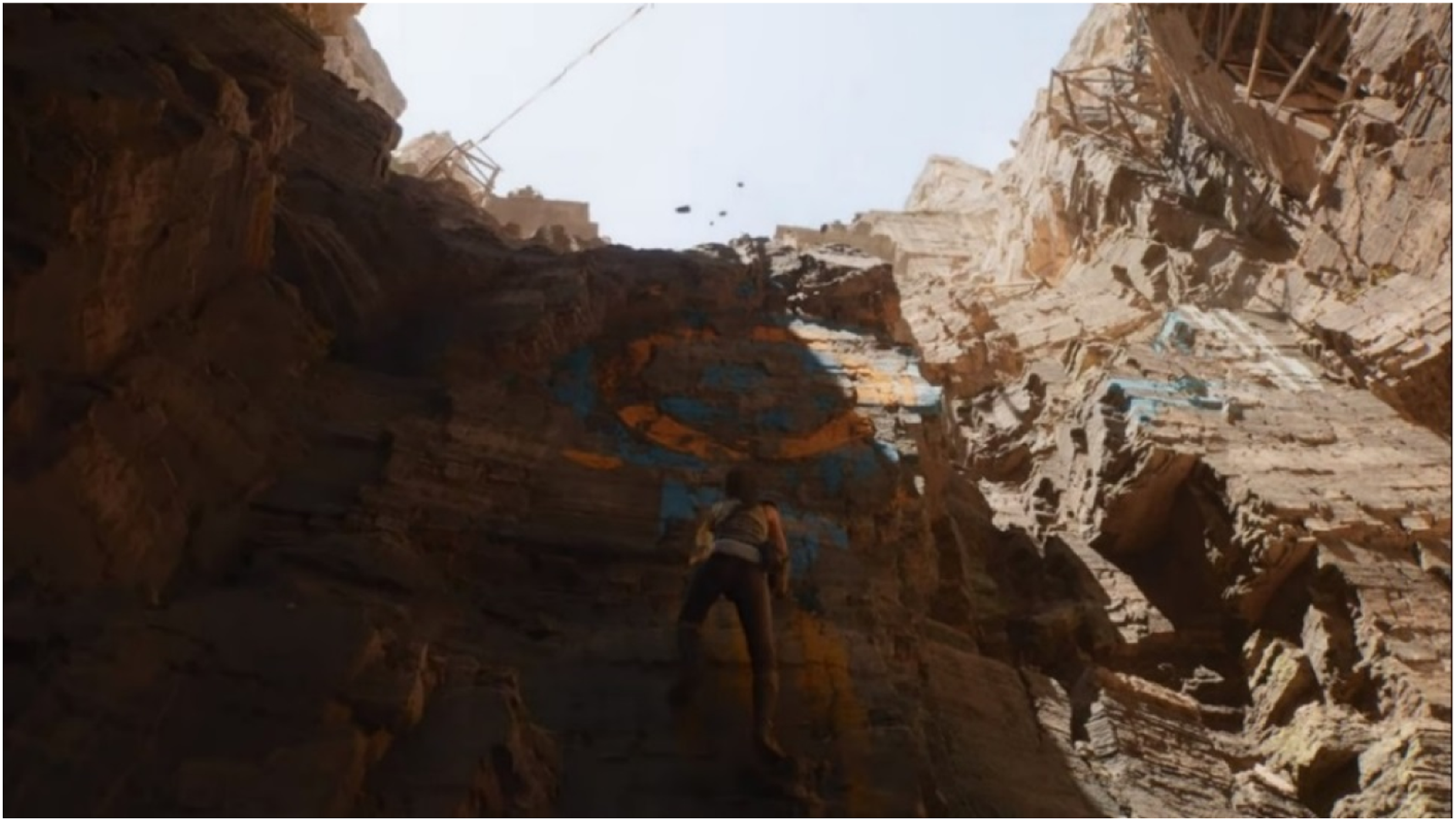
In an official release note, Epic also highlighted the continuation of its game development tool’s previous features, such as the Chaos Destruction system—a collection of resources that game designers could use to “achieve cinematic-quality levels of destruction in real time.” The Unreal Engine (2020) documentation also describes a bundle of features such as the Geometry Collection (items to be destroyed), the Fracturing Editor (used to define how items are destroyed), and Clustering (defines the varying levels according to which such items are broken apart). Additional tools, such as the Connection Graph (to manage the connection between the different broken pieces) and Fields (to directly control fractured parts) offer to designers some more enhanced options for the expressive implementation of audiovisual downfall in games.
This is not at all unusual. Back in 2009, the company Thinkinetic started working on a plug-in for 3D design software that assists in destroying structures in a realistic way. Originally developed for a project to digitally demolish the Acueducto of Segovia, the plug-in attracted many designers and software companies in the meantime. Currently, the plug-in is available for 3D StudioMax and for Maya. It might well be that a decade that has been haunted by disasters like the demolition of the Buddhas of Bamyan in a cliff in Afghanistan or the attacks on city centers was mentally prepared and visually conditioned to enjoy decay and destruction in the medium of computer simulation (Figures 3 and 4). Thinkinetic’s Pulldownit plug-in web banner. Source: Kineticthoughts.
15
Screenshot from Thinkinetic’s destruction tool as applied in Autodesk Maya. Source: Kineticthoughts.
16


One does not have to look any further to realize that there is a very systematic methodology for breaking objects apart and to simulate decay at many different levels of game design. As the main character of the Horizon Zero Dawn sequel climbs the canyons and runs through the highly detailed decaying monuments of the scenery, we see the billowing clouds of dust; the rolling fragments of tiny rocks add some lively motion to the natural rock formations depicted at the background.
Ruination is also present in the game’s sound design project. We can hear subtle crackles of grainy, fragmented objects settling into the landscape while we feel surrounded by the reverberation of sonic events that fill the monumental gallery spaces. By simulating special conditions through the behavior of sound, these ruins turn out to sound even larger and deeper, compensating our very limited range of sight during certain parts of the video.
The sonic idiosyncrasies of malfunctioning machines and the “dirt” we usually hear on damaged speakers can also become aural references for the creation of decadence in game sound design very frequently. For example, the sound designers of the game Nier: Automata (2017) have developed a series of plug-ins to implement different types of superficial crumbling sounds during gameplay (Kohata & Shindo 2018). In this case, the deterioration parameters were designed mainly using frequency filtering and digital signal processing while the performance of music, voices, and sound effects was set to change for a determinate period when the player reached certain trigger points within the game. In addition, the sound designers developed glitches and “lo-fi” effects that, when applied, would set a decrease of 50% to the sampling rate of sound playback, reducing the definition of audio samples in real time during gameplay. When navigating the world of Nier: Automata, these parameters are mainly triggered for depicting ruined machines, malfunctioning robots, and cracking operating systems, but they are also used as sonic metaphors for the existential crisis that afflicts the anthropomorphic machines in the game’s plot. The trope of ruination touches this game on many different aspects. In most cases, it provides a metaphor for physical destruction and emotional misery.
These phenomena find a parallel with the increasingly popular holiday activity of so-called “dark tourism,” in which travelers are guided through locations that are reminiscent of crime, disaster, and despair. The number of visitors to places like Ground Zero, Auschwitz, Chernobyl, or Cambodia’s “Killing Fields” is estimated to be many millions.
2
The Netflix series Dark Tourist shows to those who are interested how it would feel to be in the Darvaza gas crater—also called the “Gate to Hell”—or in what remains of the Fukushima Daiichi nuclear reactor. There are numerous video documents of people sneaking into Chernobyl’s reactor 5 or other places in the vicinity of the meltdown.
3
The footage demonstrates an excitement that seems to be fueled by the thrill of doing something dangerous and illegal, but also by a positive feeling of experiencing historical material in an authentic manner. Computer games allow for a quasi-authentic experience without the health risks of nuclear radiation. Commercial games and amateur productions live from the thrill of a virtual dark tourism and restage meticulously places such as the hotel Polissya in the city of Pripyat (Figure 5). The city of Pripyat, as rendered in the game S.T.A.L.K.E.R.: Shadow of Chernobyl (2007). Source: screenshot taken by the author.
In computer game imagery, just as these and many other cases show, ruins are important for setting the mood and atmosphere, bestowing a nearly animistic quality to audiovisual landscapes and environments. Such tropes seem to render the synthetic game worlds more organic through the modeling of real-time images and sounds of deterioration. These are not simply realistic representations of technical objects, urban architecture, and natural landscapes, but very rusty machines, decadent buildings, and expressive natural habitats. This is not still life, but hyper-realistic granular drama.
As pointed elsewhere (Fuchs, 2017, 4), ludic nature becomes “more corroded than it once was. Trees have to have moss on the bark, the feet on the ground have to trace dust tracks and the air needs to be filled with fog and smoke.” Fog, dust, and pollution effects are render-intensive and require a high processing power from the computer. Such textural details and granularities (Figure 6) mean much more demanding struggles in terms of computer performance: “only with advanced video cards did it become possible to generate hyper-realistic fog in the distance, to blur the view when diving in muddy water or to create smoke trails and realistic rain” (Fuchs, 2017, 4). City ruins in Nier: Automata. Source: screenshot taken by the author.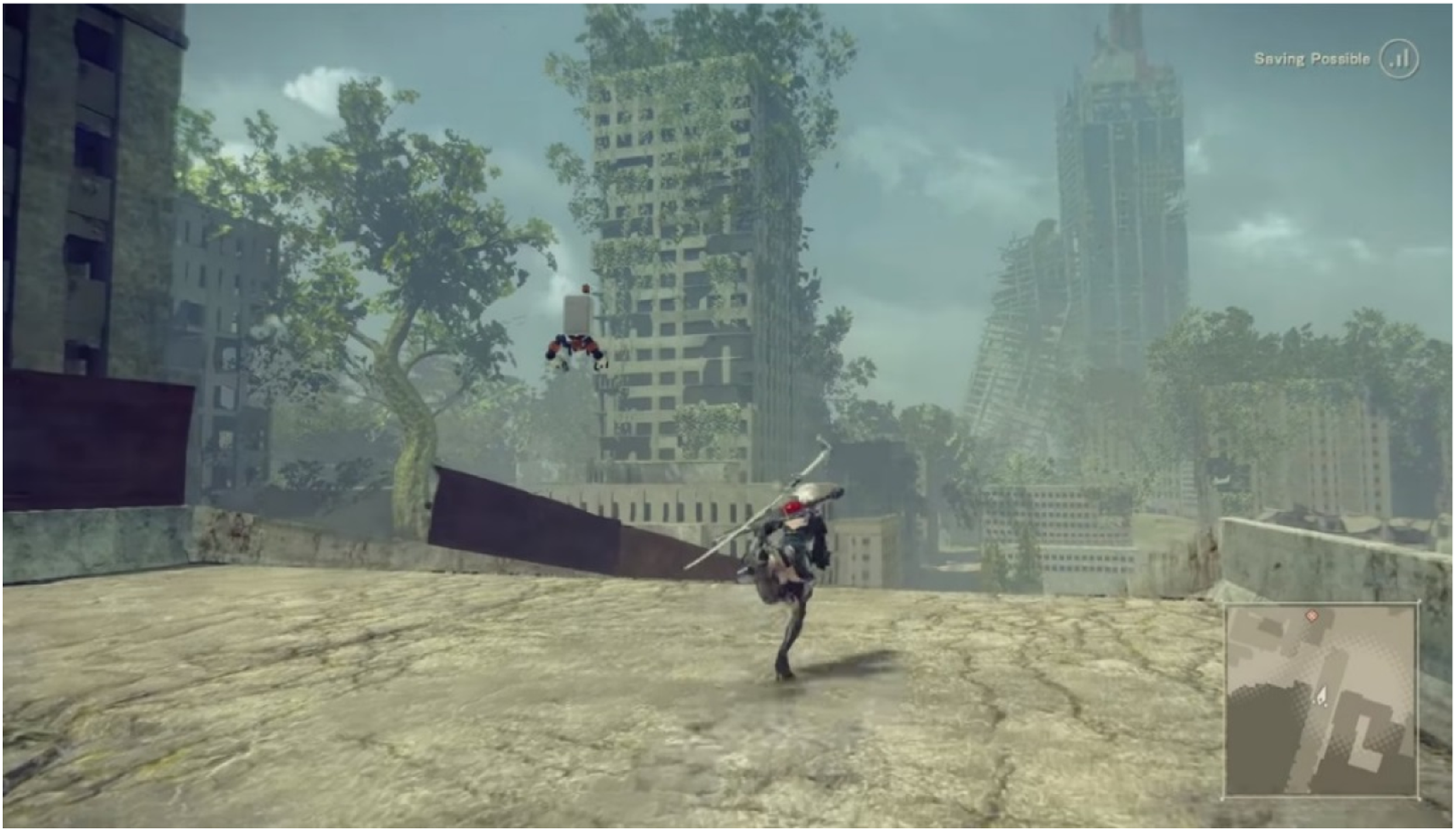
Customarily, this tendency also incurs in a significant difference in terms of the computer’s data storage capacity. In the months prior to Final Fantasy XV’s (2016) release, there was a hoax taking place in game-related forums and blogs that the new J-RPG would have a 170 gigabytes install size. 4 Even though it happened to be just the result of a misguided press statement, the fact that many gamers and critics were not surprised by the news testifies about the escalation of AAA games free-disk storage requirements. 5
It turns out that most of the actual massive storage requirements refer to graphic and sound design models and samples. The simulation of materials plays an important role in this, in the performance of high-definition images of texture and lighting effects at 60 frames per second, for instance. As one developer puts it, “1,280 x 1,280 textures are around 3.6 MB, while 2,560 x 2,560 becomes 14.7 MB. A 4 K texture could be as much as 64 MB.” 6 In regard to storage capacity, it then turns out that modeling and art direction regulate a large part of the image economics of gaming.
The global dispersal of digital games is also important in this aspect. Some AAA games are currently producing voice-acting audio files up to seven different languages, in some cases including all of them, regardless of their buyers’ language proficiencies. Voice acting (and voice audio samples) seems to be a significant resource in some games also for an esthetic reason. The expressive traces and frictions of the human voice are harder to simulate than a clean speaking tone, and such tropes seem to be esteemed even to represent speaking machines. Although speech synthesis has been largely developed lately due to the use of more varied machine learning data sets, the raging robots and depressive androids of Nier: Automata still whine and moan with human voices dubbed by human voice actors.
Moreover, in a more general account, audio files are heavily demanding in terms of storage due to their high-definition standards. As a result, audio samples are oftentimes rendered with lower compression rates, for instance. “Perfecting sound forever” (Devine 2013) seems to be a persisting trend even (perchance especially) when modeling damaged and broken worlds.
The ruins in Horizon Zero Dawn 2, Nier: Automata, and in many other games seemingly highlight the underlying relation between computer storage, processing capacity, and contemporary game design, especially in the case of AAA games as representative of game industry standards. Although these examples should not hold the interpretation of this phenomenon as a unidirectional approach toward game design, such quantitative data provide us with a provisional, even measurable dimension of the drive for continual enhancement of computers' processing power and storage capacities. To stay up to date with state-of-the-art game audio and graphics, one has to enter the hardware replacement cycle of consumption and disposability.
On that account, we can draw the partial conclusion that the highly detailed perfectioning of ruins in games is endemic to the innovations of graphic and audio cards, processors, and data storage units. Moreover, there is a wide range of game design tools, features, and methods to implement the imagery and sounding of ruination in game worlds. Through such correlations, besides its historical, psychological, and esthetic motivations, one might say that the drive for ruins in contemporary digital games is also a hardware industry standard.
Provisional spaces of ruination: making room for obsolescence
But perhaps we can properly dig this phenomenon through a different layer. Although there have been important bodies of work articulating video games with technological obsolescence (Guins 2014; Newman 2012), the relationship between game images or sounds and obsolescence still seems much less explored. Yet, this is not without reason. Comprehensibly, we usually tend to separate the study of media properties, its chains of circulation, and image analysis as parts of different grounds of research which comprise specific analytical methods and epistemological assumptions. What we propose here though is that through the motif of ruins, we can suggest a strong bond connecting esthetic representation with technical infrastructure in the case of computer games. Through this effort, perhaps we can trace some continuities between the growing audiovisual ruins in digital games and the material accumulation of electronic rubbish—at times dumped oceans away from its leading consuming markets.
As far as we know, there has been no digital game within which images of ruins are explicitly denotative of the debris of computer hardware in extra-ludic contexts. In certain dystopian games, however, there are connotative links between rusty computers and the decay of hardware (e.g., Fallout, Call of Duty, S.T.A.L.K.E.R, and Nier: Automata). In games like those, there seems to be a nonconscious, nonsignifying, and intensive link between physical waste, metaphoric ruination, and technological obsolescence. These forms of affective relatedness are based on what Massumi (2014) calls an “attunement.” Following up on a Deleuzian formula of attunement, such precognitive affects bring “the collectivity of shared events to the fore […] a multiple, bodily potential for what might come” (Massumi 2014, 111). In other words, the gamers get acquainted with a situation beyond their knowledge and before they develop any conscious understanding. They might not even have heard of or thought about technological obsolescence or e-waste, but they “attune” to these phenomena by playing the games. This could be seen as a “microperception” (Deleuze 1992, 86) or a form of affective politics (Massumi 2014). “Political thought,” Massumi (2014, 40) tries to convince us, “flourishes with noncognitive primary consciousness.” We have argued elsewhere that a politics emerging from such nonsignifying and precognitive affects contains lot of potential for ideological distortion, idealization, or superficiality, if things go wrong. Hence, the ruins in ludic environments may remind us of the actual piles of electronic waste to come, or they may just attune us to processes of accumulation of huge amounts of technotrash that underlie planned obsolescence. Walking through these ruins, we might eventually grow a precognitive understanding that the e-waste cycles underscore broader systemic issues of material deterioration.
To entangle computer games' graphic and sonic motifs of ruination with technological obsolescence, we might also do well to consider the role that disposability plays in the designing of contemporary digital media, especially in regard to the “life cycle” embedded in consumer products as an integral mechanism of present-day industrial modes of production and consumption.
As described by Parikka and Hertz (2012, 425), the concept of planned obsolescence was conceived by Bernard London in 1932 as a governmental policy to tackle the economic downturn of the Great Depression. At that time, London saw it as “a prescription for the relief and cure of the ailments from which our economic organization [was] […] suffering” (London 1932, 6). The proposition consisted of a taxation system that would charge consumers who used a product for longer than its prealigned obsolescence date—whether it was a piece of clothing, an automobile, or an apartment.
Although London’s proposal did not thrive as a governmental taxation plan, we can say that the planning of obsolescence survived as an ideology soon to be adopted as an industrial standard (in many different scales) for product design, mainly through the artificial decrease of consumer electronics' lifespan. Consumer culture had a big boost in the United States after the Second World War, with the production of goods increasing to the point of market saturation. Automation, a term popularized early in the postwar period, certainly played an important role in this. When computers emerged in the 1950s, industrial sectors were already involved in a radical restructuring of operations designed to “automate as much of the production process as possible.” In April 1947, “Ford Motor Company vice president Del Harder set up an automation department” (Rifkin 1996, 66).
Of course, automation fostered the emergence of different practices of consumption and disposal, but also the acceleration of production. As Jennifer Gabrys (2013) points out in her research on digital rubbish, though, it was when the integrated circuits (microchips) became usual that manufacturing facilities acquired a radically high pace. The microchip led to temporal transformations in design, logistics, and material usage, which guided a new machine economy under principles of proliferation, quickening of matter, and increased disposability. The electronic media products that emerged from then on would appear to be “programmed for their own elimination” (Gabrys 2013, 81). As Jonathan Sterne (2007, 22) observes, this is an important factor to be taken into account when we talk about the computer specifically, as engineers not only plan obsolescence but design and embed it to the medium itself. Computer industry pushed the logic of obsolescence to such an extreme level that the constant offer of fresher and newer computer equipment would simultaneously hasten the physical decay of its own, still very recent, parts. Just think how many generations of computers have become out-of-date during your lifetime, for instance.
The far-reaching standardization of this model by the tech industry, of course, has also entailed radical changes to the rhythms and practices of disposability. After their first owner’s use, computer pieces can be sold to secondhand markets, but there is a relatively short span of time until they get outmoded there too. Moreover, unlike other consumer goods that may get back in the loop during nostalgic waves or vintage fads, computer parts have very limited use after they are outdated. It is also very common for computers (and arcades or videogame consoles alike) to have a much more gradual process of ruination, often ending up in warehouses, deposits, or basements before they go to secondary markets or dumps—less often, they might also have an “afterlife” (Guins 2014, 213) through practices of reuse. The former is essentially a realistic depiction of one whimsical scene in Haruki Murakami’s novel Pinball, 1973 (Murakami, 2016). The story’s unnamed protagonist, a freelance translator, delves deep into a journey of obsession while looking for an old Spaceship pinball machine only to find it in an abandoned warehouse, locked inside some sort of arcade graveyard with many other obsolete machines. This allegory in Murakami’s novel plays with a very common destination for electronic machines and parts once they stop being useful. It dramatizes how trashed media technologies take a different route than that of daily residual waste as they tend to have a sort of “storage phase” prior to their forthcoming waste stage (Figure 7). This is a trope that could be extended to many different kinds of disused hardware such as printers, monitors, and peripherals. This transitory yet inertial stage of disposability strongly contrasts with the fast-paced rhythm of the cycles of production and consumption that habitually encompass computer-related technology. Two rooms of a typical “arcade graveyard” in Benidorm, Spain. Source: Retrobreak.
17
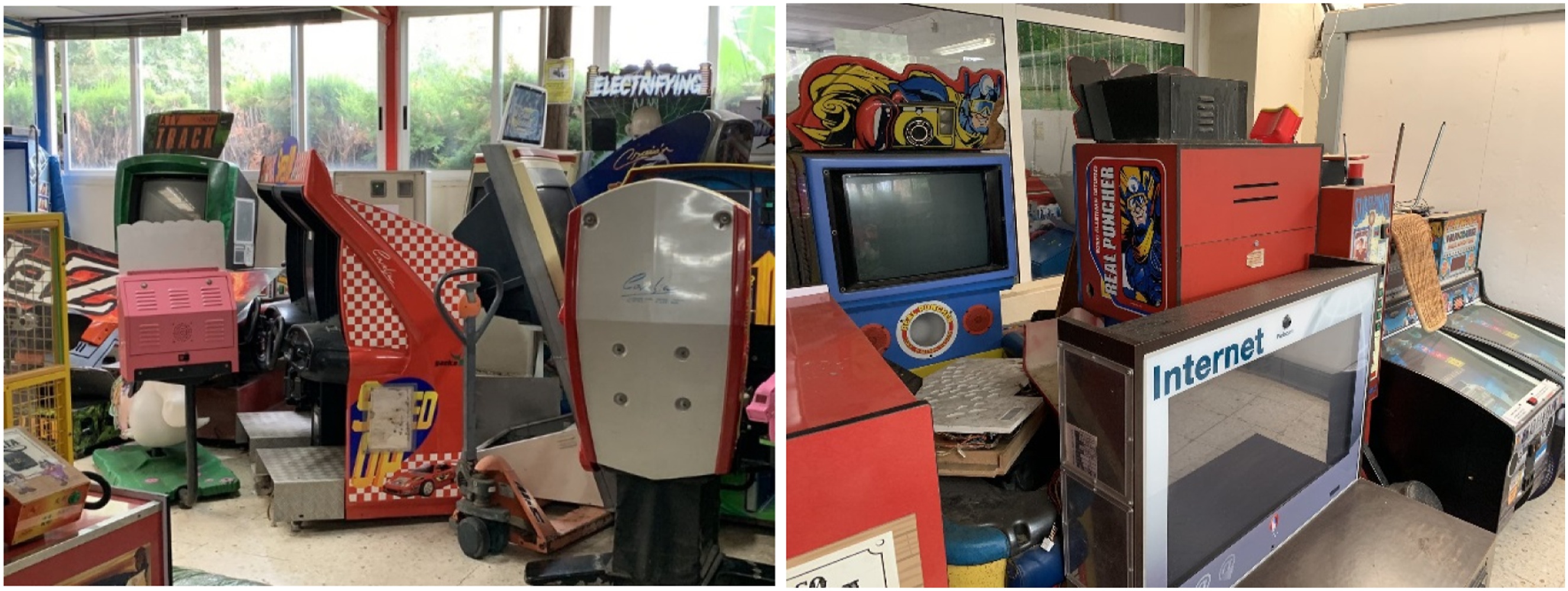
At any rate, far from representing interruptions, the lingering inactivity of these abandoned devices can be regarded instead as extensions of such processes, which intrinsically require the creation of specific spaces to keep the production surplus. Through accumulation of obsolete material, these places become themselves abandoned. As Edensor (2005, 102) points out, abandoned places as these can bring us to realize that “there was a sudden passing which we never properly acknowledged and, more than this, that these disappearing things were objects we might have regarded fondly as part of our own histories.”
Some of these objects also find their way to media and technology history museums, where they are prompt to become categorized, archived, and historicized. More recently, besides museums, some media labs, like the Media Archaeology Lab (University of Colorado), the Residual Media Depot (Concordia University), and the Media Archaeological Fundus (Humboldt Universität) just to mention a few, have been gathering functioning or restorable old computers for careful research use. Outmoded devices may also find their way into the niche subcultures of retrogaming, within which running older generations of games on the original hardware is highly valued as a means to allegedly replicate past playing experiences (Reinhard 2018). This goes in line with other tinkering activities in cultural practices of reuse, such as the case of chiptune music scenes, in which musicians and art collectives employ outdated video game hardware as composer tools (Schafer 2015). Through both these practices, computer hardware may either have a more institutionalized afterlife or instead nurture more subjective relations, contributing to produce “lieux de mémoire” (Nora 1993) as objects, places, and events that allow an engagement with lively memories of past experience. In spite of their significance for affectively engaging with digital media’s past and despite their undeniable potential to catalyze secondary markets, these initiatives are still largely outnumbered by the growing amount of hardware that becomes just plain junk, given the size of the obsolescence-driven market for new equipment.
Thus, such pieces are material rem(a)inders of the cycles of mass production and consumption of digital objects, specifically of how they depend on a logic of fast-track replacement. Computer industry usually recommends that companies upgrade their computers every 3 years (or, in times of economic recession as ours, 5 years) but, as one game developer puts it, the one exception is the case of gaming computers: to keep up to date with image, sound, and performance standards, one is recommended to “replace computer parts each 12-36 months.” 7 High-definition audio and video standards and applications continuously feed the upgrading cycle. That is why gaming is so important for the hardware industry. Even though software has been often thought of as “immaterial,” here, its material conditions of possibility, although not necessarily palpable, become very substantial. Game images and sounds, designer tools, operating systems, and other aspects of software and hardware development help to push the recursive experience of planned obsolescence further, always renovating the very need for updating. Novelty becomes digital media’s inbuilt obsession, constituting ruination anew out of the recent past. The remnants of outmoded hardware that not so long ago were considered high-end, cutting-edge technology are now the material testimonies of such fascination for standardized upgradability.
Here, we can recall Walter Benjamin’s thesis that the obsession with novelty characterizes an ideological notion of progress, one that is ultimately armed with a catastrophic drive. This is a dangerous ideology not only because it accelerates the pace of accretion of ruins but also because it continually justifies it (Mate 2011). In Benjamin’s words, this concept of progress is “grounded in the idea of catastrophe” (Benjamin 2009, 515) for it is responsible for an unrelenting pile of ruins rising up to the sky. What is regarded as waste in the present may once have been (sometimes in a very recent past) a gleaming display of progress. Both the audiovisual images these pieces once supported and the involuntary rites of their physical disposal leave traces of the very idea of progress as novelty and growth, the same conceptualization that is already relegating present-day technology to a transitory stage of ruination. The outcome of such a model of development, thus, is the need to make room for obsolescence, creating lingering spaces of longstanding ruination.
In fact, this practice ends up postponing the further stages of computer parts’ decay, which often have an unclear destination. As the United Nations Global E-waste Report shows, the large majority of discarded electronics are not documented in a systematic manner and end up being managed outside the official recycling system. The report estimates that approximately 34.1 megatons of the e-waste generated worldwide (2016) are unreported and untraced, corresponding to circa 80% of all the electronics discarded (Baldé, Forti, Gray, Kuehr, & Stegmann, 2017, 5). While these outmoded pieces of technology are likely dumped or traded, we should also consider that some of them might be stored in such provisional spaces of ruination.
In gaming and personal computers promotional advertisements, we are used to hearing mostly of novelty, innovation, improvement, and new releases, especially regarding the performance of images and sounds, as well as their new design features—such as the developer tools highlighted in the first section of this article. The conditions of disposal are not regarded as an important issue, although the United Nations has already suggested (Baldé et al. 2017) that certain disposability standards should be urgently incorporated in the designing of forthcoming electronic objects. The fact is that the very term “planned obsolescence” gives us the impression that, after fulfilling the role (and the given time) for which the hardware pieces were designed, the objects would simply be gone. Yet, what we actually have is a design strategy based on redundant disposability, nurturing different practices and even spaces of accumulation. Just as Jucan (2019, 12) states, despite the fantasies of erasing the old to construct the entirely new, the obsolete “does not go away—it only goes elsewhere.” Moreover, in the long run, it might even get a different name.
E-waste: moving through ruins of excess
About 50 million metric tons of electronic waste are generated globally every year 8 (Parajuly et al. 2019). This is equivalent to the weight of 5000 Eiffel Towers and more than enough to “fill a line of 40-ton trucks that, end-to-end, would stretch three-quarters of the way around the world” (Jucan 2019, 69). In this case, the accumulation of remainders that Benjamin was referring to—ruins that would “pile up to sky”—could take a quite literal sense.
It is very hard to assert how much of this corresponds to gaming-related waste. Yet, in the last couple of decades, “gamer-designed computers,” usually quite eccentric apparatuses, have gone mass market. Many personal computer components, like video and audio cards, processors, RAM modules, and motherboards, now also have products custom-branded for gamers. Furthermore, since gaming has become more mainstream, one might envisage that the number of general PC users who just happen to also play has increased, adding up to the general consumption of high-end computer hardware.
As we have seen so far, though, the planning of obsolescence entails more than overproduction. Digital media may have obsolescence as its core driver, yet it consistently produces new patterns of endurance and creates alternative spaces for its extended duration. Contrasting with the accelerated cycles of production and consumption, the remnants of media move through complex circuits of discarding in prolonged orders of material decomposition. It is thus not very common to see computer pieces and video game consoles dumping, precisely because electronic waste is usually taken to the inner peripheries of each country and, in many cases, abroad—more often, moving from developed to developing countries. 9
This issue is covered by international regulations (mainly the Basel Convention 10 ) on waste management and the control of transboundary movement of hazardous waste, but the regular infringement of these rules indicates how this issue more profoundly relates to historically constructed hegemonic structures. For instance, it was only in 2010 that Brazil ruled a law for electronic waste management and now, 10 years later, it is clear that it did not bring all the expected effects. It is very usual that one associates such ineffectiveness to a lack of more refined local policies and rigorous inspection. Nonetheless, since much of the waste volume is imported below the radar, through illegal transboundary movements of cargo, it is clear that there are also broader geopolitical issues involved. From 2013 to 2018, the Brazilian Institute for the Environment and Renewable Natural Resources (IBAMA) has intercepted around 500 tons of technotrash illicitly entering the country through harbors and borders 11 (Wermann, Saccol & Tubino, 2018).
In many cases, it is difficult to know exactly where the electronics that move abroad are destined to go because most of them are sent undocumented and mixed with other kinds of garbage, usually in containers and roll-on/roll-off vehicles, trucks, and buses. Some experiments could give us an initial clue, though. From 2015 to 2016, the Basel Action Network (BAN) conducted an investigation in which 205 GPS trackers were placed inside obsolete equipment departing from the USA and European Union member states. It showed that 34% of the cargo moved offshore. 93% of the deployments moved to different developing countries in eastern Asia and 7% went to Mexico and Canada (Hopson & Puckett 2016). Another study (Baldé et al. 2017) showed that 85% of the electronic waste entering Nigeria in 2016 departed from the same regions while another 7% corresponded to China’s deployments. Another report showed that Hong Kong systematically receives e-waste from the city of Houston (Basel Action Network, 2018), with the deployments ending up in the northern region of New Territories, in a rural area comprising several e-waste scrapyards.
It is usually cheaper for companies in developed countries to ship obsolete electronic materials to other parts of the world than to recycle them properly within their own borders. Thereby, these companies sell costly materials at very attractive prices to recycling facilities in other nations, but include all kinds of waste mixed within the cargo. To buy the recycling materials at attractive costs, the receiving companies accept the irregular loads of e-waste.
All these data tell us about a logistics of waste, which encompasses shipping the debris of electronics from one continent to another as part of informal geopolitical arrangements of naval exchange. The computer pieces that once composed an apparatus at the cutting edge of gaming technology are set for a ghostly expedition through what Sekula (2002, 37) calls “the forgotten space” of the sea. In this very peculiar kind of “supply chain of waste,” in fact, the rather “invisible” transportation of materials across the sea coalesces with the slow pace of shipping (Gabrys 2013). While 80% of the global trade depends on maritime transportation (UNCTAD 2018), the often-overlooked oceanic space grants an opportunity to deploy large amounts of cargo at once through transcontinental streams of commodities. From the disposability stage onward, it follows a solid accumulation of material ruins that move through such naval chains before e-waste is dumped elsewhere. This is an important aspect to consider because it shows that spaces for remainders are also produced according to certain infrastructural conditions under which wasteful electronics make a fluvial movement toward locations that are previously, if not historically, assigned for recurring material ruination. 12
Therefore, as the growing accumulation of waste is implied in its economics of excess, we can see how planned obsolescence presupposes a multilateral scattering of ruins that, in an age of planetary-scale computation (Bratton 2015), reveals tendencies to extend and further distort prior issues of political geography.
Stripped from the different parts that make them function on a daily basis and then shipped to locations where they can be further dismantled, disassembled machines are set to become a different kind of commodity. After the disposal of sound and video cards, processors, hard drives, motherboards, and so on, there is a subsequent stratum of the phenomenon of planned obsolescence to consider. The discarding of computer pieces implies a different kind of agency once these objects become “useless,” when they are no longer considered as media for human amusement, and are soon to be scrapped for their most valuable parts.
While some methods for recycling electronic waste consist in just smashing machines in smaller units to separate their different pieces, the most efficient approaches are the ones that aim for a higher material compression, by fractioning matter for further separation (based on their material composition) at a much lower level: dust (Gabrys 2013, 138). Transforming the scraps of electronic junk into dust makes it easier to sort materials by their chemical compounds, gathering them on a microscale according to their exchange value. This more efficient process is put through in specialized facilities with higher investments in recycling techniques. The material remains that reach so-called developing countries usually undergo a much less efficient recycling process and find a less valued and regulated labor, a process that seems to be itself an infrastructural and material residue—in this case, a residual mark of colonialism.
Hence, we could say that a systemic loop of deterioration is extended by the narrow, recursive policy of planned obsolescence, which feeds (back and forth) broader geopolitical and geological metabolisms of ruination. As Benjamin Bratton (2015, 83) puts it, What is called “electronic waste” inverts the process that pulls entropic reserves of metal and oil from the ground and given form, and instead partially disassembles them and reburies them, sometimes a continent away and sometimes right next door. Minerals originally sourced from the Congo might make their way to California via China, before being pulled by hand from a dead phone and burned or buried in Agbogbloshie, Ghana, or Lagos, Nigeria, two of the most active repositories, a short distance from their source.
The late stages of technological obsolescence describe a feedback loop between earth and media, restating the fact that technology is “aggregated and made of the raw materials of the earth” (Parikka 2015, 5). Raw materials are “operationalized in digital devices before returning to the earth as waste” (Young 2020, 13), following their devaluation as capital. From this step further, the objects' agency could be regarded more and more in relation to earth as their process of ruination comes along with a broader ecosystemic composition.
Indeed, after flowing between continents, the debris of electronic media end up forming a pile of ruins somewhere else. Nevertheless, considering the dumpster as their final destination would be very problematic according to the perspective on ruins that we have been developing during this article. For ruins are not just in the resulting images and soundscapes of gameplay, or in the transitory spaces of deposition of obsolete electronics, nor only in the piles of trash on the surface of landfills in developing countries. Ruins are complex temporal processes that testify about the perpetual transformation of objects and spaces and, in the case of electronic media, about their ongoing cycles of production, extension, and decomposition. From this perspective, the dumpster could be understood as a locus that discloses enduring geotechnical relations, as well as the updated conditions of the soil at the intersection of nature and technology (Figure 8). It highlights a deeper layer of ruination for computer hardware materials—the geological layer. Left: artificial hills of e-waste in a scrapyard in Taiwan. Right: stacks of computer cabinets in the e-waste landfill of Agbogbloshie, Ghana. Source: The Technological Citizen and For 91 Days.
18

Computer Chemical Components and Constituent Metals.
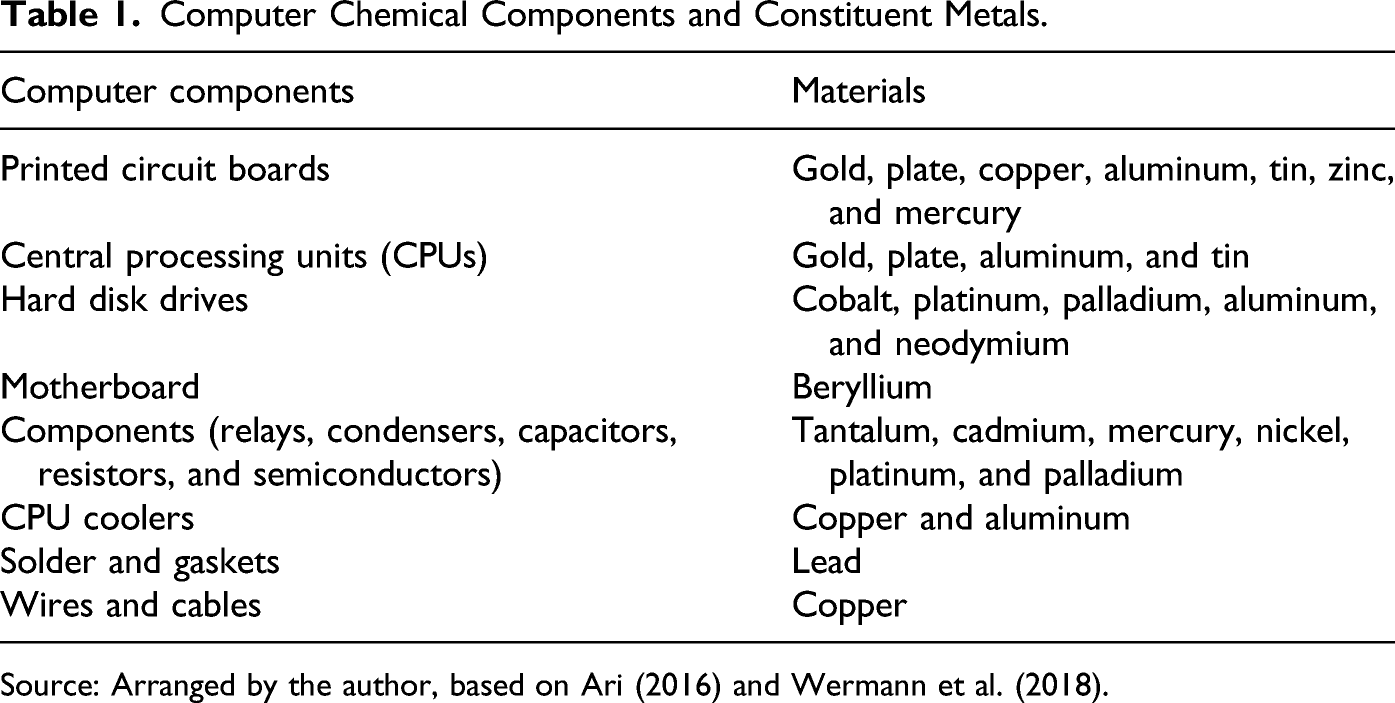
Source: Arranged by the author, based on Ari (2016) and Wermann et al. (2018).
In different sorts of recycling facilities, both garbologists and waste pickers retrieve the “raw materials” from outdated electronics. Here again, these workers may find that the term “obsolete,” which dubs “planned obsolescence,” means more to the industrial urge for excess, as to the pace of compulsive consumer culture, than to the actual material conditions of technical artifacts. Because, as we mentioned earlier, after their outmoding, media does not disappear. One might say that they not only move elsewhere, but that in their future destinations, they also leak and infect. Due to the toxicity of e-waste chemicals, working in waste picking in facilities with poor infrastructure and labor conditions means a high risk of developing severe health conditions, ranging from skin and hormonal disorders to damage in the nervous, circulatory, and reproductive systems (Ari 2016). At this stage, the disassembled materials left in dumpsters and landfills have a prolonged stage of endurance while being absorbed by the organisms and environments: Just as the production of electronics involves the release of numerous hazardous materials into the environment, so recycling and dumping of electronics unleashes a tide of pollutants that spread through the soil and enter the groundwater. From manufacture to final decay, electronics seep into the aquifer and subsoil, settling into longer orders of time and more enduring chemical–material conditions (Gabrys 2013, 142).
There is hardly any deeper structural ruination process involving wasted electronics than this one, with bodies and the very material strata of the soil ending up organically mixed with the chemical components of media technology. In the scrapyard of Agbogbloshie, Ghana, researchers have found that the eggs of free-range chickens raised in the area contained the highest levels ever measured of several dioxins and furans, among other hazardous elements. The process of burning and smashing gears and rigs to extract the metals releases perilous substances and creates highly toxic by-product chemicals that infect the soil (Petrlik, Puckett, Bell, & DiGangi, 2019). Besides the chicken, cattle are raised in the scrap area as well, and the animals pick their food from among the soil in the location.
Wasted hardware, after being exchanged across the sea, ends up seeping into the land. While in the updated images of ruins the traces of obsessive technological renewal seem to vanish, the discarded media of the recent past finds a way of disclosure in the pathway between soil, (agri)culture, and humans. If once such technological rubbish was part of high-performance hardware that supported state-of-the-art images and sounds of debris in game worlds, now they have become core drivers of large-scale organic and environmental processes of ruination.
Final considerations
By walking through the ruins of excess, we might learn that the flows of e-waste underscore broader systemic loops of material deterioration. When we use the term “systemic,” we wish to emphasize the fact that this loop is not the sole responsibility of one main source of material debris, but the outcome of a chain of successions that entangles such disposability cycles, where geopolitical aspects are always contingent. In a broader sense, though, just like playing through ruins in gaming is (and for a good time now it has been) a transnational phenomenon, the subject of infrastructural ruination fostered by technological obsolescence is also a problem that defies national sovereignty. Thus, any proper account on this issue should not dismiss its implications in global political geography.
In a certain way, digital games take the logic of technological obsolescence further, carrying it through a strange esthetic paradox: they present novelty drawing from an accretion of ruins, which are the audiovisual traces of a model rooted in a catastrophic drive. Alternative methods for dealing with the increasing accumulation of ruins from electronics have already been proposed elsewhere (Parajuly et al. 2019). Models of circular economy, for instance, have to rely on large-scale changes in product design to have any systemic effect. Extending the lifetime of products and improving the efficiency of recycling facilities are important measures, yet only if adopted multilaterally.
Likewise, in the guise of global climate change and the geopolitical implications of the current standard, the effectiveness of waste management policies has already proven to be a matter of critical infrastructure. As Bruce Schneier (2018, 50) argues, though, investing in infrastructure is not “sexy,” and thereby “even when a country touts its infrastructure investments, it usually means building shiny new bridges rather than repairing rickety old ones.” Perhaps we could say something similar about the infrastructural repair of game technology, for the current development policy is more than proven to be profoundly unsustainable as we can perceive by the rapidly increasing accumulation of ruins at present time.
As an endnote, we would like to underline how dealing with this relationship between game content, technological obsolescence, and material conditions of disposal was perhaps the more challenging aspect of studying such a large-scale (and deep) problem, but it was also a fruitful approach in an epistemological sense. Outlining traceable continuities between cultural and natural processes through the trope of ruins in order to highlight the intermingling between an imaginary, an infrastructural, and a geological layer, our analytical framework included opening up to a cross-pollination between different fields of research. Cutting through the design methods to build in-game decay and analyzing the monitored data available on eco-geopolitical matters that comprise the stocking, sorting, moving, piling, leaking, and absorbing of the material remains of hardware, we can find connections in ruination processes that encompass computer game esthetics and technical assemblages (and disassemblies).
Along these lines, we sought to subscribe the study of game design into a broader perspective of material culture through the sketching of a perspective that could nurture further possibilities for more holistic critical analysis concerning contemporary game studies. After all, as realms of memory that convey images, symbols, and stories, ruins claim the weaving between the material and the imaginary and may prompt us to attune to the endemic excretions produced by our models of development—excrescencies we, in fact, would rather forget. These are, after all, ruins of excess, whose recollection can no longer escape even the continuously upgradable imagination of novelty. The ruins in game worlds become the topographic images of the enduring geotechnical processes of ruination to come, the organic and environmental outcomes of an industrial standard of built-in technological obsolescence. The stacks of electronic waste that loom in landfills underscore the need for scalable, deep space/time assessments (Parreńo, 2020) of the ecological, geological, and geopolitical implications of contemporary policies based on accelerated expenditure. Such assessments could start, as we propose, with a critical appreciation of different forms of ruination that are contiguous to game worlds and game technology. The excess of ruins that abound in ludic environments may remind us of the growing piles of e-waste, or they may rather attune us to the processes of dispatching loads of obsolete hardware from one continent to another. Nonetheless, the trope of ruins may connect present-day esthetics of post-industrial game design and the upcoming material destination of computer hardware into the deep metabolisms of the Earth.
Footnotes
Declaration of Conflicting Interests
The author(s) declared no potential conflicts of interest with respect to the research, authorship, and/or publication of this article.
Funding
The author(s) disclosed receipt of the following financial support for the research, authorship, and/or publication of this article: This research received financial support from Coordenação de Aperfeiçoamento de Pessoal de Nível Superior (CAPES), Deutscher Akademischer Austauschdienst (DAAD), and Conselho Nacional de Desenvolvimento Científico e Tecnológico (CNPq).
