




Abstract
Can video games afford authentic heritage experiences, comparable to physical visits to a heritage site? How is authenticity of historical settings related to the player’s immersion? This article explores these questions by looking at the notions of experience and authenticity in tourism/heritage studies and the experience economy and mapping them onto the layers of game immersion. As both video games and site visitation are user-centred designed experiences, they share most of their experiential dimensions: five strategic experiential modules (SEMs) (sense, feel, think, act and relate). Linked through the SEMs, five forms of heritage authenticity reveal close correspondence with five (out of six) dimensions of game immersion/involvement. Therefore, player’s perception of heritage authenticity in historical settings seems to be intertwined with immersion/incorporation. The dual framework of authenticity/immersion presented here allows for detailed analysis of both, the central example being Assassin’s Creed Unity with its famous representation of the Notre-Dame cathedral.
Introduction
Can historical settings in video games afford authentic heritage experiences, comparable to physical visits to heritage sites? Following Champion (2017), I see history-themed video games as ‘activity-based virtual environments (computer games) that attempt to reveal the culturally specific ways in which people created, modified and experienced past environments’ (p. 111). As a form of virtual heritage, they ‘attempt to convey not just the appearance but also the meaning and significance of cultural artefacts and the associated social agency that designed and used them’ (Champion, 2015, p. 95).
I start by looking at the notions of historical accuracy/authenticity in game studies (Section 1) and then experience and authenticity (and experiential authenticity) in tourism and heritage studies (Section 2), to be followed by an exploration of the same in the experience economy (Section 3). Then, I map these onto the types of game immersion/involvement (Section 4). This conceptualisation enables me to correlate multilayered tourism/heritage authenticity to multilayered customer experience and to multilayered immersion/incorporation in video games.
With this analytical framework established, I discuss the main problems with imagining video game locations as heritage sites (Section 5) and the details of their ‘placeness’ and ‘worldness’ (Section 6). Finally (Section 7), I apply these theories to Assassin's Creed Unity (Ubisoft, 2019). Section 8 (briefly) broadens the scope to mixed reality and non-digital games.
Summarising the field of historical game studies, Chapman, Foka, & Westin (2017) frame historical accuracy as ‘the relationship between games and cultural-heritage’ (p. 366). I strongly insist on the ‘heritage approach’, highlighting the fact that ‘heritage is primarily not about the past, but instead about our relationship with the present and the future’ (Harrison, 2013, p. 4). See an extensive discussion of this difference in Mochocki (2021, p. 8–11).
This article has two limitations I am aware of, both due to limited space. I focus narrowly on representations of tangible heritage, leaving the rich and fascinating theme of intangible heritage largely untouched. Focussing on representation of and interaction with material heritage, I will not speak much about the issues of power and politics, for example. Secondly, my examination of AC Unity is not a full-length case study but a demonstration of how the presented theoretical framework works in analytical practice. The aim of this study is to frame virtual historical locations as heritage sites that may trigger meaningful heritage experiences similar in many ways to visitation of physical sites.
The multilayered conceptualisation of experience, immersion and authenticity allows for their precise examination in relation to cultural heritage content. My purpose is mainly academic: to better understand player engagements with heritage. Nonetheless, I can easily imagine game developers, immersive experience designers and heritage industry professionals (e.g. museum educators) turning that analytical framework into a design toolkit.
Authenticity and Accuracy in Historical Game Studies
How is historical authenticity related to accuracy? These terms are not used consistently across historical game studies – sometimes not even within a single book. Playing with the Past (2013) edited by Kapell and Elliott is a case in point. Wackerfuss (2013) sees accuracy as a variant of authenticity: there is ‘behavioural and psychological authenticity’ and ‘accuracy-based authenticity’ (p. 237–238). Similarly, Salvati & Bullinger (2013) speak of ‘selective authenticity’, whose variant named ‘technology fetishism’ relies on detailed ‘accuracy’ in the representation of weaponry and other items (p. 154, 158–189). But Köstlbauer (2013) uses the term ‘authenticity’ instead of ‘accuracy’ for realistic simulations representing the historical past ‘as faithfully as possible’ (p. 170). By contrast, Copplestone in her 2016 work picks ‘accuracy’ as the all-encompassing term, including what others name ‘authenticity’. Meanwhile, the editors of the 2013 volume insist on the separation of ‘accuracy from authenticity’ (Kapell & Elliott, 2013a; 2013b, p. 358). And it is the latter they find more significant in historical gaming (p. 361).
In general, the shift of attention from factual accuracy towards variously defined authenticity is a major rising trend in historical game studies (Elliott, 2020). Among video game developers, as Sweeting (2018, p. 65) and Majewski (2018) report, one excludes the other: ‘Authenticity meant the game is intended to feel accurate without being accurate’ (p. 45). To Zimmermann (2020), ‘A clear distinction between authenticity and accuracy has only been formulated in recent years’ (p. 15). Analogical attempts in studies on historical fiction (not games) were made as late as last year, with a note that the two terms ‘are regularly used interchangeably’ (Saxton, 2020, p. 2). In game studies, such a clear distinction dates back at least to Kapell & Elliott (2013a, 2013b): accuracy is about ‘getting the historical facts correct’ – authenticity is ‘about getting the experience and expectations of the past “right”’ (p. 361).
I call this ‘accuracy-of-facts vs. authenticity-of-feelings’ (Mochocki, 2021, p. 30), analogously to Selwyn’s (1996) ‘cold authenticity’ of knowledge and ‘hot authenticity’ of feeling (p. 7-8) in tourism and Winnerling’s (2014) ‘factual history’ versus ‘affective historicity’ in video games. Zimmermann’s (2020) text links this binary to ‘a clash of object and subject authenticity’ (p. 15), referring to discourses of authenticity outside historical game studies. The newest conceptualisation of authenticity in re-enactment studies (Agnew & Thomann, 2020) or philosophy (Varga & Guignon, 2020) highlights such dualisms. But acknowledging the object/subject dichotomy is just a step towards discovering more layers. Zimmermann (2020) advocates borrowing ‘highly productive theories on authenticity’ from ‘fields like tourism studies’ (p. 17), prognosticating that we may arrive at three, not two types. His ideas are in perfect alignment with my take on adopting three-to-five dimensions of authenticity from Ning Wang (1999).
The Concept of Authenticity in Tourism and Heritage Studies
Heritage experiences are a subset of tourism experiences, but also function in heritage practices outside tourism. In any case, researchers of heritage site visitation (Bagnall, 2003; Latham, 2015), popular public history (Rozenzweig & Thelen, 1998, p. 201), historical memory (Campbell, 2006), etc. commonly emphasise the subjective, affective and socially constructed nature of heritage authenticity. Some stick to the traditional Western emphasis on expert-authorised originality of objects and practices; many ‘produce meaningful acts and objects without necessarily bringing the past ‘faithfully’ into the present’ (Silverman, 2015, p. 85). Ultimately, ‘We are all judges of authenticity, and where it resides is ultimately less important than where we find it’ (Waterton & Watson, 2015, p. 8). If it comes in multiple forms and facets, we need a conceptual frame to capture this complexity.
In Chapter 1 of Role-play as a Heritage Practice, Mochocki (2021) follows the three-to-five typology of authenticity in tourism by Ning Wang (1999). Dated as it might seem, it remains influential and inspiring – and detailed enough to organise most, if not all, related debates in tourism and heritage studies (Matos & Barbosa, 2018). Wang (1999) recognises three basic types of authenticity: objective, constructive (aka symbolic) and existential, the last one with three subtypes (self, bodily feelings and interpersonal). Objective and subjective are both ‘object-based’, while existential is ‘activity-based’, which reflects the object/subject dichotomy well established in theories of authenticity (see Section 1). Wang’s three authenticities may or may not correspond with Zimmermann’s (2020) ‘authenticity of verification’, ‘authenticity of the self’ and ‘felt authenticity’ (p. 17); there is no space to examine it here, but readers are welcome to draw parallels.
Objective authenticity resides in the object and is defined by genuine originality: the quality of having been created in the past and preserved through time. Wang (1999) names it ‘a museum-linked usage of the authenticity of the originals’ for which ‘there is an absolute and objective criterion used to measure authenticity’ (p. 351). The best examples are historical sites and artefacts whose time of origin is verified by experts and/or reliable witnesses. Less obvious examples are cultural practices, such as folk dances, which Wang also includes among ‘toured objects’. Here, the searched-for genuine authenticity is elusive and is better explained as constructive authenticity.
Constructive authenticity relies on ‘social construction, not an objectively measurable quality . . . constructed as such in terms of points of view, beliefs, perspectives, or powers. . . . It can be the projection of one’s dreams, stereotyped images, and expectations onto toured objects’ (Wang, 1999, p. 351).
Existential authenticity is Wang’s own contribution to the field. It ‘involves personal or intersubjective feelings activated by the liminal process of tourist activities’ (p. 351), which ‘can have nothing to do with the authenticity of toured objects’ (p. 352). Existential authenticity resides in the act of subjective (or intersubjective, when in a group) ‘sampling’ of what existentialist philosophy terms ‘the authenticity of Being’ (p. 359). It takes three forms:
Existential: Self-making is found in a hobbyist activity that liberates from the dullness and constraints of daily routines: people ‘cannot realise their authentic selves in everyday life . . . turn to tourism or its adventure form in order to reach this goal’, which often involves ‘self-creation through seeking suitable challenges found in nature and from adventures’ (p. 363), such as mountaineering or battle re-enactments. If it is not sport or recreational tourism, but heritage tourism, I expect this identity-building happens through heritage experiences.
Existential: Bodily feelings analogically relies on a liberation from routine subordination of the body to the demands of everyday environments: ‘tourism involves a bodily experience of personal authenticity’ where ‘sensual pleasures, feelings, and other bodily impulses are to a relatively large extent released and consumed and the bodily desires (for natural amenities, sexual freedom, and spontaneity) are gratified intensively’ (p. 362). These may be realised in physically performed heritage practices, such as historical re-enactment or site visitation or craftsmanship – or practising these via the digital body of game avatar, with manually operated game controls.
Existential: Interpersonal (p. 364–365) breaks into ‘family ties’ and ‘touristic communitas’. In both, it is about the celebration of authentic relationships with other people (family bonds, friendships and collective identities) and co-participation in authentically shared experiences – and related communication before and after.
As a side note, I wonder how deeply the three authenticities – when narrowed down from general tourism to heritage experiences – correlate with Munslow’s (1997) three epistemic approaches to history: reconstructionist, constructionist and deconstructionist. Chapman (2016) already used Munslow to examine history in digital games. Copplestone (2016) did so to discuss historical accuracy (p. 14), using the term ‘accuracy’ as encompassing everything under the labels of accuracy and authenticity.
In Wang (1999), the three views on authenticity were positioned as conflicting, if not mutually exclusive. Wang links objective authenticity to hard-line scientific positivism that believes in expert-authorised objective truth. In this view, only material objects could be unquestionably authentic, with any staged performances of heritage marked as inauthentic because they are not original. Conversely, the constructivist/social constructionist view questions the existence of objective truth, rejecting ‘objectively authentic’ for ‘constructed as authentic’. Wang’s existential(ist) view, in turn, marginalises the role of objects in favour of activity-based subjective experience. I follow Matos & Barbosa’s (2018) rereading of Wang in the lens of the complexity theory, with all three authenticities (five, if the subtypes are counted separately) seen as multiple dimensions that may coexist in – and co-constitute – one experience. This often may be a ‘meaningful heritage experience’ (as in Mochocki 2021, p. 239), which I would see as a variant of Wang’s (1999) ‘potential existential state of Being’ (p. 352).
Authenticity in the Experience Economy and the Heritage Industry
This experience is often deliberately designed and often for profit. Tourism, including museum and heritage site visitation (just like video games, including historical ones), is a customer-oriented industry, with designed experiences at its core. If we adopt the multilayered view of authenticity, then some heritage experiences will actualise more than one layer – possibly all five. It is up to the designer’s creative vision, available resources, and affordances of the medium: a museum, a re-enactment camp or a video game. This resembles Salvati & Bulinger’s (2013) ‘selective authenticity’, shaped by the creators’ decision about ‘which elements are foregrounded as establishing authenticity, and which of those are absent’ (p. 157): objects, narratives, memories, art or interactions?
Interestingly, the term ‘selective authenticity’ is also applied to historical re-enactment: ‘research should conceive authenticity as experiential and selectively manipulated’ (Hall, 2015, p. 8), with different combinations of material objects, symbolic content, situational context and human interactions. Hall (2015) finds two major approaches: object-related authenticity focused on reproduction of material culture and contextualist/interactionist authenticity based on situated interactions with others (p. 15–17); a divide which at least partially resembles ‘constructionist’ and ‘reconstructionist’ attitudes to history among video game developers (Copplestone, 2016, p. 9–10). Significant parallels between Hall’s work on physically performed re-enactment and Salvati and Bulinger’s on historical video games support my attempt to compare authenticity of heritage sites in these two media. Parallels and connections between historical re-enactment and virtual heritage are also drawn by Majewski (2018, p. 42–44). Salvati & Bulinger’s (2013) interest in ‘well-designed game environments . . . cited by players as offering rewarding, authentic engagements with the past’ (p. 156) easily finds an analogy in heritage sites (including re-enactment camps/battlefields), designed for the same purpose.
According to Pine & Gilmore (2007), pioneers of the experience economy, ‘the customer perception of authenticity’ is of paramount importance. Purchase decisions are driven by judgements of ‘real’ and ‘fake’ in relation to the customers’ self-image: ‘who they are and who they aspire to be in relation to how they perceive the world’. Sweeting (2018) finds this view relevant to historical authenticity in video games (p. 66), and so do I, noticing its correspondence with Wang’s (1999) constructivist (worldview) and existential (self-making) authenticities. Pine & Gilmore (2007) also recognise five types of authenticity – natural, original, exceptional, referential and influential – but these do not align well with Wang (1999). What I pick from the field of experience economy is Schmitt’s experiential marketing.
Schmitt’s (1999) model involves five strategic experiential modules (SEMs): sense, feel, think, act and relate. Any one, two or all five may be active in a customer’s experience. In the logic of heritage sites as instances of experience-driven tourist industry, Cerquetti (2018) demonstrates how a physical site (Poggibonsi Archaeodrome in Italy) successfully combines all: 1. sense: albeit in the absence of real artefacts, which are fragmentary or preserved elsewhere, visitors can “touch” the past, i.e., reconstructions made from the same materials used in the Carolingian Age . . . and smell or taste medieval food during, for example, historical tastings and dinners; 2. feel: visitors participate in different situations from everyday life in a Carolingian Age village (e.g., ceremonies such as funerals or marriages); 3. think: visitors are critically engaged, by thinking, questioning, and learning about history; this process also involves scholars; 4. act: visitors act and interact with historical characters during their visit asking questions and sharing their knowledge; 5. relate: visitors relate to historical characters and other visitors during and after the visit (i.e., through social networks). (p.164)
Can we find a comparable richness of experience in virtual heritage sites in video games? This question will remain pending for a while. Let me first connect the five SEMs to five authenticities and then to five forms of game immersion/involvement. I first developed this triple framework for non-digital RPG, larp and historical re-enactment (Mochocki, 2021). Further on, I will apply it to video games (video game theory having significantly informed the model).
Three pairs seem to correlate strongly: SEM-Act with Existential: Bodily Feelings; SEM-Relate with Existential: Interpersonal; SEM-Feel with Existential-Self-making. Both object-based authenticities (constructive and objective) correlate with SEM-Think and SEM-Sense together: ‘Sense’ is required to perceive the details of ‘toured objects’ and ‘Think’ to judge their authenticity in light of one’s knowledge and imagination (Mochocki, 2021, p. 28–29). Thus, I can reframe the experiential modules of Cerquetti’s (2018) Archaeodrome as involving constructive authenticity in the ‘Think’ and ‘Sense’ experience of perceived objects and their use (no ‘objective’ authenticity involved as all items are replicas, not genuine originals), existential/bodily feelings authenticity in the ‘Act’ of physically performed actions (also with objects and interactors), existential/interpersonal authenticity in the ‘Relate’ dimension of interpersonal relationships, existential/self-making authenticity in the ‘Feel’ aspect of personal fulfilment or investment, for example, in identity-building.
Summing it up top-down, the experience economy is relevant to both tourism and game industries, and both tourism and video games include historical sites/settings as designed experiential environments. This warrants the use of Schmitt’s SEMs as the common denominator. Wang’s authenticities capture ‘tourism experience’ in the broadest sense, from extreme outdoor sports to seaside family holiday, but do not ignore its ‘heritage sector’ of museums and folk festivals. I therefore assume that Wang’s ‘general tourism’ authenticities naturally extend to heritage-driven ‘cultural tourism’ and ‘authentic tourism experience’ to ‘authentic heritage experience’. There is a difference in trends: while activity-based ‘existential’ authenticity often ignores object-based authenticity, in heritage experiences they tend to coincide as ‘activities-with-objects’. Such ‘dialogue between people, objects, places and practices’ (p. 226) is to Harrison (2013) the essence of heritage. For us here, it is finally the time to switch from real-world heritage sites to their digital versions in games.
The Concept of Authenticity and Game Immersion
Experiential Heritage Authenticity versus Game Immersion/Involvement in AC Unity.
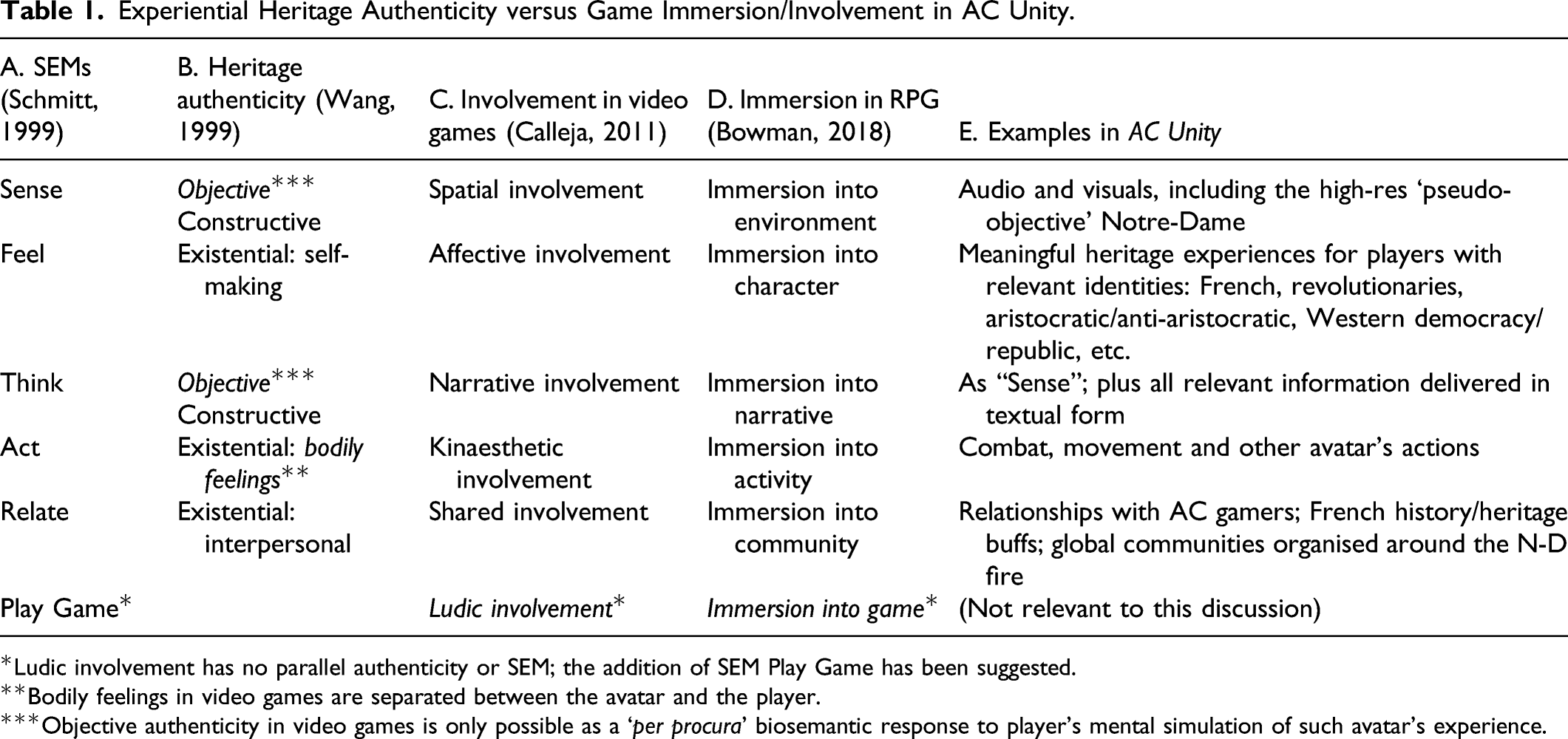
*Ludic involvement has no parallel authenticity or SEM; the addition of SEM Play Game has been suggested.
**Bodily feelings in video games are separated between the avatar and the player.
***Objective authenticity in video games is only possible as a ‘per procura’ biosemantic response to player’s mental simulation of such avatar’s experience.
Historical video games, historical re-enactment and heritage sites have all been compared to ‘time machines’. Authenticit(ies) defined in heritage/tourism studies and the experience economy pertained to corporeal visits to real-world sites, where historical environments are represented primarily through physical spaces and objects. Below, I will compare this to digital games, which do so through digitally represented spaces, objects and beings. Like Sweeting (2018), I will use the Assassin's Creed series as the main example, frequently praised as it is for such immersive-transportative quality of its historical settings (Spring, 2015, p. 6; Gilbert, 2016, p. 4,6,8; Makai, 2018, p. 10) – including the authenticity of their ‘look and feel’ (Boutonnet, 2016, p. 116).
This lengthy passage from Calleja (2011) outlines his view of the multilayered nature of player involvement with digital game environments: control and movement (kinesthetic involvement), the exploration and learning of the game’s spatial domain (spatial involvement), co-presence, collaboration, and competition with other agents . . . (shared involvement), . . . an ongoing story and interaction with the scripted narrative written into the game (narrative involvement), the affect generated during gameplay (affective involvement), and the decision making undertaken in the pursuit of . . . goals (ludic involvement). (Calleja, 2011, p.4)
Adapting Calleja’s model to role-playing immersion, Bowman (2017, 2018) replaced affective involvement with immersion into character, moving their character-related content from Calleja’s narrative involvement. With this variation aside, the structure did not change. As shown in Table 1, five out of six areas of Calleja’s player involvement (Bowman’s says immersion) in game environments can be paired with the dimensions of tourism/heritage authenticity.
As explained in Mochocki (2021, p. 33–34), Spatial involvement/environment-immersion is based on sensory perception of the (here, virtual) environment. This is Schmitt’s SEM-Sense. It correlates with Wang’s object-based authenticities: whether objective or constructive, objects must first be perceived (SEM-Sense) in order to be judged (SEM-Think) for authenticity. It seems that audiovisual representations can only reach ‘constructive’ authenticity, with ‘objective’ reserved only for original artefacts – not copies or mediated representations (more about it in point 3 below). Kinaesthetic involvement/activity-immersion is based on movement in space and physical performance of activities (also with objects). This is Schmitt’s SEM-Act, and it triggers Wang’s ‘existential: bodily feelings’ authenticity. In video games, it functions on two levels: kinaesthetic activities of player-controlled avatar and player’s manual operations on game controls. Narrative involvement/narrative-immersion is based on storyworld’s content, including backstories and the emergent alterbiography of the player’s avatar. Consisting in cognitive information-processing, this is SEM-Think. Heritage content represented in video games – whether audiovisually (see point 1. above) or textually – may be judged for ‘constructive (symbolic)’ authenticity. ‘Objective’ seems out of the question, but there is another way of looking at it. See ‘per procura’ in Difference 3 in Section 5. Affective involvement in Calleja (2011) encompasses multiple cases of emotional investment in and reactions to game play and pre/post-game activities. Bowman’s (2018) character-immersion denotes emotional and imaginary identification with the avatar. This is Schmitt’s SEM-Feel. It correlates with ‘existential: self-making’ authenticity. Shared involvement/community-immersion is about sharing and communicating experiences, and forming/keeping relationships. This is SEM-Relate and ‘existential: interpersonal’ authenticity.
Importantly, ‘What is special about SEM-Relate in games with historical settings is that they directly engage with real-world heritages and identities, connecting to networks of communal sharing that extend far beyond the gaming world’ (Mochocki, 2021, p. 34). These include communities centred around History, Heritage, and Identity Politics, which correspond with ‘reconstructionist, constructionist and deconstructionist perspectives’ on history and historical accuracy (Copplestone, 2016, p. 14).
Three Problems: Gameplay, Embodiment and Material Artefacts
The multifaceted comparison of SEMs/authenticities/involvements reveals three major differences in visitor’s experience between physical heritage sites and their virtual counterparts in digital games. The differences are marked in Table 1 with asterisks.
*Difference 1: Gameplay. While digital games lack some qualities of physical heritage sites, they have an important one that heritage sites do not. The ‘ludic involvement/game-immersion’ is absent from visits to physical heritage sites – unless the visits are gamified. Adding ‘Play game!’ as the sixth SEM to heritage site visitation is plausible ‘to account for gamified tours and exhibits’ (Mochocki, 2021, p. 34).
**Difference 2: Mediated embodiment. This essentially changes the sensory and interactional experience of the environment. Visual and auditory experiences may be at times identical, given that heritage sites also display text, images, animations and digitally generated sounds as part of the visitor experience. But 'at times' is the operative word here: no video game ever has replicated 100% identical visitor’s 'walk-through' of a heritage site. Such audiovisual equivalence can only be momentary. Moreover, the tactile, kinaesthetic, visceral, gustatory and olfactory sensations will be radically different for a gamer interacting with digital game hardware than for a museum visitor (see Krzywinska, Phillips, Parker, & Scott, 2020, for interesting research comparing the two). The same applies to communication (relatedness) with co-participants: seeing co-players as avatars and hearing them on a voice chat is different to walking a heritage tour with living and breathing people.
***Difference 3: Historical artefacts. Ostensibly missing from the experience of playing history-themed video games is immediate physical contact with genuine historical artefacts. As reported in museum studies, visitors ‘value original objects over replicas, looking at them for longer and differently’ (Dudley 2018, p. 196), commonly locating authenticity in ‘an actual physical thing that was there and is right here in front of me now’ (Latham, 2015, p. 5). Video games can only offer digitally mediated representations of such artefacts, never their unmediated presence. Hence, Wang’s 'objective authenticity' should be crossed out from the table – unless we find another solution.
The proverbial Reviewer 2 deserves credit for challenging me to rethink this seemingly obvious conclusion. Searching for ways to include ‘objective’ authenticity in mediated representations, I found some theoretical basis for a case for per procura substitution. ‘Fiction, film, video game, graphic novel etc. can only offer a mediated representation of a fictional character. Yet, . . . those media biosemantically trigger the illusion of larp-like immediatedness’ (Mochocki, 2021, p. 105). I am following the embodied turn in cognitive narratology, which highlights the importance of ‘bio’ in biosemantic meaning-making. This redefines the limits of embodiment in Difference 2 as well, but I wish to elaborate on Difference 3 instead.
Ryan’s (2019) ‘mental simulation’, Alber’s (2019) ‘evaluative enactments . . . derived from our bodily experience’ (p. 170) and Caracciolo’s (2014; 2015; 2019) enactivist narratology agree: fiction is ‘partially real’ (Alexander, 2018) because it happens ‘to us’ in lived emotional experience (p. 263). It triggers real physiological reactions to the character’s immediate situation, felt ‘as if’ it were our own body – especially if we have actually experienced similar situations, our body ‘remembering’ an echo of all related sensations. Hence, if face-to-face contact with original artefacts is a qualitatively different experience, seeing the avatar interacting with such artefacts might possibly trigger an experiential trace of ‘objective authenticity’.
Would it really feel different (be differently experienced) than ‘constructive authenticity’? Alexander’s anthropological or Caracciolo’s enactivist theory would claim so. A museum-goer who loves the thrill of ‘touching the past’ in the cold stones of centuries-old monuments is likely to feel some (albeit faint) echo of that thrill when his/her character arrives in Stonehenge, or the Notre-Dame or the Colosseum. Psychologists or social scientists could validate such claims in empirical research, which narratologists have not been trained for. I cannot offer more than a theorisation of ‘Pseudo-objective authenticity per procura’ and even that deserves much more space than I can afford. I will try to apply it to Assassin’s Creed further down, leaving it up to the readers to judge whether it makes sense. A more extensive study on player avatar’s encounters with ‘objectively authentic’ family heirloom in Attentat 1942 is coming next (Mochocki, forthcoming).
Placeness and Worldness
Salvati & Bullinger (2013) subscribe to the metaphor of immersion-as-transportation, juxtaposing the immersive simulations of Medal of Honor with the intellectual 'engagements' (not 'immersion') of strategic simulations of Civilization (p. 156). My main question concerns the potential similarity of video games to physical heritage sites in their simulation of authentic heritage experiences. For this purpose, I can put aside the large-scale historical strategy games as they fall far away from historic site visitation. The first-person sensory (embodied) experience of a tourist walking through a heritage site is best compared with games simulating an individual or small-group exploration of virtual places: a limitation I share with Chapman (2016).
To repeat, the central question of this article is as follows: Can a history-themed video game offer an authentic heritage experience comparable to a visit to a heritage site? Chapman's (2016) answer is: yes – partially. In his words, Games can structure affordances that are in some way similar: 1. To those of other heritage environments (e.g. museums) 2. To the environments of the past (e.g. those experienced by historical agents) 3. To the practices of others engaged in history (e.g. historians) (Chapman, 2016)
Having covered ‘Digital Games as Heritage Experience’ in one section in Chapter 7, Chapman moves on to discuss the other two (past environments and historying) at length in Chapters 8 and 9. He does not do the same for heritage as ‘the heritage function of digital historical games relies mainly on qualities also shared by other visual historical forms or other types of virtual environment and can therefore already be explored through the relatively rich broader literature on virtual heritage’ (Chapman, 2016). His interest lies primarily in the game-specific formal features, namely the affordances and mechanics for player's actions. I take the opposite direction, leaving out the ludic aspect of game play to focus on the 'virtual environment' quality as compared to physical heritage sites.
Putting aside the ludic involvement/immersion-into-game (it having no counterpart in site visitation), it may be argued that historical video games are, indeed, similar to interactive heritage sites/events in their attempts to represent a slice of a historical space and time. Of course, this will not apply universally to all games which include heritage elements, but first and foremost to audiovisual simulations of heritage-relevant places characterised by a historical worldness. They provide what Champion (2015) names ‘Cultural Presence’: his alternative term to ‘historical immersion’.
I say 'places' knowing that ‘Virtual environments are often criticized for evoking “cyberspace” but not “place” . . . they lack the richness of the associations and encounters that occur in real space’ (Champion, 2011, p. 11). My question about the experiential authenticity of virtual heritage sites is, in a way, about the possibility of evoking a 'sense of place'. According to Champion (2011), • A place can have a distinct theme, atmosphere, and contextually related artifacts. • Some places have the capacity to overawe. • Place has the power to evoke memories and associations. • Place has the capability to act as either stage or framework in which communal and individual activity can ‘take place’. • Place has the ability to transmit the cultural intentions of individual participants and social ‘bodies’. (p.29)
These five points roughly correspond with the SEMs and involvements: 'distinct theme and contextuality' with SEM-Think/Narrative; 'overawe' coupled with 'memories and associations' with SEM-Feel/Affective; 'stage for activity' with SEM-Act/kineasthetic; and 'transmit culture' with SEM-Relate/Shared. SEM-Sense/Environment does not have its bullet point here but was extensively discussed by Champion one chapter earlier (2: Virtual Environments). These pairings suggest that the multiple layers of video game involvement may indeed endow the gamespaces with 'placeness'.
I also invoked 'worldness': the potential to generate a mental image of a believable storyworld. The term ‘storyworld’ much better applies to historical and quasi-historical settings than ‘fictional world’ as ‘a storyworld can be fictional or nonfictional or have components of both’ (Schrier, Torner & Hammer 2018, p. 352). Its ‘mental representation’ is based on ‘three conditions . . . being logically consistent, large enough to stimulate the imagination, and experienced as complete’ (Ryan, 2019, p. 82).
As Chapman (2016) observes, the ‘museum quality is most obvious in games with realist simulation styles, which typically contain numerous virtual representations of historical objects that specify some of the same affordances as the original objects because they present similar perceptual information’. Chapman's 'realist' (opposed to ‘conceptual') simulation relies strongly on ‘visual over-specification’, which ‘is often compounded by the player’s “spatial” agency (the movement of the player-character) and control over the virtual gaze (camera)’; parallel to a tourist's movement and gaze control in a museum – and potentially conductive to the experiential 'sense of place'.
Worldness, in turn, is assumed to lie in the off-screen space: ‘virtual space that is only hinted at or that is excluded in a given moment of gameplay can also be very important to historical representation in games’ (Chapman, 2016). The virtual space/place simulated on-screen (or on-site in museums) is supposed to be just a tiny part of the whole, extending into immediate surroundings, close neighbourhood, then region, country, continent and beyond. Some games, like Assassin’s Creed, offer wide 360° view of vast landscapes as a suggestion of an ‘infinite expanse’ beyond (Martin, 2011). Connecting the micro-level of on-screen (on-site) locations to the macro-level of the historical world, the player forges ‘a link between a game’s historical representation and the larger historical discourse . . . gleaned from their lived cultural experience, including their engagement with historiography in different forms (e.g. books, documentaries, films)’ (Chapman, 2016).
Together, placeness and worldness make a powerful combination to simulate historical environments and create the immersive potentials Calleja (2011) refers to when he talks about ‘a sense of virtual environment habitation’ (p. 5). Thus, in the multitude of video game forms, those most similar to heritage sites are 'realist simulation' games, which generally seek to represent entire historical environments. This moves them closer to other kinds of heritage sites, such as castles, stately homes, recreated Bronze Age villages (and other kinds of open-air museum), in which efforts are often made to situate objects consistently in an environmental context, broadly spatiotemporally arranged. (Chapman, 2016)
Chapman (2016) also points out that non-player characters (NPCs) populating video game worlds perform similar functions to 'living history' interactors performing at heritage sites. Hence, another similarity that virtual game environments may be seen as 'living history' sites, though with varying scope: open-world realist historical games, such as the Assassin’s Creed series . . . seem to . . . best emphasise this living history function. Partly this is due to their sheer size, their offering of relatively massive historical spaces filled with objects and characters, but this is also due to the more varied focus that this allows . . . more comprehensive historical scope than focusing solely on warfare . . . e.g. agricultural, economic, religious, domestic and political. (Chapman, 2016)
The ‘living history’ quality of video games supports their comparison with sites such as the Archaeodrome in Cerquetti (2018).
Speaking of the 'realist simulation' games, Chapman (2016) repeatedly emphasises the role of visuality or audiovisuality. In the categorisations of authenticity/experience/immersion (Table 1), audiovisuality corresponds with one experiential module: SEM-Sense; yet there is more to it than meets the eye and ear. As Majewski (2018) notes (citing earlier scholars who share his view), video games are often more successful in creating a sense of place than non-entertainment virtual heritage projects (p. 45). This is due to the broader repertoire of experiential affordances, including interactivity, role-play, dialogue, etc. This work is exploring the parallels of video game environments and heritage sites (with their placeness/worldness) through the lenses of all five SEMs.
I started to write this article in mid-2019, not long after the fire at Notre-Dame in Paris, so I could not think of a better example than this very cathedral in Assassin’s Creed Unity.
Assassin's Creed and Notre-Dame
Readers looking for an in-depth study will be disappointed with the brevity of this passage. With the discussion of theories and analytical models spanning over six sections, a detailed case study would go far beyond the size limits of one article. I propose to look at it as an extension-by-example of the analytical model. Not being a full-size case study, it demonstrates which elements can be investigated as layers of heritage authenticity under the five experiential modules (analogically to Cerquetti’s study of heritage sites; see Section 3).
SEM-Sense
The Assassin’s Creed series has been praised for its recreation of real-world environments (McCall, 2016, p. 3), including ‘the details such as the art, architecture and the more basic aspects of life such as indoor lighting, furniture and utensils’, all of which ‘put a player into a historical moment’ (Spring, 2015, p. 6). In Latham’s layers of The Real Thing (TRT), this corresponds with TRT-Surround: heritage objects presented in the environment surrounding the avatar and/or presented to the player's senses, such as the rich interior design of the famous Notre-Dame cathedral from AC Unity. This adds to an authentic sense of place. Panoramic views of the landscapes add to the sense of worldness. Unlike Cerquetti’s (2018) Archaeodrome, it does not afford smelling, tasting or touching (not to the player – only to avatar), but it does speak directly to the player through sights and sounds.
Objects perceived through SEM-Sense get judged for ‘constructive’ or ‘pseudo-objective’ authenticity in SEM-Think (see below).
SEM-Feel
To recall Wang’s (1999) view on ‘existential: self-making’ authenticity: it relies in searching for, and forging, one’s ‘true self’, which is not fully actualised in everyday routines. People experience heritage moments as personally meaningful to them, resonating with their own nostalgia, memory, culture or any collective identity they discover, challenge or reinforce.
Many such moments come through intangible heritage, especially via performance and performativity of music, dance, rituals, etc., which Cerquetti (2018) highlights in the case of the Poggibonsi Archaeodrome. This part is largely absent from AC Unity. Much as the avatar participates in rituals, those are rituals of the fictitious Assassins and Templars, not factual real-world cultures or communities. I must agree with Barbara (2020) that AC’s ‘representation of intangible heritage leaves much to be desired’ (p. 4). It evokes heritage first and foremost through representation of its materiality.
‘Recreating cities for nostalgic play’ (p. 9) is exactly what Makai (2018) sees in L.A. Noire and Assassin’s Creed. Sometimes, as in the case of the 1940s L.A., it is ‘actual nostalgia in people who lived in the city at that era’ (p. 9). Some players will feel nostalgia for the distant roots of their own culture, like Arab players exploring Middle Eastern medieval cities (El Nasr et al., 2008). Other times, a not-so-distant past may still actively shape today’s identities and worldviews, as 1868 London in AC: Syndicate discussed by Sweeting (2018). He warns that ‘ludic historical simulation has the potential of unintentionally indulging the controversial aspects of Britain’s history and the identity that can form around this; with damaging consequences’ (p. 73). Moreover, playing in historical settings may also create the feeling of personal connection to cities players never even visited as is massively reported about the environments of Assassin's Creed (Wang, 2017, p. 1; Dubois & Gibbs, 2018). Visiting Paris for the first time, a Chinese long-time player of AC Unity reportedly could find his way without maps and ‘after sightseeing, he sat on the bank of the Seine, feel like crying, as if Paris is his long-time absence hometown’ (as shared by his wife on social media and quoted by Wang, 2017, p. 1).
SEM-Think
In Cerquetti’s (2018) Archaeodrome, ‘visitors are critically engaged, by thinking, questioning, and learning about history’ (p. 164). In this regard, the Assassin’s series does not fall behind. Admittedly, despite the remarkable effort at historical richness of detail, there are simplifications and bluntly inaccurate anachronisms, for example, ‘adding the famous spires to Notre-Dame that were not yet built at the time of Unity . . . in order to fit with existing player expectations’ (Makai, 2018, p. 11). Such triumphs of popular narrative over factual accuracy create a ‘simulacrum . . . false likeness’ (Dow, 2013, p. 219), moving the games away from history towards heritage. Defined as ‘creative engagement with the past in the present’ (Harrison, 2013, p. 4), heritage is essentially about ‘making and re-making narratives’ (Dull, 2013, p. 2), rooted as much in historiography as in myth, legend and historical fiction. Many, like Leffler (2019), accept anachronisms and inaccuracies as inevitable in ‘production’ of cultural memory.
To Menon (2015), games like Assassin's Creed are ‘sites of memory’ (p. 110) themselves, both shaping and shaped by narratives about history. As Spring (2015) says, ‘Assassin’s Creed IV: Black Flag’s (2013) simulation of boating uses gameplay to allow meaningful historical investigations of Colonial era nautical exploration, piracy, trade and whaling’. AC: Syndicate’s Victorian London ‘has the opportunity of reshaping the collective memory and therefore the perception of that period’ (Sweeting, 2018, p. 73). AC: Freedom Cry facilitates ‘counter-hegemonic commemorative play’ (Hammar, 2017) about colonialism and slavery. AC Unity (2014), with its ‘violent revolutionary mobs roaming the Paris streets’ (p. 6), engages with the watershed moment in French history, dealing with the themes of anti-aristocratic revolutions, republicanism and civil liberties.
Being able to situate game elements in the real historical context adds to the sense of worldness and involves judgements of ‘constructive’ authenticity, understood as ‘cultural verisimilitude’ (Copplestone, 2016, p. 11). This includes ‘Think’ judgements of audiovisual representations perceived via SEM-Sense, but also information delivered in textual form. The Notre-Dame cathedral could be a perfect example of per procura ‘pseudo-objective authenticity’ perceived audiovisually, with player’s attention and emotions invested in avatar’s direct contact with an ‘objectively authentic’ architectural wonder.
SEM-Act
Being ‘a historical fiction action-adventure open-world stealth game’ (Gilbert, 2016, p. 4), Assassin's Creed heavily relies on the control of the avatar's kinaesthetics. Be it for exploration or confrontation, it is essential to use stealth, acrobatics and movement – both horizontal and vertical (climbing) (Makai, 2018, p. 11). SEM-Act is intertwined with SEM-Sense as it is only through Act (movement) that new objects, locations and NPCs can be reached by Sense (perception). Dow (2013) considers the movement essential to immersion (p. 216–218). Exploring the space via movement and other actions adds to the sense of place: to Calleja (2011), the combination of spatial (SEM-Sense) and kinaesthetic (SEM-Act) involvement is the cornerstone of immersive ‘incorporation’. This reflects Wang’s (1999) ‘existential: bodily feelings’ authenticity, albeit different for the player’s body and the avatar’s.
In Cerquetti’s (2018) Archaeodrome, SEM-Act is defined by interacting with the site, artefacts and ‘historical characters’, and Assassin’s Creed digitally facilitates the same – and more. For instance, the ability to climb and jump from the heights of the Notre-Dame goes far beyond of what could be an authentic (or even humanly possible) tourist experience. Hanussek (2020) views such ‘transheritage’ positively, as playful transformations enliven and rekindle interest in the heritage. Barbara (2020) admits such ‘repurposed cultural heritage interaction’ is attractive to some audiences, but also warns that ‘To those familiar with the cultural space . . . the interaction mechanism that is alien to the place may be seen as a distraction or even a parody . . . and detracts from the user experience, particularly immersion’ (p. 7).
SEM-Relate
This SEM works through ‘player's feeling of relatedness to people sharing his/her gameplay experience: co-players, spectators, commentators. Any game, historical or not, allows for shared involvement in pre- and post-game activities in player communities; any multiplayer game – for shared gameplay; any single-player game – for sharing the experience with friends in the room’ (Mochocki, 2021, p. 34). In the Archaeodrome, ‘visitors relate to historical characters and other visitors during and after the visit’ (Cerquetti, 2018, p. 164). In the case of historical games, SEM-Relate was linked above (Section 4) to interactions with online and offline communities interested in Heritage, History and Identity Politics. The 'History' crowd is historians and history buffs interested in broadening and sharing their knowledge of the past. What they seek in games is factual accuracy and potentials for teaching history. Some say that Assassin's Creed is too fictionalised (McCall, 2016, p. 6–7), and many find promising educational prospects (Spring, 2015; Boutonnet, 2016). The 'Identity Politics' circle is social scientists and activists critiquing the representations of history, heritage and identity in the media. They engage with Assassin's Creed mainly to problematise its portrayal of race, gender, class, etc. and explore its potential for social education and/or critiquing the dominant discourses, for example, confronting orientalism, racism and colonialism (Gilbert, 2016; Hammar, 2017; Shaw, 2015; Mukherjee, 2017). The 'Heritage' communities include heritage professionals and enthusiasts aiming at keeping their culture alive in the present. Above, I listed individually experienced personal nostalgia for medieval Middle East as an example of SEM-Feel. Yet, when these Arab players moved on to talk about this experience and write the paper (El Nasr et al., 2008), they did so together, apparently with Wang’s (1999) ‘existential: interpersonal’ authenticity. Not only did it shape some of their relations (SEM-Relate) to each other but also to others who identify with Middle Eastern heritage. Hence, the individual and the collective experience of nostalgia and cultural connection are intertwined.
It is in the Heritage dimension that the Notre-Dame fire is so fascinating as a case study. One thing is the flood of online reactions in which people share a similar sense of shock and loss despite their different relationships with Notre-Dame: AC Unity players who have been to the real Notre-Dame; those who know it only through AC Unity and other media; and those who (seem to) have had no contact with AC Unity. More important, however, are actions taken by Ubisoft, offering a substantial donation for renovation of the real Notre-Dame and releasing AC Unity for free for a week to – as they put it – ‘give everyone the chance to experience the majesty and beauty of Notre-Dame’ (Ubisoft, 2019). Hanussek (2020) notes that when the Notre-Dame was closed for repairs, AC Unity remained the only way of entering the cathedral.
Back to the central question of this article: to what extent can one actually experience Notre-Dame by playing AC Unity? Taking into account the (asterisked) differences in Table 1, it seems clear that some of the experiential components work in radically different ways in digitally mediated environments. Some experiences of heritage authenticity of the original Notre-Dame cannot be facilitated in its digital representation in a video game. These are experiences which rely on immediate (unmediated) physical contact with genuine material artefacts (objects, buildings and landmarks) from the past, such as touching the real cold stone of Notre-Dame's masonry or smelling the incense, which Hanussek (2020) doubts can ever be replicated in the virtual Notre-Dame, interactive material replicas affording tangible sensory experiences (including smell, taste, touch and manipulation), such as rosaries, jewellery or other ‘replica’ merchandise offered at the Notre-Dame La Boutique store, other people sharing the same physical space, such as museum staff and the crowd of other co-visitors sharing the real Notre-Dame experience.
Putting this in the above-discussed vocabulary of experience/authenticity (Wang, 1999; Latham, 2015; Schmitt, 1999), I can summarise it as follows.
Differences
SEM-Sense and SEM-Think do not afford ‘objective authenticity’ (‘Presence of The Real Thing’ in Latham, 2015) – unless we introduce ‘pseudo-objective authenticity’, defined in Section 5 as ‘objective per procura’. SEM-Sense affords sensory perception of the built environment in a limited range of senses: no taste, no smell, touch and movement mediated through game controls and representation, and visuals and sound limited to the screen and audio display. These limits to SEM-Sense perception also limit the type and amount of content available for SEM-Think 'constructive/symbolic authenticity'. Things the player cannot perceive in the digital representations will not be cognitively processed; things s/he perceives in a distorted/simplified/modified way will be processed differently to what s/he would in the real-world Notre-Dame. SEM-Act, due to limited and largely mediated embodiment, has severe limitations on ‘existential: bodily feelings' authenticity. The avatar can only perform actions available in the interface; the tourist at the site has no such limits. On the other hand, avatar in AC Unity can walk – or climb – to such areas in the cathedral which are unavailable to the tourist. Analogically, SEM-Relate does not allow for fully embodied co-presence with co-players inside the environment. This limits affordances for ‘existential: interpersonal' authenticity, such as holding hands or making eye contact with other tourists on site.
Similarities
Whereas SEM-Relate on-site is limited, SEM-Relate off-site is not. All interpersonal communication with co-players, friends and online communities taking place pregame, off-game and postgame seems to be equivalent to the communication surrounding visits to heritage sites. This means that 'interpersonal' heritage authenticity, including co-presence and bodily contact with people meeting to share experiences after the fact, is also afforded by video games. Within the limited range of senses involved, SEM-Sense in video games affords many of the same sensory experiences that are used at heritage sites: text, sound effects, music, recorded voice, image, photo, film and animation, all of which change with time – and with the movement of the perception point in space. This part is highly similar to the perception of analogical media at heritage sites, so it should activate identical SEM-Think cognitive processes responsible for the experience of 'constructive/symbolic' authenticity. For example, a wall painting or a stained glass window in the real Notre-Dame and their AC Unity version are basically the same 2D pictorial message with the same heritage content for player/tourist's interpretation. This parallelism is even better illustrated with another game: Attentat 1942 (Charles University and Czech Academy of Sciences, 2017), which features video interviews with actors impersonating witnesses of history. I think players watching these in the game have similar perceptions of authenticity as tourists watching the same video material on a TV screen in a WW2 museum – or on the museum website. The cognitive processing works together with SEM-Feel emotional processing, which should analogically translate into the 'existential: self-making' type of authenticity. Hence, I think the emotional reactions to the interviews with WW2 survivors would be generally the same in the three cases: cinematic scene in Attentat 1942, cinematic scene on a museum website or cinematic scene on a TV screen in a museum.
All of the above, as perhaps should be reminded, refer to 'realist simulation' video games (Chapman, 2016) – not all digital games; not all games.
Beyond the Digital
Playful/gameful use of physical sites and objects has long been the domain of non-digital games. Live-action role-plays have used historic sites such as castles at least since early 1980s, popularised by a commercial enterprise in the UK (Harviainen et al., 2018, p. 95). Larps, scout games and escape rooms may even use genuine historical buildings and artefacts to create Wang's objective authenticity. They can literally take place in the streets and historical buildings of Paris – including the Notre-Dame cathedral, if permitted by the administrators. I have stated (above) that this kind of heritage authenticity can never be achieved in digital games (at best – approximated as ‘pseudo-objective’). Yet, it is possible in hybrid games mixing the digital with the physical.
The analogies between navigable historical settings in video games and heritage sites afford successful combinations: Augmented/mixed reality projects at physical heritage sites enhanced with digital gaming technologies. For example, the 2012 project Ghost in the Garden, ‘a partnership between the Holburne Museum, Splash & Ripple (a Bristol-based experience design company) and . . . an academic historian from the University of the West of England, Bristol’ (Poole, 2017, p. 308), enhanced the experience of exploring historical gardens with audio messages triggered by GPS-tracked proximity, and with an interactive narrative driven by Choose-Your-Own-Adventure game mechanics (more details in Westin, Foka, & Chapman, 2018).
Location-based AR/MR games can combine all affordances of digital games with all affordances of physical sites. Potentially – also with all affordances of escape rooms and larp, including character-driven live-action role-playing. This could combine the object-related (SEM-Sense + Think) authenticity of the historic site with activity-related authenticity of bodily sensations (SEM-Act), personal experience (SEM-Feel) and interpersonal interactions (SEM-Relate) typical of larp, coupled with the digital layer of augmented audiovisuality (SEM-Sense) and game challenges (SEM-PlayGame). With the massive trends of games-in-museum (Beale, 2011), gamified tourism (Bulencea & Egger, 2015) and participatory museum (Simon, 2010), it was only a question of time. See the Augmented Telegrapher project at Porthcurno Museum in Cornwall (Krzywinska et al., 2020).
Conclusion
Heritage site visitation shares with games five forms of experiential involvement (Schmitt’s SEMs), which simultaneously correspond with dimensions of involvement/incorporation in virtual game environments (Calleja, 2011), immersion in role-playing (Bowman, 2018), perceived authenticity in heritage experiences (Wang, 1999; Latham, 2015; Cerquetti, 2018).
Having explored similarities and differences between the experiential dimensions of heritage authenticity and digital game immersion/involvement, I am inclined to conclude the following: Player’s experience of historical or semi-/quasi-historical places in digital games may be similar to a tourist’s visit to a heritage site (and in location-based games, it may be actually combined with such a visit). The perception and feeling of heritage authenticity will be interconnected with the feeling of game immersion/incorporation as they have the same experiential components of ‘sense, feel, think, act and relate’. The perception and feeling of heritage authenticity is intrinsically linked to player’s out-of-game knowledge of and attitudes towards the relevant history/heritage.
Do digital games afford deep or insightful heritage experiences? Just like heritage tourism: not necessarily. As Smith and Campbell observe (2016), ‘Some visitor engagement can be quite shallow, banal even, but nonetheless this form of engagement does important cultural and political work, while some deep engagement can generate a lot of emotional feeling but does not necessarily go far in developing critical insight’ (p. 445). I think the same describes the cognitive–imaginary–emotional (frequently, immersive) visits to historical environments in digital games. Some may be shallow and banal; some may be deeply emotional but not insightful.
In the special case of representing actual heritage sites (Notre-Dame), the 'immersion-as-transportation' quality of video games merges with (perceived) heritage authenticity to the highest degree. I think the relation is mutual, as in two sides of the coin: the feeling of authenticity is a component of immersion, and the mental state of immersion supports the feeling of authenticity.
Video games do not afford physical contact with the material substance of heritage, but they do afford perceptual (audiovisual) contact and gameplayed interactions with its representations (alongside intangible/immaterial heritage such as music or folk tales; Champion, 2015, p. 94), which in turn affords cognitive, emotional and social engagement with heritage content. From the point of view of contemporary heritage studies, this part actually matters the most: ‘recognizing reason/cognition, affect/emotion and memory as being mutually constitutive and reinforcing of each other’ (Smith & Campbell, 2016, p. 452).
In the Notre-Dame case, the 'immersion into community' (Bowman, 2018) of AC Unity players merged with 'existential: interpersonal’ authenticity (Wang, 1999) of all people who felt a meaningful connection to the cathedral's heritage. It is in the multilayered SEM-Relate space that collective responses (mourning, commemoration and fundraising) to the April 2019 fire have emerged.
Footnotes
Author Contributions
M. Mochocki is the sole author.
Declaration of Conflicting Interests
The author(s) declared no potential conflicts of interest with respect to the research, authorship and/or publication of this article.
Funding
The author(s) received no financial support for the research, authorship and/or publication of this article.
