



Abstract
This paper considers J. L. Borges’ Book of Imaginary Beings as a vector for the cultural transfer of folkloric, mythological, religious, and literary motifs from foreign cultures to Japanese video games and collectible card games. My analysis relies upon Michel Espagne’s cultural transfer theories and discusses not only the Book of Imaginary Beings but also other vectors of transfer, such as the roleplaying game Dungeons & Dragons. I focus on four specific motifs from different cultural spheres, whose introduction to Japanese video games can be retraced to Borges’ bestiary: The carbuncle, the catoblepas, the peryton, and Kujata. Thus, this paper presents a case study of the cross-cultural influence of literary works on games. Furthermore, it underscores the need for a deeper consideration of the cultural influences found in games and of games as agents of cultural transfers.
In Japanese video games, particularly roleplaying games (RPG), Western medieval fantasy settings and motifs are overwhelmingly present. While Japanese games inspired by Asian history or myths also exist, they tend to anchor themselves in a liberally reimagined historical setting, as seen in, among others, Capcom’s Onimusha series (2001–2019), FromSoftware’s Sekiro: Shadows Die Twice (2019), Team Ninja’s Nioh (2017) and Nioh 2 (2020), and Koei’s Samurai Warriors series (2004–2017), all set in the Sengoku period (1467–1615). 1
Thus, the familiar Western worlds of many Japanese roleplaying games (JRPG), such as the Final Fantasy series (FF series) or the Dragon Quest series (DQ series), are easily taken for granted. However, should this be so? To find such extensive and systemic use of culturally distant elements at the core of a local genre is exceptional. I posit that the strong influence of Western tabletop roleplaying games (TRPG) 2 and early computer roleplaying games (CRPG) is at the core of this phenomenon. Such an influence was made possible by a wider dynamic of database consumption, as suggested by Hiroki Azuma et al. (2007, 2009). 3 The influence these media have had on the foundation of Japanese video game culture has been often emphasized (Adams, 1985; Addams, 1990; Lucas, 2017; Okamoto, 2019; Peterson, 2012; Wolf & Carter, 2017). However, previous research has mainly focused on gameplay, programming, or the influence of specific individuals in the early game development world. I argue that the pervasive influence of Western TRPGs and early CRPGs is not limited to such aspects.
Scholarly exploration of these Western games’ cultural impact is lacking. It has been emphasized that “RPGs have had a pervasive and ongoing impact on cultural practices and production. This includes the migration of tropes, concepts, types of storytelling, and stereotypes into broader culture” (MacCallum-Stewart et al., 2018, p. 184). Likewise, Zagal and Deterding (2018) claim that “RPG tropes not only deeply influenced games but also media culture writ large, yet this historical legacy is still underexplored.” (p. 9) I undertake this exploration by focusing on Japanese video games, which remain underexplored despite the growing global popularity of these vivid cultural productions. The introduction of a wide array of foreign folkloric, religious, or literary Western fantasy motifs into Japanese culture remains largely unexplored, despite the expertise scholars such as Azuma have displayed in explaining the societal and philosophical dynamics of such a phenomenon.
deWinter (2012) claims that while early Japanese animation borrowed from the West, notably from Disney, it was “simultaneously creating an entertainment industry that reflects Japanese aesthetics, concerns, and ideologies.” Furthermore, “this same pattern is seen in the medieval: ‘Western medieval, Japanese essence’” (70). The same claim can be made for the current topic. I demonstrate the ways in which foreign motifs of interest have been remolded to fit Japanese aesthetics, concerns, and ideologies. This overlap of claims is unsurprising, as most borrowed motifs found across database fantasy were first reused in the Japanese-produced, Japan-idiosyncratic Western neomedieval fantasy settings she analyses (deWinter, 2012).
My study investigates how and why such idiosyncratic pluriculturalism developed. While the settings depicted in Japanese video games are often Western neomedieval, the motifs originate from a wide array of cultures. Their consumption conforms to local paradigms, 4 and they have taken root so deeply that they have become the standard across different media within Japanese fantasy, a genre currently experiencing unprecedented popularity (Escande, 2021, pp. 76-78). While there are many strands of influence that have converged to form a culturally composite database for Japanese fantasy titles, they often follow similar patterns. I explore such strands through four motifs across several franchises and media: The South American carbuncle, which remained mostly unreferenced outside of Spanish literature until the translation of the Book of Imaginary Beings; 5 the Ethiopian-born, Greek-commented catoblepas; the peryton, a creation by Jorge Luis Borges often mistaken for a genuine mythological figure; and Kujata, the Islamic cosmic bull.
By retracing their cultural transfer, I indicate how their cases illustrate an aesthetic shift. This is expected if one considers deWinter’s claims alongside other cultural transfer theories. Thus, I underscore the need for deeper consideration of games and their function as cultural transfer agents. I rely on cultural transfer theories, as pioneered by the French historian Michel Espagne, to approach the complex dynamics of this case study.
Cultural Transfers and “Cultural Ferrymen”
While TRPGs have often been instrumental in the exportation of Western motifs to Japan, they do not always represent a direct link between their points of origin and new foreign context. Many such intermediaries, labeled “cultural ferrymen” in cultural transfer theory, are interconnected at several levels in this case study. The concept of cultural ferrymen can refer to the transference of culture among individuals, organizations, artwork, or even objects (Cooper-Richet, 2013). Their action can be voluntary or involuntary, and emphasis is placed on the networks they establish and the nonlinearity of the cultural transfers taking place through them (Compagnon, 2005). Moreover, these cultural ferrymen are not mere vectors of “received” influence, insomuch as they are vectors of change and reimagination. Cultural transfer theory does not refute the concept of influence, but is wary of it, emphasizing a more active role of the target culture in the transfer process (Espagne, 2012; Lüsebrink et al., 2014).
A substantial part of contemporary Japanese fantasy, defined as database fantasy (Escande, 2021), is characterized by the motifs used, the majority of which are foreign in origin, borrowed from overseas myths, religions, or sagas. However, these motifs hybridized at different phases of their passage to the archipelago and exhibit notable idiosyncrasies. Moreover, individual motifs are not isolated cases, but part of a whole repertoire of symbols Japanese audiences understand an internalized database at the creators’ disposal. Discussing Western influences thus contributes little to understanding Japanese fantasy’s idiosyncrasies. Indeed, the notion of influence suggests that the receiving culture plays a passive role. However, in the case of Japan, the changes within individual motifs, combined with the unique atmosphere of contemporary Japanese fantasy, suggests that the receiving culture takes an active role. Such an active involvement in the influence process is recognized by cultural transfer theory. Michel Espagne (2012) defines the dynamic as follows: Any passage of a cultural item from a context to another implies a transformation of its meaning, a dynamic of re-semantization that can only be fully acknowledged by taking into account the historical vectors of the passage… To transfer is not to transport, but rather to metamorphose, and the term is by no mean limited to the badly delimited and very trite question of cultural exchanges. It is less the circulation of cultural goods than their reinterpretation that is at stake. (p. 1)
Lüsebrink et al. (2014) also insists on the importance of transformation in the cultural transfer process and the active role of the culture at the (temporary) end of the process: It is the establishment of a relationship between two autonomous and asymmetrical systems that implies the notion of transfer. The specific needs of the welcoming system select: they reject ideas, texts, and items that will then stay in a space where they will be at disposal for new conjunctures. (p. 30)
Cultural transfer is not a one-time process either, as a simplistic notion of influence sometimes suggests. Through ebbs and flows, once-ignored elements can gradually be incorporated, enriching the strands of cultural transfer revolving around a common topic. This has happened and is happening to foreign motifs in Japanese fantasy. Borges’ bestiary has been one vector of this, through both the medium of Gygax’s TRPG Dungeons & Dragons (D&D) which heavily influenced JRPGs, and its direct use by Japanese game creators. 6 As such, the Book of Imaginary Beings has functioned as a cultural ferryman several times and may do so again.
Scope of the Study
Despite their wildly different origins, the four aforementioned motifs have found a place in Japanese popular culture, under often unexpected reimaginations, where they occupy territories that sometimes differ and sometimes overlap. To explore both their vectors of change and current forms, I consider a wide array of media. Aside from Argentine author J. L. Borges’ Book of Imaginary Beings (1967), 7 which occupies a central place in the motifs’ cultural transfers, I discuss JRPGs, such as the Square-Enix’s FF series (1998) or Madō Monogatari EPISODE II CARBUNCLE (Compile, 1989); influential medieval bestiaries such as Jacob van Maerlant (1340) and John Joston’s Historiae naturalis de quadrupedibus libri: Cum aeneis figuris (1657); monster compendiums from D&D such as the Fiend Folio (1981) and D&D progenitor Gary Gygax’s first edition Monster Manual (Gygax 1977), or similar content from the once TRPG-encompassing magazine White Dwarf (1977); collectible card games (CCG) that are still in production, such as Yu-Gi-Oh! Trading Card Game (Konami, 1999), Tomy’s Duel Masters (Elliott et al., 2002), Bushiroad’s Cardfight!! Vanguard (Bushiroad, 2010–), and Z/X -Zillions of enemy X- (BROCCOLI. & Nippon Ichi Software, 2012); and Japanese fantasy motif dictionaries, such as Dwellers of Fantasy Worlds 2 (Takerube and Kaiheitai, 1989), A dictionary on fantasy worlds for creators: Everything game creators want to know about mythology, fantastical beasts, magic, and other worlds (Gensō Sekai Tankyū Kurabu, 2018) edited by the “Club for the Exploration of Fantasy Worlds,” or the Japanese website www.4gamer.com’s “Museum of Sword and Sorcery: Monster Edition” article series which offers similar content. For the carbuncle case study, I also examine its derivative in the Digimon series using a character design sketch and the related digital pet software Digimon Tamers Pocket Calumon (Calumon Design Sketch, 2001). As all four motifs have a noteworthy media presence, I also cover a wide array of mobile games from the previous two decades: Me and My Bonded Monsters (Prope, 2016–2018), Brave Frontier (A-Lim, 2013–), Dragon Shout (Poppin Games Japan, 2014), Dragalia Lost (Cygames, 2018–), Elemental Story (Crooz, 2015–), Elder Sign (Miracle Positive, 2012–2016), Eternal Linkage (Jupit, 2017–2019), Door to the Hidden World (Appirits, 2014–2020), Monster Master (Jin, 2014–2020), Monster Monster (Sakura Soft, 2011–2018), Puzzle & Dragons (GungHo Online Entertainment, 2012–), Spirits Fantasia (AltPlus, 2012–2017), White Cat Project (Colopl, 2014–), SKYLOCK (CoreEdge, 2014–2022), SKYOVER (Exys & 26, 2017–2018), and Triple Monsters (Bushiroad, 2018–). 8 At the core of study, however, is the Book of Imaginary Beings.
The Book of Imaginary Beings as a Cultural Ferryman and its Ramifications
Borges’ bestiary, intended not as an exhaustive folklorist handbook, but as a compilation of imaginary beings of varied origins, was first translated into Japanese in 1974, and has been republished several times since. 9 It is often referenced by Japanese books on related subjects, such as the Truth in Fantasy series, a set of fantasy motif dictionaries. 10 The Book of Imaginary Beings is unique in that it mixes beasts from ancient folklore and religions with those from more recent literature, including that of Franz Kafka, Edgar Allan Poe, and C. S. Lewis (Borges, 1974a). Moreover, it also includes at least one of Borges’ original creations, the peryton, which would later be reused in many titles across different media. The peryton is often thought to be a legitimate creature of legend, 11 as Borges presents it as such. This is characteristic of Borges’ work, who often questioned and experimented with fictionality (Lindstrom, 1990; Wichmann, 2003). Borges blurs the boundaries between fiction and nonfiction, inserting fragments of one into the other. He went so far as to write literary reviews for non-existent books, such as his 1941 short story, An Examination of the Work of Herbert Quain. The Book of Imaginary Beings is often seen as an oddity and its literary quality of straddling the boundary between fiction and nonfiction was left mostly unexplored until a recent article by Melanie Nicholson (2020). However, it is noteworthy that such an idiosyncratic work left a durable mark on Japanese fantasy—arguably more so than in the West—and the way this occurred.
The Book of Imaginary Beings exemplifies a cultural ferryman, possessing far-reaching ramifications. Cultural transfer theory tries to eliminate linearity, unilaterality, and singularity, the importance of which are demonstrated in this case. The Book of Imaginary Beings influenced Gary Gygax in creating the D&D bestiary, which, in turn, influenced the FF series. However, Borges’ book also served as a cultural ferryman for other idiosyncratic representations, such as Flaubert’s description of the catoblepas. Moreover, the FF series references both Gygax’s and Borges’ bestiaries; thus, they are interlinked at two levels. D&D acted as a transfer vector, with reference to Borges’ bestiary, which is also referred to directly in the FF series. The bestiary, in itself, is influenced by and an aggregate of many mythological, folkloric, and literary monsters, including Borges’ own (Figure 1). Overall pattern of cultural transfers involving Borges’ Book of Imaginary Beings.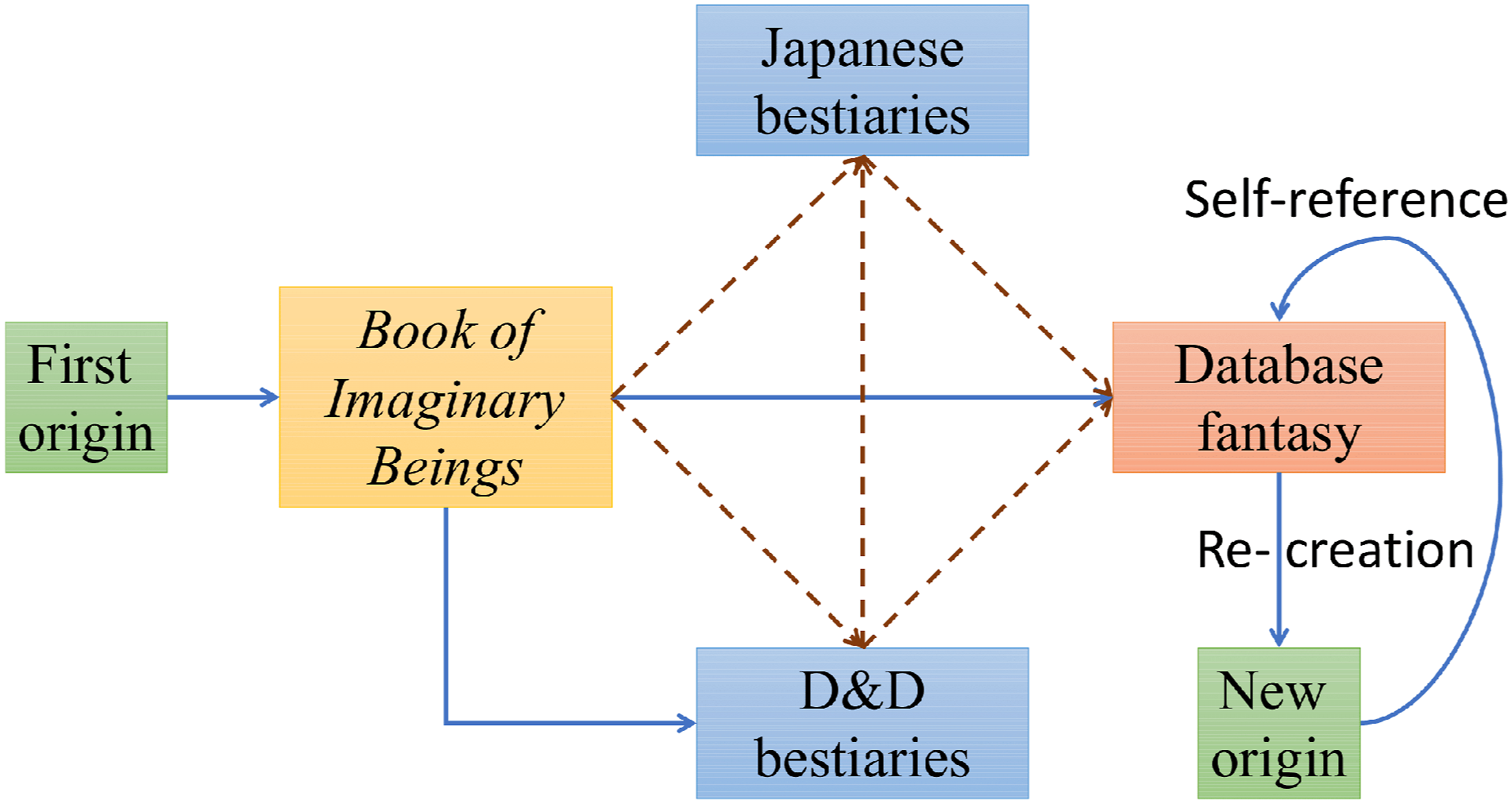
The Carbuncle
The carbuncle is a useful motif to trace when investigating the cultural transfer of content across Borges, D&D, and Japanese media. According to Borges’ bestiary (Borges, 1974a), the name carbuncle was bestowed “by the Spanish conquistadors to a mysterious animal—mysterious because nobody ever saw it well enough to know whether it was a bird or a mammal, whether it had feathers or fur.” (p. 34) The word “carbuncle” denotes red gemstones, most often rubies or garnets. Borges mentions the shining object on the creature’s head as the possible cause for its nomenclature, referencing two testimonies, one from conquistador Gonzalo Fernández de Oviedo (1478–1557) and one from Martín del Barco Centenera (1535–1602).
The carbuncle is a rather obscure folkloric creature, mostly appearing in untranslated Spanish texts from the 17th to 19th centuries. 12 More recent works that mention it, such as El Libro de la Mitología de Chiloé (1997), have not been translated into Japanese and were published after the carbuncle had already appeared in Japanese games. Apart from its presence in the 1974 translation of the Book of Imaginary Beings, the creature’s first recorded appearance in Japanese media was in 1989, in the first installation of the Madō Monogatari series, EPISODE II CARBUNCLE. However, the carbuncle is also found in D&D as an eponymous monster that fits its description, although it is described as being armadillo-like. It was first featured in White Dwarf #8 (Turnbull, 1978) and included in the Fiend Folio (Turnbull, 1981). Although not yet translated into Japanese, such English material was often showcased in local game magazines at the time of their publication. Therefore, the motif’s cultural ferryman was either one such article or Borges’ bestiary. While the carbuncle’s cultural ferryman cannot be confirmed, the wider diffusion of the latter makes it a probable option.
The most prominent (and ongoing) borrowing and reimagining of the carbuncle motif is found in the FF series, where it has been used as a “summon” (a summoned temporary ally) since the fifth installment (Square, 1992). 13 It appears as a small creature, fox- or squirrel-like, with green or blue fur, depending on the game. Its most distinctive characteristic is the red gem on its forehead, seemingly, the source of its power. However, an earlier incarnation of a carbuncle can be found in JRPGs, namely, in Madō Monogatari EPISODE II CARBUNCLE and its sequel Madō Monogatari 1-2-3, first-person dungeon crawlers 14 that were developed by Compile and first published for the MSX 15 in 1989 and 1990. In the Mado Monogatari series, the carbuncle is a yellow, long-eared mascot character with a red gem on its forehead. This franchise evolved into the better-known, tile-matching series Puyo Puyo. 16 The carbuncle remains in use as a mascot in the franchise, and its design has not evolved substantially. I cannot, with certainty, refute the possible influence of Madō Monogatari 1-2-3 or Puyo Puyo on the carbuncle’s introduction into the FF series, as they precede it. However, Puyo Puyo’s carbuncle, a yuru-kyara-type (cute, unsophisticated character often designed for promotional purposes) mascot, does not appear to have left an aesthetic mark on other Japanese iterations of the motif. Even if the carbuncle’s use in the FF series was prompted by Puyo Puyo, it is highly probable that Borges’ bestiary was still referenced, as other motifs related to his book are present in the franchise. Chief among them are Kujata and an idiosyncratic representation of a catoblepas that I explore later.
The plurality and cohabitation of possible vectors at a given point is a testament to the nonlinearity of the cultural transfer process. The acting vector might very well be plural, a cross-referencing of sources precipitated by an encounter with a specific motif. 17 A game creator involved in the development of Final Fantasy V (Square, 1992) might have first encountered the carbuncle through Madō Monogatari or its off-genre spin-off Puyo Puyo before researching it and consulting either Borges’ or D&D’s bestiary. A less obvious adaptation of the carbuncle is the digital monster Calumon from the Digimon franchise. While the abstract design of its gem and distinct ears make it a more liberal reimagining of the carbuncle, an annotated design sketch for Digimon Tamers explicitly mentions the carbuncle as an inspiration (Calumon Design Sketch, 2001). The choice of the word mamono to denote “monster” is noteworthy. It hints at the presence of at least one intermediary between Borges’ bestiary and Digimon Tamers, as mamono is mostly used in the context of Japanese fantasy. This term is not used in the Japanese translation of the Book of Imaginary Beings, where the creature is referred to as an animal, or dōbutsu (Borges, 1974b, p. 46). Referring to carbuncles as mamono evokes the iterations of the motif found in the FF or the Puyo Puyo series, and hint at such vectors of influence.
In the case of the Yu-Gi-Oh! Trading Card Game (Konami, 1999) titled “Crystal Beast Ruby Carbuncle” (Force of the Breaker booster pack18 2007), while the reference to the folkloric creature is obvious—the card depicts a small quadruped with a red jewel on its forehead—establishing a clear filiation to any specific earlier incarnations is difficult. However, this must not be viewed as a lack of data but rather as data in itself, as it exemplifies certain dynamics of cultural transfer. The same can be said for the usage of the carbuncle as a motif in the mobile game Puzzle & Dragons (GungHo Online Entertainment, 2012), with variations based on gem color. This is a testament to the dynamics of transformation during cultural transfer. Here, there is a dissociation from the original creature and anterior iterations focusing on a red jewel. The carbuncle thus finds itself transformed into variations of an often small, cute creature with a gem on its forehead that is not necessarily red. 19
The Catoblepas
The catoblepas is another motif found in several Japanese franchises. Previously, it was used as a monster in D&D, and Borges is credited as Gygax’s probable source of inspiration. In the first edition of the D&D Monster Manual, Gygax (1977) describes it as follows: Its body resembles that of a huge, bloated buffalo and gives off an offensive odor. The catoblepas’ neck is long and thin, and perched atop it is a big head uglier than that of a warthog. Its legs are thick and stumpy, much like a hippopotamus. The creature’s tail is strong and snakey, however, and moves with amazing swiftness to strike enemies. . . . The gaze of the catoblepas is equal to a death ray, extending 6″ from the eyes (even into the astral and ethereal planes). Any creature which meets this gaze dies without any chance to save itself. (p. 13)
Later in the description, Gygax mentions that the creature’s weak neck prevents it from keeping its head lifted. This characteristic is consistent with Pliny the Elder’s first description of the catoblepas, a source Borges used for describing the creature (1974a, p. 35). However, the crucial part of Gygax’s description is that the catoblepas’s neck is said to be long and thin. Borges mentions this characteristic through a quotation from Flaubert’s The Temptation of Saint Anthony (Borges, 1974a, p. 35). 20 However, both preceding and succeeding depictions of the catoblepas, from medieval bestiaries 21 to other Japanese games 22 or the Western CCG Magic: The Gathering 23 depict its neck as normal, if not robust. The abnormally long and emaciated neck was first imagined by Flaubert, while the extraordinary heaviness of its head is usually emphasized over the weakness of its neck. Thus, Gygax’s mention of the abnormal morphology of the catoblepas’s elongated neck adds Flaubert to the list of cultural ferrymen whose influence are still felt in Japanese video game culture, where most representations of the catoblepas are consistent with this highly idiosyncratic variation, as I will demonstrate. This is due to the FF series, which serves as yet another cultural ferryman in the chain.
In Final Fantasy III (Square, 1990), the catoblepas is represented as bull-like, but winged. Interestingly, Final Fantasy V (Square, 1992) shows it as long-necked, as described in the Monster Manual, but also depicts it with green fur and a single eye, characteristics that are reused in Final Fantasy IX (Square, 2000). While the folkloric catoblepas is not a one-eyed creature, some medieval bestiaries, such as the Der naturen bloeme, present an image that might have led to misperceptions of it as having a single frontal eye (van Maerlant, 1340, fol. 46v). The name catoblepas was used in the remakes of FF I, II, and IV for the Gameboy Advance, 24 likely due to the characteristic of its gaze, as variants of the basilisk. The latter is represented as a chameleon-like monster, and as such variants simply reuse recolored graphics, this catoblepas shares this representation. In Final Fantasy VIII (Square, 1999), the catoblepas is a red and black bull-like creature with a lizard’s tail, while in Final Fantasy X (Square-Enix, 2001), its representation is almost identical to another popular FF monster, the behemoth, which originated in the Biblical Book of Job.
Artistic license takes even greater liberties in Final Fantasy XII (Square-Enix, 2006), where the catoblepas becomes an orc-like humanoid. In Final Fantasy XV (Square-Enix, 2016), the creature is long-necked, but otherwise very different from earlier iterations. This suggests a self-reference, with the fifth episode of the series used as the basis for this design, as it shares both its elongated neck and single red eye. The multiple variations of the catoblepas in the series suggests that Borges, Gygax, and other sources might have been referenced at different points, alongside possible self-referencing of earlier representations in the series. However, the initial and long-lasting influence of Gygax on representations of the catoblepas as a creature with a long, thin neck is clear.
The FF series’ variations of the catoblepas with an idiosyncratic red eye on its forehead have been especially influential in later Japanese games. Similar variations of the motif have been found in Brave Frontier (2013–) since 2014, 25 Elemental Story (Crooz, 2015–) since 2018, Dragalia Lost (Cygames, 2018), and in Yu-Gi-Oh! since 2019, with the release of the Infinity Chasers booster pack “Catoblepas, Familiar of the Cursed Eye,” among others. The FF series has been an acting vector for both the long-necked and frontal red-eyed catoblepas. It is the third ferryman involved in the cultural transfer of the catoblepas, following Borges as yet another intermediary between current variations and Flaubert’s reimagination.
While my theory is that medieval representations of the creature might have been misunderstood, and that Der naturen bloeme or similar references might have influenced an accidental yet popular reimagination of the motif, the birth of the catoblepas with a single eye can be traced to a specific cultural ferryman: the fourth book in the Truth in Fantasy series, Dwellers of Fantasy Worlds 2, a dictionary of creatures appearing in fantasy titles (Takerube & Kaiheitai, 1989).
In this book, the catoblepas is covered in the entry for the gorgon and presented as another name for it. Many sources are used, such as Pliny the Elder’s Natural History (ca. AD 77), Tatsuhiko Shibusawa’s Fantastical Natural History (Shibusawa, 1978), which presents to its Japanese readership selected contents from the former, Flaubert’s The Temptation of Saint Anthony, and Borges’ Book of Imaginary Beings. Another creature is brought up and questionably presented as having deep ties with the catoblepas: the Babylonian giant Humbaba. The reason for the conflation, as per the dictionary, stems from Borges’ work wherein he referenced the German translation of the Epic of Gilgamesh by Hans-Georg Burghardt, in which the giant is attributed bovine horns. Takerube and Kaiheitai (1989) also depict Humbaba as one-eyed, without providing clear sources. However, I was able to track the origin of this very peculiar attribute, as I will show later.
Thus, even though the dictionary entry is for the gorgon, it focuses on Flaubert’s idiosyncratic catoblepas. While Pliny the Elder did write of the actual gorgon in his Natural History, no mention is made of it. The reason for this focus is probably the place accorded to Flaubert’s catoblepas in the entries for the gorgon and rhinoceros in Shibusawa’s Fantastical Natural History (Shibusawa, 1978). Most of these claims, whether inherited from Shibusawa or made by Takerube and Kaiheitai themselves, are problematic. Indeed, Alexander of Myndus did conflate the gorgon and the catoblepas as they claim, but this is an exception in the monsters’ history, and the problems associated with it have already been commented upon (Kitchell, 2014).
Meanwhile, a German translation of the Epic of Gilgamesh that has been criticized as being overtly liberal (Moran, 1980) is used as a source for Humbaba’s horns, and is the sole basis for conflating Humbaba with the gorgon. The origin of the unique eye aspect of the motif, missing from the archaeological artifacts representing the giant, is found in Theodor Herzl Gaster’s The Oldest Stories in the World, first published in 1952. The 1987 Japanese translation of the same is referenced as a source in Dwellers of Fantasy Worlds. In this translation, Humbaba is depicted as a one-eyed giant whose gaze petrifies anyone meeting it, and is placed in the same category as “the catoblepas, Lybia’s gorgon” (Gaster, 1987, p. 73). This categorization, however, points out similarities and does not claim that all three are the same creatures, as they are erroneously made to be in Dwellers of Fantasy Worlds 2.
These obvious interpretative mistakes are, however, at the origin of the idiosyncratic catoblepas. This was consolidated by an illustration in Dwellers of Fantasy Worlds 2, based on textual descriptions of the creatures, which depicted a gorgon-catoblepas as a single-eyed bull. It seems safe to assume the character designer(s) responsible for Final Fantasy V’s single-eyed catoblepas referenced both Dwellers of Fantasy Worlds 2, which first added the single eye attribute to the catoblepas proper, and Flaubert, for the elongated neck. Borges’ influence is notable here as he not only served as a source for Dwellers of Fantasy Worlds 2, but was also the major ferryman for Flaubert’s catoblepas in Japan, as demonstrated earlier.
This rather confused treatment of the gorgon-catoblepas-Humbaba, however, underscores two important aspects of such cultural transfers in Japan. One is the creative force that emerges out of misunderstandings in such a context. Without this problematic treatment of the motif, the Japanese idiosyncratic catoblepas, born of the Borges-ferried representation of the long-necked catoblepas in Flaubert and the erroneously attributed single eye in Dwellers of the Fantasy Worlds 2, would not exist. The second aspect to note is the network-like quality of cultural transfers that this case exemplifies: both Borges and Flaubert are among the sources quoted in Dwellers of Fantasy Worlds 2. While Borges’ influence might seem secondary in this catoblepas metamorphosis at first glance, it is actually central, as Borges is both the ferryman for the Epic of Gilgamesh translation and for Flaubert’s representation of the catoblepas.
The Peryton
When considering D&D as a cultural ferryman, it is apparent that Gygax may have discovered—or rediscovered—many folkloric beasts through Borges’ Book of Imaginary Beings. However, conclusive evidence of this is difficult to find. Accumulating indirect evidence—especially when the dynamics of transfer intersect with other motifs—leads to a strong argument in favor of Borges’ influence, which is further supported by the motif of the peryton. While, as we will see later, the peryton was eventually also reused in Western fantasy novels, this was several years after Gygax’s own reuse and I could not confirm any occurrence of the peryton between the publication of Borges’ bestiary and Gygax’s borrowing. This strongly supports my claim as no other intermediary seems to exist.
In the West, the peryton is a minor, rarely used monster. Unlike most creatures in his bestiary, the peryton is Borges’ own creation (Lafon, 1990), and no earlier mention of it can be found. Borges (1974a) describes the creature as follows: The Perytons had their original dwelling in Atlantis and are half deer, half bird. They have the deer’s head and legs. As for its body, it is perfectly avian, with corresponding wings and plumage. . . Its strangest trait is that, when the sun strikes it, instead of casting a shadow of its own body, it casts the shadow of a man (pp. 115–116).
The description, which pretends to be based on fragments of a manuscript that has been conveniently lost, continues. This representation of the creature matches the one in the first edition of D&D’s Monster Manual. However, as per the usual dynamics of recontextualization in fantasy worlds, the D&D description mostly focuses on the perytons’ ecology and describes them as the probable result of magical experiments, a departure from Borges’ description anchored in Roman mythology. In the illustration in Gygax’s Monster Manual, the peryton is depicted as having an avian body and a deer head, with the legs of a bird and not of a deer, differing slightly from Borges’ peryton. However, the illustration also shows the peryton casting a man’s shadow, a characteristic key to the original description (Gygax, 1977, p. 78). Despite minor discrepancies, the core characteristics of Borges’ original creation are clearly at the heart of this iteration.
In addition to Gygax’s and Borges’ works, several other potential Japanese cultural ferrymen may have aided in the peryton’s cultural transfer following its introduction to the archipelago. The first is Dwellers of Fantasy Worlds 2, the role of which in the cultural transfer of the catoblepas has already been noted. There, the description is consistent with that of Borges; however, Borges is neither referenced nor credited for the creature’s inception. Instead, its origins are attributed to the fictional folklore Borges invented (Takerube & Kaiheitai, 1989, p. 108).
A second, more recent potential vector is an article by writer Murayama that showcases the peryton on the site www.4gamer.net (2007). Murayama does not mention Borges, but his description of the peryton matches that in the Book of Imaginary Beings. Notably, Murayama mentions Atlantis, an aspect of Borges’ fictional background for the creature often forgotten by those who use the motif. He mentions the presence of the peryton in TRPGs and JRPGs, but presents it as a creature with a historicity preceding Borges. Murayama references “the folklore,” presenting the creature as a beast with ancient mythological roots, suggesting he was deceived by Borges’ literary ploy.
With respect to Japanese games, the peryton was first found in the third game of the FF series (1990). However, this was a modified peryton; the FF series’ version is a flying lizard without any deer-like aspects. The peryton’s name is idiosyncratic enough to suggest that it was borrowed, directly or indirectly, from Borges, given that he penned the name. Following its introduction to the series, it was forgotten for a time, reappearing in Final Fantasy XI (Square-Enix, 2002) with a predominantly avian shape, and in Final Fantasy XIV (Square-Enix, 2013) and Final Fantasy Brave Exvius (Alim, 2015) with a return to the winged lizard design. While this liberal reimagining of the peryton was an early one, it reappeared under more faithful representations in different franchises. These representations do not share any characteristics with the FF series peryton aside from its name. Therefore, one might consider this strand of cultural transfer a dead end. However, this could change at any time. As Lüsebrink et al., (2014) remark, elements that were once rejected “stay in a space where they will be at disposal for new conjunctures” (p. 30).
Later and more faithful Japanese depictions of the peryton began with the CCG Duel Masters (Elliott et al., 2002), a multimedia franchise that began as a manga in 1999. Here, it appears under the name “Peryuton [sic], Bird of Fire” in the Evolution Saga (2009) booster pack. In this card, the peryton is conflated with the phoenix and resembles a fiery owl, losing most of its attributes apart from its avian ones. However, although the original peryton has no relationship with flames, it reappears under the name “Hazy Flame Peryton” in the CCG Yu-Gi-Oh! The influence of Duel Masters seems likely if one considers that this card, which presents a hitherto unseen fiery peryton, was published in 2012 as part of the Cosmo Blazer booster pack. However, despite Yu-Gi-Oh!‘s reuse of a fiery peryton, it remains more faithful to Borges’ creation. This suggests that designer Kazuki Takahashi referenced both Duel Masters and either Borges’ book or one of the peryton representations produced between 1957–2012. Such simultaneous action of two cultural ferrymen in the same recreative process is of particular interest.
However, why did the peryton inherit the attributes of a phoenix? At first glance, nothing links the motifs. However, a tentative explanation can be found in the structure of the Book of Imaginary Beings. The peryton and the phoenix are listed side by side in both the English and Japanese translations of this bestiary (Borges, 1974a, 1974b). I theorize that the successive reading of the entries on the peryton and the phoenix could be the origin of this conflation. While this is merely a hypothesis, it is the best explanation for the phenomenon apart from a fortuitous artistic license.
Examples of perytons in Japanese CCG and gacha-type games.
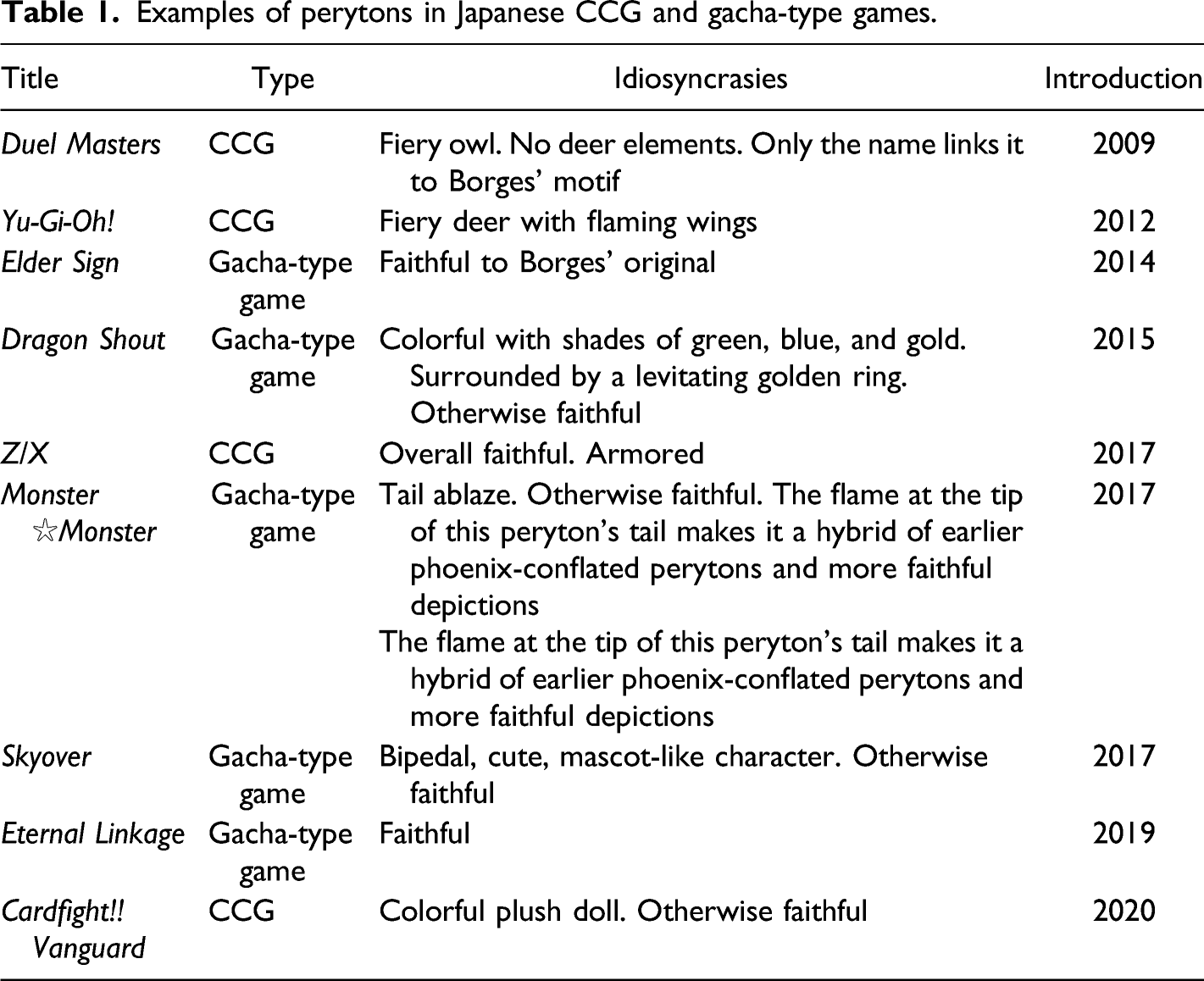
Once brought to Japan by earlier cultural ferrymen, the peryton motif was absorbed and freely reused in Japanese culture. It is unsurprising that CCGs and gacha-type mobile games, always craving intellectual rights-free material 28 to extend their product selection, found and used a creature as obscure as the peryton. Nonetheless, the trends in the motif’s reuse, scale of its adoption, and greater popularity in Japan than in the West are noteworthy phenomena from the viewpoint of cultural transfer studies.
Kujata
Kujata is another motif that supports the hypothesis that the FF series made use of Borges’ Book of Imaginary Beings. While some FF monsters were clearly borrowed from the Monster Manual, including some specific representations such as the long-necked catoblepas, Kujata is not included in this bestiary. However, it is referenced in Borges’ book. Unlike other motifs used liberally in Western fantasy settings, this one is seldom used outside of its Islamic context, even outside of Japanese productions. This reduces the number of potential cultural ferrymen and makes its presence in a popular Japanese game series all the more noteworthy. Borges (1974a) describes the creature as follows: In Moslem cosmology, Kujata is a huge bull endowed with four thousand eyes, ears, nostrils, mouths, and feet. To get from one ear to another or from one eye to another, no more than five hundred years are required. Kujata stands on the back of the fish Bahamut; on the bull’s back is a great rock of ruby, on the rock an angel, and on the angel rests our earth. Under the fish is a mighty sea, under the sea a vast abyss of air, under the air fire, and under the fire a serpent so great that were it not for fear of Allah, this creature might swallow up all creation. (pp. 89–90)
Its appearance in the FF series is late compared to most motifs. It is introduced as a summon in the seventh game, published in 1997. Like the carbuncle, Japanese sources in which the creature is represented are scant and were even more so at the time of the seventh game’s publication. Borges’ condensed description of Kujata clearly influenced its depiction as a summoned ally in the FF series. In Final Fantasy VII (Square, 1997), Kujata is represented as a bull-like entity with massive and multiple horns. While it does not have a thousand eyes, as per Borges’ description, it has six. No other creature is stacked on top of this Kujata, but its trademark attack can be seen as an adaptation of its connection to the sea, air, and fire: a succession of lightning, ice, and fire damage, finishing in an earthquake.
Examples of kujatas in Japanese gacha-type games.
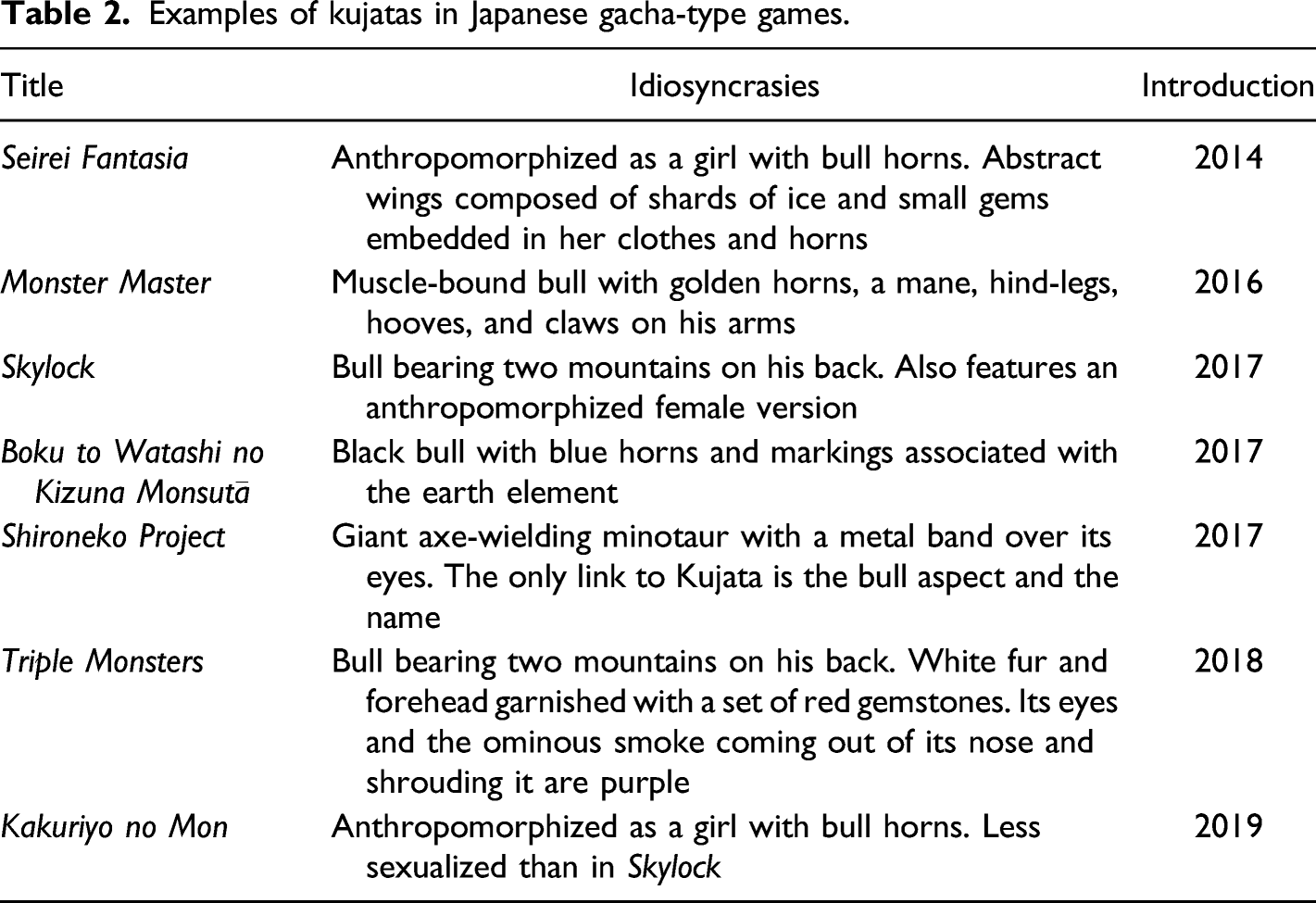
This overview confirms the shift from the metaphysical bull of Islamic cosmology. While some attributes, such as Kujata’s relation to elemental forces or the mountains on its back, evoke the original, they are aspects that Borges also described. Once again, the motif finds itself transformed. Its original religious context is rejected and substituted with various fantasy contexts. Furthermore, Kujata is often not a metaphysical being but rather a common, if powerful, monster, or even an eroticized female character. The case of Kujata showcases the degree of aesthetic transformation that motifs can undergo as they adapt to new contexts, thereby supporting deWinter (2012) claims.
What’s in a Name?
An important point to consider in the cultural transfers of such motifs is their names, which represent a significant part of their identities. Throughout the paper, I have referenced them by their English names. Their Japanese names are phonetic transliterations of their English names that makes use of the katakana syllabary usually used to transcribe foreign names. Re-transcribed to the Latin alphabet, carbuncle is kābankuru, catoblepas is katoburepasu, peryton is peryuton and Kujata, the easiest to convert to standard Japanese phonemes, is Kujata. Despite minor discrepancies arising from the relatively limited phonological extent of Japanese in comparison to the source languages, these are rather faithful transliterations. The fact that their Japanese names are taken from their English names and not from their original language (such as the Spanish carbunclo for carbuncle) is also a testament to the role of cultural ferrymen, such as Borges’s translators, in the transportation of concepts across different linguistic contexts.
However, in some cases this was an evolving process. The catoblepas was named shoat in the first English translation of Final Fantasy V. Ignorance and neglect of a motif’s origins caused several similar problems in early JRPG translations. However, as the market became bigger and translations took on greater importance, this trend declined.
These motifs, appropriated by Japanese games and other works of popular culture, often make their way back to their cultural areas of origin as a result of the global popularity of Japanese cultural productions. The reception of metamorphosed cultural items would need to be the object of a separate study. However, an interesting point to note is the fact that the motifs studied in the present paper recovered their original name and maintained a strong identity throughout the transfers and reuses they experienced, surmounting hiccups such as the mistranslation of catoblepas as shoat. Despite their often-radical metamorphoses, they retained their names and core characteristics, both during their way to and back from Japan. This, however, is not always the case. The ghoul, for example, used since the early days of JRPGs as a subtype of zombies under the influence of D&D, has now become dissociated from zombies and synonymous with the undead.
The ghoul is found in major game franchises, such as the DQ series (in games II, III, VII–XI, and other spin-offs) and the FF series (in games I, II, IV, XI, XII, XIII, Tactics, Legend, and Record Keeper). However, Final Fantasy Tactics (1997) used the name “ghoul” for a ghost-like monster, while the 11th episode of the series (2002) used the same name for a skeleton. Similar distortions are also found when JRPGs are translated for Western markets. In Final Fantasy VII Remake (Square-Enix, 2020), the specter-like monster Gurō Gaisuto (grow geist), a transliteration of the German for ghost, was translated into English as ghoul. For comparison, the French translation, Meistergeist, emphasized the motif’s German origins. The choice of ghoul to denote a specter-like undead creature may perhaps be understood as the series’ influence on the translator, as such use is specific to the FF series. Shifting the focus from the metamorphosis of these motifs in Japan to their continued travels to other countries, including to the countries of their origin, would constitute an interesting inquiry in cultural transfers. This would however need to be a separate study, for which references in the present paper should prove useful.
While such muddled identities and are an interesting aspect of cultural transfers between various cultures and Japan, the motifs covered in the present paper are relatively stable. This stability can perhaps be attributed to a better-established network of cultural ferrymen, known at both their point of origin and in Japan, such as Borges’ Book of Imaginary Beings, but going as far back as Pliny the Elder.
Conclusion
This paper illustrated the path of cultural transfer of motifs from folklore, mythology, and religion to video games via a specific intermediate transfer vector. By focusing on Borges’ Book of Imaginary Beings, I did not limit myself to examining inter-game exchanges. Rather, I demonstrated how a literary source can establish and maintain significant cultural influence outside its original cultural and mediatic sphere through various cultural ferrymen. Accordingly, motifs can gain greater popularity in another culture than in their original cultural context. This is well illustrated by the reuse of the peryton in Japan, outpacing its use in the West. The paper also discusses how the phenomenon of naturalization is achieved through the rejection or addition of certain attributes, including a motif’s historical context, as well as hybridization.
These trends are consistent with cultural transfer theory, confirming transformative tendencies and the importance of vectors at work. We have seen how various analog and digital Japanese games directly and indirectly reference Borges’ work. Borges’ bestiary is one of many fantasy bestiaries, and bestiaries themselves are only one aspect of fantasy world building. Nonetheless, its use of obscure folklore, such as the carbuncle, alongside more typical creatures, and its original creation of the peryton, makes it a useful case study. The filiation of these creatures is more traceable than that of famous, deeply entrenched motifs, such as dragons.
Beginning with Borges’ bestiary, I emphasized the role of TRPGs as prisms in the cultural transfer process. TRPGs utilize cultural content from various sources and recontextualize and standardize it in a coherent fantasy database. Following this, cultural content is refracted for further reuse in a new context—in the case of our study, contemporary Japanese video games. Cultural transfer is an ongoing phenomenon. It does not stop, contrary to the notion of influence as something received at a specific point in time. The notion of cultural transfer allows for the possibility of multiple and asynchronous vectors. The motifs discussed in this paper will likely continue to change, and their individual popularity will likely ebb and flow.
This paper also confirmed the increasing distance between culturally transferred motifs and their original representations. However, the peryton case study demonstrates that backtracking can also occur. While its first reuses were liberal reimaginations, subsequent franchises returned to Borges’ design. This suggests that game developers involved in the character design process might have discovered it—or rediscovered it, had they previously been exposed to it through older media—in Duel Masters. Following this, in searching for new material, they may have also rediscovered the original depiction of the motif and opted to reintegrate its original attributes. This hybridization of the motif, where it fails to stabilize and then returns to its original state, is one example of both the hybridization and rejection processes that cultural transfer theory discusses (Lüsebrink et al., 2014).
Other researchers, including deWinter, have made similar claims. However, they have rarely focused on video games. I endeavored to demonstrate how the medium of games is not only full of vivid cultural activity but also possesses deep roots extending throughout literature and beyond the usual classics. My study examined but a small sample among myriad strands of cultural transfers that constitute a complex and ever-evolving database. Nonetheless, I hope that this paper serves as a starting point for a deeper exploration of the cultural influence of video games.
Footnotes
Declaration of Conflicting Interests
The author(s) declared no potential conflicts of interest with respect to the research, authorship, and/or publication of this article.
Funding
The author(s) received no financial support for the research, authorship, and/or publication of this article.
