




Abstract
This paper aims to create a shorthand for video game history – from video games’ infancy to the current subscription model that is dominating gaming. In this essay, I will apply the practices of historical media scholarship that have helped parse out television history (e.g., TV I, TV II, TV III, and TV IV) and film history (e.g., Cinema 1, 2, and 3.0) to define the various shifts in video game history. Gaming I represents the arcade and home system boom up until the 1983 video game Crash, Gaming II describes the post-Crash console period, and finally, Gaming III materializes due to the arrival of modern video game subscriptions. Rather than constructing an exhaustive account of video game history, this essay means to generate more studies on what video game history can mean in the context of the established academic studies on visual media.
Keywords
Introduction
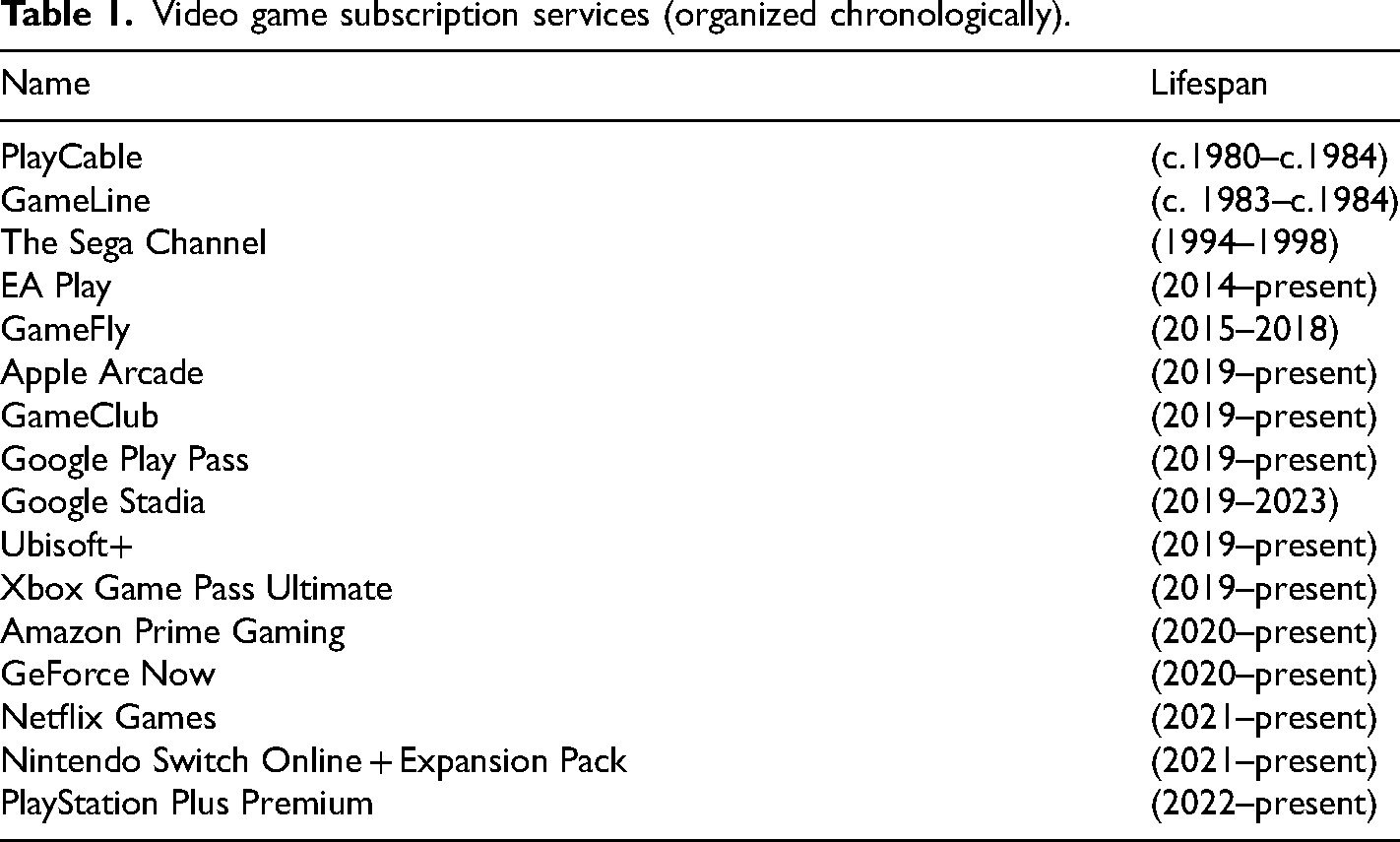
With the advent of modern video game subscription services (see Table 1 for examples) the video game industry is mirroring the business practices of the video-on-demand streaming industry (see Table 2 for examples).
Video game subscription services (organized chronologically).
Video on demand streaming services (organized chronologically).

Evidently, game subscriptions are not a new idea as PlayCable and GameLine were offering game subscription services before the availability of the world wide web in 1991. Current video game companies have drastically changed video gaming as they have adopted and effectively implemented the subscription model of contemporary video-on-demand streaming companies. Streaming businesses like Netflix also now curate games for mobile devices (and they may soon begin curating games for TV use (Gurman, 2023)) which showcases streaming merging with gaming and vice versa.
This paper aims to create a shorthand for video game history–from video games’ infancy to the current subscription model that is dominating gaming. I will apply the practices of historical media scholarship that have helped parse out television history (e.g., TV I, TV II, TV III, and TV IV) and film history (e.g., Cinema 1, 2, and 3.0) to define the various shifts in video game history regarding the development, distribution, and consumption of video game systems and arcades. While this paper focuses on video game consoles, I will consider the impact that the personal computer (PC) has had on video gaming (e.g., that video games are developed via computers and that consoles rely on the internet for subscription services and online gaming) and how mobile devices have become quasi-handheld video game systems (e.g., Netflix Games must be played on mobile devices or electronic tablets). Constructing this timeline will place video games alongside other visual media such as TV and film which are the principal mediums that are analyzed in media studies. I posit that video game history can be thought of in the same ways as cinema and TV history, which will hopefully further the seriousness of video games as well as the accuracy of the medium's past.
Gaming I represents the arcade and home system boom up until the 1983 video game Crash, Gaming II describes the post-Crash console period, and finally, Gaming III materializes due to the arrival of contemporary video game subscriptions. As I am writing this, gaming may be segueing into Gaming IV due to the advancement of virtual reality (VR)–which will need to be considered in a separate project since the technology is not yet fully formed. While Jaakko Suominen has separated gaming histories into multiple genres such as “‘enthusiasts genre, ‘emancipations genre,’ ‘genealogies genre,’ and… ‘pathologies genre,’ which…represent the most prevalent current styles of writing digital game history” (Suominen, 2017, p. 548), I hope to construct a more explicit timeline of video games’ past. 1 Rather than creating an exhaustive account of video game history, this essay means to generate more studies on what video game history can mean in the context of the established academic studies on visual media.
This essay begins by describing the academic literature on the stages of the TV and film industries which will allow me to compare how academics have defined the shifts in television and cinema to the evolution of video games. In discussing the progression of video games, I describe the abundant generations of consoles by organizing them by era. Numerous interviews with software engineers and professionals who utilize Xbox Game Pass Ultimate and Nintendo Switch Online + Expansion Pack in their place of work are included in this paper. 2 These conversations will help explain how game subscription services have changed how people play and purchase video games. Evidently, data collecting is the new currency, and companies like Netflix track viewers’ watching behavior to create algorithms to curate personalized viewing experiences (O’Flaherty, 2021). Based on the landings of the various game subscription applications and websites, these companies are imitating the same business standards of the streaming businesses – they are personalizing the gaming experience by recommending games to players. 3 Situating the gaming subscription model within the context of a larger video game history will not only provide reference points that show how the video game industry has shifted, but also illuminate streaming's impact on game distribution and development.
TV I, TV II, TV III, TV IV, and Cinema 1, 2, and 3.0
TV I is known as the network era of television in the U.S. (c.1948–1975; see Jenner, 2018, p. 15; see Williams, 1974, pp. 28–29). The technology in this period relied on broadcasting (Todreas, 1999, p. 13). TV stations would use antennas to send radio waves (or signals) to personal televisions (or public TVs (McCarthy, 2001, pp. 89–93)). TV II is what Steve Behrens uses as a shorthand for the “post-network era (roughly 1975–1995)” (Behrens, 1986, pp. 8–10; McCabe & Akass, 2007b, pp. 266–267; Rogers, Epstein & Reeves, 2002, p. 43; see Ellis, 2000, p. 39; see Jenner, 2018, p. 13; see Newman, 2014, pp. 2–3; see Pearson, 2011, pp. 1262–1266). Timothy M. Todreas describes TV II (1975–1999) as the “cable era” (Todreas, 1999, p. 13). TV II is more technologically advanced than TV I as it utilized a “combination [of] satellite and cable distribution system[s], augmented by VCRs, [and] remote controls” (Rogers, Epstein & Reeves 2002, p. 45). Although both TV I and TV II depended on “developing popular entertainment…to attract the ‘attention’ of potential consumers– ‘attention’ that was then commodified and sold to advertisers” (Rogers, Epstein & Reeves, 2002, p. 46), the shows in TV II became more narratively and thematically complex (Feuer et al., 1984).
HBO revamped television by establishing a subscription model that audiences can pay for. This period is known as TV III (1999–c.2015) (Rogers, Epstein & Reeves, 2002; see Todreas, 1999, pp. 76–78). Television companies in TV III no longer depended on broadcast technology (thus, it partially resembles TV II in this way). Instead, premium TV stations send signals via cables that reside underground. Cable stations also use dishes which are like antennas. Instead of the antenna being affixed to the TV itself, dishes are installed onto the roofs of buildings which obtain signals from space satellites. These signals are redirected to the DVR boxes (or cable boxes) that are connected to the TV. Thus, dishes do not depend on radio waves but instead digital transcriptions–1 s and 0 s which are delivered through space satellites (Dish: Insider's Guide, n.d., n.p.).
Albeit TV III “is largely defined through a shift towards the digital” (Jenner, 2018, p. 11; Newman & Levine, 2012, p. 2; Rogers, Epstein & Reeves 2002, p. 48), TV III can also be examined in relation to “quality content”–or intricate narratives that challenge the status quo of traditional TV storylines (DeFino, 2014, pp. 8–10; Edgerton, 2008, pp. 11–13; Jenner, 2018, p. 14; McCabe & Akass, 2007a; Newman & Levine, 2012; Pepper, 2021, p. 93, p. 103; Rogers, Epstein & Reeves 2002, p. 51). HBO's “subscription model offers more liberty,” which has become known as the “HBO effect” (DeFino, 2014, p. 11). HBO can “present language, nudity and violence that far exceeds the MPAA (Motion Pictures Association of America) rating of NC-17” (Tait, 2008, p. 54; see DeFino, 2014, pp. 5–6; see Rogers, Epstein & Reeves 2002, p. 51). This artistic freedom shields “content producers from the fear of offending nervous advertisers” (Rogers, Epstein & Reeves 2002, p. 47; see Jenner, 2018, p. 11; see McCabe & Akass, 2008, pp. 84–85). As TV I and TV II were dependent on advertisers paying to place their products alongside narratives, HBO made it possible for artists to create their work without worry of retaliation from other companies.
Premium channels are also able to produce aesthetically and narratively experimental shows (Feuer, 2007, p. 145). HBO's 1996–2009 slogan, “It's Not TV. It's HBO” exemplifies this ideology (DeFino, 2014, p. 3; Edgerton, 2008, p. 9; Pepper, 2021, p. 93). Academically, prestige television is often defined in this regard: “It is not ‘regular TV’” (Thompson, 1996, p. 13; see Dunleavy, 2018, pp. 43–44; see McCabe & Akass, 2008, p. 83; see Mittell, 2015, p. 18; see Nochimson, 2019; see Polan, 2009; see Shuster, 2017).
Currently, viewers can stream TV by using the internet to access streaming websites. They can watch how they want (on laptops, TVs, phones, and tablets) and when they want. Viewers are also able to interact with the shows they are watching by blogging and vlogging about the series. This is what Mareike Jenner calls “TV IV” (c.2015–present) (Jenner, 2017, p. 305; see Balanzategui, 2018, p. 664; see Jenner, 2016, pp. 258–259; see Mittell, 2015, p. 128, pp. 280–283). TV IV is used to describe the streaming age as TV III “is inadequate to contain the significant changes streaming providers Netflix, Amazon, and Hulu make to television itself” (Jenner, 2018, pp. 13–14). These companies offer “quality content” (Balanzategui, 2018, p. 657, p. 664) that is delivered through a “subscription video on demand” (SVOD) service (Kirkpatrick, 2018, p. 3). This model reinvented TV because it gave the viewer “individual control over entertainment technology” (Jenner, 2018: 35, my emphasis; see Jenner, 2016, p. 260). Similar to the academic organization of the various TV history periods, film scholars have used the same methodology to construct the stages of cinema–specifically cinema 3.0. Before I can discuss Cinema 3.0, I must turn to Gilles Deleuze and his definitions of Cinema 1 and 2.
Deleuze argues that Cinema 1 is a “system which reproduces movement…to create an impression of continuity” (Deleuze, 1983, p. 5). Cinema 1 evolved into Cinema 2 after WWII because of Italian neo-realism. Neo-realism created a “a new type of image [that] aimed at an always ambiguous, to be deciphered, real” (Deleuze, 1985, p. 1). Kristin Daly argues that Cinema 2 transitioned into Cinema 3.0 because cinema no longer produces the impression of continuity nor is it ambiguous, but rather it becomes a “cinema of the user, as the time-image gives way to the interactive-image” (Daly, 2010, pp. 81–82; see Rodowick, 2007, p. 177). These “users” are renamed “viewsers” 4 by Daly (2010, p. 82; see Harries, 2002, pp. 172–173, p. 178). Cinema has progressed (2 to 3.0) because of the viewer's command over the images. This also became the case for television (TV III to TV IV) (Jenner, 2018, pp. 89–98). TV IV is not solely about how television is delivered (streaming) but rather how the viewers interact with the text online.
Deleuze's and Daly's categorization of cinema is more theoretical than practical in that both scholars (Deleuze more than Daly) 5 do not discuss the advents of the VHS, DVDs, and Blockbuster (brick and mortar rental stores). This scholarship exists elsewhere 6 (Benson-Allott, 2013, pp. 1–25; Besser, 1998, p. 137; Metcalf, 2012). The analog components of media will be integral to parsing out video game history, which I will turn to in the next section of this essay.
Gaming I
Gaming I represents c.1971–1983. While Spacewar! (Steve Russell, 1962) was technically the first video game (see Lendino, 2020, pp. 23–27; see Skelly, 2012, p. 140) the American arcade industry and the home console market were both established c.1971. Galaxy Game (Bill Pitts & Hugh Tuck, 1971) and Computer Space (Syzygy Entertainment, 1971) were the first two coin operated video games. They were based on Spacewar! Pong (Atari, 1972) was the first financially successful arcade game. The Magnavox Odyssey (1972–1975) was the earliest video game console. 7 And the Atari 2600 (1977–1992) was one of the first commercially successful game systems (see Wolf, 2012a, pp. 2–4; see Wolf, 2012b, p. 81).
The primary reason for why Gaming II transitioned into Gaming III is because of the advent of successful game subscriptions which is dependent on modern networks. However, companies were producing products and services that allowed people to pay for game subscriptions as early as 1980 which depended on computer technology. Computers have intersected with video gaming since its infancy as Spacewar! was a quasi-computer-video game (written for the PDP-1 computer), 8 and video games are developed via programming languages (e.g., C++) and computer graphics gaming engines (e.g., Unreal Engine) (see Wardrip-Fruin, 2020). Video games and online gaming became possible with the advent of PCs and the internet. To discuss the computer's relevancy to modern gaming (which includes how Gaming III became possible with cloud gaming and online subscriptions) I will turn to examining the beginning of mass-produced computers and the internet to explain how online services and play affected the video game industry.
Computers and Online Gaming
Online play was available during Gaming I as personal computers like the Apple II (1977–1979), Commodore's VIC-20 (1980–1985), and the IBM PC (1981–1987) were mass produced and the internet materialized in the early 1980s 9 which allowed gamers to dial “via modem into bulletin-board systems (BBS's) to discuss and play games” (Dyson, 2020, n.p.). 10 The world wide web would not become publicly available until 1991 (Bryant, 2011; Galloway, 2023, Interview by Banfi). Thus, online play did not become readily accessible until Gaming II (more on that in the Gaming II section).
PlayCable was the first service to offer an online game subscription for players. It was developed by Mattel and General Instrument for the Intellevision. The service utilized cable television system operators to deliver games to the Intellivision console via cable wires and television signals. Customers would use the PlayCable adapter to download the games directly to their system. This service “offered a selection of monthly games for a fixed monthly fee; there were 15 monthly games at first and which was later expanded to 20 games” (Lawlor, 2021, n.p.; see Langshaw, 2011).
A few years later Control Video Game Corporation (CVC) operated and developed GameLine which was a game subscription service that utilized “dial-up”
11
to connect to game systems (see Klein, 2003, pp. 14–16; see Schrage, 1983, p. 17). To use GameLine patrons would need to purchase a Master Module [(which costs $59.99)] … a high-speed modem…that automatically dials GameLine's toll-free number and receives the selected game program…. In addition to the Master Module, the player must buy a GameLine membership for $15. After that, games can be loaded for about $1 each, and each game can be played five to ten times per load. This enables a player to test-play games before purchasing them in cartridge form, or to just play at a cost less than at the arcades (Burns, 1983, p. 82).
GameLine was advertised in the Electronics Games Magazine November 1983 edition with the taglines more games added every month! All through your telephone… Just insert the GameLine Master Module into your Atari 2600 VCS, ColecoVision, or other VCS compatible system and hook it up to any telephone. After registering on our toll-free number, use your joystick to pick and play your favorite games…Your games will be automatically charged to you (or your family's) major credit card…And your telephone will never be tied up for more thana a minute (Electronic Games Magazine, 1983, n.p.).
Evident from these business practices and GameLine's advertisement, these services were attempting to compete not just with other consoles but with the arcade industry. However, the game subscriptions were too expensive for the American population and the computer technologies and networks were not sufficient to support a robust catalogue of games (see Klein, 2003, pp. 21–22, p. 25; see Landro, 1983, p. 25). CVC's product did not sustain the 1983 Crash 12 and neither did PlayCable.
The 1983 Crash
Various video game services, consoles, and games would saturate the video game industry and cause the 1983 Crash which would lead to the disruption of the video game industry (Oxford, 2012).
13
According to Benjamin Nicoll Atari was primarily responsible for the Crash. They produced a poor port of Pac-Man (Namco, 1980) for their Atari 2600 in 1982 and that game “is often labeled as a catalyst for the major crash in the North American video game market in 1983…the game was almost unrecognizably different to its coin-op counterpart due to the limitations of the Atari hardware” (Nicoll, 2017, p. 203; see Montfort & Bogost, 2009, pp. 74–76). E.T. the Extra-Terrestrial (Atari, 1982) for the Atari 2600 was also considered responsible for the Crash. Atari made E.T. “in a mere six weeks after [they] spent $20 to $25 million on the property rights and skipped quality testing to make it out the door in time for the 1982 Christmas season” (Oxford, 2012, n.p.; see Aldred, 2012, p. 91). Nolan Bushnell, the co-creator of Atari, admits that the Crash was totally Atari's fault. I’ve always said it wasn’t homicide; it was suicide…It was all about not understanding that they had saturated the market. Atari went into Christmas 1982 thinking they could put another 15 million VCS [(Atari 2600)] consoles into the market, but they couldn’t. Everybody went off that 15 million number to put in cartridges, so when the hardware didn’t sell, the cartridges didn’t sell…. When the cartridges didn’t sell, a huge rush to discounting went on. People were liquidating inventory at almost any cost (Ramsay, 2012, p. 33).
Atari lost $536 million (USD) in 1983 (and they “slashed their workforce from 10,000 employees to just 400” (Beatteay, 2020, n.p.) and Mattel's deficit reached $201 million (USD) during that same year. Imagic, “one of the fastest-growing makers of game cartridges, laid off 40 of its 170 employees” (Kleinfield, 1983, p. 60). In 1982, K Mart, one of the U.S.'s largest retailers, opened and closed “200” of its videogame rooms (Kleinfield, 1983, p. 60). Industry observers projected that the video game market would move into the home because of the initial popularity of home consoles (Kocurek, 2015, p. xxiii). This did occur.
The arcade industry mirrored the downfall of the home video game business. Donkey Kong (Nintendo, 1981), Pacman, and Defender (Williams Electronics, 1981) sold well, but no new hits followed their releases (Kleinfield, 1983, p. 60). Many American arcade operators (or arcade owners) lost “30 to 40 percent in revenues…. Between 1980 and 1982, arcade parlors doubled to 10,000. Industry analysts estimate that more than 1,500 of them closed” in 1983 (Kleinfield, 1983, p. 1, p. 60). Thus, both industries transitioned into a state of decline. To help illuminate the various transitions of video game history, including the industry's 1983 downfall, the following section will explain and display the various generations of video game consoles.
The Video Game Console Generations
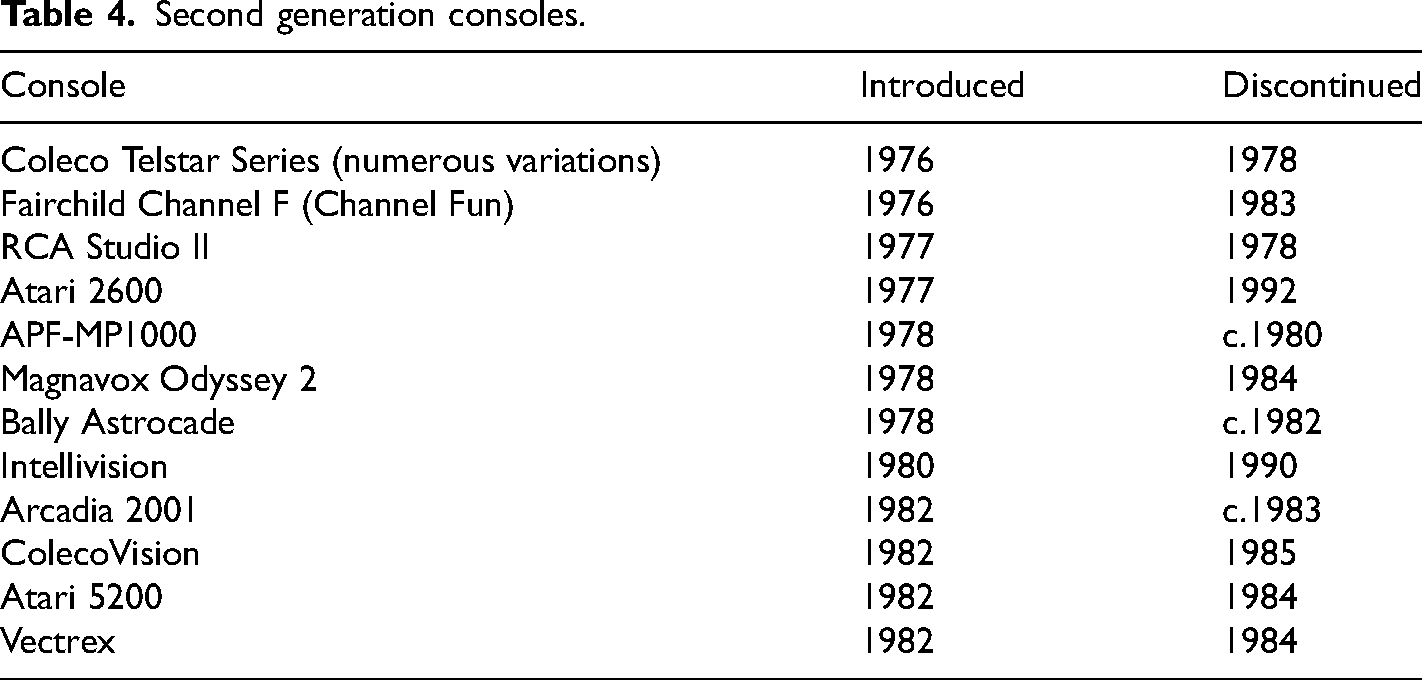
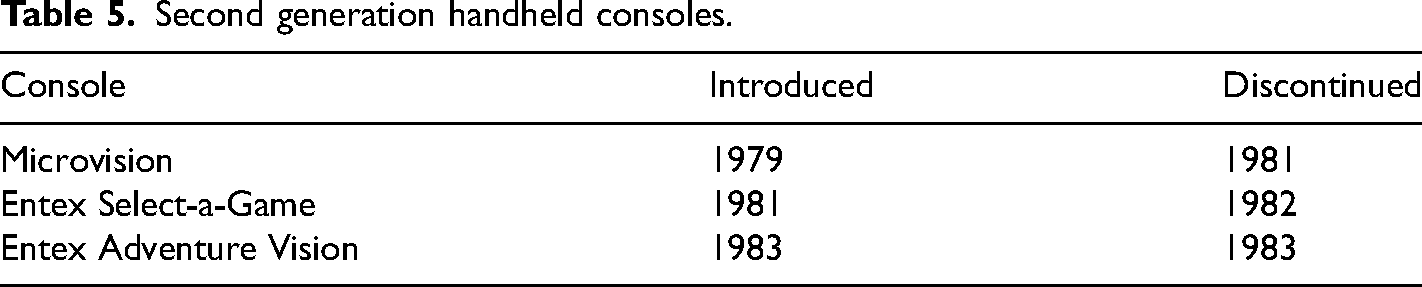
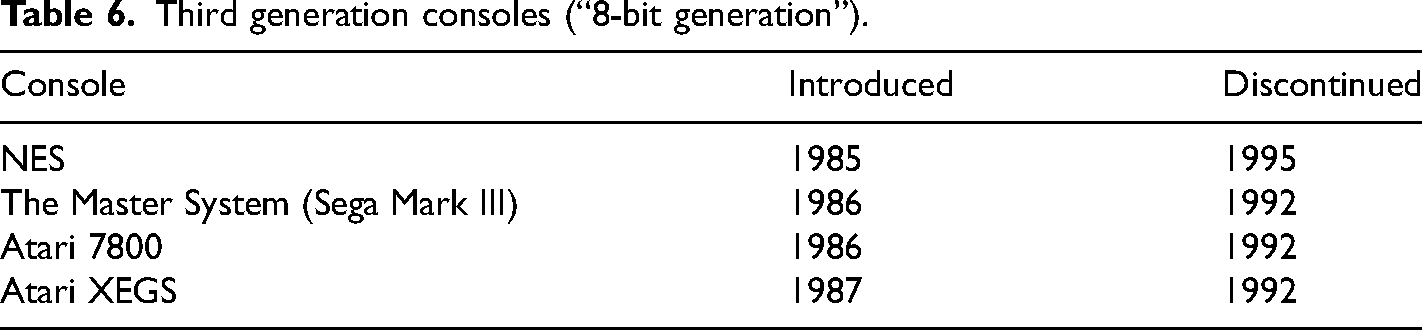
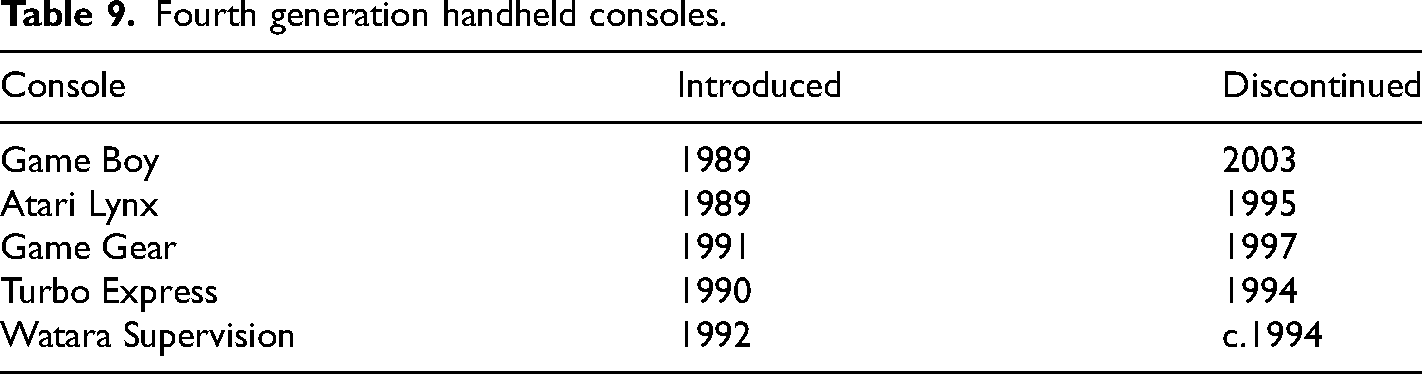
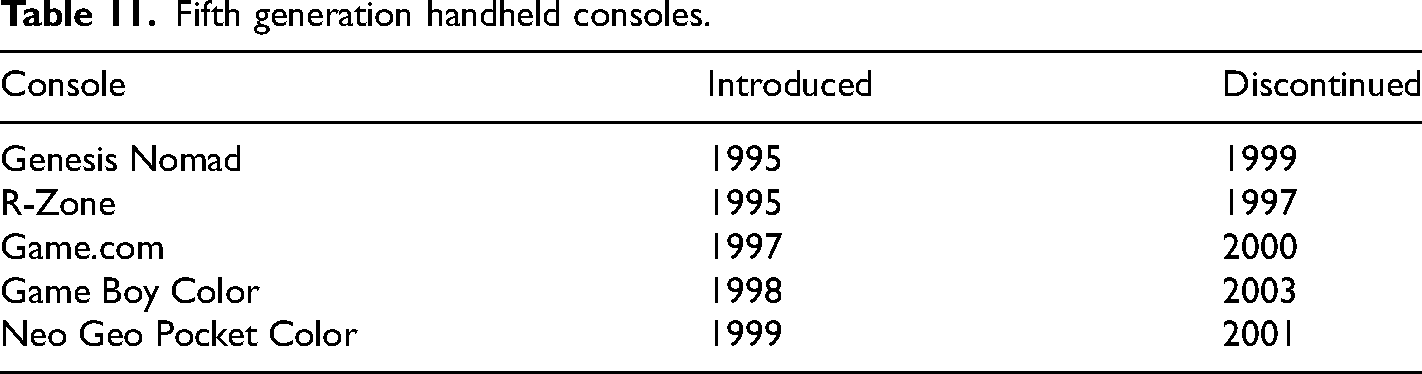
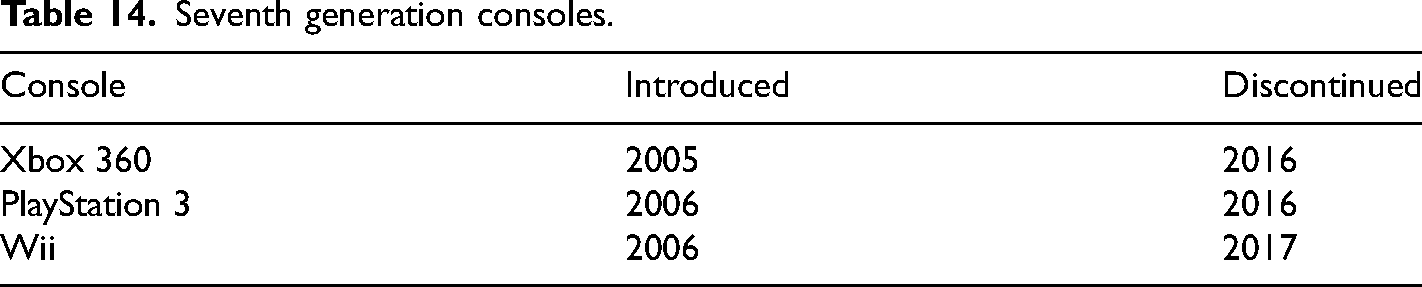
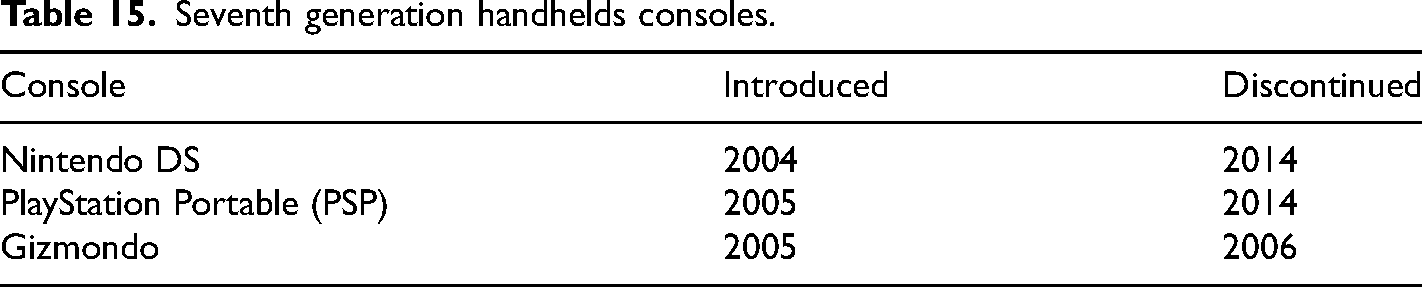
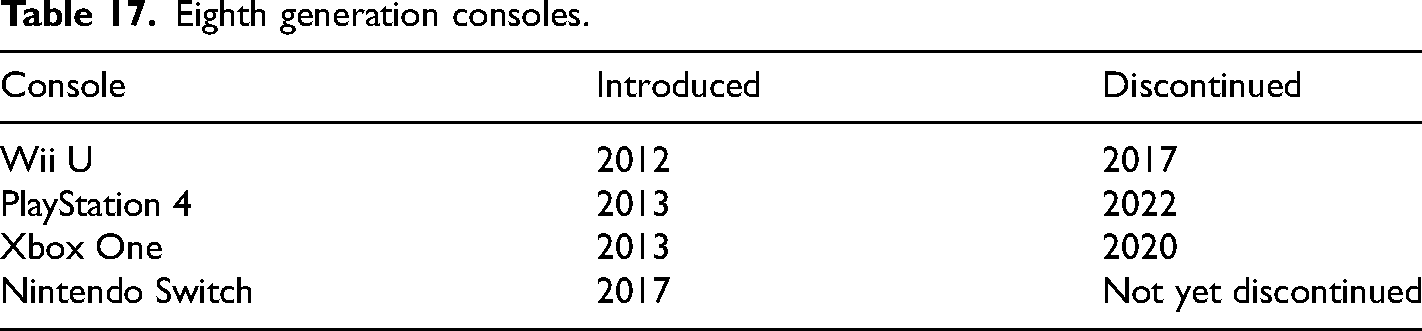
In the following pages I have included tables organized by home console generations (first to ninth generations; and I include handheld generations) to help showcase the various periods in video game history. 14 Tables 3–5 display the console systems that were produced during Gaming I (the pre-Crash era). These tables along with Tables 6–19 parse out the consoles that were released during Gaming II and Gaming III (more on this later). My timeline of these consoles is based on online wiki work, magazine articles, and Evan Amos’ The Game Console 2.0 (Amos, 2021, pp. 6–7; Jack, 2021; Winkie, 2019).
First generation consoles.

Second generation consoles.
Second generation handheld consoles.
Third generation consoles (“8-bit generation”).
Third generation handheld console.

Fourth generation consoles (“16-bit generation”).

Fourth generation handheld consoles.
Fifth generation consoles (“32-bit and 64-bit generation”).

Fifth generation handheld consoles.
Sixth generation consoles.

Sixth generation handheld consoles.

Seventh generation consoles.
Seventh generation handhelds consoles.
Eighth generation handheld consoles.

Eighth generation consoles.
Ninth generation consoles.

Ninth generation handheld console.

All the dates concerning the launch years and the periods when the consoles would become terminated in this essay refer to the North American lifespan of these systems. Analysis on the exclusive Japanese and European consoles are omitted for clarity and space. 15 Moreover, Europe did not consume video games like Japan and the U.S. did. Mark J.P. Wolf states that in Europe “computer games were more popular than video games, so they often referred to video games as computer games… and the Crash was specific to North America” (Wolf, 2023, Interview by Banfi). Thus, these tables are not an encyclopedic account of video games’ past. That would require more research to construct an international history of video games (for research on the history of the Japanese video game industry see Consalvo, 2009; see Consalvo, 2016; see Picard, 2013). Similarly, TV I-TV IV primarily refer to American television, while Cinema 1–3.0 are more inclusive of international films (this is especially the case as Deleuze argues that Italian Neo-realism is what alters cinema 1). Although I do not discuss exclusive Japanese and European consoles, the consoles that are included in these tables were played globally. In addition, some of the consoles listed here are based on the Japanese versions of the gaming systems. For instance, the NES was known as Family Computer (FC) or Famicom in Japan. Video game history becomes complicated because of this. And again, this complexity is a topic that needs more attention in game studies.
Gaming II
Gaming II represents c.1983–c.2019. This period begins after the 1983 Crash and ends when modern gaming subscriptions begin to become relevant (Gaming III). The video game market post-Crash was almost non-existent from 1983 to 1985. According to Bushnell “there was virtually very little game activity for a couple of years. When Nintendo wanted to bring their unit [(the NES)] into the United States, they did it very tentatively because many retailers didn’t want to hear the words ‘video game’” (Ramsay, 2012, p. 33). The 1983 Crash changed the industry indefinitely as it would lead to Nintendo controlling the video game market because of the NES’ popularity in 1985. Nintendo allowed few third-party titles for their systems (Wolf, 2012b, p. 88). This decision was a reaction to Atari's poorly produced games like E.T. The third-party games that Nintendo did admit later for its consoles had to be of high quality.
In the mid 1980s, the home console companies began overtaking the arcade industry. Although the arcade industry did flourish at the end of the 1980s 16 as “Beat-em-up games proved to be a savior for arcades…with those leading other popular run-and-gun and cockpit-style titles for a combined $6.4 billion (USD) in revenue in 1988” (Lendino, 2020, p. 335), by the mid-1990s “consoles and home computers were pushing the video game industry forward, so there was little reason to leave the house and pay per play” (Lendino, 2020, p. 379). While arcades began to decline in the late 1990s, they now cater to a niche American market as many arcades transitioned into barcades (places where adults can play new and retro arcade games and drink alcohol).
Comparative to arcade cabinets, video game systems could support multiple games rather than one dedicated game. Moreover, the polygon count began to increase, and gameplay was becoming more complex with each new generation of consoles. This was due to companies building intricate systems with increasingly powerful processors. The various consoles became entangled in what is unofficial known as the “bit wars.” “Bits” are mentioned in game studies frequently but often without detailed explanation (Grabarczyk, 2018; Harpold, 2007; Švelch, 2013). Bit “stands for Binary Digit [(1 s and 0 s)], and it is a singular piece of data”
17
(Beatteay, 2020, n.p.). The Central Processing Unit (CPU) and Graphics Processing Unit (GPU) within the gaming consoles are necessary to process the bits into games. According to Sunny Beatteay, phrases like “8-bit” or “16-bit” refer to the number of bits that a CPU or GPU can process in a single clock cycle. The number of bits that can be processed at once can play a crucial role in the graphics and game play of a video game (Beatteay, 2020, n.p.).
Beatteay compares the NES which contains an 8-bit CPU to the Sega Genesis which includes 16-bit capabilities. For the NES “the largest number an 8-bit processor can handle at any given time is 256…. This is why the original Nintendo games had simplistic graphics and controls. As processors became more complex, they could handle more bits. The Sega Genesis console with its 16-bit capabilities, was evidently a technically superior system than the NES” (Beatteay, 2020, n.p.).
Gaming companies soon began advertising their consoles based on their capabilities to support more “realistic” games. Atari is one of the most famous businesses for commercializing “bits”–this became evident in their “Do the Math” television commercial for their system, the Atari Jaguar. In the ad, a teacher delivers a seminar on the “bits” that the consoles support. She states, “Sega Genesis is 16-bits, 3DO is 32-bits, The Atari Jaguar is 64 bits, so with 64 bits and 3D graphics that you can only get with Jaguar…. which is more advanced? Jaguar!” The video game companies’ emphasis on bits amplified the console wars (which had already been underway in Gaming I as companies were releasing new systems therefore creating a saturated market). Ultimately, the contest to manufacture more dynamic consoles led to companies such as Sony releasing the PlayStation in 1995 and Nintendo unveiling the Nintendo 64 in 1996 (see Table 10). The “64” part of Nintendo's 1996 system title was a direct reference to its capabilities of producing 64-bit games. According to software engineer John Smith (his name has been redacted) “a higher bit count does not translate to 3D graphics necessarily. Computers that contain more memory grants more data which means you can produce better graphics, and more complexities to a game. This all requires more memory, which in turn allows for a greater bit count” (Smith, 2023b, Interview by Banfi).
As consumers purchased consoles for their power (e.g., the bit wars), they also bought systems for their online capabilities. The Sega Genesis (and later the Sega Saturn) supported The Sega Channel which was like PlayCable and GameLine in that it was a pay to play service designed for Sega's consoles. This service cost “a monthly fee of $15 and a $25 activation fee that also provided the necessary hardware, Genesis owners received a Sega Channel adapter that fit into the console's cartridge slot and access to upwards of 50 games. The games were often rotated and shuffled every month” (Buchanan, 2012, n.p.; see McCash, 1993). After The Sega Channel became defunct in 1998 Sega created SegaNet, an online multiplayer gaming service, for the Dreamcast. The Dreamcast was one of the first consoles with advanced internet capabilities as it included an internal modem. 18 SegaNet allowed “users to play 3D multiplayer games, chat, find codes, send e-mail, or browse the Internet” (Satterfield, 2000, n.p.). The service cost $21.95 (USD) per month. Sega's service failed due to limited internet access as dial-up was not sufficient to support complex online play. It became too expensive for Sega to operate servers for a small pool of players. Sega, a pillar in the gaming industry, ceased producing consoles after the Dreamcast's failure in 2001.
Although online play was possible in Gaming I it did not become readily accessible until Gaming II with the advent of Xbox Live. 19 While Xbox Live is an online multiplayer gaming service (like SegaNet) and not a game subscription service, it did show that the servers could finally support intricate online gameplay. The membership fee was $49.99 (USD) annually, which made the service more affordable than SegaNet. Four months after Xbox Live was launched it attracted 350,000 users. In 2004, it had 1 million members (Hatfield, 2012). While the other sixth-generation consoles, PlayStation 2, and GameCube (see Table 12), supported online capabilities, they were not as robust as Xbox and its online service (Jones, 2020; Kurland, 2022).
Online gaming and computer technology allowed for gamers to connect with each other. This would drastically change video gaming and it occurred during Gaming II. Network capabilities are essential to subscription gaming which is why Gaming II transitions to Gaming III. The online networks in Gaming III are robust and they can better support complex online play, and cloud gaming (more on this later). It is important to note online gaming in Gaming II as the premium gaming companies such as Sony, Microsoft, and Nintendo outlast Sega in the early 2000s because of their premium products (e.g., Sony's PlayStation 2, Microsoft's Xbox, and Nintendo's GameCube). These companies set this precedent during the sixth generation of consoles which allowed for these companies to thrive (see Tables 12–18).
The competition between Sony, Microsoft, and Nintendo is still relevant today. Like TV III's defining moment with the inclusion of HBO as a premium company rivaling network TV, the beginning of the transition from Gaming II to Gaming III began with the solidification of premium gaming companies producing quality consoles, games, and services. Gaming III would become an advent in video game history (albeit a recent and evolving one) because of the companies’ advertisement of prosperous gaming passes. In other words, the gaming companies are now competing by advertising their libraries–consumers will choose the collection that contains a more robust roster of titles. This strategy emulates TV IV as streaming companies like Netflix are producing original content and acquiring other shows and films to attract consumers to their platforms. As stated in the introduction of this essay, Gaming III materializes because of the video game companies’ adoption of the subscription model, and the streaming companies’ (namely Netflix) curation of games for their platforms. This transition showcases streaming merging with gaming and vice versa. Netflix can support games by allowing users to download them onto their mobile devices. For that reason, this essay must consider mobile gaming. Although mobile devices are not video game consoles, they are competing with the big three video game companies, and mobile gaming began in Gaming II.
Mobile Gaming
Before the advent of the smartphone and app stores, many consider the pre-installed game Snake (Nokia, 1998) for the Nokia 6110 (1998–c.1999) “to be the original mobile game. This simple 2D game involved directing an ever-growing snake around the screen to pick up items” (Fidelman & Omega, 2011, n.p.; see Angelos, 2021; see Parikka & Suominen, 2006). Mobile gaming was initially limited due to monochrome screens and keypads. In 2007, Apple released the first-generation iPhone (2007–2008). The iPhone and later smartphones became the perfect platform for gaming. They utilize important components such as a high-definition screens, accelerometers, gyroscopes, and touch screens…. the software used to run games has become much more accessible and affordable. App markets began popping up, allowing gamers to utilize their wireless internet providers and play any of thousands of games in seconds (Fidelman & Omega, 2011, n.p.).
Mobile gaming has been described as “casual gaming” because these games are accessible to a diverse group of people. Casual games are usually puzzle based games which do not rely on complex gameplay, but rather the smartphone's intuitive touch screen. For example, in Angry Birds (Rovio Entertainment, 2009) the player utilizes the smartphones’ touch controls to slingshot the birds against the game's enemies (the green colored pigs). Pokémon Go (Niantic, 2016) is an augmented reality (AR) mobile game that uses the phone's Global Positioning System (GPS) to detect and capture virtual creatures called Pokémon. The game was immensely popular given its accessibility and its ability to socially connect players (Vella et al. 2019). Both games discussed here are considered “freemium games.” Freemium games “allow players to download and play…game[s] at no cost while offering optional in-app purchases to supplement their experience” (Apple App Store, n.d., n.p.) (and they also rely on in-game advertisements to generate income). Mobile games’ success is often determined by downloads rather than purchases (although they are not mutually exclusive), hence why freemium games dominate the app market. According to Statista, Pokémon Go has achieved 600 million downloads. By 2015 Angry Birds had been downloaded 3 billion times (Robertson, 2015). Comparatively, Grand Theft Auto V (Rockstar Games, 2013) one of the best-selling video games, has only sold 175 million copies across numerous consoles (Sirani, 2023a).
Mobile games reach mass audiences because people already own mobile devices. According to the Pew Research center 97% of Americans “own a cellphone of some kind. The share of Americans that own a smartphone is now 85%, up from just 35% in Pew Research Center's first survey of smartphone ownership conducted in 2011” (Pew Research Center, 2021, n.p.). This means that 282,115,000 Americans can download mobile games which makes the smartphone the most accessible “gaming system.” Comparatively, the PlayStation 2 is the best-selling console of all time, it has sold 159 million systems, albeit this is referring to worldwide sales (Sirani, 2023b).
The mobile device has largely dismantled the handheld gaming market (see Tables 15 and 16). Per Table 16, Sony and Nintendo are no longer manufacturing handheld consoles. 20 Nintendo is currently promoting their mobile app (Nintendo Co., Ltd., 2022, pp. 30–31). They have also produced Super Mario Run (Nintendo, 2016) a “casual” version of the original Super Mario series. Super Mario Run removes the difficulty from the series’ original installments. In the mobile game, Mario automatically vaults over many of the obstacles and some enemies. For that reason, the game is not as dependent on timing difficult jumps. Moreover, Super Mario Run's first three levels are free. 21 Nintendo is partially maneuvering towards casual gaming to appeal to the new handheld market, which suggests their interest in the future of mobile gaming.
While “freemium games” dominate the mobile gaming market, these games depend on in-game advertisements (like TV I and TV II). Netflix charges players a monthly fee to access their game library. Thus, their service is not “freemium” but “premium,” like their streaming service. This monthly subscription to play is also being utilized by video game companies. The gaming industry is changing drastically as players are subscribing to play games rather than purchasing them which revamps how games are advertised and consumed. This alteration of videogame distribution radically changes not just the industry but how players play. Hence why Gaming II transitions into Gaming III.
Gaming III
Gaming III represents c.2019–present. It concerns the eighth and ninth generation consoles except for the Wii U which was a commercial failure and a primary reason for why Nintendo produced the Switch during the eighth generation of consoles (Shay & Palomba, 2020). Nintendo did not produce an online subscription for the Wii U. The Steam Deck is manufactured during Gaming III, but currently Steam does not provide a game subscription for the system. While Xbox Game Pass Ultimate, and PlayStation Plus Premium can be purchased for the PlayStation 4 and the Xbox One, PlayStation 5, Xbox Series X/S, and the Nintendo Switch are still being manufactured whereas the former two are not.
Video game subscriptions are becoming increasingly popular for these consoles. 10 million people subscribed to Xbox Game Pass Ultimate in April of 2020. In early 2021, 18 million enrolled for the service. By 2022, 25 million subscribed to Xbox Game Pass Ultimate (Clement, 2023a). As of December 2022, 46.4 million people are members of PlayStation Plus Premium (Clement, 2023b). In 2020, 26 million subscribed to Nintendo Switch Online. By September 2021 Nintendo had 32 million members (Allen, 2021; Nintendo Co., Ltd., 2021, p. 40). As of September 2022, “Nintendo Switch Online…has exceeded 36 million paid memberships” (Nintendo Co., Ltd., 2022, p. 14). Regarding the trends of Nintendo's digital trade growth, “Nintendo Switch Online memberships accounted for approximately 21.9% of all its digital sales. Nintendo's digital sales overall have risen “roughly six times the amount seen in the fiscal year ended March 31, 2018” and in 2023, digital sales reached 359.6 billion yen (Nintendo Co., Ltd., 2022, p. 16). Comparatively, The Sega Channel supported “250,000 subscribers” at its peak (Buchanan, 2012, n.p.). Since video games’ infancy, the industry was continually attempting to produce video game subscriptions (and tech to support those services) so that consoles could download video games. It has remained evident that subscriptions are a productive way to deliver games to players. In this way, video game companies were able to compete not just with the arcade industry but with physical stores that sell hard copies of games. In Gaming III the streaming technology is more effective as it can deliver games to these consoles because they are equipped to connect to the internet via Wi-Fi (rather than using dial-up). Now subscriptions are reasonably priced, which was a continuing issue throughout Gaming I and II.
Streaming video services have proven that the subscription model sells. Currently 230.7 million subscribe to Netflix (Ruby, 2023). 73.8 million people pay for HBO and Max (Curry, 2023). Most streaming companies have endured apart from Quibi, and streaming services that came after Netflix such as Disney + have remained robust. Comparative to gaming subscription services, GameFly (see endnote 6) and Google Stadia are two of the only modern services that have failed (see Table 1). Stadia did so because of its lack of games, connectivity issues, and costly price (MacDonald, 2022; Rao, 2022).
A large difference between the streaming companies and the gaming businesses is accessibility. For Jenner, TV IV came to fruition because of convenience – viewers can watch on laptops or TVs or tablets. In the case of video games, gamers still commonly need a console to subscribe to the services. But this is also changing as Xbox Game Pass Ultimate can be used on the PC (Xbox uses Windows software, which many PCs also utilize). Moreover, Xbox's Game Pass includes “Cloud Gaming” which allows players to stream Xbox games on multiple devices like Android smartphones. Cloud gaming is advantageous for gamers because the games that they play are accessed through remote servers. These servers stream the games to the gamer's system. In this way, players do not need to download the games to their device's hard drive. Players can play the most current version of the game (as the cloud updates the software) and they can access numerous other titles. It is an open question as to whether PlayStation or Nintendo (or a new gaming company) will allow gamers to play their games on multiple platforms in the future – like the way viewers can watch Netflix on a multitude of devices.
Regarding physical media, optical media (discs) may be less advantageous for gaming companies than the gaming subscription model. I spoke with several software engineers (all of whom have asked for their names to be redacted) about the differences between the two. Todd Hickey explains that “from a development standpoint, the subscription model is a game changer as developers can fix bugs and update the game quite easily, whereas with optical media some players may play completely offline, and thus they may be unaware of the emendations to the software” (Hickey, 2023, Interview by Banfi). James Mack states that “because games are increasing in size and scope (and this is evident by the memory that some games now require) there are bound to be more glitches. And consumers do not want to play broken games, so this is a big advantage for developers in terms of being able to quickly update their games to avoid disgruntled consumers” (Mack, 2023, Interview by Banfi). Dissatisfied consumers demanding better games was a large part of why the 1983 Crash occurred. With the subscription model, developers can correct issues that consumers are having with their products, which can prevent an exodus of gamers.
According to John Dunst, the gaming industry is reaching a turning point in terms of affordability as new video games now cost $69.99 (USD). “The gaming subscription model is a needed change as games have cost $59.00 (USD) since the 1990s [(see Kharif & Mochizuki, 2020)]. Even in today's market, new games cost $70.00 (USD), and that is a lot of money…game passes make gaming more affordable and more available” (Dunst, 2023, Interview by Banfi). Mack concurs with Dunst as he states that the game subscription is now the “winning model” (Mack, 2023, Interview by Banfi). He did elaborate by stating that a key difference between a Netflix subscription and Xbox Game Pass Ultimate is that “with streaming companies, a lot of consumers move from one show/film to the next…with games, because they take more time to complete, some people may spend 5–6 months on just one game, and at a rate of $14.99 for Xbox Game Pass Ultimate it may not be the best deal…however, this model existed before with streaming companies and it has proven to be lucrative. The pay to play monthly fee will make the most sense for the average consumer/gamer” (Mack, 2023, Interview by Banfi).
In the same ways that Netflix began creating its own in-house content and acquiring films and shows for their platforms to entice consumers (and this is not a reference to first party exclusives, like mainline Mario games for Nintendo consoles, for example), the big three gaming companies have begun doing the same. For instance, High on Life (Squanch Games, 2022) was created in part to showcase Xbox Game Pass Ultimate's effectiveness. The game was co-created by Justin Roiland who gained international acclaim for his animated comedy series Rick and Morty (2013-present). Thus, Roiland's popularity carried over from television into the realm of video games. While High on Life is not a Game Pass exclusive as consumers can purchase the game, it did show the marketplace how effective the subscription model can be as companies were able to advertise games that will attract players and fans of established licenses. According to Xbox's website, “High on Life is the biggest Game Pass release of 2022, the biggest 3rd party launch in Game Pass history, and the biggest single-player game launch on Game Pass ever (Skrebels, 2022, n.p.; see Byrd, 2022). Xbox, like other companies, does not release the number of minutes that players play or how many times they download the game (Netflix and Max have recently begun releasing data on highly successful shows). With the subscription model it is much easier for companies to track players’ activity on their platforms.
The most significant change brought on by game subscription models may be that gaming businesses can curate recommendations based on what games players have played and how long they have played them. Yet, it is unclear exactly how the game companies are using their data to construct algorithms that recommend games to users. It is evident that this is happening. The Xbox Game Pass Ultimate service is connected to the Xbox app and this application recommends games based on players personal interests which also follows the curated model for streaming services. The app also records “achievements” – Xbox's term for goals that are set by game developers. When players meet specific goals, they unlock points. High on Life, a game that is representative of the gaming subscription model as it is used to advertise the service, calls attention to how players are now predominantly public facing–they are connected online and their friends can view which games they are playing, and which goals they have met. In High on Life, Nipulon, the penultimate boss in the game, grants the player the achievement: “Spent 15 Hours at the Alien Strip Club” (see Figure 1).
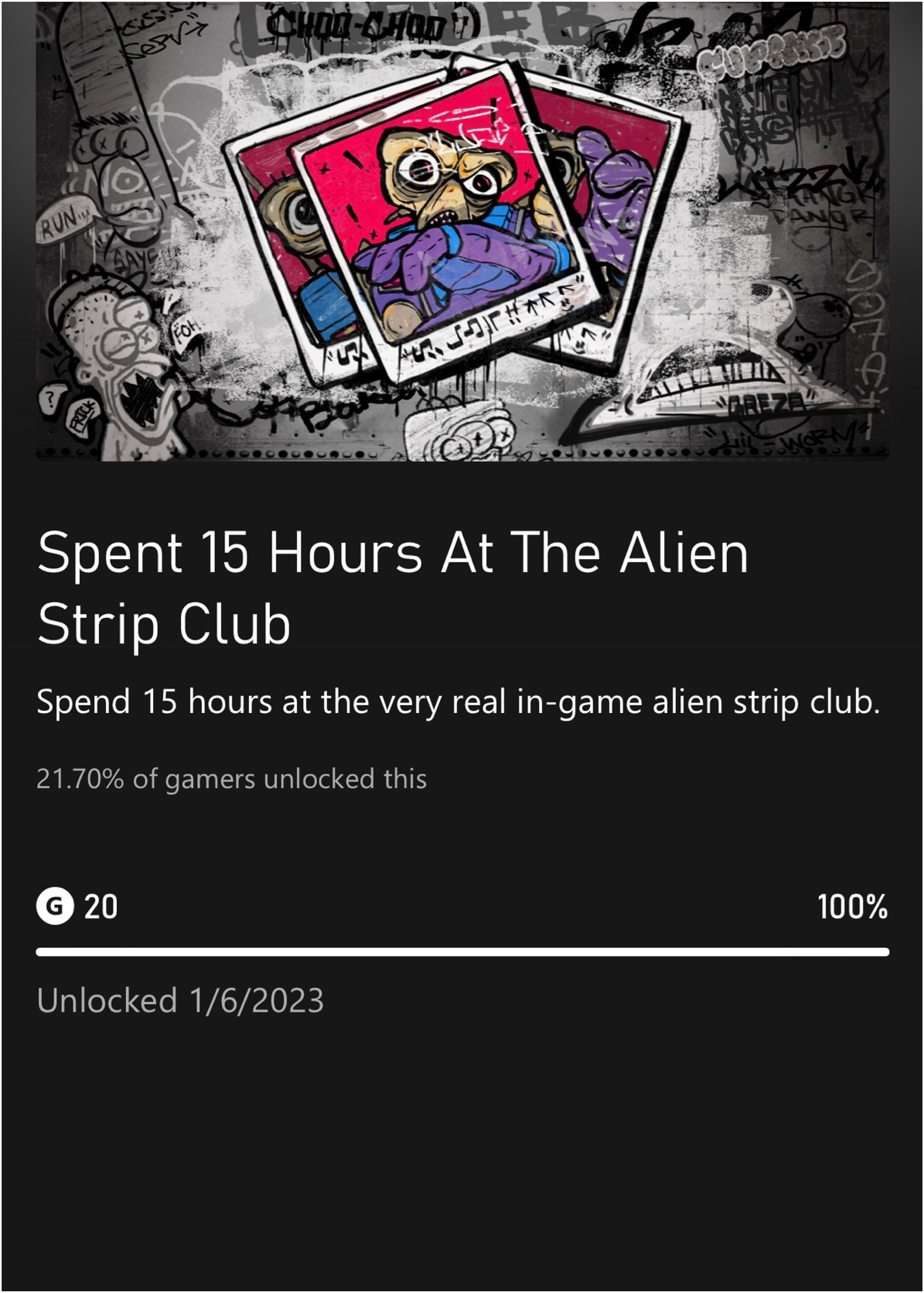
“Spent 15 Hours at the Alien Strip Club” Xbox achievement. Screenshot by Banfi.
This Xbox achievement is meant to publicly humiliate the player as other online users can see this accomplishment. High on Life is a quasi-comedy/action game and the humor in this joke arises from the lack of privacy that games now contain because other gamers can view players’ profiles. Thus, the developers who create the games that are designed to advertise the subscription services are aware of the new gaming model. The game creators reflect upon this transformation inside and outside of the diegesis of certain games. In this way, they acknowledge a recent transition to how players play and why they play – to unlock achievements and showcase that they are “good” at playing. Earning goals has remained a staple in video games since the arcade era when players would mark arcade cabinets with their initials to communicate to other players that they earned a notable number of points. However, during that period the achievements were contained to a physical space rather than to a digital one.
Similar to how Xbox has used the cult following of TV to promote their games, PlayStation is utilizing the popularity of HBO's adaptation of their prestige text, The Last of Us Part I (Naughty Dog, 2013; 2022) to advertise their subscription service. 4.7 million people watched the premier of The Last of Us (Druckmann & Mazin, 2023-present) on HBO Max (now Max). After the release of the second episode the show had reached an overall viewing of “22 million viewers domestically and quickly became a hot topic on social media…. [because] Episode 2 pulled in 22% more viewers on its opening night than Episode 1 – the largest week two audience growth for any HBO original drama ever.” For that reason, HBO has committed to producing a second season which will be based on The Last of Us Part II (Naughty Dog, 2020) (Dinsdale, 2023, n.p.). Following the initial success of the series, “PlayStation…offered a two-hour trial of PlayStation 5's The Last of Us Part I for all PlayStation Plus Premium subscribers” (Bankhurst, 2023, n.p.). The gaming industry is allowing the impact of streaming services to influence their own business decisions. The gaming subscription model is increasingly becoming more intertwined not just with creatives who work within both mediums, but how gaming companies market their products. Texts like The Last of Us and High are Life are lucrative because they can bridge the gaps not just between fans, but between business models – original content that attracts customers to their platforms.
Video Streaming Services and Gaming
Similar to Sony's and Microsoft's transition into subscription services, Netflix is segueing into the gaming industry. Netflix's mobile app includes a “Games row” (Netflix, n.d., n.p.). Users can download Netflix games, but subscribers are unable play the games in the Netflix app or on the streaming company's website. Netflix members must play the games as stand-alone software on their mobile device. 22
Netflix Games includes Immortality (Sam Barlow, 2022), an interactive fiction game in its roster of software (see Figure 2).

Immortality game app. Screenshot by Banfi.
Immortality was initially released an Xbox and PC, and later released as a mobile game through Netflix Games (Benfell, 2022). In Immortality, players attempt to understand the disappearance of Marissa Marcel, an actress who starred in three separate films from the 1960s to the 1990s by filtering through full-motion video from these movies (which were never officially released in the diegesis of the text). Gameplay consists of pausing and clicking on persons or items of interest in the films which can lead to “match cuts” that provide the player with more footage to interrogate. For Xbox and PC, the player must play with an Xbox controller or keyboard and mouse. To play the mobile version of the game they must utilize the smartphone's touch controls.
This is a crucial moment in gaming as a prestige game like Immortality is now available via Netflix which suggests that streaming companies may further segue into the gaming industry. As noted before many people have smartphones and numerous people subscribe to Netflix. So, Netflix is at an advantage over the big three video game companies as they have an established infrastructure to deliver their games to their members. While it is a question as to whether Netflix subscribers purchase the service for its games, many people do play casual “freemium” games on their phones. Immortality, however, is not a freemium game but rather a premium game. Netflix advertises their games on their app by writing “no ads, extra fees or in app purchases. Unlimited access to exclusive games, included with your membership.” This addition of premium titles further blurs the lines between streaming and gaming as it allows mobile gaming to become a premium subscription service, which may soon further rival the big three video game companies especially because Netflix may soon curate games for their website which can be accessed via TVs and computers (Netflix's games might not be solely for mobile devices) (Gurman, 2023).
Further Research on Gaming Subscriptions
Beyond the technological and marketing similarities between the streaming companies and gaming businesses, gaming subscriptions are changing how people play in other ways – specifically it is advancing therapeutic gaming. For Mike Ryan (his name has been redacted), a “therapeutic gaming and digital technology specialist” at a major children's hospital in the U.S., Xbox Game Pass Ultimate and Nintendo Switch Online + Expansion Pack improve video game therapy. According to Ryan, he could not perform his duty as a video game therapist amidst the Covid-19 pandemic (and even post-pandemic) without gaming subscriptions. Before gaming subscriptions Ryan was constantly losing game discs, and during the pandemic it would have been nearly impossible to wipe down the discs to avoid the spread of germs in the hospital. With game passes, I can provide the patients with a wide variety of games, and these are all easily accessible. There are numerous ways to filter out the games as well, by ESRB rating and genre, etc., so I am better able to recommend games to patients based on their desire to play specific genres and age appropriateness (Ryan, 2023, Interview by Banfi).
As video games are now entering a new phase technologically, they are also currently being used to help people cope with their diseases. It is proven that patients playing games can help “bring pain down in conjunction with medication” (Ryan, 2023, Interview by Banfi). Thus, people are now using video games in more nuanced ways, and gaming subscriptions are furthering that “newer aspect” of how and why people play video games.
While the pay-to-play model is helpful in physical spaces like hospitals, monthly subscription services would not be productive for the arcade industry. I interviewed numerous arcade owners, and all of them stated that a monthly membership would not be optimal. Peter Rose, the owner and operator of Sunshine Laundromat in Brooklyn, NY states I need my pinball machines to be on “coin drop” or (“credit/coin mode”) for my business to be sustainable. If players could pay a monthly fee of $50.00 (USD) and play whenever they wanted during business hours, I would not be making a profit (Rose, 2023, Interview by Banfi).
Todd Tuckey, the owner, and operator of TNT Amusements (a private arcade) in Southampton, PA, concurred with Rose– “monthly subscription fees would not be as ideal as booking private parties, and I would not opt to use that model” (Tuckey, 2023, Interview by Banfi). Rob Berk's new venture Past Times Arcade, a forthcoming museum/arcade in Girard, OH will also not offer a monthly subscription plan for similar reasons (Berk, 2023, Interview by Banfi). Although the video game industry may be moving towards a subscription-based model, it is evident that physical arcades will generally not adopt a game subscription 23 which further separates arcades from video game consoles which has been evident throughout Gaming I and II.
Conclusion
This essay parsed out three shifts in video game history and it did this by referring to the established scholarship on TV and cinema history to showcase how and why those transitions might have occurred. I discussed only a few sections of video game history – albeit these parts were meant to highlight when and why the industry changed. This essay intends to initiate an academic conversation about how the video game industry has changed, and why it is relevant in today's market and play practices. I also hope that my work will allow for a shorthand to discuss periods of video game history, which evidently, academics use in the fields of TV and film studies.
Ultimately, streaming has penetrated the gaming industry as data collection has become the new currency, and these companies will surely be tracking what we play, how long we play, and likely how we play to develop more games, create algorithms to keep players playing, and to attract new gamers. More data on the algorithms are needed. I was unable to discuss gaming subscriptions with the professionals at Xbox and other gaming companies. The few representatives who responded to my questions about the Xbox Game Pass Ultimate claimed that they were not allowed to answer questions due to the non-disclosure agreements (NDA) that they signed with Microsoft. While this barrier restricted me from gaining first-hand information from the people who design these systems and software, I was still able to interview several professionals who work for tech companies that are directly adjacent to Xbox and PlayStation. As I was unable to interview Xbox professionals about Game Pass, it is unlikely that they would explain their algorithm to me, and I do not wish to speculate on how it is created. This will also require more transparency not only from gaming industry but from the video-on-demand streaming industry and tech companies.
Regarding gaming's similarities with streaming, more research can be done on how developers are releasing downloadable content (DLC) or “expansions,” “seasons,” or “waves” for their games. Nintendo, for example, releases “booster packs” for Mario Kart 8 Deluxe (Nintendo, 2017). These expand the number of courses players can race on. Fire Emblem Engage (Intelligent Systems, 2023) contains expansion passes that provide the game with more battles to play. Nintendo offers a season pass for Immortals Fenyx Rising (Ubisoft, 2020) so that players can expand their adventure. Video game businesses are not just following streaming companies’ model of releasing new seasons to continue a series’ narrative (this is different from providing a sequel), but they are also using TV's language, e.g., “seasons.” These game expansions are often one-time purchases rather than being included with subscriptions, 24 but the “seasons” may soon become ingrained in the subscription model.
As I mentioned at the beginning of this essay, gaming may be segueing into Gaming IV with the advent of VR as Sony has recently released its PlayStation VR2, a new add on for the PlayStation 5. While Nintendo was one of the first companies to develop VR in the early 1990s in Gaming II, under the codename VR32 which would later become the Virtual Boy, VR has developed immensely, and gaming will soon become more immersive.
Footnotes
Declaration of Conflicting Interests
The author(s) declared no potential conflicts of interest with respect to the research, authorship, and/or publication of this article.
Funding
The author(s) received no financial support for the research, authorship, and/or publication of this article.

