




Abstract
Educational leaders are increasingly required to become effective change agents as schools and universities are faced with pressures to cut costs and adapt to stakeholder demands. This case details the administrative challenges of restructuring a private-sector higher education provider from a traditional to an enterprising university capable of making agile responses to promote its success. Focus is on a dean as change leader in the dynamic environment of transnational higher education in the Middle East.
Case Narrative
Introduction
Demand for education in the Middle East has skyrocketed in recent years, attracting many Westerners to the region to teach and work as administrators. Western-style education is popular—many schools have a Western country affiliation attached to their name such as American, Canadian, British school, and so on. At the university level, established Western institutions have expanded their presence into Middle Eastern Gulf countries. Transnational higher education is the term used to describe the globalization of universities. Reasons for the increased demand for education in the Middle East include factors such as the youth bulge in the population: More than a quarter of the individuals in the Gulf Cooperation Council (GCC) are under the age of 15 and half are under 30 (U.S. Census Bureau International Database, 2013). There are also national efforts to reduce reliance on expatriate labor. Education can help the native citizenry to develop skills for greater participation in the private sector of the regional economy. The term for this movement is the “ization” process (Emeratization, Kuwaitization, Saudization). Economic diversification in Gulf countries away from a primary dependence on the oil industry is also supported by education. State-supported universities in Gulf countries have largely not met student demand since the 1990s. Privately owned higher education providers therefore entered the region to offer students more higher education options. The new, private institutions such as many of the primary and secondary schools tend to operate for-profit. The higher education institutions often partner with well-known foreign universities to establish a reputation for quality.
For-Profit Higher Education
The present case focuses on change management practices that can apply at every level of education and elsewhere in the world. Privatization of public education is a global phenomenon. Public funding for education is being reduced in many parts of the world for programs that focus on early childhood learning as well as primary and secondary institutions. This has motivated alternative approaches to education at all levels. An example is the growing charter school movement apparent in the United States as well as in other countries. Charter schools are independently run and exempt from some of the regulations imposed on traditional district schools. This gives them more freedom to be innovative. However, at the same time, these schools are held accountable for improved student achievement. Examples of innovations used by charter schools include next-generation learning models such as online virtual classrooms or specialized school cultures that focus on areas such as performing arts or science and technology (National Alliance for Public Charter Schools, 2013). Transnational education initiatives have likewise developed to innovatively serve specialized community and student needs in various parts of the world.
The phenomenon of transnational education is described by Ahmed and Rao (2011) who drew connections between universities’ global expansion and the growth and operating characteristics of multinational corporations. These authors explain that the arrangement between Middle Eastern universities and their foreign partner institutions is similar to a licensing agreement in international business. Middle Eastern universities are licensed to use the name and processes of established Western universities in the form of educational programs. The Western universities can improve their worldwide brand recognition and reputation through such licensing. The majority of the 57 transnational higher education institutions in the Middle East were started since the year 2000 (Miller-Idriss & Hanauer, 2011). This is a huge and relatively sudden influx of providers attracted by the regional market opportunity for higher education. Universities using the for-profit business model exhibit varying degrees of free-market behavior. This was unheard of in higher education until recent years. In the past, most universities were government-supported, which minimized needs for efficiency and customer responsiveness. This is not true for the now ubiquitous private-sector education providers in GCC countries. Competition for students is intensifying among private universities in the United Arab Emirates (UAE), and there is evidence that supply may exceed demand (Becker, 2010; Wilkins, 2010). The environment for such education “businesses” is dynamic, and some have failed (Tétreault, 2012; Wilkins & Huisman, 2011). Examples are the campuses in the UAE affiliated with Michigan State University (Dubai), Australian-based University of Southern Queensland (Dubai), and George Mason University (Ras Al Khaimah). There appear to be pressures on private higher education providers to take on an agile, entrepreneurial stance to compete and survive.
The notion of entrepreneurism for universities has gained attention in recent years (Clark, 1998). The title of Burton Clark’s (2004) book, “Sustaining Change in Universities” highlights the need for universities to become responsive to their external and internal environments. The concept was developed further to take into account that universities are often large, mature organizations but are capable of demonstrating agile market responses. This led to the term, “enterprising university” (Enterprising Universities, 2013). Enterprising universities often review and reform their organization to respond to external and internal demands effectively. These organizations tend to innovate, use strategy, and market-oriented governance and management structure (Clark, 1998; Pietsch, 2011). The trend has been brought on by the growth of for-profit providers and restriction of public funding for universities in many parts of the world. The enterprising focus of universities has created pressures for efficiency that reduce slack time in faculty jobs. Faculty tend to resist such changes by exhibiting behaviors such as efforts to protect entrenched interests (Harvey, Ready, Kuffel, & Duke, 2006) and organizational silence (Lawler & Sillitoe, 2010), which means that employees do not speak the truth to their supervisors about important issues and problems in the organization. Business schools have traditionally been characterized by static, hierarchical structures. These structures may inhibit faculty members’ acceptance of initiatives for change that enable these organizations to effectively compete like firms (Harvey et al., 2006).
Focus of the Case
Change management skills are essential for leadership of enterprising educational institutions. Such skills include collecting and analyzing information on the organization’s internal and external environments using strengths, weaknesses, opportunities, and threats (SWOT analysis), conducting organizational diagnosis, formulating strategy, and introducing and implementing change. The present case describes a major organizational change and the leader’s role in the process at a private, transnational university in the Middle East called here the GCC–U.S. University (GCC-USU). This private university was partnered with a large university in the United States. It was what Miller-Idriss and Hanauer (2011) called a new turnkey-foreign style independent institution. The U.S. partner acted as an outside contractor to assist in developing the university. When that process was completed, local owners assumed operation. The university was founded as an undergraduate liberal arts institution. However, business degrees were also offered with majors in accounting, economics, finance, management, and marketing. Less than a decade after the university’s founding, student demand for the business majors was much greater than for liberal arts. This prompted a change in the university’s structure to create a new business college in addition to the college of arts and sciences.
The GCC-USU campus was compact, modern, and located in a suburb of a major city, which allowed an easy commute for students. Green space and date palms were attractively integrated with facilities to support student learning and health including a library, bookstore, gym, soccer field, health infirmary, and café. Enrollment was over 2,000 mainly traditional college age students and approximately 100 faculty members. Seventy-five percent of the students were native to the local area. The remainder was largely made up of children of expatriate workers from other parts of the Middle East. The faculty in the business college was diverse: Half were from Middle Eastern countries, 20% were natives of the United States, and the others were from Europe, Asia, and non-Arab regions of Africa.
Background: Market Awareness and Strategy for the University
Prior to the restructuring to create the business college, the university mission statement was revised. This was accomplished in 2011-2012 to set the foundation for future changes. A committee was formed to oversee the process. It met several times in the fall of 2011 and encouraged participation from the entire university community. The revised mission statement put greater emphasis on learning process and outcomes such as students’ knowledge and professional success. It was expanded to improve the university’s flexibility to respond to changing student needs. The revised mission statement set the stage for a SWOT analysis aimed at identifying the university’s internal strengths and weaknesses and opportunities and threats in its external environment. Results of the analysis are described below.
Strengths
Resources available from the owners of the university were identified as a strength. The university was a component business of a financially strong, diversified holding company in the Middle East. However, the GCC-USU fully supported itself with revenues from tuition and fees. Government regulations capped the university enrollment at slightly over 2,000 students. This tended to impose an emphasis on education quality rather than student numbers. GCC-USU benefitted from not having to manage both growth and quality. Reputation of a university and quality of a program are reportedly primary predictors of students’ choice of an institution (Wilkins & Huisman, 2011).
Another strength was the GCC-USU brand image, which was based on its partnership with a large U.S. university and American-style education. Fried and Hill (2009) pointed out the importance of brands for marketing higher education. Such branding exemplifies transnational education. A world region or the name of a foreign, well-established university provides instant status and recognition to a new school. As described earlier, the campus, its location, and the university faculty were also strengths. The faculty held doctorates from accredited universities and were published.
Fried and Hill (2009) concluded that for-profit universities are well-adapted to the rapidly changing higher education environment because they allow fast and focused responses to market changes and student needs. Therefore, the for-profit business model of the university might also be designated as a strength especially in the transnational context.
Weaknesses
Potential weaknesses were the traditional bureaucratic structure and the large proportion of administrative employees. Both characteristics could limit effectiveness of the for-profit business model. The administrators outnumbered the faculty members at GCC-USU. Greene, Kisida, and Mills (2010) documented the U.S. trend in public higher education toward increasing numbers of administrators Their report indicated that “between 1993 and 2007, the number of full-time administrators per 100 students at America’s leading universities grew by 39 percent, while the number of employees engaged in teaching, research or service only grew by 18 percent” (p. 1). These authors attribute the trend to universities’ reliance on government funding. Organizations top-heavy with administrators can experience slowed decision making, increased costs, and a reduction in resources devoted to teaching and research activities.
A large proportion of administrators can also contribute to centralized, top-down decision making, which may inhibit faculty acceptance of organizational change. Ghabra (2010) pointed out the prevalence of centralized decision making at private, American-style universities in the Middle East and noted that faculty members have little participation in governance decisions. Such an insular focus (Harvey et al., 2006) is inconsistent with the spirit of an enterprising university.
Opportunities
Ahmed and Rao (2011) summarized evidence that world demand for business education is strong and rising in non-Western universities. This demand comes from a desire for increased standards of living fueled by the growth of the globalized economy (Ahmed & Rao, 2011). Many students at GCC-USU were from high-income families, typical for wealthy GCC countries. Cost was generally not a barrier to getting a university education.
Threats
The main threat to the university appeared to be competition from other higher education providers. Foreign universities did not appear to be a major threat. Some individuals study abroad; however, Wilkins, Balakrishnan, and Huisman (2012) found that students in the UAE were attracted to locally based international branch campuses because they offered convenience, allowed students to remain close to family, and have a sense of security offered by familiar culture. Families typically wanted their daughters to study close to home. Safety was often a factor in Arab students’ decisions on whether to study in the United States since 9/11. A more serious competitive threat was posed by other private universities in the region that offered bachelor’s degrees in business. The GCC-USU enrollment goal was to maintain the maximum permitted by government regulations. The new business college could contribute to this goal for the university and address the competitive threat by offering high quality, attractive business degrees.
Strategy
The university pursued a differentiation strategy based on quality. The organization presented itself as being distinctive from the competition by emphasizing the quality of its educational services. Quality derived from the U.S. university partner affiliation, faculty with strong credentials, and an attractive campus that was conveniently located. Low cost was not used as an approach to gaining competitive advantage. Tuition and fees for a 4-year degree amounted to approximately US$78,000. Differentiation based on quality is increasingly being used as a strategy by universities. Some for-profits offer fewer programs so that they can focus resources to promote quality. This approach has been used to create the image of a “boutique university.” For example, the Malaysian Universiti Tun Abdul Razak (UNIRAZAK) has achieved quality assurance ISO 9001:2000 certification. Its focus is on providing quality education in niche areas of business, government, and English for emerging economies.
Results of the SWOT analysis indicated that a differentiation strategy based on quality appeared to be appropriate for the new business college. This was a fit with the larger university strategy. The challenge was for a university with a traditional liberal arts focus to attain quality standing in the area of business.
Organizational Diagnosis
Organizational diagnosis was based on data indicating that more than 60% of the students at the university were majoring in business. The number of business graduates increased by 33% (245-326) from the 2009-2010 to the 2010-2011 academic year. Twenty-seven percent of the undergraduates in the university were business majors versus 18% for the college of arts and sciences during the 2011-2012 academic year. All other students had undeclared majors. Government regulations prevented students from declaring a major until they had attained junior-year standing. The majority, 69%, of graduates earned a bachelor of business administration degree from 2009 to spring, 2012. GCC-USU had a need to address student demand for business education.
Communication with current and prospective students through the university website also appeared to need attention. Information about the business program was not easily available. The Academics link on the website linked only to the college of arts and sciences. An Academic Divisions link under the college of arts and sciences page connected to a list of other areas, one of them being business.
The university organizational structure was “tall,” meaning that it had many levels of administration. This tended to prevent quick and effective decisions. The levels of administration included program lead, division head, and dean of the college of arts and sciences. Some decisions had to pass through the assistant dean and associate dean. Figure 1 shows the university organization chart before creation of the business college. The administration and faculty in the business program were frustrated that they were not able to quickly respond to student demand for new and specialized business subject matter. Delay was caused by the organizational structure. Slow response to demand is a weakness given the competition presented by other business degree granting universities in the local market.
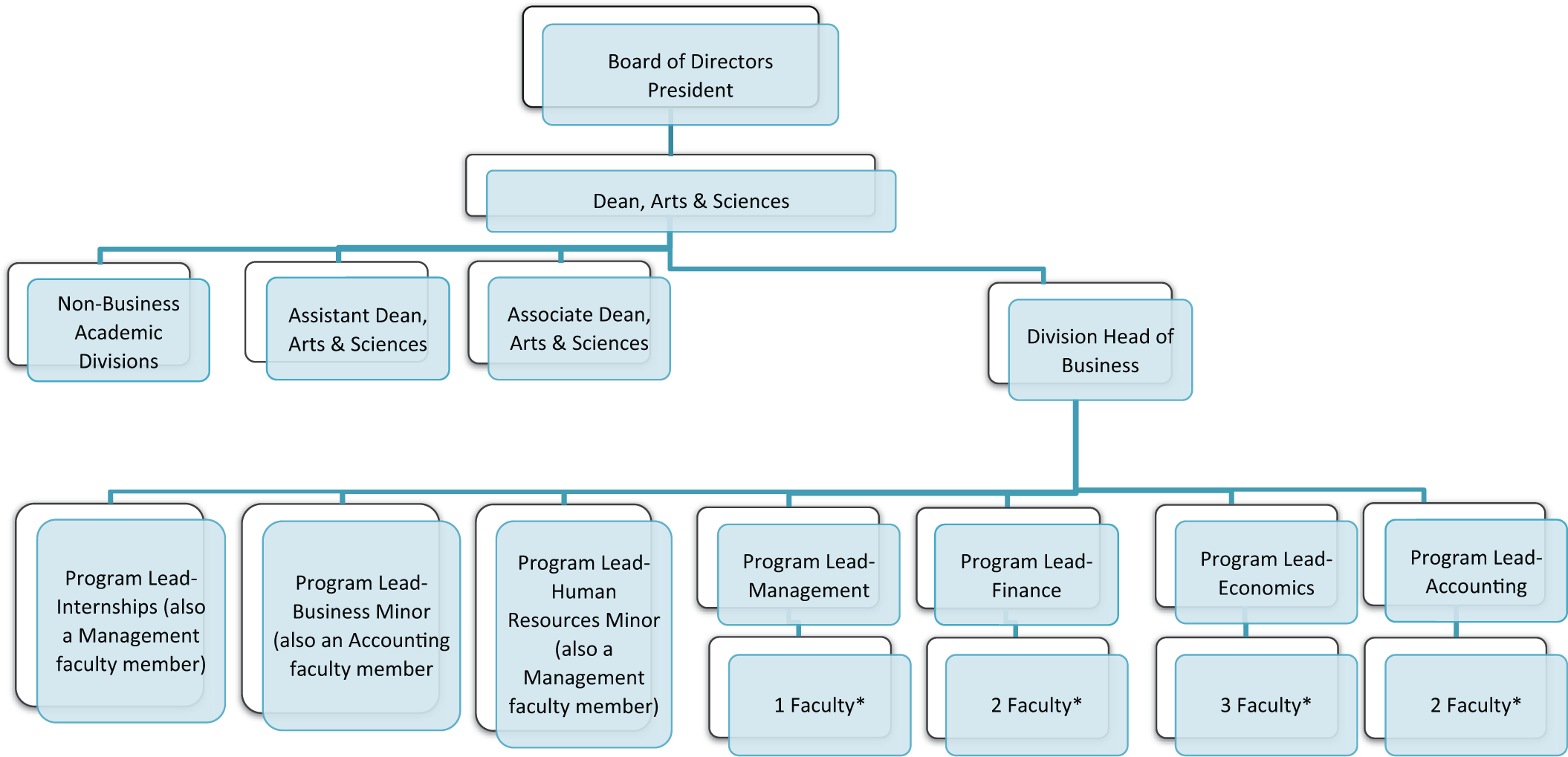
Organizational structure before the change.
Introduction and Implementation of Change
On the basis of the diagnosis, the university president, Dr. Silas, announced to the faculty in November 2011 that the university would restructure to create a new business college. The business college faculty office space was physically relocated in January 2012 to a new floor that had been added to the top of a campus building. The offices were new and large. Faculty members participated in choosing their offices. During February 2012, the faculty was also involved with selecting a dean for the new college. The successful candidate was an American, R.D. Morrow, who had decades of experience as a high-level executive at a large multinational corporation. He had worked around the world in North and South America, Africa, Europe, and Dubai. However, as the company faced financial difficulties, he was forced into early retirement. Morrow held a PhD in economics and had an academic position before entering corporate life. He taught evening classes as an adjunct instructor throughout his corporate career when his work schedule permitted. The forced early retirement allowed a welcome return to academia full-time. He was excited about the new position and eager to succeed.
Before arriving at the university, Morrow asked a personal friend who was a former dean to mentor him in preparation for assuming the new responsibilities. They met several times. Based on what he learned in these sessions, Morrow began to consider the steps he should take in forming the new business college. The first step was taken soon after arriving at the institution. It involved meeting with faculty members individually to get to know them, a process Morrow called the walkabout. During the walkabout, Morrow resolved to listen to what the faculty said about any topic, but primarily, he wanted to know what they viewed as important issues facing the college and the university. In addition, Morrow had several meetings with Dr. Silas, the university president, who had extensive experience running institutions both in the United States and internationally. The business college had officially begun as a unit.
Dean Morrow now felt he had sufficient information to begin formulating an action plan for the business school. He felt confident that the majority of the faculty believed the college should focus on high quality business education. One of the key discussions that had emerged during the walkabout was the issue of accreditation. Before the business college was created, the business program had been accredited by the Accreditation Council for Business Schools and Programs (ACBSP). This was distinctive because many of the other private university business programs in the Gulf were not accredited by any independent agency. Dean Morrow and the faculty resolved to pursue the higher level of accreditation offered by the Association to Advance Collegiate Schools of Business (AACSB) as a further step to increase quality. Attainment of this level of accreditation became the vision of educational quality that guided the development of the business college.
Another area Morrow considered important was the organizational structure of the college. The dean and faculty researched and discussed structures of organizations that operated successfully in dynamic environments. Morrow, coming from a business background, strongly believed that the organizational structure of the university as well as the former business division was highly bureaucratic and would impede the overall implementation of college goals. Thus, the dean determined to flatten the structure of the new business college. The structural change was accomplished by eliminating the program lead positions. This produced a concentration of administrative duties on the dean and two department chairs. Faculty members participated in nominating and electing the individuals who filled the two department chair positions. One of the departments included the areas of management, marketing, business law, and human resources, and the other combined accounting, economics, and finance. There were approximately equal numbers of faculty in each department, and their academic backgrounds were diverse. Department chairs did not have course release time for their administrative positions. They taught full course loads. The new structure is diagramed in Figure 2.

Organizational structure after the change.
Birth Pains for the New College
The number of faculty members did not change when the college structure was flattened, but the number of administrative positions was reduced. The program lead positions were renamed “program coordinators,” following the structural change, and continued to have the same administrative duties. In his proposal to President Silas on the new structure, Morrow argued that the stipends earned by the former program leads be folded into their base salary, so there would be no financial penalty to individuals in the new structure. He considered this to be a reasonable recommendation, because the president acknowledged that business faculty salaries had suffered while under the college of arts and sciences, and the incremental cost of the action to the university was zero. However, the administrative change that was actually approved eliminated the salary stipend for the program leads. The faculty did not participate in this decision, and the dean’s recommendation was ignored. The decision was made by upper administration and communicated in top-down fashion. Morrow felt a sense of betrayal. The president’s cost-cutting decision would certainly undermine faculty support for him as a new dean. Some of the affected faculty complained bitterly. Some were not aware of his efforts to prevent the salary cuts and blamed him.
Furthermore, the business faculty sensed that they were being treated unfairly because the college of arts and sciences kept 10 department chairs, a dean, and an assistant dean after the restructuring compared with the business college with only the dean, two department chairs, and no assistant dean. All the positions in the college of arts and sciences had existed before the restructuring, which means that college sacrificed nothing in the interests of efficiency and cost-effectiveness. This produced workload ratios of 33 students per administrator for the college of arts and sciences (364 students per 12 administrators) versus 177 students per administrator (530 students for 3 administrators) for the business college. On average, faculty teaching loads in the business college were more than twice as large with 29 business majors per faculty member (18 faculty including all except the dean) versus 11 majors per faculty member for the college of arts and sciences (32 faculty members including all except for the dean). The business faculty viewed their administrative and teaching load as being much heavier. Several were forthright in voicing their discontent. Morrow complained to President Silas that large differences across the colleges were not appropriate, but was told he should focus on his own college, and not be concerned about what was going on in the other units of the university. Again, he could feel the tension building with what he saw as a continuing lack of administrative support for his proposals for change.
Despite the setback in the university organizational arrangement, Morrow felt he could establish momentum in the college by focusing faculty effort on the accreditation process. The business faculty and Dean Morrow worked together to revise university catalog descriptions and the business curriculum. The process began by benchmarking the college curriculum against similar business colleges that were already AACSB accredited. This helped identify significant areas for improvement. For example, some of the business minors had evolved to include many elective choices from the college of arts and sciences. Business faculty had felt pressure in the past to accept demands from the college of arts and sciences to list their courses in the curricula of the various business minors. Some classes in the college of arts and sciences suffered from chronically low enrollments. In an effort to remedy the problem, these courses had been added as elective options in the business minors. The business faculty now felt empowered to design curricula with stronger business focus when the business college separated. They decided to infuse the minors with more business electives and eliminate elective options that they believed to be unrelated to the subject matter of the minor. Figure 3 shows a proposed change for the human resources management minor. This is an example of the types of changes that were occurring. This movement engendered considerable resentment among faculty and administrators in the college of arts and sciences. And, because they continued to dominate university-level committees, they actively blocked changes in the business curricula that they perceived as working to their disadvantage. The business college faced bureaucratic foot-dragging and outright refusals to approve proposed changes to their own curriculum.
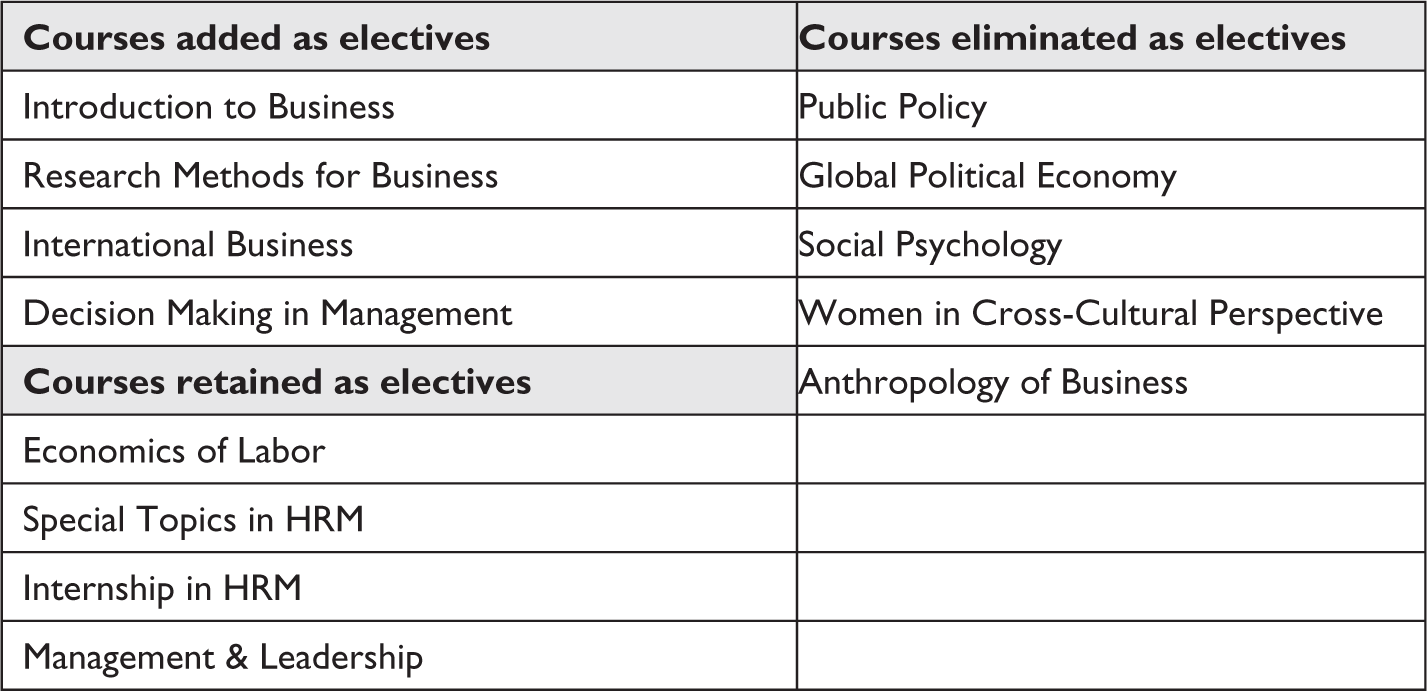
Courses for the human resources management minor.
The college of arts and sciences Associate Dean H. Porram also held a faculty position in the business program. He had applied for the position of business dean but was unsuccessful. He felt disappointed about being passed over for the promotion when he had loyally served the university for a number of years. Furthermore, because the number of students was considerably reduced in the college of arts and sciences after the business college had separated, the associate dean position was eliminated. Porram was no longer an administrator after the restructuring and was clearly dissatisfied with his role as a business faculty member. The negative emotions surfaced as resistance to change and a withdrawn attitude. Dean Morrow made efforts to encourage Dr. Porram’s involvement in the activities of the business college, but nothing seemed to work.
What Now?
Dean Morrow felt a mixture of emotions as he gazed from his office window at the palm trees, desert sand, and calm Gulf waters outside. He still felt energized to be a top administrator in the new field of transnational higher education but could sense the problems intensifying. Parts of the university seemed to be working against him and his faculty, not giving them the support needed to promote educational quality and possibly threatening faculty retention. In a further blow, Dr. Silas, who had supported the creation of the business college, unexpectedly resigned as the president of the university. Factors internal to the organization seemed to be threatening the continued success of the new college. His years in the industry had given Dean Morrow a deep appreciation for the need to effectively manage organizational change, but that process was proving to be more of a challenge than he had expected in an education environment.
Teaching Notes
Abstract: Synopsis of the Case
Educational leaders are increasingly required to become effective change agents as schools and universities are faced with pressures to cut costs and adapt to stakeholder demands. This case details the administrative challenges in restructuring a private-sector higher education provider from a traditional to an enterprising university capable of making agile responses to promote its success. Focus is on a dean as a change leader in the dynamic environment of transnational higher education in the Middle East.
Questions With Analysis
Discussion:
Think about the differences between bureaucratic and enterprising educational institutions. Schools at all levels have traditionally used bureaucratic organizational structures. Staff members are generally expected to follow established rules or directives from administrators. An enterprising stance encourages faculty to propose and work to implement new ideas in the context of the school’s external environment. Consider how an enterprising stance might be introduced to educators who are unfamiliar with it.
As faculty members adopt an enterprising stance, how might it affect students’ educational experience? In other words, while bureaucratic and enterprising organizational characteristics can affect faculty behavior, to what extent does this influence reach students?
In which education environments do you think an enterprising stance would be appropriate? In which environments might it be less appropriate? Why?
Analysis:
Organizational culture
The organizational culture should support internal cooperation and enterprising change that is responsive and proactive in relation to the external environment. The change is immense from an internally focused culture based on individual faculty interests to one that is externally focused and based on collective, organizational interests. Such a change will take time. Steps in building the culture could include the following:
Identify a core value of enterprising change that supports the college’s and the university’s best interests. The dean, as change leader, can communicate this value to faculty as often and in as many ways as possible. The business college and the college of arts and sciences are not consistent in their approaches to organizational change. The business college is attempting to use an enterprising stance whereas the college of arts and sciences is top-heavy with administrators and bureaucrats. There is conflict between the two organizational units as evidenced by the refusal of the college of arts and sciences to approve changes to the business curriculum. Establishment of core values could serve as a superordinate goal that requires both colleges to work together. This could be a goal such as (a) improved competitive standing for the university in the GCC or (b) better ratings on an objective quality indicator or in student/community perceptions.
Provide guidance to employees on how to behave so that changes are effective. Some of the faculty may be unaware of the types of behaviors that contribute to enterprising success for universities.
Recognize and reward behaviors that support change.
Maintain a performance-based work environment. Instituting and maintaining this type of environment in the university as a whole might result in a reduction of the large number of administrative positions. Top administrators should analyze the proportion of staff to line (faculty) employees and make changes to improve efficiency. Changing the entire organization with a focus on efficiency could reduce or eliminate the perceptions of inequity that the business college currently has relative to the college of arts and sciences regarding faculty administrative duties.
Enable faculty members to pressurize those who are new and underperformers to behave in ways that support change. This would allow faculty to exert social support and control to reduce the former Associate Dean Porram’s disengaged and, at times, disruptive behaviors.
Connect individual rewards with college and university performance. Profit sharing is an example. This is possible in a for-profit university.
The flattened organizational structure of the business college requires administration to delegate more responsibilities and empower employees to make decisions. This mode of operating may be contrary to traditional Arab culture, which, according to Hofstede’s (1980) research, has a high power distance. Cultures with high levels of this cultural dimension tend to accept and even expect unequal distribution of power in organizations. Conscious communication may be needed across all levels of the university on how power will be exercised.
College and Faculty Management
Discussion:
A bureaucratic organizational structure typically assumes a top-down approach to change—administrators make decisions regarding changes then communicate them to the faculty, who implement them. How might opportunities for faculty participation be built into school administration practices?
There tends to be more resistance to subtractive changes as opposed to additive changes. An example of a subtractive change is a funding cut or elimination of a department. Resistance to change can have an effect on job satisfaction and commitment to the change, whether or not it is expressed openly. How might subtractive change be managed to minimize resistance to change?
Analysis, continued:
For the present case, faculty and administrative support for and commitment to change should be increased throughout the university. Approaches to increasing commitment to change could include the following:
Creating conditions for effective faculty participation. Help faculty to “Buy-in” to the concept of the enterprising university as an approach to gaining competitive advantage. A first step could be allowing faculty involvement in aspects of the SWOT analysis. Sharing this information early in the change process could promote feelings of ownership of the change among the faculty. See their interests as being connected to organizational goals. An approach such as management-by-objectives (MBO) might help to connect(a) individual performance goals with college goals and (b) each of the college’s goals with the superordinate university goal. Administrators can point out linkages between faculty actions and attainment of the superordinate goal. Emphasize cooperation in working toward goals throughout the university. Employees were allowed to participate in the additive changes, including selection of the dean, but they did not have input to the subtractive changes that included losing Program Lead salary stipends. The university administration could have created more transparency by sharing data on reasons for this change.
Celebrating short-term wins. Progress toward the superordinate goal could be recognized throughout the GCC-USU. Collaborative short-term wins such as passage of curriculum changes could be jointly celebrated. These shared positive experiences may help to improve cohesiveness among the university faculty and create conditions for better cooperation. Cohesiveness could further be fostered by shared social events such as luncheons and business faculty attendance at arts and sciences campus events such as art exhibits and lectures.
Communicating the change. Simply knowing what to expect can help to increase acceptance of change. The administration could share up-to-date information about the external environment with faculty. This information could include benchmarking against competitors, student preferences, and trends, as well as pertinent regulatory changes. Educate faculty about the benefits of quality improvements such as AACSB accreditation and what it is likely to require of them.
In his book, “Changing Minds,” Howard Gardner (2004) suggested that a change leader can be more persuasive by using different methods to present points. Dean Morrow might continue to communicate with the former arts and sciences Associate Dean H. Porram, rephrasing arguments and presenting different, mutually reinforcing perspectives on the change. He may eventually find an argument that will resonate with this individual.
Rebuilding trust. Trust was damaged by the lack of transparency or even explanation for the pay cuts and demotions for the Program Leads. This will take time but administrative attention to consistency between words and actions, faculty participation in decisions, and transparency will help to lay foundations for increased trust. Clarification of work roles is needed to manage the feuding between the colleges: arts and sciences versus business.
Discussion:
Internal conflicts among individuals or between departments can reduce the effectiveness of organizational change efforts. Think about managing such conflict through the use of (a) reward or funding systems, (b) organizational and job structure and design, and (c) articulation and communication of a vision statement.
Educational leaders such as principals or deans are often hired from outside of the school. Coming in, these leaders do not have first-hand knowledge of the school’s history or existing social dynamics. What might a leader from the outside do to assess the situation and start to build a base of influence so that he or she can effectively perform?
Organizational change can give rise to various emotions. How might a change leader in an educational organization address emotions of those affected by the change?
Analysis:
Leadership context
Dean Morrow was hired at the time the organizational change was implemented. He was not able to participate in the pre-launch activities of the SWOT analysis and initial communications to faculty and other stakeholders. He was given heavy responsibilities but only had a formal power base. Being new, he did not have referent power or alliances from which he could draw support. This was in contrast to the dean of arts and sciences who had been with the university almost from its beginning. He had developed a referent power base, knew the board members well, and was familiar with the informal organization. The university president’s resignation further undercut Dean Morrow’s support base.
Change leadership
R. T. By (2005) noted that major models of emergent change share a recommendation to create a vision for the change. The vision for the change in the present case appears to be improved quality. Evidence of quality educational process might include student–faculty ratios, awards at student competitions, accreditation, and so on. Dean Morrow and the faculty focused on AACSB accreditation. What would comprise an effective quality criterion for higher education? How can the vision of quality be expressed? Might this vision help to inspire support for the changes in the business college from the college of arts and sciences?
The college of arts and sciences appeared to be exhibiting blind resistance to change. This type of resistance may be effectively managed by providing reassurance and allowing time to pass. The changes regarding the business college happened quickly. Faculty in the college of arts and sciences may feel that the identity of the university as a liberal arts institution is changing. They felt in control of a business division but with the growth of the new college, arts and sciences may see their future as simply providing support courses for the business college. At this point, it might be beneficial for the change leader (business dean) to provide reassurance that the liberal arts identity is valued and will not be lost as the business college grows.
An essential step in change leadership is communicating the need for change. It is critical for Dean Morrow to communicate consistently with many stakeholders regarding the needs for a separate business college and improved quality. Next, he must communicate about behaviors necessary to make the change successful. These behaviors will differ across the college of arts and sciences and the business college.
The change leader is often the target for emotions concerning the change. This requires the leader to be patient, listen, and generally take the heat. At the same time, the change leader must continue to encourage those involved and exude enthusiasm for the change. About a week after he assumed his position, Dean Morrow said, “Separation of the colleges will be not as easy as peeling off a band aid (painful, but quick).” If he can manage this difficult process, he will surely build considerable respect and admiration throughout GCC-USU and earn the referent power he lacked in the beginning.
Footnotes
Authors’ Note
A research-focused analysis version of this decision case was presented at the Asian Journal of Management Cases (AJMC) conference at Lahore University of Management Sciences in Lahore, Pakistan, in January, 2013.
Declaration of Conflicting Interests
The author(s) declared no potential conflicts of interest with respect to the research, authorship, and/or publication of this article.
Funding
The author(s) received no financial support for the research, authorship, and/or publication of this article.