




Abstract
In this case, the authors explore the tensions that emerge when students exert their right to visibly demonstrate their cultural values and beliefs at school or school-sponsored activities and events. This case was designed for educational leadership courses dealing with diversity, pluralism, multiculturalism, and democratic values. Students should be encouraged to discuss pluralism and democratic education juxtaposed with multiculturalism. They should consider ways in which the principal and teachers in this case either missed or tried to use opportunities to engage students in transformative, cross-cultural pedagogies that could prove to be socially reconstructive.
Case Narrative
Loretta Garcia, principal of Winona High School, entered the teachers’ workroom to drop off a meat and vegetable tray for the afternoon’s meeting to discuss plans for the school’s upcoming graduation ceremony. She was hoping to make what was sure to be a tense encounter a little more palatable. She opened the door with her hip and was just turning to enter and place the tray on the nearby counter when Mr. Oñate and Ms. Price sprang to their feet, with Mr. Oñate yelling, “We already look like a circus parade. Now you’re going to let them dangle things off their caps. That’s the last straw.”
“Oh yeah, it was all just fine until the American Indians wanted to show some pride. Then, suddenly, you want to shut it all down. It’s the same reason you still teach Manifest Destiny as a noble goal instead of greedy exploitation,” screamed Ms. Price.
Mr. Oñate staggered back as though he’d been struck, knocking Principal Garcia into the trashcan in the corner and showering the food tray all over the floor, sink, counter, and wall. He asked Principal Garcia whether she was all right, and when she said “yes,” he said he was sorry and would help her clean up, but he was going to be late for class. Ms. Price began helping Principal Garcia pick up meat, cheese, and vegetables but when the bell rang she, too, made her apologies and left. Principal Garcia stood up and looked around. She said to herself, “It’s turning into a real mess,” but was thinking less about spilled food and more about how to solve the school’s immediate problem over the graduation ceremony dress code, as well as how to reunite her staff in the process. She also made a mental note to take a look at the social studies text Mr. Oñate was using for his American history class.
Context
Located in a self-proclaimed “progressive” Midwest U.S. city, Winona High School sits at the edge of the state’s capital and draws students from affluent suburban neighborhoods, a working-class community, and a small American Indian community struggling to retain its cultural heritage and regain its almost extinct language. One of the state’s two major public universities is located on the other side of town. Built as the city expanded its western boundary, the school first served, almost exclusively, White students from the affluent suburbs immediately surrounding the school. However, as light manufacturing moved outside the city for lower taxes, and nearby farms began to sell land for housing, the high school built another wing to accommodate increased enrollment. Most of the new students were from working-class homes or from the small American Indian community that had once been somewhat isolated but was now surrounded by an ever-expanding city. With 2,300 students, student ethnicity is listed as 59% White, 23% Hispanic, 9% American Indian, 5% Asian, and 4% Black. Three-hundred twenty students are classified as eligible for English Language services and 480 qualify for free or reduced-priced lunches. Students who are Hispanic, American Indian, or Black account for 56% of students receiving Individualized Education Plans (IEPs) for students with disabilities and only 20% of those receiving Gifted and Talented services.
Background
Although several professors at the nearby university have offered to engage the school in a conversation around the overrepresentation of students of color in special education services, Principal Garcia is just ending her first year at the school and has said she wants to “strengthen her team’s cohesion” before she engages “such a controversial issue.” Principal Garcia is half Hispanic, half White. Like Mr. Oñate, who has been at the school since its inception 10 years ago, Principal Garcia is originally from the southwestern United States. On hire, the school board president met with her and said one reason they had been excited to have her on board was to “bring up the Hispanic students’ ACT scores.” As School Board President Wollerschein explained,
some of our families are complaining that the curriculum is not as rigorous as it used to be, and I can’t help but wonder if your teachers are not watering things down to help students who do not speak English succeed.
Ms. Wollerschein continued to tell Principal Garcia, “You have experience with these students, so we will be watching to see how this group improves on their ACT performance and on the 11th grade end of year assessments.” Garcia knew she was under the gun, so to speak, but believed the way forward meant first building a spirit of collaboration and sense of mission among her staff. Toward this end, she had engaged teachers in professional learning communities (PLCs) organized into both cross-content and content-specific teams and charged with looking at student data to identify school strengths and challenges. Many teachers at the school had never noted the school’s performance on the 11th grade high stakes assessments. Although Principal Garcia had paid consultants she worked with at a previous school to provide professional development designed to help teachers understand the basics of the available performance indicators, few had bothered to review results of the Measures of Academic Progress (MAP) scores sent to them three times per year.
Although teachers at the school felt they were now deeply immersed in the data, Principal Garcia believed they had just scratched the surface. However, some teachers seemed to be awakening to the fact that there were underlying issues and patterns of performance that had distinctly racial overtones. Some teachers were genuinely disturbed by what they were seeing. Others went on the offensive, blaming students’ families and cultures for their underperformance. Because Principal Garcia could not attend every PLC session, she had not actually witnessed but had heard reports that Ms. Price and Mr. Oñate had clashed during a cross-content team meeting. Both had been with the school since its founding. The tensions began about 5 years earlier when, due to the increasing enrollment of students of Mexican heritage, Ms. Price had helped form a “Chicano” club. Mr. Oñate began questioning the name of the club in class. He explained that the term Chicano was too exclusive and that many students’ parents did not like the name either. He convinced students that Hispanic was a broader term and would include students with Mexican and Spanish, as well as Latino heritage. Mr. Oñate encouraged students to explore the different names possible and students eventually settled on Latino Club because they felt it better acknowledged indigenous roots. Students then also asked Mr. Oñate to sponsor them—something Ms. Price continued to resent.
While discussing White/Hispanic gaps in the performance data, Ms. Price had apparently been using the word “hegemonic” repeatedly and with some passion. Mr. Oñate had reportedly called her a “bleeding heart liberal,” who “wants to save all us poor minorities because you think we can’t do it without your help.” Principal Garcia called both in for a chat and both admitted becoming too emotional, apologized, and assured the principal it would not happen again. Principal Garcia thought they had left on friendly terms.
While Mr. Oñate was on Principal Garcia’s observation schedule, an assistant principal observed Ms. Price. Both seemed quite competent in the classroom, with good management skills and content, seemingly aligned to standards and designed to promote student thinking and problem solving. Both were recognized as leaders in their respective departments—Ms. Price in the English department and Mr. Oñate in social studies. In fact, Mr. Oñate, as the only non-White member of the social studies department, seemed to be afforded particular regard in terms of issues pertaining to race and diversity. His views were sought and his opinions in the department generally prevailed. He led the textbook committee’s selection of new texts for all four of the grade levels and was commended for leadership by the previous principal. His mantra was that it was less important “what” students were reading than “how” they were reading it. He followed the national debate over the possible creation of Common Core State Standards (CCSS) for the social studies carefully. 1 While this process was evolving, some in the department were also reacting negatively to the CCSS English Language Arts (ELA) standards in history and social studies. Oñate, on the other hand, suggested these new standards might encourage students to think more deeply and critically.
Stop and discuss
Because this is a complicated case, we have inserted questions in places we think may help students consolidate the facts, nuances, and issues of the case. Take a moment now to consider the following:
1. How might the existence of a seemingly stable teaching force, coupled with changing school demographics, have nuanced this case? In other words, in what ways might changing demographics force change for teachers and what are the benefits and challenges when these changes occur?
2. What impact might the new focus on student achievement be having on this case?
3. Why did the social studies department look to Mr. Oñate for leadership on “minority issues?” Deconstruct this practice.
4. The Latino Club rejected Ms. Price as a sponsor. How might this have affected the case?
Beginning of the Conflict
Principal Garcia was surprised when two American Indian students specifically asked to be transferred from Mr. Oñate’s class during the first semester of that school year. The counselor brought it to the principal’s attention and, because she was overwhelmed at the time with the demands of a new job, she asked whether the students could be transferred without too much trouble. When the counselor said it could be done, Principal Garcia consented and told herself she would investigate further when she had more time.
As she learned more, she also thought the students might be trying to curry favor with the school’s American Indian liaison, Ms. Sauk. In Principal Garcia’s opinion, Ms. Sauk was a firebrand who liked to cause trouble more than she liked helping students and families from the American Indian community. Ms. Sauk’s position, however, was one for which a new school board member had advocated, and the board was quite proud of the fact that they were the only district in the state to have someone serving this function. On hearing of the creation of this new post, several parents from the Latino community asked why there was not a liaison for them. This was something Principal Garcia—apparently unaware of the federal government’s special trust responsibility toward American Indian students 2 —had asked the superintendent as well. The superintendent had not yet responded.
Ms. Sauk had recently recommended the social studies department supplement its textbook with readings from Lies My Teacher Told Me by James Lowen (2007). She circulated her request to other teachers in the school and, when the social studies department ignored her request, began encouraging students in the American Indian Club she sponsored to read the book on their own. This led to challenges in class that Mr. Oñate, in particular, had taken personally. When one of the students pointed out it was the Spanish conquistador named Oñate who had also persecuted American Indians, Mr. Oñate tried to explain the perspective of the Spanish conquerors. A student charged him with defending the “Spaniards who were responsible for genocide.” At that point, Mr. Oñate wrote the student a referral for “rude, insulting” behavior toward a teacher. The student left and one of his girlfriends joined him in solidarity. Mr. Oñate gave both an “F” for the day, which prompted the students’ request to be moved to another class. One of these students was vice president of the American Indian Club. Their exchange became a hot topic of discussion at the group’s meetings for a short time, but things seemed to cool after the winter break.
Principal Garcia had heard rumblings about the club and intended to ask to sit in on a meeting soon, but, again, her list of concerns was long and this one soon slipped to the bottom of her priorities. Little did she know, the discontent on both sides would fuel an issue that would consume her time as graduation drew nearer.
Other Key Players
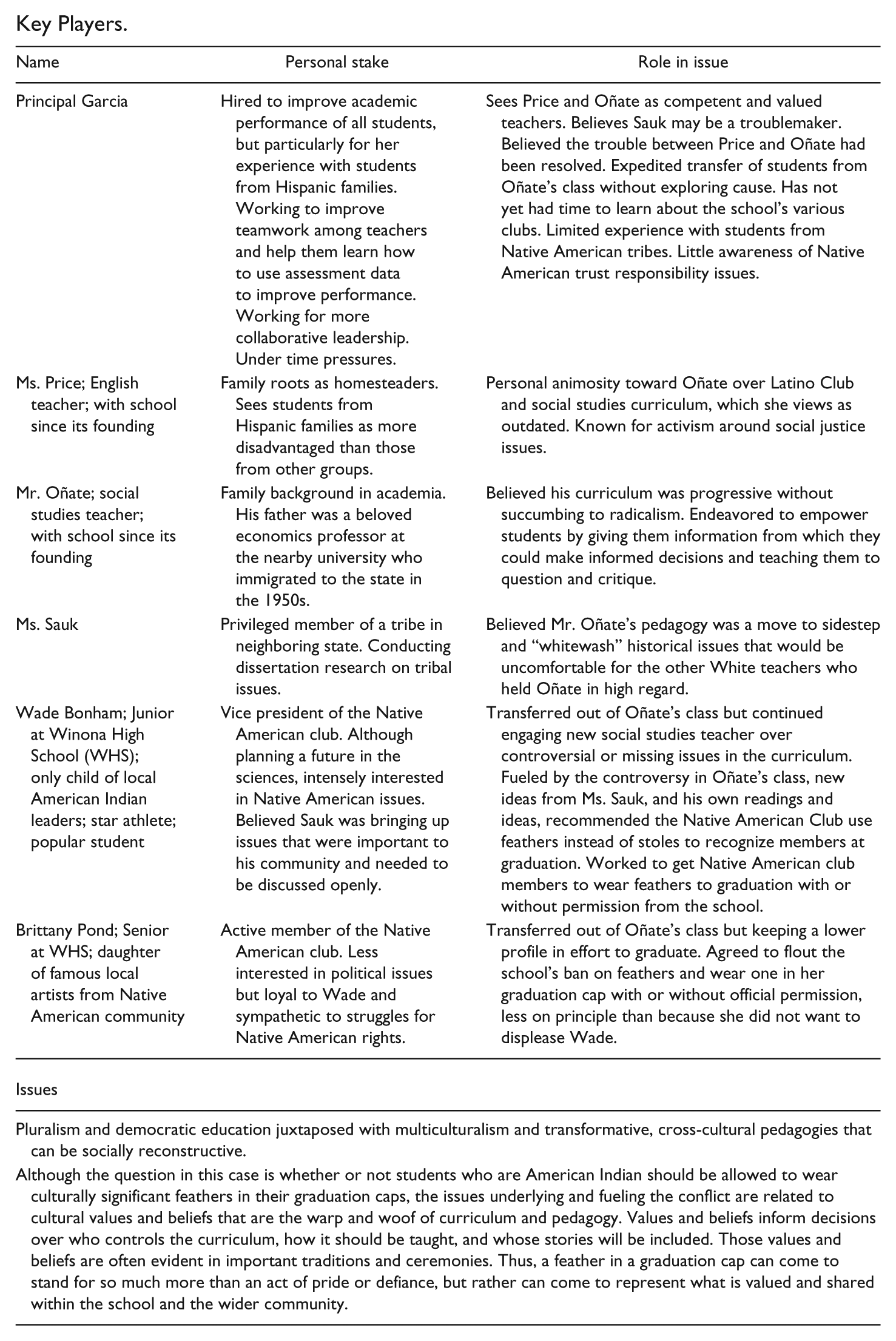
Wade Bonham was the only child of a family seen as leaders in the nearby American Indian community. He grew up with his grandfather’s stories of his tribe’s dealings with other tribes in the area; stories of the French and the British; Zachary Taylor, the “bad” president; the Dream Dance; and Franklin Roosevelt, the “good” president. American history interested him because of its impact on his own family’s life and history. A future science major, he saw the American history class as one requirement outside the sciences that, at least, would not be boring. Wade was a popular student and star quarterback on a winning football team since his sophomore year (see Appendix A).
One year older than him, Wade’s girlfriend, Brittany Pond, was not as enthusiastic as he was about American history. Art was her passion, and she was hoping to graduate in June if she could make it through English IV and the American history class she had flunked the year before. Discussing it later with her mother, she decided walking out with Wade during “the debate,” as it had now been dubbed, was not her smartest move, but she and Wade had been a couple as well as best friends since junior high school and she really did not see a choice. She did not have the same level of interest in politics Wade had, but then, as a female, she had not been tapped as a future tribal leader early on, as he had. Also, her family was not as involved in tribal politics. However, hers was a respected and famous family of artists, and both families approved of her relationship with Wade.
Although she supported him, Brittany sensed trouble for Wade. Since the argument with Mr. Oñate, he seemed to be looking for ways to antagonize his former teacher, as well as the new teacher whose class they had been allowed to join; and Ms. Sauk was not helping. In fact, in Brittany’s opinion, the woman was just trying to make trouble. Although the book Ms. Sauk recommended they read for Native American Club was interesting, and, yes, Brittany did finally finish reading it, it was sure to agitate someone like Wade. Wade needed to maintain his grade point average, and she had to at least pass this class or she would not graduate. Why look for trouble? She wanted Wade to just go back to being a science nerd and leave the politics alone.
However, Wade now had a new idea. The American Indian Club was thinking of buying stoles for graduating seniors to wear over their gowns to signify membership in the club. Reserve Officer Training Corps (ROTC) students wore them and so did the school’s few African American students, as well as many members of the Latino Club. However, Wade was worried there would not be enough time to come up with a design the community would approve and that club members liked; and, then, where were these things made; and how would they raise the money to pay for one for each member? There were so many obstacles. While looking for suppliers, Wade came upon a school site in North Carolina where the district had posted a policy allowing Native American students to wear eagle feathers in their caps for graduation. The policy read as follows:
March 25, 2013 In regard to public inquiries over the use of eagle feathers (and other raptor series bird feathers) during graduation ceremonies at Cherokee Central, the Cherokee Central Schools Administration has taken the position that the use and display of eagle feathers (and other raptor series bird feathers) and Cherokee traditional beadwork are welcomed and encouraged. There are a number of laws pertaining to the eagle and its feathers. The commonly cited law is Title 50 Part 22 of the United States Code of Federal Regulations (50 CFR 22) that governs the use of eagle feathers for religious and cultural purposes. This law governs who can possess and display eagle feathers and for what purposes. Generally, all members of federally recognized tribes are welcome to display eagle parts for cultural purposes. We encourage parents and students to reference the stated law for clarification or questions.
Wade saw this as the perfect solution. Instead of stoles, club members could wear the feathers they received during the community’s private graduation ceremony in their graduation caps. Each senior would already have one. It was easy. It would be incredibly meaningful. It was perfect. He would talk to Principal Garcia immediately. [Appendix B provides links to related news articles the reader may wish to peruse at this point.]
Conflict Develops
Principal Garcia received an email message from Wade Bonham requesting a meeting. She knew he was the American Indian Club vice president and was a student who had run afoul of Mr. Oñate. She continued to worry about whether or not she had acted wisely in transferring him to Ms. Danek’s American history class. She just needed a little more time each day and she was already working 14-hr days many weeks. She suggested a time to meet and hoped this would not be another problem.
Wade presented himself in Principal Garcia’s office in a dress shirt and tie and he brought Ms. Sauk with him. Sauk asked politely whether she might be allowed to “sit in” on their meeting. Principal Garcia said she did not think that was necessary, but would give her a call if she felt her assistance was needed at any point. She asked Wade what was on his mind. Wade explained his proposal, noting the club members had unanimously voted in favor of the idea. The young man was impressive. He had excellent speaking skills and exuded calm confidence. It made her wonder a little more about the argument with Mr. Oñate. She told Wade the proposal sounded reasonable to her, but she would have to run it by the graduation committee before she gave final approval, and she added that Wade should know that Mr. Oñate was a member of that committee. Wade looked disappointed and asked who else was on the committee. She named the other teachers and Wade felt confident the other members would override any negativity Mr. Oñate might generate. He seemed certain Oñate would not support the idea but just as certain Price would champion it. Principal Garcia said she would get back to Wade by the end of February as the committee was meeting in 2 weeks. Wade thanked her and reported back to Ms. Sauk and the other club members, who were excited and spread the word in their community and to other American Indian students who were not club members that they were probably going to get to wear their eagle feathers on their graduation caps.
Mr. Oñate heard of this issue when it came up at the end of a PLC meeting. One of the teachers remarked that “maybe the eagle feathers will show the tribe we really do want to make the school more inclusive for their children.” Mr. Oñate inquired about the statement and had thought about it long and hard by the time he and Ms. Price had their shouting match the day of the graduation committee meeting.
Stop and discuss
5. Wade’s position as school football hero and a future American Indian leader gave him a certain status in the school and in his community. Discuss how the case might differ if Wade had had a lower status in either the school or community.
Decision to Make
With a new food tray ready and waiting, and soft drinks in a nearby cooler, the Winona High School graduation committee began a long and difficult session. Principal Garcia reminded them the purpose of the ceremony was to honor the accomplishments of all students. She said stoles had already been approved and that all clubs were welcome to honor members in that way. Could this not be seen, she suggested, as an alternative to the stole. Mr. Oñate presented the view that the ceremony should be a solemn, dignified occasion and that if they allowed feathers this year, next year it would be something else and they would be on a slippery slope to a day when the ceremony would be a mockery honoring no one. Principal Garcia said surely he was overdramatizing the situation. However, other teachers informed her she had not seen last year’s ceremony when students snuck in a beach ball, which was tossed just as the school board president stood to give her speech, and shoe polish that was used to paint, “Hi Mom!” and crosses on several mortarboards. The crosses, in particular, had been the subject of an angry editorial, surprisingly from a local Baptist minister, and a call to the superintendent. Against strong objections by Ms. Price and Principal Garcia, the committee voted not to allow the feathers.
Principal Garcia felt she had a decision to make. She could override the committee’s vote, violating her desire for more democratic processes at the school, or she could try to get the students who were American Indian to understand and accept the decision. After all, Mr. Oñate was right, in that they could wear the stoles.
Unbeknownst to the principal, Wade had already coaxed Brittany into sneaking her feather into the ceremony and wearing it no matter what the principal decided. As he put it, “there will be American Indian pride at the graduation ceremony this year no matter who tries to stop it.” He was working to assure other seniors would do the same.
To make sure the principal knew how serious they were, Wade arranged a march at a local park where his parents and other community leaders spoke to the group about cultural pride. The group also discussed responsibility and accountability. Wade was popular with other students. Word got around and almost 200 students attended.
At the rally, a small group of students who volunteered regularly with the Society for the Prevention of Cruelty to Animals (SPCA) held signs and chanted, “Eagles are Endangered—Honor Their Rights Too!” They created a disturbance while Wade’s mother was speaking, prompting her to stop her speech so that she could address the issue directly. She told the students she understood their concerns and realized the issue might come up, so she had prepared a statement. She read the statement to the audience and passed copies of it to the students. The statement read as follows:
Recently, United States Attorney General Eric Holder sought tribal leaders’ input and engaged in formal consultations with them to draft a policy regarding the use of eagle and other feathers by tribal members. The policy covers all federally protected birds, bird feathers, and bird parts, including eagles . . . The Department of Justice . . . understands that these feathers have always played an important role in the cultural, spiritual, and religious practices of Native American tribes, and that they continue to do so today. Therefore, . . . [t]he Department of Justice will allow a member of a federally recognized tribe to engage in the following without fear of prosecution or penalties: Possessing, using, wearing or carrying federally protected birds, bird feathers or other bird parts (federally protected bird parts); [and other federally sanctioned uses, none of which includes the killing or wounding of these protected birds].
4
The SPCA students quieted and Wade’s mother continued with her thoughts regarding the graduation committee’s decision. One of the things she pointed out was the way the parents and tribal leaders had been excluded from the process. No one had asked them to speak to the graduation committee to explain why this was so significant to them, what it might mean to their families and the graduates, or how it pertained to their traditional practices and customs. She said she had called Principal Garcia to meet and talk about the issue but their meeting was scheduled for the following week, after the graduation committee had already made its decision public.
Members of the local press attended the rally, and one ran a story titled, “Will Winona Principal Garcia Give in to American Indian Demands.” Indian Country News subsequently picked up on the story running a front-page account titled, “Students Can’t Wear Eagle Feathers During Graduation.”
Stop and discuss
6. Ms. Sauk seemed to be advocating a transformative or social justice view of multicultural education. Did the graduation controversy further those aims?
7. The community historically recognized graduates with eagle feathers in a private ceremony. What additional value might there be in wearing the feathers to the graduation ceremony?
8. Because of the media, the decisions in this case will unfold under close scrutiny. Could this media attention have been avoided? Is this a positive or negative result, and why?
Teaching Notes
This case was designed for educational leadership courses dealing with diversity, pluralism, multiculturalism, and democratic values. Students should be asked to discuss pluralism and democratic education juxtaposed with multiculturalism. They should consider ways in which the principal and teachers either missed or tried to use opportunities to engage students in transformative, cross-cultural pedagogies that could prove to be socially reconstructive.
Students should research the differences between various forms of multicultural education (contributive, additive, transformative, socially active). Then, write a short paper discussing how, with more time, the principal might have taken different courses of action to lead teachers in developing pedagogy and practices that support either transformative or social action models. In the paper, students will discuss the following:
The goals of pluralism and how these goals could support or hinder the pedagogy and practices the paper recommends.
The purpose of democratic education as outlined by Gutmann (1999), and how this purpose is supported or subverted by the pedagogy and practices the paper recommends.
The reasons for culturally responsive practices and how the pedagogy and practices recommended in the paper might expand or diminish a culturally responsive school environment.
In addition, although the question in this case is whether or not students who are American Indian should be allowed to wear culturally significant eagle feathers in their graduation caps, the issues underlying and fueling the conflict are related to equity and curriculum—specifically to who controls the social studies curriculum and whose story of the past will be told, and how cultural differences are understood and held forth by members of the school community. It is important to understand that school conflict is often the tip of an iceberg that has been growing for years. Understanding the context in which these issues developed is critical for effective leadership and decision making. Thus, further discussion of the larger issues involved in this case is also recommended.
Discussion Outline
The following outline is designed to help instructors develop notes for an in-class or online lecture that can be used to prepare students for reading the case presentation. This lecture may take place before the case is presented, after the case presentation but before students write the paper outlined above, or used after the case has been presented and papers written as a way to expand thinking before a final discussion.
Pluralism All are treated equally Differences tolerated but not embraced Individual rights Past less important than the future
Multiculturalism Equity over equality Difference recognized and encouraged Past informs the future
Democracy Under the influence of majority; can be repressive—hence the Bill of Rights Hobbes, Rawls, and the “social contract” Mills’ sociological imagination Positive liberty ruled by one’s own reason versus negative liberty choices are available but limited by one’s situation or status
Essentialism Notion that all in the group are the same Common in superficial forms of multiculturalism Possible in any person’s or group’s view of “Other”
Problems a group member faces when the group’s beliefs are marginalized Risk continued group membership or endure marginalization Often mainstream beliefs are won by status rather than deliberative processes or reason
Problems when only a majority view is presented Belief there is no need to attend to diversity or multiculturalism Practical examples and experiences missing Failure to critique the dominant culture
Identity Personal-propriospect (See Wolcott, 1991) Possible internalization of human rights Concern for those beyond one’s own group Responsibilities to others that may conflict with group identity Local Cultural National Global
Paradoxes Traditions that different cultures value may perpetuate or stem from injustices Tolerance of intolerable acts may be self-destructive Race consciousness and anti-essentialism Marginalization can be imposed or chosen
Questions for Final Discussion
What decision do you think Principal Garcia ultimately made?
Identify and discuss how Principal Garcia’s commitment to shared leadership and collaborative structures shaped the outcome of this case.
Choose a pedagogical approach and identify opportunities the teachers and principal had to engage students in discussions around that approach. (Options include the following: pluralism, democratic values, multiculturalism, transformative pedagogy, pedagogy for social justice, or others.)
How do you think the gaps in achievement between different ethnic groups, and the work teachers were engaged in to address these gaps, might have affected their positions?
Do allies outside a particular cultural group have a role to play in gaining social justice for this group? If so, what is that role and who gets to define it?
How were some of the key players in this case essentialized? Did they also essentialize others? If so, how?
What role might/should parents and community members play in Principal Garcia’s decision?
If a decision was made to prevent students from wearing eagle feathers, what would you expect the consequences to be if Brittany or others wore the feathers in defiance?
If the students were allowed to wear their eagle feathers, what other requests might be expected from other groups?
How might this controversy affect key players the following year?
How might this controversy affect the achievement gaps Principal Garcia was hired to address?
In what ways might cultural pride and academic achievement be related and how might this differ among different ethnic groups?
How does student motivation and engagement interact with culture?
Additional Readings
Students might also consider the work of Paolo Freire (2005), particularly in terms of Freire’s argument that effective civic participation requires a critique of one’s own social context. In this case, the students’ request to celebrate their cultural heritage at this important transition in their lives, as well as the teachers’, administrators’, and community members’ reactions to that request, offered a unique and important opportunity for reasoned consideration and critique of the school setting. Other educators (e.g., Banks, 2004; Gay, 2000; Ladson-Billings, 1995; Nieto, 2000; Sleeter & Grant, 1999) might also consider this issue an opportunity in which students, teachers, administrators, and community members had a chance to “read,” or understand more completely, and perhaps change their own milieu. This case illustrates an important opportunity for educators to meet the needs of a unique group of students and learn how to afford accommodations for social justice in a way that did not disrupt the process for others—the bedrock of democratic ideals.
Footnotes
Appendix A
Key Players.
| Name | Personal stake | Role in issue |
|---|---|---|
| Principal Garcia | Hired to improve academic performance of all students, but particularly for her experience with students from Hispanic families. Working to improve teamwork among teachers and help them learn how to use assessment data to improve performance. Working for more collaborative leadership. Under time pressures. | Sees Price and Oñate as competent and valued teachers. Believes Sauk may be a troublemaker. Believed the trouble between Price and Oñate had been resolved. Expedited transfer of students from Oñate’s class without exploring cause. Has not yet had time to learn about the school’s various clubs. Limited experience with students from Native American tribes. Little awareness of Native American trust responsibility issues. |
| Ms. Price; English teacher; with school since its founding | Family roots as homesteaders. Sees students from Hispanic families as more disadvantaged than those from other groups. | Personal animosity toward Oñate over Latino Club and social studies curriculum, which she views as outdated. Known for activism around social justice issues. |
| Mr. Oñate; social studies teacher; with school since its founding | Family background in academia. His father was a beloved economics professor at the nearby university who immigrated to the state in the 1950s. | Believed his curriculum was progressive without succumbing to radicalism. Endeavored to empower students by giving them information from which they could make informed decisions and teaching them to question and critique. |
| Ms. Sauk | Privileged member of a tribe in neighboring state. Conducting dissertation research on tribal issues. | Believed Mr. Oñate’s pedagogy was a move to sidestep and “whitewash” historical issues that would be uncomfortable for the other White teachers who held Oñate in high regard. |
| Wade Bonham; Junior at Winona High School (WHS); only child of local American Indian leaders; star athlete; popular student | Vice president of the Native American club. Although planning a future in the sciences, intensely interested in Native American issues. Believed Sauk was bringing up issues that were important to his community and needed to be discussed openly. | Transferred out of Oñate’s class but continued engaging new social studies teacher over controversial or missing issues in the curriculum. Fueled by the controversy in Oñate’s class, new ideas from Ms. Sauk, and his own readings and ideas, recommended the Native American Club use feathers instead of stoles to recognize members at graduation. Worked to get Native American club members to wear feathers to graduation with or without permission from the school. |
| Brittany Pond; Senior at WHS; daughter of famous local artists from Native American community | Active member of the Native American club. Less interested in political issues but loyal to Wade and sympathetic to struggles for Native American rights. | Transferred out of Oñate’s class but keeping a lower profile in effort to graduate. Agreed to flout the school’s ban on feathers and wear one in her graduation cap with or without official permission, less on principle than because she did not want to displease Wade. |
| Issues | ||
| Pluralism and democratic education juxtaposed with multiculturalism and transformative, cross-cultural pedagogies that can be socially reconstructive. | ||
| Although the question in this case is whether or not students who are American Indian should be allowed to wear culturally significant feathers in their graduation caps, the issues underlying and fueling the conflict are related to cultural values and beliefs that are the warp and woof of curriculum and pedagogy. Values and beliefs inform decisions over who controls the curriculum, how it should be taught, and whose stories will be included. Those values and beliefs are often evident in important traditions and ceremonies. Thus, a feather in a graduation cap can come to stand for so much more than an act of pride or defiance, but rather can come to represent what is valued and shared within the school and the wider community. | ||
Appendix B
Appendix C
Declaration of Conflicting Interests
The author(s) declared no potential conflicts of interest with respect to the research, authorship, and/or publication of this article.
Funding
The author(s) received no financial support for the research, authorship, and/or publication of this article.