




Abstract
Multiple and complex issues simultaneously present themselves for the principal’s attention. Learning how to identify, prioritize, synthesize, and act in relation to these issues poses a particular challenge to early career principals. This case study engages aspiring and current school leaders in critical reflection upon leadership opportunities and practices in a simulated setting that elicits challenges commonly experienced by early career principals. Discussion questions integrate educational leadership research specific to the case issues. Activity suggestions focus on use of the case as a collaborative assessment in an educational leadership admissions process, midpoint review, or course; as a self-assessment; and in supervision of principals.
Keywords
Introduction
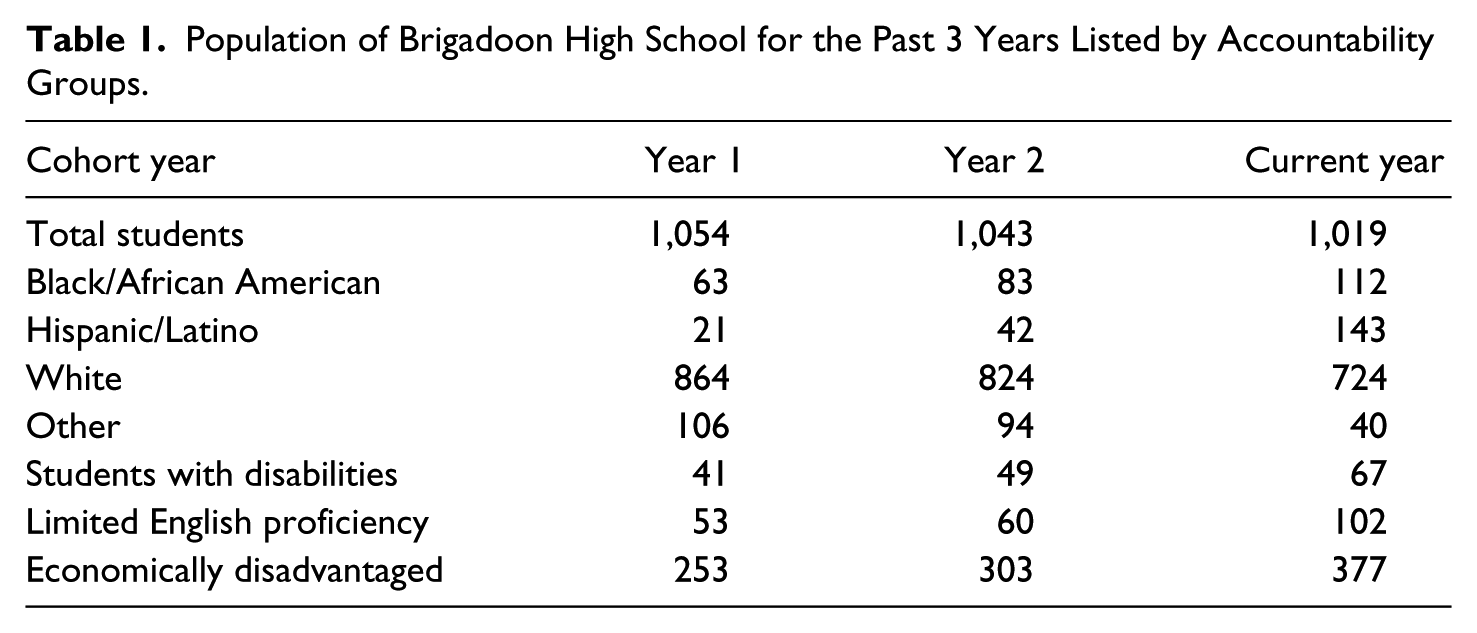
You are the principal of Brigadoon High School, and you are in the second year of your appointment. Over the past three academic years, diversity in the student population has increased by race/ethnicity, ability, primary language, and socioeconomic status (see Table 1). Two weeks ago your campus learned that your Accountability Rating changed from “In Good Standing” to “In Need of Improvement, Year 1.” Although scores in Science and English Language Arts remained at the level of the previous year, this year’s school report card shows that there was an overall decline in the scores for mathematics on the state standardized tests (see Table 2). This is the second consecutive year math scores have declined and the school has not met its Annual Yearly Progress (AYP) mathematics goals in one population subgroup. The school must now participate in the state’s Quality Review Process and a School Quality Review (SQR). Accompanying this already troubling 14% shift in scores is the added fact that the central office and the board of education agreed to allocate a considerable amount of funds last year implementing a new math intervention program across the district, hoping to curb the decline in test scores reported at the secondary level. This makes your results all the more troubling. The assistant superintendent has scheduled a meeting with you tomorrow morning at 8:00 a.m. in your office to discuss this turn of events.
Population of Brigadoon High School for the Past 3 Years Listed by Accountability Groups.
Total Combined Cohort Test Results in Secondary-Level Mathematics for the Past 3 Years Listed by Accountability Groups (11th- and 12th-grade scores).
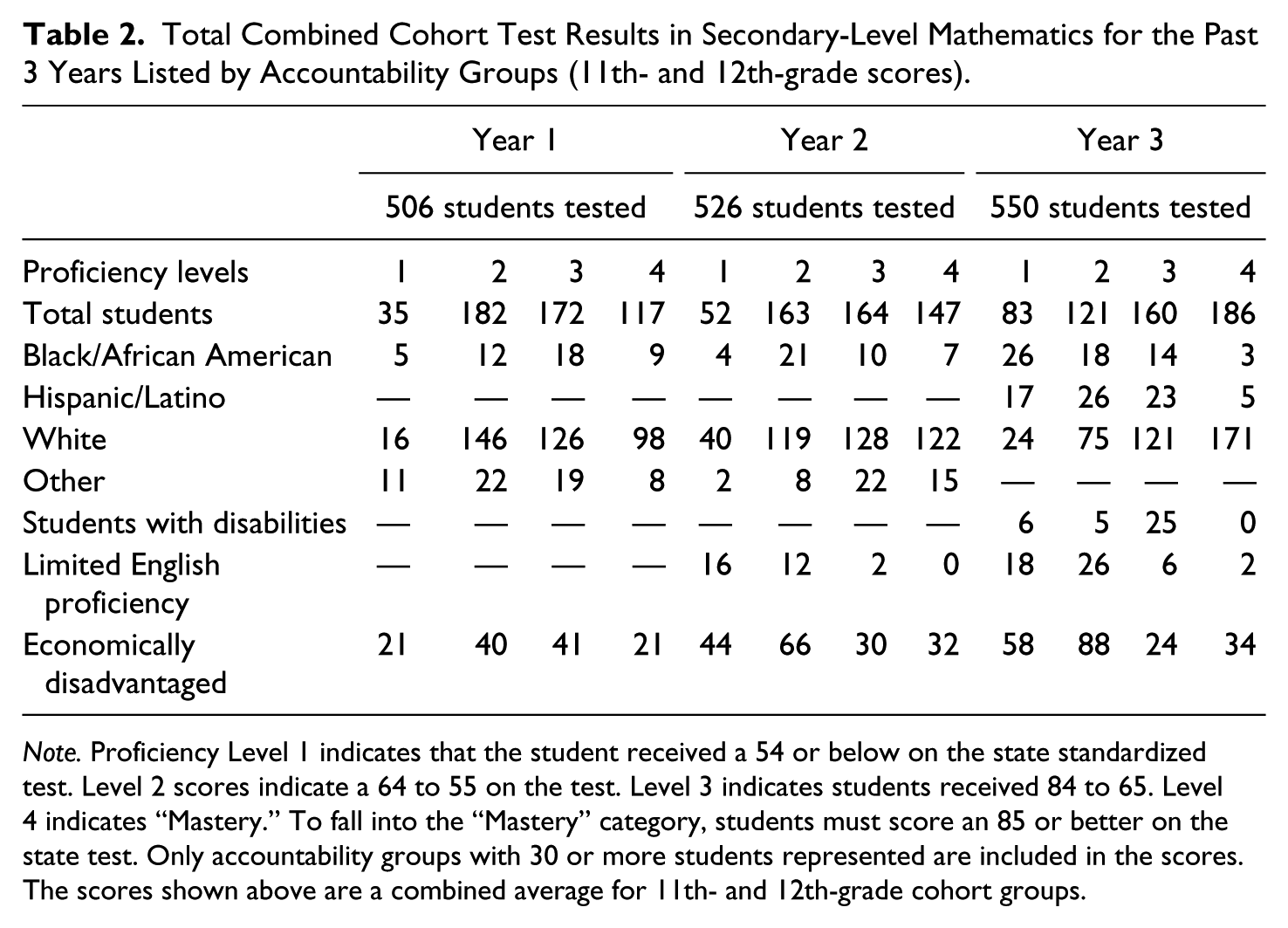
Note. Proficiency Level 1 indicates that the student received a 54 or below on the state standardized test. Level 2 scores indicate a 64 to 55 on the test. Level 3 indicates students received 84 to 65. Level 4 indicates “Mastery.” To fall into the “Mastery” category, students must score an 85 or better on the state test. Only accountability groups with 30 or more students represented are included in the scores. The scores shown above are a combined average for 11th- and 12th-grade cohort groups.
In addition to the district’s concern, the decrease in ratings has affected the tenor on your campus in many ways, most notably in teacher morale. The increased pressure from the district’s roll out of the intervention program had already weighed heavily on the Mathematics Department, resulting in several difficult conversations with the department chair and instructional coach throughout the year. You felt that you had done an adequate job encouraging the department to implement the intervention despite the lack of professional development support from the district office and had assured them that the program would show results in student achievement. Although the teachers had begun to express optimism regarding the potential effects of the program in the weeks leading up to the state test, you have seen how deflated and defeated the department now feels after receiving the results. The math instructional coach spent a good part of the afternoon in your office trying to figure out what went wrong. She was visibly concerned, expressing to you her perception that the department chair would resign from that role. You are feeling somewhat concerned about how this reflects on your leadership.
Community and School Context
Brigadoon High School is the epicenter of a small, rural farming town. The school is part of a district of five schools, consisting of three elementary schools, one junior high school, and one high school. The population of the township, originally founded in 1788, has grown in recent years to approximately 9,500 residents. The school is located 90 min from a major, metropolitan center on the east coast of the United States. In spite of this close proximity, the town has maintained a relatively small community infrastructure. The town is comprised mostly of farmland that, due to the economic downturn within the state and nationally, has been mostly abandoned or repossessed. Very little has occurred since the downturn to stimulate economic growth. Main Street is referred to as the center of town and considered the area’s business district. It is comprised of five main businesses, including a real estate agency, a bakery, a deli, and two restaurants. The town board has continuously rejected proposals to stimulate economic growth by expanding the town center and inviting new businesses into the community.
Recently, middle class families that have had roots in the town for several generations have begun to move away. Most of the families who have moved credit limited economic opportunity as the main reason for leaving, citing a lack of initiative on the part of the town board to effectively revitalize the local economy by attracting businesses that could expand opportunity for professional salary workers. Lack of economic growth, and a stagnant tax base, leaves minimal options for addressing rising costs of maintaining what infrastructure the town does have and for funding the school district budget.
In addition to the movement of these families, both the town and the school district have experienced new families moving into the district due to perceived benefits for working-class families and the historically positive reputation of the schools. The majority of these new residents are moving into rental properties and apartments rather than buying homes. An increased number of seasonal migrant families are also coming to Brigadoon to work on the remaining operational farms in the area. This mobility involves an increase in the district of students and parents/guardians who are primary speakers of languages other than English. The majority of these are primary speakers of Spanish and there is also a sizable increase of families whose primary language is Albanian. As the school district finds itself needing to educate more students of greater diversity, it is also grappling with the effect of decreased state funding.
Demographic changes in Brigadoon High School’s student census over the past 3 academic years include an internal loss of 35 students (down from 1,054 to 1,019). Within this same time frame, there has been a marked increase in the number of Hispanic students from 21 students (2% of the student population) to 143 students (14%). There has also been an increase in the number of African American students attending the high school, from 63 (6%) to 112 (11%) students. The number of students identified as White has decreased from 864 (82%) to 724 (71%) students. The number of students considered economically disadvantaged as defined by free and reduced lunch eligibility has increased from 253 (24%) to 377 (37%). The number of students designated as Students With Disabilities has increased over this time period from 41 (4%) to 67 (7%) students. The number of English as a Second Language (ESL) students in the high school has doubled from 53 (5%) to 102 (10%) students in this current year. There has also been a recent increase in student suspensions, rising from 42 (4%) to 92 (9%) this year.
All the 52 teachers in the school hold state certifications and licensure. Of the 52 faculty members, 50 (96%) identify as White, with the remaining 2 (4%) identifying as Hispanic or African American. There is 1 ESL teacher servicing all the ESL students throughout the entire school district, including the high school. There has been an increased turnover rate among early career teachers (those with 5 years or fewer of teaching experience) from zero (0% of teachers) before 3 years ago to nine (17% of teachers) over the past 2 years combined. Although specifics vary across individuals, elements of job dissatisfaction are most commonly cited as reasons why these teachers with 5 or fewer years of experience left the school. The English Department teachers have the most cumulative years of teaching experience, whereas the Math Department has 4 out of the school’s 6 teachers newly hired beginning with the current academic year. Turnover rates are less significant among teachers with 6 or more years of teaching experience, reflecting greater stability among those with more established teaching experience. Turnover among this experienced population is attributed most frequently to pursuit of career opportunities within or beyond the district, significant life changes, and retirement. Although cited as a concern among a number of this group, elements of job dissatisfaction have been secondary or minimal in motivating career change among this group. Teacher professional performance ratings are determined by a composite effectiveness score constituted by three elements: local metrics determined via collective bargaining, including classroom observation (60%); local standards determined by the school district central administration (20%); and student scores on state assessments, or comparable measures as determined by the district for nontested areas (20%). In the previous academic year, the majority of teachers at Brigadoon were rated highly effective (82%) or effective (14%). Two teachers (3%) were rated as developing, and zero was rated as ineffective. The composite of teachers rated highly effective or effective (96%) is congruent with statewide aggregates (94%), though with a differential across the categories of highly effective and effective (51% and 43% at the state level, respectively). There is some critique in the media and among educational policy analysts that the teacher appraisal system does not sufficiently differentiate the quality of teacher performance.
Case Study
You enter the school’s main lobby shortly after the end of the school day, heading to your office after a meeting with the special education teachers. They expressed a high degree of frustration with what they perceive to be the larger faculty’s resistance to inclusion efforts, as well as concerns that special education students are not being served well. Andrea, the Special Education Department Chair, pulls you aside after the meeting to discuss some of her more pressing issues. The content teachers are not getting lesson plans to her teachers with enough time to modify activities and assignments effectively. Her teachers also feel that the special education students in the inclusion classroom setting are being ignored by the content teachers.
“Apparently,” Andrea says to you, “they assume it is not their responsibility to teach these students since we are in the classroom with them.” You try to assure her that this is not an intentional response by the content teachers, but she challenges you:
In more than a few of the classrooms, the teacher isolates the SpEd students in the back of the room and practically ignores them, choosing to focus on the rest of the class. And when my teachers don’t have adequate lesson plans given to them in advance, it only compounds the problem.
In an attempt to address this specific issue, you suggest that some additional training for the inclusion teachers could bring some awareness to best practices in that specific classroom setting. She remains undeterred, saying that the problem has only gotten worse over the last couple of years. As she walks away, she mutters that this was not an issue under the last principal.
As you cross the lobby, Nathan, a veteran teacher from the Social Studies Department stops you to have a discussion (and to vent some) about the effects that the rating change is having on your campus. He tells you that the faculty is highly demoralized, saying,
Honestly, I think you mean well but the messages that you and the District staff have sent to us saying that you know we can and will do better just leave us all feeling flat. It’s as if no one appreciates or understands how hard we work all year.
“I do understand how hard all of you work,” you say, “and I appreciate the effort you put into your students and your jobs. What do you mean by feeling flat”?
“People are frustrated!” Nathan exclaims.The district is spending all of their time and money on the Math Department and the rest of us are not receiving equal resources. It’s as if we are the only ones who care about Social Studies and ELA. We would feel more appreciated if we there was some acknowledgment and support for us.
“Tell me more about what this acknowledgment and support would look like,” you respond.
“The Math Department gets all of the money. Every year they get new supplies—textbooks, supplemental teaching materials, technology upgrades—and our budget gets cut to fund it,” Nathan began. “We are being asked to do more and more with less. And nobody seems to notice that our scores haven’t declined! Maybe they would even improve if we had some of what the Math Department gets.”
You try to offer Nathan some reassurance. “I have noticed the remarkable job your department has done in the face of budget cuts. I apologize for not verbalizing my gratitude more often. But the Math Department needs some additional support at this time.”
Nathan ignores your comment. “That’s the thing. The worst part is the Math Department . . . everyone seems focused on them. Some are saying we are all suffering because they didn’t do their job well,” he continues. “We want to do well and see the students succeed, but the subtle message is we’re not working hard enough and we’re not good enough. Some teachers in the department are saying they don’t like coming to work anymore!”
As Nathan talks, you are listening to him, but you are also overhearing a conversation between four nearby students in the lobby. You focus on listening in, and you hear a calm but passionate discussion in which one student is describing how often he feels excluded at school for being gay, and that he is feeling worn down from the range of misunderstanding, distancing, and even occasional verbal taunts that he experiences at school. These are usually minor, he says, but sometimes very harsh. It seems to you that the other students are trying to be supportive and encouraging, and the group is trying to figure out what to do.
You hear one friend offer a suggestion. “Have you talked to one of your teachers or the counselor about this?”
“Not really,” the worried student replies. “I tried talking to my science teacher about it, but it really didn’t go anywhere.”
“Why not?” another friend asks.
“Well, we were doing a lab experiment in class the other day, and that’s when it started up again,” the student began. “It’s usually the worst in Science, because there’s a group of guys who harass me when the teacher’s not looking. Lab days are the worst, because the teacher’s usually more distracted. That’s why I hate Science so much.”
“You should tell the teacher about it,” the friends suggest.
“I tried,” the student says, “but she didn’t seem to care. She actually caught the guys making fun of me and told them to stop, but then she had to go and deal with another lab group. They waited till she left, and then just started picking on me again [the student explains]. When I went to talk to her about it after class, she couldn’t really pay attention because she had to set up the experiment for the next class. So I just left.”
“You should talk to her after school when she has more free time,” a friend offers.
I got the sense that she really didn’t think it was a problem. She told me to just ignore them and they would stop. “They’ll find someone else to pick on soon enough,” I think is what she said.
“So, let’s go talk to someone else, then. Maybe the counselor. She’ll have an idea, I bet,” another friend adds.
“Let’s just drop it,” the student resigns. “I don’t feel safe enough here to trust anyone but you guys. The year’s almost over, and then maybe I won’t have to come back next year.”
You turn your focus back to the conversation with Nathan, who has continued to describe how the accountability rating and all the talk about it is damaging the morale of the teachers, and something needs to be done—and soon. Your mind drifts back to a meeting you had this morning with a Hispanic parent who had made an appointment to come see you. In the meeting, she said that her daughter and several of her neighbor’s children have been saying that talk among students, and even some teachers, is that the rating has changed because of the Hispanic students and their math scores. One of her friend’s sons came home last week extremely angry because a group of students was saying that “everything at the school is fine, no one can help it if Hispanic students can’t do math.” The parent wanted to know why people are saying this and what you are going to do about it. You tried to assure her of the school’s commitment to all students and also that you would look into this, and meet with her again next week. Now you find yourself telling Nathan the same thing, although he seems to share the parent’s skepticism. You tell Nathan that you appreciate him coming to you and that you will think about everything he said and about how to move forward. You have this sense that things are spiraling in a very bad direction.
You return to your office to check the messages on your desk. A parent has questions about her son’s progress in math class, and a second parent called to complain that he heard that the school has a Bible club and he wants it stopped immediately—“this is a public school!” is written on the message pad, and the secretary indicates the caller was polite but very firm in his demand. The third message is from a parent demanding a meeting with you regarding her concerns about unfair disciplinary actions administered to her son.
Just then one of your assistant principals (APs) walks into your office relaying information about an incident that occurred earlier that day in one of the classrooms. Apparently one of your math teachers who is struggling with classroom management, and is already on a growth plan, had a situation in third period with a group of students. One of the students involved just happened to be the son of the irate parent who left you the message.
“The teacher is incredibly frustrated,” the AP began. “He said that he tried to handle the situation on his own, using the strategies we coached him on, but they were not successful.”
“These things can take some time to correct,” you reassure your colleague.
The AP continued,
The teacher said he had to call down to the office multiple times to get a response from us, which I think was part of his frustration. I realize we’re short-staffed right now with Donyell being out on maternity leave, and she handles most of the discipline with that grade level. I was in a parent meeting at the time and responded as quickly as I could, but he was visibly upset at the lag time. It ended up disrupting his entire period. “Waste of a class” is I think how he described it.
“How did you handle the situation?” you ask.
“I removed all of the students for the remainder of the period and held them in my office,” the AP said. “I made each of them call their parents and write an apology letter to the teacher.”
That explains the phone message, you think to yourself. “I’ll go and have a talk with the teacher,” you tell the AP. “I’ll apologize for the tardiness of our response.”
The AP cautioned, “Be careful what you say. He’s already on pins and needles with the growth plan he’s on. Although he didn’t say it directly, I think he thinks we’re just out to get him.”
You thank the AP for coming in and offer a reassurance that you will be mindful of the teacher’s perception. You open your email and, of course, the assistant superintendent has sent a reminder of tomorrow morning’s meeting to discuss strategies for addressing your rating change. There is also a message from the local paper wanting a quote from you regarding the ratings change for a piece they are writing on the state of education in the district.
As you prepare to leave your office to visit the teacher, a very vocal member of the Parent-Teacher Association, and a prominent real estate agent in your community, appears unannounced at your doorway and says,
I hope you understand how important it is that we get back on track here. I was just telling the superintendent at our local Chamber of Commerce meeting last night that the last thing the housing market in this community needs is a lack of confidence in the only high school we have.
Teaching Notes
This case presents the complexity of longer term and shorter term issues that might call for a principal’s attention on any given day, framing them within the particular early career stage circumstances of a novice principal. Recent research on principal longevity has found that only approximately 50% of newly hired secondary school principals in Texas remain in the job for 3 years, and less than 30% of Texas secondary school principals remain for 5 years. Such retention rates appear similar to multiple other states. Teacher turnover also increases with principal turnover, which has a negative effect on student achievement indicators (Baker, 2007; Fuller, Orr, & Young, 2008; Fuller & Young, 2009; Fuller, Young, & Baker, 2007). These early career principals frequently encounter five challenging experiences that must be negotiated through professional growth to support effectiveness and retention: (a) lack of understanding of the principalship, (b) overemphasis on technical rather than instructional work, (c) dealing with multiple tasks and unanticipated negative events, (d) loneliness and fear of failure, and (e) uncertainty with staff relationships (Oplatka, 2012). This case narrative has been constructed to simulate the fast-paced environment within which school leaders practice—one that is filled with multifaceted and contesting issues—and to provide participants with an opportunity to critically engage these five challenging experiences associated with a principal’s early career stage. Recognizing that leadership is contextual, the case is framed by a specific school and community background.
The extent of issues that the principal encounters in this vignette are leadership opportunities that can appear overwhelming to an early career principal, inviting missteps such as reactive or overly managerial “solutions.” Although management functions are a significant responsibility of school leaders that must be conducted well, effective principals must become “leaders of learning who can develop a team delivering effective instruction” (The Wallace Foundation, 2011, p. 4). The case invites aspiring school leaders to think through the “generalist” nature of the principalship, meaning the larger portfolio of campus-wide issues that call for the principal’s leadership and engagement and which are beyond her or his established disciplinary, pedagogical, or grade-level expertise. It further calls for doing so within a real time simulation in which significant opportunities and challenges present themselves in both structured and random ways (the meeting focused on special education instruction in contrast to the impromptu conversation with Nathan, for example). This format creates a context in which participants are able to anticipate how they might be affected by the challenging experiences commonly confronting early career principals (Oplatka, 2012) and to develop strategies for navigating them.
The case is intended in part to support principal career longevity, identified by the educational leadership research base as a significant factor in positively facilitating teacher stability and student achievement (Baker, 2007; Fuller et al., 2008; Fuller & Young, 2009; Fuller et al., 2007), by affording aspiring school leaders an opportunity to critically reflect on leadership practice in a context-specific case that is likely to elicit challenges experienced by early career principals. Discussion questions below incorporate specific educational leadership research that can assist in addressing the case issues. The activities below delineate options for using the case as a collaborative- or self-assessment with aspiring school leaders to identify progress with developing leadership knowledge and skills. As an assessment tool, it may also be used for setting learning goals related to prinicpal preparation. The case is also suitable for use in a professional development setting with early career principals.
Discussion Questions
Strategies for responding to this case might be organized using various theoretical frameworks common to educational leadership. For example, how might Bolman and Deal’s (2010) four frames (political, human resource, structural, and symbolic) help you as the principal by serving as a lens to systematically identify dynamics underlying challenges presented in the case, interrelationships among them, and possibilities for action?
Alternately, in a comprehensive review of a decade of their research on effective school leadership, The Wallace Foundation (2011) identified five key functions of effective school leadership. Performing these five responsibilities well through a holistic and integrated approach allows principals to create the conditions under which teaching and learning can improve. These five functions of effective school leadership include (a) fostering a shared vision of academic success, (b) creating a climate hospitable to education, (c) cultivating distributed leadership, (d) improving instruction, and (e) strategically managing resources to support school improvement. How might you as the principal view the issues arising in this “day in the life” case study through the lens of these five responsibilities of effective school leaders, and how might this framework help the principal systematically develop meaningful action steps?
How might viewing the case through an equity lens assist you as the principal in developing systematic and sustainable improvement in teaching and learning and in school climate? Strategies to consider include equity audits (Skrla, Scheurich, Garcia, & Nolly, 2004), culturally responsive leadership (Nelson & Guerra, 2014), and supervision strategies for effective instructional leadership (Glickman, Gordon, & Ross-Gordon, 2014). In addition, frameworks of social justice leadership can be helpful to consider in developing action steps. Most concisely described as explicit concern with the margins (Furman, 2012), these social justice frameworks provide research informed strategies for systematically advancing educational and social equity for historically marginalized persons and communities across a complex range of intersecting identities and experiences (O’Malley & Capper, 2014; Marshall & Oliva, 2010; Tillman & Scheurich, 2013).
The case also provides a context for discussion of the challenging experiences that commonly confront novice principals (Oplatka, 2012). How might these dynamics affect you personally if you were the novice principal in this case, and what strategies and possibilities for professional growth might help you navigate them successfully?
An issue presented more subtly in the case involves the role of gender expectations in relation to school leadership. Although the principal is identified in the case as “you,” participants in collaborative assessment settings, in which the case was piloted, almost universally referred to the principal as “he.” This has been inclusive of groups comprised exclusively of women. The prominent real estate agent in the case, whose gender is not described, has been read unanimously in pilot groups as male. Blount (2000) conducted a rigorous historical analysis demonstrating how rigid gender-identified roles have operated in U.S. school employment for over two centuries. What gender role expectations for school leadership do you notice in your school and local community, and how might these present unique challenges for women navigating the path of school and district leadership?
Extending the prior discussion question, what unique challenges might be experienced by persons of color; Lesbian, Gay, Bisexual, Transgender, or Queer (LGBTQ) persons; or other persons of difference navigating the path of school or district leadership in your community (O’Malley, 2013; Bloom & Erlandson, 2003; Tillman, 2004)?
Activities
Collaborative assessment
Because of the extensive range of leadership topics, issues, and skills that arise in the “day in a life” format of this case, it is well suited for collaborative assessment activities such as an assessment center simulation used as part of an educational leadership program’s admissions process or a midpoint review. Similarly, it could be used for a collaborative course-based formative or summative assessment in a class such as campus leadership or the principalship. Assessment center simulations provide an opportunity for multiple evaluators to observe interactions and contributions with a rubric that focuses on constructs such as school leadership vision, leadership skills, knowledge, and group process skills (McKenzie et al., 2008). In an admissions process, observing how individuals work together to address issues presented in the case can provide one data point for informing the program’s selection decisions based on a local rubric oriented toward the program’s research informed vision for leadership preparation. We caution that it may be more helpful to assess candidates’ readiness for learning knowledge and skills prioritized in the program mission and vision than it is to assess for selection of candidates who already demonstrate the core knowledge and skills.
Informed by piloting the case study with two distinct groups (masters students in educational leadership courses and doctoral program applicants), we suggest the following format for a collaborative assessment process. Establish small groups and provide each with the following guidelines:
Working in your assigned group, read the following scenario, and
identify key issues that the principal is facing,
prioritize actionable concerns, and
strategize action steps that the principal can follow, distinguishing between short-term responses and long-term strategies.
Another possibility we favor is to assign the case for individual reading and reflection in advance, offering the above prompt at the time the group convenes. Optimal group size for an assessment center process is 4 to 5 participants and two assessors per group, establishing time marks as follows: introduction (5 min), group collaboration (35 min), and group summary statement (5 min). For assessment within a course setting, graduate students can be organized into larger groups (approximately 10) and afforded 60 to 90 min to work through the case, drawing on research literature and theories engaged in the course or program, and prepare a presentation to be assessed. Typically, graduate student groups will identify and prioritize issues together, then form task groups to develop action steps, and finally work as a whole group to integrate action steps into a holistic plan. In this way, the collaborative course-based assessment offers a simulation of the school context by affording graduate students an opportunity to navigate the case challenges within the context of multiple stakeholders with varied and at times competing priorities and perspectives.
Self-assessment
To engage the case as a self-assessment tool, aspiring school leaders might individually follow the prompt above while focusing on mapping specific educational research and leadership theories that inform their analysis of the context and development of action steps. The intent of this exercise is a reflective process that encourages participants to consciously incorporate research-based strategies and theories into their improvement plan, thereby interrupting possible reactive or predetermined “solutions.” In addition, this mapping allows participants to identify issues in regard to which their research base is underdeveloped. Such insight might be used to guide an individual’s further study or, if engaged early in a course or at a program midpoint review, to inform resources and instruction that will be developed in the course or program. The same process can be followed for the aspiring leader to identify strengths and limitations in her or his leadership skills and dispositions. As such, the self-assessment process provides a framework for identifying strengths and improvement needs in the participant’s educational research knowledge, leadership skills, and leadership dispositions. This can be used to set a learning plan for course, future courses, and/or internship fieldwork.
Supervision of principals
The case is useful also for the preparation and professional development of those who supervise principals. As such, it is relevant for instructional leadership and human resources management courses in a superintendent preparation program. Research by The Wallace Foundation has focused, in part, on enhancing leadership practice through the effective use of principal supervisors (Gill, 2013; The Wallace Foundation, 2009). The foundation has described principal supervisors as those who “observe classrooms, review data on student test scores, coach their principals through difficult decisions—and follow up with a phone call to see how those decisions played out” (Gill, 2013, p. 3). The principal supervisor might be positioned at the deputy superintendent level and acts as a conduit between schools and the superintendent. According to Gill (2013), 70% of a principal supervisor’s time is best spent in the district’s schools.
Educators preparing for superintendent certification and those already serving in executive leadership positions in school districts can use the case to enhance skills for meaningful supervision of principals. For example, how might principal supervisors coach the principal in this case in terms of prioritizing, synthesizing, and systematically addressing issues represented in the case? What forms of support might a novice principal need from a mentor or from the district structure to effectively lead the school in relation to emergent issues in the case? How might the district’s strategic plan assist the principal in prioritizing and responding to these issues? How might the supervisor assist the novice principal in understanding and enhancing teacher professional performance? How might the principal supervisor’s experience of consistently observing in schools and mentoring principals become a pathway for informing and reshaping how the district staff interacts with its schools? These guiding questions can be used by readers to develop a professional development plan to support this novice principal in effective leadership. Conversely, aspiring school leaders and practicing principals could consider the questions in this third activity from the perspective of how they might proactively engage principal supervisors in their district to enhance the quality of mentoring and structural support they receive to effectively lead the school in relation to these case issues.
Conclusion
This case study was designed to present aspiring, and current school leaders with a simulation of the multiple and contesting leadership issues presented to a school principal at any given time in the course of the school day and year. It is particularly focused on the experience of the novice principal, who often experiences unique leadership and affective challenges specific to her or his career stage. The case requires the reader to view herself or himself as an actor who strategically and systematically identifies, prioritizes, and addresses issues across a wide range of circumstances and demands occurring within the school community. Effective school leaders must be able to accomplish this task in relation to a wide range of simultaneously occurring and competing issues. The case provides aspiring and current school leaders, who by role must be generalists, a simulation of the fluid, contesting, and even chaotic nature of leadership in schools. Navigating this context in collaboration with the school’s multiple constituencies is a core leadership skill which the case both teaches and assesses.
Footnotes
Declaration of Conflicting Interests
The author(s) declared no potential conflicts of interest with respect to the research, authorship, and/or publication of this article.
Funding
The author(s) received no financial support for the research, authorship, and/or publication of this article.
Author Biographies
References
Supplementary Material
Please find the following supplemental material available below.
For Open Access articles published under a Creative Commons License, all supplemental material carries the same license as the article it is associated with.
For non-Open Access articles published, all supplemental material carries a non-exclusive license, and permission requests for re-use of supplemental material or any part of supplemental material shall be sent directly to the copyright owner as specified in the copyright notice associated with the article.
