




Abstract
A respected principal finds himself caught in the middle of a complex legal conundrum when a student requests to bring a service animal to his public school where another student may be dangerously allergic to the animal. This case explores how accommodations per the Americans with Disabilities Act (ADA), Section 504 of the Rehabilitation Act of 1973, and the Individuals with Disabilities Education Improvement Act (IDEA) intersect in a public school setting where classroom space and personnel resources are limited. Educational leaders will be able to construct effective responses by understanding how the three laws apply to students with disabilities who request that their service animals accompany them to public school and when their requests may come into conflict with the needs of others.
Keywords
Introduction
Students with disabilities and who have service animals are increasingly requesting permission to bring their animals into public schools. As a result, school administrators must be knowledgeable of the three primary federal disability laws that influence policies and practices regarding service animals: Section 504 of the Rehabilitation Act of 1973 (Section 504), Title II of the Americans with Disabilities Act of 1990 (ADA), and the Individuals with Disabilities Education Improvement Act of 2004 (IDEA) (Wieselthier, 2011). Section 504 1 and the ADA 2 are civil rights laws that protect individuals with disabilities from disability discrimination, whereas IDEA, also considered a civil rights law, guarantees students with disabilities, age 3 through 21, a free appropriate public education (FAPE). 3
Public school leaders must consider several factors in the formulation of policy and procedures that govern service animals’ access to school grounds, including the impact on other students and staff (Huss & Fine, 2017). If a student with disabilities requires a service animal for equal access to educational services and programs, then due consideration must be given to that student’s request to bring the service animal to school. However, competing interests among students with disabilities may require a search for alternatives that meet the needs of those students, as well.
The following case study explores the relationship between and application of federal disability law for school leaders’ decisions regarding service animals. The discussion questions offer school leaders the opportunity to formulate responses to multiple situations.
Case Narrative
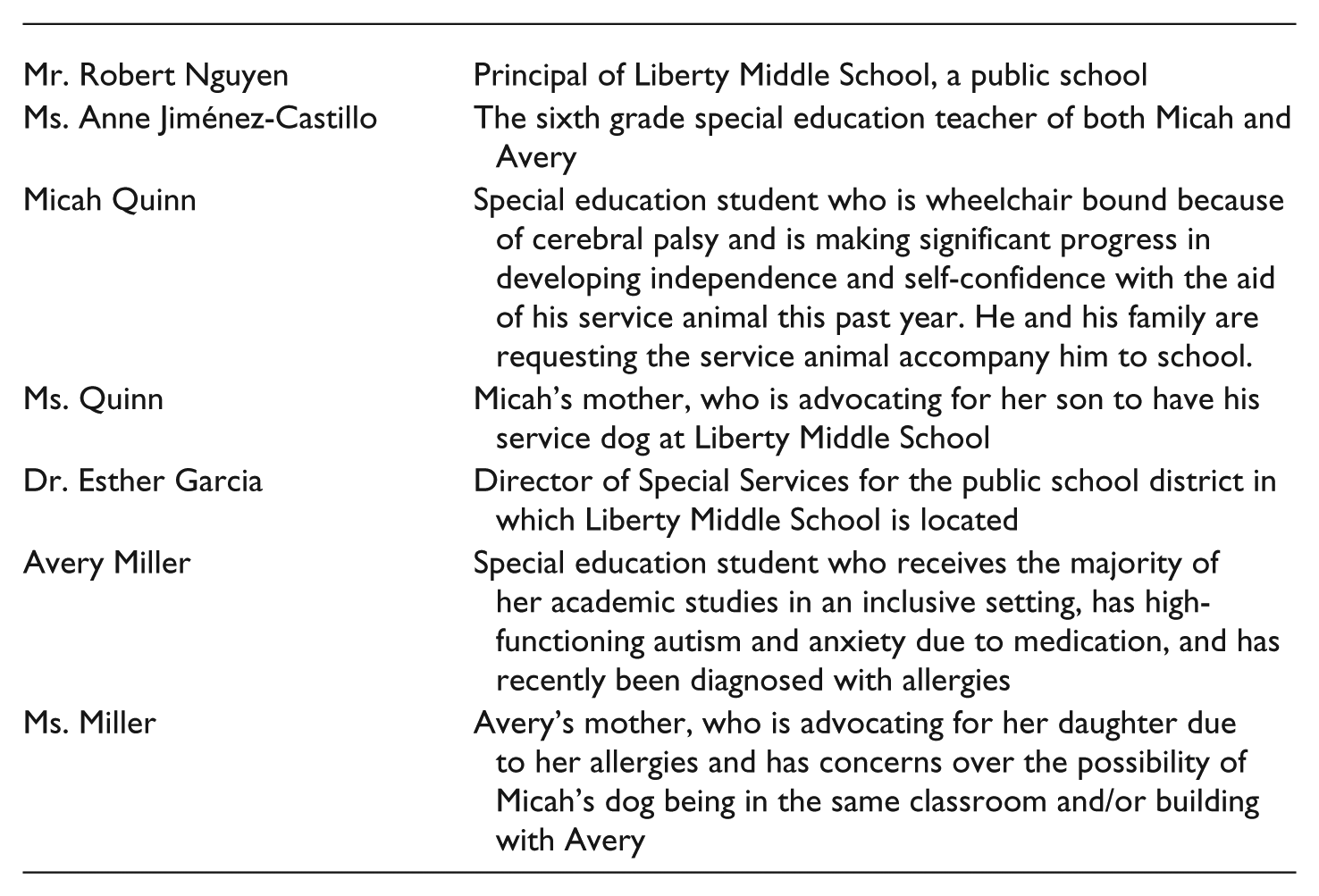
Robert Nguyen has been principal for 3 years at Liberty Middle School, a public school which serves students in Grades 6 through 8 in a historic yet gentrifying neighborhood near the center of a city. Typical of older schools, the size of the school site and building structure impose strict limitations on the school’s physical expansion. Moreover, the addition of an elevator per ADA requirements has further diminished instructional space. Currently, 370 students are enrolled in the school, which is the maximum capacity for the building.
In a program review 1 year prior to Mr. Nyugen becoming principal of Liberty Middle School, the State Department of Education noted a historical practice of the school district failing to provide a FAPE in the least restrictive environment. The superintendent and school board responded by hiring principals experienced in educating students with disabilities. Mr. Nyugen was known at his previous school for insisting that all students with special needs be provided FAPE in the least restrictive environment. When hired to serve as principal at Liberty Middle School, he was determined to improve the school’s special education delivery model, with a particular focus on inclusive classrooms. Mr. Nyugen has made it his duty to integrate special education students into the general education classroom whenever possible to ensure that they have an opportunity to learn alongside and to interact with their non-disabled peers.
The school’s sixth grade special education teacher, Ms. Jiménez-Castillo, shares Mr. Nyugen’s desire. She serves as case manager for 18 special education students whose primary instruction is provided in an inclusive general education classroom. Ms. Jiménez-Castillo and her one assistant work diligently to coordinate student schedules so that these students can fully access the general education curriculum. They also provide general education teachers the necessary support required to implement appropriate modifications and accommodations according to each student’s individualized education program (IEP). Consequently, neither Ms. Jiménez-Castillo nor her assistant has much latitude in their day to provide additional services or to take on additional responsibilities.
Micah Quinn and His Service Animal
One afternoon, Mr. Nyugen was at the bus area finishing student dismissals when Ms. Jiménez-Castillo approached him to express her concerns about a student’s request to bring his service animal to school. Micah Quinn, the student making the request, was a special education student with cerebral palsy who used a wheelchair. As Ms. Jiménez-Castillo spoke, many thoughts ran through Mr. Nyugen’s mind. He was not sure whether to be excited or apprehensive about a service animal in his building.
Ms. Quinn, Micah’s mother, believes the service dog helped her son function more independently, and that having the dog at school would allow him to participate fully in the general education classroom with minimal special education support. Micah trained with the dog, Peppy, for a full year prior to this request. Peppy was trained to support Micah by helping him retrieve dropped items, open doors, carry objects, and adjust his position in his wheelchair. As a result, Micah improved in his ability to navigate around his home, neighborhood, and community, which boosted his self-confidence and his sense of independence. As his parents saw such significant progress at home, they decided to request that Micah have the dog to help him in the school.
Mr. Nyugen Meets With Dr. Garcia
As there had never been a service dog at Liberty Middle School or at his previous school, Mr. Nyugen had little knowledge about what this situation entailed. His first thoughts turned to a myriad of operational questions. Where would the dog go to the bathroom? Would Micah be able to take the dog outside unsupervised? Who would feed the dog? How would the dog access water? What if the dog growls at or bites someone? Would the dog become a distraction in the classroom or cafeteria? What if someone was allergic to dogs?
Mr. Nyugen sought input from Dr. Garcia, the Director of Special Services, to gather as much information as he could prior to discussing the situation further with Ms. Jiménez-Castillo or Micah’s parents. He made an appointment with and provided some preliminary information to Dr. Garcia so that he could discuss the request at length. Although he felt he had a good understanding of IDEA and the provision of FAPE, he was less certain if IDEA required school officials to allow service animals in the school. He wanted to learn about the responsibilities of school personnel and the rights of the student under federal disability law. Furthermore, he was not as knowledgeable about other federal laws that might directly influence how Micah’s request should be addressed. He began his meeting with Dr. Garcia by expressing Ms. Jiménez-Castillo’s reservations about a service animal in the school: Ms. Jiménez-Castillo, the special education teacher, feels certain that she and her assistant can provide Micah with everything he needs to access the general education classroom, thus negating the need for a service dog. Besides Ms. Jiménez-Castillo isn’t even sure if the dog has been trained. I think we will need documentation that the dog has been trained and provides an actual service, right? And, don’t we need some proof of certification that the dog is current on his shots and that Micah’s parents have liability insurance just in case he bites?
Dr. Garcia interrupted Mr. Nyugen: I understand Ms. Jiménez-Castillo’s and your concerns, but you need to be aware that as a recipient of federal funding, the school district must comply with all federal disability law. The Americans with Disabilities Act and Section 504 of the Rehabilitation Act are the most relevant in this case. ADA and Section 504 protect individuals with disabilities from discrimination, so we must take care when making the decision that we do not deny Micah an opportunity that non-disabled students have. We must ask ourselves if the work that the service animal performs provides Micah the ability to function independently and successfully, in ways similar to his general education peers, and if being separated from the dog during the school day impairs Micah’s ability to be more independent, which is something he wants for himself and his parents want for him. For instance, the ADA addresses service animals, which are not to be confused with therapeutic or emotional support animals that are not covered in this instance. Therefore, we need to determine if the dog is an actual service dog. However, under ADA regulations, we can only ask two questions. First, does Micah need the service dog because of his disability? Second, what work or task is the service dog trained to perform? ADA prohibits us from requiring documentation as proof that the animal is certified, trained, or licensed as a service dog. Nor can we require liability insurance.
This slice of information only led Mr. Nyugen to have more questions. “How will we know if the animal is a service animal if we cannot ask if the dog has been trained? Anyway, I didn’t know there was a difference between service animals and therapeutic support animals.” Dr. Garcia pointed out that, per ADA regulations, a service animal must perform tasks for the benefit of an individual with a disability such as (but not limited to) retrieving items, opening doors, or guiding a visually impaired person. Conversely, a therapeutic animal or emotional support animal provides affection and companionship but is not trained to perform a specialized task. She went on to say, “You also need to know, we cannot ask if the dog has been vaccinated beyond what the state and local ordinances require for animals generally.”
Mr. Nyugen continued to probe the issue: Logistics could be troublesome. What are we supposed to do about feeding the dog and letting him go to the bathroom during the day? Who will be his handler since Micah is too young and physically incapable of controlling the dog? Ms. Jiménez-Castillo’ schedule is already stretched thin. There is no time for her or her assistant to assist with the dog. The ADA pamphlet says the handler must be the person with a disability, right?
The director continued to clarify the ADA for Mr. Nyugen: Well, those are good questions, but the ADA states the handler must be the person for whom the services are provided. In other words, the dog must be under Micah’s control. I believe you indicated in your message to me prior to this meeting that Micah trained with this dog for a year and has been handling it in his home and neighborhood. We should assume, at least initially, that Micah can handle the dog, and that the dog has been trained to relieve itself and drink water when and where given the opportunity. Yes, some details would need to be worked out, but we should not deny the request outright because of these logistical questions. We can require that Micah’s dog have a harness or leash, as long as Micah’s disability doesn’t restrain him from using one or the leash does not interfere with the dog’s safe and effective performance of its work. If a leash or harness is out of the question, then Micah must be able to control the dog through voice commands or other signals.
Mr. Nyugen’s thoughts then turned to the potential health and safety concerns of students and staff members in the building who might be allergic to or fearful of dogs. He knew he had one staff member who was allergic to cats, but what about dog allergens? He also knew of a few students who had been bitten and, as a result, were fearful of dogs. He thought about the limited space in his building and how keeping the dog away from those who are allergic to or fear it may not be feasible. But Dr. Garcia cautioned, I know Liberty is small and classroom space is tight, which is a concern. However, it is important for us to remember that ADA regulations say that we must accept a service animal if the animal is necessary to give a student with disabilities equal access to educational services and programs. That should be our first concern. The ADA does provide a direct threat clause. In situations in which the service animal fundamentally alters the school’s programming, service, or activities
4
or poses a direct threat—that is, a significant risk of harm to others that can’t be eliminated by a reasonable modification—then we might not have to accept the service animal.
5
However, we simply cannot deny the use of a service animal because others have allergies or a fear of dogs. If there are concerns that the animal is dangerous or may bite, then we would be required to demonstrate that the direct threat exists. But keep in mind, it is the history of the individual dog that must serve as evidence that dog is dangerous and, consequently, poses a threat. A direct threat cannot be based on an abstract fear of dogs, even if the dog’s breed is perceived as aggressive by the general public. If the concern is based on students and staff allergies, we must try to find a way to minimize contact. If we can’t, we need to be able to argue effectively through documentation that there is no way to modify the environment to accommodate everyone’s very real needs. However, in the spirit of the law and for Micah’s benefit, we should consider possible modifications at Liberty, such as assigning the individuals with allergies and Micah to different classrooms. Again, we have to rely on the information that Ms. Quinn has provided us, and that is that Micah and the service dog trained together for a year. Unless evidence to the contrary arises, we have to assume the dog has been trained not to create a disturbance or to be aggressive. If you decide to let Micah bring his service dog to school and then learn the dog is a problem, you can rescind permission.
Mr. Nyugen was learning that there were multiple factors to consider when weighing a request to bring a service animal into the school. And, he was about to learn there was more. Dr. Garcia went back to her previous point about federal disability law and how it provided protection against discrimination for individuals with disabilities: Section 504 of the Rehabilitation Act is another law we must abide by. The legal issue of service animals in schools evolves from issues of access to the building, classrooms, and programs. Micah has been identified as having a disability, so under Section 504 he must be provided access to Liberty so that he can attend classes and participate in his special education program. A service animal that can help him navigate hallways, retrieve dropped items, or help Micah shift positions in his wheelchair helps provide Micah access; it allows him participate more independently in his education and with minimum disruption and, therefore, function more like his non-disabled peers. If a Section 504 team determines that a service animal is required for a student to have equal access to educational services and programs, then the service dog must be allowed. We are required to make reasonable modifications to rules, policies, and procedures to avoid discriminating against a student with disabilities. Of course, the other factors, such as the handler’s responsibilities, must be put into place, as well.
Mr. Nyugen was still unclear and asked if he and the IEP Team should consider the request under IDEA and not worry about ADA or Section 504. Compelled to learn more, Mr. Nguyen remarked, I don’t understand why are we talking about ADA and Section 504, when we already know Micah is being served under special education and has an IEP? Micah’s parents want the service animal so their son can more easily access the regular classroom and other parts of the building and be more independent. Can’t the IEP team, of which the Quinn’s are members, simply add the service dog as a related service in Micah’s IEP?
The director pointed out that the IEP Team is not required to and should not designate a service dog as a related service: Remember, related services are those services that accompany special education that allow a child with special needs to benefit from special education such as, but not limited to, speech and language services, mobility training, physical and occupational therapy, and others. Under IDEA, the IEP, including specified related services, must be agreed upon by a consensus of the IEP team. However, related services are the responsibility of the school district. To include a service animal as a related service puts the burden of providing and caring for the service animal on the school district. That simply is not a practical option and not one that is required under IDEA.
Mr. Nyugen felt confused. Surely, he thought, if the IEP Team decides a service animal is not required as a related service, the parents cannot pursue their request for the student’s use of a service animal at school. However, he was concerned that if the Quinns felt they had a strong case for the service animal, they may decide to pursue a legal remedy. He asked the director, “The parents must exhaust all procedural safeguard requirements under IDEA law before they can file a suit for violation of FAPE, right?”
Dr. Garcia cautioned Mr. Nyugen to not confuse an alleged denial of FAPE with an allegation of disability discrimination. She agreed that if a complaint were filed about a denial of FAPE, the procedural safeguard requirements under IDEA must be followed prior to filing a case in court. However, if the Quinns have no issue with Micah’s IEP but, instead, believe denying their request for the service dog to accompany their son in school is disability discrimination under ADA or Section 504, they would likely contact the Office for Civil Rights (OCR) in the U.S. Department of Education first and file a complaint with them. The OCR would investigate and make a determination that would inform the Quinns and the school district of their findings.
Dr. Garcia pulled out a file from her desk and consulted some notes she had on a U.S. Supreme Court decision, Fry v. Napoleon Community Schools,
6
which addressed this very point: If a student with disabilities is denied the right to use a service animal at school, the U.S. Supreme Court said the student need NOT exhaust all remedies under IDEA when the core of the complaint is about disability discrimination in violation of ADA or Section 504 and not about FAPE. Just because a service animal is not addressed in the IEP, we still must be sure that our decision is not discriminatory. The Fry case, which was about a request that a service dog accompany a student with disabilities to school, gives us guidance on this point.
She described some of the facts of the Fry case to Mr. Nyugen and then shared how the Court provided some assistance on how to determine if the student’s request was about her education program or about access, and whether the school administration’s denial of the request was a form of disability discrimination: School officials refused to let a service dog accompany the Frys’ daughter to school and to perform the work he was trained to do. He was trained to open doors, to turn lights on and off, to retrieve dropped items, to help her maintain balance when she walked with a cane, and even to help her transfer to and from the toilet. School authorities wanted to use paraprofessionals to assist the girl, which included carrying her into and out of bathroom stalls.
7
The Frys first filed a complaint with the Office for Civil Rights in the U.S. Department of Education, alleging that school officials violated their daughter’s rights under the ADA and Section 504. The OCR investigated and agreed with the Frys. The OCR indicated that under the ADA and Section 504, a school’s obligation to disabled students goes beyond just providing education services. This case was not about FAPE; the parents were not complaining about the educational services and programs their daughter was receiving. It was about the student being able to participate similarly to her peers in the school, which included entering and leaving classrooms, putting on and taking off her coat, and even going to the bathroom on her own. The Court posed two questions to help determine if the Frys’ complaint was indeed about disability discrimination under ADA and Section 504 and not about the child’s educational program—a denial of FAPE—under IDEA. First, could the Frys have brought a similar claim if the alleged violation had occurred at a public facility other than a school? Next, could an adult at the school file a similar complaint if her or his request to be accompanied by a service dog had been denied?
8
The Court concluded that if the answer to those two questions was yes, then it is likely the problem is of one of disability discrimination and not of FAPE. So, we must ask ourselves, what if Ms. Quinn had made this request at a library and the librarian said no. Or, what if a teacher asked to bring a service dog to school to perform the same tasks as Micah’s dog will perform and we said no? In light of these two questions, would a denial of the Quinn’s’ request be viewed as discriminatory? Would denying the service dog into the school prevent Micah from doing his work and conducting himself more independently, similar to what his non-disabled peers are allowed to do?
Mr. Nyugen felt he had a better understanding of the factors he must consider after speaking with Dr. Garcia. What he would seek now is the input of knowledgeable others in the school. He previously requested that Ms. Jiménez-Castillo ask Ms. Quinn to file a written request for Micah to have a service dog. He had concluded from his talk with Dr. Garcia and the information contained in the request that the Quinns were not asking for revisions to Micah’s IEP, so he also asked Ms. Jiménez-Castillo to convene a 504 Team to consider the request.
During the meeting with Mr. Nyugen, Ms. Jiménez-Castillo tried not to show her apprehension. As a special education teacher, she was aware of Section 504 and ADA and the protection against discrimination they provide students with disabilities. However, this request was not just about Micah. Avery Miller was a student with disabilities, who suffers, among other things, from persistent symptoms due to allergies related to canine dander. During the meeting, Ms. Jiménez-Castillo expressed concern about Avery’s severe allergies. She was uncertain how both Micah and Avery’s needs were going to be met. Mr. Nyugen suggested that the 504 Team meeting would be the best venue in which to explore options and opportunities. A careful weighing of both students’ needs and possible alternatives must be considered. Mr. Nyugen knew that Ms. Miller was as strong an advocate for her daughter as Ms. Quinn was for her son.
Avery Miller
Avery Miller is a student with high-functioning autism who spends most of her day in an inclusive setting. During the past year, Avery developed several severe allergies, including canine dander and peanuts. Avery’s mother is especially concerned about Avery’s exposure to peanuts in the cafeteria and the classroom, so she had already requested an IEP meeting to discuss the need for additional precautions. Mr. Nyugen understood these allergies to be serious and could become worse with repeated exposure.
Upon learning about the possibility of a service animal in the school, Avery’s mother approached Ms. Jiménez-Castillo and asked her if it was true that a service dog might be allowed in the building. Ms. Miller exclaimed, No way is that dog going to be in the same classroom or building as my daughter. You know, Avery is deathly allergic to dogs. Avery’s allergies already trigger her anxiety issues causing her to self-stimulate and possibly harm herself. You know a child with autism can’t just stop self-stimulating; it’s not like turning on and off a light switch. Her needs are just as important!
Ms. Jiménez-Castillo was taken aback that Ms. Miller knew about the Quinns’ request and acknowledged Ms. Miller’s concerns, but indicated she was not at liberty to discuss another student. She did say she would pass Ms. Miller’s comments on to Mr. Nguyen.
Mr. Nyugen cautioned the IEP Team members that Avery’s upcoming IEP meeting could get tense. As team members sat to discuss Ms. Miller’s concerns, she began by pointing out that Avery’s rights were just as important as any other student with disabilities: It’s not fair that my daughter’s unique special needs may be subordinated in this situation. My child has rights, too! Certainly there must be something in the law that prohibits a service animal from being a health and safety threat to Avery.
Ms. Miller asserted that her primary concern was for Avery’s health, but also wanted the team to consider Avery’s autism as a factor. She stressed that Avery is a student with high-needs autism who suffers from extreme allergies and has severe anxiety. The medication she takes for her allergies may trigger high levels of anxiety and she might engage in a physically aggressive outburst.
She continued to relate how Avery’s disability might provoke safety concerns if a dog were present: What if the dog mistakes Avery’s outburst as a threat and attacks her? What if Avery becomes so stressed by the dog’s presence that she is constantly anxious and hurts herself? Would the school be liable?
Mr. Nyugen knew Ms. Miller had valid concerns, and he was not sure how to proceed as her assertions focused on different elements in the three federal statutes: Avery’s educational benefit, Micah’s access, and permissible exclusions under ADA, such as a direct threat or the inability to make reasonable accommodations. These laws were enacted to protect persons with disabilities, but, like most laws and policies, they are not written in anticipation of every possible scenario that may arise in a public school. He and his staff had to consider the competing needs of students with disabilities and the limits of physical space and resources at Liberty Middle School.
The Conundrum
With the prospect of a dog being in the same classroom as Avery, things could become complicated. In fact, there were serious health issues involved. At this point, Mr. Nyugen sensed that a situation was developing in which neither Ms. Miller nor Ms. Quinn would be happy with the outcome, but he knew that his decision had to be based on the spirit and meaning of disability law, and not exclusively on satisfying the parents’ expectations.
After returning to his office, Mr. Nyugen sat in silence pondering the situation. With the emotions of two meetings fresh in his memory, he found it difficult not to frame the situation as two students’ needs juxtaposed to one another. On one hand, how can he and his staff deny Micah’s request to be accompanied by his service animal when that dog provides Micah the opportunity to function more independently and be more like his non-disabled peers. On the other hand, how can he and his staff minimize any contact that Avery may have with the dog, thereby protecting her from serious health consequences? Furthermore, what role might the permissible statutory exclusions play in this decision? That is, considering the physical limitations of Liberty Middle School, is there a reasonable modification that can be made that meets the needs of both students? And, considering Avery’s allergies, does the dog pose a direct threat—a health and safety risk—to her? How was he going to make this work for both students? What is the district’s responsibility? How might he organize his thinking to construct a response?
Teaching Notes and Related Information
The disability rights movement has brought about significant progress and increased opportunities for people with intellectual and developmental disabilities. Landmark legislation has created meaningful change for people with disabilities and opened doors to educational opportunities. In recent years, changes to federal laws have furthered these opportunities, especially for persons with disabilities rights to use service dogs in public schools. To avoid unnecessary lawsuits and to best serve students with disabilities, school leaders must meet their affirmative obligations under IDEA, Section 504, and ADA. All three federal laws ensure that students with disabilities have equal access to educational programming and services and receive appropriate education. Administrators must be adequately prepared to respond correctly to requests from parents to permit the use of service dogs in public schools.
IDEA
The IDEA is a federal funding law that entitles students with disabilities to a FAPE (20 U.S.C. § 1401(9)) in the least restrictive environment. This law guarantees that students with disabilities are educated with non-disabled peers to the maximum extent appropriate at no cost to the parents. The law is implemented through a child find provision that requires all public school districts within a state to identify, locate, and evaluate each child with a disability residing in the jurisdiction (34 C.F.R. § 300.111(a)(i)(i)). Eligibility for special education programs and related services is determined through a two-step process: First, a team (which includes the parents) determines whether the child’s disability meets the definition of one or more of the 13 categories of disabilities specified under the IDEA regulations (34 C.F.R. § 300.8(c)). Second, the team determines whether the student requires special education and related services as a result of his or her disability (20 U.S.C. § 1401(3)(A)(i)&(ii)). The IDEA requires public school officials to develop an annual IEP to provide eligible students educational services that are “reasonably calculated to enable the child to receive educational benefits” (the Rowley standard). 9
Importantly, the IDEA regulations do not require the IEP Team to identify a service animal, which are restricted to dogs and miniature ponies (the latter with restrictions), as a related service. To do so would require school districts to bear the burden of providing and caring for them. However, IEP Teams must give due consideration to requests to bring a service animal into school if the animal serves to help the student access a FAPE.
Section 504 of the Rehabilitation Act of 1973
Section 504 of the Rehabilitation Act of 1973 is the seminal federal law that protects individuals from discrimination based on their disabilities in connection with any public or private program that receives federal financial assistance. Because Section 504 preceded the enactment of the ADA by nearly 20 years, Section 504 has generally been the basis for disabilities protection in public schools.
Section 504 regulations require that the needs of students with disabilities be met as adequately as the needs of non-disabled students. Section 504 regulation defines a person with a disability as “any person who: (i) has a physical or mental impairment which substantially limits one or more major life activities, (ii) has a record of such an impairment, or (iii) is regarded as having such an impairment” (45 C.F.R. § 84.3(j)(1)). 10 A 504 Plan is developed for all eligible students who require accommodations and modifications to either the physical space or the learning environment to access educational programming (Wright & Wright, 2013, 2017). Importantly, not all students with an eligible disability under Section 504 have a qualifying disability under IDEA and, therefore, would not be eligible for IDEA services.
All students eligible for IDEA educational programs and services, however, are eligible for Section 504 plans if they are needed to access FAPE. 11 All students who receive services under IDEA are eligible for all Section 504 protections, including program accessibility, comparability of facilities, and educational opportunities commensurate with their peers who are without disability (Wright & Wright, 2017). School leaders may satisfy the Section 504 obligations to special education students by complying with the requirements of the IDEA, including the provision of FAPE. A Section 504 plan should include service animal if the work or task the animal performs is related to the student’s disability and is necessary for the student to receive the benefits that are afforded non-disabled peers.
ADA
The ADA of 1990 is a broad civil rights statute prohibiting discrimination against individuals with disabilities. As with Section 504, the ADA protects people with disabilities in areas of employment, public services, and public accommodations which include educational facilities (Bateman & Bateman, 2014). The ADA was modeled on Section 504 and its regulations; however, the major distinction is that Section 504 only applies to entities that receive federal financial assistance, whereas the ADA has broader coverage, not tied to the receipt of federal funds.
The ADA defines a person with a disability similarly. 12 In 2008, however, Congress amended the original ADA through the Americans with Disabilities Act Amendments Act (ADAAA), which included broadening the definition of a disability and statutorily establishing the definition of a substantial impairment of a major life activity. Although not all inclusive, the definition of major life activities was expanded to include caring for oneself, performing manual tasks, seeing, hearing, speaking, breathing, learning, working, walking, standing, reading, concentrating, and thinking. 13 Furthermore, the ADAAA includes a conforming amendment to Section 504, meaning that the newly expanded coverage under ADAAA extends to Section 504, making the definitions and provisions of both laws consistent with the new provisions passed by Congress (Bateman & Bateman, 2014).
Service animal definition
The ADA is the only civil rights law that provides a legal definition of a service animal. Under the 2011 ADA regulations, only a dog that is “individually trained to do work or perform tasks for the benefit of an individual with a disability” is considered a service animal (28 C.F.R. § 36.104). 14 Per this definition, emotional or therapeutic support animals do not qualify as service animals. Therefore, even with a doctor’s recommendation, school personnel may deny students the use of these non-service animals on school grounds.
Section 504 does not define service animals, but, because the ADAAA of 2008 incorporates Section 504 by reference, the ADA definition of a service animal applies. The only mention of service animals in the IDEA is as a related service for teaching children who are visually impaired and require mobility training (34 C.F.R. § 300.34(c)(7)(ii)(B)). Under IDEA, however, the use of service animals in connection with visual impairment and mobility training is not a mandated service.
For a dog that meets the ADA definition of a service animal, with few exceptions, school authorities must allow the dog access to school facilities and to vehicles and must make reasonable accommodations so that the student can access services (Huss, 2019). Furthermore, per ADA regulations, there are only two questions that school personnel can ask the owner or handler of the animal: (a) Is the animal needed because of a disability and (b) what work or task is the animal trained to perform? 15 School leaders are not permitted to require documentation, such as licensure or certification of training, from the service animal’s handler or owner (28 C.F.R. § 35.136(f)). However, the school may require documentation of vaccinations that are required by local government entities for all animals.
Permissible exclusions of service animals under ADA
Only under a very narrow set of circumstances may educational leaders deny a student’s request to have a service animal accompany her or him to school if the service animal performs work or a task that enables the student’s needs to be met as adequately as her or his non-disabled peers. School personnel can only prohibit the animals’ access to school grounds if (a) the animal is not housebroken, 16 (b) the animal is out of the handler’s control, (c) the animal poses a direct threat, or (d) the animal’s presence requires modifications that fundamentally change the nature of the service, program, or activity 17 (U.S. Department of Justice [DOJ], 2015).
The Direct Threat exemption is possibly the one that is given the most consideration by school leaders, IEP Teams, and Section 504 Teams. A direct threat is defined as “a significant risk to the health or safety of others that cannot be reduced or eliminated by modification of policies, practices, or procedures, or by provision of auxiliary aids or services” (42 U.S.C. § 12182(b)(3)). When a school administrator asserts that the presence of a service animal poses a direct threat, as a covered entity under ADA, then the administrator must conduct an individual assessment to determine if alternatives exist that can alleviate the health or safety concerns while allowing the service animal to accompany the student to school (28 C.F.R. § 35.139(b); 28 C.F.R § 36.208(b)). A direct threat may involve an animal who is out of control or aggressive toward others, or a student who is so severely allergic to canine dander that any contact with the dog may cause an anaphylactic reaction. However, the DOJ and OCR, the two entities that enforce disability laws for the U.S. Department of Education, have taken the position that allergies and fear of dogs are not valid reasons for denying access to service animals. This includes any reference to the presumed aggressiveness associated with a breed of the dog (DOJ, 2015).
Procedural Considerations for Service Animal Integration
In applying these laws, administrators can follow a simple procedural process for integrating a service animal in the public school setting: 18
1. Determine if the animal is a service animal by only asking the two questions allowable under ADA: (a) whether the dog is a service animal required because of a disability and (b) what work or task the service dog is trained to perform (28 C.F.R. § 35.136(f)).
(A) If the animal is not a service animal per ADA definitions, then the school leader is not required to allow the animal in the school. 19
(B) If the animal is a service animal, then administrators are advised to ask the following two questions before denying a student the right to a service animal in a public school under ADA.
(a) First, could the parent have brought the same claim if the conduct had occurred at a public facility that was not a school such as a public theater or library?
(b) Second, could an adult at the school, such as an employee or visitor, have pressed the same grievance? (Fry, 2017, p. 756).
If the answers to both questions are yes, then ADA applies. School officials should allow the student access to the service animal while at school because the use of a service animal in a public school is a right covered under ADA and is not dependent on an IEP or a Section 504 Team decision. The exceptions to this include the inability of the handler to control the dog, the dog is not housebroken, the ADA direct threat clause, and having to alter fundamentally the nature of the education programming or services (DOJ, 2015).
2. Determine if the student gains FAPE through IDEA (34 C.F.R. § 300.101(b)) or Section 504 (34 C.F.R. § 104.33).
(A) If the student is being served or qualifies to be served under one of the 13 disabilities of IDEA, and the student is gaining educational benefit from the service animal, then an IEP will be implemented. This would be the more common scenario for special education students.
(B) If the student is being served under IDEA, but the student needs access to FAPE, then a 504 plan would be utilized.
(C) If a student qualifies under the definition of a disability under Section 504, but is not served under IDEA, then the student needs access to FAPE through a 504 plan.
Teaching Activities
There are two types of discussion questions for this case. Prior to engaging in discussion, students should read the case narrative and familiarize themselves with the applicable federal statutes. State statutes have not been specifically addressed in this case study because they are unique to each state. However, students should investigate what, if any, statutes apply in the state in which they live and practice. This includes vaccination requirements for animals.
As is typical in administrative decisions, responses to this case do not converge on a single, perfect outcome. Rather, the case and its alternative scenarios offer practice using a model for student reasoning to analyze situations and to construct effective, yet legal responses. The first set of questions focuses on key concepts and may be completed by students working individually, which then should be followed by class discussion. The second set of questions is best answered by small groups of students working on the same question simultaneously, because subsequent questions depend in part on the responses to previous questions. After the group’s report on each question, a whole class discussion could be used to clarify the multiple options that are feasible.
The following resources are recommended for use with the discussion questions that follow:
ADA requirements: Service animals. Retrieved from https://www.ada.gov/service_animals_2010.htm
Parent and educator resource guide to Section 504 in public elementary and secondary schools. Retrieved from https://www2.ed.gov/about/offices/list/ocr/docs/504-resource-guide-201612.pdf
Frequently asked questions about service animals and the ADA. Retrieved from https://www.ada.gov/regs2010/service_animal_qa.pdf
Protecting students with disabilities: Frequently asked questions about Section 504 and the education of children with disabilities (including the interrelationship of IDEA and Section 504). Retrieved from https://www2.ed.gov/about/offices/list/ocr/504faq.html
The Individuals with Disabilities Education Act (IDEA). Retrieved from https://sites.ed.gov/idea/about-idea/
Shaver, E. A., & Decker, J. D. (Eds.) (2017). A guide to special education law. Cleveland, OH: Education Law Association.
Huefner, D. S., & Herr, C. M. (2012). Navigating special education law and policy. Verona, WI: IEP Resources.
Discussion Questions: Application of Key Concepts
What is the difference between a service animal and a therapeutic or emotional support animal?
Per ADA, what are the only two allowable questions that administrators can ask to determine if the animal qualifies as a service animal?
Is there a difference in what constitutes a disability between IDEA and Section 504? If so, explain. Does this impact the way that a student with a service animal would be planned for? If so, explain.
If a parent is not in agreement with the IEP or 504 plan, what procedural safeguards (due process procedures) are guaranteed for each plan?
Identify reasons why a service animal could be denied by a school system? Explain.
DeAngelo attends a private school that does not receive federal funds. Can he bring his service animal to school? Explain.
Discussion Questions: Synthesizing the Case Scenario to Construct Effective Responses
Is Micah’s dog considered a service animal? Explain.
As the school principal, how would you address the physical logistics of Micah’s service dog attending school at Liberty Middle? Explain.
(a) Explain what decision you would make about Ms. Quinn’s request to allow Micah to bring his service animal to school and the tasks and work the service animal performs.
(b) Are any modifications necessary for Avery? For Micah? Explain.
(c) Ms. Jiménez-Castillo emphasized that there is very little latitude in either her or her assistant’s schedule to assist Micah with caring for the dog. May Ms. Jiménez-Castillo and Mr. Nyugen assume that Micah is too young or small to handle Peppy? Is the school district responsible for providing services to assist Micah with handling the dog? Explain.
How would you respond if the IEP Team recommended that Micah use the classroom aides to assist Micah instead of the service animal? Would that be in violation of Micah’s rights to have a service animal? Explain.
Consider the situation in a public school in which
(a) The IEP Team developed a plan that did not include Micah’s service animal as a related service. Is this a violation of the IDEA provision for mobility training? Must the service of the animal be outlined in Micah’s IEP? Can Micah still bring his service animal to school even if the IEP Team deemed the service animal unnecessary for him to receive a FAPE?
(b) Micah wants to participate in afterschool programs with his non-disabled peers. Do the ADA and the use of service animals in public spaces apply to extracurricular activities like school-affiliated choirs, sports activities, or afterschool academic clubs? Explain why or why not.
If you served on the district policy team, what recommendations would you make to ensure all three federal laws were incorporated into district policy on use of service animals on school grounds or at school-sponsored events? Review state laws and your current district policy and evaluate how your recommendations compare to the practices currently in place in your school district.
Sandra, a student who does not have an IEP or a 504 plan currently in place, requests to bring her service animal to school. What questions would you ask?
(a) If she meets the required standards laid out by ADA as the handler and the animal is individually trained to assist her, can she have the service animal with her in school? Explain.
(b) In the situation above (Item 2), how would you manage the accommodations of Micah, Avery, and Sandra?
Under ADA regulations, a fear of animals by others is not a reason that a student can be denied use of her or his service animal. How would you respond if there was a student who feared dogs in Micah’s class and Micah’s request to bring his service dog was granted?
Ricardo, a student who is not eligible for an IEP or a 504 plan, brings his dog to public school and presents a letter from his psychiatrist stating that he requires the animal for helping to calm him during an anxiety attack. He states that he has been able to take this animal on an airplane and into other public places in his state.
(a) What questions would you ask?
(b) Are school officials required to accommodate the presence of the dog? Explain. (See U.S. Department of Justice, Civil Rights Division, Disability Rights Division. (2015). Frequently asked questions about service animals and the ADA. Retrieved from https://www.ada.gov/regs2010/service_animal_qa.pdf)
Footnotes
Declaration of Conflicting Interests
The author(s) declared no potential conflicts of interest with respect to the research, authorship, and/or publication of this article.
Funding
The author(s) received no financial support for the research, authorship, and/or publication of this article.
