




Abstract
Student homelessness, an educational leadership challenge, is on the rise. Fortunately, the McKinney–Vento Homeless Assistance Act provides key supports. However, schools may struggle to implement McKinney–Vento and respond to student homelessness due to lack of awareness, limited funding, stigma, and confusion around political messages. Uniquely, this case is inspired by a 16-page comic based on the authors’ multi-year research on K–12 student homelessness in Houston, Texas, that foregrounds students’ lived experiences. Drawing from a distributed leadership perspective, the case explores how Principal Yamaguchi could build school capacity to meet the unique needs of two composite students experiencing homelessness, Angel and Ben.
Introduction
Student homelessness is not merely a housing issue; it is also a matter of educational leadership practice. Federal laws like the McKinney–Vento Homeless Assistance Act (MVA) provide key protections for students, yet the on-the-ground activity happens behind and beyond school walls, where principals, liaisons, and staff work with families and the community to meet students’ diverse needs. Addressing student homelessness can be challenging because it can necessitate capacity building, collaboration, and shared leadership practices. It can also be complicated by political messaging such as executive orders around homelessness, education, and equity that create confusion around advocating for marginalized students.
Our case narrative is set in Sunview Independent School District (SISD), a pseudonym for a large, urban school district facing a sharp rise in student homelessness after a natural disaster. In fact, nearly 30,000 (13%) SISD students were identified as homeless the year following the storm. Consequently, our research team engaged in a multi-year, mixed methods study of student homelessness in SISD, analyzing district data and interviewing families and education and community leaders (see Pavlakis et al., 2026; Richards et al., 2026). Inspired by our research, we created a free 16-page full color comic focused on students’ homelessness experiences (www.smu.edu/uprooted).
While the comic includes four composite student stories, our case narrative, which extends the comic, is based on Angel and Ben and their principal, Dr. Yamaguchi, at SISD’s Emerson Middle School. Dr. Yamaguchi strives to uphold the spirit of MVA and serve students like Angel and Ben amid shifting political landscapes. While Dr. Yamaguchi is fictitious, her leadership challenges are real.
Case Narrative
Principal Yamaguchi
The day started out overcast, but puddles began to shrink as the sun broke through the clouds. Inside, the yellow glow fell across Dr. Yamaguchi’s desk, spotlighting the sheaf of papers that lay there. While her eyes were glued to the top-most page, her mind was elsewhere, thinking about what she and her administrative team could do to meet this growing need: Their school district was experiencing an uptick in homelessness. Although she’d already reviewed the numbers, she ran her finger down the page and stopped at Emerson. Homelessness had increased by 2% from last year. Dr. Yamaguchi knew she wasn’t Wonder Woman; she needed support from others. She and her team decided to have a staff meeting to plan their response. Anticipating this afternoon’s meeting, questions flooded her mind.
How can we protect students’ privacy while offering support? Is everyone able to recognize signs of homelessness like absences or sleeping in class? How can I deepen teachers’ understanding of homelessness and its presentation in the classroom? What strategies from educators who are great at building relationships with students and families, could we use more systematically?
Even as the cloud coverage outside her window lifted, the prevailing political context cast a shadow over Dr. Yamaguchi’s concerns. Although school staff should be aware of MVA, she was unsure if they had received explicit training, and even if they did, if they remembered it. On top of that, Dr. Yamaguchi was concerned that her staff might be confused about students’ rights due to recent executive orders on homelessness and anti-diversity, equity, and inclusion initiatives. She needed to clarify that executive orders did not supersede federal laws like MVA. Students who were experiencing homelessness were still entitled to educational access and other protections under the law.
Despite concerns, Dr. Yamaguchi believed in her staff, especially if they worked together. During spirit week, her teachers had proudly worn their I TEACH. What’s your superpower? T-shirts. She admired the idea of teaching as a superpower but also recognized that homelessness demanded awareness and collaboration, not capes. Her smile faltered as she looked out the window and noticed one of her students, panic-stricken, racing toward the building.
Angel
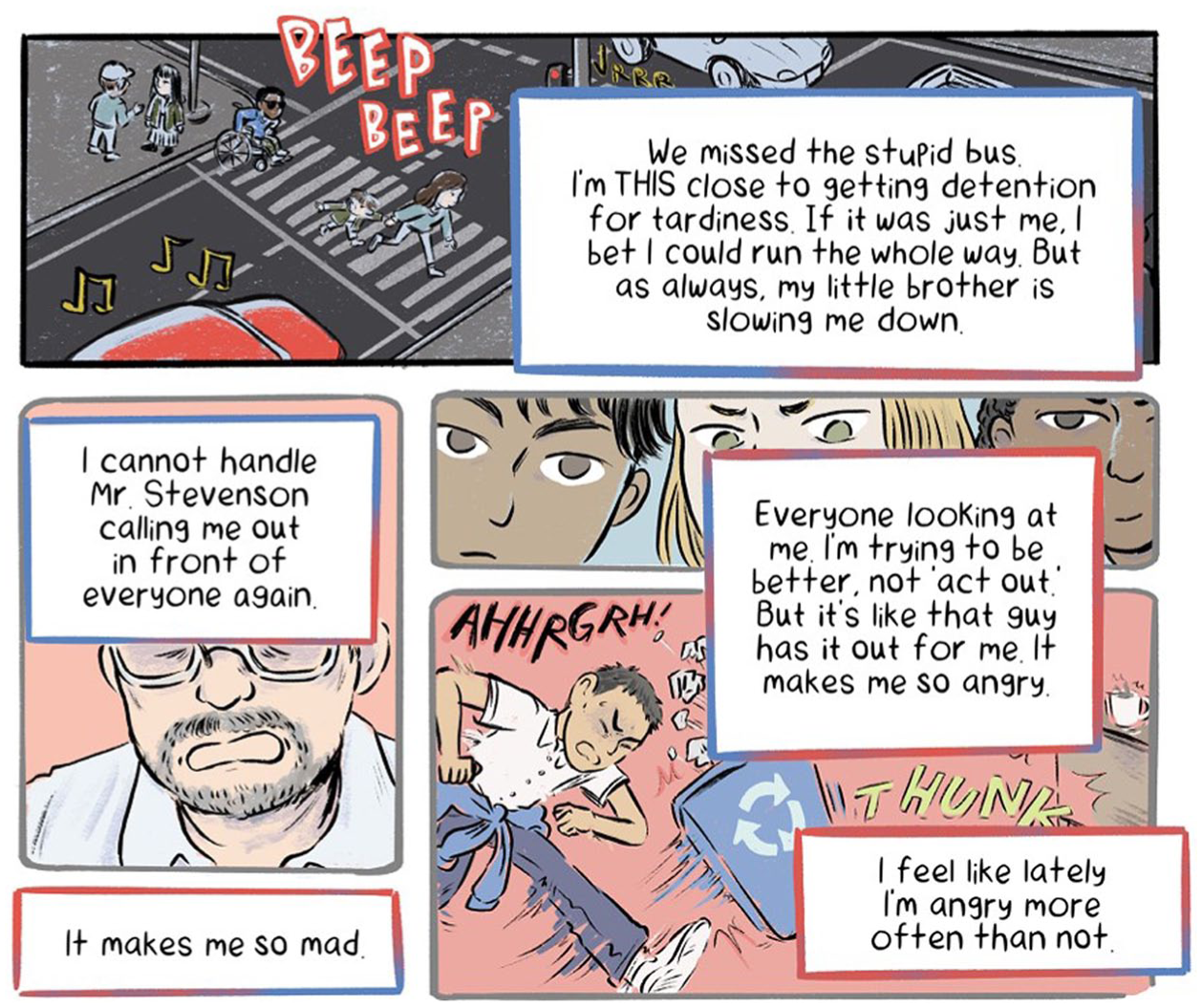
My heart was pounding. It wasn’t from sprinting down the street after missing the bus. It wasn’t from rushing to class after dropping my little brother, Mateo, off at his elementary school. It was from the anxiety of knowing that Mr. Stevenson was going to give me a hard time for being late. I wish he’d lay off.
As my sneakers slapped on the wet pavement leading to the entrance of my school, water seeped in, turning my socks into soggy dishrags. While I was desperately hurrying ahead to try to make it to room 303 before the tardy bell, the squidgy sound wafting up from my shoes pulled me back to the hurricane. To Mateo’s constant whimpering. To the blue tarp covering our leaky roof, its edges flapping in the wind, threatening to blow away like our old life.
The hallway was empty as I rushed to class. The only sound louder than my beating heart was the screeching of my wet sneakers. Clad in a sweaty blue hoodie, straining forward with my feet kicking up imaginary dust clouds, I was a dead ringer for the Roadrunner in that old cartoon we used to watch before we moved into the motel. I guess that meant Mr. Stevenson was Wile E. Coyote.
Before stepping into Mr. Stevenson’s room, I took a deep breath to steady myself before he pelted me with his usual lecture about my tardiness (see Figure 1). Mr. Stevenson is too pigheaded to see that it’s not my fault. Maybe if the crummy motel wasn’t so far from the bus stop, I could get to school on time. I know mom is doing her best to find us somewhere else to stay, but I’m sick of digging my clean shirts out of the trash bags that store our clothes. Sick of the crappy Wi-Fi that makes it hard to do homework. Sick of not knowing what will happen. I wish I could’ve stayed at my old school. Mrs. Gonzalez tried to tell mom I didn’t have to leave, but she thought a fresh start might be good. Relax. Don’t think about all that now. Today, I will not lose my temper. I entered the room with my eyes cast down. Maybe if I didn’t make eye contact with him, he wouldn’t see me.
Reprinted with permission from Pavlakis, A. E., Richards, M. P., Roberts, J. K., Franklin, A. R., & McKinney, K. (2024). Uprooted: Voices of student homelessness. ISBN: 979-8-218-46295-6. http://smu.edu/uprooted
“Nice of you to finally join us, Angel,” Mr. Stevenson boomed. No such luck.
“Uh, s-s-sorry, Mr. Stevenson. I-I missed the bus and then I had to drop my lit—”
“I don’t want to hear excuses. Just go sit down.” I trudged to my seat, feeling the eyes of Mr. Stevenson and my classmates on me. My grip on my temper was already slipping.
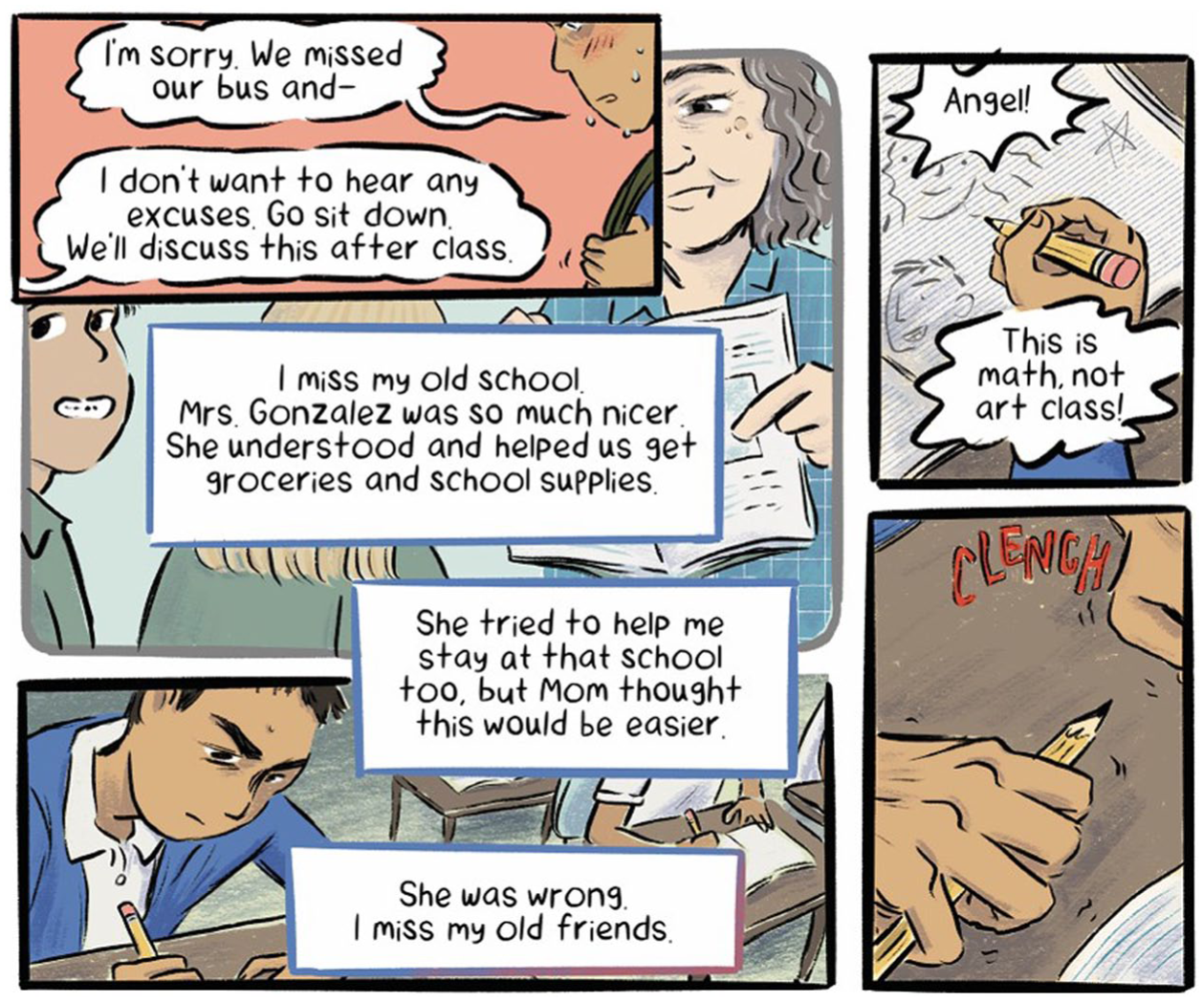
“And stay after the bell, Angel. We need to talk.” I wanted to tell him to shove it, but I was already on thin ice. I wish he’d stop calling me out and just be happy I made it to school. Not wanting more trouble, I pulled out my notebook and began working on my comic.
The sky darkens as the Jackal chases the boy to the cliff’s edge. The boy stumbles, and gravel falls into the abyss below. The Jackal inches forward, sure of victory. Suddenly, El Valiente flies in, his theme music playing. “Not so fast, Jackal,” he declares. “Oh, no, El Valiente!” the Jackal whimpers, his self-assured grin replaced by a look of defeat. El Valiente lifts the Jackal up and tosses him into the distance, a trail of “Ahhhh!” streaking across the sky. He reaches for the boy’s hand to pull him to safe—
“Angel. This is math, not art class! Pay attention.” Geez, this guy doesn’t quit. I gripped my pencil tightly, trying to get a grip on my anger. I know I need to get my grades up, but I have so much on my mind. Mrs. Gonzalez would’ve understood (see Figure 2). She had helped us before with groceries and school supplies. She was warm and really seemed to care. I tried to concentrate on the math problem on the board, but when Mr. Stevenson put his back to the room, I chanced a glance at the unnamed boy in my drawing, his hand suspended in midair. El Valiente’s smile was reassuring, but his hand was just out of reach. I stuffed my notebook into my backpack.
Reprinted with permission from Pavlakis, A. E., Richards, M. P., Roberts, J. K., Franklin, A. R., & McKinney, K. (2024). Uprooted: Voices of student homelessness. ISBN: 979-8-218-46295-6. http://smu.edu/uprooted
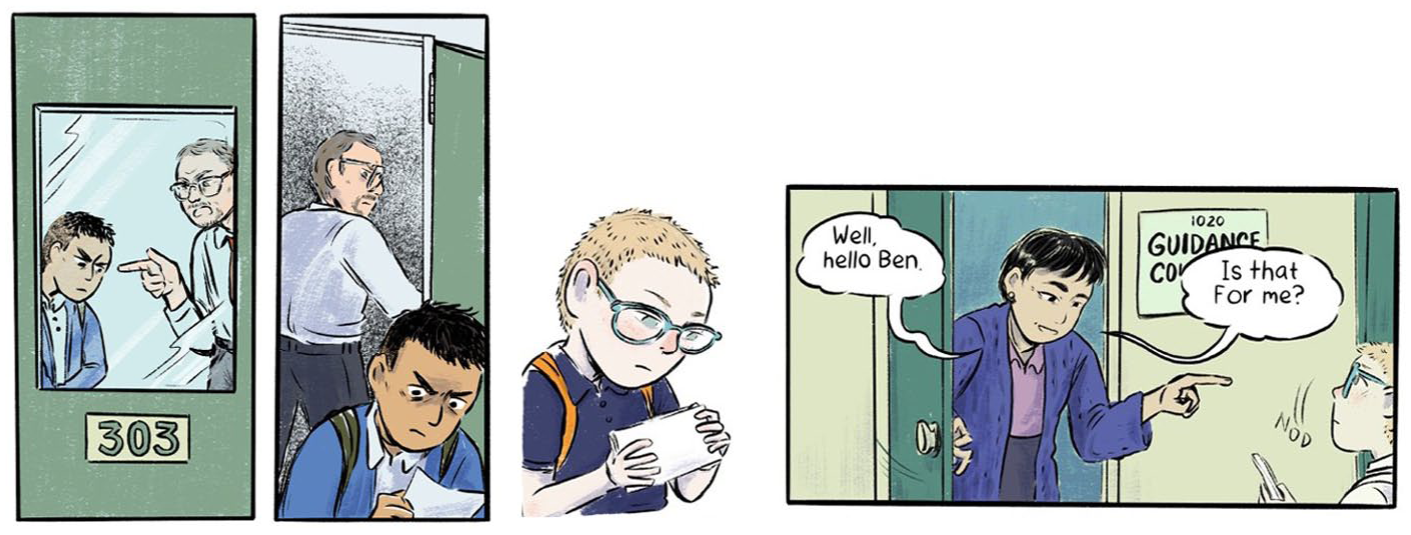
Most days, I can’t wait for the bell to ring. But today, I dreaded it because it signaled another of Mr. Stevenson’s lectures on tardiness. As if embarrassing me in front of the class wasn’t enough. He handed me a note marked PRINCIPAL YAMAGUCHI’S OFFICE. All caps. I bit back a sigh as he reminded me of how disruptive I was (see Figure 3). Eyes on the floor, I rehearsed what I’d never get the chance to say. Seeing red the whole way down the hall, I didn’t notice the little blond kid coming my way until I crashed into him.
Reprinted with permission from Pavlakis, A. E., Richards, M. P., Roberts, J. K., Franklin, A. R., & McKinney, K. (2024). Uprooted: Voices of student homelessness. ISBN: 979-8-218-46295-6. http://smu.edu/uprooted
“Hey! Watch where you’re going, kid!” I howled. Now who was the coyote? I’d seen him before, but I never paid much attention. Seeing him up close, I realized he wasn’t much bigger than my little brother. I felt the same guilt I felt whenever I snapped at Mateo.
Ben
I flinched, startled by the older kid’s attitude. My Rubik’s cube went flying. I stood, unmoving, an apology already sliding off my tongue. The scowl on his face immediately softened. I’d noticed him in the halls before, but he was usually frowning and grumbling under his breath, so I tried to stay out of his way. He was much bigger in person. Apologize, Ben. He could probably wipe the floor with you.
“I mean, my fault. I didn’t see you. And I’m sorry I yelled at you,” the older kid said as he bent to pick up my cube.
“That’s okay. I wasn’t watching where I was going either.” He dropped the cube into my hand, hesitating. Say something, Ben. Nothing came out—just the same blankness I feel when my cousins, Mickey and Jackson, tease me. I laughed nervously and adjusted my glasses. He tugged his backpack straps, started to speak, then thought better of it.
“Well, uh, I gotta go. Principal’s office,” he said, rolling his eyes and balling up a piece of paper.
“Yeah, see you later.” I looked down at my own piece of paper. Another note to the guidance counselor, Ms. Haneda, about me falling asleep in class. Third time. I hope I don’t get detention. Dad’s been trying to get back on track, and Auntie Alyssa would get upset if she had to come get me. I’m trying to stay on her good side after yesterday’s fight about the dishes. It must be hard to have more people in the house.
The squeaky springs of my Rubik’s cube kept pace as I shuffled toward Ms. Haneda’s office. Find the logo piece, make a white cross, and twist the bottom layer. Arrange the white corner pieces and finish the first face. She’d given me the cube when I first started at Emerson, thinking it might help me relax. Although I hated being called out for sleeping in class, I didn’t mind being sent to Ms. Haneda. She’s a good listener, so sometimes I share things with her I’d normally keep to myself.
Before knocking on her door, I reread my teacher’s note and tried to think of an excuse. How about the truth? I’m sure she’ll understand. I took a deep breath and tapped on the door.
“Well, hello, Ben. It’s nice to see you,” Ms. Haneda pleasantly remarked. Eyeing the note in my hand, she softly asked, “Is that for me?” As she read it, I played with my cube. Sneaking a glance at her over the top of my glasses, I saw Ms. Haneda’s soft smile and felt better (see Figure 3).
“Come on in, Ben. I’d like to chat with you.”
“Have a seat, Ben. Would you like a snack?”
“Not right now,” I murmured as I sat in one of the comfy chairs. Decorated in warm colors, Ms. Haneda’s office further put me at ease. She sat across from me and pointed to my Rubik’s cube.
“What’s your best time this week?”
“Um, I solved it yesterday in five minutes.” I smiled, trying not to brag.
“Wow! I’m impressed. Maybe you can be a speedcuber,” Ms. Haneda joked.
“That’d be great! I really like puzzles. I’m almost done solving this one.”
“That’s fantastic, Ben. You can keep working on it while we chat. So, how are you? Are you feeling tired today?” I wanted to tell her no because a yes would mean more questions, but her welcoming expression encouraged me to share (see Figure 4).

Reprinted with permission from Pavlakis, A. E., Richards, M. P., Roberts, J. K., Franklin, A. R., & McKinney, K. (2024). Uprooted: Voices of student homelessness. ISBN: 979-8-218-46295-6. http://smu.edu/uprooted
“Well, maybe a little.” Ms. Haneda waited patiently for me to continue. I added, “Sleeping at Auntie Alyssa’s is hard sometimes.”
“I’m sorry to hear that. Would you like to say more about it?”
We’d been “victed,” and we’d moved around a lot since then. I didn’t want Ms. Haneda or my teachers to get the wrong idea about my dad. If they knew we didn’t have our own place to live, they might take me away from him again, like when he went to jail and I had to stay with Grandma (see Figure 5). “Well . . . we’re staying with my auntie until Dad can get back on his feet. But at night, it’s so noisy. I can’t always fall asleep.”

Reprinted with permission from Pavlakis, A. E., Richards, M. P., Roberts, J. K., Franklin, A. R., & McKinney, K. (2024). Uprooted: Voices of student homelessness. ISBN: 979-8-218-46295-6. http://smu.edu/uprooted
“I can understand how that could be very difficult.”
“And sometimes my cousins tease me about my science projects, but Dad loves them. He didn’t even get mad when my volcano exploded and covered the kitchen in orange foam. Auntie Alyssa was pretty upset, but Dad just laughed.”
“We’re holding the Science Fair next week, and we’d love if your dad could come.” It’s nice of Ms. Haneda to invite my family to the fair. Dad will like knowing he’s welcome.
“Thanks,” I mumbled.
I gripped the cube and focused on the last few moves, trying to find the right words. It’s not always easy explaining our living situation, but Ms. Haneda cares. Living at Auntie Alyssa’s is a lot like this Rubik’s cube—tricky sometimes, but Dad and I keep working at it.
Principal Yamaguchi
The staff meeting was due to start in 20 min. Dr. Yamaguchi sat at her desk collecting her thoughts. She recalled what she’d seen through Mr. Stevenson’s classroom window: a strained moment between him and Angel. Mr. Stevenson was inventive in his math teaching but short on patience. Maybe Ms. Haneda could coach him on how to support Angel’s non-academic needs. After all, Dr. Yamaguchi had seen how well the counselor connected with Ben.
Dr. Yamaguchi checked her watch, gathered her papers, and headed to the meeting. The hum of conversation faded as she entered the cafeteria. Surveying the room, she observed a patchwork of emotions, some radiating hope and steadfastness, others clouded with weariness and frustration.
“Thank you all for being here. As you know from my email, we’re seeing an increase in student homelessness.” A wave of murmurs spread through the group. “We all want the same thing—to do what’s best for our students—and I’m here to listen, learn, and work together.”
There was a moment of silence as no one seemed eager to be the first to speak. Then, Mr. Stevenson stood up, his expression clouded in confusion:
Wait, do we actually have students here who are experiencing homelessness? I’m not sure I’ve even seen these students in my classroom. Some kids come in late or don’t participate in class, but that’s probably because we’re gearing up for testing season. They’re likely unmotivated or avoiding work, not dealing with something like that. And honestly, I’m unsure what our role is. Shouldn’t the guidance counselors handle this? What can we do?
Dr. Yamaguchi acknowledged her staff’s feelings but reiterated their roles:
I understand this can be shocking, but under MVA, we must support these students so they can have educational stability and participate fully in school. While you are not responsible for ultimately determining who is legally eligible for MVA—the district liaison is—it is important we work together as a school to help identify and provide support.
Some staff nodded in understanding, while others sighed and exchanged uneasy glances, feeling frustrated and overwhelmed.
Mr. Thompson, who’d been drumming nervously on the table, asked a question many were thinking: “I’m confused about how this affects us. With the new executive orders to dismantle the Department of Education, are we still allowed to advocate for these students? Does MVA still hold?”
“Does this mean we’ll need to do more training on supporting students experiencing homelessness? Honestly, I’m already burnt out,” Mrs. Billingsley snapped.
Remembering how she felt as an undertrained new teacher, Ms. Ramirez tried a different approach:
Many of our students are coping with a lot outside of school, and that can leave us feeling unsure of how to respond. I know of a local community organization that provides trauma-informed training. Maybe that could help us feel more capable.
Ms. Haneda stepped in to ease rising tensions: “I understand all your concerns. This isn’t about adding more to your plates but about sharing responsibility, both within and outside of Emerson.” A few heads nodded in quiet agreement.
Dr. Yamaguchi paused as the room quieted, and the tension waned. She smiled warmly and closed. “MVA is still in place. Working together with our families and district liaison, I know we’ll do everything we can to support our students.”
Teaching Notes
Using the composite stories of Angel and Ben, our case profiles the realities of student homelessness and highlights the leadership challenges faced by principals who must bolster the capacity of their staff and navigate complex political terrain to address student homelessness. In our teaching notes, we provide additional context on student homelessness and MVA. We then discuss the distributed leadership perspective. We end by exploring the current political terrain in which Emerson, and other schools across the country, is situated.
Student Homelessness
Public schools identified nearly 1.4 million students as homeless in U.S. public schools during the 2022–2023 school year, a 14% increase from the previous year (SchoolHouse Connection [SHC], 2025). Of these students, 40% were Hispanic/Latine, 26% Black/African American, 25% White, 6% two or more races, 2% Asian, 2% American Indian or Native Alaskan, and less than 1% Native Hawaiian or Pacific Islander (SHC, 2025). Due to challenges in identification, such as lack of awareness and stigma, these numbers are an underestimate (Cutuli et al., 2024; Moore et al., 2023). Although causes vary, homelessness is often rooted in poverty, unemployment, and lack of affordable housing (Buckner, 2012), as well as natural disasters intensified by climate change (Pavlakis et al., 2026; Richards et al., 2026). While many causes of homelessness fall outside the purview of schools, educators are tasked with assisting once students come through their doors (Hallett et al., 2025).
Unfortunately, students experiencing homelessness tend to be highly mobile, and school moves can uproot them from friends and trusted educators. Likewise, they tend to struggle with absenteeism, low academic performance, and behavioral health problems (Buckner, 2012; De Gregorio et al., 2020). Still, some show remarkable academic resilience and do well (Edwards, 2023).
The McKinney–Vento Homeless Assistance Act
Fortunately, MVA provides students who are identified as homeless with rights, such as immediate school enrollment, free school meals, and the educational supports inherent in Title I, Part A of Every Student Succeeds Act (ESSA). The policy requires each district to appoint a liaison who is responsible for identifying children, ensuring families know their rights, and partnering with community agencies and other school staff (42 U.S.C. § 11432(g)(6)(A)(i)). To promote stability, families may keep their students in their school of origin or, if in the best interest of the child, attend the school associated with their new address (National Center for Homeless Education [NCHE], 2023).
MVA implementation is uneven though; only some districts receive MVA subgrants, and policy awareness varies widely. Gaps in training further impede consistent application of MVA (Hallett et al., 2025; Miller, 2011).
Fortunately, Dr. Yamaguchi still had the federal education policy, MVA, to guide her practice. The policy defines homelessness as lacking a fixed, adequate, and regular nighttime residence (42 U.S.C. Section 11434a(2), 2015). This definition includes:
Sharing housing with extended family, friends, or acquaintances after loss of housing or having no other place to stay;
Staying in hotels, motels, trailer parks, or camp groups due to a lack of options;
Staying in emergency or transitional shelters;
Living in public or private places that are not fit for human habitation.
Angel and Ben exemplify different housing situations—one in a motel, the other doubled up—yet both meet MVA’s definition of homelessness. Students experiencing homelessness return to varied living arrangements: doubled up with others (76%), in shelters or transitional housing (11%), in hotels/motels (9%), or in unsheltered places such as cars (4%; NCHE, 2023). These arrangements are fluid, but each setting poses distinct challenges that shape educational outcomes. For instance, students in motels may experience notably large attendance gaps, perhaps due to transportation challenges, while those doubled up may fare better academically than peers in shelters (Richards & Pavlakis, 2022). However, doubled up students are also more likely to go unidentified (Hallett et al., 2025). Students’ needs also vary by circumstance; for instance, Angel faced transportation barriers while Ben struggled with fatigue. Strengthening relationships with families experiencing homelessness could help schools provide more tailored supports (Hallett et al., 2025; Pavlakis, 2018).
Under MVA, liaisons ensure identified children have a “full and equal opportunity to succeed,” offering families connections to housing and health care services (MVA, 2016). District liaisons also help guardians understand their rights and stay engaged in their children’s education. To better serve Emerson families, Dr. Yamaguchi could consult with the district liaison on current community partnerships and potential collaborations.
In addition, liaisons ensure school staff who provide MVA services receive professional development. This is important because state education agencies and school districts must remove barriers to the identification, enrollment, and retention of students experiencing homelessness (SHC, 2025). Dr. Yamaguchi saw Mr. Stevenson needed support and wondered how Ms. Haneda could be a school-level resource (see Hallett et al., 2025; Havlik, 2025). Yet, confidentiality is crucial. Collaborative efforts must protect Family Educational Rights and Privacy Act (FERPA) rights and ensure information sharing does not hinder students’ identification as homeless or their school enrollment (SHC, 2025). This means that, in some cases, school staff may not know a student’s homeless status, so Dr. Yamaguchi had to figure out how to support Mr. Stevenson without violating confidentiality.
Distributed Leadership
Implementing MVA necessitates a shared leadership practice that extends beyond Dr. Yamaguchi (see Lyle et al., 2024; Pavlakis, 2019; Spillane et al., 2004). Principals play a key role in setting and maintaining school cultures that are protective, collaborative, and supportive (Moore et al., 2023), while other educational leaders, like homeless liaisons, school social workers, and counselors, may have on-the-ground expertise of families’ needs and community resources.
Distributed leadership, which highlights shared roles and collaboration across individuals, is well suited for addressing student homelessness (Miller, 2011). It consists of two key parts: the leader-plus component and the practice component. Spillane (2006) explains that distributed leadership “moves beyond the Superman and Wonder Woman view of school leadership” (p. 3). Rather than focusing on a single, idealized leader with traits like charisma, distributed leadership values the contributions and interactions of many people, including Dr. Yamaguchi, Mr. Stevenson, and Ms. Haneda, regardless of their formal job titles (Spillane et al., 2004). Leadership is understood as ongoing practices that influence members’ motivation, knowledge, and behaviors, emphasizing collective effort over individual heroes (Spillane, 2006).
Leadership can be distributed in collaborative, collective, and coordinated ways (Spillane et al., 2004). Collaborative distribution involves people working together in real time, collective distribution occurs when individuals work separately on shared goals, and coordinated distribution occurs when leadership tasks unfold in sequence (Spillane, 2006). By calling a staff meeting, Dr. Yamaguchi was engaging in collaborative practice. How else might leadership around student homelessness be shared?
Situations refer to organizational structures, routines, and tools in a setting, such as a school or district. They include activities people commonly engage in and instruments used to complete work, like forms or memos. Within the student homelessness situation (Miller, 2011), Dr. Yamaguchi was unclear about which routines and tools her team used. This challenge was further complicated by confusion after a series of executive orders were released by the federal government.
Executive Orders and Political Terrain
Amid shifting federal priorities, Dr. Yamaguchi anticipated heightened anxiety about students’ rights and advocacy efforts (SHC, 2025). After the 2025 executive orders—one ending diversity, equity, and inclusion (DEI) programs (The White House, 2025b) and another initiating the elimination of the U.S. Department of Education (The White House, 2025c), she was concerned because MVA was a federal education policy and student homelessness was disproportionately experienced by students of color. Dr. Yamaguchi reassured staff that these orders do not override federal law protecting students (SHC, 2025). However, the Executive Order on Homelessness (The White House, 2025a), which limited privacy and housing protections (National Alliance to End Homelessness [NAEH], 2025), could also hinder creating a supportive school culture around housing insecurity. Dr. Yamaguchi questioned if shared leadership and staff capacity building would be enough to counter uncertainty about current policies and future government actions.
Suggestions for Teaching With the Case Narrative
This case could be beneficial to educational leadership master’s or doctoral courses on special populations; crisis leadership; leadership approaches; family–school–community relations; or policy, politics, and law. The included questions and activities help leaders or emerging leaders develop their staff’s capacity to effectively address student homelessness.
Discussion Questions
Examine the case from distributed leadership (see ; Lyle et al., 2024; Miller, 2011; Pavlakis, 2019; Spillane et al., 2004) and social justice leadership perspectives (see Theoharis, 2007, 2008). The class can be split into two groups and jigsaw responses.
Distributed Leadership
How can Dr. Yamaguchi leverage the expertise of staff, families, and the broader community to create a stronger support system for students experiencing homelessness?
To what extent can Dr. Yamaguchi consider collaborative, collective, and coordinated leadership practices? What tools and routines may be particularly important in the situation of student homelessness?
Social Justice Leadership
Social justice leadership reflects a commitment to ensuring that students who are marginalized receive the same educational opportunities as other students. It prioritizes equity and diversity in nearly all aspects of the job, such as analyzing data through equity lenses and ensuring professional development considers race, class, gender, disability, and other factors (Theoharis, 2007, p. 252).
How might Dr. Yamaguchi respond to her staff if she practices social justice leadership?
Considering 2025 executive orders (see NAEH, 2025; SHC, 2025; The White House, 2025a, 2025b, 2025c), what challenges might Dr. Yamaguchi face when implementing social justice initiatives? How could she address these barriers?
To what extent might this case require a social justice leadership perspective?
Suggested Learning Activities
In groups, role-play how would you address Emerson teachers’ differing concerns.
Think of a student you’ve worked with who experienced homelessness (no names or identifying details). Compare their situation with one from the comic (www.smu.edu/uprooted). Suggest some specific steps a leader could take to better support the student.
Reflect on your current class-, school-, or district-level policies (e.g., homework, attendance, dress code) and consider how they affect students experiencing homelessness. Use sticky notes to write down policies you’d change and how. Exchange notes and discuss concrete actions leaders can take to improve policies.
Footnotes
Acknowledgements
While any views or errors are our own, we would like to thank Ashley Robin Franklin, Kacy McKinney, J. Kessa Roberts, and Meredith P. Richards without whom the Uprooted: Voices of Student Homelessness comic would not be possible.

Funding
The authors disclosed receipt of the following financial support for the research, authorship, and/or publication of this article: This research was made possible in part by a Research Communication grant from the Spencer Foundation. The views expressed are those of the authors and do not necessarily reflect the views of the Spencer Foundation.
Declaration of Conflicting Interests
The authors declared no potential conflicts of interest with respect to the research, authorship, and/or publication of this article.