



Abstract
Conducting clinical trials in resource-poor settings may contribute to local capacity building. We describe the perspectives of local research personnel regarding the impact of collaborating in a clinical trial in rural Ghana. Forty-six Ghanaian research personnel were eligible to complete an anonymous survey, and 35 (76%) participated. Of the 35 respondents, 32 (91%) agreed that future patients will benefit because the hospital was part of the study. All 35 respondents reported a personal benefit derived from study involvement, most commonly citing skills or knowledge gained. Of the 35 individuals, 21 reported one or more burdens, most commonly citing nonspecific research responsibilities. Our data support the hypothesis that participation in clinical trials can contribute to capacity building in district hospitals in a lower middle-income country.
Introduction
Scientifically and ethically sound clinical trials conducted in low- and middle-income countries (LMICs) have the potential to effect lasting improvements in health care delivery; however, ensuring that the benefits of research redound to the community in which the research takes place can be challenging. Wealthy institutions conducting research in LMICs may disrupt local systems because of insufficient knowledge of local infrastructure and cultural norms, mismatch between the research aims and the needs of the community, and the potential for the research to divert resources or attention from more pressing public health needs (Chetwood, Ladep, & Taylor-Robinson, 2015). London (2005) argues that research in LMICs is only ethically sound when “it functions to expand the capacity of the basic social structures of that community to better serve the fundamental interests of that community’s members.” Similarly, the Council for International Organizations of Medical Sciences and the Nuffield Council on Bioethics agree that sponsors and investigators have a responsibility to strengthen local expertise when conducting research in developing countries (Council for International Organizations of Medical Sciences, 2016; Nuffield Council on Bioethics, 2004).
Denburg and colleagues hypothesize that clinical trials may serve as “a mechanism to drive health system advances that directly improve the quality of care” in LMICs (Denburg, Rodriguez-Galindo, & Joffe, 2016). The mechanism for this proposed effect is an “infrastructure effect,” defined as “the organizational systems, expertise and culture that grow from sustained participation in the enterprise of clinical research” that could significantly benefit patients living in LMICs around the world. The idea that involvement in clinical research can develop local capacity has been proposed elsewhere (Chetwood et al., 2015; World Health Organization [WHO], 2012), along with the myriad of challenges faced by researchers in sub-Saharan Africa (Mwangoka et al., 2013). Common themes have emerged among stakeholders, such as the need for equitable partnerships entailing the respect for the needs, interests, and agendas of all partners; addressing the barriers and opportunities to sustain system capacity; addressing local health targets; and regional commitment to benefit sharing (Ogundahunsi, 2016; Ward, 2017), along with communicating end-of-trial information and disseminating study results (Ward 2018).
The authors and other U.S. investigators recently collaborated with Ghanaian researchers and health care providers at two district hospitals in Ghana to conduct a controlled trial investigating the impact of continuous positive airway pressure (CPAP) on mortality in young children with respiratory distress (Wilson, Baiden, et al., 2017). CPAP is a noninvasive respiratory support system that has not been previously available to children presenting at these hospitals prior to the commencement of the CPAP program of research. The CPAP study was an open-label, cluster, crossover design trial designed to determine whether the use of CPAP decreases mortality in young children with respiratory insufficiency. Study funds were used to provide the participating hospitals with heart rate, blood pressure, and oxygen saturation monitors; oxygen concentrators; and electricity generators. Day-to-day management of the study and all study interventions were conducted by local health care providers who were part of the local hospital staff.
Nurses from the participating hospitals were trained by the investigators on how to monitor and document vital signs, how to use CPAP, and in the physiology of respiratory distress in children. Approximately every 6 months during the 2-year study, refresher educational sessions were held for local study staff. All U.S. and Ghanaian research personnel completed necessary training modules on the responsible conduct of research as required by U.S. research institutions, and approval was obtained from the Columbia University Medical Center Institutional Review Board and local institutional review boards at the Kwame Nkrumah University of Science and Technology and Ghana Health Service (GHS), and by the leadership of each hospital while the Ghana Food and Drug Authority provided regulatory oversight. Over a 2-year period, 2,200 children were enrolled in the study. All study equipment and training materials were given to the participating hospitals at the end of the trial.
In this survey study, we explored the extent to which the CPAP study resulted in capacity building or infrastructure gains in the participating communities. We report the perspectives of Ghanaian research personnel regarding (a) the impact of the study on patients cared for during and after the study, and (b) the benefits and burdens of the study for the research personnel and their hospitals.
Method
The study consisted of a written survey, including open-ended and categorical items. The survey was developed with the primary goal of program evaluation to inform future research studies. The items were designed to address the following domains: (a) impact of the study on contemporary patients, whether enrolled in the study or not; (b) impact of the study on future patients; (c) benefits and burdens of the study for local health care providers; and (d) anticipated long-term impact of the study on local health care providers and participating hospitals.
All Ghanaian personnel who were listed on the delegation of responsibilities log for the CPAP Survival Study were eligible to complete this survey. The survey was written in English, and all eligible participants were fully fluent in English.
As the survey was conducted as part of the program evaluation, the Columbia University Institutional Review Board classified this work as not human subjects research. Surveys were distributed in person to eligible individuals. The purpose of the survey was explained to participants, and it was made clear that completing the study was optional and that they could skip any questions they did not feel qualified to answer or did not want to answer. It was made clear to respondents that the survey was anonymous. Participants were asked to return the surveys (completed or not) to a large opaque envelope. No personal identifying information was collected.
Data Analysis
Quantitative data are presented using descriptive statistics. Qualitative data were analyzed using thematic analysis. Definitions of themes were agreed upon by all three investigators, based on a priori hypotheses and content analysis. Qualitative responses were coded separately by two investigators (M.C.M., P.T.W.), and all discrepancies were resolved to the satisfaction of all three investigators.
Results
Forty-six Ghanaian research personnel were identified from the delegation of responsibilities log. Of these, 35 (76%) were available at the participating hospitals when the survey was conducted. Surveys were distributed and collected between January 22, 2016, and February 4, 2016, 6 to 8 weeks after the CPAP study closed to enrollment. All participants who received the survey completed or partially completed it. Of the 35 participants, 16 were from Hospital 1, 14 from Hospital 2, and five affiliated with the local research center. The participants included 21 nurses, six physician assistants, five medical doctors, two research coordinators (one at each site), and the Ghanaian program officer. All research personnel except the five affiliated with the local research center were already employed by the participating hospitals before the study began.
Participants were asked to indicate the extent to which they agreed or disagreed with the following three statements: (a) “Children who were part of the CPAP study received better care than they would have gotten if the study didn’t happen,” (b) “Future patients in this hospital will receive better care because we were part of the CPAP study,” and (c) “It would be good for our hospital to be part of other research studies like the CPAP study.” Results are shown in Figure 1.
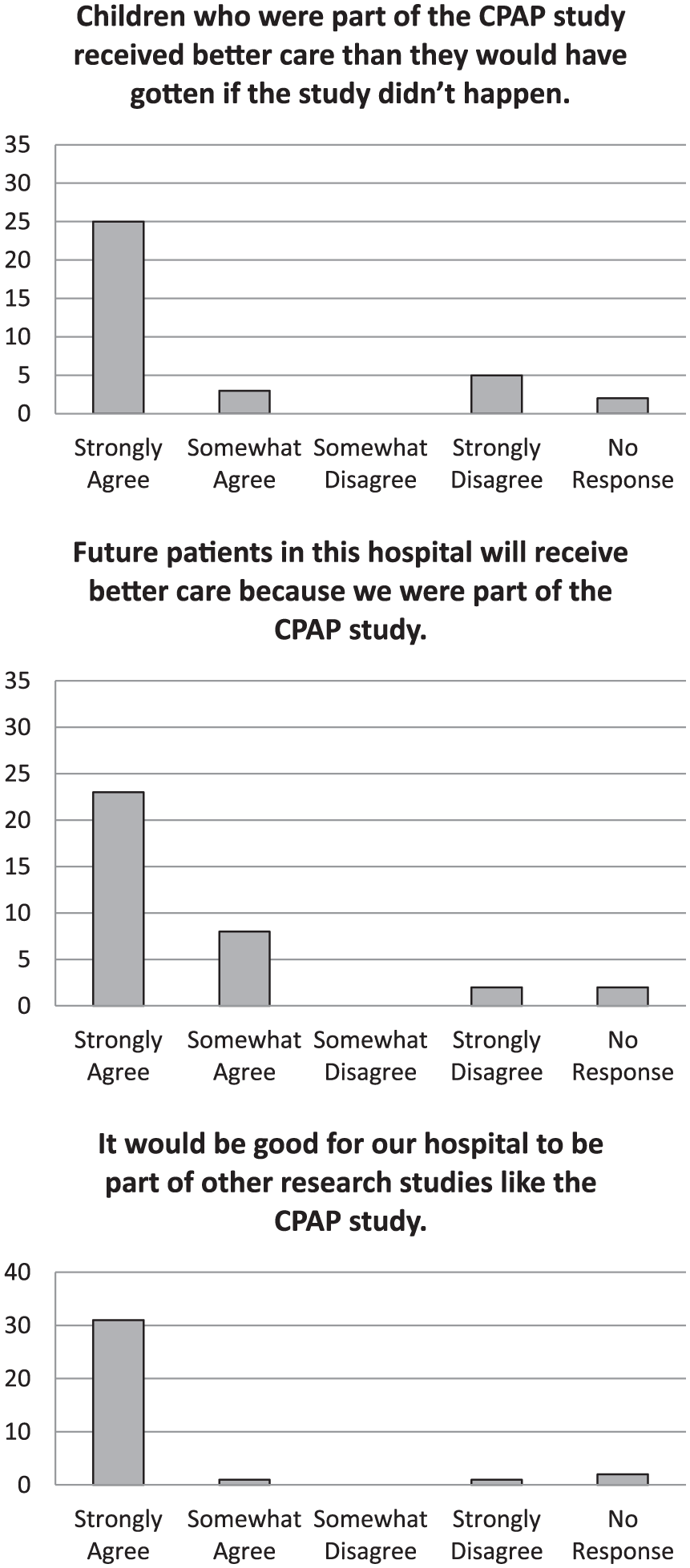
Extent to which participants agreed or disagreed with the described statements.
Five individuals (14%) strongly disagreed with the statement “Children who were part of the CPAP study received better care than they would have gotten if the study didn’t happen.” The survey did not contain a follow-up qualitative item, so it is difficult to ascertain the reasons for these responses. All other survey responses were reviewed for each of these individuals to seek evidence of any harm they thought the study may have caused; no suggestion of harm was found. Two of these five individuals made statements that all patients received standard care (e.g., “We are professionals who practice under guidelines and protocols”). All five strongly agreed that future patients will receive better care because the hospital was part of the study, citing improvements in knowledge and skills.
Participants were then asked, “How do you think the CPAP study affected patients who were NOT part of the research, but came to the hospital during the study?” Thirty-three individuals responded. Of the 33, four (12%) chose the response that their care was worse, 11 (33%) that it was better, and 18 (55%) that it was not affected. The most common reason given by those who felt care was improved was that nonstudy patients benefited from the equipment or training provided by the study. Of the four who responded that care was worse, three responded that nonstudy patients missed out on benefits that were provided to study patients, and one responded that care of nonstudy patients was delayed. A summary of responses, with representative quotes, is found in Table 1.
Qualitative Responses to “How Do You Think the CPAP Study Affected Patients Who Were NOT Part of the Research, But Came to the Hospital During the Study?”.

Note. CPAP = continuous positive airway pressure.
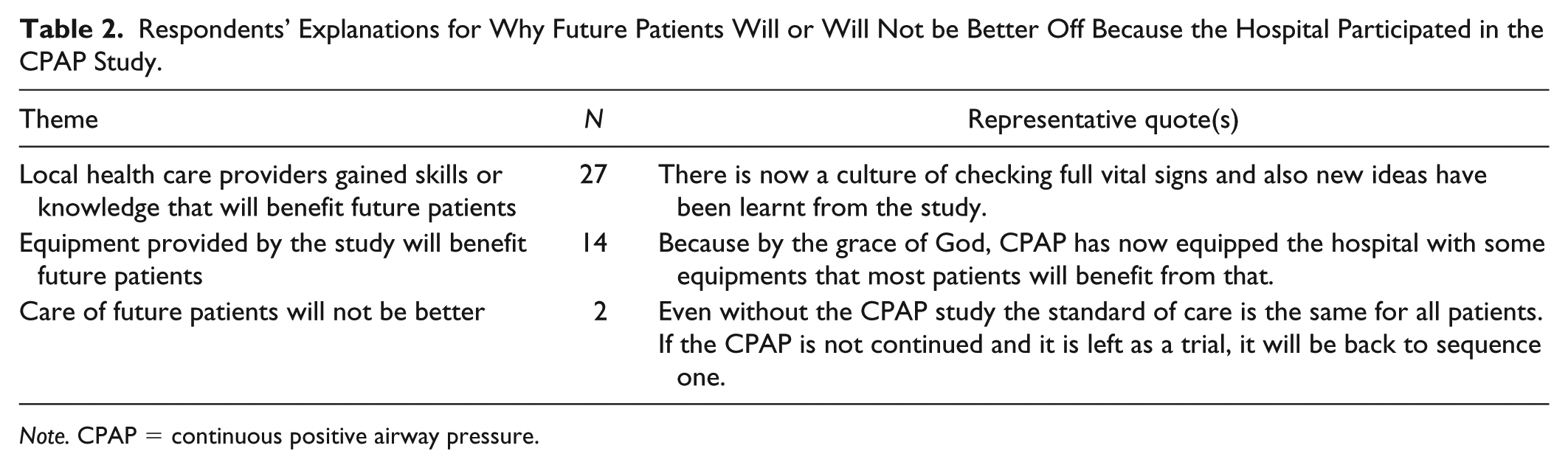
When asked, “Do you think that future patients at this hospital will be better off because the hospital was part of the CPAP study,” 32 (91%) of the 35 participants replied yes, two (6%) responded no, and one (3%) responded “not sure.” After selecting a categorical response, participants were asked, “What makes you feel that way?” Among those who responded that future patients will be better off, the most common reasons given were that future patients would benefit from the knowledge and skills that health care providers had received, or that they would benefit from the equipment that the study provided. The two respondents who reported that future patients would not be better off wrote that CPAP may not be maintained, and that care would continue as usual. A summary of responses, with representative quotes, is found in Table 2.
Respondents’ Explanations for Why Future Patients Will or Will Not be Better Off Because the Hospital Participated in the CPAP Study.
Note. CPAP = continuous positive airway pressure.
Participants were asked, “Were there any benefits to you from helping with the study? If so, what were they?” “Was your job made harder or less pleasant because of the CPAP study? If so, in what way?” Every participant reported at least one benefit of participating in the CPAP study. Of the 35 individuals, 21 reported one or more burdens, although one response was illegible. Responses to the open-ended questions are summarized in Table 3. Every individual who reported monetary gain as a benefit also reported at least one other personal benefit.
Benefits and Burdens Reported by Study Staff.

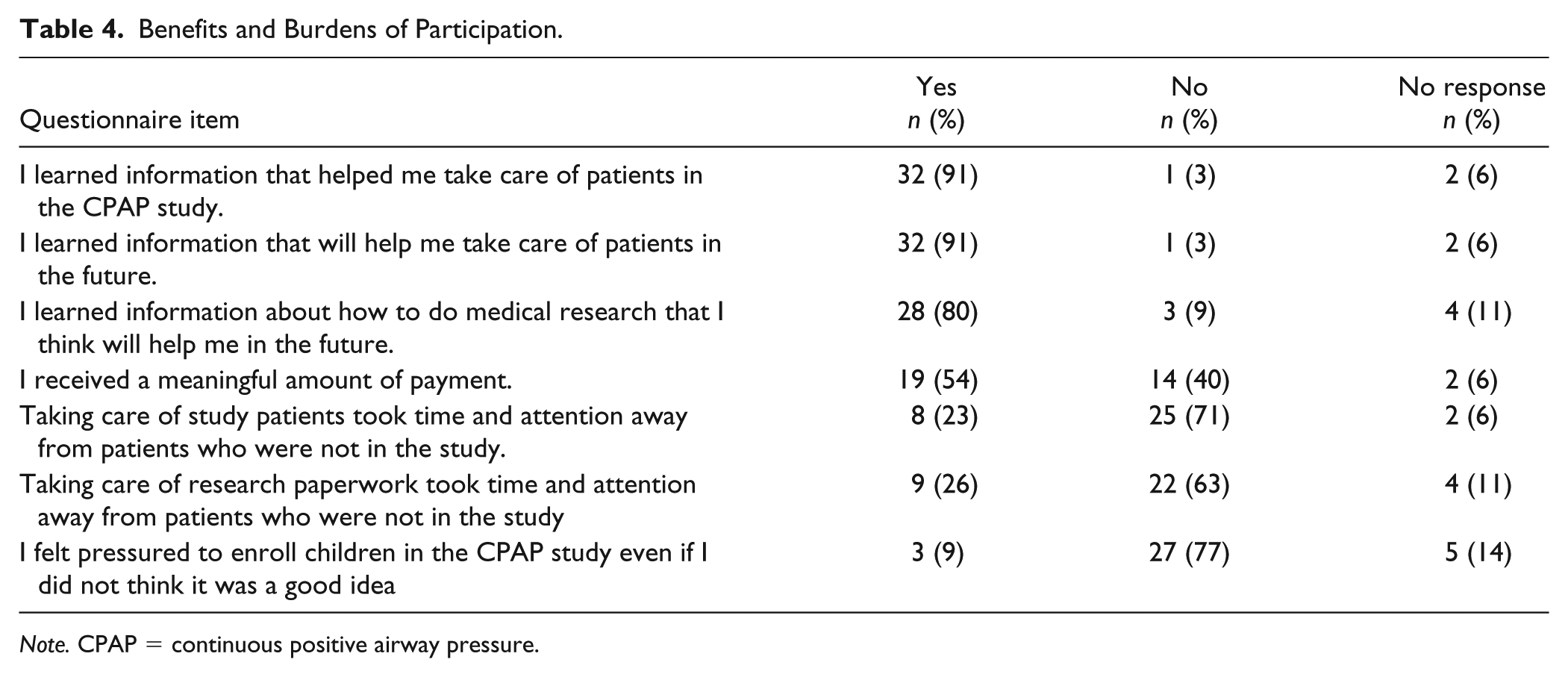
Note. Following the free text field, participants were asked to respond yes or no to a series of benefits and burdens. The number of participants who responded yes to each is shown in Table 4. CPAP = continuous positive airway pressure.
Following the free text field, participants were asked to respond yes or no to a series of benefits and burdens. The number of participants who responded yes to each is shown in Table 4.
Benefits and Burdens of Participation.
Note. CPAP = continuous positive airway pressure.
At some point in the survey, 33 (94%) of the 35 respondents stated they perceived value to the clinical training that they received as part of the CPAP study. Twenty-three (66%) of the 35 participants mentioned the importance, or a benefit, of the equipment provided during the study. Seven (20%) individuals specifically mentioned the importance of learning to monitor patient vital signs.
When asked, “In what ways could the CPAP study have been improved?,” 27 of the 35 individuals offered a response. Ten (28%) suggested additional support that the study could provide. Examples include the following: “The study should have had its own FBC (full blood count machine,” and “Pediatricians or nutritionists are needed to take care of the special cases.” Six (17%) of the 35 participants suggested providing additional training (“Regular training of newly posted staff at the department the project is taking place”). Three suggested limiting the geographical area for eligible subjects so as to decrease the burden of reaching subjects for 2-week follow-up; three suggested increasing “motivation” of study staff (in other contexts, research personnel had used the term “motivation” to mean monetary compensation); two suggested broadening the inclusion criteria of the study; and two suggested decreasing study-related paperwork.
When asked, “What things were done particularly well in the CPAP study?,” 33 of the 35 individuals offered a response. The most common responses included provision of equipment or supplies (11/35, 31%), improvement in patient care (10/35, 29%), and training of study staff (8/35, 23%). Additional responses included organization (n = 5), responsiveness of study leadership (n = 5), and follow-up of subjects (n = 4).
The last item on the survey read, “What are three important things that American researchers should know if they want to conduct good research in hospitals like yours?” Of the 35 individuals, 32 responded. Twenty respondents (57%) referred to the need for knowledge of the local community, including issues like illiteracy rates and capacity of the hospital. Twelve individuals (34%) referred to the importance of training study staff, and 12 (24%) referred to providing needed medical equipment. Seven individuals (20%) specifically mentioned staff compensation, and an additional five (14%) mentioned the importance of staff “motivation.” Three individuals (9%) mentioned the importance of having respect for local personnel.
Discussion
The local health care providers who participated in the CPAP Survival Study report that the study benefited not only the children enrolled in the study but also nonstudy patients cared for during the study period, future patients at study hospitals, and study personnel. Our findings support the hypothesis that participation in clinical trials can lead to capacity building in district hospitals in LMICs.
Denberg et al. (2016) hypothesize that the infrastructure effect of research participation improves local health care more generally: “In other words, improved routine care outside of a trial can occur precisely because of the bar set for routine care within trials on the same disease or patient population at a given center.” Similarly, health managers employed by the Department of Health in KwaZulu-Natal report that they endorse medical research at provincial health facilities in part because of the potential for research to promote human resource development and capacity building (Lutge, Slack, & Wassenaar, 2017). Our findings largely support this hypothesis, with local health care providers reporting gaining valuable clinical training, improved medical equipment, and an improved ability to routinely monitor patient vital signs, which benefited both study and nonstudy patients. Over 90% agreed that future patients at their hospital will be better off because they were part of the CPAP study. However, we believe that participation in research will not automatically improve care at resource-poor hospitals; care must be taken in designing research to foster the potential for lasting benefit for the community in which the research takes place. Specifically, the study intervention must be appropriate to the needs of the local population and health care system. Studying an intervention that is too expensive, extremely technologically advanced, or that addresses an illness that is not prevalent in the study sites will fail to have a lasting benefit in the community. Of the 35 survey respondents, 32 (91%) anticipated that future patients at their hospital will benefit because of the CPAP study. The most common response was that future patients will benefit because of staff training, including the routine practice of monitoring vital signs. Patients presenting with acute respiratory distress were quickly recognized because of close monitoring of vital signs and clinical examination allowing for rapid medical interventions to treat the underlying disease process which greatly outweighs the minimal risk of obtaining vital signs. It is also possible that the refresher trainings provided throughout the study empowered the local health care providers by providing more knowledge and skills needed to improve patient care. Optimization of staff training and practices for monitoring patients certainly ought not depend upon hospitals’ participation in clinical research studies, but we believe that when research is conducted in a resource-poor setting, the local and outside researchers should collaboratively seek opportunities to enhance education and training of health care providers. A training package (Wilson, Benckert, Moresky, & Morris, 2017) was left at each site at the end of the study to encourage ongoing refresher training. Our respondents also commonly cited the benefits of equipment that was donated to the hospitals. One respondent did voice concern that the use of CPAP may not continue. This could be secondary to other interventions in district-level hospitals in Ghana (HIV, malaria, and tuberculosis) competing for time and resources from the health care providers. There is always the concern that the CPAP machines will break, consumables will run out, or that lack of stable electricity can become an issue.
All CPAP equipment and supplies used during the study remained at each hospital as agreed upon by stakeholders at the beginning of the study. As the CPAP Survival Study showed improvement in respiratory rate in all age groups and a reduction in mortality in children under 1 year of age, a 1-year supply of consumables was provided to each study site using leftover study funds in discussion with all stakeholders. Each hospital identified a CPAP champion and provided training material to ensure new staff were all trained to safely and effectively place pediatric patients on CPAP. The training material included a teaching manual, training video, training mannequin, and two-page illustrated summary document that lists indications, contraindications, and step-by-step process of applying and monitoring CPAP. Both study sites have reported ongoing use of CPAP through informal communication.
Our study personnel provided mixed responses about the impact of the CPAP study on nonstudy patients cared for during the study period. In all, 55% of respondents replied the CPAP study did not affect care of nonstudy patients, 33% that their care was better, and 12% that their care was worse. The primary reasons given for how nonstudy patients benefited included equipment and training provided by the study. Clinicians had full access to the automated patient monitor for vital signs, medical oxygen, and emergency medications provided by the study for use on all patients regardless of whether the patient was part of the research study. However, study funds were not used to pay for laboratory tests or medications for patients who were not involved with the study. Despite these benefits to study participants and nonstudy participants, there is the risk of taking resources away from routine care. Of the 35 individuals, nine (26%) responded yes to the survey item “Taking care of research paperwork took time and attention away from patients who were not in the study.” When asked how the CPAP study could have been improved, two individuals suggested decreasing the required paperwork. The potential for even low-risk research studies to divert medical staff attention from existing responsibilities has been noted by WHO (2013), and the problem has been raised as a concern by individuals involved with research in provincial hospitals in KwaZulu-Natal (Lutge et al., 2017). In our study, a research coordinator was identified at each site and compensated for assisting with study logistics and paperwork. In addition, a lead study nurse was identified at each site and compensated to provide additional clinical assistance with study patients when needed. Local health care providers and assistants working in the hospital who were involved in any way also received compensation based on enrollment numbers, which created a teamwork mentality. The compensation was in line with local Ghanaian norms and was discussed at length with the local collaborating researchers prior to commencing the study. All research personnel except the five affiliated with the local research center were already employed by the participating hospitals and remained at their respective hospitals after the study ended. Investigators and sponsors must ensure that plans for research in LMICs include sufficient personnel to ensure that the research does not divert human resources from nonstudy patients.
Resource diversion can be a problem not only during a clinical trial but also in its aftermath, if research leads to inappropriate skewing of health care resource allocation. Both the research venue and the research focus have the potential to affect future resource allocations. Because respiratory distress is a major cause of morbidity and mortality at the study sites, the allocation of resources toward an effective intervention seems appropriate. A study of health care funding in South Africa found that provinces with greater existing health care capacity were more likely to receive additional health care funding, exacerbating inequalities (Stuckler, Basu, & McKee, 2011). We believe that these data underline the value of conducting research at the district hospital level (vs. a well-funded referral hospital) to improve capacity and increase the likelihood of receiving additional health care funding where it is most needed. The research agenda in resource-poor settings must be thoughtfully chosen to avoid studying nonsustainable interventions, misuse of resources, or studying topics not relevant to the local community. In a manuscript discussing the proportion of health care funding spent on HIV in South Africa, Kevany, Benatar, and Fleischer (2013) write, “Priority-setting decisions are thus required and should increasingly be based on an explicit, transparent and accountable process to facilitate sustainability.” Study personnel, study subjects, and future patients will benefit significantly from the conduct of clinical research only when the intervention under study is sustainable, tailored to the specific country context, directly relevant to the local population, and developed in collaboration with local research leadership and communities.
It is not possible to determine the extent to which the benefits study personnel reported resulted from the extensive training workshops involved in the study and to what extent they resulted directly from participating as collaborators in the study. A Cochrane review clearly demonstrates that continuing education meetings and workshops improve professional practice and health outcomes (Forsetlund et al., 2001). However, we believe that the actual study conduct reinforced and routinized the practices that were taught. This concept is supported in a 2007 Institute of Medicine report describing that the integration of clinical care and knowledge generation leads to “continual improvement in care”(Institute of Medicine, 2007, p. 6).
Study Limitations
Almost a quarter of Ghanaian study personnel were not available to complete the survey, either because they had transferred to another institution or were otherwise unavailable. GHS assigns nurses to a specific hospital with a specified time period and then transfers them to another hospital based on the needs of GHS. A nurse may request to stay at the current assignment or suggest a region they would like to be assigned, but their request is not guaranteed. We cannot determine whether this fact introduced meaningful selection bias. It is possible participants completing the survey were more motivated to stay at the study sites with the hope of being involved in future studies to gain further skills, knowledge, and monetary compensation. Our survey was kept intentionally brief, but as a result, we may have failed to identify significant benefits or downsides to conducting clinical trials in resource-limited settings. It would have been ideal to expand the questions on specific examples where the study created stresses on the health care system and suggestions on how to avoid this problem.
Implications for Future Studies
The importance of a collaborative partnership has been highlighted as a primary ethical benchmark for research in multinational clinical research. Among other aspects, this collaborative partnership should respect the community values and develop capacity in the local community (Emanuel, Wendler, Killen, & Grady, 2004). When asked to suggest responsibilities of future international collaborators, 20 (57%) of the 35 respondents made comments referring to the need of knowledge of the local community, including issues such as illiteracy rates and capacity of the hospital. These comments highlight the need for “cultural humility and collaboration,” which has been emphasized as integral to any efforts to improve health in LMICs (Adams, Suresh, & Lahey, 2016).
Best Practices
Meaningful collaboration between out-of-country investigators and local health care providers should include equitable decision making and shared responsibilities. This is critical to ensure clinical research will lead to improved health in LMICs. Research capacity, particularly in Africa, may be limited (Davies & Mullan, 2016). Twelve of our participants (34%) specifically mentioned acquisition of research skills when asked whether they benefited personally from participating in the CPAP study. The U.S. team provided training in Human Subject Protection, while the Ghanaian research team provided them Good Clinical Practices training. Health care providers were also trained to maintain accurate case report forms, how to report adverse events, and participated in creating enrollment graphs. The lead study nurse at each site also helped prepare and present the study data to their respective hospitals at the completion of the study. The study would not have been possible without the guidance and knowledge of the local investigators. The U.S. investigators were taught how to submit the protocol to the three different regulatory bodies in Ghana, how to obtain approval from each study hospital, logistics of obtaining local supplies, and how to recruit study workers and study participants. Researchers from Ghana and the United States worked successfully as a team to design and execute a large clinical trial demonstrating the effectiveness of a relatively low-cost intervention. These data support the idea that well-designed collaborative research endeavors can begin to address what has been recognized as an acute need to build research capacity among African health care providers.
Research Agenda
Our findings support the idea that the conduct of research can contribute to capacity building in resource-poor settings, but more information is needed to fully leverage this potential. The issues of post-trial sustainability, resource drain, and impact of capacity building on patient outcomes in resource-poor settings need further examination. Investigators who conduct research in resource-poor settings should be encouraged to seek input from all teams when developing a new program and should elicit feedback from local personnel regarding the effectiveness of these programs throughout the process. Dissemination of this information through open-access publications and local, national, and international meetings will help develop a best practices approach to effective collaboration that will lead to meaningful and lasting improvements in research capacity and in health care delivery.
Educational Implications
Investigators who conduct research in resource-poor settings along with local stakeholders should be educated on the potential benefit of local capacity building with the aim of maximizing it before, during, and after conducting research. In addition, investigators should learn specific methods to effectively build local capacity that is appropriate to the particular setting in which they are conducting research, such as ensuring truly collaborative partnerships, sustainable interventions, and listening to the local team’s needs, resource limitations, and cultural norms. The education could come from the global health literature, global health conferences, and collaborative discussions with local partners and stakeholders.
Footnotes
Acknowledgements
We thank the dedicated nurses, doctors, and research staff who participated in the survey.
Declaration of Conflicting Interests
The author(s) declared no potential conflicts of interest with respect to the research, authorship, and/or publication of this article.
Funding
The author(s) disclosed receipt of the following financial support for the research, authorship, and/or publication of this article: The CPAP Survival Study was funded by a grant from the General Electric Foundation (PT-AABK1277). The funder had no role in the study design, collection, analysis, or interpretation of the data or decision to submit this manuscript for publication.
