




Abstract
In the South African Individual Deprivation Measure, the individual survey, included questions about two potentially highly sensitive topics—individuals' experience of violence and their control over personal decision making. In-depth follow-up interviews were conducted with 105 consenting survey participants to determine whether participating in the survey resulted in negative impacts for individuals, particularly in relation to these two topics. Several participants found that being asked about their experiences resurfaced painful memories, but we did not find any evidence that the approach of surveying every eligible individual in the dwelling resulted in any form of harm for the survey participants.
Keywords
Introduction
The Individual Deprivation Measure (IDM) is an individual level, gender-sensitive measure of multidimensional measure of poverty. The individual survey tool used in the South Africa country study included questions about two sensitive topics (among other less sensitive topics), which were asked to all eligible and consenting individuals residing in sampled dwellings. These two topics were: (1) individuals' experience of violence and (2) their control over personal decision making.
Relatively little is known about the emotional and other risks for respondents, of engaging in research on violence (especially violence against women [VAW]), in particular where the same questions are asked for both men and women in the same household. Thus, a follow-up study was undertaken in South Africa, the aims of which were to identify any unintended consequences of asking about these experiences of violence and lack of control over personal decision making, and to safeguard future respondents by identifying and understanding any negative consequences. This paper describes the results of this follow-up study in South Africa, and discusses the implications for the IDM and other research programs of exploring these issues, focusing on the ethical and other obligations to data collectors and research participants.
Sensitive Research and Unintended Consequences: What is the Harm?
Research on sensitive or socially stigmatized topics—like HIV, mental health issues, sexuality, and deviance—has the potential to negatively impact participants (Dennis, 2014; Jorm et al., 2007). Research on violence, and particularly VAW, is no exception. To gain understanding of levels and impact of VAW on the lives of women, researchers ask women about their experiences of intimate partner violence (IPV) and rape and other forms of violence (Ellsberg & Heise, 2002; García-Moreno et al., 2005; Jewkes et al., 2006; Machisa et al., 2011). Reliving the trauma through telling the story to a researcher can evoke strong emotional reactions, such as anxiety, sadness, and feelings of helplessness (Fontes, 2004). Such research may also be the first time women have spoken about their experience of interpersonal violence or sexual violence (Ellsberg & Heise, 2002).
In addition to emotional harm, women may be physically harmed as a result of their participation in VAW studies. Researchers report stories of men beating their female partners for participating in research without their approval (Ellsberg et al., 2001; Jewkes & Wagman, 2007; Jewkes et al., 2000). Participation in VAW research also brings a risk of being stigmatized by family and community members (CIOMS, 2002; Dickson-Swift et al., 2008; Fontes, 2004).
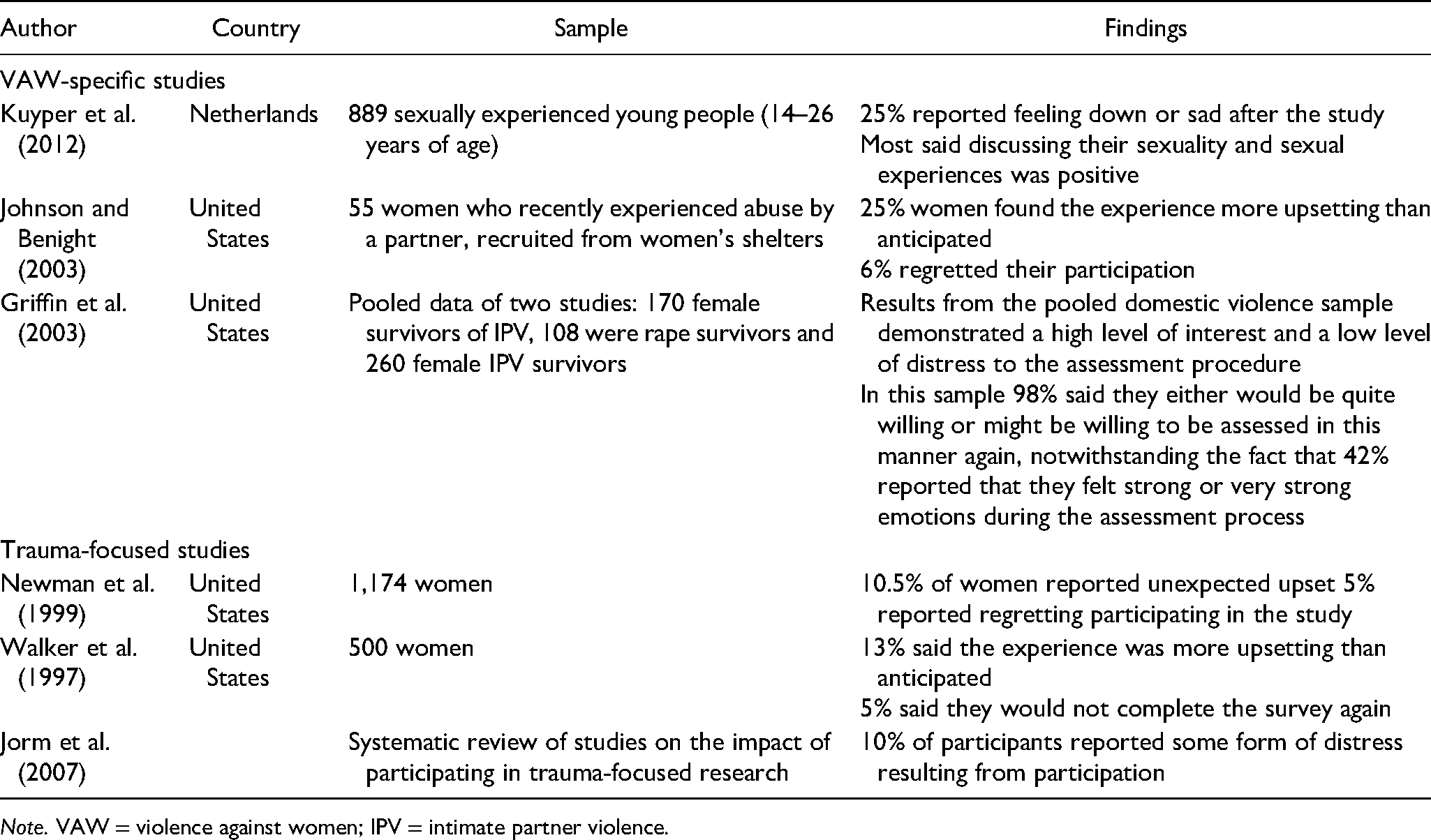
Given the potential for emotional harm of such research on participants (Black et al., 2006), ethical review boards closely examine VAW research protocols for safety risks (Savell et al., 2006). Yet, the ethics of asking sensitive questions during research are not well studied (Deprince & Freyd, 2006). There is little or no research on the potential physical harms that may be experienced by participants, arising from their participation in sensitive research. Available research focuses mostly on the psychological impact (Jorm et al., 2007), and findings varying from study to study. The emotional impacts reported by participants when asked about sexual abuse and IPV are summarized in Table 1.
Participants' Reports of Emotional Impact When Asked About Abuse and Violence.
Note. VAW = violence against women; IPV = intimate partner violence.
Interpreting these results is difficult. Although it is clear being asked about violence can cause distress, it is not clear that such research poses more than a minimal risk of emotional harm for participants (Jorm et al., 2007; Newman et al., 1999). Further, where this distress exists, it is unclear whether it dissipates quickly or persists over time (Jorm et al., 2007; Kuyper et al., 2012).
As researchers in this field, we do not have a shared operational definition of what we mean by emotional harm or distress, nor how to measure its severity. There is a paucity of literature on the lasting nature of the distress should it occur at more than minimal risk to participants (Kuyper et al., 2012). Further, a number of studies report women describing being asked about violence in a research context as cathartic and beneficial, and that it was the first time someone had asked them to share their stories (Ellsberg & Heise, 2002; McClinton Appollis et al., 2014).
However, we do know how to minimize the risk of emotional harm to women being asked questions about violence. This is particularly important when unprecedented levels of global attention on levels of VAW (especially during the COVID-19 pandemic) has increased demand for epidemiological research on VAW to develop more responsive and effective services and programs and to inform funding (Namy & Dartnall, 2020). To maximize the safety and protection of research participants in VAW studies, they need careful preparation and should follow international ethical guidelines, which recommend the following:
Ensuring information provided by participants is kept confidential. Ensuring all personal information is removed from data sets. Planning for potential for emotional distress and strategies identified and implemented to minimize emotional distress. Providing emotional first aid and professional support to participants who demonstrate distress because of questions asked (WHO, 2001).
VAW research that is not ethical, methodologically sound, and does not take into account the sensitivity of the issue can result in an underestimation or overestimation of levels of violence. In turn, this can result in poor policy decisions and, of course, a waste of precious research, program and policy resources and survivors' time.
The follow-up study described in this paper was designed to build an understanding of the impact of asking questions about these sensitive topics, and to investigate if any unintended—and possibly dangerous or negative—consequences arose from asking about these topics as part of such a large-scale survey, in which all eligible dwelling members were asked the same questions. 1 This paper is therefore an important step in filling the information gap—helping to build a better understanding of the emotional and other risks of engaging in research on violence when asking both men and women in the same household the same questions.
Methods
In 2019, the IDM South Africa Country Study, was undertaken, which included a national-level survey (collecting quantitative data), and the qualitative follow-up study, described in this paper, which took place around 1 month after the main survey. The follow-up study was part of a suite of research designed to further develop and refine the IDM, and was undertaken with a small number of respondents who, during the main study, had agreed to be contacted following their participation in the main survey.
Ethics approval for the IDM Program was from the Australian National University Human Research Ethics Committee. 2 Ethics approvals specifically for the South African Country Study were from the South African Human Sciences Research Council Research Ethics Committee and the Limpopo Provincial Research Ethics Committee. 3 The South African follow-up study sought and gained the approval from the South African Medical Research Council's Human Research Ethics Committee. 4
The strategy for the main survey was to interview all eligible and consenting individuals in the sampled dwelling, and the same questionnaire was used for all individuals (thus each survey respondent would know the questions other individuals had been asked, but would not know their answers). Each individual survey was conducted one-on-one, in private, by an enumerator of the same gender as the respondent, and in their preferred language. Informed consent for participation in the individual survey was obtained verbally by enumerators, and additional, or secondary consent was also sought (and received) before each series of questions on violence and lack of personal decision making were asked. If the secondary consent was refused, these series of questions were skipped.
The questions regarding violence in the individual survey tool asked whether the respondent had experienced psychological, physical, aggravated physical, and/or sexual violence in 12 months prior to the survey. To maximize the safety of respondents, no questions regarding the perpetrator or location of any violent experience were asked to any respondent. Such questions were seen to pose too high a risk, especially to respondents who experience violence within the home (see Suich et al., 2020) for the data reporting implications of this in South Africa.
The questions in the individual survey tool regarding personal control over decision making asked whether the respondent had been prevented by someone within the dwelling from a range of activities, including seeking education or training, health care, work or income generating activities, or being allowed to socialize.
The research protocol for the follow-up study was designed to identify any unintended (negative) consequences of asking these questions during the IDM individual survey. Two interview guides were developed for use with two “types” of participants 5 in the follow-up study. Interview Guide 1 (IG1) was designed for use with survey respondents who had reported experience(s) of violence and/or issues of personal control over decision making in 12 months prior to the main survey. Interview Guide 2 (IG2) was designed for use with survey respondents who lived in the same community as the individuals selected for IG1, but had not reported experience(s) of violence or issues of control.
The separate interview guides for the two types of participants were designed to mask the selection of individuals who had reported experiencing violence or a lack of personal control over decision making, and to de-emphasize the focus of the research on violence and issues of control. This was felt to be particularly important because in many communities, household members and neighbors may be aware of violence within the home.
For the topics regarding violence and personal control over decision making, the two interview guides asked different questions about different aspects of these topics. Both interview guides also contained questions about less-sensitive topics in the main survey, which were added for several reasons. Their inclusion enabled interviewers to build rapport with the participants before broaching questions on the most sensitive topics of violence and lack of control over decision making. These additional topics were also added to provide participants with a range of topics they could discuss with their household members, neighbors, and/or community members if they were asked about the content of the interview, so they did not have to reveal being asked about their experiences of violence. Although fulfilling these roles, the questions were also designed to collect additional qualitative data that would be useful in further strengthening the design of the survey tool.
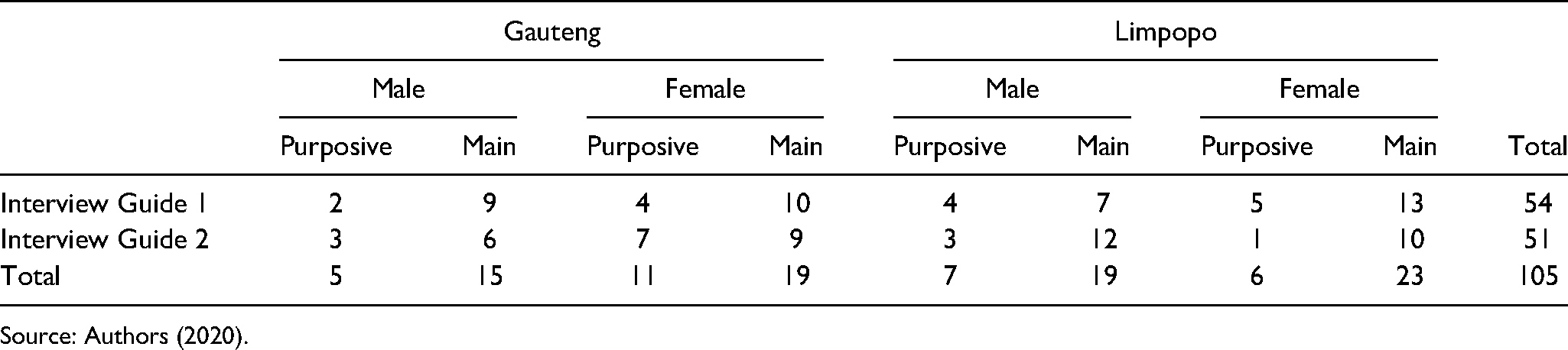
The IDM survey in South Africa had two samples—a national-level sample and a purposive sample of people with disabilities (and their household members), which was implemented in Gauteng and Limpopo provinces. The follow-up study was also undertaken in Gauteng and Limpopo provinces to ensure rural and urban representation, and its participants were selected from both of the samples. The number of participants interviewed using each interview guide, by gender and the sample they were drawn from are shown in Table 2.
Participants Interviewed, by Interview Guide and Sample Selected From
Source: Authors (2020).
A list of potential participants and their contact details was delivered by email to the field team weekly. The individuals on the list were selected using several criteria: (1) they lived in Gauteng or Limpopo provinces; (2) they had participated in an individual interview in the IDM main survey; (3) they had consented to be contacted in future for the purposes of the follow-up study; and (4) they were 18 years or older.
Additional criteria were used to select potential participants for each of the two interview guides. The criteria for IG1 were: (1) individuals had reported experience(s) of violence in the 12 months prior to the survey and (2) if selected from the purposive sample, individuals were classified as having a disability, in order to improve understanding of the potential multiple vulnerabilities of those with disabilities and experiencing violence. The categorization of individuals with a disability was based on the use of the Washington Group on Disability Short Set of Questions in the main survey (WGDS, ud), and the respondent had answered that they had a lot of difficulty or could not function at all in at least 1 of 6 domains asked about.
For potential participants for IG2, the criteria were: (1) individuals lived in the same enumeration area and relatively close to the individuals selected for IG1 and (2) they had not reported experience(s) of violence.
Care was taken to ensure that only one individual from each dwelling was selected to be approached to participate in the follow-up study, and that there was a balance of participants interviewed using IG1 and IG2 in each community. Finally, more women than men were targeted for interview, based on the assumption that higher proportions of women are at greater risk of violence within the home, and would thus be more likely to experience negative unintended consequences of participating in the IDM main survey.
Follow-up Interviews With Participants
All individuals on the weekly list of potential participants were contacted by trained research assistants (RAs) and asked if they were still willing and available for an interview. Interviews were then scheduled with those who indicated availability and willingness to participate. A day before the scheduled interview, RAs would call participants to remind them about the appointment.
The field team comprised two men and four women RAs who between them spoke the dominant (official) languages of Gauteng and Limpopo provinces: isiZulu, Sepedi, Setswana, Xitsonga, TshiVenda, and English. The RAs worked in pairs when visiting the households for interviews. The primary reason for the pairing was to enhance the RAs' safety and to ensure that when one RA conducted the interview, the other engaged other people or person(s) in the household (Ellsberg et al., 2001). To conduct interviews, RAs were matched with participants by gender (i.e., male RAs only interviewed male participants) and by participants' preferred language.
Four out of six RAs had prior experience of working in studies asking about interpersonal violence. Before conducting the interviews, the RAs undertook an intense 5-day training on conducting violence focused research. In the training, the RAs were provided with information on the background and objectives of the study, trained on the methodology and data gathering tools and on self-care and how to reduce risk for vicarious trauma for researchers. They also received specific training on ethics of interviewing persons with disability, which was given by a global expert researcher on researching VAW and disability. Moreover, questions in both interview guides were reviewed to ensure that RAs understood each question and what was being asked. Last, the RAs were trained on how and when to use IG1 and IG2.
At the beginning of each interview, written informed consent was sought (and interviews proceeded only if it was given), as was permission to audio record the interviews for later transcription and translation. If permission for recording the interview was denied, the RAs politely explained that the interview could not continue. Once the interview commenced, to build rapport, questions were phased in, starting with more general topics before asking questions about the more sensitive topics of violence and control over personal decision making. Moreover, RAs first primed the participants before moving to the next topic by describing briefly what the subsequent series of questions were about.
We conducted 105 in-depth follow-up interviews with adult respondents of the IDM main survey in Limpopo and Gauteng provinces (see Table 2), typically between 7 and 21 days after they participated in the main survey.
To safeguard interview confidentiality, the RAs ensured that no one above the age of 2 years was close enough to hear what was being discussed in the interview. When it was not possible to have privacy or when an adult person refused to leave the room because they were curious to hear what the interview was about, the RAs ended the interview. Where possible, these interviews were re-scheduled for a time when the interview could be conducted in privacy, and where this was not possible, alternative participants were sought.
Information sheets were provided to all respondents in the IDM survey and all participants in the follow-up study. These provided provincial-level contact details—toll-free telephone numbers where available—of provincial service providers, including those dealing with gender-based violence, elder and child abuse, services for refugees, people with disabilities, physical and mental health services, etc. The decision to provide information about a wide range of services and to provide the information to all survey respondents was taken to ensure that attention was not drawn to those individuals who required or requested any specific forms of assistance—particularly services for victims of violence—from survey enumerators. Additionally, participants were informed that if they require the assistance of the study researchers for referral to a professional service, they should contact the study project manager who will facilitate their referral to a local public service for professional help.
To ensure the de-identification of participants, upon completion of the in-depth interviews, personal details of the participants were permanently deleted from the emails and study folders in the researchers' computers. All names used in the presentation of results below are pseudonyms.
Data Analysis
All audio-recorded interviews were translated into English and transcribed verbatim by the same RAs who conducted them. Data were analyzed inductively using thematic analysis (Braun & Clarke, 2006). However, there were deductive elements to our analysis as we explored themes that were related to violence and control over personal decision making.
YS and PM read the transcripts repeatedly, and developed the initial analysis codes based on the two interview guides (IG1 and IG2) and phrases representing segments of the text in the transcript. When there were conflicting codes, they discussed this until they agreed on the appropriate code as supported by the data. YS and PM used the codes to develop a codebook. Following this stage, the YS and PM reviewed and tested the applicability of the codebook using the raw data from the transcripts, which led to expansion of codes. Next, text that seemed to fit together was grouped together under a specific code (Nowell et al., 2017).
Further to this, YS and PM explored the data and identified numerous open codes. Similar open codes were grouped together under defined categories (Nowell et al., 2017). Next, all authors explored the relationships between the categories and interpreted what they saw emerging (Braun & Clarke, 2006).
Results
The results presented below focus only on those parts of the follow-up study that investigated the topics of violence and personal control over decision making. These results emphasize the content of interviews using IG1, as they reflect the responses of individual men and women who had reported experiences of violence in the IDM individual survey. Important differences in responses between subgroups (e.g., between men and women, or between those with and without disabilities) are noted throughout. Where such differences have not been explicitly described this is because the views of different subgroups appear not to differ.
The results are organized into two sections dealing first with violence and separately with control over personal decision making. For violence, subthemes included recall about being asked about violence in the survey, the emotional impact of being asked about violence, experiences of violence since the survey, and participants' preferred method of being asked about violence. The second theme of control over personal decision-making deals with autonomy and decision making at home.
Violence
During the follow-up interviews, some participants (male and female) volunteered information about the violence they had experienced, though they were not asked specifically about these details. There were clear differences in terms of the type of violence that was experienced by men and women. Men said that the violence they experienced almost always occurred in public spaces and rarely at home, for example, being mugged by men they did not know or insulted and threatened by neighbors. In contrast, almost all of the women described violence they experienced as having occurred in the home, and mostly perpetrated by male partners and other members of the family.
A preliminary analysis and stakeholder consultations suggest that data collected in the main survey were likely to measure very different types of violence experienced by men and women (as indicated above), and should therefore not be reported to ensure that they are not equated in analysis. However, the prevalence of violence in South Africa is very high, with women (Machisa et al., 2011) and men (Van Niekerk et al., 2015) reporting experiences of violence in their lifetime.
Recall About Being Asked About Violence in the Survey
All participants (both IG1 and IG2) were asked if they recalled being asked about their experiences of violence during the individual survey—if they had experienced psychological, physical, aggravated physical, and/or sexual violence, and if yes, the frequency of those experiences.
All participants responding to IG2 were asked about violence as they had provided answers to these questions in the individual survey. However, they were all participants who had reported not experiencing any violence, and interestingly, were unable to remember the violence questions from the main survey. Thabang's response in his interview evidences this, and is typical of both male and female participants who did not report experiencing violence: “Uhmm… No, I can’t even remember that… Yoohh… I don’t think they asked me that” (Thabang IG2, male).
However, participants who reported having experienced violence in the individual survey were typically able to recall being asked about these experiences during the follow-up interviews (i.e., those responding to IG1). There were no apparent gender differences in this group; both male and female participants could remember. These narratives indicate a link between recall and prior exposure and experience of violence, as exemplified by Precious, who when asked if she could remember being asked the survey questions about violence said “yes, because I experienced some form of violence” (Precious, IG1, female).
Emotional Impact of Being Asked About Violence
We explored how participants who reported experience of violence in the main survey (IG1) felt about being asked about these experiences. Women were more likely than men to report some discomfort in response to being asked about violence. Five of the 32 female participants who had reported violence said that being asked about their experiences resurfaced painful memories. Kgalalelo's and Prudence's statements are illustrative:
What I can say is that it reminded me of what happened in the past … It was painful things and I had forgotten about what happed, but being asked those questions brought back the pain (Kgalalelo IG1, female).
I was emotional … and I really cried, and she [the RA] gave me an ear and … I felt relieved. (Prudence IG1, female).
Several female participants who had or were still experiencing violence at the time of the IDM survey appreciated the opportunity to be listened to and be heard by someone who appeared to be caring about their circumstances:
I felt good because I was asked if someone has violated me before, whether emotional, physical and otherwise. That has opened my eyes that if one experiences such, the person needs to speak out and not keep quiet. You need not to be afraid because you are scared that the person will kill you or hurt you, but you need to report abuse to the police or social workers so that you can get some help (Johanna IG1, female, purposive).
Both male and female participants who reported experiences of violence in the main survey were prepared to talk about their experiences, because they felt the topic was an important aspect of life and because it was necessary in order to be protected.
These are things that are happening around our community, so we must talk about it (Edmond IG1, male).
I felt like that’s [being asked about violence] exactly what needed to happen for us people living with disability to be protected (Jessica IG2, female).
Bakhona's narrative also supports the contention that while initially nervous this did not mean he did not want to talk about violence:
Violence, neh. At first, I was shy, because violence is not that much here. The only violence that we experience here is a verbal one, to a point where people here will insult or mock you about your sickness. That’s the most violence I get from around here. Because I have epilepsy, and that makes me not to enjoy and withdraw from people because, even if we are just chilling here in the house, you will hear people start making fun about me saying, oohh is this one who has epilepsy, who always falls, who gets pension money [a government/social grant], who has fits, things like that. And you find that whoever is saying that, he or she just speaks loud so that everyone can hear them, and that thing hurts me so much my brother. I can put it in this way, that is the kind of violence I get here (Bakhona IG1, male).
These narratives show that most participants—both women and men—did not find the questions about their experience of violence inappropriate. Instead, they appreciated the research process and felt supported in their pain by the interviewer.
Experiences of Violence Since Survey Participation
There were two participants who reported experiencing violence in the period between the survey and the follow-up study, both of which were verbal abuse and aggression, not physical or sexual violence. Palesa's experience of violence was not related to survey participation:
I had borrowed someone [lent] my charger so now when I went to take it back, [but] they just swore at me, then my mother said I must no longer respond I must leave them … my mother and I don’t talk to them anymore, and they also don’t talk to us anymore, even if we bump into each other on the streets they don’t talk to me (Palesa IG1, female).
However, Bongiwe reported that she was interrogated by community members for allowing survey enumerators to come into her house, and for giving them information. In her own words:
Yes, after the survey I did experience some violence [aggressive questioning] from community members I was questioned why I allowed people that I don’t know to come into my house and why did I give them some information (Bongiwe IG1, female).
However, she consented to another interview as part of the follow-up study, and her willingness to do so may indicate that she felt there were no significant or long-lasting negative repercussions. Further, Bongiwe's participation in the main survey seems to have taken place during campaigning for the 2019 presidential election, and tensions in some communities were heightened during this time. In some locations across the country, survey implementation was halted in the lead up to the election because of such tensions in communities, and not wanting enumerators to be thought of by community members as campaigners for political parties, potentially threatening their safety.
Preferred Method of Being Asked Violence Questions
All participants were asked if there was anything in the way the questions were asked that might have discouraged people from reporting their experiences of violence in the main survey (IG1 and IG2). Most participants stated that they believed the way questions about experiences of violence were framed and asked were suitable. They reported that, for them personally, the way the questions were asked did not discourage reporting of these experiences: “The way they [survey enumerators] asked doesn’t make someone feel discouraged” (Masego IG1, male), a sentiment shared by Rosario: “no, I didn’t feel there was a problem [with the way the questions were asked]” (Rorisang IG1, female). Our analysis did not reveal any gender differences in these feelings.
However, there were a small minority who felt that it is not a good idea to interview all members of the household about their experiences of violence:
No, I don’t think it is okay because it is going to get personal and it is going to cause more fights (Prudence IG1, female).
While Prudence expressed this concern, it was not clear from the interview if this was true for her family.
Most participants felt it appropriate to ask all members in the household about their experiences of violence, as doing so gives everyone an opportunity to share their lived experience. Participants recognized that people living in the same household have different experiences and views, so it is important to ask everyone. The following quotes from Pule and Bina are illustrative:
It is appropriate my friend because everyone’s opinion is valuable rather than just getting my opinion only (Pule IG1, male).
Yes [it is appropriate to ask everyone here at home]. Ehmm, if it’s that violence whereby maybe I am being beaten by a man, the children also see it, that means, if there’s somebody coming to investigate, they can also ask the children about how we live here at home (Bina IG1, female).
During the interviews, participants were asked if they had any concerns about the confidentiality of the information they were providing. One woman told the interviewer that she was not candid in answering the survey questions because she saw that the survey enumerators were walking around with a Community Policing Forum (CPF) member that she knew, and was worried that the enumerator may share what she reported in the survey with the CPF member. 6 Despite her concern, she did report having experienced violence during the survey. No other participant indicated that they had any concerns or had not thought about the potential for confidentiality breach:
I didn’t take it that someone might be hearing me or not…I took it as I am answering what is true and what is happening and if someone takes it somewhere, I will be telling the truth and be safe (Khuthadzo IG1, male).
I just told myself that I don’t really know this person so I don’t think she will take this information and share it with my neighbours or my uncle would come to me and say I hear this person say this and this (Magda IG1, female).
Several participants said they understood that it was research and that the information will be used for research purposes, as illustrated by Bina: “No, I didn’t have a problem, because all I want is to help only, if I am able to tell people that will research about it, and see what they can do. If the community is like this, they are crying for help about such things, how can we help them, it’s not only helping me alone” (Bina, IG1, female).
Finally, participants were asked if there was any alternative method of asking these questions that would be better (e.g., listening to a recording of the questions using headphones and responding directly on the enumerator’s digital device, writing their answers with pen and paper and enclosing the response sheet in an envelope). A majority preferred the question and answer format with enumerators, with particular reservations expressed with respect to completing forms, particularly by those individuals who could not read or write. There were no gender differences in how participants preferred to be asked violence questions, nor any differences in preferences between those with and without disabilities, or those who responded to IG1 and IG2.
Personal Control Over Decision Making
Decision Making at Home
In the main survey, respondents were asked about whether they had control over personal decision making, or if they had been prevented from making their own decisions, including about meeting with family and friends, choosing to work or study, seeking health care or buying things for the household. Very few respondents reported that they had been prevented from doing any of these activities (fewer than 4% of all respondents reporting control over any of these decisions, except for spending money on household expenditures, which was 6%) (Suich et al., 2020).
The majority of the participants said they had never experienced someone else exerting control over their decision making, and there were no gender differences in these results. Most participants reported that neither their movements nor what they said were controlled by others. As Jane so eloquently asserts, not allowing someone to express their views about something “… [it is] abuse and it’s not right being stopped from expressing yourself” (Jane IG1, female). The participants asserted that they were not prevented to go to school, go to hospitals, or visit friends. For example, Mpho posited:
No, I do things for myself and I do them the way I want. I go to town and also get my grant. No one is controlling me (Mpho IG1, female).
However, the few participants who reported that they lacked control over their personal decision making were women, often those living with disabilities:
Yes, it’s like the homes we come from, there are different kind of treatments, when you are disabled and when you are not disabled, your parents are not disabled they will not treat you the same, us as disabled we are not treated the same way as those who are not disabled. That’s the reason why we left home to come and stay with those who are disabled like us, because staying with someone who is not disabled it’s like being fooled, and more especially if it’s your parent who is discriminating you and when you look at it from the side the income is yours, it’s better you see, to leave and go stay aside (Kelebogile IG2, female).
When asked in the interviews how they felt about this, they described it as discrimination that is perpetrated mainly by their family members or people close to them. For example, Nyakalo described instances where she had, in the past, been prevented from doing things she wanted to do:
While we are still staying at home, it [being controlled] happens … I do go home but, eish, I left because of such things, that’s what makes me to be here, I do go home because home is home … But here where I am, I am not stopped from anything because I stay in a room, for some time, I can’t be stopped by anyone (Nyakalo IG1, female).
Busi also described the multiple ways in which her control over decision making was taken from her:
Being stopped can actually manifest in many ways. For example, like me in this house, they do not appreciate, whatever you do, they will make you feel pain so that you can stop or until you stop, you see … Like with them they feel that they can tell you what you need to do or not to do … Yes, they would treat me like I am a child or I am foolish, you understand … Even with friends, my mother used to choose friends for me, she did not like some of my friends. Even clothes, she would be complaining and asking how are you wearing, women are supposed to wear this and that. She would want to influence whatever thing I do…And if I don’t do as she says she would be angry with me, acting more like a control freak (Busi IG2, female).
Two forms of lacking control were identified by one respondent, the first being not having permission to do certain activities, and the second being not having the opportunity:
Haaa, I was prevented before he was injured [her husband is no longer able to walk or work] … Haaa, now, he knows that even if he doesn’t, even if he prevents me, how will I go to work even if I want to work, because will I leave him like this? Ahhh, when he came back from work, it would be a fight because it also included being overprotective, it’s like when you go to work you have men … There was no permission I would be given even if I had asked, so I had given up that I don’t even start it because if I start it, it will be a fight (Rorisang, IG1, female).
In general—that is, not referring to the individual respondent's specific situation—approximately half of the respondents felt that the household head should be the decision maker, including several who felt an age-based hierarchy should be observed in decision making, particularly with respect to parents making decisions for their children (albeit with some degree of consultation with the children, depending on their age and developmental capacity).
The remainder preferred family members to sit together and take decisions jointly, and though a few participants said decision makers in the home should be men (i.e., fathers), the majority of female participants disagreed with this view, arguing that decision making should not be based on gender: “I don’t think it [gender] matters, because we are a family, so if we take decisions based on gender then it means we are discriminating” (Kim IG2, female). Several married men also agreed, emphasizing that decision making in the home should involve both a husband and a wife.
Discussion
Experiences of violence were reported by both men and women during the main survey, and information from this study indicates that the types of violence experienced differed according to the gender of the participants. Men who reported violent experiences indicated that the violence they experienced was “public” violence, mainly perpetrated by men not known to them, or men known to them but outside their family. Yet, for women, the violence they experienced was chiefly perpetrated by male spouses or male relatives, with the violence occurring at home. These findings are in keeping with existing literature from South Africa and other parts of the world. Women are disproportionately affected by IPV and domestic violence (García-Moreno et al., 2005; Machisa et al., 2011; Stats SA, 2018), and in South Africa, men experience very high levels of violence, yet this violence is likely to be perpetrated by other men, and occurring outside the home (van Niekerk et al., 2015).
Human Research Ethics Committees, Institutional Review Boards and researchers have long appraised VAW as a sensitive topic warranting special protections for women who participate in such studies (Fontes, 2004), with concerns regarding potential physical and psychological harm that participants could potentially experience from their participation. In this study a majority of participants reported no discomfort or emotional upset from being asked about violence. This finding reaffirms other literature from South Africa and elsewhere (García-Moreno et al., 2005; McClinton Appollis et al., 2014).
However, a number of female participants (who had reported experience of violence) did state that being asked about their experiences resurfaced painful memories. We contend that this should not be interpreted as meaning that these women found being asked about their exposure to violence to be harmful or deleterious (Kuyper et al., 2012), because participants also reported that they appreciated the rare opportunity to be listened to, and be heard, by someone who demonstrated interest in them and appeared to care about what they went through. A mounting body of evidence supports this finding (Ellsberg & Heise, 2002; García-Moreno et al., 2005). Further, participants generally understood the importance of being asked these questions, even when they found talking about their violent experiences difficult, because it is happening in their community and such discussions are necessary to protect those experiencing violence. Others also felt the discussions were educational, highlighting the importance of reporting the abuse to the authorities and accessing services and support.
We have presented a salient finding showing that we did not find any evidence that the approach of surveying every eligible individual in the dwelling resulted in any form of harm for the survey participants, at the time of the follow-up interviews (a maximum of 21 days after the main survey). As described above, the survey did cause an unpleasant interaction between Bongiwe and her community members. That she was willing to be interviewed by the follow-up team may suggest the severity of this interaction was relatively mild and had no long-lasting negative repercussions for her. The 2018 follow-up study in Indonesia also found that survey respondents had not experienced any violence or controlling behaviors as a result of participating in the Indonesian IDM survey (Siagan et al., 2020).
This finding partially contradicts the common view from Southern African researchers who have argued that violent reprisals are likely to happen when third parties know or suspect that their female partners were interviewed about their violence experiences (Jewkes & Wagman, 2007; Jewkes et al., 2000; Wasunna, 2007). Notwithstanding, it is critical to underscore that a small number of female participants in our sample opined that the approach of interviewing everyone in the household was worrisome because it could potentially lead to fights in the household. Another South African study also found that some women remained fearful after completing a survey on VAW, concerned about the potential physical harm that could result as reprisal if their male partners were to know that they participated in such a survey (Sikweyiya & Jewkes, 2012).
This study also sheds new light on how South African men perceive being asked in surveys about their experiences of violence. In this paper, we have shown that the men who had reported experiences of violence felt it reasonable to be asked about such experiences in the main survey. This is a significant finding considering that rarely do violence-focused studies explore how men feel about being asked about their experiences as victims of violence (Sikweyiya et al., 2007), such data as is typically reported relies on police reports and official crime statistics.
The data did not allow us to explore fully whether the severity of the violence experienced by men and women had a particular effect on their emotional reaction to survey questions on violence experiences'. Future studies would do well to explore this question.
Best Practice
There is a widely accepted view that in population-based household surveys, researchers should not interview both men and women in the same household about issues of VAW (Ellsberg et al., 2001; WHO, 2001). This approach is considered essential as a measure for protecting female participants from potential violent reprisal from third parties, including male spouses (Ellsberg & Heise, 2002; García-Moreno et al., 2005). The design of the IDM survey was to interview every eligible individual in the sampled dwelling. Thus, following guidance from experts, the survey asked only about experiences of different types of violence and their frequency, but did not ask about either the perpetrator or location of the violent experiences.
As noted above, we did not find evidence of harm among participants who had experienced violence within the home by asking the survey questions about experiences of violence. This finding may have been influenced by the decision not to ask any questions about perpetrator or location in the main survey, a decision taken with the explicit intention of minimizing risks to those experiencing violence in the home (Hunt et al., 2017). The authors support this decision, and suggest best practice should remain so that no questions about the perpetrator or location of violence are included in surveys when the sampling strategy includes interviewing more than one person per household or dwelling.
The findings of this study also suggest that most participants interviewed felt it was appropriate to interview everyone in the household about their experiences of violence, as it provides all eligible individuals with an opportunity to share their personal experiences. However, the lack of information regarding perpetrator and location does raise questions about the policy-relevance of the data collected, particularly in relation to the different types of violence being faced by men and women. This then raises the question of the value of collecting such data—it does not enable the comparison of experiences of violence between men and women, because they are typically not the same. This question has been answered within the IDM Program to date by the decision not to collect any data on experience of violence in any further iterations of the IDM individual survey.
Research Agenda
Although concerns about the confidentiality of information collected was expressed by only one participant, such a concern was raised, which provides insight into the tradeoff of the relative comfort of survey respondents confiding in outsiders about deeply personal information, with practical issues of survey enumeration—in this case the need for local people to act as guides to ensure enumerator safety. This individual reported that she was not candid in her responses during the survey, but she did report experiencing violence, so even if the prevalence of this behavior is low, the effects on the accuracy of the data collected are unknown. Further research would be necessary to fully understand the implications of confidentiality concerns for the accuracy of data collected with respect to experiences of violence.
These findings demonstrated a link between the ability to recall (up to 3 weeks after the main survey) being asked about violence in the main survey and reporting experience of violence during the main survey—those who did not report any experience of violence during the main survey could not remember being asked questions about such experiences after the survey, whereas those who reported experience of violence could remember these survey questions. This may be explained by the fact that people who have experienced trauma or violence may recall the incident and or revisit those experiences when asked about them in surveys and may continue to reflect on the questions and their experiences for some time after the survey. Further research will be necessary to understand this issue better, and to deepen understanding of any long-term impacts of participating in violence-focused population-based surveys, especially for women.
Although few individuals reported lacking control over personal decision making in the main survey, it was recognized by respondents in the follow-up study as a form of abuse, and those who experienced a lack of control tended to be women, especially those living with disabilities. Male relatives were identified as exercizing controlling behavior, though several participants noted that it was female relatives (their mother or aunts) who prevented them from doing certain activities (Meer & Combrinck, 2017). One respondent also identified two types of lack of control—one relating to not having permission from others in the household to do certain activities (the type the study was investigating), and the second being circumstances meaning that an individual has no opportunity to do certain activities, for example, when a family member is incapacitated and cannot be left alone. Further research on this issue, and the way power is exercized within households would contribute to the improvement of the IDM survey questions in particular, and to the more effective measurement of issues of control and coercion within the home in general.
There are some implications for the human participants research ethics field, in relation to informed consent, that can be derived from the finding that few individuals reported a lack of control over personal decisions. First, this finding suggests that many of the participants in the follow-up study were able to freely and voluntarily give consent to participate in the research without needing to first obtain permission from other people. On the other hand, this finding adds to mounting evidence that some women—especially those with controlling or violent partners, and people living with disability—are a vulnerable group in research and need careful and sensitive approach when enrolling them in surveys or other studies (Fontes, 2004). This is a topic that would benefit from further research to learn how women and people living with disability in patriarchal societies can be safely enrolled in community-based studies without predisposing them to the risk of harm by third parties.
As noted in the methods section, information sheets providing contact details for a range of services were provided to all survey respondents and all participants in the follow-up study. Future studies would do well to explore whether the information on referral services provided to participants is useful (Devries et al., 2015). This understanding is essential because service referrals are considered an important measure for enhancing the wellbeing of participants in research focusing on personal and sensitive topics.
Owing to the pervasiveness of violence in South Africa, it is likely that some of the RAs in the follow-up study may have been survivors of violence, and thus conducting the interviews may have caused them to relive those experiences. To mitigate the potential harm of this work on their mental health, the RAs had access to the wellness program which offers three sessions with a therapist and available for free to all employees at the (South African Medical Research Council). Moreover, PM held debriefing sessions once a week with the RAs where she encouraged them to speak about their fieldwork experiences including how conducting the interviews was affecting them emotionally.
Education Implications
These results are of particular relevance to funding agencies and researchers involved in research about violence and highlight the importance of building a more nuanced understanding of the impact of research on participants (see also Dennis, 2014). Of particular importance is the lack of evidence from this study of unintended negative consequences from the approach taken by the IDM, and the broad recognition of participants of the importance of asking about the experiences of all members of the sampled household/dwelling. However, for the safety of both respondents and field workers, researchers should not ask about perpetrator or location in research regarding violence when sampling more than one individual in a household/dwelling, which raises questions regarding the usefulness of data collected.
Footnotes
Acknowledgements
The authors are thankful to the participants who shared their views and experiences with them. The first author acknowledges the Fogarty International Center and the National Institutes of Health for the training he received on research ethics through the South African Research Ethics Training Initiative (SARETI).
Author contributions
Y.S., P.M., E.D., and H.S. worked on the conceptualization of this study. Y.S., P.M., E.D., and H.S. contributed to the formal analysis of this study. Y.S., E.D., and H.S. contributed to the funding acquisition of this study. Y.S., P.M., E.D., and H.S. designed the methodology of this study. P.M. and Y.S. carried out the project administration of this study. Y.S., P.M., E.D., and H.S. contributed to the writing and drafting of the original manuscript. All authors read and approved the final manuscript.
Declaration of Conflicting Interests
The authors declared no potential conflicts of interest with respect to the research, authorship, and/or publication of this article.
Funding
The authors disclosed receipt of the following financial support for the research, authorship, and/or publication of this article: This work was supported by the Australian National University, the International Women’s Development Agency, and the Australian Government, through the Department of Foreign Affairs and Trade.
