




Abstract
Objective:
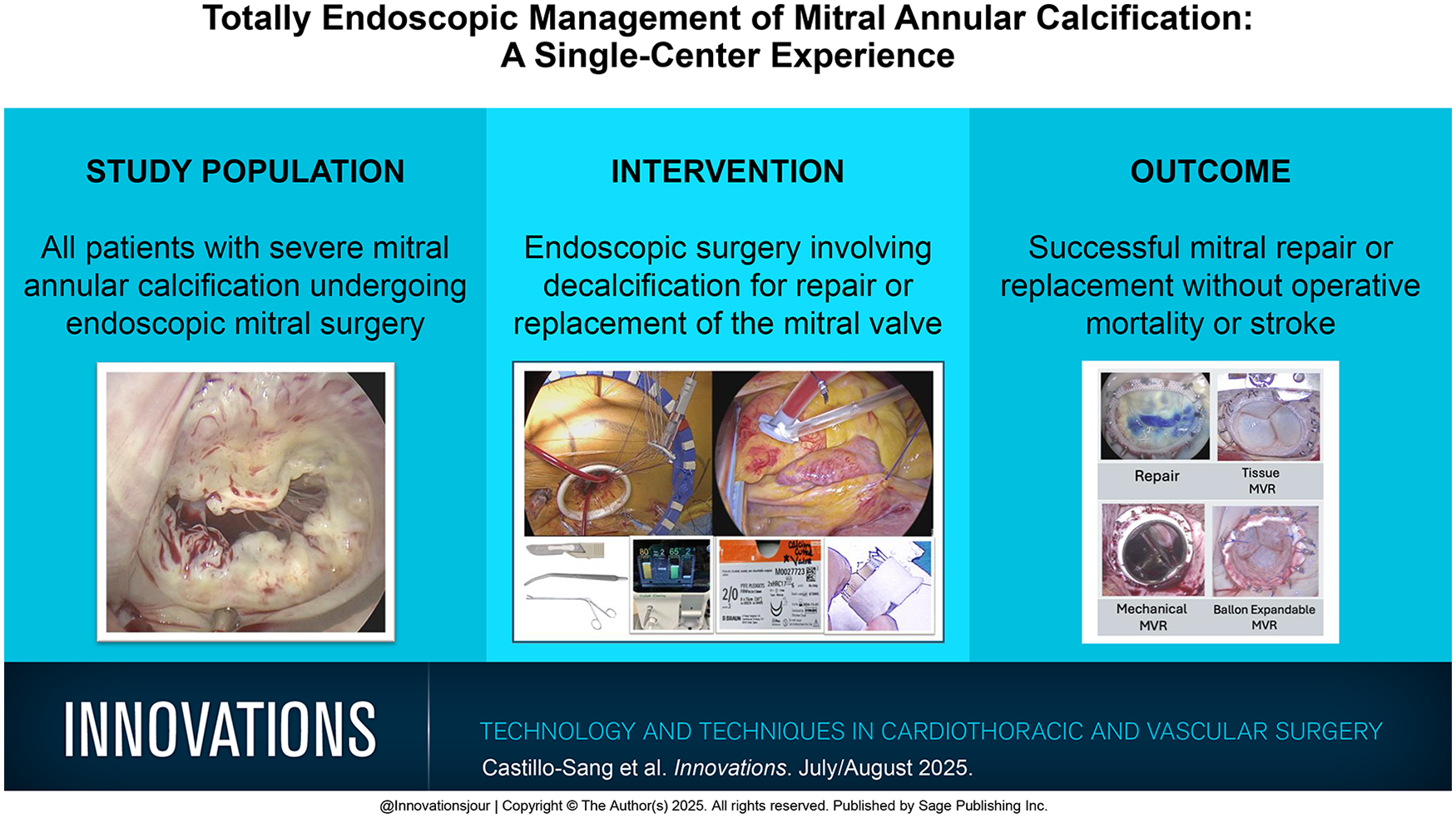
Minimally invasive surgery for mitral annular calcification (MAC) has been reported sporadically, but data on endoscopic surgery are scarce. We summarize current surgical understanding of MAC and how it applies to endoscopic surgery through our experience.
Methods:
All patients with severe MAC undergoing endoscopic mitral surgery at a single institution (December 2020 to August 2024) were studied.
Results:
Twenty-five patients (3 female patients) with an average left ventricular ejection fraction of 52.12% (46.25% to 60%), average age of 69.13 (64 to 75.7) years, average body surface area of 1.92 (1.69 to 2.09) m2, and average Society of Thoracic Surgeons predicted risk of mortality score of 8.30% (2.13% to 8.66%) underwent endoscopic surgery. Twelve patients had regurgitation (48%), 10 had stenosis (48%), and 3 had a combination (12%). Circumferential MAC was found in 4 patients (16%), 80% circumference in 7 (28%), 60% circumference in 7 (28%), and 40% circumference in 7 (28%). Mitral valve replacement was done in 72% (n = 18) with tissue valves (n = 11), mechanical valves (n = 4), or transcatheter balloon-expandable valves (n = 3). Seven patients (28%) had repairs. There were no operative deaths, atrioventricular complications, or strokes. The average duration of surgery was 5 h 40 min (4 h 13 min to 8 h 22 min), with average cardiopulmonary bypass and cross-clamp times of 214 (166 to 241) min and 152 (117 to 193) min, respectively. MAC was debrided in 20 patients with ultrasonic emulsification (n = 13) or mechanical debridement (n = 7).
Conclusions:
Endoscopic surgery for severe MAC can be safely and successfully performed using a combination of surgical techniques including ultrasonic decalcification, mechanical debridement, annular patching, and direct implantation of balloon-expandable valves.
Keywords
Get full access to this article
View all access options for this article.
References
Supplementary Material
Please find the following supplemental material available below.
For Open Access articles published under a Creative Commons License, all supplemental material carries the same license as the article it is associated with.
For non-Open Access articles published, all supplemental material carries a non-exclusive license, and permission requests for re-use of supplemental material or any part of supplemental material shall be sent directly to the copyright owner as specified in the copyright notice associated with the article.


