




Abstract
Recent research has been focused on the portrayal of intimate partner homicides in the news media with specific emphasis on the most commonly occurring type, femicides (the murder of a female intimate partner by a male intimate partner). One important finding in the analysis of intimate partner homicide is the striking number of femicides that are followed by perpetrator suicide. Whereas homicide followed by suicide is a rare occurrence in the context of crime generally, within the context of intimate partner homicide, femicide–suicide is common. The present research utilized content analysis to explore the media coverage of a near population of femicide–suicide cases in the North Carolina from 2002 to 2009 (n = 86). An examination of the article titles showed that the majority of titles (54%) assigned to the articles describe the crime as an ambiguous homicide or homicide–suicide and do not indicate the relationship between the perpetrator and victim. In comparison, results show that 78% of the articles’ text defined the homicide–suicide as domestic violence. Specifically, in cases where the news coverage defined the femicide–suicide as domestic violence, the authors identified 4 media frames used (1) femicide–suicide by a male perpetrator, (2) femicide–suicide due to loss of perpetrator control, (3) femicide–suicide as a mercy killing, and (4) femicide–suicide due to jealousy. Implications for societal perceptions of violence against women as well as corresponding victims’ policies/services are presented and discussed.
Research consistently demonstrates that domestic violence is a pervasive public health problem for women (for a review, see Belknap, 2007). In addition, femicide, the killing of woman by a male intimate partner (Dawson & Gartner, 1998), is a leading cause of death for females (Anderson, 2002), with some cases ending in perpetrator suicide (Liem, 2010; Marzuk, Tardiff, & Hirsch, 1992). Despite such evidence, the media consistently portrays domestic violence as an individualized problem instead of a widespread social issue (Bullock & Cubert, 2002; Richards, Gillespie, & Smith, 2011; Taylor, 2009). This is problematic because the news media have the unique ability to choose which “personal” problems are “invested with a broader meaning and made available for public consumption” (Sacco, 1995, p. 142). According to Best (1989), the construction of social issues begins when a private problem is identified and invested with broader meaning for society. The interpretation of such social problems is important at the individual and societal levels. At the personal level, naming a problem assists individuals in understanding their experiences in relation to the experiences of others as well as making decisions on a course of action (Kelly, 1988). At the public level, naming a problem is the first step to the creation of collective resources or policy solutions (Mehrotra, 1999). Consequently, the ways in which the news media choose to frame domestic violence, especially at its deadliest, can have important ramifications, influencing how society perceives the dynamics of such violence, its victims and perpetrators, and most importantly, the public’s role in potential solutions (Gillespie, Richards, Givens, & Smith, 2013).
Femicide–suicide is often the violent culmination of years of male perpetrated domestic violence (Moracco, Runyan, & Butts, 1998). Although recent scholarship has focused on media representations of femicides alone (Bullock & Cubert, 2002; Gillespie et al., 2013; Meyers, 1994; Richards et al., 2011; Taylor, 2009), media representations of femicide–suicides have been largely ignored. This gap in the literature is problematic because it hides the dangers of domestic violence—batterers often devolve to the point where they take their own lives as well as the lives of their female intimate partners. The present study aims to expand our knowledge concerning the media’s representation of femicide–suicide and the media’s impact on the construction of violence against women as a social problem. First, the presentation of homicide–suicide in the news will be reviewed. Second, a brief overview of the social construction of crime and gender will be presented. Next, existing media frames used by journalists to tell the story of domestic violence will be examined. Finally, the present study will build on the past literature by exploring the media frames employed in stories that define the femicide–suicide as domestic violence compared with stories that fail to define the femicide–suicide as domestic violence and discussing how such framing may impact policies concerning violence against women.
Homicide–Suicide in the News
Since no study to date has been focused on how the media frames homicide–suicides, Marzuk et al.’s (1992) typology of homicide–suicides is a useful place to begin this examination. Marzuk et al. identified the four most common types of homicide–suicide based on the relationship between victim and offender: (1) spousal homicide–suicide due to jealousy, (2) spousal homicide–suicide due to declining health, (3) filicide–suicide, and (4) familicide–suicide. As reviewed by Liem (2010), research indicates that the killing of an intimate partner is the most common type of domestic homicide (compared with other types such as parents killing their children) and intimate partner homicide–suicide is the most common type of homicide–suicide. Past studies have also found that in the case of intimate partner homicide–suicides the perpetrator is often male, there is a history of physical abuse by the perpetrator, and the perpetrator suffers from mental illness (primarily depression; Liem, 2010). Furthermore, two subgroups of intimate partner homicide–suicide have been identified: (1) those that indicate jealousy by the perpetrator or, more likely, dependency on the victim by the perpetrator and (2) those that reference old age or ill health by the victim and/or the perpetrator (Liem, 2010; Marzuk et al., 1992).
According to existing research, homicide–suicide is one of the most newsworthy cases of suicide and is more likely to appear in print media than independent acts of suicide (Jamieson, Jamieson, & Romer, 2003). Jamieson et al. (2003) found that while homicide occurs in fewer than 5% of suicides, homicide–suicide stories accounted for more than one third of all suicide news coverage in the New York Times for the years 1990, 1995, and 1999. In regard to the newsworthiness of homicide–suicide, interviews with news reporters indicate that homicide–suicides are perceived as very newsworthy, more so than suicides, and that homicide–suicides are likely to always be covered, whereas suicides must display certain characteristics to be worthy of news coverage (Jamieson et al., 2003). Furthermore, when the cause of a suicide can be labeled or connected to a larger problem, the newsworthiness increases.
Research on media representation in the 1990s suggests that the problem of domestic violence has been utilized by journalists to provide a compelling narrative for homicide–suicides (Jamieson et al., 2003). However, several more recent studies have indicated that contextualizing homicides and homicide–suicides within the frame of intimate partner violence (IPV) as a social problem only occurs in the minority of cases (ranging from 10% to 34%) (Bullock & Cubert, 2002; Gillespie et al., 2013; Richards et al., 2011; Taylor, 2009). These findings suggest that further examination of the reporting of intimate partner homicide–suicide in print journalism is necessary to understand the presentation of homicide–suicide in the news and assess how this particular type of social problem is represented to society.
Social Construction of Violence Against Women
The understanding of violent crime victimization and/or offending is often a “mediated experience” (Surette, 2007) given that the majority of individuals have little firsthand experience with violent crime, either as a victim or offender. Consequently, individuals gain their understandings or “social construction” of crimes like domestic violence via avenues such as the media, in the form of a mediated experience. More specifically, Berns (2001) suggests that newspaper articles are one of the “public arenas where images of domestic violence are constructed, debated, and reproduced” (pg. 263). Thus, the degree to which the news media provide distorted images concerning domestic violence (e.g., she lets him abuse her, she could leave if she wanted, etc.) as well as victims’ roles in such violence (e.g., if you were a better wife/mother the abuse would stop) propagate myths that violence against women is not a serious crime, that women are responsible (or partly responsible) for their victimization, or both. On the other hand, accurate reporting of domestic violence, especially at its deadliest, provides a unique opportunity to shape public opinion and mobilize community support.
Social problems can be framed in many ways, and these various frames suggest divergent causal explanations and corresponding resolutions (Gusfield, 1989; Schneider, 1985). The news media are an important part of this framing process due to their power to proliferate some views and repress others. In addition, the media frequently emphasize only certain kinds of criminals and their victims, while downplaying or ignoring others, and disseminating powerful messages concerning who matters most in society. Mainstream media representations also create an interpretive framework for solutions to social problems that favor some types of social change over others (Ericson, Baranek, & Chan, 1991). The media framing literature has examined how the media utilize templates to present a structured understanding of social phenomena to society. While these templates may vary in their content and accuracy they provide the public with an avenue for understanding a broad array of events including violent crime (Surette, 2007). In the case of domestic violence, these frames shape the public’s perception about the occurrence, impact, and characteristics of violence against women (Bullock & Cubert, 2002). As campaigns to prevent domestic violence become increasingly widespread and news media attention is focused on legislative issues relating to violence against women (e.g., reauthorization of the Violence Against Women Act), it is prudent to examine how such violence is presented, and by extension understood, to the public. Funding and resources for victim services (including suicide prevention), as well as support for legislation, may be influenced by how relevant issues are presented by the media to society.
Framing Femicide
Media frames are based on three primary components: sources, word choice or language, and context. The three components of media frames, sources, language, and context, will be briefly discussed in reference to how they may shape perceptions of domestic violence, 1 including femicide–suicide, and how they operate in framing femicide events. Examinations regarding the influence of sources in framing domestic violence events have focused on three source types: official sources such as law enforcement, individuals who personally know/knew the victim and/or offender (e.g., neighbors, friends, family), and qualified non-law enforcement sources (e.g., advocates and shelter operators in the case of domestic violence). It has been well established that, in regard to crime news, law enforcement are the primary contact for information and as a result the opinions of law enforcement influence the framing of criminal events (Chermak, 1995; Ericson, 1989; Fishman, 1981; Surette, 2007). Law enforcement officers are often first responders and are most likely to provide news media with a description of the crime and those involved from a legalistic standpoint (e.g., history of police visiting the home). Police and officials are also most likely to be quoted or paraphrased in newspaper coverage of femicide, because they have the details of the fatal event, and thus, police appear as sources in all types of media frames (Gillespie et al., 2013; Richards et al., 2011). Extant research has indicated that official sources provide information that reinforce severely limited “official” definitions of what should be considered criminal behavior (Gorelick, 1989; Humphries, 1981) and that the knowledge of official sources is limited to previous legal interactions between the victim(s), perpetrator(s), and police. Limited definitions of crime may be especially relevant in the study of femicide–suicides since suicide-completers are often pathologized as “sick” and the deaths of their victims may be seen as a tragedy of circumstance.
In addition to law enforcement sources, the media may also attempt to cite individuals who know/have known the victim and offender. While family members and close friends are more likely to have intimate knowledge about the victim and/or offender, the media more routinely utilize neighbors as sources in cases of domestic violence (Gillespie et al., 2013; Richards et al., 2011; Taylor, 2009). Neighbors might be a more convenient source of information or they might be more willing to talk to the media than family members, but they also are shown to be more likely to characterize the event as an isolated incident when in fact there was a history of abuse (Taylor, 2009). The framing of femicide–suicide events in particular may be influenced by the use of neighbors in comparison to family or friends since the event cannot be shaped by future coverage regarding the legal outcome of the perpetrator. While the knowledge of friends and family may be more descriptive than the knowledge of neighbors, the most important source in the framing of domestic violence incidences as representative of a larger social issue is experts and professionals in the field (Richards et al., 2011).
Previous studies have lamented the limited use of qualified non-law enforcement sources such as academics, and in the case of domestic violence, victim advocates (Bullock & Cubert, 2002; Byerly, 1994; Gillespie et al., 2013; Meyers, 1997; Richards et al., 2011; Taylor, 2009). Given the public health concerns associated with suicide reporting (in regard to preventing suicide contagion) citing sources that have professional knowledge about domestic violence, femicide, and suicide is imperative to framing femicide–suicide as a prominent social problem. In cases of femicide–suicides, domestic violence experts are vital to contextualizing such events as domestic violence and dispelling myths about the true dangerousness of batterers.
The second influential framing component is language. Word selection affects the public’s understanding and interpretation of events (Bullock & Cubert, 2002; Gillespie et al., 2013. In reference to reporting on femicide, language has the power to portray domestic violence as a social issue that requires community action or as a singular, isolated violent event caused by the action or inaction of the victim. The identification of a homicide–suicide event involving intimate partners as domestic violence, IPV, or femicide requires the utilization of specific language. It is often the case that titles/headlines and even the content of an article fail to include language that distinguishes a domestic homicide from a homicide between strangers (Bullock & Cubert, 2002; Gillespie et al., 2013). Distinguishing domestic violence from other forms of violence is important for accurately portraying femicide and drawing attention to the most common type of homicide–suicide event, femicide–suicide. Furthermore, language is thought to be extremely important in shaping suicide events in a way that will minimize the likelihood of contagion effects (Centers for Disease Control and Prevention (CDC), 2001; Jamieson et al., 2003; O’Carroll et al., 1994). For example, it has been suggested that when reporting suicide events the word suicide should not appear in the headline; the deceased should be described has “having died by suicide” not “a suicide” or “committed suicide”; and in reference to contrasting deaths and attempts, terms associated with success should be avoided, (e.g., “the death was a result of a successful suicide attempt”; CDC, 2001). Therefore, language used to describe femicide–suicide may influence the framing of such events in ways that are distinct from femicides not followed by perpetrator suicide.
Third, in examining how the media frames femicide–suicide, it is necessary to consider context. Prior literature has revealed that domestic violence is most often cyclical with periods of grave violence by the perpetrator followed by periods of calm and tranquility (for a review, see Belknap, 2007). Prior history of domestic violence is the most common risk factor of deadly domestic violence while previous arrest for IPV, including highly supervised sanctions for offenders, continued safety planning for victims, and coordination of advocates, law enforcement, and the community are all protective factors (Campbell, Glass, Sharps, Laughon, & Bloom, 2007). Despite this, more often than not, journalists do not effectively contextualize domestic violence as an ongoing personal and social issue (Bullock & Cubert, 2002; Gillespie et al., 2013; McNeill, 1992; Taylor, 2009). The recommendations for contextualizing femicide more effectively, such as detailing the couple’s history of abuse, indicating the prevalence of femicide, and treating femicide as distinct from other forms of violence, may come in conflict with some of the recommendations of suicide reporting, like emphasizing a decrease in the occurrence of suicide, avoiding use of the word suicide in the title, and avoiding the prominent placement of suicide stories (CDC, 2001). Some recommendations for contextualizing femicide and suicide events are congruent such as not romanticizing the event or emphasizing the positive traits or aspects of the initiator, including referral information and sources for crisis intervention or shelters, citing professionals familiar with the issue (suicide, domestic violence), and avoiding oversimplifying the causes or presenting the causes as unknowable or unexplainable (Bullock & Cubert, 2002; CDC, 2001; Gillespie et al., 2013; Taylor, 2009). Contextualizing femicide–suicide events may be unique from femicide and suicide events. The differences and commonalities between femicide, suicide, and femicide–suicide may influence how these events are framed. Therefore, in addition to the identified typologies of homicide–suicide events, the present study is also informed from the media frames employed in the representation of femicide events.
A recent frame analysis of newspaper articles covering femicide cases in North Carolina for the years 2002-2007 identified media frames for articles defining the event as domestic violence and for articles not defining the femicide event as domestic violence (Gillespie et al., 2013). For domestic violence-defined (DV-defined) and non-domestic violence-defined (non-DV-defined) articles, four frames emerged: (1) normalizing the event as commonplace, (2) framing the event as an isolated incident, (3) focusing on the actions of the victim or victim blaming, and (4) finding fault with the criminal justice system. In addition, a fifth frame used in DV-defined articles (5) domestic violence as a social problem contextualized the femicide as domestic violence. For articles not defined as domestic violence, two additional frames were identified, (6) minimizing the event by focusing on an alternative issue in the lives of the victim/perpetrator (e.g., illness), and (7) personal loss of control or moral breakdown by the perpetrator. Those articles that focused primarily on a secondary issue were largely used in cases where the couple was elderly and the femicide resulted in perpetrator suicide. Given that prior homicide–suicide research (see Liem, 2010; Marzuk et al., 1992) has identified declining health as one of the two subgroups of intimate partner homicide–suicide, this frame may be especially pertinent in the present sample of femicide–suicide articles.
Present Study
Existing research on news reporting of femicide incidences have indicated through descriptive statistics that a portion of femicide cases involve perpetrator suicide (see for example, Richards et al., 2011; Taylor, 2009); however, the portrayal of femicide–suicide cases have not been specifically analyzed or discussed in these studies. Considering the occurrence and social implications of femicide–suicide in domestic violence, examining how these stories are framed by print media is important to informing society’s perception of domestic violence and the prevalence of femicide–suicide as the final outcome. While existing literature has examined the media representation of femicide broadly (Bullock & Cubert, 2002; Gillespie et al., 2013; Meyers, 1994; Richards et al., 2011; Taylor, 2009), the present study is the first to use content analysis to examine the print media’s representation of femicide–suicide specifically.
As suggested above, there are several frameworks commonly used in reporting femicide-only and/or homicide–suicide reporting. We examine the applicability of these existing frames to femicide–suicide, by analyzing the components of these frames—the sources used, language and word choice, and the context of the incident—in newspaper coverage of a near population femicide–suicides in North Carolina from 2002-2009. As evidenced by the existing studies examining femicide in the news, there appears to be a duality in the representation of intimate partner homicide by the media such that the majority of stories do not define the event as domestic violence, while a minority of stories defines the event as domestic violence. The present study intends to contribute to the literature on the representation of domestic violence in the news by examining the framing of femicide–suicide cases over a period of 7 years in a single state. The following research questions will guide the present study:
How are femicide–suicide cases reported by the news media in terms of established framing components—source, language, and context? To what extent are femicide–suicide cases contextualized as domestic violence in news reporting?
Do news articles that contextualize the femicide–suicide as domestic violence use different frame(s) than those that do not contextualize the femicide–suicide as domestic violence?
Method
Data Collection
The initial step in data collection was to isolate the population of femicide–suicide cases for the state of North Carolina by obtaining a list of femicides (N = 405) from the North Carolina Coalition Against Domestic Violence (NCCADV) for the years 2002 (the 1st year of their work) through 2009 (the last complete year). This group is comprised of a network of service providers and law enforcement personnel who systematically identify domestic murders across the state by conducting daily searches of news media stories and public sources (see http://nccadv.org/homicides.htm).
The next step in the process was to exclude all cases that could not be identified specifically as cases of femicide–suicide. Femicide–suicides were operationalized as femicides (the killing of a female by a male intimate partner) that resulted in the immediate suicide of the perpetrator (n = 109). Adopting a strict interpretation of femicide–suicide, cases where the perpetrator was arrested and/or went on the run after the femicide and later committed suicide (n = 9) were excluded from this study in an attempt to analyze cases in which the homicide and suicide were part of a continuous action on the part of the perpetrator. As described further hereafter, this screening process resulted in a list of 100 cases. Items of interest were then recorded for each case from NCCADV records. These included the name of the victim and perpetrator, the date of the incident, the relationship of the victim and perpetrator, the weapon used, and the age and race of the victim and the perpetrator (when available).
Once a complete list of known femicide–suicides was compiled, the researchers performed a news article search using the electronic newspaper databank, Access World News. Access World News presently includes 30 newspapers serving rural and metropolitan areas of North Carolina. News articles were identified using two search terms for each case: (1) the victim’s name paired with the key words “murder” and “suicide” and (2) the perpetrator’s name paired with the key words “murder” and “suicide.” Following this search method, cases for which coverage could not be found were subject to a wider internet search that focused mostly on the websites of small-town or small-region newspapers near the setting of the femicide–suicide. Articles authored by specific writers as well as anonymously authored “wire” stories were included; editorials and articles on the broad issue of domestic violence that mentioned a case as an example were excluded.
Missing Data
Having exhausted all internet search options, newspaper coverage for a total of 14 cases (approximately 14% of femicide–suicides) could not be recovered. This missing data can be classified into three categories: (1) 2 cases where the femicide–suicide was mentioned in an article about domestic violence, but had no articles dedicated to the case specifically; (2) 1 case where only an editorial about the femicide–suicide appeared in the newspaper; and (3) 11 cases where a story about the femicide–suicide did not appear in the newspapers accessed. Overall, the proportion of cases for which coverage was obtained (86%) represents a substantial sample (actually, near population) of femicide–suicides that occurred in North Carolina during the 8 years of 2002-2009.
Description of Sample
As described hereinbefore, there were 405 femicides in North Carolina recorded by the NCCADV for the period 2002-2009; of these 109 (27%) were determined to be femicide–suicides. After excluding cases where the suicide did not immediately follow the femicide, and cases for which coverage could not be identified, 86 cases remained for analysis. In total, 147 newspaper stories were found for the 86 cases. Among the 86 femicide–suicides cases in the sample, 61% merited 1 newspaper article, 24% 2 articles, and the remaining 15% 3 or more articles. The most covered femicide–suicide case was covered in 9 different newspaper articles. Table 1 presents the comparison of the descriptive characteristics for the missing cases and the cases included in the sample.
Characteristics of Femicide–Suicides: Missing Cases Versus Sampled Cases.

Analytic Technique
Content analysis was conducted using Atlas.ti V5.0 (Muhr, 2004), a qualitative data management package. Each of the 147 newspaper articles representing the 86 femicide–suicide cases were uploaded into an Atlas.ti database and were electronically coded by one of two researchers according to a coding scheme adapted from past research examining newspaper coverage of femicide (see Gillespie et al., 2013). For the first level of coding, the two researchers reviewed 25 news articles independently, noting key framing constructs described previously (see appendix for coding scheme employed). After this initial step in coding, both researchers discussed their individual coding to determine that a unified coding schema had been followed. A comparison of coding decisions yielded a Cohen kappa of .80, a level that exceeds the established threshold of acceptability (.50; Landis & Koch, 1977). Once inter-rater reliability was established, each coder independently coded approximately half of the remaining sample. Each article was read for content specifically relating to the three components of media frames: sources of information, language (e.g., word choice in titles, characteristics of the victim and perpetrator), and context (e.g., couple’s history, perpetrator’s history of violence).
Results
The following results describe how femicide–suicide articles are framed by the news media. First, the articles’ titles are examined to determine how femicide–suicides are described by their headlines. Next, the three components of print media framing—sources, language, and context—are briefly explored. Finally, the various media frames used by journalists in cases of femicide–suicides are identified.
Article Titles
First, each articles’ title was examined to determine whether the article was identifiable to readers as a femicide–suicide event or even as a crime between intimates. Titles were collapsed into three different categories: (1) titles that described the crime as an ambiguous homicide/homicide–suicide (n = 79), (2) titles that identified the relationship between the perpetrator and victim, but were vague as to the crime (n = 30), and (3) titles that indicated the crime was a femicide–suicide (n = 38).
The majority of titles (54%) assigned to femicide–suicide articles described the crime as an ambiguous homicide or homicide–suicide. These titles did not indicate a relationship between the perpetrator and the victim such as “Sheriff’s office: Deaths a murder, suicide” (Rickert, 2007) and “Durham deaths murder–suicide” (Associated Press, 2008). Other times, the title did not even reveal that the crime was a murder–suicide such as, “Deaths shock friends” (Dorell & Weigl, 2003) or “Two shot to death near beach town” (Associated Press, 2002b).
The next category of titles (20%) assigned to femicide–suicide events indicated that there was an intimate relationship between the two victims, but was vague on the circumstances of the crime. Many times these titles did not distinguish which individual was the perpetrator and which was the victim. Examples of such titles include, “Couple dead in apparent murder–suicide” (Associated Press, 2003a) and “Husband, wife found dead in home—Couple had recently separated, police suspect murder–suicide” (Mitchell, 2008). In other cases, titles did not indicate that a murder and a suicide had occurred, “Love tangle ends in two deaths” (LaGrone, 2007).
A third group of titles (26%) did describe the crime as a femicide–suicide incident. These titles distinguished that the perpetrator was male and the victim was female and described the nature of their present or past intimate relationship. Examples of this type of title included: “Woman feared for life—Wife in murder–suicide case took out restraining order against husband” (Boone & Hewlett, 2007); “2 die in murder–suicide, Police: Husband shot wife at workplace, then turned gun on himself” (Ferreri & Velliquette, 2004); and
Framing Components
As a first step in exploring the ways in which the media frames femicide–suicides, the framing components of the femicide–suicide articles were examined. Findings are presented in Table 2. Beginning with sources, the majority of articles (88%) used the police as a primary source of information about femicide–suicide cases while only a minority of articles included the input of domestic violence experts (14%). Findings also revealed that neighbors were used as sources in fewer articles than friends and family, 29% versus 52% of articles, respectively. Next, the language used to describe the perpetrator and/or relationship between the perpetrator and the victim was explored. Results indicated that perpetrator substance use and/or mental health issues were mentioned in only a minority of news coverage, 3% and 6% of articles, respectively. Similarly, other potential triggers revealed in past homicide–suicide literature such as infidelity (3%), marital discord (7%), separation (4%), and money problems (1%) were also rarely mentioned in femicide–suicide news articles. Finally, in regard to contextualizing the femicide–suicide as domestic violence, only 13% of articles indicated prior domestic violence by the perpetrator; 3% of articles described past mutual domestic violence between the victim and perpetrator; and 14% of articles indicated ambiguous domestic violence between the couple without distinguishing the perpetrator from the victim. It was also found that 16% of articles discussed different mechanisms the victim used to protect herself from domestic violence by the perpetrator such as taking out a protective order against the perpetrator or using a domestic violence shelter; however, 9% of those articles argued that the victim did not take enough protective action by, for example, not showing up for court dates or returning to the abuser. Finally, 14% of articles mentioned other state and local incidences of deadly domestic violence, while 5% provided information for local marches and/or vigils to raise awareness concerning the problem of domestic violence.
Components of Femicide–Suicide News Articles.
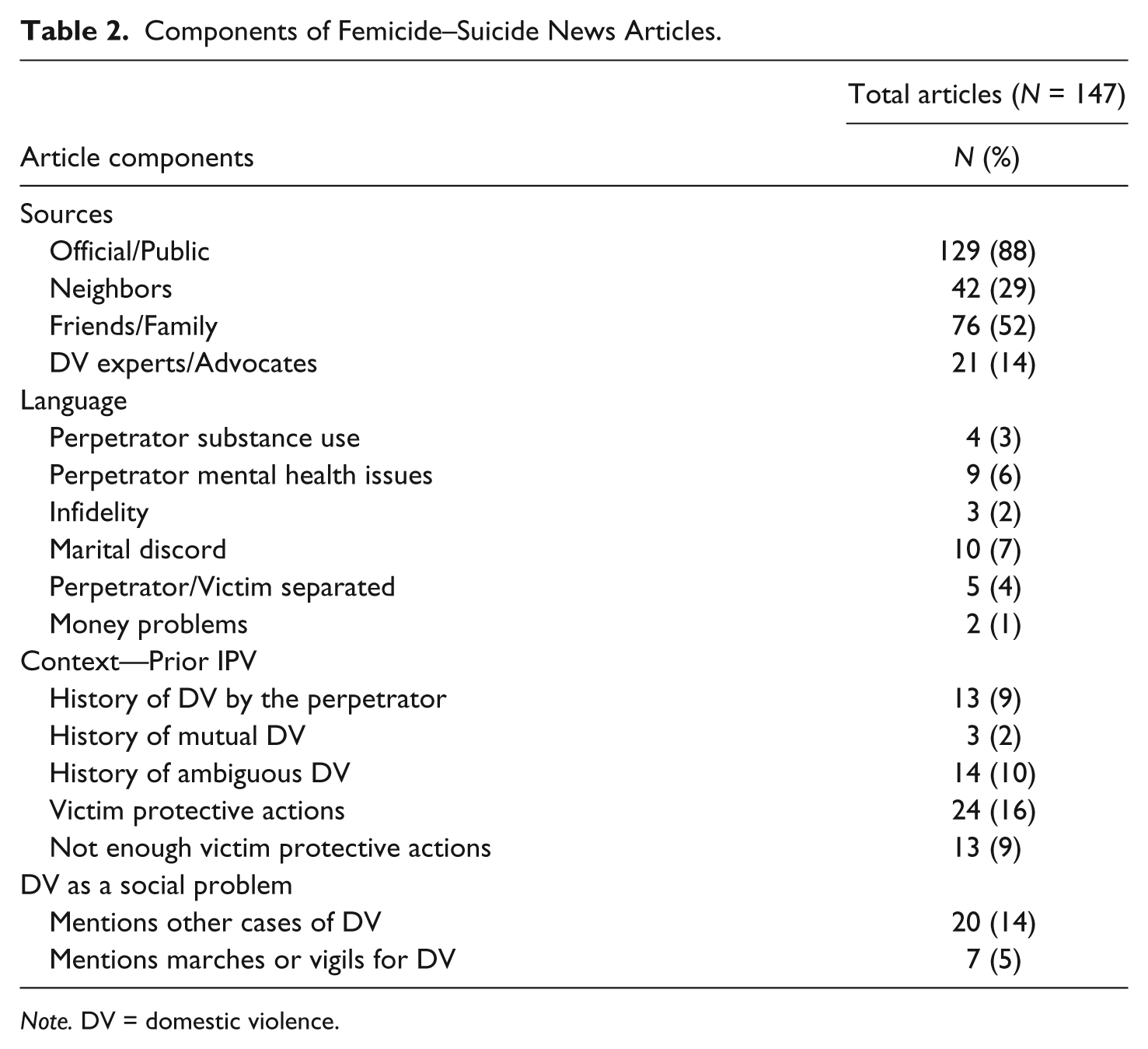
Note. DV = domestic violence.
Media Frames
Finally, the different media frames used for femicide–suicide articles were identified. These results are presented in Table 3. Similar to past research on media framing of femicide-only cases (Gillespie et al., 2013), the first distinction made by the researchers regarding how the media frames femicide–suicides was to distinguish articles that identified the crime as femicide–suicide (i.e., domestic violence committed by a male perpetrator against a female victim) from those that did not. Articles that failed to define incidents as femicide–suicides were framed in one of two ways, as an ambiguous murder–suicide (n = 25) or as a mystery (n = 6).
Media Frames Used in Femicide–Suicide Articles.

Twenty-five articles (17%) framed the femicide–suicide as an ambiguous homicide meaning news coverage failed to indicate who the victim was and who was the perpetrator and, in some cases, that the incident was a murder–suicide. In one such article, the scene was described in the following way, “‘Their bodies lay opposite each other across the Lee Road home’s living room,’ said law enforcement. Law enforcement said it was too early to determine who shot whom or what led to the shooting” (Mitchell, 2008). Another article described a femicide–suicide where the father, mother, and two children were all found dead, “the lead investigator wouldn’t say which parent was suspected, saying investigators would wait for initial autopsy reports this week before releasing details” (Kirkpatrick, 2009).
Another 6 articles (4%) framed the femicide–suicide as a mystery, for example one article described, “There were no signs of any other criminal or suspicious activity at the residence,” police said in a news release. They added that they had not previously responded to calls for service at the West Davis Street house. “It was not an ongoing domestic situation,”(the police captain) said. (Brevorka, 2005)
In another femicide–suicide article, law enforcement stated that they were “leaning” toward murder–suicide: “That’s the general consensus by looking at the bodies and the information gathered at the scene,” an officer said. “We are pretty much still leaning toward marriage rumblings (as the possible motive). But we may never know. The two people who could really shed light on it aren’t here.” (Rickert, 2007)
Of particular interest to the present study was the identification of frames used in cases where the news coverage defined the femicide–suicide as domestic violence. As shown in Table 3, these frames include (1) femicide–suicide by a male perpetrator (n = 85), (2) femicide–suicide due to loss of perpetrator control (n = 20), (3) femicide–suicide as a mercy killing (n = 6), and (4) femicide–suicide due to jealousy (n = 5).
First, 85 articles (58%) clearly identified the crime as a femicide–suicide committed by a male intimate partner. These articles were more likely to talk about past domestic violence between the couple and cite domestic violence experts and/or resources for domestic violence. In one such article, an attorney lamented, “What are you supposed to do? We’ve got the protection order, but it’s only a piece of paper. It’s not a bulletproof vest” (Ferreri & Velliquette, 2004). In another article, a domestic violence expert warned, Folks need to take domestic-violence incidences very seriously. If someone is in danger and we’re believing the best about their abuser, then we’re not giving them the help they need . . . It’s very difficult for a victim to leave an abusive relationship. It takes a great bit of strength, faith and courage. (Boone & Hewlett, 2007)
Among the articles defined as femicide–suicides, a minority of articles contained frames used to assign a “cause” as to why the perpetrator committed the deadly domestic violence. The first frame, perpetrator loss of control, was used to frame 20 articles (14%). The articles described femicide–suicide events that occurred after the female intimate partner had left the perpetrator. For example, in one case law enforcement expressed the following after a woman was killed after leaving her abuser, “Victims need to take every threat seriously. We’ve learned a person becomes more dangerous when they feel they have nothing left to lose” (Hess, 2002). In another case, after separating from her abuser, family members stated this about why a woman’s husband committed the femicide–suicide, “He couldn’t stand the fact that she was leaving him and taking the kids” (Manware & White, 2002). In an additional article a witness described that the perpetrator allowed everyone to flee the scene except the victim and then, “He then took (the victim) behind a small shed in the woods nearby, where the two exchanged heated words. He said, ‘If I can’t have you, nobody can’ . . . we heard two shots” (Kenna, 2003).
In another 5 articles (3%), perpetrator jealousy was identified as the cause of the femicide–suicide. In these cases, the victim had not only left her abuser but had begun a new relationship. In one such case, a neighbor described that the perpetrator had “cracked” and that the perpetrator “wanted her for himself . . . He just couldn’t stand for her to have someone for herself” (Associated Press, 2003b). In another case, a man shot his wife and then himself after finding out a day earlier that his estranged wife had begun seeing a co-worker (McDonald, 2004).
Finally, 6 articles (4%) described the femicide–suicides as “mercy killings.” While it may have been expected that more articles using this frame would be present in a sample of femicide–suicides, this number is fairly similar to prior research findings with articles representing femicide (not followed by suicide) events (i.e., Gillespie et al. [2013] found 6 (2.7%) articles used this frame).In these cases, the victim was suffering from a serious illness. Articles described as mercy killings did not assign any blame to the perpetrator but instead described the act in sympathetic terms. For example, one article stated, “Authorities believe that a Wilkes County man shot his extremely ill wife before shooting and killing himself this past weekend” (Associated Press, 2002a), while another declared that “after more than 55 years of marriage, an elderly couple’s life together came to an end in an apparent murder–suicide” (Welch, 2004).
Discussion
The present study is the first research to date to explore the ways femicide–suicides are framed by the news media. The research examined newspaper coverage for a near population of femicide–suicide cases in North Carolina over an 8-year period. The present study began by exploring the language used to describe the femicide–suicide event in the title/headline. Word choice in headlines is important because it conveys the main idea of the article and allows readers to choose stories of interest or importance to them. In addition, many news consumers may “skim” the headlines instead of reading entire articles to gain information about news. Thus, it is vital that femicide–suicides be correctly titled. First, findings demonstrate that the majority of femicide–suicide articles are titled in ways that indicate that they are ambiguous homicides. Therefore, the majority of femicide–suicides articles may be easily misidentified by readers as stories about stranger homicides instead of deadly domestic violence concluding in perpetrator suicide. Next, a group of stories included titles that identify a relationship between the perpetrator and the victim but are vague on the crime. Readers may believe that these articles describe the murders of husbands by wives or even the murders of a couple by a stranger. Finally, a minority of titles indicated that the stories describe femicide–suicides by specifically designating the victim in contrast to the perpetrator as well as the relationship between both individuals. As a result, news consumers may accurately identify only a select few of the total articles sampled as femicide–suicide. These results are similar to findings by Bullock and Cubert (2002) that headlines fail to include language that distinguished an intimate partner homicide from a homicide between strangers. Making this type of distinction about the relationship between the victim and offender is vital for the transmission of information concerning the frequency and nature of femicide–suicides to readers.
Next, we examined the framing components including the sources, language, and context of the femicide–suicide articles. Beginning with sources, similar to prior research concerning domestic violence news coverage (see Gillespie et al., 2013; Richards et al., 2011; Taylor, 2009), the majority of femicide–suicide articles used law enforcement as the main source of case information while domestic violence experts and/or advocates were rarely cited. Contrary to the prior literature focused on femicide cases generally, the present findings revealed that for femicide–suicide cases friends and family were used as sources more often than neighbors. The increased use of family and friends could be indicative of a difference in journalistic treatment of femicide–suicide (or homicide–suicide) cases compared with femicide cases, (i.e., journalists may approach family members more frequently in these cases, because there are multiple deceased individuals or because there is no longer a perpetrator to explain the event). Family and friends may also be more willing to talk to journalists in cases where the perpetrator is no longer living. Regardless of the reason, this finding is particularly intriguing and may indicate a need for further examination in future studies of suicide and femicide reporting.
In addition to the articles’sources, the present study also examined the language and resulting contextualization of femicide–suicide events in comparison to previous studies of femicide representations. Contrary to the previous literature on the media presentation of suicide and/or homicide–suicide, but similar to the prior research on femicide, the present research revealed that perpetrator mental health and/or substance use issues were rarely discussed by journalists. Suicide research has indicated that the vast majority of suicide victims have psychiatric problems, most commonly mood disorders and substance abuse, and that these issues and treatment options should be contained in articles reporting suicide events (CDC, 2001). It is important to note that this research and reporting suggestions are in reference to suicide victims specifically and there may be differences between suicide victims and the perpetrators of murder–suicide. Despite these potential variances, assessing the role of mental illness is important for accurately portraying problems and solutions associated with domestic violence and suicide. In addition, divergent from established information concerning the evolution of domestic violence, perpetrator/victim separation was also rarely mentioned in femicide–suicide articles. While specific contextual elements were less present in the sample of femicide–suicides compared with femicides generally, overall, a slightly higher percentage (14%) of articles contextualized femicide–suicide within the greater problem of domestic violence compared with the 12% of femicide-only articles identified by Gillespie et al. (2013) and the 10% of articles indentified by Bullock and Cubert (2002; but see Taylor, 2009).
Finally, the present research explored the use of different types of media frames within femicide–suicide news coverage. As mentioned previously, the present findings revealed two distinct ways the media contextualized femicide–suicides (1) those that did not identify the crime as domestic violence committed by a male perpetrator against a female victim (not a femicide–suicide) and (2) those that did identify the crime as domestic violence (as a femicide–suicide). Although the titles rarely reflected as much, the text of the majority of femicide–suicide articles described the event as domestic violence. Specifically, 78% of the articles in the present research defined femicide–suicides as domestic violence compared with only 38% of the femicide articles analyzed by Gillespie et al. (2013). Results demonstrate that four media frames represented articles that identified femicide–suicides as domestic violence. In line with previous studies identifying an explanatory typology of homicide–suicide events, the present study found a spousal murder–suicide due to jealousy frame and spousal murder–suicide due to declining health (a mercy killing) frame. The present study found that articles emphasizing the perpetrator’s loss of control or those that did not suggest a specific reason/motive for the femicide–suicide outnumbered these two frames. To our interest, divergent from prior research on femicide cases (Gillespie et al., 2013), a faulty criminal justice frame was not identified in the present research. Articles that did not identify the crime as femicide–suicides were framed as either ambiguous homicide–suicides or as a mystery. These articles failed to discuss prior domestic violence in the lives of the couple or even identify the present murder of the female victim by the male perpetrator as domestic violence. Likewise, these articles did not utilize the expertise of domestic violence advocates and/or provide information on the local resources for domestic violence. These findings indicate that femicide–suicide cases are distinguishable from femicide cases in their circumstances, outcome, and journalistic representations.
Limitations
The present study is not unique in its research limitations. First, while the sample of articles represents a near population of identified cases from a singular state over a period of 8 years, the identified frames may not be generalizable to other geographic areas. As discussed in previous studies using the present data (Gillespie et al., 2013; Richards et al., 2011), the NCCADV is active in the state and has developed relationships with the local media—this relationship may influence the prevalence of domestic violence language and contextualization in North Carolina’s news coverage. Comparing media frames used in states without an active coalition to states with more active advocacy (such as the case with the present study) may be useful in identifying the influence coalitions have on the media. In addition, while the present results are comparable to the findings from recent femicide news representation examinations, this study did not include a comparison sample of non-femicide homicide–suicides. Examining the framing of articles on homicide–suicide between non-intimates may be useful in bridging the suicide and domestic homicide media representation literatures. Finally, frame analysis of femicide and femcide–suicide in other forms of media is needed. In an increasingly digital age, print journalism may be becoming less influential than electronic news sources such as internet sites, television news programs, and social networking outlets. Addressing the evolving methods for the dissemination of news and the influence these various types of media have on the collective social construction of the problem of domestic violence is necessary to this line of inquiry.
Policy Implications and Future Research
As previously mentioned, interpretation and understanding of violent crime commonly occurs through “mediated experience” (Surette, 2007) as opposed to personal experience. At first glance this notion may appear inconsequential; however, the potential implications should not be ignored. Specifically, societal reactions, including those of policymakers, based on inaccurate media portrayals may result in misguided strategies to address a form of violence. Therefore, it is requisite that the media portrayal of violence against women represents the true nature of such violence and that the media embrace the opportunity to assist in the dissemination of accurate information concerning social problems and the resources available to victims. Furthermore, assessing media representations of intimate partner abuse, femicide, and femicide–suicide can prove useful in developing publishing recommendations for reporters.
The CDC has been active in publishing recommendations for the reporting of suicide events primarily due to concerns about contagion effects. These recommendations are often not implemented in the reporting of femicide–suicide, and, as mentioned previously, may at times conflict with the reporting suggestions for increasing domestic violence understanding and awareness. Assessments of the reporting of murder–suicide and femicide–suicide are important in terms of framing femicide as a social problem and in terms of creating responsible reporting efforts that are in agreement with the goals of the suicide and domestic violence advocacy networks. Even within the literature addressing the reporting on suicide, murder–suicide is treated as a separate category and has received less attention in terms of explicit reporting suggestions. While the present analysis was intended as an initial exploratory examination of media representations of the most common type of murder–suicide, femicide–suicide, it also lays the groundwork for assessing responsible reporting recommendations. Future research should examine the degree to which homicide–suicide recommendations are followed in femicide–suicide articles, how suicide and homicide–suicide recommendations may adhere to or conflict with the goals of domestic violence advocacy, and develop reporting recommendations for femicide–suicide cases specifically. Although homicide–suicide is rare compared with suicide, this future research agenda is important because (1) homicide–suicide is more likely to be reported on than suicide events, (2) femicide–suicide is the most common type of homicide–suicide event, and (3) femicide followed by perpetrator suicide is prevalent among domestic homicides—occurring in approximately one quarter to one third of all domestic homicide cases (Campbell et al., 2007; Richards et al., 2011;Van Wormer, 2008).
Conclusion
The media have the unique ability to harness the attention of news consumers and shape public opinion concerning important social problems such as domestic violence as well as society’s role in prevention and intervention efforts. In this vein, Surette (2007) suggests that the power of the media is an obstacle and an opportunity—the present research demonstrates the veracity of Surrette’s assertion. While there is optimism in finding that the majority of the sampled femicide–suicides are framed as domestic violence, the fact remains that many femicide–suicides are explained away in overly simplistic terms, as isolated instances of perpetrator jealously or loss of control. In addition, in several cases the media failed to portray femicide–suicides as domestic violence at all, instead presenting it as an ambiguous homicide–suicide or a mystery. Such articles are missed opportunities to channel the media’s power to educate and advocate for victims by providing news consumers accurate depictions concerning deadly domestic violence followed by perpetrator suicide. It is our hope that research in this area will continue to encourage meaningful partnerships between researchers, advocates, and the media and that similar to recommendations for the reporting of suicide, best case practices for reporting on femicide–suicides will be developed, disseminated, and implemented on a national level.
Footnotes
Acknowledgements
The authors acknowledge the North Carolina Coalition Against Domestic Violence, which continually compiles data on intimate partner homicides making this research possible.
Authors’ Note
Portions of this research were presented at the 2011 meeting of the American Society of Criminology in Washington, D.C.
Declaration of Conflicting Interests
The author(s) declared no potential conflicts of interest with respect to the research, authorship, and/or publication of this article.
Funding
The author(s) received no Financial support for the research, authorship, and/or publication of this article.