




Abstract
U.S. Extremist Crime Database (ECDB) Study data of homicides by far-right extremists and arsons and bombings by environmental and animal rights extremists suggest that compared with men, relationships are catalysts for women’s involvement in domestic terrorism; recruitment and opportunity differ by ideology and are not always effective in victimizing their intended hate group. We suggest an inter-disciplinary approach that considers criminological principles of strain theory along with sociological emphasis on gendered social networks and the strength of weak ties.
Introduction
This study aims to triangulate theories of gender and ideology, criminology, and sociology to analyze the phenomenon of women engaged in U.S. homegrown terrorism and extremist violence. Although a number of scholars have looked at women’s involvement in global terrorism and extremist violence (Berko, 2012; Bloom, 2011, 2005; Dalton & Asal, 2011; Gonzalez-Perez, 2008; Hasso, 2005; Herath, 2012; Holt, 2010; Israeli, 2004; Miller, 2007; Scroggins, 2005; Victor, 2004), few have considered their active and nuanced engagement in U.S. homegrown terrorism and extremist violence (Blee, 2002, 2001). Our use of the term terrorism throughout the article refers to violent acts committed to further a political ideology. This remains consistent with most academic definitions of terrorism. We include violent, ideologically motivated “extremists” in our category of “terrorist” because they also use violent (criminal) methods to achieve a political aim. Our categorization of homegrown, U.S. female terrorists and violent extremists thus excludes those simply affiliated with an ideological group or social movement who have not committed a crime. This study limits its analysis to females indicted in the United States for extremist homicides, arsons, and bombings.
The fact that women in terrorism are understudied adds to their mystery. What kinds of women get involved in terrorist crimes? Are these women categorically different from other women? Do theories of extreme deviance apply to women terrorists in the same ways that criminologists apply them to male terrorists? This study creates an empirical framework of analysis for approaching the study of minority populations within extreme deviant crimes by focusing on women who participated in U.S. domestic ideologically motivated violent crimes since 1990. This period captures a picture of terrorism in the United States before and after the watershed terrorist incident of September 11, 2001.
Theoretical Significance of the Current Study to Feminist Criminology
By focusing specifically on the female perpetrators of domestic U.S. terrorism, we aim to critique the current study of women in terrorism as part of a long tradition of over- and under-representation of female criminality (Chesney-Lind, 1982; Duncombe & Mattson, 2007; Morgan, 1989; Nacos, 2008; Strunk, 2010). We empirically test theories presented by the previous literature that examine women as offenders. We set forth various hypotheses to amend gaps in the literature that do not take into account recent studies of women in terrorism, including the theory that women are more incentivized to participate in domestic terror instead of terror with global aims (Gonzalez-Perez, 2008) and that they play more than just supportive roles (Al-Ashtal, 2009; Blee, 2001). One of the areas where gender differences can inform theories of female criminality in terrorism is in pathways toward radicalization (Sageman, 2004). We add to theories of female criminality in homegrown terrorism by using social network theory (Granovetter, 1973; Papachristos, 2009) to help understand the kinds of social relationships that may influence women’s involvement in terrorist crimes.
Our hypotheses are grounded in gender and criminological theory principles while incorporating political theory on the importance of ideological distinctions. We also incorporate a sociological emphasis on the social networks of intimate relationships that leave women more vulnerable to recruitment than men. In essence, a gendered theory of criminality helps to expand the current understanding of women as agents of terrorism and opens new paradigms for the study of terrorism informed by perspectives on female criminality. Last, our inter-disciplinary approach and findings have implications beyond the study of feminist criminology.
In this article, we do the following: We extend the state of the art of female criminality and apply it to the most extreme cases of women involved in U.S. homegrown terrorist violent crimes. At the same time, we also expand the understanding of terrorist radicalization and analysis to incorporate U.S. women’s experiences with homegrown terrorism. We do so by analyzing data of women involved in far-right extremist homicides and environmental and animal rights activist arsons and bombings in the United States since 1990.
Patterns of Women’s Involvement in Terrorism
Several studies that have looked at females in terrorism at the organizational level argue that patriarchal norms are replicated even in insurgent organizations that recruit women (Blee, 2002; Ezekiel, 1995). Some theories suggest gender difference at the micro-level relates to anger management and a propensity for aggressive engagement, where men turn their anger outward while women turn their anger inward (Cox, Stabb, & Hulgus, 2000; Kopper, 1993) and may even be socialized to do so (Broidy & Agnew, 1997; K. C. Smith et al., 1989). There is little evidence to suggest that terrorist groups actively recruit women except out of desperation, whatever the language of equality, empowerment, and choice is used in their recruitment (Dalton & Asal, 2011).
Some memoirs of former U.S. terrorist women, such as from the left-wing Weather Underground organization, corroborate the claims that women were relegated to supportive roles by the male leadership of the terrorist organization, whatever their stated policies regarding gender equality (Gonzalez-Perez, 2008; Kalinowski, 1979; Varon, 2004). Herath (2012) finds, as in many social institutions led by men, both legitimate and illegitimate, that “combatant women . . . are rarely at the very top of the organization” and “lack of leadership training may also have kept them out of leadership positions” (pp. 23-24). 1 However, the role of men as enablers of female terrorism is an interesting avenue for study that is largely unexplored. Durham has identified instances where in British far-right groups, male leaders have publicly debated their support for “roughly equal rights” (Durham, 1995, pp. 281, 282, 285). The results of this study also point to the essentiality of male catalysts to women’s involvement in terrorism.
Other researchers (Bloom, 2005; Johnson, 2008; McCauley & Moskalenko, 2011) have begun to explore mechanisms of terrorist radicalization that investigate motivations aside from explicit political and religious ideology, which may shed light on women’s involvement. They cite motivations such as personal and group grievances, love, risk and status, polarization, isolation, and intergroup competition, among others (McCauley & Moskalenko, 2011).
Although religious ideology can be conflated with other powerful ideological beliefs, in this study, we also isolate terrorist ideology from religious identity and belief. This methodological choice is data-driven. Of the female terrorists who engage homegrown terrorism in the United States, there were no open-source data available on their religious beliefs or affiliation. In addition, the women’s far-right and eco-terrorist ideologies did not access religious arguments for their political agendas when justifying their violence. Of course, it is possible for terrorist ideology to act as a substitute for religion for terrorists, but again, we find no data to support this theory. Other scholars who have analyzed female terrorists outside Islamic jihadism have noted the absence of religion in their motivations (Herath, 2012).
Last, we would like to test whether women turned against their male terrorist comrades and informed on them to police, or otherwise testified against them in court. The contribution that the “witness and snitching” variable makes to the study of women in terrorism is that it looks at the role of women as spoilers of terrorism by displaying their proclivity to turn against the very social networks that drew them into terrorism in the first place. If found to be significant, the presence of witnesses or snitches would support the yet untested theory that women are not only less involved in terrorism than men, but that among the few involved, they often serve as spoilers of terrorist violence.
Theoretical Models for Explaining Women’s Involvement in Terrorism
Although we do not have the appropriate data to test Agnew’s (1992) General Strain Theory (GST) in this article, we nevertheless include GST as support for incorporating a gendered study of criminality to terrorist radicalization. Although previous analysis of terrorism attempts more general theories, we advocate an inter-disciplinary approach to understanding terrorism as an extreme form of criminal deviance that benefits from a nuanced approach to criminality, including gendered perspectives on radicalization, motivations, and pathways for involvement. GST would suggest that women may suffer particular emotional strain, or “negative affect states,” not only by the original political or ideological grievances that drove them to ideological extremism but also by the very activism expected of them as members of the violent group and to retain close ties to the group (Broidy & Agnew, 1997). One can think of the strain of “double-consciousness” (Du Bois, 1994) suffered by female domestic terrorists.
Besides the motivation of achieving stated political and ideological goals, other documented motivations for female terrorist involvement include loss of a loved one (Kline & Franchetti, 2002), being sold into the practice out of poverty or patriarchal authority (Kline & Franchetti, 2002), perpetuating a cycle of violence resulting from exposure to domestic violence (Johnson, 2008), and revenge for the dishonor of being raped (Bloom, 2005). Such evidence broadens the possibilities of understanding involvement of previously marginal actors, such as women and children, in extreme deviant criminality.
Previous scholarship on female criminality suggests that women generally tend to turn their anger inward (Broidy & Agnew, 1997; Cox et al., 2000; Kopper, 1993; K. C. Smith et al., 1989) and thus would exhibit self-abusive behaviors before they would resort to acting alone (what we label “lone wolf” terrorism) to commit violent terror acts directed toward others. Furthermore, some suggest that in crime, women are more risk-averse than men, particularly when relationships and emotional commitments are involved (Gottfredson & Hirschi, 1990; Gove, 1985; Steffensmeier & Allan, 1996). Thus, perhaps the use of violence would add considerably more strain to female terrorist involvement. We expect that as women participate in U.S. homegrown terrorism and extremism, they will tend to participate in less violent crime types. In essence, women are more likely to participate in acts that result in property damage (i.e., arsons and bombings) than loss of human lives (homicides). Agnew (2010) also cites Hamm’s (2002) work to develop a GST of terrorism. Of particular importance to this study is Agnew’s assertion that “terrorism is most likely when people experience ‘collective strains’ that are . . . inflicted by significantly more powerful others, including ‘complicit’ civilians, with whom members of the strained collectivity have weak ties” (pp. 131-153).
We borrow the idea of the importance of weak ties within a strained collectivity, and in the case of far-right women, we see evidence of “complicit” civilians. However, we go a step further to say that these weak ties create the opportunity for women terrorists when they otherwise would not be open to them. It is unlikely that women would have the motivation and opportunity to commit violent acts of homegrown terrorism on their own, outside their social networks. Consistent with previous theories of radicalization that some terrorists are driven by means other than ideology such as love or greed (Falk & Zweimuller, 2011; McCauley & Moskalenko, 2011), we predict that women will demonstrate a variety of personal motivations for involvement in homegrown terrorism aside from ideology. 2 Because it is difficult to test for unknown motivations, we measure variance in the explanatory mechanisms of female motivation by measuring their lack of ideological motivation and strength of association with the ideology behind the violent act.
Finally, we find evidence of a complicated set of sociological reasons and circumstances why women are increasingly engaging the role of terrorist. Some scholars (Blee, 2001) have criticized Ezekiel (1995) for portraying female neo-Nazis and skinheads as victims of patriarchal violence and limiting the complexity of their agency in extremist participation. It is even claimed that terrorist activism redefines women’s roles in the larger civic society that ordinarily constricts women to largely submissive roles relative to men. In her analysis, Herath (2012) uncovers that suicide bombings can actually be perceived as “empowering” acts that reinstate lost agency.
A theory of women as agents and not victims of terrorism also emphasizes the rationality and deliberateness of the actions of the individuals involved. Evidence for this is women’s decisions to participate in suicide missions out of the self- and collective empowerment they receive socially through their terrorist activism (Herath, 2012). In some ways, a theory of female criminality where women are agents and not victims of terrorism incorporates findings from studies of mostly male terrorists that do not conflate gender effects and interpret motivations as consistent among terrorists despite gender (Merari, 2010; Richardson, 2006a, 2006b).
Ideology and Women Terrorists
Ideology has been used to distinguish individual motivations and paths to radicalization, group structures, and longevity of terrorist groups. For this study, we draw on previous literature that looks at women in far-right movements both domestically (Blee, 2002, 2008; Southern Poverty Law Center [SPLC], 2004) and internationally (Eckardt, 2013; Fangen, 1997; Mushaben, 1995), 3 as well as the women in ecological or environmental/Animal Liberation Front (ECO/ALF) 4 terrorist movements in the United States. When few sociologists analyzed U.S. racist groups as terrorist groups, Kathleen Blee (2008) pointed out that “research on terrorism has paid relatively little attention to the growing tendency of White supremacism in the United States to adopt the organizational structures, agendas, and tactics more commonly associated with terrorist groups in other places” (p. 202).
Investigations of European far-right extremist women show that these female extremist groups are more than off-shoots of men’s groups, they are in fact separate entities with differentiated roles and leadership structure that work in partnership with but are not subservient to the men’s groups. Presently, U.S. far-right “racial terrorist” groups have the ability to connect their activities to other like-minded terrorist groups abroad. Loose group organization also enables women to become more directly involved in racial terrorist violence (Blee, 2008).
Still, women’s participation in terrorist violence is low in numbers despite their increased participation in racist groups. Interestingly, SPLC (2004, cited in Blee, 2008) statistics indicate women’s participation is less when violent terrorist crimes are directed at state institutions rather than racial minorities. Blee (2008) finds that although women’s participation is “strategic,” mostly propaganda and logistical support, it has been steady until the present day, and that women’s participation in “narrative,” street-level physical violence is increasing while social gender barriers to their participation are decreasing. Her work shows that women’s participation in racial terrorism was determined both by group definitions of the enemy and by the crumbling gender roles in U.S. society at large. In essence, even far-right extremist groups are affected by the norms of gender equality in U.S. society.
Besides ideologically motivated far-right terrorists and ECO/ALF terrorists analyzed in this article, a third important category of women terrorists we analyze, even more understudied but perhaps equally relevant, is that of the non-ideological collaborators, what we call throughout the rest of the article, “non-extremists.” These are women who have been arrested for participation in a terrorist incident but have no ideological commitment to the movement. Instead, for a variety of personal reasons, they collaborated with the extremists to commit the crime. These women are labeled as terrorists for their support of terrorism and yet they are “ideological zeros/nones.” 5
Previous scholarship supports the hypothesis that women who are involved in terrorist crimes are less ideologically driven than men. In addition, the importance of education to deterring women’s involvement in terrorism may differ by gender, as Atran (2003) has argued that there is little evidence to support that convicted (male) terrorists lack education. Social learning theory (Bandura, 1977) suggests that peer groups who enable opportunities to commit extremist crimes also groom the female recruit into behaviors and personas to enable them to carry out violent crimes. It is possible that younger women will be more vulnerable to ideological recruitment and more committed to the cause. Thus, we might expect the more ideologically committed female extremists to be younger than non-extremist collaborators.
Testing the State of the Art of Women in Terrorism
The current knowledge of women’s involvement in terrorism is little understood except for applying current theories of radicalization that are based largely on samples of male terrorists. The trends are to view terrorists as either irrational actors or rational actors, and understand radicalization in terms of deprivation theory or organizational theory when involved at the group level. In this article, we not only incorporate previous understandings of terrorist involvement based on mostly male samples but also improve the state of the art by assuming that gender and ideological associations are significant for analysis and provide insights into both terrorist perpetrators and incidents. Whereas most previous studies of women and terrorism mentioned here use historical data and interview case studies as the primary sources of analysis, the present study uses current, open-source information of women engaged in U.S. terrorism. The Extremist Crime Database (ECDB) uniquely includes a “strength of ideological association” variable to measure the extent of ideological commitment among perpetrators of ideologically motivated terror incidents.
The main research questions explored in this study include the following:
Although we are not focused on women in terrorism outside the United States, it is useful to briefly review previous theories of women in terrorism and then present our hypotheses informed by this inter-disciplinary literature. Based on the literature, we set out to test the following hypotheses:
Categorization of the Independent Variables.
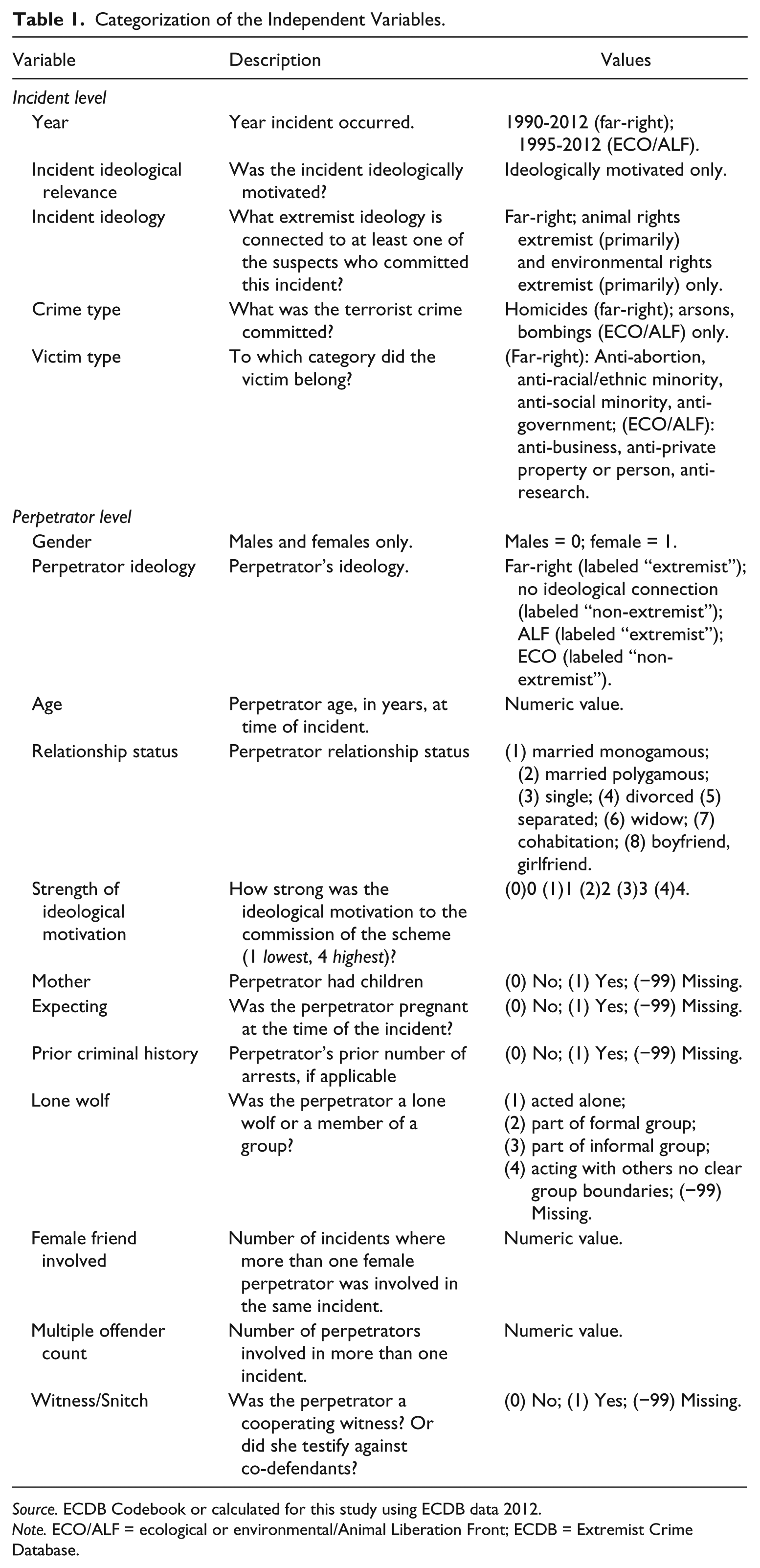
Source. ECDB Codebook or calculated for this study using ECDB data 2012.
Note. ECO/ALF = ecological or environmental/Animal Liberation Front; ECDB = Extremist Crime Database.
Data and Methods
To test our research questions, we use data from the U.S. ECDB to analyze two of the most relevant terrorist threats in the United States today: far-right and environmental/animal rights extremists (Freilich, Chermak, & Simone, 2009). 6 The ECDB is an open-source relational database that includes incident and perpetrator-level information on crimes committed by domestic extremists since 1990. The ECDB’s incident identification and coding is a multi-stage process (Freilich, Chermak, Belli, Gruenewald, & Parkin, 2014). First, open-source publications and databases are used to identify cases that could potentially fit the inclusion criteria. These sources included, but were not limited to, the SPLC’s Intelligence Report, the Anti-Defamation League’s Militia Watch-Dog, the FBI’s “Terrorism in America” publication, Hewitt’s (2003) chronology of terrorism events in the United States, the American Terrorism Study, and the Global Terrorism Database. Additional incidents were identified in online newspaper articles, which were searched using keywords and terms such as: homicide and Klan, homicide and militia, homicide and sovereign citizen, homicide and Aryan Nations, and homicide and skinheads. The use of multiple sources increased the probability that all cases needed to capture the entire population of interest were identified. Due to the identification process used by the ECDB, the risk of inclusion and exclusion errors is minimized, especially when compared with other sources and databases that have been used to study terrorism and ideologically motivated crime (Chermak, Freilich, Parkin, & Lynch, 2012).
Once potential incidents were identified, we systematically searched more than 30 open-source search engines and databases to collect all publically available information on the homicide events. After the open-source materials were collected, they were forwarded to a coder who read the documents, verified that the incident met the appropriate inclusion criteria, conducted additional open-source searches, and coded each incident. Variables coded related to the incident, the offenders, the victims, and the reliability of the open-source documentation. This coding process was iterative and reliability was increased through coder training and multiple coders examining each incident (Freilich et al., 2014). The ECDB has proven to be a valid source of data on violent crimes committed by domestic extremists in the United States (Chermak et al., 2012). Recent studies have relied on the ECDB to examine the evolution of domestic extremist groups (Freilich, Chermak, & Caspi, 2009), far-right homicides (Gruenewald & Pridemore, 2012) including fatal attacks against the police (Freilich & Chermak, 2009; Suttmoeller, Gruenewald, Chermak, & Freilich, 2013), and lone-wolf attacks (Gruenewald, Chermak, & Freilich, 2013).
This current study’s variables of interest pertain to exploring the most serious ideologically motivated crimes committed by far-right and eco-terrorist extremist female actors (extremists and non-extremist supporters)—homicides committed by far-rightists since 1990—and because ECO and animal rights extremists have not committed fatal attacks, we focus on their most serious crime types, completed bombings, and arsons in the United States since 1995 (Chermak, Freilich, Duran, & Parkin, 2013; Chermak et al., 2012; Freilich et al., 2014; Gruenewald & Pridemore, 2012). A homicide (for the far-right) or an arson or bombing (for animal and environmental rights extremists) must have been committed for an incident to be included in this study. In addition to this behavioral requirement, at least one of the perpetrators who committed the attack must have been an extremist (far-right or ECO/ALF) who committed this attack to further that ideology. Once an incident was included, we also included information on the perpetrators who committed the attack. Although most of the perpetrators are extremists, as noted, occasionally non-extremists (for a variety of personal reasons) also participated in the attacks. We examined these non-extremist collaborators as well.
Among the incident-level variables we include year (1990-2012); incident (only ideologically motivated); incident ideology, again, only those incidents that were linked to far-right homicides or ECO/ALF bombings or arsons were included; crime type, we only analyzed homicides for the far-right, and arsons and bombings for ECO/ALF because they were the most utilized crime types included in each group of interest; and victim type, we identified whether the victim fit into any of the following categories (Parkin, 2012): anti-abortion, anti-racial/ethnic minority, anti-social minority, anti-government (far-right), anti-business, anti-private property or person, and anti-research (ECO/ALF). In addition, we include perpetrator-level variables: gender; perpetrator ideology, to distinguish between those perpetrators who were themselves ideologically driven, or were “ideological nones” (i.e., non-extremist collaborators); age; relationship status; strength of association with the ideology; whether the perpetrator was a mother; whether the perpetrator was expecting at the time of the incident; prior criminal history; lone actor or part of a group; female friend involved or not; multiple offender count; and witness/snitch.
We use a largely descriptive method of analysis of far-right and ECO/ALF terrorists. The measurement procedures for all independent variables are outlined in Table 1.
Initial Findings
As expected, fewer women were involved in violent extremist crimes than men. Women were involved in 78 of 150 far-right completed homicides since 1990 and in 34 out of 129 completed ECO/ALF arsons since 1995. Out of 28 ECO/ALF completed bombings, women were involved in only three of those incidents. Because these incident-level numbers include multiple offenders, by perpetrator count, our total universe includes 40 female perpetrators: 24 female perpetrators involved in far-right homicides since 1990 and 16 women who committed ECO/ALF arsons and bombings since 1995. We note, however, that a more accurate perpetrator count for far-right homicides was possible because in the event of these homicides, there is invariably an arrest made. However, most ECO/ALF attacks have not made successful arrests of individual perpetrators, so we have fewer known perpetrators for documented ECO/ALF incidents. This results in an undercount of ECO/ALF perpetrators in general. Based on the sample of female perpetrators we have obtained, we find that females account for about 25% of ECO/ALF perpetrators and we can project that there are a number of unknown female suspects involved in documented ECO/ALF incidents who have not been counted.
Keeping in mind a likely undercount of females involved in ECO/ALF bombings and arsons, our hypothesis is confirmed that more women would be ideologically involved in the ECO/ALF movement than far-right extremism. However, we were incorrect in our prediction that women would be less ideologically committed to ECO/ALF causes; in fact, the opposite was true. All the ECO/ALF women were ideological extremists, while almost half of far-right females were non-extremist collaborators. Although not presented as a formal hypothesis, we expected that women, as with men, would be more involved in retaliatory far-right terrorist crimes right after the global jihadist attacks of 2001; however, this was not the case. In fact, extremist activity was unrelated to the year 2001 but showed cycles of increased activity that differed by ideology. 7
At the perpetrator level, we find some interesting initial findings by looking at the demographic data of U.S. female terrorists. The fact that the group includes a 16-year-old and a 71-year-old is interesting; none of the women were lone wolves, all served supporting roles, and more often than not, they were acting informally or as part of an informal group. This is an insight—in the United States, women are not as likely to identify themselves with formal terrorist groups. This may be because they are kept from leadership (as Blee and others suggest), which, in fact, replicates the patriarchal patterns of the wider society or even supports an entrenched chauvinism, as Ezekiel (1995) argues, or they may choose to play supportive roles for other reasons not presently considered.
Among far-right female offenders, we found no multiple offenders; minimal evidence of prior criminal history; and only one perpetrator with a known prior criminal history was also unemployed and divorced. It appears that for most other far-right female offenders, this was their first arrest. All were White, non-Latino Caucasians. There was little information about formal education or occupation, although we hypothesized that perhaps a younger age, as well as a lack of education or employment, would make women more vulnerable to victimization, brainwashing, and coercion (Dalton & Asal, 2011). Several perpetrators had other female friends involved (8 non-extremists, 2 extremists). Several were connected to the crime through a brother or boyfriend or husband (8 extremists, 2/10 non-extremists); one actually served as point of retaliation at a party.
Regarding H1 and H2, The data confirm more non-extremist female perpetrators than men among the far-right, although all women involved in ECO/ALF were ideologically motivated (see Table 2).
Perpetrators by Ideology and Level of Extremism (Incident Analysis).
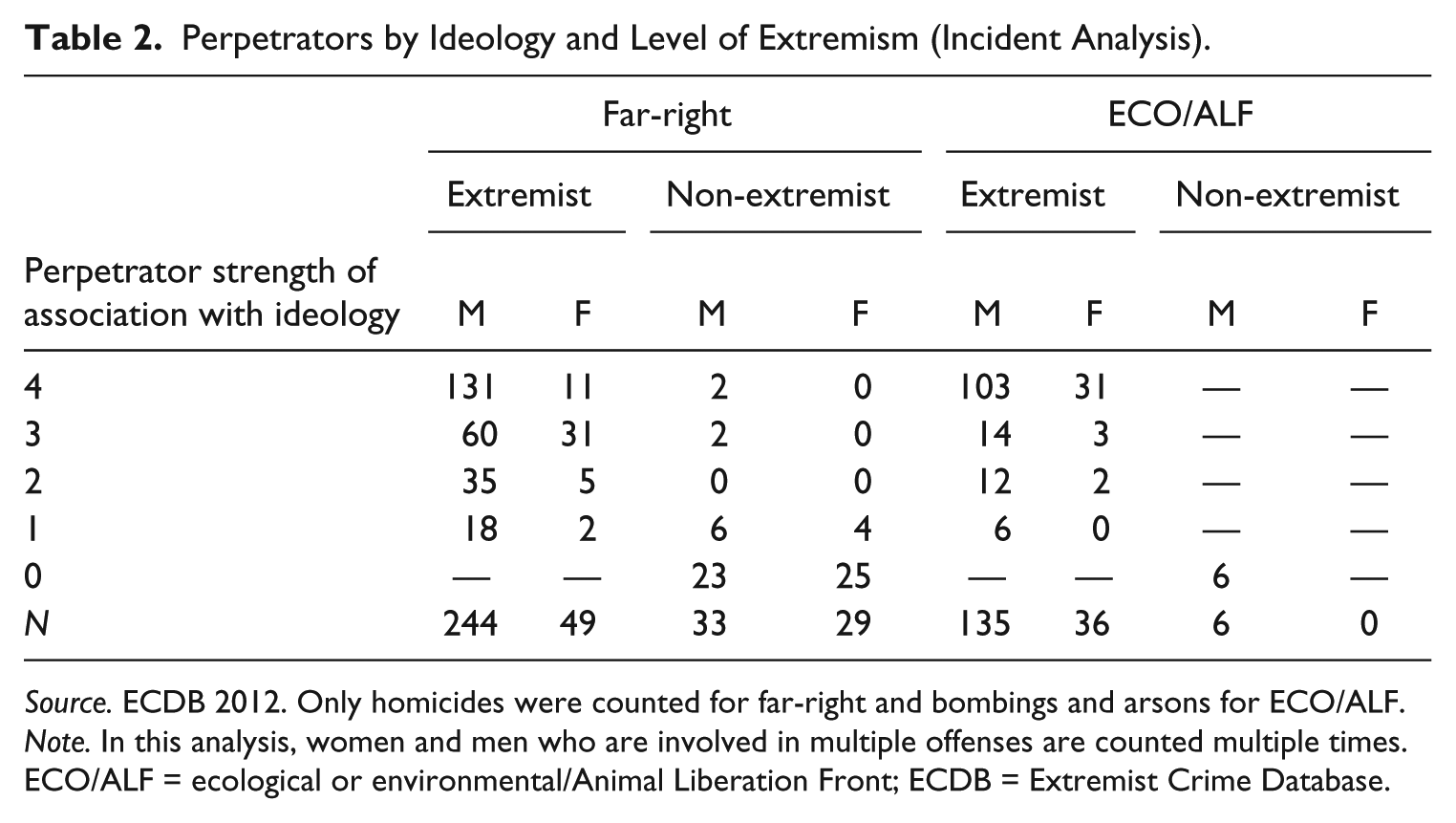
Source. ECDB 2012. Only homicides were counted for far-right and bombings and arsons for ECO/ALF.
Note. In this analysis, women and men who are involved in multiple offenses are counted multiple times. ECO/ALF = ecological or environmental/Animal Liberation Front; ECDB = Extremist Crime Database.
The data confirm part of H3 that there were no lone-wolf female perpetrators in our analysis, and where women participated, they had either a significant male accomplice or a female friend also involved (see Table 3). We would like to note that in the ECO/ALF case, all female perpetrators were ideological extremists, which may speak to the literature on gender and risk aversion, where women would be more likely to participate in extremist groups whose victims were not explicitly human targets but rather expressed violent activism in a less lethal manner through symbolic targets in arsons and bombings.
Demographics and Background Variables of Interest of Distinct Female Offenders Involved in Ideologically Motivated U.S. Terrorist Crimes 1990-2012 by Ideology.
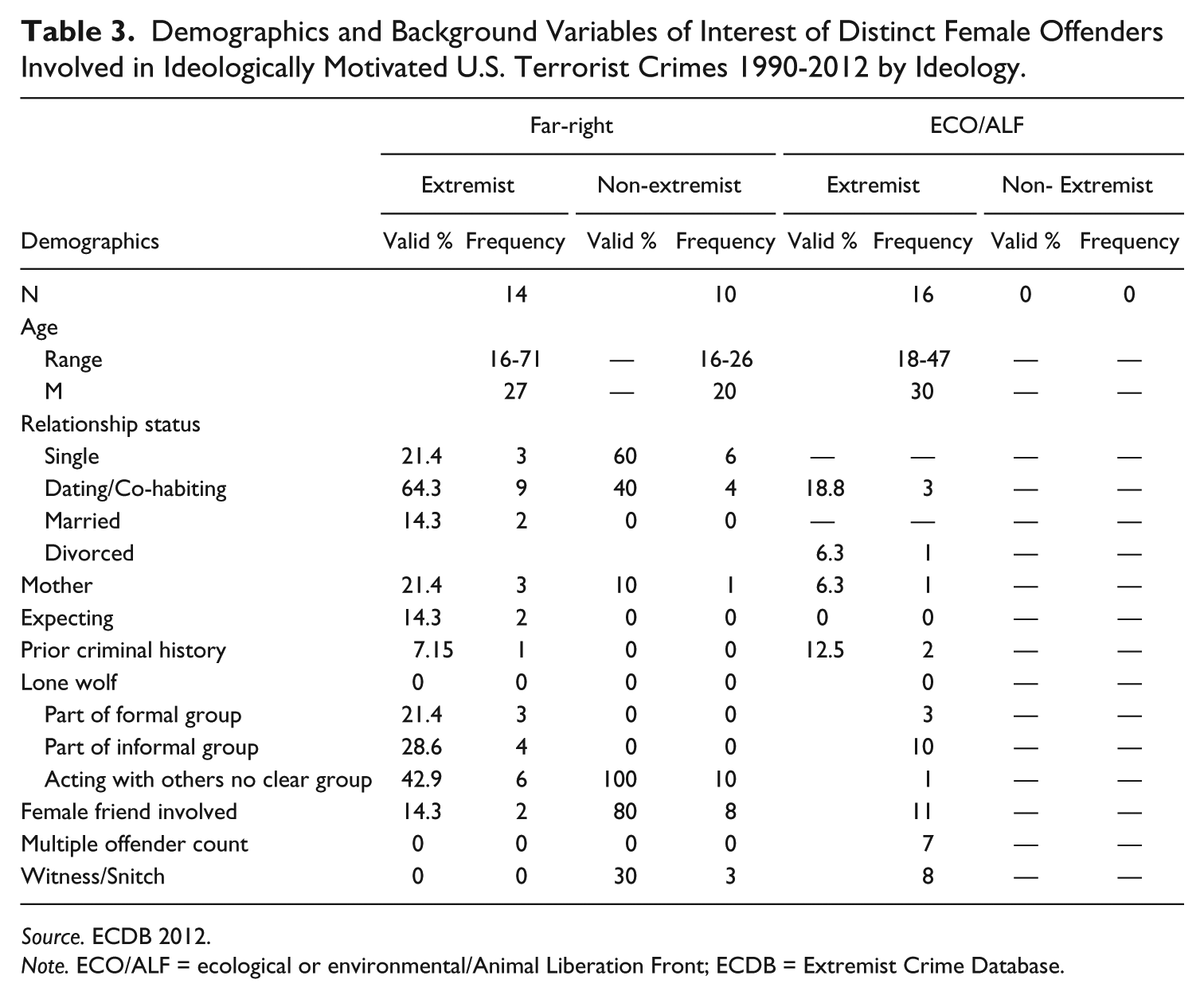
Source. ECDB 2012.
Note. ECO/ALF = ecological or environmental/Animal Liberation Front; ECDB = Extremist Crime Database.
On the question of which ideological extremist group had more women represented, the data show mixed results. By incident count, more women were involved in ECO/ALF arsons and bombings (confirming H1); however, there were only 16 ECO/ALF women (all extremists) and half were multiple offenders while 24 were far-right (14 extremists, 10 non-extremist), most only one-time offenders (see Table 3). So, we report this as a mixed result to our test of H1. It is important to note the difference in number count by incident analysis (Tables 2 and 4) where perpetrators are counted multiple times for each incident they were involved with versus analyzing the demographic and individual-level variables of the 24 far-right and 16 ECO/ALF women themselves (Table 3). Regarding H2, only 24 women were involved in far-right homicides since 1990, less than 10% the number of men involved in these incidents, and almost half were non-ideological collaborators. Of the 16 environmental and animal rights extremists (ECO/ALF) involved in arsons and bombings since 1995, all were ideological extremists, and unlike the women in the far-right, were involved in multiple incidents, making women’s participation in ECO/ALF bombings and arsons about 25% of ECO/ALF perpetrators.
Victims of Ideologically Motivated Far-Right Homicides (1990-2012) and ECO/ALF Arsons and Bombings (1995-2012) With Female Involvement (Incident Analysis).
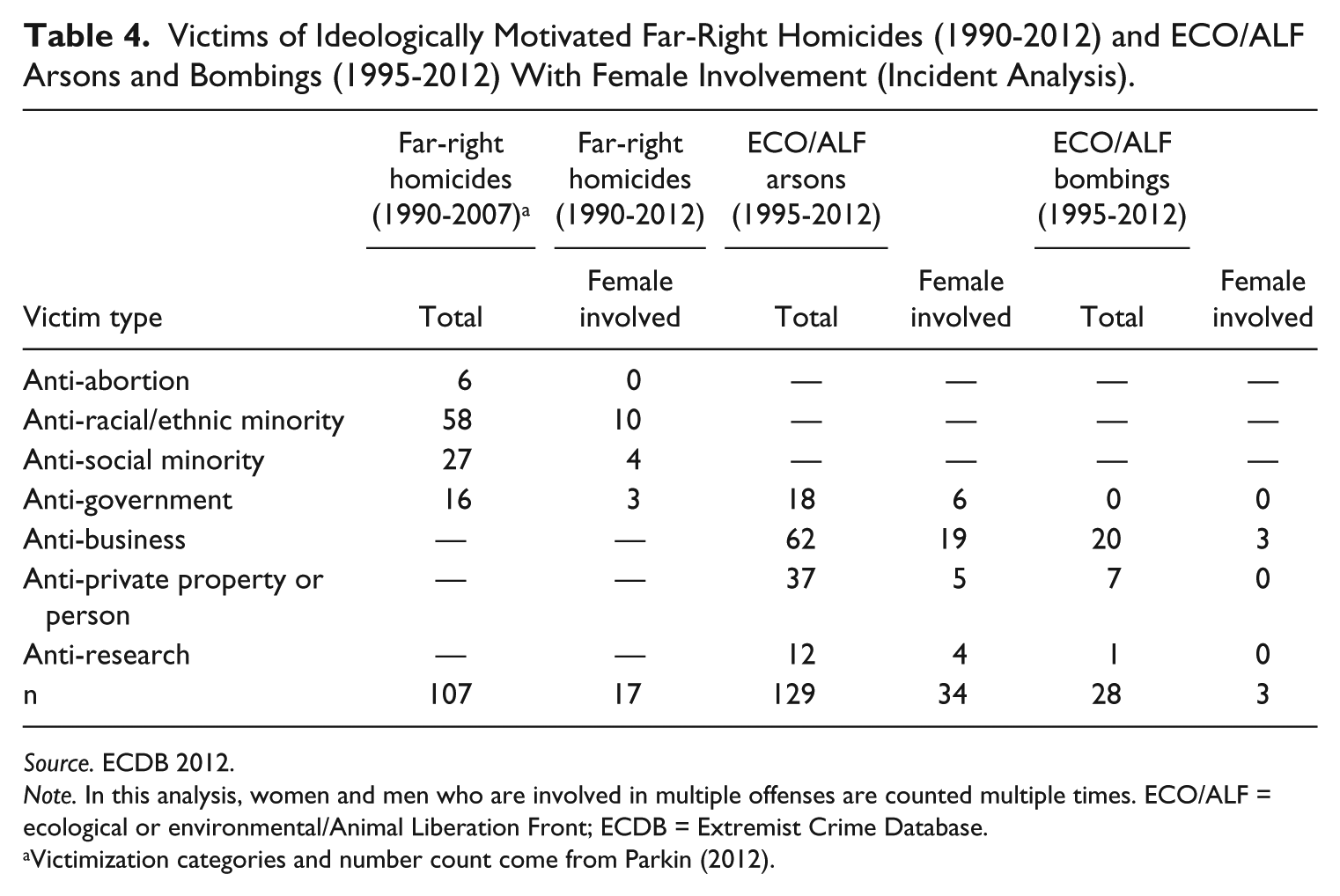
Source. ECDB 2012.
Note. In this analysis, women and men who are involved in multiple offenses are counted multiple times. ECO/ALF = ecological or environmental/Animal Liberation Front; ECDB = Extremist Crime Database.
Victimization categories and number count come from Parkin (2012).
Although our data on employment status and education were insufficient to be tested at this time, we note the vulnerability of younger far-right non-extremist collaborators who engaged in informal far-right group activity while homeless or living with significant others whose association implicated them in the terrorist incident. These findings partially support our initial hypothesis (H3). Our data showed that far-right women were younger on average than ECO/ALF women, but that non-extremist collaborators among far-right women were the youngest by far (there was a 10-year difference in the means between far-right non-extremist collaborators and ECO/ALF women). It is likely that the mean age was skewed because of a few cases of much older far-right extremist women who became involved in extremist crimes later in life. These observations suggest support for strain theory but require further testing.
Several of the far-right females were homeless and on the street (four, all non-extremists). This lends evidence to view homeless females as more vulnerable to being co-opted into violent crimes although they do not believe in the ideology (unlike the ones in gangs with homes to go to). Five out of 14 of the extremist perpetrators were involved in inter-gang violence or racial homicides to earn prestige within the gang. This makes the case of ideologically motivated females interesting because it might more closely approximate patterns for gang involvement. There were almost as many non-extremist far-right women involved in homicides as were extremist women. This finding lends support to criminological strain theory that would predict this young and homeless female population would be vulnerable to recruitment for extremist violent crimes.
Regarding victim data and H4, we refer to previously established categories of victims of extremist crimes (Parkin, 2012). The data confirm our hypothesis based on the findings of the SPLC (2004) and cited in Blee (2008) that women in the far-right did in fact victimize more racial minorities than government officials. We must also point out that the second-largest victim category “anti-social minority” actually included two gay homicides, two gang-related victims, and four who were either homeless, drug-users, or personal acquaintance bystanders (see Table 4). So actually the broad category of “anti-social minority” may not be fully appropriate for victims of ideological far-right extremist crimes where women are involved because there is a lot more situational volatility in who the victims are. This finding indicates that presented opportunities may explain the reality of actual versus intended victims of extremist crimes. We also recommend the possible addition of a “random bystander” category to the victim categorization of extremist crimes where women are involved. Beginning to analyze the nuances within a “random bystander” category of crime could help us understand why some “random” bystanders may appeal to extremists than others.
Regarding victims of ECO/ALF crimes where women were involved, we note that in all ECO/ALF cases, all bombings were anti-business corporations; the arsons were spread out among mostly anti-business (19 incidents) and anti-private property (4); a university professor was attacked (1); and either universities or businesses involved in research (4). Interestingly, there were no anti-abortion victims or targets where women were involved, as opposed to various incidents where men were perpetrators of anti-abortion violent crime.
Romantic and familial relationships were essential to female involvement, and we found that three mothers were extremists and two others were expectant mothers at the time of the incident. However, we did not find that contractual marriage relationships were significantly related to female involvement, partially disconfirming our expectations of far-right women in H3. The presence of female friends in all kinds of categories for women (far-right extremists and non-extremists as well as ECO/ALF extremists) is an original finding and its meaning needs further study. We partially confirm our original hypothesis that among far-right women, more non-extremists had a female friend involved than the extremists. However, 11 out of 16 ECO/ALF extremist women also had a female friend involved. Regarding H5, preliminary results show that ECO/ALF women were most likely to snitch or testify against other members, and then non-extremist far-right women were next likely to snitch. Far-right ideologically motivated women were least likely to snitch or testify against comrades, but the type of crime may also bear some effect on this phenomenon. Further testing is needed to confirm our preliminary results.
Discussion
In summary, all of our hypotheses were partially confirmed in the following manner:
Our findings show that women’s involvement in terrorism differs by ideology and crime type. Similar to male terrorists, females are affected by group-level effects such as the structure of the group and methods of operation. For example, we observe that several of the victims of far-right extremists in the United States were killed not as a result of ideological forethought but more as “presented opportunities” (Freilich & Chermak, 2009), the unintended casualties of unstructured time by aimless youth. Where somehow premeditated, the victims were often targeted within the group’s social network as part of a gang initiation. By this observation, it is difficult to categorically equate U.S. far-right female extremists with jihadi terrorists. However, in a way, their involvement expands our theoretical understanding of pathways to ideological violence and challenges theories that assume the effectiveness of ideological motivation for achieving its stated aims, or even offending its intended victims. Interestingly, we did not identify any female lone-wolf actors. Our findings, consistent with previous research on women in terrorism (Berko, 2012; Berko & Erez, 2005; Bloom, 2005; Galvin, 1983) but not discussed in the context of female criminality, highlight the main story of our study that relationships are essential to women’s involvement in terrorism, and that their involvement is made or broken through their misguided male and female acquaintances.
A critical finding for women involved in far-right extremist homicides is that relationships matter. Most of the female terrorists in our study were dating or married and often had a female friend involved in the crime. In addition, female terrorist offenders are not always effective in victimizing their intended hate group. Most of the victims of far-right extremist homicides where women were involved were racially motivated, but then, the next most vulnerable victims were social minorities (homeless or mentally ill) or otherwise seemingly random bystanders who served as convenient targets for gang-initiation activities. There was only one ideologically motivated homicide where a police officer was killed (although the perpetrators did not seek out the officer, the officer was killed in the line of duty), and one police officer was killed by a non-extremist collaborator (although here again, he was not the principal target, the officer was following up on a call for a break-in and was killed in the line of duty).
Among the ECO/ALF female terrorists involved with arsons and bombings, there were a number of multiple offenders. There were not enough non-extremist perpetrators for ECO/ALF to provide a meaningful comparison here. Regarding the victim discussion, ECO/ALF crimes do not neatly fit into the same categorizations for far-right victims of anti-abortion, anti-minority categories (Parkin, 2012). If anything, victims of ECO/ALF arsons and bombings constitute something of an “anti-economic majority.” Commercial developers, law enforcement, or government property are often the inadvertent victims. The victim analysis does not cut across ideology and makes them incomparable to the far-right.
Of the three bombings, one woman was involved with three other men and all were students at the same university, and the other two women involved in a separate incident were sisters. All three women involved with bombings had male accomplices and were ideologically motivated. Of the arson incidents (N = 34), seven women were repeat offenders, and five were involved in multiple offenses together. What appears to be true is that again, women were not lone-wolf arsonists, and where multiple offenses occurred, there tended to be more than one female involved. In one incident, it looks like three couples were involved (the nature of their relationship is unclear, but they worked in pairs of one guy and one girl or two guys and two girls). So again, the story of relationships is important for ECO/ALF terrorist women as well, although it is unclear how these relationships forged except for common interest activity groups on campus or as relatives of activists.
This study of female involvement in U.S. homegrown terrorism since 1990 advances female criminology because of the theoretical insights and original data findings. The use of a gendered lens with which to understand pathways to homegrown radicalization sheds light on the important nuances of inter-personal relationships and social networks that have not been counted so centrally to previous terrorism studies. An inter-disciplinary approach to the study of women in terrorism points out the importance of mediating social networks on creating opportunities for motivated perpetrators and a lack of capable guardians (Cohen & Felson, 1979) to result in victimization of targeted groups.
Although the story of relationships is most salient to the discussion of women involved in U.S. domestic terrorism, a discussion of the victims of far-right homicides and ECO/ALF arsons and bombings is also another important point of discussion. Among far-right extremist and non-extremist female perpetrators, the frequent cases of gang-related and inter-personal victims are notable. Women appear to be more involved in cases where the victims were not specifically targeted but rather were casualties of their affiliation with men or other female friends who were involved in violent far-right groups.
Perhaps related to the finding that there were no anti-abortion victims among the female perpetrated incidents, we find that religion is unusually silent as a social force in the commission of female extremist crimes. Various male extremists, particularly those whose targets were abortion clinics or practitioners, were found to be extremely zealous Christians or, among some racial homicides, were zealous members of the Christian Identity movement (unaffiliated with mainstream Christianity). However, despite the vast sociological literature that observes that women are more religious than men almost without exception, in the case of U.S. domestic extremist violent crimes among female perpetrators, religion seems to have no influence whatsoever. This non-finding of the importance of religion to political ideological extremism should influence future studies of women in terrorism more broadly to see whether religion can in fact serve as a counter-violent force, even among ideological extremists.
It is important to note the limitations of quantitative approaches to the study of female criminality, and of terrorism in general, even as we seek to fill in gaps in academic knowledge about women’s criminal involvement in terrorism as their participation increases. Thus, it is worthwhile incorporating qualitative interview data of former female terrorists to further this study. Unfortunately, open-source information on these perpetrators does not include the information needed to conduct more analysis of demographic variables at the perpetrator level such as education, employment, mental illness, history of domestic violence, or substance abuse. These variables and hypotheses should also be considered in future studies of female terrorists in the United States.
One suggestion for future research and exploration is to extend our analysis to women involved in financial terrorist crimes. Our study and the work begun by the ECDB project emphasize the academic need and policy imperative for more empirical and ethnographic research on female extremists in general. Another extension of the current study is to consider women’s involvement in foiled plots. Future studies should incorporate a multi-layered approach to the study of women in terrorism, combining national and organizational-level variables while including incident and perpetrator-level characteristics. Our article also uniquely contributes to the literature on the category of non-ideological (non-extremist) collaborators, and we suggest additional research incorporate this category of extremist criminals into their analyses. Future questions for exploration must continue to engage the female extremist as a keystone for understanding the problem of terrorism, wherever it is found.
Footnotes
Declaration of Conflicting Interests
The author(s) declared no potential conflicts of interest with respect to the research, authorship, and/or publication of this article.
Funding
The author(s) disclosed receipt of the following financial support for the research, authorship, and/or publication of this article: This research was funded by a series of research and education grants from the U.S. Department of Homeland Security (DHS) Science and Technology Directorate’s University Program Division and Resilient Systems Division both directly and through the National Consortium for the Study of Terrorism and Responses to Terrorism (START). The views and conclusions contained in this document are those of the authors and should not be interpreted as necessarily representing the official policies, either expressed or implied, of DHS or START.
Notes
Author Biographies
References
Supplementary Material
Please find the following supplemental material available below.
For Open Access articles published under a Creative Commons License, all supplemental material carries the same license as the article it is associated with.
For non-Open Access articles published, all supplemental material carries a non-exclusive license, and permission requests for re-use of supplemental material or any part of supplemental material shall be sent directly to the copyright owner as specified in the copyright notice associated with the article.
