



Abstract
For a study of occupational barriers, qualitative and quantitative data were generated from surveys collected from 168 women working in 34 federal law enforcement agencies and varying in race, ethnicity, age, rank, and tenure. All women report at least one occupational barrier in the workplace. Pervasive negative attitudes from male colleagues, lack of high-ranking female role models, and work–life balance issues prove to be the biggest barriers women face in federal law enforcement. Despite the obstacles, women not only persist against the challenges but also highlight the unique attributes of federal law enforcement to the policing research community.
Keywords
Introduction
According to the Bureau of Labor Statistics (2013), women account for 47% of all working Americans; however, they comprise just 15.5% of all sworn federal law enforcement officers 1 (Reaves, 2012). The percentages are even lower in state and local law enforcement. Women represent 12% of officers in local police departments, 11.2% in sheriffs’ offices, and 6.5% in state agencies (Hickman & Reaves, 2006a, 2006b). Despite the higher employment figure, women in federal law enforcement are the least visible of all women in policing, evident by the lack of existing research by feminist criminologists on gender and federal policing. At the same time, no women working as law enforcement officers today have endure greater barriers to equality than the women who work in federal policing. While women began their start in municipal police departments in 1908 (Horne, 2006), women’s entry into federal law enforcement did not occur until 1971 due to a number of discriminatory laws—not mere masculine tradition—that limited their full participation (Schulz, 2009).
Its origin was legislation enacted in 1870 and its 1934 interpretation that allowed federal agencies the option of selecting men or women regardless of merit for job vacancies (Markoff, 1972), resulting in few women filling positions traditionally occupied by men. Although Congress finally repealed the 1870 law in 1965 and Executive Order 11375 formally added sex to the other legally prohibited forms of discrimination in 1967, one additional roadblock remained—an exception granted by the Civil Service Commission in 1962 for “law enforcement jobs requiring the bearing of firearms” that continued to allow discrimination on the basis of sex (Martin & Jurik, 2006; Schulz, 2009, p. 676). It would take another 9 years before the Civil Service Commission finally canceled the “firearms” exception in 1971 (Hellriegel & Short, 1972; Markoff, 1972; Schulz, 2009). Only then do women become eligible for positions in the GS-1811 2 and other job series that require carrying a firearm. That year, the U.S. Secret Service and the U.S. Postal Inspection Service become the first federal agencies to swear in women special agents (Bumgarner, 2006). Other federal agencies quickly follow and by late 1972, the initial pioneers of female federal officers begin to emerge from training as special agents.
Women have now worked more than 40 years as special agents and in a variety of supervisory and management positions since the 1990s (Schulz, 2009). But it was not until 2002 that Teresa Chambers became the first woman to head a minor 3 federal law enforcement agency as the Chief of U.S. Park Police (Schulz, 2004). A year later, Karen P. Tandy became the first woman to head a major 4 federal law enforcement agency as the administrator of the Drug Enforcement Administration (DEA; Schulz, 2004). The selection of Michele M. Leonhart as Tandy’s deputy was also an important first since Leonhart, a career DEA special agent, was the first woman in her agency to come from the agent’s rank to fill a top management position (Schulz, 2004). Leonhart succeeded Tandy when the Senate unanimously confirmed her nomination as the new DEA (2010) administrator in December 2010. President Obama appointed another female director that month when Stacia A. Hylton became the 10th Director of the U.S. Marshals Service (2013) after 30 years of law enforcement and management experience. Like Leonhart, she too came up through the ranks starting her career in 1980 as a Deputy U.S. Marshal and would later hold several key positions (U.S. Marshals Services, 2013). Finally, in March 2013, after more than 30 years with the U.S. Secret Service, President Obama swore in Julia A. Pierson as their 23rd Director (Department of Homeland Security [DHS], 2013).
Most of these positions have a minimum entry requirement of a 4-year college degree. In comparison, a high school diploma is the educational requirement for 68% of all new recruit positions in state law enforcement, 81% of all new recruit positions in local police departments, and 89% for all new recruit positions in sheriffs’ offices (Hickman & Reaves, 2004, 2006a, 2006b). As women hold 58% of all undergraduate degrees in the United States (Wittenberg-Cox & Maitland, 2008) and more Americans pursue postsecondary education, those interested in a career in law enforcement with college degrees are likely to be drawn to federal over state and local police agencies. For these reasons and more, the women in federal law enforcement are worth exploring, especially as the percentage of women in federal law enforcement has increased only slightly when there was a vast increase in the overall number of federal law enforcement personnel in the past 10 years (Langton, 2010). In this article, we profile the women in federal law enforcement and explore eight occupational barriers common in federal policing.
Literature Review
Most of the feminist criminological research on women in law enforcement targets women police officers in state and local law enforcement. Only four studies exist whose target population examine female federal law enforcement officers. The first by Keverline (2003) on entry-level special agents’ persistence in federal law enforcement create a baseline of women’s experiences in federal policing. Her study of 280 sworn female federal law enforcement agents found that three particular factors influence women’s decision to remain in federal law enforcement—background factors, self-efficacy, and environmental factors. Environmental factors prove to exert the strongest influence, specifically in the areas of strong levels of social support, job satisfaction, tenure, commitment to their federal law enforcement agency, and few occupational barriers. Nearly 70% of the women in her study indicate a high probability they would remain in federal law enforcement despite personal, organizational, and male colleague challenges.
The second by Schulz (2009) was the first-ever study on women Special Agents in Charge. 5 She explores demographic and career path information about women middle managers in federal law enforcement agencies to establish a collective portrait of the first generation of federal law enforcement leaders. The 41 women in her study are overwhelmingly White, well educated, new to middle management despite having spent an average of 20 years in law enforcement, and on average 48 to 49 years old. Due to hiring and retirement patterns in federal law enforcement, many of the women were at or close to retirement age when they obtained their management positions. Interestingly, though overall hiring in federal law enforcement increased as a result of 9/11, the overall percentage of women in federal law enforcement remained relatively static; however, the numbers of women in middle management increased, suggesting these women in middle management were not doing enough to increase female representation in federal law enforcement. In addition, research by Blasdel (2010) on the examination of the glass ceiling effect identified barriers such as males’ refusal to accept females, gender stereotyping and bias, and the “good old boy” network as impediments to the career progression of female officers into middle management positions in federal law enforcement.
Finally, the fourth study by Barratt, Thompson, and Bergman (2011) research factors that influence women to pursue supervisory positions within their agencies. Their study of 74 female supervisors found that nine factors influence women’s decision to pursue supervisory positions: values, understanding, career, personal enhancement, organizational concern, impression management, family, women in federal law enforcement, and economic and personal reasons not associated with the job. Supervisors report that on average their current job satisfies them; however, their job was frequently more stressful and their work led to moderate amounts of conflict in their family/home. The researchers also survey 135 nonsupervisors to assess their desire to seek promotion into the supervisory ranks. Nearly 75% of the nonsupervisors have interest in seeking a supervisory position and of those numbers, 89% are willing to work longer hours and 83% are willing to relocate. In addition, 78% felt they have the knowledge, skills, and abilities to do the job and 59% want to take on more responsibility. Yet despite their interest in supervisory positions, they are unsure about the promotional opportunities within their organizations. These four studies join a series of employment figures published by the Bureau of Justice Statistics and a few articles and books chronicling women’s experiences in federal law enforcement that amass the small body of research on female federal policing.
A key research goal was to move beyond assuming that policewomen at all levels of law enforcement—local, state, and federal—are a homogeneous group and examine women’s occupational barriers only in federal law enforcement. However, as the original pioneers of women in policing, those early and current experiences by women in local and state law enforcement may draw parallels with those accounts by women in federal law enforcement. Since the creation of U.S. police departments in the mid-19th century, most people view law enforcement as a traditionally male occupation because of its association with crime and danger (Heidensohn, 1992; Horne, 2006). Although women have been active in police work since the 1840s as police matrons 6 (Lunneborg, 1980; Wells & Alt, 2005), women did not obtain arrest authority until some 60 years later. This set in motion decades of feminist research exemplifying women’s struggles to integrate into police agencies. What is clear, however, is that men and women enter law enforcement for similar motives (Meagher & Yentes, 1986; Schulz, 2004) but depart for different reasons (Fry, 1983; Keverline, 2003; Martin, 1980; Rabe-Hemp, 2008; Timmons & Hainsworth, 1989; Wexler & Logan, 1983). Women are not making quick exits from the profession but rather after several years of service (International Association of Chiefs of Police, 1998). This pattern seems to reflect problems not with recruiting or screening but with aspects of the job itself. What causes this turnover is not clear; however, eight factors in particular appear to be significant.
Feminist criminologists suggest that the single most significant factor for high turnover is the negative attitudes of male colleagues (Bloch & Anderson, 1974; Heidensohn, 1992; Hunt, 1984; Keverline, 2003; Martin, 1980; Martin & Jurik, 2006; Seklecki & Paynich, 2007; Timmons & Hainsworth, 1989; Wexler & Logan, 1983). Male police officers’ resistance to female officers has been well documented and despite changes to both the nature of policing and the status of women, many male officers continue to believe that women cannot handle the job physically or emotionally and therefore do not have the ability to exercise the moral authority of the state (Martin & Jurik, 2006). In addition, existing feminist criminological scholarship on police culture describe a distinct subculture that celebrate masculine values and a social structure that exist purposely and specifically to oppress female officers (Brown & Sargent, 1995; Dick & Jankowicz, 2001; Franklin, 2005; Hughes, 2011; Paoline, 2003; Waddington, 1999). Beyond the sexist attitudes of individual men, heavy drinking, crude jokes, racism, homophobia, and demands that women who enter it “subsume male characteristics to achieve social acceptability” characterize this work culture (Young, 1991, p. 193). A lack of promotional opportunities also strongly affects women’s rates of turnover (Fry, 1983). Men and women report the same desire for promotion, yet these opportunities are perceive by women to be less available to women than to men (Barratt et al., 2011; Blasdel, 2010; Horne, 1980). Furthermore, “quid pro quo” and “hostile” sexual harassment and sexual discrimination in terms of work assignments, promotions, and training opportunities are widespread throughout law enforcement (Barratt et al., 2011; Haarr, 1997; Hunt, 1990; Keverline, 2003; Martin, 1980; Martin & Jurik, 2006; Rabe-Hemp, 2008; Seklecki & Paynich, 2007). In a recent study by Rabe-Hemp (2008), all the female officers in her sample identified personal instances of sexual harassment, sexual discrimination, or disrespect that impeded their success and acceptance in police work.
Another factor for turnover is the lack of female role models (Poole & Pogrebin, 1988; Schulz, 2004). Feminist researchers argue that without the guidance and presence of female veterans in the workforce, younger female officers foster feelings of isolation in their organization (Wells & Alt, 2005; Wexler & Logan, 1983). In addition, agencies with higher percentages of sworn female officers and female administrative leadership provide female officers with greater promotional opportunities and aid with retention of female officers (Kranda, 1998; Martin, 1980; Schulz, 2004). Research also found that police agencies are not at pace with the private sector in implementing more family-friendly policies such as maternity/paternity leave, flextime to accommodate general family needs, and in-house day care options (Rabe-Hemp, 2008). Other family-friendly policies include accommodations for breast-feeding and other nursing care and the ability to stay in one location for an extended period of time without jeopardizing one’s career. Finally, though law enforcement employers are under no obligation to adopt more pregnancy-friendly policies except to provide them time to attend medical appointments (National Center for Women and Policing, 2001), existing research suggests women would leave law enforcement because their agency did not provide adequate support during pregnancy (Keverline, 2003). Any one of these eight factors can prevent women from continuing a career in law enforcement; however, given the range of issues, it may likely be a combination of factors, as well as the interrelationship between factors, that influence turnover decisions.
However, some women have careers in law enforcement and stay for many of the same reasons that men do, including salary and benefits, challenging and exciting work, and the opportunity to help others (Keverline, 2003; Poole & Pogrebin, 1988). These women likely face the same challenges as women who depart law enforcement; however, they perceive the challenges differently than those who left. Speculation exists that the challenges themselves may be the very reason why these women stay in law enforcement and the desire to prove they are just as good as men (Doerner, 1995; Poole & Pogrebin, 1988). Supporting this view, recent research found that female officers do feel equal to their male counterparts and “despite experiences of sexual harassment, discrimination, and disrespect, almost all believe they had achieved acceptance in their current agencies” (Rabe-Hemp, 2008, pp. 256-257).
The problem of employee turnover is an extremely costly one for law enforcement agencies (Fry, 1983). High rates of turnover could cost an agency directly in terms of recruitment, selection, and training, and indirectly by loss of productivity, reduced efficiency, transferring employees to fill vacancies, and disruptions in employee social networks that build morale (Lambert, Hogan, & Barton, 2001). As federal law enforcement agencies increasingly have to compete for quality candidates to reflect the diversity of the communities they serve, they must understand the challenges these women encounter in the work environment and implement courses of action to minimize the costs of turnover. Prior research has not fully considered the unique experiences of women in federal law enforcement. This study was designed to fill this gap.
Research Method
Sample
Observations made in this article are based on responses from sworn female federal law enforcement officers attending the annual Women in Federal Law Enforcement (WIFLE) Leadership Training Conference in 2011. This sample was chosen from this population for several reasons. First, the women attending the WIFLE Leadership Training Conference represent all the major federal law enforcement agencies in the United States, including all the professions in federal policing, and varied in age, rank and experience. Second, it ensured a large sample size was achievable to provide generalizable results. Finally, this sampling strategy followed a baseline study by Keverline (2003) on women’s persistence in federal law enforcement and allowed for comparative analysis on the findings. Of the 623 women who attended the conference, 196 responded to the study representing a 31.5% rate of return, an acceptable response for an exploratory study. Adopting a strict interpretation of sworn federal law enforcement officers, cases where the respondents were employed by federal law enforcement agencies but not in the capacity of a sworn federal officer (n = 28) were excluded from this study. This screening process resulted in a final sample (n = 168) for analysis. The richness of the data allowed for developing a complex picture of the experiences women face in federal law enforcement.
Surveys
Survey packets were included in the welcome folder for each conference attendee, containing an information letter describing the study and a solicitation for their voluntary participation. To increase reciprocity with potential study participants, the conference moderator framed the research as an opportunity to share past and present experiences in federal policing, affirming the importance of women’s perspectives. The 56-item survey asks both quantitative and qualitative questions about women’s identities and experiences on a variety of issues facing women in federal law enforcement. It covers three basic domains: demographic (e.g., age, race, education), occupational barriers (e.g., sexual harassment, sexual discrimination, lack of female role models), and other areas of interest (e.g., physical agility testing, firearms, work satisfaction). Not all survey items are covered in this article. The remaining data will be discussed in later research. Instructions for survey return were also in the information letter and all respondents were guaranteed anonymity and confidentiality.
Analysis
Survey responses were loaded into SPSS software to analyze the data. The first part collects responses to demographic variables using both open-ended and fixed-choice questions to describe the current status of women in federal law enforcement. Open-ended questions include respondents’ year of birth, number of children, employer, years of service at their current agency, total years of service in federal policing, and rank. Year of birth determines the respondent’s age to provide the mean age and range of the overall sample. Number of children determines the percentage of women with or without children and its mean number and range. Years of service at current agency and total number of years in federal law enforcement provide the mean and range of experience level in federal policing. Employer determines the number and type of federal agencies representative of this sample. Respondents’ employer was coded using the actual acronym of the agency. Rank provides a mean, median, and range of the sample’s occupational level in federal law enforcement. Rank was coded using GS-level or military rank from the most junior to the most senior: 5 (GS-5 or E-5), 6 (GS-6 or E-6), 7 (GS-7 or E-7), 8 (GS-8 or E-8), 9 (GS-9 or E-9), 10 (GS-10 or O-1), 11 (GS-11 or O-2), 12 (GS-12 or O-3), 13 (GS-13 or O-4), 14 (GS-14 or O-5), 15 (GS-15 or O-6), and 16 (Senior Executive Service [SES] or O-7 and higher). For those few agencies that did not utilize the GS pay scale, a missing code was in place for “Non-GS pay scale.” The remaining demographic variables utilize fixed-choice questions to further describe the sample and include sexual orientation, level of education, ethnicity, current relationship status, supervisory experience, and nonfederal law enforcement experience. Sexual orientation was coded: 1 (heterosexual), 2 (bisexual), and 3 (homosexual); level of education was coded: 1 (high school), 2 (some college), 3 (bachelor’s degree), 4 (master’s degree), and 5 (doctoral degree); ethnicity was coded: 1 (African American), 2 (Asian/Pacific Islander), 3 (Caucasian), 4 (Latina), 5 (Native American), 6 (Other), and 7 (Multiracial); current relationship status was coded: 1 (single), 2 (married), 3 (domestic partner), 4 (separated/divorced), and 5 (widowed); and law enforcement supervisory experience determined the percentage of women with supervisory experience and coded: 1 (yes) and 2 (no). Finally, the study determined whether respondents had any experience in either state or local law enforcement prior to working in federal law enforcement and coded: 1 (yes) and 2 (no). If the response was 1 (yes), respondents had a follow-up open-ended question to capture the number of years in state or local law enforcement to provide the mean and range of additional law enforcement experience.
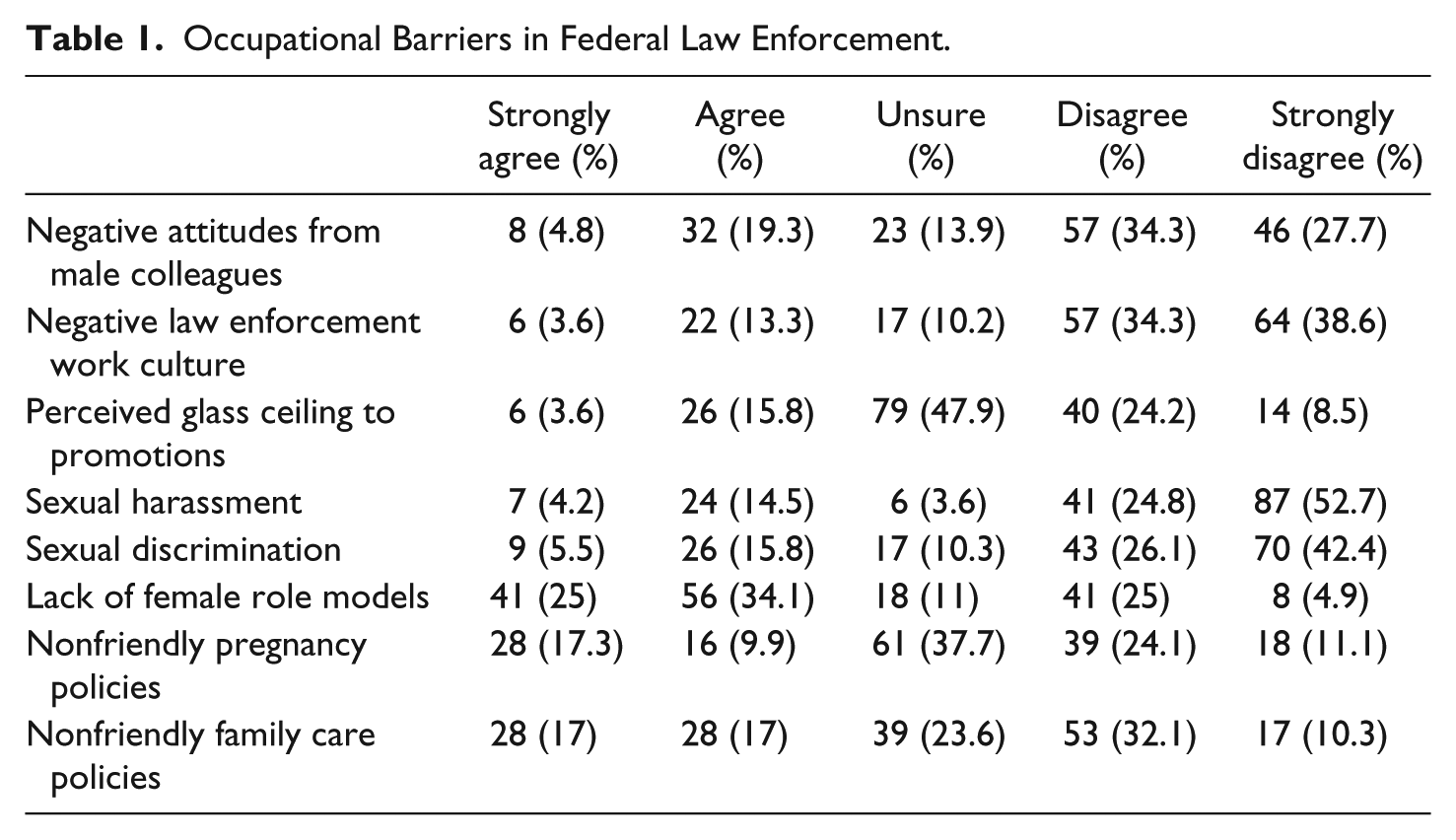
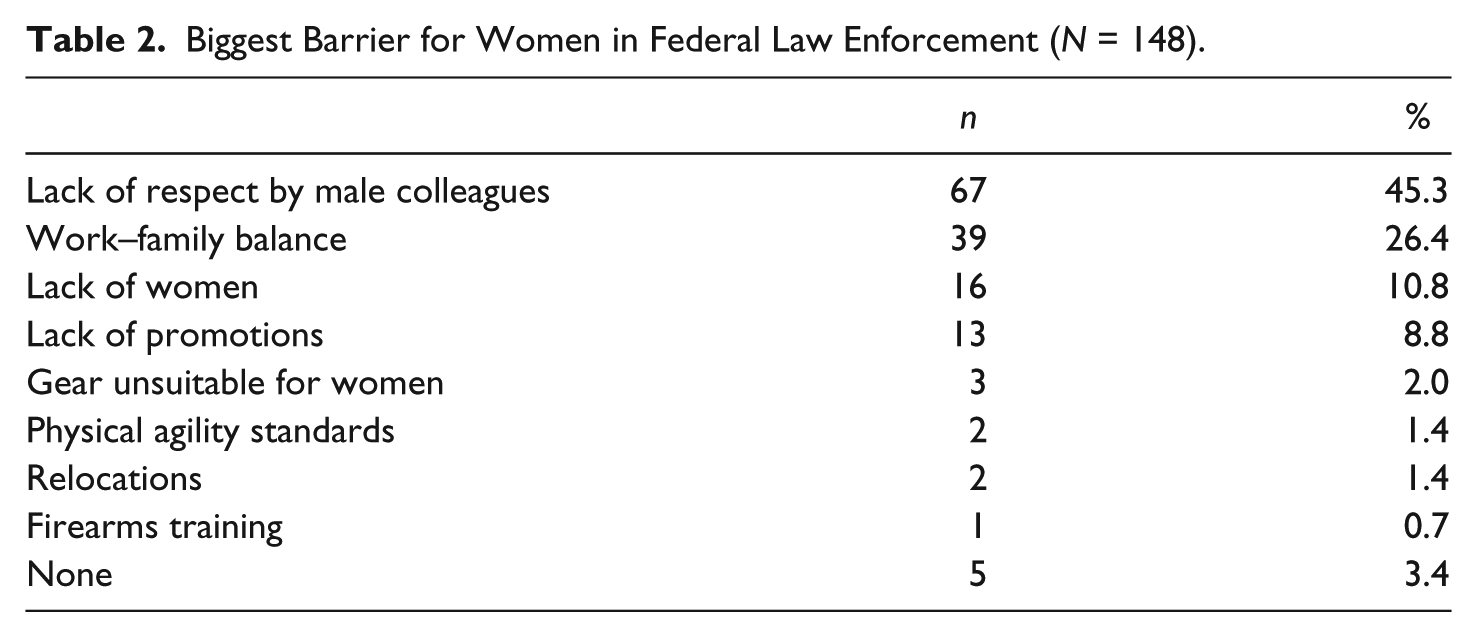
The remainder of the survey collect responses to actual experiences and opinions and use fixed-choice questions and statements to examine eight occupational barriers in the work environment—pervasive negative attitudes from male colleagues, a negative law enforcement work culture, perceived glass ceiling to promotions, lack of high-ranking female role models, sexual harassment, sexual discrimination, gender-specific obstacles of child care and gender-specific obstacles with pregnancy (Table 1). These barriers are measured using a 5-point scale and coded: 1 (strongly disagree), 2 (disagree), 3 (unsure), 4 (agree), and 5 (strongly agree). In an effort to identify new barriers to the study of gender and policing, a final survey item collects in open-ended format what respondents’ perceive to be the biggest barrier for women in federal law enforcement (Table 2). Responses are coded into specific themes based on researcher’s technical interpretation of the data.
Occupational Barriers in Federal Law Enforcement.
Biggest Barrier for Women in Federal Law Enforcement (N = 148).
Findings and Discussion
Analysis reveals a complex picture of the women in federal law enforcement. Some of the findings are consistent with existing feminist research on female police officers in local and state law enforcement while others are unique to federal policing. Data are divided into two areas. The first is demographic to describe the current status of women in federal law enforcement and the second describes respondents’ experience and opinion on occupational barriers in the work environment. These barriers are further partitioned by gender and work–life balance issues.
Demographics
Of the 168 women sampled, most identify themselves as Caucasian (54.5%) with Latinas (19.2%), African Americans (14.4%), and Asians (6%) also present. The survey respondents are 23 to 60 years old with a mean age of 39. More than half (64.9%) are married or had been married though less than two fifths (38.1%) have minor children at home. Of those women with children, the overwhelming majority (85.9%) had only one or two. The role of child rearing in the careers of professional women will be discussed in more detail later in the article; however, it is likely these women made sacrifices regarding family to pursue a career in federal policing. These women are educated with 84.5% having at least a bachelor’s degree and 26.8% having a master’s or higher. In comparison, only 36% of the overall general population of women aged 25 to 64 has a bachelor’s degree or higher in the United States (Bureau of Labor Statistics, 2013). The demographic makeup of this sample was comparable with previous feminist studies that found women in nontraditional occupations and law enforcement as primarily White, older, educated, unmarried, and had few to no children (Garrison, Grant, & McCormick, 1988; Keverline, 2003; Martin, 1980; Moore & Rickel, 1980; Schulz, 2009; Wexler & Logan, 1983). The sexual orientation of this sample is consistent with the U.S. population; 91.6% report being heterosexual, 1.2% bisexual, and 7.2% homosexual. More than half (58.7%) are mid-level officers (GS-13) or higher and 54.8% have supervisory experience. The sample represents 34 federal law enforcement agencies with all the major agencies present. The majority came from agencies within DHS, consistent with the fact that DHS employs more federal law enforcement officers than any other federal department (Hess, 2009). These women are experienced federal law enforcement officers having an average of 10.01 years at their current agency and 12.23 years total in federal law enforcement. An overwhelming 91.2% indicate they will remain in federal law enforcement assuming things in their personal life and work remain the same. These findings lent support to previous research that examines the relationship between tenure and retention (Keverline, 2003; Lynn, Cao, & Horn, 1996; Mitchel, 1981; Werbel & Bedeian, 1989). These studies found that tenure is positively related with intentions to stay with an organization. Finally, the majority (81.5%) of women in this sample had no prior experience in state or local law enforcement, lending support to a common misperception that federal agencies recruit from local law enforcement (Schulz, 2009). Of the 18.5% who did have prior experience in municipal policing, the mean response was 4.76 years. The reported average may be interpreted as an indication of the duration these women took to obtain a college degree, a prerequisite for employment in most federal agencies. As federal agencies are constantly looking for new and experienced recruits, this is certainly one area they will find a pool of qualified applicants, regardless of the misperception.
Gendered Occupational Barriers
In addition to demographics to describe the women in this study, the research sought to learn about their occupational barriers in the workplace. These barriers are separated into gendered occupational barriers and work–life balance occupational barriers. Gendered occupational barriers include pervasive negative attitudes from male colleagues, negative law enforcement work culture, perceived glass ceiling to promotions, sexual discrimination and harassment, and lack of high-ranking female role models.
The women in this study identify lack of respect by male colleagues as the biggest barrier for women in federal law enforcement. Of the respondents surveyed, 24.1% of the women report pervasive negative attitudes from their male colleagues. The results of other studies lend credibility to this finding. Keverline (2003) also found that the most salient challenge women face is male colleagues’ negative attitudes; these negative attitudes are pervasive, infect all aspects of work, and make it difficult for women to concentrate on performing the job at hand frequently leading to more harmful situations such as discrimination and harassment. In addition, Seklecki and Paynich (2007) report 39% of the women in their study were made to feel less welcome than their male counterparts. Similarly, 16.9% of the women in this study experience a negative law enforcement work culture at their agency. There is wide speculation on the nature and purpose of the police subculture. Some theorists posit the solitary, masculine police subculture is a dated vestige of the past, and modern police organizations have many different subcultures, each vying for resources (Wood, Davis, & Rose, 2004). Despite the fact that women represent 47% of the nation’s workforce, no police organization in the United States has female employment equal to that percent, suggesting if women do possess a unique subculture, it is subordinate in strength and power to the male subculture (National Center for Women and Policing, 2001; Rabe-Hemp, 2008). There is consensus that the sovereign police culture is a distinctive occupational subculture that celebrates masculine values which engender particular views of women, the nature of policing, and the roles for which men and women officers are believe to be most suitable (Dick & Jankowicz, 2001). The intrusion of women into the police subculture has the potential to change these norms, values, and customs and hence is met with great resistance (Hughes, 2011; Rabe-Hemp, 2008). Despite these challenges, the women in this study are not intimidated; 90.5% report they would not depart federal law enforcement as a result of this negativity. Their positive attitudes to overcome these challenges lend support to research put forth by Lent, Hackett, and Brown (2000) and Luzzo (1996) who suggest women in nontraditional occupations face challenges head-on, using them as self-tests and motivation. Other studies report similar results with women in policing, suggesting that the negative aspects of the job itself serve as built-in motivation for persistence and their need to prove they are just as good as the men (Doerner, 1995; Keverline, 2003; Poole & Pogrebin, 1988; Seklecki & Paynich, 2007).
In addition to male colleagues’ resistance, women appear to face a glass ceiling to promotions, and the progress up the career ladder is slow. Of the respondents surveyed, 19.4% of the women in this study perceive a glass ceiling to promotions with an additional 47.9% unsure of the promotional possibilities at their agency. In the past decade, 2003 was a strong year for women in the top echelons of all levels of law enforcement; more received appointments or won elections for sheriff than in any other single year (Schulz, 2004) and President Bush appointed the first female director to lead a major federal law enforcement agency. But of the approximately 200 women chiefs of police and 30 women sheriffs in the United States in 2004, they make up only 1% of the law enforcement chief executives in the nation (Schulz, 2004). Interestingly, the similarities between men and women chiefs of police and sheriffs are striking except in education; the women chiefs and sheriffs are exceptional in their educational levels, each having a master’s degree or a juris doctorate (Schulz, 2004). Initially, this appears positive; however, at second glance, it may suggest that women experience a double standard and are expected to have more credentials for the same position. On the federal side, the numbers are better but only 3 women—DEA Administer Leonhart, U.S. Marshals Service Director Hylton, and U.S. Secret Service Director Pierson—lead a major federal law enforcement agency, out of 25, employing at least 500 or more full-time officers with firearm and arrest authority. Rabe-Hemp (2008) provides an explanation as to why there are not that many women in high-ranking positions. She argues family and child care issues play a larger role in women’s decision to forego early promotional opportunities than they do for men; this reflects a preference by women to stay in their current assignment and job shift (Schulz, 2004; Whetstone & Wilson, 1999). Skipping the first promotional opportunity may put a female candidate as much as a decade behind in making rank, possibly precluding any chance to be considered for executive-level positions later in her career (Schulz, 2004). It would be of interest to researchers to learn the exact career paths and familial arrangements of Administrator Leonhart, Director Hylton, and Director Pierson. There is no research on the characteristics of the federal police chief executives to discern any difference between male or female directors or administrators.
Due to the masculine nature of policing, it comes as no surprise that more than 40% of the women in this study identify instances of sexual discrimination or sexual harassment. Despite efforts to curb discrimination particularly in the federal sector, 21.3% of the women in this study experienced sexual discrimination in regard to work assignments, promotions, and training opportunities at their current agency with 43% having experienced sexual discrimination at one time or another throughout their career in federal policing. Of note is the enlarged number of respondents who experienced sexual discrimination during their career (n = 66) in comparison with those (n = 35) who experienced sexual discrimination at their current agency, suggesting almost half the women did so at their former agencies and perhaps led to their decision to transfer to another agency. A unique aspect of federal policing is the ability to apply and transfer to another federal agency without fear of losing time toward retirement in federal service. With the Federal Law Enforcement Training Center (FLETC) serving as the interagency law enforcement training organization for 89 federal law enforcement agencies, and more than 100 federal agencies throughout the federal domain, male and female federal officers can apply to any one of these agencies (with few exceptions) having acquired the prerequisite training. This begs the question whether certain federal agencies are more attractive to female officers and vice versa. Keverline (2003) also report one third (38.2%) of the women in her study experienced sexual discrimination. Despite the higher figure in this study, only 21.2% of the women made a formal report in comparison with the 48.2% who filed complaints in Keverline’s study. It is unclear what the implications of the decrease in reporting may imply. Do women still fear retaliation or being ostracized by peers and supervisors, or does it reflect a common perception that nothing will be done. Similarly, 18.7% of the women in this study experienced sexual harassment at their current agency with 39.8% of the women having experienced sexual harassment at one time or another during their career in federal law enforcement. This percentage is less than the numbers (48.9%) Keverline reports in her study of female federal law enforcement officers and much less than the rates (63%) Hunt (1990) reports in her study of 72 female officers in local law enforcement. However, the percentages are higher than two recent studies that report less than 30% of the women in their study experienced sexual harassment (Barratt et al., 2011; Seklecki & Paynich, 2007). Of those who experienced sexual harassment, only 19.7% made a formal report. This is a stark decrease from 68.2% who reported the incident to their supervisor in Keverline’s study. The much lower response in reporting is troublesome and again, difficult to interpret. Do alleged victims fear reprisal or are the women more “thick-skin” in federal law enforcement? Regardless of women’s reactions, such harassment is problematic. It is a significant source of stress and isolates women from male colleagues and divides women (Haarr & Morash, 2005; Texeira, 2002; Wells & Alt, 2005; Wexler & Logan, 1983). Although many women officers experience sexual harassment, they do not appear to unite or take action to press for change (Martin & Jurik, 2006).
As for female role models, 59.1% of the women in this study perceive there are not enough high-ranking female role models at their agency and report an average of only 2.81 female role models at their current agency. In addition, of the 33.5% who report having a mentor at their agency, only 40% are female mentors. The general lack of female representation in federal law enforcement likely contribute to the low numbers, but this is one area administrators can use the findings of this study and implement policy actions to minimize the perception of limited female role models. One initiative assigns every new female officer entering an agency with a female mentor to enhance job satisfaction and occupational success. Other suggestions include placing more women in special duty assignments to highlight women’s contributions within an agency and proactive efforts to ensure at least one woman receives a training slot for every training opportunity that becomes available. By placing value on women’s presence in the workplace, female officers become part of the informal networks that are essential to the police culture (Martin, 1980; Wells & Alt, 2005; Wexler & Logan, 1983). Without female role models, junior female officers may foster feelings of isolation in law enforcement organizations. A number of state, regional, national, and international associations exist to give support to female officers, but the organization that solely promotes the population in this study is WIFLE. Incorporated in June 1999, WIFLE (2009a) is an outgrowth of an interagency committee from the Departments of Justice and Treasury. Their mission is to promote gender equity through its leadership education center that provides training, research, scholarships, awards, and networking opportunities in partnership with law enforcement agencies, their members, and supportive sponsors (WIFLE, 2009b). Due to the decentralized nature of federal law enforcement, nongovernmental organizations such as WIFLE provide women-focused training opportunities and afford female attendees an avenue not only to meet and network with their peers but also receive words of wisdom and mentorship from high-ranking female federal officers who also attend these training opportunities (Yu, 2014). Any policy initiative or venue to highlight high-ranking female role models will positively contribute to the recruitment and retention of women in this underrepresented field.
Work–Life Balance Occupational Barriers
Next to lack of respect by male colleagues, the women in this study identify work–life balance as the second biggest barrier for women in federal law enforcement. Work–life balance occupational barriers include lack of family-friendly care policies and lack of pregnancy-friendly policies at the workplace. One third (34%) of the women in this study perceive a lack of family-friendly care policies at their agency, and 31.7% indicate they would leave their agency as a result of inadequate support with family obligations. The results of other studies lend support to this finding. Keverline (2003) also found work–life balance as a significant barrier in federal law enforcement. Almost half (44.2%) of the women in her study report they would depart their present agency because their agency’s policies did not provide adequate support in raising a family; 25.7% would depart for inadequate support in caring for elderly parents. Much attention is given to the role of child rearing in the careers of professional women (Chambers, 2003; Hewlett, 2002; Valian, 1998). In today’s society, women continue to be the primary caregiver, making employment with shift work especially difficult (Rabe-Hemp, 2008). Unlike municipal policing, shift work is common in federal law enforcement and for junior officers, frequently work weekends, holidays, and nights (Damp, 2008). By law, federal special agents and inspectors receive law enforcement availability pay (LEAP)—equal to 25% of the agent’s basic pay—because of the large amount of overtime that these agents work and the expectation to carry their firearm and exercise their arrest authority whenever necessary (Damp, 2008). Likewise, travel and frequent transfers are common practice in federal law enforcement. No other profession, other than the military, requires relocations for career advancement. The women in this study had a mean response of 1.61 (SD = 1.831) permanent relocations ranging between 0 and 10 transfers. Similarly, the women had a mean response of 1.31 (SD = 1.824) business trips lasting longer than 3 months with a range of 0 to 15 trips. Had the researcher collected responses to shorter travels (e.g., 1-2 weeks), the numbers would have been significantly higher. Altogether, such occupational requirements impede family obligations. In addition, police agencies have not kept pace with the private sector in implementing more family-friendly policies such as maternity/paternity leave, flextime to accommodate general family needs, and in-house day care options (Rabe-Hemp, 2008). Other family-friendly policies include the ability to stay in one location for an extended period of time without jeopardizing one’s career and providing accommodations for breast-feeding and other nursing care. Due to the decentralized nature of federal law enforcement, a presumption exists that some federal agencies do have family-friendly policies; however, as a whole, there is no data to suggest federal law enforcement agencies promote family-friendly policies. Strategies to retain more women in federal policing must include policies that promote a flexible work environment. One such policy recommendation involves a maternity leave program separate from sick leave or vacation leave. If women do not have sick leave or exhaust all their vacation leave, they are “on leave without pay” status. Federal law enforcement agencies should adopt maternity leave programs similar to New York Police Department (NYPD) and the military. Female military members and NYPD officers automatically receive 6 weeks of paid maternity leave separate from sick leave or vacation leave. In addition, male military members receive 10 days of paid paternity leave when their wives give birth. Adopting this initiative in federal law enforcement sends the message that federal agencies support raising a family. Another policy proposal is telecommuting or domicile agents (agents who work from home full- or part-time). Due to variations among federal agencies, the application of this initiative is unrealistic for all agencies but for those with streamlined functions, working from home benefits women (and men) with family responsibilities. Both proposals support women raising a family early in their careers and help balance work–life issues.
Likewise, 27.2% of the women in this study perceive a lack of pregnancy-friendly care policies at their agency and 30.7% indicate they would leave their agency because of inadequate support during pregnancy. The Pregnancy Discrimination Act (PDA) of 1978 prevents law enforcement agencies from discriminating against its employees due to pregnancy, childbirth, or related conditions unique to females (Kruger, 2006). The Family and Medical Leave Act (FMLA) of 1993 provides pregnant women the right to take up to 12 weeks of leave without losing one’s job; however, neither law encourages employers to accommodate pregnant workers in ways that allow them to make realistic and productive choices about their work during pregnancy, because neither requires an employer to make accommodations for a woman whose work abilities may change because of pregnancy (Kruger, 2006). Specifically, the PDA does not require law enforcement employers to offer maternity benefits to make it easier for pregnant women to continue to work during pregnancy and to return to work after delivery, and the FMLA does not require law enforcement employers to accommodate pregnant employees, except to provide them time to attend medical appointments, or be absent from work with or without pay for limited periods of time. Several nongovernmental organizations have challenged this issue. The National Center for Women and Policing (2001) suggest police agencies adopt more pregnancy-friendly policies that include light duty assignments and safety measures during range qualifications without jeopardizing the female officer’s career. The International Association of Chiefs of Police produced a Pregnancy Policy for State and Local Officers, and WIFLE published their own Pregnancy Guidelines for Federal Law Enforcement, to provide guidance to the appropriate decision maker concerning work-related assignments involving pregnant law enforcement officers (Campbell & Kruger, 2011; WIFLE, 2011). Both policies provide options for a pregnant law enforcement officer to remain working in a full-time capacity performing full-duty assignments or alternative duty assignments, for as long as reasonably practical, while still protecting the property interest she has in her job and the risks inherent in the performance of her duties. The unique environment that federal law enforcement agencies operate under today may allow for the incorporation of some of these guidelines into official policy, but not in all cases. Agency resources may impact some of the guidelines and other considerations may have to be taken into account before a consistent policy is implemented. In either case, federal agencies themselves will independently choose to adopt or ignore pregnancy-friendly care policies.
Limitations
The present study is not unique in its research limitations. First, the sample represents those women who only attended the WIFLE Leadership Training Conference. This limits the sample frame of possible women in federal law enforcement that might have been part of the study and may therefore not be representative of all sworn female federal law enforcement officers, but there is no reason to believe a particular group or subgroup was excluded from attending the conference. In addition, the single wave of data collection at the WIFLE Leadership Training Conference may also limit the representation of all sworn female federal officers. Second, responses relied on the self-reporting of the participants. As all participants have unique characteristics, different orientations, and different perceptions, there may be some reporting bias; however, as the researcher has knowledge and technical understanding of federal law enforcement, the survey used appropriate technical language. In addition, the researcher pretested the survey with two individuals who were familiar with federal law enforcement and one without to minimize bias or misinterpretation. Finally, because these women chose to attend the WIFLE Leadership Training Conference or were sent by their respective agencies as an award for outstanding performance, they were likely committed to their careers and may have shown bias in their responses.
Future Research
As with many exploratory studies, the current research has expanded knowledge but has led to additional questions that present opportunities for further inquiry. Many of the women surveyed had experience working in at least one other federal law enforcement agency prior to their current agency. This leads to further questions such as why they left their first agency and does that agency have a reputation for high turnover? In addition, what is attractive about their current agency? Are some agencies more supportive of their female officers than others? The answer requires looking beyond overall figures in federal law enforcement and focus on human resource practices and unique organizational cultures of individual agencies. Exit interviews is one tool to analyze why female officers depart federal policing; however, federal law enforcement agencies have not been forthcoming with providing the names of their former female employees for reasons such as the Privacy Act, and most certainly to preclude any potential embarrassment for the agency. Feminist scholars may consider contacting the DEA, U.S. Marshals Service, or the U.S. Secret Service whose recent appointment of female directors may be more cooperative with the research community. While the current analysis was intended as an exploratory examination of women in federal law enforcement, it also lays the foundation for setting apart women’s police experiences between municipal policing and federal policing. Future research should examine the wide range of job opportunities, as well as specialty occupations beyond those of traditional policing, unique to federal law enforcement. Although federal policing is the smallest of the three law enforcement platforms, this future research agenda is important because the federal government employs law enforcement personnel in more than 40 job series and the percentage of women in federal policing has increased only 9% when there was a 45% increase in the overall number of federal law enforcement personnel between 1998 and 2008 (Reaves, 2012; Reaves & Hart, 2000).
Conclusion
All policewomen identify at least one occupational barrier that may impede their success in federal law enforcement. As long as women in federal policing continue to idle around 15.5%, no amount of organizational “sensitivity” training will likely change the masculine identity of law enforcement. Federal agencies must create an organizational culture that does not tolerate harassment and discrimination and implement policies that highlight women’s contribution in this male-dominated field. In addition, while there is basis for feminist criminologists to concentrate on municipal policing, the fact remains that federal law enforcement differs from local and state police agencies, and varies considerably from agency to agency. Without consideration of the unique characteristics of federal agencies, it becomes impossible to determine why women in federal law enforcement are underrepresented. The results of other studies failed to portray the unique experiences of federal officers, instead presenting women’s narratives of resistance as a homogeneous group. Such articles are missed opportunities to educate and highlight women’s contribution in federal policing. It is my hope that this article will encourage dialogue between researchers and the federal agencies and those recommendations for increasing women’s participation will be disseminated on a national level.
Footnotes
Author’s Note
Portions of this article were presented at the 13th Annual WIFLE Leadership Training Conference, Orlando, Florida, June 28, 2012.
Declaration of Conflicting Interests
The author(s) declared no potential conflicts of interest with respect to the research, authorship, and/or publication of this article.
Funding
The author(s) received no financial support for the research, authorship, and/or publication of this article.