




Abstract
Many scholars argue that intimate partner violence is too complex to address through the “one-size-fits-all” approaches that are common in most criminal justice venues. Instead, they advocate for coordinated approaches that address the unique circumstances of each offender. For 3 years, El Paso County ran a “Pilot Program,” which applied in-depth analytical tools to tailor court orders to each defendant. The program, to which offenders were randomly assigned, ran parallel to the county’s “one-size-fits-all” program, providing a rare opportunity to assess the efficacy of each approach. We find the Pilot Program significantly increased compliance and reduced the likelihood of recidivism.
In Michael P. Johnson’s (2008) words, “It makes no sense to treat intimate partner violence as a unitary phenomenon” (p. 72). Iovanni and Miller (2001) have similarly asserted that domestic violence is a complex problem, requiring a “coordinated response from the entire criminal justice system” (p. 308). To that end, R. L. Davis (2008, p. 257) has suggested the use of “diverse and individual assessments” toward more effective treatments. Despite these and many voices calling for more nuanced criminal justice responses, a one-size-fits-all approach is still common in most criminal justice venues (Henning, Martinsson, & Holdford, 2009). In Colorado, for example, the state, until recently, allowed very little judicial discretion in intimate partner violence (IPV) sentencing, requiring a minimum of 36 weeks counseling and payment of court costs for virtually everyone found guilty of a misdemeanor. Occasionally, defendants are required to make payments to compensate for material damages, but other than that, the results in court, defendant after defendant, are amazingly similar. In fact, a recent review found that the minimum sentence had become, in practice, a largely uniform, one-size-fits-all flat sentence of 36 weeks of counseling (Gover, 2011).
This is a particularly important issue for feminists, as many of the regulations that have developed over the years around IPV-related criminal justice procedures have led to better outcomes for women accused of and/or victims of IPV. Most notably, “must arrest” policies for police officers and “no-drop” policies in the courts were developed as Americans took IPV more seriously, seeing it as a public rather than a private problem, and one that deserved to be treated as a crime. On the contrary, a number of unintended consequences also arose, as these policies led to more women arrested as perpetrators, even when fighting back in self-defense (S. L. Miller & Iovanni, 2007), while others felt disempowered through the arrest of their partners, with no opportunity to request that the charges be dropped (Epstein, 1999). In other words, a “one-size-fits-all” approach with strong mandates has helped women in many ways, but has harmed them in others.
This study examines the El Paso County (Colorado) courts, where a special program was created to better diagnose the problems of IPV defendants toward more appropriate sentencing and, ultimately, better treatment and less recidivism. For just over 3 years, the “Pilot Program” of the El Paso County courts treated each defendant as a unique and complicated individual, and applied in-depth analytical tools toward understanding the fullness of each case. While this was only possible in a few courtrooms (as an experimental, small scale, pilot program) and only for a few years, enough data were collected to make for an interesting study in alternative IPV criminal justice response. The State of Colorado eventually put a stop to the program, stating it was not in compliance with state law that required standardized case management across the board. Interestingly, in the years that followed, the State revised its standards in the direction of some differential treatment of offenders based on risk assessment. These changes, as we note in the discussion section, fall short of the holistic assessment undertaken in the Pilot Program. In the study that follows, we address the following questions: Does a program that assesses the unique circumstances of each IPV defendant and tailors court orders accordingly result in better outcomes than a one-size-fits-all approach? More specifically, do case-specific treatment options for IPV defendants result in greater compliance with court orders and less IPV recidivism, as compared with a uniform approach? Our findings support calls for a more nuanced approach. We end by discussing the implications of our study for the criminal justice system’s response to IPV.
Literature Review
IPV has a distinctively short history in the American criminal justice system (Henning et al., 2009). It was not until the 1960s that family violence began to be viewed as a crime, leading to a wave of legislative reforms through the 1970s and 1980s.
Laws differed state to state, and the details are too complicated to recount here (see N. Miller, 2000, for more on this history), but some fairly universal reforms were needed across the board, especially the removal of warrantless arrest bans on misdemeanors, the establishment of civil and temporary protective orders, and the creation of specific statutes for family violence offenses (Buzawa & Buzawa, 2003). Many statutes, such as mandatory and preferred arrest and “no-drop” policies, were aimed at curbing the discretion of police, prosecutors, and even victims, who had been requesting the dismissal of up to 80% of cases (Buzawa & Buzawa, 2003; Gover, 2011; Henning, Renauer, & Holdford, 2006). Judicial discretion, too, was targeted through uniform sentencing and treatment guidelines for offenders (Bohm, 2006; B. D. Johnson, 2005; Ulmer, 2012).
What has largely resulted is a one-size-fits-all approach to IPV response, regardless of gender, which clearly works for some, but definitely not for all (Pence & Dasgupta, 2006). While the criminal justice system’s handling of IPV is better than it was 50 years ago, some question whether the pendulum may have swung too far. Robert Bohm (2006) went so far as to call this phenomenon “McJustice,” using Ritzer’s (1993) well-known concept of McDonaldization as applied to the criminal justice system. Even beyond the earlier movements that pursued a more serious community response to IPV through mandates, there has been a more general effort to increase bureaucratic efficiency. With growing numbers of cases, and a desire for uniformity and fairness which bypasses individual biases, the courts have developed rules, regulations, and structures toward greater control over all sentencing (Bohm, 2006; Ulmer, 2012). Although small “windows of discretion” (B. D. Johnson, 2005, p. 762) remain in some jurisdictions and in regard to some crimes, sentencing overall is highly regulated (Tonry, 1996).
The regulation of the criminal justice system’s handling of IPV took place amid a debate as to whether IPV is a gendered phenomenon. Some have argued that IPV should be conceptualized as a problem of family violence more generally, not as inherently gendered (Morse, 1995). Steinmetz (1977), in her article titled “Battered Husband Syndrome,” argued that there was gender symmetry in IPV—that women and men were equally likely to engage in violence. Until then, IPV was widely understood as a gendered problem—that is, male batterers beat female victims, with few exceptions. Shelters were founded by and for women, hospital emergency rooms treated mostly women victims, and the criminal justice system dealt with primarily violent men. Steinmetz and others (Straus & Gelles, 1999; Straus, Gelles, & Steinmetz, 1980) who claim gender symmetry base their conclusions on data collected using an instrument called the Conflict Tactics Scale (CTS) in which participants, drawn from the general population, were asked about acts of violence they and their partners had committed toward one another. In fact, almost all studies (see Graham-Kevan & Archer, 2003, as one exception) done using this instrument, and its later editions, find that women and men commit IPV equivalently (Fiebert, 2004; Loseke & Kurz, 2005).
Many feminist scholars have criticized the claim of gender symmetry as well as the CTS instrument, arguing among other things, that the CTS does not account for the contexts and consequences of IPV (Melton & Belknap, 2003). As to contexts, men often have not only the physical advantage in a heterosexual relationship but also the economic edge as well. A woman therefore may tolerate a violent partner because she cannot support herself and her children otherwise. She therefore may underreport his violence, as she accepts it as simply an inevitable part of her situation. As to consequences, no one disagrees—women experience numerically more violence, and more serious injuries from IPV than do men. For every man hospitalized for IPV, there are 46 women hospitalized (Straton, 1994), and in fact, a full 40% of women’s emergency room visits are due to IPV (Loseke & Kurz, 2005). Feminist research has focused on statistical data found in police reports and court and hospital records, as well as interview data collected at shelters, sources that allow them to understand the contextual and consequential factors. In short, those who critique the CTS say that making claims to equivalency without considering context endangers the many women who all too regularly report their victimization through the criminal justice route.
Feminist critiques have extended to one-size-fits-all approaches to IPV. The unintended consequences of these laws and uniform guidelines have raised critical concerns among both scholars and practitioners. For one, arrests of women have risen along with those of men, accounting for up to 25% of arrests in some jurisdictions (Henning et al., 2006). Some (Archer, 2000; Fiebert, 2004; Steinmetz, 1977; Straus, 2009; Straus & Gelles, 1999) have asserted that much IPV is indeed bidirectional, in which case the arrest of both parties is warranted. Others (Dobash, Dobash, Wilson, & Daly, 1992; M. P. Johnson, 2008; Kimmel, 2002; Kurz, 1995; Loseke & Kurz, 2005) have claimed that women use violence differently, very often in self-defense. In such cases, arrest and subsequent sentencing can be harmful, as these victims may not turn to the police regarding a future violent incident. Belknap, Melton, Denney, Fleury-Steiner, and Sullivan (2009) observed that victims of IPV found the police and courts to be the least supportive among all possible sources of social and institutional response. Still other research (Gover, Paul, & Dodge, 2011; Toon & Hart, 2005) has discovered mixed feelings among police officers regarding the lack of discretionary power regarding this crime as opposed to others. This animosity has been used as one possible explanation for rising dual arrest rates, as officers say they simply arrest both parties and allow the court to determine who was at fault (Henning et al., 2006).
In addition, some feminists worry about the autonomy that is taken from victims when they are not allowed to assert themselves in requesting that charges be dropped (Epstein, 1999). This can be experienced as the same kind of disempowerment they have felt in their homes. Where the perpetrator once controlled the victim, now it is the police and then the prosecutor, operating under tight guidelines that allow for little or no discussion about individual needs or desires (Epstein, 1999). Going ahead with prosecution may endanger progress made in ending a relationship or reaching a mutually agreed upon child custody agreement. Undocumented immigrants may not want to risk deportation for themselves or their partners, or ostracism from fellow immigrants who are trying hard to abide by the law. Victims then assert themselves in the only way that they can—by refusing to testify. This then results in a backlog of “bad” cases, fewer convictions, and lower victim satisfaction (Buzawa & Buzawa, 2003).
M. P. Johnson (1995, 2005, 2008), responding to the long-standing debate about gender and IPV, sought to move the debate forward by creating a typology of offenders that acknowledges some of the complexity that previous research had failed to notice. Specifically, M. P. Johnson (2008) posed a model with three major types of IPV to describe the various kinds of violence that are reported, both in crime reports and in general survey data. At the center of the model is the issue of control. Intimate terrorism, what most of us think of when we hear “domestic violence,” is used by people who want to control their partners—it is marked by coercive tactics, intimidation, and threats, all undergirded by real and frightening physical and sexual violence that makes future outbreaks not only possible, but probable (M. P. Johnson, 2008). This kind of IPV is perpetrated primarily by men. Victims of intimate terrorism fear for their safety, and when ready to seek help, reach out to shelters, the police and courts, or they show up injured at emergency rooms. These victims provide the data for the feminist research noted above. The second major type is situational couple violence, which is probably the most common, and that which is uncovered by the CTS. In these moments, violence breaks out between partners due to a specific situation, such as the loss of a job. While both partners may act violently, neither has the goal of controlling his or her partner, so a pattern of coercion and fear is usually not present. This is where gender symmetry is very likely to be found (M. P. Johnson, 2008). The third main type is violent resistance, marked by reactive violence toward a partner, more popularly known as self-defense. In such situations, the primary aggressor is the controlling partner (an intimate terrorist), while the violent response is enacted as a resistance to the event, or perhaps as part of an attempt to escape it (M. P. Johnson, 2008).
M. P. Johnson’s (2005) typology has generated numerous empirical studies attempting to assess and refine the typology (Drumm, Popescu, & Riggs, 2009; Graham-Kevan & Archer, 2003, 2008; Henning et al., 2006; Renauer & Henning, 2005; Swan & Snow, 2002; Warner, 2010). Overall, the typology has received much support and helped contribute to calls for an end to the one-size-fits-all approach, which has been ineffective at reducing recidivism and failed to alleviate overburdened dockets (Renauer & Henning, 2005). Calls for differential treatment in IPV cases thus emanate from a number of different perspectives. Some feminist scholars see one-size-fits-all approaches as insensitive to the gendered nature of IPV and men and women’s different circumstances and involvement in IPV (Melton & Belknap, 2003; Muftic & Bouffard, 2007). Others emphasize the need for treatments to better reflect risk assessments of offenders (Henning & Feder, 2004; Jones, Heckert, Gondolf, Zhang, & Ip, 2010; Piquero, Brame, Fagan, & Moffitt, 2006). Even here, though, there is debate as to which risk assessment instruments are valid. A variety of domestic violence risk assessments have been developed to help guide treatment and sentencing guidelines (Dutton & Kropp, 2000). Some such instruments, originally designed for male offenders, are applied to female offenders. Feminist scholars have questioned whether such gender-neutral risk assessments “may risk inattention to essential programming for women” (Van Voorhis, Wright, Salisbury, & Bauman, 2010, p. 262).
M. P. Johnson (2008), for his part, has called for judicial responses that are sensitive to the type of violence and the broader circumstances, including gender, which undergird each case. Making a specific plea to the courts on this point, he has made the argument that
judges and prosecutors presumably have more time than police at the scene to gather such information; as these distinctions work their way through the justice system, they will begin to play a more visible part in decisions regarding “alternative” sentencing, such as mandated batterer treatment. (M. P. Johnson, 2008, p. 77)
This research presents the results of one such alternative model—an analysis of a specific program, which attempted to treat defendants differently, assessing their violence, not just as an isolated criminal incident by a generic offender, but in a more holistic way, such that more appropriate and comprehensive treatments could be applied.
To those outside of IPV response work, it may seem obvious that different people might commit different kinds of IPV-related crimes based on varied motives, complicated by numerous other personal and social problems, all of which might dictate varied sentencing and treatment options, but this has not been the case in most courts. Strict guidelines, first instituted as an improvement over former laissez faire attitudes, now define the commonly followed police and court processes and are normative almost everywhere. Alternatives are neither obvious nor even officially permitted in many arenas. Responding to M. P. Johnson’s (2005) invitation, through even the consideration of “alternative” paths, can be complicated (Petrucci, 2010, p. 155), and even alleged to be illegal, as in the case of this Pilot Program.
El Paso County: The Pilot Program
In Colorado’s El Paso County, arrests of women represent 24% of all IPV arrests, higher than the national average of about 20% (Murphy-Geiss, 2005). Leaders in the police department and in the District Attorney’s office were aware of these numbers, and some noticed, at least anecdotally, that a good number of the women appearing in court as defendants seemed to be primarily victims. It has been suggested that in places where there are high numbers of dual arrests, the police may be, in effect, choosing to let the courts determine culpability (Hirschel, Buzawa, Pattavina, & Faggiani, 2008). On the other side of the continuum, it seemed that some of the worst offenders seemed to have multiple problems that were not being addressed through the standard processes. For example, it has been suggested that the large minority (38% in one study) of cases that include alcohol and drug abuse is sufficiently large to warrant the consideration of addiction problems in domestic violence courts (Petrucci, 2010).
As a result, the District Attorney’s office instituted what was known as the “Pilot Program,” inspired in large part by the work of M. P. Johnson (2008). In one courtroom, to which defendants were randomly assigned through the regular process of rotating judges every 10 weeks, twice a month, all defendants were assessed through a more in-depth process, involving psychological testing and analysis for potential substance abuse. In addition, a more detailed history was collected on each person through interviews and research of court records. Each defendant spent more time than usual with special staff members, trained in these assessment techniques. While these tools are sometimes used after conviction for guidance in determining appropriate sentences, in the Pilot Program, they were used before trial and with all defendants, to aid the lawyers and judges in seeking more informed outcomes when working on plea bargains and motions/hearings. While the specific diagnostic findings of the various assessments were not available for this research due to confidentiality agreements, the resulting sentences that grew from them were. Whereas in most courts, defendants who pleaded guilty were given the state set 36 weeks of domestic violence counseling and only that, the Pilot Program defendants were given additional and/or alternative sentencing requirements suited specifically to them, including parenting classes, anger management sessions, substance abuse treatments, additional weeks of domestic violence classes (up to 52), or in a very few cases, dismissal. While concern about women being arrested for defending themselves was part of the motivation for this program, once identified, they were not simply dismissed; these defendants (mostly women, but not all) were assigned to more appropriate group or individual counseling programs, separated from those for more classic “batterers,” as suggested by M. P. Johnson (2008).
This study is informed by critiques, both feminist and other, of the one-size-fits-all approach to IPV that has emerged in many states and jurisdictions. Specifically, we assess the impact of El Paso County’s Pilot Program on both sentence compliance and recidivism, relative to the state’s one-size-fits-all approach at the time. The findings speak to the need for a more comprehensive approach to assessing IPV offenders and assigning more appropriate, often differential treatments.
Method
Through a post hoc, two-group posttest-only experimental design (Neuman, 2012), this study assessed the impact of the Pilot Program on two measures of effectiveness, compliance, and recidivism (the dependent variables), comparing IPV defendants processed through the Pilot Program and those processed through the regular courts (the main independent variable). Data for all 466 Pilot Program defendants were collected, along with comparative data for a random sample of 958 cases from the same time frame (July 2005-October 2008), a number assuring a representative sample of the whole (95% confidence level, ± 3), consisting of 9,534 total cases (466 Pilot defendants and 9,068 in the sampling frame for the comparison group) over that time period. Thus, our sample consisted of 1,424 cases. Names and case details were obtained through password-protected online court records, provided through the El Paso County District Attorney’s office. Occasional minor errors (birth date or race entered differently on two different cases for the same person) were found in the records, but as these are the official court records, we accepted the records as mostly accurate, while making corrections in our database when possible. Data collected included a number of demographic variables, such as age at arrest, gender, race/ethnicity, as well as variables related to the case, including actual sentence, compliance with said sentence, and whether a repeat offense appeared on the defendant’s record.
Dependent Variables
We analyze the impact of the Pilot Program on two outcomes—compliance with court orders and recidivism. Compliance was coded as 1 for full compliance (all requirements completed and case closed) or 0 for court recorded lack of compliance, which was often accompanied by a revised sentence or a shift from a diversion program to a regular guilty verdict. Of our 1,424 cases, 868 were coded as having complied or not. The remaining cases were either still in process (81—case still open, but defendant still within the time allotted for completion, sometimes with subsequent court dates noting appropriate progress toward completion) or dismissed (469—due to court decision and 3—due to death) and were coded as such in the database, but not included in the analysis of compliance. The 472 cases dismissed constituted almost 33% of cases, the overwhelming majority of which were in the control group, as only 6 (1.3%) of the Pilot Program cases were dismissed. Why so many dismissals? The regular process requires a plea offer of 36 weeks domestic violence counseling, which is anticipated by defendants and often rejected, and the case set for trial. After that, any number of eventualities (no victim, no witness, the dropping of this charge in favor of others, and so on) can occur that lead to dismissal of the entire case or that charge in particular. Here, the Pilot Program is clearly doing a better job, retaining the overwhelming majority of defendants, which we credit to the personalization of the sentencing. This comparison was not a focus of this study, but certainly warrants further research.
Recidivism was coded as 1 if a person had a repeat offense during the time frame of the study (2005-2008) that led to a conviction and 0 if no subsequent IPV conviction occurred during that time. Of the 1,424 cases in our sample, 1,239 were coded as having repeated or not. An additional 25 people had cases pending at the time of data collection while another 160 had been arrested, but had their case dismissed or the defendant was acquitted. Unfortunately, court data are limited and do not provide an account of the relationship between an arrest, actual charges, those dropped in plea agreements, and eventual convictions. Because we cannot know whether the pending cases will result in a conviction, or if dismissals were allowed because of good progress on a current sentence (as opposed to “not guilty”) or some confusion about a restraining order, or any number of other possibilities, only the categories of 1 (yes) and 0 (no) were included in the final analysis. While this definition of recidivism could result in a bias in favor of earlier cases, due to the time required to reach conviction, the problem is a small one, as only 25 persons, or 1.8% of the entire sample, had pending cases. As noted above, a relatively small number of cases were dismissed or acquitted (n = 160, 11.2%); the reasons for those decisions are far too numerous to list, and could introduce far more “noise” into the data than the possible bias problem presents. Most important, all persons in both the Pilot Program and the control group were coded in this way, so any bias should be equivalent across the groups. In fact, pilot and control groups were not significantly different from one another in their likelihood of having dismissed/acquitted or pending cases. Finally, the experimental design of the program helps to mitigate any temporal factor in recidivism, as random assignment resulted in the Pilot Program and control groups, in the aggregate, having similar opportunities (time-wise) to repeat within the time frame of the study.
Independent Variables
Our primary independent variable of interest is the Pilot Program status. Defendants randomly assigned to the Pilot Program were coded as 1, while defendants in the control (one-size-fits-all) group were coded as 0. In addition, in analyses assessing the mediating role of compliance in the Pilot Program—recidivism relationship—we include compliance as an independent variable.
Control Variables
Because it has been established that gender and age are associated with criminal recidivism rates, that is, women and older people tend not to reoffend as much as men and younger people (Barkan, 2006; Clark, 2011; Gendreau, Little, & Goggin, 1996; Henning et al., 2009; Renauer & Henning, 2005; U.S. Sentencing Commission, 2004; Wooldredge & Thistlethwaite, 2002), we included measures of both. In the case of age, we dichotomized offenders, classifying as “older” those who were 35 year or older at the age of arrest. We also incorporate a race/ethnicity variable, allowing us to compare Black, Hispanic, Asian American, and Native Americans to their White counterparts. There were very few Asian Americans (23) and Native Americans (13) in the sample, so they were combined into one group labeled “other.”
Analyses
We begin by reporting the relative percentages and frequencies for variables used in the analyses. We then assess the association between the Pilot Program status and both compliance and recidivism using chi-square tests of independence. We follow that with multivariate logistic regressions, which allow us to estimate odds ratios for the Pilot Program status while controlling for sociodemographic predictors. Finally, we use logistic regression and a binary mediation test to assess the degree to which the relationship between the Pilot Program status and recidivism is mediated by compliance.
Results
Table 1 reports observed frequencies and relative percentages for compliance, recidivism, and sociodemographic factors in both Pilot and Control Groups. With respect to compliance, we see that the Pilot Program participants have a compliance rate of 76.8%, compared with control group participants at 49.9%. A chi-square test of independence shows a moderate, statistically significant association between Pilot Program status and compliance, χ2(1, N = 868) = 66.647, p = .000, φ = 0.2771. On recidivism, the Pilot Program had a rate of 12.2%, compared with 20.7% for the control group. A chi-square test of independence shows a statistically significant negative association between Pilot Program participation and recidivism, χ2(1, N = 1,239) = 13.498, p = .000, φ = 0.1044. In short, Pilot Program participants did noticeably better on both outcomes compared with those in the control group.
Percentages in Pilot and Control Groups by Compliance, Recidivism and Demographics.
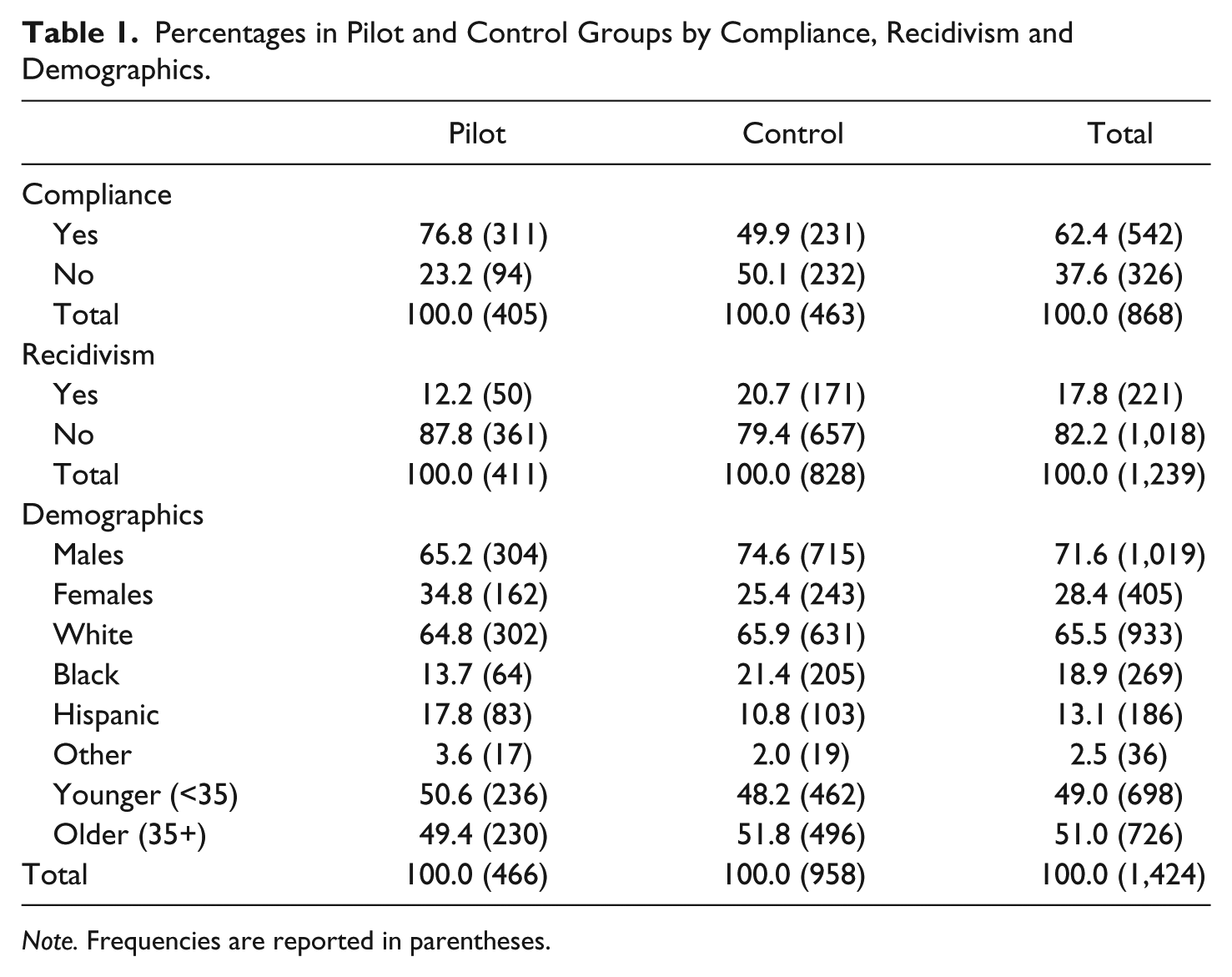
Note. Frequencies are reported in parentheses.
Although offenders were assigned to the Pilot Program through regular and identical random selection, we do see in Table 1 some differences in composition based on gender and race/ethnicity. Females and Hispanics are somewhat overrepresented in the Pilot Program, whereas Blacks are underrepresented. As gender, age, and race/ethnicity have all been linked to compliance and recidivism, we control for these factors in the subsequent logistic regression models. Table 2 presents the odds ratios and confidence intervals for models run on both compliance and recidivism.
Odds Ratios for the Effects of Pilot Program and Sociodemographic Factors on Compliance and Recidivism.
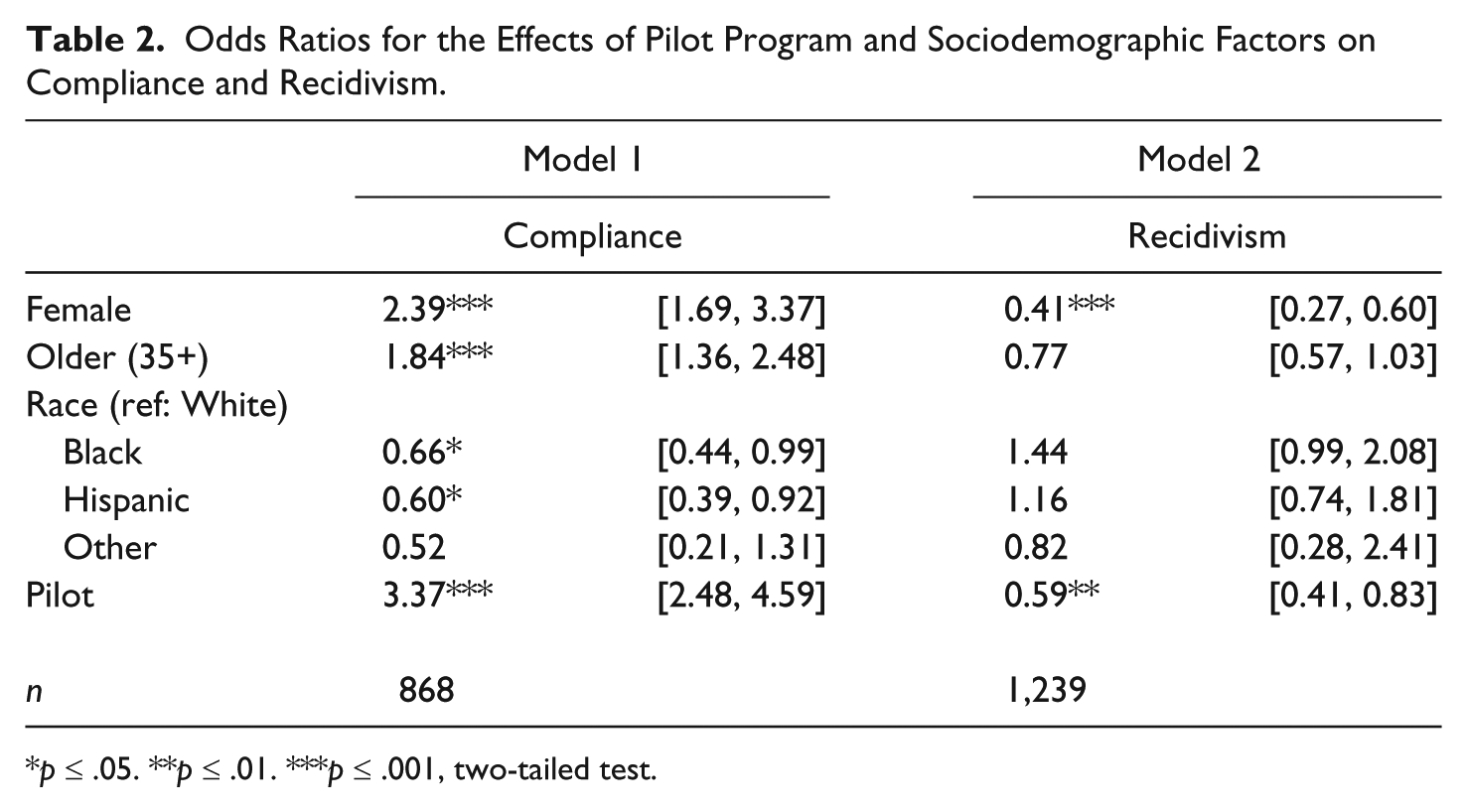
p ≤ .05. **p ≤ .01. ***p ≤ .001, two-tailed test.
Model 1 shows Pilot Program participants to be 3.37 times more likely to comply than those in the control group, controlling for sociodemographic factors. This odds ratio and its significance level is largely unchanged from a model including only the Pilot Program variable (OR = 3.32; model not shown). Among the sociodemographic factors, we see statistically significant effects for gender, age, and race/ethnicity. Females were 2.39 times more likely to comply than males. Older participants (35 year and above) were 84% more likely to comply than their younger counterparts. Finally, Blacks and Hispanics were 34% and 40% less likely to comply, respectively, than Whites.
Model 2 shows a significant negative effect of Pilot Program participation on recidivism. Specifically, compared with the control group, Pilot Program participation resulted in a 41% reduction in the likelihood of recidivism. The effect is similar to that from a model including only the Pilot Program variable (OR = 0.53; model not shown). As for the sociodemographic control variables, a significant effect is found only for gender. Females were 59% less likely than males to reoffend. No significant independent age or race/ethnicity effects are observed.
In sum, the Pilot Program has a statistically significant effect on both compliance and recidivism, even when controlling for the anticipated predictors of gender, age, and race. The sociodemographic composition of the Pilot and control groups, though slightly different, did not account for the Pilot Program effects. More specifically, Pilot Program participation had the strongest positive effect on compliance. In the case of avoiding recidivism, the Pilot Program makes a notable difference, trailing only gender in effect size.
Finally, given the Pilot Program’s effect on both compliance and recidivism, we assess the possible mediating role compliance plays in the relationship between the Pilot Program and reduced rates of recidivism. As others have noted, compliance is often a strong predictor of recidivism (Babcock & Steiner, 1999; R. C. Davis & Taylor, 1999; Murphy, Musser, & Maton, 1998; Olver, Stockdale, & Wormith, 2011; Shepard, Falk, & Elliott, 2002). Compliance does in fact have a highly significant negative association with recidivism in our data, χ2(1, N = 776) = 100.238, p = .000, φ = −0.359, a finding that conforms to the literature. Among those that complied in our sample, only 6.6% reoffended in the time period in question. That compares to a recidivism rate of 34.5% among those who did not fully comply. To discern what mediating role, if any, compliance plays in the Pilot Program-recidivism relationship, we reran the recidivism model but included compliance as an independent variable. The results are presented in Table 3.
Odds Ratios for the Effects of Pilot Program, Compliance, and Sociodemographic Factors on Recidivism.
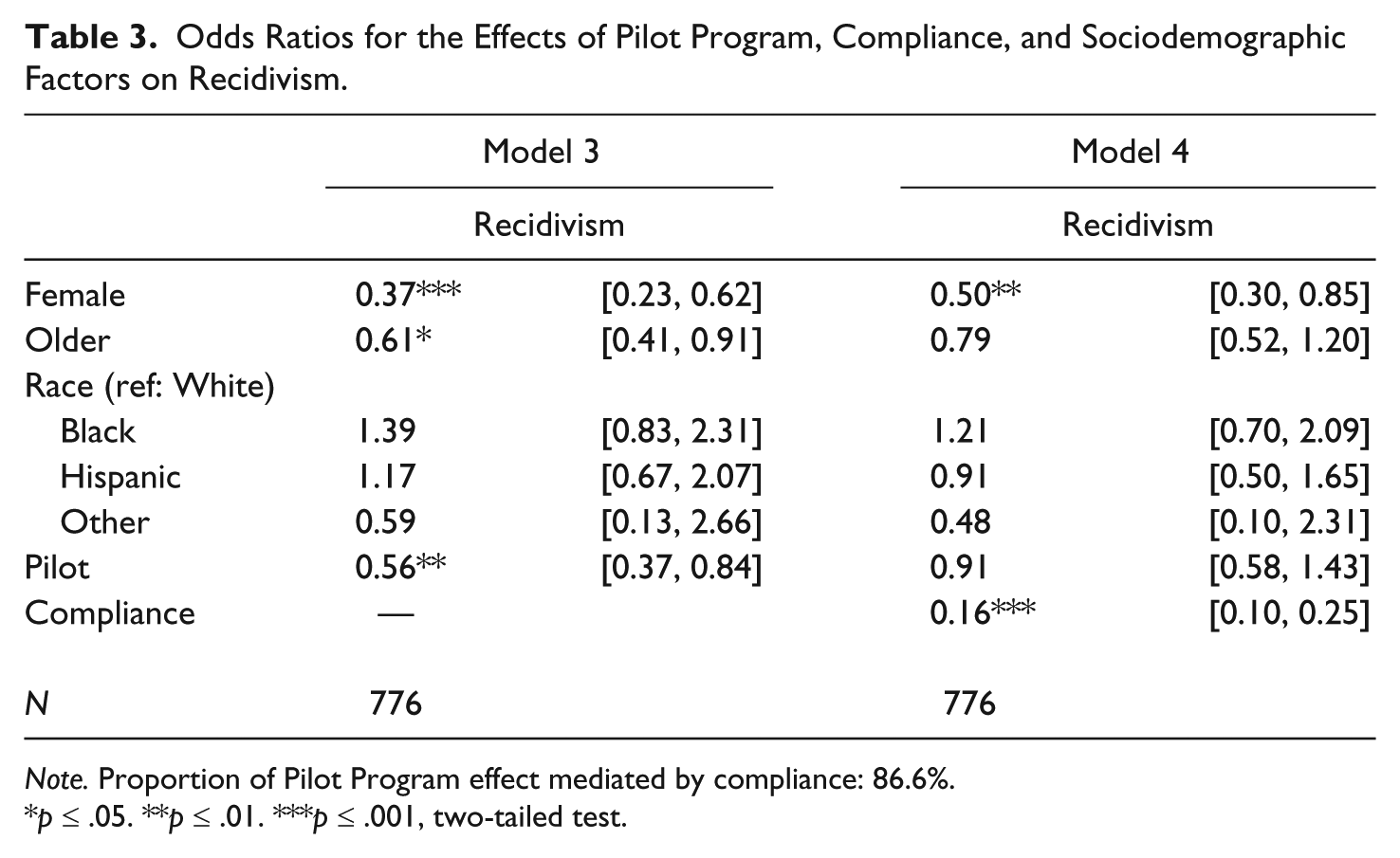
Note. Proportion of Pilot Program effect mediated by compliance: 86.6%.
p ≤ .05. **p ≤ .01. ***p ≤ .001, two-tailed test.
Due to a change in sample size caused by the inclusion of the compliance variable (missing data resulted in a sample of 776), we first replicate the recidivism model from Table 2 on the smaller sample. Despite the change in sample size, the results in Model 3 mirror those in Model 2. Pilot Program participation and gender have significant negative effects on the likelihood of recidivism. Females were 63% less likely to reoffend than males and Pilot Program participants were 44% less likely to reoffend than those in the control group. Model 4 incorporates the compliance variable, which is found to have a significant negative effect on recidivism. Specifically, offenders who fully complied were 84% less likely to reoffend. Gender retains its significant effect, with females being 50% less likely to reoffend than males. As for mediation, including compliance in the model causes the Pilot Program effect to noticeably decrease in size and drop from significance, indicating a strong mediating role for compliance in the Pilot Program-recidivism relationship. Indeed, a binary mediation test, used to assess direct and indirect (mediated) effects in logistic regression, found 86.6% of the Pilot Program effect on recidivism to be mediated by compliance. In sum, the Pilot Program, either through its tailoring of sentences and programs to the unique circumstances of offenders, or simply due to the special attention defendants experienced, significantly increased compliance and, in doing so, significantly reduced recidivism.
Discussion
The El Paso County Pilot Program was effective in both increasing compliance with the courts and diminishing repeat offenses. The impact was strongest with respect to compliance, though we may only offer some suggestions as to why the Pilot Program achieved its impact. Perhaps the sentencing that was derived through the more intense evaluation was considered more appropriate by the defendants themselves, so they saw the benefits of the treatment and stuck with it. Perhaps it was that the assessment was more holistic, making for more comprehensive treatment that addressed multiple problems. Lynch, Fritch, and Heath (2012) found that women in prison responded better to interventions that were integrated and that responded to their multiple issues. Those who worked with the defendants proposed that it may not have been the treatment itself, but simply the special handling that made the difference. That is, some defendants stated that this was the first time that they felt their issues were taken seriously, which may have led to their taking similarly serious attention to completing the sentencing requirements. This seems in line with Iovanni and Miller’s (2001) finding that defendants who felt they were treated fairly by the criminal justice system were less likely to reoffend. No matter the reason, a more individualistic, nuanced approach to dealing with IPV offenders appears to result in better compliance outcomes.
The impact of the Pilot Program on recidivism was not as great as that of gender, but there was a significant, notable effect. A binary mediation test found the Pilot Program’s ability to reduce recidivism rested significantly on the mediating effect of compliance. This finding resonates with other studies pointing to the association between compliance with court orders and reduced recidivism in domestic violence (Babcock & Steiner, 1999; R. C. Davis & Taylor, 1999; Murphy et al., 1998; Olver et al., 2011; Shepard et al., 2002). If the courts can focus on tailoring court orders to defendants and their unique circumstances, compliance rates should increase, resulting in a decrease in recidivism.
With respect to the larger issue of highly regulated (“one-size-fits-all”) sentencing versus more individualized assessment and treatment, our findings strongly support the latter approach. It appears that something about more thorough assessment and more considered treatment options has an impact, although it is unclear exactly how. Still, such real-world experiments as this can be hard to administer. In this case, the state actually declared the program illegal and stopped it because the flexibility it allowed around sentencing was out of bounds in relation to state-mandated sentencing guidelines. While such guidelines can be helpful in some ways, especially in reducing judicial bias that could lead to overly light sentences (an ongoing concern for feminist researchers and activists who work with victims), they can also be irrational in their rationality (Bohm, 2006). That is, strict regulations can wind up limiting possible improvements in a system, while maintenance of the system itself becomes the new end goal. It is our suggestion that individualized programs, such as the one assessed here, be allowed under the supervision of legislatures and sentencing commissions, such that experiments toward improvement may be tried, but also closely monitored regarding application, and carefully assessed as to effects.
It is important to note that offender treatment standards have changed in Colorado in the direction of more differential treatment for offenders since the conclusion of the Pilot Program at the center of this study (Gover, 2011). As the Pilot Program was underway, Colorado’s Domestic Violence Offender Management Board (DVOMB) initiated a review of the state’s “one-size-fits-all” standards, inquiring whether they were supported by current research. Drawing on risk assessment research (Campbell, Webster, & Glass, 2009; Douglas & Skeem, 2005), the DVOMB developed an instrument to determine an offenders’ risk level—the Domestic Violence Risk and Needs Assessment (DVRNA)—which is then used to recommend a level of treatment (Gover, 2011). Depending on the offender’s score, he or she is recommended for one of three levels of domestic violence treatment (A = lowest, B = medium, C = highest). It is important to note that treatments are differentiated only in length, not kind. There is no distinction made, for example, between batterers and other categories of violence (e.g., reactive or responsive, situational).
Thus, while the revised standards do indeed move Colorado away from its previous “one-size-fits-all” approach, there are important points of distinction to be made between them and the Pilot Program. Specifically, the Pilot Program considered more closely the nature of the violence (e.g., coercive intimidation as compared with other forms of violence). Risk and lethality were considered in the Pilot Program, as they are in the revised standards, but were only one component in the evaluation. The premise of the Pilot Program was that not all offenders or cases of domestic violence are the same (M. P. Johnson, 2008; Pence & Dasgupta, 2006). Rather, the Program viewed domestic violence offenses as a collection of various motives, circumstances, and meanings and sought to apply differential treatment accordingly. While the revised standards now adjust length of treatment based on assessment of risk and in this respect provide for one form of differentiated treatment, they do not assess cases and offenders with the same degree of comprehensive nuance as the Pilot Program. As such, our analysis of the Pilot Program remains informative in that it assesses an approach to differentiated treatment still not present in Colorado law or standards. As DVOMB is legislatively mandated to continually revise Colorado’s standards based on emergent empirical information (Gover, 2011), future research should assess how Colorado’s revised processes of assessment and differentiated treatment standards impact outcomes relative to the one-size-fits-all system of the past as well as the Pilot Program at the center of this study.
Also important in regard to differential treatment are the implications for women. First, although this study does not speak directly to M. P. Johnson’s (2005) theory that various types of IPV are gendered, it does support the notion that women and men react differently to arrest and subsequent court procedures. Women are significantly more likely to comply with court orders and less likely to reoffend than men. Among other things, this reflects the often gendered circumstances of those arrested in IPV cases. In dealing with such cases, courts should be sensitive and adaptive to such circumstances. Whether that is attention to self-defensive IPV, or the power of individual over group therapy, or something else, we are unable to say. Future research should engage such questions.
Subsequent studies should also be more deductive in the testing of theories, M. P. Johnson’s (2005) typology as related to differential sentencing and treatment programs in particular. Because we used M. P. Johnson’s (2005) work after the fact, as a way to understand differences in a real court setting, as opposed to beforehand in the design of the study, we are limited in what we can say in regard to his work. Our inductive approach was dictated by the applied research question in this case study, but M. P, Johnson’s (2005) call for more individualized police and court handling of perpetrators based on specific types of violence certainly provides a compelling explanation for the differences seen here.
There are a few other limitations to our study that must also be acknowledged. First, it is impossible for us to know what role omitted variables play, if any, in our findings. As noted, the experimental design of the program entailed random assignment of offenders to the Pilot Program. These cases were compared with a control group of cases randomly selected from the same time period. This design mitigated the role of time (in creating windows for recidivism) in our analysis, as both the Pilot and control groups were, in the aggregate, likely to have equivalent time profiles since arrest. Despite the random assignment, there were some differences in the demographic composition of the two groups in our sample. Perhaps that is inevitable when working with real-world samples, derived in “business as usual” processes, and also the limitations of court acquired data sets. Multivariate logistic regression allowed for us to control core sociodemographic factors and our findings with respect to the Pilot Program were robust. Still, it is worth noting that other variables that have been shown to impact recidivism were not available for this study. Among them are substance abuse problems, mental illness, a history of crime and/or violence, exposure to violence as a child, relationship history, and unemployment. Some of these issues may have been dealt with in the enhanced treatments provided to defendants through the Pilot Program, so future research should take those elements into account.
Another notable limitation is related to our definition of the dependent variables. First, compliance was only counted as such if completed. Certainly, some defendants want to comply with all requirements but are hindered by work conflicts, transportation difficulties, health concerns, and the like. In other words, all partial compliance is not alike. On the contrary, we have often observed judges trying to discern willful noncompliance from real life challenges, and in the latter case, extending the time or finding alternatives for those who need it. We also had no way of knowing the reasons for partial compliance in any one case, so we focused on full compliance only as a cleaner, more straightforward variable, though imperfect.
Regarding recidivism, we were limited in counting only new convictions. First, one can assume that many more defendants reoffended, but were not arrested. Others (n = 160) were arrested, but their cases dismissed or they were acquitted. Again, because we cannot know why subsequent cases were handled as they were from the record provided, and we know even less about behaviors that occurred outside of the legal system, tracking recidivism through only official reconvictions surely misses some repeat offenses. However, because these limits were imposed on both the Pilot Program and the control group, we feel that our comparison findings are still valid.
Beyond the limitations related to this data set, future research should include determining exactly what it is about individualized assessment and sentencing programs that make them effective, so as to replicate those elements specifically. Clearly something about enhanced personal attention through more thorough evaluation of defendants can lead to better results. While strong police and court responses are still necessary, widely applied general mandates have led to mixed results. This Pilot Program provided one innovative approach toward an improved response, but was halted due to legal limitations on judicial discretion. While it remains important to maintain the improvements that have come with more stringent criminal justice guidelines in arrest and prosecution, it may also be time to allow for more pilot programs such as the one studied here. With appropriate oversight, the experts on the ground should be authorized to create and test alternatives to the current system. In that way, we can build upon the past, while improving into the future.
Footnotes
Acknowledgements
Special thanks to Vicki Gorder, Director, Partners In Change, L.L.C.; Judge Christopher Acker, El Paso County Court; Judge Karla Hansen, El Paso County Court; and Kerri J. Atemcio, Attorney at Law, without whom the Pilot Program would not have been possible. Thanks also to Jan Weiland, Director of Justice Watch, who inspired the research, and Rosalie Andersen, Justice Watch volunteer, who poured over hundreds of court records in collection of the data.
Declaration of Conflicting Interests
The author(s) declared no potential conflicts of interest with respect to the research, authorship, and/or publication of this article.
Funding
The author(s) received no financial support for the research, authorship, and/or publication of this article.