



Abstract
Television crime programs not only impart messages regarding the nature of crime and criminal justice but also aid in the creation of stereotypes regarding females working in law enforcement. Using a mixed-methods approach, the study analyzes a sample of prime-time crime dramas to examine issues of employment, discrimination, sexualization, and victimization within series episodes. Although portrayals of female law enforcement officers have improved, female characters continue to face issues of discrimination and victimization. The manner in which these messages may be cultivated and disseminated and what this means for consumers, especially women interested in law enforcement careers, are explored.
Keywords
Introduction
With the release of Silence of the Lambs (Bozman, Saxon, Utt, & Demme, 1991), the nature in which female law enforcement characters were portrayed in popular culture was dramatically altered. Holding the title of top heroine by the American Film Institute (2016), Clarice Starling became the poster girl for the image of women working in federal agencies; she was portrayed as a youthful and inexperienced student at the Federal Bureau of Investigation (FBI) Training Academy when she was tasked with aiding in the investigation of a serial killer (i.e., Buffalo Bill). Although it is revealed that Starling had a difficult childhood wrought with trauma, as commonly seen among female law enforcement characters in film (Wilson & Blackburn, 2014), she, rather than her male counterparts, saved the day, eliminated the perpetrator, and rescued the intended victim before backup arrived. Her heroic efforts lead her to being promoted to the rank of Special Agent Starling, cementing her place within the FBI.
Starling represents one of the most well-known female law enforcement characters portrayed on the big screen. Regardless, her initial depiction was portrayed as one who was naive and ill-equipped for a male-dominated career. Many female heroines, in both film and television, have faced similar challenges, especially in their quest to become a respected member of the law enforcement community. Although they are often accepted as “one of the boys” (Wilson & Blackburn, 2014) and are depicted as the hero, they continue to be portrayed in stereotypical manner even when they become the heroine. Stereotypes, as noted by Lindsey (1997), are “oversimplified conceptions that people who belong to the same group share certain traits in common” (p. 2). Although not all stereotypes are negative, they are often used in a disparaging manner to promote inequality, and in the case of gender, sexism.
Television crime dramas have taken characters like Special Agent Starling from the big screen to the small screen. From Special Agent Dana Scully on the X Files to Central Intelligence Agency (CIA) Agent Carrie Mathison on Homeland, each week, viewers can tune in to their favorite crime drama to watch the characters delve into their latest investigation. Nielsen Media research has consistently ranked prime-time crime dramas as some of the most popular series among viewers (DeTardo-Bora, 2009; Flint, 2015). During the 2013-2014 season, half of the top 10 prime-time television shows were crime dramas. These crime dramas included shows such as Naval Criminal Investigative Service (NCIS), NCIS: Los Angeles, The Blacklist, Person of Interest, and Blue Bloods. Other shows including Criminal Minds, Castle, Crime Scene Investigation (CSI), Elementary, and Hawaii Five-O have ranked in the top 25 prime-time shows. These shows depict law enforcement characters working cases for various agencies including local law enforcement departments (e.g., New York Police Department, Las Vegas Police Department) and federal agencies (e.g., FBI, NCIS, CIA). The accuracy of these portrayals and the extent to which these crime dramas affect perceptions about law enforcement should be of interest given that citizens participate in the criminal justice system each day as jurors (see Kopacki, 2013), criminal justice professionals, witnesses, victims, and offenders. In addition, such portrayals may affect whether young adults consider law enforcement as a potential career option.
Of special interest is how the media portray underrepresented groups, specifically women, working within the criminal justice system. Recently, studies have examined portrayals of females as municipal law enforcement officers in film (see Wilson & Blackburn, 2014) and females working within the criminal justice system as a whole (DeTardo-Bora, 2009). However, little research has been conducted solely on the female federal agent, as portrayed in television crime dramas. Based on DeTardo-Bora’s (2009) analysis of women in prime-time crime dramas, the present study looks to fill this gap by examining the depiction of female federal law enforcement officers. Specifically, we ask whether female federal agents are underrepresented as agents in prime-time dramas compared with their male counterparts, whether they are exposed to gender stereotypes and discrimination, whether they are overly sexualized, and whether they are more likely than male characters to be victimized. Both quantitative and qualitative analyses are used to examine the research questions.
Literature Review
Although women have been serving in a law enforcement capacity since the early nineteenth century, their foray into the profession has been anything but welcoming. Women first entered into the criminal justice profession as prison matrons beginning in the early 1800s to assist in the supervision of women in the correctional system (Alpert, Dunham, & Stroshine, 2006; Feinman, 1994; Wilson & Blackburn, 2014); however, women did not enter into traditional law enforcement roles until the early 1900s. Women like Lola Baldwin and Alice Stebbins Wells blazed a trail for females in local law enforcement agencies. In addition, female FBI agents were appointed as early as the 1920s (FBI, 2012), although two of the three female agents, Jessie B. Duckstein and Alaska P. Davidson, resigned shortly after J. Edgar Hoover was named Director of the FBI in 1924. Although Hoover appointed Lenore Houston as a special agent in 1924, she also resigned in 1928. Following these resignations, it was not until 1972 that two females, Joanne Pierce and Susan Roley, were allowed entry into and successfully completed the FBI Training Academy at Quantico, Virginia (FBI, 2012).
In reality, it was the ruling by the Civil Service Commission in 1971 that women could carry firearms that opened the door for women in federal law enforcement agencies (e.g., Bureau of Alcohol, Tobacco, and Firearms [ATF], Drug Enforcement Administration [DEA], FBI, Secret Service; Feinman, 1994). Although women entering into federal law enforcement in the 1970s faced physical and administrative challenges, they persevered, and some female agents, such as Special Agent Birdie Pasenelli, rose to higher ranks within the FBI. But until recently, with the promotion of several federal agents to top positions, Special Agent Pasenelli was the exception (see Yu, 2015). Although women’s involvement as law enforcement officers remains limited, recent research has documented that female representation in the law enforcement profession has grown especially in federal agencies (Langston, 2010). Still, few females, regardless of whether the agency is at the local, state, or federal levels, advance to supervisory and command positions within their agencies (Guajardo, 2016).
Although recent employment research has shown increases in women working for the federal government and advances in pay equality (Langston, 2010; U.S. Merit Systems Protection Board, 2011), the hiring of female federal employees actually decreased from 43% in 2000 to 37% in 2012 (“MSPB Examines Hiring,” 2014). In 2009, women held 44% of federal professional and administrative positions and 30% of senior executive service positions (U.S. Merit Systems Protection Board, 2011). Although women constitute 42.7% of the federal workforce (Partnership for Public Service, 2014), they accounted for only 15.5% of federal officers with arrest and firearm authority in 2008 (Reaves, 2012). The federal agencies with the highest proportion of female officers include the U.S. Courts, the Internal Revenue Service, the U.S. Postal Inspection Service, the FBI, the National Park Service Rangers, and the U.S. Capital Police (Reaves, 2012). As of September 2012, there were 2,707 female FBI special agents constituting of 19% of all special agents employed by the FBI (FBI, 2014); however, federal agencies such as the DEA, Secret Service, and Marshals Service had notably less female employees (Reaves, 2012). Although female agents remain a minority within federal agencies especially in those dedicated to law enforcement, women have made some progress in entering into these areas. The notable progression in the field has been largely attributed to the Civil Rights Movement, an emphasis on equal employment and opportunity and the women’s liberation efforts. These drives were responsible for the growth of women and other minority groups in the criminal justice field and other historically male-dominated professions (Dow, 1996).
Although more women are working within the field, there remain challenges such as inequality in advancement opportunities as well as gender discrimination and sexual harassment (Gossett & Williams, 1998; Lonsway, 2007; Peak, 2006; Seklecki & Paynich, 2007; Yu, 2015). The U.S. Equal Employment Opportunity Commission’s (2013) Women’s Work Group Report identified the following obstacles facing women in the workplace: (a) inflexible workplace policies; (b) limited advancement opportunities; (c) underrepresentation in science, technology, engineering, and math fields; (d) pay inequality; (e) unconscious gender biases and stereotypical perceptions about women; and (f) lack of agency commitment in achieving equality in the workplace. These challenges may stem from the hypermasculine culture prevalent within law enforcement agencies (Kingshott, 2009). It has been found that media and prime-time television have done little to disparage the existence of such a culture (Davies & Evans, 2014). Instead, research suggests that media portrayals maintain biased beliefs about women’s sexuality and their ability to lead male-dominated professions (Wilson & Blackburn, 2014).
Television Portrayals of Women in Law Enforcement
Researchers have examined women in popular culture mediums over the last several decades especially in regard to crime (Bailey & Hale, 1998; D’Acci, 1994; DeTardo-Bora, 2009; Surette, 2007). What has been determined is that women have been underrepresented in popular culture mediums and have been stereotyped to fit into the small screen. As societal views of gender normality remain prevalent in television, female characters have typically conformed to socially acceptable yet stereotypical roles such as the sexual vixen, the wife and mother, or the bitch. Although women have historically been relegated to domestic roles, we have seen over the past three decades an increase in their depiction as professionals including the criminal justice field; however, as noted by D’Acci (1994), these women are much less likely to be married or have children indicating that women must make a choice between being a wife and a mother or a professional. Although there have been a number of studies addressing women as victims and their involvement in crime, few studies have examined women working within the criminal justice profession, especially policing. The most relevant works in this area can be attributed to recent studies conducted by DeTardo-Bora (2009) and Wilson and Blackburn (2014).
In examining the literature on character portrayals in prime-time television, DeTardo-Bora (2009) found women to be stereotyped. As a whole, women are overrepresented as criminal justice professionals on prime-time television. Stereotypical and sexist portrayals of women working in the field seemed to be the norm in prime-time as women are often portrayed as young, provocative, and sexually attractive. The overwhelming majority of women on crime-fighting television shows are portrayed as younger (67.9%), White (71.4%), and single (64.3%; DeTardo-Bora, 2009). Although women appeared to be in their early 30s, their male counterparts were portrayed as being between the ages of 30 and 60 years (DeTardo-Bora, 2009; Wilson & Blackburn, 2014). Finally, women were found to be more likely to be victimized than their male counterparts, which is consistent with previous media literature (Surette, 2007). In reality, we know that men are more likely to be victims of violence than women excluding instances of sexual and domestic violence.
Consistent with DeTardo-Bora’s findings, the extant literature has noted, in general, that women’s occupational roles on television are subordinate (Glascock, 2001). Very rarely is a female lead character cast as the authoritative figure. In those rare cases, the female is manly, overly aggressive, emotionally unstable, and often a divorcee. The vast majority of women are cast as partners to a male lead. In many cases, despite apparent intellectual acumen, these women are unable to function successfully and professionally without their male counterparts (DeTardo-Bora, 2009). As Inness (1999) asserted, “most women on television come across as highly incapable, unsuited to be heroes because they are helpless in emergencies” (p. 100). Such portrayals are apparent in many, if not most, crime fighter shows dating back to the 1960’s popular television show The Avengers.
More recently, female crime fighters have been portrayed in a didactic manner as they are often overly sexualized or overly aggressive, thus taking on masculine qualities (see Davidson, 2015). This duality reinforces the idea that female agents have two choices: become “one of the boys” or engage in sexualized behavior to fit in and be accepted. Overt sexualization can be found through higher levels of provocative dress for women in relation to that of men as described by DeTardo-Bora (2009). In contrast, women who are aggressive may wear unflattering, dark clothing whereas women who are more sexually appealing may wear form-fitting, racy clothing with high heels. As a result, women who are portrayed as successful federal agents on screen and in prime-time television are transformed into the quintessential male fantasy. Thus, female characters are distorted to meet the fantasies of crime drama consumers. Even during undercover work and sting operations, the female lead character must appease sexually (Barker & Britton, 2003; DeTardo-Bora, 2009). They alter their professional appearance reducing them to sexual objects. These roles and costumes objectify women and diminish their ability to perform professionally (Eschholz, Mallard, & Flynn, 2004). Although DeTardo-Bora (2009) did not find a significant difference between males and females as relates to sex-stereotypic depictions, stereotyping in television portrayals of women continues to be seen as a problem. At a recent seminar on women and the media, Sarah Macharia, director of the Global Media Monitoring Project, suggested that it will take another 75 years to achieve gender equality in the media (Wahengo, 2016). Taking that into consideration, we must consider what effect this has on women in the workplace especially those entering federal law enforcement positions, and whether exposure to these gendered stereotypes affect how women view themselves and their ability to enter into professional criminal justice careers.
The Cultivation Theory Effect
Television is perhaps the most powerful medium through which we examine, evaluate, and process aspects of society, culture, and gender normality. Nielsen Company (2012) reports indicate that television viewing has doubled over the past 20 years (see Wilson, 2014) with the average person watching 34 hr per week. The Nielsen Company’s (2009) “Three Screen Report” revealed that the average adult watches 151 hr of television monthly, with teenagers watching, on average, 103 hr of television programming each month (DeTardo-Bora, 2009). According to cultivation theory, persons, particularly impressionable youth, who consume a substantial amount of television programming are likely to base their understanding of reality on the images and messages they are receiving from such programming (DeTardo-Bora, 2009; Wimmer & Dominick, 2003; Woo & Dominick, 2003). The more one watches, the more ingrained these beliefs become (Surette, 2007 as cited by DeTardo-Bora, 2009). Thus, crime drama television shows, regardless of accuracy, not only shape viewers’ perceptions of crime and criminal justice but also affect perceptions of gender normality as relates to female law enforcement officers.
A recent study (see Wilson & Blackburn, 2014) relied upon cultivation theory to examine portrayals of female municipal police officers across four decades of the core cop film genre. Findings revealed that only 15 films released between the years 1971 and 2011 featured a female municipal police officer in the lead or joint leading role. In these films, these characters did not reflect the reality of women in law enforcement. Instead, portrayals focused on the character’s flaws such as being emotionally or mentally unstable or involved in intimate relationships with their male supervisors. Based on cultivation theory, viewers of these films would be led to believe that females in local law enforcement positions are somehow damaged and therefore less capable of performing the job.
Because crime dramas seek to attract large audiences and followers, programming tends to reflect cultural beliefs, societal sentiments, and circulate cultural images of gender (Cavender & Deutsch, 2007). According to Roberts and Inderman (2005), such images often remain undetected because they typically conform to cultural assumptions. The present study uses cultivation theory as a foundation for understanding how television programming, specifically crime dramas, shapes our understanding of the female federal agent experience. For this analysis, we examined depictions of federal law enforcement agents in prime-time dramas to determine the following:
Are female federal agents in prime-time crime dramas underrepresented as agents compared with males?
Are female federal agents more likely to be exposed to gender and sexual discrimination within prime-time dramas?
Are female federal agents likely to be sexualized within prime-time dramas?
Are female federal agents more likely to be victimized in prime-time dramas than their male counterparts?
Research Method
Content analysis was conducted on images of federal officers depicted in prime-time crime dramas. This methodological technique has been found to be useful in social research as it allows for the systemic identification, description, and quantification of language, text, themes, and images (Berg, 2004; Garland, Branch, & Grimes, 2016; Garland, Phillips, & Vollum, 2016; Hesse-Biber & Leavy, 2006; Kraska & Neuman, 2011). Although content analysis has been often used in the analysis of textual information, it has also been utilized as a means to examine images that reflect and reinforce themes within popular culture. As a result, the current analysis relied on both manifest and latent contents using both television scenes, images, and narratives to examine gender issues within prime-time crime dramas.
Manifest content uses an approach in which elements are physically present and countable whereas latent content examines the symbolism of the physical data and allows for an interpretive analysis of these data (Berg, 2004). Although latent content is considered to be a less reliable method of analysis (Hesse-Biber & Leavy, 2006; Kraska & Neuman, 2011), “It allows for more depth and greater validity in assessing information and is particularly helpful in examining social issues such as gender representation” (Garland, Phillips, & Vollum, 2016, p. 8).
Based on DeTardo-Bora’s analysis, crime dramas were defined as “a fictional television program with a common storyline in which an offender(s) commits a prohibited act and there is an attempt by criminal justice professionals to take action” (p. 157). However, in contrast to the work conducted by DeTardo-Bora, this analysis examined only officers operating in a federal-level law enforcement capacity for which they were considered an investigator, agent, forensic analyst, or a consulting member of the team; state and local positions were excluded, as were positions associated with corrections and courts.
Sample
Data were gathered using a purposive sample of popular prime-time dramas identified using IMDb: Most Popular Crime TV Series/MiniSeries featuring federal law enforcement agents. A total of 12 series were identified; however, our sample was limited to five series due to an exclusion search criteria, which required the following elements: (a) featured a female federal agent as a main character and (b) was a top 10–rated prime-time crime drama between 2000 and 2013 airing on a major network (CBS, NBC, ABC, or FOX). All programs that were not considered dramas (e.g., Fringe) were eliminated. The five prime-time dramas that were selected based on the research criteria were Without a Trace (Steinberg, Bruckheimer, Littman, Nash, & Walker, 2002), NCIS (Belasrio & McGill, 2003), Criminal Minds (Gordon, Davis, & Bernero, 2005), NCIS: Los Angeles (Kousakis, Brennan, & Tunell, 2009), and The Blacklist (Bokenkamp, Davis, Fox, & Eisendrath, 2013). 1 The first season of each series was selected for analysis resulting in a total of 113 episodes being examined with 26 main characters being selected for coding. 2 Main and recurring characters were determined using Wiki Character Analysis. Data were coded on every main character in every episode for a total of 584 entries. Those deemed as recurring characters during Season 1 were not included in the analysis. 3
Coding and Instruments
Drawing on the work of DeTardo-Bora (2009), two coding instruments were used for the analysis. The first code sheet examined characteristics of the included individual demographic characteristics (gender, race, age, marital status, parental status, education level), employment questions (agency employed, experience level, position, position of power), and attire (see Table 1). Character descriptions were verified using Wiki Character Analysis as demographic variables are included in all character profiles for popular series. A second code sheet was constructed to examine behavioral characteristics including gender stereotypes, gender discrimination, sexualization, and victimization issues (see Table 2). Variables for each episode were recorded in SPSS for analysis. Gender stereotypes in the behavioral code sheet included intelligence and helplessness (not = 1; moderately = 2; somewhat = 3; very = 4); intelligence was constructed using qualities such as being able to solve the crime, not making careless mistakes on the job, and knowledge of how to do the job, whereas helplessness was constructed as being victimized, losing suspects, losing one’s gun, being a passive bystander, and not able to perform the duties of an officer without harm resulting to themselves or others. Additional data were gathered to determine whether female characters were portrayed as unknowing (no = 0; yes = 1), which was characterized by the audience knowing what was going on, but the agent seeming aloof and “in the dark” about their own reality. Sexualization and the sexual discrimination variables addressed issues of being flirtatious and promiscuous (not = 1; moderately = 2; somewhat = 3; very = 4); sexualization was constructed to measure whether characters were addressed in a provocative manner, engaged in provocative behavior, or innuendos were made of a sexual nature with sexual discrimination being identified as statements and actions that would be considered sexual or gender harassment within the workplace (e.g., commenting on one’s ability to do the job as a result of gender). Additional information was gathered qualitatively via scene and narrative analysis. Victimization variables included whether the character had to be rescued (no = 0; yes = 1), whether they were victimized (no = 0; yes = 1), and, if so, the type of victimization (qualitative) and the sex of the perpetrator (male = 0; female = 1). Based on a deductive approach using the extant literature on gender stereotyping (e.g., Ambivalent Sexism Scale; see Glick & Fiske, 1996) and victimization and a familiarity with crime drama serials, qualitative constructs were created to examine the serials using a qualitative approach. Qualitative information was also collected to reinforce the major key constructs within the analysis. Quotes regarding issues of gender stereotypes, sexualization, gender discrimination, and victimization were examined to address the latent concepts that were present throughout the series including qualifications, embracing masculinity, separating the personal from the professional, victimization, sexualization, and gender discrimination issues.
Description of Variables of Main Characters (N = 26).
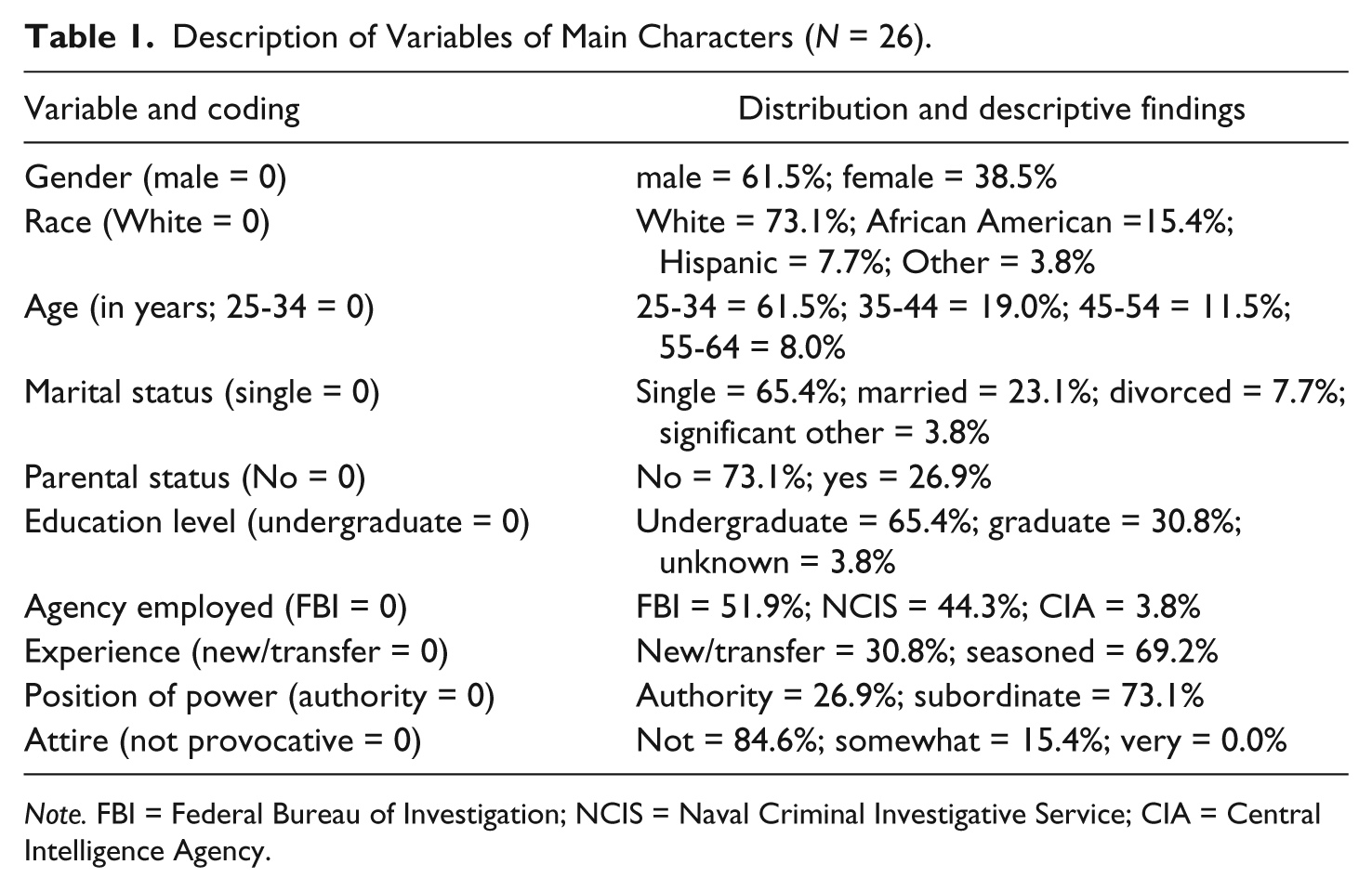
Note. FBI = Federal Bureau of Investigation; NCIS = Naval Criminal Investigative Service; CIA = Central Intelligence Agency.
Description of Stereotype Variables (N = 584).
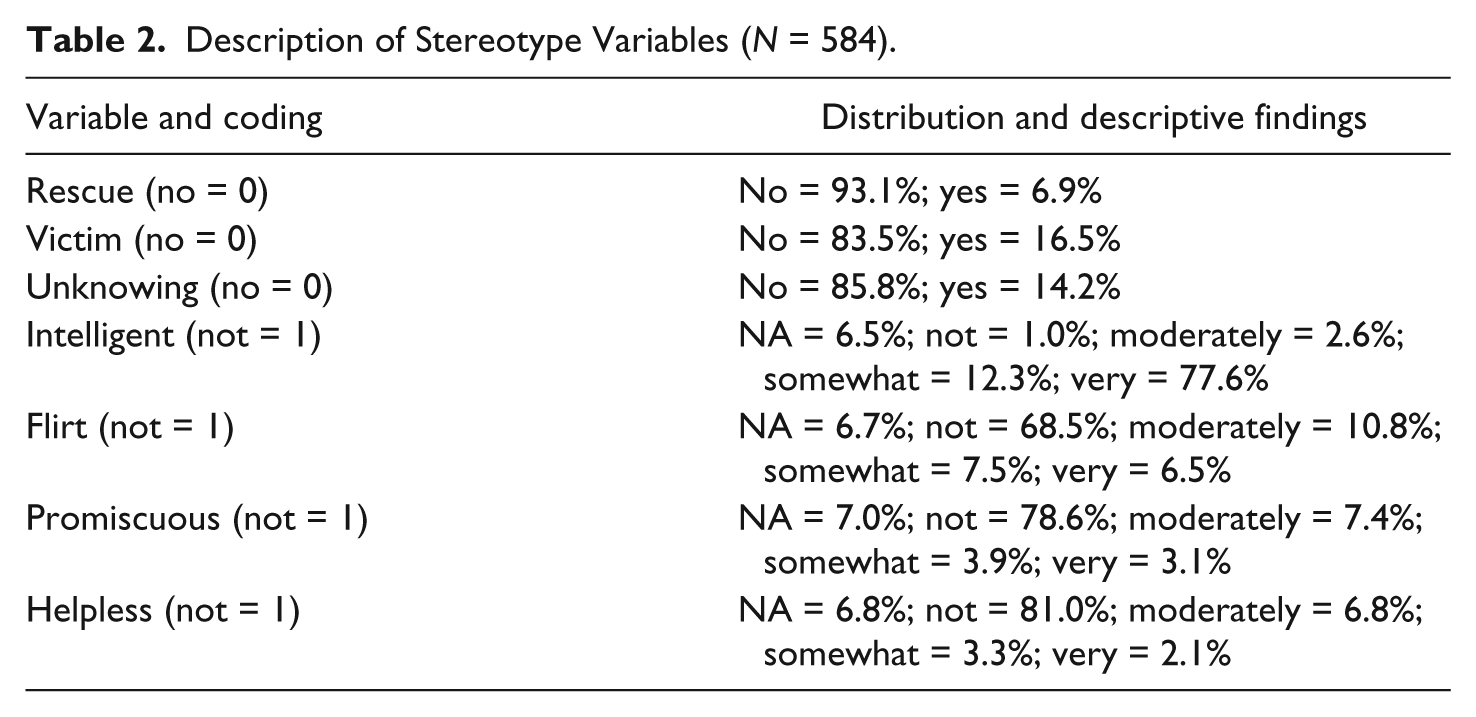
Once the coding sheet was created, three coders independently analyzed episodes to ensure agreement to be used in the analysis. The main coder watched three series with Coders 2 and 3 only watching one series. The coders discussed any discrepancies to eliminate inconsistencies in coding. Interrater reliability was used to assess any discrepancies. Reliability analysis yielded alpha levels ranging from .82 to .95.
Results
Upon examination of the five prime-time dramas featuring female federal agents as main characters, the analysis found that of the 26 characters examined, 61.5% of the sample were male, and 38.5% were female (see Table 1). Similar to findings by Eschholz et al. (2004), the majority of the characters within this study were Caucasian (73.1%) and between the ages of 25 and 34 years (61.5%). Males and Caucasians, as noted in the literature, are more likely to be depicted not only as crime fighters but also as offenders within prime-time television serials as compared with women and minorities (Eschholz et al., 2004). Although all characters were employed by a federal agency, agents were typically employed by three agencies: FBI (51.9%), NCIS (44.3%), and CIA (3.8%). Of the 26 characters analyzed, 30.8% were portrayed as new/transfers whereas 69.2% were seasoned officers. The majority of characters held the position of a field agent (38.5%) and were characterized as holding a subordinate role (73.1%). Almost 87% were portrayed as single or divorced. All but one federal agent were portrayed as college educated as education status was unknown; however, just more than 30% were portrayed as having a postgraduate degree.
Welcome to the Boy’s Club: Are You Really Qualified for This Job?
As noted, of the 26 federal agents analyzed, only 10 (38.5%) were females. Half of female federal agents were portrayed as new or transfers to their current unit whereas just over 18% of their male counterparts were portrayed as less experienced. 4 As transfers were treated similar to those who were new to the field by veteran officers, the categories were combined. Even though officers were characterized as new/transfers, almost all the officers, when applicable, were deemed as intelligent regardless of gender. Despite intelligence levels, female officers were portrayed as less qualified and not skilled to perform the duties associated with being a federal agent. In the end, it often requires them to become “one of the boys” to be accepted and perceived as qualified. In the NCIS episode “Yankee White,” Agent Caitlin Todd (Kate) must show that she is qualified and able to keep up with the boys by alluding that she, too, can grow a penis.
Okay, we can share jurisdiction, You can be on my team.
Your team? Why should you head the investigation?
You ever worked a crime scene, Agent Todd?
I am a Secret Service agent.
(smirks) I thought now.
Well, don’t dismiss me like that! Okay, I earned my jock strap.
Yeah, does it ever give you that empty feeling?
What?
Your jock strap.
No, like some species of frogs, I grow what I mean.
However, it is questionable whether a female agent can ever be truly accepted, at least in prime-time television dramas. Of the 14.2% of the sample who were identified as unknowing, there was a significant difference between male and female portrayals. Women were statistically significantly (χ2 = 12.35, p < .001) more likely to be portrayed as such even though they were not considered unintelligent or uneducated. Nevertheless, males were more likely to be portrayed as more educated than their female counterparts. Even though all of the female agents were educated, only two of the eight held a postgraduate degree. In addition, only one of the female agents held an authority/supervisory position. For female agents, qualifications are often called into question. For instance, on The Blacklist (“The Courier”), Agent Ressler disqualifies his new partner’s training and educational background.
Have I ever told you that I don’t place much stock in profiling and by much, I mean none.
Further reference to a lack of training and a dismissal of education can be seen in the NCIS episode “Sub Rosa.” Although Agent Todd has been accepted by her team, her ability to perform her job comes into question.
Don’t tell me how to run an investigation. Yeah, I’ve got other agents who can do the job but none as well as Special Agent Todd. Formerly, she was attached to the President’s Secret Service detail. Trained to be a profiler.
I don’t care what she was trained for. She’s a woman! And females cannot be deployed on a submarine!
What is this, Victorian England? The men with their cigars and brandy while the ladies sip tea in another room? I’m more qualified for this investigation than Tony.
Although the women depicted in these dramas are seemingly as qualified as their male counterparts, they are often depicted as questioning their abilities. Agent Keen is constantly portrayed as not only being unknowing but also questioning whether she belongs in the FBI. In the episode “Berlin 1,” Keen tells her supervisor Director Cooper, “I’m not strong enough.” Even when women are overqualified and serving in supervisory roles, they often question their ability to serve as an agent or, in this case, as the lead in an investigation. Hetti Lang, in response to the death of Special Agent Dom, blames herself.
I put time and stock and heart in them, and they die, proving one thing I have always suspected: That I am not cut out for this job . . . I was never ever, cut out for this. I just happened to have the capacity for it.
Separating the Personal From the Professional: Can Women Really Have It All?
Just below 27% of the characters were involved in a significant relationship during Season 1 episodes, with the majority being single or divorced. In addition, approximately 27% indicated that they were a parent; in the case of Jethro Gibbs, his daughter was deceased. Although both men and women face the issues of “having it all,” women face particular difficulties because of the expectation of women to be a wife and/or mother. Although two of the series were able to get around this issue, NCIS, Criminal Minds, and The Blacklist addressed it. Based on series’ interpretation of reality, it appears that you cannot have it all, especially if you are a female federal agent. As depicted in these prime-time dramas, it appears that there is no time for a personal life even if you are married, because you are seemingly married to the job.
I met him for a drink yesterday. I told him we had to stop seeing each other. I mean, we hadn’t been dating for long. I mean, we knew each other on the detail for a couple of months before we started dating. You know, when you’re on the job 24/7, how else do you get to know someone?
Church?
Caitlin Todd has a number of discussions about these issues over the first season. However, it never seems to be a problem for her male coworkers. Male characters such as Gibbs have been married four times, but the ability to do his job is never in question. Although divorce is considered common, the inability to have a family does not appear to affect the men of the series.
Divorce is not uncommon in the B.A.U.
You know, the other night, when you called—Saturday night—did you think it was weird that we all just were able to drop everything and go to the office, we’re all available to you anytime you call, day or night?
No, not really.
How do you do it? A wife and a baby?
Well, when I’m with them, I try to focus 100% of my attention there. And when I’m with you guys, I try to do the same thing. It’s all about priorities, Elle. It’s about setting them and keeping them.
I’m just so scared I’m gonna turn into that guy over there. Look up and see that my life has passed me by while I was chasing monsters.
In reality, Hotchner is able to be in a supervisory role in a federal agency because he has a stay-at-home wife who makes it work, although his wife eventually leaves him in a later season not used in this analysis. Male characters are portrayed as having strained relationships with their families and often being estranged. Although this affects all agents, women seem to bear the brunt. Although they too can get a divorce, women are typically the primary caregivers of children.
Although the desire to have a family is addressed, The Blacklist is the only show that focuses on a female agent’s role as a mother. Agent Meera Malik’s character was originally a CIA operative; however, due to her responsibilities as a mother, she left the agency and is now working with the FBI, so she could spend more time with her children. However, she has no interaction with them in the series, and the only indication that they actually exist is a result of a picture she possesses. In contrast, Agent Keen, who is married but childless, is desperate to adopt a child. Although none of the main male characters have children, it is the context of how women are treated in regard to their role as mother, which is disconcerting. The division between men and women on this issue becomes apparent in The Blacklist’s “The Cypress Agency.” After much protesting, Agent Keen tells her husband that she wants to be take a leave of absence and be a stay-at-home mom, if only temporary. Before she can inform her boss, Meera Malik interrupts Director Cooper and informs him she was out because her daughter was sick. The director proceeds to inform her that the job is “1st, 2nd, and 3rd priority,” clearly giving the message that family should not even be a consideration. Hence, if a female agent wants to be successful, her priorities should not include becoming a mother at least in prime-time crime dramas.
Sexualization and Sexual Harassment
Even though the images of “Jigglevision” 5 from the 1970s have been deemphasized in current prime-time crime dramas, female crime fighters continue to be sexualized and experience high levels of sexual harassment within these dramas. The results of this analysis are no different. Although women in the series we reviewed were less likely to be portrayed as scantily clad as in television shows from the 1970s (e.g., Charlie’s Angels), they were often dressed provocatively or less professional than their male counterparts. Provocative dress, such as being unclothed or in sexually revealing clothing, was not common; however, professional attire, as characterized by suits worn in the professional workplace, were for men but not for women. Within the sample, none of the males were considered to be dressed in a provocative manner; however, at times, some of the female agents would dress more provocatively or at least in a manner not suitable for the profession. It was commonplace for women to dress casually or inappropriately for fieldwork. For instance, Elle in Criminal Minds notoriously dresses nonprofessionally as she consistently wears V-neck shirts and tight fitting pants in the field. Although her clothing was not exceptionally provocative, her male counterparts wore traditional attire for the workplace. Although the female agents were not overtly sexualized by their type of dress, they were shot from angles not experienced by males. In The Blacklist’s “The Freelancer,” Agent Keen walks into a room shot from below with the camera focusing and moving up her legs to emphasize her skirt and high heels.
Gendered behaviors were found to be stereotypical in regard to the sexualization of women. Twenty-five percentage of males, and 29% of females were considered to be flirtatious in the episodes analyzed. In addition, there was a statistically significant difference in the way genders were viewed in regard to promiscuity (p < .05). Women were significantly more likely to be viewed as promiscuous than males; however, the manner in which the males were portrayed created a sense of acceptability even in the workplace. Sexualization of women within popular culture mediums has been noted as commonplace by the academic literature and this study (Coy & Garner, 2012; Garland, Branch, & Grimes, 2016). Sexual harassment was also explicit within the episodes analyzed for this study. For instance, female agents in prime-time are without question attractive; however, the encounters with male officers inside and outside the team often expose them to sexual harassment. For instance, in Without a Trace (“Little Big Man”), Vivian makes an introduction between two officers; however, rather than making the usual pleasantries in an introduction, Agent Samantha Spade is judged on her appearance.
This is Agent Spade.
Didn’t know they made them like you.
Yeah, I walk and talk, too. And I’m anatomically correct.
Although latent analysis indicated that sexual harassment is present within all of the series viewed, it is explicit in three of the five series. Anthony Dinozzo, Derek Morgan, and Agent Danny Taylor explicitly harass their coworkers and other women within the series. Although their behavior is portrayed as fun-loving and innocent, in reality, this behavior would never be tolerated within the workplace and could result in their termination. In NCIS’s “Seadog,” it is noted that sexual harassment in the workplace is inappropriate; however, it clearly remains an acceptable practice in a male-dominated field.
(READS) All agents not working active cases are to attend a sexual harassment lecture at the NCIS Human Resource Training Center at zero nine thirty hours. Today.
I cannot sit through another one of those. I will shoot myself.
You mean they actually train you guys how to harass? (Laughs) Hey, I’m kidding. Except for Tony.
Agent Tony Dinozzo’s explicit behavior is acknowledged as “tongue in cheek,” and it is noted that he consistently violates department policy in this way. Although Special Agent Derek Morgan’s behavior is not as explicit, his relationship with Penelope Garcia crosses the line, and as a result, this helps to perpetuate the acceptance of “rape culture” in our society (Phillips, 2016). Agent Morgan’s behavior toward his female coworkers may appear benevolent; however, his actions are anything but in the real world. Addressing a female coworker as “baby girl,” inappropriate touching, making sexualized comments, and inappropriate insinuations about engaging in an intimate relationship violate the boundaries that should be inherent in the workplace especially as intimate relationships between colleagues are not always condoned by governmental agencies.
Intimate relationships among federal agents seemed to be discouraged but tolerated when men were involved (e.g., Jack Malone); however, when women fraternized with their male colleagues (e.g., Caitlin Todd), they were terminated even though the male agent involved (Jack Malone) was serving in the supervisory role. Although Malone’s relationship with Agent Spade is questioned, there are never any professional ramifications for his behavior. Notably, Sam Spade is questioned rather than directly approaching Malone in the episode “Are You Now or Have You Ever Been.”
Well, uh . . . Oh, oh, one other thing, Agent Spade, Have you and Agent Malone ever had a sexual relationship?
I beg your pardon?
Unless you’re going to go Clinton on me, it’s a fairly straightforward question.
You have no right to ask me that.
Actually, I do. Administrative Operation Procedures of the Federal Bureau of Investigation, section 23 . . . A supervising agent—that would be Agent Malone—is strictly forbidden from having a sexual relationship with an agent and his immediate reporting chain. . . . Agent Spade, I don’t mean to be impolitic when I say I think we can all understand the pressures of this job, especially the difficulties a junior agent may face, say, if she were approached by a senior-a man in a very unhappy marriage, desperate for intimacy he wasn’t getting at home. In this light, the Agent’s actions would be understandable. However, refusing to answer, or lying about such a relationship would not.
Victimization
Popular culture mediums have been criticized for frequently promoting images that reinforce and promote the victimization of women (Bonomi, Altenburger, & Walton, 2013; Buchwald, Fletcher, & Roth, 2005; Garland, Phillips, & Vollum, 2016). Of the 584 cases analyzed, 16.5% of the sample resulted in an agent being victimized. There was no statistically significant gender difference between agents victimized within the sample. As expected, in cases in which victimization did occur, males were found to be the perpetrator in an overwhelming majority of the cases (84.6%). Nevertheless, only one male agent would be killed in the first season compared with one female agent being killed, one almost fatally shot, and one kidnapped.
Within popular culture mediums, being a federal agent is inherently dangerous; therefore, exposure to violence is a by-product of the job. However, it is the manner and finality of the victimization that appears to be the problem. Although less than 7% of the characters in the episodes analyzed had to be rescued, 12.2% of the sample had a main character portrayed as helpless. Women were significantly more likely to be portrayed as helpless (χ2 = 22.80, p < .001); there was no significant difference between males and females being rescued. Hence, it was expected that characters would be victimized and would need to be rescued. When males were victimized, it was simply the nature of the job; however, when females were victimized and/or had to be rescued, it was often due to their “helplessness” and inability to perform their jobs. For instance, Agent Keen was notoriously depicted as giving up her service weapon and placing herself and others in a vulnerable position. As a result, it was she who was often characterized responsible for her own victimization.
Discussion and Conclusion
The current study examined instances of gendered representations of federal agents in popular prime-time crime dramas. Specifically, we explored whether female federal agents were accurately represented within the series and whether they experienced gendered issues of discrimination, sexualization, and victimization as identified and supported by the manifest and latent contents within these popular television series. Similar to the findings of DeTardo-Bora (2009), female characters were determined to be overrepresented as federal agents within this popular culture medium. As noted, the present study found that 38.5% of the main characters within the sample were women. Although females working with federal law enforcement agencies closely resemble this figure, females who possess arrest and firearm authority consist of approximately only 15% of law enforcement agencies (Reaves, 2012). Although female federal employment within prime-time dramas may not be reflective of reality, prime-time dramas are seemingly attempting to be more representative of the general viewing population than the current make-up of women used in the field, as females working within a law enforcement capacity remain relatively small. Even though women are being cast as main characters within these crime-fighting television dramas, it appears that the same stereotypes that have systematically plagued female leads continue to remain as the dominant ideology.
The overall findings of this study suggest that gendered images of women are omnipresent within prime-time crime dramas. The manifest and latent contents supported stereotypical images of women within the field. Consistent with the literature, males not only dominate the criminal justice profession but also hold the decision making power (Martin & Jurik, 2007) and are most likely to be in positions of authority (DeTardo-Bora, 2009). As the findings of this study revealed, the majority of agents depicted as a main character in the series were male, with only one female being in a leadership role. Although female agents were consistently portrayed as educated and competent, men continued to be portrayed as leaders in the field and women as the subordinates. When women are allowed into the professional world, they remain relegated to subordinate roles or are often perceived as having less education, less training, and less valuable skills than their male counterparts. To fit in, they must become “one of the boys,” and adhere to a mentality, that is, accepting of gendered behavior. Consistent with the extant literature, women cannot have it all as a choice must be made between the personal and the professional (D’Acci, 1994). As findings revealed, the idea of “having it all” and being a successful female working within a federal law enforcement agency is tantamount to blasphemy as one’s loyalties should only be to the job and their work family. Hence, being a wife and a mother is not acceptable, at least if you want to work as a gun-toting federal agent.
Although the sexualization of females was not found to be a major emphasis within the sample, female agents were still more likely to be dressed provocatively or inappropriately for fieldwork, which is consistent with past research (DeTardo-Bora, 2009). In addition, there were also instances where camera angles were used to emphasize female attributes that did not occur with the male characters. Male and female characters were not overly portrayed as flirtations; however, females were significantly more likely to be viewed as promiscuous than men. Although men engaged in nonmarital sexual relationships, the manner in which female characters were depicted was seemingly more stereotypical and less accepting. However, at no point, were main characters perceived as “loose” or unbecoming of an agent. Thus, it appears that the overt sexualization of female characters, at least within this sample, has lessened since the 1970s images of “Jigglevision” even though some of the same stereotypes remain.
For example, the present study found that gendered discrimination and sexual harassment were portrayed as acceptable behavior within the sampled prime-time crime dramas. Although women were not overly sexualized, it was the sexual harassment that was highlighted within the series. Although many viewers may perceive the behaviors as “boys being boys” or otherwise acceptable in a male-dominated field, in reality, the type of conversations had by male characters in front of or with female characters would be deemed inappropriate and most likely against policy in the workplace. More troublesome was the referral of relationships between coworkers, especially in instances where females held a subordinate role. Although the behavior was obviously discouraged, the “good old boy” system typically ignored any sexual behaviors deemed inappropriate. When instances of sexual harassment were discussed, female characters seemingly accepted the behavior as joking and did not file a complaint. Failure to overlook the policy violation would most assuredly ensure that you were ostracized and/or not considered “one of the boys.” As noted in a recent study by Yu (2015), lack of respect by male colleagues was noted as the largest barrier faced by female federal agents today; this included negative attitudes and more harmful situations such as discrimination and harassment.
Contradictory to previous findings (DeTardo-Bora, 2009), female agents were not shown as victims more so than their male counterparts. However, female agents were significantly more likely to be portrayed as helpless (see Inness, 1999). So, although they were not necessarily victimized and/or had to be rescued, they were not able to successfully meet the standards of their job seemingly due only to the nature of their gender. Not surprisingly, two of the series’ finales ended with the murder/perceived murder of female agents and one other woman being kidnapped. Ironically, of the two women who survived their life-threatening victimization and survived the Season 1 finales would be killed/written off of their respective series by the end of Season 2. The question remains whether the killing off of female agents is simply a plot twist to enhance the male lead character’s storylines, and whether women are simply portrayed as interchangeable parts that can be replaced without consideration of the effects this has on series consumers (see Garland, Branch, & Grimes, 2016). In the end, what is the cost to society? Regardless, it may appear that consumers are willing to sacrifice their female leads as it is perceived that they are more likely to be victimized than their male in both fiction and reality than their male counterparts.
Impact of Messages on Viewership
With the popularity of crime dramas holding steady across many demographic groups, it is important to think about the cultivation effect, or how these previously described messages may affect those who view these television programs on a regular basis. Such messages could have potentially serious consequences among viewers of these programs. They may lead female viewers to believe they have to choose between the roles of family and career. As only 13% of police departments consist of female officers, and the majority of federal female agents do not hold positions in which they have the ability to carry a firearm, this is a real consideration. Stereotypic images found in these series may also lead females to believe that sexual harassment is “just part of the job” they have to learn to accept if they want to fit in. In addition, if these beliefs are transferred to male viewers, they may perceive these attitudes and behaviors to be normal and appropriate for the criminal justice workplace. Cultivation theorists would argue that the more viewers are exposed to these media messages, the more likely viewers’ perceptions of reality will be impacted.
The crime dramas under study are some of the most popular programs on television. For example, recent Nielsen data show that in 2015, NCIS had 19.5 million viewers and NCIS: Los Angeles had 11.8 million viewers (Flint, 2015). Nielsen data have also revealed that African Americans consume significantly more programming than other demographic groups (Nielsen Company, 2013), and that African American women consume more programming than men. This figure is especially important given the lack of minority female representation in the criminal justice workforce. Negative media messages may influence whether an African American female sees a place for herself in the federal agencies being portrayed on television.
Recent studies have examined the influence of crime drama narratives on viewer perceptions. Using a convenience sample (N = 88) recruited via Facebook, Brown, Lauricella, Douai, and Zaidi (2012) revealed that viewers were not watching crime dramas because they identified with the police or the victims. Rather, viewers reported being curious about and interested in crime and that they enjoyed the social context of being a viewer of these shows. For example, one third of the sample agreed that watching crime dramas provides an opportunity to interact with others about what they have watched. Such social interaction may increase the influence of crime dramas as misperceptions about the female experience as a federal agent may be shared and reinforced through these interactions.
Using data from the 2007 Nebraska Annual Social Indicator Survey, Kort-Butler and Hartshorn (2011) examined how viewing fiction and nonfiction crime dramas as well as local and national news affected viewer (N = 784) perceptions of the justice system, their perceived likelihood of victimization, and their support for capital punishment. Their findings suggest that nonfiction crime documentaries and local and national news programming were more likely to impact viewers negatively as relates to fear of crime and confidence in the justice system. Based on this finding, it seems that future studies should examine how females are portrayed not only in the crime drama but also in news programming and crime documentary series such as The First 48. Based on the research, it appears that producers of prime-time crime dramas must strive to create television serials that are not only reflective of reality but also create gender-equitable representations within their programming as consumers may be influenced by these gendered images. Hopefully, these gender-equitable representations will enable viewers to accept women as legitimate agents within criminal justice agencies and assist in eliminating gendered stereotypes and discrimination for women who pursue such careers. Additional suggestions for future research as well as limitations to the present study are discussed in the following section.
Limitations and Future Research
As noted by Garland, Branch, and Grimes (2016), content analysis allows for a systematic exploration of popular culture mediums; however, the data collected are often subjective, which allows for interpretation by the researchers. Numerous studies have shown content analysis to be a reliable tool in the examination of gendered issues within popular culture (DeTardo-Bora, 2009; Garland, Branch, & Grimes, 2016; Garland, Phillips, & Vollum, 2016; Wilson & Blackburn, 2014); however, there are still limitations within the study that need to be addressed. Although manifest content is considered to be reliable, the use of latent content has been shown to produce varied results and is considered less reliable (Garland, Branch, & Grimes, 2016; Garland, Phillips, & Vollum, 2016; Kraska & Neuman, 2011). To avoid validity issues in the present study, the authors used intercoder reliability. Most notably, with any content analysis, this methodological technique is unable to examine the causal relationships between the variables; thus, another limitation to the present study is that the impact on the viewers and their shaping of reality is unknown (Berg, 2004). In addition, a more robust sampling of characters would have provided the ability to run bivariate analyses to determine gender differences across categories of interest. As noted by Wilson and Blackburn (2014), focusing only on one type of popular culture medium may have excluded some notable differences in gendered representations among federal female agents. In essence, the results cannot be generalized to film, comic books, and other literary works. One final limitation is that the authors could not control for any serials that might have been unintentionally omitted. As the authors used IMDb to establish a sample for the study, they relied on the parameters established within the search criteria. Knowledge of popular crime series assisted as an informal control to support the IMDb search engine. Further research on the subject may want to use multiple popular culture mediums to determine how female federal agents are depicted overall. In addition, interviews or surveys of viewers on their interpretations of specific scenes that address gendered issues within prime-time crime dramas may be helpful to further examine the effects that these images have on viewers, and how these images shape attitudes toward women in law enforcement.
Footnotes
Declaration of Conflicting Interests
The author(s) declared no potential conflicts of interest with respect to the research, authorship, and/or publication of this article.
Funding
The author(s) received no financial support for the research, authorship, and/or publication of this article.