




Abstract
There exists much scholarship on the decision-making process in the juvenile court. While a variety of processes in the juvenile court, types of offenders, and theoretical frameworks have been analyzed to better understand the decision-making processes, there are some gaps, particularly in the use of an intersectional framework in explaining the plea bargaining process among serious and violent girls. Given the paucity of research on this subject, the present study pays homage to intersectionality by exploring the aforementioned process and group in the juvenile court.
Introduction
Research has focused on the context of race in decision making related to sanction severity both recently (Holleran & Stout, 2016; Leiber & Peck, 2013, 2015; Leiber, Peck, & Beaudry-Cyr, 2016) and in the past (Bishop & Frazier, 1996; DeJong & Jackson, 1998; Frazier, Bishop, & Henretta, 1992). Outside of the direct effects of race, other factors have been found to work in conjunction with race, such as age (Guevara, Spohn, & Herz, 2004), prior record (Rodriguez, 2010); offense type (Mallicoat, 2007), life and living situation (Thomas, Moak, & Walker, 2013), and gender (Freiburger & Burke, 2011; Leiber, Brubaker, & Fox, 2009). These direct and indirect effects are found despite the renewal of the Juvenile Justice Delinquency and Prevention Act (JJDPA) of 2002 and expansion of the Disproportionate Minority Contact (DMC) mandate in the JJDPA. These are important findings in light of some research which has noted that sanction severity for juveniles is linked to future offending (Huizinga, Schumann, Ehret, & Elliott, 2003), which, for example, may disproportionately fall on minority offenders (Leiber & Fox, 2005). In fact, the cumulative consequences of racial disparities in juvenile justice as the life course progresses are well documented, and may be found at the intake process, plea process, and sentencing (Engen, Steen, & Bridges, 2002; Frazier & Cochran, 1986; Leiber & Johnson, 2008; Lowery, Burrow, & Kaminski, 2016; Rodriguez, 2010; Thomas et al., 2013).
However, one may argue that much research has focused on the effects of race, and under these concerns lies an overlooked aspect in the literature: serious and violent female juvenile offenders. On average, most forms of female offending have been decreasing over the last 10 years (Chesney-Lind & Pasko, 2013). However, this is not the case for all offenses. For example, evidence does exist which suggests that in 2000 and 2009, involvement in serious and violent offenses, such as assault, robbery, and burglary, has all significantly increased, contrary to the notion that female offending has been decreasing in contemporary times (Puzzanchera & Adams, 2011). These changes for girls, especially minority girls, may be highlighted by placement statistics, which suggest that in 2013, minority girls made up 68% of placements in secure confinement (Hockenberry, 2014). Thus, the experiences that girls of color face in the juvenile justice system remain problematic and worthy of investigation, despite the efforts of DMC furthering our understanding of minority overrepresentation.
For serious and violent girls, there has been an amplification in public perceptions about their behaviors in the recent years (Artz, 1998; Feld, 2009). Noting these behavioral concerns, Steffensmeier, Schwartz, Zhong, and Ackerman (2005) looked at sources beyond criminal justice records, and concluded that violent increases were more of a social construction rather than an empirical reality; at odds with Puzzanchera and Adams (2011). However, Steffensmeier et al. (2005) did note that arrests for girls have increased, and that girls are disproportionately charged more seriously for minor offenses (e.g., using a pen as a “robbery” weapon) and “acting out” offenses, such as that of domestic violence. Thus, changes in law enforcement, sentencing, and policy may be a result of the “culture of control” over behaviors viewed as not “lady-like,” rather than true changes in girls’ behaviors (Garland, 2001; Steffensmeier et al., 2005). Resulting from these observations, it is argued that the number of girls formally processed in the juvenile justice system is disjointed relative to their crime rates (Tracy, Kempf-Leonard, & Abramoske-James, 2009). 1
But do these recent changes in perceptions affect all girls equally? Are the findings of racial disparities in the juvenile justice system among boys consistent with those of girls? Presently, that answer is unclear. Therefore, there is a need to explore the racial disparities for females, which may be furthered by the historical treatment of girls of color in the juvenile justice system and racialized/stereotyped gender identities assigned by decision makers (Burgess-Proctor, 2006; Chesney-Lind, 1973; Holsinger & Holsinger, 2005; King, 1988). To provide examples, Ward (2012) notes that when Black girls were given access to the juvenile justice system, they were viewed as less “salvageable” compared with their White counterparts who were viewed as worthy of rehabilitation. Moreover, Potter (2015) notes that the experiences of Black women, especially juveniles, in the justice system remain insufficiently addressed. This is also furthered by gaps in the literature involving the plea bargaining process for juveniles. Much plea bargaining research focuses on adults (Kyckelhahn & Cohen, 2008), and no contemporary studies have focused on the plea bargaining process for female juveniles, much less serious and violent female juveniles (although see, Burrow & Lowery, 2015 for serious/violent boys).
Moreover, no contemporary empirical evidence exists that examines whether the plea bargaining process for serious and violent girls would operate in a similar capacity to that of adults of their juvenile male counterparts. Furthermore, while studies have used an intersectional framework to better understand the nature and expression of serious and violent crimes by adult women (Burgess-Proctor, 2006; Daly, 1997; Wesely, 2006), a gap exists when it comes to gender and race-based stereotypes in the juvenile court (Leiber et al., 2009). Framed through an intersectional lens and a Black feminist perspective, this study bridges that gap by inspecting the impact of race and gender, as well as extralegal factors, on plea bargaining outcomes by using case processing data from a juvenile court in one southern state during the years 2007 to 2012.
Plea Bargaining and Juveniles
The extant literature focusing on the plea bargaining process for juveniles is far from replete. Yet, we know that plea bargains make up a very significant number of dispositions at both the state (approximately 95% of all cases disposed) and federal (approximately 84% of all cases disposed) levels for adults (Kyckelhahn & Cohen, 2008; Teeter, 2004). Existing quantitative assessments focus almost exclusively on adults but provide some salient findings: For example, Nardulli, Eisenstein, and Flemming (1988) note that environmental, contextual, and individual factors play a role in the plea bargaining process. Other quantitative research suggests that these plea negotiations are tempered by the severity of the offense found in the defendant’s prior record (Albonetti, 1990; Frenzel & Ball, 2008; Meyer & Gray, 1997).
This same line of research suggests that Black defendants seem to be consistently less likely to enter into either negotiated or nonnegotiated pleas, opting to take their cases to trial (Albonetti, 1990; Frenzel & Ball, 2008; Meyer & Gray, 1997). To that point, those who refuse to plead guilty often face a “trial penalty” for exhausting the systems resources, although this penalty may vary across offenders (Johnson, 2003; Smith, 1986; Ulmer & Bradley, 2006; Ulmer, Eisenstein, & Johnson, 2010). Other scholars note that the “trial penalty” exists within the juvenile court as well, often serving as an “unofficial waiver” (Mears, 2003; Redlich, 2009).
For juveniles, what research does exist on this increasing phenomenon comes from older, largely qualitative research and legal and/or statutory analyses in the early 1990s (Sanborn, 1992, 1993, 1996). Still, some noteworthy implications may be drawn from these works: Sanborn (1996), for example, noted that prior research points to a consistent finding, in that courtroom actors were able to identify a number of characteristics ascribed to the juvenile that affected what they believed to be the correct disposition, such as their home situation and commitment to school. Meanwhile, Albonetti (1990) noted the importance of victim injury and weapon possession in the plea process. Similarly, Bortner (1984) concluded that the plea bargaining process is important, but it may not be appropriate to refer to it as a “plea bargain,” given that the structure and negotiations vary significantly from that of the adult process.
Ultimately, we cannot truly ascertain differences between juveniles who do and do not plead guilty. Questions still exist regarding how commonplace juvenile plea bargaining is compared with adult plea bargaining, how the process truly unfolds in the juvenile court, and how the process unfolds for juveniles who sit on differently situated planes with respect to race, gender, and class. Within this context, there is a need to dive into the inchoate nature of the juvenile plea bargaining process through the lens of intersectionality, given the preliminary evidence suggests that extralegal, personal factors (i.e., one’s intersectional identity) affect the juvenile plea bargaining process. The present study is a preliminary examination of this process.
Girls in the Juvenile Court: An Intersectional Perspective
Literature that focuses on disparities in adjudication has examined a number of theoretical frameworks (e.g., focal concerns, symbolic threat, attribution theory), but one emerging framework is the use of an intersectional perspective in teasing out patriarchal racial biases, gendered expectations, and other extralegal factors affecting juvenile court outcomes (Burgess-Proctor, 2006; Crenshaw, 1991, 1995; Leiber et al., 2009; Maggard, Higgins, & Chappell, 2013; Peck, Leiber, & Brubaker, 2013). These aforementioned studies have looked at the intersecting identities at three levels: the personal, group/cultural, and structural/institutional level. Therefore, to better understand juvenile court outcomes, scholars have drawn upon the intersectional perspective and Black feminist perspective: a theoretical concept highlighted by Potter (2006). This perspective incorporates interconnected identities, social forces, and unique circumstances to better theorize, research, and graft public policy focusing on marginalized individuals (e.g., serious and violent girls). The intersectional Black feminist perspective suggests that females of color may be differently situated and/or treated differently compared with Whites based on structural position, victimization experiences, and how court actors view their personal agency (Comack & Balfour, 2004; McCall, 2005). From the Black feminist perspective, it is important to intersect these racialized and gendered concerns (Collins, 1993, 2000).
Furthermore, this notion goes beyond simply summarizing the effects of these categories, as they are interwoven and mutually weaken or strengthen one another (Crenshaw, 1991; Winker & Degele, 2011). In other words, intersectionality is a multiplicative process that intersects into the historical and structural processes within societies and individuals (Collins, 2000; Crenshaw, 1991; Zinn & Dill, 1996). Together with this understanding of a multiplicative identity, this perspective challenges a monolithic depiction of blameworthiness in the juvenile court, which posits that only individual legal factors (e.g., age, offense, prior record) play a role in outcomes. Instead, the intersectional approach argues that race and social class interact with legal as well as “quasi-legal” variables (e.g., first-time offenders or accomplices—variables not necessarily written into statutes but still of legal significance).
The interaction of these variables situated on different planes (individual, group, and structural) comes to define the culpability and perceived femininity of a juvenile, thus affecting the adjudication outcome (Maggard et al., 2013; Moore & Padavic, 2010). As Crenshaw (1995) and Bloom (1996) point out, the construction of a “traditionally feminine” and therefore less blameworthy female offender is both a race and poverty (both economic and perceived “moral”) issue, but this may also be moderated by structural and group/cultural elements, such as living in a violent and/or impoverished area (Lowery et al., 2016). In other words, girls are marginalized further for perceived violations of normative expectations (Pollack, 2000). Particularly, this finding is consistently noted in research in the juvenile court, in that economic, locational, family, and educational marginalization all have an effect on adjudication decision (Bishop & Frazier, 1996; Freiburger & Burke, 2011; Horowitz & Pottieger, 1991; Leiber & Mack, 2003; Leiber & Peck, 2013, 2015; Lowery et al., 2016).
As an example, a judge may be cognizant of issues of a juvenile’s school attendance or living situation (group characteristics), therefore perceiving that juvenile as a good candidate for a more punitive sanction as a matter of his or her “moral” poverty (Steffensmeier, Kramer, & Streifel, 1993; Widom & White, 1997), which may be further tempered by individual characteristics such as race (Wong, 2011). At the structural level, it is important to note that feminist scholars have viewed the legal system as a male-dominated institution (structural level) by interpreting law in relation to males (Burgess-Proctor, 2006; Purdie-Vaughns & Eibach, 2008). In this context, the court system creates patriarchal definitions of unacceptable female behaviors, responding to and sometimes formally punishing those who violate gender norms on the basis of “chivalry” (Gilbert, 2002; Griffin & Wooldredge, 2006). This “chivalry hypothesis” argues that certain females are viewed as childlike and in need of protection: For example, Spohn and Beichner (2000) noted that females who were first-time offenders, younger, and those with less severe offenses were less likely to be incarcerated compared with those with prior offenses, older juveniles, and those with more severe offenses.
It is noteworthy to entertain the notion that the chivalry approach ignores the race and class influences on the labeling process by individual actors. For example, some research on the “selective” chivalry approach suggests that decision makers are largely White and middle class to affluent, leading the decision makers to identify more with White, middle-class females (and thereby treating them less harshly), while minority females are viewed with the same blameworthiness as their male counterparts (Kingsnorth & MacIntosh, 2007; Spohn & Beichner, 2000; Zatz, 2000). Interestingly, there has been evidence that suggests the opposite, insofar as Black females are treated more leniently during sentencing (Griffin & Wooldredge, 2006; Steffensmeier & Demuth, 2006). Perhaps, as some scholars suggest, this is tempered by other atypical acts for a female, such as possession of a weapon or the amount of harm done to the victim (Rodriguez, Curry, & Lee, 2006). Although Rodriguez and colleagues (2006) provide an interesting finding, most studies have not found support for the interaction of type of crime or circumstances with being a female offender (Bishop & Frazier, 1984; Embry & Lyons, 2012; Kingsnorth & MacIntosh, 2007; Spohn & Beichner, 2000). In all, these individual, group, and structural characteristics may create a multiplicative process of marginalization.
Thus, the variation in intersectionality scholarship within criminological research leaves some important gaps to be filled. Of particular concern is the question, How do offenders’ intersecting identities of gender, race, and class influence the decision to offer or not to offer a plea concession? How might perceptions of certain multiplicative identities on the part of courtroom decision makers affect this outcome? Presently, there is no existing literature that answers this question, providing a serious gap in the literature.
An examination of the plea process and whether particular groups or instances preserve privilege or oppression at the structural level may provide answers toward which potential cultural stereotypes disadvantage this group of offenders. Importantly, this perspective suggests that being a minority female will produce different plea outcomes compared with White females, guided by the literature, suggesting that the joint effects of gender and race are important to the decision-making process in the juvenile court and operate differently for White females compared with Black females (Bishop, Leiber, & Johnson, 2010; Guevara, Herz, & Spohn, 2006; Leiber et al., 2009; MacDonald & Chesney-Lind, 2001; Pope & Feyerherm, 1993; Rodriguez, 2010). This, perhaps, comes from racialized gender beliefs that Black females are more likely to be aggressive, violent, and more culpable for their criminal behavior (Chesney-Lind, 1977; Chesney-Lind & Pasko, 2013; Feld, 1999). But does this also hold true in the plea bargaining process when it comes to serious and violent female offenders? Based on the research, the answer is unclear, further suggesting the need for this study.
Overall, the understanding of race, construction of gender, and the examination of other dimensions of social equality (e.g., family, living situation, education) affecting outcomes provides a resolute urgency for juvenile justice researchers to begin addressing intersecting dimensions of subjugation. Of course, there exists an abundance of criminological literature that examines demographics in the juvenile justice system at a variety of stages (Bishop & Frazier, 1988; Bridges & Steen, 1998; Cochran, Mears, & Bales, 2014; Guevara et al., 2004), but there is little evidence of examining the plea process among serious and violent girls through this framework. This is an important oversight because more often than not, the literature has suggested that gender stereotyping on the part of court actors, net of illegal and extralegal factors, affects outcomes (Bishop & Frazier, 1992, 1996; Leiber et al., 2009). In other words, courtroom actor’s perceptions that a female is not behaving “properly” has an effect on adjudication decisions.
Furthermore, studies which do take into account intersectional identities often fail to capture how the processes of race interact with gender and socioeconomic disadvantage in influencing serious and violent female outcomes, with minimal exceptions (Parker & Hefner, 2015). Thus, for the purpose of the present study, intersectionality serves as an organizing framework in the analysis of the plea bargaining process in the juvenile court among serious and violent female offenders. In the end, the results may provide better insight not only into the plea bargaining process for this group of offenders but also into what strategies should be developed to approach inequalities in this context. Particularly, the present study considers serious and violent juvenile females’ intersecting identities formed in a legal, quasi-legal, and extralegal (individual and structural) context.
Data and Method
Data were retrieved from the Department of Juvenile Justice (DJJ) files in South Carolina for the years 2007-2012. In this state, juvenile court jurisdiction extends to persons at or less than 17 years of age (§63-19-20). During the years included in this study, approximately 11,440 serious and violent offenses were committed by juvenile offenders statewide (South Carolina Department of Juvenile Justice, 2013). The initial sample consisted of 1,436 juvenile offenders who were adjudicated delinquent in juvenile court and under DJJ supervision during the study period. 2 However, the final sample was reduced to 221 after the removal of offenders who appeared multiple times 3 and offenders who were below the age of 14 and all male offenders, given the specific interest in structural and representational intersectionality in the juvenile justice system for girls of color convicted of serious and violent crimes.
Furthermore, all cases where the Solicitors dropped the charges, cases that were nolle prosequi, and cases resolved prior to adjudication were excluded. The sample of offenders used in this research was restricted to juveniles who committed serious and violent offenses as defined by the state statute (§16-1-60); however, juveniles who were waived to adult court (§63-19-1210) and all juveniles charged with status offenses (§63-1-40(6)) were purposefully excluded. Case processing information, including offender and offense characteristics, living situation, education, and type of sanction, was extracted from the case files. Sensitive information (social security number [SSN], birth dates, names) was redacted and not coded to maintain the confidentiality of the offenders.
Dependent Variable
The data obtained indicated if a case was resolved through a plea. No information provided on the type of plea (e.g., a charge bargain or sentence bargain) was available, making it impossible to reveal the true “nature” of the plea. Still, this indicator of plea provides the closest possible approximation of how the plea bargaining process plays out in the juvenile court. Thus, the outcome was a dichotomized measure of adjudication (0 = no plea, 1 = plea). More specifically, the focus of this research is on the impact of legal and extralegal factors on the decisions of judges and prosecutors. Notwithstanding that it would have been theoretically possible to treat the plea as a trichotomous outcome variable, the small amount of not processed cases (n = 4) would make any meaningful comparisons unlikely.
Independent Variables
The independent variables in the present study were divided into legal (primary and quasi-legal) and extralegal variables as they relate to the offender and offense (Mears & Field, 2000). The primary legal variables consisted of adjudicated offense and the age of the juvenile. Precisely, the offense categories consisted of robbery, assault, and major property crimes (arson, Burglary I and II, and Larceny I and II). In addition, there is no redundancy in the offense categories, as only the most serious offense was considered when determining categorical placement. Age was divided into two separate categories: 14 or 15 years at the time of the offense and 16 or 17 years at the time of the offense (0 = no, 1 = yes).
Encompassed within the quasi-legal variables of interest are being a first-time offender, the presence of an accomplice during the commission of the crime, whether the victim was injured, and the possession of a weapon during the commission of the crime. All of these variables were dummy coded (0 = no, 1 = yes) and have their basis in the literature, comprising elements that define courtroom actors’ perceptions of multiple marginalization and culpability (Burrow 2008a, 2008b; Carrington, 2015; Cauffman et al., 2007; Nash, 2008).
Based on the intersectionality perspective of double and multiple jeopardy (Beale, 1970; King, 1988) and past research on the back-end process of juvenile justice research (Ahola, Hellstrom, & Christianson, 2010; Leiber & Fox, 2005; Rodriguez, 2010; Singer, 2003), a number of extralegal variables were included in the present study: race of the offender (0 = White, 1 = Black), whether the defendant lives in a zip code with a violent crime rate higher than that median in South Carolina during the study time period (obtained from South Carolina Law Enforcement Division estimates, 2008-2012, coded 0 = no, 1 = yes), living situation (0 = single parent or other arrangement, 1 = two-parent household), highest grade completed (three groups of dummy variables less than ninth, ninth-10th, and 11th-12th; each coded 0 = no, 1 = yes) and whether there was a history of abuse, neglect, or Department of Social Services (DSS) intervention in the juvenile’s home (0 = no, 1 = yes). Importantly, because non-White Hispanic offenders made up very little of the sample (n = 4), rather than excluding them from the sample entirely, non-White Hispanic offenders were collapsed into the “black” category of race. The researcher made this choice guided by the equivocal argument that non-White Hispanics are more likely to be perceived as persons of color (Bonilla-Silva, 2006).
Predictions
The decision-making process at the back-end of the system is guided by courtroom actors’ knowledge of significant legal and extralegal factors. Thus, plea concessions are likely offered to juveniles who pose the least risk to the public. Within the intersectionality framework, this may play out differently in a number of scenarios. Certain female juveniles may be viewed as better candidates to receive a plea concession due to decision makers’ perceptions of race, gender, and class identities. Perhaps, this placement and definition exist on a spectrum of an innocent juvenile and in need of court protection all the way to a violent, remorseless, and “improper” female who should be punished punitively. In light of the nascent nature of this research inquiry, the following hypotheses will be examined:
Statistical Analysis
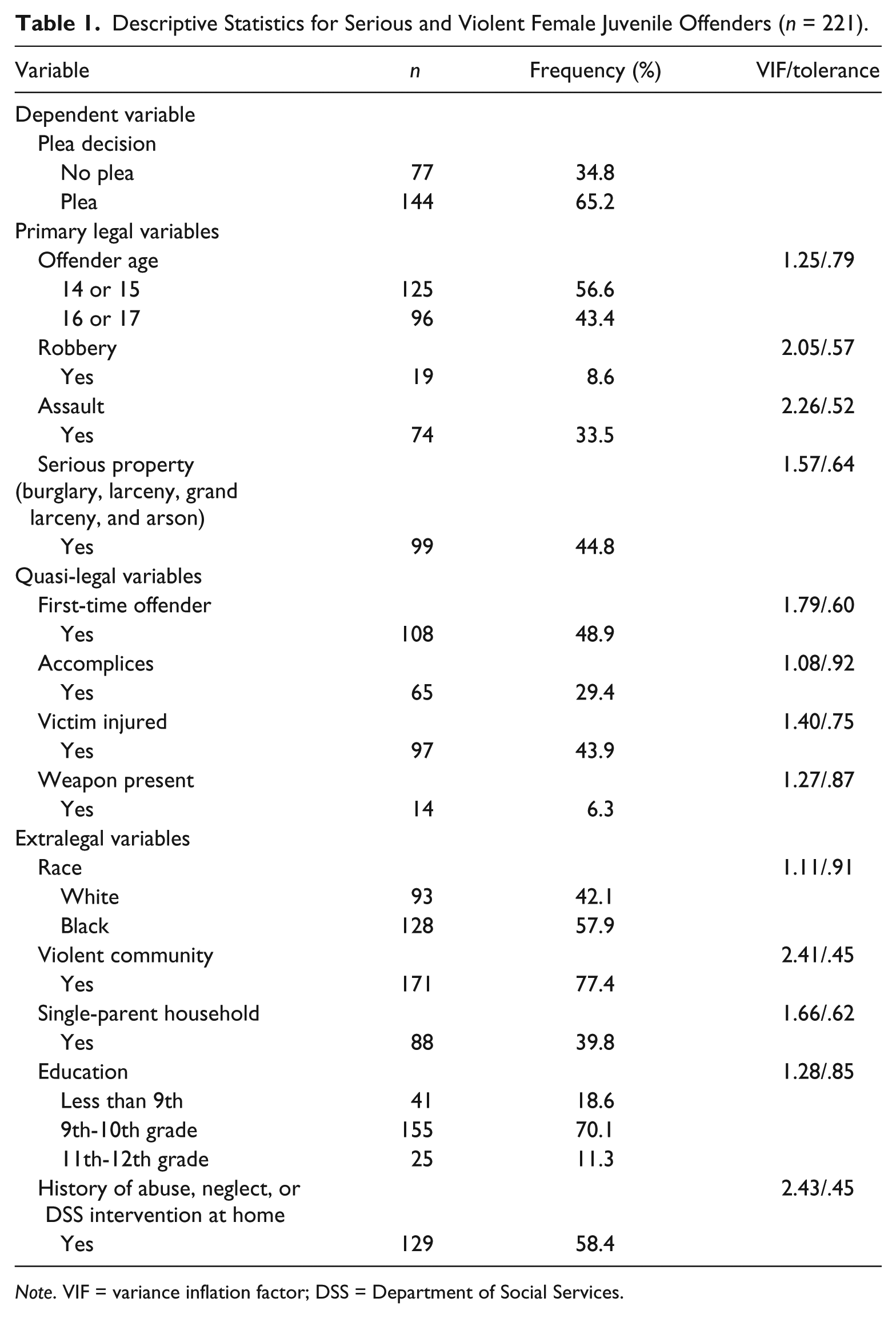
Given the dichotomous nature of the outcome variable (plea/no plea), logistic regression was utilized; this method is useful in predicting the probability of an observation appearing in one category of the dependent variable versus another (plea vs. no plea), as well as in the evaluation of which measures are stronger or weaker predictors of a dependent variable (Hosmer, Lemeshow, & Sturdivant, 2013; Menard, 2002). Resulting from this equation are “log-odds,” which may be transformed into an odds ratio by exponentiation of the produced coefficient (Menard, 2002). Noting concerns that those who employ regression analyses should be aware of the pitfalls of multicollinearity, sufficient diagnostic measures were performed using variance inflation factor (VIF) and tolerance values in STATA (Mansfield & Helms, 1982). As one may view in Table 1, the highest VIF value reported was 2.41 and the lowest tolerance value reported was .45, suggesting that multicollinearity was not an issue with these data (Freedman, 2009; Hoffmann, 2004). Moreover, it is recommended that per every predictor variable entered into the regression equation there exist at least 10 outcomes so as not to influence Type I error, relative bias, or other model performance measures (Vittinghoff & McCulloch, 2007) 4 —a condition which all of the models estimated meet. Finally, following Paternoster, Brame, Mazerolle, and Piquero (1998) coefficient comparison tests in the form of z scores were estimated (significant scores in bold) to accurately assess for any statistically significant differences between coefficients across race and intersectional independent variables.
Descriptive Statistics for Serious and Violent Female Juvenile Offenders (n = 221).
Note. VIF = variance inflation factor; DSS = Department of Social Services.
Results
Table 1 presents the descriptive statistics. It may be observed that 65.2% of the offenders received a plea concession, whereas 34.8% of the offenders did not.
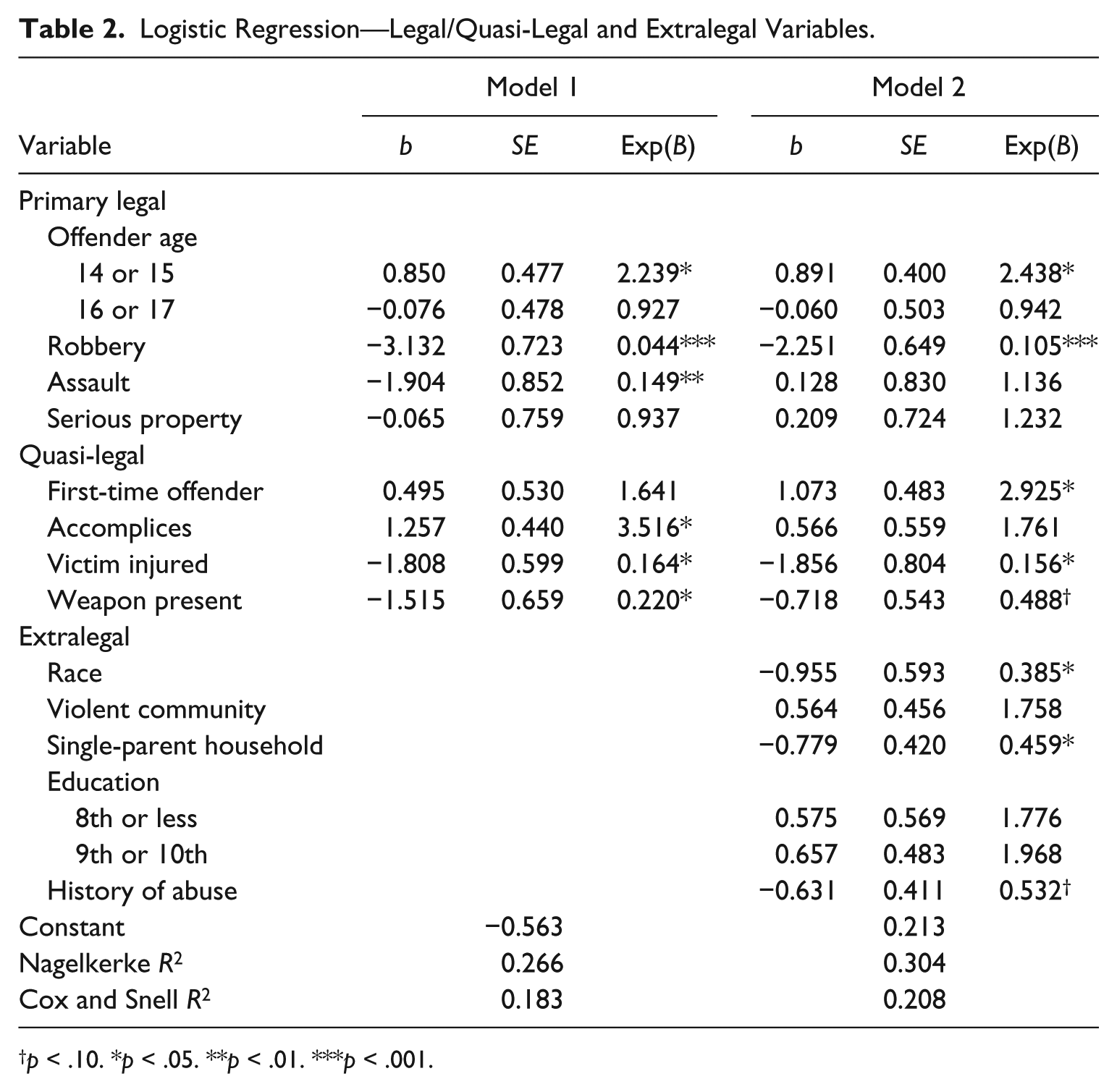
Table 2 presents the results from two logistic regression models—Model 1 (reflecting South Carolina Code of Law, 1976 §20-7-760, focused on the offense, offense circumstances, and the age of the offender), 5 and Model 2 which contains the extralegal predictor variables. Beginning with Model 1, it may be observed that younger offenders (age 14 or 15) were 224% more likely to receive a plea compared with older offenders (age 16 or 17). Among the strongest significant predictors in this model were some of the offense categories. For example, those charged with a robbery offense (p < .001, b = −3.132) or an assault offense (p < .05, b = −1.904) were significantly less likely to be offered a plea concession compared with the reference category (offense catchall category “other offense”). Those who committed a crime with an accomplice were 351% more likely to receive a plea, whereas those who injured their victim (p < .05, b = −1.808) or were in possession of a weapon (p < .05, b = −1.515) during the commission of their crime were significantly less likely to receive a plea bargain.
Logistic Regression—Legal/Quasi-Legal and Extralegal Variables.
p < .10. *p < .05. **p < .01. ***p < .001.
Model 2 provides an analysis with the extralegal predictor variable. Similar to the previous model, age was a significant predictor or receiving a plea concession. In fact, those who were younger offender (age 14 or 15) were 244% more likely to receive a plea deal compared with their older counterparts (age 16 or 17). Much like Model 1, those who committed robbery were significantly less likely to be offered a plea concession (p < .001, b = −2.251). Being a first-time offender was significant in this model, in that those who were first-time offenders were 107% more likely to be offered a plea concession compared with those with prior offenses. Consistent with Model 1, those who injured their victim in the commission of their crime were less likely to receive a plea concession (p < .05, b = −1.856), although the effects of being in possession of a weapon during the commission of a crime are somewhat marginal in this model (p < .10).
Importantly, some extralegal factors were significant predictors of being offered a plea concession. First, race of the offender was a significant predictor in this model. Compared with White offenders, Black offenders were 39% less likely to be offered a plea concession. Those who lived in a single-parent household were also significantly less likely to be offered a plea; precisely, 46% less likely. Those with a history of abuse, neglect, or DSS intervention in the home were less likely to receive a plea, although the effects of this variable were marginal (p < .10).
The results of Models I and II suggest that the plea decision is guided by primary and quasi-legal factors (e.g., offense type, prior record), keeping in line with South Carolina Code of Law, 1976 §20-7-760. Notable, however, are the significant effects of some extralegal factors (e.g., race and living in a single-parent household, chosen due to their significance in the previous models). Because of the interest in intersectionality at three different levels, gender-based expectations in offending patterns across race, and the decision to grant a female juvenile a plea, two additional models were constructed. These equations were modeled to include several two-way interaction terms to explore the possibility of how certain multiplicative effects of intersections may influence the likelihood of receiving a plea better than additive effects (Gujarati, 2003). This interaction analysis can consider whether outcome risk differs at different intersectional planes, or it can examine outcome risk at different levels of interacting processes (Bauer, 2014).
Table 3 provides the results obtained from Models III and IV, the binary logistic regression with the interaction terms. Model 3 6 provides interaction terms between race and legal variables, whereas Model 4 provides interaction terms between race and extralegal variables, both of which are predicated on the exploration of multiplicative identities as it relates to blameworthiness and culpability. Beginning with Model 3, two of the offense categories were among the strong predictors of plea decisions compared with the reference category: robbery (p < .001, b = −2.732) and assault (p < .01, b = −1.492). In fact, the effect of Black youth charged with assault has a stronger impact on the dependent variable than it does for Whites (z score = −2.75).
Logistic Regression With Interaction Terms.

p < .10. *p < .05. **p < .01. ***p < .001.
Bold faced values are significant z-scores.
With regard to the quasi-legal variables in this model, some predictors emerged as significant: First, those who committed an offense with an accomplice were 258% more likely to receive a plea concession. Second, those who were in possession of a weapon during the commission of an offense were 43% less likely to receive a plea. Some extralegal variables were also significant. For example, those who had a history of abuse, neglect, or DSS intervention in the home were less likely to receive a plea (p < .05, b = −1.448). The effect of living in a violent community was somewhat marginal (p < .10).
Race alone in Model 3 was not a significant predictor of the plea decision. However, there was a significant two-way interaction which revealed different outcomes for assault offenses by race. Black females who committed an assault offense were 43% less likely to be offered a plea. The impact of being a White female convicted of assault was marginal (p < .10). The two-way interaction between race and being a first-time offender was not a significant predictor of the plea decision in this model.
In Model 4, which provides two-way interactions between race and extralegal variables, one may again observe that, compared with the reference category, robbery (p < .001, b = −2.802) and assault (p < .01, b = −2.144) significantly affect the plea decision. Similar to Model 3, having an accomplice was a significant predictor of plea decision. In fact, those who committed their crime with an accomplice were 292% more likely to receive a plea deal. The opposite was true for those in possession of a weapon during the commission of their crime, as these juveniles were significantly less likely to receive a plea deal (p < .05, b = −1.107).
Finally, the interaction terms again had a significant impact on the outcome variable. The two-way interaction between race and living in a single-parent household revealed that Black females were 23% less likely to receive a plea deal and White females were 342% more likely to receive a plea deal. Outside of the full model, however, the calculated z scores failed to find statistically significant differences across race, single parents, and the dependent variable (z score = −1.65). The two-way interaction between race and a history of abuse, neglect, or DSS intervention in the juvenile’s home was also an important predictor in this model. White female who had a history of abuse, neglect, or DSS intervention in the home was a significant predictor of being offered a plea concession (p < .05, b = 1.242); in fact, belonging to this intersection increased the odds of receiving a plea by 346%. The effect of being Black with a history of abuse, neglect, or DSS intervention in the home was marginal (p < .10). This may be bolstered by the calculated z score between Black girls and White girls, suggesting that Black girls with a history of abuse had a significantly stronger effect on the dependent variable (z score = −2.11).
Discussion and Conclusion
The present study sheds light on a nascent and increasingly important subject through an underrepresented quantitative theoretical approach: juvenile plea bargaining from an intersectional perspective. Notwithstanding, the findings require additional discussion. Overall, underlying premise of the intersectionality framework (multiplicative identity, privilege, and oppression) which guided this research informed the research hypotheses. Specifically, there was an expectation that patriarchal entrenchment in the juvenile court, with a particular regard to race and forms of advantage or disadvantage, would play a role in shaping the plea bargaining process. More specifically, there was a research expectation that the intersection between race, legal, quasi-legal, and extralegal variables would make the plea bargaining process unravel differently depending on where one was situated on this theoretical plane. In general, this research expectation was supported by the results of the study: First, this research found some evidence that race alone played a significant role in defining the plea bargaining process (Model 2), as Black juveniles were less likely to be offered a plea concession, and were therefore disadvantaged in the plea process (Hypothesis 1).
The extant literature on the subject suggests that after considering relevant legal factors, race also plays a role in the decision-making process (Guevara et al., 2006; MacDonald & Chesney-Lind, 2001; Rodriguez, 2003) and juvenile crime in general (Engen et al., 2002; Feld, 2003). One should note that this finding does not provide wholly conclusive evidence that race alone is the starting point of oppression within an intersectional framework in the juvenile court. However, it does give reason to consider the cumulative effects of differential treatment shaped at three different levels (personal, group, structural), allowing this research to shed light on institutional racism in this setting, and how it undergirds and perpetuates inequality beyond conscious discrimination-motivated individual decision making. Indeed, findings suggest that girls of color deal not only with racial identity issues but also with group and institutional issues (Crenshaw, 1991; Segura & Facio, 2008; Zinn & Dill, 1996) leading to a disadvantage in the juvenile court (Leiber et al., 2009). From a Black feminist perspective, this may be explained by patriarchal and gendered definitions of what judges view as more or less culpable works to the benefit of White females and to the disadvantage of Black females in the legal process (Chesney-Lind & Sheldon, 2013; Crenshaw, 1989; Gaarder & Belknap, 2002; Potter, 2006).
Furthermore, when minority youth are disadvantaged in the legal process, they are increasingly placed into facilities of secure confinement or waived to the adult court (Burgess-Proctor, Holtrop, & Villarruel, 2008; Feld, 1999; Kurlychek & Johnson, 2004). Given the nascent nature of this research, it is recommended that future scholars explore the consequences and outcomes of race in the juvenile plea bargaining process, both particular to serious and violent juvenile females and within the general population of juvenile delinquents.
Second, turning to the multiplicative process, results of the research suggest that there is some evidence to support that interaction between race, legal variables, and quasi-legal variables was a significant predictor of the plea decision (Hypothesis 2). Particular to Hypothesis 2, assault alone was a significant predictor of not being offered a plea concession (Models I), and so too was being a first-time offender (Model 2). But, when these variables interacted with race (Model 3), some different outcomes began to emerge. The intersection between race and assault revealed that Black offenders, compared with White offenders, were significantly less likely to be offered a plea. This finding, perhaps, taps into the notion that decision makers may draw from race-based discourses of femininity, casting White females who commit acts of violence as innocent, while Black females who do so are viewed as more dangerous (Richie, 2012). In fact, this finding aligns well with the notion of double jeopardy, in that Black girls are being disadvantaged in the plea process not only by race but also by violating gendered assumptions of femininity by virtue of involvement in physical violence (Beale, 1970; King, 1988). Future research may consider more closely examining this nexus.
For the interaction of first-time offenders and race, no significant differences emerged. Extant literature on this subject has discussed the importance of prior offending in the decision-making process in the juvenile court (Fader, Kurlychek, & Morgan, 2014; Leiber & Johnson, 2008; Mears & Field, 2000; Rodriguez, 2010). Yet, there was only evidence that first time offenders (Model 2) were more likely to receive a plea concession and there were not differences between White and Black defendant’s likelihood of receiving a plea. As noted by Mears and Field (2000), juvenile justice research would benefit from the interactive effects of being a first-time offender and race; precisely why this interaction was included. However, results revealed that being a first-time offender does not vary between Black and White juveniles in their segment identity.
Finally, and notably, the findings provide reasonable support for the prediction that the intersection between race and extralegal factors creates advantages and disadvantages within the plea bargaining process (Hypothesis 3). In fact, the plea bargaining process did not operate in a uniform manner across differently situated juveniles. Particularly, it was noted that the intersection between being White and living in a single-parent household increased the likelihood of being offered a plea concession, but the opposite was true for being Black and living in a single-parent household. Moreover, the intersection between being White and having a history of abuse, neglect, or DSS intervention in the home was a significant predictor of being offered a plea concession.
These findings are rooted in the notion that Black girls in the juvenile court, especially poor (“morally” or economically speaking) Black women who suffer from abuse, neglect, and/or violence, as well as a nonnuclear family living situation are confronted with the suspicion with regard to their rehabilitative potential, instead of as a survivor/victim needing assistance (Richie, 2012; Zatz, 2000; Zinn & Dill, 1996). Based on these data, the same suspicion is not extended to White girls in the juvenile court. This potentially makes its way into the courtroom, where Black females are not viewed as survivors of poor circumstances but rather gender nonconformists, criminals, violent aggressors, or all of the above (Belknap, 2015; Daly, 1992). Thus, while there exists much evidence that boys and girls vary in their juvenile justice experiences (Chesney-Lind & Pasko, 2013), the social realities of the female experience in the juvenile justice system also vary across race and home living experience (McCorkel, 2013; Rodriguez, 2010; Singer, 2003). In other words, the compounding social forces of patriarchy, racism, and the family structure create a high hurdle of marginalization for Black females to overcome when entering the legal system (Arnold, 1990; Salisbury & Van Voorhis, 2009). Indeed, the results of this study suggest that this is not mere conjecture, but rather the reality Black female juveniles face in the juvenile courtroom setting.
This preliminary examination of serious and violent juvenile females from an intersectionality perspective provides insight into how one’s intersectional identity within a juvenile courtroom setting affects plea decisions among serious and violent females. From a policy perspective, results suggest that decision makers in the juvenile court be more cognizant of the privileges and forms of disadvantage faced by these juveniles. To highlight this need, it does not serve the concept of justice equity well to offer pleas unequally to juvenile defendants in single-parent households on the basis of race.
To conclude, some limitations existed in this research that must be addressed: First, the researcher was unable to compare waiver-eligible juveniles with juveniles waived up to the adult court. Not only was waiver exceedingly rare in South Carolina during the study time period (South Carolina Department of Juvenile Justice, 2013), the researcher was not able to obtain data on those waived to the adult court. Thus, this research was unable to examine if there were any substantive differences between these two groups of juveniles with regard to the plea bargaining process. Nonetheless, this research offers compelling insights that have not yet been examined by other scholars.
Second, given the significance of robbery in every model, it may have been quite telling to view the interaction between robbery and race to see how this intersection defines the plea bargaining process between races, if at all. However, given the small number of robbery offenses in the data (n = 19), a meaningful interaction could not be generated without violating interpretation assumptions of interaction-term regression (Norton, Wang, & Ai, 2004). Perhaps using multistate data over a longer period of time would permit future researchers to tap into this interaction. Third, the dichotomous definition of plea bargain as operationalized in this research may not be as simple as being offered or not offered a plea. Pleas may include, but are not limited to, charge, sentence, and count reductions, sentencing/treatment recommendations, and case dismissal (McCoy, 2005; Sanborn, 1992, 1993). More importantly, these data only tell us whether or not a plea was offered, nor the actual case outcome. It also does not tell us whether the juvenile pled or did not plea; it is an unfortunate limitation of these data. Future scholarship should strive to account for the variety of manifestations of a plea not present in this research, the case outcome, as well as attempt to gather plea information from both juveniles and judges.
A final potential limitation to this research concerns the framework of intersectionality. Interaction terms in a multiple regression help identify multiplicative effects where outcomes can be described for groups at each cross-stratified interaction (Bauer, 2014; Gujarati, 2003). However, other scholars argue that (a) this approach of merely interacting two variables in a regression is superficial and lacks explicit emphasis on the power/social structural context, thus failing to capture the complex understanding of intersectionality (Bowleg & Bauer, 2016), and (b) quantitative intersectionality research should also include a qualitative component (i.e., mixed methods; Else-Quest & Hyde, 2016). These points are well taken, and causal regression models may not always be the best choice to analyze complex social structure and power dynamics. However, in light of the unavailability of qualitative data for the present study and conventional use of regression among inequality research and policy analysis, this analysis suggests that quantitative research is not incompatible with feminist theory or intersectionality (Scott & Siltanen, 2016). Future research should expand upon these findings with mixed methods, more juvenile demographic information, and across multiple states.
In sum, plea bargains are commonplace and are likely to remain so. The researcher argues that the present study sheds a much needed ray of light onto the plea bargaining process via a Black, intersectional feminist framework, and suggests decision makers be cognizant about inequalities, disparities, and intersectional identities when considering the plea process. Being aware of inequalities in the plea bargaining process is of resolute urgency. If one is not offered a plea, there is an increased likelihood that they will be convicted of the most serious charges; it follows that they are then at an increased likelihood of receiving a more punitive sanction (Champion, 1989). These considerations have direct ties to the present study. If we accept that girls of color already face cumulative personal and group disadvantages, then it follows that racial disparities in the juvenile court create even further entrenched structural disadvantages for these girls as they enter the system (Collins, 1993; Potter, 2006).
Footnotes
Declaration of Conflicting Interests
The author(s) declared no potential conflicts of interest with respect to the research, authorship, and/or publication of this article.
Funding
The author(s) received no financial support for the research, authorship, and/or publication of this article.