



Abstract
Rejecting biological and essentialist explanations, feminist scholars posit that gender inequality is a driving force behind sexual violence against women. Using an ecological approach, I test for significant associations between national-level gender inequality and intimate partner sexual violence (IPSV). I use multi-level generalized linear modeling to analyze the responses of 9,126 women from 29 countries in the International Dating Violence Study. I find that while controlling for other risk factors, gender inequality is significantly associated with increased odds of having experienced severe, but not minor, forms of IPSV.
Sexual violence is a cultural phenomenon, enabled and fostered by social structures that create and maintain gender inequality. Societies across time and location experience varying levels of sexual violence (Sanday, 1981), some having minimal occurrences while others are infamous for their ubiquity. Yet the fact that sexual violence, such as forcible rape and sexual coercion, is relatively uncommon in some societies yet prevalent in others indicates it is likely not a manifestation of innate biological traits or the result of individual mental illness. Instead, the structural configurations of societies, especially those related to gender, either foster or hinder sexual violence (Heise, 1998; Rozée, 1993; Sanday, 1981).
Feminist scholars argue that gender inequality is a macro-level driving force behind sexual violence (Heise, 1998; Heise, Raikes, Watts, & Zwi, 1994; Rozée, 1993; Sanday, 1981). Specifically, social structures of gender inequality create milieus or “contextual effects” which shape individuals’ life chances of experiencing sexual violence. Contextual effects are the influences and impacts of macro-level forces upon the individual; the social contexts in which individuals are located affect their individual behaviors, life-chances, and risks. Due to the lower status of women to men and cultural gender norms, some societies are more conducive to sexual violence than others (Rozée, 1993; Sanday, 1981).
This article draws on three related theoretical frameworks that address the influence of culture and structure on individuals’ risk of experiencing sexual violence. First, Sanday (1981) provides a cultural explanation for societal differences in rape prevalence and categorizes societies as rape-prone or rape-free. Second, and in direct response to Sanday, Rozée (1993) argues that societies can be better understood as having degrees of rape-proneness instead of being put into a binary categorization. Third is an ecological approach to address sexual violence as a public health issue by organizing and integrating risk factors from multiple levels (Heise, 1998; Heise et al., 1994). All three frameworks approach sexual violence ecologically by conceptualizing its origins as “grounded in an interplay among personal, situational, and sociocultural factors” (Heise, 1998, pp. 263-264), though the first two focus primarily on the macro, sociocultural level as a driving force behind sexual violence. As tests of macro-level sociocultural explanations of sexual violence are often missing in past research, this article aims to address this gap by examining macro-level gender inequality as a factor in sexual violence.
This article specifically investigates whether or not macro-level gender inequality has a contextual effect on individual women’s risk of experiencing sexual violence. To test this, I focus on intimate partner sexual violence (IPSV), a specific but prevalent form of general sexual violence. Using the International Dating Violence Study (IDVS), I employ multi-level generalized linear modeling on 9,126 women students from 29 nations to test if higher levels of gender inequality in a nation are associated with an increase in individual women’s risk of having experienced IPSV. I look specifically at partners’ use of insistence, threats of physical force, and use of physical force to coerce women into engaging in sex as forms of IPSV.
Theoretical Frameworks on Sexual Violence
A number of criminological perspectives posit that social inequality is a driving force of crime (Fuller & Wozniak, 2008; Lynch, Schwendinger, & Schwendinger, 2008). Scholars have addressed the relationship between crime and various sources of inequality such as race, gender, and socio-economic status (Chesney-Lind & Morash, 2013; Daly & Chesney-Lind, 1988; Peterson & Krivo, 2005; Wright & Younts, 2009). In particular, feminist scholars give the role of gender primacy in their analyses (Daly & Chesney-Lind, 1988) and view sexual violence as a function of gender inequality and patriarchy (Chrisler & Ferguson, 2006; Heise et al., 1994; Rozée, 1993; Russo & Pirlott, 2006; Sanday, 1981; Watson-Franke, 2002).
Brownmiller’s (1975) book Against Our Will laid out a radical feminist view of rape and sexual violence. Brownmiller argued that all men consciously use rape or the threat thereof as a form of intimidation to keep women in a constant state of fear. This work sparked a surge of research and theory about rape and gender-based violence (Smith, 2004). In one such piece of research, Sanday (1981) rejectes Brownmiller’s broad categorizations about men, women, and rape and critiques the biological essentialism in her work. Based on a cross-cultural comparison, Sanday concludes that rape is neither universal nor biologically driven but is instead the result of cultural configurations.
Sanday (1981) was among the first to lay out a sociocultural theoretical framework for understanding sexual violence cross-culturally. She argues that rape is a social phenomenon evidenced by the fact that rates of rape differ between societies and historical periods. Furthermore, Sanday argues that rape is used as a means of control and domination of women to maintain men’s hierarchical status. She concludes that a cultural explanation of domination and control better explain cross-cultural patterns of rape than previous essentialist theories that argued that atavistic genetic remnants predispose men to rape women.
There are two major theoretical critiques of Sanday’s work. First, Sanday (1981) identifies two dichotomous ideal types of societies, “rape-prone” and “rape-free,” to categorize all societies. However, societies are not likely to be dichotomously rape-free and rape-prone, but rather exhibit differing levels of rape-proneness. Second, Sanday operationalizes rape as only forcible rape. This severely limits the scope of the theoretical model and does not reflect the varied and diverse forms of sexual violence.
Using the same data as Sanday, Rozée (1993) addresses both of these critiques. She finds that rape-free societies were nonexistent when she examined nonconsensual genital contact. That is, when rape was operationalized more broadly, Sanday’s dichotomous ideal types disappear. Instead, societies exhibited differing levels of rape-proneness. This idea of rape-proneness suggests that individuals’ odds of experiencing sexual violence vary across societies on a continuum.
Currently, many scholars still investigate how gender inequality, ideology, and structures affect sexual violence (e.g., Du Mont, Miller, & Myhr, 2003; Page, 2008). However, few recent researchers have further developed macro-level theories, and they tend to leave distal, structural factors such as gender ideologies or gendered economic opportunities unanalyzed. This leads to a gap in our understanding of the impact of gender inequality on individuals’ risk of experiencing sexual violence. Some contemporary scholars who do look at macro-level factors find evidence supporting the notion that gender inequality at a societal level is integrally linked to violence against women (Chrisler & Ferguson, 2006; Heise, 1998; Heise et al., 1994; Rozée, 1993; Watson-Franke, 2002). Of particular note is Heise’s (1998) use of an ecological framework to explain violence against women and Heise and colleagues’ (1994) examination of macro-level risk factors for violence against women.
At the heart of feminist understandings of the etiology of sexual violence is patriarchy, male domination, and male supremacy (Brownmiller, 1975; Heise, 1998; Peterson & Bailey, 1992; Sanday, 1981; Schwendinger & Schwendinger, 1983). Although there is no universally agreed upon definition of patriarchy, I argue an underlying commonality is that patriarchal societies have social systems and structures that privilege men in sociopolitical, economic, and interpersonal activities (cf. Brownmiller, 1975; Heise et al., 1994; Sanday, 1981; Schwendinger & Schwendinger, 1983). Patriarchal societies are fundamentally hierarchically structured around men, and men’s privilege and dominance should be evident throughout. Thus, patriarchal societies are likely to exhibit inequality in various institutions and ideologies, from the most macro institutions to micro interpersonal interactions.
Heise (1998) proposes that researchers view violence against women, including sexual violence, as a public health issue, and uses an ecological framework to organize and understand this phenomenon. Ecological approaches focus on the conditions of the social and physical location of the individual and consider how higher and lower level factors are integrated and may influence a given phenomenon such as sexual violence. Because they argue that women who are socially and physically located in societies where macro-level norms are conducive to rape and where culturally women have lower status have greater risk of experiencing rape, Sanday’s and Rozée’s explanations of rape in societies are essentially ecological, because they argue that women have greater risk of experiencing rape when they are socially and physically located in societies where macro-level norms are conducive to rape and where culturally women have lower status. Sanday’s and Rozée’s studies focus on cultural norms presents a challenge when using quantitative data, as they are difficult to operationalize and quantify. However, there exist other macro-level indicators that reflect macro-level gender inequality.
Heise and colleagues (1994) list 24 factors in four domains that they argue contribute to violence against women. These four domains are cultural, economic, legal, and political. All of the factors are related to gender inequality and include, for example, belief in inherent superiority of men, women’s limited access to employment in formal and informal sectors, limited access to education and training for women, low levels of legal literacy among women, and under-representation of women in power and politics. They suggest that these factors can be used as quantifiable indicators of gender inequality and used to investigate its effects.
Past research on macro-level gender inequality has used factors similar to those identified by Heise and colleagues (1994) as barometers or proxy measures for societal levels of gender inequality (Permanyer, 2010). One common source for such measures is the United Nations Development Programme (UNDP). The gender inequality index (GII), created by the UNDP, has been used for researching topics ranging from intimate partner violence (Straus & Mickey, 2012) to HIV prevalence (Kenyon & Buyze, 2015). Countries with high GII values are thought to be more patriarchal and dominated by men. These measures can be used as indicators of gender inequality in cross-cultural research.
Despite the improvement in data, methods, and computing ability, very little research has been done on the contextual effects of gender inequality on sexual violence. Some of the recent research that does exist suggests that gender inequality is unrelated to sexual violence, such as the following four studies, though each has notable limitations. Using Interpol data, Austin and Kim (2000) find that gender equality increases the incidence of rape. Similarly, Chon (2013) used international official crime statistics and found that developed countries had higher rates of sexual violence.
Both Chon (2013) and Austin and Kim (2000) suggest that their findings support the “backlash hypothesis,” which states that as men lose dominance over women in various social domains, they turn to sexual violence in an attempt to regain control over women (Austin & Kim, 2000; Chon, 2013; Russell, 1975; Whaley, 2001). The reverse of the backlash hypothesis is the “amelioration hypothesis,” which states that gender equality will decrease sexual violence against women as they become socially equal to men and have greater access to legal protections (Chon, 2013; Schwendinger & Schwendinger, 1983).
Whaley (2001) uses panel data in the United States and finds that gender inequality is associated with higher rates of rape in the long term, but not the short term. In other words, Whaley finds support for the backlash hypothesis in the short term and support for the amelioration hypothesis in the long term. However, Chon’s, Austin and Kim’s, and Whaley’s use of official data may hide the true extent of sexual violence, due to limitations of official crime statistics such as underreporting, varying definitions of crime, and different police agency reporting practices (see Maxfield, Weiler, & Widom, 2000).
In sum, current research on the association between gender inequality is sparse and conflicting. Couching myself in the feminist ecological frameworks described above and adding to the current research, I seek to investigate whether or not gender inequality is associated with sexual violence. I will focus on a specific form of sexual violence: IPSV. IPSV is a common form of sexual violence, the most severe manifestation of which is forcible rape, and has severe negative health and social impacts (Black et al., 2011; Chrisler & Ferguson, 2006; Heise et al., 1994).
Intimate Partner Violence Risk Factors
Researchers have identified a number of risk factors that predispose individuals to experiencing physical and sexual intimate partner violence. I aim to examine whether or not gender inequality is associated with women’s risk of experiencing IPSV independent of individual risk factors. Risk factors that reinforce or are influenced by gender inequality may cause spurious relationships between gender inequality and IPSV or suppress the influence of gender inequality on IPSV. To isolate any contextual effects of gender inequality on IPSV, I must identify and control for these individual-level risk factors.
One of the most well-studied risk factors is drug and alcohol abuse (Heise, 1998; Himelein, 1995; Koss & Dinero, 1989; Leen et al., 2013; Muehlenhard & Linton, 1987; Srivastava et al., 2014; Vogel & Himelein, 1995). Alcohol and drug use and intoxication, particularly by women, can be used by perpetrators (usually men) as a means of incapacitating victims and making them less likely to resist (Himelein, 1995; Koss & Dinero, 1989; Leen et al., 2013; Muehlenhard & Linton, 1987). Thus, alcohol and drugs may be used to coerce and manipulate intimate partners into unwanted sexual acts, especially in more rape-prone societies where gender relations may be adversarial.
Sanday (1981) identifies adversarial gender and sexual attitudes as a feature of rape prone societies. If a society normalizes violence in intimate partner settings, possibly because of adversarial gender and sexual cultural norms, the risk of experiencing such violence would theoretically increase. It is unclear, however, if abuse survivors’ individual attitudes change that risk level. Muehlenhard and Linton (1987) note that women’s attitudes on sexual violence may affect their risk of experiencing sexual assault, though Vogel and Himelein (1995) and Koss and Dinero (1989) do not find this effect. Vogel and Himelein (1995) argue that the individual beliefs may be a reflection of victimization, not a cause of it. Nevertheless, it is possible that people who approve of violence in family settings, violence by men in general, or violence in sexual situations may be more likely to tolerate or excuse a violent intimate partner and thus be exposed to greater risk of IPSV.
Sanday (1981) similarly notes that rape-prone societies have higher levels of violence overall. Just as approval of violence in intimate partner settings may predispose individuals to victimization, violent socialization (exposure to violence throughout the life course) may normalize violence for an individual (Heise, 1998; Papadakaki, Tzamalouka, Chatzifotiou, & Chliaoutakis, 2008; Renner & Whitney, 2012). The individuals may view an intimate partner’s violent behavior as normal or inevitable and continue in a relationship with them, increasing the risk and opportunity for IPSV.
The idea of violent socialization includes not only exposure to violence but also individual perpetration and victimization, especially during youth (Heise, 1998). Renner and Whitney (2012) found that women who perpetrated violence as children or teens were more likely to experience violent victimization by an intimate partner. Violent victimization in youth is particularly linked to physical and sexual abuse within the family (Heise, 1998), which may serve as a normative model for the abused child’s future relationships. Vogel and Himelein (1995) found sexual victimization in childhood, such as child sexual abuse, increased risk of later victimization by an intimate partner. Thus, violent socialization in the forms of exposure, perpetration, and victimization are all identified risk factors for IPSV.
The two final risk factors for violence by intimate partners are depression and social isolation. Heise (1998) identifies social isolation as a cause of or facilitator of violence against women. Indeed, researchers have found that abusive intimate partners use social isolation to maintain control through surveillance, limiting escape options, increasing economic and social reliance upon the abuser, and reducing outside input about relationship dynamics (Gelles, 1997; Lanier & Maume, 2009; Stark, 2012; Woodlock, 2017). Women who are socially isolated may experience loneliness and depression as a result of social isolation. Vicary, Klingaman, and Harkness (1995) find that young women who perceived themselves to have poor peer relations and those who viewed themselves negatively had higher risk of experiencing IPSV. Similarly, Leen and colleagues (2013) identify depression and negative affect as a risk factor for intimate partner violence victimization. Thus, social integration may facilitate women wishing to leave sexually violent partners, especially before the violence escalates. Negative affect and depression may hinder women leaving by emotionally anchoring them to their violent partners or fostering a sense of hopelessness.
Present Study
Sanday (1981) found strong support for the hypothesis that “rape is an expression of a social ideology of male dominance” (p. 24) and that such violence reflects societal arrangements and not instinctual or inherent behaviors of men. However, Sanday (1981) only tested this hypothesis using pre-industrial societies and a specific, rather narrow, definition of sexual violence. Although Rozée (1993) broadened the definition of rape in her research, she still relied on the same data source that does not necessarily reflect modern cultural realities. Heise (1998) suggests the use of an ecological framework in studying sexual violence cross-culturally, whereby influences at multiple levels are considered together. I argue that Rozée and Sanday’s research is in line with Heise’s use of an ecological framework in that they examine the impact of macro-level factors such as gender inequality and cultural norms on individuals’ risk of experiencing sexual violence. In this article, I seek to advance this thread of research on sexual violence cross-culturally by using data from modern societies to examine the contextual effects of gender inequality on sexual violence. This article also adds to the few current studies on this topic by using self-reported cross-cultural data.
If sexual violence in general is a culturally based phenomenon as suggested above, then I would expect to see variation in rates of specific forms of sexual violence, such as IPSV, between modern societies. Treating macro-level gender inequality as a reflection of dominance by men in societies, I would additionally expect to find that gender inequality is positively related to odds of having experienced various forms of sexual violence, including IPSV. Stated explicitly, I expect to find that women living in nations with higher levels of gender inequality are at greater risk of having experienced sexual violence, including IPSV, than women in nations with lower levels of gender inequality.
Previous research often treats the phenomenon of IPSV as consisting of two subtypes: minor and severe IPSV (Straus, Hamby, Boney-McCoy, & Sugarman, 1996). Thus, for the analyses in this article, I will separate my hypotheses into two types of IPSV: minor and severe. My hypotheses are that high levels of gender inequality in a nation will be positively associated with increase in the odds that a respondent has ever experienced IPSV in the form of (Hypothesis 1) minor and (Hypothesis 2) severe in their current or most recent relationship lasting over 1 month controlling for other risk factors.
Data and Method
Sample
I test these hypotheses using the IDVS, a quantitative dataset developed by Murray Straus (2011) for examining intimate partner violence perpetration and victimization internationally. These data, collected between 2001 and 2006, are comprised of 17,404 students at 68 universities in 32 nations (Straus, 2011). Questionnaires were administered by International Dating Violence Research Consortium members to undergraduate students at their respective universities (Straus, 2004, 2009). Questionnaires were translated into local languages and then back-translated to assure what Straus (1969) calls “conceptual equivalence” (Straus, 2004). The dataset contains students from South Africa, Tanzania, China, Hong Kong, India, Japan, Singapore, South Korea, Taiwan, Belgium, Germany, Great Britain, Greece, Hungary, Lithuania, Malta, Netherlands, Portugal, Romania, Russia, Sweden, Switzerland, Brazil, Guatemala, Mexico, Venezuela, Iran, Israel, Canada, the United States, Australia, and New Zealand. Because respondents’ countries of origin or birthplace are unavailable in the dataset, I used only data for national-level variables from the country of the collection site. The response rate ranges from 42% to 100% for individual data collection events, with most collection events ranging from 85% to 95%. Questionnaires were administered during class with the exception of the collection site with the 42% response rate, where they were administered after class (Straus, 2009). All sampling was non-random and, instead, was based on convenience sampling of university students.
Because the feminist theoretical frameworks mentioned above primarily focus on women, I limited analyses to data provided by women respondents. The majority (70.1%) of the total respondents identified as women. Questions asked pertained to the respondent’s current relationship if that relationship had lasted more than 1 month or the most recent such relationship. After eliminating respondents who had never experienced a relationship lasting more than 1 month, the final sample size was 9,126 with 29 nations being represented.
Measures
National-level variables
My hypotheses focus specifically on national-level gender inequality. To measure this, I use the GII, a measure created by the UNDP. The GII is an annual measure that consists of three dimensions (reproductive health, empowerment, and labor market) and five indicators (maternal mortality, adolescent fertility, educational attainment, parliamentary representation, and labor force participation) of gender inequality (UNDP, 2005). These dimensions and indicators mirror the risk factors for violence against women identified by Heise and colleagues (1994), including limited access to employment, limited access to education and training, and lack of political participation. Such measures are commonly used in gender violence research that examines cultural and societal-level factors (Austin & Kim, 2000; Chon, 2013; Whaley & Messner, 2002). The GII combines the five items and the final values range from 0 to 1, where 0 reflects complete gender equality and 1 indicates complete gender inequality. I used the 2005 values from the Human Development Report 2005, because they are the most complete and fall within the time frame the data were collected. GII values were available for all nations except Taiwan and Hong Kong, which I thus excluded from analyses.
I consider two national-level control variables, income inequality and gross domestic product (GDP), when testing the hypotheses. The dataset contains Gini index values based on the collection site location. The Gini index is a measure of income inequality at the individual or household level in a given region (The World Bank, n.d.). Some critical and Marxist criminologists posit that income inequality is a driving force of crime (e.g., Lynch et al., 2008). Values range from 0 to 1, where 0 indicates complete income equality and 1 reflects complete income inequality. The Gini value for Malta was unavailable from the World Bank, so I used the 2007 Gini value from the CIA World Factbook (Central Intelligence Agency, n.d.).
Both gender equality and GDP per capita are correlated with overall human development (Stanton, 2007). I include GDP per capita to control for any possible spurious relationship between these variables. Specifically, I use the 2005 parity purchasing power (PPP)–adjusted GDP obtained from United Nations (The World Bank, 2018). I use GDP instead of the Human Development Index (HDI) because the HDI is comprised of some of the same indicators as the GII and risks collinearity in the analyses.
Individual-level variables
To measure the outcome variable, IPSV, I use a scale from the Revised Conflict Tactics Scales (CTS2). The CTS2 is a set of scales designed to measure various aspects of interpersonal relationships, primarily romantic and sexual relationships, including emotional attachment and conflict (Straus et al., 1996). The CTS2 contains a Sexual Coercion Scale, which asks respondents about major and minor sexual coercion/violence events perpetrated by or against their current or most recent romantic/sexual partner. The descriptive items listed below measure perpetration of sexual coercion; however, I only used responses to the “My partner did this to me” questions which followed each item to measure victimization. I recoded the responses from Likert-type (1 = strongly disagree, 2 = disagree, 3 = agree, and 4 = strongly agree) to dichotomous (1 = yes, 0 = no) attributes. The descriptive items are as follows:
I made my partner have sex without a condom.
I insisted on sex when my partner did not want to (but did not use physical force).
I insisted my partner have oral or anal sex (but did not use physical force).
I used threats to make my partner have oral or anal sex.
I used threats to make my partner have sex.
I used force (like hitting, holding down, or using a weapon) to make my partner have oral or anal sex.
I used force (like hitting, holding down, or using a weapon) to make my partner have sex with me.
The CTS2 coding guidelines divided the Sexual Coercion Scale into two subscales: Minor (Items 1-3) and Severe (Items 4-7) (Straus et al., 1996). To measure occurrence of individuals ever experiencing sexual coercion, responses of “strongly disagree” or “disagree” were recoded as “never occurred” and responses of “agree” or “strongly agree” were recoded as “ever occurred” (Straus et al., 1996). A value of “ever occurred” on any item results in a value of “ever occurred” on the entire scale. If a respondent has “never occurred” for each item, the entire scale is coded as “never occurred.” I used these resulting dummy variables for each individual in analyses. I removed data from Iranian participants from final analyses because values of IPSV were outliers. 1
Although the scales are dichotomized, the internal reliability of the items within each scale can be assessed. Because the items are dichotomous, I used the Kuder–Richardson Formula 20 (KR-20) to assess this internal reliability of the items (DeVellis, 2003). The KR-20 values for the Minor and Severe scales are 0.5245 and 0.5836, respectively. These KR-20 values are lower bound estimates of internal reliability because the items within the scales are not necessarily tau-equivalent (Graham, 2006). They are not tau-equivalent because the items vary in severity, so we cannot assume that the items are equally precise measures of the latent variable or that their variances are similar.
The dataset contains a number of measures of risk factors for intimate partner victimization. First, I control for the demographic variables age, years in college, parents’ marital status (1 = married and living together, 0 = all others), and income (z-scored to collection site, so cross-national comparisons are possible) (Heise, 1998; Renner & Whitney, 2012; Srivastava et al., 2014). Second, I control for the following dummy variables (1 = yes, 0 = no) of relationship characteristics: broke up with partner, sex is/was part of the relationship, same-sex relationship, and relationship type (dating, cohabiting, engaged, and married) (Dank, Lachman, Zweig, & Yahner, 2014; Himelein, 1995; Papadakaki et al., 2008; Renner & Whitney, 2012; Vicary et al., 1995). Last, I control for other risk factors using available scales from the Personal and Relationships Profile (PRP) that are included in the data (Straus, Hamby, Boney-McCoy, & Sugarman, 2010). Specifically, I control for criminal history, depression symptoms, child sexual abuse history, social integration, drug and alcohol abuse, approval of violence within the family, approval of violence by men, approval of violence in sexual relationships, and violent socialization (Heise, 1998; Koss & Dinero, 1989; Leen et al., 2013; Muehlenhard & Linton, 1987; Papadakaki et al., 2008; Renner & Whitney, 2012; Vicary et al., 1995; Vogel & Himelein, 1995).
Method
The three theoretical frameworks mentioned above all suggest that gender inequality at the macro-level affects individual life experiences and risk for experiencing sexual violence. That is, the cultural and structural organization in which individuals are situated creates a contextual effect on their risk of experiencing IPSV. This describes a multi-level random-intercept model to explain IPSV where the gender inequality of the nation affects the base levels of risk for the individual.
Thus, for my analyses, I use hierarchical modeling. Hierarchical modeling allows for the examination of the effects of higher level contextual variables such as income inequality, number of hospitals in a city, or crime rates on lower level variables such as health outcomes or odds of divorce (Raudenbush & Bryk, 2002). Although most regression techniques assume that observations and their errors are independent of one another, observations within clustered data (e.g., individuals within universities within countries) are likely to have shared characteristics or histories and thus violate this assumption (Hoffman, 2004). By investigating the differences in regression coefficients between clusters, hierarchical modeling takes the shared characteristics and histories into account and makes the observations otherwise independent (Hoffman, 2004).
Due to the binary nature of the outcome variables, I will employ hierarchical generalized linear modeling using a logit link function. I use Stata 13.0 and employ QR decomposition for all analyses. As I do not focus on any between-nation variation in the individual-level control variables, I use a random-intercept model. That is, I let the intercepts vary only between clusters and do not let variables’ slopes vary on Level 2, and thus, the Level 1 coefficients reported are akin to standard coefficient in regular logistic regression. Because I use a random-intercept model, I did not mean-center any of the variables.
Findings
Table 1 presents the descriptive statistics for all variables used. Means of dummy variables are presented as percentages. The variables are split into national and individual (Level 2 and Level 1, respectively). The average participant is a 23-years-old woman in her second year of college who is currently in an intimate relationship for over 1 month or was in such a relationship within the last 6 months. She lives in a country with relatively low levels of gender inequality (0.267), moderate income inequality (0.370), and a PPP-adjusted GDP per capita of US$33,766.32. About 32% of the women reported having broken up with their intimate partners within the last 6 months. Approximately 70% of participants have parents who are currently married and living together and about 75% are or were in a sexually active relationship. Nearly 2% of respondents report being in a same-sex relationship and 77% of all respondents describe their relationship as “dating.”
Descriptive Statistics for National and Individual-Level Variables.

On the risk factors used as control variables, the average respondent scored low on the Criminal History, Sexual Abuse History, and Depression Symptoms scale. The mean score on the Social Integration scale was moderately high. Mean scores for the Alcohol Abuse scale were moderately low, but quite a bit higher than the very low scores on the Drug Abuse scale. The average respondent had a moderately low score on the Family Violence Approval scale but mean scores on the Sexual Violence Approval scale and violence by Men Approval scales were low. Similarly, mean scores on the Violence Socialization scale were low.
Experiences of sexual coercion by an intimate partner were common. Over one third (33.78%) of respondents reported experiencing minor or severe sexual coercion in their current or most recent relationship. The majority (83%) of women who experienced any form of sexual coercion by a partner only experienced minor sexual coercion. Slightly under one third (32%) of all women indicated that their intimate partner either insisted on vaginal, oral, or anal sex or insisted on not using a condom. About 5.5% of women’s intimate partners used threats or force to make her have vaginal, oral, or anal sex.
Table 2 presents sample size, GII value, and Gini value for each of the 29 nations in the sample. The clusters range in size from India (N = 71) to the United States (N = 2,723) with a mean cluster size of 315. GII values range from extremely low gender inequality (Sweden = 0.065) to rather high gender inequality (India = 0.646). Gini values ranged from 0.249 (Japan) to 0.58 (Brazil). GDP per capita in 2005 ranges from US$1,820 (Tanzania) to US$61,974 (Singapore).
Sample Sizes, GII Values, Gini Coefficients, and GDP Per Capita (US$, 2005) for 29 Sampled Countries.

Note. GII = gender inequality index; GDP = gross domestic product.
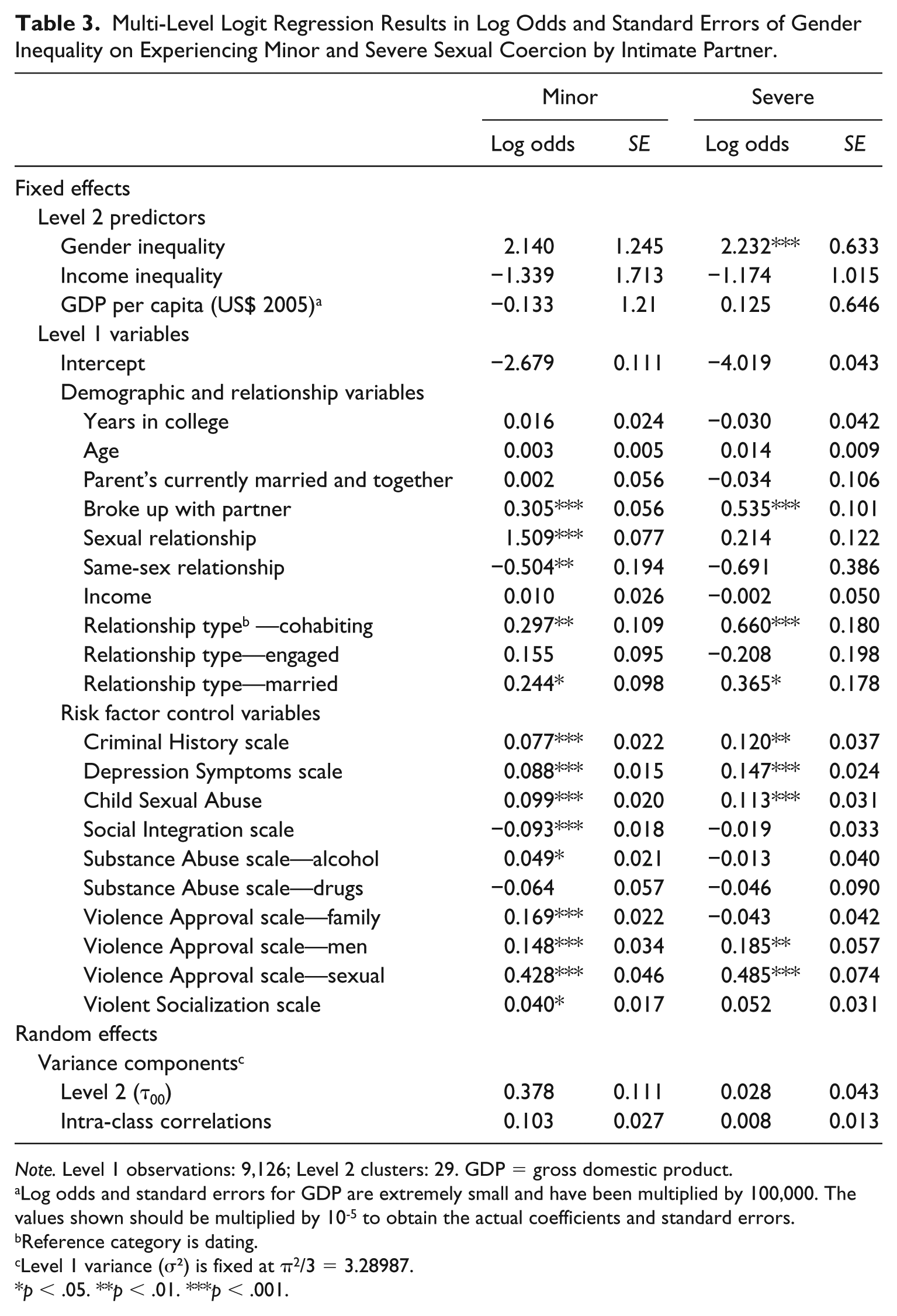
The results of two multi-level logistic regressions predicting log odds of having experienced minor and severe sexual coercion by intimate partners are presented in Table 3. Because log odds are reported, positive values indicate a positive relationship between the independent and dependent variables and negative values indicate a negative relationship. A number of demographic control variables significantly predicted having experienced sexual coercion. Having broken up with their partner positively predicted both types of sexual coercion. It seems likely that the breakup was after the fact and in response to the sexually coercive behavior. Cohabitation and marriage positively predicted sexual coercion experiences compared to just dating, but this relationship may reflect the length of time spent together and exposure to opportunities for sexual coercion. Women who described their relationships as sexual were more likely to have experienced minor sexual coercion. Women in same-sex relationship had a significantly lower probability of experiencing minor sexual coercion compared to women with other-sex relationships.
Multi-Level Logit Regression Results in Log Odds and Standard Errors of Gender Inequality on Experiencing Minor and Severe Sexual Coercion by Intimate Partner.
Note. Level 1 observations: 9,126; Level 2 clusters: 29. GDP = gross domestic product.
Log odds and standard errors for GDP are extremely small and have been multiplied by 100,000. The values shown should be multiplied by 10-5 to obtain the actual coefficients and standard errors.
Reference category is dating.
Level 1 variance (σ²) is fixed at π2/3 = 3.28987.
p < .05. **p < .01. ***p < .001.
Quite a few risk factor variables significantly predicted experiences of sexual coercion among women. Experiences of sexual coercion were positively predicted by criminal history, depressive symptoms, and history of child sexual abuse. Social integration negatively predicted minor sexual coercion. Violence approval, especially sexual violence and violence by men, predicted probability of experiencing sexual coercion. Again, however, this may be an effect of having experienced sexual violence previously rather than an antecedent risk factor.
The analyses support both hypotheses. Table 3 shows that national-level gender inequality increases the risk of women having experienced minor and severe sexual coercion by an intimate partner. In other words, we have enough evidence to reject the null hypotheses of no difference for Hypotheses 1 and 2 stated above. As seen in Table 3, a 0.1 increase in GII results in a log odds increase of 0.214, odds ratio (OR) = 1.24, for minor sexual coercion and a 0.2232 (OR = 1.25) increase in log odds for severe sexual coercion. Using ORs, a 0.1 increase in GII increases the odds of having experienced minor and severe IPSV by 24% and 25%, respectively.
Because interpretation of the log odds is not intuitive, Figure 1 presents the predicted probabilities for an individual having experienced IPSV based on GII levels controlling for other factors. GII values are shown in 0.1 intervals, the approximate difference, for example, between Great Britain and the United States. The relationship between GII and minor sexual coercion is roughly linear with an approximate increase in predicted probability of 0.0431 for each 0.1 increase in GII. That is, for each 0.1 increase in GII, there is about a 4.3% increase in probability that a woman will have reported experiencing minor sexual coercion in their current or most recent relationship, respectively. The relationship between GII and severe sexual coercion is more curvilinear. However, for severe sexual coercion, there is an average increase in predicted probability of 0.0175 for each 0.1 increase in GII, respectively. That is to say, for each 0.1 increase in GII, there is roughly a 1.8% increase in probability that a woman will have reported experiencing severe sexual coercion in their current or most recent relationship.
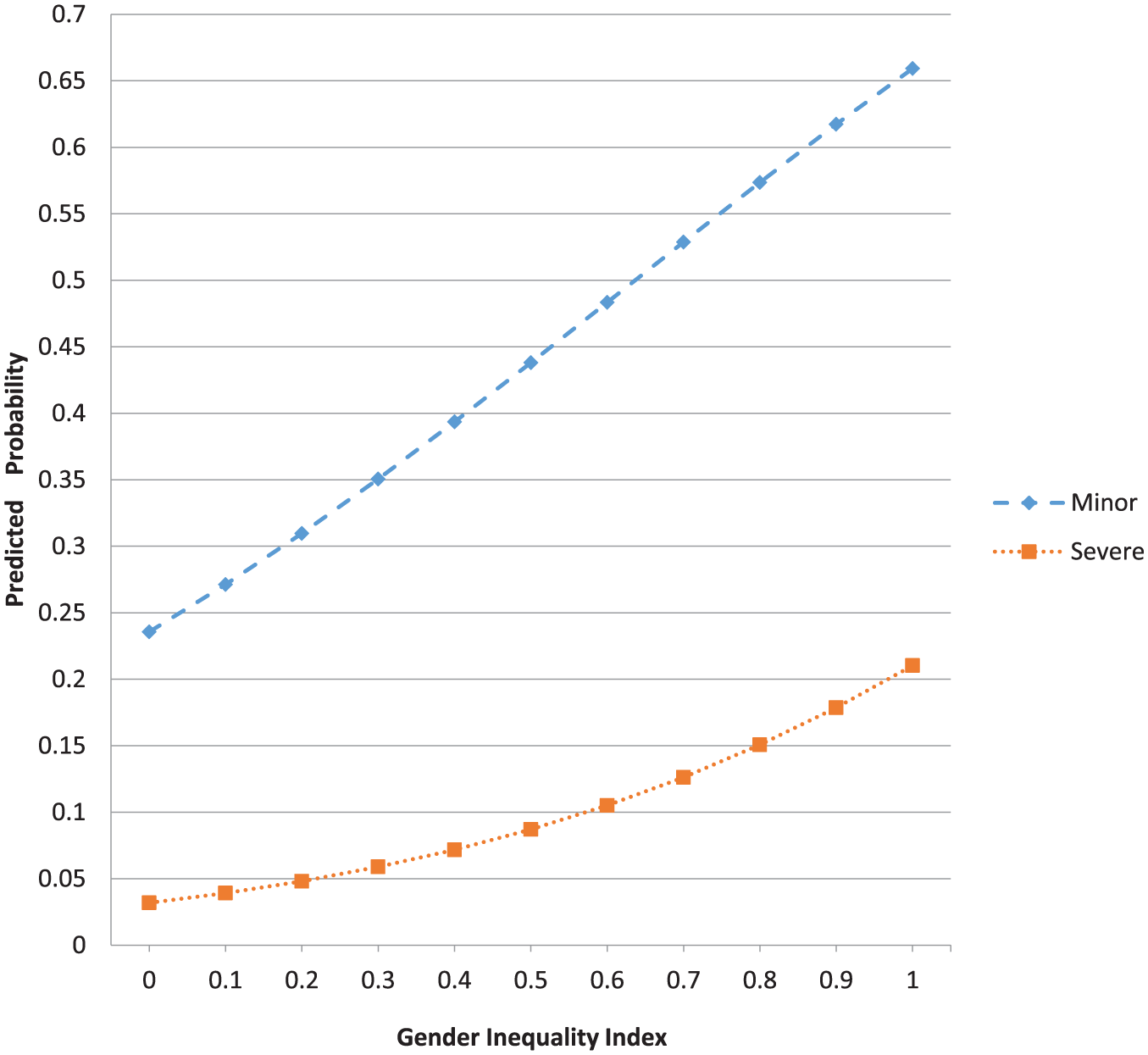
Predicted probabilities of ever experiencing intimate partner sexual coercion by national gender inequality index values.
Discussion
In line with Sanday’s, Rozée’s, and Heise’s predictions, I find that higher levels of national-level gender inequality significantly increase the odds of women having experienced minor and severe IPSV. Although only sexual violence by an intimate partner was investigated, the data add to the growing evidence in support of feminist theories that gender inequality is a driving force behind sexual violence (Heise, 1998; Rozée, 1993; Sanday, 1981). I find that gender inequality increases both types of IPSV, both the major forms (threat and force) that have been the primary theoretical focus of feminists in the past (e.g., Sanday, 1981) and minor forms (insistence).
Laying the foundation for a sociocultural understanding of sexual violence, Sanday (1981) argued that rape is not the product of biological impulses or atavistic vestiges of our ancestors. The findings presented here corroborate Sanday’s findings that gender inequality exacerbates and promotes sexual violence against women. In addition, I find support for the “amelioration hypothesis” that gender equality reduces sexual violence against women. Women in more gender equal countries are significantly less likely to have experienced IPSV than woman in more gender unequal countries.
These findings further support the application of an ecological model to sexual violence. The measures presented here suggest that gender inequality does in fact have a contextual effect on individuals’ odds of having experienced IPSV regardless of individual-level risk factors. In other words, macro-level structural inequality is associated with negative outcomes among individuals situated within that structure, independent of individual-level risk factors.
Limitations
This study has a number of limitations. First, because the sampling is non-probability, the statistical findings may not be generalizable to countries or even to university students within those countries. Similarly, university students likely reflect a privileged population within the countries being studied and the qualities that constitute average university students likely vary between countries, making their comparison questionable. Furthermore, the adequacy of the GII as a measure of gender inequality is debated (Permanyer, 2010, 2013b). The GII does not provide much variation between highly developed countries, making comparisons difficult (Permanyer, 2013a), and may overly penalize low-income countries (Permanyer, 2013b). In addition, the items may suffer from issues of social desirability bias and stigma because of their intimate and traumatic nature. This is ameliorated by the fact that self-administered self-report data like those used in this article are the most appropriate for these type of data (Groves et al., 2009). Last, some respondents may not recognize events as coercive or may not recall the event as notable, especially for the items in the “minor” events (Kimmel, 2002).
This dataset and its variables present some limitations as well. The translation process used by the original authors of the dataset is unclear. I assume that the questionnaires were translated into the language used at the school, and not necessarily the native language of the student, but without more details about the original data collect, this is an assumption. In addition, only national-level measures are gathered for Level 2 data. This restricts the examination of higher level factors to those determined by political boundaries, which is not necessarily the same as “macro-level” factors. More local, neighborhood, and regional data are thus missing from these analyses. Last, data on the nationality, birthplace, or country longest lived in of the students and their partners are unavailable. Thus, the collection site’s country is assumed to be the country of both the respondents and their partners. Last, this study focuses on only one form of sexual violence and inferences about other forms of sexual violence should be made with caution.
Given the evidence showing the contextual effects of gender inequality on individual risk for IPSV, the next step would be to investigate and specify exactly how this macro-level inequality affects the individual. Future research should examine which lower level risk factors mediate the effects of gender inequality, if any. Creating and testing a theoretical model that integrates multiple levels of help identify more proximate risk factors and elucidate how gender inequality works through them. In addition, future research should investigate whether increases in gender equality create situations favorable to temporary increases in rates of sexual violence, as suggested by Whaley (2001).
This article looks at only one form of sexual violence (IPSV), though there is no reason this feminist ecological framework cannot be applied to other forms of sexual violence. Furthermore, this framework can be applied to much more than just the women university students addressed here. Sexual violence can affect all people of all statuses, but future research can determine which statuses and intersections of those statuses are disproportionately affected by it. Ideally future research should address sexual violence against lesbian, gay, bisexual, transgender, transsexual, and queer (LGBTQ) folks; children; aged folks; men; disabled folks; people of color; and more, and how their intersections affect their risk of sexual violence.
Conclusion
I argue that past feminist sociocultural theories on sexual violence employ an ecological framework because they posit that gender inequality and the lower status of women in a society increase their risk of experiencing sexual violence. Drawing on Sanday’s (1981) observations that rape is the result of societal structures and gender inequality, I apply this framework to cross-cultural data on IPSV. I find empirical support for the contextual effect of national-level gender inequality on sexual violence by intimate partners against women university students. Specifically, I find that women living in countries with higher levels of gender inequality were more likely to report that their intimate partners insisted on or used threats and force to coerce them into vaginal, oral, or anal sex or insisted on condomless sex. I also find support for the amelioration hypothesis that gender equality reduces women’s odds of having experienced IPSV. The contextual effects of national-level gender inequality remained after controlling for numerous individual-level risk factors.
In conducting these analyses, I have furthered the thread of research investigating sexual violence employing an ecological framework. This research also supports the notion that sexual violence varies across societies on a continuum, where certain social structural configurations are either conducive or hindering to sexual violence to varying degrees. In addition, this article adds to the relatively small amount of research on the impact of gender inequality on sexual violence. The analyses advance this research by using data on modern societies around the globe and modern analyses techniques to investigate contextual effects in clustered data. Based on the findings presented here, I suggest further research on these contextual effects of gender inequality on this detrimental and all-too-prevalent phenomenon.
Footnotes
Declaration of Conflicting Interests
The author(s) declared no potential conflicts of interest with respect to the research, authorship, and/or publication of this article.
Funding
The author(s) received no financial support for the research, authorship, and/or publication of this article.
