




Abstract
Prior literature suggests that drug legislation in the late 1970s and 1980s caused the rapid increase in the female incarceration rate. Empirical investigations focused on the female incarceration rate specifically may provide important information to further our understanding of the factors that contributed to this increase. The purpose of this study is to determine how much of the change in the female incarceration rate in New York can be attributed to the introduction of the 1973 Rockefeller Drug Laws. These laws were introduced prior to most war on drugs legislation and, therefore, serve as a unique case study for this type of investigation.
Introduction
Although men account for the majority those under the supervision of the United States (US) criminal justice system, sharp increases in the female incarceration rate have posed significant, unique challenges to the system (Vainik, 2008). It is important, therefore, to understand the factors that may differentially affect the incarceration rate of women.
The introduction of war on drugs legislation has been identified as a major cause of the increase in the female incarceration rate. Prior research focusing on the increases in the female incarceration rate have consistently identified the mid-1980s and the crack epidemic as a major cause of the massive increase in the female incarceration rate. While there is little doubt that this was a truly influential time period, less is known about the years preceding this time period and how factors in the decades before impacted the substantial increase seen in the 1980s. In particular, New York State is a significant battleground in the US war on drugs. The Rockefeller Drug Laws (RDLs) were among the first pieces of legislation aimed at combatting the rise in crime and heroin use (Wacquant, 2009). The RDLs acted as a model for legislation introduced in the 1980s and 1990s. Following the RDLs, there were significant changes in federal welfare policies (Blank, 1997), the impact of crack cocaine (Osler, 2013), and other significant state and federal policies and guidelines, much of which adopted features of the RDLs (Sacco, 2014). In many ways, what came to be known as the war on drugs, particularly during the rise of crack, were a continuation of refined policies and moral panics that continue to evolve today.
Therefore, the current study presents an interrupted time series analysis of the effect of the RDLs on the incarceration rate in New York State. This analysis provides an extension to the Association of the Bar of the City of New York and the Drug Abuse Council study, which evaluated the RDLs in the 3 years after the implementation. The analysis of the state prison population found that there was not a significant increase in the total number of annual new commitments to state prison for drug offenses (Association of the Bar of the City of New York, 1978). While this study provided important information about the effect of the RDLs during this time period, it is limited by the short time period investigated and the focus on the total or male incarcerated population.
The purpose of the current study, therefore, is twofold. First, because policies in New York State greatly influenced the polices subsequently passed by other states and on the federal level, understanding how the RDLs impacted the incarceration rate may shed some light on how and when similar legislation affected the female incarceration rate. Second, understanding what happened to the incarceration rate in New York State is important for understanding the timeline of events that led to the most impactful period for female incarceration rates.
Background
The most impactful period for the female incarceration rate has been consistently identified as the mid-1980s and 1990s. This period was greatly shaped by the emergence of crack, the harshest legislation, and largest increases in the female incarceration rate (Goldstein et al., 1989). However, in many ways, this tremendous shift is part of a continuation of policies and moral panics that continue to evolve today.
The contentious relationship between the government and mind-altering substances has a long history (Auerhahn (1999) for an analysis of moral panic throughout United States history). For the purposes of the current study, and the focus on female incarceration specifically, this discussion begins in the early 1900s. The Great Migration of blacks from the south to cities in the north and increases in immigration from eastern and southern Europe, brought several challenges to cities like New York City (Schneider, 2013). While the availability of wartime industrial jobs encouraged populations to move to larger cities, housing discrimination contributed to the creation of neighborhoods segregated by race and ethnicity (Johnson et al., 1990). One issue that proved to be a great concern to society and families was the morality of women and girls living in these neighborhoods.
During this time, there was a growing concern about youths’, primarily female youths’, involvement in drugs and alcohol, as well as the activities that seemed to accompany substance use. Drugs and alcohol, which was prohibited through a constitutional amendment during this time, were linked to unemployment, poverty, and many social ills. For many, there was a clear, specific association between these vices and minority and immigrant populations in lower socioeconomic status. Even as involvement in these activities shifted from the lower class to the working-class, there was a perception that these families were unable to set and enforce standards about illegal substances and the criminal and/or immoral behavior that resulted from it (Hicks, 2003). In the 1910s and 1920s, non-medical heroin use was concentrated in marginalized populations in several urban areas (Schneider, 2013). The focus on the supposed immorality of this population ignored other possible explanations. For example, Schneider (2013) explains that African Americans faced more challenges when seeking medical care which may have contributed to the use of illegal drugs like crack, which was also highly concentrated in New York cities.
To combat young women’s involvement in these activities, some states enacted wayward minor laws. In New York, this was of great consequence because half of the nation’s heroin users resided in New York City, a major port of entry for heroin that entered the country (Schneider, 2013). In 1923, this statute penalized women between the ages of 16 and 21 who were habitually addicted to the use of substances like alcohol and drugs, associated with persons lacking morals, frequented immoral areas like houses of prostitution, or habitually associated with thieves, prostitutes, and/or other immoral characters (Hicks, 2003). The impact of this law was enhanced by the participation of black working-class families who utilized the court system to regulate the behavior of their female relatives when their efforts to do so failed. At the same time, their utilization of these resources underscored the legislators’ assumptions about the working class’s inability to parent their children as well as their own immorality (Hicks, 2003).
New York and the War on Drugs
This background sets the foundation for the current study’s focus on New York State and the introduction of the RDLs. The cycle of policies and refinement of policies illustrate the importance of New York State and the RDLs in understanding what led to the increases observed in the 1980s and 1990s. Despite efforts by communities and the government in the early 1900s, drug use continued to impact different classes and races. Community members and news reporters linked the increases in crime in cities, particularly robberies, to addiction. After World War II, heroin went from being concentrated in a few states. However, due to surpluses of the drug from soldiers who had used it to stay alert during the war, the impact of heroin use spread more generally (Schneider, 2013).
During the 1960s, increases in heroin use led to a rise in overdose deaths in poor and middle-class neighborhoods. At the same time, individuals’ hunger for drugs was blamed for increases in crime rates, particularly muggings, robberies, and burglaries (Wacquant, 2009). Further complicating the political and social landscape, Supreme Court decisions in the 1960s changed criminal justice procedures. These changes provided greater protections for defendants. The introduction of the Miranda warning and the expansion of the right to counsel during interrogation are two examples. For some, these changes illustrated the erosion of protections for law-abiding citizens in favor of protections for criminal defendants (Kohler-Hausmann, 2010; Wacquant, 2009).
Then-President Nixon affirmed these fears of drugs in a special message to Congress on drug abuse prevention and control in 1971 noting that “[i]f we cannot destroy the drug menace in America, then it will surely in time destroy us” (Nixon, 1971). Although, Nixon went on to call for addiction treatment in addition to law enforcement, confidence in the effectiveness of drug treatment programs significantly declined (Martinson, 1974; Sarre, 2001). The Comprehensive Drug Abuse Prevention and Control Act of 1970 replaced prior drug laws with a single, comprehensive model. Title II, the Controlled Substances Act, placed certain plants, drugs, and chemical substances under the jurisdiction of the federal government. Under this framework, controlled substances were classified under five schedules based on judgments of dangerousness, potential for abuse or addiction, and potential for legitimate medical use (Radosh, 2002; Sacco, 2014).
Around the same time, New York and then-Governor Nelson Rockefeller were facing a very similar crossroads. Prior to the 1970s, and like Nixon, Rockefeller supported the medical model and implemented treatment programs like those that utilized methadone treatment for heroin addiction. However, increases in crime and media’s reporting on the ills of drugs negated the validity and success of these types of programs. Additionally, Rockefeller’s presidential aspirations appeared to motivate his shift from the medical model to the crime control model. Not only did Rockefeller introduce legislation clearly aligning the policy focus in New York with that of the federal legislation, he also enacted some of the toughest penalties for possession and sale offenses (Kohler-Hausmann, 2010). The New York Substance Control Act in 1973, the RDLs, distinguished between degrees of possession and sale offenses based on weight, regardless of the type of drug. Previously, only certain drugs like heroin, morphine, and cocaine were classified into degrees. Under the RDL, the possession or sale of a specified amount of a wide variety of drugs now constituted a felony (Tsimbinos, 1999). Individuals charged with drug crime were now classified as one of three types of offenders: A-I offenders were those who sold one ounce or more or possessed more than two ounces; A-II (middle-level dealers) offenders sold one-eighth of an ounce or more or possessed one or two ounces; and A-III (street level users or “sharer-pushers”) sold less than one-eighth of an ounce or possessed up to an ounce with intent to sell. The punishments for these offenses ranged from minimum sentences of 15 to 25 years to life, for the most serious offenses, to 1 to 8 years or one-third of a year to life. Additional legislation restricted plea-bargaining options for these offenders and, due to the mandatory sentencing structure and guidelines, judicial discretion was significantly limited (Association of the Bar of the City of New York, 1978; Kohler-Hausmann, 2010; Mancuso, 2010).
New York communities, particularly black communities, reacted similarly to communities in the early 1900s. Both attempted to reinforce standards of morality and respectability by employing the use of the state, but an important shift occurred. While communities in the early 1900s were attempting to change their own families, communities in 1970s calling for action appeared far more removed from the drug problem. Fortner (2015) expands on this in his analysis of New York’s black population’s support for the RDLs. Contrary to Alexander (2010)’s analysis, Fortner contends that black middle-class feared the epidemic and its potential threat to their quality of life. Women who engaged in drugs and crime faced criticism based on the personal morality and also their negative impact on society (Van Denend, 2010).
This distinction was further solidified in the mid-1980s during the height of the crack epidemic (Schneider, 2013). During the 1980s and 1990s, several pieces of legislation were introduced, including the 1984 Sentencing Reform Act (subsequently revised by the Violent Crime and Law Enforcement Act of 1994), the 1984 Comprehensive Crime Control Act, the 1986 Anti-Drug Abuse Act, and the 1988 Anti-Drug Abuse Act (Radosh, 2002; Sacco, 2014). Much of this legislation echoed the same motivations and sentences outlined in the RDLs. At the same time sensational articles and images of “crack babies” neglected by “oversexualized women” elicited some of the most visceral reactions from communities calling for tougher legislation (Hartman & Golub, 1999).
Differential Impact on Female Offenders
Overtime, the focus on controlling female behavior evolved along with the escalating drug enforcement policies. The RDLs and similar legislation focused law enforcement efforts against those involved in all levels of the drug trade, creating a net-widening effect (Chesney-Lind, 1997; McMahon, 1990). The effect on women appears to have occurred for two reasons. First, while female offenders generally commit fewer crimes and fewer violent crimes (Steffensmeier & Allan, 1996), when they do commit crime, female offenders are most commonly involved in drug and property crime (Greenfield & Snell, 1999). Further, women generally receive more lenient sentences compared to men (Moulds, 1978) and women are generally less likely to be incarcerated and more likely to receive shorter sentences if they are incarcerated (Freiburger, 2010; Steffensmeier et al., 2017).
The differential treatment has been attributed to discretion by criminal justice actors, specifically in judging extralegal characteristics like the offender’s sex (Albonetti, 1986, 1991). According to focal concerns theory, judges make decisions based on blameworthiness, protection of the community, and practical constraints, which would tend to benefit female offenders (Steffensmeier et al., 1998). However, the new sentencing structure under the RDLs would be expected to decrease leniency for female offenders.
This is further compounded by the intense scrutiny and disapproval that women involved in crime and vice behaviors like drugs use have historically faced. Going against this morality has been perceived as having a negative impact on society. Selective chivalry specifies that lenient treatment is only afforded to women who conform to traditional stereotypes of femininity, including stereotypical criminality (Anderson, 1976; Embry & Lyons, 2012; Van Denend, 2010). Van Denend (2010) explains that judgments of female offenders are affected by cultural narratives that link women to motherhood. Women who do not conform to the good mother idealization are not afforded lenient treatment. Women involved in drug crime were viewed as inconsistent with traditional female roles (Embry & Lyons, 2012) and contributing to a social ill (Bird & Eversman, 2017).
The negative view of women who commit drug offenses has been explored in the literature. Steffensmeier et al. (1993) examining sentence lengths for men and women sentenced in Pennsylvania between 1985 and 1987. Consistent with similar literature, they found that the primary factors used by judges to determine sentences were the seriousness of the defendant’s crime and the defendant’s prior record. However, a small but statistically significant interaction effect between gender and drug offenses when. Women that were sentenced to prison for drug crimes received slightly longer sentences than men. In a 2017 study, Steffensmeier and colleagues found similar results. Additionally, in supplemental interviews, some judges indicated that women are not generally a danger unless they were found to be main pushers or dealers in the drug trade (Steffensmeier et al., 2017). In a study of adjudication withholding in Florida, Ryon (2013) found that female offenders who committed drug possession offenses had significantly lower odds of having adjudication withheld compared to all other female offenders, except for those who committed robbery or grand theft. Freiburger (2010) utilized survey vignettes sent to Pennsylvania criminal court judges which manipulated demographic characteristics of the defendant and forms of social control like living status, employment and family role (emotional and/or financial support) to determine how sentencing decisions varied. In line with Steffensmeier et al. (1998), Freiburger found that gender had a significant effect, net of all other variables. It was also determined that those who were solely caregivers or those who were caregivers and provided financial support were significantly less likely to be incarcerated. Additionally, those convicted of drug offenses were significantly more likely to be incarcerated compared to property offenses. These findings illustrate the contention between the moral and caring characteristics associated with women and detrimental effects associated with drug use on society. Conversely studies analyzing the impact of sentencing guidelines have found that women who had children were less likely to be sent to prison for drug-related and property offense, but, contrary to prior literature, gender did not significantly influence sentence outcomes in any of the time periods (Koons-Witt, 2002).
The Current Study
Although there are some commonalities, inconsistencies with theory and historical analysis remain. Based on the importance of history in studying the impact of drug law enforcement on female incarceration rates, examining New York, specifically over a longer time period, provides a more rigorous test of significant changes in the incarceration rate. The American Bar Association, funded by the National Institute of Justice, used an interrupted time series design to determine if the RDLs were successful during the time period between September 1973 and June 1976, when the law was in full effect. Analyzes covered a wide range of issues such as drug use, deterrence by threat of punishment, and expenses related to the implementation of the RDLs. According to the results pertaining to the state prison population, there was not a significant increase in the total number of annual new commitments to state prison for drug offenses. There was, however, a rapid increase in the population of the state prison system by the end of June 1976 (Association of the Bar of the City of New York, 1978). Although this study provides a wealth of information about the impact of the RDLs not only on criminal justice outcomes but also health outcomes, it is limited by the short time period investigated and the focus on the total or male incarceration population. More recently, the New York Division of Criminal Justice Services evaluated the impact of the RDLs on arrests, indictments, and commitments to prison by county for felony drug offenses from 1973 to 2008 and 1999 to 2008. According to the findings, there were substantial increases in arrests, indictments, and commitments to prison between 1973 and the late 1980s. The total inmate population also increased substantially during this time period. At its peak in 1994, drug offenders made up 35% of the state prison population compared to 11% in 1973 (Division of Criminal Justice Services, 2010).
McMahon & O’Brien (2011) examined the effect of changes in the relative rates of arrests for females and males and sentencing reforms introduced in the US between 1970 and 2008 on the gender composition of those incarcerated. McMahon and O’Brien found that the front-end reforms, back-end reforms, and three strikes laws at the state level across the US were not significantly related to the increase of women incarcerated during this time period. Additionally, Pfaff (2015) found that the number of offenders incarcerated for drug crimes did not make up a large enough portion of the inmate population to cause the increase. Further, Pfaff found that the indirect effect of technical parole violations did not explain the increase.
Building on the prior studies that have investigated the effect of war on drugs legislation, the current study adds to the empirical research in four ways. First, studies like the American Bar Association study and the Division of Criminal Justice Services study tend to focus on the male population or the total incarcerated population. The current study includes separate analyzes of the female incarceration rate before and after the RDLs were introduced. Second, the American Bar Association study provided a wide variety of information about the impact of the RDLs but was limited to the time period between 1973 when the drug laws were introduced and 1976. The current study analyzes data between 1951 and 2003, the year before many of the most severe penalties were removed from the RDLs. Third, like the American Bar Association study, the current study employs an interrupted time series design. Lastly, the rigorous empirical analysis in McMahon & O’Brien (2011) provides important information about the change in the gender composition. However, in focusing on New York State, this study capitalizes on the unique temporal, cultural, and political positioning of New York during this time period.
Based on prior literature and the series of events leading up to the implementation of the RDL, the mandatory sentencing structure would increase the likelihood of a prison sentence being imposed. While the RDL focused on drug crime, generally, the focus on drug enforcement increased the likelihood that female offenders would come into contact with the criminal justice system because women commit drug crimes more than other types of crime (Bush-Baskette, 2000; Steffensmeier, 1993). As a result, women would be more likely to face incarceration. To better understand this, the incarceration rate, for all crimes resulting in incarceration will be analyzed. Thus, the following hypotheses are proposed:
H1: The incarceration rate will increase after the implementation of the RDLs.
H2: The male and female incarceration rates will increase after the implementation of the RDLs.
Beyond this, the negative perception of women involved in drug crime and their association with the breakdown of morality in society (Embry & Lyons, 2012) suggests that women involved in drug crime would be treated more harshly than men, resulting in a greater increase in the incarceration rate for women relative to men. Thus, a third hypothesis is proposed:
H3: The increase in the female incarceration rate will be larger than the male incarceration rate.
Research Design
The total New York state incarceration rate per 100,000 population as well as the separate male and female state incarceration rates per 100,000 population were analyzed in the current study. Although the RDLs were intended to affect drug sale and possession, increased contact with law enforcement would likely increase one’s potential for arrest for a variety of other offenses, including those most commonly associated with female offenders. Including incarceration for all offenses allows a review of the overall effect of the RDLs on incarceration rates during this time period.
The end-year state prison population counts of total, male, and female inmates in New York State prisons between 1951 and 2003 were obtained from the National Prisoner Statistics Program. The National Prisoner Statistics Program presents annual national and state level data on the number of prisoners held in correctional facilities (Bureau of Justice Statistics, 2018; Bureau of Justice Statistics, n.d.). The end-year state prison incarceration rates were calculated by dividing the end-year state prison population counts by the counts for each census-year for New York State (Hobbs & Stoops, 2002). The number was then multiplied by 100,000 to produce a rate per 100,000 population.
Method
An interrupted time series analysis was used to evaluate the impact of the RDLs on the incarceration rates in New York. Interrupted time series analysis compares the levels of a time series before an intervention to the time series after the intervention. The intervention was the 1973 Penal Law Revision, the RDLs. The analysis was performed for 1975, 2 years after the introduction of the RDLs. The year 1975 was chosen in order to account for the court process and delays associated with the increase in the number of individuals arrested for drug-related offenses. In their evaluation of the RDLs, the Joint Committee on New York Drug Law Evaluation found that in New York City an increase in the demand for trials caused a backlog in the New York City Supreme Court. Trials in non-drug cases also increased during this time period. By mid-1976, the committee found that half of the cases being disposed were over 1 year old (Association of the Bar of the City of New York, 1978). Additionally, some sources indicated that police were cautious about making arrests for drug crimes due to the increased risk of backlog and overcrowding in the court system (Kohler-Hausmann, 2010). Based on this information, 2 years was determined to be a conservative and logical year to perform the analysis.
The time series were analyzed using Box and Jenkins methods (McDowall et al., 2019). Generally, the procedure begins with a noise model, which accounts for seasonality, non-stationarity, and autocorrelation in a time series. Autocorrelation occurs in time series data because earlier observations are likely correlated with later ones. As a result, the points are not independent. Because this can negatively impact the validity of the analysis, these characteristics must be controlled before the impact analysis can be performed. ARIMA modeling procedures are used to control for predictable, within-series variation (McDowall et al., 2019). After these issues are adequately addressed, an intervention model, which represents the effect of the law, is added to the noise model. A statistically significant estimate of the intervention variable would indicate that there was a significant change in the series following the intervention (McDowall et al., 2019).
An abrupt, permanent change model was considered for each time series. This model suggests that there was a significant change beginning in 1975 that continued after the intervention. This model includes one coefficient, ω, which measures the change in the series mean after the intervention is introduced. An abrupt, permanent model is more parsimonious and is in line with expectations about the way in which the incarceration rate would change after the introduction of the RDLs (McDowall et al., 2019).
History Threat
A major threat to the interrupted time series design is “history” (Cook & Campbell, 1979). History refers to the possibility that events that occur at the same time as the intervention were responsible for an effect (McDowall et al., 2019). To control for changes in the population as well as the smaller proportion of female offenders, the incarceration rates per 100,000 New York residents were used for the analysis.
To further mitigate possible history threat, additional analyzes were performed with data from Massachusetts and New Jersey. These states were chosen because they are comparable to New York. Additionally, the northeast, where these three states are located, were uniquely influential in the war on drugs because the ports of entry located in and near these states were used to import illegal drugs (Schneider, 2013). Additionally, it is beneficial to restrict the analysis to one region because differences between regions could confound the results.
While the RDLs were enacted in New York in 1973, Massachusetts and New Jersey introduced significant legislation in the years after the RDLs. The Massachusetts Truth in Sentencing Commission was created by Chapter 432 of the Acts of 1993. This reform was created to develop more uniform sentencing guidelines. Among other provisions, the legislation eliminated sentences combining incarceration and community supervision, statutory good time, and parole eligibility at one-third or two-thirds of the minimum sentence for state prison sentences (Massachusetts Sentencing Commission, 2000). In New Jersey, the Comprehensive Drug Reform Act of 1986 introduced mandatory incarceration sentences and increased the length of incarceration sentences. One of the main areas of concern in the law was affording special protection to children by enhancing sentences for drug offenders operating on or near schools, as well as offenders who sold to juveniles or employed juveniles in drug distribution (Edwards, 1989).
Therefore, if there was an effect, one would only expect to see a change in New York. If an effect were due to a general trend or common event, one would expect to see an effect in similar states like Massachusetts and New Jersey.
Results
New York State
The time series for the total, male, and female incarceration rates are plotted in Figure 1. The female time series multiplied by 10 is also displayed in order to show the pattern of the female incarceration rate time series alongside the total and male incarceration rate time series.

New York state prison incarceration rates per 100,000 population.
The results of the interrupted time-series analyzes of these data are summarized in Table 1. There are two sets of results for the New York total, male, and female time series. The first set of statistics display the results of the main analysis. The second set present the results of the analysis with a control for crack possession law introduced in the 1980s. This is explained further below. For each of the series analyzed, the table displays the noise models used to model the autocorrelation, the impact estimate, ω, which represents the effect of the RDLs on the incarceration rate, the z-statistic, and confidence interval. Additionally, values for the Ljung–Box Q-Statistic are also included. The Ljung-Box Q statistic tests the null hypothesis that autocorrelations up to a lag, k, equal zero. This is a useful diagnostic to ensure that the model that is selected adequately controls for autocorrelation. It is also useful in comparing possible alternative models (Tabachnick, & Fidell, 2013).
Abrupt, Permanent Intervention Analysis (1975).
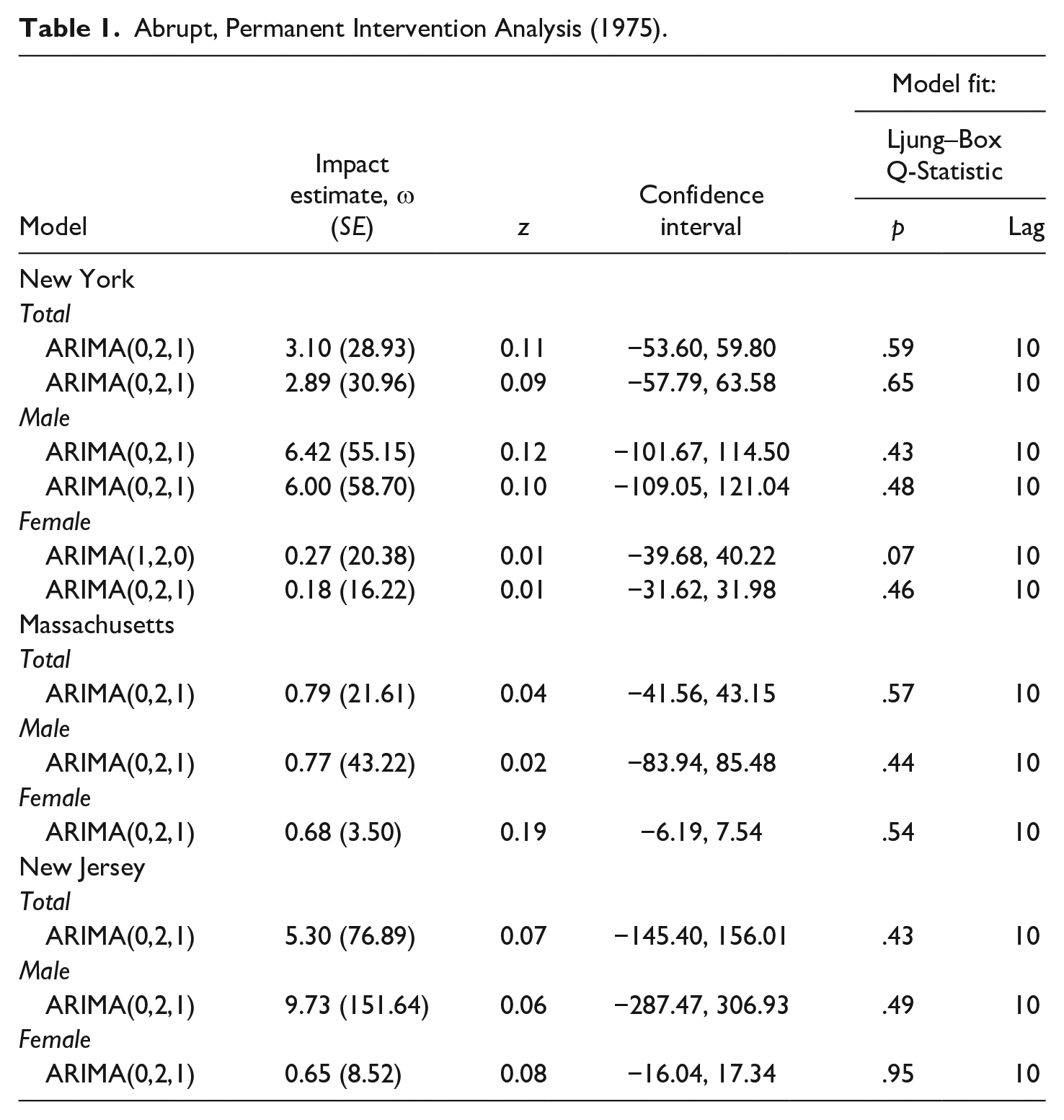
According to the analysis, the total New York State incarceration rate, as well as the rates for males and females separately increased after the introduction of the RDLs. According to the model, the total incarceration rate increased 3.10, the male incarceration rate increased 6.42, and the female incarceration rate increased 0.27 after 1975. The findings are not statistically significant for the three time series, however. This indicates that the change in the incarceration rate after the laws was not large enough to reject the null hypothesis. One would conclude, therefore that there is not enough evidence to support the hypothesis that the RDLs caused a change in the incarceration rates in New York State in 1975. More information is needed to determine if there was an impact, especially given the positive coefficients estimated after the intervention in 1975.
Although the current study focuses on the impact of the RDLs, it is important to note the emergence of crack cocaine in the 1980s and the significant effect this development had on both state-level and federal-level legislation. During the 1980s and 1990s several pieces of legislation were introduced, including the 1984 Sentencing Reform Act (subsequently revised by the Violent Crime and Law Enforcement Act of 1994), the 1984 Comprehensive Crime Control Act, the 1986 Anti-Drug Abuse Act, and the 1988 Anti-Drug Abuse Act (Radosh, 2002; Sacco, 2014). Much of this legislation echoed the same motivations and sentences outlined in the RDLs.
To account for the possible effects of the growth crack on the analyzes for the current study, additional analyzes were performed on each of the New York time series with a control variable for the 1988 Crack Possession Law introduced in New York (Goldstein et al., 1989). Using the same logic employed with the analysis of the RDLs, the control variable accounted for changes due to the crack possession law beginning in 1990.
The results of these analyzes are displayed. The impact estimates for each of the total (2.89), male (6.00), and female (0.18) incarceration rate time series were positive, indicating that after 1975, the incarceration rate increased. The coefficients for the impact estimates are comparable, but smaller than the coefficients estimated in the model without the control for the Crack Possession Law. Nonetheless, after controlling for the crack possession law, the impact of the RDLs is still not statistically significant. These results were consistent when alternate models were analyzed.
Comparing the ω coefficients, the coefficient for the male incarceration rate is larger than for the female rate. This indicates that the increase after the RDLs is the larger in the male incarceration rate. However, the results of the z-test of slopes indicates that the slope for the female incarceration rate is not significantly different from the male incarceration rate.
Comparison States
The results for the analyzes on the comparison states are displayed below the results for the New York State time series in Table 1. Like the New York time series, the coefficients are not statistically significant. From this, one would conclude that there is not enough evidence to suggest that the incarceration rates for these two states changed after the RDLs. If any of the states had changed significantly, this would have provided support against the conclusion that the RDLs had a unique impact on the incarceration rates in New York State.
Discussion and Conclusion
Historically, New York state has influenced drug policy and drug law enforcement. Prior research has identified the war on drugs as a major cause of the increase in the incarceration rate, especially for the female inmate population. In order to better understand what occurred in the decades leading up to the height of the war on drugs, the current study examined the impact of the RDLs on New York State prison incarceration rates between 1951 and 2003.
The results of the current analysis provide important information about one aspect of this impact. The results reveal that the RDLs do not fully explain the major increase in the female and male incarceration rates in New York (Hypotheses 1 and 2) and that there was not a statistically significant difference between the slopes for the female incarceration rate compared to the male incarceration rate (Hypothesis 3). The estimates indicate that the incarceration rates increased after the intervention, but the results of this study do not indicate that the there was a significant increase in the incarceration rate in 1975, 2 years after the implementation of the RDLs. Although these results align with prior studies finding limited empirical support that guidelines like those introduced in the RDLs had a differential impact on women (Koons-Witt, 2002), like these studies, the results reveal another piece of this complex story.
It is possible that the history threat was not completely alleviated by the measures taken in this study. While this may have prevented the current study from more accurately measuring the impact of the RDLs on the incarceration rate in New York State, it does suggest that the instinct to explore this time period as it relates to increases in the incarceration rate in New York State and likely the rest of the country is correct.
The crack epidemic and associated state and federal policies are more readily associated with massive increases in the female incarceration rate. The focus of this study, the decades leading up to the 1980s and 1990s, were characterized by an increase in the regulation of women and girls. Communities increasingly used the court system to control female family members who did not conform to mainstream standards of femininity as defined by society—most often the standards of white, middle-class femininity which has been defined as piety, purity, submissiveness, and domesticity (Hicks, 2003; Johnson, 2013). In some ways, the war on drugs and policies like the RDLs are yet another attempt to affirm the morals that mainstream society established and remove those who do not conform from society. The differential effect on black women in part reflects the tensions between the socialization process of black women, which tends to focus on discourses of strength and struggle (Collins, 2000; Johnson, 2013) and mainstream femininity. As a result, the relationship between gender and crime is constructed and reaffirmed over time. The current study provides a rigorous examination of the impact of the RDLs on the New York incarceration rate, a crucial point in the early stages of the war on drugs. At the very least, the null results of the interrupted time series highlight the importance of the decades leading up to the massive increase the female incarceration rate in the late 1980s and 1990s.
Future research may continue this examination by analyzing the impact of changes in the political and social landscape in New York and the sequence of the changes over time. For example, the major Supreme Court decisions in the 1960s substantially increased protections for criminal defendants. However, there is an important discussion about how legislation like the RDLs may have countered these protections through the restriction of plea and charge bargaining in the initial version of the law (Association of the Bar of the City of New York, 1978). Additionally, issues with housing availability in the years leading up to the tough on crime legislation may be an area that should be specifically examined. Although drug use was prevalent across racial and class lines, in looking at the early 1900s, restrictions on housing contributed to the concentration of drug use and law enforcement in specific neighborhoods. Among other things, prior literature has identified a link between the challenges individuals in lower income groups have when attempting to obtain legitimate medical services (Johnson et al., 1990). A closer examination of this issue in this context may explain some of the differential impacts on female incarceration rates because women tend to have more medical issues than men. Medical issues are even more concentrated in the female inmate population (Vainik, 2008).
Further, subsequent studies should address the impact of race, a limitation of the current study. Prior literature has shown that law enforcement efforts were disproportionately deployed in low-income, minority neighborhoods, which greatly contributed to the incarceration of black and Hispanic women (Bush-Baskette, 2000). Under the theory of selective chivalry, non-white women would be less likely than white women to receive more lenient treatment. Several studies have found that white women receive more lenient treatment when compared to non-white women (Moulds, 1978; Steffensmeier et al., 1998). Although Steffensmeier et al. (2017) found less race and age effects among female offenders compared to male offenders, interactions between race and gender appear to be particularly important in analyzes of outcomes for drug offenders (Bridges & Steen, 1998; Sharp et al., 2000). The literature would greatly benefit from qualitative studies that would be better suited to investigate the impact of race on this complex story, without the data and sample size limitations encountered while conducting this study.
The current study represents a small but important step in untangling the factors that led to the increase in women entering the criminal justice system after the crack epidemic as well as the increases that continue today. Although the female inmate population is still a small portion of the total prison population, the rapid growth poses significant challenges to the criminal justice system and many other aspects of society (Vainik, 2008). Important steps have been taken to better understand the unique characteristics of the incarcerated female population like the role of prior victimization in crime, the impact of motherhood on offending, as well as critiques of prior theories of female criminality (Alleyne, 2006; Radosh, 2002). Continuing this exploration is important for creating a more adequate justice system.
Supplemental Material
Supplementary_Materials_-_Revised – Supplemental material for New York’s War on Drugs and the Impact on Female Incarceration Rates
Supplemental material, Supplementary_Materials_-_Revised for New York’s War on Drugs and the Impact on Female Incarceration Rates by Colleen D. Mair in Feminist Criminology
Research Data
State_Prison_Population_and_Rates_1951-2003 – Research Data for New York’s War on Drugs and the Impact on Female Incarceration Rates
Research Data, State_Prison_Population_and_Rates_1951-2003 for New York’s War on Drugs and the Impact on Female Incarceration Rates by Colleen D. Mair in Feminist Criminology
Footnotes
Declaration of Conflicting Interests
The author declared no potential conflicts of interest with respect to the research, authorship, and/or publication of this article.
Funding
The author received no financial support for the research, authorship, and/or publication of this article.

Supplemental Material
Supplemental material for this article is available online.
Author Biography
References
Supplementary Material
Please find the following supplemental material available below.
For Open Access articles published under a Creative Commons License, all supplemental material carries the same license as the article it is associated with.
For non-Open Access articles published, all supplemental material carries a non-exclusive license, and permission requests for re-use of supplemental material or any part of supplemental material shall be sent directly to the copyright owner as specified in the copyright notice associated with the article.
