




Abstract
Women’s agency to construct prosocial lives remains understudied in criminology. This qualitative inquiry explores the nature and outcomes of women’s personal projects, which reflect their agency. In up to five interviews, 401 women on probation and parole explained efforts to improve their lives. Psychological theory on personal projects guided analysis that revealed information on project meaning and facilitators and barriers to project pursuit. Women shared a motivation to avoid trouble and establish prosocial lives. Outcomes were improved by social support and prosocial opportunities. Findings have implications for defining and analyzing agency in desistance research and for correctional responses to women.
Although there is no universal definition of personal agency in desistance research, the present study conceptualizes agency as an individual’s power to exercise control the course of their lives, within specific contextual constraints (see Bottoms, 2006; Giordano et al., 2002; Paternoster & Pogarsky, 2009). Criminological desistance theories have been criticized for considering context but not personal agency (Maruna, 2001; Paternoster et al., 2015), and this deficit is especially true for research on women. Although court-involved women have been historically been framed as victims lacking agency, feminist criminologists emphasize the importance of women’s agency and caution that viewing women’s crime primarily through the lens of victimization minimizes agency and responsibility (Daly, 1992; 2010; Maher, 1997). Feminist researchers take a critical approach in studying women’s unique experiences, including opportunities for change and sociostructural constraints on agency (Daly, 2010). For instance, in agreement with research documenting women’s high prevalence of traumatic experiences and the significance of relationships on women’s well-being (Covington, 1998; Covington & Surrey, 2000; Hoskins & Morash, 2020; Jordan, 1991), Kruttschnitt and Kang (2019) explored narratives of 95 persisters, and found that women’s agency was influenced by trauma and interpersonal relationships. These findings signal the importance of internal and situational influences on women’s agency to persist or desist from crime. However, most existing desistance theories were established from analyses with primarily or entirely male samples and fall short in accounting for agency throughout the desistance process.
To address these deficits, the aims of the present study are twofold: First, it builds on knowledge of court-involved women’s agency by exploring the nature of women’s agentic efforts to avoid illegal behavior and improve their lives, including facilitators, barriers, and outcomes of their agentic efforts. Second, it integrates psychological theory on personal projects (which reflect agency) to the study of desistance as a novel solution for defining agency and clarifying how agency functions throughout the desistance process (Little, 1983).
The Obscurity of Agency in Desistance Theory and Research
Desistance theories consider agency to a greater or lesser extent. Rational choice theories have been criticized for minimizing agency (Paternoster et al., 2015). In their identity theory of desistance, Paternoster and Bushway (2009) contend that desistance is initiated when one sees lawbreaking as “more costly than beneficial,” and desists to avoid a future “feared self” (Paternoster et al., 2015, pp. 214; Paternoster & Bushway, 2009). They acknowledge that agency is reflexive and intentional (Paternoster et al., 2015), but do not explain it in the desistance process beyond the initial decision to desist. Moreover, rational choice perspectives fail to account for sociostructural constraints on agency (Weaver, 2019). In contrast, the age-graded theory of informal social control explains that “desistance by default” occurs with sociostructural “turning points” in the life course (e.g., employment and marriage), which alter one’s choices and behaviors (Laub & Sampson, 2014, pp. 547). The theorists posit that desistance is not inherently “conscious” or intentional, yet frame agency as “situated choice,” in which choices to take action to desist are shaped by one’s social environment (Laub & Sampson, 2014, pp. 547–549). Other scholars have noted this “ambiguous” stance on agency (Paternoster et al., 2015, pp. 217). Another weakness of social control theories is that research to test them is based on primarily male samples, despite evidence that employment and marriage, which are related to men’s desistance, are not strongly related to women’s desistance (Giordano et al., 2002; Weaver, 2019).
Turning now to desistance theories that place greater emphasis on agency, Maruna’s (2001) application of narrative identity theory to desistance research accounts for cognitive and sociostructural aspects of agency. Narrative identity theory explains the relationship between how one narrates their life story and well-being (McAdams, 2013). In redemption sequences, the narrative transitions from a negative state (e.g., crime) to a positive outcome (e.g., desistance). In contamination sequences, a positive state is ruined by a negative event. Maruna (2001) compared the narratives of 30 desisters and 20 persisters, and observed that desisters’ narratives were generally agentic and redemptive, whereas persisters’ narratives demonstrated contamination and a lack of agency (Maruna, 2001). He theorizes that individuals make sense of their past crime and “make good” through prosocial identity changes. However, Maruna’s (2001) theory of desistance was developed from analysis of a primarily male sample. Morash and colleagues (2020) extended Maruna’s work by analyzing the narratives of 118 women but did not find that desisting women’s narratives had a greater number of redemption sequences, nor that persisting women’s had a greater number of contamination sequences. Their findings evince that Maruna’s theory may not explain women’s desistance, as women may construct unique expressions of agency and experience unique sociostructural influences on agency.
Giordano and colleagues’ (2002) theory of cognitive transformation was developed from analysis of a sample of 210 female and male participants, and considers internal and external influences on agency (Weaver, 2019). According to the theory, one sees crime as undesirable and becomes open to change, imagines a new prosocial identity, and seizes opportunities to construct a prosocial life. Agency is constrained within a “continuum of advantage and disadvantage,” highlighting how sociostructural circumstances can create or block opportunities to desist (Giordano et al., 2002, pp. 1026). Despite the strengths of this theory, scholars have noted its inability to specify why some opportunities are more influential than others, and how agency changes during the desistance process (Paternoster et al., 2015; Weaver, 2019). In his analysis of 20 individuals’ attempts to desist, King (2013) found that individuals adapted their strategies and goals based on perceptions of how changing circumstances and opportunities would impact success. He conceptualizes “transformative agency” to construct a prosocial identity as active, dynamic, and reflexive during the desistance process (King, 2012, pp. 324). Building on King’s work, Williams and Schaefer (2021) make a case for the development of an action theory of desistance, and propose that analysis of desistance strategies would account for how individuals use agency throughout the desistance process. A granular analysis of agency would clarify how agency functions and reveal internal and situational influences on agency and desistance. Below, I discuss how the present study contributes to this knowledge by integrating psychological theory to qualitatively analyze women’s agency to avoid crime and improve their lives. This integrated theoretical approach offers a more precise definition of agency which is unique from what desistance theorists have done.
Integrating Theory on Personal Projects to Explicate Women’s Agency
The present study explores agentic efforts of women on probation and parole to avoid crime and improve their lives. I draw on Little’s (1983) ecological theory, which is informed by motivational and personality psychology. As such, it considers agency (including agentic plans and actions) and contextual influences on agency (McGregor & Little, 1998). Little’s (1983) theory contributes to criminological desistance theories by specifying the types of agentic efforts that lead to positive and prosocial outcomes, therefore, making the analysis of agency more precise.
Personal projects are “self-generated accounts of what a person is doing or is planning to do” (Little, 1983). They range from short-term, small-scale goals to grand, long-term aims that people plan for and attempt to achieve (Sheldon & Kasser, 1998; Wallenius, 1999). For example, “applying to college” and “becoming an expert in my field” are both examples of personal projects. Personal projects are an important area of study because their nature predicts well-being, that is, life satisfaction and mental health (Little, 1989; 1993; McGregor & Little, 1998; Wallenius, 1999), both of which are related to recidivism (Laudet, 2007; 2011; Van Voorhis et al., 2010, 2013; Van Voorhis, 2012). Personal projects also predict goal achievement (Sheldon & Kasser, 1998), so information about what factors make projects successful could be used by a supervising agent to make a plan with the client about how to, for example, find a job. Personal projects research has primarily examined the goal pursuit of privileged populations, for example, college students and employees in the workplace (e.g., see McGregor & Little, 1998; Sheldon & Kasser, 1998). Recently, my colleagues and I introduced theory on personal projects to criminological research to explore the nature of court-involved women’s employment-related project pursuit (see Roddy et al., 2021). Results revealed features of women’s employment projects which affected well-being, and structural barriers that impacted project outcomes. The present study expands beyond this employment-specific analysis by exploring the nature of various personal projects of women on probation and parole.
In the present study, I analyze three cognitive elements of personal projects that are indicative of well-being, including perceived importance/value of the project (project meaning), self-efficacy to complete the project (project manageability), and social support for the project (project community) (Dietrich et al., 2012; Dowden, 2004; Pomaki et al., 2009). To understand the agentic opportunities and constraints women encounter, I explore facilitators and barriers women describe as having an impact on their project pursuit.
Research Questions
1. What is the nature of women’s personal project pursuit (i.e., expression of agency), over time? 2. What facilitators and barriers do women describe as having an impact on personal project pursuit, as indicated by positive and negative effects on project progress and well-being?
Method
Data
The analysis was conducted with available data from two sequential studies of 401 women on felony probation and parole in Michigan. The data collection began in 2011 and spanned over the course of 6 years. The primary purpose of the first study (2011–2013) was to test theories about the connection of communication patterns and relationship styles and the content of communication to short- and long-term outcomes. The primary purpose of the second study (2015–2017) was to examine narrative identity development and its connection to desistance.
For each of five interviews, interviewers asked the women about what they were doing to improve their lives since the start of supervision (or since the last interview). The resulting qualitative data were used for the present analysis. Preceding the present article, one other (aforementioned) analysis of the data collected from this specific measure has been published, which focuses exclusively on women’s employment-related efforts to improve their lives (see Roddy et al., 2021). The present study contributes to the literature beyond the prior analysis of employment-related projects by expanding theoretical knowledge about the common agentic projects and outcomes of women on probation and parole beyond employment-focused projects and makes an important contribution to desistance research examining the function of agency in the desistance process.
The primary investigators randomly selected 77 agents to invite to participate in the research from 16 counties in a Midwestern state, within driving distance of the university research office. 1 Seventy-three probation and parole agents agreed to participate and referred 846 women clients who had recently begun felony supervision and had histories of substance misuse. Some women were unavailable when interviewers visited the agencies and did not respond to follow up attempts, so 402 women consented to participate. The women who did not participate were slightly more likely to be incarcerated 1 year after supervision began. The final sample of the present study is 401 women, due to missing data for one woman.
Sample Characteristics
The average age of the women was 33.85 years (SD = 10.53; range = 18–60). One hundred and eighty-seven (46.6%) of them identified as White, 133 (33.2%) as Black, and 74 (18.5%) as multiracial or Hispanic/Latinx. Seven (1.7%) women identified as another race or did not identify their race. At the start of supervision, 303 (75.6%) were on probation and 98 (24.4%) were on parole or both. At the first interview most women (81.3%) reported an annual income of less than 10,000 dollars, 68.8% had a high school diploma/GED, and 8% had a college degree.
Procedure
All study protocols were approved by the university’s Institutional Review Board. Trained interviewers conducted interviews in person and over the phone. Participants were provided incentives for each interview: $30 for the first interview, $50 for the second, $75 for the third, $40 for the fourth, and $40 for the final interview. Most women (94.3%) were retained through the third interview, 75.8% at fourth interview, and 64.8% at the final interview.
Measures
To elicit information about women’s agency, a construct unrelated to the initial purposes of the two studies, the interview schedule included an open-ended qualitative question at the end of each interview designed to gather rich information about women’s agentic priorities and efforts. At each interview, participants were asked, “Since the beginning of probation or parole (or the last interview), are there things that you have done or are currently doing to make your life better? (If yes) What?” Interviewers probed for details about women’s agentic goals and efforts, and some women volunteered detail about reason for their efforts, progress, and facilitators and barriers. The use of a prompt designed to elicit descriptions of agentic plans and actions is useful for examining the nature of agency during desistance, and warranted considering desistance scholars’ recommendations for action-oriented approach to the analysis of agency, including agentic actions and strategies to desist, in order to understand how agency functions and changes throughout the desistance process (Williams & Schaefer, 2021).
Coding
Coding was completed in multiple stages using NVivo software. Two coders met and read 15 cases to establish units of analysis. A unit was defined as a description of an action/effort to improve one’s life. The two coders then unitized the responses of 43 participants and established acceptable reliability (Guetzkow’s U = .011) (Guetzkow, 1950). Next, the coders discussed their independent coding of the types of efforts women made for the first 15 cases. They agreed on the existence of and definitions for various types of efforts, and through several iterations of coding and discussion they agreed on all the types. Some women indicated they had done nothing and that they had even continued prohibited or illegal activities, so the category “nothing” was used. Then they coded material for 40 cases, containing 85 passages, on these themes. The intercoder reliability was .824, indicating a high level of agreement (Cohen, 1960). Then a coder completed the coding for the types of efforts women reported.
Preliminary inductive coding of women’s agentic efforts showed consistency with the personal project construct, so I worked with another coder to code characteristics of personal projects deductively and inductively. Guided by personal projects literature, we coded for progress towards goal achievement, facilitators and barriers of goal pursuit (including project meaning, project manageability, and project community), and outcomes (e.g., positive and negative effects on well-being). Inductive coding was used to categorize additional facilitators and barriers to project pursuit, such as sobriety, having a criminal record, or health issues. After establishing excellent intercoder reliability for the project characteristics codebook (κ = 0.88) on a subsample of 43 cases, I completed the coding (Cohen, 1960).
Analytic Strategy
I repeatedly reviewed the coding and compared features of women’s personal projects to understand what features contributed to women’s project pursuit and outcomes. Matrix coding was used to identify similarities between the features and outcomes of the projects. Below, I describe the types of projects women pursue and examine the relationships of project characteristics and outcomes. Characteristics included perceiving the project as important (project meaning), having self-efficacy to achieve the project (project manageability), and receiving social support for the project (project community). Outcomes were indicated by well-being and progress/achievement in accomplishing the project. To understand the internal and external influences on women’s agency and outcomes, in addition to project meaning, manageability, and community, I identify facilitators and barriers women described as impacting their personal project pursuits.
Findings
Number and Percentage of Women Reporting Each Type of Personal Project at Each Interview (N = 401).
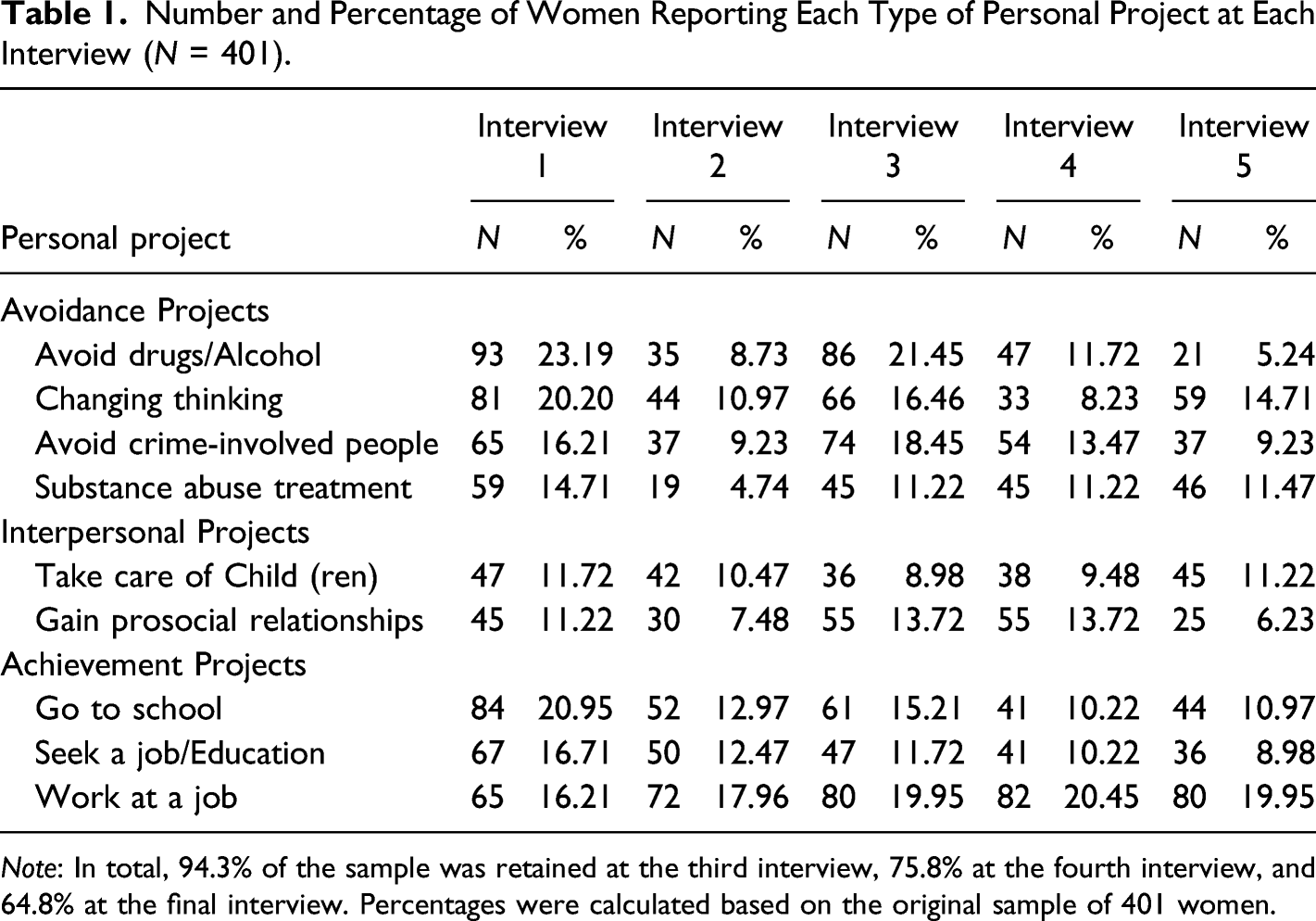
Note: In total, 94.3% of the sample was retained at the third interview, 75.8% at the fourth interview, and 64.8% at the final interview. Percentages were calculated based on the original sample of 401 women.
Avoidance Projects: Women’s Agentic Efforts to Avoid Crime and Substance Misuse
Avoidance Project Meaning
Four types of projects were focused on avoiding conflict with the law: avoiding drugs/alcohol, getting substance abuse treatment, stopping illicit thinking, and avoiding people who break the law. Women primarily saw these projects as important for avoiding further hardship/struggle, like Cynthia (pseudonym), who stopped using and selling drugs to avoid worrying “about going back to jail.” In residential substance abuse treatment, Brandi learned to be a “positive person,” and stop “being a drug addict.” Brandi illustrates how some women with avoidance projects were motivated to construct a prosocial identity. Women who saw avoidance projects as meaningful described improved psychological well-being in that they felt happier or less stressed, could think and prioritize clearly, and felt better about themselves. Substance abuse treatment helped Freya avoid antisocial associates by giving her “more self-confidence.” She explained, “my self-esteem was kind of low… it helped me to believe in myself, to know that I could do it.” Some women’s well-being also improved in tangible ways, such as improved finances, relationships, and physical health. Sonya’s sobriety helped her obtain a driver’s license and a car. Sobriety improved her life because, “It is taking me away from people and places that I don’t need to be. My thought process is a lot clearer. I have money in my pocket and do the things I want to do.” Adele cut ties with substance-involved people, sought treatment, and was sober. These efforts improved her relationships: “Being a better mom, more consistent, better partner, better daughter… overall [my] personal relationships have gotten better with everybody.” Jolene also benefited from avoiding substance misuse: “It keeps my health good… it gives me a better chance to be successful.” As these accounts suggest, meaningful avoidance projects served as steppingstones to pursue other agentic projects.
Avoidance Project Manageability
Relatively few women discussed an initial belief in their ability to achieve avoidance projects, but those making progress noted increased self-efficacy to continue succeeding in their efforts. Anne demonstrated self-efficacy and “determination” to stop “hanging around” antisocial associates. She explained, “I’ve accomplished stability in my life.” Irene changed her thinking by engaging in more prosocial activities, thereby improving her life, “It puts me more in touch with me, who I am… if I complete a project or I read a good book, I realize I can complete things… it makes me feel good about me.” Women connected progress and success in their avoidance projects to increased self-efficacy and self-esteem.
Avoidance Project Community
Many women with avoidance projects benefited from social support from various sources, including support groups, church communities, family members, and prosocial friends. One such woman was Avery: There’s been a lot of really good positive things that have come out of the counseling and even the AA meetings. You go in and you find other people that have a lot of sobriety and stuff. People you can hang out with and you know they are not going to be drinking or doing any kind of drugs.
Like Avery, other women with avoidance projects saw the benefit of having prosocial associates to spend time doing “positive” things with. Kara was one of the few women who emphasized her probation agent’s support of her efforts to avoid substance misuse as a facilitator of her success. She received “constant encouragement” from the agent: “She would share the statistics with me of how many people actually come off heroin, stay sober… [it] makes me feel good about myself because there’s really very few people [who do].” In addition to increased self-esteem, Kara maintained sobriety for nearly two years at the time of this interview. Women who received social support for their avoidance projects tended to perceive their projects as more manageable.
Interpersonal Projects: Women’s Agentic Efforts to Engage in Prosocial Relationships
Interpersonal Project Meaning
Interpersonal projects included building prosocial relationships and caring for children. Women made efforts to gain/reestablish prosocial connections through support groups like AA (Alcoholics Anonymous) and NA (Narcotics Anonymous), substance abuse or mental health treatment programs, churches, co-workers, and family. Interpersonal projects were meaningful for a variety of reasons, such as providing motivation to maintain sobriety, filling free time with healthy social activities, and as bridges to support and opportunities. Laine moved to a new city to gain access to an NA community and the support of her grandmother. These connections helped Laine “to know that there are ways out here in the community that you can do positive things without being under the influence of drugs and alcohol.” She credited her years of sobriety to this social support. Women who shared outcomes of interpersonal projects mainly experienced improved psychological well-being such as happiness and increased self-efficacy, and some described tangible benefits. Marilyn’s project of caring for her children subsequently motivated her to prioritize her health and employment. Mothers often found meaning in avoiding trouble for the sake of their children, and experienced increased feelings of happiness, strength, self-confidence, maturity, and purpose. Motherhood was a turning point for Uma, who said her daughter was “the reason everything in my life changed… she keeps me motivated [to] make sure I always stay the better person and do things the right way.” Heather’s project of caring for her daughter kept her out of trouble and was important to her because “I’m focused on my daughter growing… and not having to go through none of the stuff that I went through.” Kylie was focusing on her children, who had witnessed her arrest for drunk driving: “When I really thought of learning, establishing a relationship with my children, my children taught me they don’t want their mother drinking.” Mothers like Kylie were focused on redeeming themselves as mothers or addressing weakened bonds with their children in the wake of incarceration or addiction.
Interpersonal Project Manageability
Few women specified a belief in their ability to build prosocial relationships. One exception was Judy, who emphasized her own self-efficacy and initiative to build prosocial relationships: I’m active in my church so I have [a] good community. I live at home and have a good relationship with my family. I think all of those things are good. I was willing to make new friends this semester even though I came to school and knew zero people… I’ve made an effort to do that, I think it’s important.
Likewise, Deja demonstrated confidence in caring for her children: “[I] definitely stepped up my game tremendously when it comes to my children and that has been really important.” These accounts of self-efficacy as a facilitator to interpersonal projects were rather unique, as increased self-efficacy was more frequently described as an outcome of interpersonal projects.
Interpersonal Project Community
Women making progress in building prosocial relationships generally gained social support as an outcome of their efforts, which aided them in pursuing other projects like staying sober or keeping a job. Notably, few women mentioned that they received social support of projects to care for children. Those who did were usually supported by a spouse, parent, or church. Selena appreciated that her son’s father would occasionally alleviate her stress by taking care of their son when he was not working, and he “didn’t know how much it mattered” to her to get a break. In a unique example of social support to care for children, Lisa experienced informational and psychological benefits from the support of other mothers on the “Smart Mom” app: “It helps me with any questions I have with my littlest one and I get to help other moms too… It makes me feel good and it’s given me a lot of knowledge on things… I wish I would have known with my first [child].” Women receiving support for interpersonal projects tended to describe increased psychological well-being and self-efficacy.
Achievement Projects: Women’s Agentic Efforts involving Employment and Education
Achievement Project Meaning
Project meaning for women’s achievement projects of working at a job 2 and going to school typically included keeping busy to avoid trouble, maintain stability, and self-improvement. Some achievement projects were aimed at gaining opportunities or striving to achieve future ambitions, beyond maintaining existing efforts. Kimberly said, “I’m trying to better my life, like go to school and get a job… It makes me feel positive. I’m going to be successful someday.” Early on in supervision, Annette focused on furthering her education and by the last interview she completed nursing school and planned to become a nurse practitioner. Becoming a nurse made her “able to become a better parent and my life was just changed dramatically.” Amira enrolled in GED classes to pursue a desirable career, “After I get my GED, I want to continue my education and take some college courses in the medical field.” Over the course of the interviews, Vicky described going to school which made her “more focused,” and eventually earned a culinary arts degree: “I got my culinary degree… and now I’m working, being back on track.” This made it possible for her to “start to get out of debt, get ahold of my finances.” Amira and Vicky exemplify how some achievement projects were motivated by expectations of future tangible benefits, including financial stability and better career opportunities. Some women expressed pride in themselves for working and going to school, like Patricia, who said “working a real job [and] not selling drugs… that is something that I’m proud of.” Similarly, Michelle focused on gaining education because, “It’s helping me getting to where I need to be in the next steps of my life – being able to help take care of my family.” At the last interview, Michelle was still in school and said, “It made me feel better about myself, knowing that I’m doing good in it and can get it done.” Hannah gained work experience and was searching for a new job: “I found me a job… It definitely helped boost my confidence to help give me more social skills.” This experience increased her self-efficacy to find a new job: “I’m more confident today than I would have been last year … [working] boosted my confidence up a little more. I think my social skills are becoming a little better.” Patricia, Michelle, and Hannah illustrate how women who described achievement projects as meaningful benefited from positive psychological effects.
Achievement Project Manageability
Women tended to demonstrate self-efficacy when they were making progress in their achievement projects, and some noted psychological and tangible benefits, like increased financial well-being, self-esteem and happiness. Erica was “very proud” of herself for finding a job. Tyra was working to improve her life, “[I’m] striving… for a better job… Each job I get is always a step above the next one… every time another job opportunity opens up that’s more money, I apply for it.” Tyra was confident in her ability to keep obtaining better employment and gained a better income as a result. Similarly, Aliyah explained, “I am constantly trying to better myself since [I quit drinking]. I’ve pursued school twice since then. Even though I haven’t succeeded in getting a degree yet, I don’t quit trying.” Aliyah’s persistence shows how women’s self-efficacy can facilitate achievement projects.
Achievement Project Community
Although very few women described receiving social support to gain education beyond a GED, more benefited from social support to find or keep a job. Some mentioned that their probation or parole agent encouraged and assisted them with finding work or earning a GED by connecting them with resources (e.g., employment agencies) and notifying them of job opportunities for people with felonies. Others gained employment through family members. Adele gained employment through her father: ““I’m working with my dad right now. He’s a contactor/master carpenter and he’s teaching me the trade.” Adele experienced many benefits from her father’s support: “It makes me feel good. I’m learning something that I’ll keep with me for the rest of my life… I’m earning money… I feel good about the future.” Family support was instrumental for some women to find meaningful employment.
Project Facilitators and Barriers Specific to Women on Probation and Parole
Women described facilitators to their project pursuit beyond project meaning, social support and self-efficacy. Facilitators of sobriety also included substance abuse and mental health treatment, the threat of legal sanctions, aging and health concerns, and moving to new areas to get away from crime-involved people and places. Some women appeared to be motivated to change to avoid the pains of incarceration, especially early on in supervision. Trinity broke up with a drug-involved boyfriend because, “I had a prison sentence hanging over my head… I do not want to go to prison. I’m not getting any younger.” Even though some women’s projects involved avoiding incarceration, incarceration was not consistently a facilitator of avoidance projects. Jail made things worse for Natalie: “Jail just really made me more upset to where I was more in a ‘I don’t give a crap’ mode and when I get out of jail, I’m doing whatever I want to… treatment helped me more than jail.” Jolene’s sobriety was facilitated by substance abuse treatment: “I went to treatment for 9 months and remain clean today.” Like Jolene and Natalie, other women mentioned long-term treatment as a catalyst for sobriety. Natalie also noted that her pregnancy motivated her to remain sober by giving her something “to look forward to” and “live for.” Natalie’s project elucidates how children were described as facilitators of some mothers’ avoidance projects. Success in avoidance projects facilitated interpersonal projects, and vice versa.
Prosocial relationships, self-efficacy, and sobriety facilitated some women’s achievement projects. Beyond these facilitators, women almost exclusively identified barriers to achievement projects. For some women pursuing education and work-related projects, tangible resources were particularly important. Jane planned to go to school to become a substance abuse counselor, but her project was hindered by debt she needed to pay off to be eligible for financial aid. Like Jane, other women also encountered financial barriers to gaining education. Several women specified transportation as barrier to these projects, for example, not having a driver’s license, vehicle, or access to reliable transportation. Felicia was successful in school and enjoyed it but had to drop out because she did not “have the transportation [to get there].” Lacy said finding work was a problem and her job prospects were limited because “I can’t get around… It would become very frustrating for me… spending all my money to get around.” Lacy eventually moved to a new area where she could easily access public transportation to look for work: “I’m able to take the bus route so that does help me to be able to move forward.” In the same vein, a unique barrier women faced to various types of projects involved the places they lived. Recall Laine, who managed to move to a new city to gain prosocial connections and support to stay sober. Some women lived in areas where it was challenging to avoid antisocial associates and pursue prosocial relationships/opportunities, and some lacked resources to move to new places.
Offense records hindered achievement projects by limiting opportunities and reducing self-efficacy. Martina struggled to get job interviews and divulged, “I looked at my record, I wouldn’t hire me either… It looks so harsh on paper, but if you got to know me and understand my circumstances it would be different.” Aja was discouraged by her record: “Why go through the interview when you know you’re not going to get the job?” Tiara only had one class left to finish her degree but couldn’t enroll because of her record: “I need to see about getting [my record] expunged first and I don’t know how that works.” At the final interview, Tiara had researched the expungement process and was working on her application. Insufficient education, skills, and work experience were also barriers to achievement projects. Kylie struggled with using computers after being out of school for over 25 years. Cadence said, “I have trouble doing [job] applications online,” and relied on a friend for help. Lauren suspected that her lack of education and experience was why she did not hear back on any job applications: “I don’t know if it’s because I ain’t got a GED… but it’s hard because I was a housewife for 19 years, so I was totally out for the game for so long.” Some gaps in women’s education and work histories were explained by time spent on traditional gender roles of caring for children/family. Additionally, a few mothers described parenting concerns as barriers to achievement projects. Lillian, a mother of twins, dropped out of school and lost grant funding to deal with her children’s behavioral problems. Ivy had been trying to hold a “steady job” but said, “I’m currently unemployed because my kid is going through some medical issues.” These women struggled to manage parenting demands while pursuing achievement projects. Furthermore, some women grappled with insufficient or unreliable employment, like Nicole, who was struggling to save money with a meager income. Amanda said of her job, “It’s been consistent for the past 2.5 months, so that made my life better.” However, the job was temporary, and she would be unemployed again the following week. At the final interview, Madison had earned a master’s degree in social work and worked in a gender-informed Human Trafficking Court, but said, “I guess I’m getting laid off.” Insufficient and unreliable work was a problem for women in a variety of employment situations.
Discussion
This study explores the agency of women on probation and parole, integrating theory on personal projects to clarify the function of women’s agentic efforts and the outcomes of these efforts. Findings indicate that theory on personal projects is useful for analyzing the nature and outcomes of court-involved women’s agency to desist from illicit behavior and construct prosocial lives, as well as identifying personal and sociostructural facilitators and barriers to their agentic projects. The data suggests that women considered some projects to be interrelated. For instance, projects that involved sobriety were linked to women’s prosocial changes in thinking, education, and employment-related projects, and they improved interpersonal relationships. Likewise, projects that focused on cutting off antisocial relationships were associated with projects that focused on building prosocial relationships. In turn, prosocial relationships helped women to maintain sobriety and improved outcomes for other projects. The common thread here is that avoidance projects appear serve as steppingstones for women to pursue other prosocial projects and reap more of the associated benefits.
Theoretical Implications
Findings contribute to theory by providing a more precise understanding of the internal and external aspects of women’s agency to desist from crime and construct prosocial identities. Many women considered projects to be meaningful and connected their efforts to improved well-being—a finding which is consistent with personal projects research (Dietrich et al., 2012). A salient theme across women’s projects was a motivation to avoid trouble and construct prosocial lives. This finding is in agreement with rational choice and identity theories of desistance, in which the desistance process begins when one comes to view crime unfavorably and imagines a new prosocial future self (Giordano et al., 2002; Maruna, 2001; Paternoster & Bushway, 2009). The data also show some support for theories of desistance that emphasize maturation and age-related turning points. Specifically, mothers expressed motivation to pursue prosocial futures for their children, suggesting that motherhood may serve as a “turning point” for women’s desistance (Laub & Sampson, 1993). A personal projects framework provides a nuanced understanding of women’s agentic motivations by revealing detail about why women prioritize/see value in certain projects, and how project meaning connects to outcomes, such as project success and well-being.
In the data, it was evident that project community was important for many women’s personal project pursuit and well-being, supporting the utility of this approach for understanding how social situations can help or hinder women’s agency to build prosocial lives. This finding is consistent with feminist research and relational-cultural theory (a psychological theory) that has documented the importance of relationships to women’s well-being (Covington, 1998; Covington & Surrey, 2000; Hoskins & Morash, 2020; Jordan, 1991). Informal social control and identity theories of desistance explain that prosocial opportunities can serve as catalysts for desistance, but do not clarify why some prosocial opportunities are more influential than others in facilitating desistance (Giordano et al., 2002; Laub & Sampson, 2014; Maruna, 2001; Weaver, 2019). It is possible that the nature and extent of social support one accesses in these prosocial opportunities explains this discrepancy. In advocating for a social support paradigm in the study of criminology, Cullen proposes that greater levels of social support reduce crime (Cullen, 1994). The present study echoes this notion. Social support aided women with a variety of projects, such as avoiding trouble, caring for children, and gaining employment. Furthermore, social support was connected to improved happiness, self-efficacy, and prosocial opportunities.
Finally, findings demonstrated that women on probation and parole face unique constraints on agency. Moreover, a personal projects approach to examining women’s agency evinces how sociostructural factors shape and constrain women’s agentic projects, for example, by revealing barriers which reduce women’s self-efficacy and limit opportunities for success. A lack of tangible resources was particularly problematic for some women’s project pursuit, particularly financial constraints, and barriers to transportation. Offense records also hindered achievement projects and limited opportunities, which women connected to reduced self-efficacy. Some women also struggled with insufficient education, skills, and work experience in pursuing achievement projects. These barriers are in tune with prior research documenting constraints on court-involved women’s agency, including low socioeconomic status, employment difficulties, and transportation (Morash et al., 2017; Northcutt Bohmert, 2016).
Limitations
There are some limitations to this study. First, the study was exploratory in nature, and interviews were targeted at understanding women’s agentic efforts to improve their lives. Thus, Personal Projects Analysis (Little et al., 2017) was not used to generate a list of projects women were working on and women were not systematically questioned about theoretically relevant aspects of their projects (e.g., meaning and manageability). As a result, the scope of the present analysis was limited to details women volunteered about their efforts. Future research should consider Little’s official method for Personal Projects Analysis (Little et al., 2017) to guide data collection. Second, interviewers did not follow up about project progress at each interview, which prevented meaningful analysis of goal progress, stability, and achievement. Although the data allowed me to analyze the features of projects women volunteered at each interview, I was unable to consistently discern which projects women committed to and achieved over time. Future research should systematically measure the progress and achievement of court-involved women’s personal projects to better identify facilitators, barriers, and outcomes over time. Finally, the present study draws conclusions from women’s reports of perceived benefits and outcomes of their personal projects but does not examine relationships between personal projects and recidivism. Future research should quantitatively test for potential relationships between the types and characteristics of personal projects and recidivism.
Practical Implications
This study offers practical implications for correctional supervision and policy, particularly for advancing gender-responsive correctional practices. First, personal projects may be a useful tool for agents to understand women’s prosocial motivations and build effective case plans. Collecting periodic information on women’s personal projects may better equip agents to assist women with navigating challenges during supervision and achieving their projects. This recommendation aligns with the gender-responsive model, in which gender-responsive services are based on empirical evidence of the unique realities and voices of women, and tailored to address women’s strengths, priorities, and needs (see Bloom et al., 2004). Personal projects can serve as a practical tool for agents to take a gender-responsive approach to supervising women. Second, women’s projects benefit greatly from social support. Supervising agents can assess the level and sources of social support women have for various projects, to identify projects that are insufficiently supported and compensate for such projects. Agents are uniquely situated to facilitate women’s projects by providing support, encouragement and emphasizing women’s engagement in prosocial relationships, and gender-responsive practices are designed with the connection between the quality of women’s interpersonal relationships to their well-being and substance misuse in mind (Covington & Surrey, 2000; Jordan, 1991). Few women discussed social support to gain education beyond a GED, so agents should support women’s educational aspirations and help direct them towards desirable careers. Third, the findings suggest that women benefit from correctional interventions that divert them to substance abuse and mental health treatment, rather than incarceration (also see Hoskins & Cobbina, 2020). Finally, offense records hindered achievement projects and prosocial opportunities. Women may benefit from policies to prevent educational institutions and employers from conducting criminal background checks. This is one example of how personal projects research can be useful to policy makers in confronting structural factors that inhibit women’s agentic opportunities and well-being.
Conclusion
This study establishes theory on personal projects as a useful framework for understanding the efforts and outcomes women on probation and parole take on to desist from crime and construct prosocial lives. Desistance scholars may build upon this work to untangle the nuances of agency in the desistance process. Withal, the research highlights the value of incorporating personal projects research to the study of desistance to gain a more precise understanding of the internal and external aspects of agency in the desistance process.
Footnotes
Declaration of Conflicting Interests
The author(s) declared no potential conflicts of interest with respect to the research, authorship, and/or publication of this article.
Funding
The author(s) disclosed receipt of the following financial support for the research, authorship, and/or publication of this article: The data collection was supported by the National Science Foundation Grants No. 1126162 and 1430372 and by a Strategic Partnership Grant from the Michigan State University Foundation.
