




Abstract
Black mothers have never fit the hegemonic white standard of motherhood. The bad mother narrative has been superimposed on Black women through controlling images. Through in-depth interviews with formerly incarcerated Black mothers, I demonstrate how formerly incarcerated Black women invert controlling images through how they frame their mothering choices. Their reframing of their mothering choices reveals that formerly incarcerated Black mothers have mothering practices that entail good mothering and goes beyond the white imaginary. These mothering practices reveal a redefinition of motherhood that provides greater understanding of how formerly incarcerated Black mothers understand and make sense of their mothering choices.
Keywords
Introduction
The incarceration rate for women has increased dramatically since 1980. Among incarcerated women, Black women are disproportionately represented in comparison with white and Latinx women. Furthermore, over 60% of incarcerated women are mothers to minor children (The Sentencing Project, 2020). Given that incarceration serves as a societal indicator of being an unfit or bad mother, women exiting the criminal legal system must contend with being unable to attain the glorified status of mother. Even so, historically, Black mothers have not embodied traditional white hegemonic notions of motherhood. The inability of Black mothers to embody traditional notions of motherhood are due to controlling images, which are images and caricatures that negatively portray Black women (Collins, 2000). Controlling images of Black women are built upon longstanding norms and beliefs about race and gender that position Black people (as well as other people of color) and women as being inferior to their white and male counterparts. Therefore, the overrepresentation of Black women among currently and formerly incarcerated women then confirms and reinforces these controlling images.
Research on formerly incarcerated Black women specifically is still emerging. However, we know that the experiences of Black women in the criminal legal system are a result of intersecting forms of marginalization by gender and race. Moreover, many challenges they face after incarceration such as resuming their roles as mothers cannot be disconnected from historical narratives that devalue Black women and Black motherhood (Garcia, 2016; Garcia-Hallett, 2019; Gurusami, 2019; Richie, 1996, 2012; Roberts, 1997). Moreover, contrary to the dominant controlling images of motherly fitness, formerly incarcerated Black mothers actively engage in mothering strategies that undermine and counter controlling images. (Gurusami, 2019). What is less explored are the kinds of mothering choices formerly incarcerated Black mothers make before and after incarceration. Expanding upon this growing body of literature, I examine how formerly incarcerated Black women interpret and rationalize their unconventional mothering choices. In doing so, I answer the call made by Garcia (2016) to transcend societal perceptions and social constructions of motherhood in future research examining the experiences of formerly incarcerated mothers. I argue formerly incarcerated Black women reframe how they think about their mothering choices, and in doing so, they demonstrate the need for us to move beyond conventional ideals of what it means to be a good mother.
Literature Review
American Constructions of Motherhood
American constructions of motherhood are rooted in white hegemonic logics dating back to the Victorian era. It was during this period in which the ideology of True Womanhood emerged. The defining characteristics of the True Woman included purity, chastity, and submissiveness (Ladd-Taylor & Umansky, 1998; Roberts, 1997). The onset of the Industrial Revolution further intensified this notion of True Womanhood, and the perfect woman became synonymous with being the perfect wife and mother (Davis, 1981). The elevation of the True Womanhood ideology intensified as manufacturing moved from the home to factories (Davis, 1981). Prior to the Industrial Revolution, both working class women and men worked to support their families with women primarily taking on domestic forms of labor. When work left the home and became relegated to factories, domestic labor depreciated in value and ultimately came to be seen as inferior to productive work (Davis, 1981, p. 12). Ladd-Taylor and Umansky (1998, p. 8) note that the idea of a maternal presence being equated to good mothering was actually novel in the nineteenth century and specific to middle class culture. Historically in the United States, childrearing responsibilities have been shared efforts and reflected childrearing practices that were communal––particularly within Native American, Black American, and American immigrant communities (Ladd-Taylor & Umansky, 1998). However, mothers in these communities were regarded as bad according to white middle class standards (Ladd-Taylor & Umansky, 1998).
Although what constitutes as good and bad mothering practices have changed throughout American history, some remnants of the Victorian ideal of motherhood remain such as the expectation that mothers be self-abnegating and preternaturally nurturing (Ladd-Taylor & Umansky, 1998). However, over the past century, what constitutes as good mothering has generally been classified by three main factors: living in a ‘traditional’ nuclear family, protecting children from harm, and having children who grow up to be model citizens (Ladd-Taylor & Umansky, 1998). Therefore, mothers who do not live in a traditional nuclear family, would not or could not protect their children from harm, and raise children who are wrong are thus classified as bad mothers. Women of color, poor women, and unmarried women have been consistently portrayed as bad mothers, and the label of being a bad mother has grown to encompass far more groups of women than before (Ladd-Taylor & Umansky, 1998). Therefore, traditional constructions of motherhood in the United States privilege whiteness and class superiority.
Incarceration and Motherhood
Given the longstanding constructions of ideal motherhood in American society, it is unsurprising that the experience of being incarcerated is one of the most devastating ways in which women are deeply stigmatized as bad mothers. Research shows that incarceration damages the identity women have as mothers from their perspective and the perspective of others (Brown & Bloom, 2009). Formerly incarcerated mothers must deal with being perceived as inadequate parents (Dodge & Pogrebin, 2001). Specifically, incarceration carries the stigma of being unfit and bad mothers (Sharpe, 2015). The stigma of being a bad or unfit mother in part stems from how incarceration creates physical separation of mother and child, removing their ability to mother completely. This separation often continues when incarcerated mothers return home. The majority of incarcerated mothers were the primary or sole caretakers for their children prior to incarceration (Hagan & Dinovitzer, 1999; Roberts, 2004). Therefore, when mothers are incarcerated, it is not uncommon for their children to be placed in the care of extended family or the child welfare system (Foster & Hagan, 2009; Richie, 2001). These factors prolong separation of mother and child and reinforce the notion that mothers who do not live with their children are bad mothers (Flavin, 2001). Moreover, due to issues such as drug addiction, mental illness, and poverty, many formerly incarcerated women are confronted with the stigma of being a bad mother even prior to their incarceration. Incarceration then seemingly confirms and reinforces the assumption that incarcerated mothers did not prioritize their maternal responsibilities (Garcia, 2016).
Formerly incarcerated mothers have considerable difficulty in resuming their mothering roles after incarceration. They also struggle with competing messages of who they are, how they should be, and how they should live their lives, and these competing messages often conflict with the social expectations of them and their structural positions (Leverentz, 2014). Formerly incarcerated mothers often find themselves balancing responsibilities they have to their children and families with the responsibilities they have to themselves that will prevent reincarceration. Their identities as mothers are also very important to their sense of self (Leverentz, 2011) despite the fact they often experience maternal distress (Arditti & Few, 2008). Furthermore, some women even regard themselves as not being good mothers (Arditti & Few, 2006) and engage in self-depreciation (Dodge & Pogrebin, 2001).
Controlling Images and Black Motherhood
An examination of how incarceration affects Black motherhood and the identities of Black mothers is crucially tied to how race has shaped narratives about motherhood. James (1999, p. 136) argues, “Black women aspired to, and were excluded from, participation in the nineteenth-century Victorian cult of femininity fostered among white, middle-class women.” In essence, although Black women have historically desired and attempted to be seen as good mothers as defined by a white hegemonic standard, their race excluded them from doing so. Hence, Black mothers have long been regarded as being immoral, careless, domineering, devious, and passing down degenerative biological traits to their children (Roberts, 1997). Such characterizations of Black mothers exist due to how controlling images perpetuate stereotypical and disparaging narratives about Black women (Collins, 2000). Specifically, prominent controlling images that have been used to demonize Black mothers who have been incarcerated include the lazy welfare mother, the conniving welfare queen, and the horrendous crack addicted mother. The trope of a welfare mother is that of a bad mother who chooses to rely on welfare rather than work and passes down her bad values to her children (Collins, 2000). The welfare queen is an extension of the welfare mother. Not only is the welfare queen vilified for collecting support from the state instead of supporting herself through gainful employment, but she is also highly materialistic and abuses welfare assistance to buy luxuries. Finally, the crack addicted mother is a bad mother because she is selfish, irresponsible, and knowingly enacts harm on her unborn child. Furthermore, once born, her crack addicted child becomes a financial burden to taxpayers and ultimately lives a life characterized by welfare dependency and criminal activity (Roberts, 1997). These controlling images emerge from the intersection of race, gender, and class oppression that continues to shape the lives of Black women even in the present day.
Despite the historical representation of Black mothers being unfit, Black mothers are simultaneously often held to impossibly high standards. Collins (2000) argues that in the Black community, motherhood is held to be extremely sacred so much so that there is the image of the super strong Black mother. Collins (2000, p. 188) states, “The controlling image of the ‘superstrong Black mother’ praises Black women’s resiliency in a society that routinely paints us as bad mothers. Yet, in order to remain on their pedestal, these same super strong Black mothers must continue to place their needs behind those of everyone else, especially their sons.” Thus, with the glorification of Black motherhood being so extreme, Black mothers who become incarcerated and later return to their communities may experience more pronounced scrutiny from their communities. This is especially important given that in the Black community, women centered networks are highly important. Collins (2000) argues that the kin networks in Black communities tend to be women centered where biological mothers and othermothers (biological or not) are expected to collectively care for children. Moreover, Collins (2000) argues that motherhood can serve as a space in which Black women can define, value, and respect themselves, and learn self-reliance, independence, and empowerment. Therefore, when the central role that Black mothers play in their communities is rescinded or restricted, it is especially devastating.
Despite the power of controlling images, research shows that formerly incarcerated Black women actively resist the stigma that arises from the intersection of their gender, race, and carceral histories. On the contrary, formerly incarcerated Black women enact mothering strategies that resist controlling images of being criminal and negligent by engaging in decarceral motherwork, which is a form of intensive mothering formerly incarcerated Black women use to ensure the well-being of their children under conditions of extreme precarity (Gurusami, 2019). Specifically, Gurusami (2019, p. 129) argues: In what follows, I demonstrate how women engage in (1) collective motherwork, a community-based negotiation of tenuous childcare conditions between formerly incarcerated women living in close proximity to one another, (2) hypervigilant motherwork, the anticipatory work of shielding children from the state and strangers, and (3) crisis motherwork, the labor of confronting immediate threats that would remove children from their custody or prevent reunification.
Formerly incarcerated Black women use decarceral motherwork to undermine controlling images of Black motherhood and demonstrate the difficulties of mothering under state surveillance. I situate the narratives of the formerly incarcerated Black women in my study in conversation with the concept of motherwork posed by Gurusami (2019). I show how formerly incarcerated Black mothers respond to controlling images through decarceral motherwork with their minor and adult children. Moreover, as Gurusami (2019) demonstrates, formerly incarcerated Black mothers actively protect their children from being taken into state custody through decarceral motherwork. However, what happens when decarceral motherwork is not a viable option? I argue that when optimal mothering choices are unavailable, Black mothers reframe how they view their mothering choices and in the process, invert controlling images and narratives about Black motherhood. In doing so, Black mothers reveal a form of valued mothering that does not fall under the white imaginary unlike traditional constructions of ideal motherhood.
Garcia (2016) argues that in order to best understand the needs and experiences of formerly incarcerated mothers, we must move beyond the existing social constructions of motherhood Specifically, two suggestions offered by Garcia (2016) include future research on formerly incarcerated mothers should use narratives of their own experiences with mothering and give greater attention to the experiences of formerly incarcerated mothers who do not live with their children. I respond to these future directions for research through the discussion of how formerly incarcerated Black mothers frame their mothering choices and redefine motherhood in the process. Additionally, I argue that this reframing of mothering strategies is an act of inverting controlling images. In essence, Black mothers invert or turn these narratives of motherhood on their heads by framing their mothering choices as positive and protecting the wellbeing of their children. Furthermore, this inverting and redefining of motherhood narratives occurs through three main strategies: positively reframing being a noncustodial parent, providing emotional and financial support for their children, and using their experiential knowledge to guide their children from making choices similar to their own. Through these strategies, I argue formerly incarcerated Black mothers shape a valued motherhood challenged by their incarceration.
Data and Methods
Recruitment Strategies
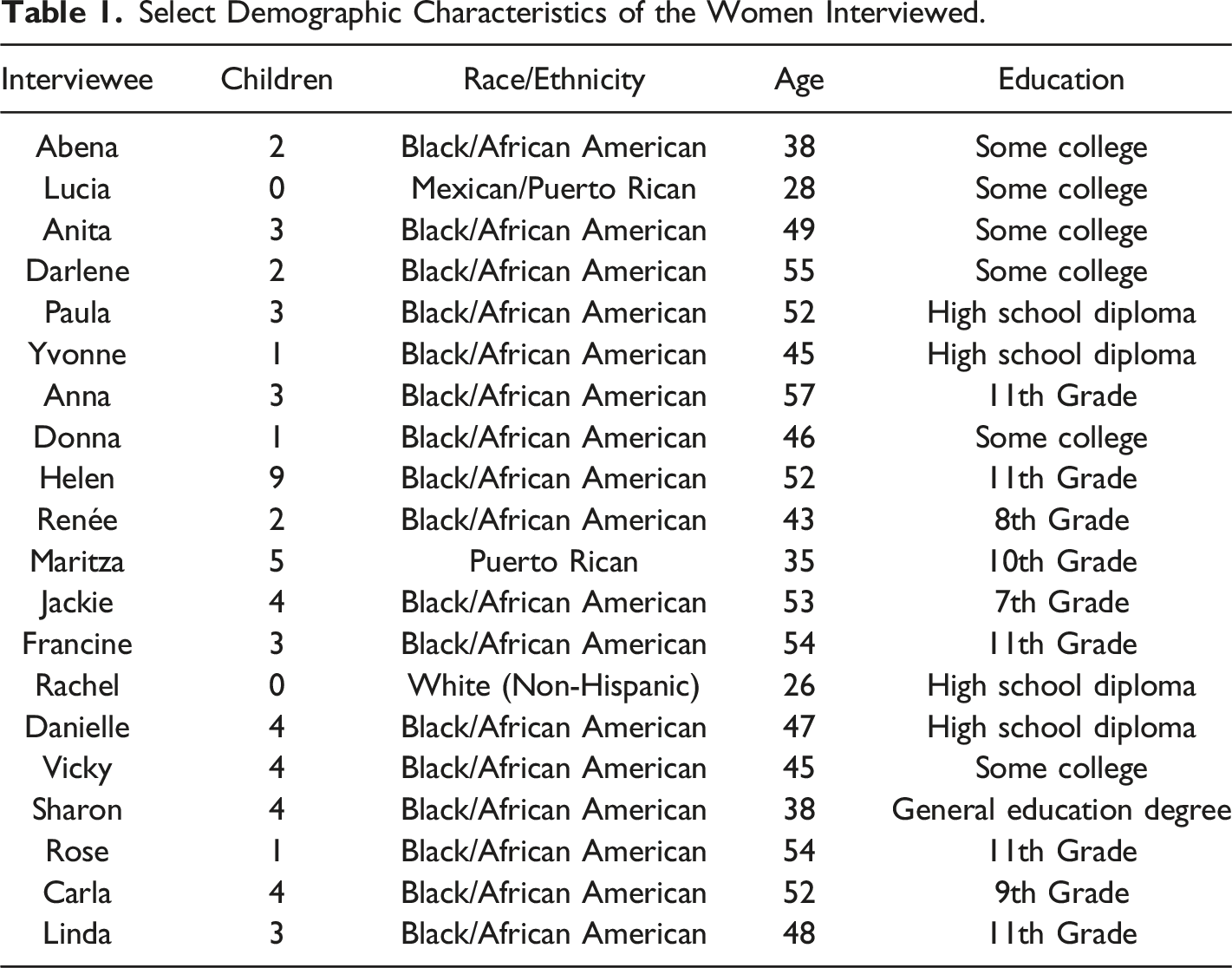
I draw on interviews with seventeen formerly incarcerated Black mothers from a sample of twenty formerly incarcerated women whom I interviewed between 2016 and 2017. All of the women were recruited through ties I had with nonprofit organizations that provide resources and services to formerly incarcerated people as well as Black community activists in Chicago, Illinois. The nonprofit employees and community activists introduced me to formerly incarcerated women who then in turn mentioned my study to other formerly incarcerated women in their networks. The vast majority of the women I interviewed were recruited from a transitional home for women. After connecting with the house director, she invited me to speak to some of the women about my study. During my talk, I introduced myself and shared that I was a doctoral student interested in understanding how formerly incarcerated women navigate the reentry process. I mentioned my primary motivation for this research was to amplify their voices given how incarceration and reentry research has often marginalized or excluded the experiences of women both within and outside academia. I also informed the women that all interviews would take place in a private space, last about an hour, be audio recorded, and their identities would be anonymous. I informed the women to be eligible for an interview, they must have a history of being incarcerated, identify as a woman 1 who is at least eighteen years of age, speak English fluently, and capable of giving informed consent. Each woman was also compensated with a $40.00 VISA gift card upon completing her interview. Due to the high level of participation among the women living in the transitional home, fourteen of the twentry women I interviewed resided at the transitional home at the time of their interview. The first three women I interviewed were not living in the transitional home, but two of the three women did have ties to the transitional home as a former resident and or through their community activist work.
Sample Characteristics
Select Demographic Characteristics of the Women Interviewed.
Interview Process
I interviewed each woman in person in a private setting, and each interview was audio recorded. The interviews were structured chronologically, tracing the process of reentry, and they usually lasted about an hour. The first set of questions in the interview recalled the day before release. The next set of questions recalled the day of release. The last set of questions focused on specific events that occurred between their release and the day of their interview such as employment, housing, and their relationships with their children. Other questions revealed the life histories and criminal offending histories of the women interviewed. Additionally, I documented demographic characteristics from each woman.
Qualitative Analysis
In this study, I used grounded theory, which takes an inductive approach and builds theory from data (Strauss & Corbin, 2007). After each interview was transcribed, they were manually coded for emerging themes and patterns. I focused heavily on parts of each interview where the women mentioned mothering and or her children. I noted how frequently their discussions about mothering and children often focused on mother and child separation, losing and or regaining custody, challenges with resuming the maternal role, and acknowledging the emotional and mental effects that their incarceration likely had on their children.
Researcher Positionality
Given how the positionality of researchers shapes how we conduct and interpret our work, I find it important to mention how my positionality might have influenced my findings. I am a Black woman, first generation college graduate, and from a low income family, and I believe a major factor as to why women were so candid and vulnerable in our interviews was due our shared racial, gender, and to an extent, class identities. I believe many of the women agreed to speak with me largely to support a fellow Black woman in her educational endeavors. For instance, one woman explicitly told me that part of the reason she agreed to be interviewed despite her general distrust of researchers was because I was, “a sistah just like her.” I also believe my genuine attempt to connect through sharing some of my own upbringing was received given how some of the women expressed to me how surprised they were that I spoke to and listened to them in without judgment, in a conversational manner, and I did not come across as simply a researcher collecting data from them. However, I also acknowledge that my privileges of being a doctoral student and not having a criminal record might have resulted in the women not sharing certain aspects of their lives for fear of judgement. Even so, given the level of comfort I was able to facilitate during our interviews, it is likely the narratives from the women are a genuine reflection of their experiences.
Findings
Acknowledging Mothering Mistakes
A central theme that emerged in the data was how women discussed their mothering choices in ways that demonstrated their awareness of how their past mothering choices mirrored controlling images of Black motherhood. For instance, some women explicitly mentioned that they had not been good mothers and or failed to mother their children in the past. Shortcomings of motherhood or instances of lack of mothering were consistently interwoven with their battles with drug addiction and mental illness as well. Thus, a pattern emerged from how the women discussed motherhood. Specifically, they often acknowledged how their past mothering choices mirrored controlling images of Black motherhood primarily when discussing their drug addiction and being physically absent from the lives of their children.
When I interviewed a woman named Paula in her early fifties, she told me she had arrived at the recovery home from prison the week before. She and her four sisters grew up on the west side of Chicago and were raised by their mother and stepfather. As a child, Paula struggled with depression and often felt like she was not smart or pretty enough. She told me that she had a strong desire to be accepted by her peers. She also struggled with schooling and was too afraid to ask for support for her learning difficulties. Paula told me that she had struggled with drug addiction for years. When I asked her about her relationship with her children, she told me: I have a really good relationship with my children, yes, a really good relationship with my children. I think I always have, but I wasn’t just a good mother. I was just that person. I always lean back to drugs because I used drugs all my kids’ life.
As Paula told me that her relationship with her children was good and they supported her, she also shared with me that she had not been a good mother in the past. Paula also explained, “Being a bad example to my children was the biggest challenge for me, and not being there for them. Not being there for them when they was going through life things. Just not being there for them.” By stating that the biggest challenge for her as a mother whose been incarcerated was being a bad example to her children, Paula demonstrates the significant value she places on being a mother. For Paula, being absent from the lives of her children and being a poor role model was the most difficult aspect of having been incarcerated as opposed to the battling her addiction or dealing with the poor conditions of being imprisoned.
Carla, another woman in her early fifties, also discussed how she failed to fulfill her motherhood duties while she was in her addiction and cycling in and out of jail and prison. Carla grew up on the west side of Chicago with eight siblings. Both of her parents struggled with drug addiction and her father cycled in and out of prison. Being the oldest daughter, she regularly looked after her siblings. Then, at the young age of ten, she started to use drugs and alcohol and joined a gang. Carla struggled with drug addiction for years and shared that she had a history of sexual and physical abuse. Before I even asked Carla any questions about motherhood, she began talking about her children. She mentioned how her addiction inhibited her ability to mother and told me, “I wasn’t a mother to them. I wasn’t no mother to them. I couldn’t have been no mother to them. I wasn’t no good for myself because my life was centered around getting high every day, all day.” Like Paula, when Carla was struggling with her addiction, it was impossible for her to properly mother her children and raise them in a healthy environment.
Rose, a woman in her mid-fifties echoed similar sentiments to Paula and Carla. When I interviewed Rose, she had been at the transitional home for almost two months. Rose was also from the west side of Chicago. She described her family as loving, supportive, and close knit. However, Rose struggled with drug addiction for years and would isolate herself from her family because she was ashamed of her addiction. Although Rose managed to stay clean for thirteen and a half years, she relapsed and was reincarcerated. Rose had a son in his thirties. When I asked Rose what she thought was the hardest thing about being a mother who had been incarcerated, her response was: The hardest thing is something that you won’t never be able to take back. And I think that that’s not being a mother to my son, and my son didn’t deserve that. And for some drugs? Come on now, who does that? But like I said, drugs is powerful. Drugs are really, really powerful. Like I said, it speaks volumes when I can sit here and say that I loved the drugs more than I loved my own baby
Like Paula and Carla, Rose too felt that she had not been a real mother to her son. She even admitted that she loved drugs more than her son while battling her addiction. The candidness with which Rose spoke about her addiction captured its severity and how much control it had over her life. In turn, this control prevented her from fulfilling her role as a mother. Additionally, I noted how the “love” Rose had for drugs reflected the controlling images of the crack mother who places the love of crack over the love of her children (Roberts, 1997).
Forty-three year old Renée from the south side of Chicago also mentioned her shortcomings as a mother. Renée had recently joined the transitional home just a few days prior to our interview. The most striking aspect of my interview with Renée was that she frequently expressed her deep passion for education. While incarcerated, she spent most of her time attending school and studying. She vividly described her upbringing in the projects with her mother and four siblings. After her mother died from cancer, Renée dropped out of school and began using drugs and did sex work to support herself and her addiction. Renée traced the roots of her drug addiction to grief from the death of her mother. Renée also had a history of physical and sexual abuse, which appeared linked to her decision to use drugs and do sex work. This connection between crime, addiction, and victimization is referred to as gender entrapment in which women commit crimes in response to violence or the threat of violence (Richie, 1996). Like many of the women I interviewed, Renée had adult children and spoke extensively about her son and daughter. When I asked Renée how she felt the day leading up to her release, she told me: Feeling like that unknown happy feeling, like I’m finally finna have a good life. Because I knew—I know inside that I’m really finna be right this time. Like I can’t wait to get out and go to school. I can’t wait to show my family that I’m really finna be a good mother and a friend and a girlfriend. So, I was just anticipating that.
Although Renée did not explicitly refer to herself a bad mother or acknowledge her failure at mothering, like Paula, Rose, and Carla, Renée did express how she wanted to prove to her family that she was capable of being a good mother. Being a good mother was one of the most important things Renée felt she had to prove to others. It was clear her identity as a mother was very important to her sense of self. Therefore, her comments suggest she had not considered herself a good mother in the past. For women like Paula, Carla, Rose, and Renée, a history of drug addiction, crime, and incarceration defined them as bad mothers by their standards and by societal standards. Because of their battles with addiction and cycling in and out of the criminal legal system, they were often absent from the lives of their children for very long periods of time. This prolonged absence coupled with their drug addiction and criminal activity contributed to their awareness of how their past decisions reflected the controlling image of the neglectful, irresponsible, and unfit Black mother. Furthermore, the pervasive connection between drug addiction and criminal activity throughout the narratives of these Black mothers reflects how the criminalization of mothers addicted to drugs increased significantly during 1980s and 1990s due to the crack epidemic (Roberts, 1997) and particularly ravaged many areas of the Black community as evidenced by the women referencing a time where the west and south sides of Chicago were heavily affected by the crack epidemic.
Reclaiming Motherhood
Despite their awareness of how their past mothering choices mirrored controlling images of Black motherhood, the women I spoke with expressed a strong sense of morale and cared deeply about their roles as mothers. Many of them expressed feelings of love, guilt, and the desire to be good examples to their children. In fact, throughout the interviews, women talked at length about how being a positive force in their children’s lives was a major source of motivation to end their drug addiction and desist from criminal activity. Ultimately, I found that the women’s narratives revealed how they acted in the best interests of their children, even though their actions violated traditional American constructions of motherhood. I show that rather than violating these ideal standards of motherhood, their actions nonetheless align with positive characteristics of Black motherhood in particular and motherhood universally. Moreover, I demonstrate that Black mothers actually invert controlling images of Black motherhood by turning these tropes on their heads through reframing their bad mothering choices as being positive and well intentioned. These Black mothers recalled times where they made decisions in the best interest of their children, and three reoccurring strategies emerged in their narratives: placing their children with responsible caretakers when they were unable to fulfill their mothering responsibilities, providing emotional and financial support for their children, and modeling positive behavior for their children. Furthermore, the fact that the Black mothers I interviewed possessed a strong desire to care and nurture their children––even long after they have become adults––demonstrates how they fulfilled their roles as mothers in the best possible way under precarious and constrained circumstances. Additionally, I show how the mothering choices made by these women reveals how they still managed to do what was best for their children even when decarceral motherwork was not an option and their options were severely limited and constrained.
Mothering From Afar
One of the prominent ways in which the women discussed acting in the best interest of their children was when they placed their children with responsible caretakers. Women such as Donna, Anita, and Carla discussed their efforts to ensure that their children were placed with caretakers who would keep their children safe despite how painful it was for them to give up their children to someone else. These mothers arranged for their children to be cared for by family member (usually a woman) such as a grandmother or aunt. Women also reframed the painful decision to have their children placed in state custody as a safer alternative to being in their care.
The story of a mother in her forties named Donna is one that demonstrates how Black mothers struggling with incarceration and addiction made decisions that inverted controlling images of Black motherhood. Donna was among the liveliest women I interviewed. She had been incarcerated for eight years which was one of the longest sentences of the women in the study. Like most of the women I interviewed, she had been incarcerated multiple times. During her incarceration, Donna earned a couple of vocational certificates, took numerous college courses, participated in a reading group, and took on leadership roles such as teaching a class on sexual health. Donna was very open about her battles with drug addiction and severe mental illness. When I interviewed Donna, she was living in the transitional home. Donna had one child—her son—who was now a teenager. When Donna gave birth to her son, she suffered from addiction, and her son was born with serious health complications. Given these circumstances, Donna felt she was not in a position to properly care for her son. Although Donna still struggled with guilt about her son being placed in the child welfare system, she told me: But I also look at it like this. Letting him be with somebody else is probably the best thing I could have done for him, because I was still in my addiction. And to take care of a sick child—there’s no telling what would have happened if he would have stayed with me.
Donna candidly shared why her son would not have been safe under her care. However, through acknowledging that giving up her son was “probably the best thing [she] could have done for him,” Donna demonstrated how she acted in the best interest of her child. Although she felt conflicted about deciding to have her son adopted, she framed this choice as what was best for her son, even though it was painful for her to do so. By deciding to permanently place her son with another family, Donna demonstrated selflessness and care, which reveals her desire to protect and not harm her son. Moreover, Donna’s reframing of her decision as positive inverts the controlling image of Black mothers struggling with addiction who neglect their children. Given that Donna could not place her child with a family member or another trusted adult, she was unable to enact what Gurusami (2019) refers to as crisis motherwork, which is how Black mothers respond to immediate threats of their children being removed from their care. Unfortunately, Donna was unable to respond to the urgent crisis of her son needing a safe home. However, Donna reframed this painful separation from her child as being in his best interest as it meant he was permanently placed in a safe home that could also address his many health needs.
The story of a woman in her late fifties, Anita, reflects another example of how women inverted controlling images of Black motherhood. Anita was a community activist. When I interviewed Anita, she told me that she was currently pursuing her degree in social work. Like many of the women I interviewed, her criminal history was connected to her addiction to drugs. However, unlike most of the women I interviewed, Anita described herself as coming from a stable and loving middle class family. However, due to her father’s declining health, her family later faced homelessness as her father was unable to support the family financially. Eventually, her family moved into public housing. Anita told me that she eventually got “caught up,” in the heavy presence of drug and gang activity within her housing project.
As did Donna, Anita also framed her choice to place her children in the care of a responsible caretaker was done in their best interest. Anita struggled with addiction for years and told me how she eventually became in danger of losing her children permanently and worried her children would be separated. To avoid that fate, Anita worked to place them in the care of their grandmother, which involved their grandmother legally adopting her children. She recalled, “So, me and their grandmother sat down and discussed it. I told her so my children wouldn’t be split apart, [she’d] have to adopt them.” Their grandmother agreed. Like Donna, Anita inverted controlling images of Black motherhood by reframing a decision that often indicates poor mothering by reframing this decision as protecting her children from being placed in state custody and separated. Moreover, her story also demonstrates how mothering in the Black community has historically been a communal effort where othermothers have been significant in defining Black motherhood (Collins, 2000; Troester, 1984). Grandmothers, sisters, aunts, older siblings, and other women often take on responsibility for raising children. Childrearing is a commonly a community effort in the Black community. Additionally, like Donna, Anita demonstrated how she still made good mothering choices when crisis motherwork was not an option for her. Therefore, while Anita made mothering decisions that defy conventional American standards of ideal motherhood, her mothering choices reflected positive attributes by the standards of Black motherhood and inverted the controlling image of negligent Black mothers battling addiction.
Like Anita, Carla also reframed one of her children being placed in the care of an othermother as well intentioned. But, like Donna, Carla also reframed her decision to give up her other children to state custody as still being a safer alternative than them remaining in her care. She told me: “I made the choice to let my kids go to D.C.F.S. because I felt like they would have a better life because I couldn’t take care of them.” While placing her children in state custody was not ideal, for Carla, keeping her children with her would have actually been a bad mothering choice from her perspective. Carla also discussed how an othermother stepped in to care for one of her children while she was battling her addiction. While her son was placed with D.C.F.S. after birth, her daughter was placed under the care of her grandmother when Carla was unable to fulfill her role as a mother. Like Anita, the decision Carla made to place her daughter with her grandmother reflects attributes of good Black mothering strategies. Furthermore, she too inverts the controlling image of the irresponsible Black mother struggling with addiction.
While women discussed acting in the best interest of their children by placing their children in the care of others before they were incarcerated, I also spoke to a woman who took this route even after she had been released, completed drug treatment, and was financially stable. Sharon, a mother in her thirties, grew up in a suburb of Chicago and recalled having a very sheltered and religious upbringing centered around the church because her father was a preacher. When Sharon was a teenager, she gave birth to a son who tragically died during infancy. Sharon told me that the death of her son had a profound effect on her emotionally and mentally, and subsequently led to her decision to use drugs. Sharon was a former resident of the transitional home but was working for a human rights organization and living independently when I interviewed her. She told me she earned her G.E.D. while incarcerated and talked about wanting to do what was best for her children, even if it meant they all did not live with her. Sharon had four children. Throughout her cycling in and out of the criminal legal system, she had her children placed in the care of their great aunt. When I asked Sharon if she thought any of her children would eventually live with her at some point she told me: The only one that I know will live with me is my eight year old. I wouldn’t take my other three kids out of their comfort zone. I would give them an option. I wouldn’t want to make anything uncomfortable in their life, but my eight year old, yeah. I see her living with me within the next two, three years.
Through this excerpt, Sharon shows how the decision to keep her children in the care of their great aunt was in their best interest, even if that meant her living apart from them. She recognized that having her older children come to live with her might disrupt their lives after having been raised by her aunt for so many years and cause them to feel uncomfortable. By putting the comfort of her children before her own wants and needs, Sharon demonstrated her selflessness and how she inverts controlling images that regard Black mothers as being selfish and careless. Sharon’s story also reinforces the fact that women can still mother and be good mothers without living with their children, which is not an uncommon circumstance among formerly incarcerated mothers upon their release (Garcia, 2016). The stories of Donna, Anita, Carla, and Sharon demonstrate that despite how their histories of drug addiction and incarceration appear to reinforce controlling images of Black motherhood on the surface, the mothering choices they made actually invert these controlling images of Black motherhood. Furthermore, while traditional constructions of motherhood deem mothers who do not have custody of their children as bad mothers, the stories of Black women like Donna, Anita, Carla, and Sharon show how making decisions in the best interest of their children, even if it means not having custody of their children, demonstrates the actions of a caring and concerned mother. Additionally, the mothering strategies employed by these women show their efforts to ensure their children were placed in a safe environment reflect what Gurusami (2019) refers to as decarceral motherwork, which includes strategies such as communal caregiving and hyper vigilance of their children. We see mothering choices made by Donna, Anita, Carla, and Sharon that reinforce how formerly incarcerated Black women practice multiple forms of motherwork that undermine and challenge controlling images and also protect their children from state custody and surveillance.
Mothering Through Support
Most of the women wanted to be present in the lives of their children, financially and or emotionally supportive, and serve as good role models. Even for the women whose children were adults, they still attempted to mother their children in these ways. When I asked Anita about her relationship with her children, she told me: Our relationship is the same. I think it’s a little different though because much as they say I preach too much. I want my children not to follow in my footsteps, which two of them somewhat have. They haven’t been arrested yet. They don’t have any felony convictions, but if they keep [participating in risky activities], they’re going to get to that point.
It was very important to Anita that her children did not enter a life of drug addition, crime, and incarceration as she had. She often “preached” to her children about not going down the wrong path. In addition to trying to guide her children to make better decisions, Anita also exercised her mothering through providing financial support for her oldest son who was living with her at the time of our interview. She explained to me: My oldest is staying with me because him and his long term girlfriend have split up. He works and [I] tell him to save his money because when my man comes home you have to leave. But no, he can stay as long as possible, I have two bedrooms.
Not only did Anita act as a positive role model to her children by warning them of the dangers of following in her footsteps, she also provided financial support by housing her oldest son and trying to advise him on how to manage his money. Carla described a similar dynamic with her children as well. She told me, “I talk to my kids because I didn’t have nobody to talk to me. I tell them don’t live like I live. Live better than I live.” Both Anita and Carla tried to guide their children in the right direction and told them not to make the same decisions that led them to a life of drug addiction, crime, and incarceration. Carla also expressed how important it was for her to acknowledge her shortcomings as a mother, but also build a healthy relationship with her children: I sit down and I talk to my kids now. I tell them, I say, “Look, I done made some terrible decisions in my life, and if y’all offended by anything that I did, I apologize. But I can’t take back the past. The past is the past. So now we need to build towards the future.”
When Renée described her relationship with her children, her story echoed similarities to the stories told by Anita and Carla. Renée talked about how she tried to guide her son and daughter down the right path. When she talked about her son, she specifically discussed how she stressed the importance of getting a stable job so he could support himself: My son had a scholarship to high school. He played basketball. He did two years of it, and he stopped. He sells drugs a little bit. I don’t know. He gotta find himself. I just talked to him today. I said, “[Jamaal], I heard a job.” He said, “Mom, stop telling me about a job. I don’t want a job.” “OK.”
Despite her attempts to guide her son in the right direction, Renée mentioned that her son was resistant to taking her advice. Renée also described a similar dynamic with her daughter. As previously mentioned, Renée was very passionate about higher education, and spent her time incarcerated taking classes and studying. Needless to say, it was very important that her children received a good education. She mentioned how she encouraged her daughter to continue with college and also maintain a stable job: So, my daughter is going to college. And she wants to do business administration. She was working at Starbucks. I don’t know why, but she quit. I said [to her], “You still gotta go to school.” So, she wanna be—she wants something. She definitely wants something. She wants something. So, but [she] just gotta learn how to not...She argue with her boss. “You can’t argue with your boss. What is wrong with you? You can get fired!”
Although Renée described her children being resistant to her advice, she still continued to try to guide them in a positive direction. Similarly, Sharon also discussed the difficulties of trying to mother through being a positive role model to her children. She spoke about these challenges regarding her oldest child. According to Sharon, her eighteen year old daughter was very troubled and deeply affected by Sharon’s incarceration. Her daughter sometimes lashed out at her for not being present during her childhood. Yet Sharon was persistent about nudging her daughter in a positive direction despite their strained relationship: When it’s time, I give her advice, but at first when I came home, I want to be mama, come make this rule and that rule. I had to stop all that because I wasn’t there. She’s getting better, but I wish she could be at the point where she could come and talk to me about some things or take my advice because like I said, “[Brianna], go to school. Don’t make the same mistakes I made. Stop focusing on the guy right now.”
Although “preaching” to their children in of itself does not necessarily make these mothers good role models, the women also discussed the decisions they made to change their lives before they were released, which I argue, bolster their preaching with action. In essence, these women not only preached, but modeled doing the right thing by the choices they made during and after their incarceration. For women like Anita and Sharon who have been out of prison much longer, staying on the right path and engaging in community activism reflects being a good role model. For women who were more recently released, many of them mentioned how they changed their lives for the better during their incarceration through decisions such as completing their education and learning about their addiction and getting treatment. Therefore, prior to even being released, these women made changes in their lives that reflect being good role models.
It is clear through examining the stories of formerly incarcerated Black women like Anita, Carla, Renée, and Sharon, that they faced challenges when trying to reclaim their mothering roles after incarceration. It was not uncommon for their children to be resistant to their mothering. Nevertheless, it was important for these women to own their mistakes and encourage their children to avoid a life of drugs, crime, and financial instability. Their persistence on “preaching” to their children demonstrates the immense care and concern that they have for their children and being present in their lives. Therefore, through their mothering choices, the formerly incarcerated Black women I interviewed described the various ways in which they reclaimed their roles as mothers which ultimately redefined motherhood in the process.
Discussion
The Black mothers I interviewed expressed how they recognized how their past mothering choices reflected bad mothering, thus reinforcing controlling images of Black motherhood to some degree. Formerly incarcerated Black women such as Paula, Carla, Rose, and Renée, acknowledged their shortcomings as mothers, with some even directly or indirectly referring to themselves as bad mothers. They discussed how battling drug addiction and going through the revolving door of the criminal legal system caused them to be in and out of the lives of their children and prevented them from fulfilling their maternal roles. Not being present in the lives of their children evoked guilt and sadness for these women. Through the narratives of these Black mothers, I demonstrate how incarceration negatively affects formerly incarcerated women’s identities as mothers.
However, while some of the mothering choices the women described appeared to mirror controlling images on the surface, I show that many of the decisions these mothers made demonstrate positive intentions and reflect mothers doing the best they can under precarious and constrained circumstances. When I spoke with women like Donna, Anita, Carla, and Sharon, I noted how their discussion of their mothering choices actually inverted or turned a controlling image on its head because of how they reframed bad mothering choices as good mothering choices. One of the ways in which Black mothers inverted controlling images through reframing their mothering choices was deciding to place to their children with responsible caretakers. Anita placed her children with their grandmother so they would not be put in state custody and separated. Donna painfully signed over her parental rights and had her only child adopted. Carla reasoned that her children being placed in state custody was better than them being under her care. Although Sharon desired to have her children live with her now that she was independent and financially stable, she left the decision of where her children should live up to them, even if it meant them not living with her. While traditionally, mothers who do not live with their children have been perceived negatively, the rationale behind these mothers choosing to place their children in the care of someone else reflect positive attributes upheld by Black motherhood.
Moreover, another way women inverted controlling images was how they reclaimed their maternal roles after incarceration. The reclaiming of their maternal roles was indicated through how the women worked to be present in the lives of their children, supported their children financially and emotionally, served as positive role models for their children, and discouraged their children from making poor decisions. Anita, Carla, Renée, and Sharon discussed how they regularly spoke to their children to rebuild their relationships. Each mother also mentioned how they constantly “preached” to their children, telling them not to get involved in drugs and crime, and to focus on pursuing higher education and financial stability. Furthermore, these mothers provided clear examples of how they adhered to their own preaching by engaging in actions such as pursuing their education and serving their communities through activist work.
While this research certainly brings important contributions to our understanding of how Black women navigate motherhood after incarceration, it is worth noting some of the limitations of this study. The majority of the women I interviewed had been recently released. Therefore, this study does not capture if and how post carceral mothering looks in the long term. It is possibly that women might view their mothering choices differently as their relationships with their children evolve. Additionally, while my discussion of the mothering choices made by these women imply they had complete agency to do so, I must acknowledge that many of these women have exercised their mothering choices under constrained circumstances. Therefore, their choices could also be perceived as not being agentic and instead demonstrate the immense power of the carceral state (which includes the child welfare system) and the control it holds over Black mothers.
Conclusion
These narratives from formerly incarcerated Black mothers reveal that existing definitions of good mothering must be redefined. We must begin to understand the context in which women struggling with difficult challenges such as drug addiction, mental illness, and incarceration make decisions that complicate and interrupt their ability to mother in the traditional sense. By examining the intentions behind the mothering decisions made by formerly incarcerated Black mothers, we can work to alleviate the stigma that incarceration brings to motherhood.
Footnotes
Acknowledgments
The author wishes to thank the women who generously gave of their time for this research. She deeply appreciates their willingness to share their experiences and their support of this project. She is very grateful to Mary Pattillo, Andrea Leverentz, Heather Schoenfeld, John Hagan, and Susila Gurusami for providing their constructive comments, edits, suggestions, and unwavering support throughout the development of this article. She also expresses her gratitude to the Department of Sociology at Northwestern University for their generous support of this research.
Declaration of Conflicting Interests
The author(s) declared no potential conflicts of interest with respect to the research, authorship, and/or publication of this article.
Funding
The author(s) disclosed receipt of the following financial support for the research, authorship, and/or publication of this article: This work was supported by the Department of Sociology at Northwestern University.
