




Abstract
We explored how highly educated and middle-class Kenyan female immigrants perceive their encounters with the police in the United States, including the decision to access the criminal justice system in response to their victimization. We found a positive correlation between perceptions of procedural justice and cooperation among Kenyan women immigrants. Conversely, prior victimization was inversely associated with help-seeking among these women. When Kenyan female immigrants perceived high police effectiveness in dealing with IPV, they were more likely to feel obligated to obey the U.S. police. Implications and recommendations for future research are discussed.
Introduction
Procedural justice is a crucial element to understanding police legitimacy. While there exists a vast literature exploring the components and application of procedural justice, this body of work has largely centered on U.S. and other Western contexts (Bradford & Jackson, 2018; Murphy & Cherney, 2011; Sunshine & Tyler, 2003; Tyler & Huo, 2002). A rapidly growing body of research suggests that there are differences in definition, understanding, and outcome of procedural justice across both nations (Akinlabi & Murphy, 2018; Boateng, 2018; Bradford et al., 2014; Woo et al., 2018) and individuals (Bradford et al., 2017; Wolfe et al., 2016).
Scant research has explored perceptions of African immigrants and how they relate to their own experiences with the police in their countries of origin and their adopted homes. The intersection of identities of Black female immigrants that takes into consideration class, education levels, and immigration status has largely been unexplored. A handful of researchers have focused on the experiences of citizens of sub-Saharan Africa (Akinlabi, 2017; Bradford et al., 2014; Pryce & Wilson, 2020; Tankebe, 2009) and how procedural justice theory does not adequately explain their experiences (i.e., Tankebe, 2009). However, this research only briefly touches on gender differences and does not fully explore how gender and class may affect perceptions of procedural justice and, ultimately, cooperation with the police—especially around interpersonal violence. Furthermore, even less attention has been centered on how these experiences translate to the United States, where African and Black immigrants must also contend with the historically antagonistic relationship between African Americans 1 and the police as well as their status as immigrants.
While previous research suggests that women may have more procedurally just interactions with the police (Mastrofski et al., 2016) and more positive perceptions of them (Weitzer & Tuch, 2004) than men, the same studies note that people of color receive less procedurally just treatment (Mastrofski et al., 2016) and have negative perceptions (Wheelock et al., 2019). Furthermore, immigrant status, class positionality, and educational attainment may have differential effects on perceptions of procedural justice and the police (e.g., Pryce, 2019). Thus, the relationship between procedural justice and the intersection of these identities is less clear—in particular, whether the mechanisms that bolster or undermine public willingness to cooperate with the police are constant for women who are also immigrants. Much more research is needed to clarify the procedural justice-legitimacy nexus, particularly among female immigrants and especially those who are Black and African. Using survey data from a sample of Kenyan female immigrants, we examine their perceptions of police legitimacy both in their country of origin and in the United States. Further, we explore how their experiences in Kenya affect their perceptions of and encounters with the police in the United States, including the decision to access the criminal justice system in response to their own victimization while controlling for important correlates such as immigration status, prior victimization, and socio-economic status.
Literature Review
Police Legitimacy and Procedural Justice
In assessing the relationship between public perceptions of police and citizen cooperation with police, scholars have noted that when citizens feel that the police treated them in a procedurally just manner, they will be more willing to cooperate with the police (Chenane et al., 2020; Engel, 2005; Gau, 2013; Gibson et al., 2010; Reiss, 1971; Tyler & Fagan, 2008). Studies have also consistently shown that procedural justice improves the public’s perception of police legitimacy (Tyler & Huo, 2002; Woo et al., 2018). Procedural justice is defined as “the fairness of the process employed to reach specific outcomes or decisions” (Tankebe, 2009, p. 111) and is based on norms about proper procedures (Lind & Tyler, 1988). There are two components of procedural justice—quality of decision-making and quality of interpersonal treatment (Murphy et al., 2009; Tyler, 1990). Quality decision-making entails allowing citizens to have a voice in the decision-making process, as well as neutrality, competence, and consistency on the part of decision makers. Quality of interpersonal treatment involves treating individuals with dignity and respect, acknowledging their rights, and considering their needs (Nix, 2017).
Tyler’s process-based model argues that procedural justice is a primary antecedent of police legitimacy. However, scholars have debated the conceptual and operational definition of police legitimacy. Some researchers have conceptualized legitimacy as trust and obligation to obey the police (e.g., Sunshine & Tyler, 2003), while other scholars have challenged this conceptualization when they observed that trust and obligation to obey loaded onto different scales when items for both constructs were factor analyzed simultaneously (e.g., Gau, 2011; Pryce et al., 2017; Tankebe, 2009). Bottoms and Tankebe (2012) contend that procedural justice (as well as distributive justice, police effectiveness, and right to power) is a dimension of police legitimacy. In the United States and other Western democracies, it appears that procedural justice outperforms both distributive justice and police performance/effectiveness as sources of legitimacy, but in transitional societies, police effectiveness seems to be a stronger antecedent of police legitimacy (see Akinlabi & Murphy, 2018; Tankebe, 2009). Thus, according to Bottoms and Tankebe (2012), in order to fully understand legitimacy, researchers must think of it as an ongoing dialogue between two parties: power-holders and audience. The dialogic process involves the power holders (e.g., the police) first making a claim to legitimacy, then the audience (e.g., the community) responds – either positively or negatively – to that claim. Power holders, in turn, observe the audience’s response to their claim to legitimacy and may or may not choose to alter it as a result. It is important to consider the views of both power-holders and audiences because the way each perceives legitimacy has implications for policing.
Normative and Instrumental Predictors of Police Legitimacy
Researchers have argued that legal compliance is influenced by both normative and instrumental factors (Tyler, 1990). Procedural justice and distributive justice are considered to be normative in nature as they involve people’s beliefs about the role of authority figures and the legal process (Tyler, 1990; Tyler et al., 2010). Given that people’s behaviors are shaped by the values they hold, people may be obligated to obey the law and cooperate with authorities when they perceive that the government holds power lawfully and should therefore be obeyed (Solomon & Chenane, 2021; Tyler et al., 2010). Early work (e.g., Tyler, 1990; Sunshine & Tyler, 2003) found that concerns about fair procedures were stronger predictors of police legitimacy. Thus, the role of distributive justice has largely been neglected in the literature (McLean, 2020; Solomon & Chenane, 2021). It is important to assess the effect of distributive justice on police legitimacy as citizens are equally concerned with how they are treated by agents of the criminal justice system as they are with outcomes of their contacts with the criminal justice system (Lambert et al., 2007). It is worth noting, however, that there are inconsistencies in the conceptualization of distributive justice (Solomon & Chenane, 2021).
While Tyler’s (1990) early work described distributive justice as a normative perspective, subsequent work by Sunshine and Tyler (2003) conceptualized distributive justice as an instrumental concern focused on the distribution of police services rather than outcome fairness (Hinds & Murphy, 2007; Reisig et al., 2007). Some scholars have also found distributive justice and procedural justice are highly correlated, and as such, they could not be included in the same model (Pryce et al., 2017). Extant research seems to suggest that the impact of police performance/effectiveness varies cross-nationally (Kochel et al., 2013). Findings from the United States reveal a moderate to no relationship between police effectiveness and police legitimacy (Davis & Henderson, 2003; Fagan & Tyler, 2004; Sunshine & Tyler, 2003). Yet, studies outside the United States tend to find a strong association between police effectiveness and public perceptions of police legitimacy (Bradford & Jackson, 2018; Pryce & Grant, 2021; Tankebe, 2009). More research is needed to determine what factors matter for immigrants’ perceptions of police legitimacy, given this discrepancy between the United States and other nations.
Procedural Justice and Cooperation with Police
Police officers need cooperation from the public (Murphy & Cherney, 2011). This reliance includes crime reporting and coming forward as witnesses during investigations. Researchers have honed in on the role of normative aspects in predicting public cooperation with the police (Sunshine & Tyler, 2003; Tyler et al., 2010). Some studies have examined the direct effect of procedural justice on public cooperation (Murphy & Cherney, 2011), while others have assessed the indirect (e.g., via legitimacy) effect of procedural justice on cooperation (Woo et al., 2018). These studies have revealed mixed results; for example, Murphy and Cherney (2011) found that procedural justice was less effective in nurturing cooperation with Australian police among ethnic minorities. Contrarily, Sun and companions (2017) found that procedural justice had both a direct effect and an indirect effect on Chinese citizens’ cooperation with the police. High levels of procedural justice were linked to high levels of Chinese citizen cooperation with the police. The main takeaway from these studies is that both procedural justice and police legitimacy are key predictors of public cooperation; however, context matters (Bradford et al., 2014; Murphy & Cherney, 2011). As Metcalfe and colleagues (2016) note, it is not enough to focus on the majority's perception—we must also understand the perspective of minority group members. It is unclear how procedural justice and/or police legitimacy may impact cooperation among Black women who are both at a higher risk for certain types of victimization, particularly gender-based violence, and also likely to distrust the police.
Cross-National Differences in Perceptions
Historically, the focus of procedural justice research has been on the United States and other Western nations (Murphy et al., 2009; Nix, 2017; Tyler, 1990). Yet, a growing body of literature suggests that national context matters in how procedural justice is perceived (Woo et al., 2018). Jonathan-Zamir and Weisburd (2013) found that Israeli citizens living in areas that experienced more frequent security threats were more concerned with the performance of the police relative to those living in areas that experienced fewer security threats. Procedural justice, however, was the primary antecedent of legitimacy (Jonathan-Zamir & Weisburd, 2013). In contrast, Woo and colleagues (2018) found that procedural justice directly affected the obligation to obey the police but not on willingness to cooperate or comply with the police in South Korea.
In developing nations, evidence suggests that perceived police competence, effectiveness, and fairness do influence crime reporting (Bradford & Jackson, 2018; Tankebe, 2009). Although this relationship is often weak, it is still significant. This result is largely due to how police efficacy is measured. Kochel and associates (2013) observed that police effectiveness only had an indirect and insignificant effect on reporting practices. Still, police legitimacy and the perception of procedural justice increased reporting in Trinidad and Tobago.
Race, Ethnicity, and Immigration Status
Within nations, there also exists variation among residents. The experience of Black 2 residents and their perceptions of the police are well established in the literature (Gau & Brunson, 2015; Tuch & Weitzer, 1997). At best, Black community members report lower satisfaction with the police (Brunson, 2007; Gau & Brunson, 2015; Pryce & Chenane, 2021; Wheelock et al., 2019) and, at worst, report being at the receiving end of both covert and overt discrimination (Hinton & Cook, 2021; Mbuba, 2010). Evidence overwhelmingly suggests that African American people have lower opinions of the police than their White counterparts (Cochran & Warren, 2012)irrespective of socio-economic status or neighborhood (Wu et al., 2009). Furthermore, fear of injury—or worrying about discriminatory interactions with the police has a disproportionate impact on minorities (Epp et al., 2014; Graham et al., 2020). Yet, this literature does not differentiate between African Americans and Black African or Afro-Latinx immigrants. Those immigrants of the African diaspora may have different experiences with the police than their African American peers (Ellis et al., 2020).
Immigrants also have different perceptions of the police than their native-born counterparts (Correia, 2010; Ellis et al., 2020). They bring experiences to their new countries that provide the lens from which they view the criminal justice system, particularly the police (Davies & Fagan, 2012; Menjívar & Bejarano, 2004). The experiences of other immigrants of color are well discussed in the literature (see Vidales et al., 2009; Wu et al., 2011). Studies suggest that Latinx immigrants have increasingly negative interactions with the police when local police take on federal immigration enforcement responsibilities (Vidales et al., 2009). Similar research must be conducted in African immigrant populations and specifically among female migrants as the intersection of these two identities – immigrant status and Black skin – creates a different experience than that of White or Asian neighbors.
However, the experiences of all immigrants are not the same, and the experiences of Black immigrants may be different (Ellis et al., 2020; Pryce, 2018). While they share the immigrant experience – they are simultaneously indistinguishable from the larger African American population to many non-Black community members. For example, in their work with Somali immigrants in the U.S. and Canada, Ellis and colleagues (2018) have eloquently noted that “As racial minorities, they [Somali immigrants] may “inherit” decades of perceptions and practices by law enforcement toward Black citizens. Such increased scrutiny to African Americans may initially draw law enforcement to initiate contact, but the additional stigma of being Muslim and an immigrant presents additional challenges to the police–Somali relationship. Being seen as immigrants and Muslim may shape their experiences with law enforcement, particularly at a time of heightened concern about Islamist extremism…While many new immigrant groups may “fit in” and appear to police and others to be Americans, Somalis are distinctive, owing in part to their dress, and the fact that women typically wear head coverings. Such triple jeopardy may influence the frequency with which Somalis are stopped, frisked, and searched but may also shape the type and magnitude of threat that is attributed to the group” (p. 2). Immigrants from other African countries such as Kenya, may experience similar treatment.
Public Perceptions of Police in Kenya and Gender-based Violence
Studies on public perceptions of the police have shown variations in how the public views the police (Brown & Benedict, 2002; Tankebe, 2009; Weitzer & Tuch, 2004). In their seminal work, Brown and Benedict (2002) noted that four variables (age, race, contact with police, and neighborhood context) were found to be consistent predictors of citizens’ perceptions of the police in the United States. Public perceptions of police in sub-Saharan Africa are shaped by other factors in addition to demographic and neighborhood characteristics. For instance, according to the Afrobarometer survey, the police are perceived as the most corrupt public institution in the 34 countries that were surveyed in 2013 (Wambua, 2015). Only 34% of Kenyans surveyed by Afrobarometer indicated that they trust the police (Wambua, 2015). Additionally, the survey revealed that most Africans do not report crimes to the police due to perceived police ineffectiveness (Wambua, 2015).
Within the context of Kenya, Mwaeke (2019) found that perceptions of police varied across age, location, and socio-economic status. However, he did not find gender differences in public perceptions of Kenyan police, but given the small sample size of the study, these results cannot be generalized. Muibu and Cubukcu (2021) found that perceptions of police in Kenya varied by ethnicity (Somali-Kenyan v. non-Somali Kenyan). Specifically, they found that relative to other ethnicities, Somali immigrants were less likely to trust the police or have an obligation to obey the Kenyan police. Additionally, Pryce, and colleagues (2018) found a strong negative correlation between prior victimization, negative police-citizen encounters, and satisfaction with Kenyan police among university students. In another study, Maina (2018) revealed that the public thought the police were ineffective in dealing with crime and reducing public disorder. Furthermore, Maina (2018) noted that the public was reluctant to engage the police as they were deemed to be inept and unethical in carrying out their job. As previously noted by other researchers, negative perceptions of the police can be imported to host countries, which might impact how immigrants perceive the police in their new homes (Menjivar & Bejarano, 2004). The perceived low status of women puts them at risk of being victims of violence and particularly gender-based violence (Gillum et al., 2018). These experiences may also contribute to their perceptions of the police.
Gender and Police Perceptions
The experiences of women with the criminal justice system are different from those of their male counterparts. Mastrofski and colleagues (2016) hypothesize that men receive procedurally just treatment less often than women. Some of this may be that women are sympathetic victims (Christie, 1986). Previous research suggests that while men are more likely to be victimized, women are more likely to report to the police (Zaykowski et al., 2019). Female victims are more likely to receive help from the police when solicited (Christie, 1986; Madriz, 1997), but most of this research does not consider the intersection of race, ethnicity, class, and gender. As Zaykowski and colleagues (2019) note, Black women are more likely to be victimized than non-Black Latina/x or White women and are overrepresented among female suspects, but that the experiences of female victims are not the same, with affluent White women considered to be the “ideal victim”. Using NCVS data, they examine how intersectionality can explain somewhat paradoxical reporting patterns. They conclude that any discussion of victimization must consider how it is gendered and how gender shapes race and class differences in reporting (Zaykowski et al., 2019) . Nonetheless, given the limitations of the NCVS, Zaykowski and colleagues were unable to consider how immigration status might further influence reporting.
More typically, research aggregates all women of color together due to small sample sizes. For example, Kule and colleagues (2019) found that “minority women” did not have significantly worse views of the police than White women. However, due to lower sample numbers, the term “minority women” was used to describe a combined group of African American, Asian, Latina, Native American, and multi-racial respondents and perhaps did not adequately capture the variations in viewpoints across these racial and ethnic groups. It is not clear how racialized identity might have affected views of the police and procedural justice.
Police can only assist victims with crimes that are known to them. There are a variety of reasons why women might not report their victimization to the police, including the type of victimization and related harm, the external environment, and more to the point of the current study individual and household demographics, including perceptions of the police (see Xie & Baumer, 2019 for a review). This means that women who perceive poor treatment are less likely to report their victimization to the police, thereby reducing opportunities to receive procedurally just treatment. This is an area where the differential experiences of women both in their countries of origin and in the United States cannot be ignored. Evidence overwhelmingly suggests that Black women have fundamentally different experiences with the police than their White counterparts (Zaykowski et al., 2019). The disparity in these experiences leads to differential perceptions of the police and procedural justice.
Socio-Economic Status
Socio-economic status also affects perceptions of the police. For example, Weitzer (1999) found that African American people in middle-class neighborhoods have more positive attitudes toward police than those living in lower-class neighborhoods. Similarly, evidence suggests that African Americans and Whites residing in disadvantaged neighborhoods are equally dissatisfied with the police (Weitzer, 2010). In contrast, more recent research finds no difference in attitudes about the police across socio-economic status. For example, Oliviera and Murphy (2015) find that measures of social class such as income level, homeownership status, and employment status have no effect on perceptions of the police. They did, however, find that educational attainment was significantly correlated with attitudes toward the police. Precisely, Oliveira and Murphy’s research reports that people with more education were more likely to view police as distributing services unfairly and were less likely to believe police use procedural justice.
Intersectionality
Intersectionality is the critical perspective that individuals are described by multiple identities: sex, race, religion, sexual orientation, among others (Potter, 2015). Oppressive institutions such as racism, sexism, classicism are interconnected and cannot be examined separately from each other. As people have many affiliations, these interconnections should all be considered (Oliveira & Murphy, 2015). The concept of intersectionality was developed from women of color feminist theory and activism and was first coined by Black feminist legal scholar Kimberlé Crenshaw in the late 1980s. Intersectionality was originally articulated as a lens to understand the complex experiences of African American women. Crenshaw (1991) developed the metaphor of “intersecting roads” to explain the invisibility of Black women. Crenshaw (1991) noted that invisibility is a problem for many constituents within groups that claim them as members but often fail to represent them. It is clear that the intersections of race, gender, class, sexual orientation and, religion shape experiences.
More recently, Hillary Potter has taken this approach. Her work highlights how different identities affect involvement in criminal activity and how traditional theories may not explain their experiences equally. She notes a Black woman’s involvement in crime may differ from that of a White woman or a Latina woman’s involvement (Potter, 2013). Potter has applied this approach as a way to frame offending behaviors. However, we propose applying this approach to better understand access to the criminal justice system. As such, we must consider how gender, immigration status, race, and class intersect to better understand the beliefs and experiences of African female immigrants. Little is known about the intersection of these identities, immigration status, race, class, and gender and how this intersection affects perceptions of procedural justice, cooperation with the police, and their own likelihood to access the U.S. criminal justice system. Existing research suggests that the intersection of identities does affect access to the criminal justice system at least for some types of crime (Day & Gill, 2020). For example, Day and Gill (2020) note that the intersections of gender, class, race and immigration status affect the ways that victims of interpersonal violence can access and benefit from victims’ services specifically and the criminal justice system overall. Rather, the consequences of cooperating with police around gendered violence can have a multitude of social consequences (Erez & Harper, 2018) meaning that victims who may opt for justice involvement, may also face potential ostracizing within their immigrant communities. Thus, the lack of access may be partly the choice of Black women who are immigrants. Undoubtedly, they are also aware of the negative portrayal of Black women in crime news across the United States (Slakoff, 2020; Slakoff & Brennan, 2020). Thus, to understand the intersection of identities and access and benefit from the criminal justice system in the United States, we use a unique sample of female immigrants from Kenya. We propose the following research questions: (1) Does the perception of procedural justice influence cooperation with police among Kenyan immigrant women in the United States? (2) Do perceptions of procedural justice and police effectiveness impact Kenyan immigrant females’ obligation to obey and trust police in the United States? (3) Do the women’s perceptions of police effectiveness in handling IPV impact their views about the legitimacy of Kenyan police? (4) Do perceptions of police legitimacy impact Kenyan female immigrants’ cooperation with police in the United States?
Methods
Data and Sample
The current paper is part of a larger study, which examines the experiences of Kenyan immigrant women in the United States and Canada as they pertain to social capital and perceptions of the police. To clarify, those residing in the United States were asked to share their views about police in the United States, while those in Canada were asked about their views of Canadian police. Data for the current study were collected from a web-based survey of Kenyan women residing in the United States. The survey was open for 3 months (September 2019 – December 2019) and garnered 449 complete responses. A more detailed description of the data collection process is provided in (Chenane & Hammond, 2021). Participants were asked to respond to questions about their perceptions of the police, both in the United States and Kenya, their experiences with crime, their willingness to contact the police, and their demographic information. We decoupled identifying information from survey responses to ensure confidentiality.
Sampling Techniques
We used non-probability sampling techniques for this study. Recruiting participants from hard-to-reach-populations such as African immigrants often requires triangulation of different techniques (e.g., purposive, snowball sampling techniques) to enlist participants (Chenane & Hammond, 2021). While probability sampling techniques are ideal, they only work when there is an available sampling frame and the chance of being selected for participation in a study is equal for each potential participant (Chenane & Hammond, 2021). However, triangulation can help mitigate the limitations inherent in non-probability sampling techniques. This is because the limitations that are faced when using one approach (e.g., snowball sampling) are not the same as those faced with a different approach such as purposive sampling (Chenane & Hammond, 2021). In the current study, we initially started with purposive sampling where we targeted Kenyan immigrant women residing in the United States. We posted an online survey to a private Facebook group page comprising of approximately 14,000 Kenyan immigrant women. We focused on the Facebook page because there was a large concentration of Kenyan immigrants in the group (Chenane & Hammond, 2021).
Additionally, the survey was also shared on the first author’s social media page and on WhatsApp 3 . Snowball sampling was used where we asked the women to share the survey link with their friends and contacts after completing the survey. Because we were not getting a good response initially, we were encouraged to repost the survey on the private Facebook page with an accompanying story describing the importance of the study and the first author’s experiences as an immigrant (See Appendix 1). Interestingly, the story captured the women’s attention and in less than 48 hours we had over 300 survey responses. It is important to note that hard-to-reach populations may be reluctant to participate in research because they lack experience and because majority of researchers are individuals who are quite different from them in terms of age, race, gender and so on. Consequently, members of hard-to-reach populations may feel that their views are not important or needed (Chenane & Hammond, 2021).
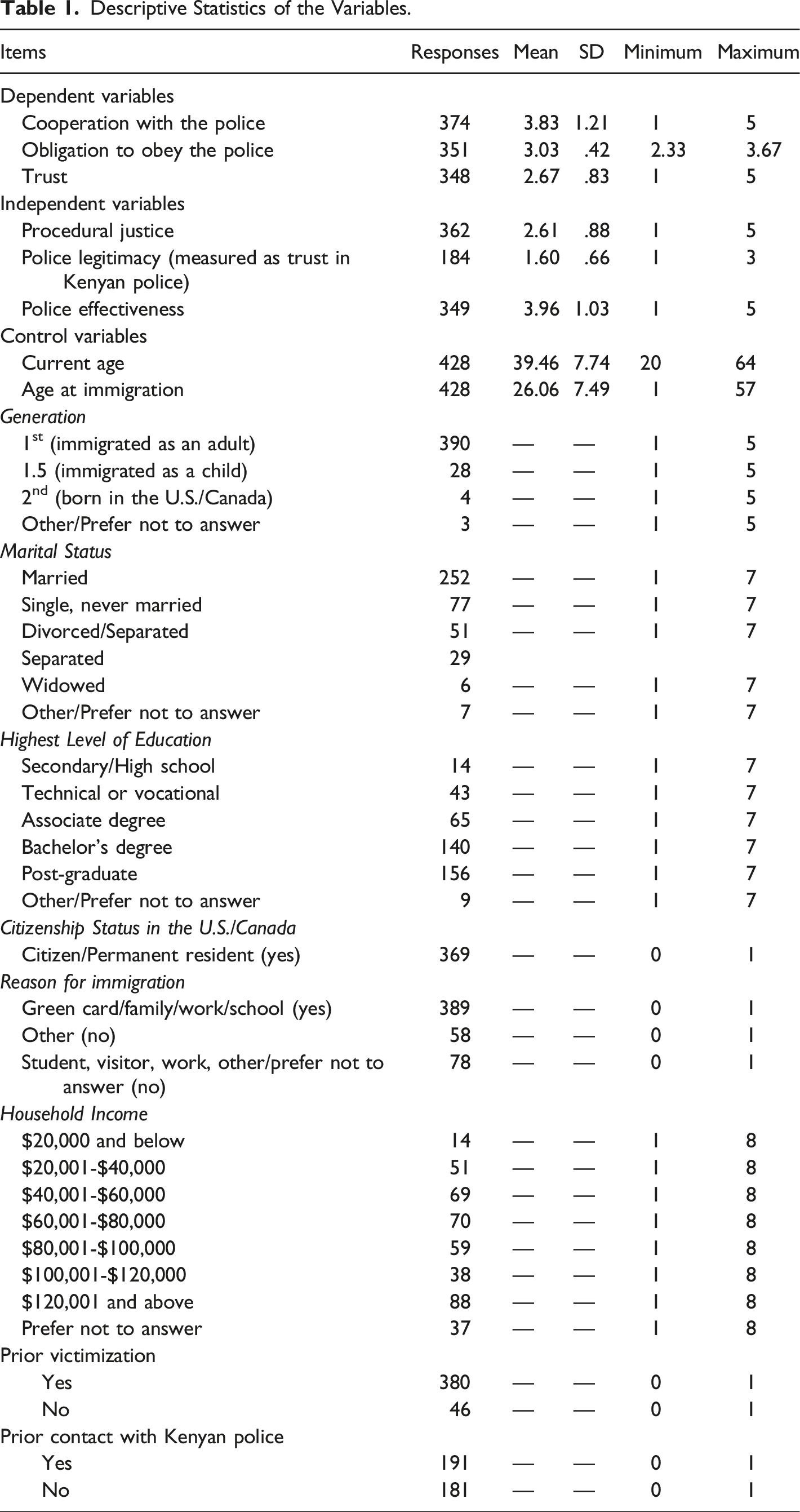
Descriptive Statistics of the Variables.
Factor Analysis
Varimax-Rotated Principal Axis Factoring (PAF).

Measures
In this section, we describe the variables that were used in the current study.
Dependent Variables
Previously, researchers have conceptualized legitimacy as the obligation to obey and trust the police (e.g., Tankebe, 2009). Here, obligation to obey and trust loaded disparately; thus, we could not measure legitimacy as a composite measure. We examined obligation to obey and trust separately; however, theitems used to operationalize obligation to obey and trust were taken from prior research (Pryce 2018; Tankebe, 2009). Respondents were asked to indicate their level of agreement (or disagreement) by selecting an answer to 3 items on a five-point Likert-type scale: (1) strongly disagree, (2) disagree, (3) neither agree or disagree 4 , (4) agree, and (5) strongly agree.
Obligation to obey
To measure obligation to obey the police, respondents were asked to respond to the following statements: (1) You should do what the police tell you to do even if you don’t understand why the order was given; (2) You should do what the police tell you to do even if you disagree with the police’s order; (3) You should always do what the police tell you to do even if you don’t like the way the police treat you. These responses were then combined to create an obligation to obey index (Cronbach’s α = .72; mean 3.03; SD = .42).
Trust
To measure trust in the police, respondents were asked to respond to the following statements: (1) The police in the United States are trustworthy; (2) I have confidence in the police in the United States; (3) The police in the United States are usually honest; (4) The police in the United States always act within the law. These responses were then combined to create a trust index (Cronbach’s α = .91; mean = 2.66; SD = .83).
Cooperation with the police
Willingness to cooperate with police was measured using items that were adapted from the Police Public Contact Survey (Langton & Durose, 2013). Respondents were asked to indicate how likely they are to cooperate with the police by selecting an answer to 4 items on a five-point Likert-type scale: (1) Very unlikely, (2) unlikely, (3) neutral, (4) likely, and (5) very likely. Respondents were asked to indicate how likely they are to: (1) Call the police to report a crime in your neighborhood; (2) Help the police with information on a suspected criminal; (3) Help the police with information to solve a crime; and (4) Report suspicious activity in your neighborhood to the police. The responses were combined to create a cooperation with police index (Cronbach’s α = .91; mean = 3.83; SD = 1.21).
Independent Variables
Perceptions of procedural justice (U.S. police)
Procedural justice was measured as quality of treatment (4 questions). 5 Our measure of procedural justice has been used by other researchers (Nix et al., 2015; Pryce, 2018; Solomon, 2019; Tankebe, 2009). A five-point Likert-type scale was used – (1) strongly disagree, (2) disagree, (3) neither disagree or agree, (4) agree, and (5) strongly agree – to measure this variable. The items for quality of treatment were: (1) The police treat people with respect; (2) The police treat people fairly; (3) The police respect people’s rights; (4) The police are courteous to people they come into contact with. The scale was coded so that higher scores reflected higher levels of quality of treatment. These responses were then combined to create a procedural justice index (Cronbach’s α = .915; mean = 2.53; SD = 1.01).
Trust in Kenyan police
Similar to Pryce’s (2018) measure of trust in Ghanaian police, we measured trust in Kenyan police using a five-point Likert-type scale: (1) strongly disagree, (2) disagree, (3) neither disagree or agree, and (4) agree, (5) strongly agree. The scale was coded so that higher scores reflected higher levels of trust for Kenyan police. The items were: (1) The Kenyan police are trustworthy; (2) I have confidence in the Kenyan police; (3) The Kenyan police are usually honest; (4) The Kenyan police always act within the law. These responses were then combined to create a police trust index (Cronbach’s α =.92; mean = 1.60; SD = .67).
Perceptions of U.S. police effectiveness
To tap into police effectiveness, we included one survey item that asked participants to indicate their level of agreement to the following statement “Compared to Kenyan police, American police do a good job responding to intimate partner violence.” Responses to this question ranged from strongly disagree (1) to strongly agree (5).
Perceptions of Kenyan police effectiveness
Participants were asked to rate the effectiveness of Kenyan police in handling IPV by responding to the following Likert-scale type statement: “Kenyan police respond fairly well to issues of intimate partner violence.” Responses to this question ranged from strongly disagree (1) to strongly agree (5).
Control Variables
Consistent with prior research, we included several control variables in our analyses. Participants were asked to indicate their current age (continuous), marital status (1 = married, 2 = divorced, 3 = separated, 4 = widowed, 5 = single never married, 6 = other), generation (1 = first, 2 = 1.5, 3 = second, 4 = third, and 5 = other), reason for migrating to the U.S. (1 = green card, work, family, and school and 0 = other, asylum, and prefer not to answer), household income (1 = $20,000 and below, 2 = $20,001-$40,000, 3 = $40,001-$60,000, 4 = $60,000-$80,000, 5 = $80,001-$100,000, 6 = $100,001-$120,000, 7 = $120,001 and above, and 8 = I prefer not to answer this question), citizenship status (1 = citizen/permanent resident and 0 = student, work permit, asyl9um, other and prefer not to answer), education level (1 = primary or elementary/middle school, 2 = secondary or high school, 3 = technical or vocational school, 4 = associate degree, 5 = bachelor’s degree, 6 = post graduate degree, 7 = other, and 8 = I prefer not to answer), prior victimization (1 = yes, 2 = no), prior experience with Kenyan police (1 = yes, 0 = no) and how old they were when they migrated to the United States.
Analytic strategy
The current study utilized ordinary least squares (OLS) regression to: (1) examine the relationship between procedural justice and Kenyan female immigrants’ cooperation with the police, (2) assess whether the women’s perceptions of procedural justice impacted their obligation to obey the police and to trust the police, and (3) whether their perceptions of Kenyan police impacted perceptions of police legitimacy for American police. Preliminary analyses were conducted to ensure that there was no violation of the assumptions of normality 6 , linearity, and homoscedasticity. Tolerance and VIF values were all within acceptable ranges suggesting that collinearity was an issue (Pallant, 2010). As such, OLS regression is an appropriate statistical test for the current analysis because the three dependent variables in this study are treated as continuous variables (Nix et al., 2015; Pryce & Grant, 2021).
Results
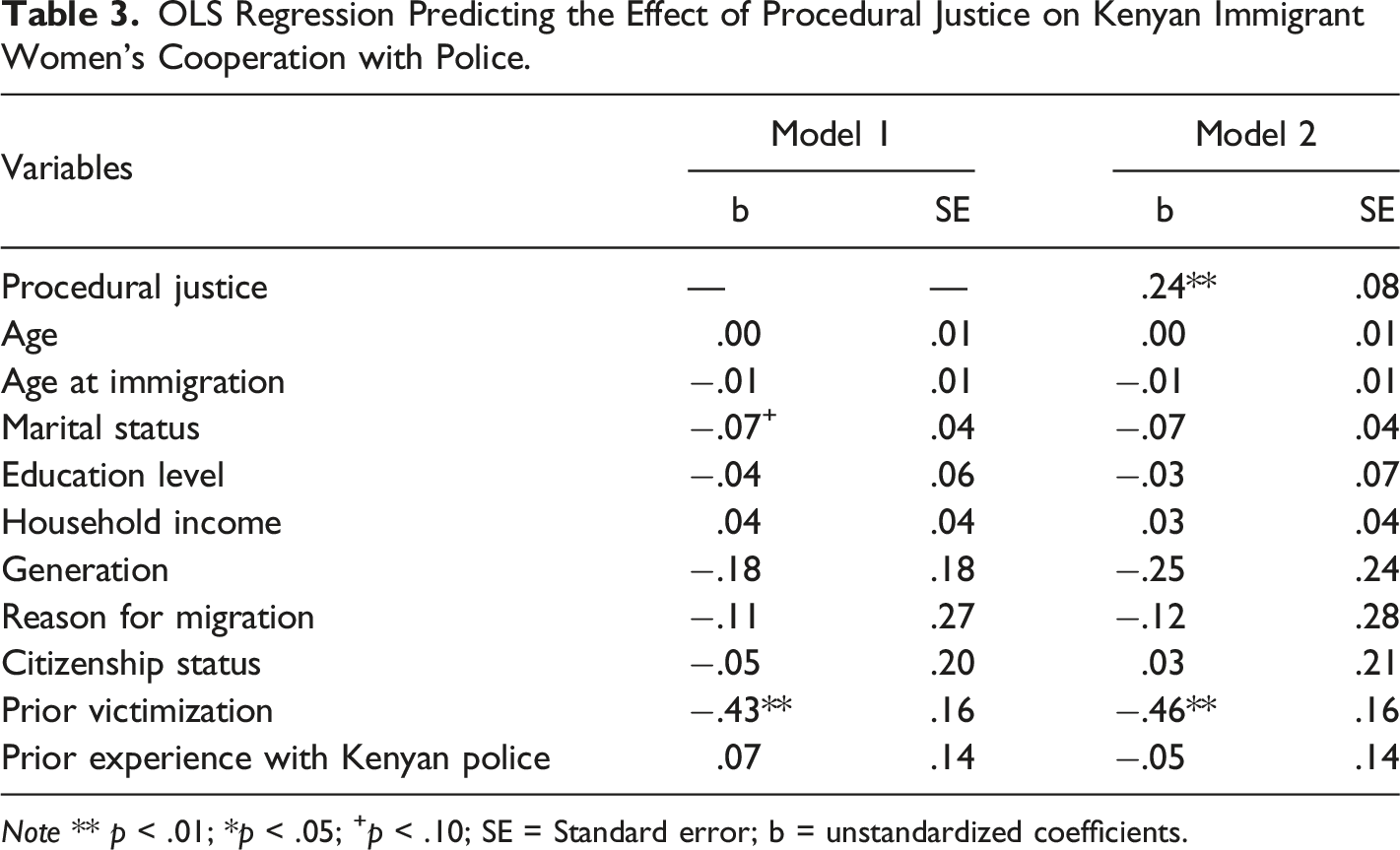
OLS Regression Predicting the Effect of Procedural Justice on Kenyan Immigrant Women’s Cooperation with Police.
Note ** p < .01; *p < .05; +p < .10; SE = Standard error; b = unstandardized coefficients.
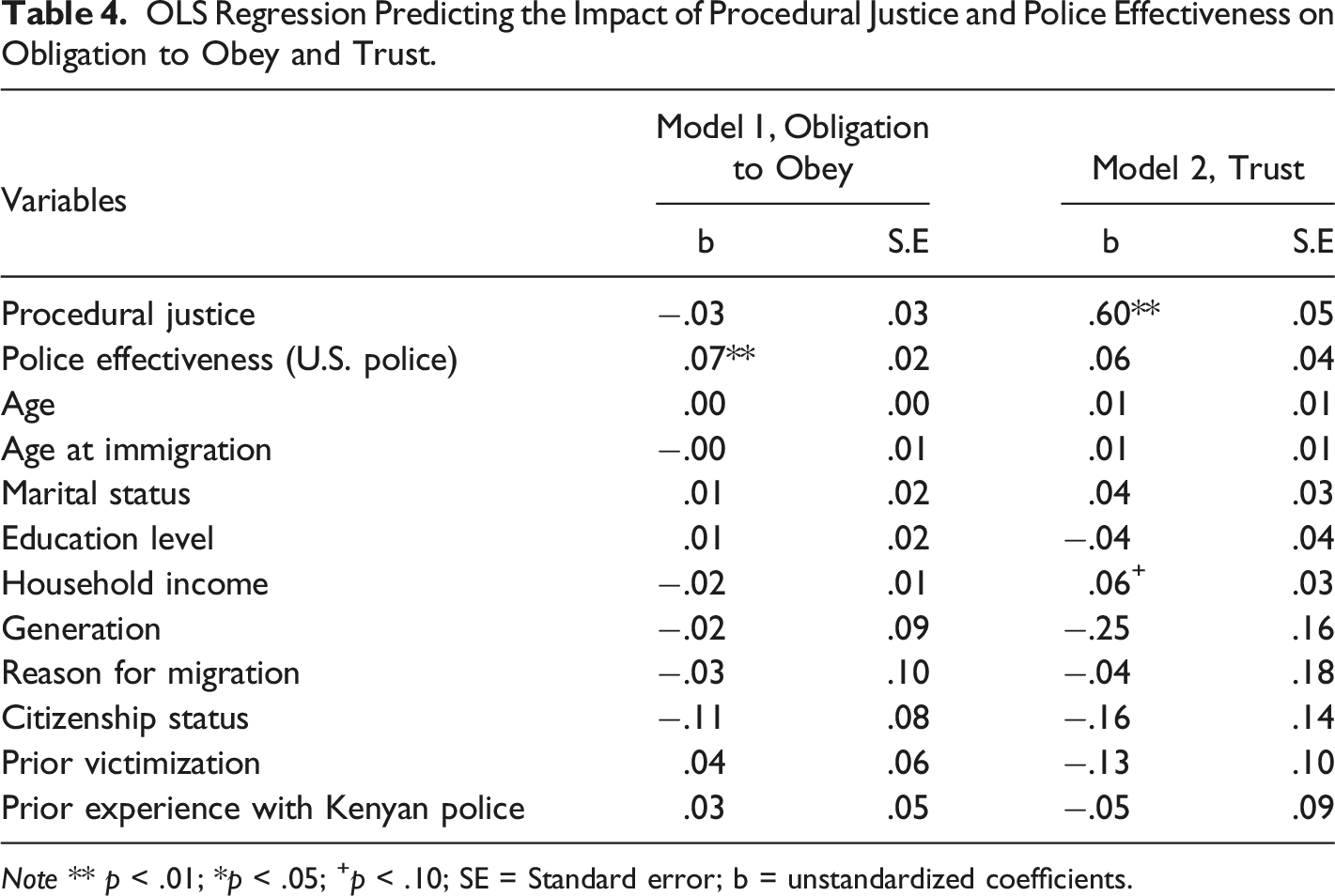
OLS Regression Predicting the Impact of Procedural Justice and Police Effectiveness on Obligation to Obey and Trust.
Note ** p < .01; *p < .05; +p < .10; SE = Standard error; b = unstandardized coefficients.
OLS Regression Predicting Perceptions of Kenyan Police Effectiveness in handling IPV and their impact on Kenyan Police Legitimacy.

Note ** p < .01; *p < .05; +p < .10; SE = Standard error, Prior experience with the Kenyan police was held constant in this model; b = unstandardized coefficients.
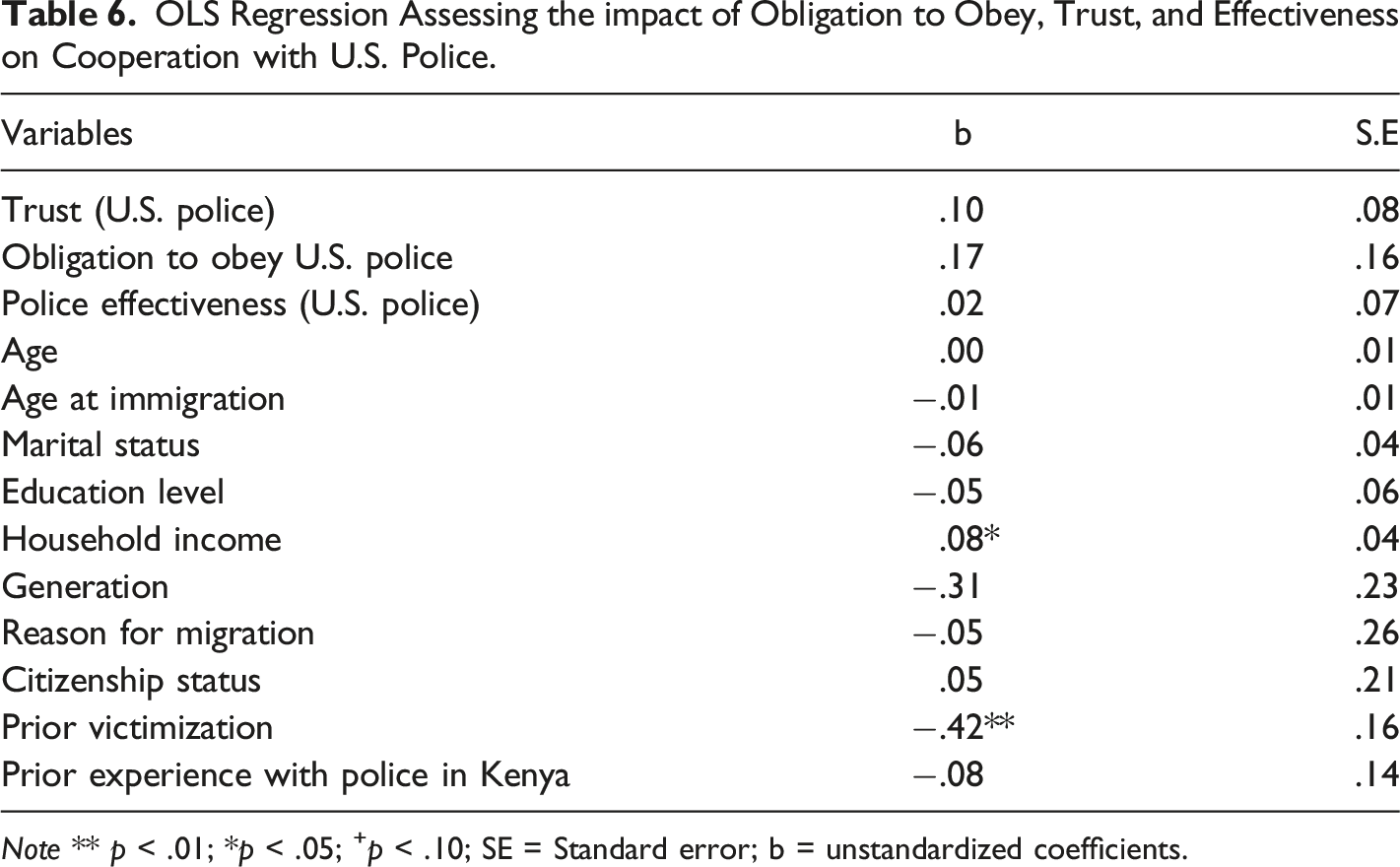
OLS Regression Assessing the impact of Obligation to Obey, Trust, and Effectiveness on Cooperation with U.S. Police.
Note ** p < .01; *p < .05; +p < .10; SE = Standard error; b = unstandardized coefficients.
Discussion and Conclusion
The current study explored several research questions. We first evaluated whether there was a relationship between perceptions of procedural justice and cooperation with U.S. police. Then we examined whether procedural justice and police effectiveness predicted trust and the obligation to obey the police. Lastly, we assessed whether perceptions of Kenyan police legitimacy impacted cooperation with police in the United States. We believe that the answers to these research questions warrant further discussion.
Extant research has linked citizens’ normative concerns to their decisions to comply with the law (Sunshine & Tyler, 2003; Tyler & Huo, 2002). Consistent with prior research, our study found that procedural justice was positively associated with Kenyan immigrant women’s desire to cooperate with the police. Our findings imply that when these women perceive that police treat them fairly; they are more likely to indicate that they would cooperate with police in the United States. Indeed, the association between procedural justice and cooperation with the police is robust as it remained significant even after we controlled for immigrant-specific characteristics, demographic information, and prior victimization. It is clear from this model that procedural justice is an important antecedent of cooperation with police in this sample. This finding contributes to the current research by showing that procedural justice is crucial for cooperation among Kenyan immigrants as it is to other populations. Proponents of procedurally just policing have noted the benefits of such policing tactics to enhance police legitimacy and public cooperation with the police.
Conversely, prior victimization was negatively associated with cooperation with police among Kenyan immigrant females. It may be that women who have been victims of crime experienced negative encounters with the police, which makes cooperation with the police less desirable. However, we tested (results not shown here) for moderating effects to assess whether prior victimization moderates the procedural justice and cooperation nexus and found that prior victimization did not worsen or strengthen this relationship. Yet, there are significant implications for exploring the crime reporting practices of immigrant women. Female immigrants are at a higher risk of experiencing intimate partner violence (Erez et al., 2009). However, reporting of IPV is lower among indigenous women, immigrant women, and women of color in general. This is where understanding the intersectionality of crime victims can enhance our understanding of cooperation of Kenyan women and other immigrants with the police. Previous experiences with the criminal justice system may have been received negatively by their larger communities– particularly in cases of gender-based violence. Gender is not the only demographic, however, that is likely to have influenced this outcome. Women in the sample may have believed that their immigrant and socio-economic statuses might have protected them from the negative stereotypes of Black women as in the United States (Slakoff, 2020; Slakoff & Brennan, 2020). Still, personal previous experience with the criminal justice may have provided evidence to the contrary, that their treatment is more in line with African American women regardless of these other demographic factors. To this end, we must better understand why these previous experiences are contributing to a failure to report as well as the extent to which Black immigrant women are not reporting victimization. The work of Potter (2013) and originally Crenshaw (1991) can and should be extended to understand not only how the experiences and reporting practices of Black immigrant women differ from other women of color but also from Black immigrant men.
Additional research is needed because reporting to the police is incredibly important for a variety of reasons. When victims do not report crimes to the police, there is no opportunity for investigation and arrest. There are other adverse outcomes as well. As some have noted, police officers can provide information about victims’ services, including victim compensation (Zaykowski, 2014). Without reporting the crime, victims may lack access to this important information about services to which they are legally entitled. Prior victimization may be more critical for women’s cooperation with the police than men; future research should empirically test this relationship.
The relationship between procedural justice, police effectiveness, trust, and obligation to obey the police was also interesting. We found that quality of treatment, a component of procedural justice, was associated with trust in the police; however, procedural justice was not associated with obligation to obey the police. This is a fascinating finding as prior work has revealed a significant association between procedural justice (both components) and police legitimacy—both trust and obligation to obey the police in Western contexts (Mazerolle et al., 2013; Sunshine & Tyler, 2003). Researchers have also argued that procedural justice and trust are highly correlated. Indeed, we found that the quality of the decision-making component of procedural justice was correlated with trust in the current study. The current study further clarifies that although procedural justice and trust are correlated, quality of decision-making was correlated with trust but not the quality of treatment. On the contrary, police effectiveness is a statistically significant predictor of Kenyan women’s obligation to obey the U.S. police but not trust in the police. This is somewhat in line with the findings of Murphy and colleagues (2017) who found that among Muslim residents in Australia, police legitimacy is more predictive of cooperation with police but not of willingness to report. While procedural justice is crucial to understanding cooperation and resistance to authority (Murphy, 2021), it is not the only important construct. Rather law legitimacy is predictive of willingness to report terror threats. It is possible that our measures should be expanded to also consider legal legitimacy and perceptions of the criminal justice system overall.
These findings reveal the importance of disaggregating measures of procedural justice and police legitimacy as different measures when taken together. Bottoms and Tankebe (2012), for example, contend that procedural justice is a dimension of police legitimacy and not an antecedent of police legitimacy. Conversely, these disparate measurements of legitimacy make it harder to define the concept, and further refining of the variable in future studies may be helpful (Pryce & Grant, 2021). In part, our findings support this contention as items of the decision-making component of procedural justice loaded with trust, a proxy for police legitimacy in the current study. Although some of our findings contrast with previous research, it is essential to note the uniqueness of our sample. Our sample was comprised of female participants; many prior studies used samples comprising of both men and women. Immigrants are often approached from a deficit perspective; however, the current sample includes women with a relatively high level of education and above-average household income. Assessing perceptions of police using different types of samples can provide more clarity on what citizens really value, as scholars have mainly focused on racial/ethnic differences between White and Black citizens. Still, there is more to learn from an intersectional lens, such as the one used in the current study.
We also considered that Kenyan immigrants' cooperation with American police would be altered by their perceptions of police in Kenya (see Menjivar & Bejarano, 2004). Surprisingly, we found that neither obligation to obey the police, institutional trust, nor police effectiveness in handling IPV were associated with Kenyan female immigrants’ cooperation with the U.S. police. Several factors can explain this finding: first, the sample for the current study was drawn from Kenyans currently residing in the United States and not in Kenya. It is possible that Kenyan immigrants’ perceptions of police in Kenya are also shaped by their experiences with police in the United States. More research is needed to understand the relationship between police legitimacy and cooperation with police among African diasporic immigrants such as Kenyans. Second, the current study focused only on women; it would be interesting to assess this relationship in a sample of both men and women. Because we took a cross-sectional approach; however, more research is needed to determine whether there is a relationship between these variables. Researchers should use a mixed-methods approach (e.g., in-depth interviews and surveys) to gain a deeper understanding of why experiences with police in native countries may not impact immigrants’ perceptions of police in their new homes. If immigrants form their opinions irrespective of negative experiences in their native countries, then positive experiences with police in the United States (and other host countries) are essential as the benefits of positive police-public interactions far outweigh the risks and should therefore be encouraged.
In addition, we found that when Kenyan women thought police in their native country were more effective in handling intimate partner violence cases, they were more inclined to view the police in Kenya as trustworthy or legitimate. Public opinion surveys on perceptions of police in Kenya have revealed that most Kenyans do not trust the police, partly because they do not feel like the police are effective crime fighters (Wambua, 2015). As our results have shown, Kenyan immigrant women’s perceptions of trust in their police were more positive when they thought the police were handling IPV cases properly. Thus, we would also argue that future research should not treat Black immigrants as a homogenous group—rather country of origin as well as individual socio-economic status are likely important predictors of cooperation with the police.
Implications for Future Research
Results from the current study offer some insights that can help researchers interested in studying immigrant women’s perception of U.S. police. This study is not without limitations; to begin with, findings from this study cannot be generalized to other immigrant populations as we used non-probability sampling techniques to obtain our sample. However, with hard-to-reach populations such as ours, probability samples can be challenging to achieve as they do not have a clear sampling frame (Chenane & Hammond, 2021). Secondly, our measure of police effectiveness is limited as it only captures one aspect of police effectiveness. Future studies should consider other aspects of police effectiveness. For instance, perceptions of police effectiveness in handling different types of crime (e.g., robbery, homicide, larceny) may affect Kenyan immigrant women’s perception of police legitimacy both in Kenya and the United States. Still, cooperation with the police can also be expanded to include different scenarios and types of crime. Although we asked questions about perceptions of U.S. police first, our items of cooperation with the police, trust, and obligation to obey the police did not specify whether we were referring to police in the United States or police in Kenya. It is possible that in responding to these survey questions, participants were thinking about their experiences with Kenyan police rather than U.S. police. 7
Future research should focus on identity construction for African immigrants and time spent in the country. As Oliveira and Murphy (2015) discuss, how individuals view themselves may also impact how they view the world. Social identity theory could help explain these views (Sargeant et al., 2016). For example, a newly arrived Kenyan immigrant might identify more with the Kenyan community in the United States than with African American neighbors. These connections may change with more time spent living in the United States and greater roots in local communities. It is important to note that we assessed people’s judgment of police fairness rather than actual police behavior (Sunshine & Tyler, 2003; Murphy, 2021). In addition, the sample included in this study is better educated and resourced than the typical Kenyan citizen. As Gillum and colleagues (2018) note, poverty is an essential driver for understanding the experiences of Kenyan women with the criminal justice system in their own country. These are experiences our sample may not have had in Kenya or in the United States.
Footnotes
Acknowledgments
The authors would like to thank Dr. Daniel K. Pryce and the anonymous reviewers for their helpful comments on an earlier draft of this manuscript.
Declaration of conflicting interests
The author(s) declared no potential conflicts of interest with respect to the research, authorship, and/or publication of this article.
Funding
The author(s) disclosed receipt of the following financial support for the research, authorship, and/or publication of this article: We received Seed funding from the University of Massachusetts, Lowell that helped us with data collection.

Notes
Appendix
Hello (name withheld for confidentiality) sisters! I’m still appealing for your participation in our survey. I graduated with my Ph.D. in Criminology and Criminal Justice in May of 2018. The journey was long and arduous, as you can see from the two photos (not shown here). But God saw me through and gave me victory. I’m currently an assistant professor of Criminal Justice at the University of Massachusetts Lowell, where research expectations are high. In order to build my research on ethnic minorities, I need to gather data and this is where your participation is much needed. We have to start somewhere in order for us to have our voices heard in this country.
Kindly take a few minutes out of your busy schedules to respond to our survey by clicking on the link below.
xxxxxxxxxx
Thanks so much for your support thus far, we are making great progress, but we still need participants. Please encourage a sister to participate. Thanks and God bless.