




Abstract
The large-scale migration and significant gender imbalance over the decades are expected to elevate HIV sexual risk behaviors substantially in China. However, the mechanisms underlying these behaviors among male migrants in the context of gender imbalance remain poorly understood. This study explores the relationship between perceived environmental factors and HIV sexual risk behaviors, as well as the mediating role of sex with online partners. The data used in this study were obtained from a 2017 cross-sectional survey of 870 male migrants. We found that both peer norms and neighborhood characteristics were associated with sexual risk behaviors among male migrants. Furthermore, sex with online partners was a significant mediator, explaining 22.50% and 20.13% of the associations between peer norms, neighborhood characteristics, and HIV sexual risk behaviors. Notably, the mediating effect was only significant for unmarried male migrants, not for married migrant males. The findings suggest that sex with online partners plays an important role in unmarried male migrants’ HIV sexual risk behaviors and that further prevention and intervention should enhance internet-based sex education.
Keywords
Introduction
Since the 1980s, China has witnessed an imbalanced sex ratio due to sex-selective abortion and increased female infant mortality (Srinivasan & Li, 2018). A significant consequence of this gender imbalance is the increasing difficulty for less educated and poorer rural males, especially in finding a spouse, as there are more males than females in the marriage market (S. Wang et al., 2018). Between 2020 and 2080, the cumulative number of these surplus males will exceed 32 million (Guilmoto, 2012). In pursuit of improved work and marriage prospects, these males often migrate to urban areas. Meanwhile, rural-to-urban unmarried male migrants are more likely than married male migrants to have sex with partners met online (Y. Wang et al., 2022). Studies have shown that sex with partners met online was significantly associated with a series of sexual risk behaviors (SRBs, which usually include commercial sex, unprotected sexual intercourse, anal and oral sex, etc.), thereby increasing those males’ susceptibility to HIV/sexually transmitted disease (STD) infections (Abara et al., 2014; Gou et al., 2022; Y. Wang et al., 2020; Xiao et al., 2020). Urgent attention is needed to identify the specific risk factors that make unmarried male migrants more vulnerable to HIV infections.
Sexual contact is the primary mode of HIV/AIDS transmission in China (National Center for AIDS/STD Control and Prevention, 2023), attributed to the increased engagement in sexual SRBs among vulnerable populations (K. Wang et al., 2013; Xiao et al., 2020). The large-scale migration population is believed to be a significant contributor to the rising transmission of HIV through sexual contact (Chowdhury et al., 2018; Liu et al., 2021; K. Wang et al., 2013). The openness of sexual cultural environments and the increased availability of services in urban areas, combined with the relaxed social control post-migration, have heightened the likelihood of rural-to-urban migrants engaging in SRBs (Gou et al., 2022; X. Yang et al., 2007). Numerous studies have identified factors that influence SRBs, including attitude, peer norms, HIV/AIDS-related knowledge, frequent exposure to pornography, and age (Jones et al., 2017; Miner et al., 2009; K. Wang et al., 2013). However, little is known about the mechanisms explaining SRBs among male migrants in the context of gender imbalance in China.
Problem Behavior Theory (PBT) is a valuable socio-psychological framework for investigating the factors that influence the likelihood of male migrants engaging in SRBs. PBT has been widely applied to predict problem behaviors, such as sexual hookups (Fielder et al., 2013), early sexual initiation (Madkour et al., 2010), and risky sexual behavior (De Leo & Wulfert, 2013). According to PBT, problem behaviors result from the combination and interaction of three major systems: personality system, behavior system, and perceived environment system (Jessor et al., 1968). The perceived environment system, the main focus of the current study, consists of both proximal and distal factors (Karaman, 2013).
Perceived Environment and HIV SRBs
Substantial empirical evidence for PBT has consistently demonstrated that both proximal factors (e.g., peer norms) and distal factors (e.g., neighborhood characteristics) within perceived environment systems are associated with SRBs. Peer norms act as a powerful social influence, representing the collective approval or disapproval of significant peers (Berkman et al., 2000). They guide individuals by providing information about morally acceptable behavior and motivating adherence to avoid social sanctions (Barrington et al., 2009; C. Yang et al., 2010). Previous research has confirmed that perceived peers’ sexual behaviors and attitudes are significant normative predictors of SRBs (Ali & Dwyer, 2011; Yamanis et al., 2016). For instance, perceptions of peers’ reduced condom use and their attitudes toward endorsing commercial sex patronage are associated with lower condom use and increased engagement in commercial sex among younger men and unmarried males, respectively (Gou et al., 2021; Hill et al., 2018). Evidence from China also indicated that unmarried male migrants who have peers engaging in sex with a non-regular sex partner are 4.4 times more likely to engage in risky sexual intercourse than those who did not have such peers (K. Wang et al., 2013).
In addition, SRBs can be attributed to more distal factors, such as neighborhood characteristics (Browning et al., 2008; Burns & Snow, 2012). Neighborhood characteristics, typically defined as the attributes or conditions of residents’ living environments (Xiao et al., 2020), are assessed through various indicators, including physical disorder, structural disadvantages, social norms, and collective efficacy, aligned with different theoretical perspectives. Numerous studies have demonstrated that both the structural (e.g., poverty, disorder) and social characteristics of neighborhoods affect HIV risky behaviors and transmission (Bowleg et al., 2014; Davey-Rothwell et al., 2015; Frye et al., 2017). Neighborhood culture shapes behavior by establishing values that guide actions (Berg et al., 2016), and information conveyed by a disordered neighborhood may contribute to risk behaviors (Jones et al., 2017). For example, one study found that permissiveness toward casual sex with a neighborhood significantly influenced adolescents’ SRBs (Warner, 2018), while another study identified a link between neighborhood characteristics and the likelihood of engaging in commercial sex among Chinese male migrants (Xiao et al., 2020). All these results highlight the importance of the perceived environment in SRBs. However, few studies have considered both proximal and distal environmental factors in relation to SRBs simultaneously. The mechanisms underlying the associations between perceived environmental factors and SRBs among male migrants also remain unclear.
Sex With Online Partners and HIV SRBs
The internet has become a popular platform for seeking sex partners (Cabecinha et al., 2017). Studies have shown a strong association between sex with online partners and SRBs across cultures and populations. For instance, a survey of Chinese rural unmarried males found that those who having sex with online partners were more likely to engage in unsafe sexual intercourse, commercial sex, and have multiple sexual partners (Y. Wang et al., 2020). Similarly, studies in Western countries have reported similar associations between online sexual partner-seeking and engaging in multiple sexual partners, unprotected anal intercourse, and concurrent partnerships among men who have sex with men (MSM), the general population, and adolescents (Cabecinha et al., 2017; Gravningen et al., 2016; Wong et al., 2014). These findings suggest that sex with online partners can increase the likelihood of SRBs.
Perceived Environment, Sex With Online Partners, and HIV SRBs
The relationship between perceived environment and sex with online partners has been previously explored. For example, perceived peer norms have been linked to sex with online partners (Y. Wang et al., 2022) and seeking casual sex via dating apps (Chan, 2017). Given the more permissive attitude toward casual sex and the higher internet penetration in urban areas, rural-to-urban unmarried male migrants may be more likely to engage in sex with online partners. For these individuals, sex with online partners not only satisfies their sexual desires but also serves as a significant pathway to risky sexual behaviors (Y. Wang et al., 2020). Thus, sex with online partners may act as a pivotal mediator between the perceived environment and SRBs. In addition, prior research has shown that unmarried male migrants are more likely to engage in SRBs compared to their married counterparts (Gou et al., 2021; Xiao et al., 2020). However, limited evidence exists on the differences in the mechanisms underlying SRBs between married and unmarried male migrants.
Aim of the Present Study
This study aims to explore the influencing mechanisms of HIV SRBs among male migrants in the context of China’s gender imbalance. Specifically, as illustrated in Figure 1, we examine the relationships between peer norms, neighborhood characteristics, and SRBs, with a focus on the mediating role of sex with online partners. In addition, we examine potential differences in the associations between married and unmarried male migrants.

Conceptual Framework.
Method
Study Design and Data Source
The data for this study were drawn from the “Mobility, Sexuality, and Quality of Life Survey,” a cross-sectional investigation conducted in China from January to September 2017. Eligibility criteria included (a) rural household registration (hukou); (b) at least 6 months of migration experience; and (c) males aged 28 and older. We conducted the survey in both rural and urban areas, and the sampling process is illustrated in Figure 2.
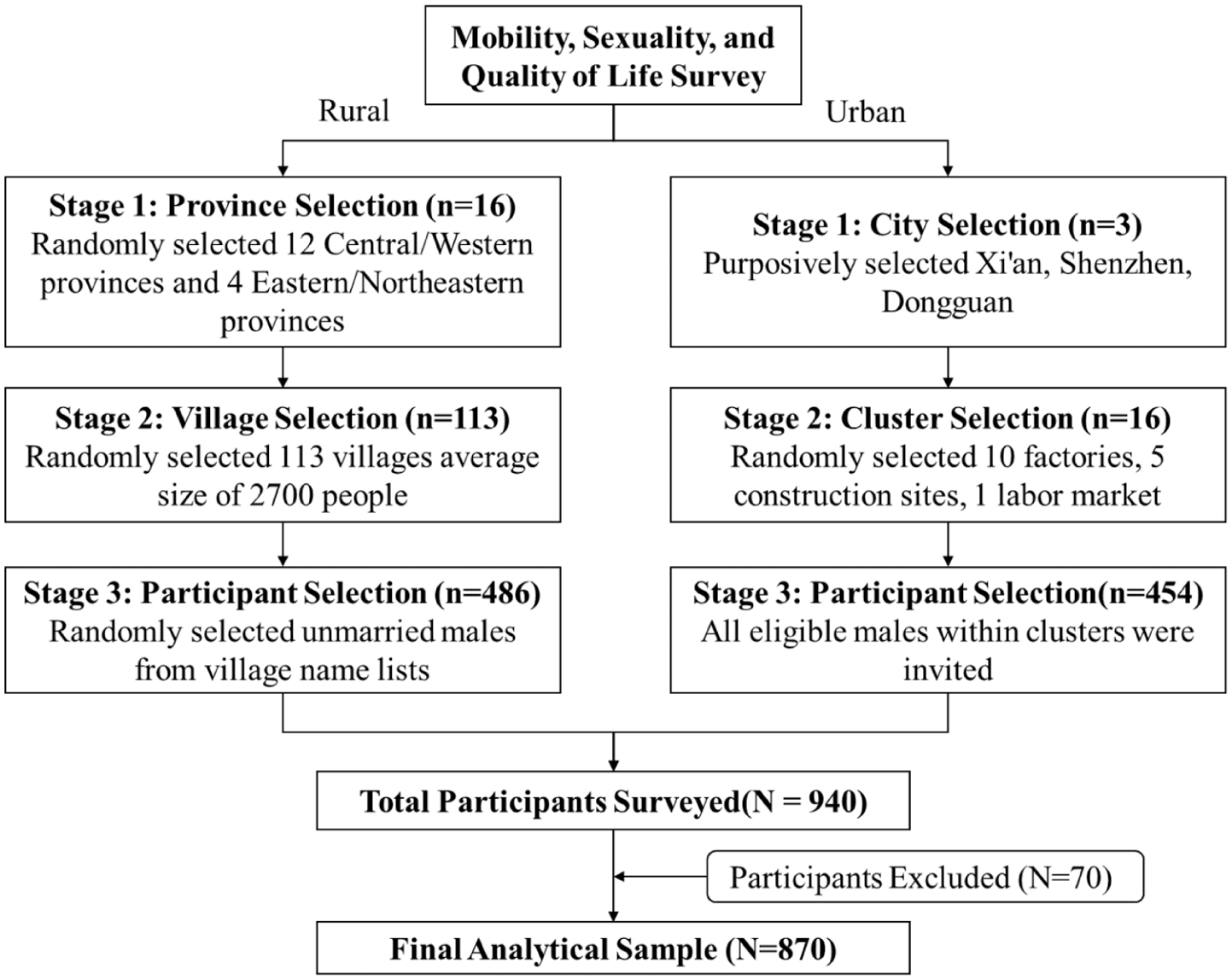
Flowchart of Sampling Strategy and Participant Recruitment.
Sampling and Recruitment Procedures
In rural areas, we employed a stratified multi-stage sampling approach to identify unmarried males who returned from rural to urban migration (Liu et al., 2021; Zhao, Liu, Hai, & Zhang, 2022). Stage 1 (Province Selection): As unmarried men due to the marriage squeeze are predominantly located in central and western China (Sharygin et al., 2013; Zhao, Liu, Hai, & Zhang, 2022), we randomly selected 12 provinces from the 18 provinces and autonomous regions in this area and 4 provinces from the 10 eastern and northeastern provinces. This sampling frame represents approximately half of all provinces in mainland China, ensuring broad geographical representation. Stage 2 (Village Selection): Within these provinces, 113 villages with an average village size of 2,700 people were randomly selected. Stage 3 (Participant Recruitment): Using name lists of unmarried males provided by village cadres, we randomly selected potential participants. The interviewer team consisted of 80 undergraduate students who were originally from the selected villages. Recruitment was timed to coincide with the 2017 Spring Festival, when most migrants return home, maximizing access to the target population. From this process, 486 (97.2%) valid samples were collected.
In urban areas, a multi-stage cluster sampling method was used to recruit the rural–urban male migrants (including married and unmarried male migrants) (Gou et al., 2022; Xiao et al., 2020). Stage 1 (City Selection): Three cities with high concentrations of migrant workers were purposively selected: Xi’an (a primary destination for intra-provincial migration) and Shenzhen and Dongguan (major hubs for inter-provincial migration). Stage 2 (Cluster Selection): Within these cities, venues with a high concentration of migrant workers were identified. Guided by the occupational distribution of migrants from the 2010 national census, a total of 16 venues (clusters) were randomly selected, comprising ten factories, five construction sites, and one large labor market. Stage 3 (Participant Selection): Within each selected venue (cluster), all rural–urban male migrant workers who were willing to participate were interviewed. In total, 454 (91.35%) valid samples were collected.
Data Collection
Data were collected via private, face-to-face interviews. All interviews were administered using the Computer-Assisted Personal Interviewing (CAPI) method to ensure privacy and data reliability. Critically, the interviewer team underwent the rigorous and standardized training program before fieldwork, covering the study protocol, ethical principles, informed consent, interviewing techniques for sensitive topics, and the CAPI software proficiency. This standardization was crucial to minimize interviewer bias. Each interview took approximately 30–50 minutes to complete. A written informed consent was obtained from the study participants, and a 50 CNY incentive was provided to participants.
A total of 940 individuals (486 from rural areas, 454 from urban areas) completed the survey. For this analysis, 70 participants were excluded: 12 who were divorced or widowed, 48 who were younger than 28 years old, and 10 who had missing data on key sexual behavior variables. This resulted in a final analytical sample of 870 participants.
The study protocol was approved by the Biomedical Ethics Committee, Xi’an Jiaotong University (No: 2016-415). Written informed consent was obtained from all participants before the interview began.
Measures
Dependent Variable: HIV SRBs
HIV SRBs were assessed using four indicators: commercial sex, inconsistent condom use, unsafe sexual intercourse, and multiple sex partners (Gou et al., 2022; Sales & Sheth, 2019). Commercial sex was measured by asking, “Have you ever had sexual intercourse with sex workers?” (1 = yes, 0 = no) (Xiao et al., 2020). For inconsistent condom use, respondents listed five sexual partners and indicated how often condoms were used (four-point scale from “always” to “never”), which was dichotomized (1 = inconsistent use, consistent use = 0) (Zhao, Liu, Chen, & Feldman, 2022). Unsafe sexual intercourse was assessed by asking about engagement in behaviors such as anal sex, oral sex, or group sex in the past 12 months (1 = yes, 0 = no) (Y. Wang et al., 2020). Multiple sex partners were measured by asking, “How many people have you had sex with?” (1 = ≥4, 0 = 0–3) (Gou et al., 2022). Scores from these behaviors were summed to create a composite HIV SRB score (0–4).
Independent Variable: Perceived Environment
In this study, two variables were used to assess participants’ perceived environment: peer norms and neighborhood characteristics, which represent proximal and distal factors, respectively.
For the measurement of peer norms, a well-established name generator method was employed, asking respondents to list five individuals with whom they had interacted most frequently in the past 6 months (excluding parents and siblings), thereby forming the respondents’ social network (Burt, 1984). Peer norms were assessed by asking whether those listed peers approve of the uncommitted sexual behaviors, such as sex with partners met online or sex workers. Responses were rated on a four-point Likert-type scale (1 = strongly disagree to 4 = strongly agree), and scores were summed for a range from 2 to 32, with higher scores indicating more positive peer norms (Gou et al., 2021).
Neighborhood characteristics were assessed by asking about the prevalence of extramarital affairs and commercial sex in both participants’ village and workplace, rated on a 4-point Likert-type scale (1 = none to 4 = many, coded 0 for “don’t know”), with scores summed to create a neighborhood characteristics score (0–12) (Gou et al., 2022; Xiao et al., 2020).
Mediation Variable: Having Sex With Online Partner
Sex with online partners was measured through a two-step inquiry: First, participants were asked, “Have you surfed the internet in the past 12 months?” Those answering yes move to the next question about having intercourse with online partners with no previous social ties. Respondents who answered yes were then asked if they had sexual intercourse with partners met online with no previous social ties. Responses were coded as (1 = yes, 0 = no) (Y. Wang et al., 2020).
Control Variables
Sociodemographic characteristics and health status were used as control variables, including age, education, monthly income, occupation, and self-reported health. Education was classified into three levels: “primary school and below,” “junior high school,” and “senior high school and above.” Monthly income was calculated as the respondent’s average monthly earnings in the past 12 months, classified as “below 3000 Yuan (RMB),” “between 3000 and 5000 Yuan,” and “above 5000 Yuan.” The occupation was coded as a categorical variable, including “farmers,” “workers, employees” “civil servants, managers,” and “freelance and other.” The five self-reported health categories ranged ordinally from “very poor” to “very good.”
Data Analysis
Stata/MP 15.1 was used for statistical analyses. First, we conducted a descriptive statistical analysis. Pearson chi-square tests (for categorical variables) and T-tests (for continuous variables) were used to compare the differences in characteristics among married male and never-married male migrants. Then, the Poisson regression was conducted to examine the association between perceived environment, having sex with online partner, and SRBs for all male migrants, as well as separately for unmarried and married males. Models 1, 3, and 5 examined the associations between perceived environment and SRBs after controlling for sociodemographic characteristics and self-reported health. Models 2, 4, and 6 examined the associations between sex with online partners and SRBs, adding the variable of sex with online partners into Models 1, 3, and 5, respectively. The KHB method (Karlson, Holm, and Breen; via the khb command in Stata), developed to analyze mediation effects in nonlinear models, calculates the percentage of the main association explained by the mediator. Before conducting the Poisson regression, a multicollinearity test of independent variables was performed, with all variance inflation factors found to be below 10, indicating an acceptable level of multicollinearity. We performed mediation analyses and calculated the percentage of the main association explained by the mediator.
Results
Sample Characteristics and Bivariate Analysis
Table 1 presents the sociodemographic characteristics of 870 migrant males (556 unmarried, 314 married). The average peer norm score was significantly higher in married migrants (14.47 vs. 11.78, p < .001). Unmarried males were more likely to engage in sex with online partners (18.35% vs. 12.74%, p < .05) and had higher SRB scores (1.61 vs. 1.43, p < .01).
Characteristics of the Sample and Their Differences (N = 870).

Note. Pearson chi-square test was used for categorical variables and T-tests for continuous variables.
Regression Results
Table 2 shows that both peer norms and neighborhood characteristics were significantly associated with SRBs across all groups. In Model 1, peer norms were positively linked to SRBs in the total sample (0.020, SE = 0.005), and similarly for unmarried male migrants in model 3 (0.023, SE = 0.006) and married male migrants in Model 5 (0.021, SE = 0.008). In addition, there was also a positive association between neighborhood characteristics and SRBs across the total sample (0.067, SE = 0.012), unmarried male migrants (0.074, SE = 0.015), and married male migrants (0.054, SE = 0.020).
Poisson Regression Models for HIV Sexual Risk Behaviors.

Note. Standard errors are in parentheses.
p < .05. **p < .01. ***p < .001.
When sex with online partners was included in the models, the coefficient size of the association between peer norm and neighborhood characteristics and SRBs decreased slightly. Sex with an online partner was significantly associated with increased SRBs among migrant males (0.490, SE = 0.066). The magnitude of the association was higher for unmarried male migrants (0.507, SE = 0.079) than for their married counterparts (0.415, SE = 0.129). These findings suggest a potential mediating role of sex with online partners in the relationship between the perceived environment and SRBs. This hypothesis was further examined through a mediation analysis.
Mediation Results
Table 3 presents the mediation results. In examining the association between peer norms and SRBs, the coefficient size was 0.120 (SE = 0.028, 95% CI = [0.064, 0.175]) without the mediator variable. With the mediator included, the coefficient size decreased to 0.093 (SE = 0.028, 95% CI = [0.036, 0.149]), indicating that 22.50% (0.027/0.120) of the association was mediated by sex with online partners. Stratified analyses revealed that this mediation effect was significant among unmarried male migrants (0.028, SE = 0.013, 95% CI = [0.003, 0.053]), accounting for 21.21% (0.028/0.132) of the association, but not for married male migrants 0.024 (SE = 0.014, 95% CI = [-0.002, - 0.052]).
Mediating Effects of Sex with Online Partners on the Association Between Perceived Environment and HIV Sexual Risk Behaviors.

Note. Standard errors are in parentheses.
p < .05. **p < .01. ***p < .001.
Similarly, for the association between neighborhood characteristics and SRBs, the coefficient size was 0.144 (SE = 0.026, 95% CI = [0.092, 0.195]) without the mediator and decreased to 0.114 (SE = 0.027, 95% CI = [0.061, 0.166]) with the mediator, indicating a 20.13% (0.029/0.144) mediation effect. Stratified analyses showed this mediation effect was significant among unmarried male migrants (0.034, SE = 0.013, 95% CI = [0.008, 0.060]), accounting for 21.66% (0.034/0.157) of the association, but not for married male migrants (0.022, SE = 0.013, 95% CI = [-0.004, - 0.049]).
Discussion
To our knowledge, this study is the first to explore the mediating role of sex with online partners in the relationship between perceived environment and HIV SRBs among male migrants within the context of China’s gender imbalance. We simultaneously examined proximal factors (peer norms) and distal factors (neighborhood characteristics) of the perceived environment system on SRBs. Key findings include (1) positive perceptions of both peer norms and neighborhood characteristics are associated with higher SRBs and (2) sex with online partners significantly mediates the associations between these environmental factors and SRBs, with this mediation effect observed only in unmarried male migrants.
Our findings highlight the significant influence of both proximal and distal environmental factors on SRBs. Regarding peer norms, male migrants perceiving their peers as more accepting of casual sex (e.g., with online partners or sex workers) showed a higher likelihood of engaging in SRBs. The result is consistent with a prior study which indicated that having peers who had sex with a non-committed sex partner increases the possibility of engaging in SRBs among male migrants (K. Wang et al., 2013). This finding further supports previous research indicating that peer norms play a crucial role in influencing various risky sexual behaviors, including commercial sex, unprotected sex, and multiple sexual partnerships (Hill et al., 2018; Jones et al., 2017; W. Wang & Muessig, 2017). According to social influence theory, individuals are likely to conform to behaviors endorsed by their social networks (Mulawa et al., 2016). Thus, perceiving peer approval of casual sex may provide a rational basis for male migrants engaging in SRBs (Hill et al., 2018).
In terms of neighborhood characteristics, consistent with existing studies, we found that exposure to neighborhoods with prevalent casual sexual activities is associated with increased SRBs among male migrants (Bowleg et al., 2014; Raymond et al., 2014). Previous studies have reported a significant relationship between neighborhood structural disadvantage (Akers et al., 2011; Parrado & Flippen, 2010), neighborhood disorder (Frye et al., 2017), and SRBs. This study further confirms that male migrants exposed to a higher prevalence of casual sexual activities in their neighborhoods are more likely to engage in SRBs (Gou et al., 2021; Xiao et al., 2020). One possible explanation is that neighborhood peers serve as role models, thereby normalizing and encouraging similar behaviors (Warner, 2018). Another possible explanation is that neighborhood contexts shape subcultural norms that foster acceptability and engagement in SRBs (Akers et al., 2011).
Crucially, our study reveals that sex with online partners serves as a significant partial mediator between perceived peer norms, neighborhood characteristics, and SRBs. This finding implies that the perceived environment not only has a direct impact on SRBs but also indirectly promotes engagement in SRBs through sex with online partners. Unmarried male migrants perceiving greater social acceptance of casual sex were more likely to engage in sex with online partners (Y. Wang et al., 2022), which is associated with behaviors like inconsistent condom use, commercial sex, and having multiple sexual partners (Cabecinha et al., 2017; Y. Wang et al., 2020). This finding reveals a mechanism underlying the effect of perceived environment on male migrants’ SRBs. Given the internet’s role in facilitating SRBs (Brown et al., 2015), internet-based health education programs may be essential for reducing SRBs among male migrants.
Notably, the mediating role of sex with online partners was significant only for unmarried male migrants, not their married counterparts. This disparity could be due to several factors. First, unmarried male migrants are generally more sexually active in casual contexts compared to married ones (Xiao et al., 2020; X. Yang et al., 2014), partly driven by China’s gender imbalance and associated “marriage squeeze.” This demographic challenge may prompt unmarried men to seek sex partners online (Y. Wang et al., 2020). Second, unlike married individuals, unmarried male migrants lack spousal social commitments, leading to weaker social constraints and an increased likelihood of engaging in sex with online partners. Moreover, younger, unmarried migrants may display a more adventurous attitude toward their sexual desires, which potentially elevates the likelihood of engaging in SRBs (Chowdhury et al., 2018; Xiao et al., 2020; Zhao, Liu, Chen, & Feldman, 2022). Recent studies have reported that unmarried male migrants are more likely to have complex sexual networks (Zhao, Liu, Chen, & Feldman, 2022), further heightening their risk of SRBs. Given their limited access to sex education and reproductive health services (K. Wang et al., 2013; X. Yang et al., 2014), targeted interventions for unmarried male migrants, such as comprehensive online sex education and regular health check-ups, are crucial.
Limitation
This study has several limitations. First, peer norms encompass both descriptive (what peers do) and injunctive norms (what peers approve or disapprove of) (Cialdini et al., 1990). Prior research indicates that individuals’ sexual behaviors are more strongly associated with perceived peer actions than peer approval (Barrington et al., 2009; Van de Bongardt et al., 2015). Future studies should include descriptive norms to better understand their distinct impacts on SRBs. Second, our analysis focused exclusively on the perceived environment system within the framework of PBT, which also includes personality and behavior systems (Jessor, 1991). Expanding future research to include variables from all three systems would provide a more comprehensive understanding of SRBs. Third, we acknowledge that the data were collected in 2017, prior to the COVID-19 pandemic. It provides a valuable baseline for behaviors driven by enduring structural factors like gender imbalance and migration. The subsequent scarcity of large-scale surveys on this hard-to-reach population highlights the unique and continued relevance of this dataset. Finally, due to the cross-sectional design of this study, causal inferences cannot be established. Longitudinal research is needed to clarify the causal relationships between perceived environment, sex with online partners, and SRBs.
Conclusion
This study provided significant contributions to understanding the mechanisms underlying SRBs among male migrants in the context of gender imbalance in China. Peer norms and neighborhood characteristics may influence SRBs both directly and indirectly through sex with online partners, with this mediation effect significant only among unmarried male migrants. These results underscore the need for targeted interventions that address peer attitudes and implement community-based sexual health campaigns. In addition, expanding internet-based sex education and improving STD awareness are critical to enhancing sexual health. Strengthening access to free condoms and comprehensive sexual health services for unmarried male migrants is crucial in early prevention and intervention efforts to reduce HIV sexual risks in China.
Footnotes
Acknowledgements
The authors thank Dr. Qunying Xiao, Dr. Huanying Gou, and Dr. Min Zhao for their contribution on survey design and data collection. The authors would like to thank all participants of the study.

Ethical Considerations
The study was approved by the Biomedical Ethics Committee, Xi’an Jiaotong University (No: 2016-415). The participants of this study gave written informed consent.
Author Contributions
YW was involved in conceptualization, investigation, software, writing, original draft preparation, and visualization. HW was involved in validation and writing. TA was involved in writing—reviewing and editing. HJL was involved in funding acquisition, data curation, methodology, and supervision.
Funding
The authors disclosed receipt of the following financial support for the research, authorship, and/or publication of this article: This study was supported by grants from the National Natural Science Foundation of China (71573202), the Ministry of Education of the People’s Republic of China Project of Humanities and Social Sciences (grant number 24YJC840051), and the Natural Science Foundation of Shaanxi Province (grant number 2025JC-YBQN-1106).
Declaration of Conflicting Interests
The authors declared no potential conflicts of interest with respect to the research, authorship, and/or publication of this article.