




Abstract
Adolescent men are under intense pressure to live up to conventional masculine standards that disallow the display of emotions, but little is known about the psychological costs of this adherence. This study was conducted using a sequential explanatory mixed-method design to determine whether the association between masculine norm conformity and psychological distress is mediated by emotional suppression. A survey (n = 892 boys; 13–18 years old) conducted on conformity to masculine norms revealed that conformity significantly predicted emotional suppression (0.521, p <.001), which entirely mediated between conformity and distress (indirect effect = 0.287, p <.001); the strongest predictors were emotional control and self-reliance. Three new processes were identified in follow-up interviews (n = 38): performative emotional labor, paradoxes of masculine authenticity, and relational hunger. The effects varied with age, with a peak pressure in the mid-adolescent period. The evidence supports gender-transformative, masculine norm prevention.
Keywords
Introduction
Adolescence is a sensitive time of development, where gender socialization demands are even more severe and have a long-term effect on emotional functioning and mental health. In men, appropriate manhood in most cultural settings dictates the expression of stoicism, independence, and invincibility over their emotions and self-sufficiency. These prescriptions add to what scholars have characterized as a crisis of connection, whereby boys are becoming further disconnected in regard to how they feel and their relational abilities. Although youth mental health has received increased attention worldwide, adolescent boys continue to paradoxically receive less help, showing a greater rate of suicide, are less likely to seek help, and have particular vulnerabilities associated with limiting gender norms.
Traditionally, previous studies on masculinity have tended to construct the inhibition of emotional displays among boys as a natural developmental process or manifestation of gender dissimilarity. Empirical research is building up to oppose this premise, which states that emotional suppression is learned proactively through social enforcement. A longitudinal qualitative study by Way et al. (2014) showed that boys enter adolescence with profound emotional sensing and great intimacy wishes but slowly develop emotionally numb acts to avoid being mocked and socially ostracized. The discursive forms of emotional authenticity shown by boys do not reduce through inability but through systematic peer and adult policing of masculinity. This performative aspect places special emphasis on emotional restriction as a means of adaptation to social danger and not as a natural male characteristic.
Conformity to masculine norms has been used as a construct that allows the study to be more specific in analyzing these processes. The Conformity to Masculine Norms Inventory (CMNI), recommended by Mahalik et al. (2003) and its abridged version (CMNI-46; Parent & Moradi, 2011), conceptualizes various dimensions of masculinity, enabling researchers to identify the most psychologically significant norms. A meta-analysis confirmed that conformity to masculine norms has a strong relationship with poor mental health, such as depression, anxiety, and mental distress (Wong et al., 2017). Notably, the effects of norms are not equally valid: emotional control and self-reliance are most strongly related to internalizing symptoms, and risk-taking and playboy norms are most effectively related to externalizing behaviors. These results imply that it is necessary to investigate the issue of masculinity more specifically and concentrate on its mechanisms rather than general criticism of the concept.
Despite these developments, there are still significant gaps. The vast majority of the available research offers correlational designs that determine the connection but do not explain how masculine norm following is converted into mental suffering. Theorized to be an important mechanism, emotional suppression has not been empirically tested as a mediating variable, especially in adolescents in the active phases of gender socialization. The body of research on boys is still overly quantitative, which does not provide the opportunity to understand how masculine pressures are seen, processed, and overcome in daily life. This exclusion is thus a consequence of the qualitative data that boys emotionally have an insight and relationship longing, which may not be well reflected in tests (Blazina & Watkins, 2000). Help-seeking paths are also determined by these masculine norms. Research continually shows that norms of self-reliance and emotional regulation prevent boys in distress from seeking mental help, even when the distress is extreme (Addis & Mahalik, 2003; Seidler et al., 2016). These norms create a vicious cycle in which distress is generated by emotional suppression and is simultaneously rendered illegitimate for disclosure or medication. The bad timing of development also adds risk, with masculinity policing peaking in mid-adolescence when peer conformity pressure is the most intense (Reigeluth & Addis, 2016: Onwuegbuzie & Teddile, 2003).
This study bridges these gaps by using a sequential explanatory mixed-method design that combines quantitative modeling with qualitative inquiry. We hypothesized that adherence to masculine norms, specifically emotional suppression, emotional control, and self-reliance, is predictive of psychological distress. We also examined the lived experiences of masculinity enforced by boys, emotional work, and deprivation in relationships through qualitative interviews. This study combines statistical mediation with narrative descriptions to establish a developmental, mechanism-oriented perspective on how masculine socialization is a determinant of adolescent mental health, which may be used to build an empirical basis for gender-transformative prevention and intervention efforts (Cleary, 2012).
Literature Review
Conceptualizing and Measuring Masculine Norms
Masculine norms are social constructs that outline the expectations of how males are expected to behave, express their emotions, and what they are supposed to be. Contrary to biological sex or even gender identity, conformity to masculine norms indicates the extent to which people adapt to the masculine attitudes and behaviors suggested by the culture. This difference is vital because fluctuations in males usually outweigh those between males and females, which implies that masculinity is a social result that is acquired and not male nature.
The definite exploration of masculine norms has been made possible by the creation of psychometrically rigorous measuring tools. The original Conformity to Masculine Norms Inventory (CMNI), a 94-item measure used by Mahalik et al. (2003) to evaluate 11 different domains of norms, was developed by the authors. The multidimensional conceptualization was proven by subsequent research that revealed various masculine norm dimension correlations with psychological outcomes. The CMNI-46 is a shortened version of the CMNI-46 that was created by Parent and Moradi (2011), which still has construct coverage but is more efficient. Most recently, Levant et al. (2020) presented the CMNI-30, an even shorter tool that can be used in large-scale epidemiological studies. Psychometric testing of these versions has proven to have high levels of internal consistency, test–retest reliability, and construct validity, with results supported by both total conformity scores and subscale comparative analysis.
The most important part of measurement validity is the development of construct differentiation from other correlated variables. Parent et al. (2011) demonstrated that conformity to masculine standards is a different construct that is not related to gender role conflict, masculine ideology, or traditional gender role attitudes. These constructs, though interlinked, reflect various dimensions of gender socialization ideology, beliefs about gender, conflict as a manifestation of psychological distress caused by gender role incongruence, and conformity as a test of actual behavioral conformity to expectations. This uniqueness indicates that people might not be in conflict or exhibit conforming behaviors despite having traditional beliefs; thus, the relationship might be complex and require empirical research rather than assumptions.
Masculine Norms and Mental Health: Meta-Analytic Evidence
Wong et al. (2017) presented the most thorough meta-analysis to date, discussing adherence to masculine standards and psychological health outcomes. They observed small to moderate correlations between masculine norm conformity and multiple mental health measures in 78 samples. Most importantly, the effect sizes differed significantly for particular norms, where the most significant negative associations were reported for emotional control (r = .30 with depression), self-reliance (r = .25 with depression), and power over women (r = .27 with hostility). In contrast, primacy of work had weak or null relationships with most consequences, whereas winning had context-dependent relationships.
Such disparate impacts dispute the monolithic ideas of masculinity as harmless or protective. Masculine norms do not seem to be harmful in some situations; on the contrary, they seem to be protective, whereas others show negative effects consistently. This trend implies that interventions should be aimed at addressing certain toxic norms instead of the wholesale masculinity change that, in addition to being impossible, can actually be detrimental in the case of breaking down toxic and protective factors simultaneously (Levant & Wimer, 2014).
Moderation by age is necessary because the effects of masculine norms do not necessarily have to be the same at different stages of development. Although the sample of Wong et al.’s (2017) meta-analysis mostly comprised adults, recent studies indicate that adolescence is a sensitive phase of masculine socialization during which norms are internalized and firmly enforced. Childhood is replaced by teenage years during which gender-typed behavior is adopted gradually but steadily, with boys who used to display emotions with ease learning to lock the feeling of vulnerability.
Suppression of Emotions as a Psychological Process
A viable means by which masculine norms are associated with psychological distress is through emotional suppression, the active suppression of emotional responses. The theoretical literature theorizes that the suppression of emotions has several negative consequences, including repeated suppression of emotions, which causes physiological arousal caused by suppressed emotions and cognitive depletion by the effort of suppression, poor skill development in emotion regulation, and lack of social support due to restricted disclosure of emotions.
According to Ahmmed and Khan (2024), peer pressure to be cool, unemotional, fear of revealing any kind of weakness, and lack of an emotional vocabulary that would allow them to express themselves despite incentives were identified as major factors associated with emotional suppression in male adolescents. These reasons indicate that the suppression of emotions in boys is not associated with the failure of boys to recognize emotions but rather a strategic camouflage attribute to evade punishment by social norms. This difference is decisive in terms of designing interventions: when a group of boys has no awareness of emotions, an education-based intervention would fit, and in cases when boys are aware and resort to the strategic suppression of expressing efforts, the intervention would have to target the social mechanisms of enforcement (Courtenay, 2003).
Empirical evidence in the non-male literature on the relationship between emotional suppression and mental health has resulted in large volumes of support, with studies proving that chronic suppression is a predictor of depression, anxiety, and low well-being. Nevertheless, it is still unclear whether a particular set of masculine norms predicts the occurrence of emotional suppression and whether distress is mediated by distress-regulating factors (suppression) in reducing the impact of masculine norms on adolescents Copeland & Kamis (2025).
Help-Seeking Barriers and Masculine Socialization
One of the most worrying outcomes of masculine socialization is the decrease in the level of help-seeking for mental health issues. It has been recorded that males are willing to receive professional psychological assistance five to ten times less often than females, even though the prevalence of symptoms in men is the same or higher. This gender difference seems to be motivated mostly by conformity to masculine norms, as opposed to biological sex itself.
Another study by Seidler et al. (2016) systematically reviewed the role of masculinity in depression help-seeking among men and found consistent evidence that traditional masculine attitudes were predictive of diminished treatment engagement. The individual standards of self-sufficiency (real men do not need help) and emotional regulation (seeking help is a sign of weakness) are in direct opposition to help-seeking norms, such as identifying distress and receiving help. Vogel et al. (2006) established the self-stigma measures of seeking psychological help, and the results showed that men had a higher level of self-stigma of seeking psychological help compared to women, and the levels of masculine ideology were predictive of self-stigma regarding help-seeking.
Lynch et al. (2018) investigated how young men perceive help-seeking barriers with the help of qualitative interviews and found that participants perceived the services of mental health facilities as feminized environments, in which men experienced trouble in presenting themselves as masculine. Most of them said that they would rather endure and tough it out than look weak or emotional. This preference is evidence of successful masculine socialization, in which suffering in privacy is a more presentable masculine performance than getting help in public.
Addis and Mahalik (2003) suggested a contextual approach to men’s help-seeking behavior, in which help-seeking or avoidance decisions are based on whether help-seeking threatens central masculine identities. It is especially dangerous to seek help when issues arise in the areas of masculine self-determination (e.g., emotional control and self-sufficiency). The model reflects the reasons men might consult medical assistance in case of physical illness and not mental health services: physical disease seems to be beyond a person, whereas emotional distress is a sign of masculine inefficiency.
Socialization of Gender in Various Cultural Contexts
Although male cultural norms differ, some restrictive expectations are strikingly similar worldwide. Kågesten et al. (2016) summarized mixed-method research on gender attitude development in young adolescents from various cultural backgrounds and identified universal patterns, according to which boys are taught to avoid female-coded behaviors such as emotional expression, vulnerability, and seeking help. Cultural differences were manifested mainly in the intensity of enforcement and certain behavioral prescriptions instead of a lack of norms.
Barker and Loewenstein (1997) studied the issue of masculinity in low-income Brazilian adolescents and reported the enhancement of masculine performance requirements as substitute sources of status due to economic marginalization. Where traditional masculine indicators of success (economic provision, occupational status) are no longer available, hypermasculine displays such as violence, sexual conquest, and emotional invulnerability are used as compensatory sources of identity. This trend indicates that the ideals of masculinity intersect with socioeconomic status, race, and other dimensions of marginality.
Flood (2025) examined current survey data and found that decades of gender equality discourse failed to change the fact that boys still followed masculine stereotypes. Boys are still receiving the message that emotional expression is a sign of weakness, that seeking help is a sign of failure, and that masculine identity must be demonstrated at all times by behavioral and conformity rigidity. These norms are intergenerationally transmitted through socialization by parents, enforced by peers and media portrayals, and through institutionalized rewards and punishments for conformity and deviation.
Considerations of Developing Masculine Socialization
Adolescence is a time of acute gender intensification, during which the previously loosened gender expectations are imposed in a very strict way. Reigeluth and Addis (2016) also reported that adolescent males experienced being policed as men, the social exclusion of nonconforming peers, and homophobic language as the most common strategies against their enforcement. Boys also reported being under constant observation to prevent behaviors that could provoke policing, which imposed psychological stress due to continual self-observation.
The findings of Way et al. (2014) were longitudinal in that emotional expressiveness and friendship intimacy decreased with age during adolescence because of growing masculine conformity. Young men in their early adolescent years reported intimate friendships where they shared and were vulnerable, but toward the end of adolescence, the same young men reported friendship patterns that were guarded and characterized by restricted emotionality, focusing more on mutual activities than on emotional closeness. More importantly, boys were saddened and lost during this transition, a factor that implies that emotional restraint is not a natural preference but an act of adapting to social coercion.
Evidence that allows relatively safe disclosure has challenged the notion of normative male alexithymia, or difficulty in identifying and expressing emotions, as a normal male developmental feature, showing that boys can have the same awareness of emotions as girls. Variations in the experience of emotion arise not from the willingness to express and grow one’s vocabulary, but from the performative emotional confinement of the socialization process, instead of emotional shortcomings.
Gender Research with Mixed-Method Approaches
To explore masculine norms and mental health, the methods used must have methodological features of the prevalence patterns as well as their subjective meanings. Creswell and Clark (2017) set forth the principles of mixed-methods research to combine quantitative and qualitative elements using purposeful sequencing, sampling, and interpretation plans. A sequential explanatory design with initial quantitative surveys and subsequent qualitative exploration is especially appropriate for developing generalizability while retaining a strong contextual appreciation.
Integration is a characteristic feature of mixed methods, as opposed to parallel quantitative and qualitative studies. Guetterman et al. (2015) outlined joint display analysis methods that allow a systematic comparison of results in quantitative and qualitative studies to identify their convergence, divergence, and complementarity. The pillar integration process was created by Johnson et al. (2019) as a systematic method that employs visual displays to systematize results obtained with the help of different methods and draw meta-inferences. The above integration strategies guarantee that mixed-methods studies provide richer insights than either method alone.
The quality criteria in mixed-method research focus on both method rigor and integration rigor, as well as being comprehensive. Nowell et al. (2017) provided the criteria of trustworthiness for qualitative analysis, such as the method of credibility, transferability, dependability, and confirmability, with the assistance of techniques such as prolonged engagement, peer debriefing, and reflexive journaling. Pluye and Hong (2014) noted that quantitative power (generalizable prevalence estimates) and qualitative power (contextual depth) should be used together to answer complex health questions that require both depth and breadth.
Methodology
Research Design
This research used a sequential explanatory mixed-method design in which survey data were collected and analyzed quantitatively, followed by qualitative interviews using quantitative results. Patterns that required further investigation were statistically identified in this sequencing, and qualitative sampling ensured that the maximum variation was measured over the distribution of each of the quantitative variables. Integration was performed by conducting a joint display analysis (comparing the quantitative effect sizes with the qualitative theme intensity) and analyzing the congruence between the statistical relationships and the experiential narratives. Its design is consistent with the recommendations of Creswell and Clark (2017) for studying complicated psychological phenomena that require generalizability and depth of context.
Participants and Sampling
Quantitative Phase
The participants were 892 adolescent boys (13–18 years old, M = 15.4, SD = 1.6) who were recruited in 12 urban (n = 523) and suburban (n = 369) districts of Pakistan using 12 public secondary schools. Schools were chosen to have urban and suburban representation of socioeconomic diversity. The sample boys were in Grades 8 to 12. The inclusion criteria were male sex, school attendance, and parental consent. The exclusion criteria involved severe mental impairments that prevented them from completing the questionnaire. The obtained sample size was greater than the minimum required for structural equation modeling using power analysis to detect medium effect sizes.
Qualitative Phase
After the quantitative analysis, purposeful maximum variation sampling selected 38 boys to participate in semi-structured interviews. Selections were made to maintain diversity in terms of level of masculine norm conformity (high, moderate, low based on CMNI-46 quartiles), degree of psychological distress (DASS-Y scores), age groups (early 13–14, mid 15–16, late 17–18 adolescence), and urban/suburban residence. This sampling approach is recommended by Nowell et al. (2017) and facilitates transferability by ensuring that all possible extremes are represented. The average age of the participants in the interview was 15.6 (M), and the percentage distribution of conformity and distress was equal.
Measures
Conformity to Masculine Norms
The Conformity to Masculine Norms Inventory-46 (CMNI-46; Parent & Moradi, 2011) was used to measure conformity to traditional masculine norms with nine items: Winning, Emotional Control, Risk-Taking, Violence, Power Over Women, Playboy, Self-Reliance, Primacy of Work, and Heterosexual Self-Presentation. The respondents were asked to rate 46 items on a 4-point scale (0 = strongly disagree, 3 = strongly agree). Examples of sample items are I never share my feelings (Emotional Control) and I should be in charge (Power Over Women). The scores range from 0 to 138, with higher scores indicating greater masculine norm conformity. The CMNI-46 has good psychometric qualities (=0.88 in the sample at hand). Parent and Moradi (2011) also achieved construct validity and uniqueness with other related gender constructs.
Emotional Suppression
This 12-item scale, where the frequency of the expression of the emotion was measured in different situations (with peers, family, school, and romantic relationships). Objects elicited general suppression (“I do not say what I would like to say, I suppress myself when I feel sad/anxious/angry, etc.”) and emotion-related suppression (“I suppress when I am sad/anxious/angry”). Responses were given on a 5-point scale (1 = never, 5 = very frequently). The internal consistency was high (=0.91). High scores indicated high levels of habitual emotional suppression.
Psychological Distress
Psychological distress was measured using the Depression Anxiety Stress Scales-Youth (DASS-Y; Szabo & Lovibond, 2022), which assessed distress in three dimensions. This 21-item measuring tool was a modification of the adult DASS-21 to adolescent populations that retained the tripartite design that measured depression (seven items, for example, their explanations were as follows: low and unhappy, anxiety (7 items, for example, Fear with no good purpose (i.e., I felt scared), and stress (seven items, for example, “I found it hard to calm down”). The respondents were asked to rate the frequency of the symptoms in the last 7 days on a 4-point scale (0 = did not apply to me at all, 3 = applied to me very much). The psychometric characteristics of the DASS-Y are highly cross-cultural, and Cronbach 89 of depression, 0.86 of anxiety, and 0.88 of stress in the current sample are high. Jovanović (2025) and Śliwerski et al. (2025) found validity and cross-national measurement invariance between genders and countries.
Demographic Variables
Detailed demographic surveys were used to measure age, grade level, family composition, parental education, socioeconomic indicators, and urban/suburban residence.
Procedures
Quantitative Data Collection
In line with the institutional review boards and school-granted approvals, research teams approached the schools during regular school hours. Researchers issued parental consent forms to be read at home after providing explanations of the purpose of the study, voluntary participation, and protection of confidentiality. Boys who returned with signed parental consent filled out anonymous survey questionnaires in classrooms, and researchers pointed out the right to leave and withdraw. The time taken to complete the survey was approximately 30 to 35 minutes. School counselors were on call for students who were in distress.
Qualitative Data Collection
Interviews with the participants were conducted 4 weeks after the completion of the survey. The semi-structured interviews took 60 to 75 minutes in private school offices (or community), depending on the preferences of participants. The principles of reflexive thematic analysis developed by Braun and Clarke (2019) were applied during the interview protocol, starting with rapport building and concluding with sensitive topics. Some of the sample questions were: How do you think boys of your age should deal with emotions? Can you recall a situation when you felt like you wanted to share your emotions but felt that you could not? What will happen when boys feel sad or scared? Question: How do your friends, family, and teachers react to emotional expression? The interviews were tape-recorded with the permission of the interviewees and transcribed verbatim. The scholars kept field notes on nonverbal messages, emotional responses, and situational notes.
Data Analysis
Quantitative Analysis
Descriptive statistics, distributional properties, and patterns of missing data (<2% across variables, handled by multiple imputation) were preliminarily analyzed. Confirmatory factor analysis evaluation of measurement models was used to evaluate the CMNI-46 and DASS-Y factor structures, and acceptable fit ensured that the measures were administered properly to this population. The hypothesized mediation model was tested using structural equation modeling, whereby the predictors of psychological distress were masculine norm conformity, followed by emotional suppression. Maximum likelihood estimation was used in Mplus 8.3 to estimate the model, and the fit was evaluated using common criteria (CFI/TLI = 0.95, RMSEA = 0.06, SRMR = 0.08) in accordance with Hu and Bentler (1999). Indirect effects were calculated using bias-corrected bootstrapping (5,000 iterations), according to MacKinnon (2012) and Hayes (2013). Multigroup tests were used to test age-based moderation by comparing models between the early, mid, and late adolescence groups.
Qualitative Analysis
Interview transcripts were analyzed using reflexive thematic analysis in accordance with the six phases of Braun and Clarke’s (2019) thematic analysis framework, which highlights the importance of researcher reflexivity and the continuous reflexivity of interpretation. The analysis process began with immersive repeated reading and then systematic initial coding of the meaning units. The codes were summarized into candidate themes reflecting the patterned meanings of the dataset. Themes were repeatedly reviewed against coded extracts and full transcripts, where they should have internal consistency and external distinctiveness. The final themes were developed and had operational parameters. Two authors coded a third of the transcripts independently, with a high inter-rater reliability level between .82 (κ) and no discordant disagreements in the discussion and consensus. Credibility was achieved by engaging over time, peer debriefing, and reflexive journaling, recording the researcher’s assumptions and responses, based on the recommendations of Nowell et al. (2017).
Mixed-Methods Integration
Integration through joint display analysis according to the methods of Guetterman et al. (2015) and Johnson et al. (2019). Quantitative results (path coefficients, effect sizes, group differences) were evaluated and compared to qualitative themes in matrices structured to identify convergence, divergence, and expansion. For example, quantitative evidence of emotional control norms predicting suppression has been studied, and a qualitative description of boys experiencing and implementing emotional control has been provided. The meta-inferences found in the integration analysis reflected synthesized knowledge that was even more than either approach could have been, and adhered to Onwuegbuzie and Teddlie’s (2003) models.
Results
Quantitative Findings
Descriptive Statistics and Prevalence
Masculine norm conformity averaged M = 84.3 (SD = 18.7), with substantial variability indicating diverse adherence levels rather than uniform conformity. Emotional suppression was prevalent, with 71.4% of the participants reporting at least moderate suppression frequency (M = 3.47, SD = .89). Psychological distress levels were concerning, with 42.3%, 38.7 %, and 45.1% of participants exceeding clinical thresholds for depression, anxiety, and 45.1% for stress. These prevalence rates substantially exceeded general adolescent population estimates, suggesting that this sample experienced elevated distress (see Table 1).
Descriptive Statistics and Prevalence of Study Variables (N = 892).

Note. Clinical/high-risk percentages on DASS-Y are those students who have scores above the validated clinical threshold scores. In the case of emotional suppression, a percentage equal to or above 3.0 (moderate-high frequency) was used. M = Mean; SD = Standard Deviation. The subscales of masculine norm have a scale of 0 to 18 with exceptions of Violence (0–12) and Playboy (0–12) and Winning, Power Over Women, Heterosexual Self-Presentation, and Primacy of Work (0–15).
Correlation tests demonstrated high levels of masculine norm conformity and emotional suppression (r = .58, p < .001), masculine norms and psychological distress (r = .36, p < .001), and emotional suppression and psychological distress (r = .51, p < .001). The subscales of masculine norms were found to have different correlations with suppression and distress; Emotional Control had the highest correlation with suppression (r = .67) and distress (r = .42), followed by self-reliance (r = .54 with suppression, .38 with distress). Winning and Primacy of Work, in turn, were weakly related to suppression and distress, confirming that not every masculine norm is equally suggestive of bad outcomes.
Structural equation modeling results indicated an excellent fit: 0.001:0.032 8 = 164.23; CFI = 0.978; TLI = 0.971; RMSEA = 0.032 (90% CI [0.025, 0.039]); SRMR = 0.037. The statistical significance of all hypothesized paths was significant (Table 2). Masculine norm conformity was a strong predictor of emotional suppression (=0.521, SD = .038, p < .001), with a variance of 27.1 in suppression. There was a significant correlation between emotional suppression and psychological distress (=0.551, SD = .042, p < .001). Masculine norms for psychological distress were no longer significant when emotional suppression was introduced as a mediator (0.067, SE = .041, p = .104), which proved full mediation.
Structural Equation Model Path Coefficients for Mediation Analysis.
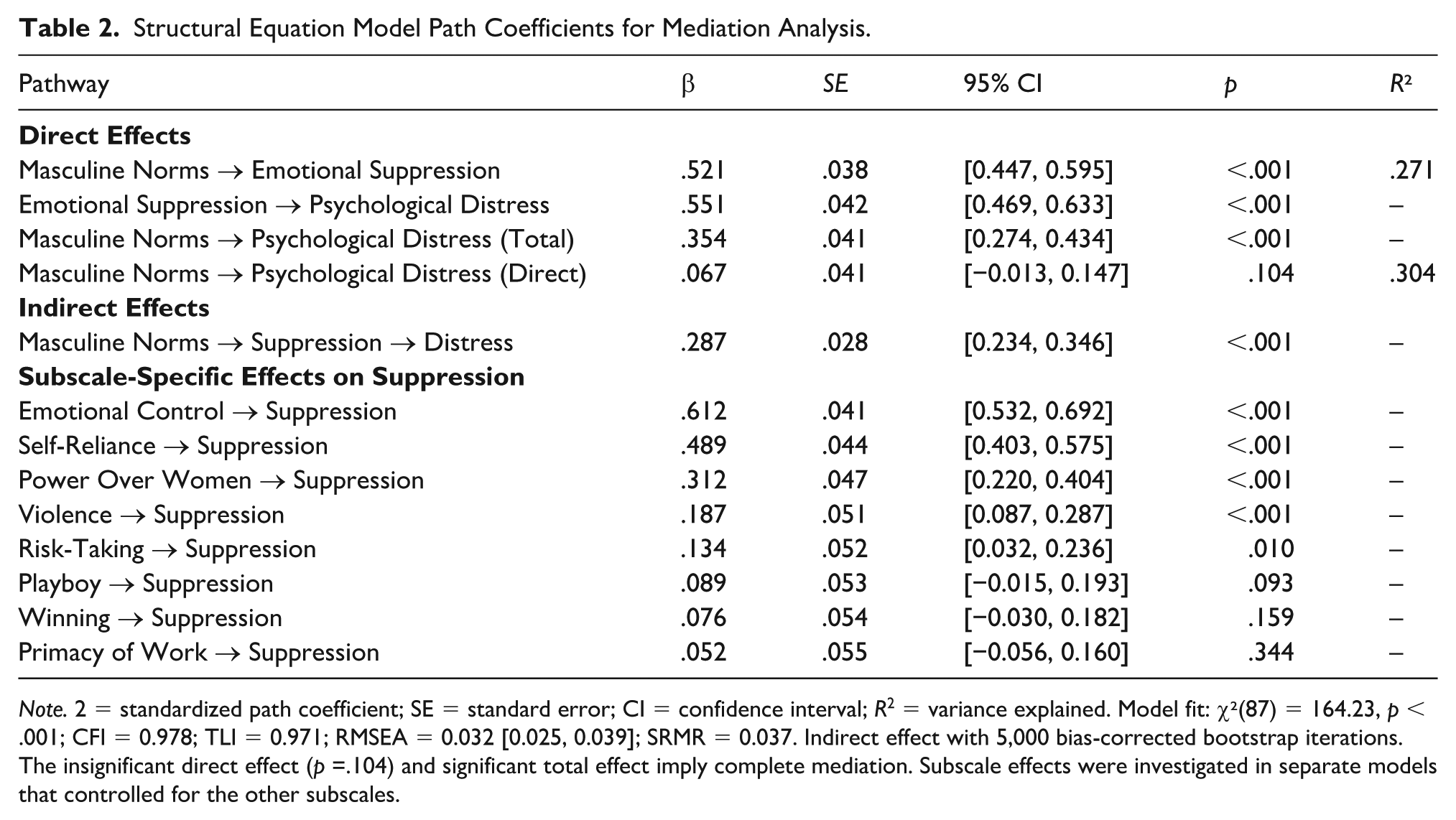
Note. 2 = standardized path coefficient; SE = standard error; CI = confidence interval; R2 = variance explained. Model fit: χ²(87) = 164.23, p < .001; CFI = 0.978; TLI = 0.971; RMSEA = 0.032 [0.025, 0.039]; SRMR = 0.037. Indirect effect with 5,000 bias-corrected bootstrap iterations. The insignificant direct effect (p =.104) and significant total effect imply complete mediation. Subscale effects were investigated in separate models that controlled for the other subscales.
Mediation was significant, as confirmed by the indirect effects analysis. Masculine norm conformity was an indirect predictor of psychological distress with emotional suppression (indirect effect = 0.287, 95% CI [0.234, 0.346], p < .001), which accounted for 81% of the total effect. This intensive mediation indicates that emotional suppression is a major process by which masculine norms affect mental health.
Differential effects were observed at the subscale level. Suppression was most likely to predict Emotional Control norms (=0.612, p = .001), followed by Self-Reliance (=0.489, p = .001), and Power Over Women (=0.312, p = .01). Violence, Risk-Taking, and Playboy norms predicted weaker or no significant suppression. These patterns imply that norms that directly call for emotional restraint and independence predetermine suppression, whereas norms that focus on dominance or risk-taking follow different directions.
Moderation by age: Multigroup SEM tested the hypothesis of a variation in relationships in different developmental phases. Age also played an important moderating role in the masculine norms-to-suppression pathway (2 (df) = 18.34, p = .001). The relationships were strongest among mid-adolescents (15–16) (0.647, p < .001) than among early adolescents (13–14) (0.498, p < .001) and late adolescents (17–18) (0.423, p < .001). This curvilinear trend implies that the greatest pressure for any conformity of the male gender occurs in mid-adolescence, when the effect of peers is generally the greatest. The suppression-to-distress process did not change with age, which means that conformity pressure changes during development, but the consequences of suppression do not.
Qualitative Findings
Thematic analysis of 38 interview transcripts revealed four broad themes with 11 subthemes, which shed light on the psychological mechanisms of quantitative relationships.
Theme 1: Emotionally Performative Labor
Instead of feeling unaware of their emotions, boys explained that they actively created emotionless facades that required a lot of psychological work. One of them, a 16-year-old, said, People think that boys do not have feelings, but it is not so. We experience all of that, but we cannot express it. It is tiring to pretend that you are okay when you are losing it on the inside.
This performative aspect demonstrates the emotional constraint as an acquired social performance, as opposed to the male’s natural characteristic.
Boys reported ongoing self-observation to prevent the expression of emotions that could produce social sanctions. One teenager aged 15 said, “You are never sure of yourself – did I sound emotional? Did my voice crack? Did anyone notice that I was upset? You can never be yourself.” This hypervigilance caused a psychological cost that was not merely the repressed feeling itself, indicating two costs: the cost of the repressed feeling and the cost of the repression itself.
Descriptions of the so-called breaking moments when performative control could not be maintained were particularly remarkable, particularly when the situation was described in the words of boys. One of the 17-year-olds told me, I managed to keep it together for months after my grandmother died. Everyone said that I was very strong. Then, one day, I simply burst out and started crying in the classroom. The rest of the guys stared at me as if I were an alien. I felt so ashamed.
Such disruption instances exposed the inability of constant repression and also showed social implications, proving the need to continue with the performance.
Theme 2: Masculine Authenticity Paradoxes
Boys reported a severe lack of connection between their true emotional selves and their masculine representations, which they referred to as feeling fake or as being two people. As a 14-year-old said, “I am able to be myself at home sometimes, I can also cry with my mom. But at school, I should play this hard guy that does not care about anything. Neither is real anymore in a full-fledged way.” This disintegration offered masculine conformity that brought confusion of identity instead of a coherent masculine identity.
When boys realized that masculine ideals could only be attained through the betrayal of personal values and desires, it became even more paradoxical. Several respondents said that they desired tight friendships with emotional intimacy and shallow friendships to avoid being seen as soft. One of the 16 year olds said, “I have many friends, but I do not know any of them; they do not know me. We simply discussed sports and games. Even being around people is lonely.” This homophilic hunger in the face of societal affiliation manifests the isolating impact of masculine norms.
Some boys explained that they discovered that masculine norms were artificial social constructs, but they could do nothing to oppose them. One 17-year-old said, I understand that it is ridiculous that I cannot cry or discuss my emotions. It would not be any easier to go against it, even when one knows it is stupid. The implications are real, even though the rules are fabricated.
This knowledge without power illustrates the restrictions of social arrangements on individual preferences despite individual ideologies.
Theme 3: Multi-System Implementation Mechanisms
Boys found that there were three major systems of enforcing emotional restriction: peer policing, family socialization, and institutional reinforcement.
Peer Policing
Peers used humiliation, threats of exclusion, and homophobic language to create conformity. One 15-year-old said, When you demonstrate your feelings, boys will refer to you as gay or a girl. No one wants to be a victim, and thus we all act like we are emotionally numb despite the fact that we are all faking it.
The norms were upheld by this collective performance by enforcing the norms on each other, even though they may have wanted the change.
Male police culture was highly pronounced according to the boys in male-dominated areas such as sports teams, locker rooms, and male peer groups. One of the athletes said, “You cannot exhibit weakness in the locker room. We are instructed by coaches that we must man up and be tough. When you are in a stump about something, you had better conceal it, or you will be benched.” It is these institutional settings that provided arenas in which masculine norms could be exercised with a certain intensity.
Family Socialization
Fathers became the main agents of the enforcement of masculine norms, and they tended to disapprove of the expression of emotions, either by direct command or by example. One of the 14-year-old ones explained, “My dad puts it to me like boys do not cry when I get upset. He has never cried in my presence, and I guess that is how men are supposed to be.” However, several boys said that their mothers tried to maintain emotional attachment and conformed to the formation of masculinity, which set up conflicting messages regarding permissible emotionality.
Some boys explained that their fathers practiced generational transmission by reproducing the restrictive socialization they had experienced. One of the respondents mentioned, “My dad is emotionally closed off because his dad was emotionally closed off. It is as though it is a circle that no one knows how to break.” This tendency between generations indicates that the norms of masculinity were reproduced through modeling and direct teaching across generations.
Institutional Reinforcement
Masculine emotional restriction was enforced in schools, religious institutions, and media images. According to the boys, teachers were more sympathetic to girls’ emotional expressions and regarded boys’ emotional expressions as a disciplinary issue. One of the 16-year-olds said, “When girls cry, they console them. Boys are sent to the principal when they express their feelings to the teacher. It teaches you genuine haste to hold everything in.”
Models of idealized masculinity in the media are based on stoicism and emotional control. Boys used the examples of action heroes, sportsmen, and male celebrities as role models of masculine emotional restraint and internalized such displays as models of true manliness.
Theme 4: Relational and Psychological Costs
Boys explained several effects of emotional repression, most of which corresponded to quantitative distress and provided subjective aspects.
Emotional Exhaustion
It effort involved in repeating emotionless fronts that produced what boys termed as exhaustion or depletion. One interviewee said, “I am tired of faking it by the end of the day. Then, I come home and cannot really give it out as I do not know how anymore.” This burnout implies that there was suppression that drained psychological resources, which may also be a factor that leads to stress symptoms.
Emotional Numbness
This chronic suppression, where the boys reported being unable to access emotions even when they were alone or in a safe situation. One teenager of 17 years said, “I have been holding things back for so long that now when I attempt to touch someone, I feel nothing, I feel numb. It is as though I shut off my feelings, and I cannot switch them on again.” This numbness conforms to the symptomatology of depression and exposes the aspect of suppression in the formation of an emotional disconnect.
Relational Deprivation
Boys reported wanting close friendships and the capacity to have emotional attachments, but superficial relationships because of masculine norms that do not allow boys to present any form of vulnerability. One of the teens explained, “I need somebody to talk to, someone who understands me, what I am going through. However, to achieve that, I should open up, and by opening up, you get a target.” Such relational hunger, even when the person was social, indicated loneliness not brought about by isolation but rather caused by emotionally constrained relationships.
Explosive Outbursts
Several boys reported that anger or aggression, the only form of emotion that is manly, was sometimes an outburst of stifled feelings. One of the respondents stated, “I save it up until I literally burst. Usually, it is revealed in the form of anger, even when I am truly sad or frightened. This is the only emotion that guys can have: anger.” This tendency implied emotional repression that led to distress in externalizing behaviors, which may be the reason why females expressed depression and conduct problems differently.
Combining Quantitative and Qualitative Results
Visual analysis of joint displays showed a significant overlap between the quantitative relationships and qualitative experiences, as well as the expansion of knowledge on the mechanisms through qualitative data analysis.
The quantitative observation that masculine norms forecasted emotional suppression (=0.521) was phenomenologically verified by boys describing in detail how they applied performative emotional labor and how they always monitored their feelings to ensure that they remained unemotional when making presentations. Nonetheless, the qualitative data showed that this correlation was based on active and effortful suppression, not passive and emotional void, which could not be quantified in the quantitative data. This implies that quantitative suppression measures would only represent behavioral consequences and not the psychological mechanisms underlying these consequences.
The mediation results showed that the effects of masculine norms on distress were entirely due to emotional suppression, which was consistent with the qualitative accounts of the various costs of suppression, such as exhaustion, numbness, and relational deprivation. Boys did not often define distress directly due to masculine norms but rather explained distress as a result of the effects of suppression, which favored the statistical mediation pathway.
Qualitative support was found in quantitative age moderation, with the highest effects in mid-adolescence (ages 15–16). Mid-adolescent participants reported that they were most intensely policed by masculine policing, their peers exerted the most pressure to conform, and the consequences of violating were the strongest. Early adolescents (early (13–14)) indicated that they maintained some flexibility in the expression of their emotions, and adolescents (late (17–18)) indicated that they had learned how to be less psychologically costly in meeting masculine requirements.
The quantitative result that Emotional Control and Self-Reliance norms were the strongest predictors of suppression was further expounded qualitatively by the explanations provided by boys in the working of these particular norms. The Suppression that is directly prescribed by Emotional Control norms (boys do not cry) and self-reliance norms inhibited help-seeking that could offer other avenues of expressing emotions. Other norms, such as risk-taking, had poorer quantitative relationships and were seldom found in qualitative descriptions of suppression, which verified the outcome of differential norm effects.
There was a radical split that developed regarding authenticity. In a quantitative study, conformity to masculine norms was associated with psychological distress, implying that conformity causes suffering. However, qualitatively, boys explained that nonconformity also caused suffering in the form of social punishment. This implies a lose-lose game in which conforming (causing internal suffering) and resisting (causing external punishment) are both accompanied by psychological expenses. This complexity suggests that interventions should focus on social environments and not just on individual attitudes.
Discussion
This qualitative study, conducted as a mixed-method inquiry, offers holistic evidence that adherence to masculine ideals, specifically the norms that dictate the lack of expression and the independence of emotions and self-reliance, causes psychological distress in adolescent boys, mainly because of emotional suppression strategies. Combining large-scale structural equation modeling with phenomenologically rich qualitative interviews not only shows us the statistical extent of these relationships but also shows us the lived experiences in which they take place. Some findings can be used as a source of new knowledge with both theoretical and practical implications.
This quantitative result, which shows that gender socialization mediated by emotional suppression had a complete effect on psychological distress (81% of all effects), provides highly empirical evidence that theoretical models asserting that suppression is a key mediating process between gender socialization and mental health are correct. This mediation was also strong and resistant to numerous covariates, and the effect sizes were large, which means that they had practical significance, as opposed to statistical significance. The results generalize the meta-analytic evidence of masculine norm-mental health correlations by Wong et al. (2017) by revealing the precise psychological mechanisms underlying this association.
Most importantly, findings that emerge in qualitative research dispel deficit-oriented approaches that describe boys as inherently emotionally sterile or unsophisticated. Boys had advanced sensitivity to emotions, using sophisticated language to describe their emotions and understand the costs of suppression. The theme of performative emotional labor showed that boys were actively creating emotionless fronts that demanded a lot of psychological work, directly opposing the belief that boys merely lacked emotional abilities. The implications of this refraction of the deficit model to socialization are significant in terms of the implications that they hold about intervention: not teaching boys to recognize emotions (they do so already), but targeting social environments that penalize the expression of emotions.
The masculine authenticity paradox is a new theoretical contribution that shows that masculine conformity produces splintered identities as opposed to a coherent masculine identity. According to the boys, they felt like fakers and even two distinct individuals, which meant that to attain masculine standards, one had to betray the true self. This paradox builds upon gender role conflict theory by showing that the conflict arises not only due to situations that require the fulfillment of masculine norms and clash with the actual emotional experience, but also because of the incompatibility between norms and the actual emotional experience. Thus, therapy could be based on identity integration and authenticity, as opposed to the development of coping skills only.
The relational hunger results offer empirical evidence to the longitudinal study of Way et al. (2014) to show that boys want to develop emotional intimacy, although they adopt a constraining masculine display. Boys reflected on their strong wish to have intimate friendships where they were vulnerable and shared their emotions, as well as their superficial relationships due to fear of social punishment. Such a discrepancy between desire and action implies that any intervention that establishes the safety of emotional expression could find willing participants since boys desire a chance to be emotionally connected, which is currently forbidden by masculine expectations.
Age moderation, in which the conformity pressure intersects the highest level of conformity in the mid-adolescence (15–16) period, signifies a sensitive intervention period. In early adolescence (13–14), active learning of masculine norms seems to take place as boys are still somewhat flexible, and the intervention of primary prevention seems possible. Mid-adolescence is the period of maximum enforcement, as the interventions are most resisted and are most needed. The Late adolescence period has certain pressure reductions because boys create maneuvers around manly needs, but suppression continues, which means there is a long-term impact that needs to be addressed further.
Multi-system enforcement observation, which records that peers, family, and institutions share their masculine norms, is a challenge to individual-level forms of intervention. As much as individual therapy or education can be effective for a given boy, systemic change necessitates the need to treat all the systems of enforcement at the same time. This implies that this kind of ecological intervention involving schools and families, along with peer group interventions, is essential for achieving sustainable changes in norms.
The disparate impacts in the masculine norm dimension (Emotional Control and Self-Reliance are the strongest predictors) will provide guidance for targeting interventions. Instead of trying to transform masculinity on a macro scale, interventions could target individual toxic norms and even protect or build on protective masculine attributes. This subtle strategy can be more palatable to boys and families than programs that seem to be assaulting masculinity in the world.
The observation that conformity and resistance mutually generate suffering exposes the inadequacy of individual solutions. Conforming boys suffer the internal discomfort of suppression and loss of authenticity, while boy rebels suffer external punishment in masculine policing. This is a bad omen because the only way to formulate real options is through systemic change that would lessen the punishment of nonconformity rather than just promoting unilateral action.
These results fit and build on the evidence of social threat and mental health in adolescents. As demonstrated by Tsomokos et al. (2025), social threat experiences forecast neural connectivity alterations to predict psychopathology. Masculine policing means long-term social danger to boys, especially those who display emotions. This implies that masculine socialization can have neurobiological implications that determine long-term mental health outcomes, but the hypothesis of masculine socialization can only be directly tested through neuroimaging studies.
One implication of this is that male adolescent distress is often not caused by depression but by emotional suppression, and interventions are needed to address suppression in male adolescents. Acceptance and Commitment Therapy, which is based on the idea of valued living despite painful feelings, might be especially applicable. In addition, masculine norm conformity and suppression should be evaluated during the treatment of adolescent boys, as it sometimes maintains symptoms following interventions aimed at directly addressing the manifestations of depression or anxiety.
Gender-transformative programming, which explicitly deals with norms of masculinity, is an implication of this in schools. Programs such as Promundo’s Program H demonstrate the potential on the international level to make boys think critically about masculine norms and their prices. Schools may also establish places where emotional expression is met with acceptance instead of mockery, such as in support groups or mentor programs, where emotionally accessible male role models could show that manhood and emotionality can coexist.
Fathers should be specifically involved in family interventions, as qualitative data revealed that fathers are the main upholders of masculine norms. Helping fathers to exemplify emotional display and react helpfully to the emotionality of their sons might disrupt the transmission of emotional suppression from father to son and may assist in the enhanced mental state of fathers themselves. Father-son emotional connections can be improved through programs that provide fathers with emotional coaching skills.
Limitations and Future Directions
This study has several limitations. The cross-sectional quantitative design does not allow causal inferences to be made; although the results are consistent with the hypothesized causal relationships and there is certain temporal information in the qualitative data from the retrospective reports, longitudinal designs are needed to determine the causal precedent beyond any doubt. The use of self-report measures brings about shared method variance, which is addressed to some extent by combining them with qualitative data. The specificity of the culture to Pakistani situations might impose restrictions on generalizing these findings. The same kind of findings replicated within various cultural situations would determine whether the findings are indicative of general universal trends of masculine socialization or simply reflect Pakistan-specific phenomena. Social desirability could have biased the answers; therefore, boys could have underreported emotional experiences that are in line with masculinity requirements, which could underestimate the actual effects.
Future investigations should utilize longitudinal approaches that follow boys through adolescence to assess whether masculine norm internalization at an early age is predictive of suppression and distress patterns later in life. Gender-transformative program intervention studies could determine whether the development of distress can be prevented by decreasing the pressure to conform to masculinity. The suppression mechanisms proposed by neurobiological studies on whether any neural correlates are evident in chronic emotional suppression would test the proposed mechanisms of suppression. Comparative studies across cultures would prove which results can be universal or situation-specific masculine constructions.
Conclusion
This mixed-method sequence study shows that adherence to masculine expectations of heightened emotional control and self-reliance triggers psychological distress in adolescent boys through emotional suppression, which includes performative emotional labor, loss of authenticity, and relational deprivation. The intersection between structural equation modeling and phenomenologically intense qualitative interviews is compelling proof that boys have emotional consciousness and interpersonal yearnings that are actively suppressed by the masculine socialization process, as opposed to an innate lack of abilities. The results contradict deficit-oriented theories of male emotional development and offer empirical support for the concept of gender-transformative interventions focusing on masculine norms as the primary prevention intervention aimed at eliminating the mental health of adolescent males. The recorded systems of enforcement used within peer, family, and institutional settings have shown that successful intervention demands ecological solutions to novel social settings that will change in the course of educating individual boys. This study transforms the mental health challenges of adolescent males into a social justice problem that needs to be changed at a structural level, since it has been shown that boys are not lacking in emotional expression but are socially limited to it.
Footnotes
Acknowledgements
Not applicable.

Author Contributions
Funding
The authors received no financial support for the research, authorship, and/or publication of this article.
Declaration of Conflicting Interests
The authors declared no potential conflicts of interest with respect to the research, authorship, and/or publication of this article.
Data Availability Statement
The datasets used and/or analyzed during the current study are available from the corresponding author on reasonable request.