



Abstract
Indigenous communities raise concerns that they are overresearched and tired of research always asking the same questions and reproducing the same answers, thus pressuring researchers to open the discourse on mixed methods research so as to enable new debates and approaches to emerge. A postcolonial indigenous paradigm provides a theoretical framework that informed a mixed methods research approach to design and test the efficacy of a school-based risk-reduction intervention for 14- to 17-year-old adolescents in Botswana. Indigenous methods were used to collect cultural knowledge and to build relationships; these approaches allowed for the integration of the largely marginalized knowledge systems with dominant knowledge systems through a decolonization and indigenization research process.
Keywords
The combination of qualitative and quantitative methods has been discussed from a feminist perspective (Hesse-Biber, 2010), transformative paradigm perspective (Mertens & Wilson, 2012), and a pragmatic perspective (Bamberger, Rugh, & Mabry, 2006; Creswell & Clark, 2011). There is little evidence from the literature on the mixed methods research that applies an indigenous paradigm lens. This may be largely because discussions on indigenous methodologies are relatively new to paradigm debates. The discussions also take different names: decolonizing methodologies (Smith, 1999), indigenous research paradigm (Kovach, 2010; Wilson, 2008), postcolonial indigenous research paradigm (Chilisa, 2012), or Indigenous research. Indigenous research paradigms have a decolonizing and indigenization aim, which seeks to bring to the center of the research process marginalized voices subjected to exploitation and abuse through experiments and colonizing research (Chilisa, 2012; Liamputton, 2010; Smith, 1999).
The main thrust of the indigenous perspectives on paradigms is that research should decolonize the power in the “word” that dictates the marginalization of the voices of non-Western and Western groups where “colonizing research is deployed” (Swadener & Mutua, 2008, p. 35). To decolonize the “word” is to recognize that the dominant language that includes gesture, tone, expression, theoretical frameworks, methods of data collection, and data analysis communicates dominant cultures and is most likely to misrepresent and render silent the experiences of the majority researched relegated to the position of Other. For instance, while the interview method is a popular data collection technique in qualitative research, it is critiqued for leaning toward individualistic Westernized assumptions and theories (Chilisa, 2012; Viruru & Cannella, 2006), ignoring the values of those where colonizing research is deployed. In indigenous research, conversational methods such as talking circles, storying, and yarning, derived from indigenous world views, are preferred over the typical interview methods because they reflect the ideal of equality among participants and emphasize building relationships and connectedness among people and with the environment. We describe a mixed methods approach that flows from a postcolonial indigenous paradigm in a multiphase study on adolescents’ health risk behaviors that arose from a partnership between a university in Botswana and a university in the United States. The theoretical perspective is derived from indigenous research philosophical assumptions about the nature of reality, knowledge, values, and methodology.
A postcolonial indigenous paradigm is informed by a relational epistemology that values communities as knowers, and knowledge as the well-established general beliefs, concepts, and theories of any particular people that are stored in their language, practices, rituals, proverbs revered traditions, myths, and folktales. Knowing is something that is socially constructed by people who have relationships and connections with each other, the living and the nonliving, and the environment. Knowers are seen as beings with connections with other beings, the spirits of the ancestors, and the world around them that informs what they know and how they can know it. African perspectives view relational epistemology as knowledge that has a connection with the knowers. The challenge is on how to bring this cultural knowledge into the research process.
The research process is informed by a relational ethical framework that moves away from conceiving the researched as participants to seeing them as co-researchers (Chilisa, 2012). The Bantu in Southern Africa discuss a relational axiology that is embedded in the ubuntu relational principles of (a) “I am we, I am because we are”; (b) relations of people with the living and the nonliving; (c) spirituality, love, harmony, and community building. From these principles, an ethical framework emerges that emphasizes accountable responsibilities of researchers and respectful relationships between the researchers and the researched that take into account the researched web of relationship with the living and the nonliving. Wilson (2008) and Weber-Pillwax (2001) discuss a relational ontology informed by four principles of accountable responsibility, respectful representation, reciprocal appropriation, and rights and regulations. A mixed methods approach thus brings into the research process a combination of indigenous research methods and other methods to build a web of relationships so that research takes place in an environment that nurtures peace and appreciation for diversity; love, harmony, and possibilities of hope; togetherness, cooperation, and collective action; and responsibilities and coalitions of disciplines and knowledge systems. Building relationships thus becomes a tool or method made up of a set of indigenous practices that is an essential component in mixed methods indigenous research.
Defining Indigenous Mixed Methods
A mixed methods approach that uses an indigenous research paradigm seeks to integrate multiple ways of knowing and seeing the world, multiple standpoints, and multiple values. It promotes a multidirectional lending and borrowing of knowledge systems between dominant and marginalized cultures. The indigenous mixed methods approach thus starts with a change of mindset that problematizes, critiques, and challenges the marginalization and exclusion of the ways of knowing and seeing the world of marginalized communities. The mixing can take the process of the indigenization process where researchers invoke indigenous knowledge to inform ways in which concepts and new theoretical frameworks for research studies are defined, new tools of collecting data developed, and the literature base broadened, so that we do not only depend on written texts but also on the largely unwritten texts of the formerly colonized and historically disadvantaged people. The indigenous mixed methods from this view point are about inviting different voices to participate in a dialogue that embraces all cultures and promotes the social validity of research studies. From this perspective, there cannot be an indigenous research without mixed methods. Both quantitative and qualitative approaches are indigenized. A set of tools to build relationships between people, space, time, and the environment and methods steeped in the epistemologies of marginalized communities are used. An indigenous mixed methods approach requires that the data collected reach and draw from the past, occupy and inform the moment, and also project into the future. Throughout the research process, indigenous methods such as naming, storying, yarning, and talking circles push to the center of the entire research process the spiritual, historical, social, and ideological aspects of the research phenomena. Given the distinct philosophical assumptions of an indigenous lens, we therefore recognize as indigenous mixed methods combining data collected through well-established qualitative methods with data emanating from an indigenous paradigmatic lens in a single study or multiphase study. We also recognize as indigenous mixed methods a quantitative study that is informed by relational sets of practices aimed at building relationships to promote collective action and social change and is driven by indigenous research protocols and uses a combination of indigenous data collection tools and other qualitative and quantitative methods. What follows is description of how mixed methods were employed in ways that promoted relevancy and usefulness of the research to the researched.
Decolonizing Collaborative Research and Building Relationships
In 2007, the University of Botswana in partnership with the University of Pennsylvania won a National Institutes of Health Grant (R24 HD05669) to build capacity to design culturally relevant and age-appropriate HIV/STI prevention interventions. We describe the mixed methods approach of this collaborative study to design and test the efficacy of a culturally relevant and age-appropriate adolescent risk-reduction intervention to prevent the spread of HIV/AIDS and sexually transmitted diseases among adolescents. It was a multiphase study with four phases (see Figure 1).
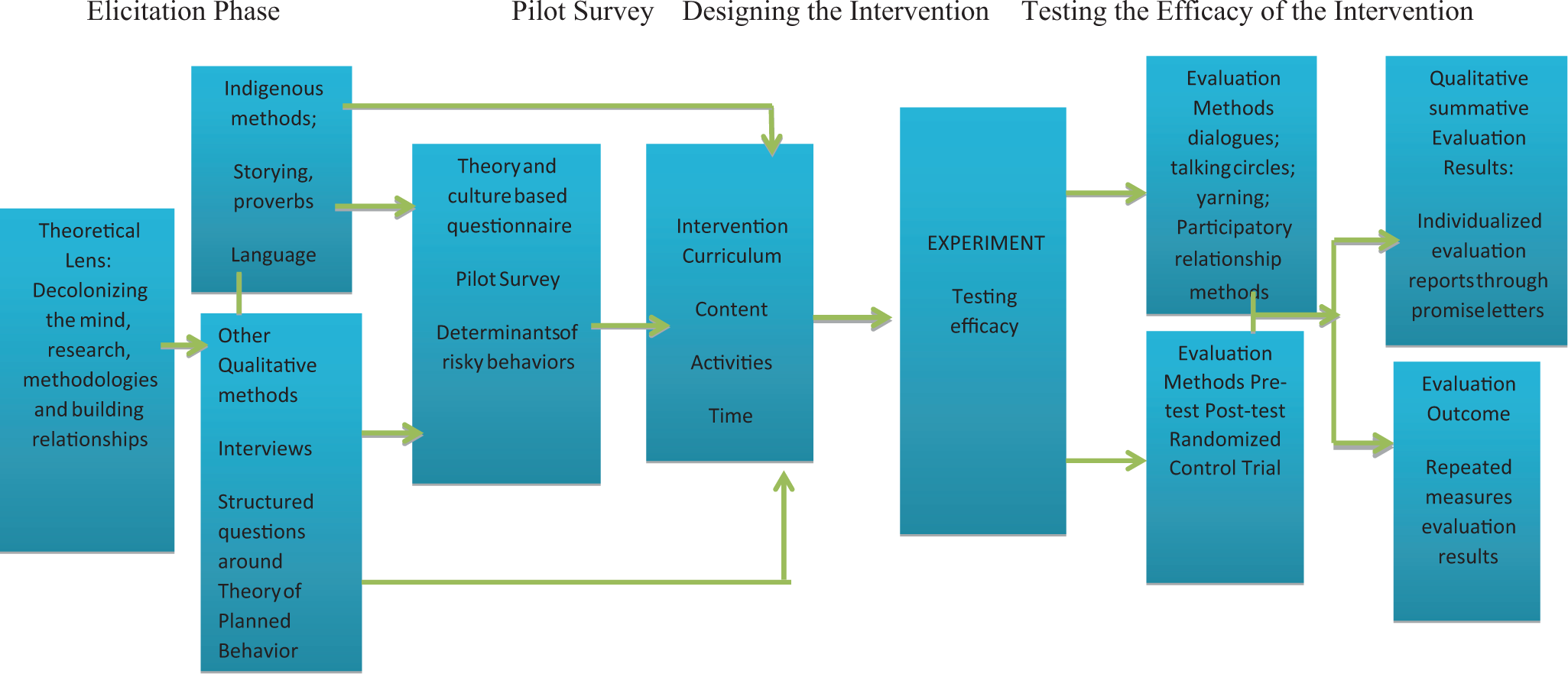
An indigenous mixed methods approach.
The research started with a process of building relationships and addressing hierarchical structures that privileged dominant cultures and literatures. The research personnel from the U.S. university were African Americans; issues of culturally appropriate and relevant research were as important to them as to the researchers in Botswana. Our dialogue on building relationships started with agreeing on a collaboration model that transformed hierarchical relationships that often exist between universities in the North and South: to create spaces for the integration of cultural knowledge with global knowledge to promote cultural relevancy and usefulness of research outcomes to communities as well as ensuring that the researchers remained accountable to the communities. We agreed on a collaboration model that gave the role of principal investigator and other leadership roles to University of Botswana researchers. This was done to break the stereotype that expertise can only come from Northern universities (Chilisa, 2005; Pryor, Kuupole, Kutor, Dunne, & Adu-Yeboah, 2009). Often when researchers from the South are given leadership responsibilities, they feel inadequate or lacking the skills and knowledge to contribute to the research (Bresciani, 2008). Most of us involved as leaders had to continuously go through a decolonization of our minds, that is, believing that the Batswana had cultural knowledge that can be understood by those who grow in the culture and that such knowledge was relevant to the design of appropriate and useful interventions in this context.
The health literature is rife with deficit-theorizing that depicts cultural knowledge and lack of urgency among Batswana as some of the factors that slow efforts to prevent the spread of HIV (Chilisa, 2005). We formed community advisory boards to serve as community theorists that could bring to the research the cultural knowledge, values, and processes of knowledge creation that could serve to make the interventions we designed relevant and useful to the communities. Their main role was to decolonize the research process by bringing Batswana worldviews to the creation of knowledge to ensure that the research remained relevant and useful to them. Indigenous research theory promotes context-specific research that goes beyond the bounds of existing methods to provide more insights into theory development and the development of interventions that address people’s needs. It involves the study of local phenomena, using local language, local subjects, and locally meaningful constructs to provide solutions to local problems.
We also had an external advisory board consisting of intellectuals with expertise on global knowledge in intervention research from the United States and Southern Africa. Members of the external advisory board served as peer reviewers who consistently asked us to identify and make explicit indigenous theoretical orientation, methods, cultural knowledge, and culture-specific findings throughout the four phases of the study.
Phase 1: Indigenous Methods and Other Qualitative Methods
In the first phase of our indigenous mixed methods approach, we combined indigenous qualitative methods with other qualitative methods to elicit adolescents’ and their parents’ beliefs, attitudes, and intentions toward sex, HIV prevention beliefs, attitudes toward HIV/AIDS intervention programs, and preferred mode of educating adolescents on sexuality issues and components of the intervention program with regard to information, skills, methods and materials, and implementation. The intention was to employ a design that would enable the community and the researched to participate in eliciting cultural knowledge on adolescent sexuality and HIV/AIDS that would enable the development of relevant and useful adolescent risk-reduction interventions. As a way to build relationships, coalitions, networks, and connectedness with the community, parents were involved as research participants to deepen understanding of cultural knowledge on adolescents’ sexuality and sexual risk behaviors so that the intervention could include community knowledge and input. A culturally relevant intervention had to come from within the culture, traditions, languages, and lived experiences of the Batswana adolescents. Finding research methods that resonate with Batswana culture was another important step in ensuring that the communities and the participants could reach back to their history, reflect the present, and reclaim and valorize cultural knowledge that was relevant to the design of risk-reduction interventions for adolescents and that needed to be interrogated. Proverbs, metaphors, stories, and myths were used as culturally appropriate methods of gathering data on sociocultural factors that influence adolescent local knowledge regarding HIV prevention strategies such as abstinence, condom use and limiting partners, and safe male circumcision.
In predominantly oral societies, metaphorical sayings, stories, songs, and proverbs serve as the literature, words of wisdom, commentaries on events and behaviors, and socialization instruments for youth and adults. Proverbs are used as a tool to describe and express social, cultural, natural, and other events and practices; pass on rich cultural traditions; transmit folklore; and communicate expected codes of behavior. In the proverbs, we find philosophical and theoretical frameworks in which we can ground research that builds on the community’s value systems to inform program interventions that address the needs of the people. Metaphors are used as the substitution of direct words that would have been regarded as disrespectful, offensive, or taboo by a cultural group. In most of Botswana societies, sex is regarded as a taboo subject; hence, people often resort to using metaphors that are already there or create new ones. We also identified and analyzed traditional songs that communicated messages on sex and sexuality.
Embedding the Study in Global Knowledge
Indigenous research identifies context-specific models that may lead to context-bound knowledge. In blending cultural knowledge with global knowledge, the theory of planned behavior (TPB) was employed to design individual and focus group interviews that explored adolescents’ beliefs and attitudes toward multiple sexual partners, abstinence, consistent condoms use, limiting partners, and safe male circumcision. The TPB asserts a specific relationship among beliefs, attitudes, intentions, and behavior. More specifically, the TPB posits that intentions to perform a specific behavior are determined by three factors: (a) behavioral attitudes that reflect beliefs about the consequences of performing the behavior, (b) normative beliefs that reflect individuals’ beliefs about whether specific referent persons (e.g., peers, romantic partners, parents, the church, etc.) would approve or disapprove of the behavior, and (c) control beliefs that involve individuals’ beliefs that they have the necessary resources, skills, and opportunities to perform the behavior.
As applied to HIV/AIDS prevention among adolescents in Botswana, the TPB can be used to predict adolescents’ behavioral intentions. Twenty-four adolescents were interviewed individually and asked to respond verbally to questions assessing behavioral, normative, and control beliefs related to the following three behaviors: condom use, abstinence, and having one partner. Behavioral belief questions included the following: What is good about the behavior? What is bad about the behavior? Normative belief questions included the following: Who approves of adolescents engaging in the behavior? Who disapproves of adolescents engaging in the behavior? Who do you know that engages in the behavior? Control belief questions included the following: What is easy about the behavior? What is hard about the behavior? Participants’ responses were analyzed using a modified version of the Consensual Qualitative Research method as described by Hill, Thompson, and Williams (1997).
The combined results of the two methods of data collection in this phase of the study provided knowledge consistent with global literature as well as culturally specific knowledge. The culturally specific knowledge was on sociocultural behavioral beliefs related mainly to the consequences of prolonged abstinence. These came under three main categories of beliefs about abstinence causing ill health: abstinence causing infertility, abstinence causing a painful erection, and prolonged abstinence causing pain for girls when they eventually gave birth. A sociocultural belief domain also emerged in the context of a question on limiting the number of partners. Adolescents reported that the beliefs on limiting partners are informed by common sayings and proverbs on multiple partners. One common proverb says manna keselepe o aadimanwa (meaning a man must be shared). Although this makes reference to men, adolescents perceive the proverb as condoning multiple partners for both sexes.
Phase 2: Indigenous, Qualitative, and Quantitative Methods
In the second phase, the focus was on designing a culturally relevant survey instrument to quantitatively measure behaviors, beliefs, and attitudes of adolescents toward sex, abstinence, condom use, consistent condom use, circumcision, and HIV. The mixed methods approach combined indigenous methods and qualitative methods to design a quantitative survey instrument to measure the prevalence of risky behaviors. A measure of the prevalence of the risky behaviors enabled us to calculate the sample size that we required to find any significant effects on the test for the efficacy of the intervention. It also enabled the identification of the beliefs and attitudes that militated against positive behavior that the intervention needed to address. The survey questionnaire items were built from qualitative data based on the TPB and data derived from cultural knowledge that came through stories, myths, proverbs songs, metaphors, and local language. The use of songs, taboos, and myths to source parents and their children’s views on sex and sexuality brought into the discussion concepts not common in the literature. During this phase, community voice was brought into the research process through the community advisory board who reviewed the survey instrument. The board’s reviews made it possible to use content, materials, and language that was acceptable to the community.
A self-report questionnaire collected data from 286 adolescents (35% boys and 65% girls) between the ages of 10 and 19 (mean age = 15.02, SD = 1.02) in eight junior secondary schools. Multivariate regression analysis was used to evaluate the predictive power of the TPB and those emanating from cultural knowledge; it revealed that sociocultural beliefs about abstinence and limiting partners among others predicted intentions to abstain or limit the number of sexual partners.
Phase 3: Indigenous, Qualitative, and Quantitative Methods
In the third phase, the indigenous mixed methods approach combined quantitative data findings from the survey with cultural knowledge derived through indigenous methods, and theory-based data derived through the qualitative structured interviews to develop a culturally appropriate and relevant intervention to promote behavior change among adolescents. The focus was on the type of data, content, and materials to drive an age appropriate, culturally appropriate, and relevant intervention curriculum that would increase adolescents’ knowledge about risk behaviors and result in positive attitudes toward risk-reduction behaviors and increase their confidence that they have the skills to practice safer behaviors. Parental and adolescent views were triangulated with pilot survey data from the second phase to prioritize the topics in the curriculum and the amount of time to spend on each topic. The content of activities (e.g., building positive attitudes toward abstinence, condom use, and limiting partners) came from traditional or local knowledge sourced through indigenous methods, as well as from the structured interviews framed around the TPB. The interventions consisted of 12 one-hour modules, with two modules delivered during each of six sessions on six consecutive school days. The process of designing the intervention thus combined quantitative methods that built on dominant theoretical frameworks and indigenous methods that yielded findings not accessible through mainstream qualitative methods.
Phase 4: Quantitative and Indigenous Methods
In the final phase, we employed an indigenous mixed methods approach to determine (a) whether the intervention was effective, (b) why it was effective, (c) with whom it was most effective, and (d) whether adolescents and their parents found it relevant, useful, and culturally acceptable. An experimental design was combined with indigenous methods to conduct formative evaluation to assess the relevancy, usefulness, and acceptability of the intervention. We also employed indigenous practices and tools to empower and build relationship between parents and their children that could promote sustainability of intervention outcomes and encourage lasting relationships among adolescents that could last years after the intervention. In the experiment, a pretest–posttest control group design was employed. Eight hundred and six Grade-9 adolescents were randomly assigned to the risk-reduction intervention or a health promotion intervention (the comparison group) and followed up at 3, 6, and 12 months. The HIV/STI risk-reduction intervention purpose was to increase HIV/STI risk-reduction knowledge, enhance behavioral beliefs that support abstinence, condom use, HIV testing, safe male circumcision, and sticking to one partner. In line with an indigenous ethical lens of providing useful experiences to all participants, a health promotion intervention focusing on behaviors to reduce the risk of heart disease, hypertension, stroke, diabetes, and certain cancers; increase fruit and vegetable consumption; increase physical activity; and decrease cigarette smoking and alcohol use was administered to the control group. The health promotion, like the risk-reduction intervention, consisted of 12 one-hour modules, delivered in six sessions of 2 hours during six consecutive school days.
Indigenous Qualitative Evaluation Embedded in an Experimental Design
The indigenous mixed methods approach combined participatory action research with the appreciative inquiry (Ludema, Cooperrider, & Barrett, 2006) and desire-focused (Tuck, 2009) frameworks to guide the implementation of the intervention. Indigenous conversational methods, namely, adolescents talking to their parents, talking circles and yarning, were used as data collection methods. One of the criticisms of participatory action research is that most of the approaches are problem focused aiming at discovering communities’ unmet needs. Conceptions of communities as knowers and participants as researchers require researchers to move from problem-focused modes of inquiry to change-focused approaches that emphasize strength and positive images of the researched (Chilisa, 2012; Ludema et al., 2006; Mertens, 2009; Tuck, 2009). In the change-focused approach, the researched reflect on their qualities and move toward a self-discovery, as they dream and envision the best that they could be, dialogue on strategies to implement their dreams, and draw a plan to take them to their destiny.
The first activity in the intervention was directed toward building group cohesion and a feeling of togetherness and worthiness among participants. At every session, there were not less than 20 adolescents. Among the Bantu people, symbols are an important strategy of building togetherness. In the intervention the “being” relationship with others was nurtured through the use of a shield as a symbol that defined the identity of the groups. In addition, naming gives character to whatever is named. The name “Own the Future” was given to the intervention groups and a motto “Pulling Together We Will” adopted by the group as ways of knowing themselves and the goals that they stood for. One of the activities of the day thus reads
Today you enrolled in the teen club, Own the Future. Own the future is a club to give you the skills to take control of your life, make responsible choices, plan for a bright future, and achieve your goals and dreams. Our motto in this club is Pulling Together We Will. In this teen club, Own the Future, you promise to encourage and support each other’s effort to avoid risky behaviors and achieve your goals. Your parents could also give you support.
In one of the activities of the first day of the intervention, adolescents were given approximately 5 minutes to think about the positive qualities and phrases that reflect their good qualities, that is, their strengths, character, and determination. They wrote and drew on their personal shields, positive images about themselves. They were encouraged to express who they were and what was special about them. They were also made aware that the shield was a symbolic personal armor that would protect them from risky sexual behaviors and health problems. Some of the adolescents thought of themselves as helpful individuals and therefore drew a hand on their heart, whereas others drew a heart to show that they were kind hearted people. Another important activity of the first day was to get participants to think about their future and understand that their behavior would impact on what they would be in the future. The adolescents then completed a goals and dreams timeline to last for 5 to 10 years in the future. They were to discuss with their parents the goals and dream timeline and their personal shield and to review and finalize the penultimate version. The two activities are anchored in the desire-centered research frameworks that move away from deficit approaches common in research with marginalized groups, to build confidence in the participants to project into the future, and imagine possibilities of hope and images of transformed communities.
Parental interest and involvement in their children’s lives was crucial to the implementation of the intervention and also for sustainable positive behavior change. Letters were written to parents explaining the intervention and inviting them to assume responsibility to discuss their children’s goals and dreams. Researchers relied on the adolescents to hold conversations with their parents that would capture the voices of their parents and keep them engaged in the intervention. Several factors can affect the validity of the data collected by adolescents. One of the factors is the cultural taboo on discussing sexual matters with their parents, which makes initiation of a discussion very difficult and sometimes impossible. The findings from the qualitative data in the first phase of the intervention indicated that for the intervention to work there was need for parent–child communication about sex and sexuality. Most of the communication between parent and child involved sending children on errands and counseling or scolding, or disowning them when they are already either pregnant or in trouble. Parents feel inadequately informed about matters concerning sex and sexuality, are embarrassed, or have difficulty finding a suitable time to talk to their children. To address the lack of parent–child communication, adolescents were introduced to effective ways of holding conversations with their parents.
To sustain adolescents and their parents’ voices in the intervention, each day’s activity involved a process where adolescents took homework assignments that required them to find out more about their parents and the role they would play in supporting them to live healthier lives, as well as find out their parents views on the daily activities. Participants became active researchers, taking action to inquire from their parents, recording their observations and interviews; critically reflecting and evaluating their action research; and using the information to inform their next cycle of activity in the intervention.
Indigenous Conversation Methods
Each day started and ended with a talking circle to gather adolescents’ views on the intervention process and to report on their conversations with their parents. The talking circle was also used as a method to build group trust and cohesion as well as develop openness and confidence among adolescents. Talking circles are based on the ideal of participants having respect for each other and are an example of a focus group method derived from postcolonial indigenous world views. In African contexts and among Indigenous peoples, there are many occasions when people form a circle. It could be around the fire place, during celebrations when they form circles to sing, or when children form circles to play games. In each of these occasions, a person is given a chance to speak uninterrupted. The talking circle symbolizes, as well as encourages sharing of ideas, respect for each other’s ideas, togetherness, and a continuous and an unending compassion and love for one another. The circle also symbolizes equality of members in the circle.
A common practice in talking circles is that a sacred object that could be a feather, a shield, a stone, a basket, or a spoon is passed around from speaker to speaker. These sacred objects symbolize collective construction of knowledge and the relations among group members. The holder of the object speaks uninterrupted and the group listens silently and nonjudgmentally until the speaker has finished. In general, talking circles on the assigned activities informed the facilitators of the opinions/views of the parents and adolescents. The information was used as feedback to empower the adolescents in getting their parents involved in assisting them with the assigned activities and in ensuring that the intervention was relevant and acceptable to both parents and their children.
On the last day, adolescents wrote letters to themselves promising how they would protect themselves to achieve their dream goals. They also wrote letters to their parents telling them what they would do to ensure they reached their goals and how they wanted their parents to assist them. The promise letters laid the foundation for parents and children to continue the dialogue on the goal and dreamtime line and to explore risky behaviors that are possible obstacles to the achievement of the goals and dreams after the researchers leave the site. Each adolescent pledge, promise letter, and goals and dreams timeline served as documented data that adolescents collected on themselves and as individualized action-oriented outcomes. The adolescents found more about themselves and their parents than they could read in a researcher-centric report. The individualized adolescents’ reports to their parents gave voice to each adolescent and preserved each adolescent and family’s uniqueness. In engaging adolescents to research themselves and their parents and to submit at the end of the interventions self-promise letters to their parents, as well as their goals and dream timelines, we preserved the multiple voices of adolescents that get silenced when researchers look for common patterns in their data and also disseminated the adolescents’ voices to their parents. We were also able to reach a larger proportion of the community than would have been possible without engaging the adolescents.
The yarn method was used to evaluate participants’ views on the effectiveness of the intervention. Yarning has been described as a way of holding a conversation or talk (Bessarab & Ng’andu, 2008; Kovach, 2010) that is directed to a specific area of inquiry with a definite purpose. In the last session, the facilitator held a yarn ball and reflected on what they had learnt from the intervention. Holding on to the thread, the ball was thrown to a participant of choice who also talked holding the ball, mainly reflecting on what they had learnt and how the intervention affected their goals and dreams. The activity continued until every participant had a chance to talk. The visual picture at the end was that of a web of connections showing how each participant is connected through the thread to one another. The web of connections served to summarize and emphasize the relationships that were built throughout the intervention process.
Conclusion
The indigenous mixed methods approach combined well-established qualitative and quantitative methods with indigenous data collection and relationship building methods to inform the design and implementation of an intervention that accessed cultural knowledge to ensure a relevant and useful intervention. When these methods are combined, they bring cultural knowledge not easily accessible through the global literature, promote research relevancy and usefulness, as well as build community relationships. It is also important to note that methods and tools for building relationships, creating positive identities, images of hope and of transformed communities are important components of indigenous mixed methods approaches that seek to make research responsive and useful to communities. An indigenous mixed methods approach goes beyond the combination of mixed quantitative and qualitative methods to engage in a decolonization and indigenization of the research process and an integration of diverse knowledge systems, as well as building relationships and creating spaces for the researched to dream about a better future. The involvement of parents and their children as participant researchers carried hopes for sustainable conversations on goals and dreams that could continue for 5 to 10 years to come.
Footnotes
Declaration of Conflicting Interests
The author(s) declared no potential conflicts of interest with respect to the research, authorship, and/or publication of this article.
Funding
The author(s) declared the following potential conflicts of interest with respect to the research, authorship, and/or publication of this article: The study was funded by the National Institute of Health (Grant No. 5R24HD056693).