




Abstract
This article makes a systematic review of the use of participant-generated image methods in social science research. Such methods have a long history of application across the social sciences. Their development has, however, been uneven and fragmented, resulting in a lack of gestalt (wholeness or unity). This has led to the methods being underappreciated and sometimes mistrusted. The article compares and contrasts the design, implementation, and analytical methods of nearly 300 studies. Six main groups or traditions are identified. However, the study finds no strong evidence that any is distinctive enough to warrant being awarded its own name. Meanwhile, no convincing evidence is found to suggest that best practice has either been identified or adopted.
Although it is often thought of as a new technique, participant-generated image (PGI) research has a track record of application across the social sciences reaching back to the 1970s. The technique gives cameras to volunteer participants who are asked to take photographs representing a particular theme or topic: perhaps some aspect of their life experience or a place they are visiting. The subjects thus become “participants” in the research (Chase, Carlisle, & Becker, 1993). The resulting photographs can then be analyzed using a wide range of techniques (Chambers, 2012). They may be analyzed directly, using either qualitative techniques, such as discourse analysis, or quantitative techniques, such as frequency-based content analysis. Alternatively, the photographs may be used as prompts during in-depth interviews or focus groups with the participants. This generates secondary data for the researcher to analyze. Laddering and multidimensional scaling techniques can be used with either qualitative or quantitative analysis. These different research methods may be, and increasingly are, used in combination. Taking a mixed methods approach enables the research findings to be corroborated through a process of triangulation, allowing for greater confidence in their validity.
As well as often involving mixed methods, the PGI technique can be a powerful vehicle for social science research. It is widely argued that the autonomy it gives to participants enables them to shape the scope of the research and to exert greater control over what they bring to it (Dodman, 2003). It also empowers participants to express concepts and feelings that would not ordinarily be possible using verbal interview techniques (Stedman, Beckley, Wallace, & Ambard, 2004). While it is commonplace for interview-based research to employ photographs as discussion vehicles—a technique that is usually known as “photo-elicitation” (Matteucci, 2013)—it is less common for these photographs to be contributed by the participants themselves. Proponents also highlight a number of valuable features of PGI research, including its emphasis on the visual rather than the textual (Dakin, 2003), the reflexive nature of the method (MacKay & Couldwell, 2004), and the benefits it can have not only in terms of contributing to academic knowledge but also for the participants, policy makers, and the public (Bilsky, 1998).
Studies using PGI methods are increasingly being published in academic journals, where they contribute to building knowledge across a range of social science disciplines, including anthropology (Wang, Burris, & Xiang, 1996), psychology (e.g., Jones, 2004; Ziller & Lewis, 1981), sociology (e.g., Jenkins & Jenkins, 1998), landscape planning (Yamashita, 2002), leisure and tourism (e.g., Garrod, 2009; MacKay & Couldwell, 2004), urban studies (e.g., Damico, 1985; Dodman, 2003), and gender studies (Bilsky, 1998). Such studies have also contributed to the development of a multidisciplinary subfield of the social sciences known as “visual sociology” (Becker, 1995) or, more generally, “visual research.” The application of PGI research has nevertheless been uneven, with some of the social sciences embracing it more readily than others. It has also been fragmented, in that studies have often been conducted with reference only to other studies in the same disciplinary field. Consequently, there is a tendency for PGI research to be known by different names depending on the disciplinary context in which it is applied. These include photovoice, autophotography, visitor-employed photography (VEP), participatory photography, and several others. As such, PGI research suffers from the problem that Prosser (1998) identified with image-based research in general: that there is no gestalt (wholeness or unity) in such research, other than simply to recognize the importance of the “visual” in understanding social phenomena.
The aim of this article, therefore, is to bring together the PGI research that has been undertaken to date. In this way, it is intended that the article will give more consistency to PGI research by providing a reference point from which further studies can be developed. The article has three objectives: to review of the use of PGI across the social sciences, tracing its development and identifying the uses to which it has been put; to identify any substantive differences in the way in which PGI has been applied in different contexts and by different disciplines, and to examine how well these choices have been reported. In pursuing these objectives, the study aspires to provide a baseline upon which best practice can be established and further developed.
Review Methods
Given the objectives of this study, it was considered necessary to identify as comprehensive as possible a database of PGI studies for further detailed analysis. A systematic review (Pullin & Stewart, 2006) was therefore undertaken. A systematic review “identifies relevant studies, appraises their quality and summarizes their results using a scientific methodology” (Khan, Kunz, Kleijnen, & Antes, 2011, p. 1). This involves making a systematic search for literature based on preestablished parameters, such as keywords, journal titles, and dates. The purpose is to try to minimize the possibility of overlooking relevant studies and to avoid the double counting of any paper that had been published more than once (e.g., first in conference proceedings and then as a journal article). The result will be a review that is as complete in itself as possible and robust in the sense that it is repeatable: a different researcher conducting a review using the same parameters would assemble essentially the same collection of materials.
The following method was therefore developed. First, the terms “volunteer-employed photography” (e.g., Garrod, 2008), “visitor-employed photography” (e.g., Traweek, 1977), and resident-employed photography (e.g., Stedman et al., 2004) were used as keyword search terms in the Google Scholar and Web of Knowledge online databases. No time restrictions were specified, as the intention was to trace the use of PGI from its origins to the present day. Further publications were then identified by working systematically through the reference list of each publication to locate additional studies. The list was then reviewed to identify papers that were not genuinely PGI-based. Only those that required participants to take still photographs for the express purpose of the study were retained. Some papers were unusable because they did not contain substantial information on the method used: often because they were part of a multimethod study with PGI mentioned only in passing. Publications in which the authors themselves were the subject of the study were also excluded as these tended to be very different in their style and purpose, having only one “participant.”
The resulting data set comprised 286 publications covering a 35-year period from 1977 to 2012. This was then coded up using a process of manifest content analysis (Weber, 1990). This involved each paper being read by at least one of the researchers and the main features of its application of PGI (e.g., the number of participants, how they were recruited, etc.) being carefully recorded. Reliability checks were performed by another researcher familiar with both content analysis and PGI-based techniques but otherwise unconnected to the project.
Results
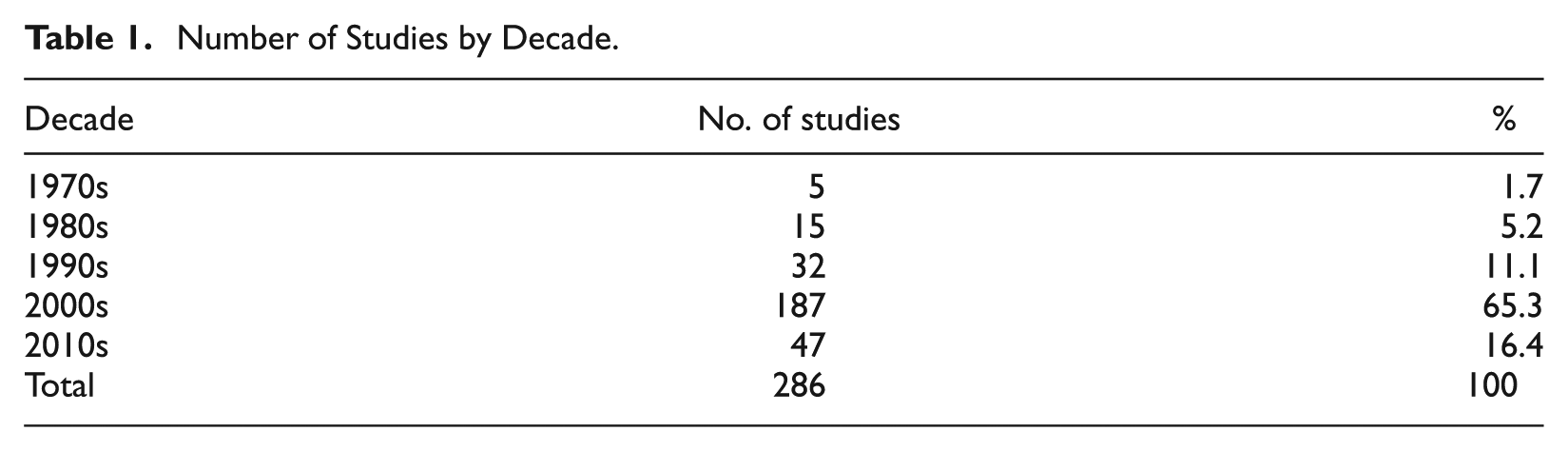
Table 1 shows the number of PGI studies published by decade. It was first used in the 1970s, with five studies being undertaken in that decade. This number more than doubled in the 1980s and more than doubled again in the 1990s. Nearly two thirds of the studies were published in the 2000s.
Number of Studies by Decade.
The review identified a wide variety of names used to denote PGI research. Table 2 shows that the most frequently used was “photovoice,” in just over 40% of studies. The next, “autophotography,” accounted for nearly 13%. Meanwhile, around 25% of studies used a name shared by five or fewer studies, suggesting that there has been considerable naming and renaming of the method over the years. Table 3 shows that more than 35 names have been proposed over the past 35 years: an average of one new name every year. An asterisk denotes instances where the author identified the name as being of their own invention. The remainder of this section presents a survey of the use of PGI under the six most popular names given to it.
Names Given to Participant-Generated Image Research.

Other Names Proposed for Participant-Generated Image Studies (Used in Five or Fewer Studies).

Note. Asterisks (*) indicate that the author suggested this name for the technique.
Photovoice
The review identified 120 studies using the term photovoice, thus making it the largest group by far. The majority were in the field of anthropology. The number of photovoice studies grew steadily through the 1980s and 1990s, becoming the most popular group in the 2000s (Table 4). Photovoice is still the most popular term used to refer to PGI, being used to identify 42% of studies published to date in the 2010s.
Names Given to Participant-Generated Image Studies by Decade.

Photovoice is described as a participatory action research technique (Wang & Burris, 1997). It builds on Freire’s (1970) work on critical consciousness, which used sketches and photographs to provide a context for group discussions. It has been praised for its ability to enable “ordinary” people to participate and for researchers thereby to harness insider knowledge. It also capitalizes on feminist theory, where women are viewed as experts of their own life situations, with the capacity to use detailed knowledge about themselves and their community, rather simply having decisions handed down to them (Keller & Longino, 1996). By giving a voice to individuals and groups who would otherwise not be heard, photovoice seeks to encourage and facilitate political change (Bilsky, 1998). It also builds on the tradition of documentary photography, which attempts to educate and sensitize the public by bringing other people’s reality to their attention (Hubbard, 1994). The types of participant groups used in photovoice studies are indicative of its empowering intentions, including women living in poor areas and/or fragile natural environments (e.g., Wang & Pies, 2004), people with disabilities (e.g., Booth & Booth, 2003), and young people from poor backgrounds (e.g., Wilson et al., 2007).
Photovoice has some relatively consistent features as a technique. First, participants are asked to interpret their own photographs: photovoice studies usually use personal interviews or focus groups to do this. Second, photovoice studies tend to take place over relatively long periods of time: from several weeks to sometimes more than a year. Of those studies providing this information, 96% left cameras with participants for more than a week and 55% for six weeks or more (see Table 5). Third, the tendency is to use relatively small numbers of participants: 92% of studies had fewer than 50 participants and 64% fewer than 20. The smallest number was four and the largest 122, with a mean of 21.7 (see Table 6). Fourth, photovoice tends to employ qualitative analysis. Of those studies where the method was clearly set out, 88% used only qualitative analysis (see Table 7). Only a tiny fraction of photovoice studies have used quantitative analysis, either alone or as part of a mixed methods approach.
Duration of Camera Usage by Name.

Number of Participants by Name Given.

Method(s) of Analysis by Name Given.

Autophotography
Autophotography was the second most popular name used. It was one of the earliest to receive its name, the first autophotography study being published in the early 1980s by Ziller and Lewis (1981). Ziller had previously published other studies that examined participant-generated photographs (e.g., Ziller & Smith, 1977) but did not use the name “autophotography” in these.
Autophotography was first used by psychologists as a technique in personality research and it continues to be used as such. Ziller’s work drew on that of Worth and Adair (1972), which investigated their subjects’ concepts of “self.” Early studies used the question “Who are you?” Photography was chosen as the medium of the research as it was hypothesized that visual communication could circumvent some of the problems participants were known to have in verbalizing their concept of self. Other autophotography studies have experimented with similar questions, including “What are you not?” (Jones, 2004) and “me and not me” (Noland, 2006). The term autophotography has been used, nevertheless, to describe studies examining a much wider range of social and psychological phenomena (Dollinger, 2002). Other questions that have been used as prompts include “What does nature in the city mean to you?” (Wilhelm & Schneider, 2005) and “What are the surroundings, the environment, and life like in your area?” (Dodman, 2003). Notably, some autophotography studies have adopted a political-transformative approach: one that is more strongly associated with photovoice (e.g., Dodman, 2003).
Many autophotography studies involve university students or schoolchildren as participants. This undoubtedly reflects the tradition among psychology academics to use students as research subjects, often linking participation to credits associated with their course. Another relatively consistent feature of autophotography is that they tend to take place over shorter periods of time than photovoice. Half of the studies left the cameras with participants for less than a week (see Table 5). Also in contrast to photovoice, autophotography tends to use larger samples, with 47% having more than 40 participants (see Table 6). The mean was 71.1, but this covers substantial variation, the smallest being two and the greatest 511.
In terms of the methods of analysis used, studies by Ziller and colleagues tend to analyze the photographs directly (using the researchers’ own interpretation), while those by Dollinger (2005), Armstrong (2005), and Radley and Taylor (2003) tend to use a mixed methods approach, often analyzing the photographs together with an explanation written by the participant (an “autophotographic essay”). Of the studies reviewed here, the analysis was mostly undertaken using qualitative methods (45.9%) or advanced quantitative statistics (27.0%), with rather less qualitative analysis than used in photovoice studies (see Table 7).
Photography
The third largest category, “photography,” includes all those studies where the authors have not specifically named their technique. As such, studies from across a wide spectrum of academic disciplines are included here. It is notable, however, that most have been undertaken in disciplinary contexts where other names, such as photovoice, autophotography, and VEP, are used. Given that these names were often already available (see Table 4), it is relevant to ask why the authors did not adopt them.
The types of participants are accordingly diverse, including people suffering illness or disability, university students, schoolchildren, people living in poverty, professionals, tourists, and recreational users. The purpose of using photographs as a medium of research is argued to be as a means of breaking down the hegemony of the written word in social science research (Damico, 1985). This tendency has been referred to as “textocentricity” (Singhal & Rattine-Flaherty, 2006). Other proponents argue that photography can be used as a means of expression to give participants a political voice. Boal (1979), referring to a literacy project in Peru, claims that giving the camera to people is a political action in itself: “If we are going to give the people the means of production, it is necessary to hand over to them, in this case, the camera” (p. 122). This is, of course, a purpose to which photovoice is regularly put.
Visitor-Employed Photography
This was only the fourth largest group, even though VEP was one the first names coined for PGI studies. The first article was published in the late 1970s by Cherem and Traweek (1977), based on Traweek’s (1977) doctoral thesis that explored VEP as a tool for interpretive planning. A number of researchers have since used the term. Oku and Fukamachi (2006), for example, use VEP to analyze planning decisions for forest recreational, while Chenoweth (1984) uses it in the context of landscape assessment. Almost all such studies focus on people’s experiences in natural landscapes, based on disciplines such as landscape assessment, leisure studies, and tourism. Exceptions include Jenkins and Jenkins (1998), which examines issues relating to community education and empowerment: a subject that is more often associated with photovoice. Haywood (1990), meanwhile argues that the objective of VEP may be to influence policy makers, planners, and marketers: another orientation that is more characteristic of photovoice.
VEP studies tend to give a relatively short period of time to participants to complete the exercise: typically a day or less (see Table 5). This reflects the tendency for VEP to be applied in open, outdoor settings with participants who are not personally connected to the researchers (e.g., recreationists or tourists), which in turn makes recovery of the camera more difficult. This was a particular issue in the 1970s and 1980s, when cameras were generally expensive; relatively inexpensive, disposable cameras were not widely used in PGI studies until the 2000s. VEP also tends to employ larger sample sizes. Table 6 shows that two thirds of studies where the information was available had more than 100 participants. The average was 113.2, which is greater than both photovoice and autophotography. However, this disguises substantial variation: the smallest sample size was 19 and the largest 221.
Photo-Elicitation
The term photo-elicitation was used by nine studies, making it the equal fifth largest group of studies. Naming the technique photo-elicitation can, however, be confusing, as the term is often used to refer to a very different technique that uses visual materials simply as prompts during interviews or focus groups (Matteucci, 2013). The use of photographs to elicit responses from research participants is, however, generally only one part of a PGI study (and then it is only a part of some of them). The practice in PGI is always, by definition, for the research subjects to provide their own photographs. Control of the elicitation stimuli is handed over to them, effectively turning them into study “participants” rather than “subjects.” This makes PGI and photo-elicitation fundamentally different methodologies and is a major reason why proponents of the PGI approach consider it to be superior to photo-elicitation on its own. PGI studies do not even necessarily use elicited comments to interpret the photographs: many photovoice studies rely solely on a direct analysis of the photographs undertaken by the researcher. It is therefore unfortunate that these nine studies have been termed photo-elicitation: while they all do include an element of “photo-elicitation,” the method they use would be better described as PGI.
The results of the analysis reveal a wide variety of practice in applying the method: the only truly outstanding feature being the tendency to use relatively few participants, with all the studies using fewer than 100 (see Table 6). As such, there would appear to be little to distinguish these studies from those published under other names.
Participatory Photography
The other equal fifth largest group of studies styled themselves as “participatory photography.” All these studies were published since 2000, making participatory photography the most recently coined of the six terms considered here. The first article to use the term explicitly aimed to explore the impact of an entertainment project intended to deliver health education into local communities in India (Singhal, Harter, Chitnis, & Sharma, 2004).
The issue that underlies much participatory photography research is the dominance of “textocentrism” in social science research, particularly anthropology. This is presented as a barrier to the acquisition and use of “lay” knowledge. Researchers also tend to highlight the opportunity it gives people or groups who would traditionally be objects of somebody else’s research to express themselves, to present their world as they live in it, to provide insights into their relationships, perceptions and experiences, and to share their reflections and feelings (Kaplan, Lewis, & Mumba, 2007; Miller & Happell, 2006). Participatory photography thus attempts to open windows into people’s lives, providing vivid accounts of their issues, opinions, positions, behavior, preferences, and so on (Frohmann, 2005). As such, participatory photography and photovoice share fundamentally the same goals.
A wide range of participant groups are used in participatory photography studies, including radio listeners, mental health patients, vulnerable women, and farmers (Beilin, 2005). Many such studies used schoolchildren. In none of the studies does the researcher claim that it is a new technique; most also make reference to other studies using similar methods but different names.
Uniquely among the six groups of studies, participant photography is the only one where just one method of analysis is used: that being qualitative (see Table 7). In most other respects, however, there is nothing to justify it being a group in its own right. As with the use of photovoice, the real question is why researchers have felt they should devise a new term for the technique when several others were already in existence.
Issues Concerning the Use of PGI
The previous section found that while a large number of names have been used to describe PGI studies, there is really not much to distinguish the traditions from one another. The groups clearly have more characteristics in common than there are meaningful differences between them. The purpose of this section, therefore, is to review some of the more general features of PGI studies and to identify some of the controversies involved in their use.
Sampling Method and Sample Size
There are a number of issues surrounding sampling methods and sample sizes. Table 8 shows that 36.7% of the studies where information was provided employed self-selection as the means of identifying participants. Such participants have come forward in response to an open invitation, rather than being individually recruited to the study by the researcher. Unless suitable parameters are pre-established by the researcher, however, self-selection raises potential concerns about the sample’s quality. This can be important in determining the reliability of the study and its findings, particularly when quantitative analysis is being used.
Number of Studies by Sampling Method.
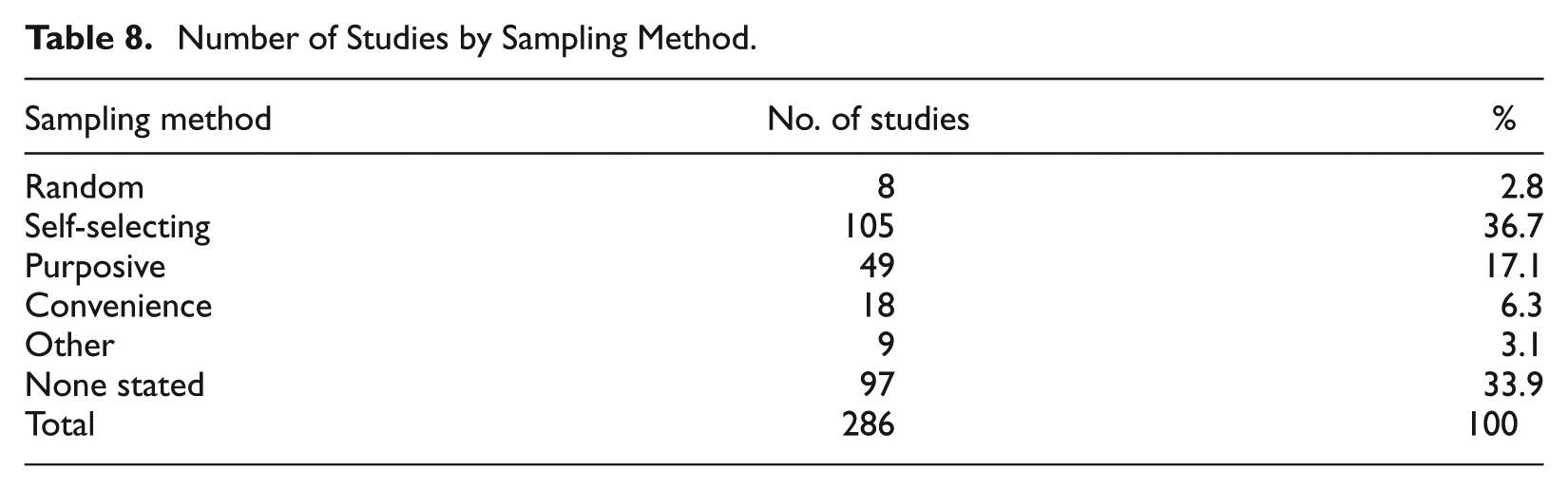
The second most popular sampling method was purposive sampling (17.1%), followed by convenience sampling (6.3%) and then random sampling (2.8%). The latter figure is a surprisingly low given that 20.2% of all studies used some form of statistical analysis (see Table 7). As such, it can be inferred that many studies using statistical methods must be drawing their conclusions on a sample of photographs that was biased toward those types of participant that are overrepresented in the sample. This is a serious concern.
Sample size is also important in evaluating reliability when quantitative analysis is being used. Small samples are likely to under- or over-represent different groups within the sampling population: those about whom the study seeks to speak authoritatively. Table 6 shows, however, that 42.6% of studies where the sample size was stated had fewer than 20 participants and 67.4% had fewer than 50. Only 6.3% of the studies used more than 100 participants. The tendency to use small sample sizes may be the result of the difficult logistics implied in studies involving the use of cameras, which are often expensive to buy from meager research funds. However, it is a particular concern for studies that are either wholly quantitative, or employ a mixed methods approach in which quantitative analysis plays an integral part.
Number of Photographs Required, Taken, and Used
Arguably it is not the number of participants involved that is important in establishing the reliability of PGI studies but the number of photographs each participant is asked to take, permitted to take, or actually does take. These factors determine the total number of photographs available for further analysis, and it can be argued that this is the relevant figure to take as the overall sample size.
Table 9 shows considerable variation among studies in the number of photographs each participant is asked to take. This is relevant even to studies using only qualitative analysis because the fewer photographs the participants are permitted to submit, the less opportunity they have to raise issues that are important to them. There is also the potential for bias due to participants wishing to “save the last shot” when they are given a fixed quota of photographs. If the photograph has not been taken, it cannot be analyzed by the researchers. The table also shows that in studies where a required number was specified, researchers were more likely to request more photographs per participants than fewer, with 9.1% of studies requesting 20 or more photographs from each participant compared to only 2.4% asking for fewer than 10. The lowest recorded figure was just one photograph and the highest 54, although some studies permitted participants to submit as many photographs as they liked.
Number of Photographs Required and Average Number Taken.

Lowest recorded was 1, highest was 54, although some studies permitted any number.
Table 10 shows the total number of photographs submitted by all participants and the total number used in the study. The most popular range was more than 100 but fewer than 500 (11.9% of studies), while hardly any used fewer than 100 (only 1.4%). The smallest number recorded was 82 and the greatest 8,000, which suggests considerable variation.
Total Number of Photographs Collected and Analyzed.
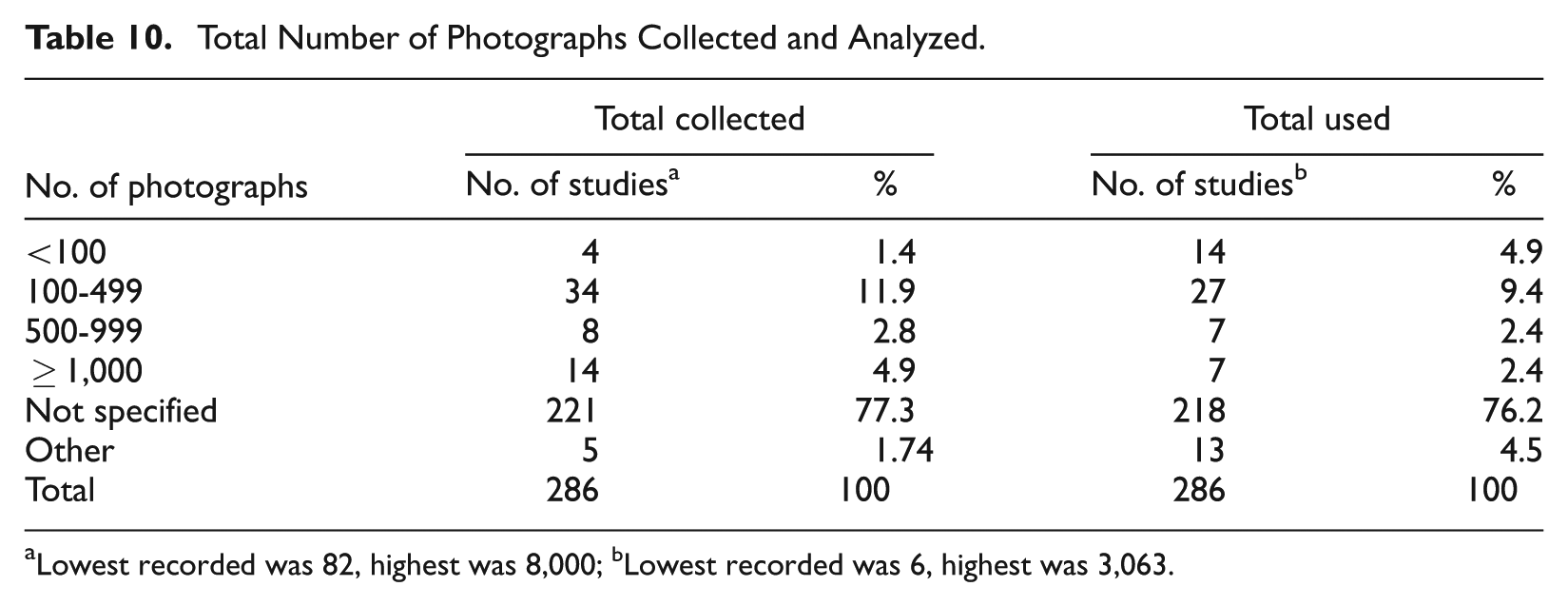
Lowest recorded was 82, highest was 8,000; bLowest recorded was 6, highest was 3,063.
The total number of photographs collected does not generally coincide with the number of photographs analyzed, the latter tending to be lower due to some photographs not being usable due to poor lighting or poor use of the camera by participants (e.g., finger over the lens). Table 10 shows that the smallest number of photographs analyzed in a study was six, while the largest was 3,063.
Use of Incentives
A controversial issue in PGI studies is whether incentives should be offered to participants. This is likely to be highly relevant when the participant has been loaned an expensive camera by the research team as offering an incentive will help ensure that the camera is returned. The participant is being set a task that can be challenging and time-consuming, as well as potentially enjoyable and enlightening, but sometimes the actual costs to the participant (in terms of time, inconvenience, and mental effort) can outweigh the expected benefits. Incentives can thus be used to encourage more people to participate, people to participate more fully, and more completions to be returned.
Only 22% of papers stated whether or not incentives were used. Incentives were most often used in autophotography studies, with the participants being students on courses taught by the researcher and being offered course credits (or extra credits) for completing the exercise. Another incentive used was for the researchers to develop another set of prints to give to the participant, perhaps presented in a photograph album (e.g., Garrod, 2007; MacKay & Couldwell, 2004).
There are, however, some potential drawbacks in offering incentives to participants, including the possibility that it may generate misleading results. Using money incentives in a study intended to document the lives of urban street children, for example, might be viewed by participants as an attractive way of earning money with little effort. The resulting photographs might not be very useful for the study as a result, with little reflexivity entering into the process of taking them. Many organizations also have ethical guidelines that discourage the use of incentives or other forms of coercion in the conduct of public research (e.g., Visual Sociology Group of the British Sociological Association, 2006).
Reference to Other PGI techniques
The tendency for PGI researchers to propose a new name for the technique, even in contexts where it has long been used, has already been noted. The review confirms this tendency, with 67.1% of all papers making no reference to other PGI techniques, not even relatively well-known ones such as photovoice and autophotography (see Table 11).
Claims Made About the Study.
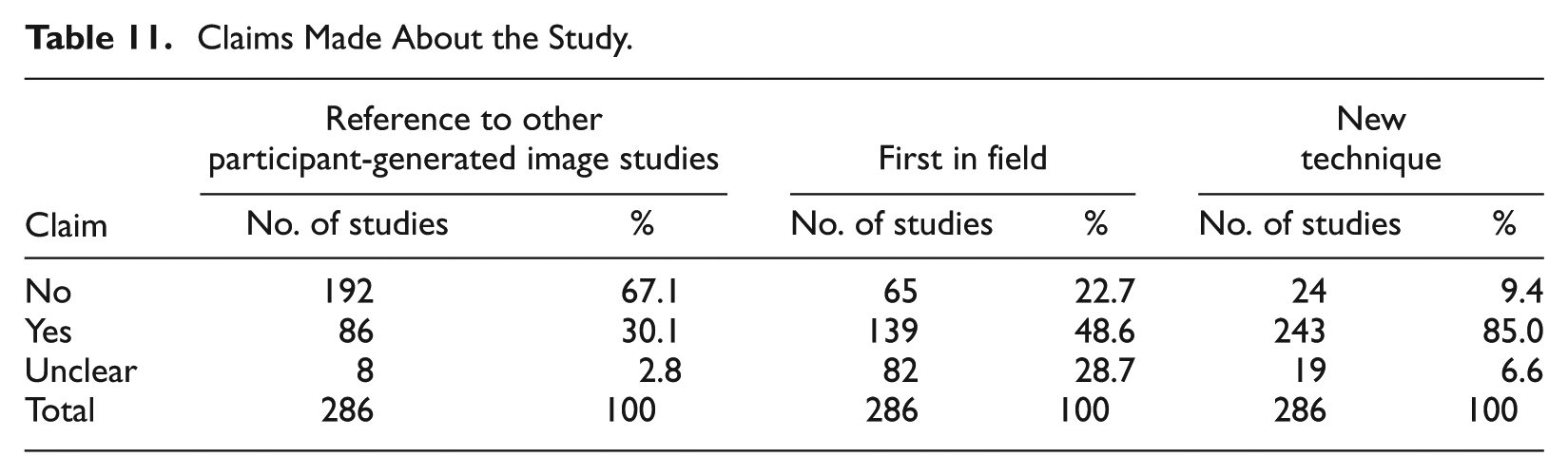
Table 11 also shows that 48.6% of the authors explicitly claimed that their study was the first in their particular field of study, while 85% claimed that their application was in some sense a “new” or “novel.” These two issues are, of course, linked: A researcher who introduces a new practice into an existing PGI technique may feel the need to rename it in order to distinguish it from its predecessors.
Reporting of the Research Method
A potentially very serious shortcoming of much PGI research is that studies often do not report even basic information on the research method, such as the number of participants or number of photographs used. Table 12 illustrates this tendency by bringing together relevant figures from previous tables. While nearly 15% of studies did not report the number of participants involved, more than a quarter failed to note the type of cameras used, and over a third did not state how the participants were recruited. These are significant issues to overlook, as they are likely to play an instrumental role in how the study’s findings should be interpreted. Meanwhile, nearly half of the studies did not report how long the participants were given to complete the exercise and almost as many again did not mention whether an incentive was used to encourage participation. These variables are important because they are likely to have a substantial effect on how participants play their role in the research. Without knowledge of them, the reader is unable to judge the context of the research and to interpret its findings meaningfully.
Number of Studies Where Information Is Not Specified.

In terms of the number of photographs requested, received, and analyzed, more than 70% of studies did not clearly state how many pictures each participant was requested to take, while almost 88% failed to state how many in total were actually taken. More than 75% of studies failed to mention how many photographs were ultimately submitted, and the same percentage neglected to state how many were then analyzed. Again, these are significant issues to omit, and they would certainly be important to gaining a proper understanding the findings of the article.
Discussion
The study’s first objective was to trace the origins and development of PGI across the social sciences. The review found six streams of research, of which three have a lengthy history of application. Meanwhile, three of these titles have tended to be associated primarily with one particular discipline of the social sciences: VEP among environmental managers, autophotography among psychologists, and photovoice among anthropologists. While this demarcation is not perfect, it is nevertheless reasonably tight. The terms photo-elicitation and participatory photography have also been used in a number of recent studies, and it is significant to note that the authors could have chosen one of the other existing titles to identify their method. The use of the former is particularly unfortunate given its more general use as a technique that may or may not be used as part of a PGI study.
The foregoing observations highlight the importance of identifying the different names of the technique, citing examples of studies that use them, and providing these names as keywords of papers using PGI-based techniques. There has hitherto been no critical review of PGI techniques available and to that extent it is hoped that the publication of this article may serve to bring greater gestalt to the field of study.
Another important finding is that while there are some distinctions evident in the way in which PGI studies are designed and implemented, such differences tend to be neither sharp nor particularly substantial. No consistent differences were found in variables such as the number of participants, complementary research methods, analysis employed, camera used, or incentives offered. It can be argued, therefore, that there is essentially just one “PGI method,” even though it might go under many different names according to the epistemological context in which it is being applied.
A complication in determining the degree of consistency in the use of the PGI technique is that far too few studies using it provide information on even the most basic parameters of how it has been applied. For example, only a small percentage of studies specified the basic features of the research, such as the number of photos requested, taken, and analyzed. Were this information available, it would be a simple matter to make comparisons and distinguish good practice from bad. There is also great inconsistency with respect to sampling: a third did not provide any information on the sampling method at all. This cannot be acceptable in terms of good research practice nor can it be beneficial for the reputation of PGI research. PGI research is often criticized for its apparent lack of rigor. If PGI researchers are actually implementing their studies rigorously, then the problem is one of communication: journal referees and editors need to be more alert to the need for the paper to cover these issues in sufficient breadth and depth. If, however, PGI studies are not actually implementing rigorous studies, then the situation is a more serious one: It would seriously call into doubt the precision and value of such research. Whichever of these scenarios is true, however, the response must be the same: papers using PGI must provide sufficient details on how it has been applied. This, it can be argued, is a necessary prerequisite for good research.
Conclusions
Having conducted a systematic review of the many PGI studies that have been published to date, this article concludes that there are no hard-and-fast distinctions to be made between the different “brands” that have emerged. All share the basic premise of collecting photographs from individuals who have agreed to participate in the study. All give cameras to participants and ask them to take photographs to address a given theme. Where there are differences, for example, in the way the data are analyzed, such differences are not systematic: examples can be found of almost every type of analysis in almost every group. None of these characteristics are exclusive to any one “brand” of the PGI technique, although subtle differences are being introduced all the time. The study found that, on average, a paper proposing a new name for the method has been published every year for the past 35 years.
Terminological consistency is vital in developing any research technique. Without it, researchers coming to the method for the first time will have difficulty identifying the extant literature. This can result in researchers failing to identify papers that could critically inform their own study. Important studies using one name can be overlooked by researchers who know it only by another. This may seriously limit the utility of the method. Without a greater degree of consistency in the naming of the technique, it is doubtful whether it will ever be treated seriously and used by the majority of social scientists.
The need to develop a set of best practice guidelines for PGI-based research is clearly a pressing one. Researchers need to demonstrate that the enterprise of social science can be furthered through the use of PGI research. The criteria against which any social scientific study should be judged should surely include what the research eventually gives back to society. PGI has significant potential in that respect: inspiring people to improve their lives, using the power of the visual to exert influence on policy makers, and so on. As this potential becomes more and better realized, the view that PGI research lacks the necessary robustness to make it useful in the social sciences will eventually lose traction. This article recommends that the following variables are reported at a minimum: number of participants beginning the exercise, number of participants completing the exercise, type of camera used (e.g., disposable, digital, smart phone), sampling method, duration of camera usage, and number of photographs required, collected, and analyzed. The article further recommends that incentives, monetary or otherwise, are best avoided.
Finally, this article highlights the potential of the PGI approach to addressing social science questions in a wide range of contexts, from landscape assessment to the analysis of tourism destination attributes, from the psychology of self-image to political advocacy. Given the increasing ubiquity of cameras in society, particularly in the form of smart phones and tablet computers, the potential for PGI techniques can only increase in the future.
Footnotes
Declaration of Conflicting Interests
The author(s) declared no potential conflicts of interest with respect to the research, authorship, and/or publication of this article.
Funding
The author(s) received no financial support for the research, authorship, and/or publication of this article.