



Abstract
Mixed methods research (MMR) is useful for addressing complex and multidisciplinary urban problems. This article demonstrates an integrated MMR approach with a novel two-phase exploratory sequential design while studying play, play space, and children’s (age 7-15 years) location preference for play in three residential areas in Dhaka. We used directly administered survey and interviews in the first phase to describe play and play space from children’s perspective. Informed by the first, we employed GIS-based spatial and statistical analysis in the second phase to study patterns of children’s location preference for play. Our article contributes to the methodological literature by combining MMR with urban spatial analysis in children’s play environment studies.
Keywords
New developments in mixed methods research (MMR) show enormous potential to address complex problems that are context-sensitive and multidisciplinary in nature (Hesse-Biber & Johnson, 2013; Johnson, 2017). MMR incorporates more than one method to address research questions comprehensively (Creswell & Creswell, 2017). One of the key challenges of MMR, particularly in addressing multidisciplinary issues, is the integration of different data collection and analysis methods at different phases of a research project (Fetters & Molina-Azorin, 2017). While MMR and its integration strategies have achieved momentum in many disciplines, they received little attention in architectural and urban studies on children’s play environments, where spatial mapping and context-sensitivity play important role.
At least two methodological issues demand attention in this regard. First, there are few MMR precedents that explore the potentials of integrating social and spatial analytical methods in children’s outdoor play and urban spatial configuration studies. Although application of MMR approach is emerging in health psychology (Dures, Rumsey, Morris, & Gleeson, 2011), behavioral sciences (Lopez-Fernandez & Molina-Azorin, 2011), and childhood play studies (Christina et al., 2018; Hume, Salmon, & Ball, 2005; Lynch & Banerjee, 1977; Walker et al., 2009), integrated MMR strategies to understand children’s location preference for play with reference to the configuration of urban physical environments are meagre. Within current MMR scholarship, integration of social science methods with spatial analytical methods has received little attention (Fielding & Cisneros-Puebla, 2009). With reference to an empirical study on community garden in Buffalo, New York, Knigge and Cope (2006) used an interesting combination of interpretation of census data, GIS (geographic information system) analysis, and mapping, participant observation, field research, and text analysis to understand the complex sociospatial issues related to community garden. Jung (2009) used a combination of image data and their interpretive codes in digital GIS platform that allows researchers to work with multiple forms of data and conduct different forms of analyses including grounded theory and spatial analysis. However, to our knowledge there are no earlier studies that used MMR to combine social and spatial analytical aspects of children’s urban play environments.
Second, few studies in social sciences and urban design focus both on social and spatial dimensions of children’s outdoor play (Freeman & Tranter, 2011). For example, studies in children’s geographies highlight children’s participation and social agencies for play, while they ignore the role of locational distribution and physical configuration of play spaces (Holloway, 2014; Jensen, 2014; Ryan, 2011). Conversely, architectural and urban studies focus on the spatial analytical aspects of play spaces and overlook the participation of children and their views in the planning process (Hart, 2011; Qvortrup, 1994; Zako, 2009). Moreover, most spatial analytical studies in architecture consider only the formal characteristics of a particular play space or a street segment (Mehta, 2007; we call these characteristics “micro-spatial qualities”) and ignore the accessibility conditions between children’s homes, streets, and play spaces (Hillier & Vaughan, 2007; we call these accessibility conditions “meso-spatial qualities”).
Children’s play in urban environments is an emerging research field (Howard, Miles, Rees-Davies, & Bertenshaw, 2017). Children’s play has been described as an important indicator of communal cohesion (Gill, 2007), urban resilience (Freeman & Tranter, 2011), and a source of urban spatial aesthetics (Lefebvre, Stanek, & Bononno, 2014). Lack of adequate outdoor play negatively affects children’s physical health and well-being (Bates & Stone, 2014; Sivam, Karuppannan, Koohsari, & Sivam, 2012; Tremblay et al., 2015; Wen, Kite, & Merom, 2009). Article 31.1 of the United Nations Convention on the Rights of the Child (1990) specifically recognizes children’s right to play. Despite increased efforts from global organizations, scholars argue that cities are not as good places for children’s play as they could be (Freeman, Tranter, & Skelton, 2017; Rigolon & Flohr, 2014). Opportunities for children’s outdoor play are diminishing at an alarming rate in many cities (Freeman et al., 2017; Karsten, 2002; Shaw et al., 2010).
Children’s play environments are different in the global north and global south urban contexts (Skelton & Gough, 2013). Appropriation of methods in local sociospatial context is important for children’s play environment studies (Pellegrini, 2009). South Asian cities are home to more than 163 million children aged younger than 18 years and many of them are characterized with high density and high rate of urbanization (United Nations, 2014). Very few studies used MMR to develop context-specific understanding of children’s outdoor play in South Asian urban context (Ahmed, 2011; Islam, 2009). To our knowledge, no children’s play environment studies in South Asia have applied MMR to relate children’s location preference and usage of urban play spaces to the micro- and meso-spatial qualities of those play spaces. Understanding such relationship is important to rethinking children’s play environments in cities through planning and design.
Objectives
In this study, we present an integrated MMR strategy while investigating play, play space, and children’s location preference for play in Dhaka, a little-researched city in South Asia. Reportedly, Dhaka is the densest city in the world with more than 15 million people living within only 134 square miles (United Nations, 2014). The city is growing at an annual rate of 5.4% (Hossain, 2008). Currently, more than 2 million residents are children (younger than 18 years) living in this city. Empirical studies on children’s play environments are meager in Dhaka. Lack of child-friendly outdoor playgrounds is considered as one of the major causes for obesity among children (14%), juvenile crimes, and children’s health hazards in Dhaka (International Centre for Diarrhoeal Disease Research, 2016). The need for proper spatial planning for children’s play is widely reported in the local media (Anam, 2015). However, prior to any urban spatial intervention for play, it is important to understand the meaning of “play” and “play space” from children’s perspective; and how such understanding can inform urban planners to assess spatial qualities for play and create equitable and accessible play spaces across city.
With reference to existing gaps in children–environment studies in the global south urban context, this study addresses three relevant research questions using MMR: (1) What are the constructions of children’s play and play spaces in Dhaka from children’s perspective? (2) How can we measure the configuration of urban physical environments by taking children’s outdoor play behavior into account? and (3) Does configuration of urban physical environments affect children’s location preference for play; and if it does, what is the extent? This article argues that integration of a range of qualitative and quantitative data and a combined use of both social and spatial analysis show high potential in addressing multifaceted problems in children’s play and urban configuration studies.
Research Approach and Design
The stated questions are interrelated and have both social and spatial components. They also contain ambiguous issues, such as “play” and “play space” (Gray, 2013; Sutton-Smith, 1997). In order to address these issues comprehensively, we identified an MMR approach with an exploratory sequential design as the most suitable research strategy. An exploratory sequential design in MMR typically involves collection and analysis of qualitative data followed by designing a quantitative feature based on the qualitative findings, and finally testing the quantitative feature (Creswell & Creswell, 2017). Besides incorporating more than one method in a single study, we explored full potential of MMR by integrating a range of dimensions including philosophical, theoretical, data analysis, and data collection (Fetters & Molina-Azorin, 2017).
Philosophically, we contend that researchers must consider subjective, intersubjective, and objective aspects to understand the multiplicities of issues involved in play and play space studies. Going beyond objectivism and constructivism (Guba, 1990), we deny sharp distinction between means and ends (Tilman & Knap, 1999) and appreciate the dialectical understanding of urban space (Ellin, 2006; Lefebvre & Nicholson-Smith, 1991; Merrifield, 2002; Sargin & Savas, 2012). Both children’s play and play space can be considered as means or ends at the same time. For example, if a child plays, cities need to provide accessible play spaces. Here, “play” is a means and “play space” is an outcome. Conversely, if there is no play space, a child will not be able to play in the city. Here, space is a means, and child’s play is an outcome. Considering architectural and urban planning discourses on play and play space, dialectical approach denies strict adherence to either modern or postmodern ideologies (Ellin, 1999) and remains focused on both subjective and objective aspects of people–environment interactions in real context.
We operationalize our dialectic understanding by drawing resources from recent developments in children’s geographies and urban morphology. Proponents of pluralism in children’s geographies recognize that children differ from adults in the way they assign meaning to reality (Matthews & Limb, 1999). They highlight qualitiative approaches to understand children’s perceptions and preferences across age, gender, economic background, and so on (Holloway, 2014). However, comparative assessment of children’s play across locations and their pattern across space–time are difficult to explain with pluralistic theories only. Comparative assessment of children’s outdoor play environments requires inclusion of morphological theories and spatial analytical methods. In urban morphology, space syntax focuses on the impact of spatial configuration on social phenomena (Batty, 2013; Hillier & Hanson, 1984). They highlight the importance of spatial qualities such as density and accessibility in the formation of society. An urban play space, conceived as having both “social origins” and “social consequences” (Hillier & Hanson, 1984), is a suitable ground for spatial analysis.
Our data collection and analysis strategy involved two phases (Figure 1).

Design of an integrated two-phase sequential mixed methods research strategy.
The first phase (Phase I) included collection and analysis of subjective data to explore differential constructions of play and play space with reference to themes such as children’s perceptions and preferences of play and play spaces, degree of independent mobility, perceptions on neighborhood environments, and so on. We analyzed these themes with reference to children’s social profiles (such as, age, gender, locations, family income, and length of stay). We used participatory methods such as directly administered survey and interviews with children and their respective parents in three residential areas in Dhaka. The key reason for exploring subjective issues in the first phase was that the definitions of “play” and “play space” and spatial adjacencies of children and outdoor play spaces was not clear in the studied context at the beginning of the project. We applied the findings from Phase I to define strategies for Phase II that focused on objective data. Specifically, the first phase informed us in (1) selecting play spaces for systematic observations, (2) defining context-specific spatial qualities of a play space, and (3) developing measurable indicators (both spatial and social) for statistical analysis in the second phase. In Phase II, using data collected through systematic observation supplemented with map studies and user interviews, we defined, modeled, and measured the configuration of urban physical environments of play using a combination of digital platforms such as AutoCAD, ArcGIS, MapInfo, and so on. Configuration of urban physical environments of play was modeled in terms of micro- and meso-spatial qualities—referring to morphological and accessibility aspects of an urban play space, respectively (see Supplemental Appendices 1 and 2 available online). We developed a robust set of micro- and meso-spatial quality indices and empirically tested the impact of the configuration of urban physical environment on children’s location preference for play.
The first author (principal investigator [PI]) collected all primary data for this study. The PI is familiar with the urban context of Dhaka and experienced in children’s environment research (Bhuyan & Skelton, 2014). Data collection process involved four field trips from Singapore to Dhaka (2 to 4 months each) between 2013 and 2017. The first field trip was a reconnaissance survey for a pilot study (Bhuyan & Zhang, 2014). Piloting was necessary due to the lack of available data collection instruments on children’s urban play and play spaces for the studied context.
Research with children as participants needs to be ethical, sensitive, and respectful (Skelton, 2008). We secured prior approval from the institutional review board for all data collection instruments related to human subjects. Informed consents were taken from all participants before collecting any personal data. The following sections describe the settings, applied methods, and their integration at various phases of this study.
Settings of the Study
We followed several strategies to maintain copresence of different data collection sites (such as studied neighborhoods, schools, play spaces in the neighborhoods, etc.) within Dhaka. As depicted in Figure 2, we first selected three residential areas—known as Sutrapur (Area 1), Dhanmondi (Area 2), and Uttara (Area 3)—in Dhaka. Historically, Dhaka grew from south to north (Ferdous, 2012). Sutrapur is in the southern part of Dhaka (popularly known as Old Dhaka). Dhanmondi and Uttara are in the central and northern part of the city, respectively. The three selected study areas experienced urban developments in different times. Sutrapur experienced rapid urban growth in British colonial period (1757-1947); Dhanmondi in the Pakistan period (1947-1971); and Uttara in Sovereign Bangladesh period (1971 to present). These three areas represent typical residential living environments in Dhaka, which is characterized with patches of planned settlements surrounded by unplanned settlements (Nilufar, 1997).
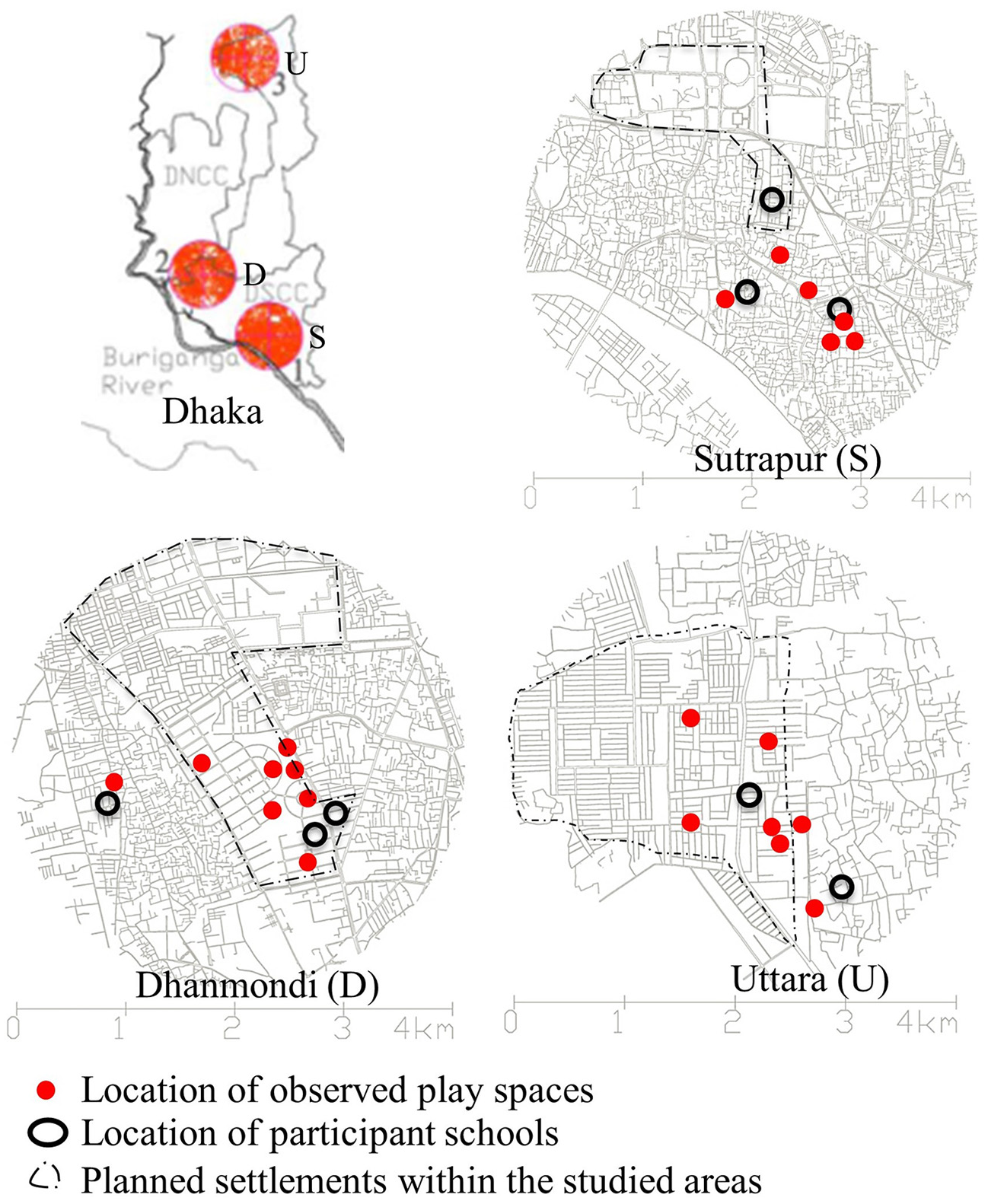
Location of mixed methods data collection sites within the three selected urban areas in Dhaka.
We considered a demonstrative radius (approximately, 2 kilometers) that included planned and unplanned areas within the selected areas. Gradually, we developed other criteria to specify study areas within the demonstrative radius, recruit participants, and select play spaces for detailed study. For example, one of the criteria to specify study area boundary was whether the area has any “open” and recognizable play space, such as playgrounds, parks, green spaces, and so on. We considered paid play facilities such as amusement parks as “not open.” To see whether selected study areas have any open and recognizable play spaces, we consulted past studies in Dhaka (Ahmed, 2011; Dasgupta et al., 2010; Nilufar, 1997), Google Maps, and GIS maps supplied by the local planning authority. Subsequently, a list of schools and play spaces (located adjacent to the selected schools and within the three residential area boundaries) were finalized to collect mixed methods data.
Phase I
In the first phase, we used a range of subjective data collection methods including a survey of children in schools and their respective parents, and interviews with children—a subgroup of survey participants.
Survey and Interviews
We conducted survey and interviews in 8 schools (3 public schools and 5 private schools) located within the three study areas. Sourcing children from schools allowed us to include both boys and girls conveniently and maintain high control on age group (Islam, 2009). We focused on children aged 7 to 15 years. Most studies on children’s outdoor play include middle-age children ranging from 7 to 15 years (Harding, 1997; Mikkelsen & Christensen, 2009; Shaw et al., 2010). Earlier studies in Dhaka reported that children start accessing urban outdoors independently at the age of 10 to 12 years, close to the age when they move from primary to secondary school (Islam, 2009). We considered a buffer of 3 years around 10 to 12 years.
First, we sent emails to the heads of schools, located within the three selected study areas, seeking assistance to source participants and conduct survey in their schools. Rate of email response was nil. This was not surprising since only 13.2% of the population is subscribed to any kind of internet service in Bangladesh (Internetlivestats, 2017). Subsequently, following a direct meeting strategy, we shortlisted four schools from each of the three study areas and arranged meeting with the heads of the schools. During the meetings, the PI showed printed invitation letters and survey instruments to the respective heads of schools; informed him or her about the topic and survey procedures; and if agreed, set a schedule for conducting the survey and interviews with children in the classrooms.
We used two different sets of questionnaires, one for children (aged 7-15 years) and another for their parents. Questionnaires for children were directly administered inside classrooms (of Level 2 to Level 7) on prescheduled dates by the PI. After each survey session with children (30-40 minutes), questionnaires for respective parents were supplied to the participant children and requested to bring it back to the school within a scheduled day (typically within 2 weeks). An information sheet and a consent form for parents were supplied as well. The questionnaires were written in English and translated in Bangla by the PI (who is a native Bangla speaker). Translated questionnaires were validated by another qualified Bangla speaker.
In total, 308 children took part in the directly administered survey. The ratio of girls and boys was fair (1:0.82). Fifty-five percent of the children returned parent’s questionnaires completed either by their mother, father, or an adult caregiver in the family. Children (n = 152) who returned their parent’s questionnaire attended a follow-up interview session. School going children’s performance in survey varies across age (Harding, 1997). We provided direct assistance for children younger than 9 years during the survey and interviews. The PI repeatedly read aloud and clarified all the questions to them.
Questionnaire for Children
We designed the questionnaire for children by considering local context and by consulting past studies on children and their outdoor play environments (Harding, 1997; Islam, 2009; Lynch & Banerjee, 1977; Mikkelsen & Christensen, 2009; Pooley, Turnbull, & Adams, 2005). Children’s questionnaire contained a mix of close-ended and open-ended questions. The introductory part of the children’s questionnaire collected data on children’s social profile, such as gender, age, and residential address (Mikkelsen & Christensen, 2009; Pooley et al., 2005).
In order to understand the constructions of play and play space from children’s perspective, we asked children to write down, on the supplied questionnaire, whatever comes to their mind, when they hear the words “play” (khela) and “play space” (khelar jayga). To collect data on children’s everyday life (Lynch & Banerjee, 1977) and their activities in school day and school holiday (Harding, 1997), we provided a list of activities in “from-to” format with choice for children to add other activities. The given list of activities included sleeping, eating, studying in school, studying at home, studying at private tutor/coaching, dancing/singing/drawing classes, watching TV/playing video games, playing inside the house, and playing outside of the house. We included several questions on children’s perceived location preference for play, such as whether they like to play (anywhere or outside of their house), whether they can mention names of their preferred games and play spaces, and so on.
School going children play in the outdoors mostly with their friends (Whitebread, Basilio, Kuvalja, & Verma, 2012; Woolley & Lowe, 2012) and they start exercising independent mobility through play (Bates & Stone, 2014). We asked children whether they have any friends in the neighborhood; and if they have, “how many?”; and whether they come back from school alone; if yes, at which age they started to do so. With reference to earlier studies, we also asked children about their satisfaction (by using a 5-point Likert-type scale) for a list of environmental aspects in their neighborhood (Davison & Lawson, 2006; Hillman, Adams, & Whitelegg, 1990; Islam, 2009; Kyttä, Kuoppa, Hirvonen, Ahmadi, & Tzoulas, 2014; Shaw et al., 2010). Environmental aspects included the amount of available of play spaces in the neighborhood, proximity of play spaces from home, cars on the way to the play space, people on the way to the play spaces, parent’s permission to play, climatic factors (sun/rain/lightness/darkness), and others.
Questionnaire for Parents
Data collection through children’s questionnaire has limitations since children have limited ability to understand vocabulary (Fuchs, 2008). A survey of respective parents was useful for the validation of children’s responses through triangulation and for gaining parent’s perceptions on their child’s play and play environments (Wen et al., 2009). Parent’s questionnaire contained 15 questions, both open-ended and close-ended, with relevant subquestions. Parent’s questionnaire collected data on children’s family background and home environment, such as length of stay in the current locality in years, ownership type of the current residence (owner/renter), building type of the current house (number of stories), monthly income of the household (in BDT), parent’s educational qualification, and household size. Parents were asked whether they think playing outdoors is important for their child, whether they are satisfied with the time that their children spend playing in the urban outdoors, how far they allowed their child to move without assistance in the neighborhood (Carver, Veitch, Sahlqvist, Crawford, & Hume, 2014), how much time their child spends on screenplay during school day and school holiday, how frequently their child went out to play in the week immediately before the survey period, what kinds of games their child like to play most, and so on. To gain parent’s perceptions on social and spatial aspects that might affect their children’s play in the urban outdoors, parents were asked to assess the importance of the availability and proximity of play spaces, and street connectivity for children’s outdoors play (Aarts, de Vries, van Oers, & Schuit, 2012; Davison & Lawson, 2006; Islam, 2009).
Interviews With Children in Classroom Setting
Survey among children often fails to capture their emotions and feelings (Hughes & Ackroyd, 1981). In order to better understand children’s responses in the questionnaires (Rowiey, 2012), we conducted semistructured and one-to-one follow-up interviews with children, who took part in the children’s survey and returned the completed parent’s questionnaire. Duration of each interview varied from 3 to 10 minutes. We asked children additional open-ended questions based on the answers they provided in the questionnaire. Children’s responses on perceptions and preferences for play and play spaces, as provided earlier in the questionnaire, were expanded during the follow-up interview sessions. For example, if a child answered on the children’s questionnaire that he or she likes to play outside of their house, he or she was asked, “Why do you like to play outside of your house?” Similarly, if a child wrote down that play means “I feel happy” to him to her, the follow-up interview asked whether he or she can elaborate his or her answer. Interview responses were noted down by the PI in-situ. In addition, children, who were waiting in the classroom for their interview turn to come, took part in an optional drawing exercise. Children were asked to draw their “dream play space” in the provided blank sheets of paper. One-to-one interviews and drawing exercises helped this study appreciate children’s spontaneous participation and interest in our research topic. Children were allowed to see his or her responses and interviewer’s notes during the interviews.
Analysis of Subjective Data
We analyzed subjective data (i.e., children’s and their caregiver’s perceptions and conceptions on play and play spaces) with reference to Grounded Theory (Glaser & Straus, 2017; Strauss & Corbin, 1997). This involved iterative coding and categorization of subjective data followed by thematic analysis (Charmaz, 2008; Cho & Lee, 2014; Tashakori & Teddie, 2010). For example, children’s descriptions of ‘play’ (as reported during the survey and interviews and later, translated from Bangla to English by the PI) were coded on MS Excel. Then, the most frequented phrases on play were grouped together to construct categories. Relative frequency and pattern of stable categories were analyzed across gender, age, and social income group, location of residences, and length of stay. As part of advanced mixed methods analysis, subjective data, such as children’s reports on actual play and play spaces, were coded on Google My Maps and drawn in scale on digital platforms (AutoCAD, ArcGIS and MapInfo) by using points, lines and shapes. Most frequently mentioned play spaces and their geometric properties were superimposed with GIS maps collected from the local authority (RAJUK). This was useful for finalizing play spaces for systematic observation and conducting spatial analysis in the second phase.
Phase II
Data collection methods in the second phase involved systematic observation of play spaces and their surrounding street network, and micro- and meso-spatial modeling of the configuration of urban physical environments. To understand the variability of spatial accessibility range or radius of a play space, systematic observation was supplemented by interviews of users (children aged 7-15 years) in the observed play spaces.
Systematic Observation
We overcome the limitations of using survey and interviews, that is, the lack of accurately describing objective characteristics of built environment (Lafontaine, Sawada, & Kristjansson, 2017), by including direct and structured observation of urban spaces in the three studied areas. We selected the spaces for observation based on the learning from survey and interviews. Two types of spaces were observed systematically: (1) identifiable play spaces (n = 21) and (2) segments (n = 212) of streets and alleyways in the neighborhoods. The PI observed each space 8 times, that is, 4 times a day, respectively for a weekday (from Sunday to Thursday) and a weekend day (Friday and Saturday). Each observation was of 10 minutes duration and was conducted with 3-hour intervals from 7 a.m. to 7 p.m. (local time). Nighttime (sun sets around 6 p.m. in Dhaka) was excluded, since children in Dhaka mostly play during the day when there is natural light in the outdoors. Systematic observation of play spaces was effective for measuring children’s actual location preference for play (i.e., observed intensity of children’s play in a space).
We used Google My Maps (2016) and GIS maps, developed by the Capital Development Authority (RAJUK) of Dhaka, to keep track of the observation points and to streamline the observation process. We adopted “SOPARC” (System for Observing Play and Recreation in Communities; Mckenzie, Cohen, Sehgal, Williumson, & Golinelli, 2006), and designed two instruments to conduct observations: (1) a system for observing children’s play in the play spaces that recorded play activities across age groups and gender groups and (2) a system for observing movements and play across paths that recorded activities in the streets across age groups and gender groups. Both these instruments had designated spaces for sketching and taking notes. Time and duration of observation and weather conditions (temperature/sunny/rainy) were recorded for each observation. Photos were taken to record activities at various times and to document physical features of the observed play spaces and streets.
We considered local weather conditions and contextual forces, such as rainy days, Eid-ul-Azha and and Eid-ul-Fitre holidays, hartals (political shutdown), and so on. These events temporarily affect children’s urban play in Dhaka. For example, during the weeklong Eid-ul-Azha holidays, traffic in the streets of Dhaka remains unusually low, since many people leave the city to celebrate Eid with their family and relatives in the villages. During Eid-ul-Azha, many of the playgrounds are also used as temporary “cow markets” by the city corporation authority for few days. Throughout the observation period, daytime temperature varied from 18°C to 31°C.
In addition to systematic observations in the play spaces, we conducted interviews with young players (who were different from the participants in the school) to collect data on accessibility range of the studied play spaces for children. These interviews (n = 210) were short (2-5 minutes for each) and conducted with verbal consent from each interested interviewee. Interviews in the play spaces included questions such as how far they traveled to play; which mode of transport (walk/nonmotorized transport/motorized transport/combinations, etc.) they used; how often they came to this place to play in the week immediately before the interview, and so on. Participant’s house address (as detailed as they wanted to provide), gender profile, and age were noted down during the interview. Interview responses, particularly children’s residential addresses within the three areas, were geo-coded on scaled GIS maps to calculate the accessibility range of the studied play spaces.
Spatial Modeling
To study the configuration of the urban physical environments of the studied areas and play spaces, we collected digital copies of the latest GIS maps provided by the urban development authority in Dhaka (RAJUK). Based on the systematic observation of real spaces and maps, we developed two kinds of spatial quality data sets: micro-spatial qualities or MiSQ (i.e., the geometric configuration of an urban play space) and meso-spatial qualities or MeSQ (i.e., the accessibility conditions of street networks surrounding a play space). Building on the outcomes of the first phase and with reference to past studies in urban design (Islam, 2009; Loon & Frank, 2011; Kyttä, 2004), we measured copresence of other age groups in a play space, size, enclosure, amenities, green cover ratio, front-road geometry, and front-road business activities as MiSQ indices. Drawing on the graph theory (Euler, 1741), we generated two types of MeSQ units: (1) pedestrian street network segment line and (2) pedestrian street network segment line and associated land-uses to measure MeSQ indices. With reference to advanced street network analysis methods in urban morphology, we applied two types of distance measurement systems, namely metric (Porta, Crucitti, & Latora, 2006; Sevtsuk, 2014) and topological (Hillier, 2012; Hillier & Hanson, 1984), to generate indices for each type of MeSQ unit.
Analysis of Objective Data
Spatial analytical and statistical methods have been used to analyze objective data. Spatial analysis focused on measuring the micro- and meso-spatial qualities (MiSQ and MeSQ, respectively) of the studied play spaces. We analyzed 17 MiSQ indices to evaluate the morphological properties of the studied play spaces. Digital software such as AutoCAD and SPSS were used for spatial coding of observed data and analyzing the MiSQ indices. We developed 63 MeSQ indices to assess the spatial accessibility conditions of the studied play spaces. We used urban spatial network analysis tools, such as DepthmapX (Turner, 2004), Place Syntax Tool (Stahle, Marcus, & Karlstrom, 2007), UNA Toolbox (Sevtsuk & Mekonnen, 2012) within ArcGIS and MapInfo platforms to analyze the MeSQ indices.
It is important to determine physical boundary or radius for MeSQ analysis of a play space. We applied intra- and interphase integration technique (Fetters & Molina-Azorin, 2017) in this regard. For example, short interviews of children in the play spaces and subsequent spatial analysis of the geo-coded play spaces and residential locations (interphase integration) have been an effective technique for determining appropriate radii for the MeSQ analysis (intraphase integration). Spatial coding of children’s (player’s) residential location with reference to play spaces revealed that frequency of use of a play space by children is a factor of spatial proximity and more than 80% of the children resided within 400 meters from a frequently used play space. Based on this finding, 400 and 800 meters (more than 95% of the children resided within 800m from a frequently used play space) were selected as the suitable radii for MeSQ analysis.
Assessment of MiSQ and MeSQ has been useful for the comparative assessment of the morphological and accessibility conditions of the play spaces in the studied context. This also created a baseline to statistically test whether configuration of urban physical environments affects children’s location preference for play. We measured children’s location preference for play in terms intensity of children’s play in the play spaces (ICP). ICP has been defined as the average number of observed children using a unit area (1 acre) of a play space within the observation period (10 minutes each).
Key Findings
While Phases I and II addressed specific research questions, the former informed the later in our study. Outcomes of one phase added new insights to the other (Figure 3). In the first phase, survey and interviews with children and their respective parents in schools exposed differential constructions of children’s play and play spaces in Dhaka (Research Question 1 of this study). They revealed both homogeneity and diversity of children’s perceptions and preferences for outdoor play across children’s age, gender, family income, residential locations, length of stay, and so on. For example, thematic analysis of open-ended questions in the children’s questionnaire suggested that children summarized play as “happiness” (anondo lage) and “fun” (moja lage) that take place within individual, social, and spatial constraints in the city.
[when I hear the word play], I get [so] overjoyed [that I’d do] something wrong. (Boy, 14) [when I hear the word play space, I wish] if our neighborhood had a big playfield, it would be much more fun; and we could be happier! (Girl, 15)
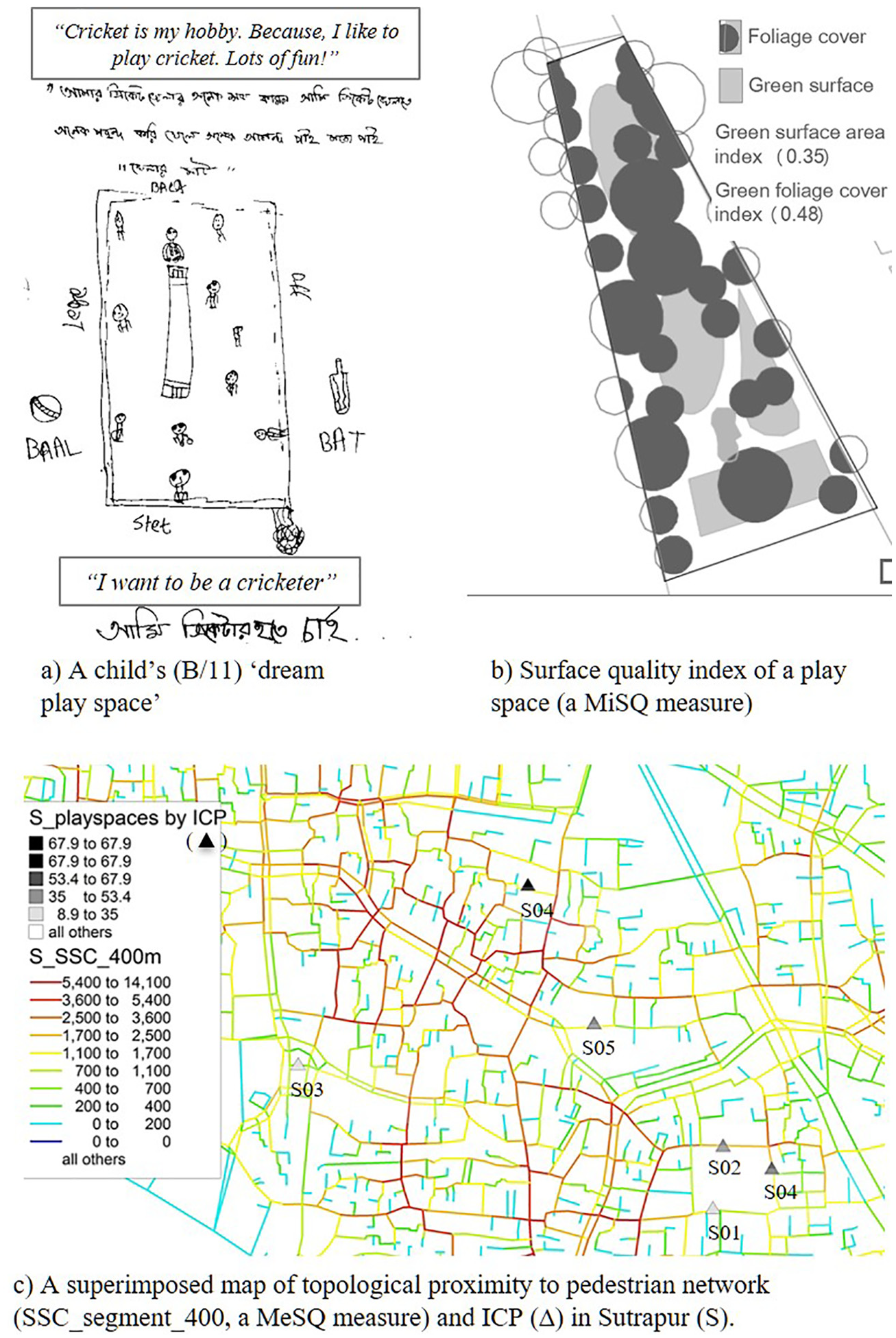
Examples showing outcomes of (a) interviews and drawing exercise with children, (b) micro-spatial analysis, and (c) statistical analysis superimposed map.
Children mentioned 50 different types of games (cricket, chua-chui, football, kana-machi, badminton are the most frequented among them). Children also mentioned 484 different names of their preferred play spaces. Some of the most preferred play spaces are playgrounds with or without name, streets, leftover spaces near their houses, schools and school playgrounds, rooftops, and so on. Children’s drawings of “dream play spaces” highlighted natural elements, various types of amenities, preferred games, and boundary conditions of play spaces. Children, and their respective parents highlighted the importance of provision, proximity, and car-free safe access routes to play spaces. They expressed low satisfaction about the current state of these environmental aspects.
Diversity of children’s play practices were evident across children’s residential locations, gender, age, and family income. For example, play preference in the outdoors was relatively lower among girls than boys. Thirty two percent of the girls reported that they do not like to play in the outdoors, comparatively, only 17% of the boys mentioned that they do not like to play in the outdoors. When asked why they liked or did not like to play outside their home, girls and boys provided different explanation. Boys who like to play in the outdoors highlighted positive social and spatial features such as sky, friends, people (with positive reflection), and so on.
I get air, I like to see the sky, Isn’t it beautiful? Friends say goodbye . . . (Boy, 9)
Because, [I have] lots of fun. I feel happy. I want to be a cricketer! (Boy, 11)
I don’t feel good . . . staying long time at home. (Boy, 11)
A lot of people play outside. . . . We all can play in harmony. (Boy, 11)
Girls explained their low preference for outdoor play by highlighting the unfriendly social environment, restrictions from their family and/or, unfriendly streets because of the car.
Outdoors are not so good, many people, bad people in the streets. (Girl, 13)
because, [my] mother does not allow [me to play outdoors]. Don’t know why! (Girl, 11)
Because, [there are] lots of cars in the street. (Girl, 11)
Parent’s report on children’s screenplay time on school days was higher for younger children (aged 7-9 years, mean score = 1.9 hours/day) as compared with older children (aged 13-15 years, mean score = 1.3 hours/day). Parent’s report on weekly frequency of outdoor play, measured with a 5-point Likert-type scale (1 = did not play outdoors in a week, 5 = played outdoors daily in a week) was higher for children from middle-income group (mean score = 2.5) in a comparison to those from low- and high-income groups (mean score = 2.5).
Results from systematic observations reveal that mean ICP (i.e., the intensity of children’s play in the play spaces) was 24 users/acre/10 minutes, while it varied across play spaces (from 2 users/acre/10 minutes to 67 users/acre/10 minutes). Boys were using urban play spaces 11.4 times more than girls of the same age group. All these explorative outcomes in the first phase were useful for developing indices for micro- and meso-spatial analysis and defining variables for regression studies in the second phase.
We applied high-resolution spatial analysis, measured in terms of MiSQ and MeSQ indices, to assess the configuration of the studied play spaces and their surrounding areas (Research Question 2 of this study). Results reveal that MiSQ and MeSQ vary significantly across play spaces and street segments, respectively. Measurement of MiSQ and MeSQ indices for 21 play spaces in three study areas enabled us to successfully test the impact of urban physical environments on children’s location preference for play (third problem of this study). Multivariate regression results confirm that children’s location preference for play is significantly influenced by both morphological or MiSQ (R 2 = 0.212, p < .000) and accessibility or MeSQ (R 2 = 0.216, p < .000) indices of a play space.
Notable MiSQ indices related to ICP are the enclosure of a play space (r = 0.326, p < .01) and small business intensity in the front street of a play space (r = 0.40, p < .05). Higher enclosure of a play space (i.e., higher degree of visual opaqueness from the adjacent streets) and the higher rate of small businesses in the front street were associated with higher ICP. Correlation studies involving the MeSQ indices show that both metric (such as, Land-Use Reach to medium volume vehicular intersections within 400 meters from a play space) and topological (such as, Place Syntax Accessibility to vehicular intersections within 400 m from a play space) measures are significantly correlated to ICP. Among all the MeSQ indices, Space Syntax Choice within 400 meters from a play space (a topological measure that accounts for the connectivity of pedestrian networks) showed the highest predictive strength (r = 0.273, p < .01). MeSQ indices involving both network segments only and network segments combined with land-uses are significantly correlated to ICP. These results extend current debates in urban morphology about the primacy of metric and topological accessibility measures (Hillier & Penn, 2004; Ratti, 2004) in assessing children’s play environments in the city and highlight the need for methodological integration of subjective preferences of children with different spatial representation methods during spatial assessment and planning for play.
Discussion
We presented a new integrated MMR strategy while exploring the constructions of children’s play and play space in Dhaka; modeling urban spatial configuration with respect to children’s play; and subsequently examining the impact of the urban configuration on children’s location preference for play. The novelty of our strategy lies in how participatory and advanced spatial analytical research approaches are used to complement each other in children’s environment studies. The integrated MMR strategy with a two-phase exploratory sequential design has been instrumental in addressing the multifaceted and complex sociospatial aspects of our study. While directly administered survey and interviews in the first phase have been a fun learning experience for us as researchers to appreciate children’s participation and interest in the research topic, systematic observation and spatial modeling in the second phase allowed us to document physical environments of play and their use pattern, conduct high-resolution spatial simulation using GIS, and identify the impact of urban physical environments on children’s location preference for play.
Mixed methods outcomes strengthened human ecologist’s assertion that children’s play must be understood in real environments rather than only in laboratory settings (Bronfenbrenner, 1993). Results revealed different aspects of children’s wellbeing in Dhaka, such as happiness and joy in everyday life, while highlighting the social and spatial constraints of play. Social exclusions and contradictions of play in terms of gender, family income, and so on, are evident in our empirical outcomes. These differential aspects of children’s play are often ignored in existing play theories. For example, play is considered nonprofit in nature and having little relevance with material world (Gray, 2013; Huizinga, 1949). Our findings suggest that children’s play takes place in contested and costly urban spaces. Besides social constraints, our micro- and meso-spatial analysis showed that children’s outdoor play is significantly affected by measurable spatial conditions (residential location, morphology, and accessibility of play spaces and street network, etc.) that are beyond children’s control. Results suggest a renewed attention on MMR studies, particularly in its potential to combine participatory social research methods with advanced and context-sensitive spatial analysis in GIS platforms in children’s play environment studies. Urban scholars repeatedly emphasized the importance of incorporating children’s views and participation (Hart, 2011; Lynch & Banerjee, 1977) and the role of street networks (Mehta, 2007; Zako, 2009) in the planning and design of children’s play spaces.
Contribution to the Mixed Methods Literature
Mixed methods outcomes in our study contribute to existing debates in urban studies whether individual or collective social actions (in this case, children’s play) produce and define urban space, and whether the configuration of urban spaces, in this case play spaces and their surrounding street networks and land-uses, affect social phenomena, such as children’s play (Westin, 2015). Participation of all stakeholders, and most important children, in the process of making urban play space is important. In this regard, spatial analysis must draw from both subjective (such as, preferences of children and their parents) and objective (such as, configuration of a play space) dimensions of space in order to further our understanding on the dialectics of urban space (Lefebvre et al., 2014; Sargin & Savas, 2012).
Diverse and complementary outcomes from a range of social and spatial analytical methods in the two phases of our study highlight the benefits of using integrated MMR strategy in addressing complex urban issues related to children’s play (Christina et al., 2018). Outcomes of one method add new insights to the other. For example, findings from the first phase (i.e., survey and interviews of children) suggest that the perceived difference between boys’ and girls’ preference for outdoor play is 18%. However, observation results in the second phase reveal that the difference between boys’ and girls’ actual use of an outdoor play space is 82%. Both findings support results from earlier studies in Dhaka that boys use outdoors play spaces more compared with girls (Ahmed, 2011; Islam, 2009). Both participatory and spatial analytical findings confirm the negative role of cars in the streets for children’s location preference for play. MMR outcomes also add interesting planning and design consideration for play spaces in the context. For example, presence and distribution of trees are important considerations for the design of outdoor play space design. In contrast to traditional understanding, correlation results in this study show that higher percentage of green foliage coverage within a play space affects children’s location preference for play negatively. We can explain such spatial analytical results only by combining them with the findings from the qualitative study, where children reported that they mostly like to play cricket and football. These two games demand flat and unobstructed surface. Thus, a play space with many trees within its boundary attracts fewer children as compared with the one with few trees at the periphery.
Tools and techniques to link subjective data to spatially referenced GIS data are emerging in MMR scholarship, particularly in planning-oriented studies (Fielding, 2012; Knigge & Cope, 2006). Besides addressing the stated research questions, application of a unique MMR strategy with exploratory sequential design has been useful in our study for formulating a novel spatial analytical framework that puts children at the center of urban spatial analysis and emphasizes the role of both playground and street network in the planning and design of children’s play spaces. Three key dimensions of this framework are people, place, and path (Figure 4)—we call it “3P Framework”. The framework facilitates spatial analysis of social phenomena, in this case, children’s location preference for play and micro- and meso-spatial qualities of play spaces in Dhaka. People refers to children’s differential perceptions and location preferences for play. People dimension has been explored using participatory research tools such as interviews, directly administered survey, visual documentation, and so forth. Place and path refer to the immediate environment qualities and the accessibility conditions of a play space respectively. They have been studied with reference to tools such as systematic observations and map studies leading to micro- and meso-spatial analytical models at different scales. Application and interpretation of outcomes from this framework highlight the limitations of “playground” as a planning concept. The concept of “playground” as spatial setting for children’s play goes back to the “playground movements” during the industrial revolution in the West (1760s-1840s; Curtis, 1917). Playground movements at that time sought to protect children from the perils of urbanization and contributed to the development of “playground” as a confined place. Rationales of playground movements are still relevant in the emerging South Asian cities. However, over the past two centuries children’s independent mobility and play in car-dominated urban streets and open spaces have changed significantly all over the world (Shaw et al., 2010). Planned and standardized playgrounds for children, typically fenced and alienated from other urban spaces, seldom consider actual play and mobility behaviors of children (Rudner, 2012). It is important to rethink the concept of playground in order to ensure children’s right to play in each urban street and open space. Drawing on the learning from this mixed methods study, we propose an alternative concept called “Playpolis” (derived from Middle Dutch pleien for “leap for joy” and Greek polis for “city state”). Playpolis calls for a renewed emphasis on the multidisciplinary studies of children’s differential perception and location preference for play in all potential urban spaces and street networks at multiple spatial levels.
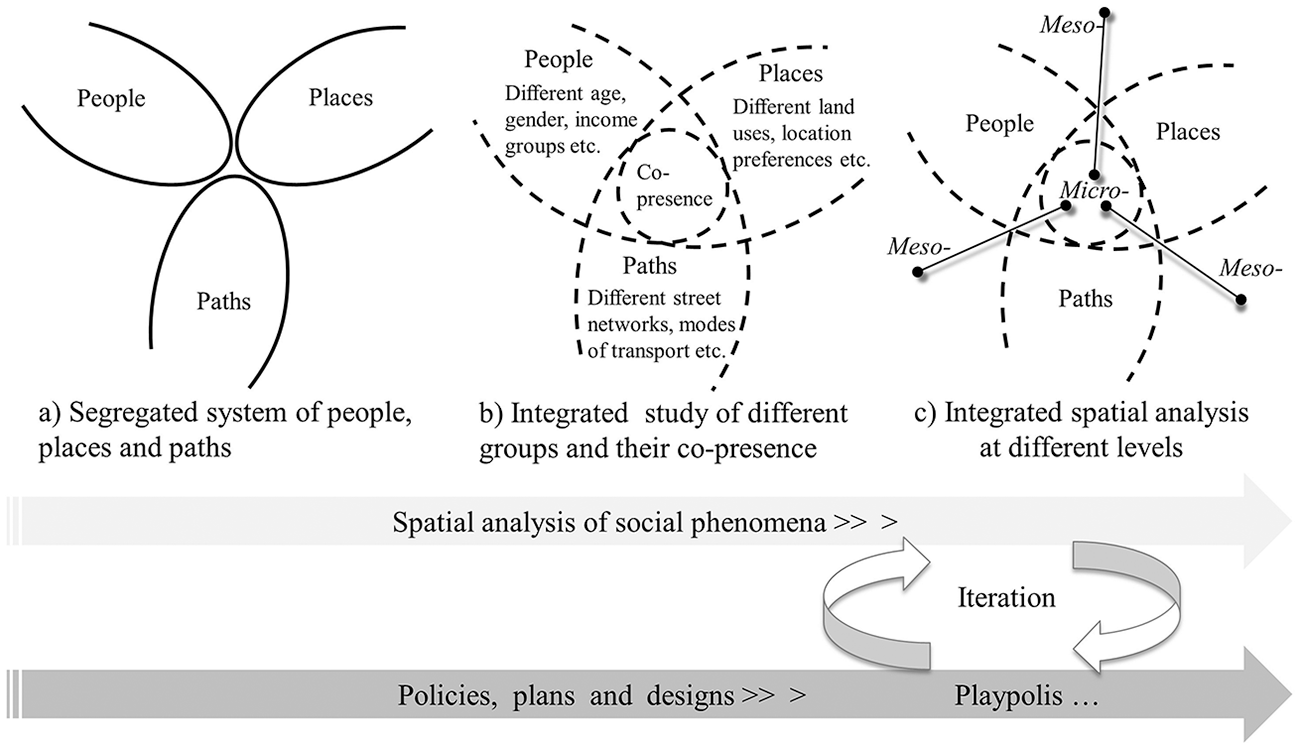
3P (People-place-path) as an integrated spatial analytical framework to study differential play spaces at multiple levels in the city.
Conclusion
Scholars highlight the implication of MMR in the process of de-disciplining, that is, looking beyond disciplinary boundaries by asking questions that lie in the borders of multiple disciplines (Hesse-Biber & Johnson, 2013). We described an MMR strategy that uniquely combines theories and methods in architecture and urban studies, children’s geographies, sociology, and psychology. Authentic participation of children and their community to help inform architectural and urban design is at the core of this strategy (Hart, 2011). Outcomes show high application potential of MMR and its integration strategies in expanding our understanding on the dialectics of urban space and children’s play, particularly in rapidly urbanizing South Asian cities. Dialectical understanding of space can facilitate new ways to alleviate practical urban problems by rethinking design paradigms in new urban conditions (Sargin & Savas, 2012).
The methodology proposed in this study can be scaled up by team research and applied to other high-density urban settings. While children’s play has been the key focus of this study, the integrated methodology can be explored to study outdoor activities of other age groups such as older adults. MMR approaches in this direction need to address limitations regarding small sample size, observation bias, and external validity of outcomes and interpretations. Practical issues such as availability of skilled workforce, time, climatic and local urban conditions need to be considered while applying MMR with explorative sequential design in children’s play environment studies. Future studies might explore greater potentials of MMR by explicitly comparing children’s drawings of dream play spaces to observed qualities of actual play spaces to reveal interesting gaps in current play space planning and design.
Supplemental Material
Appendix_1 – Supplemental material for A Mixed Methods Research Strategy to Study Children’s Play and Urban Physical Environments in Dhaka
Supplemental material, Appendix_1 for A Mixed Methods Research Strategy to Study Children’s Play and Urban Physical Environments in Dhaka by Md Rashed Bhuyan and Ye Zhang in Journal of Mixed Methods Research
Supplemental Material
Appendix_2 – Supplemental material for A Mixed Methods Research Strategy to Study Children’s Play and Urban Physical Environments in Dhaka
Supplemental material, Appendix_2 for A Mixed Methods Research Strategy to Study Children’s Play and Urban Physical Environments in Dhaka by Md Rashed Bhuyan and Ye Zhang in Journal of Mixed Methods Research
Footnotes
Acknowledgements
The authors are thankful to Dr. Cho Im Sik, Dr. Tracey Skelton, and the anonymous reviewers for their valuable feedback on the contents of this study.
Declaration of Conflicting Interests
The author(s) declared no potential conflicts of interest with respect to the research, authorship, and/or publication of this article.
Funding
The author(s) disclosed receipt of the following financial support for the research, authorship, and/or publication of this article: The study received financial support from the National University of Singapore Research Fund.

Supplemental Material
Supplemental material for this article is available online.
References
Supplementary Material
Please find the following supplemental material available below.
For Open Access articles published under a Creative Commons License, all supplemental material carries the same license as the article it is associated with.
For non-Open Access articles published, all supplemental material carries a non-exclusive license, and permission requests for re-use of supplemental material or any part of supplemental material shall be sent directly to the copyright owner as specified in the copyright notice associated with the article.
