



Abstract
In order to enhance core mixed methods research designs, social scientists need an approach that incorporates developments in the social constructionist perspective. This work describes a study that aimed to promote occupational well-being in hospital departments where employees are at risk of burnout, based on a constructionist inquiry developed starting from the Maslach Burnout Inventory. Taking this study as an example, we define a “generative sequential mixed methods approach” as a process that involves consulting quantitative studies to identify criticalities on which to conduct focused, transformative investigations. The article contributes by envisaging ways to mix qualitative and quantitative methods that consider a “generative” and “future-forming” orientation to research, in line with recent shifts in social psychology.
Various proposals have been advanced for integrating qualitative and quantitative methods, but not enough attention has been paid as yet to a social constructionist perspective, especially as developed in the field of social psychology (K. J. Gergen, 2015a). Although Holstein (2017) argues that social constructionism, in its many forms, is now thoroughly embedded in the analytical landscape of qualitative inquiry, social constructionist studies in the field of mixed methods seem rare. This may be partly due to constructionists preferring methods that traditionally focus on language, and rejecting the use of quantitative tools (McNamee, 2010; Romaioli & McNamee, 2020). Although some authors refer more broadly to a “constructivist” paradigm in mixed methods studies (Mertens & Tarsilla, 2015; Tashakkori & Teddlie, 2010), a research design that specifically incorporates recent shifts in social constructionist theory toward a generative research (K. J. Gergen, 2009, 2015a) still needs to be outlined.
Over time, there has been lively debate on mixed methods designs (Maxwell, 2019; Morse, 1991; Reichardt & Rallis, 1994; Tashakkori & Teddlie, 1998). Some authors suggested using interactive research designs that focus on the parts and processes of a study, bearing in mind that methodological choices are also shaped by external influences (Maxwell, 2012; Maxwell et al., 2015; Maxwell & Loomis, 2003). Others, like Creswell and Plano Clark (2017), pointed out some typologies variously named and assembled over time (Creswell, 2013; Leech & Onwuegbuzie, 2009). Three options are included in the currently widely utilized design taxonomy. One is called Convergent Mixed Methods Design, and involves using qualitative and quantitative methods simultaneously during the data collection phase. In this case, the goal is to obtain different types of data, which are then compared and interpolated with a view to arriving at more detailed and complex interpretations of the phenomenon being investigated. Another option, called Explanatory Sequential Mixed Methods Design, entails collecting and analyzing data using quantitative methods, then assessing the results using qualitative methods (such as focus groups): “The overall intent of this design is to have the qualitative data help explain in more detail the initial quantitative results, thus it is important to tie together or to connect the quantitative results to the qualitative data collection” (Creswell & Creswell, 2018, p. 369). In a third approach, called Exploratory Sequential Mixed Methods Design, “the researcher first begins by exploring with qualitative data and analysis, then builds a feature to be tested (e.g. a new survey instrument, experimental procedures, a website, or new variables) and tests this feature in a quantitative third phase” (Creswell & Creswell, 2018, p. 372). Although these various options can be put to different uses and combined with diverse worldviews—for example, the transformative paradigm, pragmatism, and so on (Creswell & Poth, 2018)—some authors have made the point that they seem to be implemented more readily within a postpositivist framework (Giddings, 2006; Hesse-Biber, 2010).
The present contribution aims to suggest another way to combine quantitative and qualitative methods, defining a “generative sequential mixed methods approach” as a process that involves consulting quantitative studies to identify criticalities on which to conduct focused, transformative investigations. This approach is particularly consistent with a social constructionist framework and takes a “generative,” or future-forming stance that we will discuss later (K. J. Gergen, 2015b).
Weinberg (2014) pointed out that one of the central distinctive elements of constructionist thought is its antifoundationalist sensitivity, an orientation that offers an interesting perspective for integrating different paradigms and research methods. Taking this view, every study paradigm is seen first as a social construction, inasmuch as it is rooted in cultural traditions that have contributed to legitimizing a particular view of the world, of the individual, and of science and its exploratory mandate (McNamee & Hosking, 2012).
In this sense, there is no one methodology that can be considered more true and well-founded than another (Tuli, 2011; Yilmaz, 2013). Social scientists can honor the diversity of philosophical positions informing research and its methods by placing them in a “mutually productive dialogue” (Maxwell, 2011a, p. 27). Instead of being interested in grasping what is most “true,”“valid,” or “right,” our attention should focus more on the potential implications of a particular way of interacting or conducting research—on the type of reality that might be legitimized by a study, for instance, and on its consequences for the study participants and/or for society as a whole (McNamee, 2012; Yvonne Feilzer, 2010).
Taking this perspective, there are no methods or tools of choice. As several authors have already maintained (McNamee, 2010), social constructionism is primarily a philosophical stance: The focus is on the process of coordinating researchers and participants, and consequently on what they construct together during the research activity. The social constructionist emphasis is on exploring the worlds that gradually open up, like the different forms of understanding that can originate from the investigation process (Gehart et al., 2007; Romaioli & Contarello, 2017).
In the reference frame that we have outlined, various examples and considerations link qualitative methods with a social constructionist research approach (Holstein & Gubrium, 2008), but relatively few attempt to find synergies and opportunities for dialogue between quantitative studies and the now-classic options of constructionist inquiry. Choosing from the great variety of philosophical views informing research, the present contribution specifically proposes to suggest ways in which postpositivist and social constructionist traditions can interact and be mutually enriching. In the following sections, these two paradigms are briefly introduced and some opportunities for dialogue are outlined. Then a study that led us to envisage a “generative sequential mixed methods approach” is presented, focusing on how the qualitative and quantitative methods were combined in line with recent developments in social constructionist theory. Limitations and implications of this proposal are discussed in the final paragraphs.
Postpositivist Tradition
The postpositivist paradigm posits that any psychological phenomena it aims to study are real in nature (Slife & Williams, 1995). Though this view is held much more widely (Maxwell, 2011b; Schwandt, 2015), postpositivist researchers often try to trace psychological events back to observable indicators. The assumption is that a reality can be identified and investigated in a manner independent of the observer providing the most rigorous methods are used.
Precisely because of this interest in arriving at ultimate and universal truths, the postpositivist tradition is usually applied to large samples. Studies aim to identify macrocategories for characterizing phenomena, which can consequently be defined with a high level of abstraction and generalization. The techniques used to analyze the data are strictly statistical, while the investigation methods usually involve administering carefully structured questionnaires (often proposing dichotomous answers) or tests that offer a limited choice of solutions (Oppenheim, 2000). In the psychological setting, the development and use of inventories often remains focused on the problems being investigated, and on devising items capable of describing them, or measuring the domains assumed to be at the root of a problem (or “pathology”).
Crucial Aspects and Possible Improvements
Various claims (coming not only from the constructionist side) raise concerns that research procedures are generally not neutral, and even risk contributing to the very construction of the problems they aim to elucidate (Conrad et al., 2014). The efforts intrinsic in our theories and our approach to identifying, distinguishing, and quantifying problems ultimately tend to reify their nature and consolidate dysfunctional realities, and may exacerbate them as a result (Romaioli et al., 2008). By concentrating their analytical efforts on the critical aspects of a situation, social scientists risk amplifying these problems, obliging people to frame their view of reality as a function of the categories suggested by the researcher (K. J. Gergen, 2015a).
On this issue, Schwarz (1999) says that social scientists often disregard how questionnaires are not just measuring tools; they also elicit a certain point of view in respondents. Questionnaires, or tests for that matter, also serve as a source of information that respondents use to orient their self-assessments. They provide a conceptual anchor that is implicit in the content of the items, and is consequently made salient, influencing a respondent’s answer. In Schwarz’s words: “Unfortunately, as researchers we are often not fully aware of the information that our questionnaires—or our experimental procedures . . .—provide, and hence miss the extent to which the questions we ask determine the answers we receive.” (Schwartz, 1999, p. 103).
In the present setting, what we wish to emphasize is that social scientists will never be neutral enough to prevent the way they pose a question from influencing the answer (Strack & Schwarz, 2007). The information they collect is “fallible” because any variation, however small, in the words they use, the phrasing of a question or the context in which it is posed will significantly influence the outcome of the study. While this is reasonable, a methodological approach that constructionism recommends (even for supporters of the postpositivist approach) is that social scientists take responsibility for their own lack of neutrality. In other words, they should wittingly manage this influence intrinsic in their research methods in order to pursue shared and socially relevant goals (Romaioli & Contarello, 2019). In fact, interpreted in a constructionist vein, this “influence” is simply the outcome of an incessant process of coordination between researchers and participants in the activity of producing meaning.
Social Constructionist Tradition
Social constructionist theory sees knowledge of reality as socially constructed and constantly changing (K. J. Gergen, 2015a). Observers construct their object of interest within a context of meanings that is created by people communicating with each other (Denzin & Lincoln, 2017). These considerations lend support to the idea that reality is not self-evident. Knowledge of it takes shape and substance depending on the languages culturally available for making sense of it. The emphasis of constructionist inquiry is thus placed on the meaning, and particularly on the relational activity of negotiating meanings in which people engage in their exchanges with one another (Romaioli, 2013).
Some readers may find similarities between these premises and the transformative paradigm (Mertens, 2009; 2010). In fact, social constructionism shares with this worldview the assumption that “there are multiple realities that are socially constructed,” and “to know realities, it is necessary to have an interactive link between the researcher and the participants in a study” (Mertens, 2007, p. 216). While the transformative paradigm prioritizes addressing “issues of power inequities, the impact of privilege and the consequences of these for achieving social justice” (Mertens & Wilson, 2012, p. 163), social constructionism considers this aim worth pursuing, but wonders about the benefit of research options that only adopt such a critical orientation. As K. J. Gergen (2015b) put it, although challenging the status quo . . . critical work typically discredits its targets (the powerful, colonialists, men, psychiatrists). While inciting resistance, the pejorative rhetoric galvanizes its opposition and lends itself to increased polarization . . . The likelihood of finding in such work a balanced weighing of competing views is slim. (p. 299)
Such considerations have prompted constructionists to rethink research more as a “generative,”“world-making,” and “future-forming” activity, in the sense that “the aim of research would not be to illuminate what is, but to create what is to become” (K. J. Gergen, 2015b, p. 294).
Moving from this perspective, some authors (i.e., Cooperrider & Whitney, 2001; Fry et al., 2001) have proposed studies in which participants are asked to focus on potential strengths, on the future, on solutions to problems, and their positive experiences, which can be shared and meaningful within a context of interaction (Romaioli et al., 2016). In other words, unlike studies that aim to define a problem, identify what is not working, and focus on these issues in an attempt to measure and control them, constructionist inquiry usually aims to emphasize what is working, or how things could be. It focuses on the expressive potential intrinsic in a group of individuals relating with one another (Seligman & Csikszentmihalyi, 2000). The core features of constructionist inquiry are therefore its orientation toward the future and its generative nature (Bushe, 2010; Newbury & Hoskins, 2010). It is a methodology that proposes to coconstruct narratives and actions that tend to pursue forms of contextual adaptation, soliciting the emergence of new ideas, and stimulating people to take functional action to achieve shared goals (Bushe, 2007; Bushe & Kassam, 2005; Morsillo & Fisher, 2007).
Crucial Aspects and Possible Improvements
Critics of this latter approach to research frequently claim that it creates conversational settings in which participants are strongly inclined to express the best of themselves. This does not prevent them from tacitly retaining problematic narratives, but the novel interactive conditions of an appreciative investigation would prevent them from emerging (Barge & Oliver, 2003; Fineman, 2006; Miller, 2008). Social constructionist theory emphasizes that it is what is significant in the here and now, in a given communicational setting, that is real and valuable to the individuals concerned. Even so, social scientists must bear in mind that the production of meaning is also the outcome of traditions extending into the past (K. J. Gergen, 2009). Sedimented and implicit constructions of meaning may remain silent or be actualized; either way, they influence present and future interactions. In other words, when dealing with complicated issues, focusing only on the solution may not suffice. It makes it hard for social scientists to understand and deconstruct dysfunctional narratives that people may have acquired over time in their relational history. As K. J. Gergen (2009) pointed out, many resist the [solution-focused] practice because they feel it gives insufficient room for the expression of their anguish. If their story of maltreatment and injustice is not heard, they say, then they cannot be understood. Their relational history is not sufficiently affirmed. (p. 330)
On the other hand, constructionist inquiries can presumably draw on postpositivist studies that have focused on statistically relevant criticalities instead, reconstructing particular forms of individual malaise. Awareness of these negative dimensions—however abstract, generalized, and reified—can help us foresee the criticalities in a given situation. They can shape our investigations so that we can first capture, and then challenge participants’ negative self-perceptions, which might go in unvoiced in the setting of a classic appreciative inquiry (Shuayb, 2014). Constructionist studies can glean important ideas from quantitative studies, and then focus on deconstructing any dysfunctional narratives that might not emerge during the conversation.
Integrating Postpositivism and Social Constructionism: An Example of a Study
To give an example of how social constructionist and postpositivist traditions can be integrated, we take a look at a study conducted in Italy, at Padua General Hospital, that aimed to support a change in the self-perception of nurses working in intensive care units (ICUs), promoting their awareness of the positive aspects of their profession. This study was prompted by the findings of previous research conducted at the same departments, which had revealed high levels of staff burnout. According to Maslach and Jackson (1986), burnout syndrome can be defined as a pathological outcome that mainly affects people working in care-providing professions when they fail to react appropriately to the burden of stress that their work entails. The emotional stress and tension that develop as a result of burnout contribute to a state of irritability and emotional excitability that can severely interfere with the way people work.
The Quantitative Phase
Setting and Instruments
By the time our research team was involved, a quantitative study had already been carried out by a psychologist 1 who subsequently became part of our team. Moving from a postpositivist logic, the aim of the quantitative study had been to examine the level of burnout of hospital nursing staff. In particular, the main goal was to assess burnout syndrome in three different departments: intensive care, operating rooms, and diagnostic outpatient facilities. These three types of service are very different in terms of their organizational, normative, and relational aspects (Morse, 2012), making it worth comparing the different levels of work-related stress in their paramedical staff.
The study was based on the Maslach Burnout Inventory (MBI) developed by Maslach and Jackson. Burnout is seen as a multifaceted phenomenon, with three main dimensions, “emotional exhaustion,”“depersonalization,” and “inefficacy” (as the opposite of “personal accomplishment”). The MBI is the tool most often used to measure these dimensions of burnout. Emotional exhaustion is identifiable in people feeling drained and tired, but unable to relax and regain their energy. According to Maslach et al. (2001), emotional exhaustion is the first reaction to the stress caused by the demands of the job, and cynicism is the first response to this reaction. Depersonalization describes how individuals can become cynical, and develop a cold and detached attitude to their work, and to the people they deal with, minimizing their own psychological involvement (Maslach et al., 2001). In other words, depersonalization is an attempt to protect themselves from emotional exhaustion and disappointment: It feels safer to become indifferent, taking for granted that things will not work out well. Inefficacy becomes apparent when such individuals experience a growing sense of inadequacy, and begin to perceive any project or initiative as tiring and oppressive. They consider what activities they do succeed in completing as more a matter of luck, and gradually come to deny their own abilities and expertise.
Participants, Data Collection, and Analysis
The study involved 401 nurses recruited from various hospital departments: 70% of participants were between 31 and 50 years; 18.7% were men, and 81.3% were women; 3.4% had been employed for less than a year, 59.4% had 1 to 20 years of work experience in hospital, and 37.3% had been working for over 20 years; 36.1% were working in intensive care units, 28.2% in operating rooms, and 35.7% in diagnostic outpatient facilities). The questionnaires were delivered to the department coordinators who administered them to employees. Statistical analyses to obtain the descriptive statistics reported below were conducted using the SPSS software.
Quantitative Results
The MBI generates scores indicating a low, moderate, or severe burnout. Of the 401 nurses in the sample, 98.5% completed the MBI properly. Table 1 shows that signs of burnout were widespread, but the departments with the highest percentage of employees with high MBI scores were the ICUs, where the study identified high levels of perceived emotional exhaustion (in 38.6% of respondents), depersonalization (in 53.1%), and inefficacy (in 36.5%).
Levels of Burnout Detected in the Three Departments.
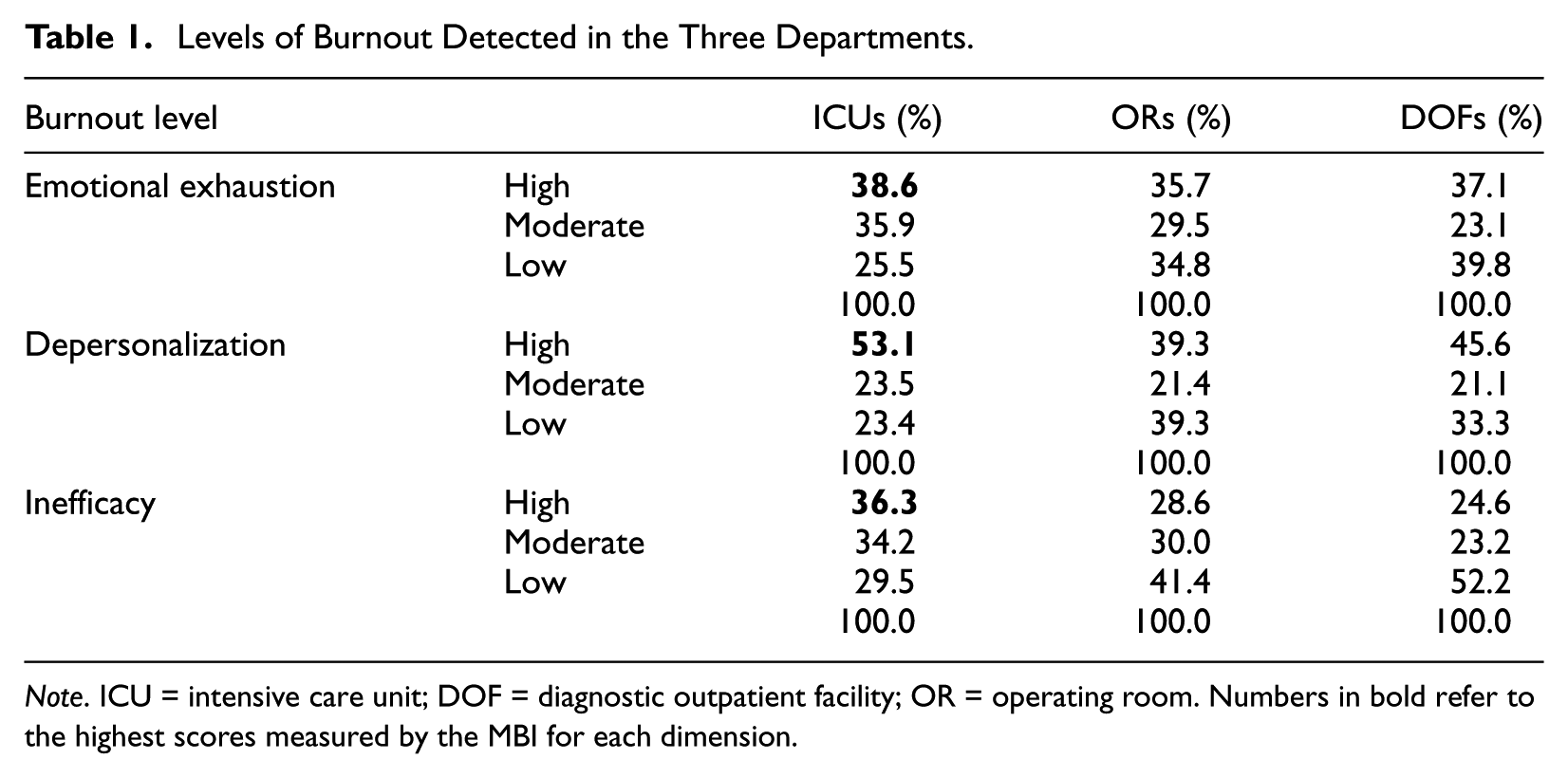
Note. ICU = intensive care unit; DOF = diagnostic outpatient facility; OR = operating room. Numbers in bold refer to the highest scores measured by the MBI for each dimension.
The Qualitative Phase
Setting and Instruments
After the quantitative study had been conducted, our research team was involved in an effort to support change in the ICU nurses’ self-perception. The fact that a diagnostic study had already been conducted was initially seen as a drawback, since our usual research/intervention approach is based on a social constructionist perspective. Adopting the classic stance of an appreciative inquiry (which aims to emphasize generic positive work experiences) seemed unproductive in a setting where nurses’ unease had already been highlighted. This situation subsequently emerged in a positive light, however, as it gave us the opportunity to focus our transformative intervention on the criticalities that the previous study had allowed to surface. By “criticalities” we mean participants’ negative self-perception as might emerge from an initial assessment. In this study, for instance, this could consist in a sense of emotional distress, depersonalization, inefficacy, or the like. We nonetheless avoided reifying the concept of burnout because—from a social constructionist viewpoint—burnout syndrome is primarily the result of a certain meaning-making activity (Fruggeri & McNamee, 1991). The dimensions considered by the authors of the MBI as constitutive elements of the problem were thus interpreted along the lines of an “archipelago of meaning,” or as semantic dimensions containing clues to dominant discourses in the sphere of life experiences that might be labeled as “burnout.” In the following section, we focus on the part of the study that enables us to emphasize how we refined our qualitative inquiry starting from the questionnaire administered, and taking into account the dimensions that emerged as problematic in the setting considered.
Participants
This part of the inquiry focused on the departments reporting high levels of burnout. After first contacting the managers of the three ICUs at the Padua University and General Hospital complex, the nursing coordinators at each unit were given letters explaining the purpose of the inquiry and asking for nurses who felt they needed personal support to volunteer. Social constructionists encourage inquiries in which researchers and participants cooperate, are transparent and frank, and work toward a transformation, paving the way to shared ethical meaning-making practices (Anderson, 2001). Twenty-one nurses were thus recruited, aged between 24 and 51 years (mean 38), with 2.5 to 31 years (mean 15) of work experience in the public health sector; 13 had a university degree in nursing sciences, and 8 had a secondary school diploma.
Data Collection and Analysis
Our qualitative inquiry involved administering ICU nurses an interview based on “unconditionally positive questions,” that is, questions designed to underscore positive perceptions of oneself and one’s working experience (Ludema et al., 2001). As Hosking and McNamee (2007) put it, positive therapeutic questions are worded so as to facilitate an account that is functional to the achievement of certain goals. Social constructionist inquiry bears a resemblance to therapeutic practices inasmuch as it has less to do with observing or measuring a reality, and more with challenging, disrupting, and transforming it (McNamee, 1994; Wulff & George, 2016). In this vein, Simon and Salter (2020) suggest that, since researchers always affect the context they are studying, it is important to declare this bias and put it to work. They can direct their “influence” to deliberately and collaboratively promote change concerning how people participate in conversations capable of challenging destructive dominant narratives (Strong & Knight, 2012). The assumptions underlying the use of generative questions are that the way in which social scientists ask questions influences their findings; and that inquiry and change are simultaneous. Stratton-Berkessel (2010, p. 29) wrote that we need to consider the direction of the question . . . For example, we are likely to receive different responses from the following two questions: (1) how was work today?, and (2) what’s the best thing that happened at work today? The first question usually elicits a response such as “ok,”“not bad” or “fine” . . . The second question focuses the attention on “the best thing that happened” and the conversation opens up and will head in a totally different direction.
With this aim, constructionist inquiry usually involves the art of crafting and asking questions that elicit possibility and inspire images of the future: “Through the affirming questions, the participants co-construct their realities, create new knowledge, and start to generate ideas about how they might apply this new collective knowledge wisely.” (Stratton-Berkessel, 2010, p. 35).
An initial prompt focused on generic positive work-related experiences in line with a classic protocol of an appreciative inquiry, as follows: Please think about your whole experience with your department, and the times when you have felt most engaged and alive . . .
In devising the subsequent inquiry protocol, however, our research team bore in mind that the ICU nurses had shown negative self-perceptions relating to the psychological dimensions of burnout syndrome. To deconstruct these critical dimensions, or potentially iatrogenic narratives, the interview was shaped around the MBI scales, but the items in the questionnaire concerning the problematic dimensions relevant to the research context were reformulated so as to pose questions capable of soliciting a more specific positive account of the dimension investigated, generating counternarratives about daily working life situations (Andrews, 2004). Some examples of how the items were converted for this purpose are given below:
Item: “I feel exhausted at the end of a day’s work.” 2
Generative questions: “How do you feel at the end of a day’s work? How does your work help you feel satisfied at the end of the day?” . . . “If there are days when you feel particularly tired at the end of your day’s work what do you do for feeling better? Which resources do you have to deal with work fatigue?”
Item: “I feel like I treat some patients as if they were objects.”
Generative questions: “How do you feel you treat your patients? How do you succeed in treating your patients with empathy and humanity?” . . . “Which tricks did you learn to face successfully demanding patients?”
Item: “I feel that working with people all day is a burden.”
Generative questions: “How do you feel about the opportunity to work with people? How do you benefit from being able to work with people?” . . . “What would you suggest to colleagues who think that working with people all day is a burden?”
Item: “I have the feeling my patients hold me responsible for their problems.”
Generative questions: “How do your patients show they are grateful for the work you do? How do you experience the satisfaction of solving your patients’ problems effectively?” . . . “What are the capabilities you display to manage responsibilities at work?”
Item: “I feel like I’ve had enough.”
Generative question: “In your opinion, what would be the most effective and constructive way to continue in your job?”
The questions reworded in this way were divided on the basis of the three dimensions considered in the MBI, but in a generative/reconstructive instead of diagnostic/symptomatic key, shifting: from emotional exhaustion to professional satisfaction, from depersonalization to the ability to deal with relationships, from inefficacy to perceived efficacy.
The interviews were audio-recorded, and conducted at the three ICUs by three psychologists over a period of 4 months. 3 The recordings were then transcribed word for word and a content analysis was conducted on this textual material (Charmaz, 1995, 2014). The themes and narratives generated by the interviews were shared with all participants, and with the hospital staff in general (Sandars & Murdoch-Eaton, 2017). In the classic protocol of an appreciative inquiry, the investigation aims to coconstruct a set of potential strengths and resources during the conversation with participants. Once participants have generated an empowered view of themselves by developing alternative narratives, the model involves circulating this content among the members of staff. The assumption is that making such narratives public can change the shared perception of a setting and the way in which individuals relate to one other, thus, creating other realities more in line with desired goals (for more details, see Cooperrider et al., 2008).
Qualitative Results
The interviews enabled various topics to be coconstructed relating to the macrocategories of interest. The main results are outlined below.
Job Satisfaction
The generative questions brought to light elements widely shared by participants that somehow enabled them to feel satisfied and proactive in their working activities, in contrast with the emotional exhaustion theorized by Maslach and Jackson (1986). Some of the main topics are listed below, indicating for each one the number of interviews in which they appear.
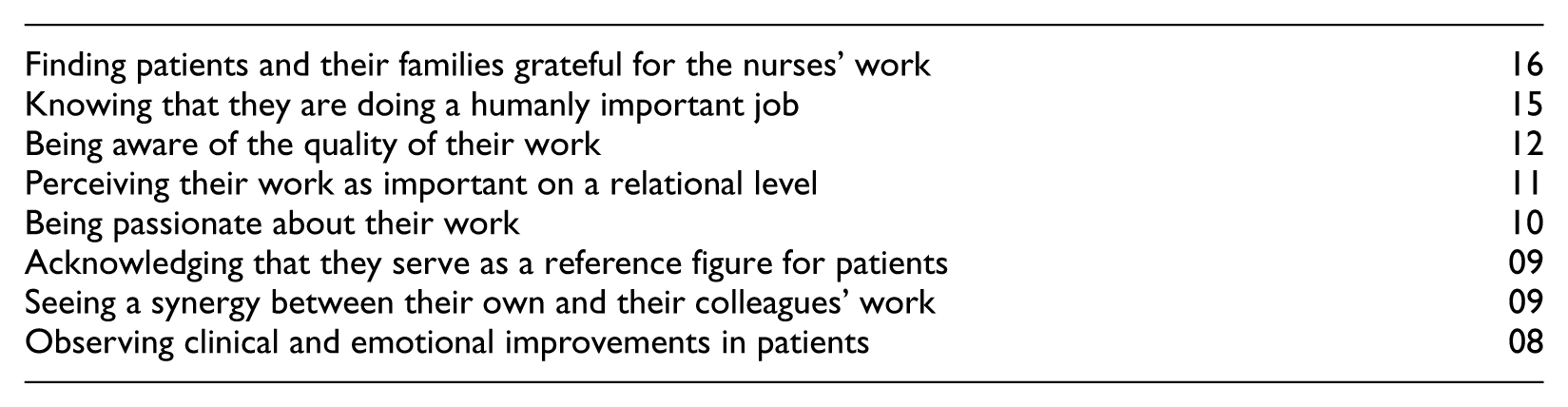
A few brief quotes from the interviews can provide some examples: I’ll always remember the look in a patient’s eyes when she said to me: “I’ll never forget you. I’m glad you’re here.” Yes, it’s very gratifying. There’s great satisfaction in seeing patients content, and wanting to thank you. For example, a patient may ask: “Will you be here tomorrow morning?.” Another reason to be satisfied that comes to mind is when there’s an emergency and you see that you succeed in going in and coping, in the sense that you make yourself useful and manage the emergency effectively and appropriately.
Good Relational Skills
Engaging in a generative conversation enabled many participants to feel that their nursing work positively affected their relational skills. These narratives contrast with numerous authors’ claims that individuals working in ICUs are more likely to develop a cynical attitude, a lack of empathy, and depersonalization. The main topics that the inquiry underscored, in order of frequency, were
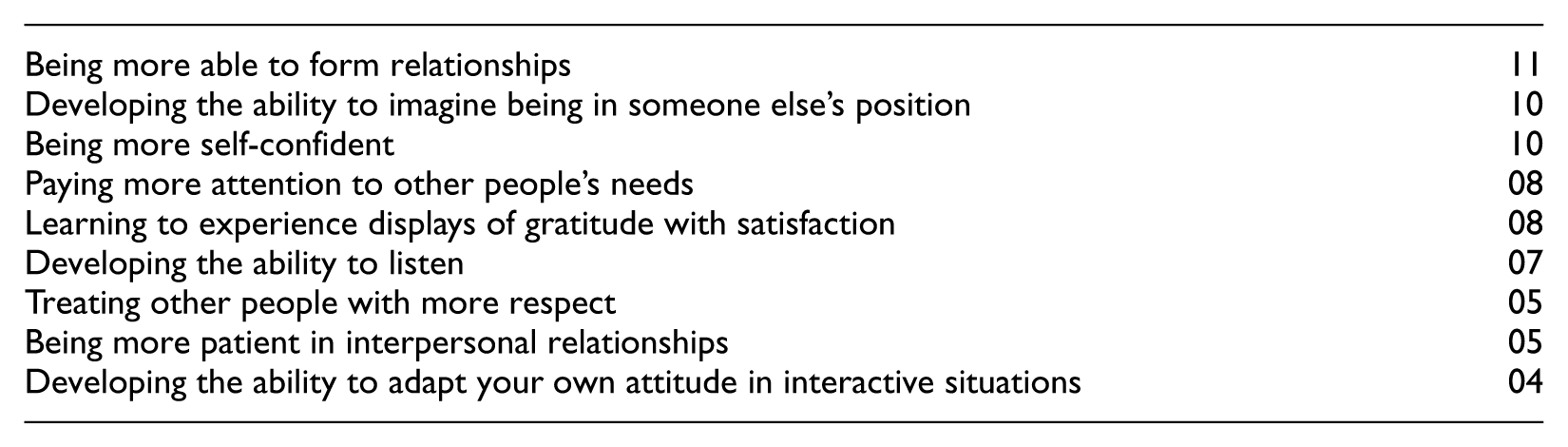
Some examples drawn from the interviews: I’m a bit impulsive by nature, but I’ve learned to be more diplomatic, more reasonable, and more patient. I’ve grown up a lot, character wise . . . partly because of the sense of life you get to know in here. In the sense that I see meaning in the different lives of other people. I’ve gained confidence in myself, whereas I’m usually very insecure, and it’s thanks to working in this department. I’ve learned especially to interact with people and understand that not everyone’s the same. We don’t all think the same way, and not everybody reacts the same way.
Perception of Professional Efficacy
Other significant elements coconstructed during the interviews illustrate the ICU staff’s perception of being effective and efficient in their work, and several facets came up frequently. The main points participants mentioned concerned:
Some more excerpts from the interviews illustrate these aspects: Experience! The fact of having seen so many similar situations, situations that repeat themselves, so I know what’s going to happen a bit later on . . . Learning from experience of what I do, so I’ve gained a dexterity that I didn’t have 20 years ago . . . I manage to do things because I’ve done them before. I deal with patients’ problems effectively thanks to my awareness of my professional expertise, and the fact that I’m not alone, but part of a team of people. For me it’s valuable when I realize that I know how to manage, I know how to learn from the practical aspects, here on the job . . . I’ve certainly matured from the professional standpoint.

Toward a Generative Sequential Mixed Methods Approach
The above-described study enabled us to focus on a form of inquiry that involved a particular combination of quantitative and qualitative methods. Because a quantitative study had already been conducted, we were prompted to adapt our usual inquiry practices. An effort to generalize the methodological solution that emerged, led to our generative sequential mixed methods approach. Taking this approach, an initial use of questionnaires and quantitative measures can investigate the criticalities of a given context to inform a subsequent qualitative investigation.
Such an approach is embedded in a social constructionist perspective. Quantitative and qualitative methods were used sequentially (Sandelowski, 2000), and some authors would argue that ours was a “qualitative driven” study (Morse & Niehaus, 2009), in the sense that the core part of the research is still the qualitative inquiry conducted according to the generative, relational, and appreciative mode suggested by social constructionism (Van der Haar & Hosking, 2004). The question that social scientists can ask themselves using such a generative sequential mixed methods approach is “Which are the critical dimensions of the research context that need to be deconstructed by means of a generative inquiry?” In answering this question, researchers can proceed in three stages, as follows:
Depending on the aims of the study, they can identify a quantitative tool for assessing participants’ self-perception on critical aspects relating to specific topics.
Following our example, the items of the questionnaire relating to dimensions emerging as critical from the quantitative study can be turned into generative questions.
These generative questions can be included in a protocol for an appreciative inquiry.
Following the principles for achieving integration in mixed methods designs outlined by Fetters et al. (2013), our approach involves integration at the method level by means of connecting that “occurs when one type of data links with the other through the sampling frame” (p. 2139): The interviewees involved in the generative inquiry are selected from the group of participants who respond to the questionnaire and show moderate-to-high levels of criticalities. The approach also involves integration by means of a particular kind of building as the results of the quantitative data collection procedure inform the construction of the generative inquiry. The unconditional positive questions are built on the list of items that fit the critical dimensions identified by the quantitative study as significant in the research setting. Figure 1 illustrates the three phases and related procedures and products.
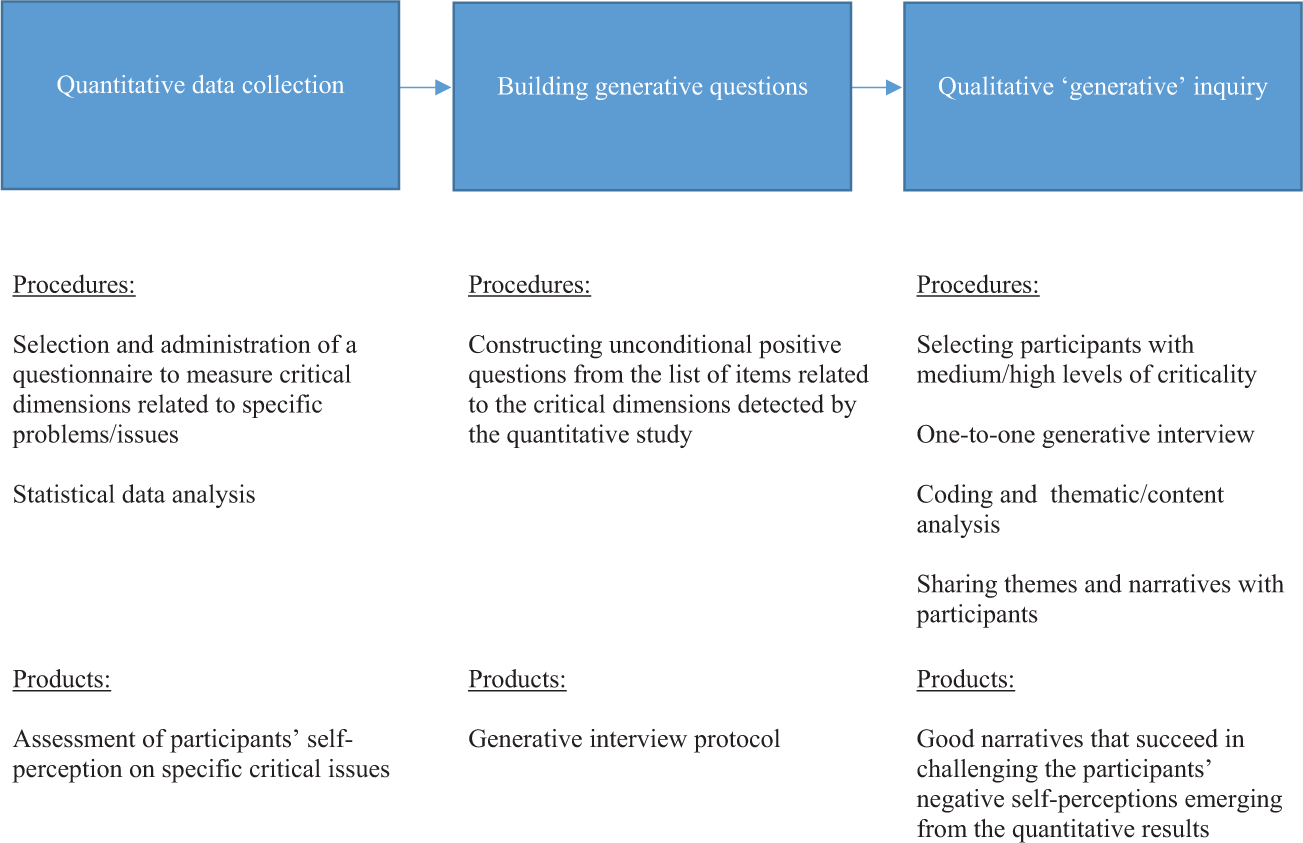
Diagram for a study that uses the generative sequential mixed methods design.
The generative sequential mixed methods approach could be classified among known core design typologies (such as the explanatory sequential design), in the sense that social scientists can begin by conducting a quantitative study and follow up on certain findings in a subsequent qualitative phase. Usually, “the qualitative phase is implemented for the purpose of explaining the initial results in more depth, and the name of the design—explanatory—reflects how the qualitative data help explain the quantitative results” (Creswell & Plano Clark, 2017, pp. 124-125). In our approach, on the other hand, the aim of the qualitative inquiry is not to explain quantitative results, but to challenge them by generating alternative views. In the same way, our proposal resonates with the transformative paradigm (Mertens, 2009), to the extent that research is intended as an intervention to promote change (Sweetman et al., 2010). In the transformative paradigm “a qualitative dimension is needed to gather community perspectives . . . while a quantitative dimension provides the opportunity to demonstrate outcomes that have credibility for community members and scholars” (Mertens, 2007, p. 212). In the case of the generative sequential mixed methods approach, however, the scope and the manner of integrating these methods are quite different. In our proposal, the quantitative measures adopted to identify critical issues are used as a starting point for generative inquiries that aim to deconstruct any such issues, and find exceptions to them.
Discussion
The above-described study enabled the social scientists to coconstruct narratives that helped the ICU staff to imagine a positive future for their profession, focus on aspects of personal satisfaction and self-efficacy, and further their positive relations with colleagues and patients. Being well aware that the way in which an inquiry is conducted contributes to the reality the study elucidates (Nylund & Corsiglia, 2019), the investigators designed the interview to encourage participants to activate changes that would have a positive effect both on their own well-being and on their working environment as a whole.
As mentioned earlier, from a social constructionist perspective, questions that aim to solicit positive narratives enable respondents to focus on the propositive aspects of their experiences, and this facilitates the coconstruction of narratives revealing a strong sense of self-efficacy and personal satisfaction. As Bushe (1998) put it, posing positively oriented, generative questions helps to promote a way of thinking, being, and behaving that leads to constructive change, empowering people to make organizations more efficient. This is especially true when the narratives solicited by such appreciative inquiries can be shared, amplified, relaunched, and used to support organizational practices (Cooperrider & Whitney, 2001).
The study discussed here was developed mainly around the problem of burnout, a condition of fatigue and frustration deriving from an overload of stressful commitments that are not sufficiently gratifying. Starting from a rewording of the items linked to the critical dimensions detected by the MBI, the interview was based on unconditionally positive questions and the main goal was to solicit and amplify proactive narratives about the nursing profession from ICU staff—a category identified by the mainstream literature as being at high risk of burnout (Vargas et al., 2014). The questions enabled participants to imagine resources and identify “unique outcomes” (White & Epston, 1990) and exceptions to the pathogenic conditions believed to be responsible for burnout (and usually measured by tests like the MBI). Participants’ answers covered various topics and emphasized numerous positive facets of their work at the ICU. Judging from a first informal feedback from the nurses, taking part in the inquiry made them feel more satisfied, and positively influenced their sense of self-efficacy and motivation to continue in their jobs.
As mentioned earlier, when using the generative sequential mixed methods approach, statistically relevant dimensions identified by quantitative surveys as contributing to the psychological or psychosocial problems of interest can be interpreted—from a social constructionist standpoint—as indicative of the narratives most often voiced by a given group at risk. Then a transformative qualitative inquiry can be used to coconstruct more harmonious points of view, finding exceptions to the dominant problem-centered discourses. The goal of research conducted using this reference frame is therefore not to arrive at accurate descriptions of phenomena (Rehner Iversen et al., 2005). It attempts instead to maximize the potential for change inherent in the exchange between social scientists and participants by amplifying new points of view that are functional to shared goals (as in many now classical studies based on appreciative inquiry). It also specifically deconstructs those dysfunctional narratives that quantitative studies bring to light.
Limitations and Future Applications
The generative sequential mixed methods approach suggests a rather useful way to include qualitative and quantitative procedures in a dialogue that takes into account the recent shifts in social construction toward a relational, generative, and future-forming way of conducting research. There has also been much debate on what can be legitimately called a mixed methods approach (Greene, 2008; Hesse-Biber & Johnson, 2015; Johnson et al., 2007). Some authors might define our approach as only “quasi-mixed” (Teddlie & Tashakkori, 2006), as it proposes neither sophisticated data integration, nor a real mixing at the level of philosophical paradigms, insofar as it remains centered within the social constructionist perspective. In our presentation, postpositivism and social constructionism are envisaged as “paradigms” for research, as they clearly influence research methods. Some authors have suggested, however, that such positions are either monolithic or foundational for research methods, and the use of a particular method is not intrinsically linked to a specific philosophical paradigm (Maxwell, 2011b, 2012).
Another limitation of the present proposal might lie in that there would be no need to give it a new label, partly because it could be included in the already-known categories if their interpretation is stressed a little, and also because the concepts of emerging (Morse & Niehaus, 2009) and interactive design (Maxwell, 2012) could both already be pertinent in elucidating the study presented here. In actual fact, the idea of a generative sequential mixed methods approach originated from a research setting that demanded a creative solution to what was initially perceived as a drawback, but later considered a resource. That said, we also agree with Creswell and Plano Clark (2017, p. 104) that core designs can be used “as a guiding framework to help inform design choices. As researchers gain more expertise with mixing methods, they are better able to effectively design their studies using an interactive or dynamic approach.” Since some social scientists who take a social constructionist perspective might be less familiar with the field of mixed methods, pointing out a general frame of reference that is explicitly congenial to them could help them to better shape a study from the beginning and grasp opportunities.
As regards the empirical study outlined, there are some further limitations that need to be acknowledged. The quantitative study was conducted to measure differences between the departments in the level of burnout. It did not separately consider single respondents and their item scores. For our purposes, it would have been more effective to analyze the impact of every single item in relation to each participant’s response, thereby achieving an even more refined and focused generative inquiry. Future studies could therefore envisage further levels of integration between the quantitative data and the qualitative inquiry, enabling a more accurate selection of the items on which to construct the generative questions, for instance, and showing how good narratives may vary, depending on the level of criticalities detected in participants. It would also be interesting to apply the generative sequential mixed methods approach to other contexts, such as organizations, schools or communities, using different quantitative tools and focusing on issues other than burnout.
Contribution to Mixed Methods Research
This contribution offers an example of what we call a “generative sequential mixed methods approach,” which involves identifying critical issues in self-perception from a quantitative study in order to conduct transformative inquiries that aim to deconstruct these issues and find exceptions to them. This approach more fully incorporates a social constructionist perspective in its recent shift toward a generative and future-forming orientation to research inasmuch as it enables researchers and participants to coconstruct positive narratives in search of personal and organizational change.
We argue that there are useful ways in which postpositivist and social constructionist traditions can join in a debate, taking criticisms raised by both sides into account, and working to overcome the drawbacks by envisaging alternative forms of inquiry.
In addition to recognizing the potential of social constructionism in the field of mixed methods research, our study also emphasizes the activist and performative dimension of interviewing (M. M. Gergen, 2020). This activist dimension focuses deliberately on the positive, hopeful dimensions of a participants’ experiences, engendering thoughtful reflective responses relating to their personal satisfaction and efficacy. With this orientation, the qualitative inquiry is aimed not at supporting or explaining the quantitative results, but at challenging these quantitative results with alternative views, coconstructing narratives of self-efficacy and success. An example of a joint display of integrated data collection in a generative sequential mixed methods design is presented in Table 2.
Examples of How MBI Items Were Used to Build Unconditional Positive Questions in the Burnout Study.
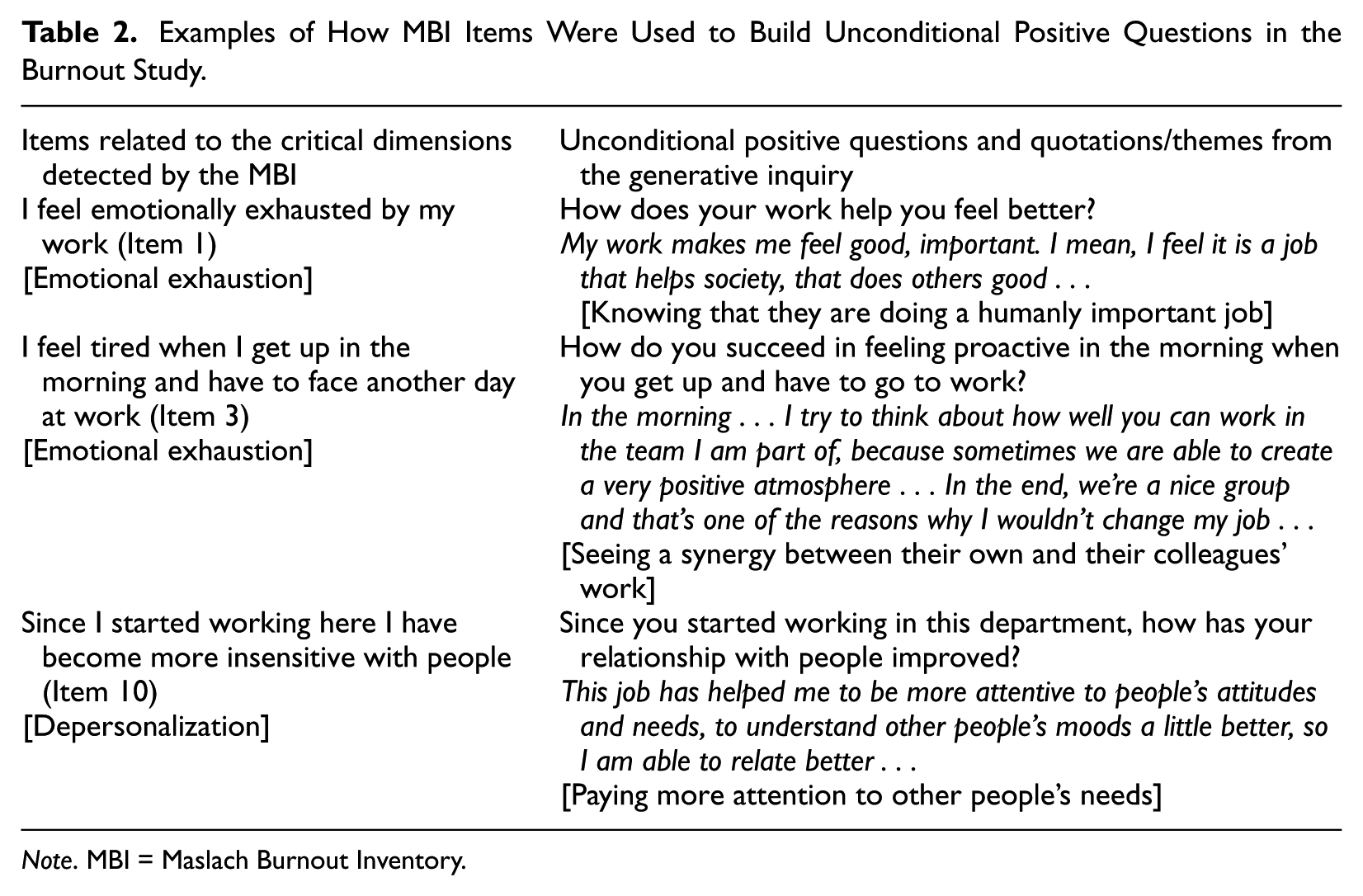
Note. MBI = Maslach Burnout Inventory.
In conclusion, from a methodological standpoint, we can say that conducting an initial assessment using questionnaires enables researchers to pick up the perceived criticalities of a given context. Using items of the critical dimensions measured by administering the questionnaires as a basis for devising unconditionally positive questions can consequently be a good choice for several reasons. For a start, it makes the construction of generative questions more focused and straightforward, as such questionnaires suggest an abundance of useful topics for studies that aim to deconstruct problems already investigated according to the postpositivist tradition. It also enables social scientists to focus on dimensions (in the sense of dominant narratives) that statistical studies have found relevant, and that have been widely accepted as shedding light on a certain problem. Then these dimensions, when found relevant in the research context, can be deconstructed by focusing participants’ attention on narratives that lead them to identify exceptions, or personal resources for coping with these problems.
Before this research, we saw postpositivist studies as irreconcilable with a generative, solution-centered approach of the type implemented in some developments of social constructionism in the sphere of social psychology. The core idea underlying the postpositivist orientation that the aim of research is to “reveal,”“reflect,” or “explain” a given state of affairs (K. J. Gergen, 2015b) seems to contrast with the constructionist assumptions that reality is constantly moving, that inquiring is like changing, and that our efforts to understand a problem risk amplifying it. Now, in the light of our research, we feel that a constructionist shift toward a strengths-based approach can even be more effective—providing it is handled with caution, otherwise we risk leaving some aspects of people’s perceived negative experiences unspoken. The idea of sketching these criticalities first, and then devising focused transformative inquiries could be a third way with a great deal of potential.
Footnotes
Declaration of Conflicting Interests
The author(s) declared no potential conflicts of interest with respect to the research, authorship, and/or publication of this article.
Funding
The author(s) received no financial support for the research, authorship, and/or publication of this article.
