




Abstract
This article addresses the essential yet often overlooked aspect of choosing a research topic in mixed methods research studies. Seven leading mixed methods textbooks are reviewed for insights into choosing a research topic which elucidates the dearth of specific guidance in the existing literature. Utilizing the established 13-step framework proposed by Collins et al. (2006), a new step is proposed that incorporates the process of research topic selection. This addition is intended to encourage thoughtful consideration of the research topic and make transparent decisions regarding topic selection, thereby ensuring coherence with the broader mixed methods research process. The framework is presented alongside an exploration of reasons for choosing a research topic and problem and is derived from the reviewed literature.
“Every research project needs to start somewhere, and I advise starting with a topic.” Mike Fetters (2019, p. 24)
Introduction
Where do research topics come from? This is a question that is elusive, as most researchers do not think about how research originates (Newman & Benz, 1998). Research has been defined as a “disciplined method of gaining new information, building knowledge, or answering questions” (Gliner et al., 2017, p. 3). The first step in research is to determine a research topic which is defined as “the broad subject matter area to be investigated” (Johnson & Christensen, 2020, p. 81). Having a deep understanding of where the research topic and problem stems from is important as understanding this choice impacts all aspects of the research study (Hesse-Biber, 2010). For example, how much of the research topic and problem comes from lived experience or a strength-based research motivation can assist the researcher in knowing the incentives and motives for the study. Research topics are different from research problems (Johnson & Christensen, 2020). Research topics, or “researchable idea,” is defined as “a specific topic within a content area of interest that can be empirically examined using QUAL, QUAN, or MM research methods” (Tashakkori et al., 2021, p. 91). A research problem is described as an “issue or problem within a broad topic area” (Johnson & Christensen, 2020, p. 627). Research problems stem from research topics; thus, a researcher should first identify a research topic and then select a research problem (Johnson & Christensen, 2020).
The importance of choosing a research topic and identifying a research problem for mixed methods studies cannot be understated. Mike Fetters (2019) included a helpful discussion of identifying a topic for a mixed methods research study. Fetters (2019) states, “A preliminary topic refers to the content, subject matter, or point of concern for your MMR or evaluation project. While many research experts urge starting with the research question, in reality, many people begin by experimenting with topics” (p. 24). Yet, upon examination of the Sage Handbook of Mixed Methods, only one chapter refers to the “content area, topic, and/or problem” to be researched (Plano Clark & Badiee, 2010, p. 277). The authors state “the content area, also referred to as the topic or research problem, represents the broad substantive subject matter of a study” (p. 276). This is a good working definition, but it would be helpful to have more information about how to decide on a topic and research problem. Furthermore, the extant mixed methods literature was reviewed using the following Boolean strings: “mixed methods research” and “research topic.” The ERIC EBSCO database located only three articles and Web of Science identified five articles. Unfortunately, none of these were methodological or helpful in understanding how to choose a research topic as the selection of the research topic impacts the value, impact, and rigor of the produced mixed methods research. Additionally, understanding how researchers choose a research topic improves the transparency of the research process which will increase the availability of high-quality mixed methods research studies.
Planning a Mixed Methods Study
When designing a mixed method study there are available frameworks and models to assist in the planning. Frameworks and models help as a road map for following the steps in a mixed methods research study (e.g., research topic, goal, objective, rationale, purpose, research question, sampling design, research design, data collection, data analysis, data validation, data interpretation, and writing the research report). For example, Newman et al. (2003) offer a framework for defining the study’s goals, Johnson and Christensen (2020) provide guidance on establishing the research objective, Onwuegbuzie and Leech (2006) offer direction on formulating research questions, Onwuegbuzie and Collins (2007) present a model for sampling from multiple frameworks in the design (e.g., Creswell et al., 2003; Morgan, 1998) and data analyses (e.g., Onwuegbuzie & Johnson, 2023). Additionally, Onwuegbuzie and Johnson (2006) provide a framework for legitimation, and various frameworks are available for data interpretation (e.g., Miller, 2003; Teddlie & Tashakkori, 2003) and report writing (Onwuegbuzie & Johnson, 2004). Regarding the conceptualization of research problems, Younas et al. (2023) provide guidance on the application of Elliott’s (2021) conceptual framework. Elliot recommends (1) the formulation of a “slogan,” a brief and superficial statement intended to capture the general situation; (2) the development of a general propositional model, which helps the researcher identify specific elements of the problem that may warrant investigation via a research study; and (3) the implementation of an agential model that explicitly identifies potential stakeholders, their motivations, and the influences extant in the group of interest that may help or impede the conduct of a research study. Currently, there are no known frameworks for considering the research topic, its direct relationship to the research problem, and its external influences for a mixed methods study.
The mixed methods research framework by Collins et al. (2006) is the most comprehensive framework available for conducting a mixed methods study as it incorporates the most steps (e.g., goal, objective, rationale, purpose, research question, sampling design, research design, data collection, data analysis, data validation, data interpretation, and writing the research report) of the mixed methods research process. Collins et al. (2006) state they developed this framework because, “a comprehensive framework [did] not exist for either the rationale or the purpose” (Collins et al., 2006, p. 73). The steps in the model include: (1) determining the goal, (2) formulating the research objective, (3) determining the research/mixing rational, (4) determining the research/mixing purpose, (5) determining the research question(s), (6) selecting the sampling design, (7) selecting the mixed methods research design, (8) collecting data, (9) analyzing data, (10) validating data, (11) interpreting data, (12) writing the research report, and (13) reformulate the research question (Collins et al., 2006). Each of these steps are beneficial as they delineate the process for successfully conducting a mixed methods research study.
The first step, determining the goal (Collins et al., 2006), is to “identify […] the overall, long-term aim of the study” (p. 70). The step of determining the goal of the mixed methods study (Collins et al., 2006) assumes that the content area has been chosen and that the researcher is ready to think through and plan the goal of the study. Choosing a topic can be difficult and is the “authentic starting point for research in the social and behavioral sciences” (Tashakkori et al., 2021). Thus, this paper is a call for more transparency: the purpose is to encourage researchers to make more transparent how topics are chosen for mixed methods research studies. Being transparent in how research topics are chosen can increase the rigor and quality of mixed methods results. We review seven mixed methods textbooks written by leaders in the mixed methods field for what they include regarding choosing a research topic and research problem. This investigation also includes if these textbooks have frameworks or other models for conducting a mixed methods study. Finally, a new framework for identifying a topic and problem for a mixed methods study is presented along with adding this step to the framework of Collins et al. (2006). It is hoped that our new framework will assist researchers in making choosing a topic for mixed methods research studies more transparent.
Mixed Methods Textbooks: Information on Choosing a Topic
To understand the available guidance for choosing a topic for a mixed methods study, we reviewed seven textbooks to evaluate what information was provided. Textbooks were selected based on the following criteria: (1) authored by a leader in the field of mixed methods research and (2) an overall focus on how to conduct mixed methods research from start to finish. We wanted the texts to be well-known, thus, we chose only books written by leaders in the field of mixed methods. The identification of these authors as leaders in the field was subjective, and not intended to be representative. Furthermore, the chosen books needed to have a focus on how to conduct mixed methods studies from start to finish so that there would hopefully be discussion of research topics. Many books (e.g., Bergman, 2008; Tashakkori & Teddlie, 2010) were considered but did not meet these criteria. We chose the following texts for our investigation: Creamer (2018), Creswell and Plano Clark (2018), Fetters (2019), Greene (2007), Hesse-Biber (2010), Morgan (2014), and Tashakkori et al. (2021).
Searching the Index
To begin our exploration of these texts, the index of each text was searched for the terms “research topic” and “research problem.” If the index included either of these terms, the pages referred to were searched. Authors typically include important concepts in the index (Bennion, 1980), so inclusion of these concepts within the index indicates the level of importance placed on these concepts by the authors. The main benefit of an index search is the discovery of relevant information, but there are limits; an index may include extraneous information and may omit pertinent references (Bennion, 1980).
Results of the index search revealed three texts that did not include research topic or research problem (Greene, 2007; Morgan, 2014; Tashakkori et al., 2021). Hesse-Biber (2010) did not include research topics in the index but did include “research problem stage” (p. 237). In the text related to the index entry for “research problem,” Hesse-Biber (2010, p. 178) underscores that it is important to focus not only on a review of the literature, but also on “subjective experience as a source of knowledge building.” Creamer (2018) did not include “research problem” in the index but did include “research topic”; however, exploring the pages referred to under research topics, very little information about research topics was found. Creswell and Plano Clark (2018) did not include research topic but did include “research problem suitability” (p. 487). The related text includes a discussion of how to identify a research problem suitable to a mixed methods study. Finally, Fetters (2019) includes an extensive list of related topics under the key term “research topic,” including “definition,” “identifying,” “passion for,” “preliminary,” “purpose,” “sourcing through stories,” and “writing.”
Guidance for Discovering Research Topics and Problems
Although most indexes searched did not all include guidance on where to find information on research topics and research problems for mixed methods studies, many of these textbooks did provide insight into where research topics may be discovered. For example, Hesse-Biber (2010) presents an approach for designing a mixed methods study with a discussion of how most mixed methods research begins with the method, which is putting the “cart before the horse” (p. 10). Instead of starting with the methods, Hesse-Biber (2010) argues that mixed methods studies should begin with a methodological perspective, which emphasizes the paradigmatic viewpoint of the researcher and leads to an exploration of ontological and epistemological considerations. This approach is beneficial because it nests the research problem within the methodology and mixed methods design, and considers extant literature, economic factors, stakeholder interests, and serendipity as external influences impacting the research problem.
Morgan (2014) describes a model based on Dewey’s (1933/1986) book How We Think. This model includes the following steps: selecting a problem, reflecting on the choice of the problem, considering the potential design, reflecting on the choice of the research methods, and conducting the research. The model does not advocate for a linear progression through these steps as it includes aspects of backtracking through the steps including reformulating the research question, developing a new research problem, reconsidering the research design, and developing a new solution to the problem. Research problems are described as “a situation in which your current range of experiences does not supply a line of action that would address the situation: instead, you need to think through the problem and search for a likely solution” (Morgan, 2014, p. 29). Morgan (2014) provides a helpful idea of reflection but does not provide how to select the topic or problem.
Creswell and Plano Clark (2018) discuss research problems that “require mixed methods” (p. 7). These authors state, In general, research problems suited for mixed methods are those in which one data source may be insufficient. Further, results often need to be explained, exploratory findings need to be generalized, a primary experimental design needs to be expanded or enhanced, multiple cases need to be compared or contrasted, the participants need to be involved in the research, and/or a program needs to be evaluated. Over the years, authors in the mixed methods field have enumerated multiple reasons (also called rationales) for using mixed methods (Bryman, 2006) (p. 7).
These are all excellent reasons or even purposes for conducting a mixed methods study, but these do not provide guidance for selecting a mixed methods research problem; instead, as these authors astutely observe, their listed reasons are rationales for conducting mixed methods research, not how to develop a research topic or problem.
Tashakkori et al. (2021, p. 85) suggest three “reasons for conducting research,” namely, (1) personal reasons, including career aspirations and the satisfaction of curiosity; (2) the advancement of knowledge, including the utilization of research to make predictions, develop explanations, or test new ideas or instruments; and (3) societal reasons, such as the empowerment of disadvantaged groups or general improvement of society as the result of research. These reasons are excellent reasons and helpful to note when considering conducting a mixed methods study.
The most comprehensive discussion of where research topics may be discovered is found in Mike Fetters’ (2019) book “The Mixed Methods Research Workbook” in the chapter entitled “Identifying a Research Topic for Mixed Methods Project.” Fetters (2019) describes identifying a research topic should be something that you are passionate about. So, you want to start out by asking yourself, ‘What is a topic that I am really interested in pursuing?’…What I am proposing is you must first think about what is a research topic that interests you or puts ‘fire in your belly’ (Ewigman, 1996)” (p. 39-40).
Fetters (2019) is by far the best description of how to locate a research topic available in the selected textbooks.
Planning a Mixed Methods Study: Inclusion of the Research Topic and Problem
When considering the overarching plan for a mixed methods study, there are frameworks and models for mixed methods researchers to follow. Unfortunately, many of these are not well developed or are incomplete as many do not include all the steps in a mixed methods research study (e.g., research topic, goal, objective, rationale, purpose, research question, sampling design, research design, data collection, data analysis, data validation, data interpretation, and writing the research report). For example, Creswell and Plano Clark (2018) present “Four Levels for Developing a Research Study,” which includes the following: paradigm worldview, theoretical lens, methodological approach, and methods of data collection (p. 35). Another framework is shared by Creamer (2018) which incorporates the following steps: (a) rational/purpose, (b) priority (qualitative or quantitative), (c) timing of data collection, (d) timing of data analysis, (e) where the mixing occurs, (f) meta-inference, and (g) value-added. Hess-Biber (2010) developed a “mixed methods process” (p. 76) which starts with the assumptions (ontology, epistemology, and methodology), mixed methods research problem and questions, literature review and ethical issues, data collection, stakeholder interests, data analysis, disciplinary structures, data interpretation, and writing of findings. Fetters (2019) is written as a workbook for readers to work through the chapters as they progress through a mixed methods research study, yet there is no overarching framework provided. Finally, Tashakkori et al. (2021) incorporate the following as steps for a mixed methods research process with an undergird of research context (social, cultural, and political): inputs (purpose, question, prior knowledge, paradigm), process (implementation and data collection), process (procedures for data analysis), outcomes (results and inferences), and consequences. Feedback loops are incorporated between inputs and process (implementation and data collection), and between process (procedures for data analysis) and outcomes.
Incorporating the Step of Choosing a Topic into the Mixed Methods Framework
Therefore, we propose incorporating the step of topic determination into the 13-step Collins et al. (2006) model, thus creating the following steps: (1) determining the topic, (2) determining the goal, (3) formulating the research objective, (4) determining the research/mixing rational, (5) determining the research/mixing purpose, (6) determining the research question(s), (7) selecting the sampling design, (8) selecting the mixed methods research design, (9) collecting data, (10) analyzing data, (11) validating data, (12) interpreting data, (13) writing the research report, and (14) reformulate the research question. The added step is intended to encourage researchers to thoughtfully consider the aspect of topic selection and ensure transparency in their interaction with the other steps of the mixed methods research process.
To assist researchers with the first step of determining the research topic and problem, a framework was developed based on the findings from the current investigation. Figure 1 presents the framework, which starts with thinking about stories (Fetters, 2019). According to Fetters (2019): Regardless of your discipline, one of the best sources of good ideas will be your own experiences. In your field, life, work, and readings, you’ll inevitably stumble upon problems and issues. These experiences are “stories” rooted in real issues that spawn ideas for research (Miller & Crabtree, 1990). These can be considered as “eyebrow-raising,” something that made you “stop and think,” something you observe(d) in your daily work that “didn’t make sense.” Perhaps, you have read something and then thought “that doesn’t make any sense!” or you’ll ponder the many choices about how you could do something, but there is “no clear best choice.” An inspiration for your work might be an article you have read about an injustice that occurred in your community, or perhaps there was a national event. What are the stories that have driven you to thinking about the topic you raise? (p. 13). Model for selecting a research topic and problem for a mixed methods study.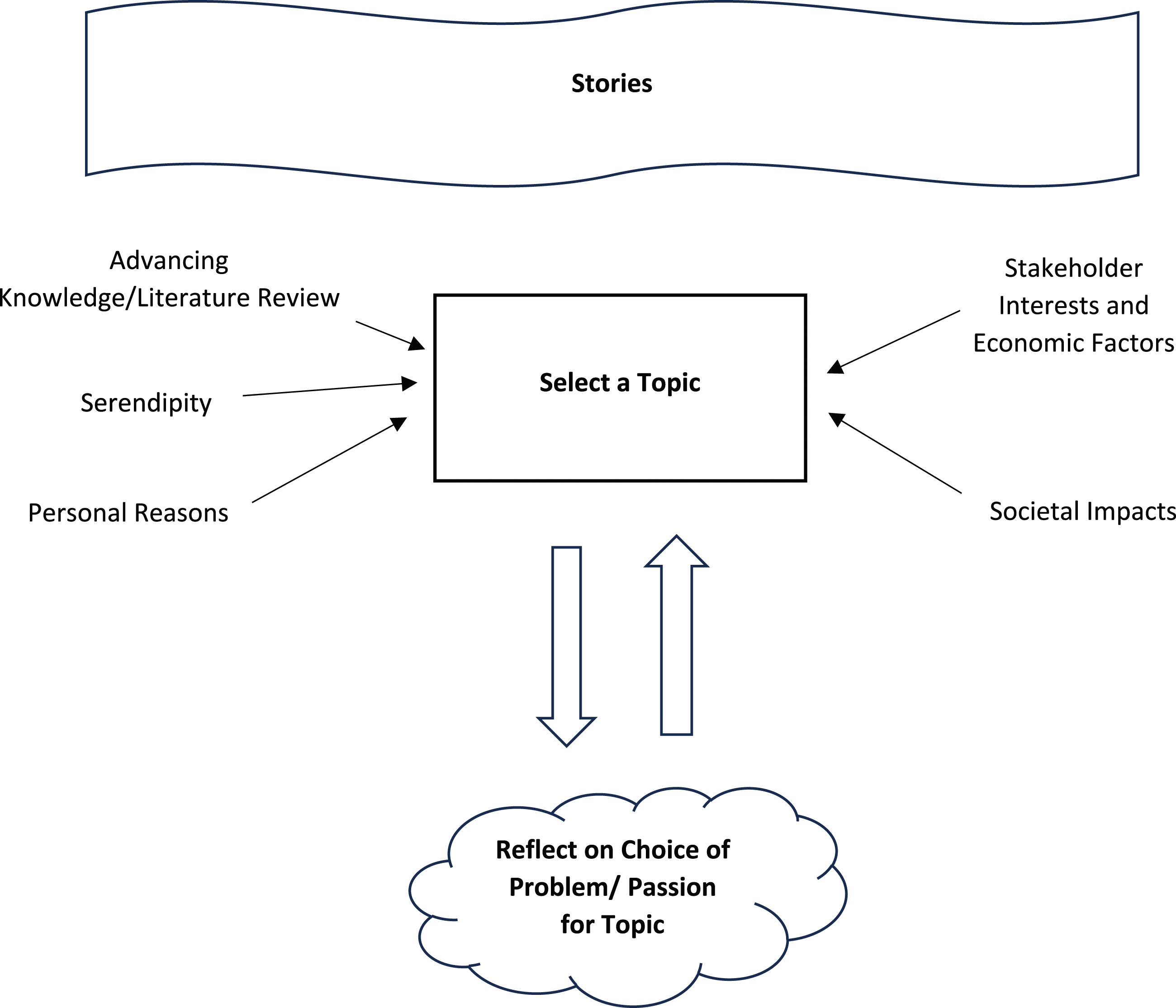
While thinking about stories from personal experiences, it is important to consider the following areas: advancing knowledge/literature review, serendipity, economic factors, personal reasons, stakeholder interests, and societal impacts. Advancing knowledge/literature review is focused on understanding phenomena, making predictions, generating new instruments and/or ideas, and adding to the extant literature (Hesse-Biber, 2010; Tashakkori et al., 2021). Serendipity (Hesse-Biber, 2010) is defined as an accidental discovery (Dictionary.com, 2024). Stakeholder interests and economic factors include groups who have an investment in the project and/or “constraints imposed by funding agencies” (Hesse-Biber, 2010, p. 13). Personal reasons incorporate aspects such as having a curiosity about a phenomenon or impacting the researcher’s career (Tashakkori et al., 2021), identifying a topic or problem outside of personal experience (Morgan, 2014), or “economic and lifestyle choices” (Hesse-Biber, 2010, p. 13). Finally, societal impact refers to improving institutions or communities and “to empower disadvantaged groups or constituencies” (Tashakkori et al., 2021, p. 85). During topic selection, reflection of the research problem should occur (Morgan, 2014) with a focus on passion from the researcher (Fetters, 2019). This may be a back-and-forth exercise as a researcher may utilize one or more reasons for selecting a research topic and then, upon reflection of the research problem, may need to go back and use other reasons for modifying the chosen topic (Morgan, 2014).
When contemplating conducting a research study, a researcher or research team should first think of a research topic. Using the framework presented in Figure 1, the first aspect to consider is stories from past experiences. For example, a researcher may have been a teacher in K-12 schools and wondered why teachers leave the field. While considering why teachers leave the field, the researcher would move to the next part of the figure and think through personal reasons, accidental projects that are available (i.e., serendipity), reviewing the extant literature, considering stakeholder and economic factors, and societal impacts in relation to teachers leaving the field. The researcher may review the extant literature, serendipitously have access to many teacher stakeholders who have left the field for other professional opportunities (perhaps due to economic pressures), want to understand why teachers leave to help current teachers to stay (i.e., societal reasons), and start to look for funding for the study from interested upstream stakeholders. After considering these aspects, the researcher would consider how passionate they felt about the topic and reflect on the topic. If the passion was high and the researcher felt the topic was interesting, then they would move to the next step in Collins et al. (2006) framework of determining the goal of the study. If they did not feel passionate or found that stakeholder interests were not aligned with the project goals, they could go back to selecting a topic and start the process again.
Concluding Thoughts
The purpose of the present article was to inspire researchers to make more transparent how topics are chosen for mixed methods research studies. Seven mixed methods textbooks written by leaders in the mixed methods field were investigated for (1) how they discussed choosing a research topic and research problem and (2) whether these textbooks included frameworks or other models for conducting a mixed methods study. Finally, due to the dearth of guidance and based on the extant literature, a new framework for identifying a topic and problem for a mixed methods study was presented along with adding this step to the framework of Collins et al. (2006).
Contribution to Mixed Methods Research
This article underscores the critical role of transparently selecting a research topic and research problem in the mixed methods research process; it is evident that topic selection is a crucial step in the formulation of any study and should precede the determination of the study design. It is the authors’ opinion that the methodology should suit the topic; nevertheless, it is often the case that the research topic is tailored to fit the researcher’s preferred methodological approach. Rather, by undertaking the process of topic selection and reflection, researchers approach all proceeding steps from the lens of their identified topic with an exhaustive understanding of the research problem’s nuances and manifestations in the field. For example, students and new researchers often choose to conduct a mixed methods study before considering a research topic or research problem: the researcher’s preference or expertise in mixed methods often outweighs their interest in the chosen research topic or research problem.
This is not unexpected, as graduate students have been found to believe “when done correctly, mixed methods has something for all readers, regardless of their philosophical worldview…[and] mixed methods is more rigorous than quantitative and qualitative methods” (McKim, 2017, p. 213); yet, choosing the method prior to exploring a research topic and research problem can lead to a misfit of method. Furthermore, not all research fits into a mixed methods research study: thus, researchers should consider the research topic and research problem first and then explore how using each monomethod and mixing methods would benefit the investigation into the research problem. By advocating for transparency in research topic selection, researchers can ensure the most appropriate methodology aligns with the identified research problem. The incorporation and formalization of topic selection contributes foundational precedent to the field of mixed methods research, aligning research problems with tried-and-true methodological solutions used to elucidate areas of interest.
The dearth of literature focused on topic selection and the omission of this step from existing frameworks illuminate a more significant problem faced by many students and academics. In traditional university settings, many students tend to affiliate with a specific methodological framework before finding a suitable topic—a practice misaligned with authentic research exploration. This misalignment emphasizes the need for further research into methods of topic selection, evaluation of these topics, and methodological-topic fit. Addressing these aspects is essential for promoting a more authentic and effective approach to mixed methods research.
Footnotes
Declaration of Conflicting Interests
The author(s) declared no potential conflicts of interest with respect to the research, authorship, and/or publication of this article.
Funding
The author(s) received no financial support for the research, authorship, and/or publication of this article.
