



Abstract
The relatively recent trend of mixing MMR with other methodologies represents a significant methodological advancement in the field and on examination spans a diverse range of methodologies. The purpose of this paper is to provide an overview of recent trends in inter-methodology mixing. The paper will provide signposts to the methodological literature that has begun to conceptualize and advance these methodological innovations and highlights examples of empirical studies that are adopting these new forms of mixed methodological types. The article provides a snapshot of the current state of this trend with particular reference to the mixing and merging of MMR with four established methodologies: grounded theory, case study research, community-based participatory research, and action research.
Keywords
Introduction
The evolution of MMR design has now been well documented, and a trend that is currently emerging is the combining and integration of methodologies through inter-method mixing and methodological merging. Additionally, there is acknowledgment across the MMR community that certain levels of creativity, flexibility, and fluidity are required in designing MMR along with openness to hybridity in terms of the myriad of MMR design typologies that are available. Importantly, there is general consensus across the MMR field that data integration principles and practices are essential in MMR (Fetters et al., 2013).
References to the mixing of methods can be traced back to Charles Ragin’s work on mixing data sets through Boolean algebra that allowed for the combining of variable and case-oriented research studies (Greene, 2008; Ragin, 1987). Molina and Fetters (2022) note the earlier work in the 1980s where literature began to explore the possibilities of combining qualitative and quantitative data (Bryman, 1988; Fielding & Fielding, 1986). Since then, the MMR field has experienced many advancements and at times intense phases of methodological development. Today, we are witnessing the emergence of an innovative trend towards the mixing of methodologies which is a relatively new development in the MMR field.
A distinction needs to be made between the terms methodology, research design, and method prior to introducing literature which describes certain methodologies as being inherently mixed and the discussion on the mixing of methodologies. Definitional ambiguities exist between these terms which are exacerbated by the fact that at times, methodology and research design are terms that are used interchangeably and that certain terms or labels can be used for both a methodology and a method (i.e., case study). Mackenzie and Knipe (2006) in their discussion of the differences between methodology and methods conclude that the “most common definitions suggest that methodology is the overall approach to research linked to the paradigm or theoretical framework while the method refers to systematic modes, procedures or tools used for collection and analysis of data” (Mackenzie & Knipe, 2006, p. 197). Greene (2008, p. 93) defines methodology as engaging “four domains of issues and assumptions: philosophical assumptions and stances, inquiry logics, guidelines for practice, and sociopolitical commitments in science.” Greene (2008) asserts that methodologies gain credibility through strong coherence between these four domains and to evidence this point describes how experimentalism and interpretive case study methodologies attain this coherence.
The confusion between the terms methodology and method and the distinction between them is also partly due to the fact that certain labels can be used to describe both a methodology and a method (O’Reilly et al., 2021; Sandelowski, 2003). For example, in reference to the term case study which can be referred to as a methodology or to the methods used to conduct the case study. Methods refers to data collection and analysis methods directly related to Greene’s guidelines for the practice domain and includes research practice activities such as interviews, focus groups, participant observation, surveys, experiments, and the associated data analysis techniques appropriate for each data collection method.
Additionally, there may also be obscurities between the terms methodology and research design. Creswell defines research designs as the “plans and the procedures for research that span the decisions from broad assumptions to detailed methods of data collection and analysis” (Creswell, 2008, p. 5). A research design is the overall plan, structure, framework, roadmap, blueprint, or strategy used to answer the particular research question/s posited (Babbie, 2004; Creswell, 2008; O’Sullivan et al., 2007). It involves systematic approaches and techniques used to plan the actual conduct of a study.
Many MMR scholars claim that there are certain methodologies which are inherently mixed, meaning methodologies which can use both qualitative and quantitative data collection methods within the same overarching methodology. Bazeley (2016) refers to inherently mixed methodologies as those which weave and merge methods as a means to pursue the different research goals they wish to attain. Johnson et al. (2010) refer to grounded theory as inherently mixed while Bazeley (2023) refers to ethnography, case study, Qualitative Comparative Analysis (QCA), and social network analysis as characteristically mixed. Onwuegbuzie and Johnson (2021) also refer to QCA as fundamentally mixed and also add Q Methodology and Geographical Information System (GIS) research to this unofficial catalog of the “inherently mixed.” Some of the earliest explicit conceptualizations of combining and integrating MMR with other methodological traditions are in reference to grounded theory mixed methods (Johnson et al., 2010) and mixed methods action research (Ivankova, 2015).
There has been a growing recognition and acknowledgment of this growth in methodological integration and mixing across the broader MMR scholarly community with different terms being used to describe this phenomenon, such as the intersection, integration, mixing, and merging of methodologies. Fetters (2022) acknowledged this trend by identifying articles published in JMMR that combined MMR with various methodologies such as ethnography, narrative research, case study, grounded theory, community-based participatory research, quasi-experimental intervention, and randomized control trials. Cameron and Golenko (2023) identified and highlighted several examples of these innovations in methodological mixing when exploring the maturing of the MMR field. They highlight a range of new methodological approaches and innovations that are emerging across the MMR scholarly community.
Creamer and Schoonenboom (2018) use the term “inter-method mixing” to categorize merged methodologies, which is the focus of a Special Issue of the American Behavioral Scientist. They argue that the core defining feature of MMR is its “commitment to the intentional engagement of multiple sources of data or analytical procedures to explore complex problems” and that “the field may now be at the point that we can consider mixed methods as an inquiry logic that has the potential to spawn the construction of new methodologies” (Creamer & Schoonenboom, 2018, p. 880). The special issue contains a collection of articles which engage with “inter-method mixing” with an array of qualitative methodologies and contain reflections on the utility of MMR within that mix of methodologies and the resulting synthesis it creates.
Other terms being used to describe and label this emerging trend include the “scaffolding” or “intersecting” of methodologies (Molina-Azorin & Fetters, 2018). Fetters (2020) goes on to introduce a framework that in part can assist in structuring these intersections between methodologies. He introduces the concept of “scaffolded mixed methods designs” which expand upon core designs. The rationale for the scaffold is to provide researchers with an underlying structure to enable the expansion of MM designs. These are defined as follows: “Scaffolded mixed methods designs, also sometimes called advanced frameworks, complex designs, or intersected designs, are plans that involve the collection and analysis of both qualitative and quantitative data, are built with a core design or combination of core designs, and are typically integrated with another design and/or theory or ideology (Fetters, 2020, p. 81).
Fetters presents three types of scaffolded MM designs: (1) mixed methods integrated in multiple stages or phases; (2) mixed methods integrated with another methodology; and (3) mixed methods integrated with a theory (Fetters, 2020, p. 81).
Schoonenboom (2018) has developed a multimethodology approach and distinguishes between mixed methodologies (combining different methodologies) and merged methodologies (creating a new methodology). She defines mixed methodology as: “… a methodology with more than one research strand, each of which is conducted according to a different methodology. Examples of mixed methodologies are the case study and ethnography … In addition to such established mixed methodologies, a mixed methodology comes into being whenever a researcher combines two or more research strands, each belonging to a different methodology, within one study” (Schoonenboom, 2018, p. 1004).
Merged methodologies on the other hand are described as a methodology which is created with only one research strand and in which elements from another methodology are merged within it, thereby creating a new methodology (Schoonenboom, 2018).
For the purposes of this paper, and to respond to the array of terms that are being used to describe the mixing, integrating, and merging of methodologies, the broad umbrella term of inter-methodology mixing will be applied to refer to the integrated methodology types being presented. This term provides a broad base representation for the array of terminology currently being applied and discussed above. Inter-Methodology Mixing (I-MM) is defined as a broad overarching term that refers to the many forms of mingling, mixing, and blending between different methodologies. While the field acknowledges the nascent nature of inter-methodology mixing, it has yet to address these advancements in a coherent manner that reflects the emergent nature of these innovations and their development across a broad array of research disciplines and methodological traditions. Nonetheless, methodological advancements are occurring within certain types of inter-methodology mixing and literature is beginning to appear that provides guidance, models, and frameworks for positioning and naming these innovations.
Contribution to Mixed Methods Research
The key purpose of this paper is to provide a directory and useful signpost to key literature for those wishing to explore this trend in inter-methodology mixing that mix MM with a set of other methodologies. This article offers a concise overview of a set of specific I-MM types, along with the corresponding MM notations researchers are assigning to them which tend to follow established MM notation conventions. Key methodological literature and empirically applied studies are presented for four I-MM types. These four I-MM types have been chosen as for two reasons: (1) they have deeper histories in the MMR methodological literature more generally and (2) the literature associated with them is offering advancements in terms of systematic reviews, best practices, guidelines, and frameworks to guide others wishing to pursue such I-MM approaches.
This is followed by highlighting two key publications that support practical application in designing I-MM and a taxonomy for a proposed naming convention for these I-MM research designs. The paper concludes with areas for future exploration and key issues that need to be addressed to ensure the MMR field can capture and adequately reflect the methodological advances and features of these intersected, integrated, and merged methodologies systematically and consistently.
Inter-Methodology Mixing (I-MM) Types
Summary of MMR Inter-Methodology Mixing Types.
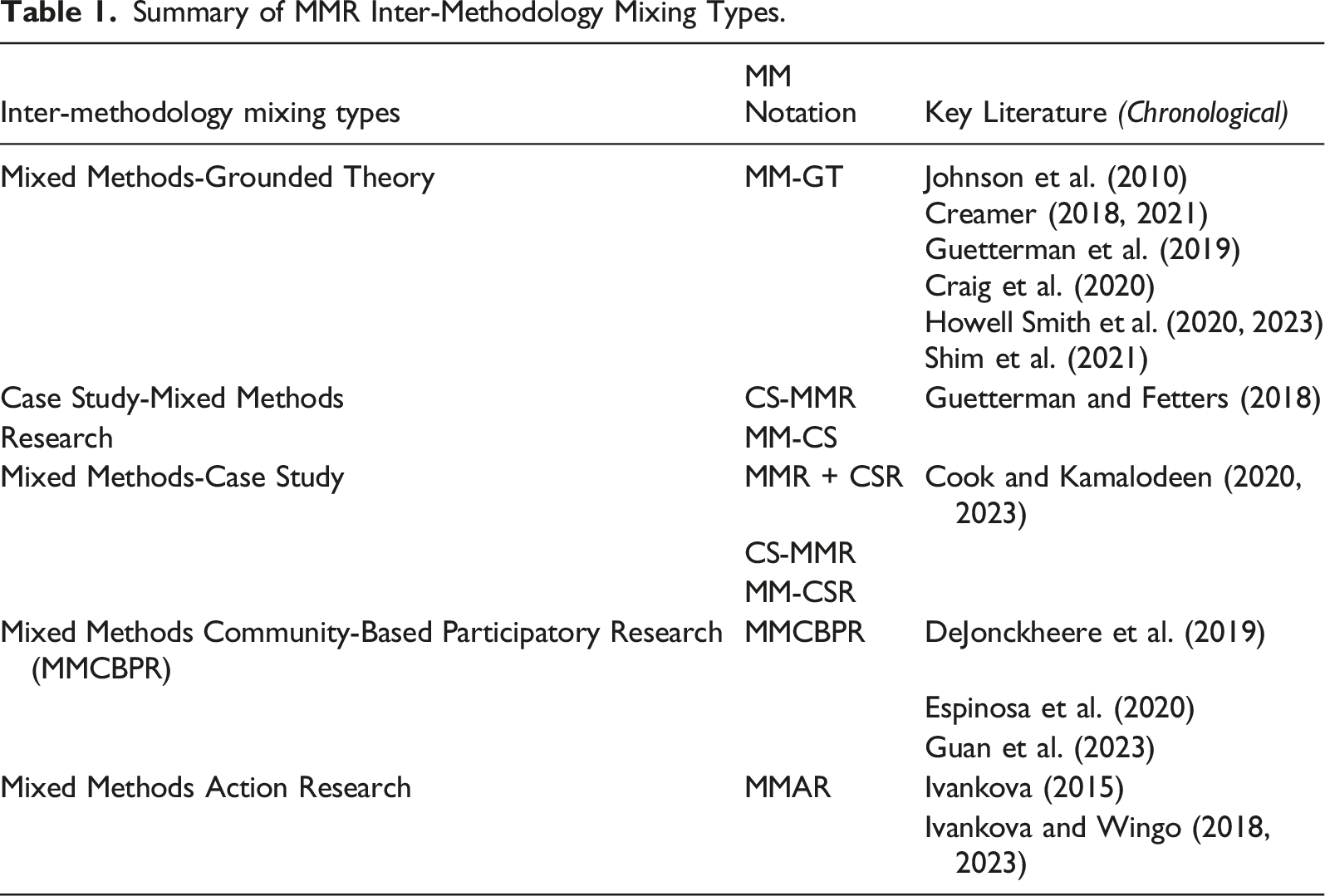
To accommodate word constraints, summaries of each inter-method mixing type are provided.
Mixed Methods Grounded Theory (MM-GT)
The first inter-methodology mixing type to be summarized combines MM with grounded theory (MM-GT). Grounded theory is a methodology which utilizes inductive thinking to generate and construct theory that is grounded in empirical reality. Grounded theory is considered as an emergent methodology used to generate emergent theories that can explore “unchartered, contingent, or dynamic phenomena” (Charmaz, 2008, p. 155). This allows researchers to discover processes grounded in the empirical world and to “direct their methodological strategies accordingly” (Charmaz, 2008, p. 155). Grounded theory entails developing increasingly abstract ideas about research participants’ meanings, actions, and worlds and seeking specific data to fill out, refine, and check the emerging conceptual categories. Our work results in an analytic interpretation of participants’ worlds and of the processes constituting how these worlds are constructed (Charmaz, 2005, p. 506).
Johnson et al. (2010) first referred to the concept of mixing GT with MMR, this was followed by Babchuk (2015) and then advanced more significantly by Creamer (2018, 2021). Guetterman et al. (2019) examined 61 applications of MM-GT and offered a set of best practices and procedural guidelines for conducting MM-GT. These best practices and procedures are developed further by Howell Smith et al. (2023) in a comprehensive coverage of literature that summarizes the methodological development of MM-GT designs and updates the practical guidance procedures for these design types. They also touch on anticipated future developments such as the creation of MM-GT specific designs and new ways of intersecting MM-GT with other methodologies such as case study research.
This set of literature is a useful starter kit for those wanting to learn more about MM-GT and its first conceptions, theoretical reasoning, and foundations. Examples of empirical studies which apply MM-GT designs can be found in Craig et al. (2020), Howell Smith et al. (2020), and Shim et al. (2021). Craig et al. (2020) combine grounded theory with an integrative mixed methods design using a large mixed methods cross-sectional survey sample to develop a theory to describe how sexual and gender minority youth navigate online negativity. Howell Smith et al. (2020) provide best practices and procedural details for conducting an MM-GT study in the field of engineering education. They utilize an MM-GT exploratory sequential instrument development research design. Of particular value is the article from Shim et al. (2021) which looks specifically at explaining how to construct MM-GT designs and offers an exploratory-confirmatory MM-GT design focused on theory development and testing.
Mixed Methods and Case Study (CS-MMR and MM-CS)
Case study (CS) methodology is defined by Yin (2009, p. 18) as “an empirical inquiry that investigates a contemporary phenomenon in depth and within its real-life context.” This is especially so when the edges are blurred between the confines of the phenomenon and the context in which it is situated. CS methodology entails the study of a case or cases in which the researcher needs to define the parameters or boundaries of the case. This is referred to as bounding the case. Yin (2009) proposes three types of CS all with different purposes: descriptive (describe the phenomenon), exploratory (use the case study to identify and develop research questions and procedures for a subsequent study), and explanatory (explain the how and why of a phenomenon).
The second inter-methodology mixing type combines CS research with MM. A key study in relation to these design types was undertaken by Guetterman and Fetters (2018). They conducted a systematic review of published studies that integrate MM with case study designs (n = 81) and analyzed these against the two types of integrated MM and CS designs they developed, the case study MMR (CS-MMR) design and mixed methods case study design (MM-CS). They define these two design types as follows, “In a mixed method–case study design (MM-CS), researchers employ a parent mixed methods study that includes a nested case study for the qualitative component. In a case study–mixed methods design (CS-MM), researchers employ a parent case study that includes a nested mixed methods design” (Guetterman & Fetters, 2018, pp. 901–902). The figures representing the two designs are particularly useful in visually depicting the distinction between these two designs.
Cook and Kamalodeen (2020, 2023) also refer to the intersection of case study research with MMR (MM + CSR) and introduce two designs, “the deductively driven design (case study-mixed methods research (CS-MMR)) or the inductively driven design (mixed methods-case study research (MM-CSR))” (Cook & Kamalodeen, 2020, p. 47). CS-MMR research starts with a CS and then embeds MM within it, whereas MM-CSR commences as an MMR and after data analysis cases are generated (Cook & Kamalodeen, 2023). Although these two MM + CSR designs equate closely to the two designs described by Guetterman and Fetters (2018), there are subtle variances between them.
Community-Based Participatory Research and MMR (MMCBPR)
The third inter-methodology mixing type combines MM with community-based participatory research (MMCBPR). Community-based participatory research is defined as, “an orientation to research that focuses on relationships between academic and community partners, with principles of colearning, mutual benefit, and long-term commitment and incorporates community theories, participation, and practices into the research efforts” (Wallerstein & Duran, 2006, p. 312). It takes place in local community settings with community members and empowers all stakeholders through collaboration and respect.
DeJonckheere et al. (2019) undertook a review of published studies using both approaches in the health sciences (n = 129). The analysis and findings informed a set of recommendations for best practices for those wishing to combine these two methodologies. Refer to Espinosa et al. (2020) and Guan et al. (2023) for examples of empirical articles applying and reporting MMCBPR designs.
Mixed Method Action Research (MMAR)
Action research is known by several names (participatory action research, action science and action learning, and co-operative enquiry), and like grounded theory, it is an emergent methodology, which is iterative and cyclical. Action research (AR) is defined as: … a participatory process concerned with developing practical knowing in the pursuit of worthwhile human purposes. It seeks to bring together action and reflection, theory and practice, in participation with others, in the pursuit of practical solutions to issues of pressing concern to people (Reason & Bradbury, 2008, p. 4).
The last inter-methodology mixing type to be presented combines MM with action research (MMAR). Mixed methods action research (MMAR) was first conceptualized by Ivankova (2015) through the development of a MMAR framework which overlays the traditional action research cycle with MMR across the five phases in the AR cycle/s: diagnostic phase (identifying issue/problem), reconnaissance phase (preliminary assessment of the problem), planning phase (designing of data collection), acting phase (intervention undertaken), and monitoring phase (ongoing monitoring and evaluation) (Ivankova, 2015). A mix of data collection methods can be undertaken across all phases although unlikely to be during the intervention phase.
The original MMAR framework was further advanced by Ivankova and Wingo (2018). Encapsulating and building on the synergies between the two methodologies. Conceptual, philosophical, and procedural similarities between mixed methods and action research make integration possible and justifiable. Combining the two approaches can produce more scientifically sound and transferable results by synergistically integrating qualitative stakeholder engagement with quantitative outcomes to inform action/intervention planning, implementation, evaluation, and monitoring (Ivankova & Wingo, 2018, p. 978).
They then made even further advancements by “intersecting” MMR with action research (AR) and community-based participatory research (CBPR) in the field of education. In doing so, they explain the “conceptual, philosophical, and methodological features of MMR, AR, and CBPR and discuss the advantages and challenges of intersecting them within a study. We introduce a mixed methods action research (MMAR) framework and, using examples from three studies that intersected MMR with AR and CBPR in different phases” (Ivankova & Wingo, 2023, p. 567). This MMAR framework serves a similar purpose to Fetters’s(2020) scaffolding framework.
Integrating methodologies by combining three methodologies represents another innovative development and signals even further complexity in the I-MM space. Such developments provide even further impetus for what Fetters (2022) advocates and argues for, the adoption of a systematic naming convention across the MMR field for the varying ways MM is being combined, intersected, and integrated with other methodologies.
Guidance for Inter-Methodology Mixing
Two key pieces of literature are now proffered as guidance for researchers wishing to further advance their methodological understandings and research through the combining and integration of methodologies. The first is a model to guide the mixing and merging of methodologies developed by Schoonenboom (2018). As discussed earlier, she makes a distinction between two types of multimethodology, mixed methodology research and merged methodology. Mixed methodology research, “contains two or more separate research strands, each designed according to a different methodology” and merged methodology research occurs when “a researcher creates a new methodology by combining elements from existing methodologies” (Schoonenboom, 2018, p. 998).
Schoonenboom’s (2018) 13-Step Model for mixing and merging methodologies is based on a set of ten methodology building blocks for a multimethodology approach. These include “research questions, methodologies, remote research purposes, immediate research purposes, research purpose types, scope, research strands, purpose of mixing, purpose of merging, and mixed and merged methodologies” (Schoonenboom, 2018, p. 998). The thirteen steps are structured in the model across four levels and have been designed to provide guidance and support for those researchers who are wanting to mix and merge methodologies.
The second key publication is by Fetters (2022) who draws upon his years as co-editor-in-chief of JMMR (2015–2022) to address the issues and challenges of naming conventions in this growing category of studies that intersect, combine, mix, and merge methodologies. This lack of consistency in naming conventions leads to uncertainty, confusion, and muddies the field. Fetters (2022) advocates for a taxonomy and a systematic naming convention to counter the effects of this confusion in MM design naming conventions and proposes a “unifying and comprehensive mixed methods design taxonomy” (Fetters, 2022, p. 394). His taxonomy is based on seven dimensions or facets of integration and include methods, design families, methodological, theory, paradigm, philosophical orientation, and field. His claim is that the “proposed taxonomy provides a basis for unifying thought across methodologists by clearly acknowledging and embracing the different dimensions of emphasis and sophistication on mixed methods designs” (Fetters, 2022, pp. 405–406). He hands the baton over to the wider MMR scholarly community to contribute to this ongoing dialogue and debate and invites further commentary on these innovations and associated issues.
Limitations, Future Research and Contributions to the MMR Field
This article has a limitation in that it summarizes the inter-methodology mixing of MMR with a set of four methodologies. As a result, it does not cover inter-methodology mixing with other methodologies outside these four. Future research could further explore this emerging taxonomy of inter-methodology mixing with quantitative approaches and other qualitative approaches to broaden the scope and mapping of this emerging methodological trend. In addition to this, further research could explore to what extent new methodologies are being developed as anticipated by Creamer and Schoonenboom (2018) and Schoonenboom (2018).
As noted by Guetterman et al. (2019) and Shim et al. (2021), there is currently minimal guidance provided in the literature for those wishing to apply specific I-MM design types. However, several pieces of literature are beginning to offer procedural guidelines, guiding principles, best practices, frameworks, and models to guide others in these specific I-MM types. General guidance has been offered by way of Schoonenboom’s (2018) 13-Step Model for mixing and merging methodologies and through Fetters’s (2020) scaffolded MM designs infrastructure; however, advancing these frameworks, developing methodologically specific guidance, and moving the field towards a systematic naming convention is an area ripe for future advancements.
This article provides an overview of an innovative trend being reported across the MMR field, that of the inter-methodology mixing of MMR with other methodologies. The I-MM reported here is focused on a set of four established methodologies: grounded theory, case study, action research, and community-based participatory methods. The synthesizing of these forms of inter-methodology mixing and associated literature provides a succinct update and snapshot of current advances in the field. It also collates a series of publications that not only demonstrate empirical applications of some of these inter-method mixing designs but signposts researchers to those publications which are advancing these designs methodologically and those that are providing valuable practical multimethodology design guidance, frameworks, and models to assist MM researchers navigate these emergent innovations.
Footnotes
Declaration of Conflicting Interests
The author(s) declared no potential conflicts of interest with respect to the research, authorship, and/or publication of this article.
Funding
The author(s) received no financial support for the research, authorship, and/or publication of this article.
