



Abstract
The purpose of the study was to investigate the relationship between wellness center use and depressive symptoms to increase understanding of how campus recreation affects first-year college students’ mental health. A total of 172 first-year college students at a midsize university completed an in-person questionnaire. Based on their Patient Health Questionnaire (PHQ-8) scores, 54% of the students reported some depressive symptoms. A series chi-square analysis indicated: (1) female students tended to report a higher depressive symptom score than male students; (2) freshmen who use the wellness center more often or who go to the center with a friend reported less severe depressive symptoms, and (3) students who have participated in open recreation or intramural sports also reported fewer depressive symptoms than students who never participated in these activities. Our findings showed the importance of social interaction in college freshmen’s recreation participation to reduce depressive symptoms.
Introduction
Although depression is a serious mental disorder that can reach a person of any age, the college years are considered a period of transition, which can bring new stressors and lead to experiencing depression. Chronic or severe stress could contribute to depression, which affects appetite, sleep habits, interest levels, and concentration; those effects in turn can increase stress levels, creating a cyclical interaction between stress and depression (Copper, 2021). First-year college students move away from their families and support groups, gaining more freedom, yet students might have a difficult time making new friends or having supporting groups, may feel alone and isolated from their family and old friends, or may struggle with studies and academic performance (Beiter et al., 2015). Because of these life changes, the start of college is a time when students can get overwhelmed, and depression or depressive symptoms may become more prevalent (Beiter et al., 2015; Leino & Kisch, 2005).
A systematic review of 24 studies between 1990 and 2005 by Ibrahim et al. (2013) reported that the average depression prevalence in college students was approximately 31%, which is 9% higher than the United States general population. More recently, a national study showed 40% of college students reported having symptoms of depression and anxiety in 2020 (Eisenberg et al., 2021); that increase may be associated with the COVID-19 pandemic. Depression in college students may result from struggling with academic performance, lack of social support, unhealthy dietary habits, lack of exercise, and inadequate sleep (Beiter et al., 2015; Furr et al., 2001). Especially for freshmen, who may experience social isolation for the first time, the lack of a social connection with their peers or parents is a prevalent stressor related to symptoms of depression (Brandy et al., 2015).
Recreational opportunities on college campuses provide students various physical, social, and psychological benefits. Forrester (2006) points out that recreational sports activities should be a part of education as a whole, not just supplemental to education, but as a vital core of college learning and experience for students’ overall physical and mental health as well as for building connections and sense of belonging with other students. Students who are physically active are less likely to have symptoms of depression (Elliot et al., 2012; Goodwin, 2003) and suicidal thoughts (Babiss & Gangwisch, 2009). Physical activity can also improve psychological and cognitive functioning and improve life satisfaction (Goodwin, 2003). Physical activity alone, or in conjunction with other interventions, may be a preventative measure for depression (Martinsen, 2008). Students who report three to seven days of medium to high levels of physical activity per week experience fewer depressive symptoms than those students who report zero to two days of such activity (Elliot et al., 2012).
The current literature has discussed the positive association between use of campus recreation and students’ overall experience on campus. For example, the wellness center plays a role in creating a place for bonding experiences between the student and the university, which increase the likelihood that college students will remain at school (Henchy, 2013; Miller, 2011). As used here, the term wellness center refers to recreation centers, fitness centers, field houses, and associated indoor and outdoor recreation facilities. Few studies have addressed the relationship between depression and the use of wellness centers, especially with a focus on first-year college students. Freshmen tend to have a prevalence of academic stress, loneliness, and problems with close relations due to their life changes (Beiter et al., 2015; Boujut & Bruchon-Schweitzer, 2009; Leino & Kisch, 2005). College freshmen who established regular exercise routine reported fewer depression symptoms better sleep quality, and less screen time than their peers (Feng et al., 2014). Moreover, students who used the wellness center or recreation facility showed high motivation to engage in physical activities (Chu et al., 2019) and were more likely to perceive positive benefits including improved physical and mental health and a reduction in depressive symptoms (Belch et al., 2001). Therefore, the purpose of this study was to investigate the relationship between wellness center use and depressive symptoms in college freshmen to better understand how campus recreation affects first-year college students’ mental health and well-being.
Methods
Research Procedure and Data Collection
The participants included 172 freshmen in the fall semester of 2019 at a midsize public university located in the Midwest region of the United States. The first author selected six classes exclusively for first-year students across a wide range of academic programs (e.g., nursing, education, chemistry, agriculture) with the instructors’ permission to hand out the survey during their class time. After completing an informed consent form, students voluntarily participated in the study and had an opportunity to win a $20 Amazon gift card. The university’s Institutional Review Board (IRB) approved the study’s research procedure and survey instrument.
Instruments
Depression
The Patient Health Questionnaire (PHQ-8) consists of eight questions that measure symptoms of depression; it excludes the PHQ-9’s last question that is often linked to suicidal ideation. The PHQ-8, which has been used for general population and college students, has shown comparable results to the PHQ-9 in terms of identifying depression and could avoid the PHQ-9’s potential risk of triggering suicidal thoughts (Kroenke et al., 2009; Wells et al., 2013; Wu et al., 2020). Students were asked to rate each item listed on the PHQ-8 on a Likert scale ranging from 0 (not at all) to 3 (nearly every day) based on their experiences of depressive symptoms over the previous two weeks.
Wellness Center Usage
Questions on wellness center usage were adapted from Forrester (2014) to fit the chosen study site. Students rated their overall use of the wellness center, including frequency of use (never, sometimes, often), average time spent per visit (less than 30 min, 30–89 min, 90 min or more), and whether they typically went with a friend (go by myself or go with a friend) in the first semester. Students’ frequency of participation, which was categorized as never, sometimes (a few times a month), and often (at least once every week) during a semester for eight different programs (cardiovascular training, weight training, open recreation, group fitness, intramural sports, sports clubs, outdoor adventures, and personal training) was adapted from Forrester (2014) and modified based on the current program offerings of the selected university in Fall 2019.
Demographics and Stressors
Demographics and stressors were used to better understand research participants’ background and experience as freshmen in a college. Demographic information was collected to identify students’ gender (male, female), age (18, 19, 20, or 20 + years old), and residency status (in-state, out-state students). Participants were also asked to select common stressors from a multiple-select question: What are common stressors you have faced since starting the semester? The responses offered six common stressors as possible responses: being away from family, amount of coursework, pressure to drink or do drugs, pressure to make new friends, dietary habits, to lack of sleep.
Data Analysis
Descriptive analysis was applied to understand the demographics of the respondents as well as the common stressors. To evaluate depressive symptoms, the PHQ-8 response scores for each item are totaled to determine the extent of the respondent’s overall depressive symptoms at one of five levels (Kroenke et al., 2001; Marthoenis et al., 2018; Wells et al., 2013): No symptoms (0–4), minimal symptoms (5–9), mild symptoms (10–14), moderate symptoms (15–19), and severe symptoms (20 + ). In addition, chi-square analyses were used to examine whether students’ depressive symptoms in different levels vary with their demographics, overall wellness center usage, and participation in seven different programs. The statistical significance level was at the .05 level (p-value).
Results
Among the 172 participants in the study, 58 (33.9%) were male, 113 (66.1%) were female, and one identified as non-binary. Approximately 70% were 18 years of age, 27% were 19 years of age, and 3% were 20 or 21 years old. About 59% of freshmen in the study were in-state students, and 41% were out-of-state. Of the responses, 59 (34.7%) reported they use another facility off campus for their recreational physical activity. Almost all students (98.7%) had participated in sports or exercise before college.
Wellness Center Use
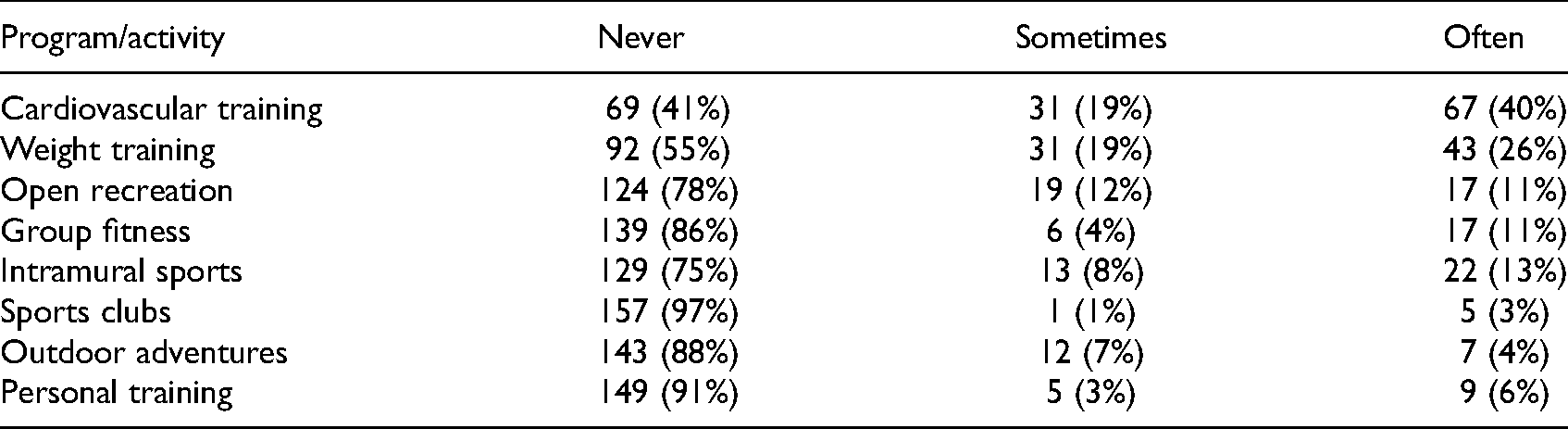
Regarding students’ overall wellness center use, 68 (40%) reported they never use the wellness center, 26 (15%) sometime use it, and 75 (44%) use it often. The majority (69%) spent, on average, from 30 min to 90 min per visit. Approximately 68% go to the wellness center with a friend, whereas 32% usually go by themselves. Table 1 shows the programs offered at the wellness center with freshmen’s frequency of use. Cardio exercise and weight training were the most common activities freshmen participated in when using the wellness center.
Frequency and Percentage of Freshmen Use of Different Recreational Programs.
Depression Symptoms and Stressors
Based on the PHQ-8 summary scores, students’ symptoms of depression ranged from 0 to 23. Among these students, 78 (46%) reported zero score/no symptoms, 47 (28%) minimal symptoms, 28 (17%) mild symptoms, 11 (7%) moderate symptoms, and 4 (2.3%) severe symptoms. We combined the responses reporting moderate and severe into one group for further analysis due to the small sample size in each of those two categories.
The amount of coursework was the most frequently reported stressor (82.6%), followed by lack of sleep (60.5%) and dietary habits (52.3%). The remaining stressors reported included being away from family (46.5%), pressure to make new friends (39.5%), and pressure to drink or do drugs (11.6%).
Depression Symptoms With Demographics and Wellness Center Usage
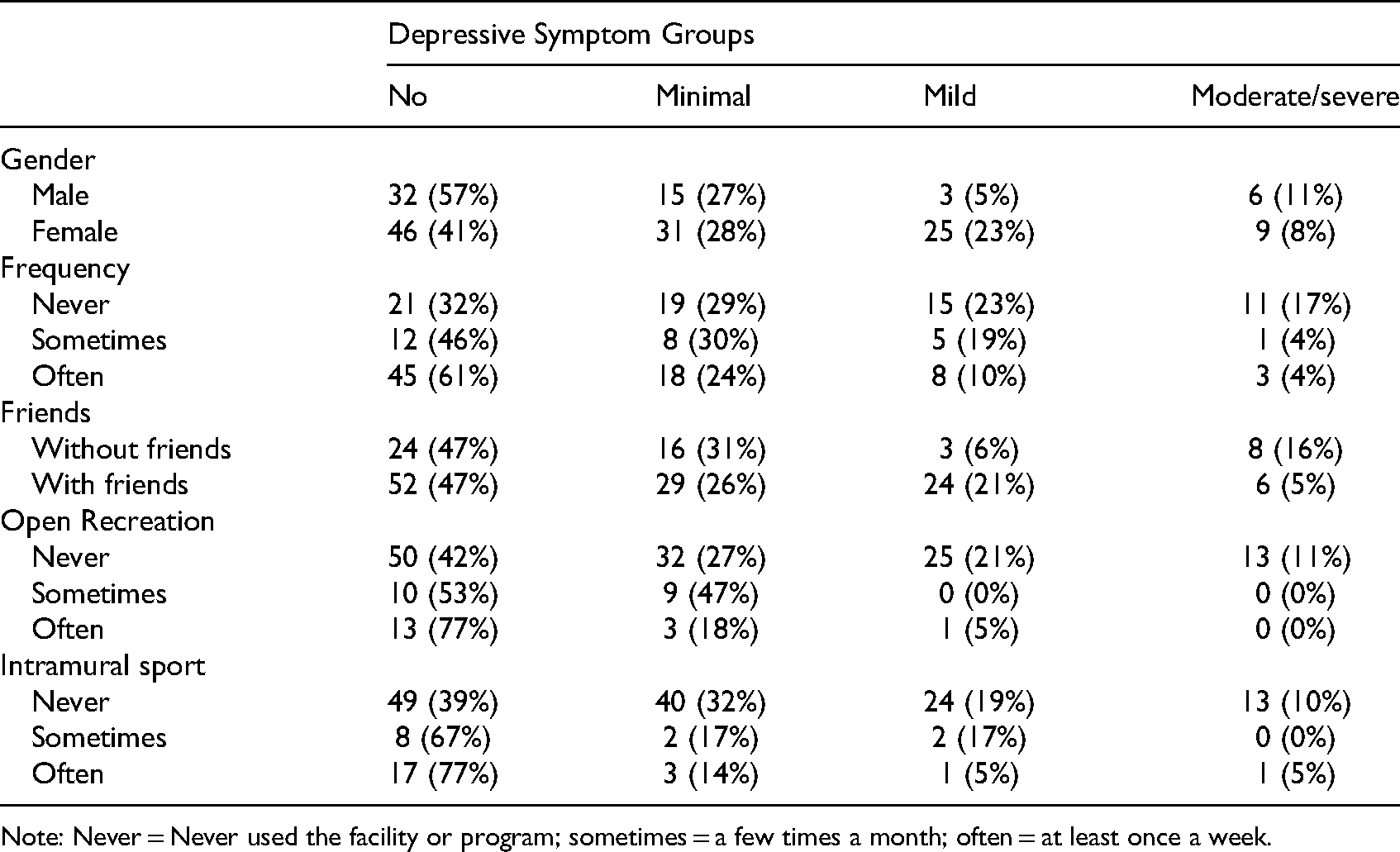
Chi-square analyses were conducted on different levels of depressive symptom groups with students’ demographics, including age, gender, and from in-state or out-state. Among all demographic variables, gender is the only one showed a statistical difference [ X2(3,167) = 8.81, p = .032*] in levels of depressive symptoms. Approximately 57% of male students reported no depressive symptoms, compared with only 41% of female students (Table 2). No statistical difference was found in various age groups and in-state or out-state students.
Chi-Square Significance of Variables and Depressive Symptoms.
Note: Never = Never used the facility or program; sometimes = a few times a month; often = at least once a week.
As for freshmen’s overall wellness center use with symptoms of depression examined by chi-square analysis, a statistical difference was found in the reported symptoms of depression related to students’ frequency of using the center [ X2(6, 166) = 16.75, p = .010*]. More than 60% of students who often used the wellness center reported no depressive symptom, which is almost twice as many as those who never used the center at 32% (Table 2). A statistical difference regarding reported symptoms of depression was also revealed in whether participants went to the wellness center with a friend or not [ X2(3,162) = 9.18, p = .020*] (Table 2). No statistical difference in the reported symptoms of depression was found regarding students’ average time spent per visit.
Moreover, among the eight programs included in the study, students who participated in open recreation [ X2(6,156) = 16.76, p = .010*] or intramural sports [ X2(6,160) = 14.11, p = .028*] showed statistically different levels of depressive symptoms. Table 2 shows that students who participated (sometimes or often) in open recreation reported no depressive symptoms, at 53% and 77% respectively, which was higher than students who never participated in open recreation at 42%. Similarly, students who participated intramural sports (sometimes or often) reported no depressive symptoms at 67% and 77%, which was higher than students who never participated in the program (39%). No statistical difference was found among reported depressive symptoms for the other six activities offered by the center, including cardiovascular training, weight training, group fitness, sport clubs, outdoor adventures, and personal training.
Discussion
The purpose of the study was to investigate the relationship between wellness center use and depressive symptoms in first-year college students. The results indicate that wellness centers promote physical and mental health by offering physical activities and specialty recreation programs. More than 54% of freshmen in the study reported having some level of depressive symptoms, with the most prevalent stressors being course work, lack of sleep, and dietary habits. The students who use the wellness center reported fewer depressive symptoms than the students who never or rarely use the facility.
Our study found that the most popular programs among college freshmen were generalized fitness programs, such as cardiovascular training and weight training. Sports clubs, personal training, outdoor programming, and group fitness had the lowest levels of participation in the current study. These latter programs are more specialized programs in campus recreation that serve individual interests in specific sport and recreational activities (Dalgarn, 2001) and usually require fees for participation (Taylor et al., 2003; Stier Jr et al., 2005). For example, sports clubs often need additional funding, such as from club dues, to be competitive. Personal training and outdoor adventure programs also typically require additional fees, which help cover the high cost of equipment or personnel certifications (Taylor et al., 2003). However, due to the extra cost that might deter student participation in those activities, programs that require no extra fee or less additional financial commitment, such as cardiovascular training and weight training, may attract more first-year students. Moreover, students may also be reluctant to commit to a fixed time with recreational activities, especially for first-year students who may feel overwhelmed by their options and academic schedules.
In addition to documenting the connection between the variation in overall frequency of wellness center usage and different levels of symptoms of depression, our findings also add to existing literature by noting that specific programs may have a stronger impact than other activities on reducing depressive symptoms among first-year students. College students’ social connections are associated with the level of depressive symptoms; therefore, activities facilitating social interaction and connection, such as recreational activities and programs on campus, could act as a protective factor to mitigate depression (Barbour et al., 2021). In the current study, students who participated in open recreation or intramural sports reported fewer depressive symptoms. It is possible that both activities, in addition to providing the general health benefits of exercise, also create more opportunities for social interaction and benefits than generalized fitness programs do (Artinger et al., 2006). A comparison study of recreational programs conducted by Lower et al. (2013) showed intramural sport participants reported greater social benefits than group fitness participants. Social benefits from participating in intramural sports could lead to greater social support and may facilitate a sense of belonging with their friends and campus community among freshmen (Lower et al., 2013; Miller, 2011). Such social support generates a sense of belonging through recreational sport participation which might mitigate their depressive symptoms.
Practical Implications
This study provides insight into the benefits offered by campus wellness centers for improving both physical and mental health among college students, especially for freshmen. As 40% of the freshmen in our study never used the wellness center in their first semester and fewer than 10% of freshmen participated in some specialty programs, such as personal training and sports clubs, campus recreation marketing teams should continuously promote the diverse programs offered by campus recreation. They should also consider offering reduced fees, fee waivers, or free trial periods for new participants to encourage students to explore different programs that may require extra fees. Creating fun and engaging programs that encourage students to share their experience using the wellness center, such as campus recreation ambassadors or social media campaigns, may also help campus recreation professionals encourage student participation. Moreover, campus recreation professionals could create mental-health related programs with a holistic approach by collaborating with the university clinic, consulting services, nutrition, and student affairs to promote a wide range of services on campus that can help college freshmen to manage their stress and self-care.
Our study revealed a significant difference between female and male students’ occurrence of depressive symptoms. For example, female students reported a lower percentage (41%) with no depressive symptoms than their male counterparts (57%). Conducting a systematic review of university students’ depression prevalence, Ibrahim et al. (2013) concluded that female students are more at risk and reported a higher rate of depressive symptoms than male students, which may result in females being more likely to seek help or support than male students. Therefore, it is essential for campus recreation professionals to focus not solely on specific demographics but to provide an inclusive and welcoming recreational program that assists first-year students in being aware of the benefits of participating in recreational activities and encourages them to explore and use recreation facilities and programs to improve or maintain their physical and mental health. Finally, our study showed that cardiovascular and weight training programs, the most popular among first-year college students, were available and accessible for individuals who want to stay active and gain physical benefits; however, students could participate in these activities without any or with only minimal social interaction, which might limit their effectiveness for improving mental health and reducing depressive symptoms. Therefore, campus recreation professionals could create support programs (e.g., work-out buddy match, friend groups) that facilitate interactions among students in order to enhance mental health benefits through physical activities.
Limitations and Future Recommendations
A few limitations to this study should be acknowledged. First, the data consists of self-reported survey responses. Memory lapses and selective memory—such as recalling past events incorrectly, exaggerating or minimizing events, or being swayed by bias based on social norms—can lead to inaccurate accounts. A future recommendation to reduce memory lapse and selective memories would be to have participants keep diary entries covering a longer period of time, such as a semester or year, before they complete the survey. Second, we selected diverse courses in which to conduct the surveys in order to recruit freshmen from different majors. The ratio of males to females participating in the study, roughly 1:2, did not reflect the gender distribution of the chosen campus. It is possible that the courses selected had a greater ratio of females to males than other courses might have had. Future studies could use random sampling to recruit freshmen throughout a college campus or could incorporate collaborative efforts across multiple campuses via an online survey for a broader understanding of the impact of wellness centers on student depression. Additionally, in the current study, we utilized one question to gather the most common stressors of college freshmen to briefly understand their first-year college experience. Therefore, future studies could apply a more comprehensive measurement to further investigate college freshmen’s stressor stressors, such as Student-life Stress Inventory (SSI, Gadzella, 1994) and the Inventory of College Student Recent Life Experiences (ICSRLE, Kohn et al., 1990). Moreover, future studies could examine various stressors as mediating factors influencing symptoms of depression on using wellness center and physical activity level as well as causal effect among these variables. Finally, while we identified the prevalent stressors of first-year college students, our focus was primarily on symptoms of depression. Future studies could examine the relationship between stress and wellness center use to explore whether specific programs might be more helpful in managing stress than others.
Conclusion
In summary, our findings showed that first-year college students who use wellness and recreation centers have reduced levels of depressive symptoms, which could improve their mental health and well-being. First-year students who use wellness centers regularly tend to report fewer depressive symptoms than students who never or rarely use these centers. Establishing a habit of participating in wellness center activities is particularly important when a student is first coping with major life transitions. While we found that cardiovascular and weight training programs were the most popular among students who went to the wellness center, students who participated in open recreation or intramural sports reported fewer depressive symptoms. This suggests that the most popular activities do not necessarily have the strongest connection to reduced depressive symptoms. Our finding that students who go the wellness center with a friend reported lower symptoms of depression suggests the importance of social interaction as well as physical activity. Our findings add to the existing literature by denoting specific programs that might have a stronger likelihood to reduce freshmen’s depressive symptoms than other activities.
Footnotes
Acknowledgments
We thank the research support from the College of Education and Human Sciences and Wellness Center at South Dakota State University.
Declaration of Conflicting Interests
The author(s) declared no potential conflicts of interest with respect to the research, authorship, and/or publication of this article.
Funding
We thank the research support from the USDA National Institute of Food and Agriculture (NIFA) Multi-state (#1016891) and Hatch (#1016822) project.
