



Abstract
Although involvement in recreational sports has been found to be beneficial for college students, sparse research has explored how recreational sports student employment has benefitted college graduates who are now active in the professional workforce. Filling this critical gap, this study explored how former recreational sports student employees (n = 10) developed marketable skills and increased their career readiness and professional capabilities. Findings suggest graduates did develop marketable skills that they regularly use as professionals, including interpersonal communication, teamwork and leadership, organization, and cross-cultural competency. Implications for research and recreational sports administration are addressed.
Research has found that when college students become more involved on-campus with student organizations and on-campus employment, students tend to earn better grades, persist at their institution, and graduate at higher rates than students who are not involved (Astin, 1993; Kuh, 2009). The same has been true for college student involvement in recreational sports, as research has found that recreational sports can be a critical facilitator of cross-cultural competency (Burnett, 2021), a sense of belonging (Woo et al., 2022), and leadership development (Burnett, 2021; Hall et al., 2008) for college students. Yet, the bulk of research into college student involvement in recreational sports has been from the perspective of the student participant, not the student employee (Hall et al., 2008; Woo et al., 2022).
Moreover, most college students do not choose to enroll in college specifically to have new experiences and enjoy recreational sports—they enroll in college to prepare for a career (Burnett & Taylor, 2020, 2022; Fishman, 2015; Hart Research Associates, 2015; Johnson, 2017; Kaufman & Feldman, 2004). Further, Kuh's (1995) canonical study, The Other Curriculum, revealed that leadership roles, internships, and work experiences provided the greatest impact on students’ acquiring marketable skills (decision-making, teamwork, critical thinking, and oral and written communication) required to bolster postgraduate employability. Kuh's (1995) work was echoed by Burnett and Taylor's (2020, 2022) syntheses of college students’ marketable skill development, asserting that college students greatly benefit from on-campus employment. Yet, these syntheses did not focus directly on students working in recreational sports (Burnett & Taylor, 2020, 2022).
Pointing toward marketable skills, Helyer et al. (2014) noted that experiential learning through a work-based model can provide a context better suited for learning the nuanced application of skills required for success in the rapidly changing work world. Burnett (2021) also found that college students developed an understanding of organizational leadership, marketable skills, and self-efficacy, but this work focused on student employment within the institution's student affairs unit. Here, research has found that on-campus employment is a critical catalyst for career readiness for college students (Astin, 1993; Carr, 2005; Kuh, 2009), yet the field of collegiate recreation has not explored this topic in detail. Wilson's (2022) review of recreational sports scholarship revealed that few empirical articles focus on how collegiate recreation facilitates career readiness. To date, only four studies (Carr, 2005; Burnett, 2021; McFadden & Wallace-Carr, 2015) have focused on how recreational sports student employees develop workplace competencies.
Only Carr's (2005) dissertation addressed the career readiness of 14 college students who worked in an on-campus recreation center. Carr (2005) found that many students developed communication and collaboration skills that students felt would translate to the professional workplace. However, Carr's (2005) work focused on current students, not professionals who had already graduated college and understood the relationship between their student employment and postgraduate employment experience. Burnett (2021) revealed that European college students developed a sense of teamworking, emotional control, and situational adaptability after participating in the European Sports Leadership Programme, a recreational sports program meant to develop leadership skills in college students, not career readiness. McFadden and Wallace-Carr (2015) interviewed college students working in recreational sports and learned that students developed leadership through informal learning, skill development, and their work environment, but the authors did not examine career readiness in these students more broadly beyond leadership. However, none of the aforementioned studies have engaged with college graduates who worked as recreational sports student employees to explore how these students (now graduates and full-time professionals) developed marketable skills that helped them develop a sense of career readiness as they entered the labor market and became degree-holding professionals.
Several organizations, including the AAC&U and NACE, have detailed marketable skills that help college students develop into polished professionals, readying them for the workforce (Hart Research Associates, 2015; NACE, 2021). In 2020, the Georgetown Center for Education and the Workforce conducted a study investigating competencies workers need for occupations and how those competencies interact with postsecondary educational attainment (Carnevale et al., 2020). Findings revealed that while specific clusters of competencies are divided between blue- and white-collar occupations, there exist clusters of general workplace competencies that transcend all employment contexts (Carnevale et al., 2020). These, workplace competencies—including communication, teamwork, customer service, leadership, and complex thinking—highlight the need for postsecondary graduates to understand “the optimal mix of education and competencies for their chosen occupation” (Carnevale et al., 2020, p. 17) and how best to engage the world of work after graduation. Ultimately, Carnevale et al. (2020) asserted that employers most desire employees with the competencies of communication, teamwork, sales and customer service, leadership, problem-solving, perception, and attentiveness.
According to the American Association of Colleges and Universities (AAC&U), marketable skills are individual non-technical competencies understood to be applicable across a wide range of employment contexts (Finley, 2021). These skills can include the ability to manage people and facilitate teamwork, critical thinking, analysis, and interpretation of data, application of knowledge in real-world settings, digital and technological fluency, problem-solving, and developing cultural competence, specifically geared toward marketing a student to a prospective employer (Finley, 2021). Related to career readiness (National Association of Colleges and Employers [NACE], 2021), marketable skills are a critical area of personal development for college students that generally prepare graduates for success in the workplace.
In total, NACE (2021) described eight career readiness competencies that include communication, critical thinking, equity and inclusion, leadership, professionalism, teamwork, and technology (NACE, 2021). Combined, these competencies provide a framework for employers and educators in shaping curricular, cocurricular, and internship learning environments for the optimal development of postsecondary graduate career success. Graduates who can effectively develop these competencies will improve their propensity for success in the workforce, increasing their career readiness and likelihood of gaining employment upon graduation (Burnett & Taylor, 2022; Carnevale et al., 2020; Finley, 2021; NACE, 2021).
The purpose of this study was to explore whether graduates who previously worked in campus recreation identify marketable skills (Carnevale et al., 2020; Finley, 2021; NACE, 2021) they developed while a student employee and which specific work experiences led to this skill development. This study answers two research questions related to how recreational sports student employees can benefit from on-campus employment: R1: Do college graduates formerly employed by a collegiate recreation organization feel that they learned marketable skills while employed in their collegiate recreation role?
R2: If these student employees did develop marketable skills, what are these skills and what recreational sports employment experiences facilitated that skill development?
Methods
To answer this study's research questions, the research team utilized a qualitative methods research design. This section will describe that design, as well as how participants were identified and sampled, how the research team gathered and analyzed data, and how the research team addressed limitations and made delimitations to the work.
University of Study, Target Population, and Participant Identification
To carry out this study, the research team conducted purposive, convenience sampling of college graduates with former on-campus recreational sports student employment at a single institution—Driftwood State University (DSU). Located in a predominantly Republican-aligned state, DSU enrolls generally 50,000 students or more annually and employs over 3,300 faculty who confer on average 14,000 degrees per year from 18 colleges. Its student body is comprised of 55% women and 45% men, with a racial composition of 34.6% White, 24.8% Hispanic, 21.1% Asian, 9.8% international student, 5.3% Black, 2.7% multiracial, 0.1% American Indian or Alaskan Native, 0.1% Native Hawaiian or Pacific Islander, and 1.6% race unreported.
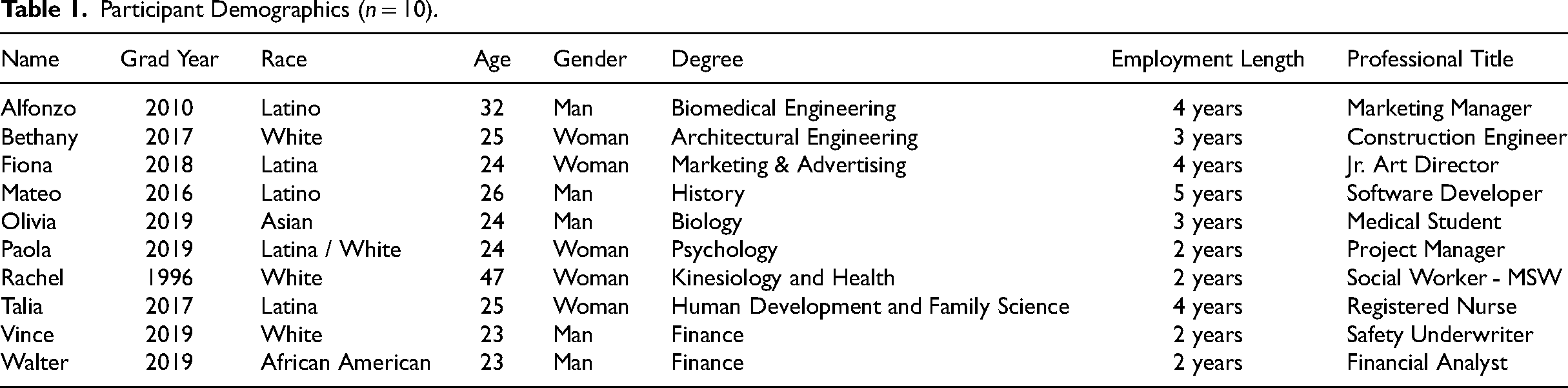
In total, 10 college graduates were sampled for this study, with an accurate representation of DSU's gender diversity and a slight overrepresentation of DSU's racial diversity. Although a limitation, this study only sampled ten students, as only ten students responded to the research request, as the request came during the height of the COVID-19 pandemic in 2021. Table 1 outlines the demographics of the participants of this study.
Participant Demographics (n = 10).
Data Collection
The research team conducted one-hour open-ended interviews with college graduates regarding their experiences with and perception of recreational sports student employment as it related to their career readiness and professional work. These one-hour-long sessions incorporated an experiential facilitation using Chiji Processing Cards (Simpson et al., 1997), standardized open-ended interviews (Patton, 2014), and fill-in-the-blank structural questions inspired by Spradley's (1979) dyadic questions to allow participants to feel at ease and facilitate a subjective interview experience during a turbulent time (COVID-19 pandemic). Prior studies have validated the use of Chiji Processing Cards as a method of eliciting deeper, more reflective narratives of participant experiences to both allow the participant to relax within a research environment while also allowing the participant to use metaphor, simile, and analogy to relate their lived experiences (Barnes et al., 2012; Guise et al., 2008; Patton, 2022).
All interviews were conducted via an online video platform, Zoom, with only the audio portion of the interview recorded. All interviews were recorded (audio) and transcribed for detailed analysis. Interviews were scheduled at the convenience of the participant. To provide additional depth and organization to the study, we gathered basic demographic information to include the race, gender, age, and length and location of employment of the participants.
Data Analysis
Our analysis of the qualitative data occurred concurrently with data collection. A concurrent data collection and analysis strategy helped correct unclear areas and facilitated the generation of interim reporting required by many studies (Miles et al., 2014). To inventory and organize the interview response data, we employed a partially ordered meta-matrix (Miles et al., 2014). Initially, we employed an open coding system (Miles et al., 2014) which facilitated a general understanding of what the data and what participants were expressing, coding data separately and then collaborating to compare results.
Next, the interview responses were partitioned (Miles et al., 2014), where child codes were refined and created from the parent code group. We partitioned participant responses into categories that corresponded to notions of marketable skills outlined by the AAC&U (Finley, 2021), the National Association of Colleges and Employers (NACE, 2021), and the Georgetown University Center on Education and the Workforce (Carnevale et al., 2020), as well as types of experiences in which respondents reported that marketable skills were developed. This process resulted in final, condensed code categories including (1) quotes related to explication of marketable skills, (2) interpersonal skills, (3) working with people and facilitating teamwork, and (4) cross-cultural interactions competencies.
Four categories were rephrased into four major themes related to the role of recreational sports student employment in developing marketable skills, as well as the types of experiences that best facilitated marketable skill development and which marketable skills best transferred to postgraduate professional appointments.
Findings
Given the data yielded from 10 college graduates with recreational sports student employment experience, the major themes of this study revealed that (1) Graduates Developed Marketable Skills as Student Employees That They Use as Professionals, (2) Graduates Developed Interpersonal Communication Skills, (3) Graduates Learned to Manage People and Facilitate Teamwork, and (4) Women Graduates Expressed Cross-Cultural Competency Development.
Theme 1: Graduates Developed Marketable Skills as Student Employees That They Use as Professionals
This study revealed that graduates were easily able to identify, discuss, and detail the marketable skills they developed from their on-campus recreational sports employment experience and that they use in their everyday professional work. Moreover, graduates—even those years removed from graduation—were able to remember specific examples of instances when they developed these marketable skills, emphasizing the indelible nature of their experiences.
For instance, both Olivia and Vince said they developed great customer service skills, with Olivia developing these skills while “running facilities that had over 1,000 people in them every day.” Related to customer service, Walter explained how he developed conflict resolution skills while working in recreational sports as an official. Walter remembered, “There were always disputes about a call, disputes about an official, disputes about a program. I would have to listen to the players even if they weren't correct, just because you don't want to come off poorly. You want them to still have a good experience and still you just still be genuine about conversation. It was all conflict resolution.”
Mateo revealed how his undergraduate work in recreational sports facilitated his understanding of the relationship between effective communication and problem-solving in his postgraduate work context, stating: Learning the better ways that I can actually communicate with people. Small talk isn't my forte personally. For me, I learned that it's about finding a topic in order to more properly engage. Working at Rec Sports, it's like, “There's a problem, how can I efficiently ask this question to get the information I need?” At the same time, I’m not just trying to solve problems. There are individual people that I'm working with. They all have lives and everything. You can't just be like, “Hey, it's not broken. Okay, walk away.” There's a little bit of rudeness in that. You learn there's better ways to solve problems.
Theme 2: Graduates Developed Interpersonal Communication Skills
Of all marketable skills, graduates in this study most frequently discussed their development of interpersonal communication skills, including learning to communicate with different types of people and educational stakeholders. For instance, Talia explained, “Communication. And it differs if you are at an event and talking to a child, talking to your supervisor, talking to a college student. Just learning to tailor my communication to the person that I’m speaking with.” Talia continued by saying that in her career as a nurse, “I am always going to be working with people,” and “rec sports gave me the confidence to talk to people.” Like Talia, Olivia now works in the healthcare field and explained, “I think the big thing that my recreational sports job taught me was how to communicate. Your medical team is made up of a nurse, a respiratory therapist, a doctor, your charge nurse. You must communicate.” For Vince, he was short and to the point: “Being able to communicate effectively at my current job is a result of learning and developing communication habits while I was employed at recreational sports.” Walter added, “Communication. And at my job, if something is unclear and the decision falls on me, I have to explain what's going on and why.”
For other graduates like Alfonzo, working in recreational sports allowed him to develop their English language skills. As an immigrant student from Mexico, Alfonzo said that working in recreational sports “really empowered” him. When asked why, Alfonzo explained: I was very insecure with my English and my use of English. It was a big struggle that first year. Feeling out of place. But then suddenly, I’m swiping people in and out and I'm giving tours. I'm memorizing things. It really gave me that confidence to just talk and be able to express myself the best way possible. My presentation skills, my ability to talk and communicate effectively with people really came through while working at Rec Sports. So, I’m a social worker, and I have to build rapport with the clients. Because of my ability to communicate with people while working in rec sports as a student, I am able to communicate well with people in my current job. I work with people who are moving out of homelessness or people who are living, basically in affordable housing. They are in a spot in their life where they cannot really hold a job because of a mental health issue or because of a physical issue or because they’re retired or addicted or whatever. Being able to build rapport with people and people being able to trust you to help them is really key. I think that's why communication is so important as a social worker.
In response to the follow-up question, “How did your RecSports experience better prepare you for work than academics?,” Mateo emphasized how his recreational sports student employment taught him how to communicate within a team, stating: I have no problem just asking questions. I'm comfortable with it now. Going back, it was an emphasis on a team rather than just us as individuals. That's also something that RecSports did that I tried. I eventually learned that, again, if you don't have a certain level of communication. There's trying to get together as a team to work something, get something done, and stuff doesn't get done. It was more than once at RecSports where we would have a student that either wasn't skilled enough to complete a task or didn't have a certain level of communication where the goal was to just improve upon those to get stuff done. And now in my current job, there's such a level of communication and teamwork that I can get stuff done and I feel comfortable now.
Ultimately, graduates reflected on their recreational sports student employment experience and overwhelmingly discussed interpersonal communication skills as developed through recreational sports employment and critical to their professional work.
Theme 3: Graduates Learned to Manage People and Facilitate Teamwork
Second and tangentially related to interpersonal communication, graduates frequently discussed how they learned to manage people and facilitate teamwork as recreational sports student employee. Specifically, graduates shared that leadership opportunities and situations helped develop these skills. Rachel explained that before she worked in recreational sports, she “had an inability to lead or wasn’t adequate” as a leader, but then she learned to lead through recreational sports employment. Fiona shared a similar sentiment while reflecting on her time supervising the climbing wall. Fiona remembered, “When I was the manager at the climbing wall, I really learned to delegate and rely on others to help you out. That translates to my current job every day.”
Both Walter and Vince shared memories of working in recreational sports with mentors, eventually becoming mentors themselves. Walter explained, “I grew working within a team while at rec sports, and I'm able to translate that to working with my current coworkers at my current job.” When asked what helped him facilitate that learning, Walter said, “Mentorship. I had people that pushed me, and now I do that for others. I support and I push them.” Vince also mentioned his intramural supervisor, articulating that, “Having that person and then learning and being one that others answered to, it was empowering. I learned to lead and gained the confidence to take leadership roles as a professional.”
Olivia, Mateo, and Alfonzo also commented on their leadership development through recreational sports employment, with Olivia sharing, “I had to delegate and multitask. It taught me how to be a leader.” Mateo, in his current role, loves to manage people, and this love developed as a recreational sports student employee. Mateo said, “I learned that I love a management role. I like helping others use their skills to complete tasks.” Like Mateo, Alfonzo learned to love leadership, especially the teamwork aspect. Alfonzo asserted, “Teamwork is what I developed. The opportunity to lead and manage my peers at my student job has helped me to be better at managing other peers and managing teams below me at my current job.” Bethany, Paola, and Talia made similar comments as well, reflecting on their student employment and articulating their leadership and teamwork development skills, with Talia simply saying, “Rec sports was so good for me.”
Theme 4: Women Graduates Expressed Cross-Cultural Competency Development
Finally, several graduates asserted that they learned to work with people who are different from them, articulating a development of cross-cultural competencies while working as a student employee in recreational sports. Paola mentioned that she met and developed relationships with “many different people at rec sports.” Today, her current role necessitates cross-cultural communication, stating, “Especially with a company that's global, you have different cultural barriers, and you have different language barriers. I need to make sure that when I send communication, it's clear in whatever culture is receiving it.” Similarly, Olivia mentioned the “cultural aspect” of her recreational sports student employment, stating, “I had different friends from very different backgrounds, but especially after working at rec sports, I developed relationships with so many people from very different backgrounds.” Talia mentioned that she worked with socioeconomically diverse students while a student employee, and that insight helps her “work with diverse people and be able to listen to their whole story and be able to tailor what I can offer.”
Fiona's story went into more depth, as she learned to adapt to a new city and new cultures in her current role, an adaptive trait that she developed while working in recreational sports. Fiona explained: I think once you go beyond college, move to a completely new city with new people, work in an agency that's very diverse in age and race and socioeconomic backgrounds. That skill, working with different people, definitely came even more into play once I graduated. Now, I’m facing all these different types of people in a professional setting, and it's just like rec sports. I can handle it. I was in my last year of being a climbing wall supervisor. I was really trying to start new programs that would serve women and people of Color because I always found that to be an ongoing issue within recreational sports. Now, there's always been a diversity and inclusion problem everywhere, but especially at our agency. I’ve been pretty vocal in my last two years, and starting programs there that help people of Color, help young talent of Color, of marginalized groups be able to enter these industries. I see that as my personal responsibility. My leadership responsibility directly at rec sports has allowed me to take power in that and know how to start those programs and feel comfortable leading diverse people.
Although these graduates spoke in-depth about their development of cross-cultural competencies, it was notable that men in this study did not express this skill development. We will address this finding in the next section, as well as implications for research, policy, and recreational sports practice.
Discussion and Implications
This study explored the recreational sports student employment experience of 10 college graduates (bachelor's degree) to understand whether these graduates could identify marketable skills (Carnevale et al., 2020; Finley, 2021; NACE, 2021) they developed while a student employee and which specific work experiences led to this skill development. Prior literature suggested that recreational sports research has addressed the leadership development of students (Burnett, 2021; Hall et al., 2008) and student employees (Burnett, 2021; McFadden & Wallace-Carr, 2015) but not the career readiness of student employees after graduation. However, this study successfully found that former recreational sports student employees could easily articulate the marketable skills they developed as student employees and how those skills have translated to the professional workplace, including many of the marketable skills outlined by the AAC&U (Finley, 2021), NACE (2021), and the Georgetown University Center on Education and the Workforce (Carnevale et al., 2020). In this regard, working in campus recreation should be seen as a critical driver of career readiness, akin to student employment in other units on college campuses (Astin, 1993; Burnett & Taylor, 2020; Kuh, 2009). From here, many connections to literature and implications for research and practice emerge from this work.
First, this study found that graduates developed marketable skills as student employees that they use as professionals, echoing many prior studies related to student employment and career readiness (Astin, 1993; Carr, 2005; Helyer et al., 2014; Kuh, 2009; Woodside, 2018). While Carr's (2005) dissertation focused on the student experience, this study extends Carr's (2005) work and ties recreational sports student employment to postgraduate outcomes. Specifically, this study examined full-time professionals who were able to clearly connect the marketable skills they developed while a recreational sports student employee to their current work. Moreover, graduates in this study specifically and repeatedly mentioned their development of interpersonal skills, management and teamwork facilitation skills, and cross-cultural competencies they developed while recreational sports student employees. Here, these marketable skills echo many of those outlined by career readiness experts and professional organizations (Carnevale et al., 2020; Finley, 2021; NACE, 2021) as highly desirable for employers in many professional sectors.
This study's findings sustain and extend Kuh's (1995) work, as Kuh stated, “the nature of many out-of-class activities, however, requires that students be competent in these areas” (p. 148). As this study indicates, recreational sports student employment imbues practical experience with real consequences, facilitating the mandate of performance of workplace competencies by students in their employment roles. This study, therefore, buoys and extends Kuh's (1995) work by validating how the mandate of successfully performing workplace responsibilities during recreational sports student employment can be a context for students to refine and hone their marketable skills for success in the postgraduate labor market.
Moreover, Helyer et al. (2014) articulated that employers desire graduates with a combination of technical, practical, and sector-specific skills, along with skills that cross sectors: critical thinking, leadership, teamworking, and customer service. As this study indicated, participants reported the development of varied skills that occurred during their recreational sports student employment, therefore, supporting the Helyer et al. (2014) claim. Additionally, participants in this study repeatedly shared how their recreational sports student employment was difficult at times, as developing a complex combination of skills can be a rigorous experience. Here, Woodside (2018) explained how the academic rigor of the college experience can be increased through cocurricular involvement. Woodside (2018) purported that in higher education, “rigor without relevance is pedantic or trivial academic learning; relevance without rigor is support without an underlying basis” (p. 285). Therefore, the major themes of this study echoed Woodside's (2018) notion of real-world rigor, as recreational sports student employment served students by providing rigor with practical relevance that can facilitate the development of career readiness and professional development.
Yet, not all students developed or articulated the same skills in the same ways. For instance, this study found that women were much more likely to discuss their development of cross-cultural competencies than men. Although the actual level of cross-cultural competency may have been similar between men and women, it is notable that women discussed this development in much more detail, suggesting gender differences in either the development of this skill or the discussion and articulation of this skill. Carr's (2005) dissertation found that one student, Catherine (self-identified woman), claimed that she developed transferable skills while working in collegiate recreation, especially as it related to “leading different genders” (p. 133). Although Carr (2005) did not elaborate on this finding, it is notable that no men in Carr's (2005) study articulated any development of cross-cultural competency. This discrepancy of articulated outcomes by gender is an area of future research.
Similarly, three Latinx graduates discussed their communication skills development as developing English-language fluency and confidence, another phenomenon that this study uncovers without precedent in the recreational sports literature. In this regard, Carr's (2005) dissertation briefly discussed how recreational sports student employees worked with peers from different language backgrounds, but no participant in Carr's (2005) study discussed their language development because of their employment. Here, more implications for research emerge, especially as it relates to how English-language learners or international students may develop English communication skills through collegiate recreation employment.
As a result, this study makes novel contributions to the literature and encourages much more future research. First, considering the dearth of research related to recreational sports student employment and career readiness, both professionals and researchers could explore this topic in much more depth. These approaches could include how professionals can recruit and retain student employees, how professionals can convey the benefits of on-campus employment for career readiness, and how researchers can communicate the benefits of recreational sports involvement from the student employee perspective, drawing positive attention to the field. As institutions of higher education continue to cut costs to counterbalance declining higher education enrollment (Burnett & Taylor, 2022; Finley, 2021), recreational sports student employment should be supported and researched in ways that continue to justify recreational sports budgets. During a time when the cost of college and the value of a degree is being continuously brought into question (Burnett & Taylor, 2022; Carnevale et al., 2020), recreational sports could be positioned as a critical campus unit for developing students’ career readiness.
Second, many graduates in this study were years or decades removed from their student employment experience, yet these graduates were easily able to identify instances when they developed skills and how those skills translated to their professional position. Here, professionals working in recreational sports could work to promote the success of recreational sports alumni who have continued onto successful professional careers. Here, recreational sports departments could likely help their institutions strengthen alumni relations, build connections between the institution and industry, and drive philanthropic relationships with external employers. Research has suggested that student employment as a pathway to professional careers can elevate an institution's profile and better retain student workers (Carnevale et al., 2020; Hora, 2016; NACE, 2021; Tomlinson, 2017), and recreational sports could catalyze this institutional elevation.
Finally, given the data in this study, not all graduates reported the same type of skill development, especially as it related to leadership development and cross-cultural competencies. When graduates did discuss leadership and teamwork facilitation, they often developed these skills while in supervisory or leadership roles—yet, not all graduates in this study reported having access to those roles. Moreover, men in this study talked much more about communication and leadership development than cross-cultural competencies, even though men were underrepresented in this study and their experiences may not be generalizable to all men with experience as recreational sports student employees. However, these access and experience gaps are important for professionals to acknowledge, as graduates in this study thrived and grew through supervisory and leadership experiences. Therefore, every effort should be made to facilitate these experiences and roles for student employees, especially in areas where men could be exposed to different people and different cultures to foster a sense of cross-cultural competency. Prior research has not explored gender differences in recreational sports student employment experiences, and thus, future research may want to explore this area in further detail.
Limitations and Delimitations
This study was limited and delimited in several ways. A primary limitation of this study was the single institutional context, as other recreational sports studies have (Wilson, 2022). However, the researchers were very familiar with the institutional and geographic context of the institution. This limitation could be conceptualized as a strength of the research design, as this familiarity with the institution and geographic region may have yielded richer data and deeper findings. Yet, this study was conducted during the COVID-19 pandemic in 2021; therefore, we held interviews over Zoom rather than in-person, possibly limiting the richness of the data. Finally, our sample size was limited to ten, as only ten individuals agreed to participate, with many nonparticipants citing the pandemic as a reason they could not participate. We also only interviewed professionals in fields unrelated to recreational sports, and as a result, future studies could explore the student employment experiences and outcomes of former recreational sports student employees who now work professionally in the field.
Conclusion
Graduates spoke glowingly of their recreational sports student employment experience, asserting that they learned crucial marketable skills that helped them thrive as student employees and develop into professionals. From here, the field of recreational sports could be seen as a critical driver of career readiness among both student participants and student employees, helping bolster the visibility of recreational sports on college campuses. After all, so many graduates felt that “Rec sports was so good for me.” As a result, the rest of campus and the higher education community ought to know how good rec sports can be for the system of higher education writ large.
Footnotes
Declaration of Conflicting Interests
The author(s) declared no potential conflicts of interest with respect to the research, authorship, and/or publication of this article.
Funding
The author(s) received no financial support for the research, authorship, and/or publication of this article.
