




Abstract
This study is on mechanical performance and water absorption behaviour of hybrid epoxy composites reinforced with human hair and goat hair fiber. The composites were fabricated using a compression molding technique. Three formulations were developed by maintaining a constant epoxy content of 70 wt.% while varying the reinforcement ratios of human hair (25, 22, and 20 wt.%) and goat hair (5, 8, and 10 wt.%). Mechanical properties were evaluated through tensile strength and microhardness tests, while water absorption tests were conducted to assess moisture resistance. The results show that the composite containing 20 wt.% human hair and 10 wt.% goat hair exhibited the highest tensile strength (13.42 MPa) and hardness (29.4 HV), along with the lowest water absorption (∼2.19%). SEM observations revealed improved fiber–matrix adhesion, uniform fiber dispersion, and reduced void content in the optimized composite. Statistical analysis (ANOVA) confirmed significant differences among the compositions (p<0.001), while regression analysis demonstrated a strong positive correlation (R2>0.90) between goat hair content and mechanical properties. Furthermore, all samples exhibited low moisture uptake (<3% after 24 h), indicating good dimensional stability. The findings suggest that hybridization of human and goat hair fibers provides a sustainable approach for developing lightweight composite materials with enhanced mechanical performance and moisture resistance.
1. Introduction
The growing need for sustainable, environmentally friendly materials in the engineering industry has prompted the use of natural fiber-reinforced composites, leading to extensive research in recent years. 1 Synthetic fibers such as glass, carbon, and aramid have superior mechanical properties; however, they are non-biodegradable, energy-intensive to produce, and difficult to dispose of. 2 The issue of volume of plastic and synthetic waste has turned into a crisis in the world and requires the creation of biodegradable materials that would minimize the impact on the environment without affecting performance. 3 Renewable sources converted into natural fiber offer a good solution, and they have certain benefits like low density, biodegradability, renewability and low cost.4–6 Nonetheless, the mechanical properties of natural Fiber composites are generally inferior to those of synthetic fibers, necessitating the development of cutting-edge strategies to improve their performance through fiber modification and hybridization. 7 A study on coir (25 %)/hemp (20 %)/kapok (5%) natural fiber epoxy composite exhibited the best mechanical performance reaching tensile strength of 66.28 MPa, flexural strength of 138.92 MPa due to enhanced fibe matrix interaction. 8 The addition of 15 wt% dolomite filler and 2 wt% sisal fiber in the epoxy matrix resulted in 177 % and 127 % improvement in tensile strength and flexural strength. 9 Compared to a four-layer pure jute composite, the four-layer Kevlar composite exhibited an 181% increase in tensile strength. 10 The mechanical performance of Areca catechu fiber-reinforced epoxy composites (ACF/epoxy, 50 wt%) showed a 53.33% increase in tensile strength and a 53.72% improvement in flexural strength compared to pure. 11 The fiber treatment, volume fraction, hybridization and manufacturing technique significantly impact composite performance.12,13 Despite extensive research on plant-based fibers such as jute, flax, hemp, and sisal, and hybrid natural fibers but limited attention has been given to keratin-based waste fibers, particularly human hair and animal hair.14–17 Human hair, an abundantly available waste material from salons, possesses high tensile strength, flexibility, and a keratin-rich structure with strong disulfide bonds, making it a promising reinforcement material. 18 Similarly, goat hair, an animal by-product, exhibits relatively higher stiffness, coarse surface texture, and good thermal resistance, which can contribute to improved interfacial bonding and load transfer within composites. 19 However, existing studies have largely investigated these fibers individually, and there is a lack of systematic research on their combined (hybrid) effect in polymer composites. This gap enlightens the formation of hybridization of human hair (for toughness and flexibility) with goat hair (for stiffness and bonding) has the potential to balance and enhance composite performance. The current study is on fabrication of composite materials with value-added properties by blending these two waste-generated fibers with an epoxy matrix. This approach not only address environmental concerns but also reduces the use of polymer.20,21 The scope of research in this case is to investigate waste-derived natural Fibers as reinforced polymer composites, focusing on their characterisation, optimal evaluation of mechanical performance, and statistical evaluation. 22 By utilizing waste-derived keratin fibers, the research not only addresses environmental concerns but also proposes a sustainable pathway for producing cost-effective composite materials suitable for lightweight and non-structural applications, contributing to circular economy principles. 23
2. Materials and methods
2.1. Materials
Epoxy resin (LY556) and hardener (ARADUR2963) was procured from Herenba Instruments & Engineering Ltd., Chennai, India. The epoxy resin has a density of 1.15 g/cm3, while the hardener has a density of approximately 1.20 g/cm3. Human hair fibers were collected from local salons, where they are readily available as waste materials at no cost. Goat hair fibers were similarly obtained from nearby farmlands as a by-product of routine animal grooming, also at no cost. Figure 1(a) and 1(b) present the human and goat hair fibers, respectively, while Figure 1(c) shows the epoxy resin and hardener used in this study. Raw Materials Utilized for Composite Fabrication a) Natural Human Hair Fiber,(b) Processed Natural Fiber, (c) Epoxy Resin LY556 with Hardener.
2.2 Composite Fabrication
Figure 2 illustrates the sequential fabrication process of composites reinforced with human hair and goat hair fibers. Initially, the fibers are collected from local sources and subjected to cleaning to remove surface impurities such as dust, oil, and other contaminants. The cleaned fibers are then dried under controlled conditions. After drying, the fibers are cut into uniform lengths to facilitate effective reinforcement within the matrix. Subsequently, the prepared fibers are combined with a polymer matrix formulated using epoxy resin and hardener in the required proportion to achieve a homogeneous mixture. The fibers are thoroughly mixed with the resin to ensure uniform distribution and proper wetting. Following this, mold preparation is carried out using a release agent to enable easy removal after curing. The fiber–resin mixture is then placed into the mold and subjected to compression molding at 1500 psi and 100°C, ensuring proper shaping, compaction, and consolidation of the composite. After curing, the fabricated composite is removed from the mold to obtain the composite specimens as shown in Figure 3. The notation of composite samples was designated as sample 1, sample 2 and sample 3 corresponding to human hair/goat hair ratios (i.e. 25/5, 22/8, and 20/10). Comprehensive processing and fabrication of human hair and goat hair reinforced epoxy hybrid composite. Fabricated composite samples a) sample 1, b) sample 2, c) sample 3.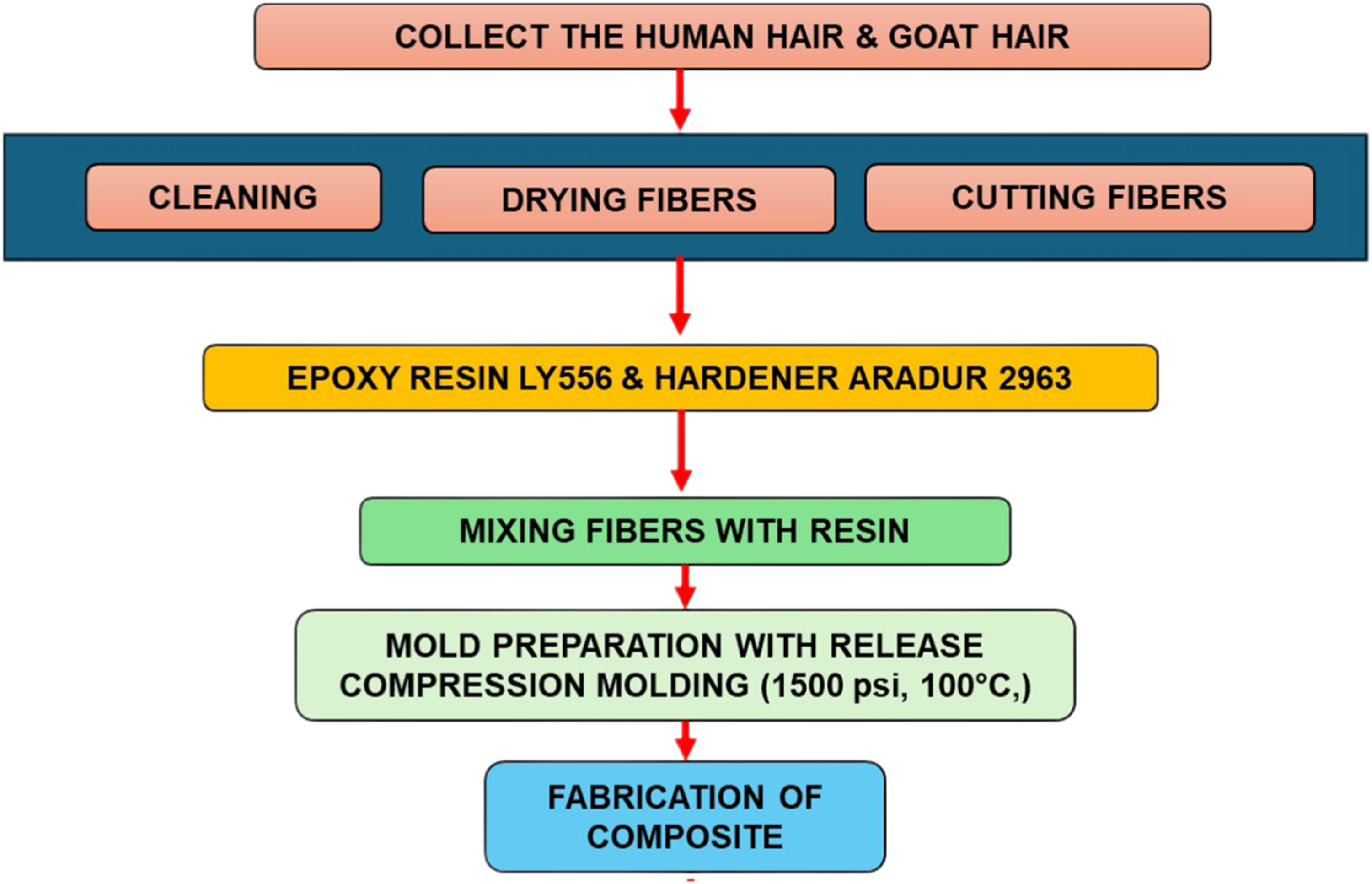

2.3. Tensile testing
The tensile property was measured using a KIC-2-314-C, Universal Testing Machine (UTM) with a load accuracy of ±0.2%. The tensile test specimens with dimensions 165 mm overall length, 50 mm gauge length, 13 mm gauge width, and 3.2 mm thickness as per ASTM D638 Type I standard were used. All tests were performed at room temperature and a crosshead rate of 2 mm/min. The specimen was uniformly elongated to failure using the moving crosshead under uniaxial tensile load. The mechanical properties, such as tensile strength, were evaluated.
2.4. Hardness test
Hardness testing of the fabricated composites was performed in accordance with ASTM E384. Microhardness testing was carried out using an HMV-G21 Microhardness Tester. The rectangular specimens of approximately 30 mm × 10 mm × 3 mm dimensions were used. The hardness value (HV) measurements were carried out using a diamond pyramidal indenter with a face angle of 136°, applying a load of 0.5 kg for a dwell time of 10 s. Upon removal of the load, the diagonals of the indentation were measured and Vickers Hardness Number (HV) was calculated accordingly.
2.5. Water absorption test
Water absorption behavior of the composites was evaluated to assess their resistance to moisture and suitability for humid environments. The specimens of dimensions 30 mm × 10 mm × 3 mm were initially dried and weighed to obtain the initial mass. They were then immersed in distilled water at room temperature for 24 hours. After immersion, the samples were removed, surface moisture was carefully wiped off, and the final mass was recorded. The percentage of water absorption was calculated based on the weight gain of the specimens. The water absorption % is calculated using the following equation 1.

2.6. Statistical analysis
Composition details of hybrid natural fiber-reinforced epoxy.

3. Results and discussion
3.1 Tensile test results
Figure 4 presents three plots showing displacement (mm) on the x-axis and load (N) on the y-axis for Sample 1, Sample 2, and Sample 3. The Sample 1 reaches the maximum load of about 1394 N at displacement of 0.5 mm after which the load gradually decreases to 600 N at 1.4 mm. Sample 2 show improved performance, attaining a peak load of about 2146 N at a displacement near 0.7 mm, followed by a gradual decline to 1195 N at 1.5 mm. Sample 3 demonstrated the highest load bearing capacity reaching a maximum load of 3299 N at 0.69 mm, and then decreasing slightly to 2406 N at 1.5 mm. The results demonstrated that there is increase in load capacity and displacement from sample 1 to sample 3, indicating progressive improvement in mechanical properties with increase in goat hair %. Load vs. displacement diagram for a) Sample 1, b) Sample 2, c) Sample 3.
3.2. Combined tensile, hardness, and water absorption results
Output parameters fiber compositions, and sample distribution.

Experimental observations of characteristics of load, tensile strength, micro-hardness, and water absorption.

3.3. Microstructure analysis
The scanning electron micrographs (SEM) of the three composite groups at different magnifications are shown in Figure 5. Figure 5(a)-(c), which is attributed to Group 1 (25% Human Hair + 5% Goat Hair), non-uniform distribution of the fibers, which exhibits the presence of fiber clustering and agglomeration. There are clear fiber-matrix interfaces and fiber pull-out, which demonstrate a lack of interfacial adhesion. These flaws are characterized by reduced tensile strength and increased variability in Group 1. Group 2 (22% Human hair + 8% Goat hair) shown in Figure 5(d)-(f) has better dispersion of fibers and less clustering. The Fiber-matrix interface is also less discontinuous, with fewer voids, and is associated with an intermediate tensile strength. Group 3 (20% Human Hair + 10% Goat Hair) has been shown in Figure 5(g)-(i) with the homogeneous fiber distribution and the best interfacial bonding. The fibers are well bonded in the epoxy matrix, and no apparent debonding. This better microstructure is directly proportional to the highest tensile strength and hardness obtained by Group 3. Scanning Electron Micrographs of human hair-goat hair hybrid composites at various magnifications showing (a-c) Group 1 (d-f) Group 2 (g-i) Group 3.
3.4. Interval plots and ANOVA results
Figure 6(a–c) present the interval plots (95% CI for the mean) for tensile strength (Value_1), hardness (Value_2), and water absorption (Value_3). In Figure 6(a), tensile strength values (maximum, mean, median, and minimum) are closely grouped between ∼10.5 and ∼11.5, with a low standard deviation (∼1), indicating consistent performance. Figure 6(b) shows hardness values clustered around ∼11.8 to ∼12.6, also with a small standard deviation (∼1), reflecting low variability. Similarly, Figure 6(c) indicates water absorption values in a narrow range of ∼12.8 to ∼13.8, with a slightly higher but still low standard deviation (∼1–1.5). The narrow spread and small variability across all three properties confirm high consistency and reliability of the measured results. Interval Plots of a) tensile Strength, b) microhardness, c) water absorption.
Consolidated analysis of variance (ANOVA) for tensile strength and hardness.

3.5. Regression analysis
The regression analysis and residual plots is shown in Figure 7(a)-(f). The influence of goat hair content on the mechanical properties of hybrid Fiber-reinforced epoxy composites, tensile strength, hardness and water absorption %. The relationships between goat hair percentage and material properties are illustrated using fitted line plots in Figure 7(a), 7(c) and 7(e). These graphical representations are useful for assessing the accuracy, reliability, and assumptions of the regression models. Figure 7(a) shows the fitted line plot for tensile strength (MPa), described by the regression equation 2: Regression analysis and residual plots for (a), (b) tensile strength, (c), (d) hardness, (e), (f) water absorption.

This model also indicates a positive linear relationship between goat hair content and tensile strength. The R2 value of noted as 90.3%. This further confirms the significant role of goat hair in enhancing the load-bearing capacity of the composite. Figure 7(c) presents the fitted line plot for hardness (HV), which follows the linear regression equation 3:
The model demonstrates a strong positive linear relationship between goat hair content and hardness. As the percentage of goat hair increases, the hardness of the composite also increases. The coefficient of determination (R2) is 93.16%, indicating that approximately 93% of the variation in hardness is explained by goat hair content. This confirms the strong predictive capability of the regression model. Figure 7(e) presents the fitted line plot for water absorption, which follows the linear regression equation 4:
The model indicates a strong negative linear relationship between goat hair content and water absorption. As the percentage of goat hair increases, the water absorption of the composite decreases. This suggests that the addition of goat hair improves the resistance of the material to moisture uptake. The coefficient of determination (R2 = 98.7%) shows that approximately 98% of the variation in water absorption is explained by the goat hair content. The high R2 value confirms the excellent model accuracy. The residual plots in Figure 7(b), (d), and (f)fig7 further validate these models: the residuals are randomly scattered around zero with no clear pattern, indicating that the assumptions of linear regression are satisfied. Additionally, the spread of residuals is relatively uniform with no significant outliers, confirming good model adequacy, consistency, and reliability for all three properties, which confirms the excellent predictive capability and reliability of the regression model.
4. Conclusions
This study demonstrates the effective utilization of waste human and goat hair fibers in the development of sustainable hybrid epoxy composites with enhanced mechanical performance and low moisture absorption. Hybrid composites were successfully fabricated using three fiber ratios (25/5, 22/8, and 20/10 human hair/goat hair) through compression molding. Among the tested formulations, the composite with 20 wt.% human hair and 10 wt.% goat hair exhibited the best performance, with the highest tensile strength (13.42 MPa) and hardness (29.4 HV), along with the lowest water absorption (∼2.19%). SEM microstructural analysis revealed improved fiber–matrix interfacial bonding, uniform fiber dispersion, and reduced void content in the optimized composite, which contributed to its superior performance. Statistical analysis (ANOVA) confirmed highly significant differences among the compositions (p<0.001), indicating the strong influence of fiber ratio on mechanical properties. The results confirm that hybridization of human and goat hair fibers significantly enhances mechanical properties and moisture resistance compared to lower goat hair content. This study provides a sustainable pathway for converting keratin-based waste into value-added composite materials. The developed composites are suitable for non-structural, lightweight applications and support waste reduction and circular economy principles. However, the study is limited to narrow range of fiber composition and primarily focuses on mechanical and water absorption behaviour. Future studies will be focused on the development of multifunctional hybrid fiber composites with wide range of fiber composition. Future research also will explore the integration of conductive nanofillers and sensor technologies for development of smart natural fiber composite for application in structural health monitoring, wearable electronics, and smart fabrics.24,25
Footnotes
Acknowledgement
This work was supported by the Ongoing Research Funding Program (ORF-2026-7) at King Saud University, Riyadh, Saudi Arabia.

Funding
The authors received no financial support for the research, authorship, and/or publication of this article.
Declaration of conflicting interests
The authors declared no potential conflicts of interest with respect to the research, authorship, and/or publication of this article.
Data Availability Statement
The original contributions presented in this study are included in the article.