



Abstract
The generation of social and economic value from the vast quantities of data opened by governments has been much lower than the initial expectations. It requires the development and cooperation of ecosystems composed of various public, private, and non-profit actors. For the development of these ecosystems in order to generate social and economic value from open government data (OGD), necessary conditions are, on the one hand, the availability of a critical mass of OGD and, on the other hand, the existence of some level of homogeneity and interoperability among the numerous portals and websites providing them, which enables their combined exploitation that increases the potential for value generation from them. This paper focuses on the latter and develops the Technical, Semantic, Legal, and Organizational (TSLO) Interoperability Framework, a conceptual tool designed to provide a structured multi-dimensional assessment of the interoperability capabilities of OGD infrastructures, based on the ‘European Interoperability Framework’ (EIF) as well as relevant OGD literature. This TSLO framework has been applied for the assessment of the above main dimensions of the interoperability of the OGD infrastructures of the Greek local government administration institutions of all three layers (decentralized, regional, and municipal). After this application, nine interviews were conducted with nine municipalities that do not provide OGD in order to gain a deeper understanding of the reasons for this. The results of this first application of TSLO revealed not only the low participation of Greek local government institutions, and especially of the municipalities, in the OGD movement (with only 8 out of the 332 municipalities providing open data on their portals or websites), but also the inconsistent implementation of this, especially with respect to the use of semantic technologies as well as the legal frameworks under which the open data are provided, resulting in low levels of interoperability among them. The interviews that were conducted revealed that the opening of some of their data was not a priority for them, as their limited resources had to be used for the development of internal information systems for increasing their efficiency, as well as e-services for the citizens, enabling them to conduct transactions electronically (through the Internet). Our study makes a contribution to the still limited body of research on OGD ecosystems, examining an important precondition for their development that has not been researched in previous literature; also, our framework can contribute to the increase of interoperability of OGD infrastructures and therefore to the increase of social and economic value generations for the OGD they provide.
Keywords
CCS Concepts
• Information systems • Information systems applications • Collaborative and social computing systems and tools
Additional Keywords and Phrases
Open Government Data (OGD), Open Data Interoperability, Open Data Ecosystem, Greek Open Government Data, Greek Local Government.
Key Points for Practitioners
Open Data Publisher – TSLO interoperability framework is useful for the OD publishers to identify and evaluate the portal weaknesses and strengths concerning interoperability.
Open Data Policy Makers – based on the outcomes of the TSLO interoperability framework better policies can be developed for open-data.
Tools and application developers – Can better interact with the open data providers and other stakeholders of the open data ecosystem in the presence of proper open data interoperability framework.
ACM Reference Format
Not yet processed.
Introduction
As data are highly important for modern economies and societies, the opening of the large quantities of data that government organizations possess has a great potential to enable the generation of significant social and economic value; there is a plethora of academic research that reveals its importance for the cultivation of civic trust, the promotion of administrative transparency, as well as the boost in economic growth (Reggi et al., 2022; Reggi & Dawes, 2016; Sarantis et al., 2023). The embrace of open data provision took its contemporary form initially with the launch of the Open Data Foundation in 2004, and at a government level, with the United States government pioneering it with the release of open government data (OGD) through their data.gov portal. This approach was gradually adopted by other governments globally. Over the past decade, OGD programs have been promoted by governments of many countries with the purpose of enhancing openness, transparency, accountability, and innovation, as well as fostering economic development (Luna-Reyes & Najafabadi, 2019).
However, despite the large investments that have been made by governments of many countries for these OGD programs, their outcomes have been much lower than the initial expectations with respect to the extent of use of the OGD as well as the generation of social and economic benefits and value from them (Dawes et al., 2016; Fang et al., 2024; Reggi & Dawes, 2022). Especially the latter has turned out to be much more complicated and less straightforward than expected; it requires the involvement and cooperation of many public, private, and non-profit actors, so multi-actor ‘ecosystems’ have to be developed and efficiently function and cooperate for this purpose (Fang et al., 2024; Harrison et al., 2012; Immonen et al., 2018; Lnenicka et al., 2024; Reggi & Dawes, 2022; Susha et al., 2023; Van Loenen et al., 2021; Zuiderwijk et al., 2014). Though some research has been conducted about OGD ecosystems, their study ‘is still in its infancy’ (Lnenicka et al., 2024; Reggi & Dawes, 2022), and extensive further research on them is required.
Our study makes a contribution to this still limited, however quite important (due to the abovementioned significance from the generation of social and economic value from OGD) body of research about OGD ecosystems. It investigates a critical precondition for the development of the OGD ecosystems: the existence of sufficient and interoperable OGD-provider portals. In particular, there is a good motivation for the development of OGD ecosystems if: i) there is a critical mass of OGD, provided by OGD portals and websites of many government organizations of both central and local government; and also, ii) there is a high level of interoperability between these OGD portals and websites, which enables the combined exploitation of them (i.e., datasets from several different OGD portals and websites can be retrieved and merged/joined) that enables the generation of high levels of social and economic value. This latter precondition is quite important, as relevant literature has revealed that it is the combination of multiple and diverse OGD datasets from a variety of sources that can lead to the generation of higher levels of social and economic value (Ali et al., 2022b; Lnenicka et al., 2024, 2024; Van Loenen et al., 2021; Yunita et al., 2022). So, the standardization and interoperability of OGD provision is recognized as a necessary condition for generation of substantial value from them (Ali et al., 2022b; European Commission, 2020; Lnenicka et al., 2024). This is particularly important for the case of local government organizations: each of them can provide OGD valuable ‘real-life’ data concerning many different thematic areas, which however concern a limited geographic area; so in order to generate substantial social and economic value, it is necessary to use, combine, and merge/join OGD from many different local government organizations (Jetzek et al., 2013, 2014; Sieber & Johnson, 2015).
In particular, the present study aims to develop initially a multi-dimensional structured framework for assessing this highly important interoperability of OGD infrastructures (and therefore the potential for combining the OGD datasets they provide). The framework is then applied to the OGD infrastructures of the Greek local government administration institutions of all levels (decentralized, municipal, and regional) in order to evaluate their interoperability capabilities. Greece is a very interesting national context for this first application of our framework, as it belongs to the developed world, being a member of the European Unions and the Eurozone; however it is characterized by a lower level of ‘digital’ development in comparison with the other European Union countries (e.g., see its position with respect to the ‘Digital Economy and Society Index’ (DESI) (https://digital-strategy.ec.europa.eu/el/policies/desi). Furthermore, Greece has experienced a prolonged economic crisis between 2008 and 2018 (Gourinchas et al., 2016; Meghir et al., 2017), which on the one hand reduced the available economic resources for digital investments in government but on the other hand created strong incentives for the increase of its efficiency by expanding the use of digital technologies. The Greek initiative to open government data to society and the economy is a journey that started more than a decade ago; it has also been supported not only by the government but also by non-governmental organizations like Open Knowledge Greece, which started its activities in 2012 and is part of the Open Knowledge International since 2013. Quite limited research has been conducted concerning the investigation and evaluation of the OGD status in Greece, which however focuses mainly on OGD provision by central government organizations (Alexopoulos et al., 2013, 2018) or is a small part of study of the digital transformation of the local governments (Bousdekis & Kardaras, 2020). Thus, we observe a notable research gap in the examination of the status of OGD provision by local government in Greece at all its layers (municipal, regional, and decentralized administrations). So, the findings of this application will provide insights into the current status of OGD infrastructures in the Greek local government and identify areas for improvement in order to enhance the interoperability of OGD infrastructures and foster the development of OGD ecosystems.
Therefore, the research objectives (ROs) of our study are:
RO1: Develop an integrated multi-dimensional framework for assessing the interoperability of OGD infrastructures. RO2: Apply/validate this framework for the assessment of the interoperability of the OGD infrastructures of the Greek local government.
Our research objectives concern the investigation of a fundamental and highly important precondition for the development of OGD ecosystems, which has not been examined in previous relevant literature.
This paper consists of nine sections. In Section 2, research background work is outlined. In Section 3, the detailed methodology of this work has been listed. In Section 4, the above Technical, Semantic, Legal, and Organizational (TSLO) Interoperability Framework is described. Then Section 5 presents the method and data of its application in the context of Greek local government. The results of this application are presented in section 6. In Section 7, we present the insights from the interviews we conducted with some Greek municipalities that do not provide OGD. We conclude with sections 8 and 9, which include a discussion and the conclusions of our research respectively.
Background
In this section we outline the background of our study, which includes previous literature about the existing interoperability frameworks (in 2.1) and the OGD provision by local government (in 2.2); this literature has been found through a Google Scholar search using as keywords ‘interoperability frameworks’ for the former, and ‘local open government data’ for the latter.
Existing Interoperability Frameworks
While no comprehensive frameworks for the assessment of the interoperability of OGD infrastructures have been identified, there are some frameworks in this direction that focus on specific aspects or thematic types of OGD infrastructures, which offer some useful insights and elements.. Leiva-Mederos et al. (2017) focus on the semantic interoperability of Research Information Systems (CRIS). Hernandez et al. (2019) develop an interoperable open specifications framework for smart city urban platforms; although it contains an interoperability layer that also accommodates OGD, it has a much wider scope and aims to integrate various technologies and ensure interoperability across the smart city systems. Ibrahim et al. (2021) focus on the health domain and examine the integration of various health datasets opened in Malaysia. A recent paper by Barcellos et al. (2022) is focusing on data ‘interpretability in OGD portals, aiming to identify relevant challenges and research opportunities.
Furthermore, we also examined relevant frameworks, which might be useful for the development of our multi-dimensional framework for assessing the interoperability of OGD infrastructures. Initially we examined the European ‘Interoperability Maturity Assessment of a Public Service’ (IMAPS) framework (DIGIT-IMAPS, 2016), which was developed by the European Commission, for the assessment of the interoperability of public services based on the ‘European Interoperability Framework’ (EIF) (European Commission, 2017) (see https://ec.europa.eu/isa2/eif_en/); it includes/assesses four aspects of interoperability: technical, semantic, organizational, and legal. The EIF is widely recognized and used as an interoperability framework, and this has led to further work on it by the European Commission, such as an elaboration for smart cities and communities. European Commission., Directorate General for Informatics., Deloitte. et al. (2021), a study on the development of a European framework for interoperability skills and competences in the public sector (European Commission., Directorate General for Informatics., Katholieke Universiteit Leuven. et al., 2021), etc., while it has also attracted considerable research interest, (e.g., (Casiano Flores et al., 2021), (Kyriakopoulou et al., 2021)). Furthermore, we examined an interesting model that has been developed by the Australian government for the assessment of data interoperability of government agencies: the ‘Data Interoperability Maturity Model’ (DIMM) (National Archives of Australia, 2022). These two models cannot be directly used for the assessment of the interoperability of OGD infrastructure that is required for a functioning OGD ecosystem; they include some useful elements; in the case of DIMM, the dimensions that have been used to form this model are too broad and they can be abstractly interpreted and the EIF is more about the interoperability of public administration service provision.
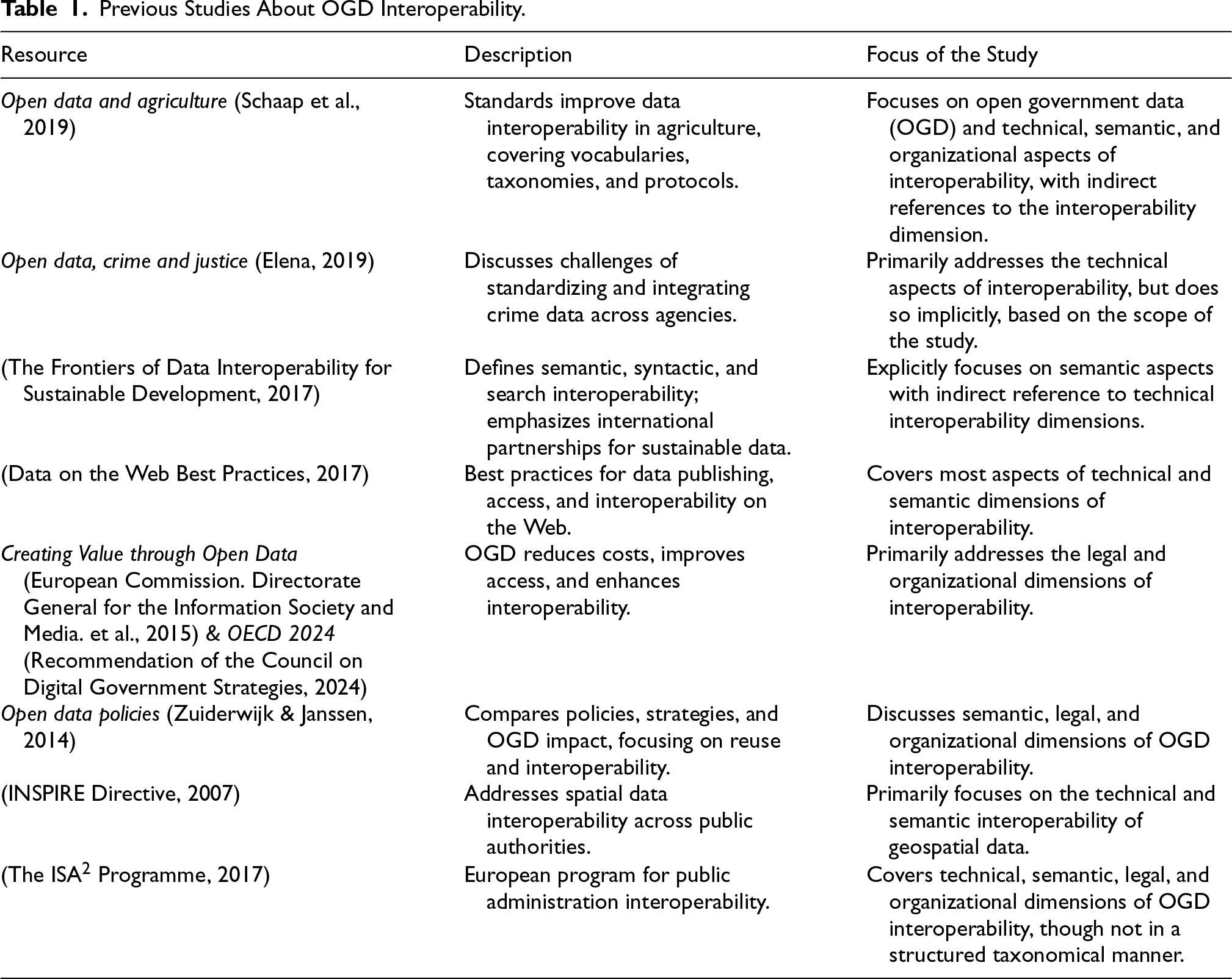
Relevant literature, policy documents, guidelines, and standards have been identified, emphasizing the growing requirements for OGD infrastructures and the interoperability needs across technical, semantic, legal, and organizational dimensions. This will enhance our study and contribute to answering the research questions. Table 1 outlines these key studies (academic, policy-based, standards, and guidelines) and their connection to the TSLO dimensions.
Previous Studies About OGD Interoperability.
Previous Studies About OGD Interoperability.
A constructive conclusion has been drawn from synthesizing existing interoperability frameworks for public administration and OGD: they do not fully address the specific aspects of OGD interoperability and lack a structured approach for measuring OGD infrastructure interoperability. Therefore, a clear need exists for a comprehensive framework that incorporates all relevant dimensions from existing frameworks and literature with concrete, easily assessable sub-metrics.
The provision of OGD by local government organizations is particularly important, as these entities are more closely connected to citizens and the 'real-life' functioning of cities in comparison with central government and have a wide range of thematic areas of activity, so they possess valuable ‘real-life’ data that can be quite useful from both a social and economic perspective. The release of certain data held by local authorities can not only promote transparency and accountability in their activities, but also generate opportunities for local economic development (Abutabenjeh et al., 2022; Las Casas et al., 2016; Lupi et al., 2020; Vostrovský & Rysová, 2014), which is much needed, especially in rural and disconnected areas. However, in order to achieve these objectives, it is necessary: a) big numbers of local government organizations to provide large quantities of OGD; and b) to achieve a high level of homogeneity and interoperability among the OGD infrastructures of the numerous local government organizations, which enables the combination of them; this can significantly increase the social and economic value that can be generated from them (as the value that can be generated from the use of OGD of only one local government organization usually is limited, with the only exception of the very big municipalities). These provide strong incentives and motivation for the development of larger and wider ecosystems around OGD for the generation of social and economic value from them. So, the homogeneous and interoperable local government OGD portals/websites are a vital precondition for the creation of OGD ecosystems that can multiply the benefits each institution can provide on its own: businesses can efficiently utilize and combine data from different institutions and provide added value services; also, the local governments themselves can compare their performance in various aspects of their operation with other local governments, possibly get inspired from them and finally offer better services to their citizens; furthermore, active citizens and journalists can easily compare the performance of different local government organizations boosting accountability and transparency overall.
With respect to the opening of data by local government, the most relevant study we identified was a paper that evaluated the capabilities of local governments’ portals in Australia concerning the provision of OGD and the impact of their release at a local level (Chatfield & Reddick, 2017). Some similar studies were identified as well concerning other countries, including Taiwan, South Korea, etc. In particular, Lin & Yang (2014) examine OGD provided by local governments in Taiwan, with the main emphasis on the evaluation of the quality of OGD based on the five-star ranking system. A study by Kim & Eom (2019) focuses on the effects of some ‘soft’ factors on the success of open data initiatives of Korean local governments; in particular, it examines the effects of managerial ability, institutional conditions, and socio-economic characteristics of each particular local government, as well as the demographic characteristics of the area it serves. In the research described in Kariuki et al. (2020), the main focus is to investigate the role of OGD in enabling fiscal transparency and accountability in municipalities in Africa (South Africa and Nigeria).
Also, Sandoval-Almazán et al. (2021) delve into the strategies used by Mexican municipal governments to adopt OGD and examine the perceptions and priorities of 67 Mexican public officials around OGD, specifically regarding openness, citizen involvement, and OGD. They discover that local public managers tend to have two main views about OGD: one is more concerned with technological innovation and the other with democratic principles and shared accountability. The findings show that authorities have a vague idea of what OGD is and that there are substantial problems because of lack of resources and different degrees of awareness. In order to improve local levels of openness, involvement, and collaboration, this study emphasizes the necessity of more explicit policies and stronger backing.
Additionally, with respect to Greece, we identified a paper examining the digital transformation and the websites of local government organizations in Greece, which is dealing with OGD provision, however with a minor emphasis on it (Bousdekis & Kardaras, 2020). Furthermore, a study by Lampropoulou & Spanou (2022) dealing with citizen empowerment and elimination of corruption in Greece, examines (among others) the role of OGD provision by government organizations of different layers for this. The launches of Data.gov.gr, which is Greece's National OGD Portal, are investigated by Dimitrelou & Fouskas (2023), as it is clear evidence of the country's unwavering commitment to developing the OGD realm. However, the analysis conducted by Papachristou & Gounopoulos (2023) reveals weaknesses with respect to the quality of the OGD provided by government agencies in Greece, which reduce their usefulness for social and economic value generation.
Summarizing, through our review of literature about the existing interoperability frameworks outlined in Section 2.1 and the provision of OGD by local governments outlined in Section 2.2, it becomes evident that, despite notable contributions, a critical gap persists in research on the interoperability of OGD infrastructures of local governments. Moreover, there is a need for a comprehensive framework specifically designed to assess and enhance interoperability of OGD infrastructures.
Research Methodology
As mentioned at the end of the previous section, from the review of the related literature we conducted, two important research gaps have been identified. Firstly, there is no proper framework for assessing the degree of interoperability of OGD infrastructures that enables the integration of open data from different OGD infrastructures, which allows their combined exploitation leading to the generation of higher levels of social and economic value from them (and therefore creates strong incentives and motivation for the development of OGD ecosystems for this purpose). Secondly, we identified a research gap concerning the opening of data by local government organizations. Our research contributes to filling both of these research gaps. In particular, it addresses the first of the above research gaps by developing the TSLO (Technology, Semantic, Legal, and Organizational) framework for the assessment of interoperability of OGD infrastructures (which is described in the following section 4). Also, it addresses the second of these research gaps by applying this TSLO framework for the Greek local government (as described in sections 5 and 6). Furthermore, by addressing the above two research gaps, our research investigates a highly important precondition for the development of OGD ecosystems, which has not been examined by previous relevant literature.
So, we developed and then applied/validated a TSLO interoperability assessment framework. For this purpose, we adopted a research methodology that includes the following steps (shown in Figure 1):
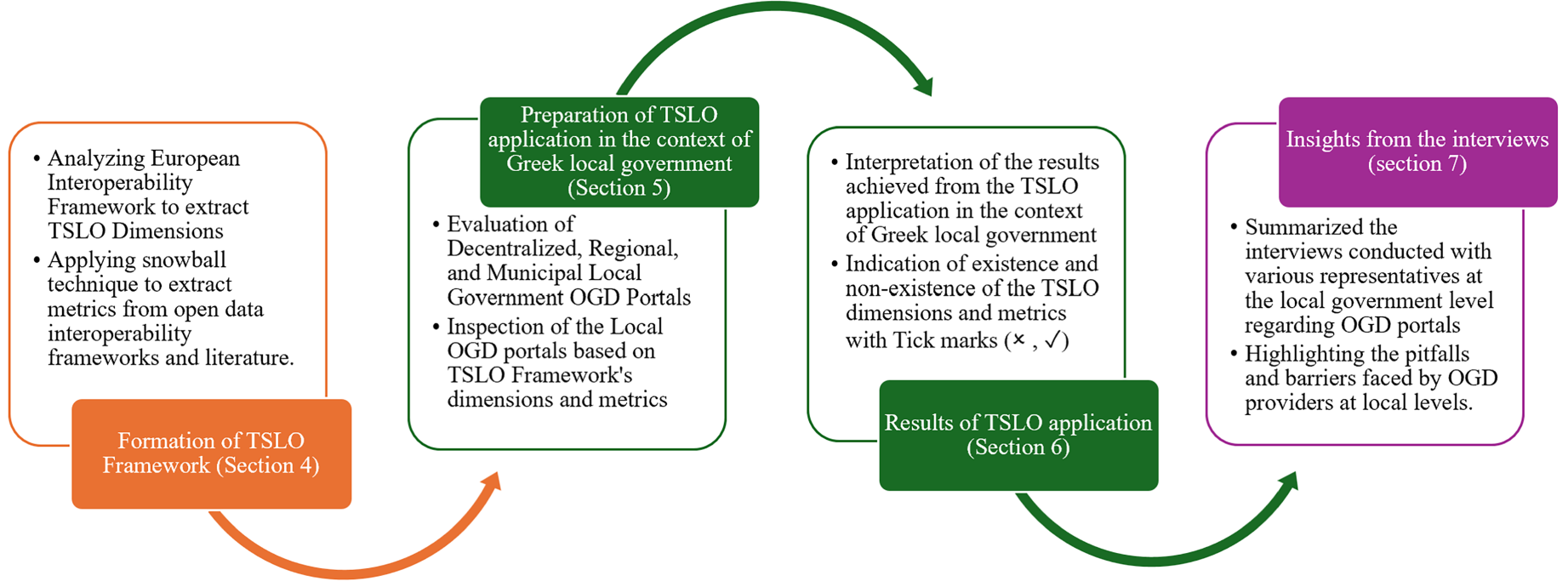
Research methodology for the development of the TSLO interoperability framework and its application/validation in Greek local government.
a. Initially based on the European Interoperability Framework (EIF), as it is the most widely recognized and used interoperability framework, we defined the main assessment dimensions of the TSLO (technical, semantic, legal, organizational) (see Section 4 for more details about the justification and foundations of these four TSLO assessment dimensions).
b. Then for each of these assessment dimensions, a set of metrics was defined based on relevant OGD literature (in the final paragraph of Section 4, the methodology we used for this is explained in detail).
c. Next, the TSLO interoperability framework was applied for assessing the OGD infrastructure of the Greek local government; we examined all three layers of it: decentralized administrations, regional administrations, and municipalities. For each of these OGD infrastructures, by inspection of them, we assessed the four dimensions of the TSLO framework; in particular, for each dimension, we assessed each of its metrics in a binary form (i.e., the existence or absence of the corresponding characteristic in this OGD infrastructure). The main steps we followed are shown in Figure 2. Initially we examined the availability of OGD infrastructures in the above local government organizations; then desk-based research was conducted, which included access and examination of the existing OGD infrastructures of Greek local government organizations, in order to assess them with respect to the technical, semantic, legal, and organizational metrics of the TSLO framework.
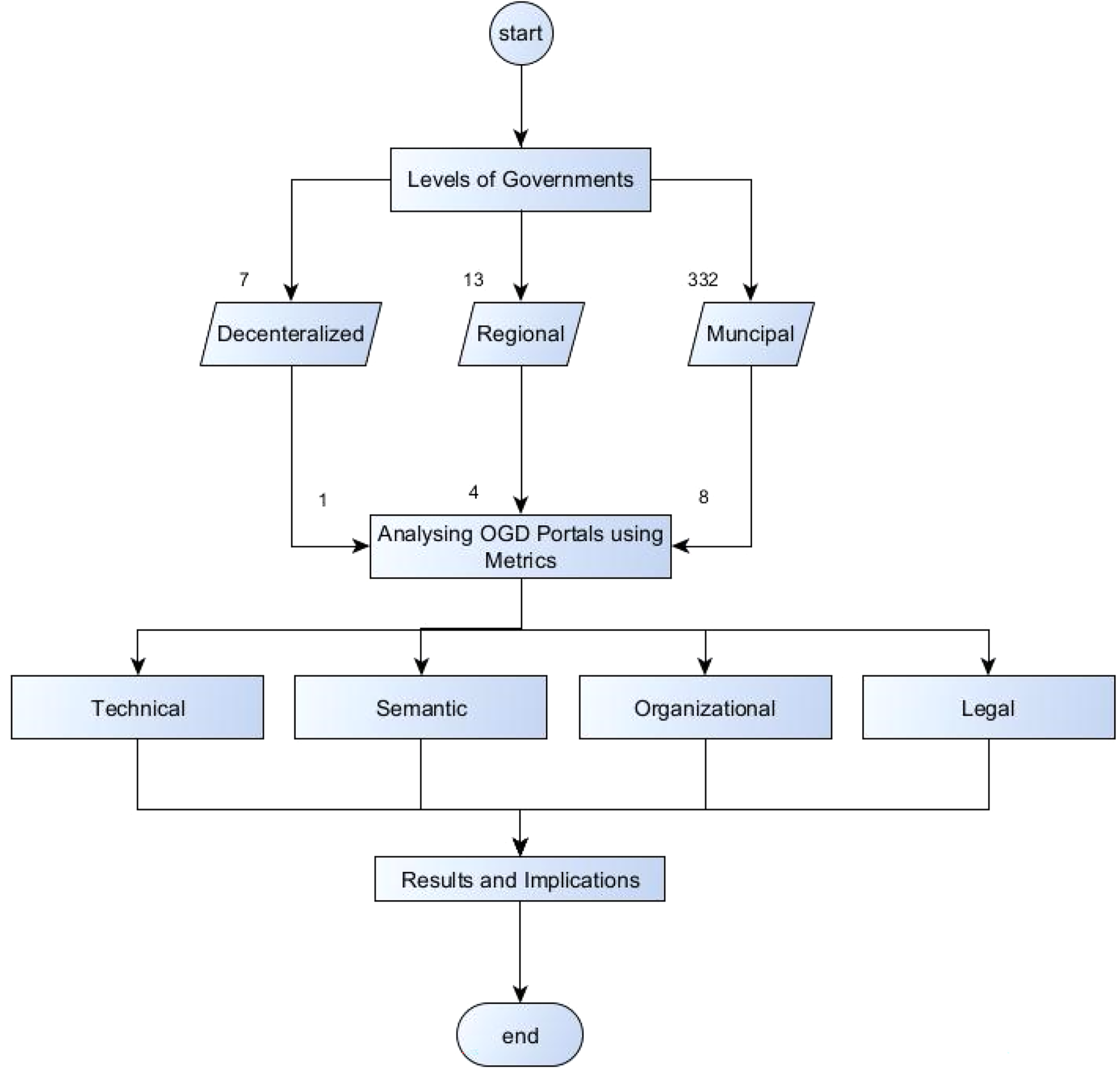
Steps of the application of the TSLO.
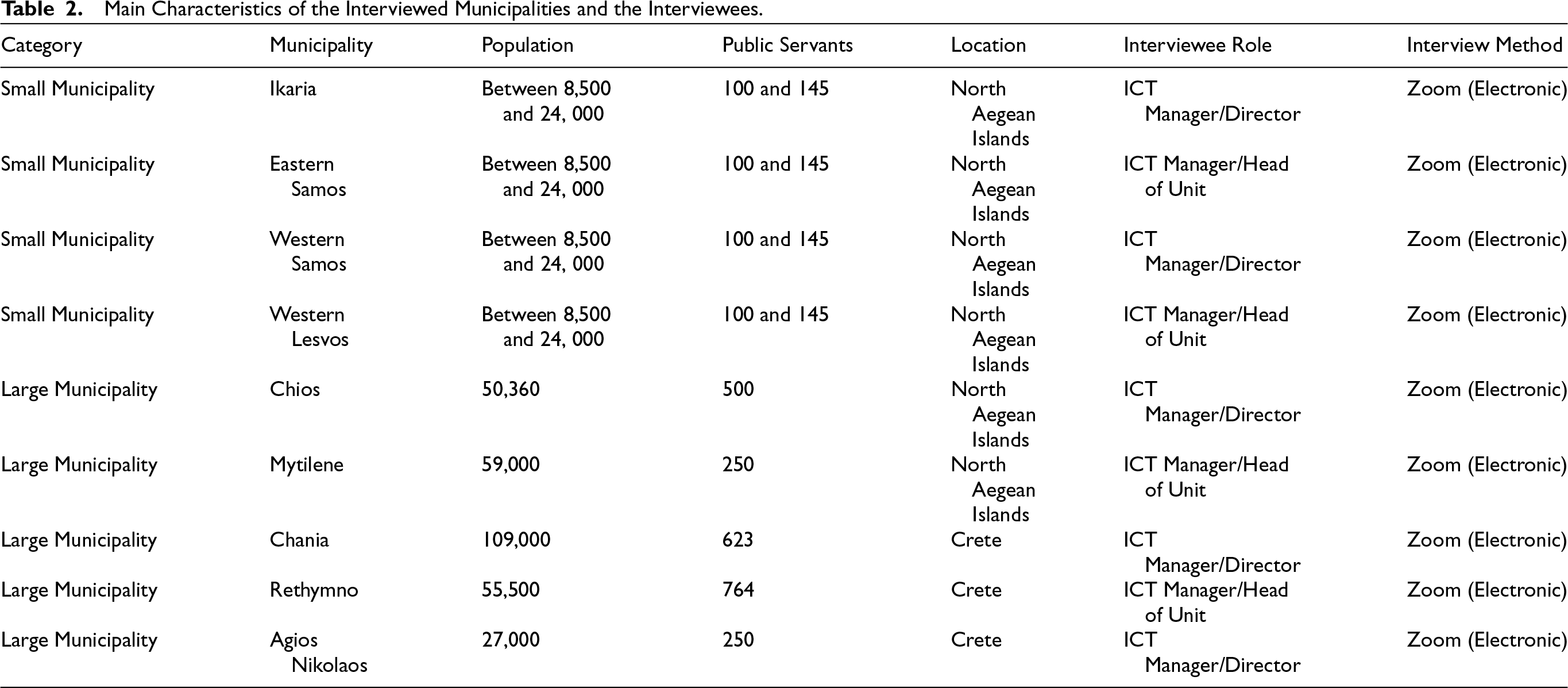
d. Finally, as we found that only a small share of the local government organizations of the above three administrative layers of Greece provided OGD, we conducted a number of interviews with local government organizations not providing OGD in order to understand the main reasons for this. In particular, we conducted interviews with four smaller and two larger municipalities of the North Aegean islands not providing OGD. The first category includes the municipalities of Ikaria, Eastern Samos, Western Samos, and Western Lesvos, which are responsible for geographical areas with populations between 8,500 and 24, 000 citizens and are staffed with 100 and 145 public servants; the second category includes the larger municipalities of Chios and Mytilene, which are responsible for areas having populations of 50,360 and 59,000 citizens, respectively, and are staffed with 500 and 250 public servants, respectively. We also conducted interviews with the three out of the four large municipalities of Crete that do not provide OGD (Crete is the biggest Greek island, having higher levels of economic activity and development than the North Aegean islands): Chania, Rethymno, and Agios Nikolaos (while the fourth one is the municipality of Heraklio, which provides OGD through a dedicated portal, as described in more detail in the following section). They are responsible for areas having populations of 109,000, 55,500, and 27,000 citizens, respectively, and are staffed with 623, 764, and 250 public servants, respectively. In each of these municipalities we conducted an interview with the ICT manager (in some of them being a director, and in some others a Head of Unit); these interviews were conducted through electronic means (mainly Zoom). In each interview, initially we asked them some questions in order to assess their level of awareness about OGD, and then we discussed with them the reasons for not providing OGD. In Table 2, we can see the main characteristics of these nine municipalities. These interviews were recorded, transcribed, and then coded using an open-coding approach. The insights gained from this second part of our research (interviews) are presented in Section 7.
Main Characteristics of the Interviewed Municipalities and the Interviewees.
For the combined exploitation of OGD from many different OGD portals and websites, several different dimensions of interoperability among them are required. Quite important is the semantic interoperability, as it enables a common meaning and understanding of OGD, which is crucial for generating high levels of value by combining multiple open data sources (Kirstein et al., 2020; Papachristou & Gounopoulos, 2023). Furthermore, in order to facilitate effective collaboration and sustainable development, highly important are organizational dimensions that include particular responsibilities and governance mechanisms concerning the opening and use of data (Kampars et al., 2020). Also, the data licensing, privacy, and regulatory frameworks are all part of the legal standards that control the usage of the OGD by the actors participating in an OGD ecosystem and the value generation from them. At the same time, important for the combined exploitation of OGD are the data formats and standards, which are defined in the technical perspectives of interoperability. To build a robust OGD ecosystem, it is essential to meet the distinct needs of each standard. This approach ensures that the data is technically feasible to combine and logically consistent, and that its use is also ethically and legally sound (Geisler et al., 2022; Immonen et al., 2018; Styrin et al., 2017). Moreover, data quality standards are necessary to guarantee that OGD portal datasets are accurate; otherwise, incompatible datasets and errors in data collection can lead to false findings, which can have negative consequences for their usefulness for social, policy, economic, and scientific purposes. Therefore, in order to enable combined exploitation of datasets from many different OGD portals/websites, which allows the generation of higher levels of social and economic value from them, increasing the motivation for the creation of OGD ecosystems for this purpose, several different dimensions of interoperability among these OGD portals/websites are required.
Based on the above principles, we developed a multi-dimensional framework for assessing OGD infrastructures from the interoperability perspective. The framework adopts the main dimensions of interoperability defined in the European EIF and the IMAPS framework (European ‘Interoperability Maturity Assessment of a Public Service’) outlined in Section 2, as well as its complementary: it examines the interoperability of OGD portals and websites from the technical, semantic, legal, and organizational (TSLO) perspectives, which are crucial for developing interoperability between OGD infrastructure and can pave the way for the creation of an OGD ecosystem. The EIF defines the main layers/dimensions of interoperability: technical, semantic, organizational and legal; however, these interoperability dimensions are not elaborated for OGD infrastructure interoperability in the EIF; also, the EIF does not suggest metrics for each of these four interoperability dimensions. So, we used as basis the following definitions of these four interoperability dimensions provided by the EIF (European Commission, 2017) :
The technical dimension concerns “the applications and infrastructures linking systems and services. Aspects of technical interoperability include interface specifications, interconnection services, data integration services, data presentation and exchange, and secure communication protocols.” The semantic dimension aims to ensure “that the precise format and meaning of exchanged data and information is preserved and understood throughout exchanges between parties; in other words, ‘what is sent is what is understood’.” The legal dimension concerns “ensuring that organizations operating under different legal frameworks, policies, and strategies are able to work together. This might require that legislation does not block the establishment of European public services within and between Member States and that there are clear agreements about how to deal with differences in legislation across borders, including the option of putting in place new legislation.” The organizational dimension refers “to the way in which public administrations align their business processes, responsibilities, and expectations to achieve commonly agreed-upon and mutually beneficial goals.” technical aspects/features of open data, technical features of open data infrastructures/portals, semantic aspects/features of open data, semantic features of open data infrastructures/portals, legal aspects/features of open data, legal aspects of open data infrastructures/portals organizational aspects/features of open data, organizational aspects of open data infrastructures/portals
Based on the above conceptualizations of the four interoperability dimensions outlined above, we developed an elaboration and adaptation of them for the assessment of OGD infrastructures’ interoperability. For each dimension of the TSLO, a set of metrics was defined based on relevant literature. In particular, for each dimension, we searched through Google Scholar for relevant papers using the following keywords:
Then using the papers, we found from the above search we adopted a snowballing’ approach: in the references of each paper, we searched for more relevant papers. We also conducted a similar search using the Scopus database, but we did not find any additional papers. Finally, from the whole set of relevant papers we found, we extracted the main aspects/features of each dimension, from which the specific metrics of it were defined. These metrics of the four dimensions of the TSLO as well as their rationale and supporting literature are shown in Table A1 of the Appendix.
Greece was one of the first countries in the European Union to become part of the OGD movement, joining the Open Government Partnership (OGP) in 2011 (Open Government Partnership, 2011). Despite Greece's early involvement with OGD in an attempt to promote government transparency, enhance citizen trust, and boost economic growth, the progress has been slow. According to the Open Data Maturity Report of 2023 (data.europa.eu, 2023), Greece acquired a "beginner" rating and has declined in comparison with other European countries, slipping from 13th place to 30th. Other studies, such as the evaluation of data format quality of OGD portals in Southern EU countries by Papachristou & Gounopoulos (2023), have revealed that the quality of the OGD formats provided by Greek organizations is low, often rated at levels 1 or 2 in the five-star model. To improve the state of OGD in Greece, the government has released an action plan (Greece, 2023) aiming to promote the development and enhancement of OGD portals, with a main focus on the central OGD portal. This plan seeks to improve both the quality and quantity of available data and provide training to public workers and other stakeholders to increase the impact of OGD in the country. The use of the TSLO framework can become a useful tool towards this direction, helping government officials achieve the goals presented in the action plan. Furthermore, as mentioned in the Introduction, the Greek national context is a very interesting one for making a first application of our TSLO framework, as Greece belongs to the developed world, being a member of the European Union and the Eurozone; however, it is characterized by a lower level of ‘digital’ development in comparison with the other European Union countries; also, Greece recently experienced a prolonged economic crisis between 2008 and 2018 (Gourinchas et al., 2016; Meghir et al., 2017), which impacted negatively all aspects of social and economic life.
In Greece there are three layers of local government: decentralized administration, regional administration, and municipalities: in particular, there are 7 decentralized administrations, 13 regional administrations, and 332 municipalities. We conducted a combination of searches, initially on all local government websites using their search functionalities and menus. Subsequently, we used queries in web search engines, constructed to identify mentions of OGD on all the local government websites. We retained only those local government entities providing OGD through their dedicated infrastructures, in their websites, or in specific OGD portals they have developed for this purpose. We excluded those entities that provide data through the national OGD portal. Then we assessed the existing local government infrastructures (websites or portals) using the TSLO framework with respect to all its technical, semantic, legal, and organizational metrics. The results of this first part of our research are presented in the following Section 6.
Furthermore, because, as explained in more detail in the following section 6 only a small share of the local government organizations of the above three administrative layers provided OGD, after the above desk-based research, we conducted nine interviews with Greek municipalities that do not provide OGD, in order to understand the main reasons for this.
Results of TSLO Application
Our first interesting result is that only a small minority of municipalities (8/332) and decentralized administrations (1/7) provide OGD; furthermore, nearly a quarter of the regional administrations (4/13) have proceeded to the provision of OGD. In particular, five municipalities have OGD portals (Heraklion, Thessaloniki, Malevizi, Trikkala, and Chalandri), and three host OGD provisions on their websites (Larissa, Patra, and Rhodes). Furthermore, two regional administrations have OGD portals (Attica and Central Greece) and two host OGD provisions on their websites (Western Macedonia and the Ionian Islands). Some more local government organizations provide OGD through the national OGD portal. This indicates a low participation of municipalities, as well as regional and decentralized administrations, in the OGD movement with their own infrastructures, and therefore a low awareness and understanding of the social, political, and economic benefits that the opening of local government data can offer; this does not allow the generation of high levels of social and economic value by combining OGD from large numbers of municipalities and decentralized administrations, so there are not strong motivations for the development of ecosystems for this purpose. However, at the regional level of government, there is a higher participation in the OGD movement, which reveals some higher awareness and understanding of the potential benefits that the opening of their data can offer.
Technical Dimension
Initially, we assessed the existing OGD infrastructures of the local government (decentralized, regional, and municipal) administrations with respect to the 12 metrics of the technical dimension described in Section 4. They concern important technical aspects of them: performance and scalability, integration with external systems, multi-language support, data update frequency, data visualization tools, data filtering and search, metadata of the data, underlying OD CMS (CKAN, DKAN, Socrata, Custom, etc.), data access methods (direct download), Application Programming Interface (API) availability, data formats supported (up to 2 star) and thematic categorization.
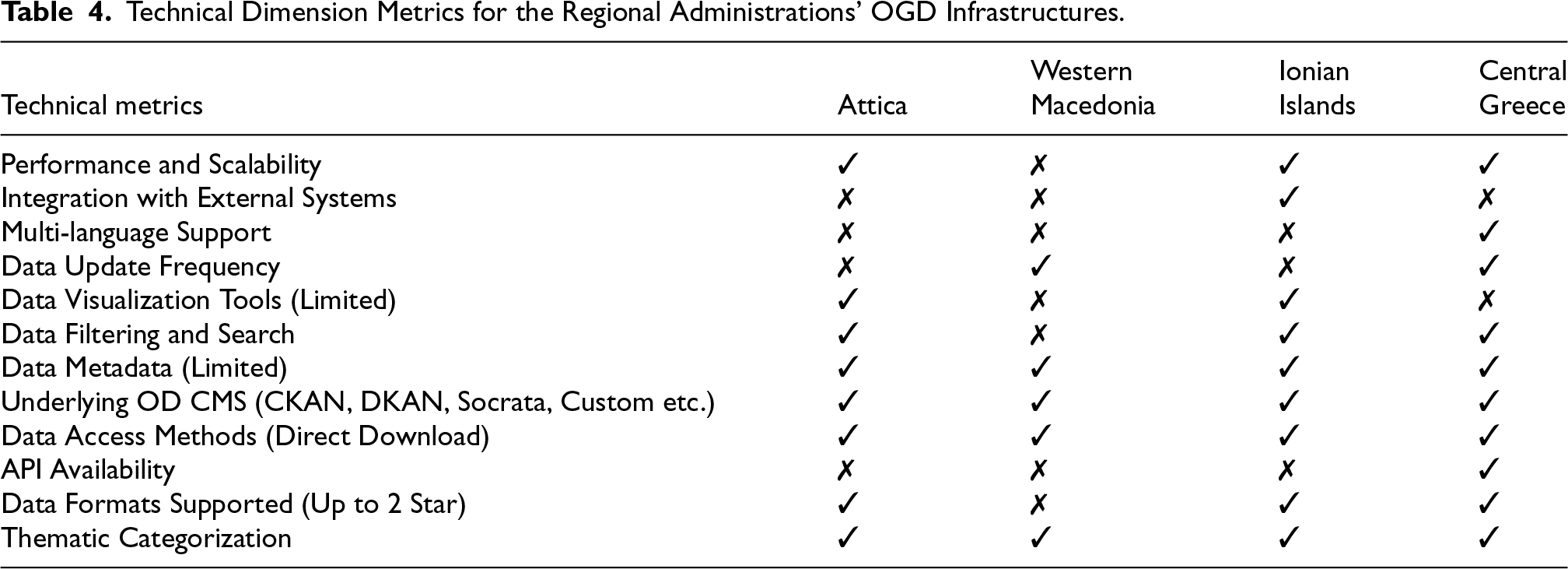
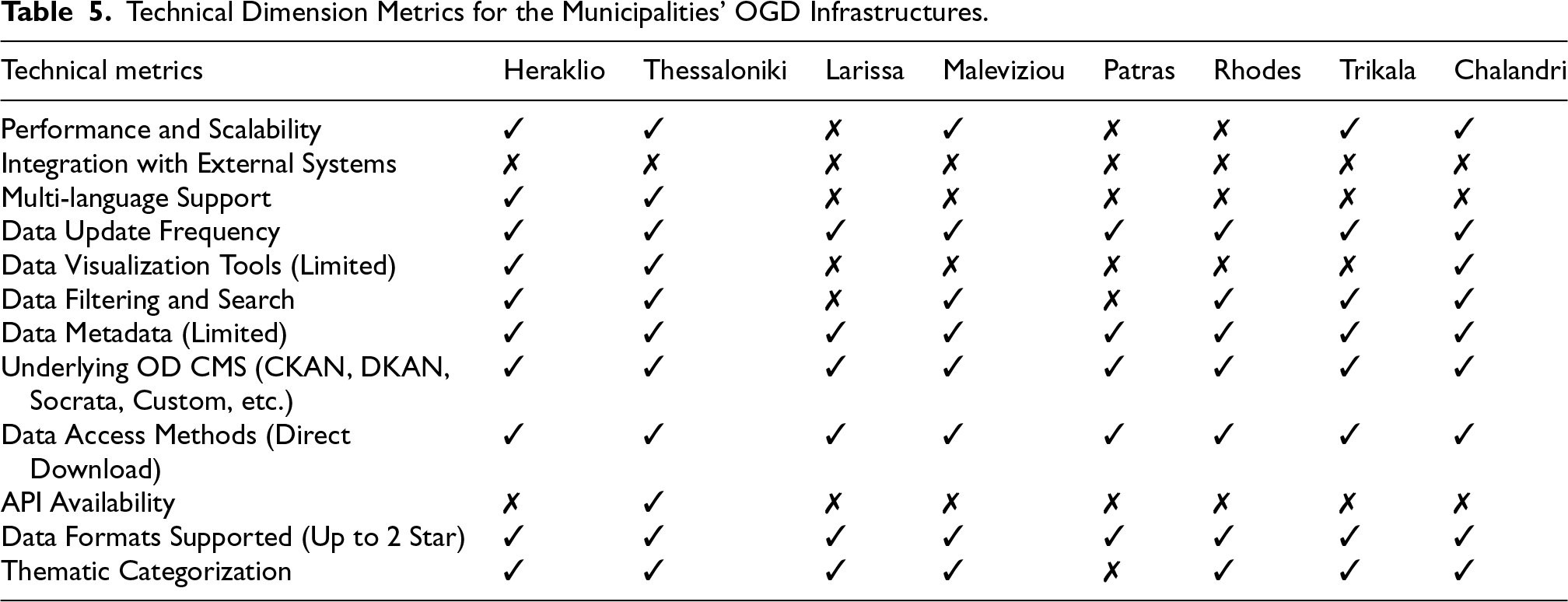
In Table 3, we can see the results for the only existing OGD portal of decentralized administration: the one of Crete; we can see that it meets 11 out of the 12 metrics, with the only deficiency being the lack of multi-languality. In Table 4, we can see the results for the four regions that have OGD infrastructures. Most of them meet a significant part of the technical metrics (one meets 8 metrics, one meets 9 metrics, and one meets 10 metrics), and only one meets less than half of the metrics (5). The main deficiencies in the regional administrations’ OGD infrastructure concern the lack of multi-linguality, API availability, and data update frequency. Finally, in Table 5, we can see the results for the eight municipalities that have OGD infrastructures. Three of them meet a significant part of the technical metrics (9 or more), while the remaining five meet less metrics (however more than half of them). The main deficiencies in the municipalities’ OGD infrastructures concern the lack of integration with external systems, API availability, and multi-linguality.
Technical Dimension Metrics for the Decentralized Administration OGD Infrastructure.
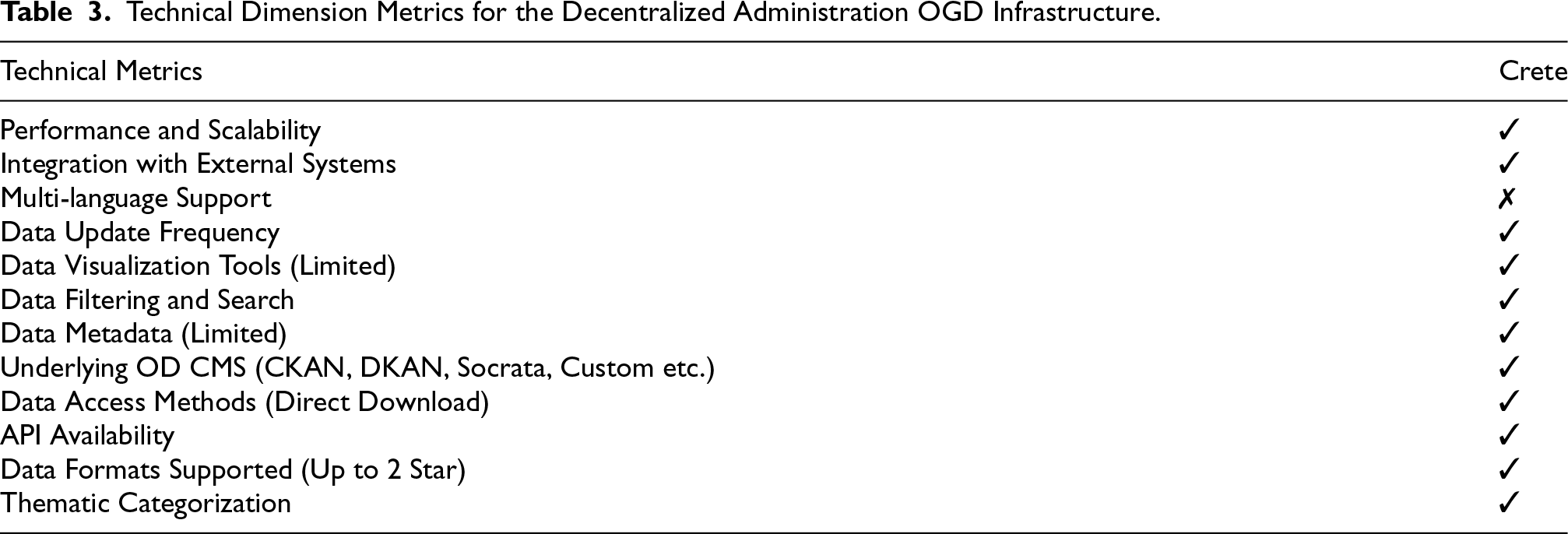
Technical Dimension Metrics for the Decentralized Administration OGD Infrastructure.
Technical Dimension Metrics for the Regional Administrations’ OGD Infrastructures.
Technical Dimension Metrics for the Municipalities’ OGD Infrastructures.
In Figure 3, we can see the results concerning the technical dimension metrics for each of the 13 local government organizations that have OGD infrastructures (portals/websites), organized by administrative layer: initially for the 8 municipalities, then for the 4 regional administrations and finally for the regional administration. The average number of technical metrics met by these 13 local government organizations’ OGD infrastructures is 8.2/12, so we can conclude that there is a moderate degree of compliance with these basic technical requirements. The OGD infrastructures of the decentralized administration of Crete and the municipality of Thessaloniki meet the highest number of technical metrics (11/12) among the examined local government organizations, followed by the ones of the regional administration of Central Greece and the municipality of Heraklio that meet 10/12 technical metrics. Also, we remark that the OGD infrastructures of 6 out of these 13 local government organizations meet at least 75% (9) of the technical metrics.
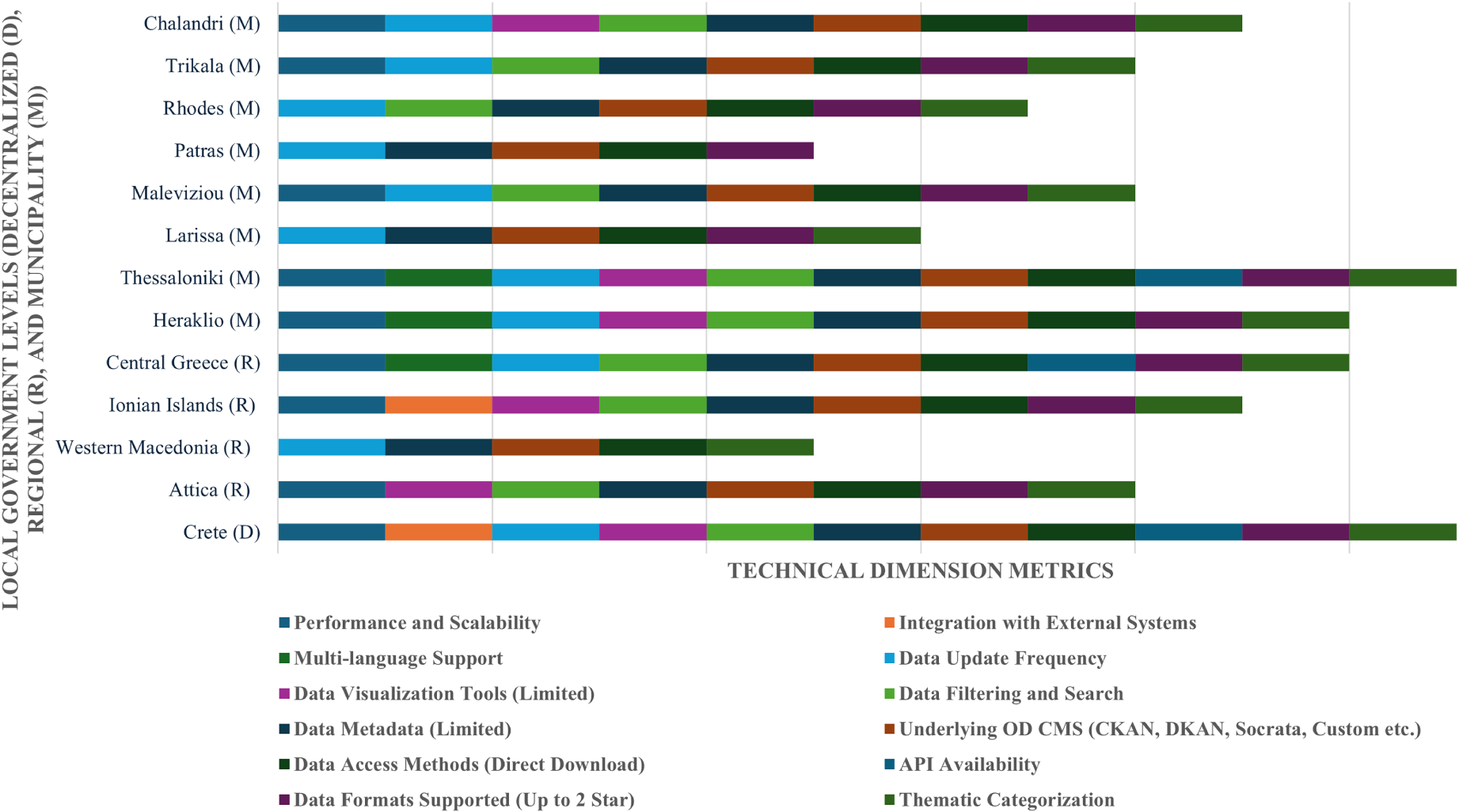
Technical dimension metrics for the decentralized (D), regional (R) and municipal administration OGD infrastructures.
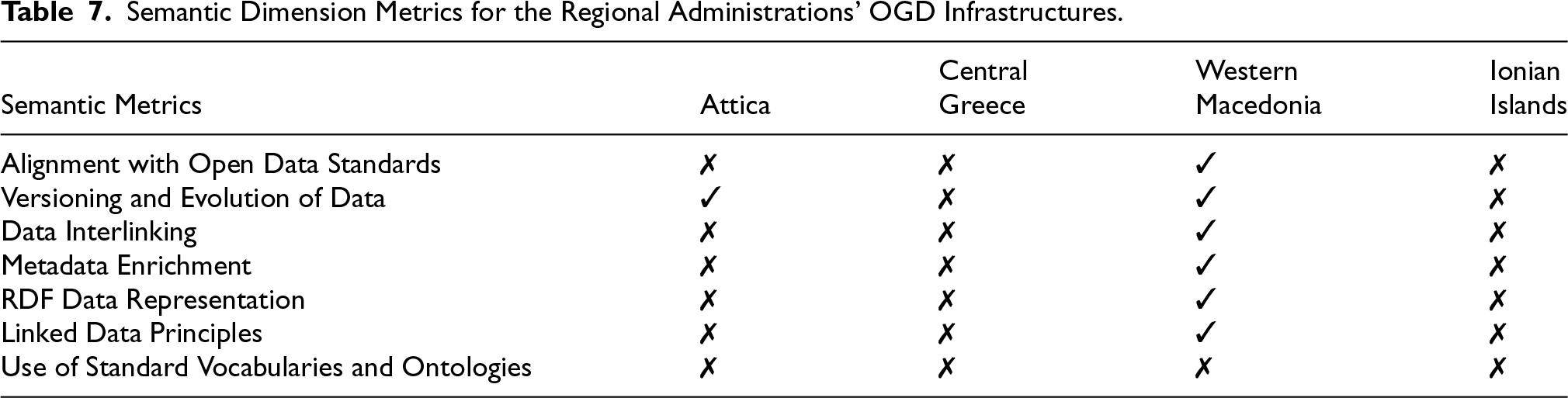
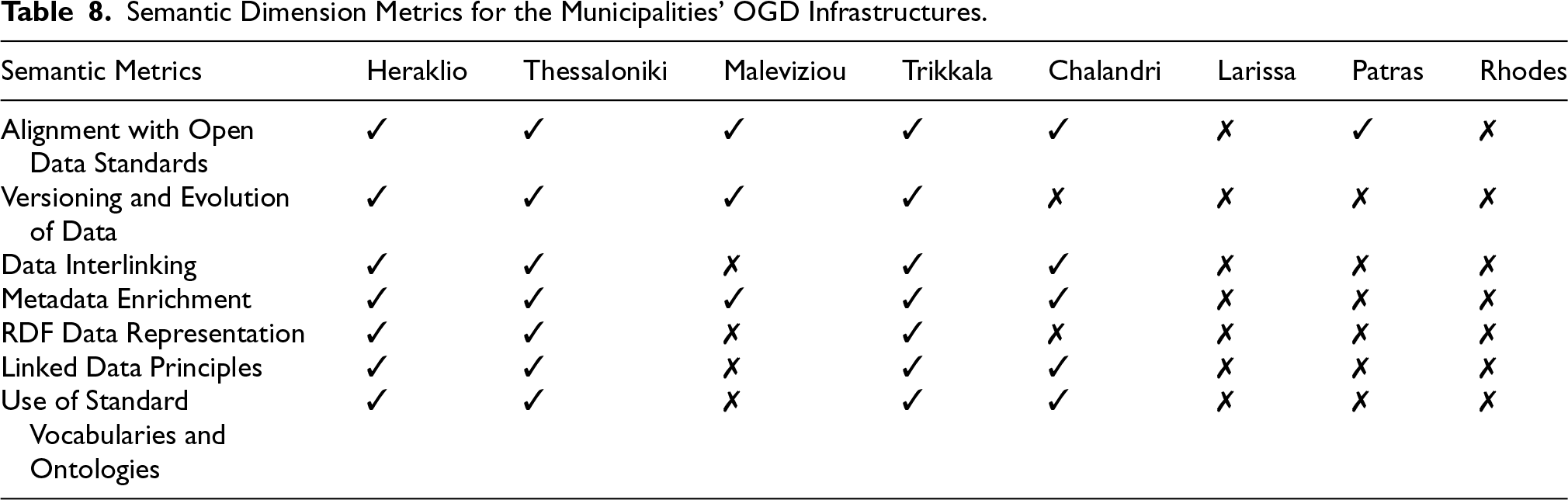
In Tables 6, 7, and 8, we can see the results of assessment of the same OGD infrastructures with respect to the 7 metrics of the semantic dimension; they concern some important semantic aspects of them: the utilization of standard vocabularies and ontologies, linked data principles, RDF data representation, metadata enrichment, data interlinking, versioning and evolution of data, and alignment with industry standards for open data. In particular, in Table 6, we can see that the decentralized administration of Crete meets almost all these semantic metrics of the TSLO framework (6 out of 7), with the only exception of the utilization of standard vocabularies and ontologies. In Table 7, we can see the same metrics of the semantic dimension of our TSLO framework for the four regional administrations: two of these four regional administrations meet none of these semantic metrics, while on the contrary, Western Macedonia meets nearly all these semantic metrics (6 out of 7) followed by Attica meeting only one of the metrics. Therefore, there is a lower adoption of these semantic standards/specifications by the above regional administrations. The main deficiencies concern again the utilization of standard vocabularies and ontologies, the adoption of the linked data principles, the RDF data representation, the metadata enrichment, the data interlinking, and the alignment with open data standards. Finally, Table 8 shows these semantic dimension metrics for the eight municipalities: two of them meet none of these semantic metrics, and another one meets only one metric, while on the contrary, another three, the Heraklion, Thessaloniki, and Trikkala ones, comply with all the semantic metrics of the framework (7 out of 7), followed by Chalandri (5 out of 7) and Maleviziou (3 out of 7). The main deficiencies at the municipal level are the lack of RDF data representation, followed by the lack of data interlinking, linked data principles adoption and use of standard vocabularies and ontologies.
Semantic Dimension Metrics for the Decentralized Administration's OGD Infrastructure.
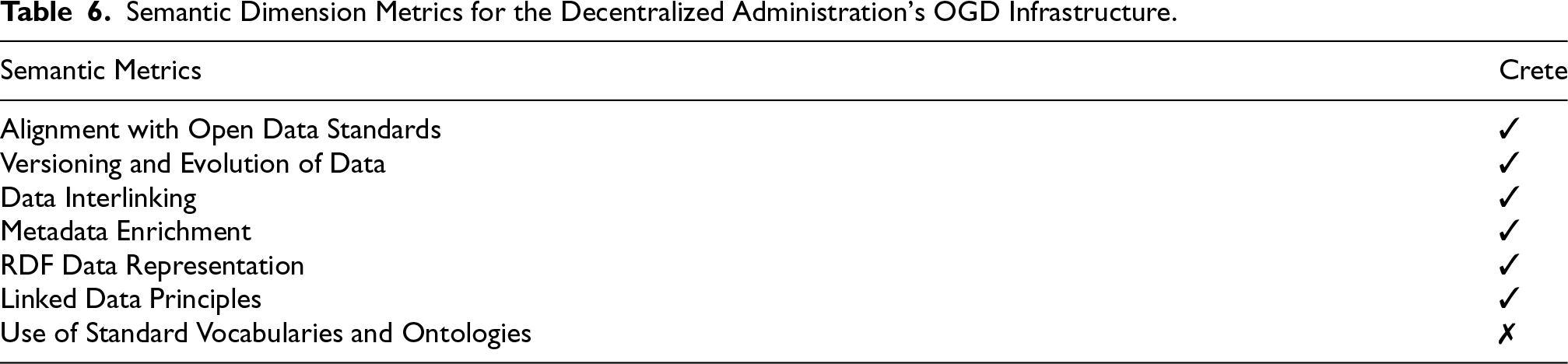
Semantic Dimension Metrics for the Decentralized Administration's OGD Infrastructure.
Semantic Dimension Metrics for the Regional Administrations’ OGD Infrastructures.
Semantic Dimension Metrics for the Municipalities’ OGD Infrastructures.
In Figure 4, we can see the results concerning the semantic dimension metrics for each of the 13 local government organizations that have OGD infrastructures (portals/websites), organized by administrative layer. The average number of semantic metrics met by the OGD infrastructures of these 13 local government organizations is 3.6/7, so we can conclude that there is a lower degree of compliance of them with these basic semantic requirements. However, we note that there is a high level of heterogeneity among these organizations: there are three municipalities, the ones of Heraklio, Thessaloniki, and Trikkala, that meet all the 7 semantic metrics, while the decentralized administration of Crete and the regional administration of Western Macedonia meet 6 out of 7 semantic metrics; on the contrary, we have six of the examined local government organizations meeting one or none of these basic semantic metrics.
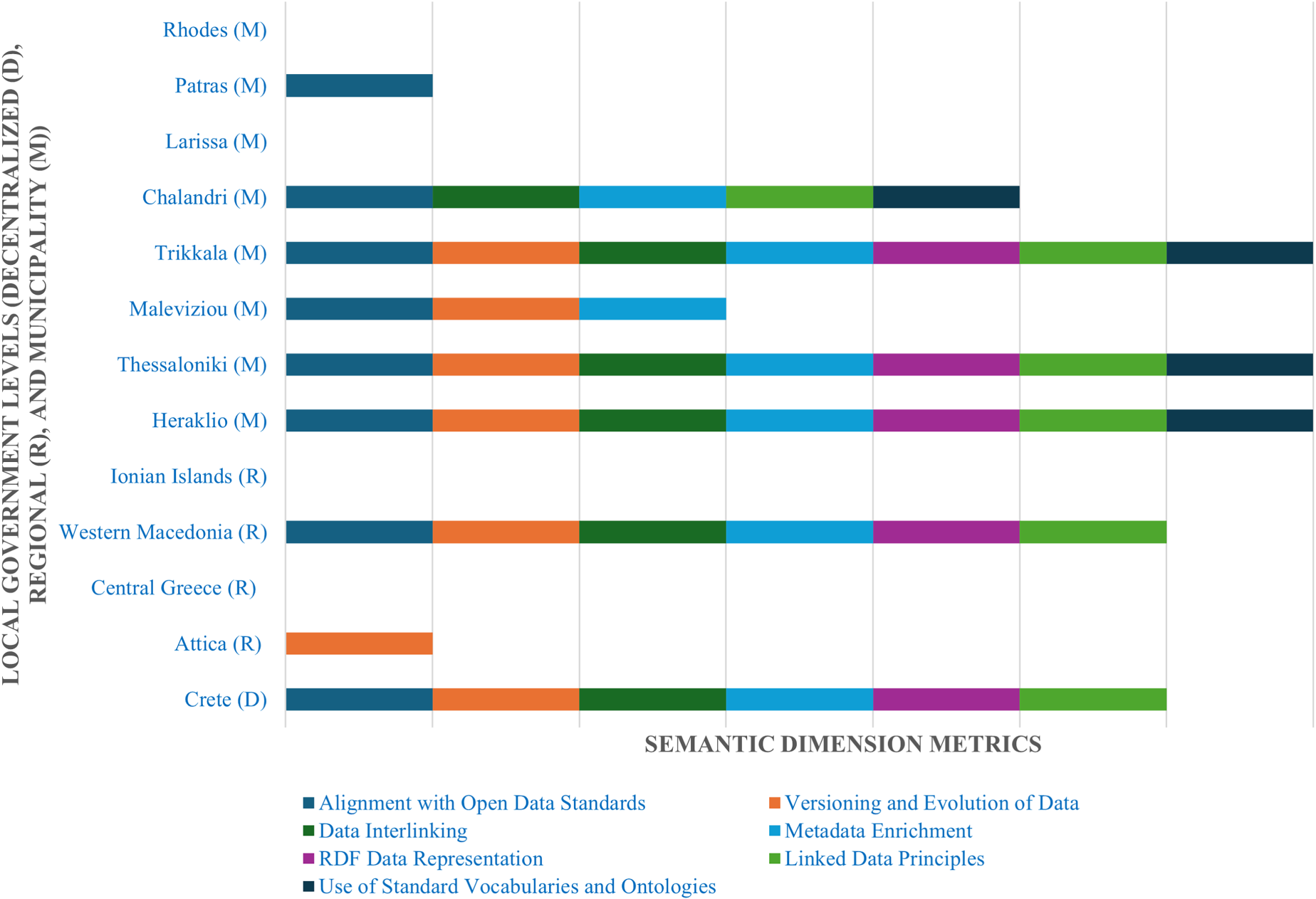
Semantic dimension metrics for the decentralized (D), regional (R) and municipal administration OGD infrastructures.
Legal Dimension Metrics for the Decentralized Administration's OGD Infrastructure.

Legal Dimension Metrics for the Regional Administrations’ OGD Infrastructures.

In Tables 9, 10, and 11 illustrate how the existing open data infrastructures of decentralized, regional, and municipal adhere to the 4 metrics of the legal dimension; they concern important legal aspects of open data provision: open data licensing, license compatibilities, data usage rights, and attribution requirements metrics. In Table 9, we can see that the OGD portal of Crete complies with all the metrics (4 out of 4) by providing proper information regarding open data licenses; these licenses are also compatible with the open data rules and regulations and usage rights, as well as attribution rights, and are well-described on the portal. At the regional layer, as depicted in Table 10, the OGD infrastructures of Attica and Western Macedonia regional administrations comply with the legal dimension metrics fully (4 out of 4). The Ionian Islands regional administration complies with most of them (3 out of 4) and only lacks license compatibility. On the contrary, Central Greece regional administration OGD infrastructure is not providing any information regarding these four important legal aspects of their open data infrastructure. In Table 11, we can see a clear ‘polarization’: out of the eight municipalities that have OGD portals, half (four) do not provide any information regarding the legal dimensions of the TLSO framework, while on the contrary, the other four achieve a high level of compliance: the municipalities of Heraklion, Thessaloniki, and Chalandri fully comply with the legal metrics (4 out of 4), while the Maleviziou one (3 out of 4) lacks information only on open data licensing.
Legal Dimension Metrics for the Municipalities’ OGD Infrastructures.
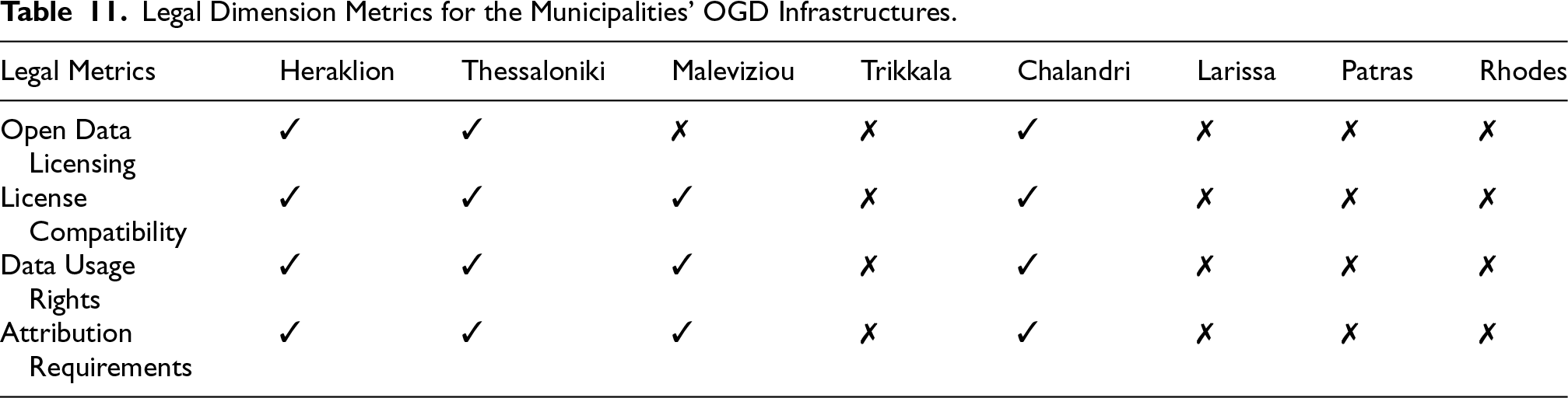
Legal Dimension Metrics for the Municipalities’ OGD Infrastructures.
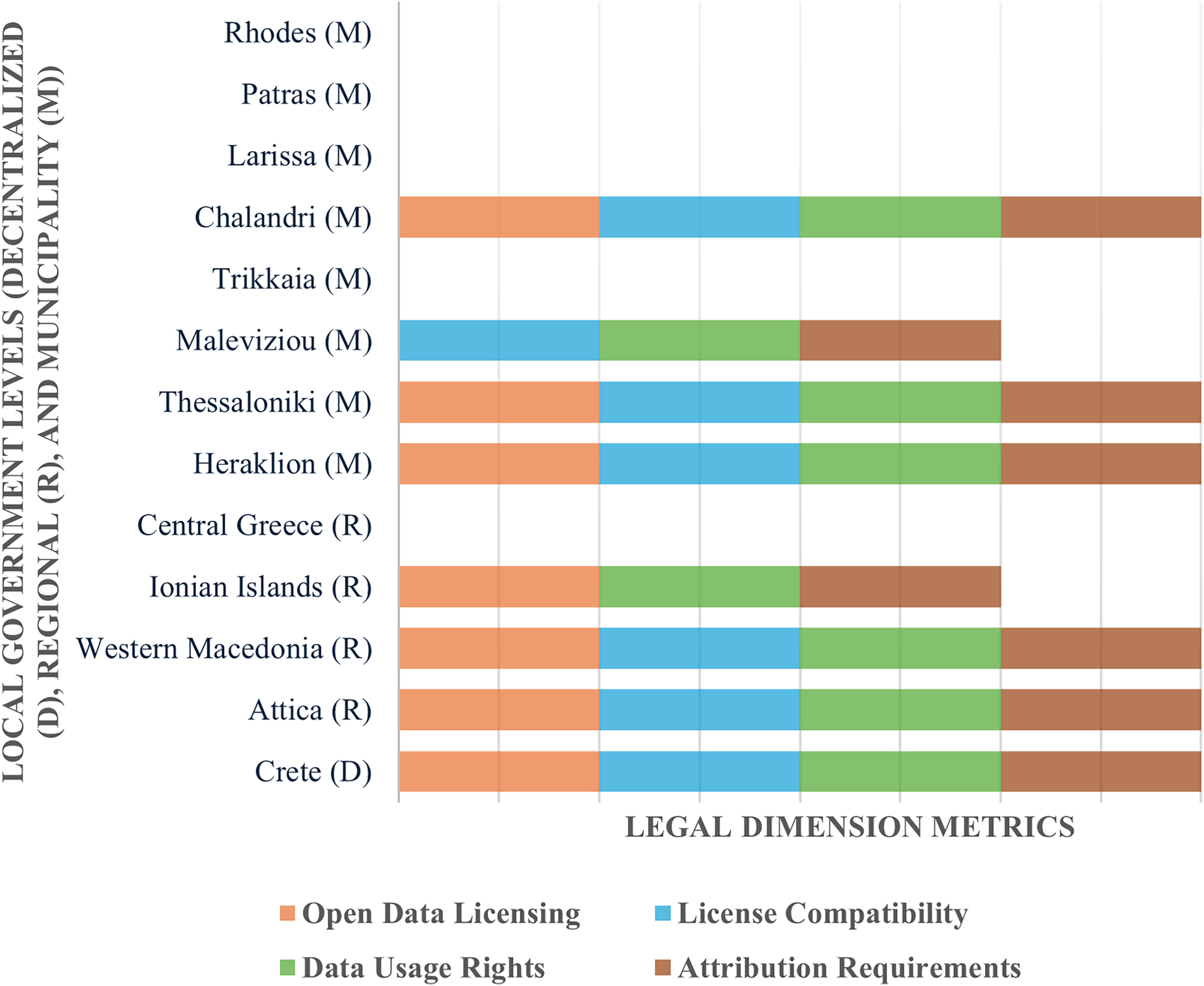
Legal dimension metrics for the decentralized (D), regional (R) and municipal administration OGD infrastructures.
In Figure 5, we can see the results concerning the legal dimension metrics for each of the 13 local government organizations that have OGD infrastructures (portals/websites), organized by administrative layer. The average number of legal metrics met by the OGD infrastructures of these 13 local government organizations is 2,5/4, so we can conclude that there is a low to moderate degree of compliance of them with these basic legal requirements. However, we note that there is a high level of heterogeneity among these organizations: six of them meet all 4 legal metrics, and another two meet 3 out of the 4 legal metrics; on the contrary, the remaining five organizations meet none of the legal metrics.
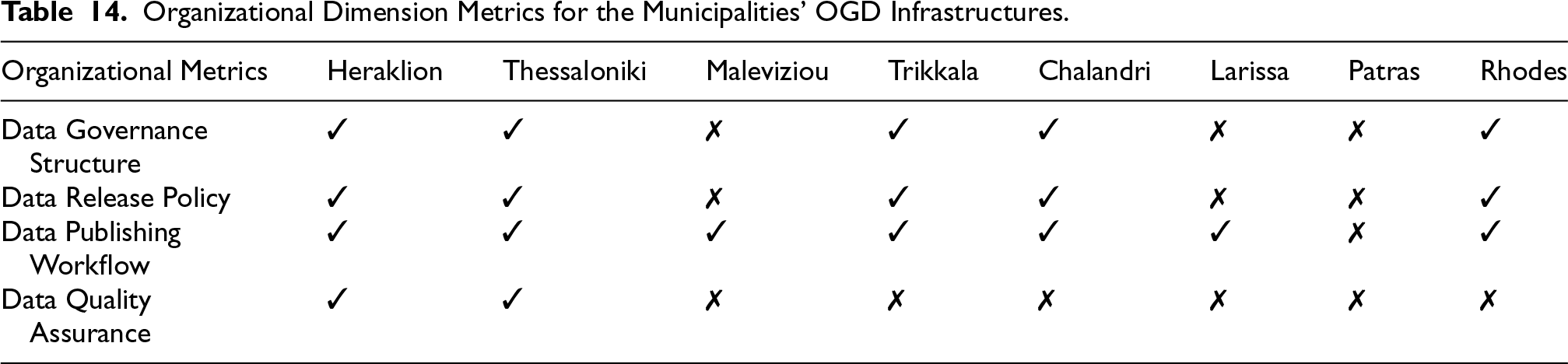
Tables 12, 13, and 14 describe the compliance of decentralized, regional, and municipal open data infrastructure, respectively, with the 4 metrics of the organizational dimension metrics; they concern important aspects of the organization of the open data provision by the provider local government: data governance structure, data release policy, data publishing workflow, and data quality assurance; these aspects contribute to the better organizational interoperability of open data infrastructure. At the decentralized administration layer, the Crete open data portal fully complies with the organizational dimension metrics (4 out of 4) as shown in Table 12. At the regional administration layer, as portrayed in Table 13, Attica fully complies (4 out of 4) with the organizational metrics, while Western Macedonia complies with most of them (3 out of 4) and the Ionian Islands comply with half of them (2 out of 4). The main deficiencies are the lack of data quality assurance, which is common in both, and the lack of data governance structure for the Ionian Islands. Finally, the Central Greece open data portal does not comply with any of the organizational dimension metrics. At the municipal level, as depicted in Table 14, Heraklion and Thessaloniki fully adhere (4 out of 4), followed by Trikkala, Chalandri, and Rhodes having only one deficiency in data quality assurance (3 out of 4). On the contrary, two municipalities comply with only one metric, and one municipality does not comply with any of the organizational dimension metrics: the Maleviziou and Larissa ones (with only 1 out of 4), which, in addition to data quality assurance, have deficiencies in data governance structure and data release policy. Finally, the municipality of Patras does not meet any of the organizational dimension metrics.
Organizational Dimension Metrics for the Decentralized Administration's OGD Infrastructure.

Organizational Dimension Metrics for the Decentralized Administration's OGD Infrastructure.
Organizational Dimension Metrics for the Regional Administrations’ OGD Infrastructures.

Organizational Dimension Metrics for the Municipalities’ OGD Infrastructures.
In Figure 6, we can see the results concerning the organizational dimension metrics for each of the 13 local government organizations that have OGD infrastructures (portals/websites), organized by administrative layer. The average number of legal metrics met by the OGD infrastructures of these 13 local government organizations is 2,6/4, so we can conclude that there is a low to moderate degree of compliance of them with these basic organizational requirements. However, we note that there is a high level of heterogeneity among these organizations: four of them meet all 4 organizational metrics, and another four meet 3 out of the 4 organizational metrics; on the contrary, there are 4 organizations meet one or none of the organizational metrics.
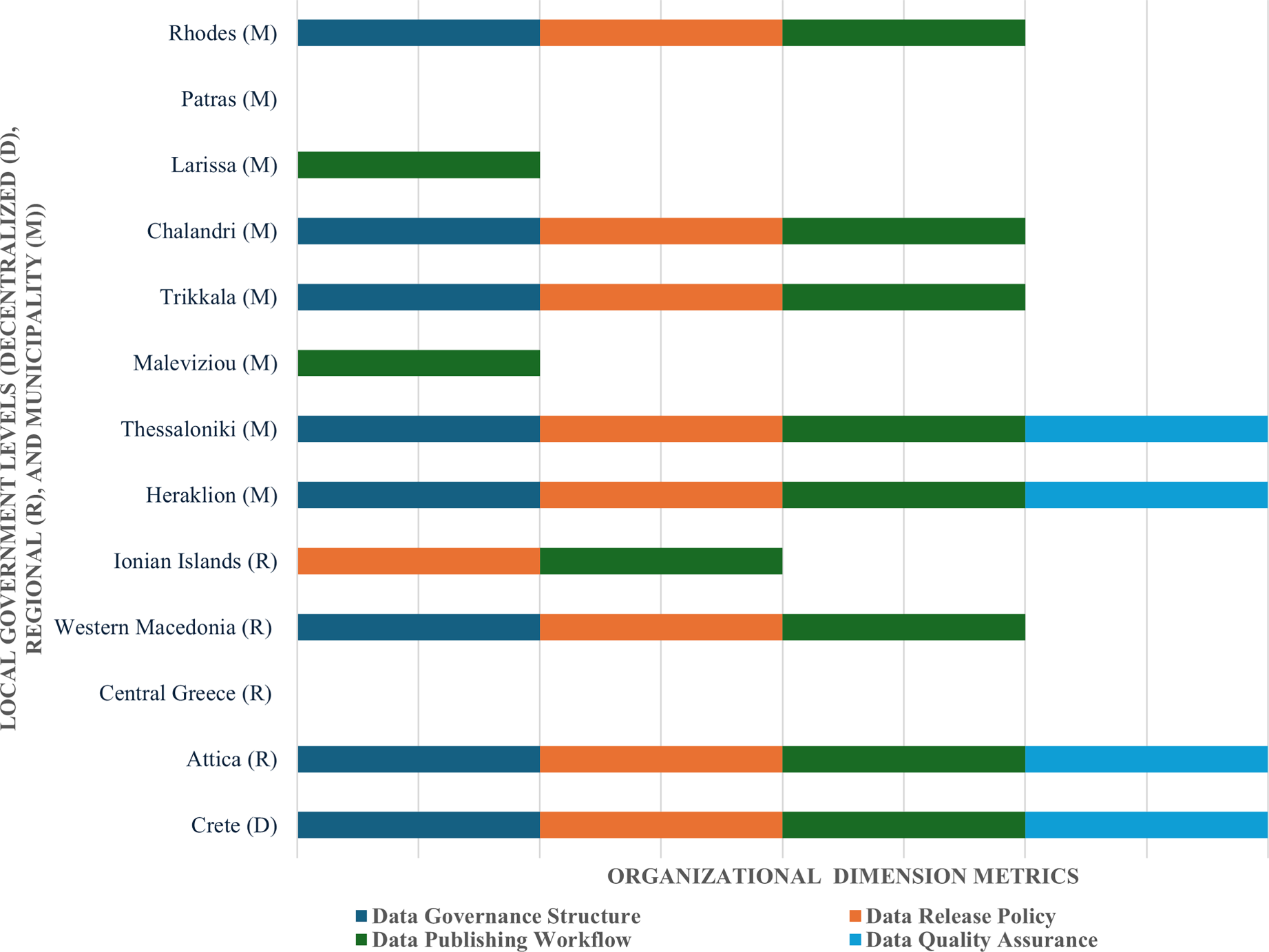
Organizational dimension metrics for the decentralized (D), Regional (R) and Municipal administration OGD infrastructures.
In all the interviews we conducted with these nine municipalities that do not provide OGD, it was clear that there was a good awareness about OGD, as in the past they had been issued relevant guidelines from the central government; furthermore, they had identified some of the datasets they possessed that can be useful to various actors (firms, citizens, researchers, journalists, etc.) if they are opened; however, there were differences with respect to their specialized knowledge of how this data opening can be implemented (from technical, organizational and legal perspectives), as well as the relevant standards they should comply with and the best practices for this.
But the most interesting finding was that all of them, despite their awareness about OGD, did not regard it as an ICT activity of high priority, as their main priorities were: a) the development of internal information systems, in order to support the complex internal processes of their municipalities, increase their efficiency and reduce their operating costs; b) the development of e-services for citizens and firms, which enable them to conduct electronically (through the Internet) their transactions with their municipalities; this improves the quality of the services provided to the citizens and firms, which is highly visible and appreciated by the local societies, and at the same time reduces their operating costs of their municipalities.
Furthermore, they mentioned that during the last fifteen years Greece faced two important crises: the serious and long recessionary economic crisis in the period 2010–2018, and then the COVID crisis in the period 2020–2023. The first of these crises resulted in a severe decrease in the available financial resources in all Greek public organizations, especially in the local government ones, as part of the austerity programs that had been put into effect for overcoming the crisis; this reduced the available budgets for all the activities of their municipalities, including the ones for ICT activities. However, despite these reduced ICT budgets during this period, they faced strong pressure to make quite demanding developments of internal information systems, which allowed them to continue performing their main operations (e.g., their complex financial management processes) with fewer personnel than in the past (i.e., ‘to keep the lights on’), as recruitments of personnel had been drastically reduced (so it was not possible even to replace the public servants who retired). One of the interviewed ICT managers said: ‘This was a difficult time, because we had to do more with less money, and the elected officials, the mayor and the councilors, could not understand the magnitude of the effort required, as they did not have sufficient knowledge about ICT, and software development in particular, and that this was not possible with drastically reduced ICT personnel and budgets’
So, under these circumstances, opening data was not a priority, as it did not contribute to the above main objectives they had at that time (contributing to continue performing the main processes and operations, and reducing the operating costs) or to the improvement of the services they offered to citizens and firms.
The second crisis was caused by COVID-19 and started two years after the end of the first and on one hand, it led to a considerable increase in the financial resources available for ICT activities (as the central government increased substantially the financial resources it provided to public organizations of all layers for ICT activities). However, on the other hand it necessitated the rapid development of e-services for citizens and firms, which enabled them to conduct electronically (through the Internet) their transactions with public organizations, in order to reduce the face-to-face contacts and the spread of COVID-19 that might result from them; also, it necessitated the provision of tele-working and tele-conferencing capabilities (i.e., working as well as holding meetings from home using personal computers provided by the municipality, which are connected through the Internet to its internal systems) to big numbers of public servants, as well as elected officials (even the municipal councils and the municipal committees had to be conducted through teleconferencing. These often required an upgrade of their hardware as well as their network connections. Therefore, these were their high priority ICT activities during the COVID-19 period 2020–2023, so opening data was not included among their main priorities. For instance, the ICT manager of a small North Aegean municipality said:
‘It was absolutely necessary when COVID-19 appeared to provide as soon as possible tele-work and tele-conferencing capabilities (at their homes) to many of the employees and elected of our municipality, which required the procurement of many laptops, cameras and other equipment, as well as to upgrade many of our digital infrastructures. This had to be done in a very short time and was very difficult’
Another ICT manager of a larger municipality in Crete said:
‘One of the most important challenges during the COVID-19 period was that we had to provide extensive teleconferencing capabilities to a big number of people; the municipal council had to be conducted online, and the same happened with the expensive required co-operation and meetings during this period with other public organizations of the central as well as the regional administration’
Summarizing, the interviews indicate that the main reasons for having not proceeded to the opening of some of the data possessed by these municipalities were:
Some other much higher ICT-related priorities that had been caused by the two important crises that appeared in the previous decade. The opening of data is less visible and appreciated by the local societies and has no impact on the efficiency and the operating cost of municipalities’ internal operations, in comparison with other kinds of ‘digital actions’ that they can undertake (such as internal information systems and e-services).
The findings presented in the two previous sections indicate that only a minority of the Greek local government organizations have developed a dedicated infrastructure (a dedicated infrastructure or a section of their website) for opening part of their data that might be interesting and useful to the economy and society. Furthermore, there is a lack of homogeneity between the few existing open data portals and websites of local government organizations. Only some of them meet the basic technological, semantic, legal, and organizational requirements, while most of them exhibit significant deficiencies, especially concerning the semantic dimension. The small number of Greek local government organizations that provide open data, and these disparities (lack of homogeneity/interoperability) among them do not allow the combined exploitation of open data from large numbers of local government organizations that would allow the generation of substantial social and economic value (as the value that can be generated from the use of open data from such small numbers of local government organizations is limited); this results in quite low incentives and motivation for the development of cohesive and comprehensive open data ecosystems for generating social and economic value from them: the main ‘resource’ – precondition required for the development of such ecosystems seems to be missing (both from a quantity and interoperability perspective).
Recent studies support the narrative that local governments face challenges in open data provision. For instance, D. Wang et al. (2018) conclude that in China the development of government data opening at the local level is limited and mention that there is a lack of systematic analysis of local government OGD provision. In the same direction, a recent study by Rajamae-Soosaar & Nikiforova (2024) reveals that OGD provision by local governments in Estonia (a highly advanced country with respect to digital technology use) lags behind, despite the national OGD portal being well-developed, usable, and in compliance with OGD legislation. (Afful-Dadzie & Afful-Dadzie, 2018) examine OGD at various levels—city, municipal, county, federal state, regional, and provincial—identifying the same trends we observed in the case of the Greek government: a lack of heterogeneity among local government OGD infrastructures within the same country concerning the functionality and content of OGD provision infrastructures, as well as the degree of adherence to OGD web publishing standards.
Similar are the conclusions of previous studies concerning the challenges that the OGD provision in Greece at the national level faces, particularly from technical and semantic perspectives. Alexopoulos et al. (2013) found that approximately 54% of datasets on the national portal lack semantic web compliance. Plessas & Dionysiou (2016) conclude that there is limited public sector information reuse due to factors such as Greece's low OGD readiness score. They also point out that the majority (81%) of application developers are unaware of public sector information reuse capabilities, and the datasets on portals are often closed in terms of machine readability, typically provided in formats like DOC/DOCX, PDF, and RAR/ZIP; this limitation negatively impacts open data interoperability, as evidenced by our TSLO framework.
However, the variety in commitment to and participation in the open data movement observed among the Greek local administrations emphasizes the necessity of further investigating the factors that influence and shape these varied approaches. Understanding the barriers and enablers affecting local open data initiatives is critical for enhancing broader participation in and implementation of government data opening; this insight is essential for developing strategies that effectively address these challenges. A small first step in this direction has been made through the interviews we conducted with nine municipalities that do not provide open data, which gave some interesting insights (presented in the previous section 7); however, further much more research is required on this.
Furthermore, the results shed light on the potential for augmenting public engagement within the open data ecosystem. Enhancing the functionality of existing local open data portals and websites could include addressing the abovementioned deficiencies at the technological, semantic, legal, and organizational level that were identified by our analysis (especially the semantic ones), as well as integrating features that empower citizens to actively participate in data discovery (findability), analysis, and feedback provision. This could involve incorporating interactive data visualizations, collaborative data exploration platforms, and mechanisms for citizen-driven data requests.
Also, our results demonstrate the relevance of the TSLO framework for the interoperability assessment of OGD infrastructures in advocating the implementation of OGD policies by identifying the strengths and weaknesses of them. They also facilitate knowledge transfer concerning the necessary capabilities and organization of OGD infrastructures, as well as their standardization/interoperability. However, an optimization of the TSLO framework might be required, which consists of two stages:
As it includes a large number of metrics (27 in total), for which we do not know their importance for enabling the combination of OGD from different OGD infrastructures (the main objective of the TSLO framework), it is necessary to examine their importance (this can be done through a survey of participants in OGD ecosystems, or even OGD sophisticated users); this will allow identifying and eliminating metrics of minimal importance, making the TSLO framework more focused, practical and easy-to-use. As the TSLO framework has been based on the EIF, adopting its four interoperability dimensions, it might be useful to investigate other existing interoperability frameworks, which might lead to adding some more interoperability dimensions to it.
Furthermore, recent literature (e.g., Lnenicka et al., 2024) has revealed a trend toward the creation of domain-specific OGD ecosystems (e.g., focused on healthcare, educational, environmental, tourism-related, etc., OGD); so, since the TSLO is generic (i.e., not specific to some domain), it might be useful to develop domain-specific versions/adaptations of it.
Lastly, the findings of this study suggest that ongoing efforts are needed to strengthen and standardize open data practices in Greek local governments. The development of a structured evaluation framework, such as the TSLO framework, can be a useful tool for proceeding in this direction, as it enables local government officials to assess their open data infrastructures and identify deficiencies and areas for improvement. By evaluating the technical, semantic, legal, and organizational aspects of open data portals and websites, local government organizations can enhance the interoperability of their open data infrastructure and foster their socially and economically beneficial utilization, through the development of open data ecosystems for generating social and economic value from them.
Government organizations of many countries have made significant investments in order to open to society and the economy part of the data they possess, in order to promote on the one hand political/social objectives, such as openness, transparency, and accountability, and on the other hand economic objectives, such as new economic activity, innovation, and economic development. However, the outcomes of these government initiatives/investments with respect to both the extent of use of the OGD and the generation of social and economic value from them have been much lower than the initial expectations, and the above objectives have been achieved only to a limited extent. The realization of social and economic benefits and value from OGD has turned out to be much more complicated and less straightforward than expected, and requires the involvement and cooperation of many public, private, and non-profit actors; therefore, it is necessary such multi-actor ecosystems are developed and efficiently function and cooperate. Despite the importance of the OGD ecosystems for their utilization of OGD and generation of social and economic value from them, the research about them ‘is still in its infancy’ (Reggi & Dawes, 2022). The present study contributes to this limited body of research on OGD ecosystems by investigating a critical precondition for the development of OGD ecosystems that has not been examined in previous relevant research: the existence of sufficient and interoperable OGD portals.
In this direction, we initially develop a multi-dimensional framework for assessing the interoperability of OGD infrastructures: the TSLO framework; it provides an elaboration and adaptation of the EIF for the OGD infrastructures (this is in line with a first elaboration and adaptation of the EIF that has been developed by the European Commission for smart cities and communities (European Commission, Directorate General for Informatics., Deloitte. et al., 2021)). The TSLO framework includes four assessment dimensions (technical, semantic, legal, and organizational), which are based on the European Interoperability Framework (EIF), and for each of them it provides several specific metrics for evaluating OGD portals and websites.
Then we used the above framework to assess/analyze the interoperability of the OGD infrastructure across the three local administration levels (decentralized, regional, and municipal) of Greece. The findings of this study reveal that only a minority of Greek local government organizations have OGD portals or websites, and also that there is a lack of homogeneity and interoperability among them, with only a small part of them meeting the basic technological, semantic, legal, and organizational requirements; this highlights the importance of ongoing efforts to strengthen and standardize OGD practices in Greek local governments.
This study has interesting implications both for research and practice. With respect to research, it makes a contribution to the still limited body of research on OGD ecosystems and examines an important precondition for their development that has not been researched in previous literature. Also, it makes a first application/validation of it in an interesting context, the Greek local government, which provides some first evidence about the usefulness and value of this TSLO framework, and some interesting insights about the opening of local government data in an interesting national context, which has experienced two major crises in the last decade. With respect to practice, our study provides a multi-dimensional framework for the assessment of the features/capabilities and the organization, as well as the interoperability of OGD infrastructures; this can be useful both for the initial design of OGD infrastructures, as well as for their evaluation in various stages of their life-cycle, and also for the development of interoperability among them, which will be of critical importance for generating high levels of social and economic value from them, and therefore for the development of OGD ecosystems for this purpose. Furthermore, it reveals some practice-relevant negative perceptions of some municipalities concerning the usefulness and visibility of the data opening initiatives.
Further research is required for overcoming the limitations of our study. One limitation of the TSLO framework is that it has been based on the four interoperability dimensions of the EIF; so, further research is required for the improvement/enrichment of the TSLO framework with additional interoperability dimensions (beyond the ones of the EIF); also, we can conduct further research for the enrichment with additional metrics of the four interoperability dimensions it currently includes.. A second limitation is that the TSLO is generic, so further research is required for the development and evaluation of domain-specific versions/adaptations of it for important domains (e.g., healthcare, education, environment, tourism, etc.). A third limitation is that its first application has been conducted for the local government of Greece, a developed country that belongs to the European Union, but with a lower level of ‘digital’ development in general, and government data opening maturity (see first paragraph of section 5) in particular, in comparison with the other European Union countries; so further research is required concerning nd its application in other contexts: in other countries, with different levels of digital and data opening degrees of development, as well as in central government organizations. Also, in future applications of the TSLO framework, the metrics of its four dimensions can be assessed in more detail on a three- or even five-level scale (instead of their binary assessment (existence/absence) of them performed in this first application of it presented in this paper). Finally, additional research is required to identify factors that affect positively and negatively (enablers and barriers) the opening of data by different types/layers of local government organizations.
Footnotes
ORCID iDs

Funding
This project has received funding from the European Union’s Horizon2020 research and innovation programme under the MarieSklodowska-Curie grant agreement no. 955569. The opinions expressed in this document reflect only the author’s view and in noway reflect the European Commission’s opinions. The European Commission is not responsible for any use that may be made of the information it contains.
Declaration of Conflicting Interests
The authors declared no potential conflicts of interest with respect to the research, authorship, and/or publication of this article.
Author biographies
Appendix
Metrics of the Four Dimensions of the TSLO and Rationale and Literature Support of Them.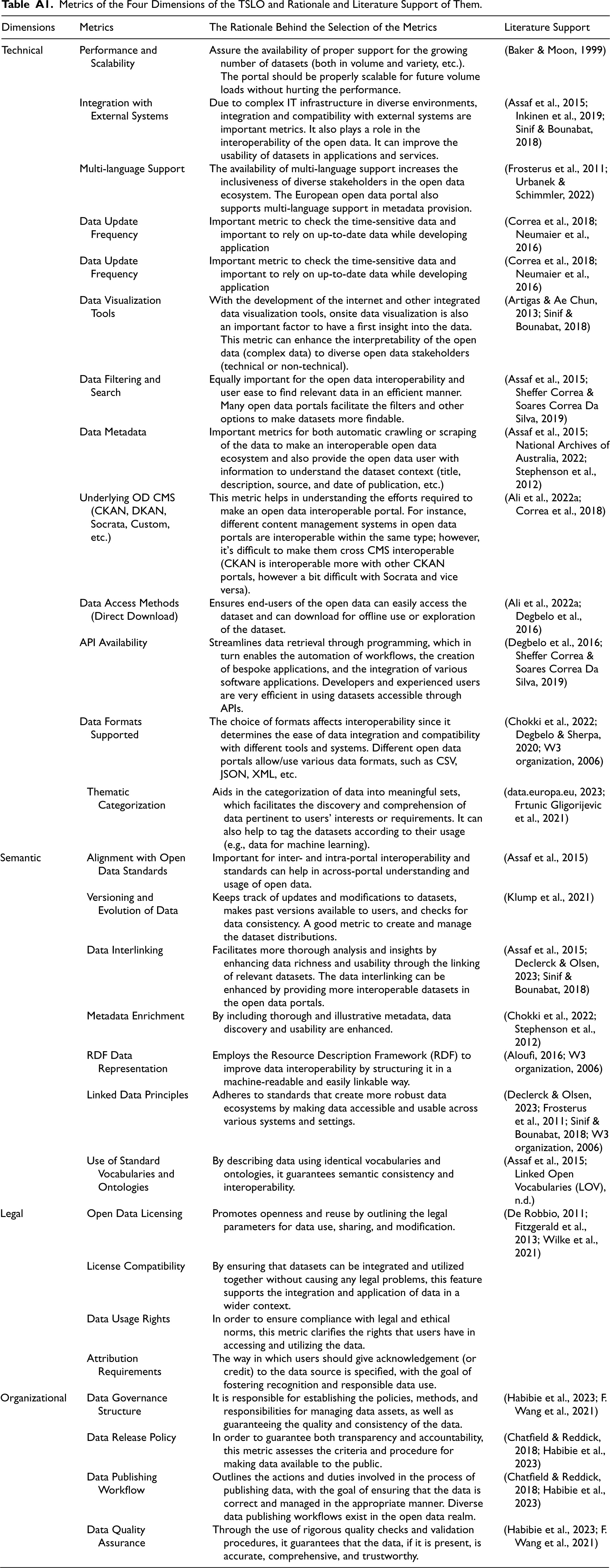
Dimensions
Metrics
The Rationale Behind the Selection of the Metrics
Literature Support
Technical
Performance and Scalability
Assure the availability of proper support for the growing number of datasets (both in volume and variety, etc.). The portal should be properly scalable for future volume loads without hurting the performance.
(Baker & Moon, 1999)
Integration with External Systems
Due to complex IT infrastructure in diverse environments, integration and compatibility with external systems are important metrics. It also plays a role in the interoperability of the open data. It can improve the usability of datasets in applications and services.
(Assaf et al., 2015; Inkinen et al., 2019; Sinif & Bounabat, 2018)
Multi-language Support
The availability of multi-language support increases the inclusiveness of diverse stakeholders in the open data ecosystem. The European open data portal also supports multi-language support in metadata provision.
(Frosterus et al., 2011; Urbanek & Schimmler, 2022)
Data Update Frequency
Important metric to check the time-sensitive data and important to rely on up-to-date data while developing application
(Correa et al., 2018; Neumaier et al., 2016)
Data Update Frequency
Important metric to check the time-sensitive data and important to rely on up-to-date data while developing application
(Correa et al., 2018; Neumaier et al., 2016)
Data Visualization Tools
With the development of the internet and other integrated data visualization tools, onsite data visualization is also an important factor to have a first insight into the data. This metric can enhance the interpretability of the open data (complex data) to diverse open data stakeholders (technical or non-technical).
(Artigas & Ae Chun, 2013; Sinif & Bounabat, 2018)
Data Filtering and Search
Equally important for the open data interoperability and user ease to find relevant data in an efficient manner. Many open data portals facilitate the filters and other options to make datasets more findable.
(Assaf et al., 2015; Sheffer Correa & Soares Correa Da Silva, 2019)
Data Metadata
Important metrics for both automatic crawling or scraping of the data to make an interoperable open data ecosystem and also provide the open data user with information to understand the dataset context (title, description, source, and date of publication, etc.)
(Assaf et al., 2015; National Archives of Australia, 2022; Stephenson et al., 2012)
Underlying OD CMS (CKAN, DKAN, Socrata, Custom, etc.)
This metric helps in understanding the efforts required to make an open data interoperable portal. For instance, different content management systems in open data portals are interoperable within the same type; however, it's difficult to make them cross CMS interoperable (CKAN is interoperable more with other CKAN portals, however a bit difficult with Socrata and vice versa).
(Ali et al., 2022a; Correa et al., 2018)
Data Access Methods (Direct Download)
Ensures end-users of the open data can easily access the dataset and can download for offline use or exploration of the dataset.
(Ali et al., 2022a; Degbelo et al., 2016)
API Availability
Streamlines data retrieval through programming, which in turn enables the automation of workflows, the creation of bespoke applications, and the integration of various software applications. Developers and experienced users are very efficient in using datasets accessible through APIs.
(Degbelo et al., 2016; Sheffer Correa & Soares Correa Da Silva, 2019)
Data Formats Supported
The choice of formats affects interoperability since it determines the ease of data integration and compatibility with different tools and systems. Different open data portals allow/use various data formats, such as CSV, JSON, XML, etc.
(Chokki et al., 2022; Degbelo & Sherpa, 2020; W3 organization, 2006)
Thematic Categorization
Aids in the categorization of data into meaningful sets, which facilitates the discovery and comprehension of data pertinent to users’ interests or requirements. It can also help to tag the datasets according to their usage (e.g., data for machine learning).
(data.europa.eu, 2023; Frtunic Gligorijevic et al., 2021)
Semantic
Alignment with Open Data Standards
Important for inter- and intra-portal interoperability and standards can help in across-portal understanding and usage of open data.
(Assaf et al., 2015)
Versioning and Evolution of Data
Keeps track of updates and modifications to datasets, makes past versions available to users, and checks for data consistency. A good metric to create and manage the dataset distributions.
(Klump et al., 2021)
Data Interlinking
Facilitates more thorough analysis and insights by enhancing data richness and usability through the linking of relevant datasets. The data interlinking can be enhanced by providing more interoperable datasets in the open data portals.
(Assaf et al., 2015; Declerck & Olsen, 2023; Sinif & Bounabat, 2018)
Metadata Enrichment
By including thorough and illustrative metadata, data discovery and usability are enhanced.
(Chokki et al., 2022; Stephenson et al., 2012)
RDF Data Representation
Employs the Resource Description Framework (RDF) to improve data interoperability by structuring it in a machine-readable and easily linkable way.
(Aloufi, 2016; W3 organization, 2006)
Linked Data Principles
Adheres to standards that create more robust data ecosystems by making data accessible and usable across various systems and settings.
(Declerck & Olsen, 2023; Frosterus et al., 2011; Sinif & Bounabat, 2018; W3 organization, 2006)
Use of Standard Vocabularies and Ontologies
By describing data using identical vocabularies and ontologies, it guarantees semantic consistency and interoperability.
(Assaf et al., 2015; Linked Open Vocabularies (LOV), n.d.)
Legal
Open Data Licensing
Promotes openness and reuse by outlining the legal parameters for data use, sharing, and modification.
(De Robbio, 2011; Fitzgerald et al., 2013; Wilke et al., 2021)
License Compatibility
By ensuring that datasets can be integrated and utilized together without causing any legal problems, this feature supports the integration and application of data in a wider context.
Data Usage Rights
In order to ensure compliance with legal and ethical norms, this metric clarifies the rights that users have in accessing and utilizing the data.
Attribution Requirements
The way in which users should give acknowledgement (or credit) to the data source is specified, with the goal of fostering recognition and responsible data use.
Organizational
Data Governance Structure
It is responsible for establishing the policies, methods, and responsibilities for managing data assets, as well as guaranteeing the quality and consistency of the data.
(Habibie et al., 2023; F. Wang et al., 2021)
Data Release Policy
In order to guarantee both transparency and accountability, this metric assesses the criteria and procedure for making data available to the public.
(Chatfield & Reddick, 2018; Habibie et al., 2023)
Data Publishing Workflow
Outlines the actions and duties involved in the process of publishing data, with the goal of ensuring that the data is correct and managed in the appropriate manner. Diverse data publishing workflows exist in the open data realm.
(Chatfield & Reddick, 2018; Habibie et al., 2023)
Data Quality Assurance
Through the use of rigorous quality checks and validation procedures, it guarantees that the data, if it is present, is accurate, comprehensive, and trustworthy.
(Habibie et al., 2023; F. Wang et al., 2021)