




Abstract
This study aimed to show whether the link exists between ethnic/immigrant origin of older internet users and the two digital exclusion parameters - non-use of government websites and reporting skill insufficiency as a reason for their non-use. The second-level digital divide approach served as the theoretical framework for the study. Data were obtained from the 2020 Israel Social Survey. The sample included 1293 internet users aged 60 years and older. The results show that members of ethnic minority group and immigrants were more likely than members of ethnic majority group to both belong to the government website non-user group and provide insufficient skills as a reason for non-use. The results support the second-level digital divide approach. They suggest that being internet user does not protect older immigrants and members of ethnic minority from being excluded from the e-government use. The findings imply that tailored support and training are required for older internet users with ethnic minority or immigrant background in order to better integrate them into the world of online government services.
Key Points for Practitioners
Older persons with ethnic minority or immigrant background are less likely to enter websites of government ministries and agencies. In addition, compared to older adults belonging to ethnic majority, each abovementioned group is more likely to state that insufficient skills or training represent a reason why they do not enter these websites. More efforts are necessary to include older persons with ethnic/immigrant background into the digital society in general and online public service use domain particularly.
Introduction
E-government is an important channel that connects between governments and citizens. Using this channel, citizens are able to obtain government information or updates and perform transactions (Dodel & Aguirre, 2018). E-government services are available for all groups in each given society, including older adults. However, as previous research suggests (Hong & Choi, 2020; Rosenberg, 2022), many of older internet users have not adopted this outlet thereby being e-government non-users. One reason for this non-use, scarcely addressed by the previous research, refers to the perception of insufficiency in skills necessary for adoption and use of e-government. Numerous studies found that digital skills in older population are somewhat limited (Hargittai & Dobransky, 2017; Hunsaker et al., 2020; Quan-Haase et al., 2018). Since this may impede the of use online public services, which may serve a plethora of older adults’ needs (Hong & Choi, 2020), it is important to further investigate the phenomena of technology non-use and digital skills (insufficiency) in later life.
The current study will investigate these phenomena through the prism of the grey digital divide perspective. This perspective suggests that older adults differ in terms of access to technology (commonly referred to as “first-level digital divide”) and its use or an ability to use (commonly referred to as “second-level digital divide”) (Friemel, 2016). In accordance with the second-level digital divide perspective, we refer to the two of the four domains of digital divide: usage access and skills access (Jiang & Liu, 2020). Usage access means “one's application of new technologies for different activities” (ibid, p.62). This type of access will be investigated in the current study in the form of models predicting government website non-use. Skills access is “the ability or skillset to search, select, process, and understand information in computer and network sources.” (ibid, p.62). This type of access will be investigated in the current study in the form of models predicting provision of insufficient digital skills as a reason for government website non-use.
In accordance with the second-level digital divide approach, it can be maintained that older persons with different ethnic/migration background will differ between them in terms of e-government (non)use and perception of related digital skills. As an advantaged group in the society, individuals belonging to ethnic majority group may have adopted e-government earlier and have more resources and opportunities to acquire proper skills to use it as compared to individuals with ethnic minority or immigrant background. Previous research conducted in general population found that individuals belonging to ethnic minority and immigrant groups tend to use online services to a lower extent than members of ethnic majority. Mesch (2016) found this difference with respect to online health services and Rosenberg (2019, 2022) - with respect to e-government use. In another study, members of ethnic/racial minorities were found having lower digital skills than members of racial majority (Hargittai, 2010). Hence, we hypothesize the following:
The Current Study
Since its early introduction about two decades ago, the volume of studies investigating e-government adoption and use through the prism of the digital divide perspective has grown tremendously (Botrić & Božić, 2021; Dodel & Aguirre, 2018; Gauld et al., 2010; Rosenberg, 2019; Taipale, 2013). Much less studies were conducted in older population (Hong & Choi, 2020; Rosenberg, 2022). However, these studies focused mostly on the users rather than non-users of e-government. Given the importance of understanding non-use of technology in later life underscored by the related literature (Gallistl et al., 2020; Knowles & Hanson, 2018), this can be seen as a significant gap to fill. In addition, the cited studies did not refer to digital skills or their perceived (in)sufficiency for using e-government. Furthermore, they did not address usage and/or skill access divide as a function of having minority (ethnic/racial/immigration) background. Hence, the goal of the current study is to contribute to the literature on the grey digital divide by testing the link between ethnic minority/immigrant background and e-government non-use and providing insufficient digital skills as reason for its non-use.
The data, which was used for the current study, was collected in the setting (Israel) the population of which consists of two relatively advantaged groups in terms of socio-economic position - native-born majority population and longtime immigrants (which we relate to as one Jewish majority group), and two relatively disadvantaged groups - notable Arab-speaking ethnic minority and post-1990 immigrant population (Mesch, 2016). The latter two populations in Israel are disadvantaged as compared to the two former populations in many aspects (Bar-Haim & Semyonov, 2015), including online service use (Lissitsa & Chachashvili-Bolotin, 2021; Mesch, 2016; Rosenberg, 2019; Shahrabani & Mizrachi, 2016).
Understanding government portal non-use and skill insufficiency as the reason for this non-use is important. It will assist in providing solutions for making the portal more accessible to members of particular groups in older population. In addition, older members of ethnic minority and immigrants tend to experience social exclusion (Manor, 2020; Xu et al., 2023). Therefore, the findings of the study will contribute to development of broader policies aimed at greater inclusion of older ethnic minority and immigrant populations in the digital society.
Methods
Data
Data for the current study were obtained from the Social Survey of Israel. This survey has being conducted every year by the country's Central Bureau of Statistics since 2002 (Levin, 2013). Each year, the survey consists of a core questionnaire which includes items assessing demographic, socio-economic and health background as well as labor market participation, and a rotating module (Lissitsa & Chachashvili-Bolotin, 2016). In 2020, this module referred to digital age and included items related to various computer and internet uses as well as those assessing subjective digital skills and perceptions of technology (Central Bureau of Statistics [CBS], State of Israel, 2020). Survey participants (n = 7249) were noninstitutionalized adult (at least 20 years old) residents of Israel representing the 5,717,173 persons in this age group (CBS, 2020). The population registry serves as a basis for the sample which is stratified for the purposes of the survey according to population subgroups (five in total: Arabs from East Jerusalem, Arabs from elsewhere in the country, pre-1990 immigrants from any country, 1990-onward immigrants from any country, and Israeli-born Jews), sex (two in total: male, female), and age groups (seven in total: 20–24, 25–34, 35–44, 45–54, 55–64, 65–74, and 75 + years). The relative size of each subgroup in Israel's total population is reflected in the number of respondents included in each of the subgroups (Pinchas-Mizrachi et al., 2020). Additional information regarding the dataset, population, and sampling method, can be found elsewhere (Lissitsa & Chachashvili-Bolotin, 2016; Pinchas-Mizrachi et al., 2020).
Sample
The initial sample of 7249 survey participants was further limited by age, so that the responses of persons aged 59 and younger were eliminated (n = 5503). Of the remaining 1746 entries, 421 were eliminated due to missing information on the government authorities’ website use. Of the remaining, 32 entries were eliminated due to having missing value on the ethnicity variable. Therefore, the final sample included the responses of 1293 Israeli older internet users.
Measures
Dependent Variables
Government website non-use – the original dichotomous item asked “Do you use the sites of government bodies, ministries, the National Insurance Institute, etc.?” Respondents who entered these websites represented the reference category.
Insufficient skills or training as a reason for non-use – the subsequent original item, which was asked among the government website non-users only, stated: “Why don’t you use online governmental services?”. The response options were: “The services do not meet your needs”, “You do not have Internet access”, “You are not interested in using them”, “You don't need to use them”, and “You do not have a proper training or do not know how”. The item was further recoded into a dichotomous variable whereas respondents who mentioned the reasons other than skill insufficiency as the reference category.
Ethnic/Immigration Status
A variable was computed using the information about the respondents’ population group, country of birth, and religious affiliation. Three groups were yielded: non-immigrant Jews (reference) – a category which included Jewish respondents who were either born in Israel or immigrated up to 1989, post-1990 immigrants (regardless of country of origin), and Arabs (Pinchas-Mizrachi et al., 2020).
Covariates
Gender (0 = Female; 1 = Male), age category (60–64 years (reference), 65–74 years, and 75 years and older), education level (Up to high school (reference), Postsecondary, and Tertiary), marital status (0 = Not married, 1 = Married), locality size (0 = Small, i.e., up to 49,999 residents, 1 = Large, i.e., 50,000 residents and more), and self-rated health (reversed, from 1 = Poor, to 5 = Excellent).
Analysis
Sample statistics, using percentages or means and standard deviations, are presented for all variables. The data were analyzed using logistic regression models. This method was chosen because we intended to contrast between those older adults who used and those who did not use government websites, as well as between those who reported their non-use as stemming from insufficient digital skills and those who reported other reasons for non-use. Sensitivity analysis was performed in the model predicting insufficient digital skills while excluding the respondents who had no need for e-government services.
Results
Sample Statistics
The total sample was predominantly non-immigrant Jewish, female, aged 65–74 years, with higher than secondary education level, married, residing in large localities, and with moderate mean self-rated health status. As for the study outcomes, the sample was comprised mainly of non-users of government websites, a notable share of whom did not access them due to perceived insufficiency of related skills.
The subsample of the government website non-users mostly resembled the total sample, with some minor differences. The share of respondents with up to secondary level of education reached almost a half of the subsample, and respondents aged 65–74 years represented less than a half of this subsample.
The detailed statistics are provided in Table 1.
Sample Statistics.
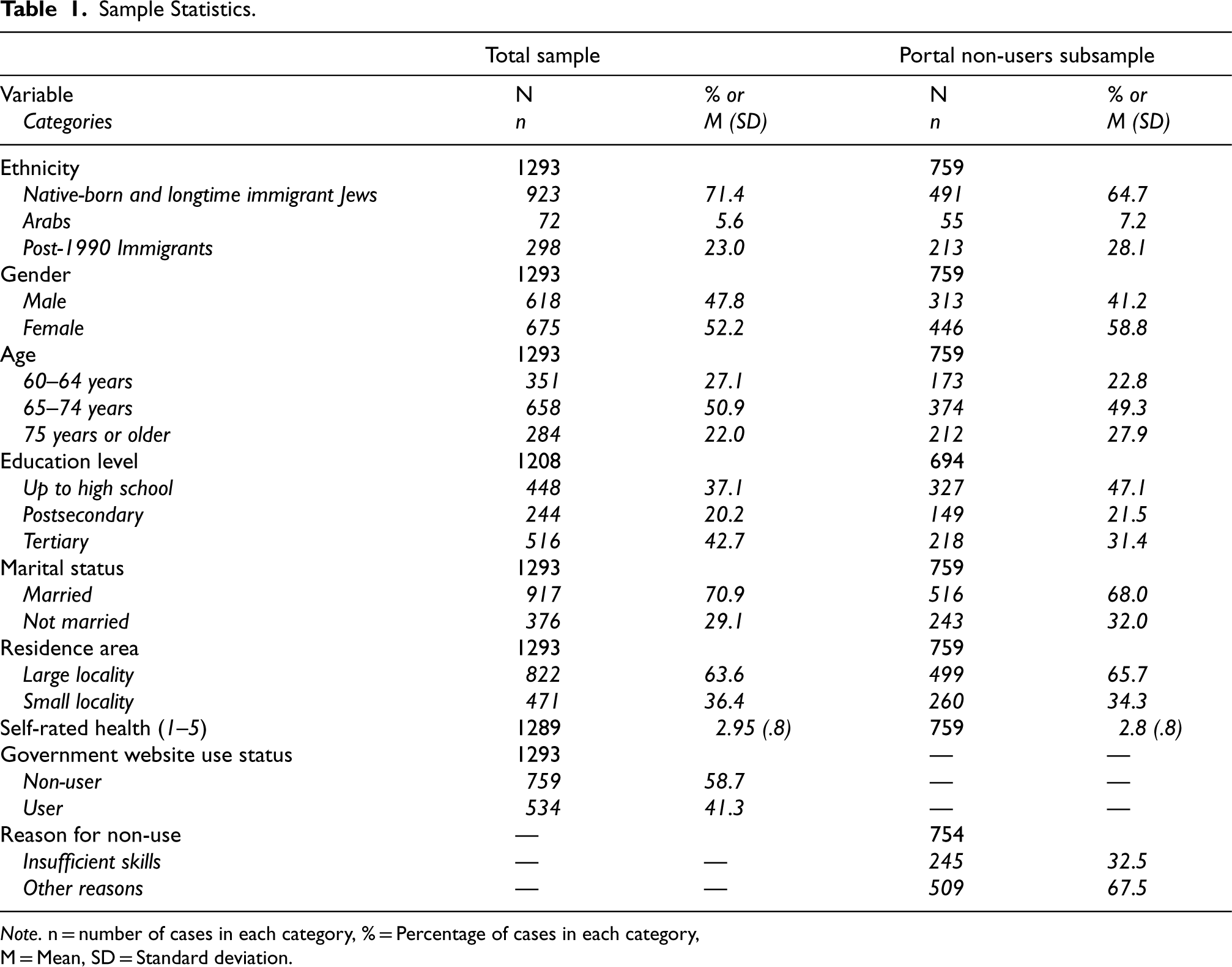
Sample Statistics.
Note. n = number of cases in each category, % = Percentage of cases in each category,
M = Mean, SD = Standard deviation.
Table 2 shows the results of the analysis estimating the likelihood of being older non-user of government website.
Coefficients (Standard Errors) of the Logistic Regression Analysis Estimating the Likelihood of Being E-Government Non-User.

Coefficients (Standard Errors) of the Logistic Regression Analysis Estimating the Likelihood of Being E-Government Non-User.
Note. HCP = Healthcare provider, N = Number of valid cases, p = Significance value, OMR = Online medical record, OR = Odds ratio, SE = Standard error.
Reference categories: 1Native-born and longtime immigrant Jews, 2Female, 3Age 60–64 years, 4Up to high school level, 5Not married, 6Residence in small locality.
The findings in the model show that both ethnic and immigration background were associated with greater likelihood of being e-government non-user. In other words, older members of Arab minority group and older post-1990 immigrants were more likely than older members of Jewish majority group not to use government websites. Therefore, H1 was supported.
As for the covariates, being 65–74 years old and being 75 years old or older were each positively associated with being non-user of government websites. In contrast, male gender, having higher than secondary education, and self-rated health were each negatively associated with being non-user of government websites.
Table 3 shows the results of the regression analysis estimating the likelihood of providing the digital skill or training insufficiency as the reason for the non-use of government websites.
Coefficients (Standard Errors) of the Logistic Regression Analysis Estimating the Likelihood of Not Entering Government Portal Due to Insufficient Digital Skills.
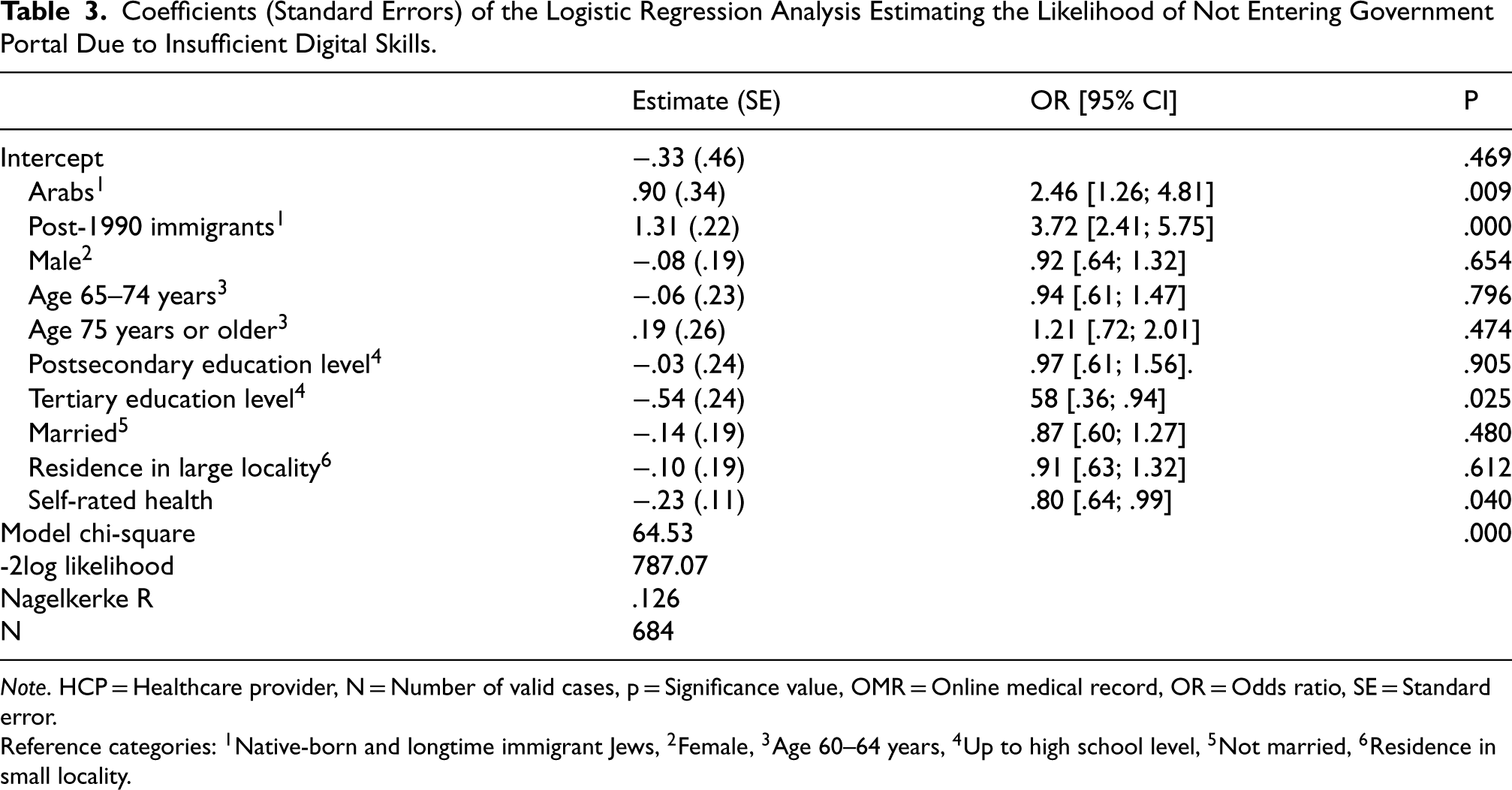
Coefficients (Standard Errors) of the Logistic Regression Analysis Estimating the Likelihood of Not Entering Government Portal Due to Insufficient Digital Skills.
Note. HCP = Healthcare provider, N = Number of valid cases, p = Significance value, OMR = Online medical record, OR = Odds ratio, SE = Standard error.
Reference categories: 1Native-born and longtime immigrant Jews, 2Female, 3Age 60–64 years, 4Up to high school level, 5Not married, 6Residence in small locality.
The findings in the model show that ethnicity and immigration status were each associated with greater likelihood of not using government website for the mentioned reason. In other words, older members of Arab minority and older post-1990 immigrants were more likely than members of Jewish majority group to report that they do not to use governmental websites due to skill or training insufficiency. Therefore, H2 was supported.
As for the covariates, similarly to the model predicting the non-use, having higher than secondary education and self-rated health were each negatively associated with the dependent variable.
The results of the sensitivity analysis show that after excluding the respondents who reported having no need for using e-government, the coefficients and the directions of association for both ethnic minority and immigration status variables remained similar to the main analysis (see Supplementary Table S1). Hence, the findings of the multivariable analysis can be considered robust.
The goal of this study was to understand the link between ethnic/immigrant status and two e-government-related outcomes – general non-use of government websites and reporting insufficient skills or training as a reason for their non-use – in older population.
The findings of the study corroborate the findings of the previous related research (Rosenberg, 2019; 2022). Similar to it, the current study found that members of disadvantaged groups were less likely to use government websites as compared to members of the advantaged group. The findings are in line with the second-level digital divide approach (Friemel, 2016). They imply that the inclusion of older adults with ethnic minority or immigrant background in the internet user group (meaning they overcome the first-level digital divide) does not protect them from finding themselves outside the group of the particular online venue users (meaning that they are yet to overcome the second-level digital divide). What is even more critical to mention in this regard is that this lower use of online services by members of ethnic minorities and immigrants seems persisting over years, as earlier studies, which investigated the use of online healthcare services, discovered similar associations (Mesch, 2016; Shahrabani & Mizrachi, 2016). All this may mean that second-level digital divide is somewhat tough barrier to overcome for persons with less advantaged background in terms of their position in the stratification system of their societies of residence and that it may take a great deal of time to overcome it.
The results also suggest that skill or training insufficiency is a major factor explaining e-government non-use in later life. This was demonstrated in both descriptive statistics and the comparisons by numerous socio-demographic background characteristics. Moreover, older adults of ethnic and immigrant background were found more likely to report skills insufficiency as the reason for e-government non-use. This finding is in line with the second-level digital divide approach (Friemel, 2016) and it echoes the results of previous studies that investigated digital skills in older population (Hargittai & Dobransky, 2017; Hunsaker et al., 2020; Quan-Haase et al., 2018). Indeed, even after years of internet use, like was shown in the study by Hunsaker et al. (2020), many older adults still have a need for advanced digital skills and high-quality training in order to be better integrated into the internet or its particular venues like e-government. These issues are of large societal importance, as digital exclusion stemming from the lack or the insufficient amount of digital skills not only limits the possibilities of older persons to participate in the online sphere but also can be viewed as a barrier for a full participation in the contemporary society where individuals are expected to use online services (Korpela et al., 2023). This applies even to a greater extent to older Internet users with ethnic minority or immigrant background who were found in a current study being at a greater risk of being non-users because of insufficient digital skills or training. One of the reasons for this disparity may be lack of resources and opportunities to acquire better skills. Future (qualitative) research may confirm this argument.
Implications
Several implications can be solicited from the findings for policy. First, e-government should become more accessible to older members of ethnic minorities and immigrants. This can be reached by organization of the campaigns encouraging government website use held on the mother tongues of individuals with ethnic or immigrant background. Second, public authorities should organize digital training for older persons with ethnic minority/immigrant background. This training may be more general, i.e., how to efficiently use online services use like information retrieval, performing transactions and contacting the service. This training may also be e-government specific, i.e., learning how to navigate the governmental portal, how to use its features for different purposes, or how to successfully use other public sector websites. Communities should also assist older adults to be included in the e-government user group, for example, by instructing them on how to navigate this type of websites. For example, these can be members of families or peers (Hunsaker et al., 2020).
Limitations
This study is not without limitations. First, this is a cross-sectional study. Therefore, no causality can be concluded from its findings. Second, although insufficient skills were identified as a major barrier, it is unknown which particular skills hinder e-government use. Third, the study was conducted in one setting. The generalization on the other societies with members of ethnic minorities and immigrants should be done with care. Fourth, this study used a data which was collected in the first year of the COVID-19 pandemic. The digital skills of older population with ethnic or immigrant background, both general and those related to e-government use, could have undergone changes since then. Finally, some of the measures were used in a dichotomous way, therefore restricting the pool of possible analyses.
Conclusions and Directions for Future Research
To summarize, the study shown the importance of ethnic/migration background in understanding e-government non-use and reasons for non-use. The findings of study join the established discussion on older non-users of technology (Gallistl et al., 2020; Knowles & Hanson, 2018) while further underscoring the importance of this discussion. The second-level digital divide perspective seems to provide a proper theoretical framework to explain the studied link.
Older age is generally associated with a greater utilization of public services (Hong & Choi, 2020), which are constantly move online (Choudrie et al., 2013). In addition, the number of older persons is going to substantially grow in the forthcoming decades (Weber et al., 2020). Finally, many older immigrants or members of ethnic minorities generally suffer from social exclusion (Manor, 2020; Xu et al., 2023). Due to all these issues, it is of high importance to assist older adults in their attempts to be included in the digital world and specifically e-government utilization.
Future studies can go to several directions. The first suggestion is to conduct a qualitative research using focus groups. Such a study should discover the particular skills the insufficiency in which prevents older adults from using e-government. This study should consider conducting focus groups separately for members of ethnic minorities and immigrants as differences in their skills or training aspects may emerge. The second suggestion is to conduct an experiment in which older adults with insufficient digital skills would get training on how to use e-government. Such a study will examine the effectiveness of this type of intervention. It is also possible that belonging to immigrant/ethnic minority can represent further disadvantage with respect to online service use when combined with other factors, like additional socio-demographic characteristics, hence creating a “double jeopardy” situation (Huxhold et al., 2020). Hence, future studies should examine various types of interactions between these variables in relation to e-government use skills or similar concepts.
Supplemental Material
sj-docx-1-ipo-10.1177_15701255251321344 - Supplemental material for Non-Use of Government Websites in Old Age: The Role of Ethnicity and Immigrant Status
Supplemental material, sj-docx-1-ipo-10.1177_15701255251321344 for Non-Use of Government Websites in Old Age: The Role of Ethnicity and Immigrant Status by Dennis Rosenberg in Information Polity
Footnotes
AI Use Statement
No AI tool has been used during the preparation, the revision, and the edition of the manuscript.

Ethical Considerations
This study used the secondary de-identified data. Therefore, no ethical approval was necessary.
Funding
The author received no financial support for the research, authorship, and/or publication of this article.
Conflicting Interests
The author declared no potential conflicts of interest with respect to the research, authorship, and/or publication of this article.
Data Availability
The current research used the data from the dataset available by request from the Central Bureau of Statistics, State of Israel. The link for downloading this dataset was received upon online request to the email on February 16, 2022.
Supplemental Material
Supplemental material for this article is available online.
Author Biography
References
Supplementary Material
Please find the following supplemental material available below.
For Open Access articles published under a Creative Commons License, all supplemental material carries the same license as the article it is associated with.
For non-Open Access articles published, all supplemental material carries a non-exclusive license, and permission requests for re-use of supplemental material or any part of supplemental material shall be sent directly to the copyright owner as specified in the copyright notice associated with the article.
