




Abstract
We provide a theoretical foundation for a formal ontology of artifacts based on the notion of a realizable entity: a property that can be realized in associated processes of a specific correlated type in which the bearer participates. This realizable-centered approach to artifacts aims to accommodate a wide range of artifacts, from technical artifacts (e.g., screwdrivers) to artworks (including ready-made artworks) and spiritual artifacts (e.g., amulets), making it applicable across diverse fields such as engineering, art, anthropology and archeology. It is motivated by limitations of function-based accounts of artifacts and the needs for a meticulous analysis of their intentional dimension. To articulate various usages of the term “artifact,” we introduce two key notions: canonical artifact (an entity intentionally produced for a specific purpose) and usefact (an entity intended to be used for some accidental purpose). We provide a realizable-based characterization of both, classifying intentions as a subtype of realizable entities. We argue that our realizable-centered approach is more general than three prominent function-based theories of artifacts: designer-based, etiological and systemic. We further demonstrate that our framework can be adapted to Basic Formal Ontology (BFO), highlighting its flexibility and broad applicability.
Introduction
Background and Motivation
The world is brimming with artifacts. To name just a few, there are technical artifacts (e.g., screwdrivers), artworks (e.g., paintings), social artifacts (e.g., the European Commission) and abstract artifacts (e.g., software and Shakespeare's work Hamlet). These types of entities are usually contrasted with so-called “natural objects” such as molecules, stones, people and planets. They are intimately connected with many kinds of entities such as intentions, agents, actions (physical and mental), capabilities, capacities, functions, roles, and affordances. Artifacts are notoriously difficult to analyze ontologically because no clear consensus exists yet over how to understand systematically a number of different ontological characteristics of artifacts.
In this paper we will develop a new approach to the formal ontology of artifacts. Let us begin by explaining the general motivation behind our work. First, artifacts have been traditionally investigated in terms of functions, as is illustrated by the example of screwdrivers and the function to turn screws. There may be nonetheless some problems with the function-based accounts of artifacts. One theoretical problem is about their generality. While technical artifacts may be generally explicable in terms of functions to some degree, it is controversial whether so are all the kinds of artifacts as well (Franda & Souman, 2025; Houkes & Vermaas, 2009b; Juvshik, 2021b; Koslicki & Massin, 2025, in press; Olivero, 2019; Raven, 2025). For instance, what would be, if any, the function of Leonardo da Vinci's Mona Lisa? This question may be difficult to answer straightforwardly, given the variety of theories of functions as well as desiderata for a satisfactory theory of functions in the literature (Artiga, 2011, 2016; Röhl & Jansen, 2014; Wouters, 2005).
One related, practical problem with the function-based accounts of artifacts is that they could yield conceptual and linguistic confusion in the development of domain ontologies. This is because the term “function” has been used differently in different domains and upper ontologies, or even within specific domains such as engineering (Carrara et al., 2011; Yargan & Jansen, 2024). To take one simple example, the definition of the term “material artifact” as “a material entity that has some function” may be differently interpreted and formalized, according to different views of functions. This may, in turn, exacerbate the problem of the lack of semantic interoperability between information systems (Gardner, 2005), as it is arguably the case that: “neither in philosophy nor in formal ontology is there a generally accepted theory of functions. In particular, there is no consensus how to include functions into a top-level ontology or whether to include them at all” (Röhl & Jansen, 2014, p. 1).
Second, it is widely acknowledged that artifacts have an intentional dimension. However, there may be room for further exploration of the intentional dimension of artifacts. Suppose that I shaped and dried an amount of clay with the intention that it will be capable of containing liquid. What is, ontologically speaking, my intention to shape and dry this amount of clay in such a way as to be able to contain liquid? What kind of ontological relation holds between my intention and my intentional act of shaping and drying the clay to be able to contain liquid? What are the relationships among my intention, my intentional act and the resulting clay pot? These questions must be addressed by a complete analysis of the intentional dimension of artifacts. For instance, Borgo and Vieu (2009, p. 291) say: “although we need to model intentional aspects [of artifacts], we will avoid as much as possible the direct reference to theories of mental attitudes, which are not per se the subject of this paper and are by no means consensual.” Although there may be no solid consensus as to an ontology of mental attitudes such as intentions, it will constitute an important step toward a comprehensive ontology of artifacts to analyze the intentional dimension of artifacts in terms of some specific ontological account of mental reality.
To summarize, we are motivated to develop an alternative theory of artifacts in the field of formal ontology, partly because of the theoretical and practical limitations of function-based accounts of artifacts, partly because of the needs for further study of the intentional dimension of artifacts.
Purpose
The objective of this paper is to provide a theoretical foundation for a formal ontology of artifacts on the basis of the ontology of realizable entities, extending our previous works (Toyoshima et al., 2024a, 2024b). 1 A realizable entity is a property that can be realized in associated processes of a specific correlated type in which the bearer participates. For example, the fragility of a particular glass can be analyzed as a realizable entity whose bearer is this glass and which can be realized in a process of the glass breaking when the glass is pressed with sufficient force. One paradigmatic subtype of realizable entities is the concept of dispositions, such as the fragility of a glass and the solubility of salt. Among upper ontologies, Basic Formal Ontology (BFO) features the category of realizable entity, which include dispositions (Arp et al., 2015; Otte et al., 2022) and the Unified Foundational Ontology (UFO) features the category of disposition (Guizzardi, 2005; Guizzardi et al., 2022).
We will develop a “realizable-centered approach to artifacts” in accordance with the aforementioned motivations for an alternative ontology of artifacts. Concerning the motivation from function-based accounts of artifacts, the notion of a realizable entity can be expected to help to develop a more general theory of artifacts (notably, beyond the scope of technical artifacts) than that of function. For one thing, as we will discuss in detail below, various kinds of functions may be generally characterized as subtypes of realizable entities such as dispositions (Roberts, 2024; Röhl & Jansen, 2014; Spear et al., 2016; Toyoshima et al., 2022b; Toyoshima & Jansen, 2026) and there can be correspondingly a group of artifacts that lack functions but have a special kind of realizable entities. This line of approach to artifacts can be found, for example, in Kassel's (2010) theory of artifacts, according to which artifacts have capacities and technical artifacts have functions, which are a subtype of capacities.
Concerning the motivation derived from the intentional dimension of artifacts, we argue that this dimension can be meticulously analyzed through the lens of intention as a realizable entity—specifically, as a disposition. Broadly speaking, an intention, as assumed here, is a disposition to act that comes into being as a result of the interactions between beliefs and desires (Toyoshima et al., 2020). Assuming the dispositional view of intentions, we can provide an ontological analysis (to be elaborated below) of the clay/pot example introduced above: my intention to shape and dry this amount of clay in such a way to be able to contain liquid was realized in my intentional act of shaping and drying the clay to be able to contain liquid.
Methodology and Scope
To achieve the purpose of developing a realizable-centered approach to artifacts, we will not adopt the traditional methodology of addressing the question of what is the correct definition of the term “artifact” as well as what are the correct definitions of domain-neutral artifact-related terms such as “material artifact” and “technical artifact.” This is because, like the term “function,” the term “artifact” has been employed in very different ways across various domains. As a result, it is doubtful whether seeking a single, universally applicable definition of the term “artifact” across all domains of ontology application would be theoretically and practically valuable (cf. Güngör, 2023, 2026; Preston, 2022b; Sperber, 2007).
We will instead adopt the alternative methodology of introducing two new terms whose ontological analysis can help to understand and formalize different usages of the term “artifact” in different domains: “canonical artifact” and “usefact.” A canonical artifact is an entity that is intentionally produced for a specific purpose. A usefact, by contrast, is an entity intended to be used for some accidental purpose, that is, for a purpose that is different from the one (if any) for which the entity was intentionally produced. Here, we use the term “accidental” without contrasting it with “essential”: its usage remains neutral as to the complex relationship between artifacts and essence (Irmak, 2024b; Passinsky, 2024). In particular, a natural object is a usefact when it is intended to be used for any purpose, since it was not intentionally produced for any purpose (or at least, this is the assumption that we make about natural objects throughout this article).
For illustration, when I intentionally shaped and dried this amount of clay in such a way as to be able to contain liquid, the resulting clay pot is a canonical artifact because it is intentionally produced for the purpose of being able to contain liquid. In contrast, when I intend to use a pebble to keep papers in place (cf. Borgo & Vieu, 2009), this pebble is a usefact because it is intended to be used for the accidental purpose of keeping papers in place, or more particularly, simply because it is a natural object that is intended to be used for some purpose.
Regarding the term “canonical artifact,” we introduce it with the understanding that the term “artifact” has traditionally been defined as an entity intentionally produced for a specific purpose (e.g., Hilpinen, 1992). Consequently, any well-developed theory of artifacts typically counts it as an artifact. Thus, an entity that is intentionally produced for a specific purpose can be considered as a canonical form of artifact, or simply as a canonical artifact.
Regarding the neologism “usefact,” we acknowledge that it may sound slightly etymologically problematic, as the suffix “-fact” derives from the Latin word “factum,” meaning “something made.” However, in introducing the term “usefact,” we draw inspiration from existing neologisms such as “naturefact” in anthropology (Oswalt, 1973, 1976) and “ecofact” in archeology (e.g., Kipfer, 2021, p. 422). To borrow Preston's (2022a) explanations, naturefacts are “naturally occurring objects used intentionally, but without modification, for some purpose,” such as a pebble intentionally used to keep papers in place; and ecofacts are “organic or inorganic remains of archaeological significance that have undergone no, or minimal, modification by humans, such as animal bones, stored grain, pollen, charcoal, and the like.” They are sometimes discussed in the literature on artifacts and functions to consider the difficulty of demarcating natural objects from artifacts (e.g., Artiga, 2016; Preston, 2022a; Spear et al., 2016). We introduce the notion of a usefact partly because, in some theories of artifacts (e.g., Borgo & Vieu, 2009), the term “artifact” refers to usefacts as well as to canonical artifacts, and partly because it will help to analyze artifact-related terms such as “naturefact” and “ecofact.”
More specifically, we will focus on the terms “material canonical artifact” and “material usefact” whose ontological analysis will help us better understand various usages of the term “material artifact.” We will define these two terms in terms of the ontology of realizable entities. Here we make some clarificatory remarks on the scope of this paper. First, technical artifacts are a typical subtype of material artifacts and they have been explored in formal ontology (Borgo et al., 2014a). By contrast, our focus lies on material artifacts in general, encompassing both technical and non-technical artifacts, including material artworks such as paintings.
At the same time, we will leave out of scope a detailed analysis of specific kinds of material artifacts. For instance, an in-depth study of material artworks would require an ontological analysis of art (Abell, 2012; Currie, 1989; Dickie, 1969; Dipert, 1993; Hick, 2019; Terrone, 2024; Thomasson, 1999, 2004, 2006; Xhignesse, 2020). Moreover, we will leave for future work the examination of so-called “abstract artifacts” (Friedel, 2021; Irmak, 2021; Reicher, 2022; Terrone, 2023), partly because their analysis will require an ontological analysis of abstract entities (Falguera & Martínez-Vidal, 2020; Friedel, 2021; Moltmann, 2013; Toyoshima & Niki, 2024). Abstract artifacts include repeatable artworks (Davies, 2024; Walter, 2013), musical works (Dodd, 2000; Mikalonytė, 2023), fictional characters (Thomasson, 1999, ch. 3), words (Irmak, 2019), languages (Evnine, 2025), and software (Irmak, 2012).
Organization of the Paper
The paper is structured as follows. Section 2 offers some preliminary background material. Section 3 develops a realizable-centered approach to artifacts. More concretely, we delineate and illustrate the terms “canonical artifact” and “usefact,” and define the terms “material canonical artifact” and “material usefact” from the viewpoint of the ontology of realizable entities. Section 4 examines the relationship between functions and artifacts from a realizable-centered perspective. Section 5 illustrates the flexibility and applicability of our framework through its adaptation to BFO. Section 6 discusses various issues arising from our account of artifacts. Section 7 examines preceding works on artifacts, especially those in the field of formal ontology, vis-à-vis our realizable-centered approach to artifacts. Finally, Section 8 concludes the paper and outlines directions for future research.
Preliminaries
General Ontological Framework
We introduce a general ontological framework for our investigation that is largely (if not completely; see Section 2.3) realist in spirit (Smith & Ceusters, 2010) in contradistinction with “epistemic ontologies,” especially regarding artifacts (Kassel, 2023). Figure 1 provides a taxonomy of classes used in this article. The taxonomy consists of terms denoting classes that are already well-established in existing upper ontologies and in previous formal-ontological works, including ours. In particular, asterisked classes are attributed to Toyoshima et al. (2024a). For notational clarity, we will occasionally use italics for class or type-level entity names (e.g., “Material entity”) and bold for particulars or instance-level entity names (e.g., “
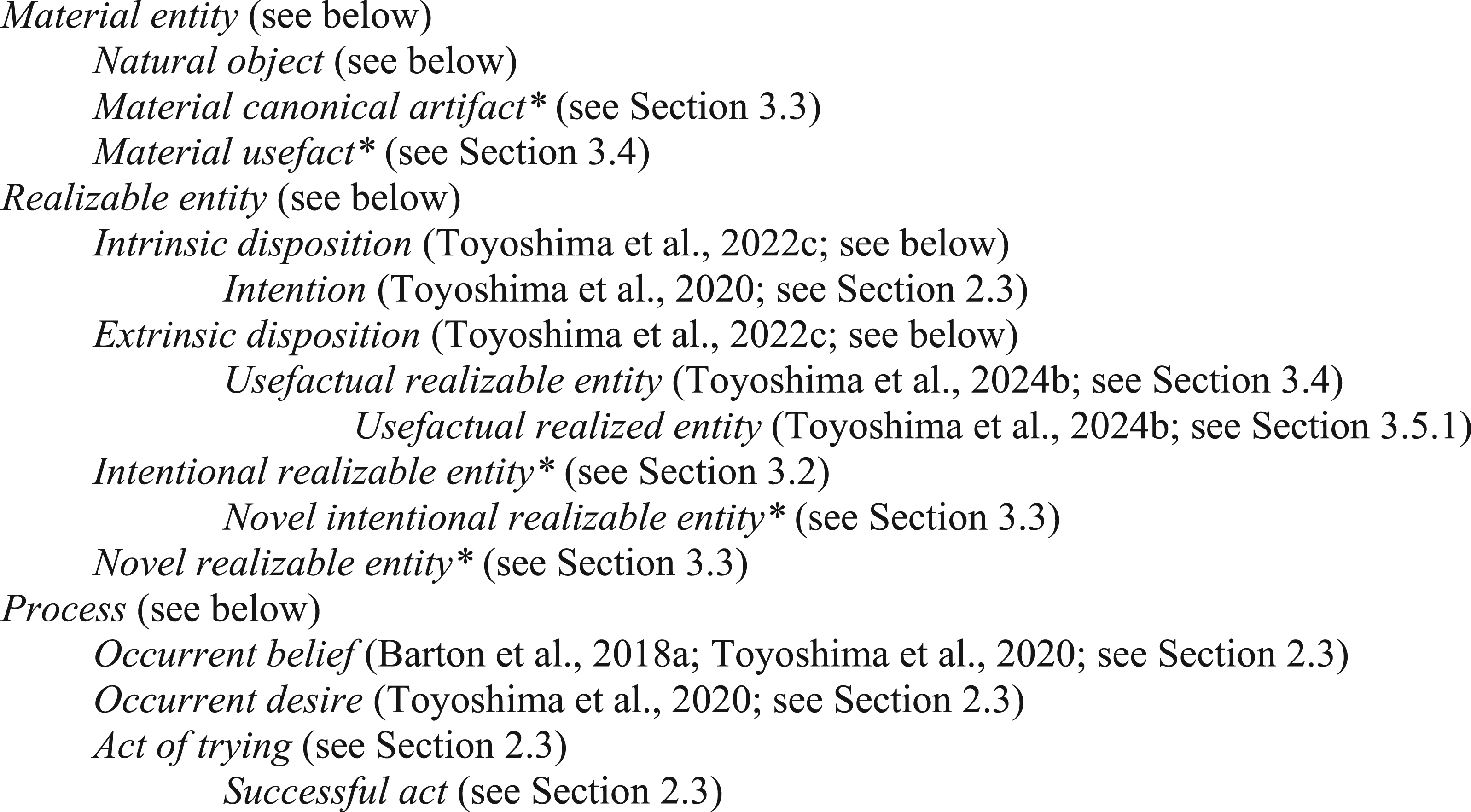
A taxonomy of classes used in this article.
We will now clarify the terms “material entity,” “natural object,” “process,” and “realizable entity” in the taxonomy. First, the notion of a material entity is widely accepted in upper ontologies, as illustrated by the BFO class Material entity and the class Physical endurant in the upper ontology “Descriptive Ontology for Linguistic and Cognitive Engineering” (DOLCE; Borgo & Masolo, 2010; Borgo et al., 2022; Masolo et al., 2003; Porello et al., 2025). Examples include an amount of clay, people and screwdrivers. We introduce the class Natural object as a subclass of the class Material entity, assuming that the term “natural object” can be understood intuitively (see Sections 1.1 and 1.3).
Second, processes and events remain widely discussed in formal ontology. They are very differently characterized by different upper ontologies (Rodrigues & Abel, 2019). In this paper we use the term “process” while remaining neutral regarding the detailed classification of occurrents (perdurants), such as the ontological distinctions between processes, events, and states. Our notion of a process aligns approximately with the BFO class Process and the DOLCE class Perdurant. Instances include the process of my shaping and drying this amount of clay, as well as the process of my using this pebble to keep papers in place.
Third and most importantly, the notion of a realizable entity has been explored in formal ontology, especially in connection with the BFO category of realizable entity (Rabenberg et al., 2024; Röhl & Jansen, 2014). In this paper we will draw upon Toyoshima et al.'s (2022c) framework for realizable entities that is theoretically underpinned by McKitrick's (2018) dispositional pluralism. The basic idea is that realizable entities can be generally understood as dispositions in McKitrick's broad sense of the term.
In particular, we will deploy the notions of an intrinsic disposition and an extrinsic disposition (McKitrick, 2003; McKitrick, 2018, ch. 8; Vetter, 2015, chs. 4.4–4.5) to specify important subclasses of the class Realizable entity. An intrinsic disposition is a realizable entity that is borne purely in virtue of the way the bearer is, for example, in virtue of the internal (physical) structure of the bearer. An extrinsic disposition is a realizable entity that is borne, at least partially, in virtue of the way the world that is external to the bearer is.
Classical examples include the intrinsic disposition of fragility and the extrinsic disposition
We will outline three philosophical views of diachronic identity as they are crucial for understanding the distinction between production and use, and thus between canonical artifacts and usefacts: the continuity view, the discontinuity view and the constitution view (the latter two grouped under the non-continuity view for expository purposes). We will illustrate them with two examples related to production and use, referred to as “Example A” and “Example B,” respectively (see Section 3 for a detailed discussion about the notions of production and use).
Before presenting Examples A and B, we offer a preliminary remark on the usages of the terms “pot” and “paperweight” as they appear in these examples. We assume that the pot in Example A is a canonical artifact (to wit, a material entity intentionally produced for the purpose of being able to contain liquid) and that the paperweight in Example B is a usefact (to wit, a material entity that is intended be used for the accidental purpose of keeping papers in place). Throughout the paper, however, we employ domain-specific artifact-related terms such as “pot” and “paperweight” primarily for illustrative purposes, highlighting our realizable-centered approach to artifacts. A meticulous analysis of these terms would require careful consideration of the difference between “artifact kind(s)” and “(specific) kinds of artifacts” (Irmak, 2024b; Jansen, 2013; Juvshik, 2025; Koslicki & Massin, 2025). As a matter of fact, the term “paperweight” may sometimes refer to a canonical artifact (to wit, a material entity that is intentionally produced for the purpose of keeping papers in place), as is shown by decorated paperweights found in souvenir shops. For this reason, we will provide fiat definitions of domain-specific artifact-related terms, whenever appropriate.
We will present Example A (diachronic identity and production) and Example B (diachronic identity and use), in which the terms “pot” and “paperweight” are employed as just explained, respectively:
diachronic identity and production
At time t1, a particular amount of clay ( Continuity view: At time t1, Non-continuity view: At time t1, a new material entity Discontinuity view: At time t1, Constitution view: At time t1,
diachronic identity and use
At time t2, a particular pebble ( Continuity view: At time t2, Non-continuity view: At time t2, a new material entity Discontinuity view: At time t2, Constitution view: At time t2,
We will articulate two different approaches to production and use from the perspective of diachronic identity: the “monolithic approach” and “hybrid approach.” The monolithic approach adopts the same philosophical view of diachronic identity for both production and use. Its strength lies in providing a philosophically coherent and unified framework for understanding both processes. However, it conflicts with intuitions about production and use—specifically, our tendency to assume the non-continuity view of production and the continuity view of use. For instance, Borgo and Vieu (2009) embrace the monolithic approach by assuming the constitution view of both production and use (see also Vieu et al., 2008). Their position has been criticized for its commitment to the constitution view of use: “it appears to us to be counter-intuitive to consider that a mental act gives birth to a new physical object” (Kassel, 2010, p. 242).
By contrast, the hybrid approach adopts different philosophical views of diachronic identity for production and use. A typical version of this approach combines the non-continuity view of production and the continuity view of use. Its strength lies in aligning well with intuitions about production and use. However, it faces the challenge of developing a philosophically well-founded and unified framework for understanding both processes. The hybrid approach may be implicitly assumed by many existing theories of artifacts, where the term “artifact” refers exclusively to canonical artifacts, and no explicit stance on diachronic identity (with respect to production, use, or both) is taken.
In this paper we adopt the monolithic approach to production and use, ensuring that our realizable-centered approach to artifacts serves as a solid theoretical basis for analyzing production, use, and their ontological distinctions. Specifically, we assume the continuity view of both production and use, acknowledging that this may involve a somewhat counterintuitive usage of the term “production.” Later, we will consider how our realizable-centered approach to artifacts can be reformulated under the non-continuity view of production and/or use; more concretely, within Borgo and Vieu's (2009) theory of artifacts espousing the constitution view of both production and use (see Section 7.1). This will show that our approach can be adapted to both the monolithic and the hybrid approaches to production and use, rendering it “foundation-agnostic” (Grüninger & Katsumi, 2019). In other words, it can be integrated into different foundational frameworks, accommodating different philosophical views of diachronic identity with respect to production and use.
An Ontology of Belief, Desire, and Intention
To analyze carefully the intentional dimension of artifacts, we will introduce an ontology of belief, desire, and intention, drawing on existing formal-ontological studies thereof (Barton et al., 2018a; Biccheri et al., 2020; Hobbs & Gordon, 2010; Toyoshima et al., 2020). First, our ontology of belief, desire, and intention will be limited in scope. For instance, we will not closely examine the representational dimension (intentionality, aboutness) of these mental entities (Biccheri et al., 2020; Mizoguchi & Borgo, 2022, 2025; Sanfilippo, 2021; Toyoshima & Barton, 2024a; Williams, 2019a; Yablo, 2014). Additionally, we will consider intentional acts only insofar as they relate to the development of a realizable-centered approach to artifacts. A comprehensive ontological analysis of actions falls outside the scope of this article (Piñeros Glasscock & Tenenbaum, 2023; Trypuz, 2007).
As for belief and desire, we import the notions of an occurrent belief and an occurrent desire from Toyoshima et al.'s (2020) dual account of belief and desire. An occurrent belief is a mental process of taking something to be the case (Barton et al., 2018a). An occurrent desire is a mental process of wanting something to be the case. Examples include my occurrent belief (
As for intention, we will leverage Toyoshima et al.'s (2020) dispositional theory of intention. Interpreted within our ontological framework, an intention is an intrinsic disposition to act that comes into being as a result of the interactions between occurrent beliefs and occurrent desires.
To further develop the view of intention as an intrinsic “disposition to act,” we will enrich it with the ontological analyses of goals by Hobbs & Gordon (2010) and Biccheri et al. (2020). Hobbs & Gordon (2010, p. 62) say: “The key concept in modeling intentional behavior is that of an agent a having some eventuality type e as a goal.” Their term “eventuality” is synonymous with our term “process.” Biccheri et al. (2020) formally characterize a goal as an entity that is desired or needed by an agent. By synthesizing these ontological accounts of goals, we will assume that a goal is a process type that is the object of an agent's desire, or more specifically, that comes into being through some occurrent desire. Examples include a process type (Goal1) which comes into being through
This ontological analysis of goals can be further elucidated as follows. First, because of our broad notion of a process (see Section 2.1), our process-based view of goals can be compatible with the existing state-based view thereof (e.g., Borgo et al., 2016; Mizoguchi et al., 2016). Second, Goal1 is a “particular type,” that is, a type that is ontologically dependent on some particular entity such as
We introduce the class Act of trying and its subclass Successful act under the category of process, corresponding to Hobbs and Gordon's (2010) notions of “trying” and “success,” respectively. An act of trying is a process in which an agent attempts to achieve a goal, that is, a process in which the agent strives to bring into existence an instance of that goal (for in-depth discussions on trying, see Grünbaum, 2008; Hornsby, 1980; McCann, 1975; O'Shaughnessy, 1980; Stuchlik, 2013). A successful act, in turn, is an act of trying that results in goal achievement, that is, an act of trying in which some agent does bring into existence an instance of the relevant goal. To clarify the dispositional account of intention, we propose that an intention is an intrinsic disposition to perform an act of trying that arising from the interactions between occurrent beliefs and occurrent desires. For simplicity, we will continue to use expressions of the form “intention to V” (where “V” stands for a verb such as “use”) rather than the more explicit form “intention to try to V.”
To provide a general illustration of our ontology of belief, desire, and intention, suppose that I intended to shape and dry
A Realizable-Centered Approach to Artifacts
Canonical Artifacts and Usefacts
We introduced the terms “canonical artifact” and “usefact” in Section 1.3. A canonical artifact is an entity that is intentionally produced for a specific purpose. A usefact is an entity that is intended to be used for some accidental purpose, i.e., for some purpose that is different from the one (if any) for which the entity was intentionally produced (cf. Evnine's (2022) “counter-use”). We will further elucidate the notions of a canonical artifact and a usefact by illustrating them with four examples involving material entities.
canonical artifact
At time t1, a particular amount of clay (
In this example,
We now address the choice of Example 1 as a driving example of canonical artifacts. Some may view the clay example as a simplistic or toy example of canonical artifacts and prefer to consider practical examples of complex canonical artifacts, such as screwdrivers and cars, as found in the industry domain; cf. Houkes and Vermaas's (2009a) critique of the “artisan model” of artifacts. Nevertheless, we chose to illustrate canonical artifacts with this simple example. Indeed, complex canonical artifacts involve the aggregation of a multiplicity of diverse parts and their ontological analysis would require an in-depth study of their structure (Grüninger et al., 2020; Koslicki, 2008), in particular their features and components (Sanfilippo et al., 2016). This may call for a non-standard mereology, whose study extends beyond the scope of this paper (see Masolo et al., 2020 for a formal analysis of composition and Section 8 for a pointer to future inquiry).
usefact and natural object
At time t2, a particular pebble (
In this example,
A few clarificatory remarks concerning Example 2 are in order. First, the expression “be intended to be used to do” is employed throughout the paper independently of whether it is actually used for that purpose. The distinction between use intention (even without associated actual use) and actual use has been highlighted by Borgo and Vieu (2009) and Toyoshima et al. (2022b).
We characterize the notion of a usefact in terms of use intention rather than actual use. This offers two key advantages. Firstly, it helps to understand a wide range of theories of artifacts, including Borgo and Vieu's (2009) theory, according to which
Second, there are at least two different, broad and narrow, senses of the term “use” in relation with production. According to the broad interpretation, production is a kind of use, as is illustrated by Houkes and Vermaas's (2010, 2014) statement that a “make plan” is a kind of “use plan” (see Section 7.2.2 for details). According to the narrow interpretation, use is distinct from production. In this article, we adopt the narrow interpretation of “use” to maintain a sharp distinction between canonical artifacts and usefacts. However, we will also investigate a type of use closely linked to production—aligning roughly with the broad interpretation—under the term “use for production” in Section 6.3.
usefact and canonical artifact
At time t1’ (later than time t1),
In this example,
properly used canonical artifact
At time t1” (later than time t1),
In this example,
Intentional Realizable Entity
We will analyze the notions of a canonical artifact and a usefact in terms of the ontology of realizable entities. More specifically, we will provide a realizable-based definition of the terms “material canonical artifact” and “material usefact.” Let us first consider the canonical artifact
We propose to analyze the canonical artifact Goal1: a process type that comes into being through
First,
intentional realizable entity
intentional realizable entity = def. A realizable entity (i) that comes into being through an intentional act and (ii) whose realization is determined by an associated goal.
By this definition,
Definition 1 can be further clarified as follows. First, this definition, especially item (ii), implies a close connection between intentional realizable entities and goals. However, this should not be conflated with the statement that any realizable entity is goal-directed in the sense that it is directed toward some associated type of processes (Tugby, 2024). We employ the term “goal” in the intentional sense of the term in this paper (see Section 2.3). For instance, the intrinsic disposition of uranium to decay is goal-directed in the broad, non-intentional sense of the term; but it is not goal-directed in the narrow, intentional sense of the term, since uranium can decay naturally without human intervention.
Relatedly, we will use the term “goal” rather than “purpose” when characterizing intentional realizable entities to encompass a wider range of canonical artifacts, extending beyond technical artifacts. For instance, McKitrick (2024) defines “artificial disposition” as “the disposition[s] that human beings deliberately cause something to have, in order to serve some purpose,” in alignment with her dispositional pluralism, which underpins our ontology of realizable entities (see Section 2.1). While our notion of an intentional realizable entity can be linked to McKitrick's notion of an artificial disposition, it is intended to be more general (for an illustration, see our analysis of Koslicki & Massin's (2025) “placebo capacity” in terms of intentional realizable entities in Section 3.5.2).
Second, one may argue that the term “intentional act” in Definition 1 is generally susceptible to a wide interpretation (cf. Borgo et al.'s (2014a) taxonomy of actions) and must be here interpreted in a constrained way in order to characterize the notion of a canonical artifact. For example, one may claim that intentional acts should involve physical modifications (e.g., shaping and drying).
On the contrary, we suggest that the term “intentional act” in the definition should be construed broadly enough to accommodate “mental selection” (cf. Borgo & Vieu, 2009). This broad understanding is motivated by the idea that, while physical modification has been a standard criterion for the production of artifacts (cf. Preston, 2022a; see also Section 7.2), the production of some kind of canonical artifacts may be better explained in terms of the notion of “appropriation” figuring in philosophy of artifacts (Hilpinen, 1992; Juvshik, 2021a; Preston, 2013, pp. 96–103; Thomasson, 2014). Examples of such canonical artifacts include ready-made artworks (e.g., Marcel Duchamp's Fountain; see also Evnine, 2013), where “appropriation” refers roughly to an intentional act of making an artwork from some pre-existing entity (or entities) with little or no physical modification (e.g., signing a urinal). Insofar as material artifacts are concerned, the philosophical notion of appropriation can be construed within our framework as an intentional act in which a material entity becomes a canonical artifact through little or no physical modification. We will delve into this point in Section 3.3.
Third, one might consider simplifying Definition 1 by omitting item (ii): “intentional realizable entity = def. A realizable entity that comes into being through an intentional act.” While this simpler definition might seem sufficient to capture the intentional dimension of canonical artifacts, it would fail to distinguish canonical artifacts from so-called “by-products”: roughly, unintended or purposeless outcomes of production processes. Although a full-fledged ontological analysis of products falls outside the scope of this paper (Vignolo, 2010a, 2010b), the notion of a by-product is used in domain ontologies, as is witnessed by class terms such as Poultry by-product (http://purl.obolibrary.org/obo/FOODON_00004144) in FoodOn, a BFO-compliant ontology of food and food production (Dooley et al., 2018).
To illustrate, consider a classical example of a by-product (e.g., Preston, 2022a): when sawdust is unintentionally produced during a woodworking operation and, by hypothesis, lacks any intended purpose, its combustibility is not an intentional realizable entity according to Definition 1. However, under some interpretation of the simpler definition, it could implausibly count as an intentional realizable entity, as the woodworking operation is an intentional act.
Fourth and finally, one may argue that the terms “is determined by” and “an associated goal” in Definition 1 should be construed in a suitably restrictive manner. While the terms “determined” and “associated” may be difficult to characterize generally, they can be elucidated with examples.
3
We propose that these terms should be understood widely enough to encompass a wide range of canonical artifacts, extending beyond technical artifacts. In particular, regarding the term “associated,” consider the analysis of Example 1: Goal1 is directly associated with
Material Canonical Artifacts and Novel Intentional Realizable Entities
We introduced in Section 3.2 the term “intentional realizable entity” to analyze canonical artifacts, particularly their intentional dimension. One may attempt to define a “material canonical artifact” as “a material entity that bears an intentional realizable entity.” However, in our view, while bearing an intentional realizable entity is a necessary condition for a material entity to be a canonical artifact, it is not sufficient. This is because material usefacts can also bear intentional realizable entities.
To illustrate, consider Example 2: at time t2,
According to Definition 1,
More generally, the mere fact that a material entity bears an intentional realizable entity fails to distinguish canonical artifacts from usefacts. Arguably, this is because it fails to capture the ontological difference between production and use: a canonical artifact is an entity intentionally produced for a specific purpose, whereas a usefact is an entity intended to be used for some accidental purpose.
In our view, the notion of novelty of a realizable entity can serve to specify the distinction between production and use, as well as between canonical artifacts and usefacts. To elaborate, we will focus on the intrinsic disposition
On the one hand,
On the other hand,
Despite these ontological differences,
Let us now compare the intrinsic disposition
To spell out the idea of the “novelty” of intentional realizable entities involved in canonical artifacts, we introduce the terms “novel realizable entity” and “novel intentional realizable entity” as follows 4 :
novel realizable entity
novel realizable entity = def. A realizable entity r such that its bearer has no realizable entity r’ where (i) r’ exists before r comes into being and (ii) if r is realized in a process, then r’ is realized in the same process.
novel intentional realizable entity
novel intentional realizable entity = def. An intentional realizable entity that is a novel realizable entity.
By these definitions,
material canonical artifact
material canonical artifact = def. A material entity that bears a novel intentional realizable entity.
By this definition,
We offer some clarificatory remarks on the argumentation developed so far, including Definitions 2–4. First, our characterization of production in terms of novel realizable entities is based on Definition 4: the production of the canonical artifact
Second, our analysis of Example 2 (usefact and natural object) can be applied, mutatis mutandis, to Example 3 (usefact and canonical artifact). In the latter example, consider the extrinsic disposition
Third, we propose to characterize canonical artifacts in terms of novel intentional realizable entities, rather than novel intentional intrinsic dispositions, even though
In the context of material artifacts, for instance, the philosophical notion of appropriation (see Section 3.2) can be understood within our framework as an intentional act in which a material entity becomes a canonical artifact in virtue of bearing a novel intentional extrinsic disposition. This is because acquiring an extrinsic disposition does not necessarily involve physical changes of the material entity that bears it. We will further illustrate novel intentional extrinsic dispositions with Koslicki and Massin's (2025) notion of a placebo capacity in Section 3.5.2.
Fourth and finally, it is important to examine whether our realizable-centered analysis of canonical artifacts—developed under the continuity view of both production and use—can be reconstructed under the non-continuity view of production and/or use (see Section 2.2). To address this, we need to consider how Definition 1 (intentional realizable entity) and Definition 2 (novel realizable entity) can hold under the non-continuity view of production and/or use.
Regarding Definition 1, it is straightforward to adapt this definition to both the non-continuity view of production and the non-continuity view of use. In particular, with respect to item (i) in the definition, if a realizable entity comes into being through an intentional act under the continuity view of production (or use), this condition is trivially satisfied under the non-continuity view of production (or use).
Regarding Definition 2, we will defer the question of how it can hold under the non-continuity view of production and/or use, as the answer depends on the specific details of the endorsed non-continuity view of production (or use), including whether it is the discontinuity view or the constitution view of production (or use). We will address this issue in Section 7.1 in discussing Borgo and Vieu's (2009) theory of artifacts which is committed to the constitution view of both production and use. 5
Material Usefacts and a Special Kind of Non-Novel Intentional Realizable Entities
We now turn to a close examination of the notion of a usefact. We will define the term “material usefact” based on the realizable-based definition of “material canonical artifact” (Definition 4) provided in Section 3.3. A naïve attempt might define this term as “a material entity that bears an intentional realizable entity that is not a novel realizable entity,” or more simply as “a material entity that bears a non-novel intentional realizable entity,” where the term “non-novel realizable entity” is defined as “a realizable entity that is not a novel realizable entity.” This naïve definition would correctly classify
However, this naïve definition may be too broad. To illustrate, consider Example 4: at time t1” (later than time t1),
Therefore, usefacts should be considered as material entities that bear a specific kind of non-novel intentional realizable entities. To this end, we introduce the relation of “being non-novel because of” between two realizable entities, based on Definition 2 (novel realizable entity), as follows: 6
is non-novel because of
A realizable entity r is non-novel because of a realizable entity r’ =def. There exists some bearer b such that (i) b bears r and (ii) b bears r’ and (iii) r’ exists before r comes into being and (iv) if r is realized in a process, then r’ is realized in the same process.
This definition enables us to classify non-novel intentional realizable entities (such as Non-novel because of some novel intentional realizable entity The extrinsic disposition Non-novel because of some realizable entity that is not a novel intentional realizable entity The extrinsic disposition The extrinsic disposition
Given that material usefacts can be characterized in terms of bearing the second type of non-novel intentional realizable entities, we define the term “material usefact” as follows:
material usefact = def. A material entity that bears an intentional realizable entity which is non-novel because of some realizable entity that is not a novel intentional realizable entity.
By this definition,
We remark that Definition 6 could be simplified as follows. An alternative approach would be to first define the term “usefactual realizable entity” as follows: 7
usefactual realizable entity
usefactual realizable entity = def. An intentional realizable entity that is non-novel because of some realizable entity that is not a novel intentional realizable entity.
By this definition,
material usefact
material usefact = def. A material entity that bears a usefactual realizable entity.
By this definition (as well as by Definition 6),
Theoretical Application
To illustrate the theoretical applications of our realizable-centered approach to artifacts, we will analyze two kinds of entities discussed in the literature: naturefacts in anthropology (Section 3.5.1) and faith-based artifacts in Koslicki & Massin's (2025) account of artifacts (Section 3.5.2).
Naturefact
As mentioned in Section 1.3, the term “naturefact” in anthropology refers to “naturally occurring objects used intentionally, but without modification, for some purpose” (Preston, 2022a). In Section 3.1, we argued that our notion of a usefact is broader than the anthropological notion of a naturefact: the latter is restricted to natural objects and is characterized in terms of actual use, whereas the former is defined in terms of use intention.
In light of our analysis of material usefacts in Section 3.4, we will provide a realizable-based definition of the term “naturefact.” In actual anthropological practice, the term “naturefact” refers to a natural object that was or is used intentionally, but without modification, for some purpose. Given the complexity of the temporal dimension in this original notion, we will focus on a simplified version: a naturefact as a natural object that is being used intentionally, but without modification, for some purpose.
To illustrate, let us introduce the following example, based on Example 2 (usefact and natural object):
naturefact
At time t2’ (later than time t2),
In this example,
We will characterize naturefacts (in the simplified sense) as a special kind of material usefacts. To illustrate the basic idea with Example 5,
usefactual realized entity
usefactual realized entity = def. A usefactual realizable entity that is realized.
By this definition,
naturefact
naturefact = def. A natural object that bears a usefactual realized entity.
By this definition,
Faith-Based Artifact
Koslicki and Massin (2025) introduced the term “faith-based artifact” to refer to artifacts that are intended and believed by their creators and users to perform a function they do not actually perform (see Section 4 for our analysis of functions and artifacts). Examples of faith-based artifacts range from religious and ritualistic objects (e.g., amulets and talismans) to abstract artifacts such as theories or ideologies (e.g., conspiracy theories).
Koslicki and Massin suggest that faith-based artifacts can be analyzed using their notion of a “placebo capacity”: roughly, a capacity to subjectively (but not objectively) satisfy an agent's desire to produce the relevant effect in the presence of her belief that the entity can bring about this effect. For instance, an amulet can be ascribed the placebo capacity to subjectively satisfy the user's desire to dispel evil spirits in the presence of the relevant belief on the part of the agent that it can in fact dispel evil spirits. However, since amulets lack the capacity to dispel evil spirits, the user's desire can only be subjectively, but not objectively, satisfied.
We will analyze the notions of a faith-based artifact and a placebo capacity within our realizable-centered framework, focusing on material artifacts. To this end, we make two clarifying assumptions. First, we assume that if a material entity is a faith-based artifact, then it bears a placebo capacity, while remaining agnostic as to whether the converse holds. Second, we assume that the intentional dimension of faith-based artifacts stems from some relevant intention. We will not explore the possibility that this dimension might be explicable without recourse to intentions, for example in terms of beliefs and desires alone (as touched upon by Toyoshima et al., 2024a, 2024b), as it would require a substantive reconstruction of our realizable-centered approach to artifacts.
Let us now introduce the following example of faith-based artifacts:
faith-based artifact
At time t3,
In this example,
To analyze the intentional dimension of
We can justify the existence of
Following Koslicki & Massin's argument, we assume that, at time t3,
Subsequently, we consider whether the extrinsic disposition
Instead, we can consider the associated goal as a process type (Goal2) whose achievement results in a process of my desire to dispel evil spirits being satisfied, because the association between intentional acts and goals can be indirect (see Section 3.2). Thus, Goal2 determines a realization of
Finally, we consider whether the intentional realizable entity
We can therefore conclude that
To generalize, we hypothesize that (material) faith-based artifacts may be characterized as a kind of (material) canonical artifacts because placebo capacities may be characterized as a kind of novel intentional realizable entities, particularly of novel intentional extrinsic dispositions. This hypothesis supports our analysis of canonical artifacts in terms of novel intentional realizable entities, encompassing novel intentional extrinsic dispositions (see Section 3.3).
Functions and Artifacts: A Realizable-Centered Perspective
In this section, we investigate the relationship between functions and artifacts from a realizable-centered perspective. Since the ontology of functions is by itself a foundational subject, our study of functions will be limited in scope.
First, we adopt an ontological and realism-based view of functions and leave aside, for example, Searle's (1995) “observer-relative” view of functions (and artifacts). Indeed, we are primarily interested in an ontological and largely realist theory of artifacts in this paper (see Section 2.1).
Second, we concentrate specifically on “artifactual functions” (such as the function of a screwdriver to turn screws) while leaving aside biological functions (such as the function of a lung to convey oxygen through the body). For clarity, we will occasionally use the term “function” to refer specifically to artifactual functions unless confusion arises.
Third, formal ontology contains a variety of accounts of functions (Carrara et al., 2011; Röhl & Jansen, 2014; Yargan & Jansen, 2024). Among these, we focus on three major theories: the designer-based theory, the etiological theory and the systemic theory—drawing inspiration from Koslicki & Massin's (in press) argumentation.
Fourth and relatedly, we provide realizable-based definitions for the corresponding terms “design function,” “proper function,” and “system function” (Section 4.1). We assume these functions form a subtype of realizable entities (cf. Roberts, 2024; Toyoshima & Jansen, 2026), while leaving aside the possibility that they can be a subtype of processes (see e.g., Burek, 2006). The view of function as a realizable entity helps us to sharply distinguish between “functions” (continuants) and “functionings” (occurrents) (Röhl & Jansen, 2014; Spear et al., 2016).
We examine the function-based accounts of artifacts by analyzing the relationship among these three kinds of functions (design, proper and system) and the kinds of realizable entities proposed in our realizable-centered approach to artifacts (Section 4.2).
Three Theories of Functions: Designer-Based, Etiological and Systemic
First, according to the designer-based theory, a function is determined by the intention(s) of the designer(s) of the function bearer (Baker, 2007). Here, “designer” is understood broadly to include authors, producers, inventors, and generally any agents responsible for creating the artifact or artifact kind. For instance, the function of a screwdriver to turn screws is determined by the designer's intention, as the designer intentionally produced (or designed) the screwdriver to perform this function. We provide the following realizable-based definition of the term “design function”:
design function
design function = def. A realizable entity (i) that comes into being through an intentional act of design and (ii) whose realization is determined by the designer's intention (or designers’ intentions).
We note that the phrase “is determined by” in this definition carries the same technical meaning as in Definition 1 (see Section 3.2 on intentional realizable entities).
Second, according to the etiological theory (aka causal-historical theory), a function of a bearer of a certain kind is determined by the successful production of an effect in past members of that kind, which explains why members of the kind continue to be selected or reproduced (Milikan, 1984, 1989; Neander, 1991; Wright, 1973). For instance, the function of this particular screwdriver (an instance of the type Screwdriver) to turn screws is determined by past successful instances of Screwdriver producing this effect, explaining why instances of Screwdriver continue to be used and reproduced. As a proper function is predicated upon a type of function bearer, we provide the following realizable-based definition of “proper function with respect to type T”:
proper function
proper function with respect to type T = def. A realizable entity of the bearer instantiating T whose realization is an effect (i) successfully produced by instances of T in the past and (ii) that explains why instances of T continue to exist.
Third, according to the systemic theory (aka the causal contribution theory) of functions—which we formulate here using the notions of a capacity and its manifestation—a function is determined by the manifestation of a capacity of the bearer that causally contributes to the manifestation of a capacity by the system of which the bearer is a component (Borgo et al., 2016; Burek et al., 2016; Cummins, 1975; Mizoguchi et al., 2016). For example, the function of a screwdriver to turn screws can be analyzed in terms of the capacity of this screwdriver whose manifestation causally contributes to the manifestation of a capacity of the “screw-turning system,” which has as component the screwdriver, a screw and an agent using the screwdriver.
The notion of a system function is based on the twin conceptual pillars: the notions of a system and causal contribution. Regarding systems, we assume that they can be intuitively understood as entities with two or more components related in a specific way, although their ontological analysis remains challenging (Miettinen, 2018; Mizoguchi & Borgo, 2021; Perez, 2020; Rodrigues, 2023). For the related notion of a mechanism, see Machamer et al. (2000) and Röhl (2012).
The notion of a system connects to the ontology of realizable entities through Vetter's (2015, ch. 4.5) systemic account of extrinsic dispositions (“extrinsic potentialities” in her terms). The core idea is that bearing an extrinsic disposition is both necessary and sufficient for the bearing of a joint disposition (“joint potentiality” in her terms) by a system having as component the bearer and other objects. Here, a joint disposition (in the Vetter-inspired sense) is an intrinsic disposition, as outlined in Toyoshima et al.'s (2022c) formalization of this systemic account of extrinsic dispositions. System functions can be considered as a kind of extrinsic dispositions, as they exist within the system that includes the bearer.
Concerning causal contribution, we interpret it in terms of realizations of realizable entities, since intrinsic dispositions, and more generally realizable entities, can be seen as causal properties in philosophy (Mumford & Anjum, 2011; N. E. Williams, 2019b; Ingthorsson, 2021; cf. Nolan's (2015) dissenting voice) and in formal ontology (Röhl & Jansen, 2011; Toyoshima, 2020; Toyoshima et al., 2022c). By synthesizing these analyses of systems and causal contribution, we can provide the following realizable-definition of “system function”:
system function
system function = def. An extrinsic disposition whose realization causally contributes to a realization of an intrinsic disposition of a system of which the bearer is a component.
Discussion: Beyond the Function-Based Accounts of Artifacts
For expository clarity, we examine the systemic, etiological and designer-based theories of functions in sequence, within the context of function-based accounts of artifacts. Our methodology involves scrutinizing, from our realizable-based perspective on material artifacts, how the notion of a material artifact is characterized in terms of bearing a [system/proper/design] function.
First, the systemic theory of functions struggles to account for many kinds of artifacts (as discussed in detail by Koslicki & Massin, in press). Consider, for example, material entities bearing novel intentional intrinsic dispositions: these are material canonical artifacts, yet they fall outside the scope of the systemic theory since any system function is an extrinsic disposition, and no intrinsic disposition can be a system function (see also Artiga, 2016; Röhl & Jansen, 2014).
It is worth noting that usefactual realized entities form a subtype of system functions—consider
Second, the etiological theory of functions encounters difficulties with “innovative or atypical artefacts” (Vermaas & Houkes, 2003, p. 266) or prototypes, defined as “a first exemplar of a newly created artifact kind” (Koslicki & Massin, in press). This difficulty arises because proper functions of instances of type T requires a causal history involving the successful production of an effect that explains the continued use and reproduction of T instances—something that prototypes lack by definition.
A related issue with the etiological theory is its relativity of proper functions to types of bearers, which makes types of bearers ontologically prior to types of proper functions. This makes the etiological theory less suitable for developing a general ontology of artifacts intended to remain neutral regarding definitions of domain-specific artifact-related terms such as “pot”, “paperweight,” “doorstop,” and “amulet” (see Section 2.2; and Section 5.4 for a related issue concerning the BFO etiological account of functions).
Third, the designer-based theory of functions has limitations compared to our realizable-centered approach. Assuming that the notion of design primarily characterizes canonical artifacts, we now compare design functions with novel intentional realizable entities, or more generally with intentional realizable entities. First of all, design functions come into being through an intentional act of design (item (i) of Definition 11), whereas intentional realizable entities come into being through an intentional act simpliciter (item (i) of Definition 1). Clarifying their comparison requires disambiguating the term “design.”
There are at least two interpretations of “design”: a broad one, where an intentional act of design need not involve physical modification and may include mental selection, and a narrow one, where an intentional act of design must involve physical modification and excludes mere mental selection.
This ambiguity creates a dilemma. If one accepts the broad interpretation, defining “material artifact” as “a material entity that bears a design function” may fail to sharply distinguish canonical artifacts (e.g.,
Moreover, realizations of design functions are determined by the designer's intention (or designers’ intentions) (item (ii) of Definition 11), whereas realizations of intentional realizable entities are determined by an associated goal (item (ii) of Definition 1). To clarify the difference, consider (material) faith-based artifacts, which we analyzed as a kind of (material) canonical artifacts (see Section 3.5.2). The designer-based theory could characterize
Finally, a “pluralist” function-based account of artifacts combining two or more theories of functions would face similar issues (Koslicki & Massin, in press). For instance, one might attempt to characterize canonical artifacts and usefacts using design functions and use functions, respectively, on the assumption that both are reducible to systemic functions, and consequently, no design functions are intrinsic dispositions (cf. Mizoguchi et al., 2016). This systemic and designer-based theory (enriched with use function) would nonetheless inherit the challenges of each individual theory. To illustrate with Example 6, it remains unclear whether the agent at time t3 is a “designer” or “user” with respect to
In sum, we examined traditional, function-based accounts of artifacts from a realizable-centered perspective, by considering three prominent theories of functions (viz., designer-based, etiological and systemic) or more concretely, by scrutinizing realizable-based characterizations of “design function,” “proper function,” and “system function.” This leads us to conclude that, despite their intuitive appeal (especially for design functions), these function-based accounts of artifacts (whether monist or pluralist) lack the generality of the realizable-centered approach to artifacts we develop here.
Formalizing a Realizable-Centered Approach to Artifacts: A Case Study Using Basic Formal Ontology
We demonstrate the flexibility and applicability of our realizable-centered approach to artifacts by adapting it to BFO, an established upper ontology. After preliminaries (Section 5.1), we introduce the terms “artifactual capacity” and “independent continuant artifact,” which align terminologically and conceptually with the BFO framework (Section 5.2). We then formally characterize these terms (Section 5.3) and conclude with a brief discussion (Section 5.4).
We choose BFO for this case study for several reasons. First, BFO serves as a useful illustrative example, as our theory of artifacts can be easily adapted to BFO among upper ontologies. Second, this case study contributes to developing a BFO-compliant ontology of artifacts, a project that has been largely unexplored to date (see Section 5.1.2). Third, it clarifies the BFO category of realizable entity, particularly functions and roles within it (see Section 5.4).
Preliminaries
A General Overview of BFO
Figure 2 provides a taxonomy of classes, including terms from BFO and our new terms to be introduced in Section 5.2. This taxonomy maps BFO class terms to class terms (in square brackets) from the taxonomy introduced in Section 2.1 (see Figure 1). Strictly speaking, BFO does not include the category of externally grounded realizable entity (parenthesized here), as the term “externally grounded realizable entity” is used to explain the BFO category of role; however, we include it to show the correspondence between this BFO term and our term “extrinsic disposition” (Toyoshima et al., 2022c).
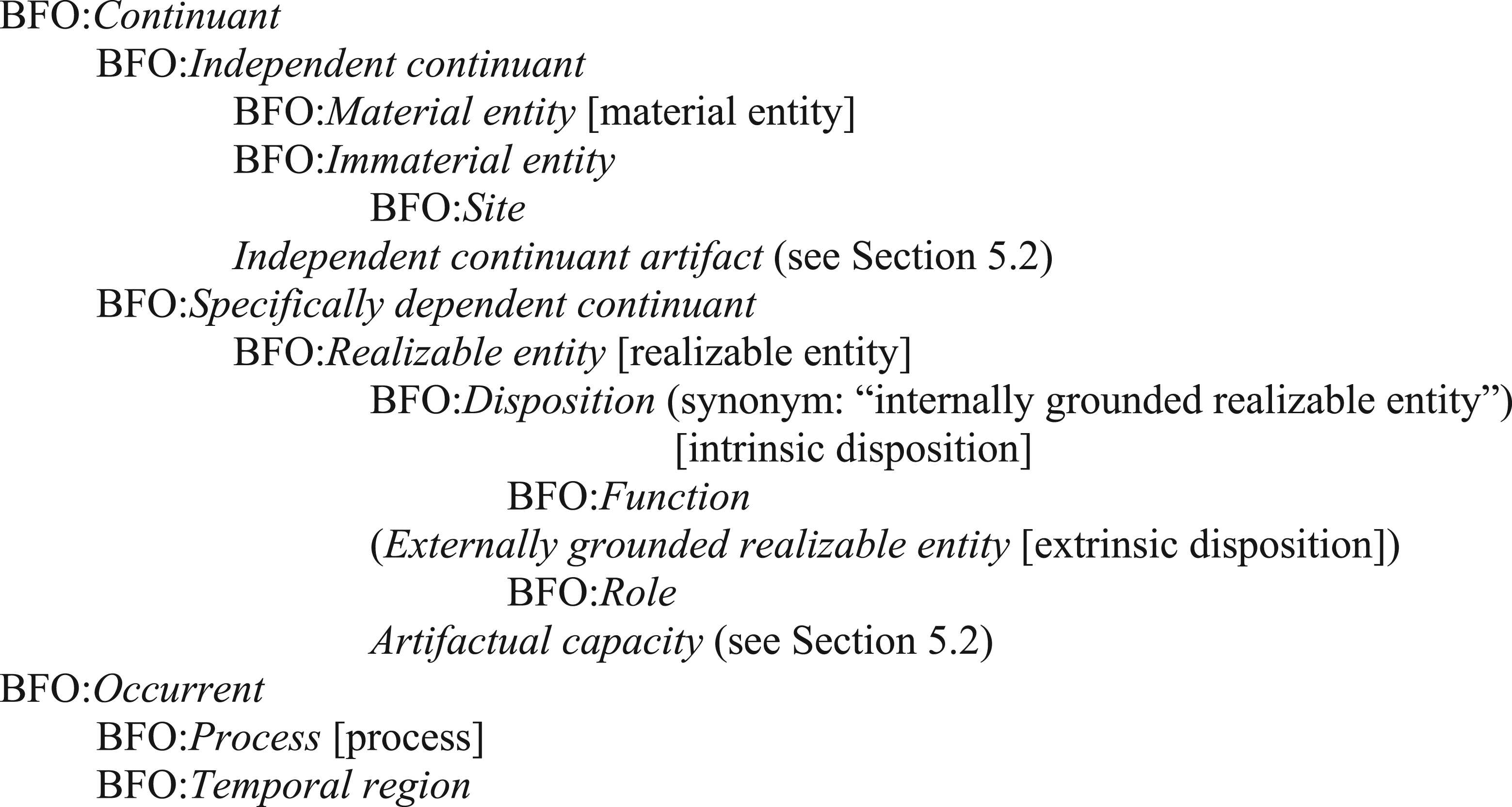
A BFO-based taxonomy of classes used in Section 5.
BFO includes the top-level distinction between continuants and occurrents. On the continuant side, independent continuants include material entities such as organisms and heaps of stones. They also include immaterial entities, with sites as one subtype. A BFO:site is defined as: “An immaterial entity in which objects such as molecules of air or organisms can be contained” (Arp et al., 2015, p. 184; see also Donnelly, 2005). Examples include my nasal cavity and the hold of a ship.
A specifically dependent continuant is a continuant that depends (existentially) on at least one independent continuant. A realizable entity is a specifically dependent continuant that can be realized in associated processes of specific correlated types in which the bearer participates. BFO currently includes three subtypes of realizable entities: dispositions, functions, and roles.
A disposition in BFO is a realizable entity that exists because of certain features of the physical makeup of its bearer—the independent continuant that bears it. It is an “internally grounded realizable entity”: if a BFO:disposition ceases to exist, then the physical makeup of the bearer is changed. Examples include the fragility of a glass and the flammability of a match.
A function in BFO is a BFO:disposition of a bearer with a specific kind of historical development. It is a BFO:disposition that its bearer possesses in virtue of its having a certain physical makeup because of how it came into being, either through evolution (for natural biological entities) or intentional design (for artifacts). Spear et al. (2016, p. 126) explain: “ ‘Came into being’ here strongly suggests that a functional disposition is one whose existence helps to causally explain the existence of the entity, or at least of the physical structure, that it is a disposition of.” Examples include the function of the heart to pump blood through the body or the function of a screwdriver to turn screws.
A role in BFO is a realizable entity that (1) exists because the bearer is in some special physical, social, or institutional set of circumstances in which the bearer does not have to be (optionality), and (2) is not such that, if this realizable entity ceases to exist, then the physical makeup of the bearer is changed (external grounding). Briefly, a BFO:role is an externally grounded and optional realizable entity. Examples include the role of being a student and the role of a stone marking a boundary. For further discussion on optionality here, see Röhl & Jansen, 2014; Toyoshima et al., 2022c; see also Toyoshima's (2021) foundational analysis of roles in BFO.
On the occurrent side, a process is an occurrent that exists in time by occurring—that is, by having temporal parts—and depends on at least one independent continuant as a participant. Examples of processes include cell division or a person's walk. A temporal region is an occurrent that is part of (the whole of) time.
Several BFO-compliant definitions of “artifact” and “material artifact” exist in the literature: (d1) artifact = def. A material entity created or modified or selected by some agent to realize a certain [BFO:]function or [BFO:]role. (Ceusters & Smith, 2015, p. 1) (d2) artifact = def. Something that is deliberately designed (or, in certain borderline cases, selected) by human beings to address a particular purpose. (Arp et al., 2015, p. 3) (d3) artifact = def. A material entity that has been intentionally selected by some agent to serve in attaining some end and is recognized in some community as having been created for some purpose. (Duncan, 2017, p. 26) (d4) artifact = def. An object designed by an agent to fulfill a certain [BFO:]function (Otte et al., 2019, p. 181) (d5) material artifact = def. An object deliberately created to have a certain [BFO:]function. (Drobnjakovic et al., 2022, p. 7) (d6) material artifact = def. A material entity that was designed by some agent to realize a certain [BFO:]function. (The Common Core Ontologies Repository, 2024; see also Jensen et al., 2024)
These six definitions suggest that “artifact” should refer to canonical artifacts (entities intentionally produced for a specific purpose) within the BFO framework. First, the term “created” may imply a non-continuity view of production (d1, d3, d5). Second, terms like “intentionally” and “deliberately” are used (d2, d3, d5). Third, the term “purpose” (d2, d3) and the expression “to realize/have/fulfill a certain [BFO]:function” (d1, d4, d5, d6) are used. Fourth, the term “[BFO]:function” is explicitly referenced (d1, d4, d5, d6) and, by definition (or elucidation), BFO:functions come into being through intentional design.
Defining the Terms “Artifactual Capacity” and “Independent Continuant Artifact”
Based on the discussion in Section 5.1.2, we adapt the notions of a canonical artifact and a novel intentional realizable entity to the BFO ontological framework. Recognizing the importance of “terminological choice” (and ontological analysis) in ontology development (Neuhaus & Hastings, 2022), we introduce more accessible terms instead of using our technical terms “material canonical artifact” and “novel intentional realizable entity.”
For an alternative to “material canonical artifact,” we propose “independent continuant artifact.” First, we retain the term “artifact,” as existing BFO-compliant definitions of the term “(material) artifact” imply that it should refer to canonical artifacts (see Section 5.1.2). Second, we introduce “independent continuant artifact” instead of “material artifact” because some canonical artifacts are arguably independent continuants that are not material entities. For instance, trenches created during the First World War may be classified as BFO:sites. Given that BFO:sites can bear specifically dependent continuants (though see Neuhaus, 2026), they qualify as canonical artifacts by bearing novel intentional realizable entities.
For an alternative to “novel intentional realizable entity,” we propose “artifactual capacity.” We use here the term “capacity” for several reasons. First, capacity-based approaches to artifacts have been developed in formal ontology and in philosophy (Borgo & Vieu, 2009; Kassel, 2010; Koslicki & Massin, 2025; see also Section 7).
Second, while “capability” and “capacity” are sometimes considered as synonymous, a BFO-based analysis treats capabilities are a subtype of BFO:dispositions (Beverley et al., 2024). In contrast, we argue that canonical artifacts should be characterized by novel intentional realizable entities, rather than novel intentional intrinsic dispositions, where our term “intrinsic disposition” aligns with BFO:Disposition (see Section 2.1).
Third, the notion of a capacity can accommodate both intrinsic and extrinsic dispositions, including novel intentional extrinsic dispositions. For instance, Koslicki and Massin's (2025) “placebo capacities” can be analyzed as novel intentional extrinsic dispositions (see Section 3.5.2). Capacities are also characterized as “relational qualities,” synonymous with our term “extrinsic property,” according to a DOLCE-compliant analysis of functions, capabilities and capacities in the engineering domain (Borgo et al., 2021; Compagno, 2025; Compagno & Borgo, 2024b; Compagno et al., 2023).
We define “artifactual capacity” and “independent continuant artifact” as follows, acknowledging the needs for a BFO-friendly reinterpretation of the term “goal” in the definition of the former term: artifactual capacity = def. A realizable entity r (1) that comes into being through an intentional act; (2) whose realization is determined by an associated goal; and (3) such that the bearer has no realizable entity r’ such that (i) r’ exists before r comes into being and (ii) if r is realized in a process, then r’ is realized in the same process. independent continuant artifact = def. An independent continuant that bears an artifactual capacity.
Second, we may need to reinterpret the term “goal” in a BFO-conformant way, as viewing goals as process types coming into being through some occurrent desire could conflict with BFO's realist methodology (see Section 2.3). The notion of a goal remains understudied in BFO-based ontology research. The BFO-compliant Information Artifact Ontology (IAO; Ceusters & Smith, 2015) defines “object specification” as “a directive information entity that describes an intended process endpoint” and lists “goal specification” as a synonym (http://purl.obolibrary.org/obo/IAO_0000005); for more details, see Duncan et al.'s (2024) analysis of the related IAO term “plan specification.” Based on this, we may loosely characterize a goal as a realizable entity that comes into being through some occurrent desire, such that it can be realized in “an intended process endpoint,” though this raises questions about which entity or entities bear the goal. We leave for future work a BFO-based rigorous characterization of goals.
Formal Characterization
We formalize “artifactual capacity” and “independent continuant artifact” in classical first-order logic, as this formalization aligns with existing ontologies (notably BFO) and avoids potential conceptual and technical issues with modal logical representations of realizable entities (including dispositions) in BFO (Toyoshima & Niki, 2021). Our first-order language includes a countably infinite supply of variables (for particulars only), standard logical symbols (including “¬,” “
Predicates and Their Informal Explanation.
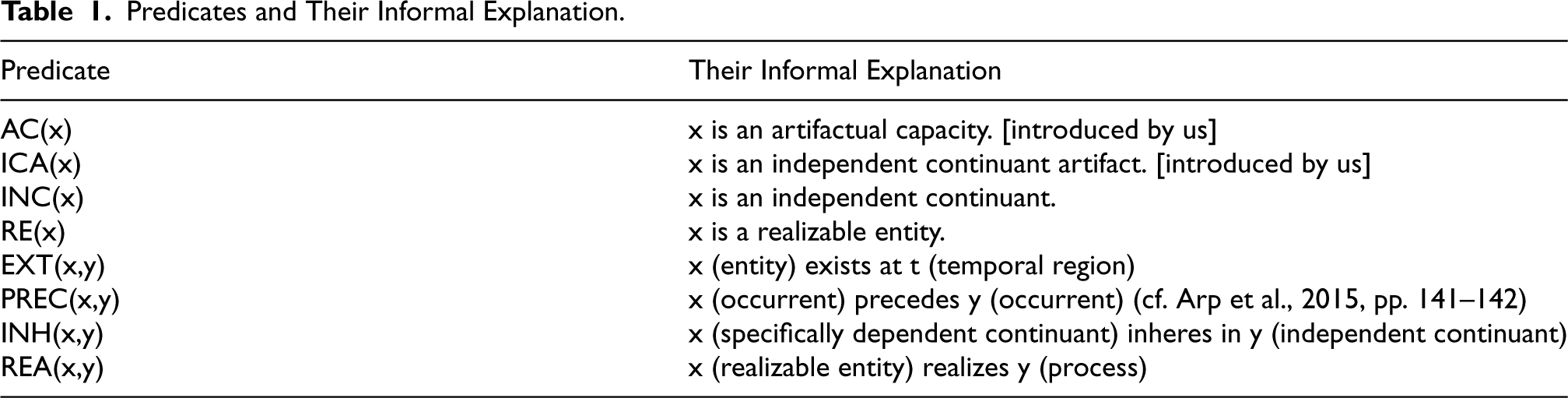
Predicates and Their Informal Explanation.
First of all, an artifactual capacity is a realizable entity:

For items (1) and (2) in the definition of the term “artifactual capacity,” formal representation is challenging due to the complexity of notions such as intentional act, determination (“is determined by”) and goal (see Section 5.2). However, one possible way to formalize item (1) is to introduce the primitive predicate IA(x) (“x is an intentional act”), adopt the “results in formation of” relation (http://purl.obolibrary.org/obo/RO_0002297) from the BFO-compliant relation ontology (RO; Smith et al., 2005), reinterpret it more broadly as a relation (RF(x,y)) between a process and a continuant (not restricted to an anatomical entity) and state the following axiom: AC(x) → ∃y(IA(y)
For item (3) in the definition, we formalize it using existing BFO relations:

(A2) can be informally read as: “Any artifactual capacity x inheres in an independent continuant y such that there is no other realizable entity r in y that exists before x comes into being and such that any of realizations of x is a realization of r.”
We formally define “independent continuant artifact” as follows:

(D1) can be informally read as: “An independent continuant artifact x is, by definition, an independent continuant in which some artifactual capacity inheres.”
We saw in Section 5.1.2 that existing BFO-compliant definitions of the terms “artifact” and “material artifact” tend to rely on the BFO category of realizable entity, particularly function. In that respect, our realizable-centered approach to artifacts can clarify realizable entities in BFO.
Initially, let us compare artifactual capacity with BFO:function. There are several key ontological differences between them. First, BFO:functions are a subtype of BFO:dispositions (or internally grounded realizable entities), whereas artifactual capacities can be externally grounded realizable entities. A case in point is Koslicki and Massin's (2025) “placebo capacities” (e.g.,
Second, BFO's theory of functions seems to be committed to the non-continuity view of production, as the BFO notion of a function is closely tied to how the bearer “came into being” and helps to causally explain the bearer's existence. As the BFO theory of functions also seems to assume the continuity view of use, it may embody a typical hybrid approach to production and use (see Section 2.2). In contrast, the notion of an artifactual capacity is intended to be neutral with respect to whether the hybrid or monolithic approach is adopted; see Section 7.1 for discussion on adapting our approach to the non-continuity view, especially the constitution view, of both production and use.
Third, artifactual BFO:function is etiological and designer-based, as BFO explicitly endorses an etiological account of functions (Spear et al., 2016) and, for artifacts (to wit, canonical artifacts), intentional design is causally responsible for the physical makeup of the bearer of a BFO:function. We note, however, that while BFO claims functions to be etiological, artifactual BFO:functions would not qualify as proper functions in the sense of Definition 12 (see Section 4.1), as the intentional design involved in a given BFO:function pertains to the causal history of the particular bearer: “In the case of artifacts, the current [BFO:]function of an artifact is determined by its history of intentional design or selection by some agent” (Spear et al., 2016, p. 109, our italics added).
As a result, the BFO account of artifactual functions may inherit the issues of the etiological and designer-based theories of functions in providing a general ontology of artifacts (see Section 4.2). For instance, we raised concerns about types of bearers of proper functions being ontologically prior to types of these proper functions. Similar concerns might be formulated in BFO: “For BFO, […] if a function of a given kind exists, then its bearer must instantiate some independent continuant biological or artifactual universal. […] we take reference to kinds to be unavoidable in almost all talk of functions and take the question of whether or not a given thing has a function to be, at least in part, a question of the kind of thing it is” (Spear et al., 2016, p. 123).
Another issue is the ambiguity of the term “design” (e.g., whether it should be broadly construed to include mental selection or narrowly to require physical modification), as noted when we examined the designer-based theory of functions. This ambiguity is evident in BFO's explanations of functions, which sometimes refer to “selection” alongside intentional design: “this bearer [of a BFO:function] came into existence as a result of […] intentional design or selection for artifacts” (Spear et al., 2016, p. 107, our italics added) and “In the case of artifacts, the current [BFO:]function of an artifact is determined by its history of intentional design or selection by some agent” (Spear et al., 2016, p. 109, our italics added).
Following this, we compare BFO:role with artifactual capacity and usefactual realizable entity (see Section 3.4, especially Definition 7). First, we have already argued that some artifactual capacities (e.g., placebo capacities such as
Second, usefactual realizable entities are BFO:roles, as illustrated by
Furthermore, previous BFO-based analyses of functions have noted the existence of BFO:roles closely related to but distinct from BFO:functions. For instance, Spear et al. (2016) state: “when sticks from the woods are merely intentionally selected to be used as chopsticks, then they do not take on or have a function at all in the BFO sense, but rather a [BFO:]role” (Spear et al., 2016, p. 126) and “naturefacts and […] (merely intentionally) repurposed artifacts generally […] do not have functions in the BFO sense; but rather [BFO:]roles” (Spear et al., 2016, p. 127). As another example, Röhl and Jansen (2014, p. 14) argue: “the so-called ‘use functions’ […] are to be classified as roles […] in agreement with the BFO conception of roles.”
When BFO:roles come into being when their bearers (e.g., wooden sticks) “are merely intentionally selected to be used” for some accidental purpose (e.g., to serve as chopsticks), these BFO:roles can be analyzed as usefactual realizable entities. We can further add that naturefacts can be defined in terms of usefactual realized entities—a subtype of usefactual realizable entities (see Section 3.5.1)—and that, in Example 3,
In sum, our realizable-centered approach to artifacts clarifies functions and roles in BFO. On the one hand, artifactual BFO:functions can be understood as a specific kind of artifactual capacities. On the other hand, some BFO:roles are artifactual capacities while others are usefactual realizable entities. Although such use-related BFO:roles have been previously mentioned in the literature, we analyzed them systematically from a realizable-centered perspective on usefacts.
Discussion
The Individuation of Realizable Entities
Since our realizable-centered approach to artifacts hinges on the ontology of realizable entities, the individuation and categorization of these entities are crucial—that is, determining which realizable entities exist and how a realizable entity is to be characterized. These determine which entities (particularly material entities) qualify as canonical artifacts, usefacts, or neither—and whether an entity can qualify as both.
To illustrate, suppose that at time t4,
Several approaches can tackle the thorny issue of individuating realizable entities. One pragmatic view holds that their individuation primarily requires domain-specific knowledge, with different domain ontologies adopting distinct principles established through “consensus creation” (Neuhaus & Hastings, 2022) among ontology developers and domain experts. For example, Arp et al. (2015, p. 102) acknowledge “the problem as to how [BFO:]dispositions are to be individuated” and state: “BFO itself does not provide a taxonomy of dispositions; it does not itself legislate concerning which types of dispositions exist, or how they are to be individuated. Rather, it leaves this task to the specific sciences” (Arp et al., 2015).
However, a domain-neutral principle for individuating realizable entities would be desirable. To explore this, consider Barton et al.'s (2018c) work on the (synchronic) identity of intrinsic dispositions. As a preliminary, we introduce the notions of a trigger and a categorical basis of an intrinsic disposition. A trigger of an intrinsic disposition is a process whose occurrence activates the realization of the intrinsic disposition; cf. McKitrick's (2018, ch. 6) event-based view of triggers within her dispositional pluralism. A categorical basis of an intrinsic disposition is a categorical (i.e., non-realizable) property (e.g., physical structure) of the bearer in virtue of which the intrinsic disposition exists (Prior et al., 1982; Röhl & Jansen, 2011). For example, the fragility of this glass is an intrinsic disposition that can be triggered by a process of pressing the glass with sufficient force and whose categorical basis is a specific molecular structure of the glass.
According to one criterion for the identity of intrinsic dispositions (“parthood criterion” in Barton et al.'s (2018c) terms), two intrinsic dispositions are identical if and only if they have the same categorical basis, the same class of minimal triggers and the same class of maximal realizations. The class of minimal triggers of a disposition d is the class of triggers of d for which no proper part is a trigger of d. The class of maximal realizations of d is the class of realizations of d which are not proper parts of another realization of d. To put it epistemically, according to this criterion, the identification of an intrinsic disposition amounts to the identification of the associated categorical property (or properties), the “smallest causal factor” which exceeds the threshold value for causation and the resulting whole causal chain of processes. Barton et al. argue that this criterion avoids “disposition multiplicativism”: the arbitrary proliferation of intrinsic dispositions that could undermine their causal and explanatory roles.
It would be valuable to extend the parthood criterion for the identity of intrinsic dispositions to the entire category of realizable entities, thereby developing a domain-neutral principle for individuating realizable entities. On the one hand, the notion of a categorical basis of an intrinsic disposition can be generalized to the broader notion of a categorical basis of a realizable entity (cf. Ferreira Ruiz & Hundertmark, 2024), as Toyoshima et al. (2022c) elaborate this notion with a focus on the causal import of realizable entities.
On the other hand, extending the notion of a trigger of an intrinsic disposition to the more general notion of a trigger of a realizable entity is more intricate. This difficulty arises partly because even the former notion remains largely unexplored in formal ontology and in philosophy. In biomedical ontologies, for instance, Röhl and Jansen (2011, p. 5) note: “It is true that in many cases the trigger of [an intrinsic] disposition might not be known, and in other cases we may even have good reasons to assume that no trigger is involved.” The latter claim aligns with McKitrick's (2018, ch. 6) philosophical argument for “trigger-less dispositions” (e.g., the intrinsic disposition of uranium to decay) within her dispositional pluralism. This presents a theoretical challenge to attempts to define a trigger notion characterizing all realizable entities. Moreover, Röhl and Jansen's former claim raises practical concerns about the applicability of a trigger-based characterization (if any) of realizable entities to ontology development. These theoretical and practical issues regarding triggers of realizable entities—encompassing both intrinsic and extrinsic dispositions—remain as key pointers for addressing the problem of individuation of realizable entities.
The Identity of Processes
Besides the individuation of realizable entities, the identity of processes is also a foundational topic relevant to our realizable-centered approach to artifacts, as Definition 2 (of “novel realizable entity”) relies on process identity—item (ii) being: “if r is realized in a process, then r’ is realized in the same process.” The same remark applies to the definition (i.e., Definition 5) of the relation “is non-novel because of” as well. The identity of processes significantly influences whether a realizable entity is novel or not, and consequently, which (material) entity is a canonical artifact or a usefact.
While the general notion of an identity criterion goes beyond the scope of this paper (Garbacz, 2022, 2023), we present two major views of processes in formal ontology: the manifestation view and the quality-change view; for details, see Rodrigues's (2023) discussion on these views. We briefly consider two corresponding identity criteria for processes (cf. Toyoshima & Barton, 2024b) with respect to our goal of elucidating the notion of a novel realizable entity.
First, the manifestation view is typically summarized as “events are manifestation of dispositions.” Paraphrasing in our terms, processes are realizations of realizable entities, particularly intrinsic dispositions. For instance, a process of this glass breaking can be analyzed as a realization of the fragility of the glass. This view underpins the UFO class Perdurant and has been practically applied in ontology-driven conceptual modeling (Almeida et al., 2019; Guizzardi et al., 2013; Guzzardi et al., 2016).
According to a simple version of the manifestation-based criterion for process identity, two processes are identical if and only if they realize the same intrinsic disposition(s) at the same time (Toyoshima & Barton, 2024b). As intrinsic dispositions are causal properties (see Section 4.1), this criterion may be seen as a (partial) dispositional interpretation of a causal criterion for the identity of processes: processes are identical if and only if they have the same causes and effects (Davidson, 1969).
Second, the quality-change view has been developed by Guarino et al. (2022), who use the term “event” rather than “process.” Central to their theory of events is the notion of a qualitative change, individuated by the triple <o, q, t> where o is an object (roughly, a material entity in our terms), q is an “(individual) quality” (as in DOLCE and UFO; see Section 7.1) and t is a time interval during which q exists. They also describe o as a “changing object” or the “object of change” (e.g., this flower) and q as a “changing quality” or the “subject of change” (e.g., the color of this flower), respectively.
Moreover, a qualitative change <o, q, t> is a direct qualitative change if q inheres in o and it is an indirect qualitative change if q inheres in one proper part of o. Then: “Direct and indirect qualitative changes are collectively called simple events” (Guarino et al., 2022, p. 261). To borrow their illustrative example, when a man gesticulates by moving his hand, we can identify at least two simple events: the direct qualitative change < the hand, the hand position, t’> (“hand-moving change”) and the indirect qualitative change < the man, the hand position, t’> (“gesticulation change”). A straightforward criterion for the identity of simple events is that two simple events <o1, q1, t1> and <o2, q2, t2> are identical if and only if (i) o1 is identical with o2, (ii) q1 is identical with q2, and (iii) t1 is identical with t2.
In our view, both the manifestation view and the quality-change view of processes offer potential criteria for the identity of processes in general. Further investigation is needed to adapt these views to elucidate the notion of a novel realizable entity. For instance, the development of the manifestation view will necessitate a robust ontological account of the identity of realizable entities (see Section 6.1). Both views of processes will need closer examination to be adapted to upper ontologies such as BFO, DOLCE and UFO; for related studies of processes in BFO, see Toyoshima and Barton (2024b) and Ceusters and Ruttenberg (2025).
Use for Production
As mentioned in Section 3.1, our realizable-centered approach to artifacts postulates the narrow interpretation of the term “use” (where use is distinct from production) in contrast to the broad interpretation (where production is a kind of use). To explore the idea underlying the broad interpretation, we investigate a kind of use (within the narrow interpretation) intimately linked with production, under the name of “use for production.” Let us introduce the following example:
use for production
At time t0 (before time t1),
Informally, we can think of
Recall now Example 1: at time t1,
To justify the idea of use for production, we must show that
Drawing on the notion of a pre-realizable entity, we can analyze the extrinsic disposition
Our notion of use for production rests on the hypothesis that there are pre-realizable entities such as the intrinsic disposition
Related Work
We review preceding works on artifacts, focusing first on Borgo and Vieu's (2009) theory of artifacts in formal ontology (Section 7.1). Indeed, our approach is substantially inspired by their theory, and their commonalities and differences will be valuable to analyze. Moreover, as already announced, we will consider how our approach can be reformulated within their constitution view of both production and use, demonstrating its adaptability to both monolithic and hybrid approaches to production and use. We later discuss additional theories of artifacts (Section 7.2) in philosophy (with a focus on the continuum problem between natural objects and artifacts; Section 7.2.1) and in formal ontology (Section 7.2.2).
Borgo and Vieu's (2009) Theory of Artifacts: Mental Selection, Constitution, and Capacity Attribution
Borgo and Vieu (2009) develop a formal ontology of artifacts compliant with the DOLCE upper ontology that rests on three key notions: mental selection, constitution, and capacity attribution. For readability, we cite their work by page number.
As a preliminary, we outline DOLCE's theory of qualities (Borgo & Masolo, 2010), especially the terms “(individual) quality,” “quality space,” and “quale,” as they are important for understanding capacity attribution. A quality is a property particular of a particular entity (e.g., the color of this particular rose). Quality types partition qualities: the color of this rose, but not its size, instantiates the color quality type. A quality space (e.g., the “color space”) classifies qualities of the same quality type: it is the mereological sum of all the DOLCE:quality regions that are related to a certain quality type. A quale (e.g., a specific redness) is a “value” that a quality has in virtue of its position within a quality space.
First: mental selection (“intentional selection” in Borgo and Vieu's terms). Contrary to popular belief, they think that mental selection alone—even without physical modification—can specify the intentional dimension of artifacts: “we do not see the action of physical modification as an essential aspect of the creation of an artefact. […] Artefacts are, in nuce, created entities in which ‘created’ refers to a mental event, not to a physical modification” (p. 292). Their notion of mental selection also distinguishes between artifacts and by-products: “residues, such as sawdust, are intentionally processed but not intentionally selected for having certain properties and use” (Borgo & Masolo, 2010).
Second: constitution (see also Vieu et al., 2008). Borgo and Vieu maintain that constitution (or the “constitution view of production,” in our terms) explains the alleged “creation” of an artifact. They critique alternative views that treat “artefactuality as a property that physical endurants may or may not have” (p. 293), which aligns with our “continuity view of production.” They argue: “by not granting artefacts an ontological status, it would not do justice to the notion of creation […]. We are thus confronted with two co-located entities, the artefact and the underlying physical object” (Vieu et al., 2008). Their theory finds support in DOLCE's “multiplicative approach: it assumes that different entities can be co-located in the same space-time” (p. 285).
Third: capacity attribution. Before the creation of an artifact, the physical endurant bears “a single individual quality named capacity that characterizes all the capacities the physical endurant has. […] This quality maps into a quale that is a region […] in the capacity space” (p. 294). Borgo and Vieu illustrate this quality-based view of capacities with an example: “the capacity of this pen now has the quale of writing finely in black when drawn over paper, fitting in one's hand when grasped, and making a certain noise when it contacts the table” (ibid.). They acknowledge that the structure of the capacity space is complex and its detailed study is left for future work.
Borgo and Vieu characterize artifacts in terms of capacity attribution: “In addition to the capacity possessed by any physical endurant [footnote: We assume that an artefact's capacity is inherited from its constituting entity.], artefacts also have an attributed capacity, another quality associated with qualia in the same [capacity] space” (p. 294). They also explain the relationship between (unattributed) capacities and attributed capacities: “Although capacity and attributed capacity map into the same space of qualia, the former remains a physical quality whereas the latter is an intentional quality as it is dependent on the intentions of the creator at the time of the creation event” (p. 295).
We can illustrate Borgo and Vieu's theory with Example 2: at time t2,
Borgo and Vieu's theory and ours share key ideas: the intentional dimension of artifacts can be specified by mental selection only, without physical modification, and being an artifact is characterized by a new property of the bearer—an attributed capacity in their theory and an intentional realizable entity in ours.
However, their theory differs greatly from ours in other respects. First, their notion of an artifact encompasses both canonical artifacts and usefacts:
Despite these differences, our realizable-centered approach—particularly the notions of a canonical artifact and a usefact—can be reconstructed within Borgo & Vieu's framework, which assumes the constitution view of both production and use. To demonstrate this, we translate our novelty notion for realizable entities into their capacity-based theory.
The notion of a realizable entity approximates the notions of capacity and the quale into which it maps. Thus, an intentional realizable entity (e.g.,
To translate the notion of a novel realizable entity into Borgo & Vieu's constitution view of both production and use, we focus on their discussion of the inheritance of capacities through constitution: “The capacity of physical endurants is inherited through constitution, in the sense that the quale of the capacity of the constituted entity includes that of the constituting entity […]. Note that the two qualia need not be identical. The capacity of a physical object may include shape-based dispositions, while the capacity of the amount of matter constituting it cannot” (p. 299).
By extending this account of capacity inheritance via constitution, we can characterize canonical artifacts and usefacts in terms of capacities. For canonical artifacts, the quale of the capacity of the constituted canonical artifact is a proper super-region of the quale of the capacity of the constituting entity. Consider Example 1, where at time t1, the quale of the capacity of the constituted
Based on this discussion, we analyze the novelty of a capacity in terms of the inclusion relation between qualia of capacities: we define the terms “novel capacity,” “novel attributed capacity,” and “physical canonical artifact” (aligning with the terms “novel realizable entity,” “novel intentional realizable entity,” and “material canonical artifact,” respectively) as follows: novel capacity = def. A capacity c such that the quale of c is a proper super-region of the quale of the capacity of the material entity that constitutes the bearer of c. novel attributed capacity = def. An attributed capacity that is a novel capacity. physical canonical artifact = def. A DOLCE:non-agentive physical object that bears a novel attributed capacity.
We define the relation “is non-novel because of” between capacities and the term “physical usefact” (aligning with the relation “is non-novel because of” between realizable entities and the term “material usefact,” respectively) as follows: A capacity c is non-novel because of a capacity c’ =def. The quale of c is a subregion of the quale of c’ of the material entity that constitutes the bearer of c. physical usefact = def. A DOLCE:non-agentive physical object that bears an attributed capacity which is non-novel because of some attributed capacity that is not a novel attributed capacity.
Other Theories of Artifacts in Philosophy and in Formal Ontology
The Continuum Problem of Natural Objects and Artifacts in Philosophy
Our realizable-centered approach to artifacts builds on many philosophical accounts of artifacts (see e.g., Sections 3.2 and 3.3). Here, we focus on a classical problem of artifacts in philosophy: the continuum problem of natural objects and artifacts, which concerns demarcating a clear boundary between the two (more precisely, canonical artifacts in our terms). For instance, consider whether the following entities are natural objects or artifacts: seedless grapes (Sperber, 2007), synthetically produced chemical elements (e.g., technetium), paths, and ant hills—see Koslicki (2018, ch. 8) for detailed discussion. Preston (2022a) also asks: is this shell, originally on the beach but later used at home to keep papers in place (as a paperweight) after washing, polishing or coloring, a natural object or an artifact?
Philosophers address the continuum problem in two main ways. Some argue that, due to the complexities of the problem, the artifact category cannot be defined in a theoretically unifying way (Güngör, 2023, 2026; Preston, 2022b; Sperber, 2007).
Others propose alternatives to the traditional natural object—artifact dichotomy. For example, Dipert (1993) introduces three kinds of (material) objects: “instrument”: a natural object intentionally used for a specific purpose (“an object that has been intentionally used in intentional activity”; p. 24). (Dipert also considers “contemplated instruments”: natural objects intended to be used but without actual use. Borgo & Vieu (2009) point out that their notion of an artifact accommodates this idea.) “tool”: an instrument intentionally and physically modified for a specific purpose (“intentionally modified instrument”; p. 27). “artifact proper” or simply “artifact”: “an intentionally modified tool whose modified properties were intended by the agent to be recognized by an agent at a later time as having been intentionally altered for that, or some other, purpose” (pp. 29–30).
Our approach does not directly address the continuum problem but offers a perspective that clarifies it. First, the continuum problem typically concerns kinds of natural objects and artifacts (e.g., is Seedless grape a subclass of Natural object or Artifact?), whereas our approach leaves aside domain-specific artifact-related classes (e.g., Pot, Paperweight, Doorstop and Amulet), mentioning them for illustrative purposes. Indeed, a meticulous ontological analysis of such classes requires distinguishing artifact kind(s) from (specific) kinds of artifacts (see Section 2.2).
Second, our approach aligns with both solutions to the continuum problem. In the spirit of the first solution, we avoid using the term “artifact” and positing the class Artifact, as this term has been very differently used in different domains. At the same time, in the spirit of the second solution, we introduced the notions of a canonical artifact and a usefact: “material usefact” corresponds to Dipert's “contemplated instrument,” while we do not introduce equivalents to Dipert's notions of a tool and an artifact, as our notion of a canonical artifact seeks to capture traditional philosophical understandings of artifacts (e.g., Hilpinen, 1992) without relying on the elusive notion of physical modification, a key source of the continuum problem.
Third, our approach to artifacts does not resolve the continuum problem but reframes it in realizable-based terms. If “artifact” in the continuum problem refers to canonical artifacts, the problem of natural reduces to distinguishing canonical artifacts from usefacts (is an entity a canonical artifact or a usefact?), then to distinguishing novel from non-novel realizable entities (is a realizable entity involved in this canonical artifact or usefact novel or not?), and ultimately to the individuation of realizable entities (is there a realizable entity because of which this realizable entity is non-novel or not?).
Theories of Artifacts in Formal Ontology
We now compare our realizable-centered approach to artifacts with other formal ontological theories, excluding Borgo and Vieu's (2009), which we examined in Section 7.1.
We begin with Borgo et al.'s (2014a) work, which provides an overview of existing theories of technical artifacts in formal ontology. They identify a “fundamental choice in ontology structuring” for technical artifacts: defining them “via a constitution relation” (the constitution view of production/use in our terms) or “via an intentional property” (ibid., p. 232). We initially took the latter path by developing the notion of an intentional realizable entity and applying it to characterize canonical artifacts and usefacts under the continuity view of both production and use. However, we also showed that our approach can be reformulated under the constitution view of both production and use (see Section 7.1).
Borgo et al. (2014a) highlight three definitions of “technical artifact”: the “ontological definition” (attributed to Borgo & Vieu, 2009), the “engineering definition” and the “technological definition”; see also Borgo et al.'s (2014b) formalization of these three definitions in linear logic. They also discuss Kassel's (2010) theory of artifacts and technical artifacts. Since the ontological definition was covered in Section 7.1, we focus on the engineering definition, the technological definition and Kassel's theory.
First, as for the engineering definition, Kitamura and Mizoguchi (2010) say that a technical artifact is a material entity that comes into being through an “intentionally performed production process”: roughly, a process in which (i) an agent physically changes a material entity with the goal that the produced entity will manifest an intended behavior in some generic situation and (ii) the produced entity can manifest this behavior to some degree. While “behavior” warrants ontological analysis in engineering (Borgo et al., 2006; Compagno, 2025; Compagno & Borgo, 2024b), this notion of a technical artifact aligns with our framework as “a material canonical artifact that bears some novel intentional intrinsic disposition” (not merely a novel intentional realizable entity, as per Definition 2 in Section 3.3), since it emphasizes production, the producer's intention, and physical change.
Second, as for the technological definition, Houkes & Vermaas (2014) define an artifact using two conceptual pillars: make plan (Houkes & Vermaas, 2009a, 2014) and use plan (Houkes & Vermaas, 2010). Borgo et al. (2014a) explain: “A use plan for a physical object is a goal-directed series of considered actions, where some of the actions involve interacting with the object” (p. 223, italics omitted). A make plan is defined as: “a use plan for a set of materials and a set of tools that has the aim to create a physical object a that meets a specific physical description (…). Carrying out a make plan for a physical object a counts as producing a” (ibid., p. 224).
For Houkes and Vermaas, an artifact is a material entity (i) which is created through the carrying out by an agent of a make plan for a material entity with a specific physical description and (ii) for which a use plan exists. To illustrate this definition,
Houkes and Vermaas's theory differs from ours in several ways. First, it centers on the notion of a plan, which we exclude from scope due to its highly complex character (Ardisson et al., 2025; Barton et al., 2019; Duncan et al., 2024). Second, their theory adopts the broad interpretation of “use,” treating production as a kind of use, as a make plan is defined as a kind of use plan. Houkes & Vermaas's “use plan” corresponds to our “usefactual realizable entity” and their “make plan” corresponds to a more specific notion of a usefactual realizable entity that is associated with “use for production” (e.g.,
Third, Kassel (2010) develops a theory of artifacts and technical artifacts within the DOLCE upper ontology. For him: “an artefact is an entity (i) that is produced with prior intention and (ii) successfully becomes a member of the kind of artefact produced” (ibid., p. 227). A technical artifact is a material entity with a function, where a function is “an ascribed capacity which enables the realization of an action” (ibid., p. 228, italics omitted) and a capacity is “a potential which an entity possesses (at least partially intrinsically) and which is exploited by that entity for the realization (as an agent) of an action, i.e., rendering the latter possible” (ibid.).
Kassel's theory share similarities with our realizable-centered approach. For instance, he endorses the continuity view of production (under which our approach is developed), and states (ibid., p. 242): “we consider the artefact and the physical object to be a single entity, whereas B&V [Borgo & Vieu (2009)] consider them to be two co-localized entities.” Additionally, Kassel characterizes technical artifacts in terms of ascribed potentials (i.e., functions), borne at least partially intrinsically, whose realizations are actions—and, in this sense, his “potential” would be synonymous with our “realizable entity.”
Nevertheless, Kassel's “artifact” is narrower than our “material canonical artifact,” even when restricted to material entities. His definition emphasizes the producer's intention regarding a specific artifact kind. Thus, Kassel's material artifact may be interpreted in our approach as “a material canonical artifact that bears some design function” (where “design function” is understood according to Definition 11 in Section 4.1), pace Borgo et al.'s (2014a) analysis that Kassel's definition is a variant of the engineering definition.
We now address other theories of artifacts in formal ontology not discussed by Borgo et al. (2014a), some of which have an interdisciplinary character.
Garbacz (2013) proposes a family resemblance approach to artifacts, drawing on the notion of a “frame” in cognitive science, whose main role is to represent concepts. Inspired by the idea of a product life cycle, he considers artifacts as “objects-with-histories,” characterized by five frames: design, production, use, service, and disposal. He argues that this framework sheds light on the multifaceted problem of artifact categorization.
Our realizable-centered approach partially captures Garbacz's (2013, p. 441) idea of “tracing the changes of [the ontological status of artifacts] through life-cycles”—cf. Evnine's (2022) “historicity” and Raven's (2025) “dynamics” of artifacts. For instance, the canonical artifact
Troquard (2014) develops a formal conceptual framework (“pre-ontology” in his terms) in first-order logic “to support the development of proper formal ontologies of artefacts [physical or institutional] and tools” (ibid., p. 120). He emphasizes that “[a]rtefacts have designed functions and realized functions” (ibid.), where “[a] function can be any state of affairs […] towards which an activity may be directed, or towards which an activity may be desirably directed” (ibid., p. 125). He also states: “A function is agent specific when its guard involves the bringing about the trying of some specific agent” (ibid., p. 126).
Despite relying on the notion of a function, Troquard's theory may contribute to formally underpin our realizable-centered approach to artifacts. In particular, it may help in future work to formalize intentional realizable entities. First, his notion of a function is broad enough to align with our notion of a goal. Second, his explanation of “realized functions” aligns with our analysis of the intentional dimension of artifacts: “Objects can be elected to the status of artefact by the mere selection by an agent and without physical modification” (ibid., p. 128).
Masolo & Sanfilippo (2020) present a formal framework for representing and comparing different theories of technical artifacts. Their work analyzes the intentional dimension of artifacts by identifying different “modalities” of characterizing artifact types without recourse to intentional properties. This approach is largely orthogonal to our realizable-centered approach, as it (i) adopts an engineering perspective focusing on design specifications, requirements, and make plans; and (ii) is inspired by cognitive theories of categorization rather than the largely realist setting underlying our approach.
Weigand et al. (2021) provide an ontological analysis of artifacts from the viewpoint of design science grounded in the UFO upper ontology. They introduce the following foundational terms for their general ontology of artifacts—including information systems (ibid., p. 5): “artificial object”: a physical object made by human agents. [Example: a footprint in the sand, production waste, hammers, cars and software.] (“physical object” here includes abstract artifacts like software, though social entities are excluded.) “natural object”: a physical object that is not an artificial object. [Example: blood produced by the human body, a pebble at the beach and a beaver dam (assuming that beavers lack intentions).] “technical object”: a non-agentive physical object intentionally created, usually for practical use. It “has capacities that are realized in its use.” [Example: hammers, cars, software and a beaver dam (assuming that beavers have intentions).] “instrument”: a physical object with the role of being used in an event. [Example: a shell used for drinking water, stars used to navigate at sea, live leeches used in medicine, a pebble thrown to kill a bird and a pebble that is cleaned and moved to serve as a doorstop as intended.]
Given the affinity between Weigand et al.'s and our views of artifacts, it is instructive to see their ontological analysis of what they call “text objects”: A text object such as the blue book on my desk is a technical object where the capacity (the written content) is manifested in the use (the reading). Text is to be understood in a wide sense, i.e., a variety of information encoding modes. Any text object has a physical basis (e.g., paper, disk block), a structure (of signs), a capacity (meaning) and an intended use. (Weigand et al., 2021, p. 14, boldface omitted)
Despite these issues, if we assume that Weigand et al.'s “technical objects” can include both material and abstract entities and can have capacities, their discussion suggests that, assuming the primitive term “abstract entity,” we could define “abstract canonical artifact” as “an abstract entity bearing a novel intentional realizable entity.” Under this definition, texts—more precisely, Garbacz's (2016) “abstract texts”—can be classified as a subtype of abstract canonical artifacts.
Further investigation is clearly warranted for the development of a full-fledged, realizable-centered ontology of texts. For example, Weigand et al. (2021, p. 14) state: “text objects […] have a representational function. […] For natural language text objects, this representational function has its basis in the language community.” This implies that an ontological analysis of texts will require an ontology of linguistic community (cf. Evnine, 2025; Irmak, 2019). While a semiotic approach to language attracts attention in formal ontology (Bateman, 2019; Sowa, 2015), a useful starting point for our realizable-based analysis of texts is Dowland et al.'s (2023) dispositional account of language and linguistic community in BFO: roughly, a language is an aggregate of linguistic competences (which are BFO:dispositions) and a linguistic community is a maximal collection of people bearing linguistic competences for the same language.
Finally, Fiegenbaum (2024) formalizes artifacts within the General Formal Ontology (GFO; Herre et al., 2007; Loebe et al., 2022). Her notion of an artifact aligns with our notion of a material canonical artifact, as she states: “Artefacts are material objects made by intentional agents with an intention to build an artifact of a specific artifact kind” (Fiegenbaum, 2024, p. 3). However, her “artifact” may be conceptually narrower than our “material canonical artifact,” as it is restricted to the intention to produce an entity of a specific kind. In addition, she analyzes the intentional dimension of artifacts in terms of mental representation, whereas we ground our analysis in a realizable-based mental ontology of belief, desire and intention (see Section 2.3).
Conclusion
We have provided a theoretical foundation for a formal ontology of artifacts anchored to the ontology of realizable entities. This realizable-centered approach to artifacts is motivated by limitations of traditional, function-based accounts of artifacts (which focus mainly on technical artifacts) and the need for further investigation into the intentional dimension of artifacts. For this purpose, we introduced the notions of a canonical artifact and a usefact, and provided a realizable-centered characterization of them, assuming a realizable-based view of intention as an intrinsic disposition. We argued that our approach is more general than three prominent function-based accounts of artifacts which rest on design functions, proper functions, and system functions. We also demonstrated the adaptability of our framework to BFO, illustrating its flexibility and applicability.
Our approach opens multiple avenues for further research. Some directions have been outlined earlier (see e.g., Sections 6 and 7.2.2). From a theoretical viewpoint, it is important to extend our approach to abstract artifacts (see Sections 1.3 and 7.2.2). Noteworthy examples include software (Begley, 2024; Colburn, 1999; Irmak, 2012), which is crucial in information systems (Duncan, 2017; Eden & Turner, 2007; Keet, 2020; Wang et al., 2014) and presents challenges in analyzing ontologically its functioning and malfunctioning (de Haas & Houkes, 2025; Floridi et al., 2015; Hurshman, 2024); fictional characters, which are vital for an ontological approach to the Digital Humanities (Masolo et al., 2025; Sanfilippo et al., 2024) and also pose ontological puzzles regarding their functioning and malfunctioning (Terrone, 2023); artworks (see the relevant references in Section 1.3; especially for discussions on their functioning and malfunctioning, see Franda & Souman, 2025); and apparently “authorless” artifacts produced by artificial intelligence (Irmak, 2024a; van Woudenberg et al., 2024).
Additionally, we can strengthen our approach by deepening the ontological analysis of faith-based artifacts based on an ontological analysis of religious and spiritual belief (Schulz & Jansen, 2018); by connecting our framework with the notion of an affordance (Cosentino, 2021), particularly with a realizable-based analysis of affordances (Toyoshima et al., 2022a); and by developing a realizable-based representation of complex canonical artifacts (e.g., cars), their components (e.g., car engines) and the relationship between them. A mereology of realizable entities will be useful in analyzing the ontological structure of complex canonical artifacts (assuming that they are composed of simple canonical artifacts), although a mereological study of realizable entities remains little investigated in philosophy (Austin et al., 2024) and in formal ontology (Barton et al., 2017).
From a practical viewpoint, it will be worthwhile to apply our realizable-centered approach to artifacts to solidify the foundations of existing domain ontologies dealing with artifacts. Such domain ontologies include: FoodOn (Dooley et al., 2018): a BFO-compliant ontology of food and food production, whose class Food product (http://purl.obolibrary.org/obo/FOODON_00001002) needs to be explored further (Toyoshima et al., 2025). A suite of BFO-based ontologies of product life cycle, where the term “product” is treated as synonymous with “artifact” (Otte et al., 2019; see also Section 5.1.2). A suite of manufacturing ontologies in the context of BFO-aligned Industrial Ontology Foundry (IOF; Smith et al., 2019; Drobnjakovic et al., 2022; see also Section 5.1.2). A BFO-compliant reference ontology for industrial maintenance (Karray et al., 2019). The CIDOC Conceptual Reference Model (CIDOC-CRM; Bekiari et al., 2024; see also Bruseker et al., 2017): a standardly used ontology for cultural heritage whose foundation warrants strengthening and extension (Beretta, 2021; Sanfilippo et al., 2020). An ontology of archeological investigations compliant with CIDOC-CRM (Hacıgüzeller et al., 2021; Lombard et al., 2022), in light of a growing awareness of the reuse of archeological data (Huggett, 2018) and the increasing role of formal ontologies in archeological studies (Cardinal, 2019; Dallas, 2009; Niccolucci et al., 2015), especially concerning artifacts (Almeida & Costa, 2021). For this line of study, see Toyoshima & Delley (2026), motivated by the limitations in traditional function-based classifications of archeological artifacts (Loughmiller-Cardinal & Cardinal, 2020).
Footnotes
Acknowledgments
The authors extend our gratitude to Barry Smith for his valuable feedback on our preceding works, which helped us write Section 5. The research was conducted in cooperation with the Swiss Center for Ontological Research (SCOR). The authors also thank several anonymous reviewers for their helpful comments.

Funding
This work forms part of the project “An Ontology of Production, Products, and By-Products” (2023–2027), funded by the Swiss National Science Foundation (SNSF; grant no. 212493). FT acknowledges financial support from SNSF.
Declaration of Conflicting Interests
The authors declared no potential conflicts of interest with respect to the research, authorship, and/or publication of this article.
Declaration on Generative AI
During the preparation of this work, the authors used AI-based tools (including Le Chat from Mistral AI and ChatGPT) for grammar and spelling checks, as well as for paraphrasing and rewording. All outputs were carefully reviewed and edited by the authors, who take full responsibility for the content of this publication.