




Abstract
Deficit-based public narratives about migrants can be profoundly violent, (re)producing intersectional stigma and exacerbating harm for gay and bisexual migrant sex workers. Migration in Latin America has doubled since 1990, with millions of Venezuelan migrants resettling in neighboring countries like Colombia, where rising xenophobia is fueled by negative portrayals in media, research, and public discourse. Guided by the theoretical movement of Latin American Social Medicine and Collective Health (LASM-CH) and Creative-Relational Inquiry (CRI) methodology, the research project Estamos Aquí (We Are Here) collaborated with gay and bisexual Venezuelan migrant sex workers in Medellín, Colombia, to co-create visual narratives that center their capabilities, agency, and vibrancy. Co-developed with the HIV organization Más Que Tres Letras (MQ3L), the project included six arts-based workshops led by a Colombian gay artist, with input from MQ3L leaders and participants. Each workshop focused on a theme (e.g., migration, sex work) and a corresponding artistic medium (e.g., fanzines, upcycled clothing, sublimation printing). Between November 2024 and January 2025, we conducted six four-hour workshops in which participants could take part more than once. In total, thirteen unique individuals participated, with an average of six participants per workshop. This paper centers on the methods of data co-creation rather than analysis, resulting in four components: (1) grounding horizontal learning and establishing workshop commitments; (2) disrupting linear growth through iterative co-learning and unlearning; (3) leveraging creativity to foster mutual presence; and (4) creating opportunities to support solidarity within and beyond the research. These themes reflect the transformative, iterative possibilities of arts-based CRI, which centers embodied, relational, and collective knowledge. By treating collective struggle and socio-political context as data, the project advances critical arts-based methodologies, rooted in relational ethics and political commitment, centering made vulnerable communities to generate more nuanced, justice-driven inquiry in research.
Introduction
Public narratives about migrants can be profoundly violent, particularly when intersecting with other marginalized identities, such as those of gay and bisexual migrant sex workers (Arcila-Calderón et al., 2023; McCann et al., 2023; Pachankis et al., 2017; Scherman et al., 2022). Since 2015, nearly 8 million Venezuelans have been displaced due to political and economic instability, marking the largest mass migration in Latin America’s modern history (Alvarez et al., 2022). This mass displacement has fueled xenophobic and intersectionally stigmatizing narratives in receiving countries like Colombia, which alone has received nearly 3 million Venezuelan migrants (Alarcon et al., 2022; Pérez & Ugarte, 2021). Public discourse across the region often mirrors this hostility, with discriminatory rhetoric circulating in political speech and media, and violent graffiti marking public spaces with dehumanizing messages (Brisson et al., 2024). For many, sex work becomes a survival strategy amid legal precarity and exclusion from formal labor markets (Arruda-Barbosa et al., 2024). Yet, few spaces exist where migrant sex workers can safely articulate their experiences and contest reductive portrayals – spaces where their stories are not framed through risk alone, but through creativity, resistance, and relational power.
Previous critical research with vulnerable communities, such as migrants, has illustrated the transformative power of arts-based and participatory research methods to amplify marginalized voices, foster agency, and challenge dominant narratives through collaborative knowledge production and creative expression (Fenge, 2022; Lee, 2025; MacFarlane et al., 2022; Moralli, 2024). Increasingly, creative methodologies are being recognized as valuable tools in participatory research to explore neglected perspectives and complex social issues (Cornish et al., 2023; Harasym et al., 2024; Nunn, 2022; Shaw & Wickenden, 2024). Visual and performative elements of creative inquiry can reveal subjective, emotional, and relational dimensions that might be overlooked by more traditional qualitative study designs (Lewin & Shaw, 2021; Owens, 2007). Moreover, creative expression enables participants to share their experiences with peers and external audiences in ways that are less reliant on verbal communication, thereby broadening accessibility and fostering inclusion. For example, Valiquete and Su (2024) employed photovoice and videovoice to explore the experiences of LGBTQ+ Venezuelan refugees and migrants in Brazil. These arts-based methods enabled participants to reclaim and communicate their narratives through visual media, facilitating expression across linguistic boundaries and enhancing accessibility to wider audiences.
Yet, despite their transformative potential, arts-based and participatory research methods often reproduce power differentials between researchers and communities by prioritizing final outputs over the creative process itself. For instance, in their arts-based participatory research with Indigenous and local communities (i.e., co-researchers) in Algoa Bay, South Africa, Strand et al. (2022) reflect on how limited time and resources sometimes prevented equal engagement across all stages of the project, leading academic researchers to occasionally propose outputs without the full input from co-researchers, restricting the depth of relational engagement.
An emerging methodology that aims to address challenges related to unequal participation, time and resource constraints, and limited relational engagement is creative-relational inquiry (CRI). It seeks to reframe the research process as a site of co-produced knowledge, where meaning emerges through ongoing relationships, creative expression, and mutual reflexivity (Harris, 2020; Murray, 2020). Rather than positioning participants as data sources and privileging polished outputs, CRI emphasizes process over product, recognizing that the emotional, embodied, and relational aspects of participation – such as participants’ storytelling, collaboration, play, and even silence – are themselves rich forms of data (De Andrade et al., 2020). By centering relational ethics and valuing participants’ lived experiences as legitimate epistemologies, CRI challenges hierarchical researcher–participant dynamics (Wyatt, 2019). Many arts-based and participatory methods focus on collective creation and product generation. As for CRI, it recognizes that differences in participants’ time, resources, or even comfort levels inevitably affect engagement in the creative process and treats these disparities not as limitations but as insights into how structural inequalities shape participation and meaning-making. In this sense, unequal engagement is not treated as a methodological limitation but as a meaningful expression of lived experience within the research process. In this study, we refer to individuals involved in the workshops as “participants,” acknowledging that while their insights and contributions were central to co-producing knowledge, the research project – including the structure and facilitation of the arts-based workshops – was developed by researchers. The term participant reflects the participatory nature of their engagement while recognizing the distinct roles in project design and implementation, fostering a more ethical, fluid, and participatory form of inquiry.
CRI was chosen as an approach to guide our arts-based research involving workshops with gay and bisexual Venezuelan migrant sex workers in Colombia. Through activist-driven participatory arts-based workshops (Chilton & Leavy, 2020), participants created artistic pieces as an initiative aiming to reclaim their agency and contest xenophobic and homophobic narratives. During the workshops, relational moments – including humor, playfulness, and group discussion – emerged as not only unexpected insights but also key modes of co-producing knowledge (Forcer et al., 2022). These moments illustrate how relationality and affect function as epistemic tools, rather than supplements to conventional qualitative methods (Keifer-Boyd, 2011). Traditional qualitative approaches, such as semi-structured interviews, may fail to capture the complexities of navigating migration, sex work, and stigma (Chilton & Leavy, 2020). Overly extractive or rigid methods can reinforce deficit-based narratives where participants’ voices are filtered through researchers’ frameworks of disempowerment, victimization, and negativity, casting participants as passive subjects. By contrast, CRI fosters co-creation and emergent meaning-making, thus becomes a form of activism for vulnerable populations (Pirrie & Fang, 2021). Grounded in the ideal of democratizing knowledge production, CRI expands conventional epistemologies to create space for people with lived experience to meaningfully shape and co-produce diverse ways of knowing, recognizing them as legitimate knowers and affirming the value of experiential and embodied expertise (Edwards & Brannelly, 2017; Phillips et al., 2022).
While flexibility is a key strength of CRI, there is limited research that outlines the dynamic, iterative, and integrated processes involved in doing CRI. This gap makes it challenging for researchers to understand how to navigate the fluidity, relational ethics, and creative decision-making that define this approach in practice. This methods paper responds to that gap by offering a detailed account of how CRI was adapted to a Latin American context – not to analyze data, but to document how knowledge was co-created through horizontal, iterative engagement. The paper demonstrates how we negotiated power dynamics, disrupted assumptions about knowledge production, and learned with participants through collaborative, arts-based inquiry.
Methodological Approach
Estamos Aquí (We Are Here) is a two-year, multi-sited research initiative based in Medellín, Colombia, and Lima, Peru. In collaboration with community organizations, peer artists, and Venezuelan migrants engaged in sex work, the project is organized into three interrelated phases: (1) co-design, implementation, and analysis of arts-based workshops exploring migrant belonging in the context of relocation; (2) consensus-based creation of counter-narrative public campaigns - such as photojournalism and graffiti - that challenge stigma and exclusion by amplifying migrant-led activism, solidarity, and resistance; and (3) dissemination of multi-modal tools (e.g., photographs, digital stories, collages, poems) that contest damage-centered narratives and foster connection across academic, artistic, and policy spaces. This paper focuses on the methods and implementation of Phases 1 and 2 in Medellín, Colombia.
The research project in Medellín was conducted in collaboration with Más Que Tres Letras (MQ3L), or More Than Three Letters, a Colombia-based community organization led by gay men living with HIV. MQ3L is actively engaged in HIV activism and advocacy for LGBTQ+ people and sex workers’ rights. The project was co-designed with MQ3L. However, given the flexibility of CRI, the six arts-based workshops were developed, led and facilitated by a Colombian gay artist living with HIV who is a member of MQ3L, alongside support from MQ3L leaders and feedback from workshop participants. Each workshop was structured around a central theme (e.g., migration, sex work, living with HIV) and a corresponding artistic medium (e.g., fanzine creation, clothing upcycling, sublimation printing). The workshops were held between November 2024 and January 2025, each lasting an average of 4 hr. Participants were welcomed to join in more than one workshop. A total of 13 participants engaged in the project, averaging 6 participants per workshop.
As with any participatory project, the researcher’s presence and positionality shaped interactions. Rather than acting as a detached observer, the lead researcher (JB) – a gay man engaged in HIV research for over a decade and of similar age to participants – attended all workshops, fostering trust and openness. Originally from Canada, he speaks fluent Spanish and has lived in Colombia, Peru and Panama. His long-standing collaboration with MQ3L on projects involving gay and bisexual men living with HIV made this partnership well suited. Sharing personal experiences functioned not as confession but as relational grounding, modeling mutual respect and emotional presence. While acknowledging his positionality, the author frames it as part of a broader process of transnational engagement. Years of working in Spanish and building relationships with migrant communities and grassroots collectives across Latin America inform a practice of reflection and action, grounded in shared inquiry and attentiveness to shifting dynamics of power, knowledge, and voice. Given the sensitive nature of the topics explored – such as sexuality, sex work, and HIV – working with gay and bisexual participants helped foster a safe and affirming environment where shared lived experiences supported openness, trust, and relational engagement. This alignment between the research focus, community partnerships, and researcher identity was essential for creating space conducive to honest dialogue and creative expression. Participants even playfully teased the researcher during workshops – an interaction that underscored how relationality became not only a foundation for connection, but also a meaningful site of knowledge co-production within the research process.
Laying the Foundation: Adapting CRI Through Learnings From LASM-CH
In our arts-based research with Venezuelan gay and bisexual migrant sex workers in Colombia, we employed CRI as a methodology to center relational, embodied, and co-creative modes of knowledge-making. Our approach was informed by the Latin American Social Medicine and Collective Health (LASM-CH) theoretical movement (Iriart et al., 2002; Tajer, 2003), which challenges biomedical reductionism by foregrounding the social, political, and historical dimensions of health. LASM-CH emphasizes participatory and emancipatory practices rooted in collective experience and action, offering a natural affinity with CRI’s relational and process-oriented ethos. We adapted the CRI method following two key Latin American thinkers: Paulo Freire and Victoria Santa Cruz. Their work shapes our approach’s theory, praxis ethics, and purpose. Drawing from Paulo Freire’s concept of conscientization (Freire, 1974, 2021), we view research as a dialogical and transformative process that cultivates critical awareness of power, inequality, and social injustice among all involved. CRI, in this context, is not about knowledge extraction but about co-producing understanding through reflection, dialogue, and action. Research becomes a collective praxis, where inquiry is inseparable from the pursuit of liberation. This shift requires acknowledging and examining the researcher’s positionality and embracing the ethical responsibility to challenge systems of oppression within the research encounter.
Victoria Santa Cruz’s (2023) conception of rhythm as an integrative life force also has been essential to reimagining how we understand knowledge, embodiment, and transformation. Santa Cruz challenges the fragmentation of dominant Western disciplinary practices by offering rhythm as a mode of knowing that connects body and space. Rhythm, in this sense, is not merely an aesthetic or sensory element but a relational and embodied epistemology that honors both the singularity of lived experience and the collective pulse of social life. Central to this vision is the idea that transformation occurs through reciprocal movement between inner reflection and external engagement – healing the self while remaining open to the world as both influence and catalyst for positive change like exercising agency in making art. Rather than positioning participants as passive informants, our CRI arts-based processes are structured to generate shared meaning through embodied expression – voice, drawing, movement, sound. These forms allow knowledge to emerge organically, through rhythm and presence, rather than being reduced to discrete units of analysis.
Who Are the Participants? Blurring the Lines of Research Subject
While recognizing its limitations, we use “participant” as an inclusive term to describe all individuals involved in the study – ranging from those who contributed artistic expression to those who co-led workshops and data interpretation – acknowledging the relational and collaborative nature of the research process. Reflecting a Freire (1974) commitment to mutual learning knowledge exchange, this term acknowledges the diverse forms of involvement and co-construction that characterized the research process.
Institutional ethics guidelines required that participants self-report as Venezuelan migrants, identify as gay or bisexual, engage in sex work, be over 18, and reside in the Medellín metropolitan area. In early workshops and following MQ3L’s community guidance, participation was initially limited to those living with HIV to create a safe space for exploring HIV-related experiences; later workshops were open regardless of HIV status. We limited workshop participation to migrant men who identified as gay or bisexual to create a culturally safe, relevant space grounded in trust and shared experience. This decision, shaped by our partnership with MQ3L and the research team member’s shared identity as a gay man, supported open dialogue. While sexuality was not an explicit theme, it was interwoven through facilitator prompts and case examples reflecting participants’ lived realities.
It is important to note that in Colombia, voluntary adult sex work is neither illegal nor criminalized (Caicedo Vasquez, 2022). The Criminal Code (Law 599 of 2000) contains no provisions penalizing consensual sex work between adults, nor does any national law define it as a criminal offense. Law 1482 of 2011, which amended Colombia’s Penal Code, criminalizes acts of discrimination based on sexual orientation to protect individual rights. Although that law does not explicitly mention HIV status, discrimination against people living with HIV may be covered under provisions related to disability.
Spatial Considerations That Facilitate Creativity
The workshops took place at a rented art space within Fundación Universitaria Bellas Artes in the city center of Medellín, intentionally chosen to support both individual reflection and collective creation. The space was not merely a backdrop but an active, co-constitutive element of the research – shaping how participants engaged with one another, materials, and narratives. Its layout offered a mix of open communal areas and semi-private zones, allowing participants to move fluidly between collaborative interaction and focused, introspective work. This spatial design fostered creativity and supported the emergence of shared meaning through embodied and relational practices. All sessions were led by a trained artist from MQ3L, who provided all necessary materials and emphasized flexibility to accommodate diverse modes of engagement. These spatial dynamics reflected our methodological commitment to relational and embodied knowledge-making, offering participants autonomy in how they positioned themselves – physically, emotionally, and socially – within the evolving creative process. The first author attended and participated in all workshops, documenting the process through notes, photographs, and videos, while also assisting the artist in facilitating discussions designed to inspire and deepen participant engagement.
Relational and Research Ethics
Our project centered relational ethics as an ongoing, in-practice commitment rather than a procedural formality. Trust-building, shared decision-making, and blurred roles between participants and facilitators replaced traditional hierarchies. Participants were recognized as co-leaders, shaping both the content and process of the workshops. This ethical orientation was evident in moments when participants’ artistic outputs did not directly respond to the workshop prompt but were nonetheless deeply valued for their expressive and dialogical contributions, as they facilitated further group reflection and discussion. These acts of creative divergence were understood not as deviations but as legitimate and meaningful forms of knowledge production – reflecting the embodied, situated, and emergent nature of rhythm as conceptualized by Santa Cruz.
The project received approval from two institutional ethics review boards: University of Toronto (#46624) in Canada and Profamilia in Colombia (CEIP-24-2024). All participants read and signed an informed consent form that affirmed their ownership of their artistic work, including the option to retain their pieces and choose whether their artwork could be photographed or their reflections audio recorded. Consent was reviewed with participants in an open, conversational format to ensure clarity, and any questions that emerged were addressed in a group-based forum unless participants sought more private consultations. The group setting was acknowledged as one in which confidentiality could not be guaranteed, but mutual respect and discretion were emphasized as shared responsibilities among all present. Participants received 80,000 Colombian pesos (∼$19 USD) per workshop in recognition of their time and contributions. Food and beverages were also provided to support a welcoming and participatory environment.
Estamos Aqui Workshop Processes: Learned Strategies
The following sections share key insights from our arts-based workshops, where artistic practice served as a mode of self-expression, collective reflection, and relational knowledge-making. The results are organized into four interrelated components: (1) Grounding horizontal learning and establishing workshop commitments; (2) Disrupting notions of linear growth through iterative co-learning and unlearning; (3) Leveraging creativity to foster mutual presence; and (4) Creating opportunities to support solidarity within and beyond the research space. These themes reflect the iterative and transformative nature of our arts-based methods, which aimed to generate knowledge that was embodied, situated, and collectively produced.
Grounding Horizontal Learning and Establishing Workshop Commitments
Every workshop began with a shared commitment to grounding the principles of horizontal learning and collectively establishing workshop commitments. Horizontal learning refers to a non-hierarchical approach to knowledge exchange, where participants learn with and from one another as equals. Rather than positioning the facilitator as the sole expert, this model fosters mutual teaching through peer dialogue, shared experiences, and co-created insights (Freire, 1974; Lahiri & Rajan, 2022; Tschirhart et al., 2016). Aligned with Freire’s emphasis on critical consciousness (conscientização), this approach enabled participants to interrogate and resist dominant narratives surrounding migrant sex workers living with HIV, generating awareness rooted in their lived realities. These principles were further demonstrated as participants organically deviated from structured prompts to create artistic outputs that reflected their own priorities, interests, and political commitments. Following this approach, the artist facilitated a range of icebreaker and trust-building activities - such as collaborative drawing and group storytelling - to foster a sense of safety, belonging, supportive environment, and mutual respect. These opening activities also invited participants into reflective and imaginative engagement with the workshop theme, laying the foundation for collective creativity and relational accountability throughout the session.
In the first workshop’s opening activity, the artist distributed long strips of white paper to all participants (see Figure 1) to emphasize the project’s central commitment to shared authorship and horizontal learning. To root the session in the collective spirit of the project, participants were invited to complete the prompt “Estamos aquí” (“We are here”) - the title of the project - with any words or thoughts that came to mind. The artist stressed that there were no right or wrong responses. After writing a sentence, each participant folded the strip to hide their contribution and passed it to the person on their right, who then added a new “Estamos aquí” sentence without reading the previous ones. This process continued until the strips were filled. At the end, participants read the completed strips aloud to the group, creating a layered and collective narrative that set the tone for relational and reflective engagement. Opening activity (workshop 1)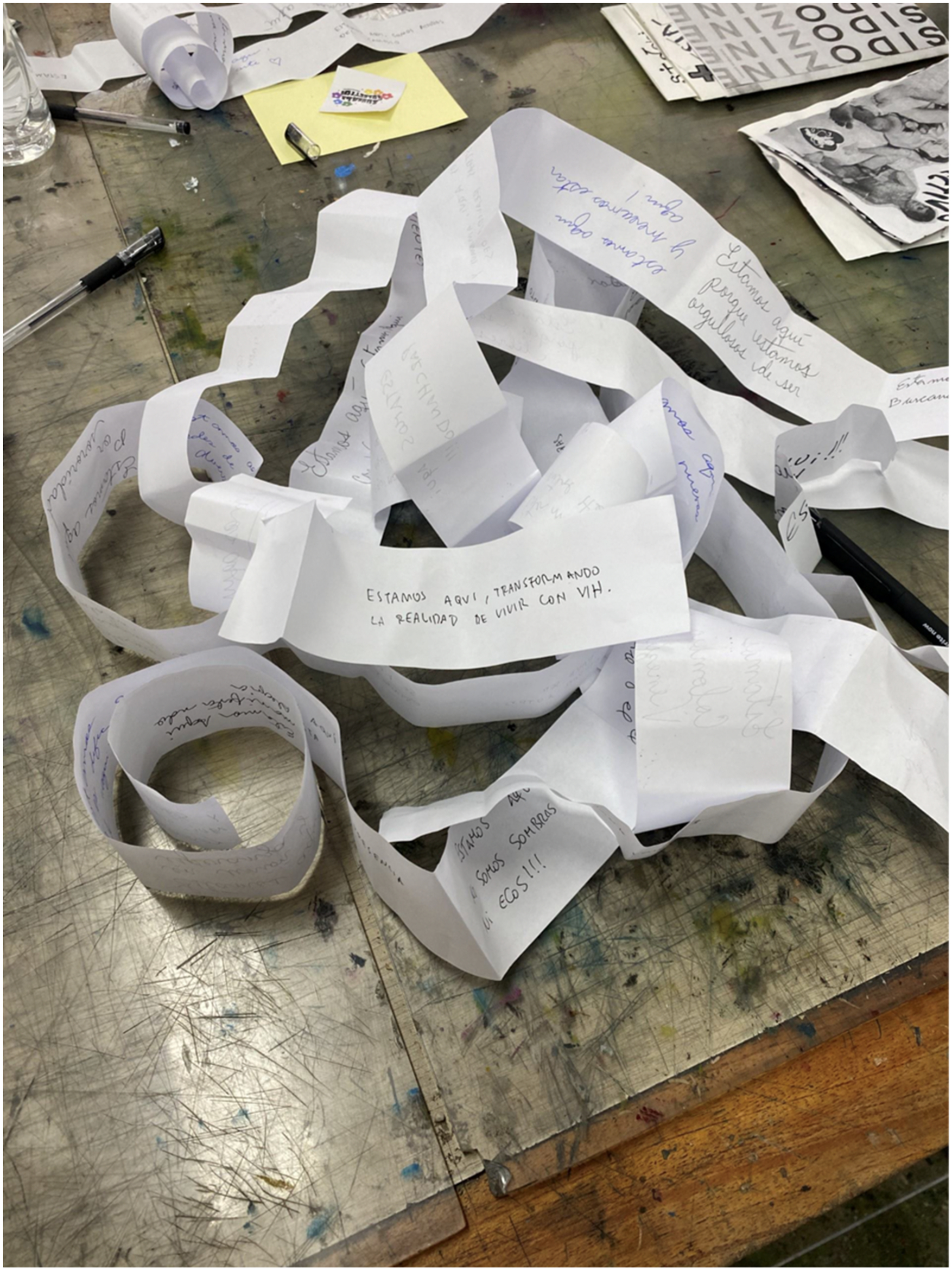
This opening exercise served also as a tool for collectively shaping the workshop’s ethical and relational commitments. The phrases generated centered on optimism, resistance, solidarity, and self-affirmation, which then laid the groundwork for a shared sense of purpose and mutual respect. For instance, phrases like “Estamos aquí manifestando alegría” (“We are here manifesting joy”), “Estamos aquí y somos importantes” (“We are here and we are important”), and “Estamos aquí y exigimos una vida digna” (“We are here and we demand a life with dignity”) reflect a collective assertion of agency and resilience. Additionally, the theme of sex work as a site of empowerment and self-affirmation was evident in statements like “Estamos aquí orgullosamente putas” (“We are here as prideful whores”). Another interconnected theme was reframing agency in having an HIV diagnosis, as expressed in phrases such as “Estamos aquí con VIH” (“We are here with HIV”), “Estamos aquí con terapia y sin muerte” (“We are here with therapy and without death”), and “Estamos aquí viviendo con VIH y somos felices” (“We are here living with HIV and we are happy”). In doing so, participants co-created workshop commitments that emphasized respect for lived experience, ownership over narrative, and the right to be seen and heard fully.
This moment also reflects Freire’s (1974) notion of conscientização – the development of critical awareness through reflection and action – as participants collectively named their realities, articulated shared struggles, and reimagined their presence in affirming and transformative ways. The presence of affirmative and empowering statements disrupts dominant narratives that frame migrant sex workers and people living with HIV through victimizing discourses. Expressions of optimism, solidarity, and collective strength highlight how CRI captures affective and embodied ways of knowing that extend beyond verbal articulation, structured data collection techniques or predetermined research outcomes.
Disrupting Notions of Linear Growth: Centering Iterative Co-Learning and Un-Learning
Across workshops, the goal was to explore how migrant sex workers enact agency and autonomy in their migration journeys while navigating intersecting stigmas. In doing so, the project aimed to co-design counter-narrative visual campaigns (e.g., photojournalism, graffiti, digital stories) that challenge discrimination and affirm migrant belonging in contexts of relocation. Recognizing that creative processes are inherently heterogeneous, the project embraced flexibility and openness as critical to ethical, participatory knowledge production. Each workshop included brainstorming and drafting activities facilitated by the artist. Using prompts such as “What were defining moments of your migration experience?” and “What does sex work represent for you?”, participants were encouraged to draw or write anything that came to mind, with the understanding that creative exploration would help refine their ideas over time. Sometimes, this process was individual, each person working on their own page, while other times it was collective, with participants gathered around a large sheet of paper. In both formats, open-ended group dialogue allowed conversations to flow organically, often sparking new insights later reflected in participants’ final pieces. This flexible, participant-led process supported diverse forms of expression and reflection, as ideas evolved through collective engagement and the researcher’s gentle prompts. This structure echoed Freire’s rejection of fixed developmental trajectories, offering space for participants to move back and forth between creation and reflection. When ready, participants had the opportunity to share their final pieces with the group – affirming each person’s contribution as part of a broader co-learning journey, following Santa Cruz’s (2023) idea of integrative knowledge as rhythm.
For example, Figure 2(A) shows a participant’s brainstorming draft and Figure 2(B) his final art piece: a painted and hand-stitched cloth bag responding to the workshop’s theme: migration. Comparing the content of the two photographs, it is evident that the brainstorming draft contained many details that were not fully reflected in the final product. Notably, the draft includes key words and phrases such as “resilience” and “pain → transformation,” along with a representative account of how receiving an HIV-positive diagnosis in Venezuela served as the primary motivation to migrate to Colombia in search of access to antiretroviral treatment. Additionally, while the final product features the representation of a butterfly, the brainstorming draft illustrates the complete life cycle of a butterfly, from caterpillar to chrysalis to fully developed butterfly. This visual progression, as described by the participant, more explicitly conveys his self-representation of a personal journey of change, resilience, and renewal. The life cycle metaphor reinforces the notion of migration as a transformative process - one shaped by hardship but also by the possibility of rebirth and new beginnings. The “simplification” evident in the final artwork reflects not only aesthetic decisions but also the condensation of complex emotions and narratives into symbolic form, demonstrating how the creative process can serve as a medium for self-reflection and meaning-making. (A) Individual nonlinear and reflective drafting toward final creation (workshop 2) and (B) Individual nonlinear and reflective drafting toward final creation (workshop 2)
Figure 3 shows a collective brainstorming activity, during which all participants gathered around a large sheet of white paper to draw and write elements that came to mind in relation to the workshop’s theme determined by the artist: experiences of living with HIV. The brainstorming draft reflects both individual expression and the relational dynamics of group discussion. Some were more visually expressive, occupying larger sections with drawings and sentences; others contributed more selectively, yet all actively participated in co-constructing themes. This brainstorming activity also serves as data, capturing key aspects of conversation and emergent reflections on HIV stigma. Reflexive prompts and open-ended exercises supported this recursive process, encouraging the layering of insights and the surfacing of new perspectives throughout the workshops. Example of collaborative dialogue (workshop 4)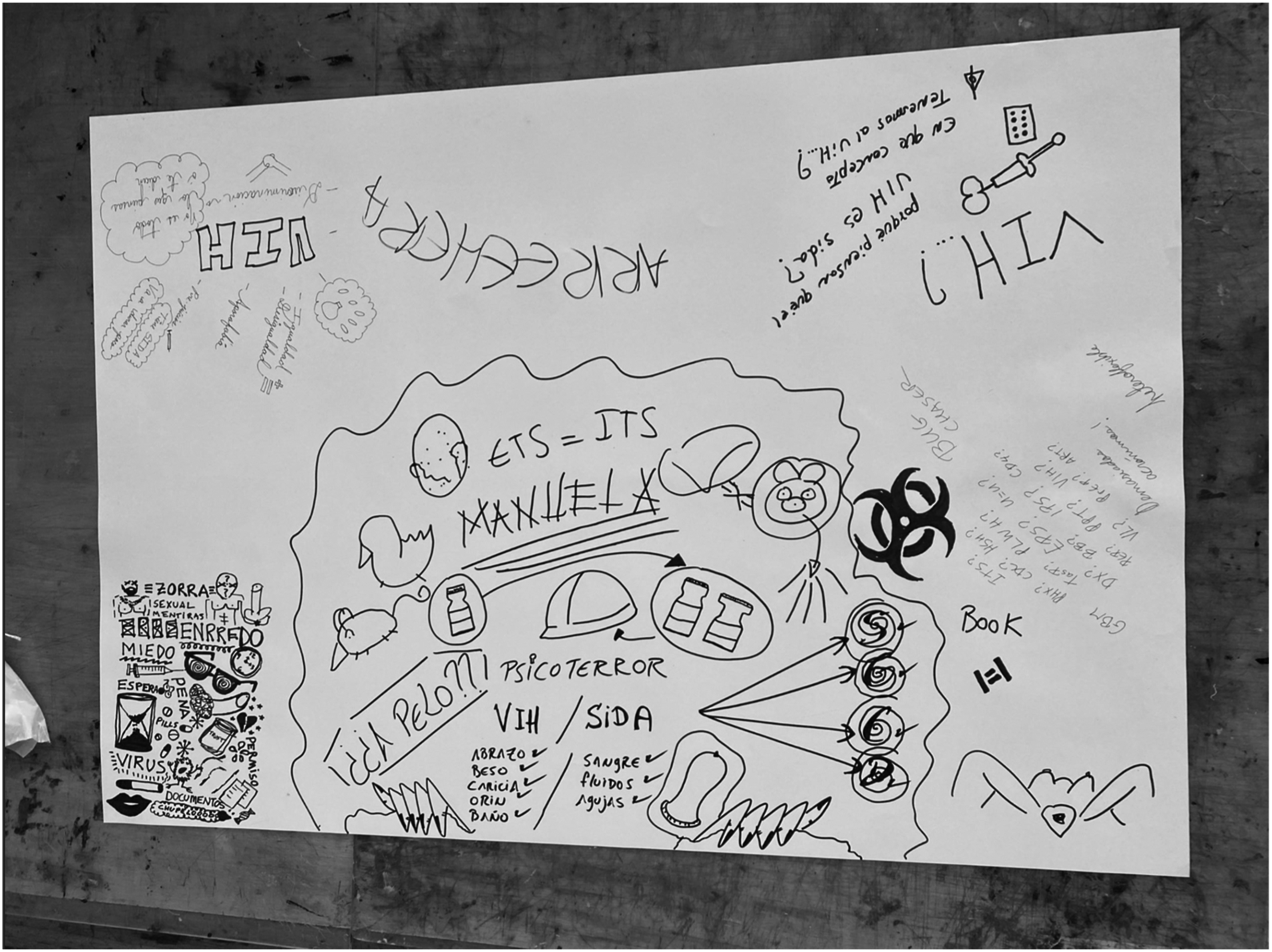
As seen in Figure 3, a key discussion centered on shared frustration with the conflation of HIV and AIDS, documented by one participant who wrote, “Why do they think that HIV is AIDS?”. Another major discussion focused on the combined stigma faced by sex workers living with HIV. Participants rejected stereotypes linking sex work with HIV acquisition, particularly the assumption that sex workers contract HIV due to sexual compulsivity, reflected in the words “zorra” and “arrechera”, which in their cultural context connote hypersexuality. These pejorative terms reinforce sex work stigma. Additionally, bisexuality emerged as a theme, with participants discussing harmful portrayals of bisexual men as responsible for “introducing” HIV to women.
The group brainstorming activity functioned as a relational space where lived experiences were articulated, negotiated, and contested in real-time. Moreover, it highlights the importance of co-construction, ensuring that knowledge does not remain confined to pre-existing frameworks but is shaped by participants’ discursive strategies and affective responses. For instance, the critique of the HIV and AIDS conflation and the rejection of hypersexuality stereotypes were not predefined research themes by the research team but emerged organically through collective dialogue, demonstrating how participants actively reframed dominant narratives about their identities. The fluidity of the process – shaped by laughter, frustration, storytelling, agreements and disagreements – demonstrates that meaning is not simply extracted from participants but emerges dynamically through relational engagement between participants. For example, moments of collective laughter or silence were noted in field observations and later discussed with community collaborators as a possible signal of shared understanding or discomfort, helping to identify how topics (e.g., stigma, belonging) resonated emotionally within the group.
Leveraging Creativity to Foster Mutual Presence
The research team member took detailed notes on participant interactions and group dynamics during the workshops when appropriate, to avoid disrupting the flow of engagement. For example, note-taking would typically occur while participants were working individually on their artistic pieces and after the workshops. However, note-taking was not always possible because the research team member was actively engaged in conversations with participants to maintain relational presence and avoid disrupting natural interaction or causing discomfort. Participant observation combined with notetaking proved to be invaluable in capturing elements of interaction that were not reflected in the final artistic outputs – particularly the development of friendships between participants, shared humor, and the informal camaraderie that emerged throughout the workshops.
For example, workshop 3, which focused on sublimation printing, required participants to print a short, impactful sentence onto synthetic fabric and display it in a public space. Given that the workshop’s principal theme was sex work, participants were tasked with selecting a phrase or question to anonymously provoke thought and challenge dominant perceptions of sex work. While the final messages carried strong activist undertones, observation notes reveal a stark contrast between the weight of these statements and the workshop’s atmosphere of humor, playfulness, and collective storytelling amongst participants. One moment stood out: a participant brought back a handstitched painted bag from a previous workshop. Another participant humorously commented on the peach design, noting it looked like a posterior, prompting laughter when the first participant replied that he “found a lot of asses on his migration journey to Colombia.” This remark sent the group into collective laughter, setting the tone for the workshop. The playful tone continued into the brainstorming phase. As participants struggled to craft short, powerful messages, one participant jokingly suggested writing “solo en efectivo” (“cash only”), which once again sparked laughter across the room. This moment of levity then transitioned into a spontaneous, 45-min group discussion in which participants shared humorous anecdotes about diverse experiences with clients. Some recounted encounters with clients whose requests were unexpectedly simple, prompting jokes about how certain clients made their job “too easy.” Others playfully teased each other about strategies for maintaining erections with clients, sharing advice and experiences in lighthearted exchanges.
These conversations, while filled with humor, also served a deeper function within CRI. They allowed participants to collectively articulate their identities as sex workers outside of victimizing or pathologizing narratives. Humor became a strategy of resilience, a way to reclaim agency over their experiences, and a means of fostering solidarity within the group. These relational interactions were not just moments of amusement; they were critical sites of meaning-making, revealing how participants used humor to reframe stigma, challenge stereotypes, and cultivate a sense of belonging. From a CRI perspective, these spontaneous, unscripted exchanges enrich the research process. The documentation of humor, playfulness, and camaraderie adds layers of insight that would otherwise be absent from a strict analysis of the final art products. While the sublimation printing activity produced activist-oriented messages around sex work such as: “¿Qué pasó con la puta desaparecida?” (“What happened to the disappeared whore?”), “El puteo no es un fin, es un medio” (“Whoring is not an end, it is a means”), “¿Por qué no es normal ser puta?” (“Why is it not normal to be a whore?”) – these statements alone do not capture the full breadth of participants’ experiences. The juxtaposition between the serious and provocative messages and the workshop’s playful atmosphere underscores the complexity of identity negotiation among sex workers.
The workshops functioned not only as spaces for artistic expression but as environments for community formation, mutual care, and personal validation. Explicit acknowledgement of this methodological strategy is particularly significant given that migrant sex workers often experience social exclusion (Goldenberg et al., 2016). Conversations during the workshop around how participants wanted to be represented in public-facing artworks also created space to reflect on power within the research: who these messages were for, and how narratives about sex work, migration, and HIV might circulate. Through these reflective moments, power was made discussable – not abstractly, but in terms of lived experience and collective authorship.
The researcher’s presence in all workshops also functioned as a data-generating instrument, shaping knowledge through engagement (Finlay, 2002; Pezalla et al., 2012). During a workshop on migration, participants invited him to join the activity, arguing that he too was a migrant. This invitation initially served as an inclusive gesture, recognizing shared experiences of movement. However, as the dialogue unfolded, participants critically redefined this inclusion by contrasting his voluntary mobility as a Canadian with their own forced displacement. Unlike the participants – who migrated under precarious conditions – the researcher retained the privilege to return home. Through this exchange, participants invited a reflexive discussion on privilege and mobility, ultimately proposing that he instead identify as a nomad (i.e., someone whose mobility is enabled by privilege rather than forced by circumstance), a term he later integrated into his artwork (see Figure 4). (Workshop 2)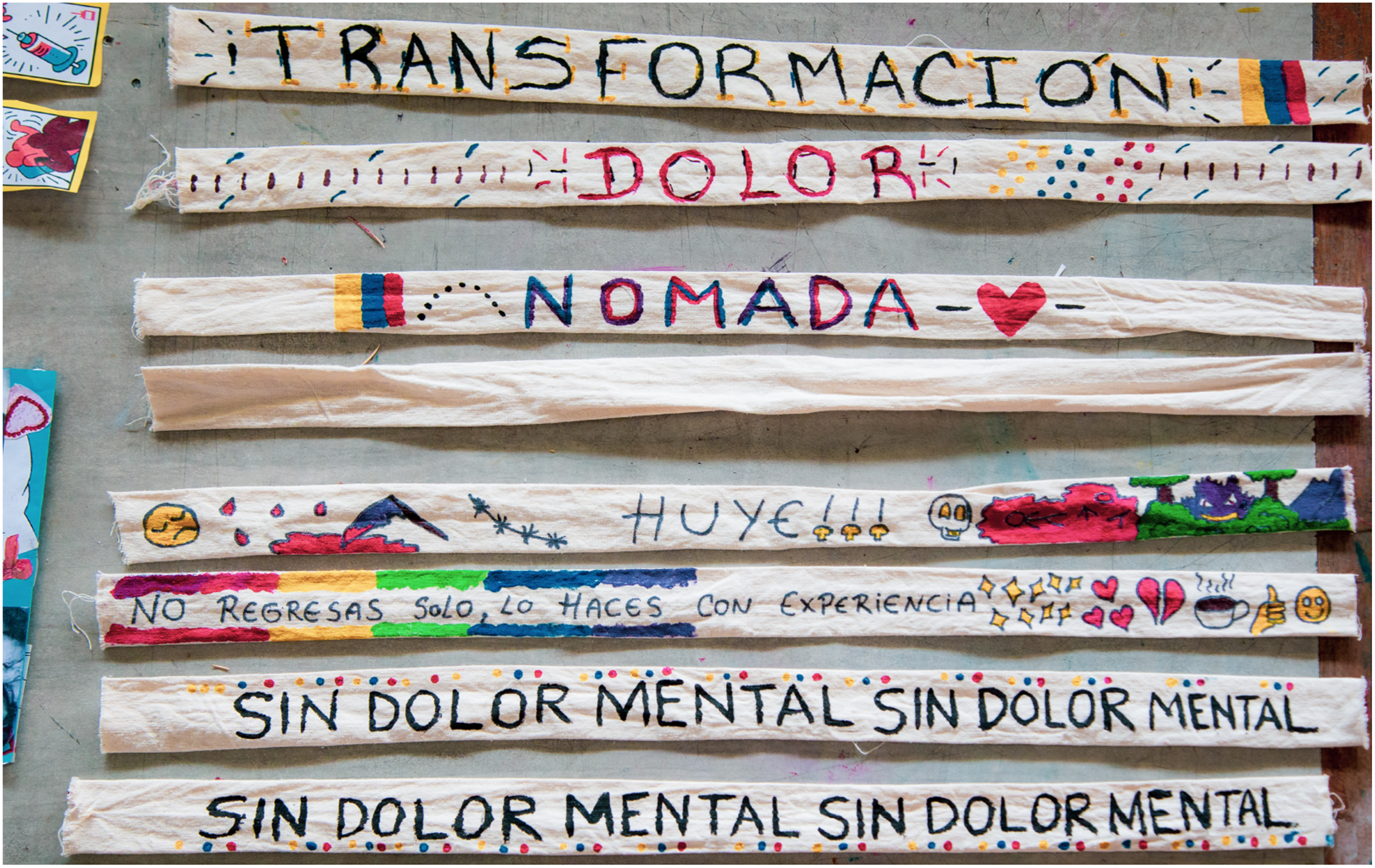
This moment exemplifies how CRI foregrounds relational co-construction of meaning. Positionality is not static; it is relational, continuously renegotiated through the research process (Rose, 1997). The participants’ engagement in defining the researcher’s identity highlights their agency in shaping the encounters during the research project, demonstrating that participatory methodologies extend beyond data collection to actively co-construct meaning. This point aligns with broader discussions in qualitative research about the ethical and epistemological implications of researcher positionality and the need for reflexivity in participatory projects (Bourke, 2014; Pillow, 2003). In this study, the researcher’s social location directly shaped participant dynamics. Rather than accepting his identity at face value, participants challenged and redefined it, generating new meaning and insight in the process. This interaction illustrates how researcher positionality does not simply influence interpretation after the fact; it is a live, negotiated element of the participatory encounter itself, shaping the knowledge that emerges.
By foregrounding such exchanges, this project reinforces the value of embracing emergent and processual data in qualitative research, particularly within arts-based participatory frameworks. The dialogue around the label migrant versus nomad was a significant moment of meaning-making, revealing the socio-political dimensions of migration, privilege, and forced displacement. It shows how qualitative research benefits not only to planned data collection but also to spontaneous interactions in the creative-relational process that provide deeper, often unexpected, layers of analysis when doing arts-based research with communities in vulnerable contexts. Foregrounding these researcher–participant interactions reveals how creativity became a conduit for building trust, co-producing meaning, and sustaining presence across power differentials. In CRI, mutual presence is not a precondition but a dynamic outcome of relational engagement – one that unfolds through spontaneous, situated encounters like those described above.
Opportunities to Support Solidarity Within and Beyond the Research
As part of Phases 1 and 2 of the Estamos Aquí project – which is being implemented across two sites: Medellín, Colombia, and Lima, Peru – participants take part in arts-based workshops that not only generate visual counter-narratives but also foster transnational forms of connection. While the project is ongoing and has thus far only been implemented in Colombia, plans are underway to carry out the second component in Peru, engaging Venezuelan cisgender women sex workers, as the partner community organization in Peru works with women engaged in sex work. To foster transnational solidarity between participants in both countries, the artist facilitated an activity in which participants in Colombia wrote handwritten letters to the participants in Peru, with the hope that those in Peru would later write back. While some participants found this activity intuitive and engaged readily, others expressed difficulty finding the “right” words, reflecting on what felt meaningful, supportive, or appropriate to share. Ultimately, all participants completed their letters – some offering brief but heartfelt notes, while others composed longer, reflective messages. Although initially conceived as an informal engagement exercise rather than a core data collection component, it aligned with the project’s strength-based approach and was also shaped by our partner organizations in Colombia and Peru, which are the two largest receiving countries for Venezuelan migrants. Further, given the pervasive xenophobic discourses migrants face, the activity sought to leverage shared experiences as a foundation for regional solidarity and collective belonging.
This activity also exemplified anti-oppressive research methods by offering participants a creative and relational space to define their modes of expression. The handwritten letters surfaced critical insights into participants’ self-representation, affective solidarities, and how they imagined connection and kinship with unknown community members across borders. One notable moment emerged when a participant explicitly requested that their letter not be read by the research team. While traditional research projects often view missing data as a limitation, in this CRI project, the participant’s decision to withhold their letter was not considered a loss but a meaningful assertion of agency within a non-extractive, relational approach to knowledge production.
As part of the participatory, arts-based data collection process, the letter-writing activity offered a generative site for reflection, creativity, and shared meaning-making. The iterative nature of CRI, which is structured around a dialogic process, where insights and new meanings emerge through ongoing interaction, allowed this exercise to evolve into a rich source of insight. While participants initially wrote their letters individually, the artist organically invited them to read and discuss their messages as a group. This spontaneous shift was intended to support community-building and deepen relational engagement at the start of the workshop. Through these discussions, two key thematic patterns emerged. First, nearly all participants positioning their letters as messages of encouragement and solidarity, despite not knowing who the recipients in Peru would be. Many offered words of support and reassurance. As one participant wrote in the closing lines of his letter (see Figure 5), “I don’t know if someone already told you today, but you are the best person that exists – although I think you already knew that,” accompanied by a winking smile. These letters became more than symbolic gestures; they reflect a conscious effort to foster relational empowerment, affirm shared experiences, and build cross-border solidarity. Part of letter written by participant (workshop 5)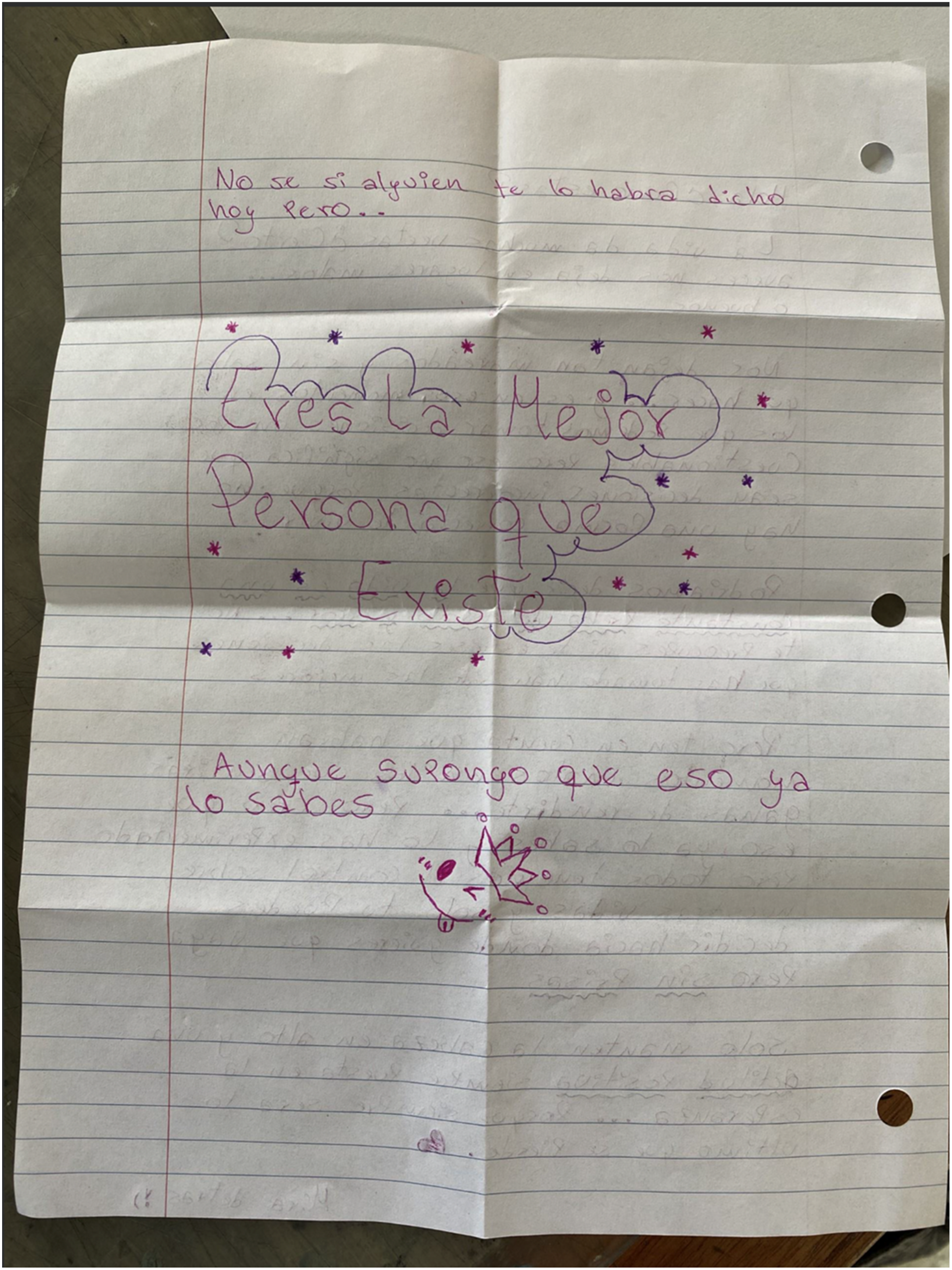
Another key dimension of relationality was using Venezuelan identity as a shared foundation for connection and solidarity. Many participants incorporated elements of Venezuelan vernacular into their letters, such as addressing their peers as “chama,” a distinctly Venezuelan colloquialism for a woman friend. Others referenced their hometowns, establishing a point of relationality by emphasizing where they came from in Venezuela. In several cases, participants added their social media handles, inviting their peers in Peru to follow them – an act that transforms this research-based activity into a real-world relational network of mutual support beyond the confines of the workshops.
The letters offer a counterpoint to the dominant narratives of precarity and exclusion that often frame discussions of Venezuelan migration and sex work. While these themes are undoubtedly part of participants’ lived realities, the affective, relational content of the letters underscores an alternative discourse centred on care, mutual recognition, and resilience. Through this activity, participants positioned themselves as active relational agents of support, solidarity, and cultural continuity. Their decision to integrate Venezuelan expressions and references into the letters demonstrates the enduring significance of national identity, even in displacement, and suggests that these transnational exchanges serve as an affirmation of belonging.
The range of responses to the letter-writing activity – from hesitation to enthusiasm – revealed the varying degrees of emotional labor involved in storytelling and self-representation within participatory research. Some participants expressed difficulty in finding the “right” words, underscoring the weight of responsibility they felt in crafting a message that would resonate with someone in a similar situation. This deliberation reflects a critical awareness of the ethics of representation and the impact of language. Rather than simply generating data, the activity highlighted how power dynamics were reimagined by creating a space for aligned personal and collective purpose. Here, participants actively negotiated their engagement in decision-making– through selective disclosure, linguistic choices, or the inclusion of social media handles – to construct relationships, co-produce meaning, and navigate affective connections to help sustain impact across borders. As such, this solidarity-building exercise exemplifies how participatory arts-based research functions not only as a means of expression but also as a mechanism for cultivating social connection, mutual recognition, and transnational kinship among communities made vulnerable by displacement, stigma, and exclusion.
Discussion
This manuscript elaborates the methodological and onto-epistemological approach guiding Estamos Aquí, a two-year, multi-sited research initiative with Venezuelan migrant sex workers in Medellín, Colombia, and Lima, Peru. Focusing on Phases 1 and 2 of the project in Medellín, the paper details how CRI methodology – grounded in LASM-CH theoretical movement, Freirean pedagogy of conscientization, and Santa Cruz’s concept of rhythm – informed the co-design and facilitation of arts-based workshops and public counter-narrative campaigns. Our manuscript advances the understanding of CRI as a set of methods, but also as a relational and affective way of knowing that centers on embodiment, co-production, and situated experience. Rather than treating creative expression to gather data, the study foregrounds the workshop process as a generative site of knowledge-making, where participants reimagined identity, negotiated stigma, and built transnational solidarities through storytelling, play, and collective creation.
The results, presented thematically to reflect the non-linear, emergent nature of the workshops, align with the project’s broader commitment to horizontal learning and iterative reflection. Methodologically, the workshops centered on recursive reframing processes – moving from facilitator-led prompts to individual reflection, group dialogue, and collective elaboration, often cycling back through these stages. While initial activities were supported by the artist facilitator, participants actively shaped the process by requesting additional art materials, extending work at home (e.g., painting and hand-stitching cloth bag), and providing feedback for activities for future workshops. This iterative structure created space for participants to revisit and subvert workshop themes on their own terms. Power was not treated as a theoretical abstraction but was actively negotiated in practice – for instance, through moments when participants reframed the researcher’s positionality, challenged deficit-based narratives, or engaged in acts of transnational solidarity.
These dynamics underscore the importance of recognizing participants not as passive informants but as epistemic agents, shaping the research through affective, creative, and relational forms of engagement. For vulnerable participants navigating intersecting forms of displacement, stigma, and marginalization, these methodological strategies can foster ethical, justice-informed research practices that center dignity, agency, and co-authorship in knowledge production. While all participants identified as gay or bisexual men, themes explicitly related to sexual orientation did not emerge as independent topics but were instead interwoven with other central themes of the workshops, such as migration, stigma, sex work, and living with HIV. Sexual orientation was subtly embedded in the creative expressions, shared humor, and relational interactions among participants (including the artist and research team member), even if it was not directly thematized. For instance, participants frequently used the term marica – a word often employed in Colombia and Venezuela derogatorily to refer to homosexuals – as a form of linguistic reappropriation and affirmation. We interpret the absence of explicitly articulated themes related to sexual orientation not as a limitation, but as a reflection of how participants chose to foreground the intersecting structural conditions shaping their lives over individualized identity categories.
As discussed earlier, participants’ lives are shaped by a legal and political climate marked by structural ambivalence – where sex work is not criminalized yet stigmatized, and protections based on sexual orientation or HIV status remain unevenly enforced. Pervasive xenophobic discourse in Colombia amplifies these forms of precarity, positioning Venezuelan migrants as outsiders. This hostile climate likely explains why participants placed greater emphasis on experiences of migration and belonging, framing these as central to their everyday struggles for recognition and safety. These conditions underscore the ethical and political pertinence of methodologies like CRI, which create space for participants to negotiate identity, challenge structural violence, and articulate alternative narratives on their own terms.
A key strength of CRI is its flexibility, which enabled the emergence of participant-driven activities like letter-writing to become rich sites of solidarity and methodological insight. These arts-based participatory methods cultivate community, political kinship, and agency, thus challenging an extractive epistemic logic that reinforce marginalization. Yet it is important to acknowledge that many of the methodological strategies enacted in this project were not new. Rather, they draw from practices long used, adapted, and refined by artist-based educators and community organizers. Partnering with MQ3L and a peer-artist who facilitated the workshops created opportunities for the research team to learn from these existing strategies – rooted in lived experience and community care – and to co-adapt them in response to the specific needs of self-identified gay and bisexual Venezuelan migrant men engaged in sex work. This collaborative approach facilitated the project’s commitment to horizontal learning, allowing for a methodology shaped not solely by academic frameworks but by the embodied expertise of those most directly impacted.
This study contributes to the methodological conversation on participatory and arts-based research by elaborating on how CRI can expand qualitative approaches with vulnerable populations (Cornish et al., 2023). Traditional methods, such as those relying on structured interviews or pre-determined research instruments, often risk flattening or oversimplifying lived experiences. In contrast, CRI foregrounds fluidity, emergent knowledge, and the ethical co-construction of meaning, offering a more responsive and respectful framework for engaging with communities navigating intersecting forms of exclusion – such as gay and bisexual migrant sex workers. However, it is important to emphasize that the methodological strategies described here are temporally and contextually bound. They emerged through specific relationships, community histories, and conditions in Medellín, and were shaped through collaboration with MQ3L and a peer-artist facilitator. Readers are cautioned against interpreting these strategies as prescriptive or universally applicable. Instead, they should be understood as methodological provocations – inviting creativity, dialogue, and adaptation in conversation with communities. CRI, as practiced in this context, offers one possible approach to querying and learning from vulnerable communities in ways that actively resist the extractive imperative in research and instead prioritize reciprocity, relational ethics, and co-authorship.
Rather than offering a fixed methodology, CRI should be understood as a set of generative tensions and commitments. This approach invites researchers to remain attuned to the cultural, temporal, and spatial specificities of the communities they engage with. Crucially, this action also demands that researchers resist the urge to co-opt activist strategies or claim innovation where community knowledge has long existed. Instead, researchers must listen, remain accountable, and learn from existing activist practices to support ongoing efforts through approaches grounded in care, reciprocity, and relational ethics. Future work might explore how CRI can be shaped by, and accountable to, decolonial, feminist, disability justice, and other culturally relevant frameworks that emerge from within communities themselves. As qualitative researchers continue to confront extractive paradigms, the invitation is not only to adopt more ethical practices but to ask: What forms of knowledge, care, and co-resistance become possible when research is reimagined as a collective, relational, and politically situated act? How can CRI be integrated into academic training, especially among those seeking social justice?
Footnotes
Acknowledgements
The authors gratefully acknowledge all the participants who generously contributed their time and insights to this research.

Ethical Considerations
The University of Toronto’s Research Ethics Board (#46624) and Profamilia’s Research Ethics Committee (CEIP-24-2024) in Colombia evaluated and approved the research project.
Funding
The authors disclosed receipt of the following financial support for the research, authorship, and/or publication of this article: This project was funded by the Canadian Social Sciences and Humanities Research Council (SSHRC) New Frontiers in Research Fund – Exploration grant (application number: NFRFE-2023-00882).
Declaration of Conflicting Interests
The authors declared no potential conflicts of interest with respect to the research, authorship, and/or publication of this article.
Data Availability Statement
The data that support the findings of this study are available from the corresponding author upon reasonable request.