




Abstract
A longstanding body of literature traces the experiences of Black faculty in Canadian universities. In Canada, Black professors face anti-Black racism, suspicion, and utter disregard. It is under such conditions that Black professors undertake review, tenure, and promotion processes. Although a dedicated body of Canadian literature examines Black faculty’s experiences with tenure and promotion, limited research centres the narratives of pre-tenured Black faculty engaged in institutional review processes. Particularly glaring is the paucity of literature exploring the realities of pre-tenured Black motherscholars navigating the third-year review. Structured as an open letter, this arts-informed autoethnography explores how pre-tenured Black motherscholars sustain their artistic approaches to qualitative inquiry while navigating the third-year review process. In the study, the author centres her own experiences as a Black mother and arts-based researcher at a Canadian university. The study draws on Endarkened Feminist Epistemologies, historical notions of hush harbours, and Endarkened storywork to further understand the distinct realities of Black motherscholars in higher education. The study highlights how pre-tenured Black motherscholars establish liberatory spaces within and beyond the academy. In these spaces, Black motherscholars commune, dream, and organize, all while undergoing institutional reviews and assessments. The methodological contribution of this paper is multifold. In this piece, readers witness: (1) hush harbours as methodological spaces; (2) the ethical use of redaction in qualitative inquiry; and (3) Endarkened storywork for data analysis.
Dear Readers:
I write to you from my kitchen table in Canada. Neighbourhood chatter and children’s laughter seep through the closed window and spill into the kitchen. Outside, my young children, ages four and seven, squeal as they race their father down winding streets towards Lake Ontario’s shorelines. I write to you as a Black motherscholar and arts-based researcher. I am a tenure-track professor in the faculty of education at a large Canadian university. In a society that has long sought to exclude and surveil Black Canadian thinkers, we, Black motherscholars, leverage the arts to engage in “more culturally indigenous ways of knowing research and enacting leadership in the academy” (Dillard, 2000, p. 661). Indeed, the arts allow us to ground our methodological practices in our personal, cultural, and social contexts (Dillard, 2000, 2018).
I write this letter to elucidate how Black motherscholars establish hush harbours to sustain our arts practice within and beyond academia. Historically, hush harbours were clandestine spaces where enslaved Black people gathered to pray, rejoice, rest, and heal, all while rejecting the authority of the white gaze (Dillard, 2022; Love, 2023; Neale-Stanley, 2023). In these fugitive spaces, Black people used the arts to interrogate their realities and imagine a world beyond the immediate. Our music, dances, poetry, and other artistic expressions continue to offer us opportunities to reaffirm Black maternal life in Canada (Fearon, 2023; 2024a). In educational research, the arts afford us methodological opportunities to define Black realities and futures beyond racist logics and processes of disavowal (Fearon, 2024b; McKittrick, 2023). Ultimately, we Black motherscholars leverage “the arts to help sustain who we are, as we recall and (re)member in the midst of chaos what it means to thrive” in the academy (Love, 2019, p. 111).
1. My Wondering
Last month, from the very kitchen table where I now pen this letter, I submitted my third-year review file. I spent the summer months curating my dossier, ensuring that it captured my viability as a candidate for tenure at the university. In addition to student course evaluations, copies of my published work and my updated curriculum vitae, my dossier included a personal statement detailing how my work upheld the university’s standards in research, teaching, and service. As I wrote and re-wrote the personal statement for my third-year review, I wondered: How do we, Black motherscholars, sustain our artistic approaches to qualitative inquiry amid the university’s established standards for tenure? Specifically, how do we leverage our arts practice to enact resistance during the third-year review process?
2. Mapping the Letter
Readers, join me as I explore how pre-tenured Black motherscholars, committed to artistic modes of inquiry, engage with institutional review processes. The study, an arts-informed autoethnography, explores how I cultivated my artistic research practice while undergoing the third-year review. I begin this piece with an overview of the complex realities confronting Black professors in Canadian universities. I intentionally highlight the narratives of Black motherscholars navigating review, tenure, and promotion processes. Afterwards, I present the questions, frameworks, and methods that guided the study. Then, I share study findings as the creative nonfiction story Hush, We’re Here. This data-driven story is a reimagined personal statement for a third-year review file. The methodological contribution of this paper is multifold. In this piece, readers witness: (1) hush harbours as methodological spaces; (2) the ethical use of redaction in qualitative inquiry; and (3) Endarkened storywork for data analysis.
Context: Black Motherscholars and Third-Year Review Processes
Canada’s relationship with Black communities is marred by practices of slavery, segregation, and ongoing state surveillance and policing (Bernhardt, 2024; Maynard, 2019; Walcott & Abdillahi, 2019). Black people constitute four per cent of Canada’s population, yet Black scholars make up less than two per cent of full-time professors nationwide (Universities Canada, 2019). In Canada, dedicated literature investigates Black faculty’s experiences with tenure and promotion processes (Henry et al., 2017; Ibrahim et al., 2021). Such scholarship maintains that Black faculty grapple with intense anxiety in relation to tenure and promotion despite Canadian universities’ public declarations of commitments to equity, diversity, and inclusion (Henry et al., 2017; Ibrahim et al., 2021). The uncertainty, stress, and anxiety faced by Black professors is not without warrant. It is well-documented that Black faculty in Canada do not receive tenure as often as other racialized and white colleagues, and it takes Black professors longer to achieve both tenure and promotion to full professor (Dieynaba Ndiaye, 2025; Longfield, 2024). Rarely explored in the literature, however, are Black motherscholars’ experiences with third-year review processes – an intermediate review conducted during a pre-tenured faculty member’s probationary year.
In Canada, the third-year review is often positioned as a checkpoint for tenure-track faculty. The substantive review provides pre-tenured faculty with constructive feedback on their progress towards satisfying the criteria for tenure in research, teaching, and service (Ontario Tech University, 2019; Toronto Metropolitan University, 2019; University of Toronto, 2025). The third-year review is led by an adjudicating committee of tenured faculty, who are typically appointed by the Dean (Toronto Metropolitan University, 2019). For the third-year review, pre-tenured faculty submit a dossier comprising their current curriculum vitae, personal statement, student course feedback surveys, and record of publications (Ontario Tech University, 2019; Toronto Metropolitan University, 2019; University of Toronto, 2025). At some Canadian universities, internal referees – who are independent from the adjudicating committee – are solicited to comment on the faculty member’s advancement towards tenure (Ontario Tech University, 2019). The review process concludes with the adjudicating committee providing pre-tenured faculty with a timely written assessment on their progress. The assessment also notes the faculty member’s shortcomings, offering them opportunities to adjust their performance before tenure (Toronto Metropolitan University, 2019).
This arts-informed autoethnography addresses the dearth of literature exploring Black motherscholars’ experiences with tenure and promotion processes. The study centres my journey as a Black motherscholar and arts-based researcher navigating the third-year review process at a Canadian university. In the study, I focused on how I cultivated my arts-based research practice amid “the often brutal realities of the [university]” (Dillard, 2022, p. 114). Truly, I conducted this arts-informed autoethnography to make further visible the often-submerged stories of pre-tenured Black motherscholars who are arts-based researchers. This autoethnographic study was guided by the following questions: How do we, Black motherscholars, sustain our artistic approaches to qualitative inquiry, amid the university’s established standards for tenure? How do we leverage our arts practice to enact resistance during the third-year review process?
3. Underpinning Frameworks
3.1. Endarkened Feminist Epistemology (EFE)
This arts-informed autoethnography is grounded in Endarkened Feminist Epistemology (EFE). In her seminal piece The Substance of Things Hoped for, the Evidence of Things Not Seen, Dillard (2000) challenges us, Black motherscholars, to resituate our research endeavours within our personal, cultural, and social roots. Dillard (2000) decries the ways educational literature and academic institutions discard Black mothers’ lived realities and cultural knowledge. Our artistic engagement with research is devalued within the university’s academic standards (Henry et al., 2017). Our spiritual groundings elicit queries from colleagues and students alike around the credibility of our research practices (Ibrahim et al., 2021).
EFE is an extension of Black maternal knowledge production and is unapologetically rooted in our cultural, artistic, and historical origins. In fact, Dillard (2000) calls for “...the expression, self-definition, and validation of Black female understandings and knowledge production in alternative sites, that is, in music (such as in the African American blues traditions), poetry, literature, and daily conversations, to name just a few” (p. 664, 2000). EFE provides me with theoretical support to ground my research practice in Black literary and visual arts. EFE invites me to reimagine the inquiry process as healing and cultural labour (Dillard, 2000). EFE holds several assumptions that inform how, I, a Black motherscholar in Canada, engage in research as an artistic endeavour (Dillard, 2018): 1. Self-definition forms one’s participation and responsibility to one’s community; 2. Research is both an intellectual and spiritual pursuit – a pursuit of purpose; 3. Only within the context of community does the individual appear and, through dialogue, continue to become; 4. Concrete experiences within everyday life form the criterion of meaning, the “matrix of meaning-making”; 5. Knowing and research are both historical (extending backwards in time) and onward into the world; and 6. Power relations, manifested as racism, sexism, homophobia, etc. structure gender, race and other identity relations within research (p. 619).
Endarkened Feminist Epistemology Across the Inquiry Process

3.2. Hush Harbours
In Canada, dominant systems continue to position Black mothers at the margins of society. We, Black mothers, have long developed and enacted tools of resistance to sustain our spirits, even amid the reign of staunch anti-Blackness (Aladejebi, 2021). A hush harbour is an example of a site where Black mothers are afforded psychological and emotional protection, and experience radical freedom (Neale-Stanley, 2023). Historically, hush harbours were clandestine worship grounds where enslaved Black people gathered to pray, rejoice, rest and heal, outside of the white gaze (Dillard, 2022; Neale-Stanley, 2023). In the hush harbour, Black mothers were shielded from a society that “attempts to dehumanize, oppress, suppress, and annihilate Black [lives]” (Evans-Winters, 2019, p. 23). In these etched out spaces of freedom, Black mothers gathered and imagined new realities for themselves and their children that differ greatly from the current harmful one (Dumas & ross, 2016; Watson & Baxley, 2021). Hush harbours were not simply a location, destination or visitation. Rather, hush harbours functioned as habitations where Black people revelled in their livingness and cultivated their imagination. Hush harbours, Neale-Stanley (2023) reminds us, were sacred sites where we communed with God, our ancestors, and each other.
Hush Harbours Across the Inquiry Process
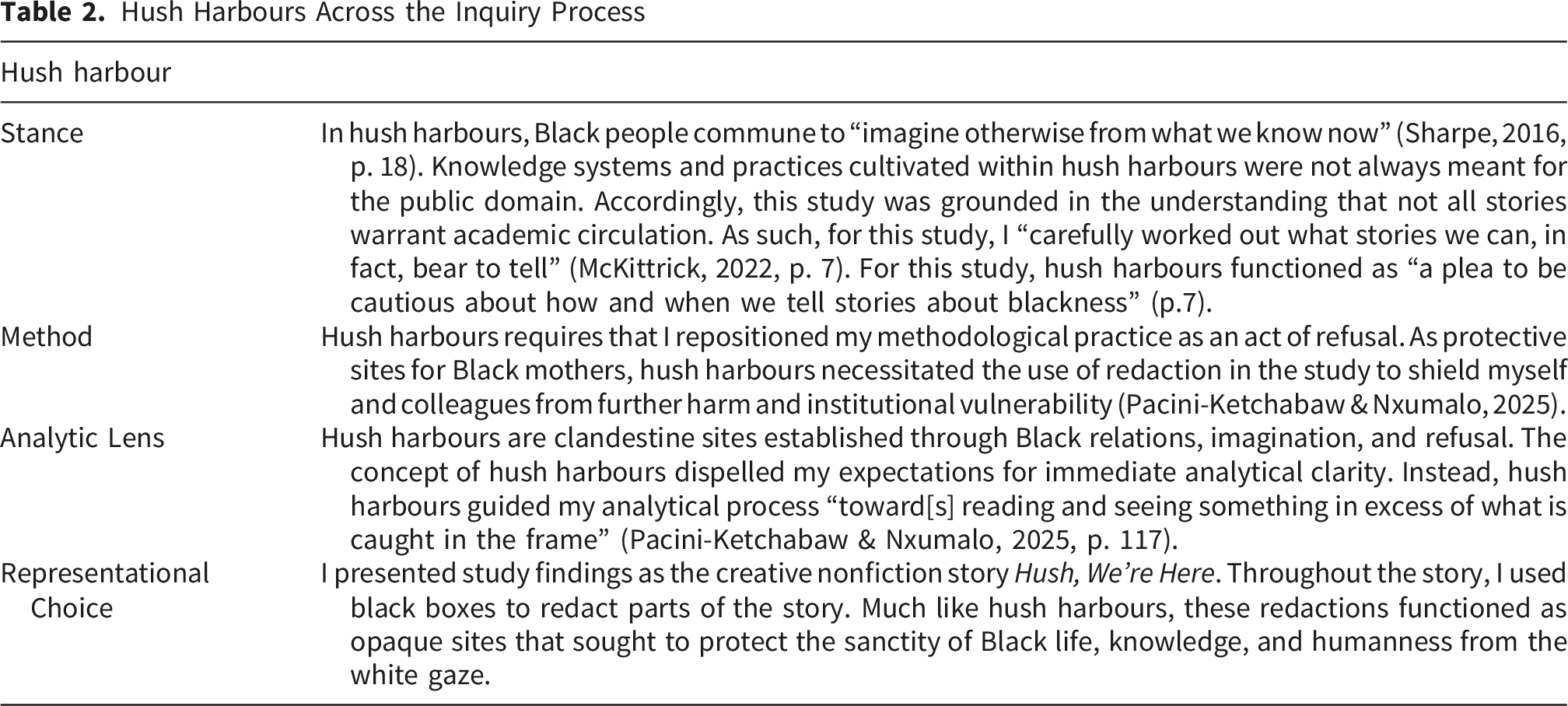
4. Methodology
4.1. Arts-Informed Research
I echo other Black motherscholars and Endarkened Feminist thinkers: artistic approaches to inquiry are inextricably connected to and an extension of researchers’ lives (Dillard, 2000, 2018; Toliver, 2021). As such, this qualitative study intertwined “the systematic and rigorous qualities of conventional qualitative methodologies with the artistic, disciplined, and imaginative qualities of the arts” (Cole & Knowles, 2008, p. 59). Guided by an arts-informed narrative methodology, this study investigated how Black motherscholars nurture our artistic research practice, amid entrenched anti-Blackness in the Canadian academy. Arts-informed narrative research relies on empirical data informed by the literary genre and comprises personal narration and cultural stories (Onuora, 2012, 2015). I continue to be inspired by researchers-turned-creative writers, like (Onuora, 2012, 2015), Dillard (2018), and Hall (2021), who participate in meaning-making by storying their own memories, life notes, and reflections.
5. Method
5.1. Authoethnography
For this study, I used autoethnography as a research method to interrogate my own journey as a Black motherscholar and arts-based researcher navigating the Canadian academy. Autoethnography is a qualitative research method that prioritizes the use of data about self to gain a deeper understanding of the connectivity between self and others within the same context (Chang, 2007; Denzin, 2006; Wambura Ngunjiri et al., 2010). Autoethnography helped me identify and then grapple with strategies I used to establish freeing and creative spaces within and beyond the university, especially during the third-year review process. This self-exploration required me to examine my relationships with other Black motherscholars and our shared realities.
In her article, For Loretta: A Black Woman Literacy Scholar’s Journey to Prioritizing Self-Preservation and Black Feminist-Womanist Storytelling, Baker-Bell (2017) calls on Black motherscholars’ to use autoethnography as a way to tell and listen to our own stories. By way of Adams, Holman Jones, and Ellis (2014), Baker-Bell (2017, p. 531) contends that autoethnography: - uses the researcher’s personal experience to detail and critique beliefs, practices, and experiences; - acknowledges and esteems the researcher’s relationships with others; - uses deep and careful self-reflection/reflexivity to identify and interrogate intersections between self and society, the particular, the general, the personal, and the political; - shows “people in the process of figuring out what to do, how to live, and the meaning of their struggles”; - balances intellectual and methodological rigor, emotion, and creativity; and - strives for social justice and making life better.
Autoethnography provided me with opportunities to assume multiple positions simultaneously within the research process: storyteller, story listener, and story keeper. This blurred distinction allowed me to scrutinize my innermost thoughts about Black motherscholars’ artistic approaches to research and journeys towards tenure. Ultimately, autoethnography helped me create a site where I was able to deeply reflect on – from varying perspectives – my own experiences with the third-year review process.
6. Data Source
Black motherscholars have long participated in meaning-making by storying their own memories and reflections. For this study, I, much like Onuora (2012 & 2015), engaged in what Toni Morrison calls “literary archaeology” (Morrison, 1987, p. 112). I used information, descriptions, and direct quotations garnered from my journal writings. My journal contained intimate accounts tracing my quotidian life, memories, insights on current scholarship, and reflections on my conversations with my family. My journal furnished pertinent information necessary to recount my journey as a pre-tenured Black motherscholar.
7. Analytical Process
Study findings are reimagined as the creative nonfiction short story Hush, We’re Here. This data-driven short story is expressed as a letter written by Dr. Stacey-Ann Truell, a Black mother and tenure-track professor. Stacey-Ann writes the letter to the members of her university’s adjudicating committee for the third-year review. I am represented in the story by way of the imagined character, Stacey-Ann. I relied on my journal writings, comprising my memories, reflections, and intimate accounts of my quotidian life as a Black motherscholar. For the study, I used a comprehensive analytic process rooted in Endarkened storywork (Banks-Wallace, 2002; Banks-Wallace & Parks, 2001). Endarkened storywork, explains Toliver (2021), focuses on how Black people “consider the sacred, nurturing ideals of story and storytelling” (p. xx). An Endarkened storywork framework required I listen to myself and my cultural roots, and honour my artistic traditions and relationships (Toliver, 2021). Endarkened storywork allowed me to (re)story my own Black maternal experiences, which continue to be ignored in qualitative research and scholarship on higher education. For this study, I followed Fearon’s (2020 & 2024a) arts-informed analytical framework that is grounded in Endarkened storywork. I used the following analytical framework to transform the memories captured in my journal into the creative nonfiction story Hush, We’re Here:
7.1. Locating my Journal Within the Historical Context and Cultural Norms
The social-cultural-political context in which this study was conducted influenced the story creation, telling, and interpretation processes (Banks-Wallace, 2002). Accordingly, I noted directly on my journal entries references I made to historical events and cultural conditions. For example, I highlighted events connected to the historical experiences of Black motherscholars in North America. I also documented references connected to Canadian universities’ tenure and promotion criteria and guidelines.
7.2. Demarcation of Boundaries for Individual Stories
Story boundaries play an integral role in the analysis of data garnered from my journal. I established story boundaries that were consistent with our experiences as Black Canadian mothers. Similar to Fearon (2024b), this study used temporal and spatial boundaries to distinguish one story from another in my journal. These boundaries indicated when I wrote about an event outside the present context (Livo and Rietz, 1986). Some keywords included: “More times...” “I can’t believe this happened. . .”
7.3. Thematic and Functional Analysis of Stories
In my journal, I upheld Black motherscholars along with myself as thinkers and prioritized key words and phrases I used to document my everyday life. When determining the thematic categories, I identified key words and phrases that provided me with insights into the “embodied context of the [story]teller’s world” (Banks-Wallace, 2002, p. 417). It was critical that I understood why I chose specific words and phrases to describe an event or convey an idea, as well as how the words were written. This step was essential in ensuring the correct interpretation of my own stories (Banks-Wallace, 2002). Some keywords included: teaching, writing; kids, breathe, meet up; finessing, grind, scheming.
7.4. Grouping Stories According to Themes and Functions
Banks-Wallace’s (2002) process for analyzing stories rooted in Black storytelling traditions calls for the grouping of stories into themes. I analyzed each identified story recorded in my journal. I created a Venn diagram labelled with the thematic categories (hush harbours within the university; hush harbours beyond the university). I titled each story and grouped them into the thematic categories on a Venn diagram. The Venn diagram allowed me to highlight the ways the story recorded in my journal addressed multiple themes.
7.5. Restructuring my Memories Into Storied Accounts
Toliver (2021) and Banks-Wallace (2002) stress the prominent role dialogue figures in Black storytelling traditions. With the aim to prioritize Black motherscholars’ voices and relationships with one another, I presented study findings as a story. Honouring the importance of dialogue in Black storytelling traditions, the story intentionally centred the dialogue between myself and members of the third-year review adjudicating committee. I took direct quotes from my journal and used creative imagination to order recalled memories into a letter. For example, in my personal journal I wrote: I refuse to overwork myself. At the retreat, today, we talked about all the Black women we know that literally worked themselves to death or to the brinks of exhaustion. Yes,
I reimagined this journal excerpt into a series of personal affirmations listed in the story Hush, We’re Here. In the story, for instance, I write, “I am in service to Black life, including my own, within and beyond the university.”
7.6. Reviewing Stories for Conspicuous Absences and Silence
I presented data garnered from the study as the storied account Hush, We’re Here. I read the completed short story aloud and listened for conspicuous absences and silences. I noted directly onto the story moments of silence. I drew on the Black storytelling tradition of call-and-response and, when introducing the story, I called for audience engagement with the story’s main character. In so doing, readers became active contributors in the analysis and synthesis process.
7.7. Engaging in the Process of Redaction
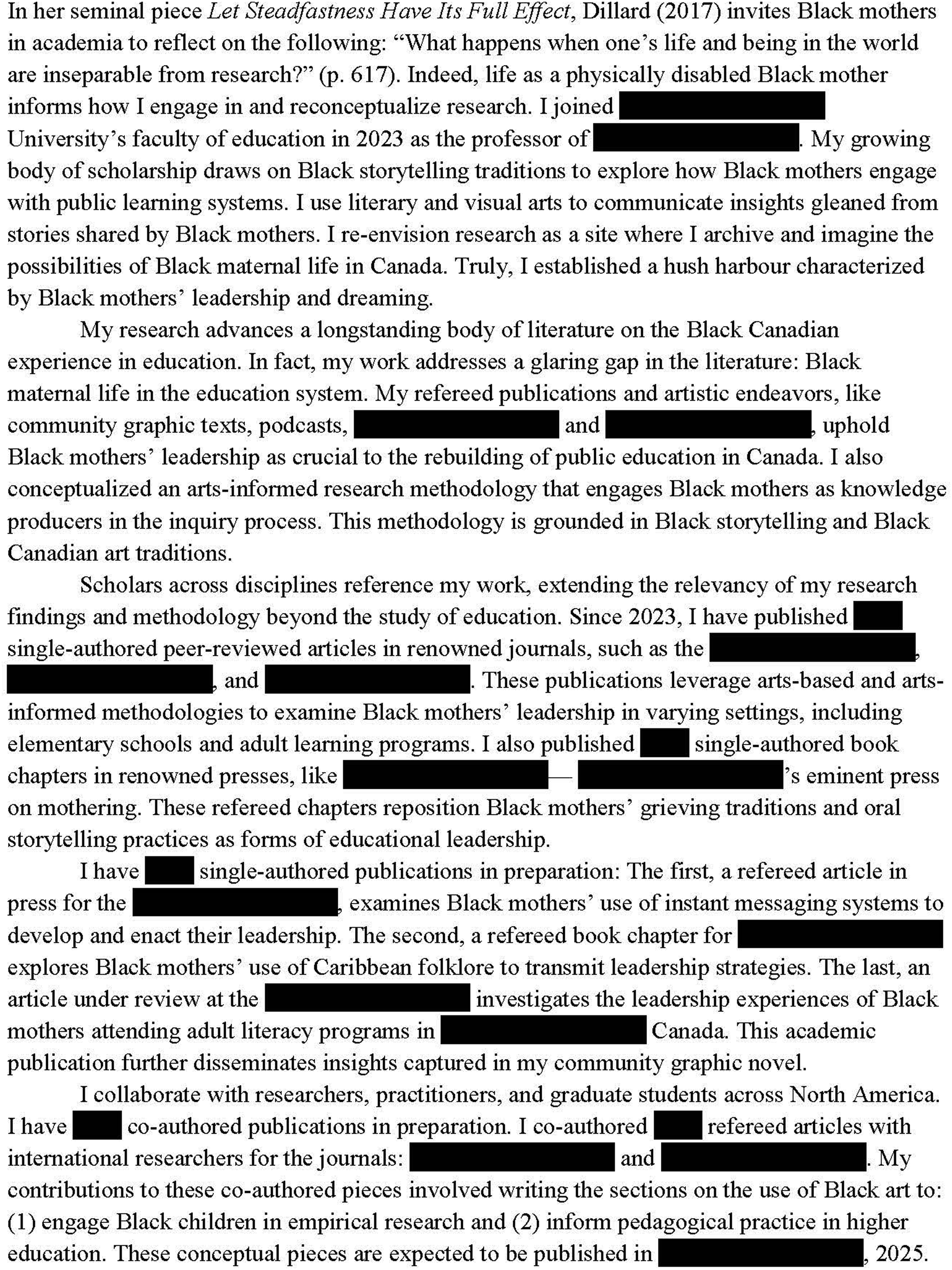
I reviewed the story Hush, We’re Here noting potential instances for misrepresentation and harm. Guided by Pacini-Ketchabaw and Nxumalo (2025), I redacted parts of the story where language might reinscribe harm, misrecognize the fullness of Black motherscholars’ experiences, or expose me and other Black motherscholars mentioned to institutional vulnerability. Black motherscholars are largely overlooked in Canadian literature in review, tenure, and promotion processes. Further, in public discourse, Black mothers are often stigmatized as unfit and lazy (Butler, 2021; Fearon, 2024b; Mullings & Mullings-Lewis, 2013). I revisited the redacted story Hush, We’re Here with two other Black motherscholars. We explored how the story resisted pathologizing Black mothers. We noted how the story instead served as a protective representation of Black motherscholars in Canada.
8. Ethical Considerations and Positionality
My engagement with redaction in the study required that I hold space for ethical ambiguity. My Blackness, disability, and motherhood shape my quotidian life. For this piece, however, I did not detail my life journeys with a rare disease and disability. At this moment, I refuse to mine these particularly intimate stories and recast them as academic data to fill the archive of pain (Tuck & Yang, 2014). Rather, this piece is about Black motherscholars’ “glimpses of Black freedom” (Walcott, 2021, p. 2), especially within our methodological practice and the third-year review process. Much like historical hush harbours, some of my stories are not meant to be scrutinized in the public domain. I used redaction to safeguard my stories and specific details of colleagues and family members that I deemed not meant for the public and academic domain. As explained by Tuck and Yang (2014), “There are stories and experiences that already have their own place, and placing them in the academy is removal, not respect” (p. 813). As such, I reviewed the redacted version of Hush, We’re Here with peers and family members for feedback and confirmation that the story is suitable to be shared in academic settings.
9. Storying my Experience: Storytellers & Story Listeners
In the upcoming section, I present study findings as the creative nonfiction short story Hush, We’re Here. Endarkened feminist thinkers insist on the connection between the storyteller, story listener, and story (Banks-Wallace, 2002; Toliver, 2021). The storying process, these thinkers maintain, is dependent upon the story listener actively participating in the narrative (Banks-Wallace, 2002; Toliver, 2021). As such, I invite you, the readers, to assume the role of story listener. I call on you to embrace the questions and feelings that arise as you read the story Hush, We’re Here. I want you to locate threads between my personal accounts and your own lived experiences. For instance, I encourage Black motherscholars working in other academic disciplines to reflect on the ways hush harbours function in their professional lives. I also invite Black mothers working in institutional settings outside of academia to locate themselves within the story, noting how the story echoes and diverges from their own. As hush harbours are specific to Black knowledges and practices of refusal, I challenge non-Black scholars to reflect on the ways they maintain, enforce or challenge the authoritative gaze of the academy.
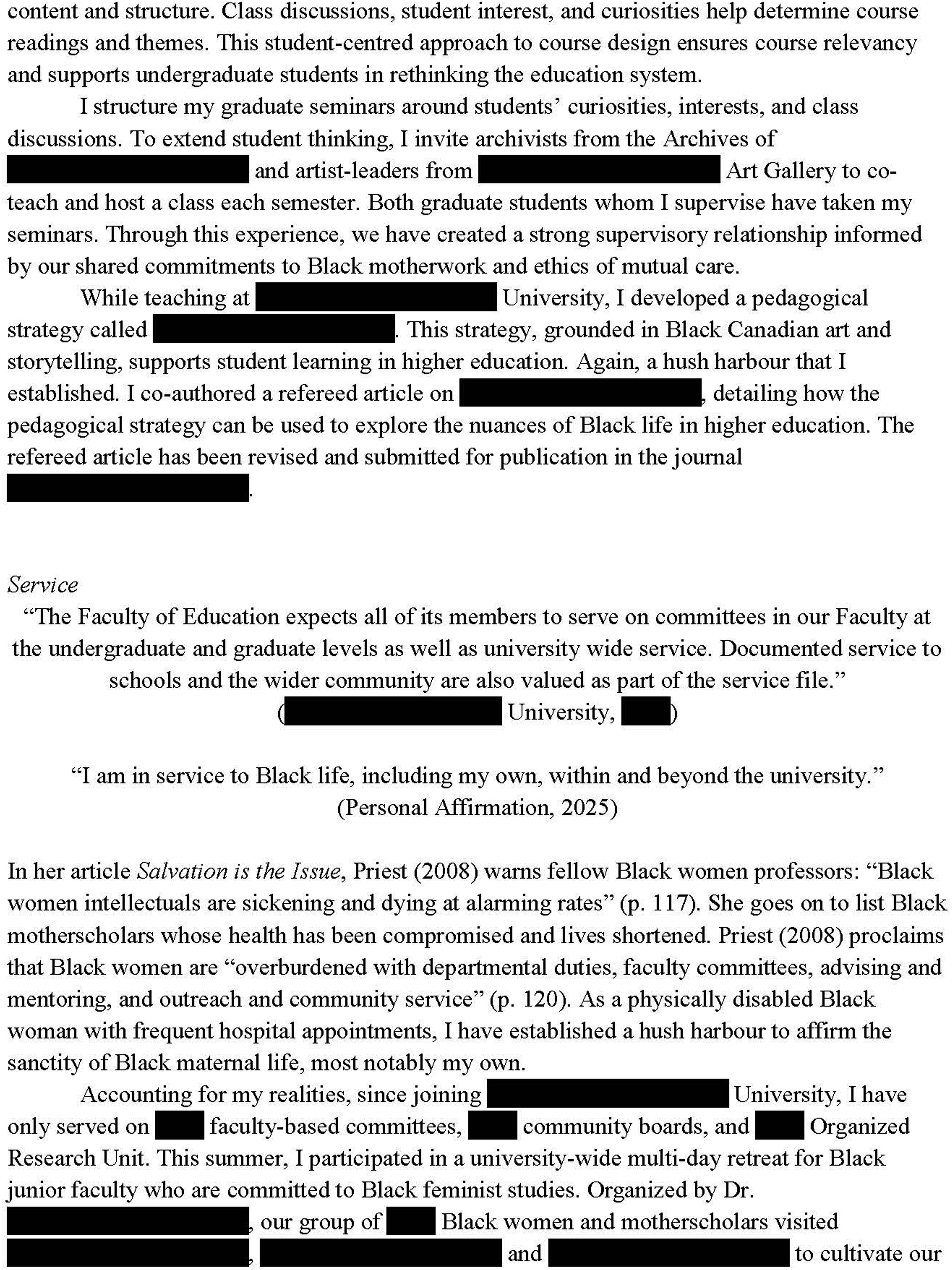
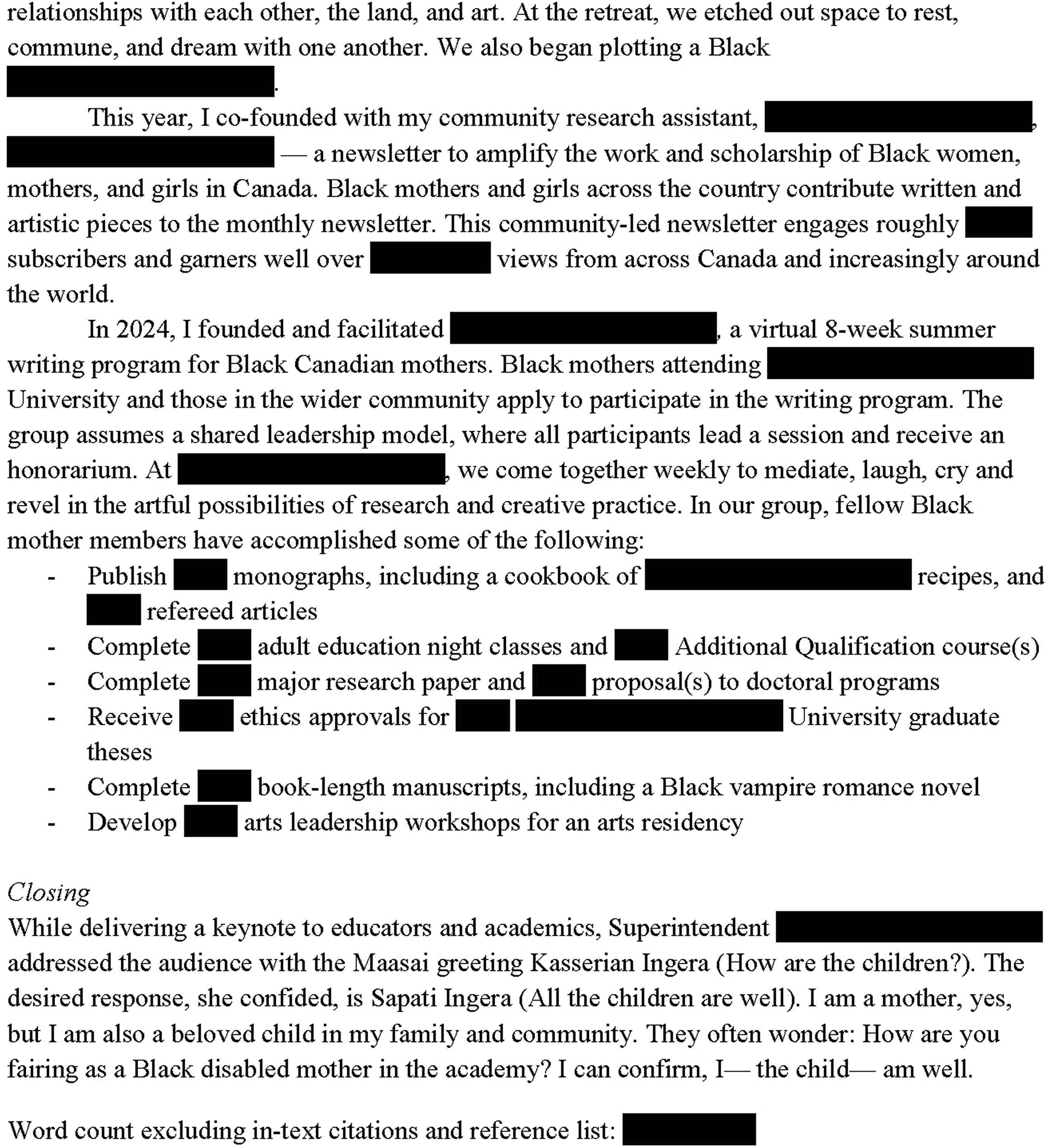
While reading the study findings, you will notice that parts of the story are blacked out. Some of you might be confounded by these redacted sections. Inspired by Pacini-Ketchabaw and Nxumalo (2025), Sharpe (2023) and Tuck and Yang (2014), the blacked-out sections are redactions alerting you to data collected in the research process that I refuse to domesticate into social science data. These redactions uphold the essence of hush harbours: secret hiding sites existing beyond the expansive reach of the academy. I invite you to witness my ethical use of redaction throughout story. As you read the story, I also want you to reflect on the varied ways that the story’s main character, Dr. Stacey-Ann Truell, reimagined hush harbours as methodological spaces. I now ask you to read, celebrate, and interrogate the data-driven short story Hush, We’re Here.
10. Study Findings: Hush, We’re Here (Figures 1-5)
Hush, We're Here (Page 1) Hush, We're Here (Page 2) Hush, We're Here (Page 3) Hush, We're Here (Page 4) Hush, We're Here (Page 5)

11. Story Insights and Conclusion
Dear Readers:
I now return to the same kitchen table where I began this letter to close it. I embarked on this arts-informed autoethnography intent on showcasing the complex and nuanced experiences of Black motherscholars working in Canadian universities. There is a scarcity of literature centres the ways pre-tenured Black motherscholars in Canada navigate institutional reviews and assessments. The study showcased how I and other Black motherscholars stole away spaces within and beyond the university. I worked with other Black mothers to reimagine these clandestine spaces as hush harbours – sacred spaces to commune with ourselves and others. It is in these sacred spaces we Black motherscholars deepen our engagements with the arts and qualitative inquiry.
In the creative nonfiction story Hush, We’re Here, the main character, Dr. Stacey-Ann Truell, details how she used Black art and storytelling to establish a protective enclave for students attending her undergraduate and graduate courses. For example, in the data-driven story, Stacey-Ann unapologetically centres Black scholarship and art in her courses, shielding students, albeit momentarily, from the systems that fail to esteem the critical and transformative essence of Black thought. Stacey-Ann also develops a pedagogical practice grounded in Black scholarship and art. In so doing, she establishes learning spaces where students engage in more culturally indigenous ways of knowing, research, art, and teaching (Dillard, 2000). These clandestine spaces, which Black motherscholars establish within our courses, offer all those who convene there, including ourselves, opportunities to radically reimagine ways of being in the academy. In these spaces, we express our commitment to artistic inquiry not only in our research practice, but also in our engagement with teaching and service.
Study findings also captured how Black motherscholars came together to leverage the university’s resources to establish hush harbours off-site. In the story, Stacey-Ann alludes to the ways fellow pre-tenured Black mothers and women secured grants and university funding to organize multi-day retreats and gatherings. The data-drive story notes how Black motherscholars positioned these gatherings as a site for rest, play, dreaming, and reconnection. It was in these restful and joyful spaces that Black motherscholars were able to subvert institutional surveillance, plot out their collective dreams, and indulge in the arts.
The study also showed how Black motherscholars established hush harbours beyond the university. For instance, in the data-driven story Hush, We’re Here, Stacey-Ann repositions her community newsletter and writing group as hush harbours that reject the institutional gaze. Whether it be in the writing group or around the newsletter, Black mothers, women, and girls living across the country gather in these virtual spaces to restore their spirits from society’s incessant onslaught of anti-Blackness. In the story, Stacey-Ann builds these virtual spaces for fellow Black women, mothers, and their children, while preparing her third-year review dossier. In these virtual hush harbours, Black motherscholars come together to meditate, laugh, cry, and celebrate. These spaces that exist outside of the university allow Black motherscholars to dream of and realize the full possibilities of their creative practice.
This arts-informed autoethnography showcased the creative ways that Black motherscholars established hush harbours within and beyond the university. In these hush harbours, pre-tenured Black motherscholars deepened their artful approaches to research, cultivated community, and organized for freedom. Hush harbours, in all their possibilities, do not offer a definitive solution to an institution intent on dehumanizing Black motherscholars and faculty (Neale-Stanley, 2023). In that sense, hush harbours’ failure to overtly abolish oppressive systems at the university could be seen as an “accommodationist strategy” (Neale-Stanley, 2023). Nonetheless, these imperfect sacred spaces established by Black motherscholars continue to serve as powerful tools of resistance and remind us of our capacity to engage in methodological practices differently (Neale-Stanley, 2023; Stovall, 2018). I now close this open letter with a series of reflection questions to fellow Black motherscholars, especially those who are pre-tenured faculty in Canadian universities: - How do you engage in hush harbours as methodological practice across varying disciplines and institutions? - How might Black motherscholars at varying stages of the tenure and promotion journey co-create hush harbours within and outside of academia? - In a society that persistently and historically demands the labour of Black motherscholars, how do you perform acts of refusal? - How does play and dreaming figure into the inquiry process?
Thank you for reading this open letter, especially while surviving a society that continues to demand our labour. Black motherscholars, may this open letter reinforce our collective resolve to engage in artful research practices that amplify our stories within the academy and beyond.
Sincerely,
Stephanie Fearon, A Black mother pursuing her scholarly and artful dreams.
Footnotes

Funding
The authors received no financial support for the research, authorship, and/or publication of this article.
Declaration of Conflicting Interests
The authors declared no potential conflicts of interest with respect to the research, authorship, and/or publication of this article.