




Abstract
Debates in qualitative research have long centred on the insider-outsider distinction, often treating positionality as a fixed binary. This study reconceptualises positionality as a dynamic and relational process within sensitive research contexts, focusing on drug-facilitated sexual assaults (DFSA) in Greece. Its aim is to explore how shifting positionalities shape the research encounter and knowledge production. Methodologically, it employs a Bourdieu-informed analysis of qualitative fieldwork, mobilising the concepts of habitus, field, and participant objectivation. The findings show that field-generated counter-discourses challenge the adequacy of static institutional vocabularies in capturing configurations of harm, vulnerability, and agency, while also unsettling aspects of the researcher’s habitus. Although outsider status may initially constrain openness, participant objectivation enables the transformation of positional distance into a dialogic resource. The study concludes that positionality emerges as co-constituted through the interplay between embodied dispositions and field-specific vocabularies, while it reconceptualizes reflexivity beyond individual self-awareness, but rather as a form of participant objectivation that situates the researcher within broader structures of power, habitus, and field relations.
Keywords
Introduction
The insider–outsider distinction has long been central to debates in qualitative research, yet scholars increasingly argue that such a binary is both reductive and analytically misleading: researchers never fully inhabit either position; instead, they occupy a shifting, relational space “between” these categories, shaped by context, interaction, and perception (Dwyer & Buckle, 2009). This in-between space, as later authors emphasize, is multidimensional, fluid, and deeply contingent (Blix, 2015; Kerstetter, 2012). Historical traditions in anthropology constructed the outsider as a somewhat neutral observer in unfamiliar cultural settings (Paechter, 2013), while methodological critiques show that outsiders must work deliberately to understand local norms, sociolinguistic cues, and tacit meanings they might otherwise overlook (Ostrander, 1993). Conversely, insiders may appear to have privileged access, yet their proximity may limit critical distance or obscure tensions that require interrogation (Berger, 2015; Merriam et al., 2001). Taken together, these tensions illustrate that insider and outsider roles are not fixed identities but dynamic positionalities negotiated throughout the research encounter.
This growing awareness has elevated positionality from a methodological formality to an ethical and epistemic cornerstone of qualitative inquiry, approaching it as essential for reflexive, responsible research practice (Holmes, 2020). Self-location thus becomes a vital starting point, since by locating ourselves we allow others to understand how we enter the field and opens space to examine how our identities, biases, privileges, and vulnerabilities shape, and are shaped by, the research process (Kwame, 2017, p. 218). By foregrounding reflexivity and embracing collaborative reflexive practices (Kapinga et al., 2022), qualitative scholars highlight positionality as a generative layer of knowledge production, one that informs every stage of research design, data collection, interpretation, and representation.
Discursive (un)certainty further complicates the insider–outsider dynamic by shaping how researchers interpret, negotiate, and participate in the meaning-making processes of the field (Bucholtz & Hall, 2005). Insiders may experience a sense of discursive familiarity, shared language practices, cultural references, and implicit norms, which can generate confidence in interpreting participants’ accounts. However, this same familiarity may obscure alternative readings or silence contradictory interpretations, producing a false sense of discursive certainty that limits analytic depth (Riessman, 2008). Outsiders, by contrast, often encounter ambiguity and uncertainty as they navigate unfamiliar linguistic cues, categories, and narrative conventions. While initially destabilizing, such discursive uncertainty can serve as a productive analytic resource, prompting closer attention to taken-for-granted meanings and power-laden constructions within the data (Silverman, 2014). In both cases, the researcher’s stance is shaped not only by their position relative to the community but by their interpretive comfort or discomfort with the discursive terrain.
This study contributes to these debates by posing two key research questions: (1) How do researchers navigate the fluid boundaries between insider and outsider positionalities? and (2) How do these shifting positions shape their experiences of discursive certainty and uncertainty during qualitative inquiry? To explore these questions, it delves into a Bourdieu-informed analysis to explore the negotiation of insider–outsider boundaries. It further draws on qualitative fieldwork investigating Drug-Facilitated Sexual Assaults (DFSAs) in Greece, i.e. a context that extended beyond researcher’s prior expertise and necessitated both reflexive openness and analytical distance. Conducted within a broader European research initiative, this study shows how fieldwork in underexplored domains obliges researchers to confront and recalibrate their methodological habitus, particularly as they encounter emerging terminologies, epistemic tensions, and unstable classificatory terrain within a shifting field. Such contexts expose the limits of established doxic assumptions and demand a reflexive engagement with the symbolic power dynamics that shape meaning-making.
The remainder of the paper is structured as follows. The second section reviews the relevant literature, revisiting academic debates on the insider-outsider divide and the idea of reflexivity. The third section outlines the research design and methodology of the primary study conducted in Greece. The fourth section explores grassroots discourses surrounding DFSA as they emerge in the Greek context, drawing out key insights that inform the concluding section. Finally, the discussion reflects on the study’s limitations and proposes directions for future research.
Literature Review
Positionality in Qualitative Research: An Insider-Outsider Distinction
Scholars have long problematized the binary distinction between insider and outsider roles in qualitative inquiry. To make sense of this complexity, studies describe the insider–outsider spectrum as multidimensional, multi-layered, variable, and irreducibly context-dependent (Blix, 2015). More analytically, the insider role may facilitate access to participants and cultural knowledge, though it may also obscure critical insights if researchers become “too close” to the field or insufficiently reflexive (Berger, 2015; Scott, 2013). Some scholars adopt the term “insider” strategically to signal forms of partial membership or alignment with the communities they study (Blix, 2015; Kerstetter, 2012). Conversely, the outsider is often imagined as more objective, yet may struggle to build trust or gain meaningful access (Paechter, 2013). Historically, the outsider position gained prominence in ethnography through anthropology, where Western researchers relocated to less developed contexts to observe and document local life (Paechter, 2013). However, this legacy reveals profound issues of power, representation, and distance that contemporary qualitative researchers must consciously address (Bilgen & Fábos, 2023).
Increasingly, authors assert that complete insider or outsider status is impossible, as researcher identities and relationships continually shift during the research process (Blix, 2015; Coombs & Osborne, 2018). In their widely cited contribution, Dwyer and Buckle (2009) reject the notion that researchers can ever fully occupy one position or the other, arguing that such a dichotomy is “overly simplistic” (p. 60). Instead, they posit that researchers invariably inhabit a fluid, shifting space “between” these categories, never entirely the same as, or completely different from, the communities they study. More recent studies extend this argument by suggesting that the task of the researcher is not to resolve this in-between position, but to learn to work productively within it (Kerr & Sturm, 2019). These dynamics underscore the importance of positionality as a foundational dimension of qualitative research. Positionality matters not only because it shapes the research encounter through shifting insider–outsider alignments, but also because, it is never static and continually evolves throughout the research process (Holmes, 2020). In this context, articulating positionality may be neither simple nor immediate, yet it is essential for transparency and ethical integrity. This ethical responsibility is closely tied to the imperative that researchers must work deliberately to avoid misrepresenting or wronging participants or their communities (Cleton, 2022).
Recognizing this responsibility, recent studies increasingly frame “me-search” as a critical component of qualitative inquiry, as a process through which researchers acknowledge the presence of the “me” in research (Nash & Bradley, 2012). This notion describes a form of critical sensemaking grounded in one’s own cultural, linguistic, and religious experiences (Madkins & Nazar, 2022). The turn toward “me” is not self-indulgent but methodologically necessary: it centers the identities, biases, privileges, and marginalizations that shape researchers’ interpretations, particularly in relation to race, language, gender, sexuality, disability, and other axes of inequality (Milner et al., 2024). Such reflexive engagement is also crucial for navigating insider–outsider tensions and the ethical challenges they raise (Chen et al., 2021). It also means that the research process is not simply a means of data collection, but a relational and transformative space (Chatzichristos, 2025), one in which the researcher, too, is changed (Alvesson & Sköldberg, 2018).
Against these backdrops, positionality should not be relegated to a methodological aside; rather, it should constitute a deliberate layer of the research design and a form of data in itself (Milner et al., 2024). Supski and Maher (2023) emphasize that positionality work often involves “generative and transformative research moments, often unpredictable and uncomfortable” (p. 743), highlighting the emotional and epistemic labor involved. Collaborative reflexivity offers one way to operationalize this approach. Sharing reflexive insights among research partners enriches understanding of data, knowledge production, and research encounters by exposing how different positional standpoints shape interpretation (Kapinga et al., 2022). Taken together, this body of work affirms that positionality is neither a static declaration nor a peripheral concern. It is a continuous, relational, and ethically grounded practice that shapes all stages of qualitative inquiry, namely from access and rapport-building to analysis, representation, and the politics of knowledge production.
Unfamiliar Discourses: A Bourdieu-Informed Analysis
Pierre Bourdieu’s social theory offers a relational framework for understanding how power, knowledge, and everyday practices are structured and reproduced. Three core concepts are central to his approach. Habitus refers to the durable yet adaptable dispositions through which individuals perceive, interpret, and act in the social world (Bourdieu, 1990). Field denotes the semi-autonomous social arenas, such as academia, medicine, law, or activism, structured by unequal distributions of power, capital, and legitimacy (Bourdieu, 1984). Within these fields, actors hold differing amounts of capital, including economic, cultural, social, and symbolic forms, which shape their authority and influence (Bourdieu, 1990). Bourdieu argues that language and classification systems operate as instruments of symbolic power, naturalizing dominant worldviews and rendering others invisible (Bourdieu, 1991). Reproduction of these hierarchies depends on doxa, the taken-for-granted assumptions that structure what is considered thinkable or speakable (Bourdieu, 1977; Deer, 2008). His methodological contribution, reflexive sociology, calls on researchers to analyze not only the social world but also the conditions of their own knowledge production, what he terms participant objectivation (Bourdieu, 2004; Bourdieu & Wacquant, 1992). Together, these concepts provide a powerful lens for examining how interpretation, discourse, and researcher positionality are shaped by broader structures of power.
Specifically, the principle of participant objectivation provides a valuable bridge between insider–outsider dynamics and contemporary discussions of reflexive “me-search.” Unlike conventional reflexivity, which often centers on personal disclosure or introspection, participant objectivation requires the researcher to critically analyze the social conditions that shape their own vision, namely their habitus, position in the field, and the forms of capital they mobilize (Bourdieu, 2004; Bourdieu & Wacquant, 1992). The interpretive process in such contexts is inherently non-neutral: every analytic decision is shaped by the researcher’s cultural, linguistic, and positional standpoint (Ergun & Erdemir, 2010). Interpretation is therefore not a detached cognitive act but a practice embedded in the researcher’s habitus, i.e. the historically constituted dispositions, perceptual schemata, and classificatory logics through which they apprehend the social world (Bourdieu, 1990). This habitus subtly organizes what the researcher notices, what they overlook, what appears self-evident, and what remains outside their field of vision. Researchers must therefore interrogate how their habitus guides data selection, elevates certain narratives while marginalizing others, and shapes the implicit assumptions through which meaning is produced. Equally important is recognizing how the researcher’s presence in the field of interaction, which is itself structured by unequal distributions of symbolic, social, and cultural capital (Bourdieu, 1984; Grenfell, 2012). Participants may modulate their disclosures in response to the researcher’s perceived authority or institutional affiliation, revealing how positionality is dynamically co-produced through the interplay of capitals and field-specific expectations, or what Bourdieu terms illusion, the tacit investment in the stakes of the field (Bourdieu, 1990).
Bourdieu’s theorization of symbolic power provides a powerful lens for understanding why interpretive friction emerges in such contexts. According to this notion discourse functions within hierarchical regimes of classification that consecrate certain ways of speaking as legitimate while rendering others invisible or unintelligible (Bourdieu, 1991). Emergent vocabularies, especially those indexing newly recognized harms, subjectivities, or resistant identities, often stand in tension with established doxa, the taken-for-granted norms and classificatory schemes that govern both institutional and academic discourse (Bourdieu, 1977; Deer, 2008). When researchers encounter such terms, familiar analytical categories may falter or fragment, revealing instances of misrecognition, whereby dominant frameworks naturalize their own blind spots and obscure experiences that lack symbolic legitimacy (Bourdieu, 1984; Hanks, 2005).
Rather than treating such semantic or conceptual instability as a methodological obstacle, Bourdieu invites researchers to engage in epistemic reflexivity, namely a systematic examination of the social and institutional conditions that shape knowledge production (Bourdieu, 2004; Bourdieu & Wacquant, 1992). This involves participant objectivation, not in the sense of objectifying participants, but in objectifying the researcher’s own position in the field, the academic habitus that structures their vision, and the forms of symbolic capital that authorize their interpretations. In this sense, discursive uncertainty becomes a productive site of inquiry (Goicolea et al., 2022), as well as an indication that the field and the researchers are both undergoing transformation (Chatzichristos & Nagopoulos, 2021) and that interpretive tools may require recalibration. Such reflexive engagement resists the temptation to treat textual features, discursive practices, and broader socio-political structures as discrete entities (Howarth et al., 2000) and instead positions discursive instability as a catalyst for methodological adaptation and theoretical innovation.
Research Design and Methodology
Contextualizing the Research: Why Greece?
This reflexive, field-attuned framework is especially critical in the Greek context, where DFSA unfold within a field marked by institutional inertia, forensic constraints, and entrenched cultural silences. Greece offers an analytically rich site for examining how new discourses around DFSA emerge and circulate precisely because the dominant doxa around gender, authority, and evidence remains relatively under-interrogated. Greece ranks 24th out of 27 EU countries on the Gender Equality Index (over 12 points below the EU average) while rates of sexual and gender-based violence remain persistently high. Approximately 42% of women who have ever been in a relationship report experiencing intimate partner violence, and 43% of working women have encountered workplace sexual harassment. Despite this prevalence, forensic detection of gamma-hydroxybutyrate (GHB 1 ) remains negligible: just 0.4% of DFSA cases in Greece involve confirmed GHB detection, compared to 5.9% in the United States, 3% in France, and 2% in the Netherlands (Skov et al., 2022). This disparity is unlikely to reflect lower incidence, but rather, it signals institutional misrecognition, shaped by outdated testing protocols, limited forensic capacity, and entrenched doxic assumptions regarding victim credibility. The rising prevalence of chemsex, particularly among men who have sex with men (MSM), further complicates the field. Recent data indicate that more than one in five MSM in Greece engage in chemsex, with strong associations to HIV and STI rates (Poulios et al., 2022). These patterns illustrate a field in which symbolic power determines what is rendered visible as risk, harm, or deviance, and what remains unacknowledged.
Parallel findings across healthcare, law enforcement, and media discourse reveal the depth of gendered silencing within Greek institutional structures (Fotou et al., 2024). In the healthcare sector, 70% of female nurses report experiencing sexual harassment, with younger and privately employed nurses at heightened risk; many chose not to report incidents due to fear of retaliation or disbelief, highlighting the unequal distribution of symbolic capital that shapes who can speak and be heard (Papantoniou, 2021). In law enforcement, tools such as the Hellenic Risk Assessment Instrument have struggled to gain traction due to inconsistent application and limited training, while police officers themselves acknowledge the absence of standardized protocols for assessing risk or lethality, resulting in systematic failures of intervention (Fotou et al., 2024). At the cultural level, the delayed uptake of the #MeToo movement reflects a collective habitus shaped by patriarchal and collectivist norms that discourage disclosure and protect perpetrators (Chroni & Kavoura, 2022).
These dynamics illustrate why Greece constitutes a critical empirical setting for investigating the emergence of new DFSA-related terminologies (Chatzichristos & Papadopoulou, 2026), not simply as descriptive tools, but as discursive acts of resistance against institutional neglect and epistemic erasure. The Greek case reveals the dual struggle to name and address violence in a field where victims often lack the linguistic resources, institutional support, or symbolic capital necessary for recognition. In this sense, the study does more than fill a regional gap in DFSA scholarship. It rather contributes to a broader understanding of how gender, substance use, and forensic ambiguity intersect within fields marked by weak institutional responsiveness and unstable classificatory regimes.
Data Collection and Analysis
Research Design

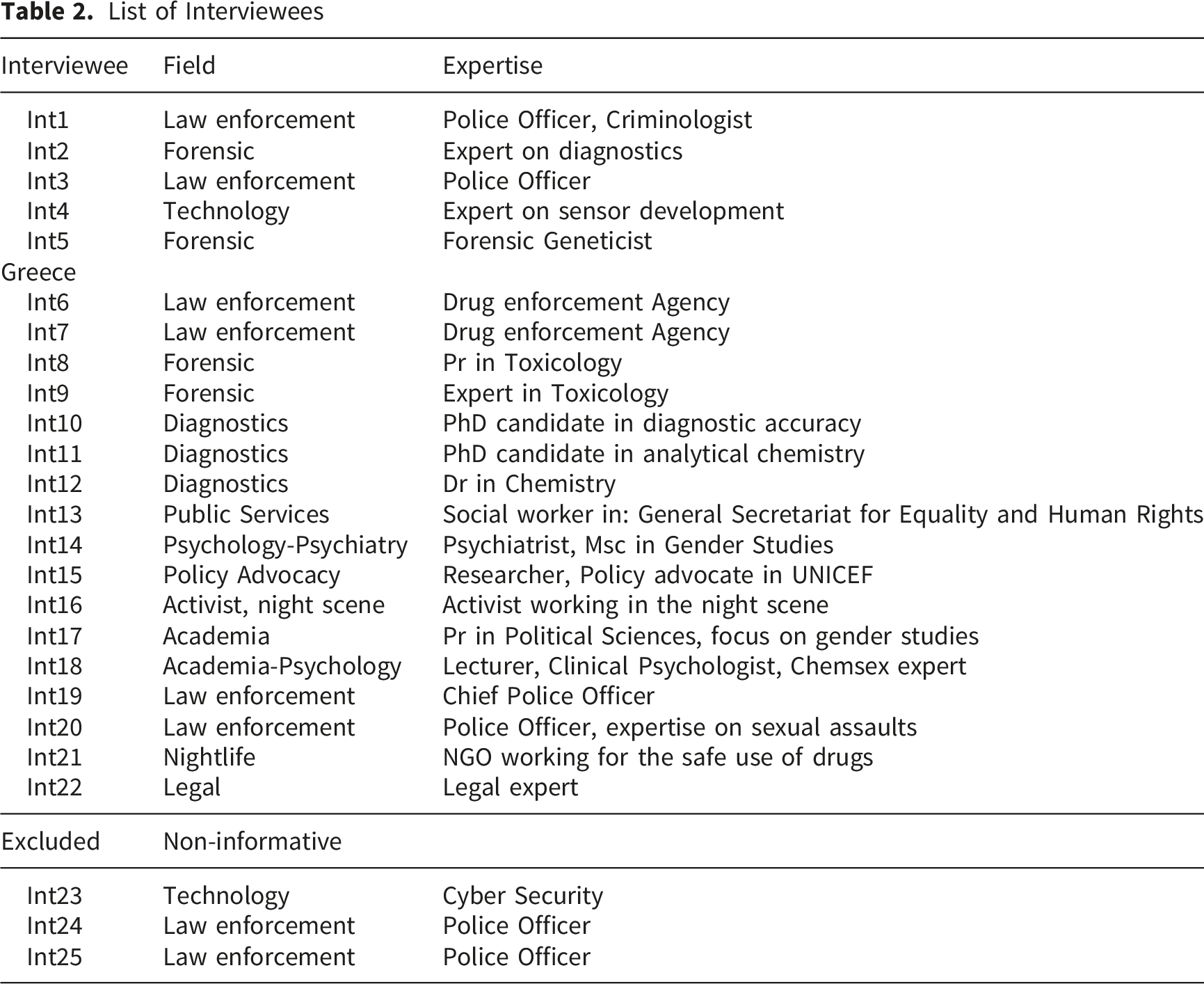
In the first phase, the study reviewed scientific literature, EU policy documents (including the Victims’ Rights Directive and the Istanbul Convention), and Greece’s National Action Plan on Gender-Based Violence (2022–2026), not simply to catalogue legal or forensic limitations but to identify discursive absences, normative assumptions, and institutional silences. Particular attention was paid to the narrow toxicological detection windows, the gendered doxa embedded in forensic protocols, and the implicit heteronormativity shaping DFSA legislation. The second phase consisted of semi-structured interviews with EU forensic toxicologists, legal professionals, and clinicians. These interviews were approached as discursive events, namely sites where institutional language, professional identity, and symbolic authority were actively constructed within a broader field. Analysis focused on how speakers positioned themselves within or against institutional logics, the terminologies they adopted or rejected, and how they navigated uncertainty, blame, and risk. This phase illuminated classification struggles between scientific objectivity and lived complexity, particularly in relation to consent, memory loss, and evidentiary thresholds.
List of Interviewees
The analysis of interviews was iterative and intertextual (see Appendix, Table 3), following a detailed procedure. Interview transcripts were read alongside policy documents, forensic protocols, and activist materials to trace the circulation, adaptation, and contestation of key terms—such as g-hole, inclusive mapping, and chemical vulnerability—across overlapping discursive fields. Attention was given to positioning (how speakers located themselves and others within epistemic and institutional hierarchies), modality (expressions of certainty, doubt, or speculation), and lexical choices (the adoption, resistance, or reframing of terminology). Discursive silences and disclaimers were treated as analytically significant, marking points where institutional doxa reached its limits or where symbolic power relations constrained what could be articulated. Terms, phrases, and framings from interviews were systematically cross-referenced with policy texts, scientific discourse, and grassroots narratives to trace their movement, transformation, or disappearance. This process made visible the classification struggles through which certain terms gained institutional legitimacy while others remained marginal, stigmatized, or excluded.
Particular attention was given to moments of hesitation, contradiction, or shifts in terminology within the same interview. These “instabilities” were approached as indicators that underlying epistemic frameworks were under strain, offering insight into emerging concepts or contested meanings. Throughout the analysis, the researcher maintained a reflexive stance, engaging in participant objectivation by acknowledging how his external positionality shaped both the co-construction of the interview encounter and the interpretive lens applied to the data. Analytical memos documented emergent insights, contradictions, and moments of discursive instability, which were subsequently examined as potential entry points for identifying shifting epistemologies and newly forming classificatory schemes.
Field Counter-Discourses
The relatively unmapped domain of DFSA in Greece was shaped by anecdotal incidents and fragmented institutional responses. As a result, the researcher encountered terminologies, narratives, and classificatory schemes that diverged sharply from his own habitus and established lexicon. This encounter made visible not only the limits of institutional knowledge but also the limits of the researcher’s interpretive dispositions, revealing a mutually constitutive dynamic in which both parties navigated unfamiliar conceptual terrain.
More analytically, healthcare professionals were explicit in marking the boundaries of their symbolic capital. Statements such as “I don’t have any experience in this field” (Int_12) or “For psychologists I don’t know; for psychiatrists, our basic curriculum doesn’t include anything specific about sexual violence” (Int_14) showed how they demarcated the scope of their authority and the legitimacy of their classificatory schemes. These disclaimers exposed knowledge gaps but also signaled a broader discursive economy in which credibility, risk, and institutional responsibility were actively negotiated.
Importantly, these professional limitations intersected with the researcher’s own outsider habitus. The interview encounter thus became a space where dual forms of limitation, i.e. the participant’s constrained institutional training and the researcher’s lack of embedded expertise, came into contact. Each side navigated the field’s uncertainties from different positions, producing a dialogic tension that shaped what could be said, asked, or interpreted. This dynamic was further reinforced by professionals’ reluctance to speak beyond their perceived domain of expertise. As one forensic specialist noted, “We’re not asked to evaluate whether something happened. That’s up to the legal system. We just analyze the samples” (Int_8). Such reiterations of role-specific mandates functioned both as protective mechanisms and as discursive devices that maintained field boundaries, reduced narrative complexity, and avoided ethically charged entanglements. In turn, the researcher’s own attempts to probe beyond these boundaries highlighted how his limited habitus confronted the limits of theirs, producing moments of discursive hesitation, deferral, or silence that themselves became analytically significant.
At the same time, these boundaries often masked deeper institutional voids. As a psychiatrist explained, “We’re not trained to deal with sexual violence. It’s not in the curriculum. Even those who want to help may not know how” (Int_14). These accounts are symptomatic of a field in flux, where the absence of shared terminology or standardized protocols reflects the early formation of new discourses and unsettled doxic assumptions. This dynamic is further evidenced by the divergent vocabularies deployed by forensic and academic experts on one hand, and front-line practitioners on the other. This was a sign of competing classificatory schemes vying for discursive legitimacy. Such disclaimers were not to be treated as simple limitations but as discursive cues pointing to epistemic tension within the field, namely moments where dominant doxic categories no longer suffice. These sites reflected ongoing classificatory struggles in which emerging concepts, such as chemical vulnerability, consensual incapacitation, or forensic ambiguity, have not yet achieved symbolic legitimacy. They revealed where the field’s symbolic order was unsettled and where new meanings are actively forming.
The emergence of counter-discourses was especially evident in how violence was named, or failed to be named. One social worker noted: “They [victims] often do not name it as sexual violence. Here, we name it” (Int_13). The discrepancy between lived experience and the available vocabulary illustrated a discursive lag characteristic of under-researched or taboo fields, where institutional doxa had yet to register emergent forms of harm. This naming gap was not merely semantic, rather it shaped whether and how survivors accessed recognition, support, or justice. As the same interviewee explained, “Many women do not identify what they experience as rape, especially in domestic settings. They may say, ‘I cried, I didn’t want to, but I did it so he’d calm down’” (Int_13). These accounts exposed a structural disconnect between institutional classifications and experiential realities, revealing how survivors lacked the symbolic resources to frame their experiences within legitimate categories of violence. For the researcher, such moments marked an evolving semiotics of harm, where terms such as “sexual coercion,” “survival sex,” or “transactional rape” may be absent from the local lexicon even as the practices proliferate.
This discursive fragmentation was intensified in DFSA cases by pharmacological effects, memory loss, dissociation, and narrative discontinuity, which obstructed traditional models of evidence. As one chemsex expert noted, victims often say, “I know something happened, but I can’t remember what” (Int_18), a formulation that challenges forensic, legal, and academic logics alike. In confronting these discursive absences or substitutions, the researcher became attuned to how social meaning is constructed and to the forms of epistemic violence produced when suffering cannot be articulated within existing categories. Such instances signaled not only what is unsaid but what is not yet sayable, pointing to the need for expanded, community-generated vocabularies of violence capable of capturing newly emerging harms.
Institutions, on the other hand, generated their own discursive regimes, often characterized by suspicion, proceduralism, or the deflection of responsibility. A gender researcher observed, “The police are one of the institutions with the lowest trust levels among women” (Int_15), while a police officer reinforced this mistrust through the lens of institutional misrecognition: “Theoretically, complaints are made, but as research and toxicology have shown, they are unfounded” (Int_19). This skepticism was mirrored in institutional protocols, or the absence of them. “There’s no official protocol,” another officer stated. “We send them to the hospital, but we don’t have training. We just follow what the forensic doctors tell us” (Int_20). Such accounts revealed a field structured by symbolic power, where uncertainty was managed through procedural distancing and the bureaucratic redistribution of responsibility. Institutional language reframed survivor narratives through classificatory labels such as “false accusations,” “delayed reporting,” or “inconclusive toxicology,” terms that depersonalized trauma and reasserted institutional authority. As one forensic specialist noted, “By the time they come to us, it’s too late to detect anything. That doesn’t mean nothing happened” (Int_2). Here, the discursive failure reflected not individual intent but a systemic mismatch between evidence thresholds and the phenomenology of chemically facilitated assault. Such non-inclusive institutional grammars of (mis)trust exposed how symbolic power shapes what counts as evidence, whose voices are legitimized, and how gendered skepticism became embedded in institutional doxa. It also illustrated how outdated classifications and protocols produce misrecognition, inadvertently silencing victims by failing to adapt to emerging forms of harm and shifting configurations of vulnerability.
Perhaps the most striking example of filed counter-terminology was the term “g-hole,” used to describe a state of complete physical and cognitive incapacitation following GHB ingestion. As a chemsex expert explained, “Even if someone says ‘yes’, if they are in a g-hole and cannot say ‘no’, it doesn’t count” (Int_18). This term -part slang, part clinical shorthand-encapsulated a complex set of ethical, legal, and affective dilemmas. It destabilized legalistic understandings of consent predicated on clear affirmation or denial. Instead, it introduced what might be seen as a temporal disjunction of agency, i.e. moments when a person consents to a scenario without being able to sustain or retract that consent due to intoxication or incapacitation. The chemsex expert further noted the emotional aftermath: “The main trauma is that they blame themselves… ‘I wanted to party’’’ (Int_18). Here, discourses of personal responsibility intersected with structural silences around drug use, queerness, and sexual exploration. This guilt-ridden narrative complicated the victim-perpetrator binary and called for a framework of understanding that integrates fluid states of agency, consent, and harm. For the researcher, the term “g-hole” was more than jargon, it was a conceptual tool born within the community to articulate a shared reality unacknowledged by conventional forensic or legal systems. Engaging seriously with such terms enabled a deeper ethnographic sensitivity to how language reflects and shapes agency and embodied experience.
In this vein, grassroots actors often coined their own terms to reclaim agency and redefine safety. As an activist working in the night scene explained, “You can’t go out and be afraid to leave your drink anywhere… We decided this can’t go on” (Int_16). Her collective developed an app to map inclusive and secure venues, creating a lexicon around ‘safe spaces’ that challenges mainstream indifference to nightlife-based harassment. This language of resistance included terms like “harm reduction,” “inclusivity mapping,” and “party awareness teams,” all of which recasted prevention as collective care rather than individual burden. Another harm reduction NGO, for instance, used booths equipped with tools like wet wipes, safe-use kits, and real-time drug testing to promote both chemical safety and social accountability. “The idea is that we look out for one another,” (Int_21) explained one organizer.
These grassroots innovations were not merely practical responses; they were linguistic interventions that introduced alternative classificatory schemes into a field marked by institutional gaps. They signaled a shift from reactive to proactive discourse, transforming safety from a contingent response into an emerging cultural norm. These bottom-up vocabularies challenged established doxic assumptions and demonstrated how symbolic power can be redistributed through everyday practices of naming and framing. By implication, discursive meaning became most visible through field-generated counter-discourses that challenge institutional doxa. These alternative grammars offered access to forms of agency, solidarity, and transformation that remained obscured within dominant classificatory schemes, revealing how marginalized actors mobilize symbolic capital to contest established narratives.
Conclusion
Unfamiliar research fields often become fertile grounds for linguistic innovation and discursive transformation. This study shows how emerging terms such as g-hole, chemsex, and safe spaces operate not only as descriptive categories but as interventions within a shifting field of symbolic power, in the Bourdieusian sense, i.e. sites where new classifications contest established meanings and forms of legitimacy. For researchers positioned between insider and outsider roles, such terrains demand more than documentation: they require sensitivity to silences and contradictions, sites where institutional doxa falters and new categories of harm, vulnerability, and agency struggle for recognition. In domains shaped by trauma and systemic inequality, reflexivity becomes a moral imperative (Pillow, 2003), as failure to understand local dynamics risks reproducing harm (Pe-Pua, 2006). Moments of discursive (un)certainty reveal underlying struggles over legitimacy, evidence, and voice. By engaging with field-generated counter-discourses, researchers can surface alternative grammars that challenge gendered skepticism and destabilize dominant classificatory schemes.
Against these backdrop, this study extends insider–outsider debates by moving beyond their treatment as fixed or dichotomous categories, instead conceptualizing them as fluid, relational effects constituted through discourse. It demonstrates that these positions are not inherent attributes of the researcher but are continuously negotiated through engagement with field-specific vocabularies, narratives, and systems of meaning. By foregrounding the role of discourse, the study shows how insider and outsider positions are discursively produced, contested, and reconfigured, shaping both access and interpretation. In this way, insider–outsider positionality becomes a site of epistemic tension where discursive uncertainty opens up possibilities for rethinking dominant classifications and generating new forms of knowledge.
At the same time, entering unfamiliar discursive fields unsettles the researcher’s own habitus and interpretive assumptions. Statements such as “it’s all empirical, not based on any protocols” (Int_20) highlight settings where lived experience is the primary epistemic resource. Discursive uncertainty thus stems not only from new terms but from embodied, emotionally saturated knowledge that resists assimilation into institutional categories. Reflexivity becomes both ethical and analytic, namely a practice of recognizing the limits of one’s classificatory schemes, resisting premature theoretical closure, and cultivating the humility to learn the field’s language without appropriating it. Terms like g-hole or inclusive mapping call on the researcher to act as listener and collaborator, allowing their own epistemic boundaries to be reshaped by those with less symbolic capital in the field.
Within this study, the researcher’s male identity initially introduced constraints on disclosure, echoing well-established patterns in research with marginalized groups. This dynamic underscores how symbolic capital and gendered power inflect the research encounter (Belur, 2013). Yet, as Obasi (2021) shows in Deaf research, difference does not preclude trust; positionality is evaluated through intent, accountability, and reciprocity. In DFSA contexts, the presence of a straight male researcher was first met with caution but gradually interpreted as a gesture of listening from outside the immediate field. This shift was neither linear nor unproblematic. In early encounters, moments of hesitation, guarded responses, or limited elaboration indicated the constraints associated with the researcher’s initial positioning and how this was interpreted through gendered assumptions. These dynamics required ongoing reflexive adjustments in communication and engagement in order to minimize the risk of reinforcing extractive or intrusive interactions. At the same time, instances of greater openness, such as the introduction of field-specific terminology or more detailed accounts, suggested the gradual development of trust, while also challenging the researcher’s interpretive assumptions. Navigating these transitions involved a continuous balancing of distance and engagement, where reflexivity operated as an embedded methodological practice rather than a solely retrospective exercise.
When approached through participant objectivation and a commitment to amplifying marginalized voices, outsider positionality hence becomes a site of engagement rather than exclusion. This reflects the broader methodological insight of the study: researchers navigate shifting insider–outsider boundaries, and their experiences of discursive certainty or uncertainty are shaped by their location within the field. Taken together, these findings show that researchers navigate the fluid boundaries between insider and outsider positionalities not as fixed positions but as ongoing relational accomplishments, negotiated through reflexive engagement, accountability, and responsiveness to the field. These shifting positionalities, in turn, shape experiences of discursive certainty and uncertainty: outsider distance may initially generate uncertainty and constrain access, yet through reflexive practice it can be transformed into an epistemic resource that enables critical distance, while moments of uncertainty become productive sites for questioning dominant classifications and co-producing meaning with participants.
This study advances a distinct understanding of positionality by moving beyond its conventional grounding in researchers’ relationships to the communities under study (Blix, 2015; Cleton, 2022). It argues, instead, that positionality is also constituted in relation to the emergent discursive categories produced within the field itself. In the context of this study, even researchers who share experiential proximity with victimized communities of sexual assault are not necessarily familiar with the vocabularies through which harm is articulated. These evolving discursive formations actively shape how researchers are positioned, recognized, and interpreted within the research encounter. Positionality thus emerges as co-constituted through the interplay between embodied dispositions and field-specific, dynamically evolving vocabularies. Importantly, positionality was not solely a matter of the researcher’s self-location but was actively constituted through participants’ interpretations and responses. Participants exercised their own forms of symbolic power in positioning the researcher along insider-outsider continua, shaping levels of access, disclosure, and the direction of the interaction itself. These participant-led positionings were also reflected in the researcher’s own field experiences, where moments of hesitation or openness signalled how such classifications were being enacted in practice. Variations in participants’ responses indicated shifting evaluations of the researcher’s legitimacy and relational proximity. In this way, the researcher’s reflexive adjustments can be understood not only as self-directed practices, but as responses to these ongoing processes of participant-driven positioning within the field. While indications of participants’ positioning practices were observed, their dynamic role in actively shaping the researcher’s position remains beyond the analytical scope of the present study. Nonetheless, this limitation highlights an important avenue for future research, particularly in examining how participant-driven processes of recognition and classification influence positionality within qualitative inquiry.
In parallel, by mobilizing a Bourdieusian framework, the study extends debates on reflexivity beyond individual self-awareness,or often framed as “me-search” (Nash & Bradley, 2012). Rather it reconceptualizes it as a form of participant objectivation that situates the researcher within broader structures of power, habitus, and field relations. In doing so, reflexivity becomes not only an ethical stance but an epistemic practice that reveals how knowledge is co-produced under conditions of inequality. Against this backdrop, future research should examine these conditions if inequality: how different constellations of positionality, across gender, sexuality, cultural background, and lived experience, shape discursive disclosure in sensitive research settings. Such inquiry would refine our understanding of trust-building, meaning-making, and symbolic power in qualitative work, responding directly to this study’s guiding questions: how researchers negotiate fluid positional boundaries, and how reflexive self-location mediates the interpretive and ethical labor of discursive analysis. By foregrounding these dynamics, the field can develop methodological frameworks that more responsibly navigate the ethical, emotional, and epistemic complexities of researching violence, marginalization, and emergent forms of social harm.
Footnotes

Ethical Considerations
The AUTH Ethics Review Committee at AUTH University approved our interviews on Month 11, 2024. Respondents gave written consent for review and signature before starting interviews.
Consent to Participate
The study was approved by the AUTH Ethics Review Committee at AUTH University approved our interviews on Month 11, 2024. All participants provided written informed consent prior to participating.
Consent for Publication
Informed consent for publication was provided by the participant(s).
Funding
The authors disclosed receipt of the following financial support for the research, authorship, and/or publication of this article: Funded by the EU Horizon Europe Research and Innovation Programme ARMADILLO under Grant Agreement No. 101168416. Views and opinions expressed are however those of the author(s) only and do not necessarily reflect those of the European Union or the granting authority. Neither the European Union nor the granting authority can be held responsible for them.
Declaration of Conflicting Interests
The author(s) declared no potential conflicts of interest with respect to the research, authorship, and/or publication of this article.
Data Availability Statement
Data is available by the authors upon reasonable request.
Note
Appendix
Discourse Analysis in DFSA in Greece
Theme
Discursive instance/Quote
Speaker type
Discursive strategy
Epistemological implication
Discursive Boundary-Making and Professional Limitations
“I don’t have any experience in this field” (Int_12); “We just analyze the samples” (Int_8)
Medical & Forensic Professionals
Use of disclaimers and role-specific boundary assertions
Signals instability in knowledge fields; creates discursive boundaries where new epistemologies may emerge
Naming Violence and Linguistic Gaps
“They do not name it as sexual violence. Here, we name it” (Int_13)
Social Worker/Counselor
Contrast between experiential and institutional/legal language
Highlights discursive lag and absence of vocabulary to frame trauma; calls for inclusive language
Institutional Deflection and Proceduralism
“There’s no official protocol”; “We just follow what the forensic doctors tell us” (Int_19)
Law Enforcement
Deferral of responsibility; reliance on procedural language; use of institutional ambiguity to displace ethical responsibility; bureaucratic language as distancing mechanism
Reveals systemic failure and gendered skepticism in evidence recognition; demonstrates how discursive structures enable institutional self-preservation and deflect survivor credibility
Emerging Terminology from Affected Communities
“Even if someone says ‘yes’, if they are in a g-hole… it doesn’t count” (Int_18)
Chemsex Expert/Harm Reduction
Community-coined terminology; redefinition of agency and consent
Challenges traditional legal concepts; proposes alternative logics of harm and consent
Grassroots Discourses of Safety and Resistance
“We decided this can’t go on” (Int_16) terms like “bystander intervention”, “party awareness teams”
Activists/Grassroots Organizers
DIY vocabulary creation; collective discourse framing; redefinition of public safety through inclusive and proactive linguistic framing; inversion of traditional power dynamics via narrative ownership
Reclaims narrative power; shifts discourse from individual responsibility to collective safety; highlights the epistemic agency of marginalized communities; introduces counter-discourses that directly challenge normative state and legal vocabularies
Pharmacological Effects and Narrative Disruption
“I know something happened, but I can’t remember what” (Int_21)
Activists/Grassroots Organizers
Use of fragmented memory; challenge to linear storytelling and evidentiary norms
Destabilizes conventional forensic and legal frameworks; reveals the limits of evidence-based epistemologies in chemically altered states
Intersection of Guilt and Pleasure
“The main trauma is that they blame themselves… ‘I wanted to party”’ (Int_18)
Chemsex Expert/Harm Reduction
Interweaving emotional aftermath with social stigma; reframing trauma in terms of structural and affective contradictions
Complicates binaries of consent and victimhood; introduces the need for nuanced understandings of agency and harm
Discursive Gaps in Domestic Violence Recognition
“They may say, ‘I cried, I didn’t want to, but I did it so he’d calm down’” (Int_13)
Social Worker/Counselor
Narrative minimization; internalization of coercion; absence of violence vocabulary
Exposes disconnect between lived realities and institutional recognition; highlights role of discourse in constructing (in)visibility of harm
Forensic Ambiguity and Delayed Evidence
“By the time they come to us, it’s too late to detect anything. That doesn’t mean nothing happened.” (Int_9)
Forensic Specialist
Acknowledgement of structural inadequacy without assigning blame; appeals to forensic temporal limits
Illustrates misalignment between scientific thresholds and lived trauma; calls for evidentiary reform in DFSA cases