




Abstract
In the past 20-30 years the resources covering qualitative research practices have burgeoned, including handbooks and edited collections. These offer valuable starting points for doctoral and early-career researchers, but there is also a growing demand for first-hand accounts from those who have experienced doctoral research, addressing the complexities and nuances of actual research projects. This paper is based on the experiences of two recently completed PhDs, one using grounded theory the other phenomenography. This provided the basis for the articulation of our concept of doctoral affordances – i.e. issues which can be brought to the attention of doctoral and other researchers, helping guide them through their research projects and scholarly careers. Through the lens of doctoral affordances we aim to indicate ways in which the perceptions and expectations of doctoral students can be enhanced, helping them undertake their highly individualized journeys towards a PhD.
Introduction
There is a paradox in the process of attaining a PhD. Only when you have achieved it do you know and understand what needs to be done. Very few people undertake a second PhD, consequently much of the experience gained can only be leveraged by supervising others, which is necessarily limited in its extent. In what follows we develop a framework oriented around the concept of doctoral affordances which we believe will be of use to doctoral students and their supervisors, offering ideas on what students need to know at the outset and during their studies, guiding them through the doctoral process.
This is in response to a growing demand for ‘warts and all’ accounts of people’s doctoral journeys, particularly from those aiming to use a qualitative research strategy. Although the range and quality of resources addressing qualitative research has increased significantly in the past 20-30 years, many students find themselves cast adrift when embarking on PhDs or equivalent qualifications. 1 There is an inevitable gap between ‘method-in-the-text’ and ‘method-in-use’ (see Bryant, 2017), and even if their advisors/supervisors are supportive, doctoral students can suffer from what has been termed ‘minus-mentoring’ (see below).
Here we draw on insights from two doctoral students, both lauded by their examiners for their methodological accounts. 2 Initially ideas were exchanged centring around the metaphor of two journeys; one destination. This elicited issues later developed with questions posed by one of us (Tony Bryant; AB), with responses provided by the newly qualified PhDs (Sanela Lazarevski: SL and Alexandra Long; AL) developing their thoughts individually. This provided the basis for our articulation of doctoral affordances. 3
Overview of Recent Research on ‘the Doctoral Experience’
There is an extensive literature concerned with issues around ‘the doctoral experience’ (McAlpine and Norton, 2006). This includes work on student well-being, doctoral socialization, and attrition rates. Three recent systematic reviews on this topic (Martínez-García et al., 2024; Saragih & Andriani, 2023; Mahsood et al., 2025), covering more than 100 articles, indicate a range of issues and suggestions for enhancement and support for doctoral students. These include work-life balance and workload management; stress, anxiety, and financial insecurity; supervisory quality, and institutional support. Psychological distress, including depression and burnout, remains widespread, particularly for women and international students facing visa and financial uncertainty.
Policies and programmes for amelioration include new funding models, mentoring, and an academic culture where support and openness is not regarded as secondary to productivity and publication metrics. Supportive supervisory relationships, financial stability, and a feeling of belonging lead to positive well-being outcomes, resulting in higher completion rates and enhanced career development.
In general, the literature demonstrates that doctoral well-being needs to be understood as a multidimensional, context-dependent issue requiring coordinated action across personal, institutional, and structural domains.
One of the aspects covered by the personal domain is self-efficacy. In the context of doctoral research, Overall et al. define this as follows:-
Self-efficacy refers to an individual’s beliefs that he or she is capable of enacting behaviours necessary to achieve desired goals. … self-efficacy is important because, regardless of actual abilities, individuals need to be confident that they have the required skills in order to engage and persist in tasks, particularly when encountering difficulties. Moreover, because self-efficacy is associated with persistence in challenging conditions, greater self-efficacy promotes further skill development and leads to more successful performance. (Overall et al., 2011, p.792)
Given our focus on the personal experiences of two recently successful doctoral candidates, we were keen to explore the ways in which research self-efficacy was developed, providing an account that can be drawn on by others travelling the same path. We did not, however, use this term in our conversations. Instead, we coined the phrase ‘doctoral affordances’, which complements the concept of research self-efficacy as will be explained below.
Doctoral Affordances
The term ‘affordance’ was coined by Gibson in the 1970s. ‘The affordances of the environment are what it offers the animal, what it provides or furnishes, either for good or ill. … It implies the complementarity of the animal and the environment.’ (Gibson, 1979, p.119) This was later developed by Norman, (2013 p.219, note 3) to incorporate mental interpretations: ‘I believe that affordances result from the mental interpretation of things, based on our past knowledge and experience applied to our perception of the things about us’. ‘[A]ffordances suggest the range of possibilities’ (p.82).
For Gibson, working in ecological psychology, 4 affordances exist objectively, regardless of being perceived or recognized by the actor. For example, a chair affords sitting regardless of whether someone sees or interprets it as such.
Norman adapted the concept for design and human-computer interaction, emphasizing ‘perceived affordances’ – i.e. properties an individual believes or perceives an object to afford, which may or may not correspond to the object’s actual capabilities. For Norman affordances are subjective and cognitive, depending on the user’s experience, knowledge, culture, and situational context. They can be signalled and learned. Hence he stresses the key role of visibility and signifiers that can indicate or communicate affordances as a guide to user actions. Affordances need to be considered in any design process, serving as markers helping users recognize possible actions.
An affordance is not a property of an object but is defined in relation between user and object: A door affords opening if you can reach the handle. An affordance is what a user can do with an object based on the full range of a user’s capabilities and perceptions. It is an action-possibility linking user and object. Doctoral affordances encompass features of the doctoral context, offering guidance and support for doctoral students. In a similar fashion to doorknobs or push-bars, they indicate possibilities, albeit intangible, for doctoral students.
Norman (2013) refers to ‘past knowledge’ regarding affordances, but they can also be associated with novel and complex environments such as those encountered by doctoral students. In such challenging contexts the affordances incorporating their ‘range of possibilities’ may not be readily apparent, necessitating drawing them to the attention of doctoral researchers keen to develop their research strategies and skills.
Keefer (2015) offers a valuable complementary position, introducing the concept of ‘liminality’, focusing on ‘doctoral learner experiences’ in the context of ‘the doctoral learning journey’. He argues that ‘doctoral students face numerous challenges along the path toward achieving a doctorate. With the experience likened to a rite of passage, many face periods of confusion and disorientation, liminal periods of being betwixt and between’ (2015, p.17).
Keefer notes that research rarely focuses on the ‘experience of doctoral liminality’, particularly the identity challenges encompassed by this rite of passage including imposter syndrome, isolation and loneliness, and research misalignment. He urges that doctoral students need enhanced ‘support and scaffolding that might alleviate some avoidable struggles’ (p.26). This necessitates focus on ‘the experiences of the learners themselves’, seeking better understanding of ‘what happens when doctoral candidates experience disorienting dilemmas through shifts in their frames of reference, such as when learning results in altered ways of thinking or perceiving reality’ (p.18).
For Keefer doctoral liminality exemplifies ‘threshold concept theory reconceived as conceptual thresholds’ (p.17). He draws on the work of Meyer and Land for whom threshold concepts were ‘akin to a portal, revealing new and previously inaccessible ways of thinking about something. It represents a transformed way of understanding, or interpreting, or viewing something without which the learner cannot progress. As a consequence of comprehending a threshold concept there may thus be a transformed internal view of subject matter, subject landscape, or even world view’ (Meyer & Land, quoted in Keefer 2015, p.18).
The use of metaphors such as ‘journey’, ‘landscape’, ‘frames of reference’, and ‘world view’ indicates that the experience of doctoral liminality can be profoundly disorienting, with doctoral students needing hints and clues that can guide them in this novel and challenging context. This is precisely where the concept of doctoral affordances provides insight and guidance.
Methods
The motivation behind this paper came from the realization that both PhD students involved had been commended by their examiners for the lucid manner with which they explained their respective research strategies set against their reflections on the overall experience of gaining a doctorate. This was worth exploring in more detail, drawing out useful indicators for future doctoral students as well as supervisors and mentors.
We began with a series of informal discussions, noting although literature on the doctoral process is extensive and helpful, it often fails to indicate the real-life complexity – ‘the messiness’ – confronting PhD students. One outcome of these initial sessions was the term ‘doctoral affordances’, something that was developed from analysis of the narratives which Sanela and Alexandra went on to prepare.
In terms of Grounded Theory [GTM] our initial meetings encapsulated a phase of open coding, leading to a series of codes which Sanela and Alexandra used in developing their accounts - these included:- - Research motivation - Key authorities and influences - Choosing a method - Characterising the research strategy - Engaging with the data - Research Challenges - Methods Idiosyncrasies - Research and Work-Life Balancing* - Peer presentations* - Qualitative Sampling* - Qualitative Interviewing* - Preparing for the viva*
This phase was followed by an auto-ethnographic one for all three participants with Sanela and Alexandra preparing accounts of their respective journeys using each heading. Tony, drawing on his experience as doctoral supervisor and examiner, then went through these, developing codes that captured the key features of the accounts. These were circulated to Sanela and Alexandra, forming the basis for a later series of meetings, followed by several rounds of editing and revision. This phase elicited a further code – impostor syndrome particularly as it impacts women. Ultimately the material relating to the starred headings was removed, partly to reduce word count, but also because some aspects of these issues are covered elsewhere.
Seven Doctoral Affordances
Our combined efforts, using auto-ethnography and GTM, resulted in 7 doctoral affordances - Motivations for and immersion in the research context - Research Dialogues - Methodological Sensitivity - Mentoring - Epistemology and Ontology - Positionality and Embodiment - Flashes of insight; abduction
These differ from the headings arrived at earlier, taking account of the analysis of the auto-ethnographic narratives through the lens of doctoral affordances. Each will now be explained, encompassing its derivation and links to the headings given earlier.
Affordance 1: Motivations for and Immersion in the Research Context
Sanela and Alexandra undertook doctoral research motivated by previous experience coupled with concerns on the state-of-play in their respective fields.
AL: Until 2011, I worked in the field of children’s play services within local authorities in England. I was also Trustee for two third sector play projects working with voluntary sector organisations helping them respond to new strategic priorities, including a move from local authority grant-giving to formal contracting or commissioning. This all occurred during a period of austerity in the UK, when funding children’s play provision experienced turmoil. This led to my interest in examining how commissioning play services was helping or hindering sustainability. SL: I chose to do a professional doctorate – EdD – rather than a PhD. Initially I investigated various learning theories, with behaviourist, constructivist, and cognitive orientations. This led me to recognize the importance of issues such as self-regulation, meta-cognition, and self-efficacy. This helped the development of a focus encompassing the relationship my computing students had to learning, requiring investigation of the ways students experienced aspects of independent digital learning, and what they perceived the impact of digital technology was on their learning practices.
Both researchers were motivated by the desire to understand the impact of potentially far-reaching changes impacting their backgrounds in ‘commissioning’ and digital learning respectively. Alexandra’s initial ideas were challenged and changed once she entered the field, a re-engagement after a period in academia. Sanela’s focus was anchored in her day-to-day lecturing experience. This combination of initial motivation and immersion in the context did not preclude flexibility and insight, on the contrary they each demonstrated an open-minded orientation to their endeavours.
Doctoral students are often motivated to target their research on an area with which are familiar. This should be noted from the start as an important aspect of the study. Researchers claiming immunity from or omitting any reference to prior experiences may well be those most affected by them. Whatever the starting point may be, however, researchers must be open to surprise, ready to make what one of Tony’s PhD students described as ‘a big manoeuvre’; changing the overall aim and focus of the study. If this occurs it must, of course, be clearly discussed in the thesis itself.
Affordance 2: Research Dialogues
Both doctoral projects involved in-depth interactions with a small number of participants. We agreed calling these ‘interviews’ had narrow and even negative connotations, failing to encompass the full nature of this activity, hence ‘dialogues’. Researchers must understand that sometimes these interactions can be seen as interrogatory, confrontational and emanating from a power imbalance between the researcher and the participant. Alexandra and Sanela complemented these interactions with contemporaneous and reflective memos.
They were asked if they were surprised at any point, how they dealt with any challenges that arose, and what guidelines would they now offer doctoral researchers.
AL: I think the greatest challenge for me as a constructivist grounded theorist was being aware of my position and the potential bias this had when interviewing my participants. My post-interview memos were littered with ideas and emergent concepts, but also, were reflexive
5
accounts addressing how my position and experiences were shaping what I heard. Fook & Gardener (2007) discuss how, … reflexivity alerts us to the fact that knowledge does not necessarily exist in some independent form, separate from our experiences and own sense of who we are. We are often responsible for interpreting, selecting, prioritizing, sometimes seeing and not seeing, and using knowledge in particular ways that are to do with a myriad of things about ourselves and our social and historical situations. (Fook & Gardener, 2007, p. 28).
I was responsible for interpreting, seeing and not seeing. I regularly restrained myself from getting involved in operational discussions, avoiding the passion, frustration, and exhaustion that my participants often expressed. In one of my memos I observed that
I need to be aware of my influence during these interviews… During the interviews I was aware of this and tried to refrain from discussing my own experiences. I did find myself craving my former roles – roles where I actually did the job. In some cases, feeling envious, learning from the interviewees, wanting to share my learning with others – how to do things better and in other cases, knowing, or at least feeling, that I could really help the projects out. Memo: Being aware of my influence. March 2019.
Memoing is a powerful way of holding yourself to account, especially when engaging in interviewing. It can help researchers consider what they see in their interviews during their data analysis and what influences their interpretations and prioritisations. It engages the researcher in an active process encouraging consideration of power and how researcher values can influence data analysis.
SL: Interviews are seen as a meaningful conversation, with both participants on the same power level. Ashworth and Lucas (1998) argue when conducting interviews and data analysis it is important to keep checking for presuppositions of the researchers, which should be bracketed. This was challenging for me being new to phenomenography and qualitative research. In my thesis I argued that bracketing and self-awareness on the part of the researcher during coding and analysis are important, realizing that it is impossible to analyse data without taking into consideration some of the researcher’s own values that may influence coding. I felt at times unsure about the phenomenographic approach, but my previous career as a systems analyst reinforced the inclination to be true to the data. Data collection and analysis in a research context correspond to the approach used by a systems analyst during requirements analysis.
After each interview I noted my thoughts on possible biases during data collection and analysis stages. One way to overcome individual bias is to have different individuals involved in collecting and analysing data, but this is not possible for PhD students. Therefore, it was important to record my thoughts and feelings before starting to make notes on any interview or during the data analysis stage. I noted my thoughts and opinions of what my respondents were saying, using the prefix Me. Here are some examples. “(ME) They feel singular way, i.e. only way doing the work is via Digital Technology (DT). The trust in DT is huge.” “Taking a break from data analysis takes me longer time to start again. Having to re-read my codes how does it influence on my thinking at the point of time.” “I feel that NVivo has slowed down my process of data analysis.” “NVivo helps me to be ‘separated’ from data.”
Later I came across Vorlet’s image derived from the parable of The Blind Men and The Elephant.
6
It encapsulates the problem of a lone researcher trying to ensure that different perspectives can be accounted for. Were my ‘findings’ simply one, incomplete and possibly misleading view? My supervisors read some of the transcripts, and I invited them to comment on my coding and review my approach to the analysis. Later I presented my results at conferences, seeking some form of affirmation from the research community Figure 1. “Context Matters”, Illustration by Christophe Vorlet reprinted with permission of his Estate 2025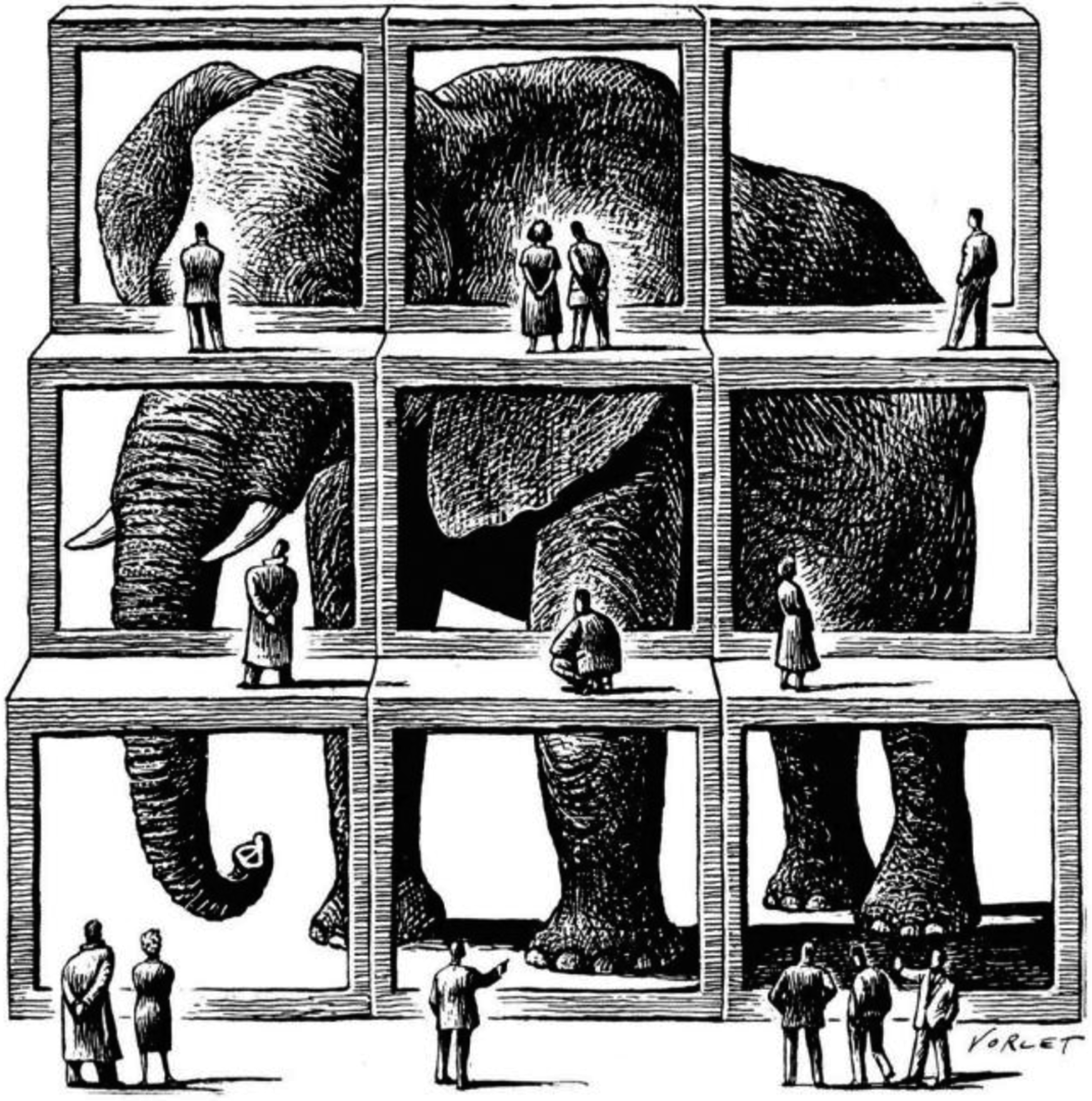
In the context of GTM, Bryant has stressed that researchers need to be ‘in dialogue with their data’ (Bryant, 2019, p.37). This applies to all forms of research regardless of the method(s) employed, and should be understood to encompass all research participants – avoiding the term ‘research subjects’ – recognizing everyone’s active involvement in the process.
Other forms of dialogue occur within the doctoral process, some unique to that context, others with wider applicability. Doctoral researchers will be in dialogue with their supervisors/promoters, a relationship that evolves during the research, also with their peers. Both Alexandra and Sanela refer to this; Sanela having to distance herself from her supervisors as she engaged with phenomenography.
Researchers should continually conduct an internal dialogue, reflecting on their research. Sanela and Alexandra refer to their specific practices in this regard. Many research guides recommend researchers keep a research journal throughout the process to accomplish this. GTM incorporates this with the technique of memo-making, a pivotal intermediate step between data collection and writing papers or dissertations. ‘When grounded theorists write memos, they stop and analyse their ideas about their codes and emerging categories … Writing successive memos keeps researchers involved in the analysis and helps them to increase the level of abstraction of their ideas’ (Charmaz, 2014, p. 343).
In practice doctoral researchers’ early memos focus more on their research activities than on data and analysis. Students wonder whether they are following the method correctly, worrying where this is taking them. Later, as their research progresses, they become more confident they are working effectively and producing coherent outcomes. The analytic aspects then come to the fore. (See Bryant, 2017, chapter 10 for discussion and examples of this.)
Memos and research journals are primarily intended to be private records. Early GTM writings mentioned memos only in passing. In the last 20-30 years, however, reports on GTM research – theses, journal papers and the like – often include verbatim memos. Sanela noted that with a phenomenographic approach she was expected to signpost the use of bracketing throughout data collection, data analysis, and discussion chapters. She termed this an audit trail, allowing readers to see/follow the journey, including her processes of data collection and analysis.
However this is accomplished, this aspect of the research dialogue is part of ‘reflective practice’. Doctoral students are expected to offer a reflective discussion as part of their thesis – usually in the concluding chapter (see the endnote on reflexivity; Schön, 1983; Bryant, 2017, chapter 10). Doctoral researchers need to be able to recognize and understand the process of reflection and the different dimensions of ‘a dialogue with the data’ as a critical aspect of their journey.
Affordance 3: Methodological Sensitivity
Consciously building on the work of Glaser and Strauss (1967), and their term ‘theoretical sensitivity’, Bryant defines methodological sensitivity as ‘the skill or aptitude required by researchers in selecting, combining and employing methods, techniques and tools in actual research situations’ (Bryant, 2017, p.36). Researchers are now faced with a plethora of accounts of a variety of research methods, tools, and techniques. Many research reports include the claim that the researcher(s) used a ‘mixed methods’ strategy. This term originally denoted a research approach involving both qualitative and quantitative methods. In some cases, however, claims to this effect do not relate to such a strategy, but rather to one where the researcher finds that the overall research strategy needed to involve more than one selected method, usually both qualitative. This is more correctly termed ‘multi-methods research’.
Far more common, however, are the issues reported by Alexandra and Sanela. Alexandra started out thinking she would use a case-based strategy and initially rejected GTM. Sanela was encouraged by her supervisors to use Action Research but then decided it was unsuitable for her research focus on student experience. As their research progressed, they each began to understand the complexities of the process itself. The textbook versions of methods only go so far, and a key research skill is recognizing the points at which changes and compromises are required as the project progresses. This is methodological sensitivity, which must be under constant development by every researcher. Researchers need to gain wide familiarity with research methods, understanding various options open to them, avoiding slavishly sticking to one method treating it as a recipe to be strictly followed. This is encapsulated by Gorard, an insightful critic on research methods and mixed methods specifically, who argued that ‘[M]ixing methods is wrong, not because methods should be kept separate but because they should not have been divided at the outset’ (Gorard, quoted in Symonds and Gorard, 2010).
Both researchers were commended for their respective discussions of how their overall research strategy evolved, clearly demarcating these details from the textbook accounts. As their comments demonstrate, they found authoritative sources, building on these, moving on and, if necessary, away from them as circumstances dictated.
Illustrating aspects of methodological sensitivity, here are their accounts relating to Key authorities and influences; Choosing a method; Characterising a research strategy; Engaging with the data.
Key authorities and Influences, and Choice of Method
AB: Your memos mention key authorities influential in developing your ideas, guiding your understanding of key topics and research strategies. Why these specific figures and how did they impact upon you and your choice of method?
AL: Choosing where to start when trying to learn about grounded theory is a task in itself. Through pure serendipity, during my PhD induction, I attended a lecture delivered by a colleague, after which I initially disregarded GTM as irrelevant to my research. Thankfully, the lecture was recorded, and I came across the online version almost a year later. This happened as I began contacting potential research participants, seeking information about their commissioning arrangements. Through these initial conversations GTM began to make sense and feel relevant.
I then accessed the literature on GTM. On reflection, I now see that I was developing ‘methodological sensitivity’ acquiring the skills to be an effective researcher. Bryant (2017) explains that methodological sensitivity is developed when researchers seek guidance from other researchers and supervisors, through experience and studying research methods.
For a GTM study, you need to do two things. First, read the seminal texts. As a minimum Glaser and Strauss’ (1967) The Discovery of Grounded Theory and Awareness of Dying (Glaser & Strauss, 1965), also Glaser’s (1978) Theoretical Sensitivity. Second, swiftly move on to read about the development of GTM, including its variants. This is to avoid getting stuck in positivist interpretations of the original approach, often referred to as Classic GTM. As a constructivist grounded theorist, this was especially important. I think if I had not continued to read more contemporary literature on the subject, I would have dismissed GTM as an option due to its positivist foundations.
Once I decided to consider GTM I went to the SAGE Handbook of Grounded Theory (Bryant & Charmaz, 2007) which helped inform the early development of my study and select the most appropriate form of GTM for my research. I realised there is more than one way to apply GTM.
At various points I searched for answers on how to conduct my research. I tried to do this using the literature, including the Handbook and peer-reviewed journal papers, but this often left me confused. However, reading more widely on Constructivist GTM (CGT), some trial and error, and seeking the support of research supervisors and peers, offered some resolution and contributed to enhancing what I now understand as my growing methodological sensitivity. This enabled me to move from the application of “method-in-textbook to method-in-use” (Bryant, 2017 p. 36).
Once I had disregarded the case-study approach, and having discovered GTM I was gifted a copy of Charmaz’s Constructing Grounded Theory and everything started falling into place. Charmaz (2014 p. 13) states that
The constructivist approach shreds notions of a neutral observer and value-free expert… researchers must examine rather than erase how their privileges and preconceptions may shape the analysis, but it also means that their values shape the very facts that they can identify.
The playwork profession is inherently reflexive (Long, 2022). Engaging with playing children requires an honest and critical examination of what we each bring to the interactions and how playing children affect how we engage with them. This approach is prescribed in our professional and ethical framework for practice (PPSG, 2005). As such, the reflexive nature of CGT resonated with me. It felt natural to think deeply about how my experiences would shape and inform the research process. My professional experiences of working in the field shaped who I was at the time of the research and as a constructivist grounded theorist, examining my subjectivity at all stages of the project became central to the journey. Other varieties of the method did not reflect my epistemological and ontological stance. It was at that point that I realised that CGT was the method most suited to my research.
SL: My supervisor suggested Action Research (AR), and for the first year I pursued this but gradually realised it was not going to work for the problem I wanted to investigate. I had used AR in various ways, to some extent intuitively, in 20 years of teaching, using feedback from students and colleagues to develop my teaching. This approach was not going to be effective in pursuing my research questions which were ‘pushing’ me towards phenomenography with its focus on understanding the experience of learning from the students’ perspective, promoting ‘a different way of thinking about teaching and learning’ (Ramsden, 1985, p.52) even amongst those not engaged in phenomenographic research.
Phenomenography is one of few methodological approaches that did not emerge out of other research methods but was specifically developed to cater for research in HE (Åkerlind, 2023, 2024). Recognising the suitability of this method and understanding its concepts was a complex process since I only really began to understand the shape and nature of my research contribution once I had clarified my use of the phenomenographic approach! The work of Marton and Booth (1992, 1997) was particularly helpful, particularly Booth as she had conducted research with computing students.
I specifically wanted to investigate student experiences of independent digital learning during the assessment period, when teaching had finished, and students were conducting their own learning through research and completing their programming assessments tasks.
As a computer scientist, working in the quantitative world of data analytics I was interested in developing my skills as a qualitative researcher. To this end I studied different research approaches to understand more about various student practices; research on self-directed learning (Knowles, 1975; Merriam, 2004); self-efficacy (Bandura, 1992); understanding student learning (Entwistle and Ramsden, 1983); learning by doing (Dewey, 1969, 2013).
This led me to investigate various qualitative research approaches. I had heard of phenomenography from a colleague who was considering this approach for his research, which aroused my interest. I realized that it provided the perfect fit with my research question since it focused on the experiences of others. It also aligned with my epistemological and ontological stance. As an independent learner myself, I needed to separate my experience from that of the context of independent digital learning under investigation. The Swedish form of phenomenography was particularly suited to this. It was developed in the Department of Pedagogy in Göteborg University, and since I can read Swedish, I was able to access the original papers.
Once I had opted for this I had to ensure that I clarified what this entailed given that the method has developed in various ways since its inception, including two distinct forms that I refer to as Swedish (Fence Marton, Roger Säljö, Lars Lindström and Shirley Booth) and Australian (Christine Bruce, Graham Webb, Gerlese Åkerlind, John Bowden) approaches.
Characterising the Research Strategy
AB: Over many years of supervising Masters and Doctoral research I have developed the view that the most appropriate term to apply to the researcher’s discussion of their overall approach is Research Strategy, rather than Method, Methodology, or Design (Bryant, 2017, chapter 2). This encompasses a researcher’s use of methods, tools, and techniques, highlighting the ways in which these combinations were used in practice, often involving idiosyncratic applications. How would you characterise your overall research strategy? Did it change over the course of your research, either regarding your focus or the process of carrying out the research, or both?
AL: My professional experiences to 2011 influenced how I thought about commissioning. I was keen to explore how the process of commissioning affected play service delivery, anticipating a disconnect between commissioning specifications and service delivery. When I entered the research field, I realised this was wrong, or at least the pace of change within our sector was so great that issues in 2011 when I left the sector had changed significantly. Following initial conversations with project representatives aiming to garner their support as research participants, the PhD started to become one which applied GTM. I realised the data was dictating what was important for the study. The GTM approach of simultaneously collecting and analysing data with the aim of capturing the stories of those within the research field shaped the study. I therefore changed focus and began my Constructivist Grounded Theory journey. SL: I had studied theories of learning. The constructivist approach seemed most appropriate for my research, but it did not directly address the dilemmas that arose from students’ ways of experiencing (thinking, feeling, perceiving). Some of the key areas I had already identified were around self-regulation, metacognition and self-efficacy. Eventually I realised I did not want to study the learning process, rather my focus needed to be students’ relationships to learning and their conceptions of learning, particularly computing students and their relationships to and experiences of digital learning, and their perceptions of digital technology and its impact on their learning.
Engaging with the Data
AB: How would you characterize your initial engagement with the research context and ‘the data’?
AL: My supervisors raised the importance of looking for surprises in the data but there were surprises in how the research developed from the start. To do the field justice, I had to find a way to represent the experiences of those within it. I needed to apply a methodology that would allow flexibility, centring round the voices of research participants, not imposing my ideas through testing a hypothesis. Having already undertaken a Masters by Research I was comfortable with the uncertainty I experienced during the early stages of the project. The study evolved as I became familiar with GTM and the study changed each time I engaged with the field and generated data. I was learning as I was doing. By the time I got to open-coding phase one data, I had discovered CGT and as I progressed towards phases two and three, my knowledge and confidence with this variety of GTM developed and evolved. I know this uncertainty can feel uncomfortable at first, but I overcame this through various strategies. Firstly, finding a good supervision team, specifically a combination of those who understood the method and the field of study. This offered reassurance that whilst the field and the method might present me with surprises, these were not beyond the experiences of the supervision team. I also managed it through reflecting on the data. If my study was to be grounded in the data, then I had to ensure that I was responding to the categories identified within the field. I felt a responsibility to do justice to the data. SL: My initial engagement with the topic started earlier listening to students reflecting on how they approached learning and what could have been factors for their good/bad results. I wanted to get beyond anecdotes, assumptions, guessing, and trial and error approaches to teaching. I wanted to focus on the learning experiences of students, finding out more about my students’ experiences, using these insights to help and support them.
Only towards the end of my research did I realise that my approach and attitude to data analysis were closely matched with the subject area of teaching. Initially I was seeking objectivity, then I came to accept that there could be different interpretations of the data, and that my research inevitably involved my own conceptions. The phenomenographic approach recognizes that research is interpretative, but this does not mean it is subjective. Rather it is seen as relational
Persistent enhancement of methodological sensitivity is crucial for all researchers, but particularly so for doctoral and early career researchers who lack extensive experience. Initially researchers will only have familiarity with the ‘method-in-text’, rather than the ‘method-in-use’. Indeed, the latter can only be developed once there is some understanding based on the former. It is, therefore, essential doctoral students recognize this transition is part of the doctoral journey and their dissertations need to reflect this, indicating the ways in which their research strategies involved an understanding that research methods are not recipes to be followed slavishly, rather they must be understood as heuristic and exploratory guides to concrete research activities and projects.
Affordance 4: Mentoring
Doctoral students develop their ideas under the guidance of more senior academic researchers. In the UK this latter group are called ‘supervisors’, elsewhere they are termed ‘promoters’ or ‘advisors’. None of these terms cover the full remit of the relationship as it develops over the course of the research, anywhere from 3-7 years. The term ‘mentor’ seems a more suitable one.
Most doctoral students start as novices, needing guidance and supervision for the early stages, even if they have been involved in research prior to embarking on a PhD. The initial stages may be constrained by senior academic(s) as the topic may already have been largely defined, perhaps as part of a funded project. Yet even in these cases the researcher will have to chart their own path as the study develops. In many other instances, including the projects undertaken by Alexandra and Sanela, the doctoral student largely devises the project from scratch with guidance from senior academics.
In their presentation of GTM in the 1960s, Glaser and Strauss stressed that the method was deliberately aimed at doctoral and early-career researchers in the social sciences who were otherwise regarded as ‘proletarian researchers’ toiling away, being exploited by ‘theoretical capitalists’ in control of the academy. Behind their colourful language lay the aim of instilling confidence in junior researchers, offering a strategy for them to develop their own theoretical concepts and models in the form of what Merton termed ‘theories of the middle-range’ (see Glaser and Strauss, 1967, pp.32-33). Yet this can be a difficult process as many doctoral researchers find themselves suffering from impostor syndrome and lack of confidence.
In the early stages a doctoral researcher may require close supervision, involving frequent meetings with one or more mentors, circulation of detailed notes, and clearly defined actions on the part of all parties concerned. Eventually, and preferably sooner rather than later, this scrutiny becomes superfluous; meetings take the form of discussions amongst equals rather than tutorials. Sometime by the latter stages, the roles are if not reversed then re-balanced, with the doctoral researcher taking the lead, presenting their findings and analysis to an expectant and receptive audience. In this latter stage mentors must act as the student’s keenest and most incisive critics, ensuring that the eventual PhD examination does not come as a nasty surprise. Alexandra and Sanela each enjoyed their viva, seeing it as an opportunity to engage with academics who had taken the time and effort to study their work from a position of expertise in their various fields.
Sanela commented that she felt rushed by her supervisors into starting data collection. In part this arose from their unfamiliarity with phenomenographic research and the necessity for her to clarify her overall research strategy. Once her understanding of phenomenography developed, she realized she knew more about this than her supervisors. The result was she grew in confidence and was able to move on.
One further aspect related to mentoring is the role of a doctoral student’s peers. Alexandra and Sanela noted the importance of the various support and teaching sessions offered by the university. These included sessions on specific methods, tools, and techniques, also ones on academic regulations and procedures. In addition, both researchers described the significance of engaging with the research community as an additional source of mentorship. Alexandra described the benefits of presenting tentative findings at conferences at two key points of her research journey. This offered an opportunity to check her findings with her peers, reviewing them against Charmaz’s (2006) criteria of ‘originality’, ‘resonance’, ‘credibility’, and ‘usefulness’. Likewise, Sanela felt strongly that engaging with the research community should be a requirement for doctoral researchers. She sought out the phenomenographic community to help develop her understanding of her approach, seeking feedback on her work and sharing ideas with others. This helped fill gaps present in published accounts of phenomenography.
Affordance 5: Epistemology and Ontology
There is often an expectation that doctoral students should declare their position on epistemology and ontology. This is not universal, and in some theses these issues are barely addressed, particularly if a quantitative strategy is used. Questions relating to ‘how do we know what we know?’ and ‘what is the nature of reality?’ hold a fascination for many, but is it fair and realistic to expect PhD students to immerse themselves in complex philosophical discussions? Without wishing to offer an extended discussion, we differed in our views on this issue. Tony felt that doctoral students should steer clear of these topics unless specifically requested to address them. On the other hand, Sanela and Alexandra felt that students need to engage with philosophical debates, particularly if their choice of method and/or research strategy emanates from areas where these issues are seen as critical or contentious. Alexandra felt that this was exactly the case regarding her choice of using Constructivist GTM.
We resolved this by agreeing that the affordance needs a sign ‘Danger – Beware: Do not use terms such as ‘positivist’, ‘induction’, ‘epistemology’, ‘ontology’, or the like unless you are prepared to defend and explain them in your viva’. Alexandra’s discussion of abduction in her thesis – see below – is a clear and cogent example of how to accomplish this. (See Bryant, 2017, pp.40-57 chapter 2 for further discussion of what he terms the ‘E’ and ‘O’ words.)
Affordance 6: Positionality and Embodiment – Personalizing
In both Alexandra’s and Sanela’s accounts there is a strong and sustained personal element. Each refers to highly personal reasons for wanting to undertake their study, gaining insight into issues that were important to them based on previous and current experiences and concerns. They also offer glimpses into their personal circumstances and biographical development. Furthermore, both Constructivist GTM and phenomenography characterize the research process as one that involves the researcher as an active and directing agent, firmly rejecting the image of the dispassionate, disinterested, and neutral researcher.
This personalizing of their respective research journeys exemplifies how researchers should account for their positionality and embodiment when reporting and reflecting on their work. Researchers, particularly those involved in qualitative research with other participants, should be encouraged to do this, albeit limiting discussion to aspects pertinent to the study itself. This is often accomplished, in part, by use of first person constructs which are all too often dismissed out of hand by editors and others.
Affordance 7: Flashes of Insight; Abduction
Alexandra refers to abduction, and GTM is now regarded by many as an abductive method. The term was used by C. S. Peirce in 19th century denoting a form of logical argument distinct from both induction and deduction. Charmaz defines abduction as: ‘a type of reasoning that begins by examining data and after scrutiny of these data, entertains all possible explanations for the observed data, and then forms hypotheses to confirm or disconfirm until the researcher arrives at the most plausible interpretation of the observed data’. (Charmaz, 2006, p.186, emphasis added)
Abduction involves a logical ‘leap’, as opposed to the more careful and considered processes of induction and deduction. Moreover, abduction is both a cognitive process and a logical one. The two aspects being equally important, with the former predominating in the early phases. Alexandra’s reference to her understanding of the term as ‘a lightbulb moment’ is an example of abduction. The key issue for researchers is that it allows for and even encourages flashes of insight as part of the investigative process; the source for these often being the experience and skills of the researcher.
GTM is a model of research based on careful engagement with and scrutiny of the data, avoiding what Glaser termed ‘immaculate conceptualization’ (1978, p.8). But in their pioneering GTM manifesto, The Discovery of Grounded Theory, Glaser and Strauss (1967) devoted an entire chapter to the importance of flashes of insight to the research process. Note, however, how they distinguish between ‘the process of research’ and the ‘source of ideas’.
Generating a theory from data means that most hypotheses and concepts not only come from the data, but are systematically worked out in relation to the data during …the research. Generating a theory involves a process of research. By contrast, the source of certain ideas, or even “models,” can come from sources other than the data. The biographies of scientists are replete with stories of occasional flashes of insight, of seminal ideas, garnered from sources out-side the data. But the generation of theory from such insights must then be brought into relation to the data, or there is great danger that theory and empirical world will mismatch. (Glaser and Strauss, 1967, p.6, emphasis in the original) Researchers should not shy away from what Glaser and Strauss refer to as ‘cultivating reflections on personal experiences’ but treasure them as ‘springboards to systematic theorizing’ (1967, p.252). But note the emphasis they put on ‘systematic theorizing’ as part of a rigorous ‘process of research’.
Discussion
Alexandra’s and Sanela’s accounts provide significant insights into the experience of doctoral research. For both prior experiences and professional practices were key motivators, proving essential in their progress; helping them re-orient their ideas once their research gained traction with the context, offering support for the conceptual development of their studies. Moreover, their research contexts were in areas significantly affected by recent and continuing changes: Children’s play by the new ‘commissioning’ model; computer science courses and teaching generally by the introduction and development of digital technology. The drive to grasp the ramifications of these developments provided initial impetus to both studies as well as the foundation for their respective contributions to knowledge and practice.
Both studies drew on the researcher’s extensive experience and immersion in a specific practice or range of practices. In Alexandra’s case this emanated from her re-engagement with previous employment, challenging her assumptions, leading to a re-orientation of her strategy. For Sanela, research allowed her to step aside from day-to-day routines, something she had grown accustomed to over may years of teaching. One beneficial outcome of this was the ability to gain a bird’s-eye view of what was otherwise experienced as turmoil and lack of direction. These both exemplify Affordance 1 ‘Motivation’, stressing the role of prior experience coupled with the opportunity research offers to move from active immersion in a field to the possibility of developing a wider, critical perspective.
Alexandra and Sanela make similar points regarding initial encounters with their research contexts, combining ‘concern’ with ‘enjoyment’. This provided the basis for engaging in the process of investigation in an open-minded and cautious manner, key prerequisites for the rigour and self-critical awareness that are essential components of any research study. This dual orientation also relates to their feelings of humility, indicated in their questioning of their initial ideas and assumptions, and the many doubts and questions they raise in discussing their work. Together these relate to Affordances ‘Motivation’, ‘Methodological Sensitivity’, and ‘Positionality and Embodiment’, indicating the necessity for researchers to be open-minded combined with humility as the basis for critical self-awareness and reflection.
Qualitative research allows various forms of engagement with the research context and the people who participate in and constitute its practices and actions. This is usually in the form of interviews, although qualitative researchers should consider alternatives and/or complementary forms of interaction. There is now an accessible and critical literature on research interviews encompassing discussions on power imbalances, bias, and other issues. Anyone using interviews in a research project must make themselves familiar with contributions such as Silverman’s (2020) and Gubrium et al.’s Handbook (2012). All three of us dislike the term ‘interviews’ given the connotations of interrogation and confrontation, preferring ‘conversations’ or ‘dialogues’ where researcher(s) aim to engage with participants – not ‘subjects’ – in a discussion based on partnership and cooperation. This is encompassed by the Affordance ‘Research Dialogues’.
Alexandra and Sanela refer to methodological doubts and issues. Phenomenography is not yet a widely used method, and currently largely confined to research in education contexts. Moreover, it is often confused with ‘phenomenology’, a misunderstanding with which Sanela had to contend on several occasions. Sanela also notes that the method was developed for research projects involving two or more researchers, a basis for enhancing validity. This made it a potentially awkward choice for doctoral research since for the most part PhDs are required to be the work of a single person.
Grounded theory, on the other hand is the most widely used qualitative research method across an increasing range of disciplines and domains. This, however, does not make it immune from misunderstanding and prejudice. On the contrary, it attracts a range of criticisms, many unfounded and ill-informed (see Bryant, 2020). Precisely because it is widely used, there are many instances of poor research claiming to be GTM-based, but this is no more prevalent for GTM than it is for any other research method. Indeed, the failings of many quantitative research outputs probably outnumber those of qualitative ones.
For doctoral students this issue is often keenly felt. Stern, an early student of Glaser and Strauss, coined the term ‘minus mentoring’ referring to the issue of doctoral researchers using a method with which their supervisors have little or no familiarity (Stern, 1994). This may not be a problem if acknowledged by one’s supervisors, providing there are authoritative and accessible resources elsewhere; texts or advisors, or both. But in the 1970s and 1980s there were few doctoral advisors with knowledge of GTM, while many doctoral students were keen to use the method. The situation has changed in the past 20+ years, with many doctoral advisors having some familiarity with GTM, although often this ‘familiarity’ is based on misconceptions about or even prejudice against the method per se.
Alexandra did not have this problem, but Sanela certainly did. When the term was explained she responded as follows:- It is important that supervisors should have a good grasp of the topic and proposed research methodology at the beginning of the project, when students are establishing their research strategy, seeking confidence that their approach is sound. My supervisors rushed me to collect the data and complete the interviews. I understood in principle what I needed to do but what I didn’t know was how to conduct phenomenographic interviews.
Doctoral students can be confronted by even more extreme minus mentoring issues if they are aiming to conduct a qualitative study, but their supervision team comprises those who only know about quantitative research. The reverse situation, with a student aiming to do a quantitative project under guidance from qualitative advisors, is far less common since doctoral advisors without experience and expertise in quantitative methods usually ensure that they either add people with relevant expertise to the team or recommend an alternative team.
Alexandra and Sanela eventually settled on what they felt to be the ‘right’ or ‘most effective’ approach, but this was only after they were well into their respective projects. The lesson here is that doctoral researchers should keep their options open while they position themselves for their project, considering different strategies and possibilities. Alexandra refers to this as developing methodological sensitivity, and much of the last few paragraphs relate to this affordance. In effect enhancing one’s methodological sensitivity may involve working against one’s peers and research mentors as much as the latter may also assist in the process.
Although there is a general congruity between Alexandra’s and Sanela’s respective epistemological/ontological stances, there are some differences. Alexandra clearly states her constructivist position, quoting Charmaz (2006, p. 132)
The constructivist approach shreds notions of a neutral observer and value-free expert… researchers must examine rather than erase how their privileges and preconceptions may shape the analysis, but it also means that their values shape the very facts that they can identify.
While the founding text on GTM was The Discovery of Grounded Theory, Charmaz’s major restatement of the method was deliberately titled
Sanela in contrast espouses the phenomenographic position that seeks to avoid the subjective-objective binary with the argument that research is relational. She quotes Marton.
The experiences and understandings are jointly constituted by interviewer and interviewee (Marton, 1994, p. 4427).
This non-dualistic epistemology views people’s understanding of a phenomenon as a relationship between the individual and the phenomenon being experienced. There is no real world ‘out there’ and a subjective world ‘in here’. ‘The world [as experienced] is not constructed by the learner, nor is it imposed upon her; it is constituted as an internal relation between them.’ (Marton & Booth, 1997, p. 13).
There is considerable overlap between these positions. Both distance themselves from any idea that it is possible to conduct research from a neutral and objective position. The phenomenographic stance is relational, refusing to distance or separate the context of research or indeed of everyday experience from the researcher or everyday actor. The constructivist position does not stress this relational aspect, although it is to some extent subsumed within the presumption that our knowledge of the world is socially constructed. This is sometimes mis-characterized, even by those who should know better, as claiming that reality is in some way the product of consciousness (see Bryant, 2017, p.347).
Richard Rorty offers a simple distinction between those who argue that truth is discovered and those who argue that truth is a social product – i.e. a construct. He never denies the existence of reality, but he does deny the possibility of humans accessing it without recourse to some interpretative process. His specific target is the notion that we can hold up ‘a mirror to nature’ (Rorty, 1979), an idea that leads to the claim that the aim of our investigations is to produce increasingly accurate representations of reality, something he rejects precisely because the only tools we have are socially-grounded communicative ones; what might be termed ‘squeaking, scratching, and fidgeting’ (Bryant, 2017, pp.347-8). Alexandra differed from Tony on the necessity to address these issues, but this is encompassed in Affordance 5, including the admonition to avoid using philosophical terms one is unable to substantiate and clarify.
The phenomenographic position is distinct from constructivism in seeking to enforce bracketing, a term taken from phenomenology advocating that investigators suspend trust in the objectivity of the world. Instead, the researcher should focus on the experiences of key agents in the context under investigation. Thus, while the constructivist position openly acknowledges and embraces the researcher as an active participant, the phenomenographic one advocates a cognitive distancing on the part of the researcher. This distinction is encompassed by Affordance 6.
Two Final Thoughts
The concept of doctoral affordances arose in our early discussions. We then developed our ideas using it as the basis for this article which we believe encapsulates what one reader of an early draft called ‘the inevitable messiness’ of doctoral research. The result is a deliberately detailed account of seven doctoral affordances drawn from the experiences of two recent doctoral students, deliberately eschewing any attempt to take the concept to a higher more abstract level at this stage. Based on our collective experience of doctoral supervision and examination we particularly wanted to offer doctoral students the basis for insightful reflection on the process, something that doctoral students crave and which is largely missing from textbooks and journal papers pitched at more abstract and often abstruse levels.
Moreover, in the foregoing we have tried to offer some practical insights for doctoral students and other early-career researchers as they embark upon and hopefully complete their research journeys. These offer guidelines for thinking about and enacting research strategies, encompassing not only the issues of methods, tools, and techniques, but also highly personal aspects involved in developing novel concepts and ideas. 7 Given the novelty of the doctoral experience anything that can be done to guide students from the outset should be welcome, both for students and their supervisors/mentors. The latter can find ways to indicate relevant affordances to the former, leaving it to doctoral researchers to experience their use and usefulness for themselves. We recognize that no two journeys are alike, but in offering these doctoral affordances, paraphrasing Keefer, we aim to indicate a portal, revealing new and previously inaccessible ways of thinking about the doctoral journey.
Footnotes

Funding
The authors received no financial support for the research, authorship, and/or publication of this article.
Declaration of Conflicting Interests
The authors declared no potential conflicts of interest with respect to the research, authorship, and/or publication of this article.