




Abstract
Introduction
We examined the rate of positive findings and the distribution of vascular ultrasounds in the pediatric and adult population. Prior literature has noted a low rate of positive findings in adult vascular ultrasounds but there is little literature on pediatric vascular ultrasound.
Methods
We reviewed our vascular duplex database on inpatients less than 18 years old and compared it to the adult inpatient vascular duplex exams from 2005 to 2010.
Results
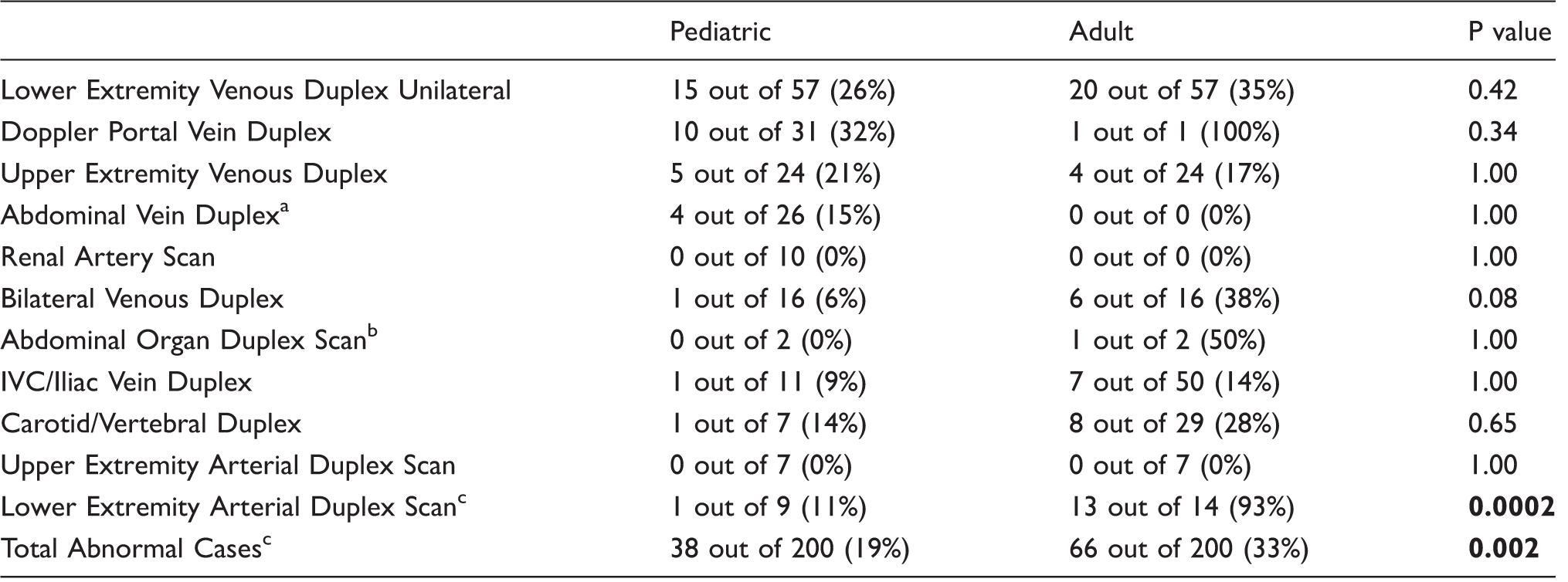
The adult patients had more extremity vascular exams while the pediatric patients had more abdominal and renal exams. Moreover, the positive rate of adult lower extremity arterial duplex was significantly higher than the pediatric group (p = 0.002).
Conclusion
We had a higher yield of positive findings in the adult cases. We observed a higher proportion of more complex duplex exams in the pediatric cases suggesting that a higher level expertise is needed to perform the pediatric vascular duplexes.
Keywords
Introduction
Ultrasonography is a diagnostic medical imaging technique that is commonly used to evaluate various types of vascular pathologies. Because of its high specificity, cheaper cost, and lack of radiation, ultrasonography has become the main initial diagnostic imaging modality for vascular diseases. 1 The technology of ultrasonography has made significant advancements, which in turn has increased the use of ultrasounds as well. Traditionally, ultrasounds have been the favored imaging modality in the pediatric population because of patient safety considerations. Surprisingly, there is very little literature on pediatric vascular ultrasonography. Also, currently there are no practice guidelines for the use of pediatric vascular ultrasonography established by the American College of Radiology.
In contrast, the topic of adult vascular ultrasonography has been well studied and prior literature has noted a low rate of positive findings in the adult population. 2 However, there has been little literature on pediatric vascular ultrasounds except very few case reports.3–8 These case reports demonstrate the utility of ultrasounds to evaluate different types of vascular pathologies in pediatric patients including portal vein thrombosis, arterial aneurysm, vascular malformation, and deep vein thrombosis of the extremities; however, even though ultrasonography is used to diagnose the pathology, no literature reports the positive finding rate of the examinations. 9 The purpose of this study is to distinguish whether or not there would be a higher rate of positive findings in the pediatric population in comparison to the adult population. A review of the Total Vascular Care duplex database on hospitalized patients was conducted, and the rate of positive findings as well as the distribution of vascular ultrasounds between pediatric and adult patients was compared.
Materials and methods
Study population
This is a comparative retrospective study of 400 hospitalized patients from 2005 until 2010. All protocols and principles of Declaration of Helsinki were strictly followed. The ultrasounds of 200 consecutive pediatric patients from the Total Vascular Care database and the ultrasounds of 200 consecutive adult patients from the same institution were selected and their results were compared. The patients’ age, sex, indication for imaging, and their results were reviewed. In the subsequent data set, the two populations were compared after they were matched according to the different types of ultrasound exam.
Categorization of the different ultrasound exams
The pediatric and adult population groups were categorized into different types of exams. These categories are unilateral lower extremity venous duplex, portal duplex, upper extremity venous duplex, abdominal venous duplex, renal artery duplex, bilateral venous duplex, abdominal organ duplex, inferior vena cava (IVC)/iliac vein duplex, carotid duplex, upper extremity arterial duplex, lower arterial duplex, aorto/iliac duplex, and arterial graft duplex. The positive results were based on the radiographic results from the Total Vascular Care medical record.
The 200 pediatric and adult patients who were consecutively selected were categorized into several test groups. Based on their electronic medical records, the positive rates of each exam were calculated.
Statistical analysis
Rate of positive finding for 200 adult and pediatric cases. Average age (years): 10.4 67.85 Sex: Male-106 Female-94 Male-98 Female-102

Abdominal vein duplex includes renal, portal, and splenic veins and excludes inferior vena cava and iliac veins.
Abdominal organ duplex includes celiac, superior mesenteric, and renal arteries and excludes aorta and iliac arteries.
Significant p-values.
Rate of positive findings in matched data sets. Average age (years): 10.4 69
Abdominal vein duplex is a visceral exam and includes renal, portal, and splenic veins and excludes inferior vena cava and iliac veins.
Abdominal organ duplex includes celiac, superior mesenteric, and renal arteries and excludes aorta and iliac arteries.
Significant p-values. The total number of vascular duplex exams that were performed in the hospital during this time period was 51,240.
Results
All of the positive rates of different examinations, when comparing 200 consecutive pediatric and adult patients, are listed in Table 1. As Table 1 demonstrates, the rate of positive finding is significantly higher in the adult group. However, the distribution of examination varies between the two populations; pediatric patients tend to have more abdominal and renal ultrasonography while the adult patient group had more extremity vascular exams.
When examining Table 1, interestingly, the positive rate of adult lower extremity arterial duplex was significantly higher than the pediatric group. However, statistical difference between the two groups may be skewed secondary to the significantly decreased frequency of that specific exam being performed in the pediatric groups. Other examinations failed to reveal any statistical significance.
It is suspected that the initial statistical analysis was skewed because of unmatched number of patients per examination. Therefore, the two groups were matched by the same particular vascular ultrasound test. Although creating exact matched number of patients for all examinations seemed impossible secondary to the wide distribution of tests that were performed for each group, the focus was made to match the more commonly performed tests such as lower extremity venous duplex, upper extremity venous duplex, bilateral venous duplex, and upper extremity arterial duplex.
Interestingly, the study failed to yield any statistical significance for the lower extremity venous duplex even when data were matched. Another phenomenon to note was the fact that the rate of positive findings of upper extremity venous duplex in pediatric patients shifted completely from lower to higher in comparison to the adult patients when data were matched. Even though the trend was appreciated, the difference was not statistically significant. Although the higher positive finding rate for the pediatric population was suspected, the positive rate for the adult ultrasonography was shown to be higher even after the data were matched.
Table 2 reports the statistical results of the positive outcomes after matching the two populations according to different types of ultrasound. As Table 2 demonstrates, there were no statistical differences amongst the majority of different types of tests even after the data were matched. The overall trend of positive rate was shown to be higher for the adult group even after the data were matched.
Discussion
The data proved the hypothesis to be invalid, and the adult patient group yielded higher positive findings from their examinations compared to the pediatric population. At the same time, it is noted that significantly greater proportion of renal and portal vein exams were performed in the pediatric group; on the other hand, carotid exams are more frequently performed in the adult group. Ultrasonography studies are technician dependent and the results may vary depending on the expertise and experience of the technician. From this study, a conclusion could be derived that higher level of expertise is needed when performing ultrasonography for pediatric patients based on the relatively lower rate of positive findings and different types of tests that are more frequently performed compared to the adult patients. When dealing with pediatric cases, the technician should be more judicious as the yields of the studies are not as high as the adult cases. Also, the technician should be better trained to perform different types of ultrasound examinations as the pediatric patients often require abdominal and renal sonography.
The strength of this particular study is the fact that it is one of the novel studies that deals with pediatric vascular ultrasounds. It provides the direction for the field as we suspect that there will be more pediatric vascular prevalence in the future. 9 Our study has obvious limitations of having a small sample size that was taken from a single institution and it was a retrospective study. Although there are obvious limitations, we believe that the study could provide a framework for the pediatric vascular ultrasound as a field that will become more prevalent in the future.
Conclusion
Our study results had a higher yield of positive findings in the adult cases when compared to the pediatric cases. Moreover, we observed a higher proportion of more complex duplex exams in the pediatric cases suggesting that a higher level expertise is needed to perform the pediatric vascular duplexes.
Footnotes
Declaration of conflicting interests
The author(s) declared no potential conflicts of interest with respect to the research, authorship, and/or publication of this article.
Funding
The author(s) received no financial support for the research, authorship, and/or publication of this article.