



Abstract
Objective
The aim of this study was to compare the drug-eluting balloon with self-expanding interwoven nitinol stent deployment in patients with complex femoropopliteal lesions.
Methods
We retrospectively identified patients at our clinic with complex femoropopliteal artery lesions treated either with self-expanding interwoven nitinol stent or drug-eluting balloon. All patients had ankle-brachial index measured before and after the intervention, and regular clinical follow-up with Doppler ultrasonography was performed at six months and one year. Patients underwent peripheral angiography if needed.
Results
From April 2012 to July 2015, 107 patients with complex femoropopliteal lesions treated with using self-expanding interwoven nitinol stent (N = 49, mean length 143.5 mm, mean follow-up of 14.1 ± 3.7 months) or drug-eluting balloon (N = 58, mean length 140.6 mm, mean follow-up of 13.8 ± 4.1 months). The technical success rate was 100% in Supera® and 96.6% in drug-eluting balloon group. There were seven restenosis in self-expanding interwoven nitinol stent (SUS) group (84.8% patency) and 11 restenosis in drug-eluting balloon group (79.2% patency). A significant increase in the ankle-brachial index in both groups after intervention demonstrated a hemodynamic success (SUS group 0.45 ± 0.06, drug-eluting balloon group 0.43 ± 0.07). The mean Rutherford Becker Class significantly decreased in both groups after a follow-up of 12 months (SUS group 0.70 ± 0.73, drug-eluting balloon group 0.74 ± 0.75).
Conclusion
Deploying drug-eluting balloon or self-expanding interwoven nitinol stent in patients with complex femoropopliteal lesions are both safe and effective with high patency rates with no statistical difference for one-year primary patency rates between them.
Keywords
Introduction
Peripheral arterial disease (PAD) is the third leading cause of cardiovascular morbidity. 1 Obstructive disease due to atherosclerosis of the superficial femoral artery (SFA) is the most common cause of intermittent claudication. 2 Endovascular therapy has been performed for the SFA gaining popularity in the last decade. It can be performed with high levels of procedural success despite low clinical risk, but the results of balloon angioplasty alone for complex femoropopliteal disease have been disappointing.3,4 The main problem with stent implantation of complex femoropopliteal artery lesions is the relatively high restenosis rate. 5 Technology and devices for femoropopliteal occlusive lesions have continued to evolve, such as atherectomy and thrombectomy systems, drug-eluting balloon (DEB), new stent designs, and therefore, the possibility for treating SFA obstruction and maintaining patency rates has dramatically increased. Self-expanding interwoven nitinol stents proved to be more efficient in long and calcified obstructive lesions compared to other nitinol stents.5–8 Our main purpose in this study is to compare endovascular recanalization with self-expanding interwoven nitinol stent or DEB in patients with complex femoropopliteal lesions.
Patient population
The study included 107 patients. We performed a retrospective, single-center study. Primary indications for intervention were claudication and rest pain. The inclusion criteria were vessel diameter of 4–7 mm, presence of Rutherford Stages 2 (all Fontaine IIb)–6, and persisting for >six months after appropriate medical therapy with walking exercise. All patients at our institution underwent baseline physical examinations with a focus on detecting manifestations of lower limb ischemia, classified according to Rutherford and Becker. Exclusion criteria were contraindication for combined antiplatelet therapy and need for major amputation at the time of enrollment. Demographic measures were similar between the two groups. Demographic measures, risk factors, and comorbidities are summarized in Table 1.
Demographics data.

DEB: drug-eluting balloon; SUS: self-expanding interwoven nitinol stent.
Methods
The present study complies with the principles outlined in the Declaration of Helsinki. The study was approved by the local ethics committee (Hospital committee no: AEK 15/002). Before the procedure, all patients underwent preoperative ultrasound evaluation and color duplex examination to visualize the extension and morphology of the femoropopliteal lesion. SFA and popliteal artery calcifications were evaluated and quantified with consultation of the radiology department, first with Doppler ultrasonography and then with digital subtraction angiography. The ankle-brachial index (ABI) was measured before and after the intervention. The mean Rutherford Becker Class and ABI measurement were similar between the groups before intervention (Tables 4 and 5).
Intravenous heparin (100 IU/kg) was administered after 6–8F introducer sheath was inserted. Mostly employing antegrade ipsilateral strategy, we used Judkins right catheter with Roadrunner® (Cook) hydrophilic guide wire to cross the lesions. Antegrade femoral approach was preferred in 94 patients (72 ipsilateral and 22 contralateral) and retrograde popliteal approach was preferred in 13 patients (11 short SFA stump and 2 failed antegrade approach). Atherectomy with Rotarex® system was preferred by operator’s choice in heavily calcified and long 35 lesions with suitable vessel diameter (DEB N = 16, SUS N = 19). Rotarex® system consists of three individual components that can be put together quickly by an experienced team. Operated by a motor unit with an electronic control unit, it also displays information on the functionality of the rotating helix. Inside the catheter runs a helical conveyor drive connected to the motor unit via a magnetic coupling. The rapid rotation (40,000 r/min) of the helix generates a permanent vacuum inside the catheter, which aspirates the thrombotic material in the target lesion and conveys it into a collection bag at the end of the catheter. A local injection of contrast agent was given to all patients via an over-the-wire catheter to verify a safe intravascular position. The Rotarex® system was advanced over this guide wire and then activated. During this step, the occlusion should be passed slowly. An average of 4 ± 2 atherectomy passes was performed with the Rotarex® system, beginning each time proximal to the occlusion with light forward and backward movements.
All lesions predilated before treatment with Supera® or DEB. Decision for further treatment with Supera® or DEB was given due to operator’s choice. The IN.PACT DEB has a dual mode of action, comprising mechanical dilatation by the angioplasty balloon plus local drug delivery to the arterial wall intended to inhibit restenosis. The IN.PACT DEB coating includes paclitaxel as the antiproliferative agent at a dose of 3.5 μg/mm2, with urea as the excipient. Available IN.PACT Admiral DEB sizes included 4- to 7-mm diameters and 20-, 40-, 60-, 80, and 120-mm lengths (the 7-mm diameter device was not available in the 120-mm length). More than 1 DEB deployed in long occlusions (>120 mm). The ratio of DEB to vessel diameter was planned to be 1:1(4–7 mm). The overlap zone was at least 10 mm if >1 balloon was used per lesion. Inflation time was 3 min. In case of flow-limiting dissection or residual stenosis of >50%, another prolonged dilation of up to 3 min was performed. A self-expandable stent was deployed when dissection affected flow or when there was >50% residual stenosis after DEB angioplasty. The interwoven nitinol Supera® stent is constructed from six pairs of nitinol wires woven together to create a helical pattern. The wires form closed loops at both ends of the stent. Stent length was selected so as to cover the lesion and at least 5 mm of lesion-free proximal and distal vessel. The overlap zone was at least 10 mm if >1 stent was used per lesion (Figure 1). Postdilation with a noncompliant balloon was performed due to operator’s choice if the stent was under expanded. Stents used in this study ranged from 4 to 7 mm in diameter and 40 to 150 mm long. Patients with additional BTK lesions were treated with DEB angioplasty (N = 8 SUS N = 10 DEB; Figures 2 and 3). Those with retrograde popliteal approach were treated in another session with no need of bailout stents.

Preinterventional angiogram of occlusion of the SFA (a). Retrograde popliteal access (b). SFA osteal seriously dissected (c). After Supera implanted to SFA distal (d). Final angiogram proximal part (e). Final angiogram distal SFA (f).
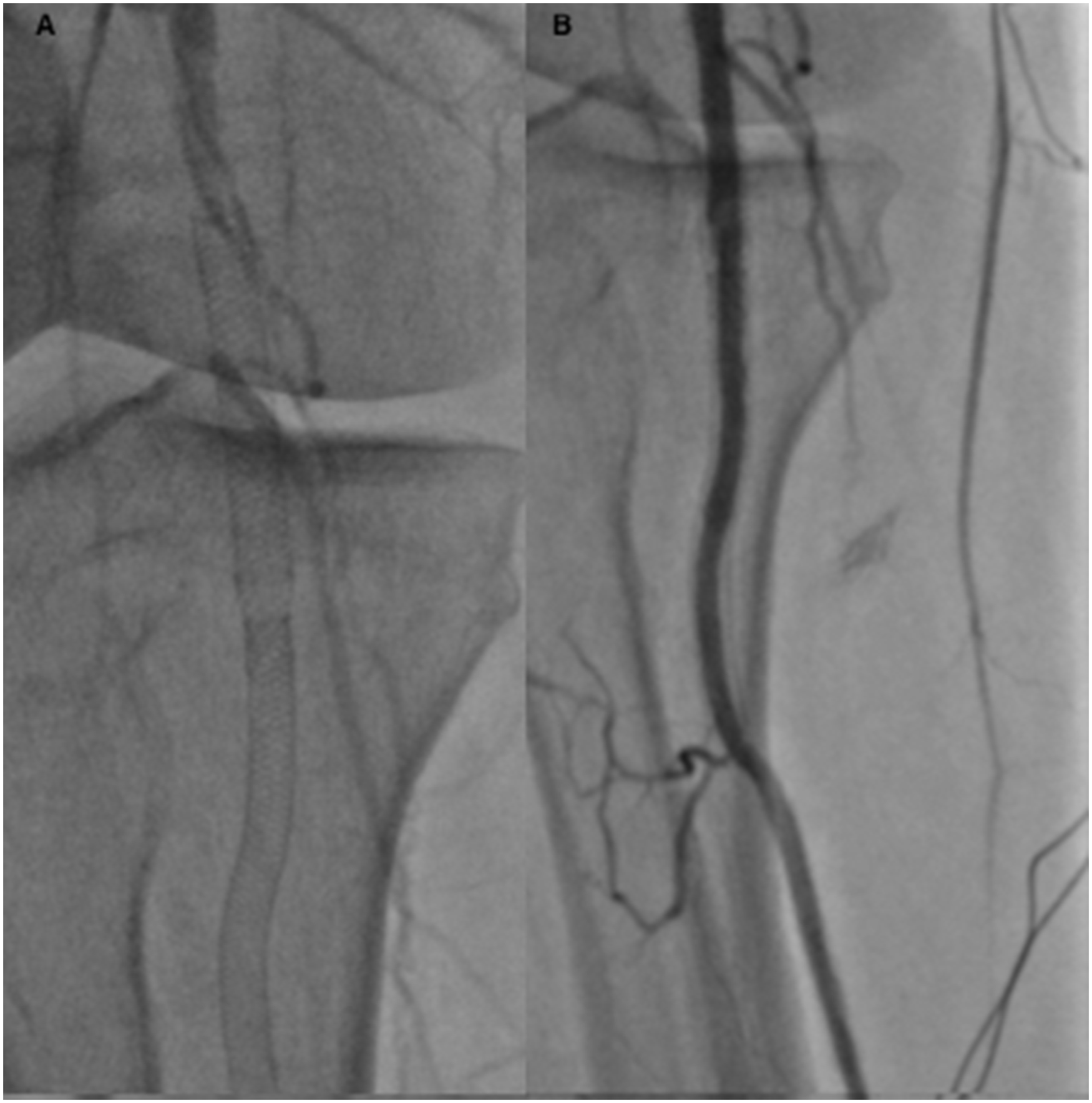
Preinterventional angiogram of instent occlusion of popliteal artery (a). After DEB angioplasty to instent occlusion with peroneal artery %100 occluded (b).

After DEB angioplasty to peroneal artery (a). Final angiogram showing below the ankle (b).
A completion angiogram concluded the procedure. Operative data are summarized in Table 2. All patients were discharged with three months dual antiplatelet therapy (DAPT) consisting of aspirin (100 mg per day) and clopidogrel (75 mg per day) and continued with aspirin alone after three months. Proper medication for risk factors such as coronary artery disease, hypertension, and hyperlipidemia was given after intervention. The primary endpoint of this study was revascularized vessel patency at one year, defined as the absence of binary restenosis (>50% decrease in vessel diameter) on duplex ultrasound examination as represented by a peak systolic velocity ratio of 2.5.
Procedural characteristics.

DEB: drug-eluting balloon; BTK: below-the-knee; SUS: self-expanding interwoven nitinol stent; TASC: Inter-Society Consensus for the Management of Peripheral Arterial Disease.
Mann–Whitney U test.
Pearson chi-square test.
Yates’ continuity correction test.
Fisher Freeman Halton test.
**p<0.01.
Statistical analysis
Number Cruncher Statistical System 2007 (Kaysville, Utah, USA) program was used for the statistical analysis. Data were reported as mean, standard deviation, median, frequency, and ratio. Student’s t test was used for the comparison of normally distributed parameters. Mann–Whitney U test was used for the comparison of non-normally distributed parameters. Fisher’s exact test and Yates’ continuity correction test were used for comparison of qualitative data. Wilcoxon signed ranks test was used to test the difference between preoperative and postoperative values. The results were evaluated in 95% confidence interval and at a significance level of p < 0.05.
Definitions
Technical success was defined as the restoration of direct flow in the target vessel and a residual stenosis less than 30%. Clinical success was defined as technical success without clinical events during hospitalization. Restenosis is defined as >50% critical lesion. Major amputation was defined as limb loss above the metatarsal level, whereas minor amputation referred to transmetatarsal amputation or removal of more distal parts of the lower extremity.
Results
From April 2012 to July 2015, 107 patients with femoropopliteal lesions underwent endovascular recanalization either with Supera® (N = 49; mean length 147.02 ± 47.53 mm) or DEB (N = 58; 140.57 ± 42.74 mm). The median follow-up in SUS group was 14.1 ± 3.7 months and in DEB group was 13.8 ± 4.1 months. The median DEB size was 5.96 mm ± 0.67 mm and length was 94.4 mm ± 26.9 mm, whereas the median stent size was 5.81 ± 0.83 and length was 93.8 mm ± 31.1 mm. The technical success rate was 100% in the SUS group and 96.6% in the DEB group. In two DEB patients (3.4%), stent implantation was necessary because of a residual stenosis of >50% or dissection which affected flow. These two patients were removed from clinical endpoints and patency rates. The primary endpoint of this study was primary patency rate at one year. There were 7 restenosis in the SUS group (84.8% patency) and 11 in the DEB group (79.2% patency) (Figure 4). Clinical endpoints are summarized in Table 3. These 18 high-grade restenosis were documented by clinical investigation and ultrasound, and repeat angiography was performed in these cases after diagnosis. These restenosis were successfully treated by repeat DEB angioplasty where no bailout stents were needed. There were four minor and no major amputations involving four patients (SUS N = 2, DEB N = 2). Extravasation occurred due to guide-wire positioning in one patient with total occlusion. This patient treated with DEB angioplasty after predilatation with standard balloon. Six patients died during 12-month follow-up (SUS N = 3, DEB N = 3). Five cases of access-related hematoma occurred (SUS N = 3, DEB N = 2) which were resolved on digital pressure. The mean Rutherford Becker Class significantly decreased in both groups after a follow-up of 12 months (SUS group 0.70 ± 0.73, DEB group 0.74 ± 0.75, Table 4). A significant and similar increase in the ABI in both groups after intervention demonstrated a hemodynamic success. The postmeasurement of ABI in SUS group was slightly (statistically significant) higher compared to DEB group (SUS group 0.45 ± 0.06 and DEB group 0.43 ± 0.07; Table 5).

Primary patency rates.
Clinical endpoints (12 months).

DEB: drug-eluting balloon; SUS: self-expanding interwoven nitinol stent.
Student’s t test.
Pearson chi-square test.
Fisher exact test.
Rutherford Becker Classification pre–post (12 months) treatment.

DEB: drug-eluting balloon; SUS: self-expanding interwoven nitinol stent.
Wilcoxon signed rank test.
**p<0.01.
ABI measurement before and after procedure.

DEB: drug-eluting balloon; SUS: self-expanding interwoven nitinol stent.
Paired samples t test.
**p<0.01.
Discussion
Maintaining patency after recanalization of complex femoropopliteal lesions becomes important purpose of endovascular therapy. The subsequent use of DEB, as well as advances in stents and atherectomy devices, has reduced failure rates. To our knowledge, our study is the first trial to investigate the efficacy of DEB angioplasty versus self-expanding interwoven nitinol stent deployment in patients with complex femoropopliteal lesions.
The wider use of nitinol stents has improved the procedural outcomes compared with balloon angioplasty.5–7 Limitations of endovascular stenting with nitinol stents for complex femoropopliteal lesions are the incidence of stent fractures and relatively low-resistive radial strength. Although stent implantation success is limited by acute technical failure due to recoil and restenosis, a recent study found that Supera® stents implanted for complex femoropopliteal artery disease showed a good patency rate and fracture resistance over a two-year surveillance period. 8 There were no stent fractures even with stenting of the femoropopliteal segments in our study. Our patency rate compared to Supera 500 registry is similar, after a follow-up of 12 months in the SUS group (84.8% our study vs. 83.3% Supera 500 registry).
The use of DEB may be an effective alternative to stent deployment, as any technology without leaving in the vessel for the improvement of long-term patency might be preferable to the long-term persistence of a foreign body. The IN-PACT and Pacifier study concluded that the rate of restenosis could be reduced if paclitaxel-coated balloon catheters are used.9,10 Both of these two studies showed primary patency rates over 90% at one year, which is better than our primary patency with DEB group. Severe calcification, total occlusion percentage, and mean lesion length are higher in our study, which can explain our fairly low one-year primary patency rate compared to these studies. Potential problems with stentless strategy with DEB, however, are the elastic recoil phenomenon and the occurrence of flow-limiting dissection. Rate of bailout stenting for lesions in our study is 3.4%, which is better than other DEB randomized trials.11,12 This can be explained firstly by predilatation of all lesions before intervention, and secondly, atherectomy was performed in heavily calcified long lesions, which both reduces the bailout stenting after DEB angioplasty, since mostly stent therapy was preferred if dissection-affected flow was seen after predilatation and atherectomy.
The therapeutic approach of the present mechanical atherectomy system is to open a channel, particularly in heavily calcified occlusions, and to remove some of the stenotic material instead of simply using a balloon to compress it against the arterial wall. A previous study noted a six-month restenosis rate of 6.9% after Rotarex® use and DEB deployment. 13 Important issues for preference of atherectomy in our institute are lesion length and calcification. Our preference can be explained by the fact that longer and calcific lesions contain more stenotic material; hence, atherectomy system is better able to reduce this material than other techniques combining with DEB or Supera®. We preferred the Rotarex® system since the price and patency of the system is comparable to some other atherectomy systems or laser angioplasty and mostly because we were more experienced with this system.
DEB, Supera®, and Rotarex® system are all high-cost materials used in peripheral intervention. DEB and Supera® patency rates were similar, whereas the cost is also similar in our country. Multideployment of DEB was significantly needed in more patients in our study, which makes Supera® therapy preferable in longer lesions (SUS 16 (%32.7), DEB 36 (%62.1) p = 0.002). Since the patency rates are similar, in order to leave as minimum as possible behind, DEB might be the choice of first intervention in shorter and less calcified lesions.
There is still no consensus about the duration of DAPT following DEB angioplasty and Supera® deployment (ranging from one to three months or more in different studies14,15). We administered a three-month DAPT in both groups in our study. Such duration appeared safe and no stent thrombosis was observed in our study population during the follow-up period.
Limitations of the data presented include the retrospective, single-center design of the analysis, inadequate number of patients to allow statistically significant differences to be detected between the two groups, and the most important one is the preference of stent therapy since flow-limiting dissection was seen after predilatation or atherectomy. Although this is an important issue, dissection after atherectomy or predilatation was seen only in three patients. Another important issue is the short follow-up period of one year.
Conclusion
Deploying DEB or self-expanding interwoven nitinol stent in patients with complex femoropopliteal lesions is both safe and effective with high patency rates. Multideployment of DEB was significantly needed in more patients in our study, which makes self-expanding interwoven nitinol stent deployment preferable in longer lesions. Larger and longer studies are needed to evaluate the efficacy, safety, and cost-effectiveness of both in this patient cohort.
Footnotes
Author note
Research materials can be accessed by hospital archives and pax center.
Declaration of conflicting interests
The author(s) declared no potential conflicts of interest with respect to the research, authorship, and/or publication of this article.
Funding
The author(s) received no financial support for the research, authorship, and/or publication of this article.