




Abstract
Objectives
To investigate the cognition of nurses on the control and treatment of venous thromboembolism in China, thereby providing suitable countermeasures for clinical venous thromboembolism prophylaxis and treatment.
Methods
In December 2019, a total of 1121 registered nurses from a university-affiliated hospital were selected to answer the self-designed and electronic questionnaire (Wenquanxing: www.wjx.cn/), which was designed to evaluate the nurses’ knowledge (21 items), attitudes (6 items), and behaviors (9 items) toward venous thromboembolism prophylaxis. Descriptive, correlation, and regression analyses were conducted for data analysis.
Results
Of the included 1121 nurses, only 55.43% nurses selected 100% correct answer. The influencing factors of knowledge included the department, education, professional ranks, and venous thromboembolism nursing experience. The nurses from ICU department gained the highest score, but the nurses from pediatrics department obtained the lowest score. The nurses with higher education level and professional ranks, and nursing experiences achieved higher scores. The total positive response rate for the attitude-related items was 68.54%. Nurses were primarily concerned about the financial penalty due to the inability to complete the work (49.0%). An increasing workload is the second primary concern of nurses (40.8%). The increasing medical cost, extension of hospital stay, and exacerbation of doctor–patient conflicts were the most serious difficulties involved in venous thromboembolism prophylaxis. The total correct score rate for the behaviors was 56.19%. Nearly half of the nurses could not offer advice for venous thromboembolism patients. The nursing experience, department, and years of work were related to the scores of knowledge-related items (all P < 0.05).
Conclusions
The overall knowledge level of the nurses was not optimistic. Although their general attitude toward venous thromboembolism prophylaxis was positive, their behaviors were influenced by many factors. Administrators should, therefore, make countermeasures to deal with these problems.
Introduction
Venous thromboembolism (VTE), which includes deep vein thrombosis (DVT) and pulmonary embolism (PE), is the third most popular cardiovascular disease. 1 VTE is a complication in pathology or pregnancy and can lead to a high death rate.2,3 This disease is the major cause of death among cancer patients accounting for 9% of all maternal deaths.4,5 In-patients can increase the risk of DVT by 10–40% without any prevention, and even reach 60–80% in orthopedics wards.6–8 In developed countries like the USA, about 200,000–400,000 people are suffering from DVT, half of which can develop into PE and eventually lead to a death rate of 30%. 9 In Asian countries, the situation is also not optimistic. For example, the overall annual incidence of VTE in China is 17.1 per 100,000 population. 9 VTE can actually be prevented, and proper VTE prophylaxis can decrease the disease risk and improve the health of hospitalized patients.10,11 Although the definitive treatment of VTE is determined by doctors, nurses play a crucial role in assessing the VTE risk, detecting illness, educating patients, and cooperating with doctors to provide appropriate prophylactic measures to the people who are at risk of VTE.12–14
Nurses play an essential part in the primary prevention of VTE. Lee’s team 15 reported that the most common perceived barrier in performing VTE risk assessments is the lack of knowledge. Among nurses in Australia, a study found that knowledge affects practice and that both improved after the provision of nurse education. 16 Piechowski et al. 17 reported that attitude can affect knowledge and practice, and that education can change their attitudes. On the basis of these inferences, the attitudes and behaviors can be considered essential factors in VTE prophylaxis. Moreover, the management of the VTE prophylaxis determines the effect.18,19
At present, only few domestic and foreign studies have focused on the knowledge, attitudes, and behaviors of practitioners toward VTE prevention. Foreign researchers focused on clinicians and pharmacists, whereas Chinese researchers mostly studied individual hospital departments. Thus, a general survey involving all professional nurses is lacking. In this present research, we investigated the nurses in a university-affiliated hospital in China to provide a basis for the development of appropriate countermeasures.
Methods
Ethical consideration
This study was approved by the Institutional Review Board through a waiver of informed consent (No. 2019KY081-01).
Research object
Our hospital has 1300 nurses in the internal medicine, surgery, obstetrics–gynecology, and pediatrics departments. The inclusion standards were as follows: (1) willing to participate in the study, (2) understood the meaning of the questionnaire, and (3) were registered nurses.
Research tool
The original questionnaire was constructed by referring to numerous domestic and foreign-related literature. Then, the questions were emailed to 10 experts (five clinicians and five nurses) for revision. All experts came from other tertiary teaching hospitals and accumulated more than 10 years of experience. After performing three revisions and reliability and validity analyses, the final questionnaire was generated.
The questionnaire includes three parts: (1) demographics of nurses; (2) questions about their knowledge, attitudes, and behaviors toward VTE prophylaxis; and (3) suggestions and advices for VTE prophylaxis.
Demographics of nurses: number, department, age, number of years at work, education, professional title, and VTE nursing experience. Questions about the nurses’ knowledge, attitudes, and behaviors toward VTE prophylaxis: knowledge about VTE prophylaxis (21 items), attitudes toward VTE prophylaxis (6 items), and behaviors toward VTE prophylaxis (9 items). The nurses’ knowledge was tested using single- (13 items) and multiple-choice questions (8 items). Their behaviors and attitudes were assessed using the following possible responses: strongly disagree, disagree, neutral, agree, and strongly agree; agree and strongly agree answers are considered positive responses. Suggestions and advices for VTE prophylaxis: an open question to gather suggestions and advices for the implementation of VTE prophylaxis
Survey process
We used an electronic platform (Wenquanxing: www.wjx.cn/) to send the final questionnaire to every nurse in the hospital. Each respondent was required to answer independently and honestly, and no one was allowed to submit until all questions were completed.
Statistical analysis
The acquired data were divided into positive and negative items in order to determine the ratio of the former. A database was constructed using Excel, and the data were analyzed using the SPSS 22.0 and statistical methods, including descriptive, correlation, and regression analyses. P < 0.05 was considered that the differences were statistically significant.
Results
A total of 1121 respondents participated in the study: 57.90% (649) had VTE nursing experience, whereas 42.1% (472) did not have any experience. The demographic characteristics of the respondents are summarized in Table 1.
Demographic characteristics of the respondents (n = 1121).

Knowledge about VTE prophylaxis
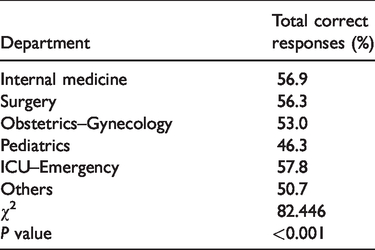
The total rate of correct responses to knowledge-related questions was 55.43%. A significant difference was observed in the rate of correct responses among the nurses from different apartments (P < 0.001) (Table 2). The education level affected the nurses’ scores. Specifically, nurses with a master’s degree obtained the highest score (13.00 ± 1.73), followed by those with a bachelor’s degree (11.71 ± 2.61), and those with a junior college degree (11.49 ± 2.67). The difference among the scores was statistically significant (F = 3.279, P = 0.038). Moreover, nurses with high professional titles gained the highest score (11.92 ± 2.66), whereas those with junior professional titles obtained the lowest (11.49 ± 2.67); the difference was statistically significant (F = 3.213, P = 0.041). The nurses who took care of VTE patients achieved a higher score than those who were inexperienced in handling VTE patients (t = 6.997, P < 0.001).
Correct responses of different type of nurses to knowledge-related items (n = 867).
Attitudes toward VTE prophylaxis
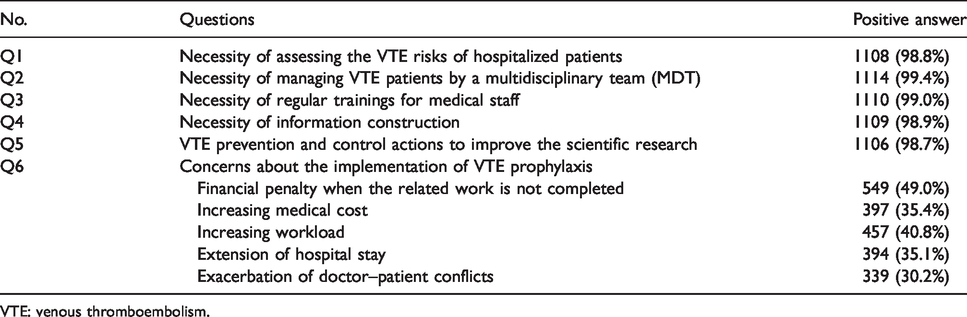
Table 3 shows the result of the attitude assessment. As can be seen, more than 98% of the participants believed that assessing the VTE risks of hospitalized patients was necessary. The main concern of the nurses was the financial penalty involved after failing to complete the assessment of VTE (49.0%), followed by the increased workload (40.8%). Moreover, the increasing medical cost, extension of hospital stay, and exacerbation of doctor–patient conflicts were the most serious difficulties involved in VTE prophylaxis.
Positive responses to attitude-related items (n = 1121).
VTE: venous thromboembolism.
Behaviors toward VTE prophylaxis
As Table 4 presented, the total positive response rate for behavior-related items was 56.19%.
Positive responses to behavior-related items (n = 1121).

VTE: venous thromboembolism.
The factors related to the scores of knowledge-related items
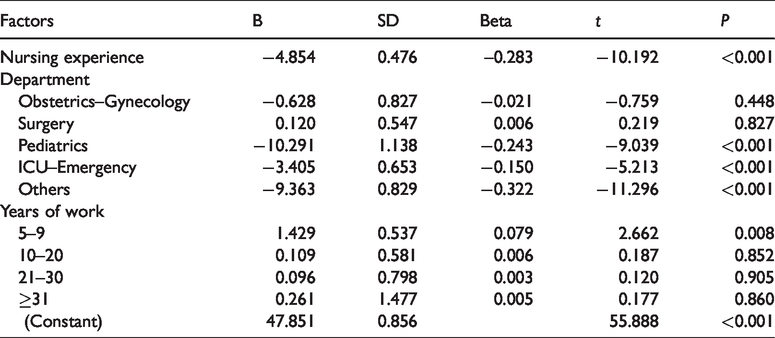
As Table 5 presented, the nursing experience, department, and years of work were related to the scores of knowledge-related items (all P < 0.05).
The factors related to the scores of knowledge-related items.
Suggestions regarding VTE prophylaxis
Fifty suggestions were collected from the responses, which were generally focused on learning VTE prophylaxis repetitively (n = 28), cooperating with clinicians to provide prevention suggestion (n = 17), and developing a reasonable nurse scheduling plan (n = 10).
Discussion
The study included 1121 nurses, and more than 50% of the respondents were under 30 years old and obtained a bachelor’s degree; few obtained their master’s degrees. More than 60% held junior professional titles, and more than half had VTE nursing experience. The prevention and treatment of VTE is crucial.
The total rate of the correct responses in this present study was lower than that reported by Al-Mugheed and Bayraktar. 20 This result suggests that nurses have not yet mastered the related knowledge. Nurses committed many mistakes on the items regarding the VTE mechanism, whereas the clinical subjects gained a high correct response rate. The possible reasons for these findings are discussed as follows: (1) lack of a scientific and standardized guideline for VTE prophylaxis for the nursing staff in China, especially for nursing students who cannot receive systematic learning;21,22 (2) nurses accumulate knowledge from normal clinical works; 23 and (3) most nurses do not perform self-study to acquire knowledge about VTE. 22 The ICU department gained the highest score, which can be attributed to the fact that the serious symptoms and moving disability of some ICU patients required the special attention of nurses. Those from the pediatrics department obtained the lowest score, which can be ascribed to the low cases of VTE in this department. However, this situation should not be a reason of attention loss. 24 Moreover, nurses with high degrees and high professional titles exhibited better performance than the others. 25 Complex pathogenic factors lead to VTE, which makes the diagnosis and treatments complex. Based on this result, strengthening the education of the different departments and other professional ranks, especially junior nurses, must be implemented to help improve VTE prevention and treatment. 26
With the development of the VTE research in China, the awareness regarding VTE prevention has been enhanced. The training activities, however, are organized by departments rather than the hospital. Consequently, the contents, methods, and attention given are not uniform, which leads to the dissimilar VTE prevention practices of the different departments. 27 Thus, hospitals should organize training sessions featuring various methods, such as knowledge lectures, nursing rounds, case analysis, and prevention training.28,29 Therefore, managers should also pay attention to this area.
Various factors may affect the nurses’ overall positive attitude toward VTE prophylaxis. 30 As previously mentioned, the main concern of the respondents was the financial penalty arising from their inability to complete the related tasks. Such inability can be attributed to the hospitals’ numerous policies for the implementation of VTE prophylaxis. 4 The increasing hospital staff–patient conflicts is another major concern that requires attention. The increasing workload and medical cost as well as the extension of hospital stay were the most serious difficulties involved in VTE prophylaxis. 31 The resolution to these concerns have yet to be established, but facing up to these problems and conflicts instead of avoiding them and if properly understood and managed, conflict can also lead to positive outcomes for nurses and healthcare organizations. 32 Although all mentioned concerns are external, the internal factors can eventually affect the nurses’ attitudes and practice. According to the results, most nurses do not clearly know their roles and duty in relation to VTE prophylaxis, resulting in their low enthusiasm. Therefore, the nurses should be informed about the importance of their roles to increase their engagement.
Although the rate of positive responses on attitude-related items was high, that of the behavior-related ones was low. A review stated that in-patients’ adherence to VTE treatments strongly depended on the nurse’s health education. 33 Gibbs et al. 34 concluded that nurses who are committed to VTE risk assessment and prophylaxis can greatly contribute to the reduction of VTE cases and the subsequent complications. Many reports have also shown that the nurses’ behaviors exert a great influence on the effectiveness of VTE treatments. 35 However, the result of the present study indicated that only 56.5% of the respondents can offer advice to VTE patients. This is because the prescription of drugs is done by the doctors and the nurses are only responsible for the care work. Their lack of knowledge to VTE prophylaxis and poor training can negatively affect their behaviors. 36 VTE nursing experience is closely related to the nurses’ behavior. Therefore, experienced nurses should be encouraged to impart knowledge to those who do not have sufficient experience. 37 Moreover, these nurses have more opportunities to study and learn than their less experienced peers. This result highlights the importance of providing regular training to nursing staff. However, our findings are not generalizable outside China, and perhaps also confined to the site in China where the survey was carried out, future studies in different areas and populations are warranted.
Conclusions
In conclusion, our results have revealed the knowledge, attitudes, and behaviors of Chinese nurses in preventing VTE. Based on the results, nurse trainers should develop comprehensive education plans on those aspects, with the aim to improve knowledge of thromboprophylaxis.
Footnotes
Availability of data and materials
All data generated or analyzed during this study are included in this published article.
Author contributions
TY and YS designed research; TY, WH, and CH conducted research; LQ, ZJ, and YS analyzed data; LQ, YS, and YX wrote the first draft of manuscript; YS had primary responsibility for final content. All authors read and approved the final manuscript.
Acknowledgements
We thank Zhuo Wang for her help with data analysis; and Zunjia Wen for his help with revising the manuscript.
Declaration of conflicting interests
The author(s) declared no potential conflicts of interest with respect to the research, authorship, and/or publication of this article.
Ethics approval and consent to participate
Our study has been approved by the ethics committee of our hospital (No. 2019KY081-01).
Funding
The author(s) disclosed receipt of the following financial support for the research, authorship, and/or publication of this article: This study was supported by the Philosophy and Social Sciences Program of Nanjing Medical University (2018ZSY015). The funder had no role in study design, data collection and analysis, decision to publish, or preparation of the manuscript.
