



Abstract
Objectives
Indoxyl sulfate, known for its cardiovascular toxicity, is associated with vascular and coronary artery diseases and increased mortality. Peripheral arterial disease, defined by low ankle–brachial index, is associated with increased mortality in patients on hemodialysis. The present study aimed to determine the relationship between the serum indoxyl sulfate level and peripheral arterial disease in patients on maintenance hemodialysis.
Methods
The present cross-sectional, single-center study included 75 patients on maintenance hemodialysis. Serum indoxyl sulfate levels were determined by high-performance liquid chromatography–mass spectrometry. Ankle–brachial index values were measured using an automated oscillometric device. Patients with ankle–brachial indexes of < 0.9 were categorized into the low ankle–brachial index group.
Results
In the study cohort, 12 of the 75 patients (16.0%) had low ankle–brachial indexes. The rates of diabetes mellitus (p = 0.010) as well as the serum levels of C-reactive protein (p < 0.001) and indoxyl sulfate (p < 0.001) were higher in the low ankle–brachial index group than the normal ankle–brachial index group. The multivariable logistic regression analysis revealed that serum levels of indoxyl sulfate (odds ratio = 1.123, 95% confidence interval 1.011–1.249, p = 0.031) and C-reactive protein (each 0.1 mg/dL increase, odds ratio = 1.169, 95% confidence interval 1.018–1.343, p = 0.027) were independently associated with peripheral arterial disease in patients on maintenance hemodialysis.
Conclusions
Serum indoxyl sulfate levels were associated with peripheral arterial disease in patients on maintenance hemodialysis.
Introduction
In patients with end-stage renal disease, the mortality remains high despite treatment with renal replacement therapy. For example, in a study based on the United States Renal Data System, the 5-year mortality was 43.0% in patients on hemodialysis. 1 The high mortality is largely attributable to cardiovascular causes in these hemodialysis patients. 2 Peripheral arterial disease (PAD), which is defined as narrowing or obstruction of systemic vessels other than coronary or intracranial arteries, can be diagnosed based on an ankle–brachial index (ABI) of < 0.9 in either leg; PAD usually develops secondary to atherosclerosis. 3 The prevalence of PAD is higher among patients on hemodialysis than the general population. 4 Several studies reported a strong association between PAD and all-cause and cardiovascular mortality in patients on hemodialysis, with more than twofold increase in mortality risk reported in patients with PAD compared to those without PAD in a large-scale meta-analysis involving more than 30,000 patients on hemodialysis.5,6 Therefore, it is important to identify risk factors associated with PAD in patients on hemodialysis.
Indoxyl sulfate (IS), a uremic toxin derived from tryptophan, 7 accumulates due to tubular dysfunction during the progression of renal failure. In patients with end-stage renal disease, the clearance of IS by hemodialysis is very low due to the high protein binding by IS. 7 The well-documented harmful effects of IS on vasculature are mediated through oxidative stress, inflammation, and impaired repair capacity of endothelial cells. 8 Furthermore, a study in rats has demonstrated that IS-mediated toxicity in the cardiovascular system involves the deterioration of atherosclerotic lesions via the induction of vascular smooth muscle cell proliferation. 9 In a cohort study of 139 patients with chronic kidney disease, IS was associated with aortic calcification and vascular stiffness. 10 Given the mounting evidence of vascular toxic effects of IS, we hypothesized that high IS levels would be associated with increased incidence of PAD in patients with end-stage renal disease. Therefore, in the present study, we aimed to determine the association between IS and PAD in patients on maintenance hemodialysis.
Materials and methods
Patients
This cross-sectional study was conducted between 1 March 2016 and 31 July 2016 in the hemodialysis unit of a medical center in Hualien, Taiwan. Adult patients aged ≥ 20 years undergoing a standard 4-h hemodialysis session three times per week for at least 3 months were assessed for eligibility. High-flux polysulfone disposable artificial kidneys (FX class dialyzer; Fresenius Medical Care, Bad Homburg, Germany) were used in the dialysis unit. Initially, 110 hemodialysis participants enrolled, 35 participants were excluded on account of malignancy (n = 5), acute infection (n = 4), myocardial infarction (n = 3), stroke (n = 4), amputation (n = 6), heart failure (n = 2), treatment with cilostazol or pentoxifylline during blood sampling (n = 6), and elevated ABIs > 1.3 (n = 5). Finally, a total of 75 HD patients were enrolled in this study. Data on basic demographic characteristics and medical history, including diabetes mellitus (DM), hypertension, hyperlipidemia, and coronary artery disease, were collected from the medical records. The present study was approved by the Institutional Review Board of Tzu Chi Hospital and complied with the general recommendations of the Declaration of Helsinki. Written informed consent was obtained from all patients.
Anthropometric analysis
Anthropometric variables were measured in the morning after overnight fasting. Body weight and height measurements were recorded to the nearest 0.5 kg and 0.5 cm, respectively. Body mass index was calculated as weight (kg) divided by height-squared (m2).
Biochemical investigations
Blood samples were obtained after overnight fasting. In each patient, approximately 5 mL blood was immediately centrifuged at 3000 g for 10 min and stored at 4°C within 1 h of processing for biochemical analyses. We used an autoanalyzer (Siemens Advia 1800; Siemens Healthcare, Henkestr, Germany) to measure serum levels of total calcium, phosphorus, fasting glucose, albumin, blood urea nitrogen, creatinine, total cholesterol, triglycerides, and C-reactive protein (CRP). Intact parathyroid hormone (iPTH) levels were measured by a commercially available enzyme-linked immunosorbent assay (catalog number: NM59041; IBL International, Hamburg, Germany).11–13
High-performance liquid chromatography–mass spectrometry
Total IS levels were measured by modified liquid chromatography–mass spectrometry.12–14 Briefly, 100 µL serum was added to a 1.5-mL centrifuge tube containing 100 µL of 50 mM sodium phosphate dibasic heptahydrate solution. The stable d4-IS isotope was used as internal control. Extraction was performed with Novum® simplified liquid extraction cartridges (Phenomenex, Torrance, CA, USA), with elution in 1.5 mL ethyl acetate. Samples dried in nitrogen gas were later resolved in 100 µL methanol. A Waters® e2695 high-performance liquid chromatography device was used with a single quadrupole ACQUITY QDa® mass detector for analysis. A Phenomenex Luna® C18(2) column (5 µ, 250 × 4.6 mm, 100 Å) was heated to 40°C, with a flow rate of 0.8 mL/min and an injection volume of 30 µL. The mobile phase included 99.9% double-distilled water (A) and 99.9% high-performance liquid chromatography-grade methanol (B); each contained 0.1% formic acid. Linear gradient from 5% B to 70% B for 14 min, maintenance at 70% B for 2 min, and linear gradient from 70% B to 50% B for 2 min. Pretreated samples were tested by negative-ion mode electrospray ionization, set at a vaporization temperature of 400°C, a capillary voltage of 0.8 kV, and a sample cone of 15.0 V. Single-ion recording mode was used for mass-to-charge ratio (m/z) scanning (d4-IS, 216.0 m/z and IS, 211.9 m/z). The Empower® 3.0 software was used for data acquisition and processing. Sample peak areas were used to quantify IS levels using a calibration curve of the standard.
Ankle–brachial index measurements
Blood pressure was measured using the oscillometric method in both arms and ankles for three times, with the patient in the supine position, and readings were obtained from brachial, dorsalis pedis, and posterior tibial arteries (VaSera VS-1000; Fukuda Denshi, Tokyo, Japan). 11 Right or left ABI was calculated as the ratio of the highest-measured systolic blood pressure in right or left ankle (dorsalis pedis or posterior tibial artery) to the highest-measured systolic blood pressure in brachial artery of either arm. Real-time electrocardiography was documented for more than 15 min. PAD was diagnosed in patients with a low ABI of < 0.9 in left or right, as described previously. 11
Statistical analysis
The Kolmogorov–Smirnov test was performed to determine normality. Continuous data were expressed as means ± standard deviation for normally distributed variables and as medians with interquartile ranges for non-normally distributed variables; between-patient comparisons were performed by two-tailed Student’s independent t test and the Mann–Whitney U test, respectively. Categorical variables were expressed as numbers with percentages and compared using the χ 2 test. Variables significantly associated with PAD were further evaluated by multivariable logistic regression analysis. The receiver-operating characteristic curve was used to calculate the area under the curve and determine serum IS and CRP levels to predict PAD in patients on hemodialysis. The SPSS software for Windows (version 19.0; SPSS, Chicago, IL, USA) was used for all statistical analyses. A p value of < 0.05 was considered to indicate statistical significance.
Results
Clinical variables of the 75 hemodialysis patients with normal or low ankle–brachial index group.

Values for continuous variables are given as means ± standard deviation and test by Student’s t-test; variables not normally distributed are given as medians and interquartile range and test by Mann-Whitney U test; data are expressed as number of patients, and analysis was done using the chi-square test.
ABI, ankle–brachial index; HD, hemodialysis; Kt/V, fractional clearance index for urea; ACE, angiotensin-converting enzyme; ARB, angiotensin receptor blocker; CCB, calcium-channel blocker.
*p < 0.05 was considered statistically significant.
Multivariable logistic regression analysis of the factors correlated to peripheral arterial disease among 75 hemodialysis patients.

Analysis data were done using the multivariable logistic regression analysis (adopted factors: diabetes, statin used, current smoking, creatinine, intact parathyroid hormone, C-reactive protein, and total indoxyl sulfate).
*p < 0.05 was considered statistically significant.
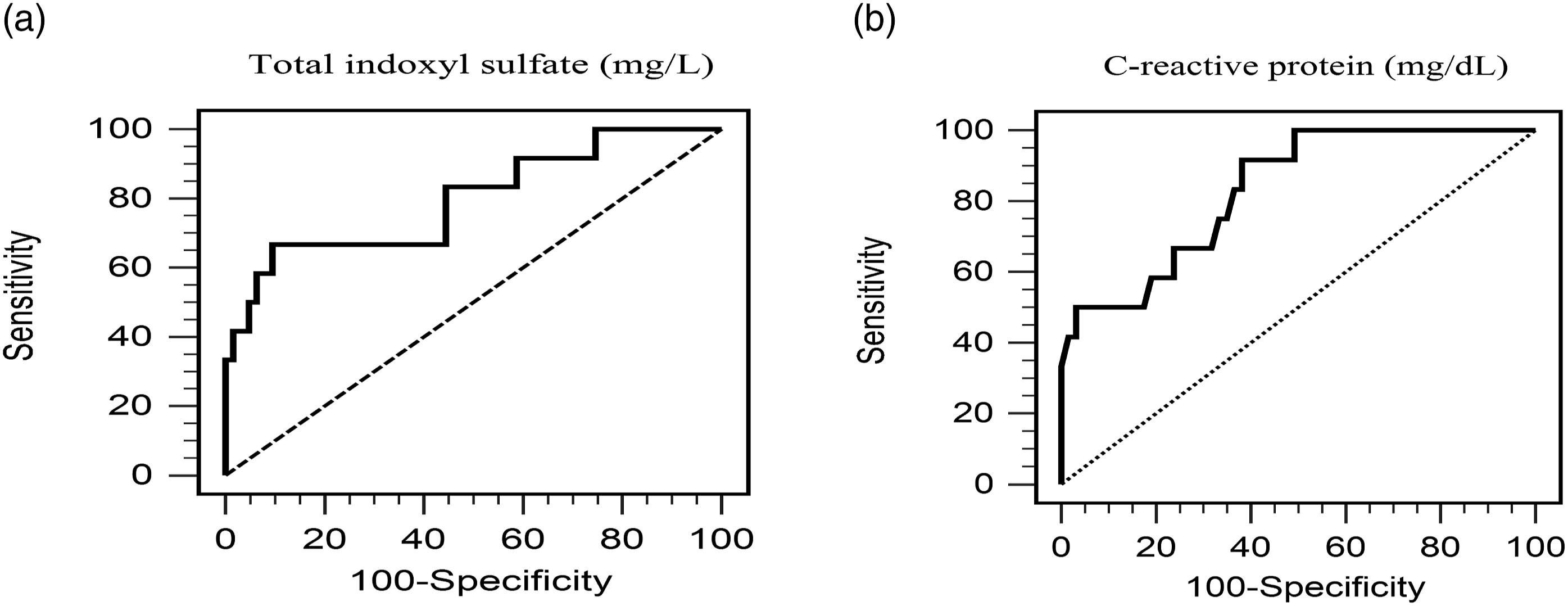
The area under the receiver-operating characteristic curve indicates the diagnostic power of the serum indoxyl sulfate level (a) and C-reactive protein level (b) for predicting peripheral arterial disease among 75 hemodialysis patients.
Discussion
In the present cross-sectional study including 75 patients on maintenance hemodialysis, our analyses revealed that higher serum IS and CRP levels were independently associated with a higher risk of PAD.
Hypertension, smoking, DM, and dyslipidemia are risk factors for PAD, which is a manifestation of atherosclerotic vascular disease. 3 The exacerbation of PAD by increased levels of inflammatory mediators, oxidative stress, overproduction of advanced glycation end-products, dyslipidemia, and atherothrombosis, which might be worse in patients with DM than those without DM. 15 Inflammation and dyslipidemia, which are associated with atherosclerosis, also play a role in the initiation and progression of PAD. 16 Moreover, high-circulating CRP levels are associated with major cardiovascular events in patients with PAD. 17 Statin use has been shown to reduce the risk of major cardiovascular and limb events in patients with PAD. 18 Our analyses also revealed that DM and higher serum CRP levels were associated with PAD in patients on hemodialysis. After multivariable logistic regression analysis, serum CRP level remained an independent predictor for PAD in patients on hemodialysis.
The direct vascular toxic effects of IS have been under extensive scrutiny in the past decade.7,19–21 In addition to the induction of endothelial dysfunction, IS also triggers a prothrombotic state and impairs neovascularization.19,20 In endothelial cells, IS decreases the production of nitric oxide; increases the production of reactive oxygen species; promotes pro-oxidant, pro-inflammatory, and prothrombotic processes through the activation of the aryl hydrocarbon receptor; and is involved in endothelial dysfunction.19,21,22 IS promotes thrombosis, altered neoangiogenesis, and atherosclerosis, which may explain the risk of increased amputation rate due to PAD in patients with chronic kidney disease.19,20 In a cohort of 139 patients with chronic kidney disease, higher IS levels were associated with significantly higher rates of vascular disease and mortality after adjustment for multiple factors, including age, sex, DM, albumin, hemoglobin, phosphate, and aortic calcification. 10 In the present study, serum IS levels were positively associated with PAD after adjustment for other significant confounders. This finding highlights the potential role of IS as a marker of PAD in patients on hemodialysis. However, the mechanism underlying the association of IS with PAD in patients on hemodialysis requires further investigation. Low-protein diets or vegetarian diets have been shown to reduce serum IS levels.23,24 Additionally, AST-120 is an oral charcoal adsorbent that could limit intestinal IS absorption and has been demonstrated to reduce serum IS levels in patients with chronic kidney disease. 25 Whether measurement of serum IS levels in hemodialysis patients for PAD risk evaluation or interventions to lower serum IS levels, such as dietary changes or oral adsorbents, will benefit these patients also needs further research.
The present study has several limitations that should be acknowledged. First, this was a cross-sectional study with a relatively small cohort size which was performed in a single medical center. Second, data on clinical symptoms of PAD, such as claudication and lower extremity pain, were not included. Third, in patients on hemodialysis, ABI may lead to false-negative results due to non-compressible calcified vessels. 4 In this study, we had excluded elevated ABIs > 1.3 in our hemodialysis patients to rule out the falsely elevated ABIs due to vascular calcification. Therefore, large-scale longitudinal studies are necessary to determine the association between IS and PAD in patients on hemodialysis.
Conclusion
The findings of the present cross-sectional study suggest that serum CRP and IS levels should be considered as independent predictors of PAD in patients on hemodialysis.
Footnotes
Declaration of conflicting interest
The author(s) declared no potential conflicts of interest with respect to the research, authorship, and/or publication of this article.
Funding
The author(s) disclosed receipt of the following financial support for the research, authorship, and/or publication of this article: This study was supported by a grant from the Buddhist Tzu Chi Medical Foundation, Taiwan (TCRD107-56, TCMF-A 109-07 and TCMF-CP 110-02).
