



Abstract
Objective
The bilateral presentation of Carotid Body Tumors (CBT) is rare; the surgical resection of these masses remains the mainstay management due to the malignant potential. We aim to describe, classify, and quantify baroreceptor failure (BRF) after the surgical management of patients with bilateral CBT to better understand the clinical consequences.
Methods
Retrospective review of patients that underwent bilateral CBT resection to assess the changes in baroreceptor function. We describe the clinical events associated to BRF after surgery, baseline patient’s demographics, characteristics, comorbidities. Additionally, clinical and a quantitative evaluation of baroreceptor sensitivity were conducted using the Composite Autonomic Severity Score (CASS).
Results
From 1986 to 2020, a total 146 CBT resections were performed in 132 patients in our institution. Tumors were removed bilaterally in staged procedures in seven patients with a mean age of 61 years (Standard Deviation 11), six (85%) were females, and there was no family history of paragangliomas. The clinical presentation were palpable masses in 5 (71%), and odynophagia in 2 (29%) cases; malignant histopathology following surgery was found in one case. BRF occurred in one patient after unilateral CBT resection, consisting of bradycardia and a 40 s asystole that was not previously associated to BR sensitivity. Three (43%) patients presented BRF in the immediate postoperative period of the contralateral CBT excision, consisting of volatile hypertensive crisis in two cases, and supraventricular tachycardia in one. All the patients developed (100%) chronic baroreceptor sensitivity symptoms consisting in syncope, vertigo and fatigue in 4 (57%), tachycardia in 2 (28%), and orthostatic headache in one (14%). Autonomic testing showed mixed sympathetic and parasympathetic failure in five (71%), severe sympathetic failure in 1 (14%), and parasympathetic dysfunction in one patient (14%).
Conclusions
Postoperative autonomic assessment confirmed BRF in all studied patients that underwent staged bilateral CBT resection with mixed, sympathetic, and parasympathetic dysfunction. Further studies are necessary to evaluate the incidence and physiological mechanisms of these sequelae to anticipate possible complications and offer the appropriate perioperative management.
Introduction
Carotid Body Tumors (CBT) are rare neoplasms of neuroendocrine origin. These represent the most common type of head and neck parangliomas, and the bilateral presentation is rarely encountered and reported in the literature.1–3 Due to the malignant potential, the surgical management of these masses is recommended and remains the mainstay management. Given the proximity to important neck vessels and the possibility for arterial reconstruction, vascular surgeons have been involved in the care of these patients in experienced centers.1,2,4 The study of the clinical manifestations and the indications of surgical treatment are areas of particular research interest and controversies among researches, in order to better define risk and benefits, predictors, outcomes and prognosis; however, due to the relatively low incidence, definitive expert consensus and standardized managements are lacking.1–5
Baroreflexes are responsible for maintaining blood pressure homeostasis by avoiding volatile hemodynamic changes, these are buffered by baroreceptors (BR) located in the aortic arch and the carotid bifurcation, 6 specifically in the sinus and carotid body. The carotid sinus (CS) is a dilated area at the base of the internal carotid artery, just superior to the bifurcation, and it contains the main vascular baroreceptors. This is composed of a set of stretch receptors located in the adventitia of the carotid bulb. The carotid body (CB) is located in the bifurcation of the common carotid artery, and it is composed by small cluster of chemoreceptors of cells type 1, or chief glomus cells, which are peripheral chemoreceptors, and type 2 sustentacular supportive cells. 7 The CB and CS are innervated by the carotid sinus nerve, also known as Hering’s nerve, branch of the glossopharyngeal nerve (CN IX), which sends information to the cervical sympathetic trunk, pharyngeal branches of the vagus, hypoglossal, and the superior laryngeal nerve. 8 Signals travel through these pathways to the nucleus tractus solitarius (NTS) in the dorsal medulla. 9 When stimulated, the CS has a sympathetic-inhibitory effect on the peripheral and myocardial vascular tissue. This reflex arc is a negative feedback loop that acts as a buffer for blood pressure and heart rate during postural changes, and during physical or emotional stress. In addition to its baroreceptor function, the CB has the ability to function as chemoreceptor, with sensitivity to changes in PaO2, PaCO2, pH, and blood flow. The CB is the main arterial chemoreceptor and when stimulated by hypoxia, hypercapnia or acidemia, produces hyperventilation, a peripheral vascular sympathetic effect, and parasympathetic effect on the myocardium. 10 BR were initially believed to be involved only in short-term BP control; however, an association with long-term control has recently been found.11–13
The impact in BR functions of vascular surgery interventions such as carotid endarterectomies has been studied and described.14–17 In our institution, the section of Vascular Surgery and Endovascular Therapy evaluates and treats routinely patients with Carotid Body Tumors.1,2,12,18,19 The relatively high incidence of this pathology in the Metropolitan area of Mexico City, which is the largest and most populous in North America and located between 7200 and 12,894 feet above sea level, has led us to observe and document recurrence and the bilateral presentation in single patients. Nowadays, little is known how the surgical treatment might impact in the function of the BR following these procedures.20,21 In the present study, we aim to describe the natural history of baroreflex failure in patients with previous history of bilateral CBT that underwent surgical management.
Methods
This is an observational study conducted with single and cross-sectional evaluation of data. Approval was obtained from the Institutional Review Board, and consent to participate was given by patients. We evaluated the baseline demographics and clinical characteristics and performed autonomic testing to quantify baroreceptor sensitivity in seven patients who underwent bilateral CBT resection at the National Institute of Medical Sciences and Nutrition Salvador Zubiran in Mexico City. Baroreflex sensitivity was assessed using a questionnaire related to BRF symptomatology or history of BP variability, and using the Composite Autonomic Severity Score (CASS) for a complete quantification of the cardiovagal and adrenergic autonomous functions, the sudomotor domain was excluded for not influencing in the baroreceptor function. Total score enabled us to classify it as mild, moderate, or severe, and sympathetic, parasympathetic, or mixed failure (Figure 1). Evaluation of baroreceptor sensitivity according to the composite autonomic severity score (CASS).
Results
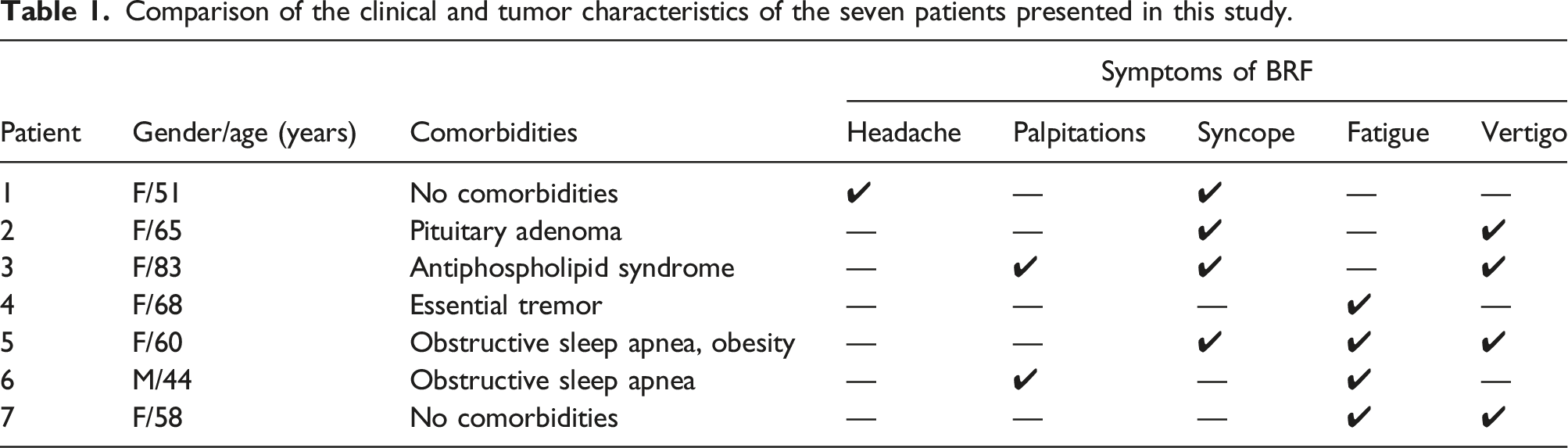
Comparison of the clinical and tumor characteristics of the seven patients presented in this study.

(a and b) Preoperative computed tomographic angiography (CTA) with three dimensional (3D) reconstructions (a and b) in a 52 year-old female patient with bilateral carotid body tumors.

(a and b) Intraoperative photograph of a Shamblin III carotid body tumor (CBT) resection. The hypoglossal nerve is encircled with vessel loop and facial vein has been ligated (a). CBT has been resected, and superior thyroid artery is preserved (b).
Immediate postoperative events
One (14%) patient had severe bradycardia leading to a 40 s asystole after the initial CBT resection. In contrast, 3(43%) events occurred after contralateral CBT excision, 2(28%) patients presented with volatile hypertensive crisis, and one (14%) with supraventricular tachycardia, at the time of these events, in none of these cases, BRF was suspected as the etiology. Recurrent laryngeal nerve palsy was present in two cases, but they recovered without sequelae within a 10 week period. The average time interval between the first and second surgeries was 12.57 months.
Chronic baroreceptor failure symptoms
After the first CBT resection, patients denied having BRF related symptoms. After the second surgery, the most common symptoms were syncope 57%, vertigo (57%), chronic fatigue (57%), palpitations (28.14%), and orthostatic headache (14.28%) (Figure 1). Time from the second CBT resection to symptoms onset was of 6 weeks on average (range 4–10 weeks).
Autonomic assessment
Baroreceptor sensitivity (BRS) was evaluated in average 25.42 weeks (1–76 weeks) after the second surgery. All patients were diagnosed with BRF. Five (71%) patients had mixed simultaneous sympathetic and parasympathetic failure. One patient had severe sympathetic failure, and one had parasympathetic dysfunction. Prior to conducting this study, and despite symptoms, none of the seven patients had the diagnosis of baroreceptor malfunction as the cause of their symptoms; and in four, the symptoms were attributed to generalized anxiety disorder (Figure 4). Tilt test evaluation. Autonomic nervous system stimulation with orthostatic stress through passive change from the supine position to standing at 70° for 5–10 min. Abnormal values are: increase in HR >30 bpm, HR >120 bpm, SBP descent >20 mmHg, and DBP descent >10 mmHg. Graphic representation of systolic blood pressure descent during tilting.
Discussion
Baroreceptor failure occurs when an afferent component of this baroreflex arc fails. 22 The disruption of the baroreflex arc can lead to autonomic instability, such as volatile changes in arterial blood pressure. Among the most frequent causes of BRF are extensive cervical surgery, trauma, and radiation.23–25 Four forms of BRF have been described: (1) Hypertensive crisis is generally manifested as hypertension, severe tachycardia, and headache, systolic blood pressure usually above 250 mmHg, occurs in the immediate period after a BR lesion and is a medical emergency; (2) Labile blood pressure or volatile hypertension results from the gradual loss of BR function that presents days to weeks after damage of the baroreflex and is the most common presentation. The baseline BP can be normal or elevated, but the patients show spontaneous sympathetic activation resulting in BP peaks and tachycardia of varying duration of minutes or hours. During the episodes, the patients have dizziness, palpitations, headache, anxiety, and irritability, and they can be hypotensive while sleeping; (3) Orthostatic tachycardia with increases in heart rate >30 bpm when the subject changes from the supine position to sitting or standing; and (4) Vasovagal Response with hypotension and severe bradycardia with asystole, due to increased parasympathetic tone resulting in fatigue, dizziness, or syncope. 26
BRF after carotid body tumor (CBT) resection is more frequently observed after bilateral CBT resection due to denervation of both carotid sinuses.20,21,27–29 Adaptation to chronic hypoxia requires respiratory and cardiovascular adjustments to ensure adequate tissue perfusion to critical organs. However, the sustained activation of these hypoxia-induced reflexes due to acclimatization to hypoxemia in high altitudes as in Mexico City, or in medical conditions, can give rise to these neoplasms. 30 CBT are generally benign, slow-growing neoplasms arising from the chemoreceptor system; only approximately 10% of CBTs are bilateral.31,32 It is generally accepted that surgery is the mainstay of management for CBTs with acceptable morbidity rates. 33 BRF is not present in all bilateral CBT resections, or it may improve through time suggesting a compensation mechanism, possible by aortic arch baroreceptors or by other unclear processes. 34 BRF is typically subclinical, reflecting abnormal responses to environmental triggers, rather than an altered set-point. 35 Neterville et al. 7 reported 30 patients with CBTs, of the 16 patients with bilateral CBT, 10 underwent bilateral resection and 100% of those developed BRF, characterized by tachycardia and fluctuations in blood pressure. Metheetrairut et al. 36 published an incidence of BRF of 16.49%. In a review of the literature, this series, consistent with these findings in the present manuscript, BRF in our experience was rare in unilateral surgery and occurs in all of the bilateral cases. Because most patients did not show BRF after the first CBT excision, bilateral denervation of baroreceptors may be responsible for postoperative symptoms. It is difficult to elucidate if the great variability in the reported incidence of BRF 36 is due to the low incidence of bilateral CBT or to unawareness or low suspicion of this poorly known entity. Considering the low incidence of malignant histopathology in these patients (4.1% overall in the largest systematic review 31 and 15% of our bilateral CBT series 3 ), and the negative impact in quality of life of patients with BRF, it should be appropriate to establish precise selection criteria to approach and operated the contralateral CBT. Limitations of our study include the retrospective nature and relatively small sample; however, these findings contribute importantly to reduce the lack of knowledge still prevalent in this area.
Conclusions
Baroreceptor failure after the surgical management of bilateral carotid body tumor is an underestimated and underdiagnosed sequela. In our study, the most alarming symptoms were seen immediately after the second CBT resection and consisted in severe hypertensive crisis, bradycardia, or asystole in immediate postoperative period; while chronic disabling symptoms occurred several weeks after the surgery, particularly recurrent syncope, vertigo, and fatigue. Autonomic testing showed baroreflex failure in all the cases, with mixed, sympathetic, and parasympathetic dysfunction in most cases. The real incidence and severity of the CBT BRF remains unknown, and given the relatively infrequency of this important and complex pathology, an international registry, further studies and expert consensus are necessary to adequately select the most appropriate approach and treatment for bilateral carotid body tumors.
Footnotes
Declaration of conflicting interests
The author(s) declared no potential conflicts of interest with respect to the research, authorship, and/or publication of this article.
Funding
The author(s) received no financial support for the research, authorship, and/or publication of this article.
Author’s note
This study was presented in Scientific Session at the 46th Annual Meeting of the Southern Association for Vascular Surgery, Manalapan, FL, United States of America. Jan 19-22, 2022.
