



Abstract
Objective
The objective is to compare the characteristics of clinical data, imaging data, and treatment methods of young and old patients with acute type B aortic dissection (ABAD).
Methods
ABAD patients admitted to the Department of Vascular Surgery of the First Affiliated Hospital of Anhui Medical University from January 2012 to December 2018 were retrospectively reviewed. Patient demographics, such as gender, age, diabetes, hypertension, presenting symptoms, imaging characteristics, laboratory data on admission, hemodynamics on admission and in-hospital management, and mortality of different age groups were compared and analyzed. Categorical variables were compared using χ2 tests or Fisher’s exact test. Continuous variables were compared using Student’s t-test or Mann–Whitney U-test.
Results
A total of 141 ABAD patients were included in this study. Old ABAD patients were more likely to have a prior history of hypertension (88.6% vs 70.4%, p = 0.037) and atherosclerosis (29.8% vs 7.4%, p = 0.016). In the young group, Marfan syndrome was significantly higher (14.8% vs 0.9%; p = 0.005). Compared with the old group, the number of distal tears in the young group was significantly higher (62.3% vs 39.5%, p = 0.027). The proportion of patients with malperfusion of lower limbs in the young group was significantly higher than that in the old group (22.2% vs 6.1%, p = 0.026). There was no significant difference in the treatment methods and in-hospital mortality between the two groups.
Conclusion
Compared with old ABAD patients, young ABAD patients had more distal tears and a higher proportion of lower limbs malperfusion.
Introduction
Aortic dissection (AD) is a cardiovascular emergency with high rate of morbidity and mortality and mortality. 1 The initial Debakey classification was proposed in 1965 to define the AD according to the anatomical characteristics. The more widely used Stanford classification is more simplified than the early Debakey classification and is based on whether the ascending aorta is affected. 2 European Society of Cardiology (ESC) guidelines divided the time course of AD into acute (<14 days), subacute (15–90 days), and chronic (>90 days) phases. 3
Population-based studies suggested that the incidence of acute aortic dissection (AAD) may be between 2.6 and 3.5 cases per 100,000 person-years, and the incidence reported in autopsy series was between 0.2% and 0.8%. 4 In 2004, the International Registry of Acute Aortic Dissection (IRAD) conducted a study of 951 cases of AAD in 18 centers and found that AAD patients under the age of 40 accounted for about 7% of the total AD patients. 5 In general, the incidence of AAD in young people was low, and the current literature reports mainly focused on patients with acute type A aortic dissection (AAAD), and there were few reports on patients with acute type B aortic dissection (ABAD).6–8 The objective of the current study was to compare the characteristics of clinical data, imaging data, and treatment methods of young and old patients with ABAD.
Materials and methods
Patient selection
A total of 141 ABAD patients admitted to the Department of Vascular Surgery of the First Affiliated Hospital of Anhui Medical University from January 2012 to December 2018 were retrospectively reviewed. This study was approved by the ethics committee of our hospital, and all patients gave informed consent. According to the World Health Organization (WHO) regulations on the division of human age groups in 2000, patients ≤45 years old were classified as the young group, and patients >45 years old were classified as the middle-aged and elderly group. 9 In this study, patients over 45 years old were divided into the old group. All patients were diagnosed with ABAD by computed tomography angiography (CTA). The exclusion criteria for this study included: 1) Incomplete clinical data that cannot be evaluated; 2) penetrating atherosclerotic ulcer (PAU) and intramural hematoma (IMH); and 3) patients with chronic or subacute aortic dissection. Surgical or TEVAR treatment was performed during the initial hospitalization. The indications for surgical or TEVAR treatment include complex ABAD patients and high-risk ABAD patients. High-risk type B AD refers to the presence of any of the following risk factors: refractory pain, refractory hypertension, bloody pleural effusion, aortic diameter >40 mm, false lumen diameter >22 mm, radiographic only malperfusion, entry tear, lesser curve location, and readmission. This study complied with medical ethics standards and was approved by the Medical Ethics Committee of our hospital.
Data collection and definitions
Data collection included patient demographics, patient history, presenting symptoms, imaging characteristics, laboratory data on admission, hemodynamics on admission, in-hospital management, and in-hospital mortality. Imaging data were collected from the patient’s CTA on admission. In-hospital mortality was defined as any death that occurred during the initial hospitalization or within 30 days of discharge.
Statistical analysis
Statistical analysis was performed with SPSS, release 19.0 for Windows. Categorical variables were compared using χ2 tests or Fisher’s exact test. Continuous variables were compared using Student’s t-test or Mann–Whitney U-test. All reported p values were two-sided, and p values < 0.05 were considered to be statistically significant.
Results
Baseline data of different age groups.

DM, diabetes mellitus; CKD, chronic kidney disease.
Laboratory data and hemodynamics on admission of different age groups.
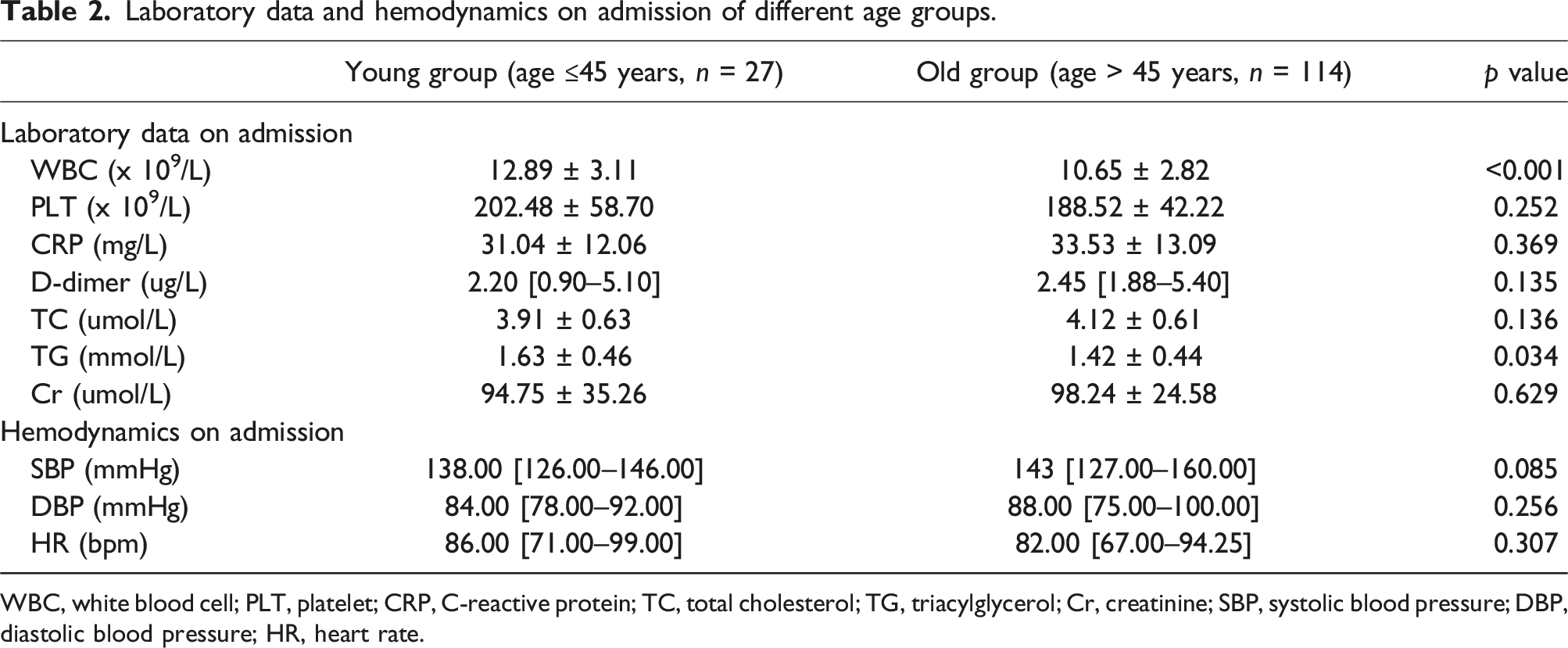
WBC, white blood cell; PLT, platelet; CRP, C-reactive protein; TC, total cholesterol; TG, triacylglycerol; Cr, creatinine; SBP, systolic blood pressure; DBP, diastolic blood pressure; HR, heart rate.
Imaging characteristics of different age groups.

SMA, superior mesenteric artery.
In-hospital management and mortality of different age groups.

Discussion
The incidence of AAD in young population is low, but there is an increasing trend. Compared with western countries, the incidence of AAD in young Chinese people is higher. 10 There were 27 young patients in this study, accounting for 19.1% of the total ABAD patients. The proportion of male patients in the young group was significantly higher than that in the old group. However, few studies have investigated the impact of gender on patients with ABAD. Takahashi et al. identified 2372 patients with ABAD in the Tokyo Acute Aortic Super-Network Registry found that female patients with ABAD were fewer and older than male patients. In addition, female patients had more intramural hematoma (63.7% vs 53.7%, p < 0.001) and were more medically treated (90.9% vs 86.3%, p = 0.002). 11 Liang et al. analyzed data about 9855 ABAD patients from the National Inpatient Sample datasets. It was found that there were fewer females patients (43.6%, n = 4293) and they experienced ABAD at a later age (69.8 ± 15.5 vs 62.8 ± 15.6, p < 0.001). Female patients had more comorbidities (heart failure, COPD, diabetes, and rheumatic diseases) and were medically managed more frequently (87.4% vs 81.8%; p < 0.001). 12
The prevalence of hypertension among Chinese adults increased from 11.3% in 1991 to 18.0% in 2002 and 26.6% in 2013.13–15 A study on 898,929 people in 2019 showed that the prevalence of hypertension among young Chinese (aged 35 to 49 years) was 26.2%. In the subgroup analysis of isolated systolic hypertension patients, 86.7% of the patients did not receive treatment, and less than 7% of the patients knew that they had hypertension. 16 The alarming trend of rising hypertension and lack of awareness may contribute to the growth of ABAD in young people. In this study, the incidence of hypertension in the young group was lower than that in the old group (70.4% vs 88.6%, p = 0.037), but the incidence of both groups was much higher than that of the general population. Marfan syndrome is inherited in an autosomal dominant connective tissue disorder, with 1 in 3–5000 people affected, regardless of race or geographical location. 17 An IRAD study included 6424 AAD patients, 258 of whom (4%) were diagnosed with Marfan syndrome. The age of Marfan syndrome patients was significantly lower than that of patients without Marfan syndrome (38.2 ± 13.2 years vs 63.0 ± 14.0 years; p < 0.001). The combined follow-up data of type A and type B AAD showed that the 5-year survival rate of Marfan syndrome patients was estimated to be 80.1%, and the reintervention rate was estimated to be 55.3%. This high reintervention rate highlights the need for careful monitoring and treatment of AAD patients with Marfan syndrome. 18 In this study, the incidence of Marfan syndrome in young and middle-aged ABAD patients was significantly higher than that in the elderly group, and it is necessary to diagnose Marfan syndrome in young ABAD patients as early as possible. The diagnostic criteria for Marfan syndrome were recently revised in 2010 and are known as Ghent II nosology. 19
Most of the proximal tears in both groups were located on the greater curvature. However, the proportion of distal tears in the young group was significantly higher than that in the old group. There is increasing evidence that distal tears may increase the risk of late aortic events and hinder aortic remodeling.20–22 Chenmou et al. retrospectively analyzed the clinical results of 130 ABAD patients who received thoracic endovascular aortic repair (TEVAR). Patients were divided into group A (without distal tears) and group B (with distal tears) according to whether there were distal tears after TEVAR. The results showed that the incidence of late aortic events in group A was significantly lower than that in group B (p = 0.028). The aortic remodeling in group A was superior to group B in complete thrombosis of the thoracic aortic false lumen at 12 months postoperatively (100% vs 83.5%; p = 0.029). 20 Mikolaj et al. demonstrated that selective exclusion of distal tears after TEVAR at the abdominal aorta level appears to be a viable way to promote false lumen thrombosis. It effectively stabilizes thoracoabdominal aortic dilatation in most patients with type B AD and may reduce mortality. 23
There were not many studies comparing the distal extension of ABAD between young and old patients. Studies from Germany and the United Kingdom had shown that dissection was more extensive in young patients with AAAD.7,24 This study suggested that dissection is also more extensive in young patients with ABAD. Malperfusion may involve renal arteries, celiac axis, SMA, and lower limb artery. The proportion of young group with lower limb malperfusion (LLM) was 22.2%, which was significantly higher than that of the old group (6.1%). Kimura et al.'s study included 30 young AAAD patients and 325 old AAAD patients, but there was no significant difference in the incidence of LLM (16.7% vs 11.2%, p > 0.05). 8 The incidence of LLM was 5%–12% in TBAD and 40% in complicated TBAD. A systematic review by Gargiulo et al. included 29 papers and reported 138 patients with LLM secondary to TBAD. There were 134 patients (97%) of acute and four patients (3%) of chronic TBAD, respectively. A total of 120 (87%) LLM patients had acute limb ischemia. The 30-day mortality after surgery and endovascular treatment was 14% (5/36) and 8% (2/26), respectively. 25 For AAAD patients with symptoms of LLM, timely intervention and appropriate treatment should be conducted to avoid the occurrence of death events.
Joker et al.’s paper reported the prognosis of 583 complicated ABAD patients in IRAD from 1996 to 2012. The study found that the use of surgical and endovascular treatment decreased gradually with patient age, while the rate of medical management increased significantly with age (p < 0.001). A total of 37% of patients under 70 years of age received endovascular therapy compared to 24% of patients 70 years of age or older (p < 0.001). 26 In our study, the proportion of endovascular management was significantly higher than that of medical therapy and surgical intervention in both groups, which benefited from the maturity of endovascular technology and the progress of instruments in recent years. According to the 2022 ACC/AHA guidelines, in patients with complicated ABAD, endovascular treatment is more effective than surgical and medical therapy. In patients with uncomplicated ABAD, medical therapy as the initial management strategy is recommended. However, in patients with uncomplicated ABAD who have high-risk anatomic features, endovascular management may be considered. 27 For uncomplicated ABAD, the 5-year follow-up results of INSTEAD study showed that endovascular treatment had better aortic remodeling than simple medical management, and had the potential to reduce the risk of long-term aorta-related adverse events. In addition, the 11-year follow-up results of a study from China confirmed that the risk of aorta-related adverse events and mortality of patients treated with TEVAR were lower than those treated with medical management alone.28,29
This study had several limitations. First, this study was a single-center study and lacked a large sample, which failed to provide high-quality evidence. Second, the study failed to provide long-term follow-up to obtain more valuable data. Finally, we did not conduct a detailed analysis and discussion of the treatment methods of the two groups of patients.
Conclusion
Compared with old ABAD patients, young ABAD patients had more distal tears and a higher proportion of lower limb malperfusion.
Footnotes
Declaration of conflicting interests
The author(s) declared no potential conflicts of interest with respect to the research, authorship, and/or publication of this article.
Funding
The author(s) disclosed receipt of the following financial support for the research, authorship, and/or publication of this article: This work was supported by a grant from the National Natural Science Foundation of China (No. 81100251).
